
Life, 1912-05-16 · page 18 of 52
Life — May 16, 1912 — page 18: what you’re looking at
What you’re looking at
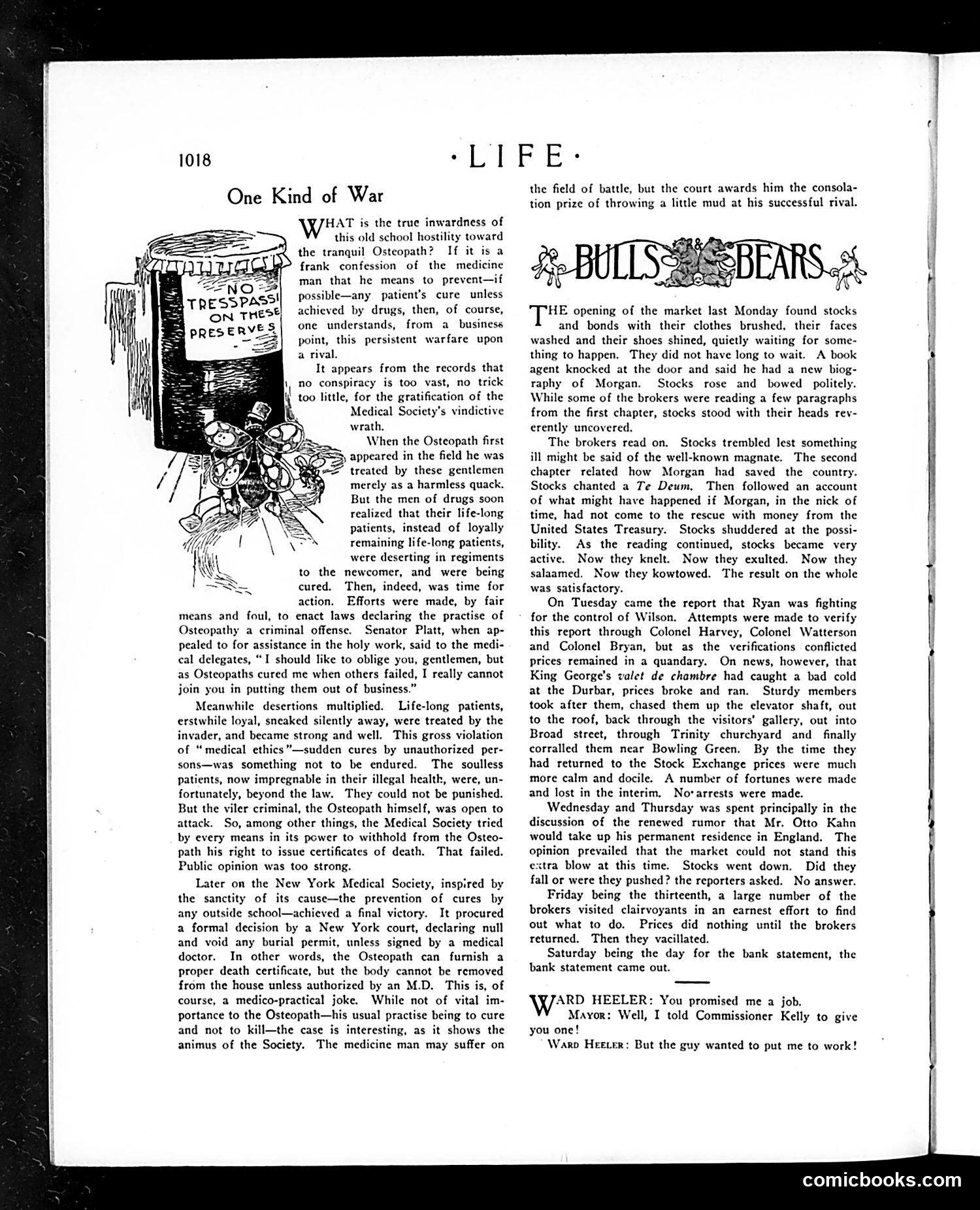
**Left cartoon:** Satirizes the American Medical Association's hostility toward osteopathy, a then-emerging alternative medicine practice. The text lampoons doctors' attempts to suppress osteopaths through legislation and legal barriers—not from genuine concern for patients, but from fear of losing profitable customers. The joke is that the AMA's "warfare" backfires: osteopaths actually cure people, so patients desert traditional medicine anyway. Even Senator Platt reportedly refused to help because osteopaths had cured him. The satire attacks organized medicine's hypocrisy: they claim ethical concern while actually protecting profits. **Right section ("Bulls & Bears"):** Financial satire depicting stock market volatility tied to J.P. Morgan's reputation. When brokers read a biography praising Morgan as the nation's financial savior, stocks react emotionally—bowing, kneeling, exulting—like worshippers. The mockery suggests markets are irrationally dependent on powerful individuals' perceived heroism rather than actual economic fundamentals. It's political commentary on wealth concentration and financial manipulation during the Gilded Age.
📄 Transcribed text from this page (OCR, searchable)
Machine-transcribed from the original scan — historical spelling and the odd misread are preserved.
One Kind of War HAT is the true inwardness of this old school hostility toward the tranquil Osteopath? If it is a frank confession of the medicine man that he means to prevent—if possible—any patient’s cure unless achieved by drugs, then, of course, one understands, from a_ business point, this persistent warfare upon a rival. It appears from the records that no conspiracy is too vast, no trick too little, for the gratification of the Medical Society's vindictive wrath, When the Osteopath first appeared in the field he was ® merely as a harmless quack. But the men of drugs soon realized that their life-long patients, instead of loyally remaining life-long patients, were deserting in regiments to the newcomer, and were being cured. Then, indeed, was time for action. Efforts were made, by fair means and foul, to enact laws declaring the practise of Osteopathy a criminal offense. Senator Platt, when ap- pealed to for assistance in the holy work, said to the medi- cal delegates, “I should like to oblige you, gentlemen, but as Osteopaths cured me when others failed, I really cannot join you in putting them out of business.” Meanwhile desertions multiplied. Life-long patients, erstwhile loyal, sneaked silently away, were treated by the invader, and became strong and well. This gross violation of “medical ethics”—sudden cures by unauthorized per- sons—was something not to be endured. The soulless patients, now impregnable in their illegal health, were, un- fortunately, beyond the law. They could not be punished. But the viler criminal, the Osteopath himself, was open to attack. So, among other things, the Medical Society tried by every means in its power to withhold from the Osteo- path his right to issue certificates of death. That failed. Public opinion was too strong. Later on the New York Medical Society, inspired by the sanctity of its cause—the prevention of cures by any outside school—achieved a final victory. It procured a formal decision by a New York court, declaring null and void any burial permit, unless signed by a medical doctor. In other words, the Osteopath can furnish a proper death certificate, but the body cannot be removed from the house unless authorized by an M.D. This is, of course, a medico-practical joke. While not of vital im- portance to the Osteopath—his usual practise being to cure and not to kill—the case is interesting, as it shows the animus of the Society. The medicine man may suffer on cL TPE : the field of battle, but the court awards him the consola- tion prize of throwing a little mud at his successful rival. HE opening of the market last Monday found stocks and bonds with their clothes brushed, their faces washed and their shoes shined, quietly waiting for some- thing to happen. They did not have long to wait. A book agent knocked at the door and said he had a new biog- raphy of Morgan. Stocks rose and bowed politely. While some of the brokers were reading a few paragraphs from the first chapter, stocks stood with their heads rev- erently uncovered, The brokers read on. Stocks trembled lest something ill might be said of the well-known magnate. The second chapter related how Morgan had saved the country. Stocks chanted a Te Deum, Then followed an account of what might have happened if Morgan, in the nick of time, had not come to the rescue with money from the United States Treasury. Stocks shuddered at the possi- bility. As the reading continued, stocks became very active. Now they knelt. Now they exulted. Now they salaamed. Now they kowtowed. The result on the whole was satisfactory. On Tuesday came the report that Ryan was fighting for the control of Wilson. Attempts were made to verify this report through Colonel Harvey, Colonel Watterson and Colonel Bryan, but as the verifications conflicted prices remained in a quandary. On news, however, that King George’s valet de chambre had caught a bad cold at the Durbar, prices broke and ran. Sturdy members took after them, chased them up the elevator shaft, out to the roof, back through the visitors’ gallery, out into Broad street, through Trinity churchyard and finally corralled them near Bowling Green. By the time they had returned to the Stock Exchange prices were much more calm and docile. A number of fortunes were made and lost in the interim. Noarrests were made. Wednesday and Thursday was spent principally in the discussion of the renewed rumor that Mr. Otto Kahn would take up his permanent residence in England. The opinion prevailed that the market could not stand this extra blow at this time. Stocks went down. Did they fall or were they pushed? the reporters asked. No answer. Friday being the thirteenth, a large number of the brokers visited clairvoyants in an earnest effort to find out what to do. Prices did nothing until the brokers returned. Then they vacillated. Saturday being the day for the bank statement, the bank statement came out. Wie HEELER: You promised me a job. Mayor: Well, I told Commissioner Kelly to give you one! Warp Hee: But the guy wanted to put me to work! comicbooks.com a ee TEE