
Life, 1912-05-16 · page 29 of 52
Life — May 16, 1912 — page 29: what you’re looking at
What you’re looking at
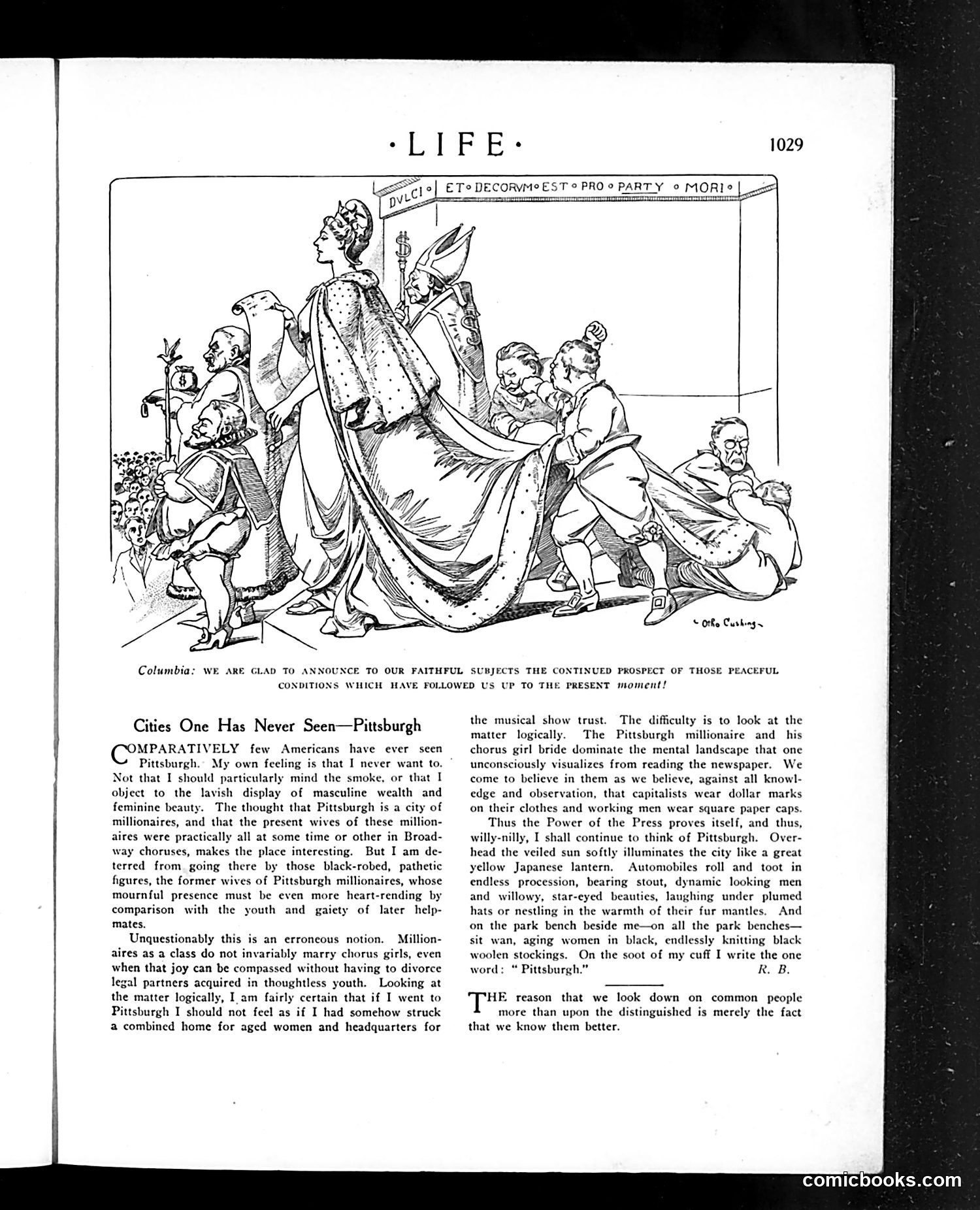
**The Main Cartoon:** The top illustration shows "Columbia" (female personification of America) as a regal, crowned figure announcing continued "peaceful conditions" to her subjects. She's surrounded by cherubs and soldiers, with Latin inscriptions referencing decorousness and duty to the state. This appears to be satirizing official government propaganda or patriotic announcements—mocking their grandiose, flowery language about national prosperity and peace, likely during a period of actual social tension. **The Article:** The accompanying essay satirizes Pittsburgh's reputation as a wealthy industrial city where rich millionaires (made from steel/industry) marry young Broadway chorus girls, then discard them. The author notes how newspaper coverage creates false impressions—we believe stereotypes (capitalists wearing dollar signs, workers in paper caps) rather than reality. The final paragraph's aphorism suggests we despise "common people" simply because we know them better than the idealized "distinguished," implying hypocrisy in social hierarchies. **Overall Point:** Satire of American pretension, media influence, and class prejudice.
📄 Transcribed text from this page (OCR, searchable)
Machine-transcribed from the original scan — historical spelling and the odd misread are preserved.
Columbia: We ARE GLAD TO ANNOU ET DECORVMe EST ° PRO o PARTY 0 MORI? | | © Othe Cushing ‘CE TO OUR FAITHFUL SUBJECTS THE CONTINUED PROSPECT OF THOSE PEACEFUL CONDITIONS WHICH HAVE FOLLOWED US UP TO THE PRESENT moment! Cities One Has Never Seen—Pittsburgh MPARATIVELY few Americans have ever Pittsburgh. My own feeling is that I never want to. Not that I should particularly mind the smoke, or that I ct to the lavish display of masculine wealth and ine beauty. The thought that Pittsburgh is a city of millionaires, and that the present wives of these million- aires were practically all at some time or other in Broad- way choruses, makes the place interesting. But I am de- terred from going there by those black-robed, pathetic figures, the former wives of Pittsburgh millionaires, whose mournful presence must be even more heart-rending by comparison with the youth and gaiety of later help- mates. Unquestionably this is an erroneous notion. Million- aires as a class do not invariably marry chorus girls, even when that joy can be compassed without having to divorce legal partners acquired in thoughtless youth. Looking at the matter logically, Iam fairly certain that if I went to Pittsburgh I should not feel as if I had somehow struck a combined home for aged women and headquarters for seen the musical show trust. The difficulty is to look at the matter logically. The Pittsburgh millionaire and his chorus girl bride dominate the mental landscape that one unconsciously visualizes from reading the newspaper. We come to believe in them as we believe, against all knowl- edge and observation, that capitalists wear dollar marks on their clothes and working men wear square paper caps. Thus the Power of the Press proves itself, and thus, willy-nilly, I shall continue to think of Pittsburgh. Over- head the veiled sun softly illuminates the city like a great yellow Japanese lantern. Automobiles roll and toot in endless procession, bearing stout, dynamic looking men and willowy, star-eyed beauties, laughing under plumed hats or nestling in the warmth of their fur mantles. And on the park bench beside me—on all the park benches— sit wan, aging women in black, endlessly knitting black woolen stockings. On the soot of my cuff I write the one word: “ Pittsburgh.” R. B. THE reason that we look down on common people more than upon the distinguished is merely the fact that we know them better. comicbooks.com