
A complete issue · 40 pages · 1928
Life — July 12, 1928
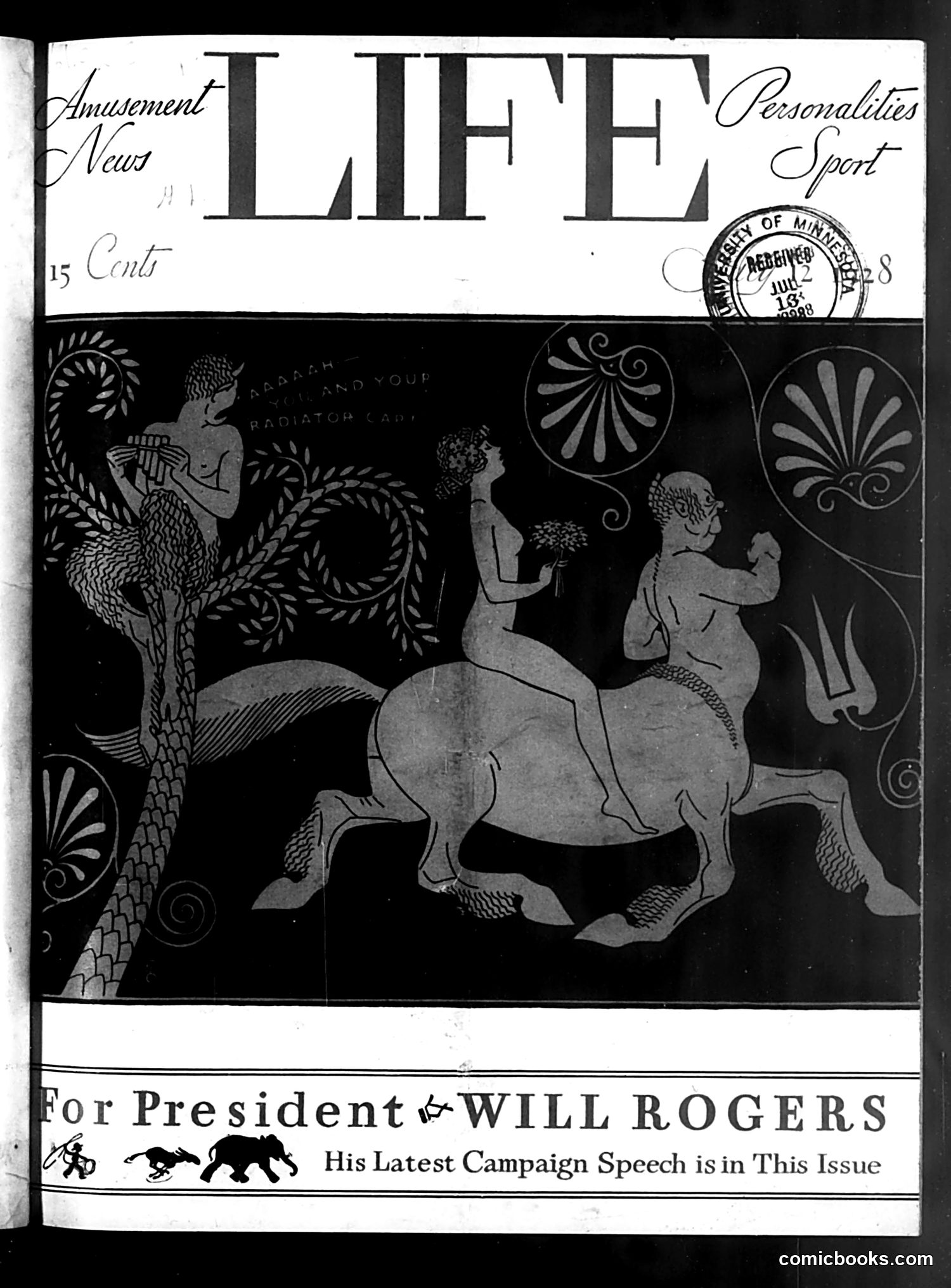
This is a **Life magazine cover** (15 cents) from approximately 1928, featuring an advertisement for Will Rogers's presidential campaign. The central illustration depicts a **centaur—a mythological creature that is half-human, half-horse**—carrying cherub-like figures. The classical, ornamental style suggests grandeur and stability. The satire is **tongue-in-cheek**: by portraying Rogers as a centaur (a hybrid, somewhat absurd creature), the magazine humorously presents his candidacy as fantastical rather than serious. Rogers was a popular entertainer and humorist who ran satirical presidential campaigns as comedy. The mythological imagery mocks the notion of treating such a campaign earnestly, while the cherubs suggest whimsical, almost childish idealism. The bottom promises Rogers's "Latest Campaign Speech" inside—further emphasizing this as entertainment rather than genuine political discourse.
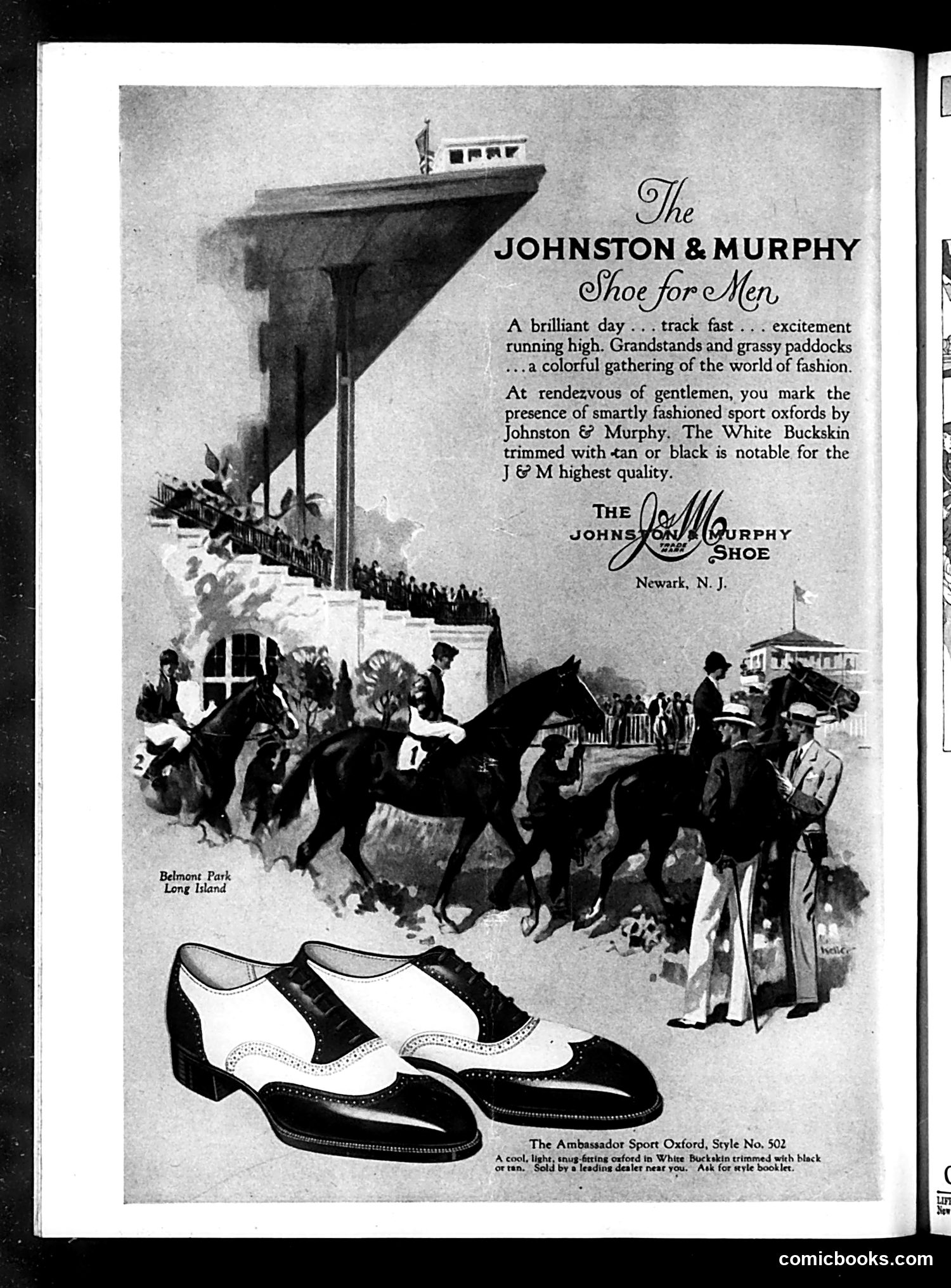
This is primarily an **advertisement**, not a satirical cartoon. It promotes Johnston & Murphy shoes for men, specifically their "White Buckskin" sport oxfords trimmed with tan or black. The ad uses an aspirational scene of horse racing at Belmont Park on Long Island to establish prestige and sophistication. The imagery associates the shoe brand with gentlemen attending exclusive sporting events—a deliberate marketing strategy targeting wealthy men who frequented racetracks. The "Ambassador Sport Oxford, Style No. 502" shoe is displayed at bottom. The copy emphasizes quality and fashion consciousness, positioning Johnston & Murphy as appropriate footwear for socially prominent gentlemen. There is no political satire here—this is straightforward luxury product marketing leveraging images of wealth and leisure.
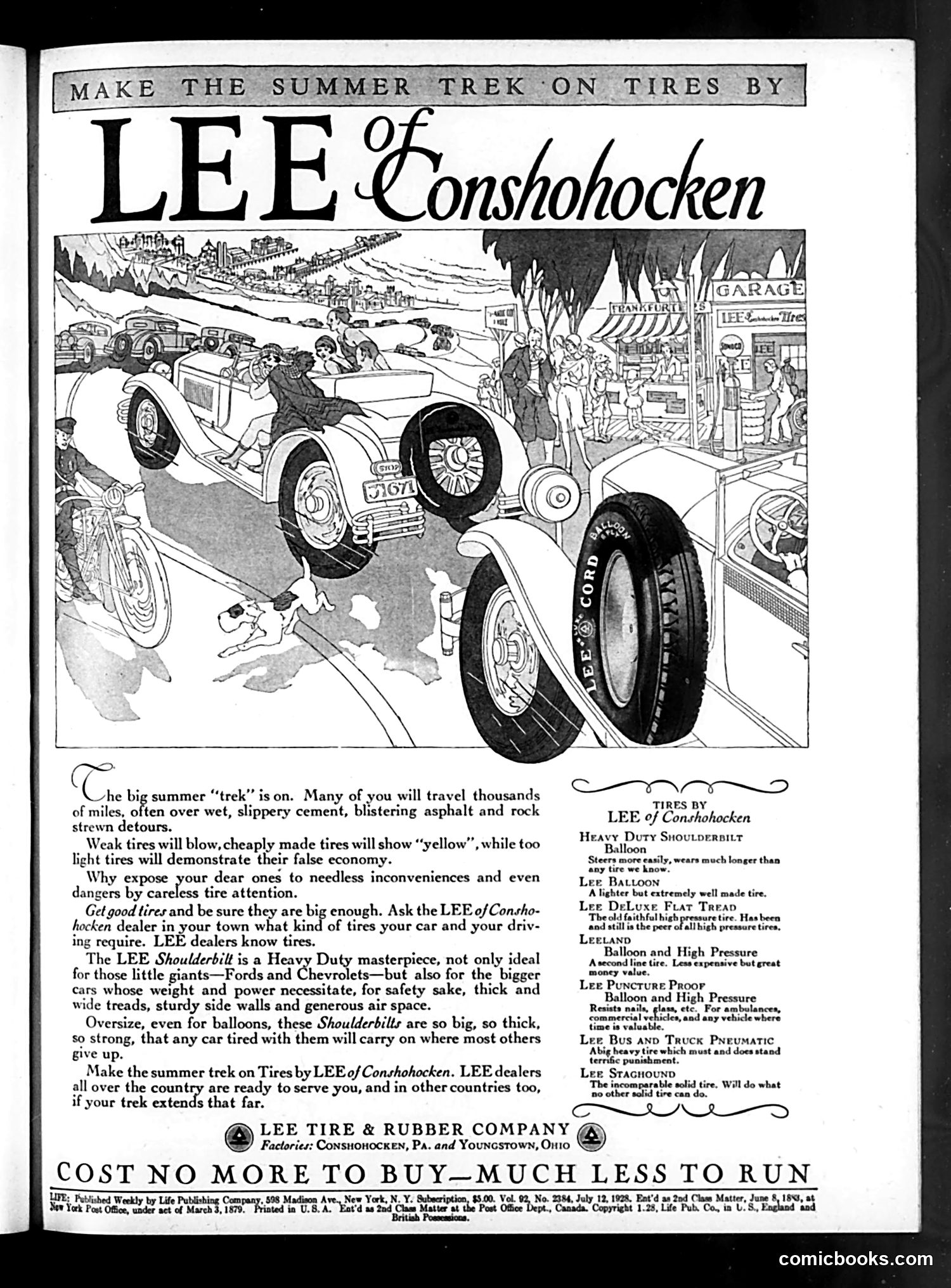
This is **not political satire** — it's a **full-page advertisement** for Lee Tire & Rubber Company (factories in Conshohocken, PA and Youngstown, OH). The illustration depicts a busy summer roadside scene with vintage automobiles and a tire shop, emphasizing that Lee tires are essential for summer travel. The accompanying text warns drivers that cheap, poorly-made tires will fail on long trips over various road surfaces, while Lee's "Shoulderbilt" tires are heavy-duty and reliable for serious driving. The ad lists multiple tire variants (Balloon, Deluxe Flat Tread, Puncture Proof, Bus and Truck Pneumatic, Staghound) targeting different vehicles and purposes. The tagline promises tires that "cost no more to buy — much less to run," appealing to economical motorists concerned about reliability during the era's popular long-distance automobile travel.
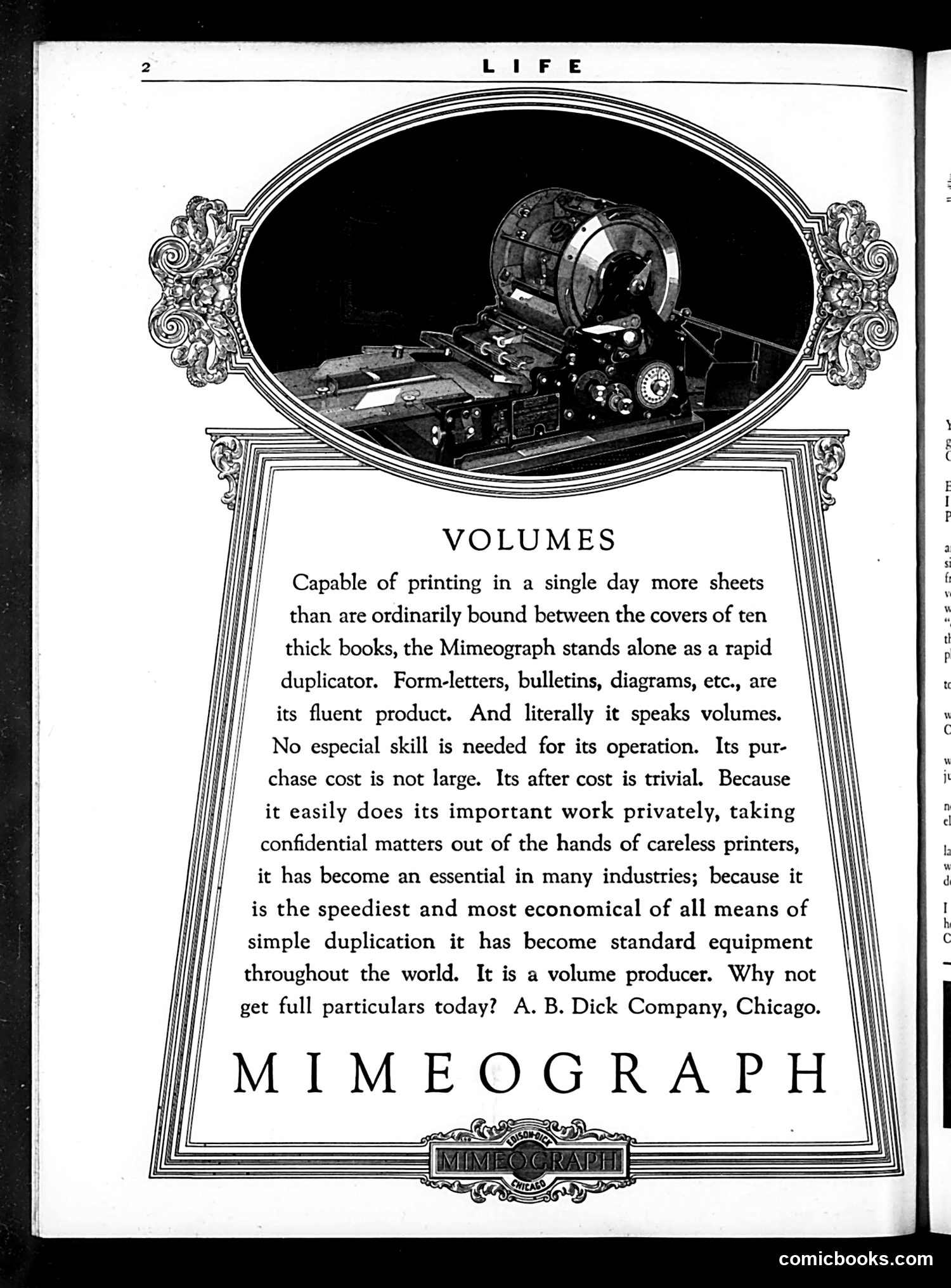
This page is primarily an **advertisement for the Mimeograph machine**, not political satire or a cartoon. The ornate framed image shows the machine itself—an early 20th-century duplicating device. The text emphasizes the Mimeograph's practical business advantages: it can produce vast quantities of documents daily, requires no special skill, has low operating costs, and handles confidential materials privately—keeping sensitive information away from external printers. The ad appeals to efficiency-conscious businesses by positioning the machine as essential industrial equipment and "standard" worldwide. The decorative framing and placement in *Life* magazine suggests this was aimed at middle-class business owners and office managers seeking modern, economical solutions for document reproduction. There is no political commentary or satirical content on this page.
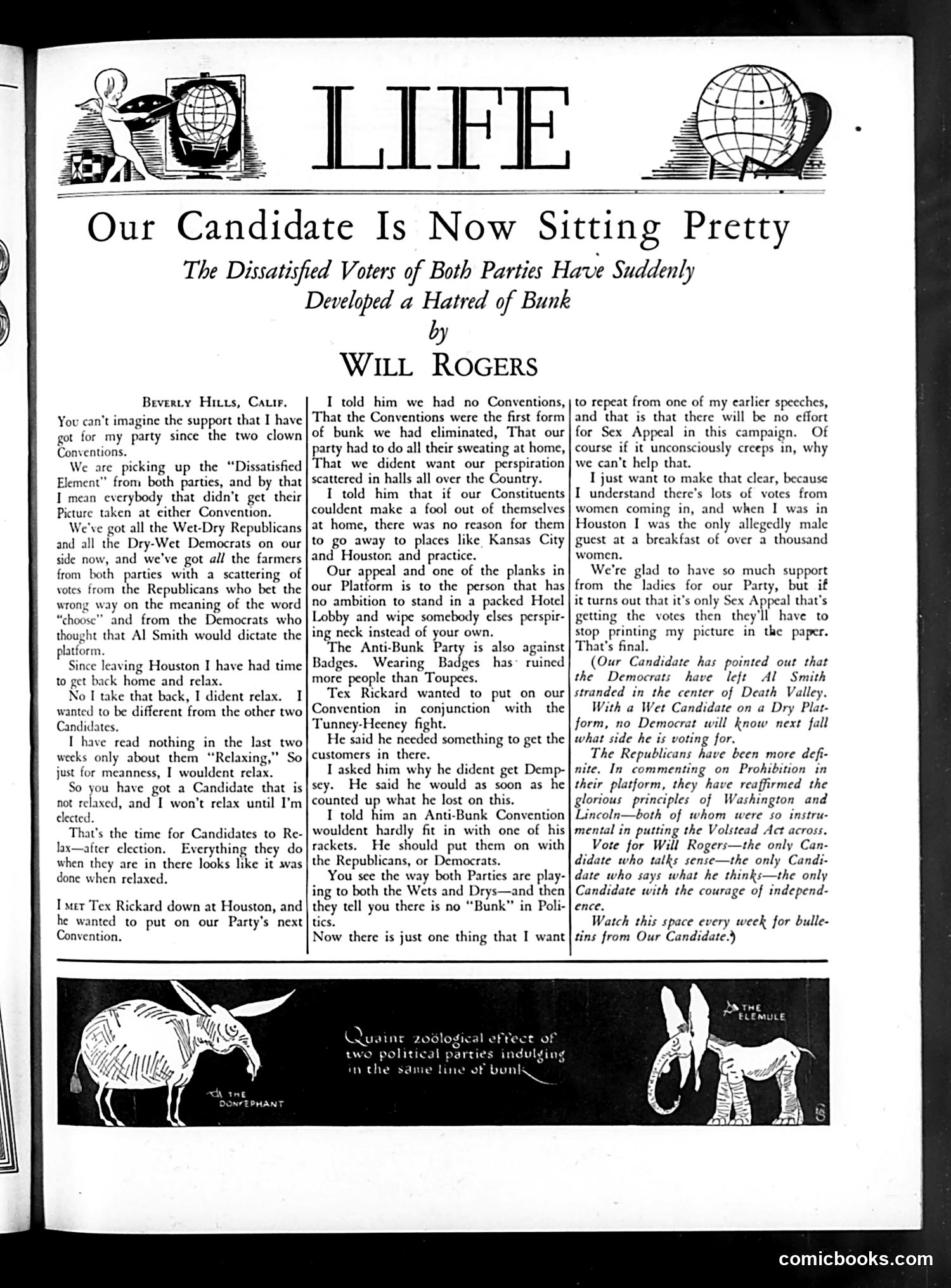
This Life magazine page features Will Rogers's satirical column critiquing the 1924 presidential election. Rogers ridicules both Republican and Democratic parties for supporting weak candidates who lack genuine conviction—dismissing them as "bunk." The bottom cartoon uses animal caricatures to mock this political absurdity: an elephant (Republican), donkey (Democrat), and mule, with text reading "Quaint zoological effect of two political parties indulging in the same time of bunk." The mule metaphor suggests the candidates are stubborn hybrids lacking authentic party identity. Rogers advocates for an "Anti-Bunk Convention" and praises his actual candidate—appearing to reference a third-party or independent alternative. The satire targets voter dissatisfaction with conventional politics and candidates who seem interchangeable or uninspired.
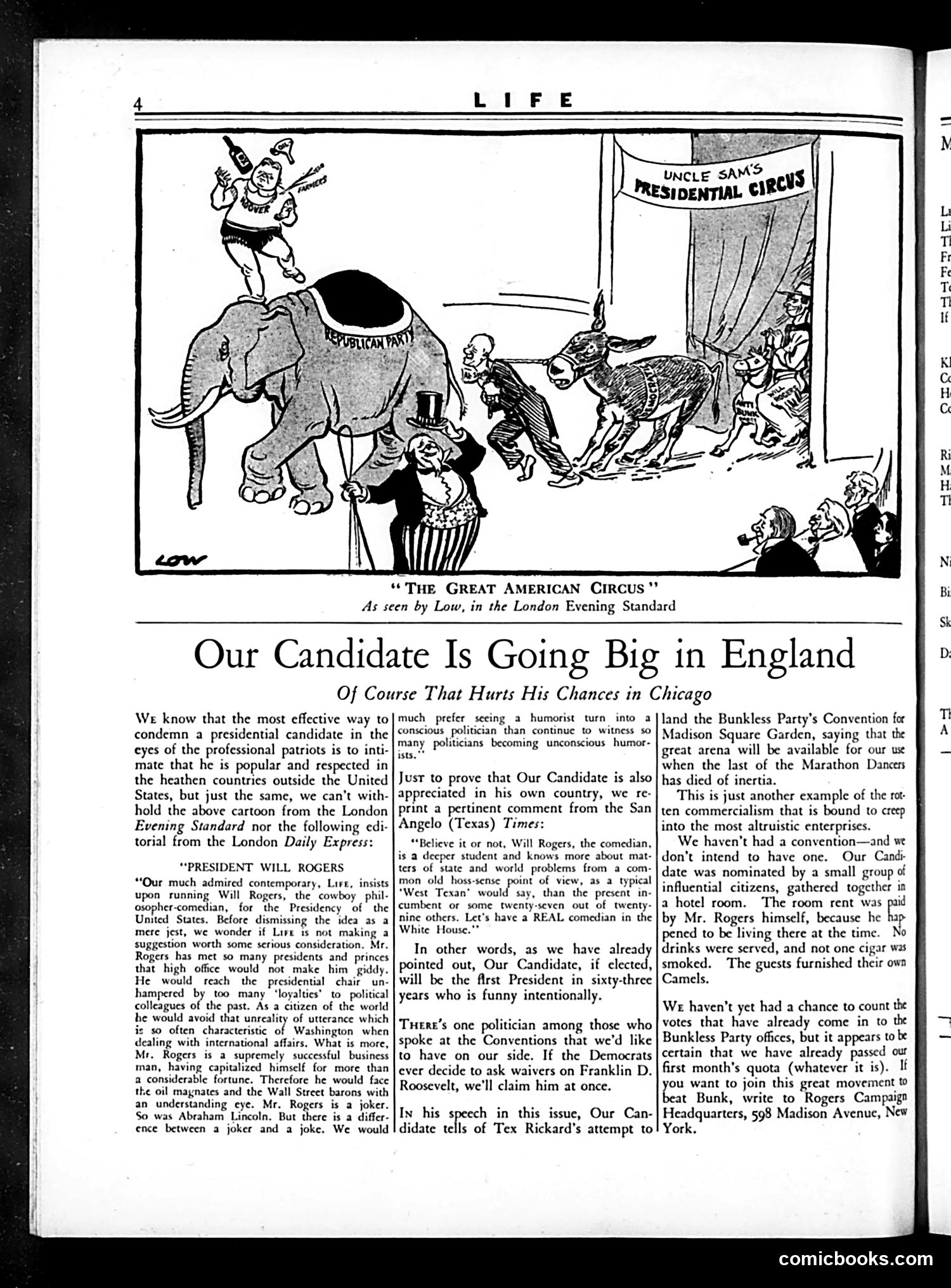
This 1928 Life magazine cartoon satirizes the 1928 U.S. presidential campaign. The image depicts the Republican Party as an elephant (the GOP symbol) performing circus acts at "Uncle Sam's Presidential Circus." A ringmaster conducts various performing animals and acrobats, representing political chaos and spectacle. The accompanying article promotes Will Rogers, the famous comedian and political commentator, as a satirical presidential candidate. The piece mocks serious campaigning by suggesting Rogers—known for witty political commentary—would be a more honest choice than actual candidates. The satire targets how presidential campaigns resemble entertainment rather than substantive political discourse, comparing the convention process to circus acts and arguing politicians often perform rather than govern authentically.
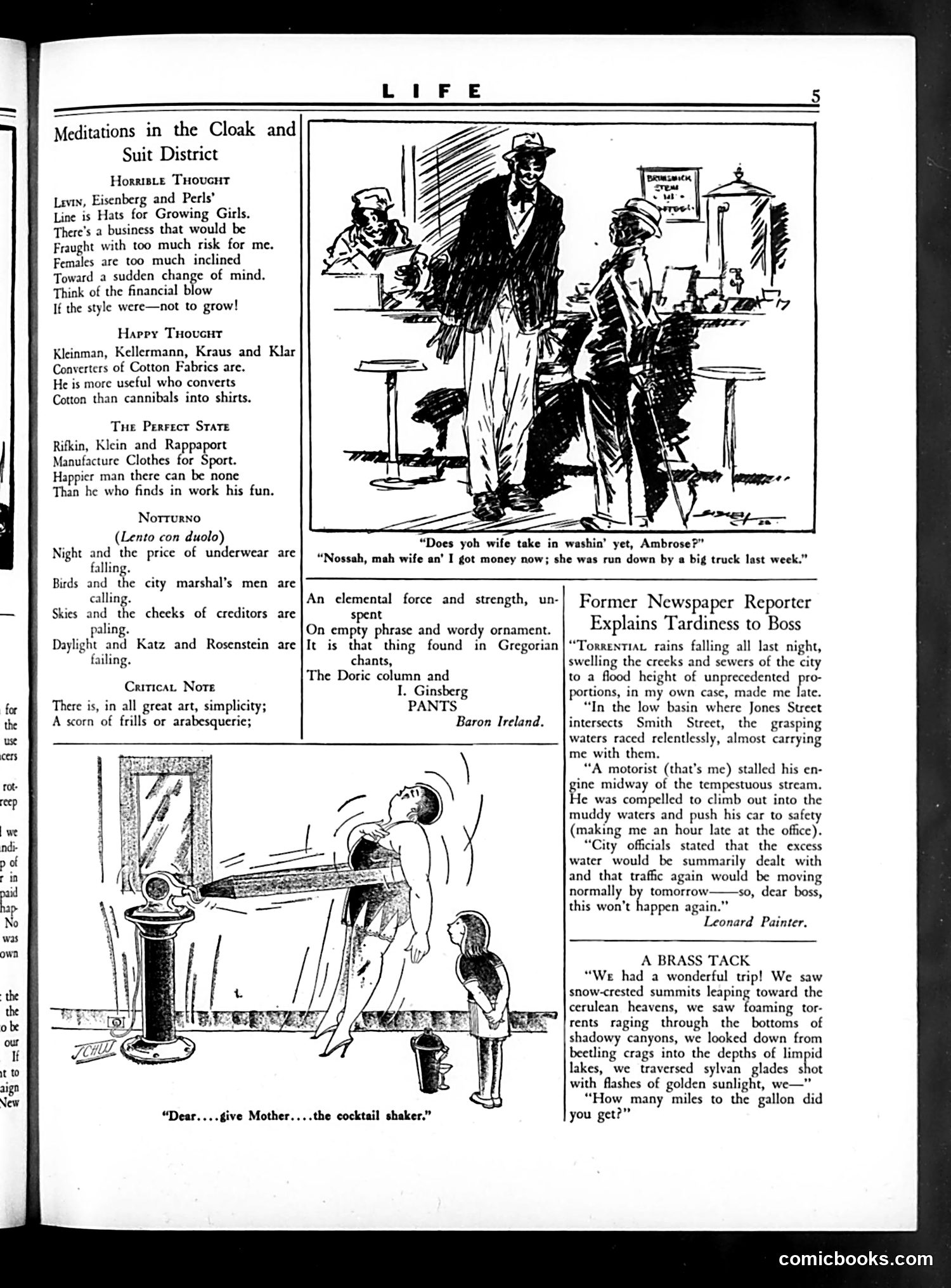
**Top Cartoon:** Shows a working-class man asking his boss about his wife's laundry work, mentioning she was "run down by a big truck last week." The joke satirizes workplace indifference—the boss only cares whether the wife can still do washing, not her injury. This reflects early-20th-century labor attitudes where workers' welfare mattered less than productivity. **Bottom Cartoon:** Depicts children asking their mother for a "cocktail shaker," likely satirizing Prohibition-era American life. The humor lies in children casually requesting alcohol-related items during the period when alcohol was illegal, mocking how pervasive drinking culture remained despite the ban. Both cartoons use working-class scenarios to critique social attitudes of their time.
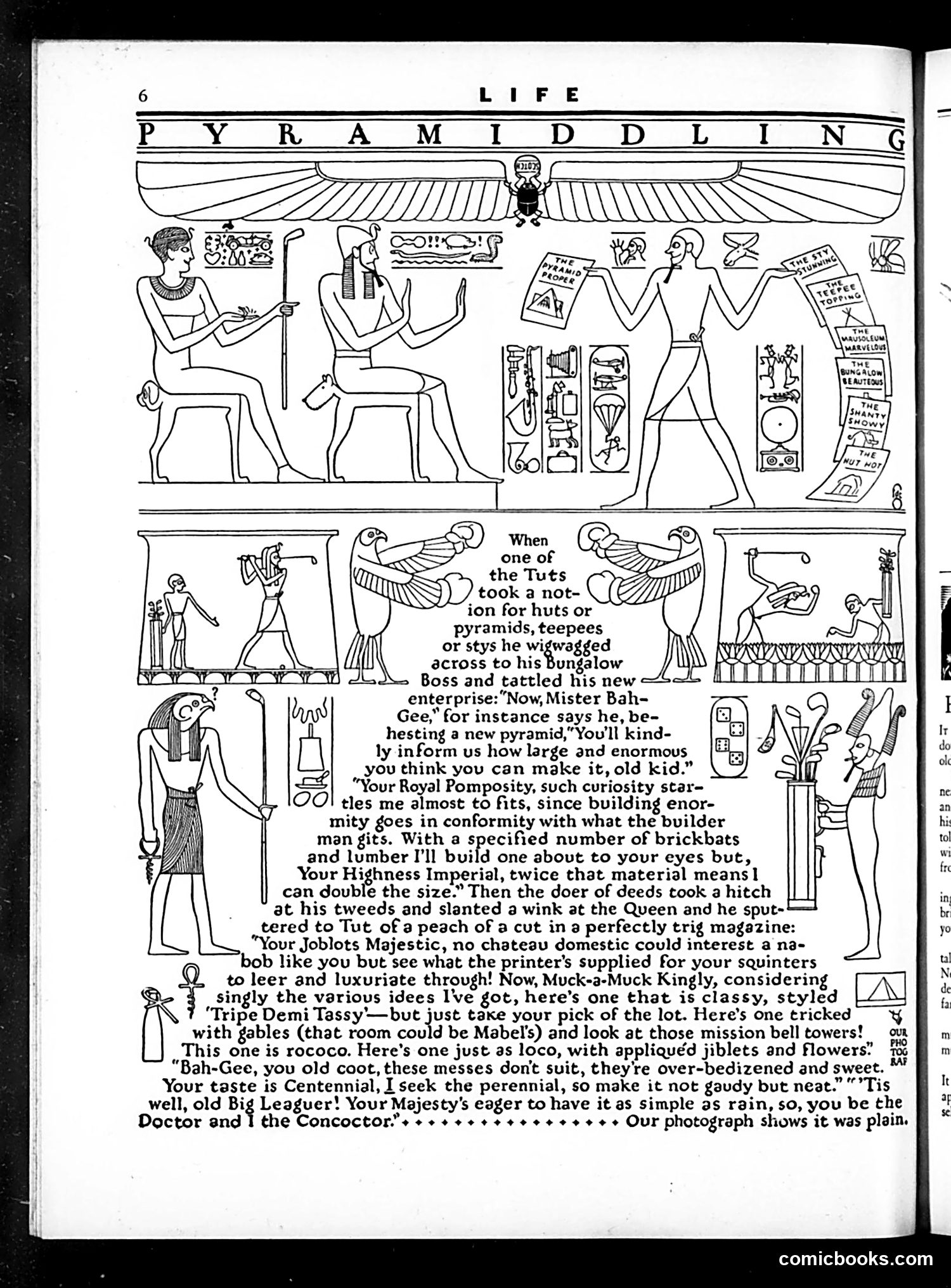
This "Pyramid Diddling" cartoon satirizes Egyptian tomb construction excess. The top panel shows seated Egyptian officials reviewing architectural plans while workers display various building materials and designs. The central narrative mocks a Pharaoh ("His Royal Pomposity") obsessed with building an ever-larger pyramid despite his builder's protests about conformity and practicality. The humor targets bureaucratic absurdity: the builder complains the pyramid must follow standard specifications, but the Pharaoh demands it be "twice that material means" larger. The satirist ridicules both the ruler's vanity-driven extravagance and the builder's helpless frustration with impossible demands. The broader target appears to be contemporary government waste and official stubbornness—using ancient Egypt as a comedic parallel to mock wasteful public projects regardless of practical objections.
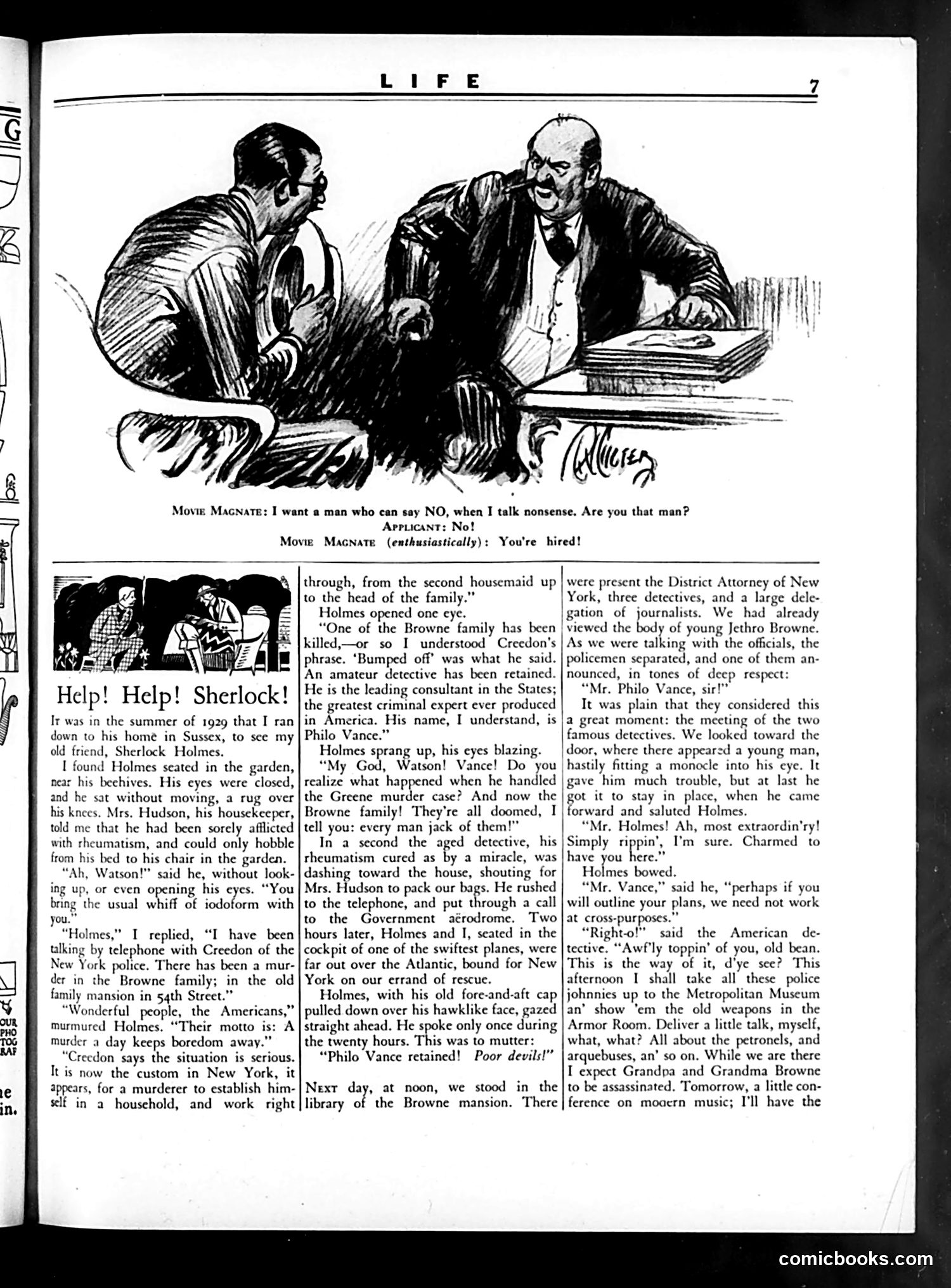
This page from *Life* magazine satirizes the hiring practices of movie producers. The top cartoon shows a "Movie Magnate" interviewing an applicant, declaring he needs "a man who can say NO, when I talk nonsense" — then immediately hiring him. The joke mocks how film executives surround themselves with yes-men despite claiming to want honest advisors. The lower section parodies Sherlock Holmes stories, with the famous detective solving a murder in the Browne family household. The satire appears to mock both detective fiction's popularity and perhaps the American obsession with crime stories, as *Life* was known for sharp cultural commentary on entertainment trends and public taste.
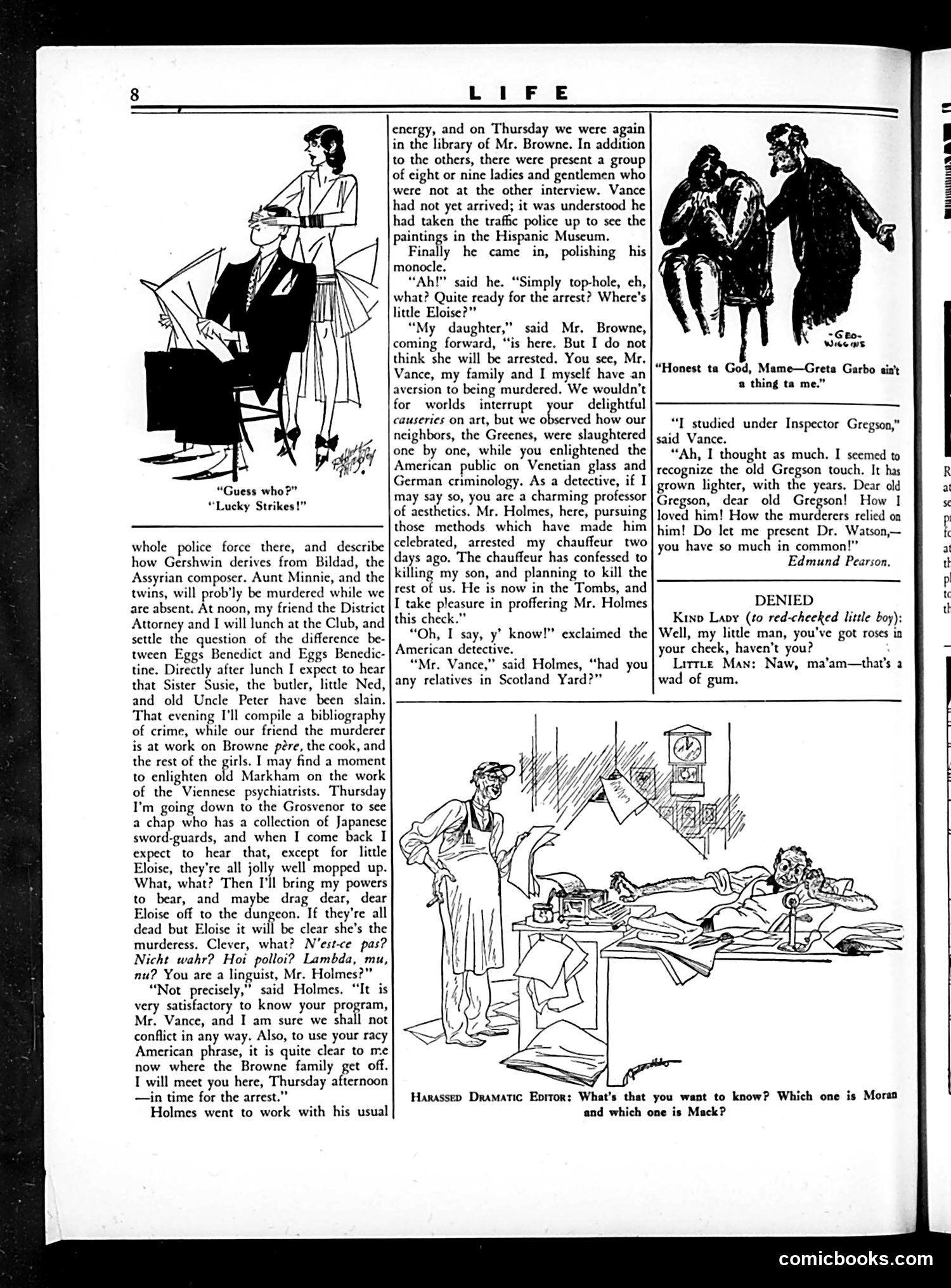
This page presents a humorous detective story narrative with accompanying illustrations. The main content describes Mr. Vance (a detective character) investigating a murder case involving the Browne family. The top-left cartoon captioned "Guess who?" and "Lucky Strikes!" shows a woman holding an umbrella over a seated man examining documents—likely depicting the detective at work. The bottom illustration shows a disheveled editor or publisher surrounded by scattered papers and files, captioned as being "harassed" while asking "What's that you want to know? Which one is Moras and which one is Mack?" The page appears to be satirizing both detective fiction's popularity and the chaos of newspaper editorial work, though the specific literary or cultural references are unclear without additional context about contemporary publications or crime stories.
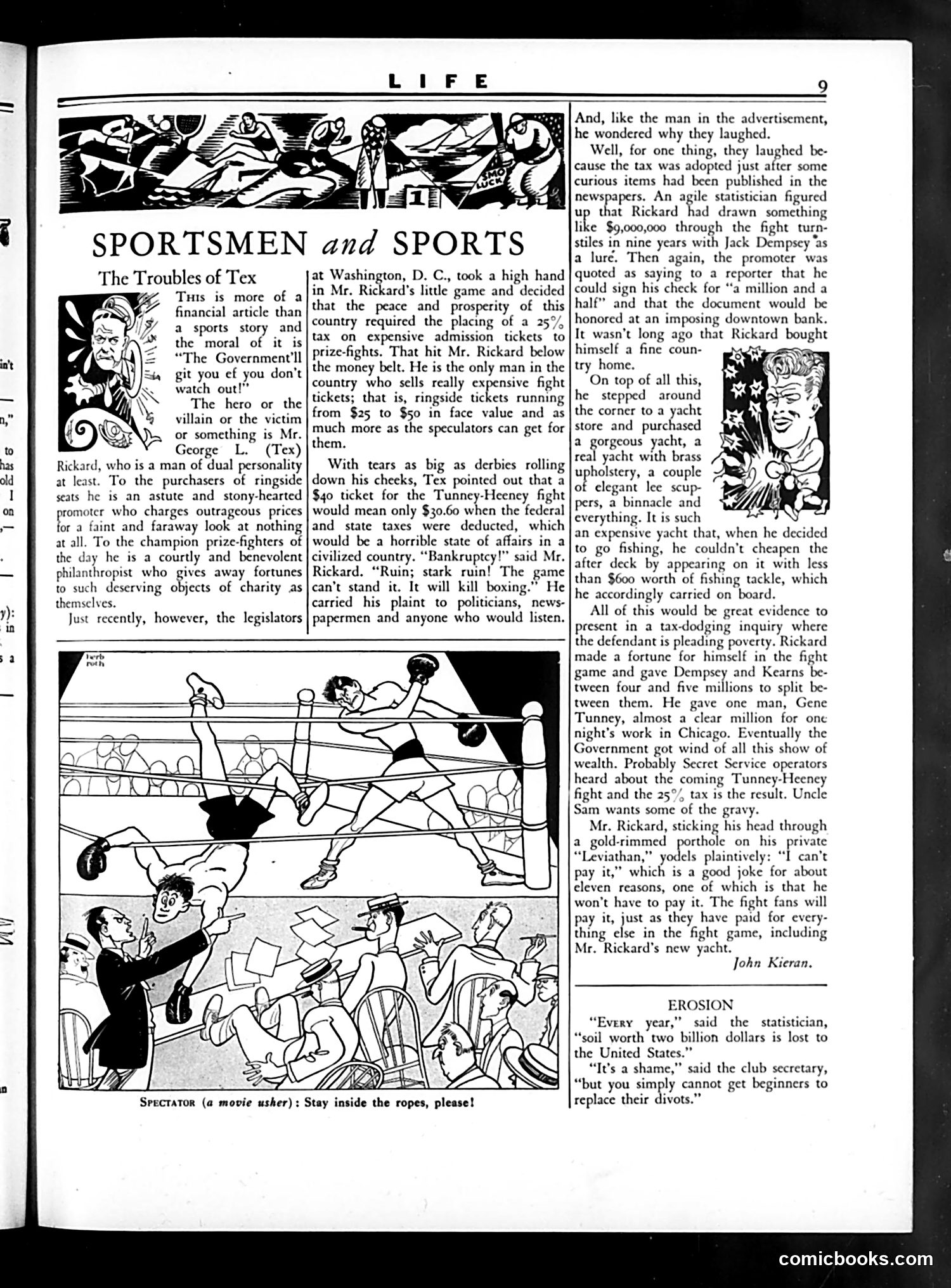
This article satirizes a real controversy over a 25% federal tax on expensive boxing tickets, championed by promoter George L. "Tex" Rickard. The piece mocks Rickard's complaint that the tax is economically destructive, while noting his hypocrisy: he made enormous wealth from fights (the article mentions $9 million from a Dempsey-Carpentier bout) and even purchased a yacht afterward. The satire's point: Rickard profited vastly from boxing but complained when the *government* taxed fight tickets, claiming poverty. The cartoon illustrating the piece shows a boxing match's chaotic scene, emphasizing the sport's rowdy nature. John Kieran's byline indicates this is serious sports criticism disguised as humor, targeting wealthy promoters' tax avoidance and self-serving arguments.
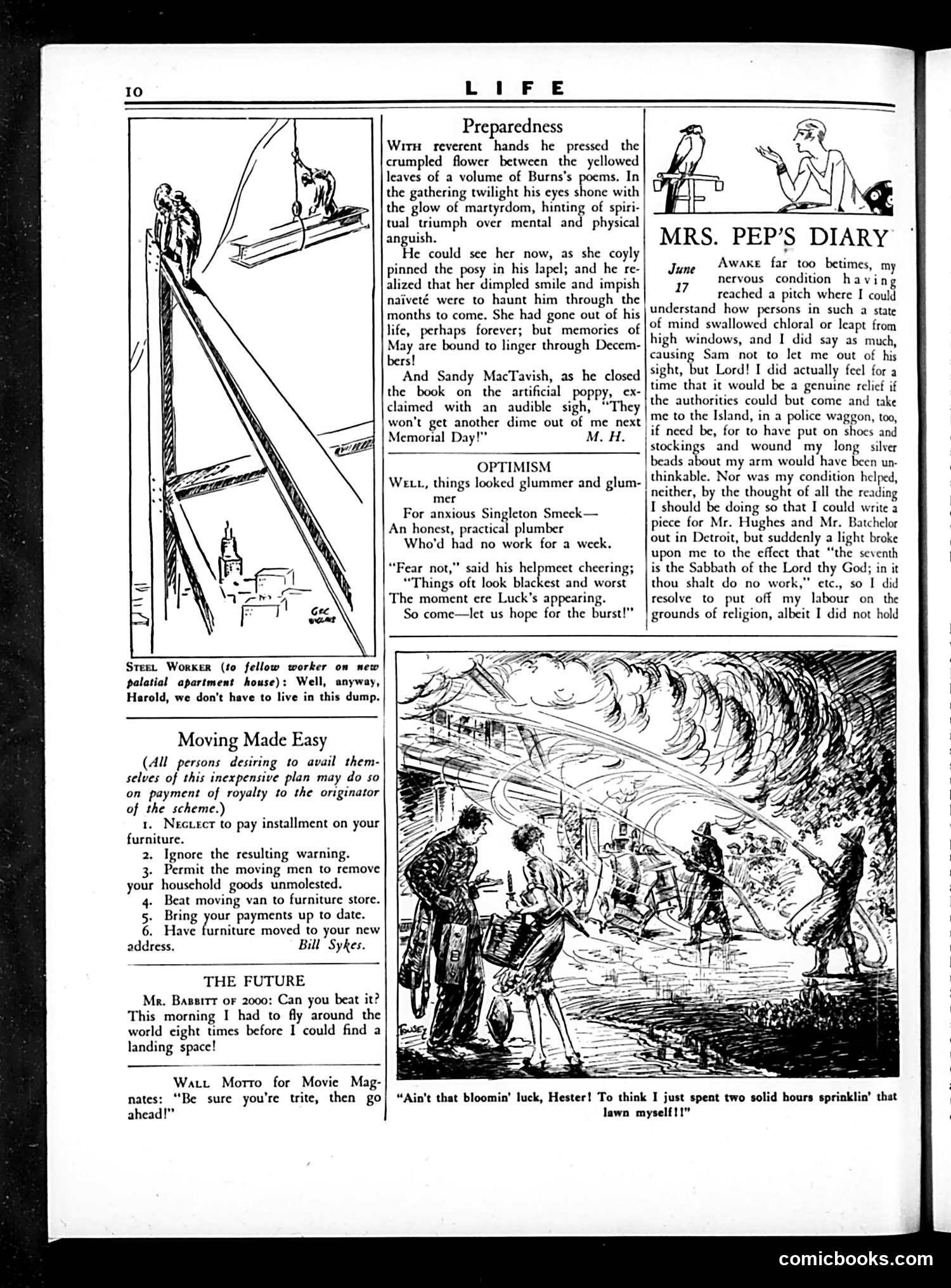
This page contains several humor pieces typical of Life magazine's satirical format: **"Preparedness"** depicts a romantic scene between a couple with Burns's poetry, likely mocking sentimental pre-World War I romance amid military anxiety. **"Mrs. Pep's Diary"** (June 17) shows a nervous woman worried about her mental state and seeking relief—possibly referencing period anxieties about women's health or wartime stress. **"Moving Made Easy"** and other sections offer practical household humor and advice. The large bottom illustration shows people fishing, with the caption about "bloomin' luck" and lawn-sprinkling—depicting suburban leisure and the frustrations of failed attempts at relaxation. The cartoons satirize everyday middle-class concerns: romance, domestic anxiety, moving logistics, and recreational pursuits.
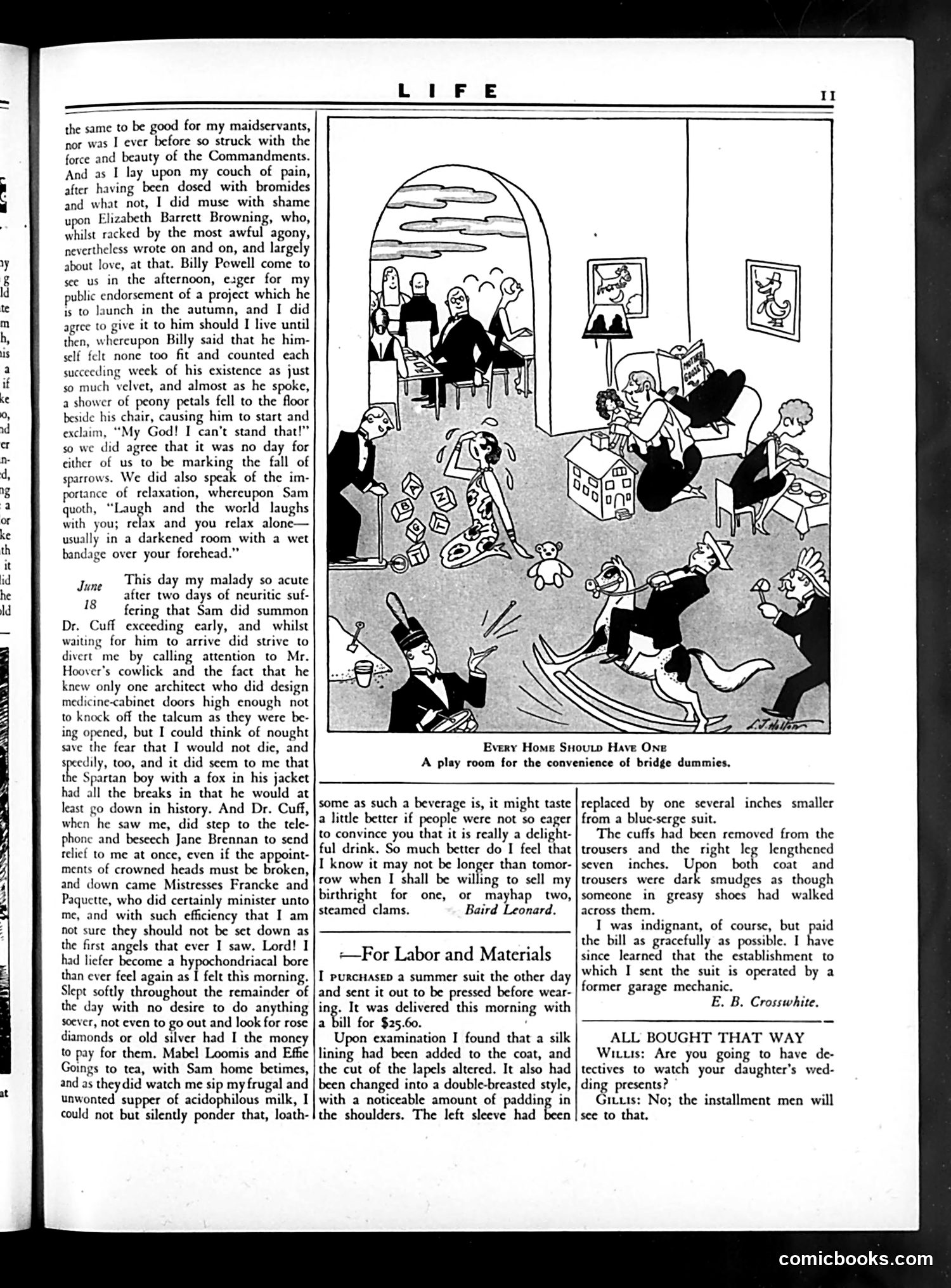
This cartoon satirizes the craze for recreational spaces in American homes during the early 20th century. The illustration shows a chaotic "play room for the convenience of bridge dummies"—referring to people who play bridge poorly or serve as placeholder players. The humor lies in the mess: toys, games, and scattered objects cover the floor while well-dressed adults play cards above, oblivious to the pandemonium. A child literally climbs the furniture while a dog runs wild. The satire targets the upper-middle-class trend of designating special rooms for leisure activities (bridge was hugely popular among women), while satirizing the assumption that children could be contained in a separate space during adult entertainment. It mocks both the aspirational home design trend and the chaos that actually results.
This is a theater column offering summer entertainment advice for New York theatergoers. The small decorative cartoons show simplified figures in leisure poses—one appears to be relaxing, another fishing—illustrating the "summer evening hints" theme. The column discusses which Broadway shows are worth seeing during summer, when many venues close and attendance drops. It references specific productions like "Rain or Shine," "Present Arms," "Strange Interlude," "Volpone," and "Black Birds of 1928," offering guidance on which acts can be skipped or which moments justify the ticket price. The satire is gentle: the author pokes fun at the theatrical custom of listing only the "best moments" of shows, suggesting readers strategically time their arrivals to catch highlights while avoiding slower passages—practical advice for a summer audience tired of sitting indoors.
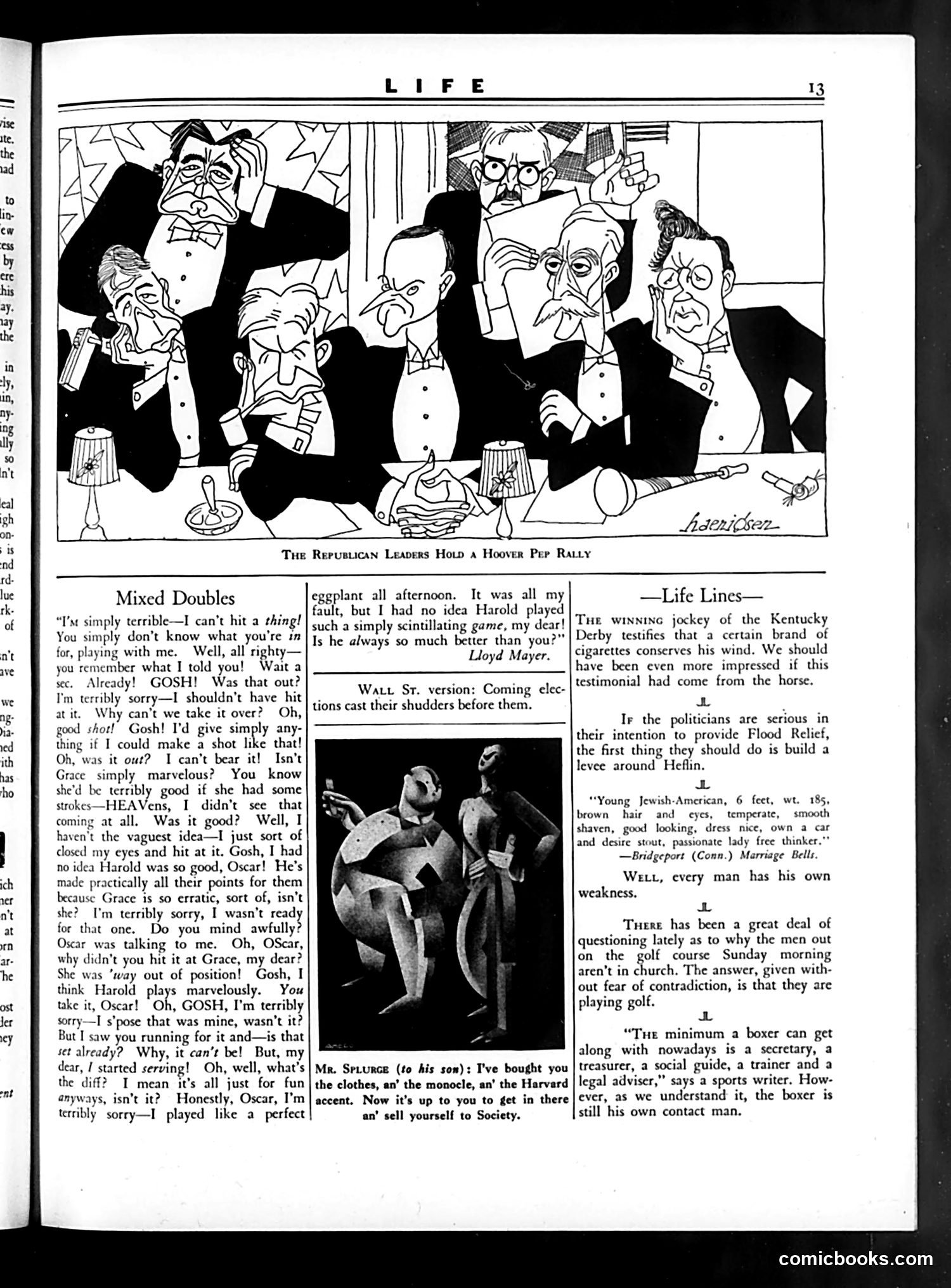
This political cartoon satirizes Republican Party leadership during Herbert Hoover's presidency, likely from the early 1930s Depression era. The exaggerated caricatures depict five men in formal attire at what appears to be a tense gathering or rally. Their distorted facial expressions—grimacing, worried, conflicted—suggest internal discord or forced unity rather than genuine confidence. The caption's reference to a "pep rally" is ironic: these leaders look anything but energized or optimistic. The satire likely mocks Republican attempts to maintain public confidence in Hoover's economic policies while privately doubting their effectiveness during the Depression. The cartoon critiques both the party's leadership and their messaging strategy during a national crisis.
This editorial page critiques the 1928 presidential campaign. The main cartoon (bottom) depicts a mechanical voter-registration apparatus, satirizing how conventions and campaigns have become mechanized processes focused on producing predetermined outcomes rather than genuine democratic choice. The text discusses the Republican choice between Al Smith and Herbert Hoover. The editorial argues that Democratic politicians selected Hoover not because they wanted him, but because they calculated he might win—treating the election as a strategic game rather than a moral choice about who best serves the nation. The secondary cartoon references the Daughters of the American Revolution, mocking a controversy where the organization claimed a "blacklist" of radical speakers, illustrating how organizations ostensibly patriotic were suppressing political speech.
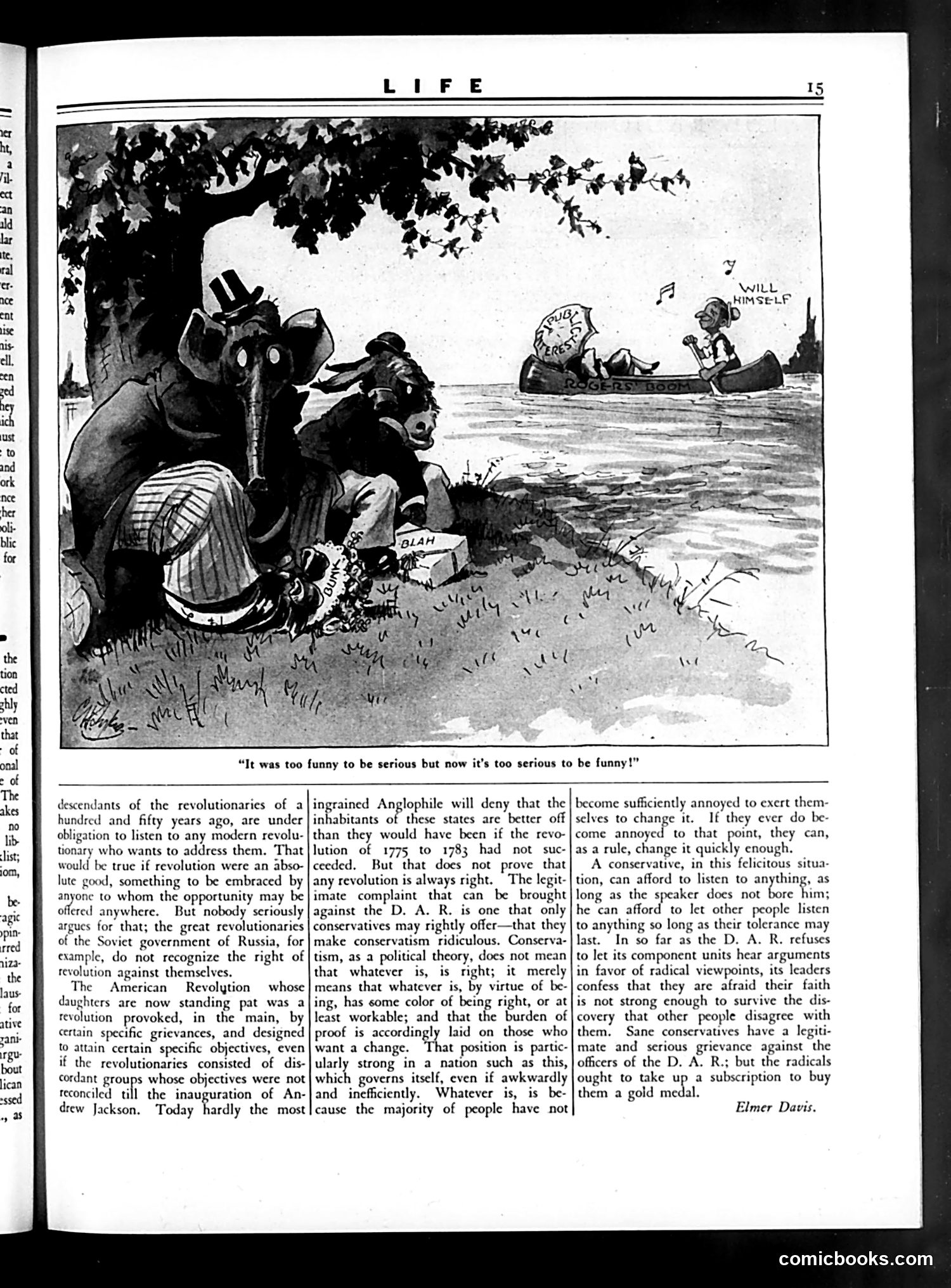
This cartoon satirizes the **Daughters of the American Revolution (D.A.R.)**, a patriotic hereditary organization for descendants of Revolutionary War veterans. The figures on shore—dressed in colonial costume—represent D.A.R. members, while those in boats represent modern Americans trying to enjoy themselves. The caption, "It was too funny to be serious but now it's too serious to be funny!" suggests the D.A.R. has become overly rigid and humorless about their patriotic mission. The accompanying article criticizes the D.A.R. for opposing change and reform, arguing that their conservatism and reverence for Revolutionary ideals has made them intolerant of modern viewpoints. The cartoon mocks how the organization uses historical nostalgia to dismiss contemporary concerns.
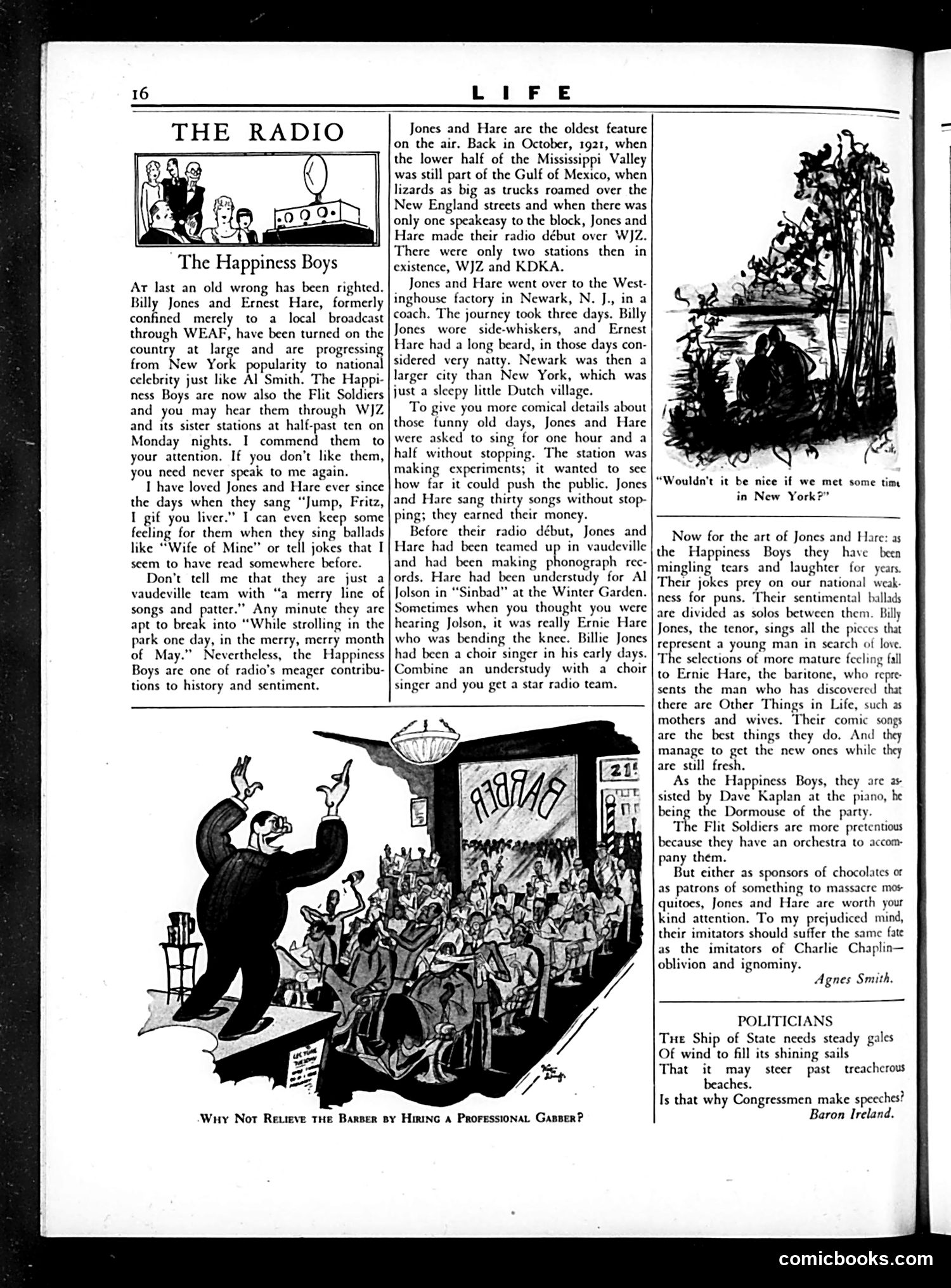
This page features an article about "The Happiness Boys" (Jones and Hare), early radio entertainers who debuted in 1921 on WIZ. The text describes their journey from local New York broadcast to national popularity, noting their vaudeville background and comedic style. The cartoon below, captioned "Why Not Relieve the Barber by Hiring a Professional Gabber?", satirizes radio's capacity for endless talk. It depicts a radio broadcaster addressing a massive crowd—a visual joke equating the barber's incessant chatter with radio's non-stop programming. The satire mocks both broadcasting's verbose nature and the mass audiences it attracted, suggesting radio amplified what had previously been confined to barbershops.
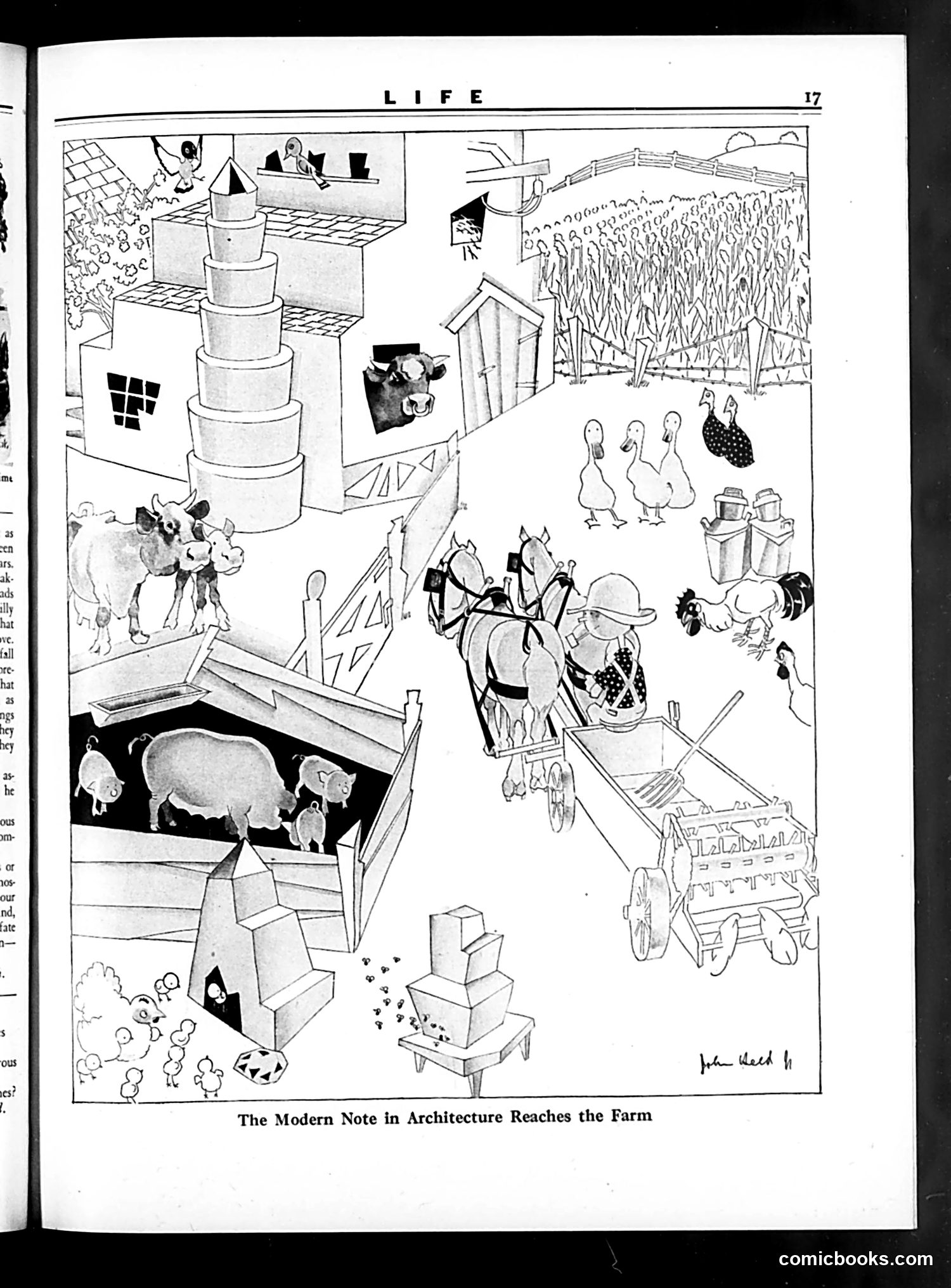
This satirical cartoon mocks the adoption of modernist architecture in rural agricultural settings. The left side shows an incongruous cylindrical silo-like structure with geometric windows dominating a traditional farmyard, while farmers and livestock go about their work below. The right side depicts farmyard chaos: horses pulling a cart laden with modernist architectural elements, ducks, chickens, and farm workers scattered about near grain fields. The satire targets the clash between avant-garde architectural trends and practical farm life. The "modern note" appears absurdly out of place and impractical in an agricultural context. The cartoon suggests that fashionable design movements, however celebrated in urban settings, are ridiculous when imposed on working farms where functionality matters more than aesthetic ideology.
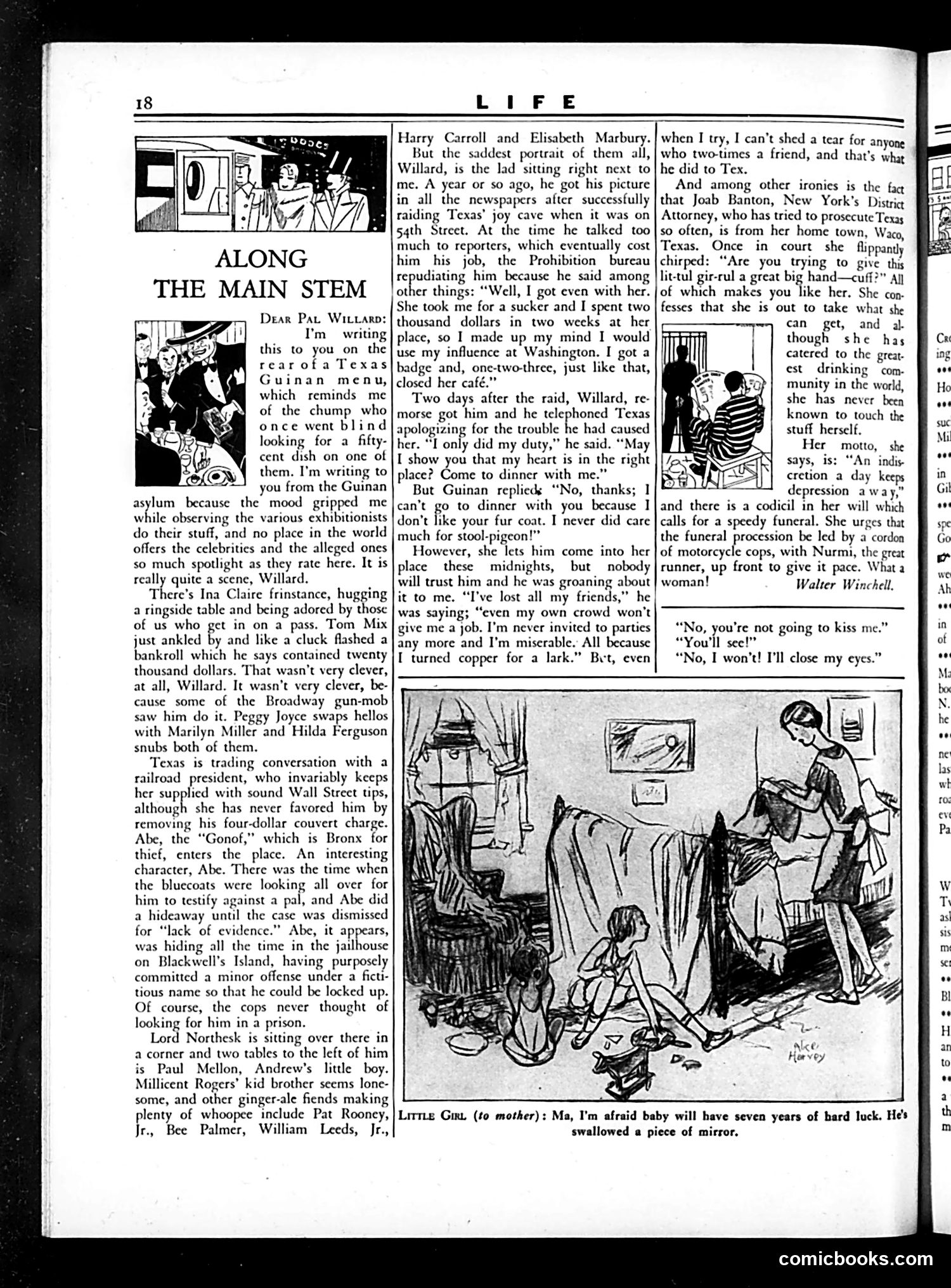
This page satirizes 1920s Manhattan nightclub culture, specifically Texas Guinan's famous speakeasy during Prohibition. The column mocks various celebrities and hangers-on frequenting these illegal establishments. The central irony concerns a Prohibition enforcement agent who raided Guinan's club, then apologized and sought her friendship—only to be shunned by the very social circle he'd courted. The satire critiques his hypocrisy: he betrayed his friend for a government "badge," destroying his reputation among Broadway's elite. The cartoon below (captioned about a child swallowing mirror glass) appears unrelated to the main text—typical of Life's mixed-content format. The piece mocks both Prohibition's ineffectiveness (speakeasies openly operated) and the moral bankruptcy of those seeking social status by informing on their peers. It's essentially a gossip column dressed as social criticism, naming actual celebrities (Ina Claire, Peggy Joyce) who frequented such venues.
This page is **not a political cartoon** but rather a **gossip/humor column** organized by city, featuring short satirical items about local celebrities and news. The humor relies on 1920s context readers would recognize: **New York**: References to celebrities like Harpo Marx and Alice Duer Miller celebrating Bastille Day; mentions illustrator Rollin Kirby and cartoonist Cy Curtis. The "Hoover will be elected" line suggests this is pre-1928 election coverage. **Denver**: Mrs. J.J. Brown (the "Unsinkable Molly Brown" from the Titanic) is mocked for monetizing her survival by creating a Eugene Field memorial. The joke about Ernest Truex and Douglas Fairbanks missing a class reunion plays on their celebrity absence. **Pittsburgh**: "Dance" Crandall's marathon dancing (a 1920s fad) is noted as Pittsburgh newsworthy. **Detroit**: A car half-protruding from a department store window is presented as absurdist humor; the prison "advertisement" satirizes incarceration. The column mocks local news importance, celebrity movements, and urban oddities with dry wit characteristic of 1920s satirical journalism.
This page from Life magazine consists primarily of **local gossip columns** from various American towns (Superior, Portland, Jacksonville, etc.), not political cartoons. The humor is genteel, small-town Americana—dating mishaps, fishing trips, and pet anecdotes. The most notable political reference appears in the Portland section: **Aimée McPherson**, the famous evangelist, visiting and causing a car accident. The joke plays on the irony of a religious revival leader's automobile "climbing a pole," shaking the fire chief's "newly acquired faith in Providence." Other satire includes a jab at **Calvin Coolidge** (President at the time, visiting Wisconsin), depicted obsessively fishing—mocking his famous taciturn personality and vacation habits. The **Clara Bow** reference jokes about a suitor sending only a quarter with his love letter, reducing romance to commerce—typical 1920s flapper-era humor. This reflects Life's role as a weekly humor magazine focused on gentle social observation rather than hard political satire.
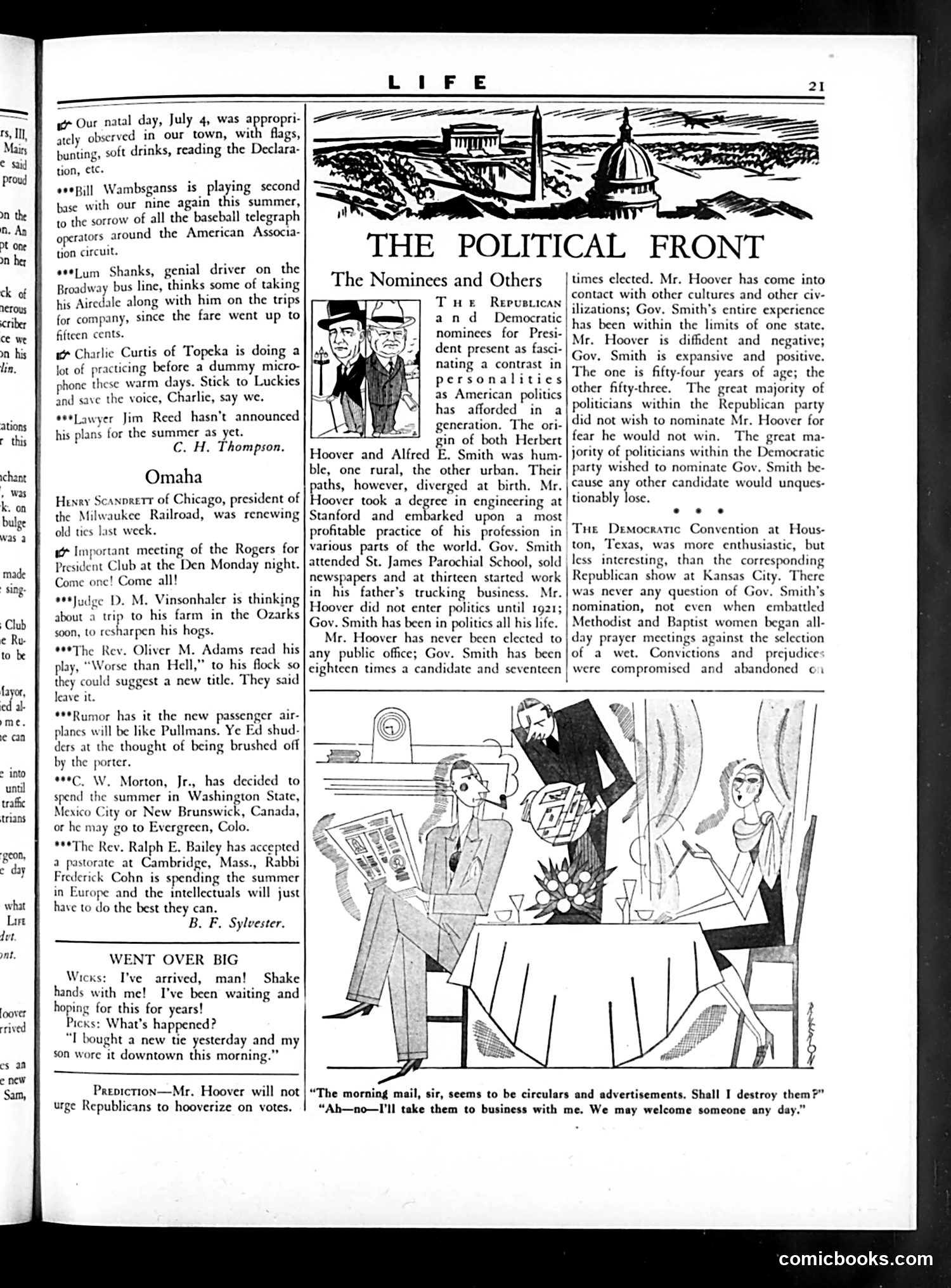
This page from *Life* magazine presents 1928 presidential election coverage comparing Republican nominee Herbert Hoover and Democratic nominee Alfred E. Smith. **The Main Cartoon/Article:** "The Nominees and Others" contrasts the two candidates' backgrounds and personalities. Hoover is portrayed as a wealthy engineer from rural origins who avoided politics until 1921, while Smith is depicted as a lifelong urban politician from New York who rose from poverty. The text emphasizes their opposing temperaments: Hoover as "diffident and negative," Smith as "expansive and positive." Notably, the passage reveals that Republican politicians didn't want to nominate Hoover (fearing electoral defeat), while Democrats enthusiastically supported Smith—suggesting Smith was the more politically attractive candidate, despite Hoover's eventual victory. The lower cartoon depicts a domestic scene about a man's new suit, unrelated to politics—typical of *Life*'s mixed content approach.
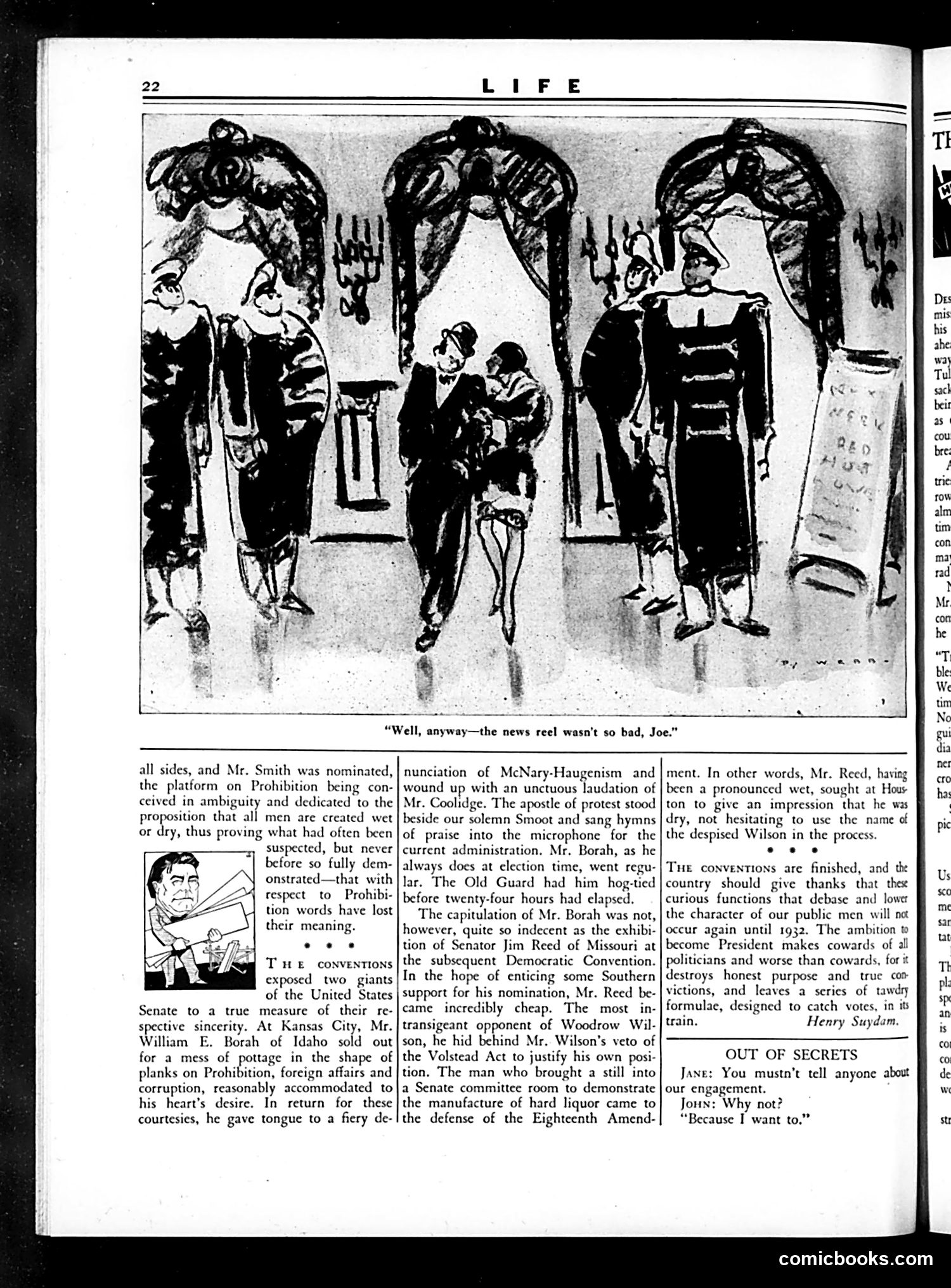
This page satirizes the 1928 Democratic and Republican national conventions, focusing on two prominent senators' compromises of principle for political advantage. **The main cartoon** depicts three women at what appears to be a social gathering; one comments "the news reel wasn't so bad, Joe"—suggesting even mundane coverage beats discussing the conventions' embarrassments. **The text attacks**: - **Senator William E. Borah** (Idaho Republican) who abandoned his progressive stance on farm relief (McNary-Haugenism) and corruption to secure party support, then hypocritically praised the Coolidge administration - **Senator Jim Reed** (Missouri Democrat) who, though a staunch "wet" (anti-Prohibition), pretended to support Prohibition and invoked the despised Woodrow Wilson to gain Southern convention support The author argues both men sacrificed integrity for presidential ambitions, exemplifying how "the ambition to become President makes cowards of all politicians." The conventions are condemned as events that "debase and lower the character of our public men."
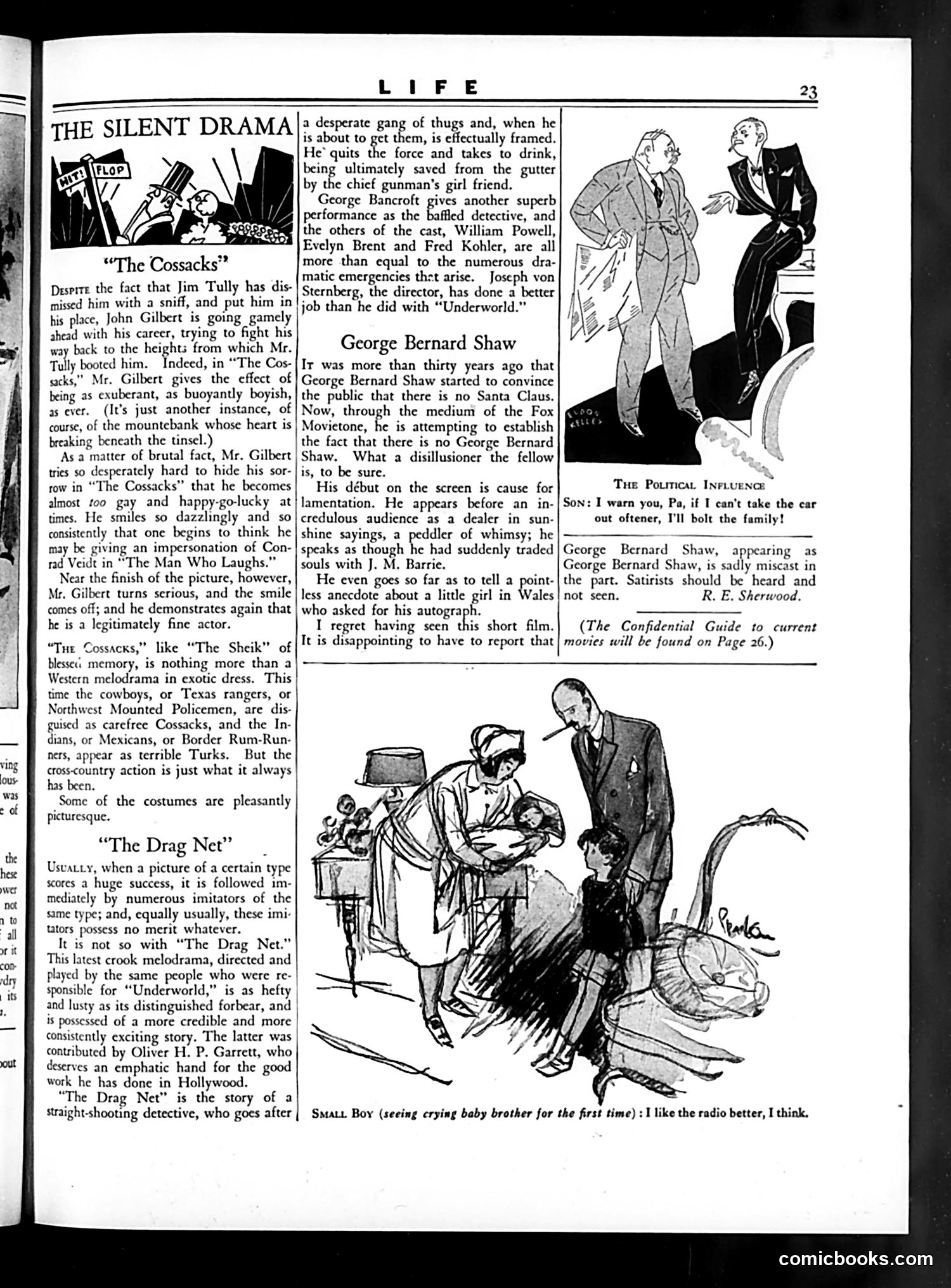
This page reviews three films and includes a political cartoon about parental authority. **Film Reviews:** The page critiques "The Cossacks" (starring John Gilbert), "The Drag Net," and a Movietone short featuring playwright George Bernard Shaw. The reviews note that Gilbert performs well despite personal struggles, while "The Drag Net" is praised as a superior gangster melodrama. Shaw's film appearance is mocked—the critic laments that Shaw, famous for his witty social criticism, appears on screen as a purveyor of saccharine platitudes, "trading souls" with sentimentalist J.M. Barrie. **Political Cartoon:** The cartoon titled "The Political Influence" depicts a son threatening his father that he'll "bolt the family" if denied use of the car. This satirizes 1920s youth rebellion and changing family dynamics—the son weaponizes abandonment to demand modern privileges, suggesting parental authority is collapsing. The joke reflects contemporary anxiety about generational conflict and automobile culture's social impact.
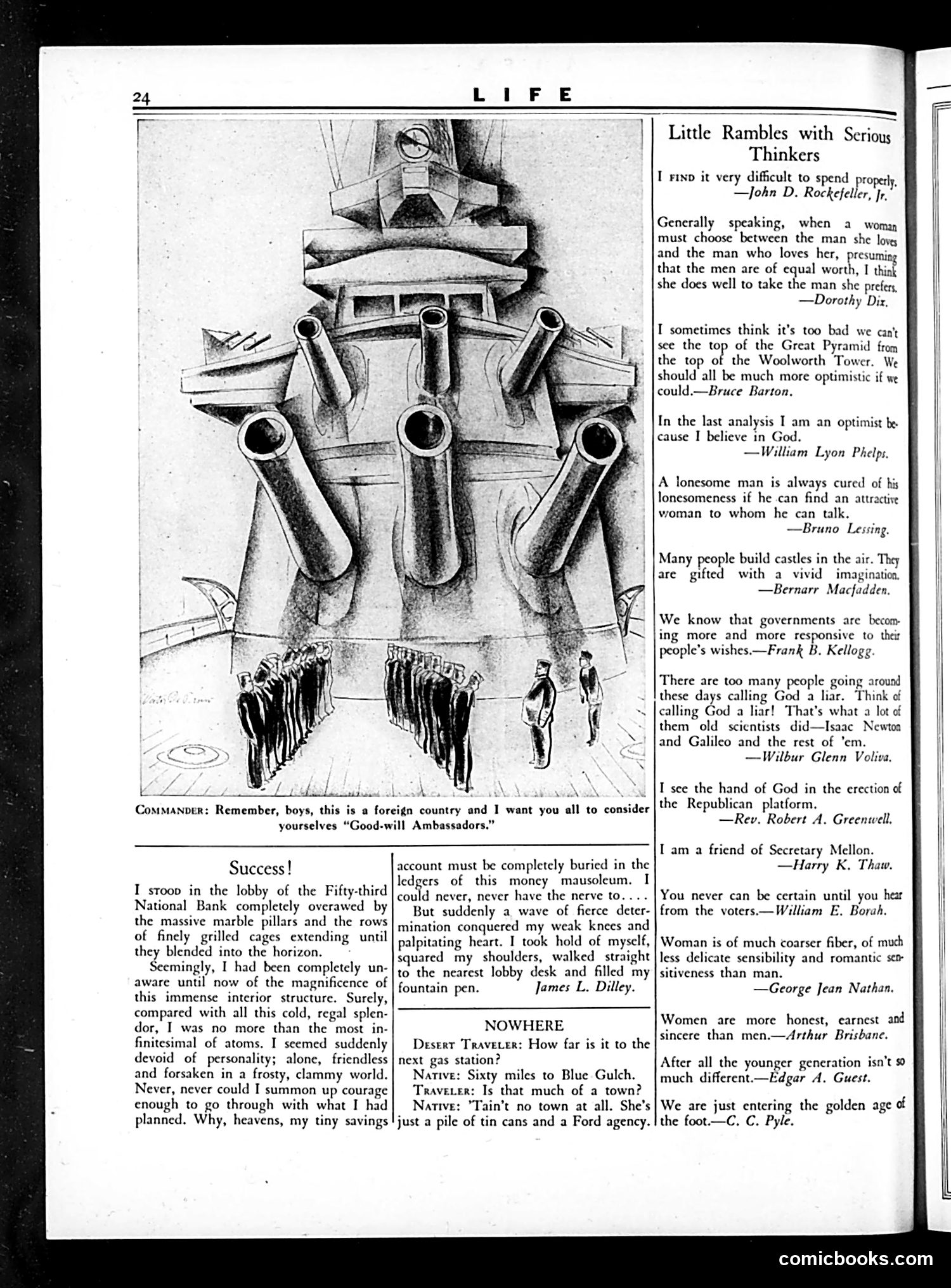
**The Main Cartoon**: The large illustration depicts a massive mechanical or robotic military commander addressing soldiers below, instructing them to act as "Good-will Ambassadors" in a foreign country. This satirizes American military interventionism and cultural imperialism—the contradiction between aggressive military presence and the pretense of friendly diplomatic relations. The towering, impersonal machine suggests the dehumanizing nature of militarism. **The Text Stories**: "Success!" humorously depicts a man intimidated by a grand bank, nearly unable to conduct his business. "Nowhere" jokes about rural American desolation—a town reduced to "tin cans and a Ford agency." **"Little Rambles with Serious Thinkers"**: A collection of quotations from celebrities and public figures offering platitudes on romance, religion, government, and morality. The page mocks how the famous dispense obvious wisdom as if profound. **Historical Context**: This appears from the 1920s, reflecting post-WWI anxieties about American military presence abroad and the era's celebrity culture where public figures' every utterance was treated as meaningful.
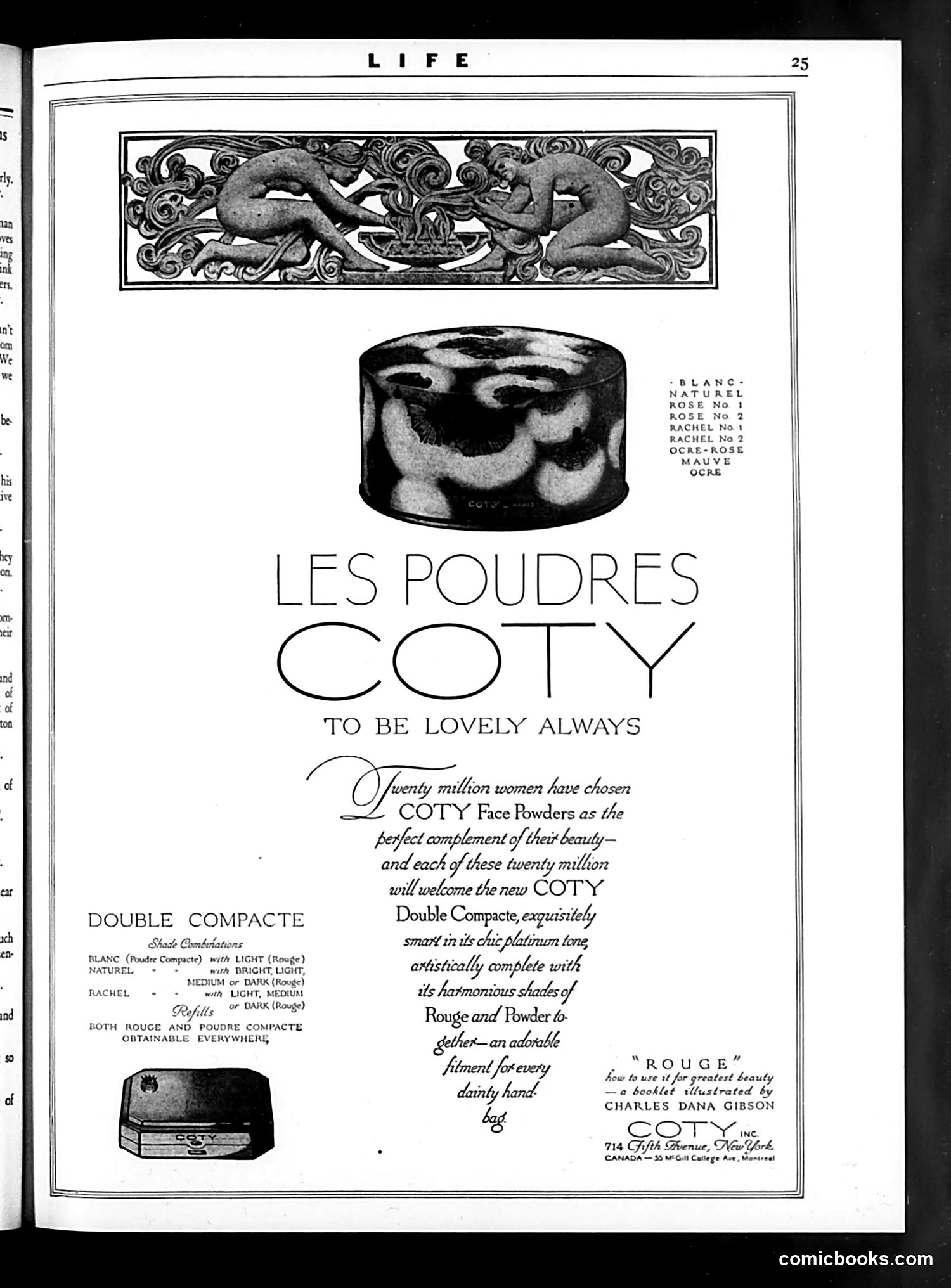
This page is **primarily a cosmetics advertisement**, not satire or political content. It advertises Coty Face Powders and their new "Double Compacte" compact. The decorative header shows two cherubs or putti (classical figures) in an ornamental baroque-style border—a common design motif of the era, not a caricature. The ad claims "twenty million women have chosen COTY Face Powders" and emphasizes the product's color range (Blanc Naturel, Rose No. 1, Rachel No. 1, etc.) and convenient compact design. The only notable reference is to **Charles Dana Gibson**, the famous illustrator, who created an accompanying beauty guide booklet titled "Rouge." For modern readers: this reflects 1920s-30s advertising that emphasized mass-market cosmetics adoption and designer/celebrity endorsements as beauty legitimization—a nascent consumer culture moment when makeup use became mainstream rather than transgressive.
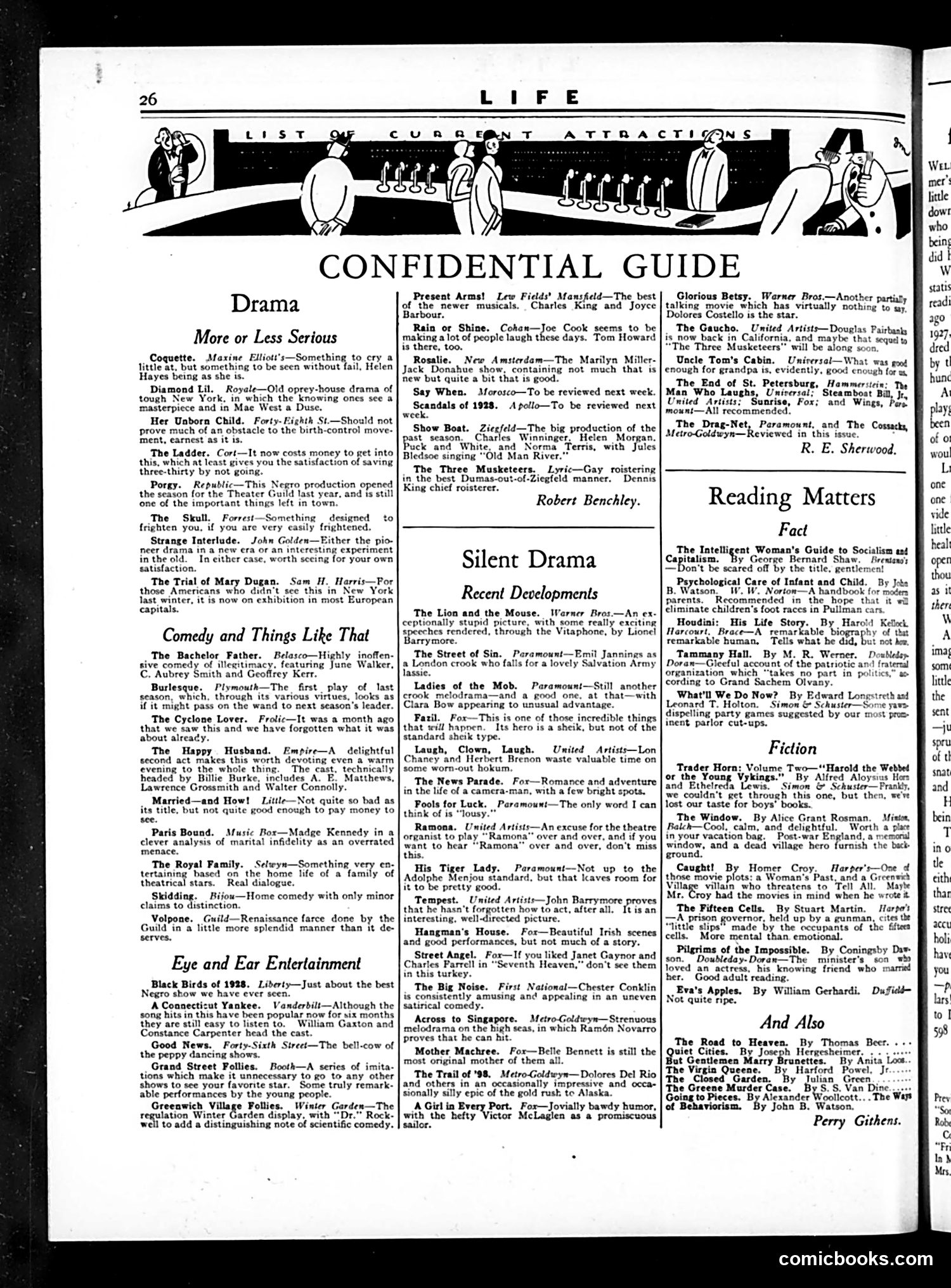
This page from *Life* magazine presents entertainment reviews rather than political cartoons. The decorative header showing stylized figures in formal dress establishes the satirical tone, but the content is primarily a theatrical guide. The "Confidential Guide" reviews Broadway productions across categories: serious drama, comedy, and musical entertainment. The writing employs *Life*'s characteristic irreverent humor—mocking poorly-written plays, praising performers like Helen Hayes and Mae West, and dismissing mediocre productions with cutting brevity (e.g., "The Cyclone Lover" was "forgotten" after one viewing). Notable references include *Strange Interlude* (described as either pioneering or experimental), *The Royal Family* (satirizing theatrical dynasties), and Negro productions like *Porgy*, which the reviewer identifies as "one of the important things left in town." The satire functions through condescending wit rather than visual caricature—*Life*'s approach to critiquing 1920s entertainment culture and theatrical pretension.
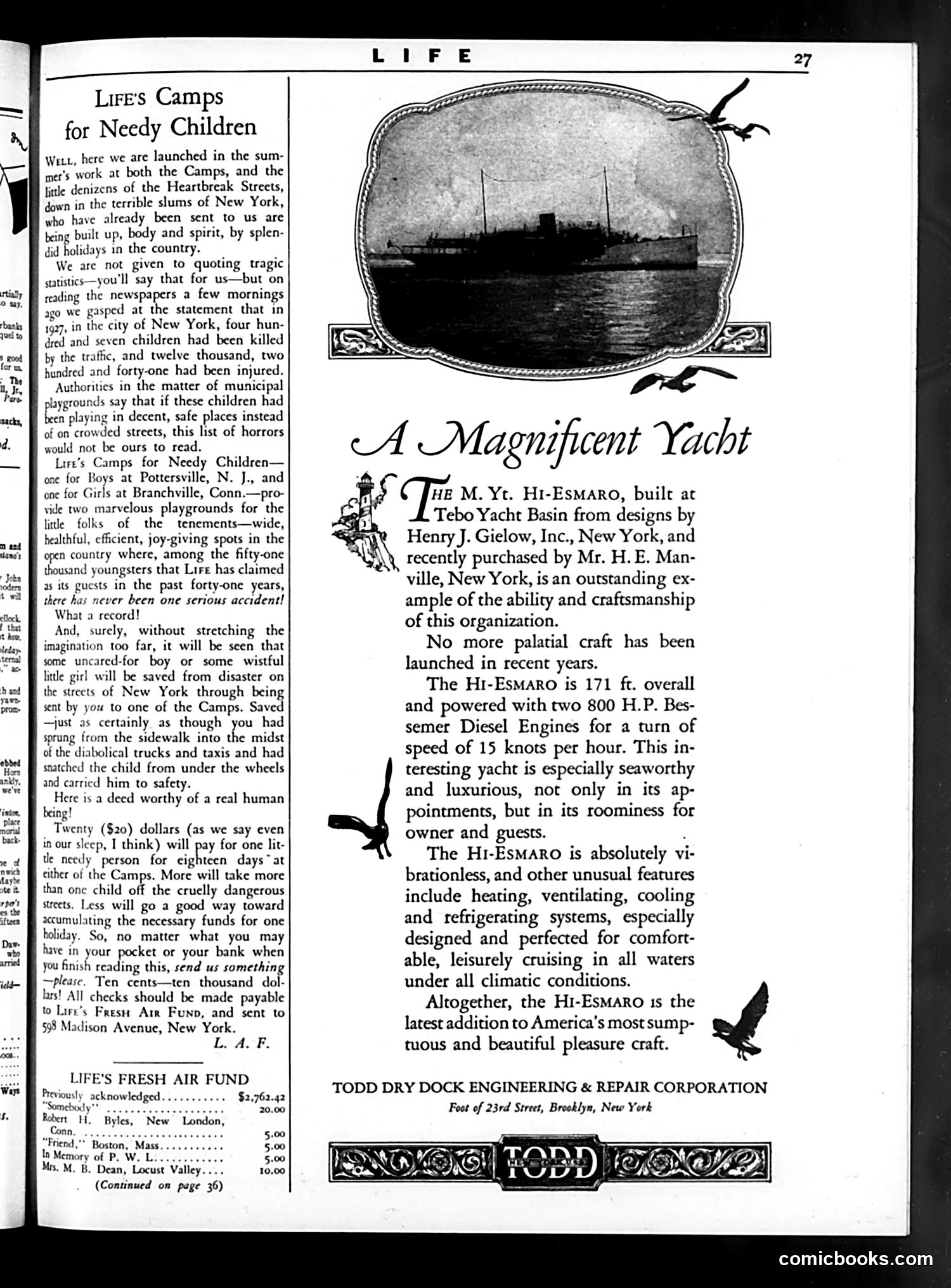
This page combines charitable fundraising with luxury advertising—a striking juxtaposition that reveals 1920s class tensions. The left column solicits donations for **Life's Fresh Air Fund**, which sends poor children from New York City slums to summer camps. The pitch emphasizes a moral imperative: in 1927, NYC traffic killed 407 children; safe camps prevent such tragedies. Twenty dollars funds one child's eighteen-day stay. The right side advertises the **Hi-Esmaro**, an extravagant 171-foot yacht with dual diesel engines, built for wealthy owner H.E. Manville. It features luxurious amenities: heating, cooling, refrigeration—comforts designed for leisurely cruising. **The implicit satire**: Life juxtaposes desperate poverty (children dying in traffic, needing charity camps) against obscene wealth (a palatial pleasure yacht). The magazine essentially asks readers: will you spare $20 for a slum child's safety, or will the wealthy continue building ever-more-luxurious vessels? It's social commentary wrapped in fundraising—highlighting economic inequality without explicit editorial comment.
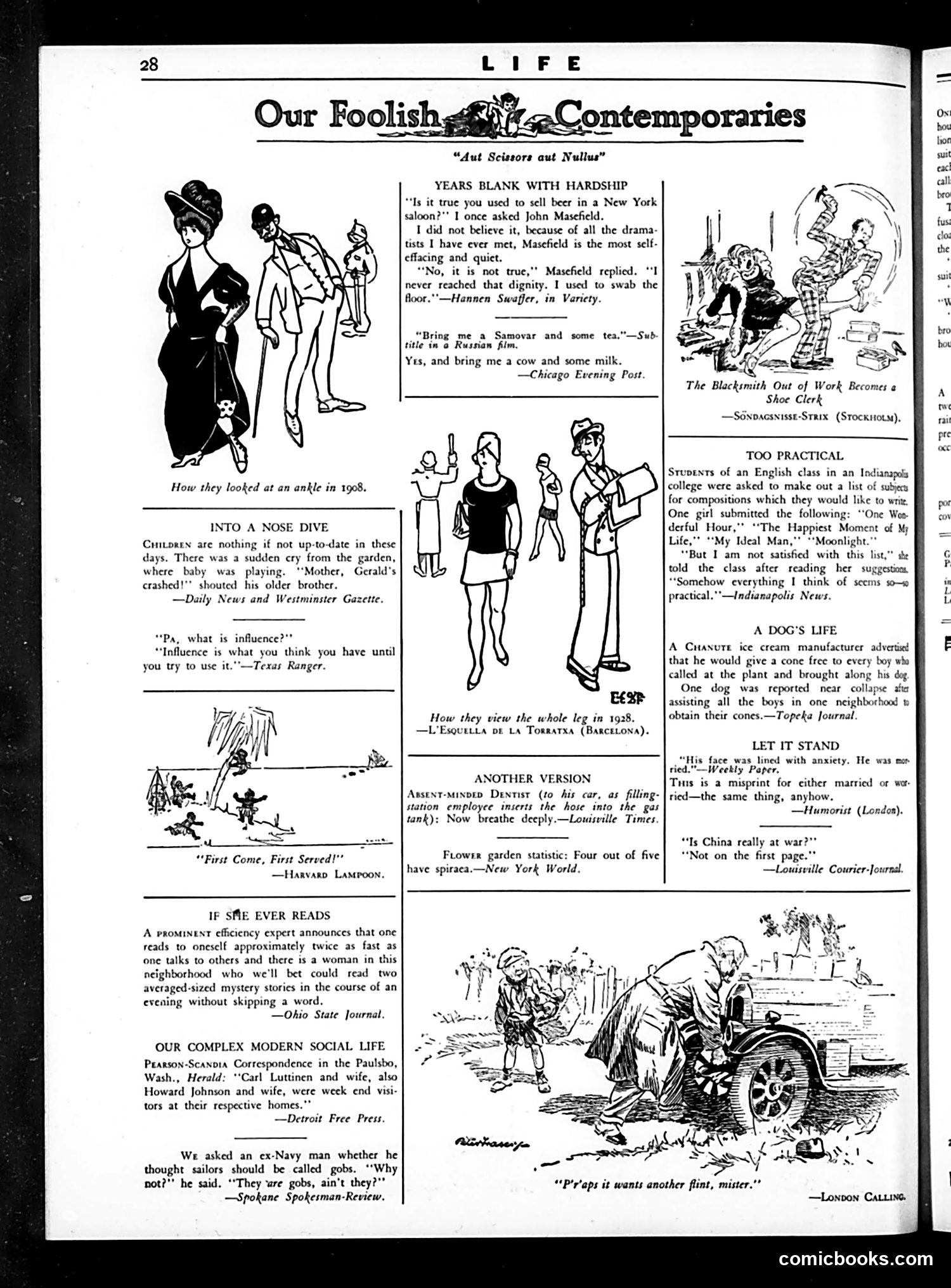
This page collects humorous anecdotes and cartoons mocking contemporary society across various topics: **Fashion/Social Change**: The top contrasts how people viewed women's ankles in 1908 versus 1938, satirizing shifting social attitudes about modesty and propriety over three decades. **Humor Sections** include jokes about modern inefficiency (a talkative woman who reads mystery stories), absurd bureaucratic language ("week end visitors at their respective homes"), and naval slang debates. **Notable Anecdotes**: A story about poet John Masefield's humble past (swabbing floors, not selling beer as rumored) punctures romantic notions about literary figures. **The Bottom Cartoon** shows a motorist asking a mechanic about engine trouble—a joke about automobile dependency in modern life. The page's recurring theme is satirizing contemporary American life as contradictory, unnecessarily complex, and worthy of gentle ridicule. It's a humor compilation typical of *Life* magazine's mid-century satirical format.
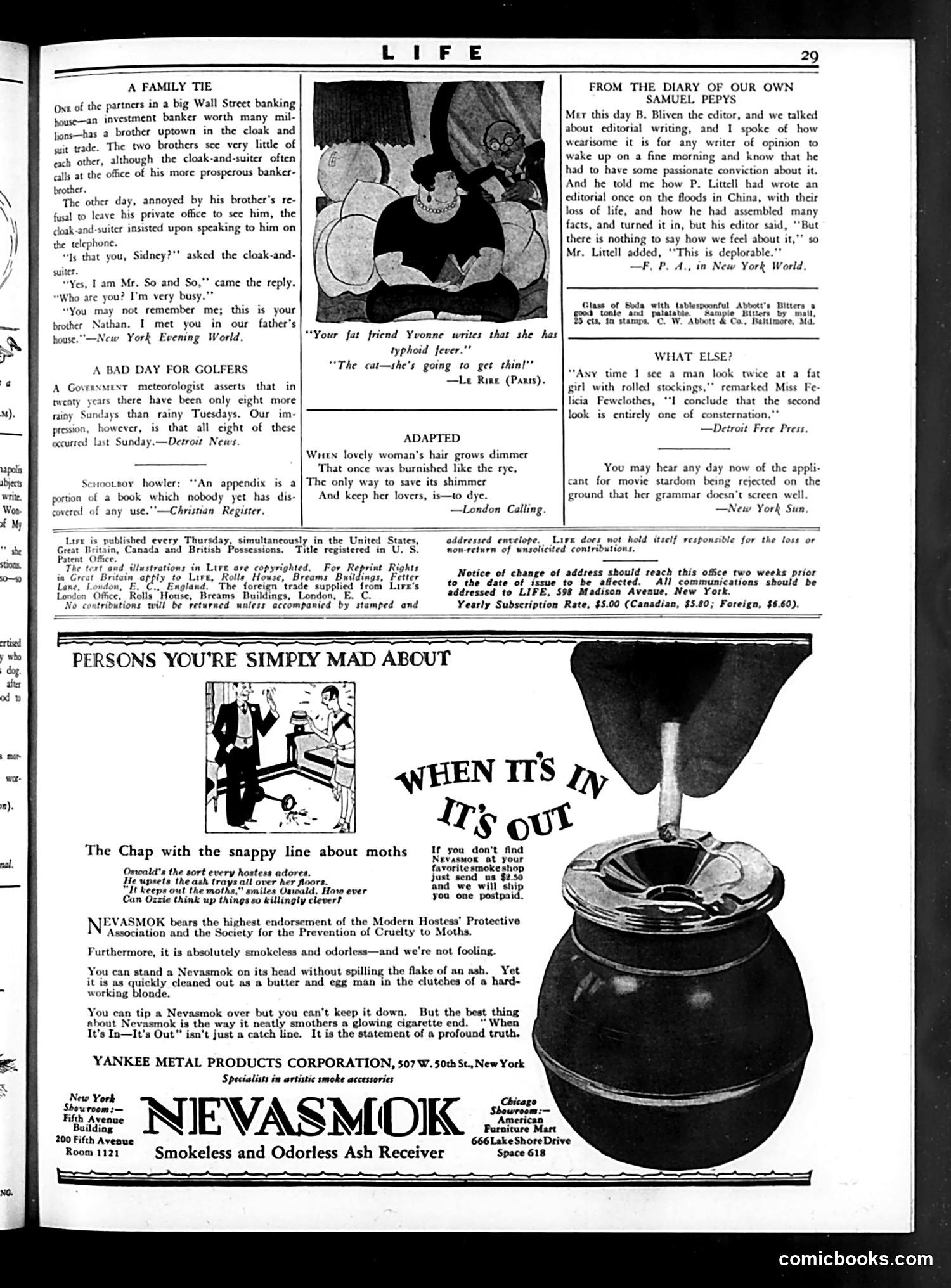
This page contains satirical commentary on social class divisions and several humorous anecdotes typical of 1920s American life. **"A Family Tie"** satirizes the social divide between wealthy and working-class relatives. A prosperous Wall Street banker refuses to see his brother—a "cloak-and-suiter" (garment industry worker)—in person, forcing him to call by telephone. The joke's bite comes from the banker's pretense of not recognizing his own brother, highlighting how wealth created social distance even within families. **Other content** includes brief humor pieces about golf, editorial writing challenges, and observations about appearance and dating. The **Nevasmok advertisement** (bottom half) for a smokeless ash receiver uses the tagline "When It's In—It's Out," playing on the product's function while maintaining the page's comedic tone. Overall, this reflects Life's role as a satirical magazine mocking American social pretensions, class consciousness, and modern consumer culture during the prosperous 1920s.
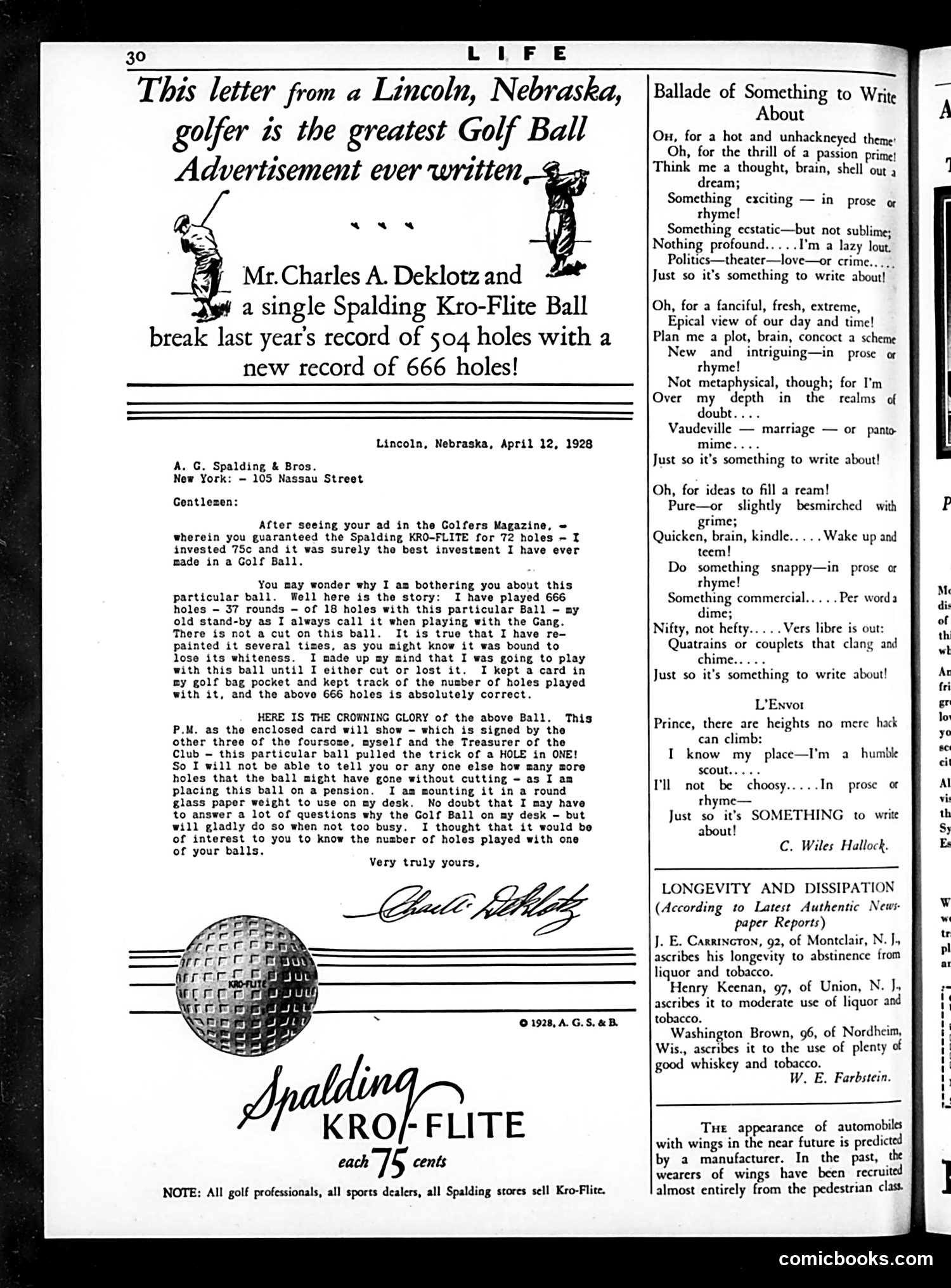
This page is primarily **advertising disguised as editorial content**—a marketing strategy common in early 20th-century magazines. The main feature presents a letter from Charles A. Deklotz of Lincoln, Nebraska, claiming he played 666 holes with a single Spalding Kro-Flite golf ball without damage, culminating in a hole-in-one. He's now retiring it as a desk ornament. While presented as genuine testimonial, this is clearly a paid advertisement for the ball (75 cents), designed to demonstrate durability and value. The accompanying page includes a humorous poem by C. Wiles Hallock about writer's block—requesting *any* topic worth writing about—and a satirical note titled "Longevity and Dissipation" listing contradictory longevity claims (one man attributes long life to abstinence, another to whiskey and tobacco), mocking dubious health claims common in newspaper reporting. The satire targets credulous newspaper reporting and advertising's manipulation of testimonials.
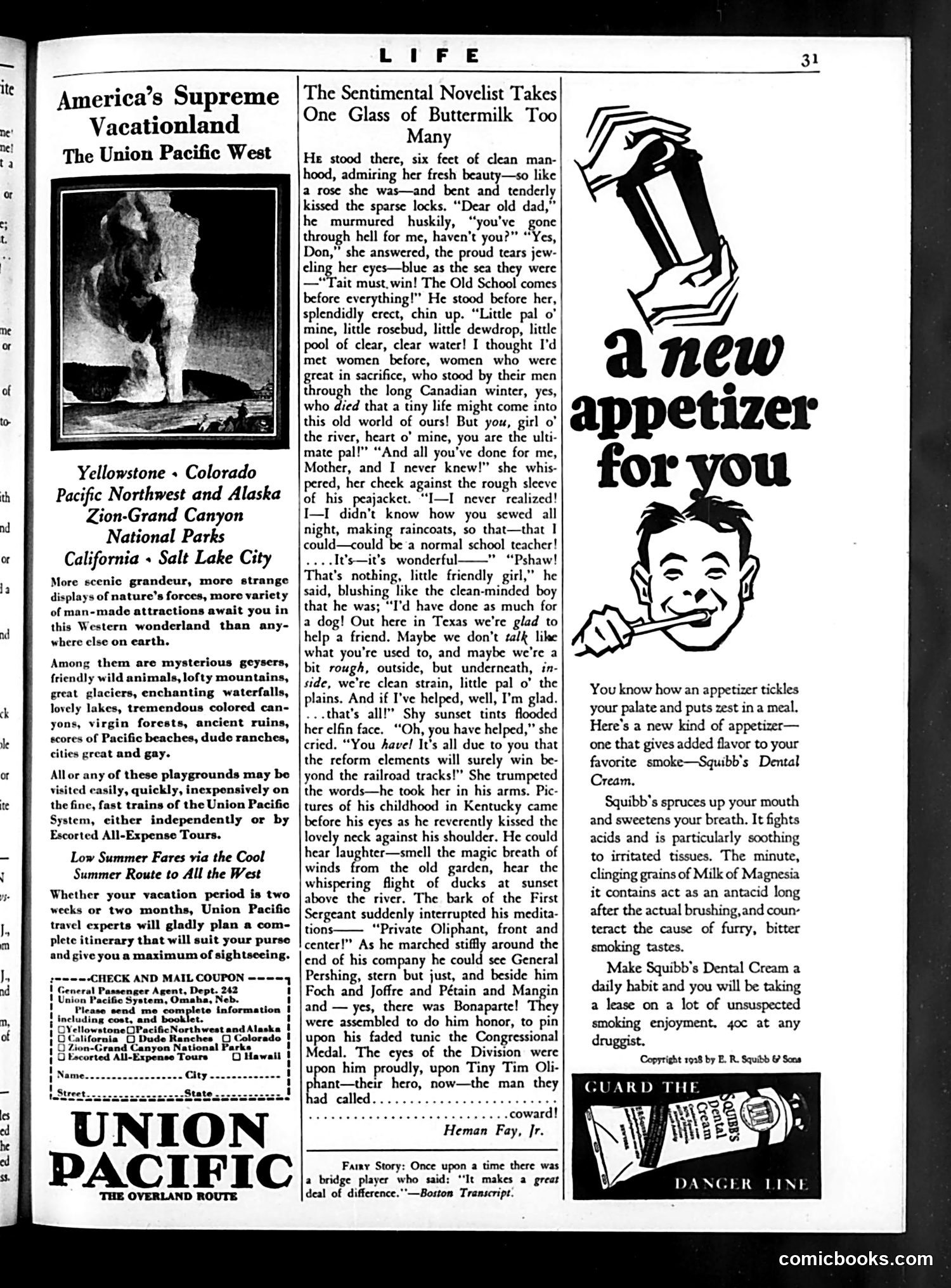
**Left side:** Union Pacific Railroad advertisement promoting Western vacation destinations (Yellowstone, Grand Canyon, national parks) as "America's Supreme Vacationland." The ad emphasizes accessibility via Union Pacific trains, with a mail-in coupon for information. **Right side:** A satirical short story titled "The Sentimental Novelist Takes One Glass of Buttermilk Too Many," which mocks overwrought romantic fiction. The text parodies purple prose common in sentimental novels—excessive metaphors ("blue as the sea"), clichéd descriptions ("little rosebud," "heart o' mine"), and melodramatic sacrifice narratives. The joke is that this overwrought emotional monologue is supposedly triggered by buttermilk. It's a gentle mockery of the sentimental literary style popular in early 20th-century fiction. **Bottom right:** Advertisement for Squibb's Dental Cream, a toothpaste brand, featuring a smiling cartoon face. The page mixes commercial tourism promotion with literary satire typical of *Life* magazine's humor.
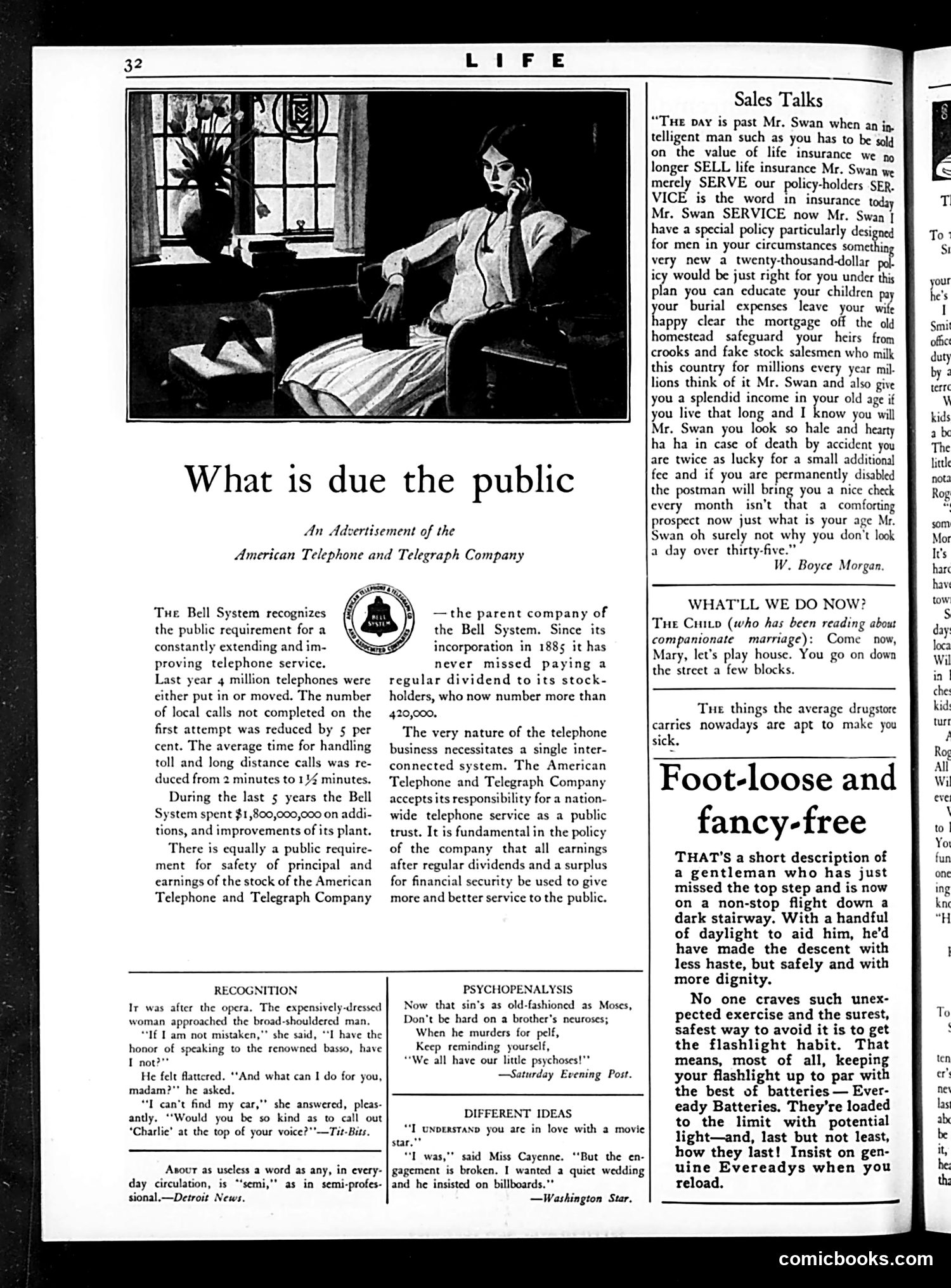
This page mixes corporate advertising with satirical humor typical of 1920s Life magazine. **Main Content:** A full-page advertisement from American Telephone and Telegraph Company defends the Bell System's public service record and dividend payments to stockholders—addressing contemporary criticism that utilities prioritize profits over service. **The Cartoon/Image:** Shows a contemplative man at a desk, illustrating the adjacent "Sales Talks" piece—a satirical monologue by a relentless insurance salesman (W. Boyce Morgan) pressuring "Mr. Swan" with jargon-filled pitch about life insurance benefits. **Satire:** The humor mocks aggressive 1920s sales techniques: the salesman's breathless, circular logic; his assumption that flattery and fear-based pitches ("accident," "disability") will close the deal; and his transparent switch from "selling" to "serving" as corporate doublespeak. **Social Context:** Reflects era anxieties about emerging corporate language, high-pressure salesmanship, and the tension between public good and profit motives in growing industries.
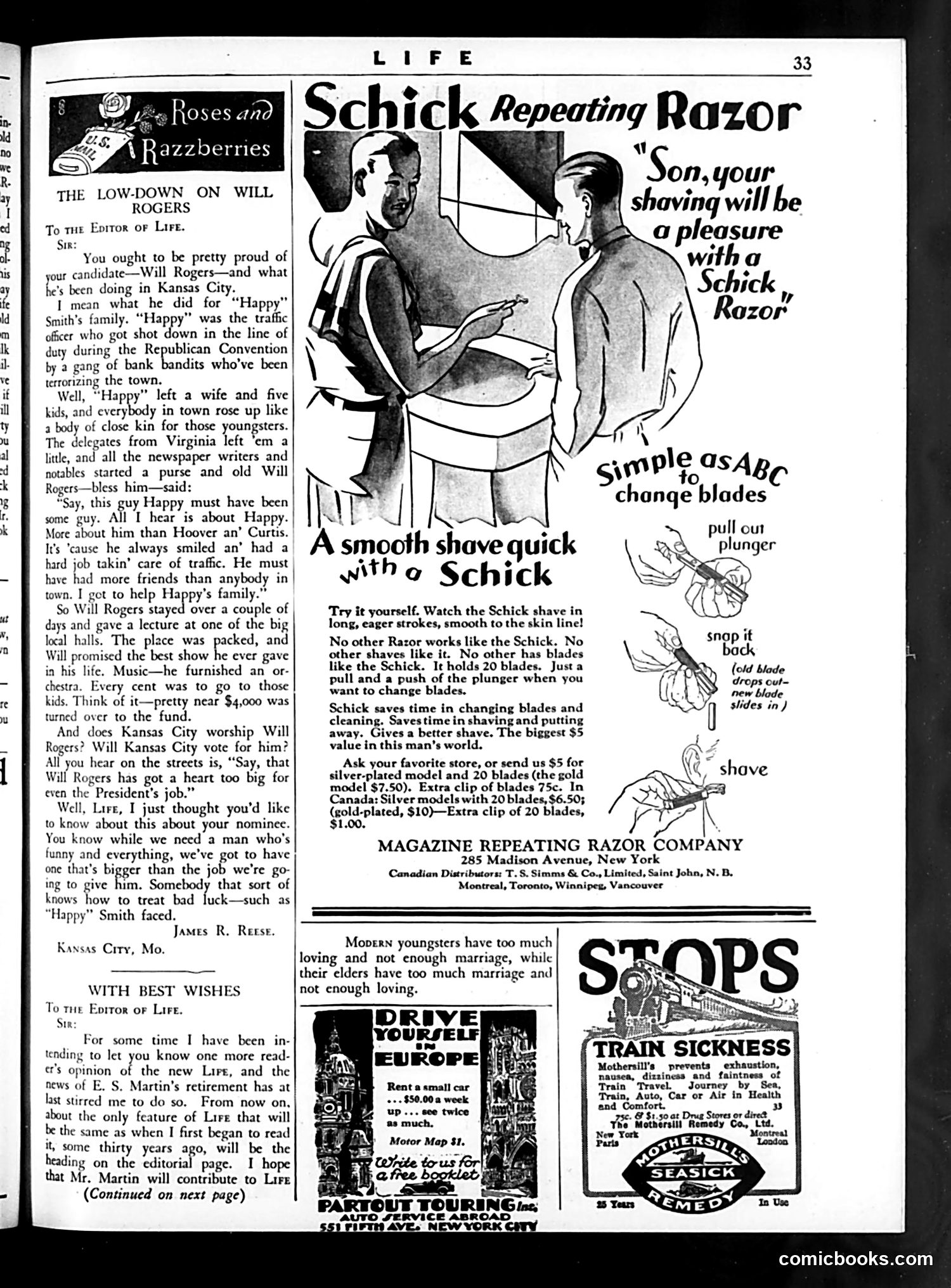
This page is primarily **advertising and reader correspondence**, not political satire. The main content includes: **Letters section**: Readers praise **Will Rogers** (identified as Life's political candidate) for his charitable work in Kansas City. After a traffic officer named "Happy" Smith was killed during the Republican Convention, Rogers stayed to give a benefit lecture, raising nearly $4,000 for Smith's widow and five children. The letters portray Rogers as compassionate and genuinely concerned with ordinary people—qualities the writers argue make him worthy of high office. **Advertisements**: The page features ads for the **Schick Repeating Razor** (emphasizing ease of blade-changing), a "Drive Yourself" car rental service for touring Europe, and **Mothersill's** (travel sickness remedy). The Rogers praise reflects 1920s-era admiration for his folksy humor and apparent decency, contrasting him favorably with political figures like Hoover and Curtis mentioned in the letters.
This page is primarily **advertising and reader letters**, not political satire. The left side features a **French Line travel advertisement** promoting luxury cruises along the French Riviera—from Biarritz to Monte Carlo—emphasizing elegant dining, scenic routes, and ocean liners. The right side contains **reader correspondence** responding to Life magazine's editorial direction. One letter (from John W. Perkins) critiques the magazine's recent redesign, missing older features like Oliver Herford's whimsical sketches and Oliver Cushing's artwork, while finding newer contributors like Walter Winchell and Robert Benchley tiresome. A second letter argues **against Will Rogers entering politics**, despite respecting him as an honest man who could reform government. The writer warns that involving Rogers in politics would compromise "the only good man we have." The **Dunlop golf ball advertisement** in the hexagonal frames is standard product marketing. There is **no political cartoon** on this page—it's largely commercial content with fan mail reflecting 1920s-30s cultural preferences.
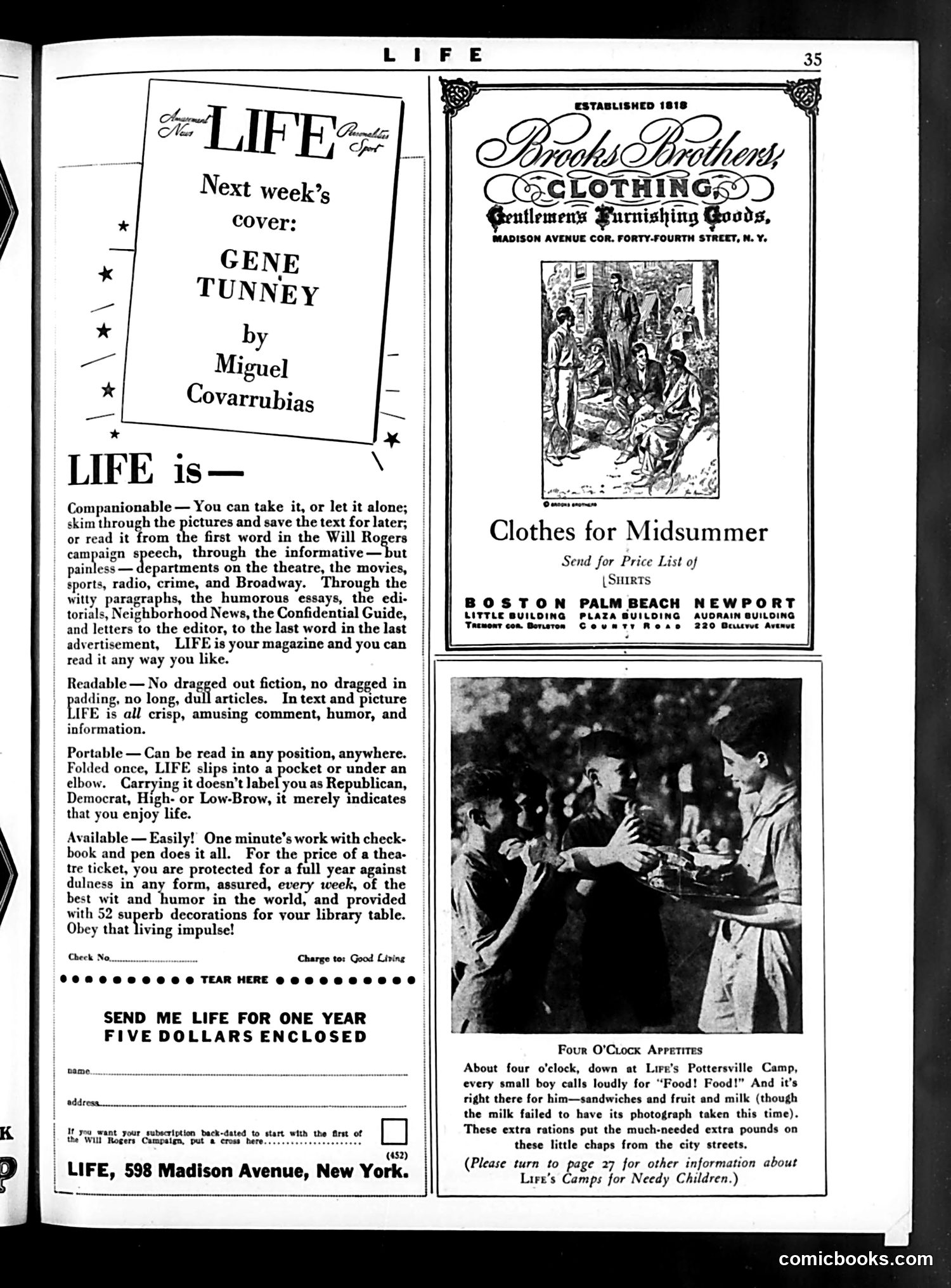
This page is primarily **advertising and promotional content** rather than political satire. The left side features Life magazine's self-promotion, describing itself as "companionable," "readable," "portable," and "available"—emphasizing its appeal as an affordable entertainment weekly ($5/year subscription). It references Will Rogers, a popular humorist of the era, suggesting this is from the 1920s-30s. The right side contains a **Brooks Brothers clothing advertisement** and a photograph promoting "Life's Camps for Needy Children," a charitable initiative providing extra meals to underfed city boys. The caption notes the children received sandwiches, fruit, and milk to help them gain weight. **No political cartoon or satire is present.** This is a straightforward magazine page mixing subscriber recruitment with advertisements and social welfare messaging typical of Life's era.
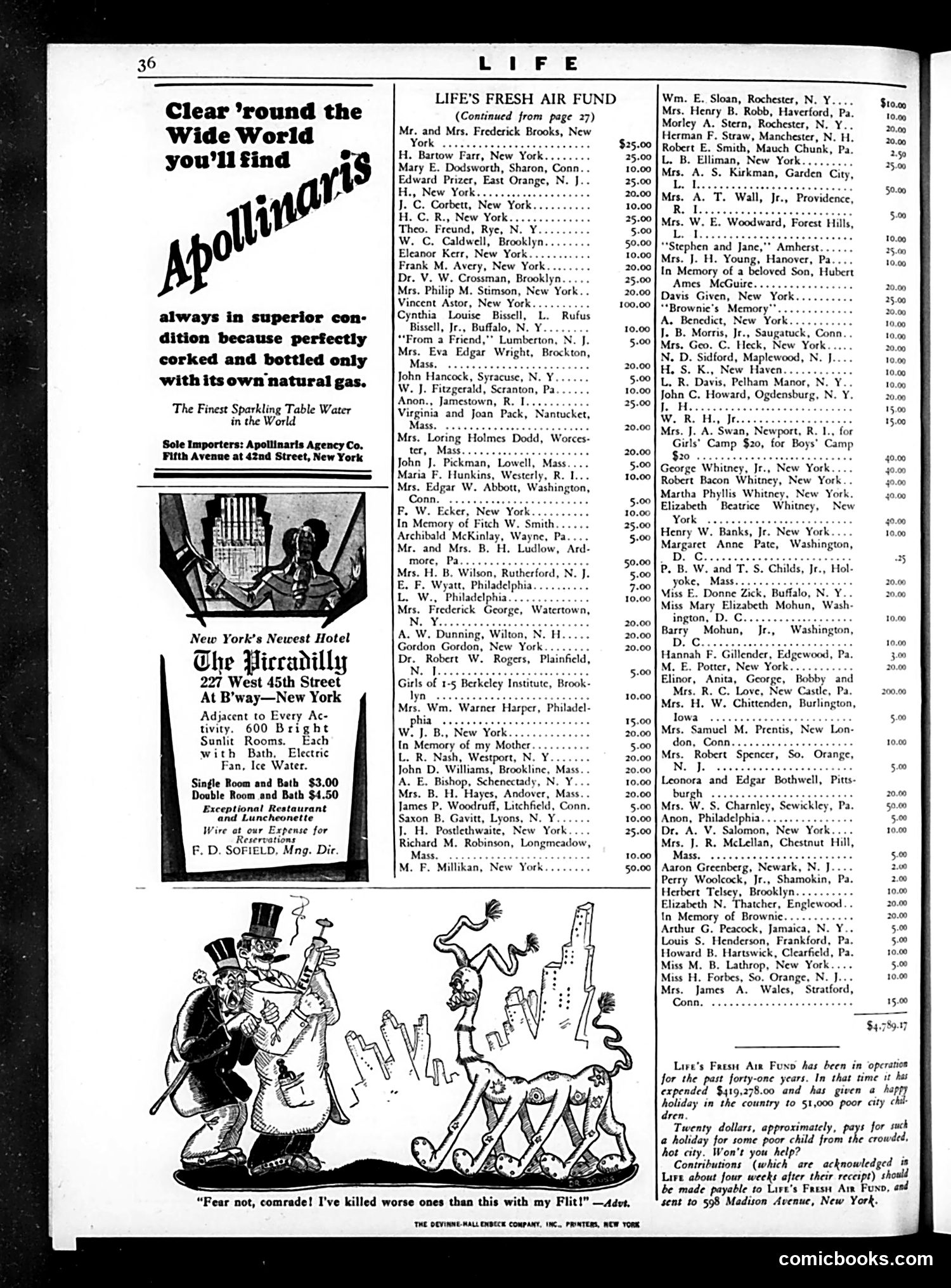
This page is primarily **advertising and fundraising content**, not a political cartoon requiring historical context. The dominant visual element is a cartoon advertisement for "Flit" insecticide showing a caricatured figure wielding a spray gun against insects labeled as "worse ones," with the tagline "Fear not, comrade! I've killed worse ones than this with my Flit!" The word "comrade" appears to reference communist rhetoric, likely playing on anti-communist sentiment of the era to create ironic humor—suggesting the insecticide is so effective it could defeat even ideological enemies. This reflects early-20th-century American anxieties about communism used for commercial purposes. The page's main content is **Life's Fresh Air Fund**, a charitable initiative providing poor children summer camp access, with an extensive donor list from wealthy Americans. This represents philanthropic activity typical of the era's wealthy class addressing urban poverty.
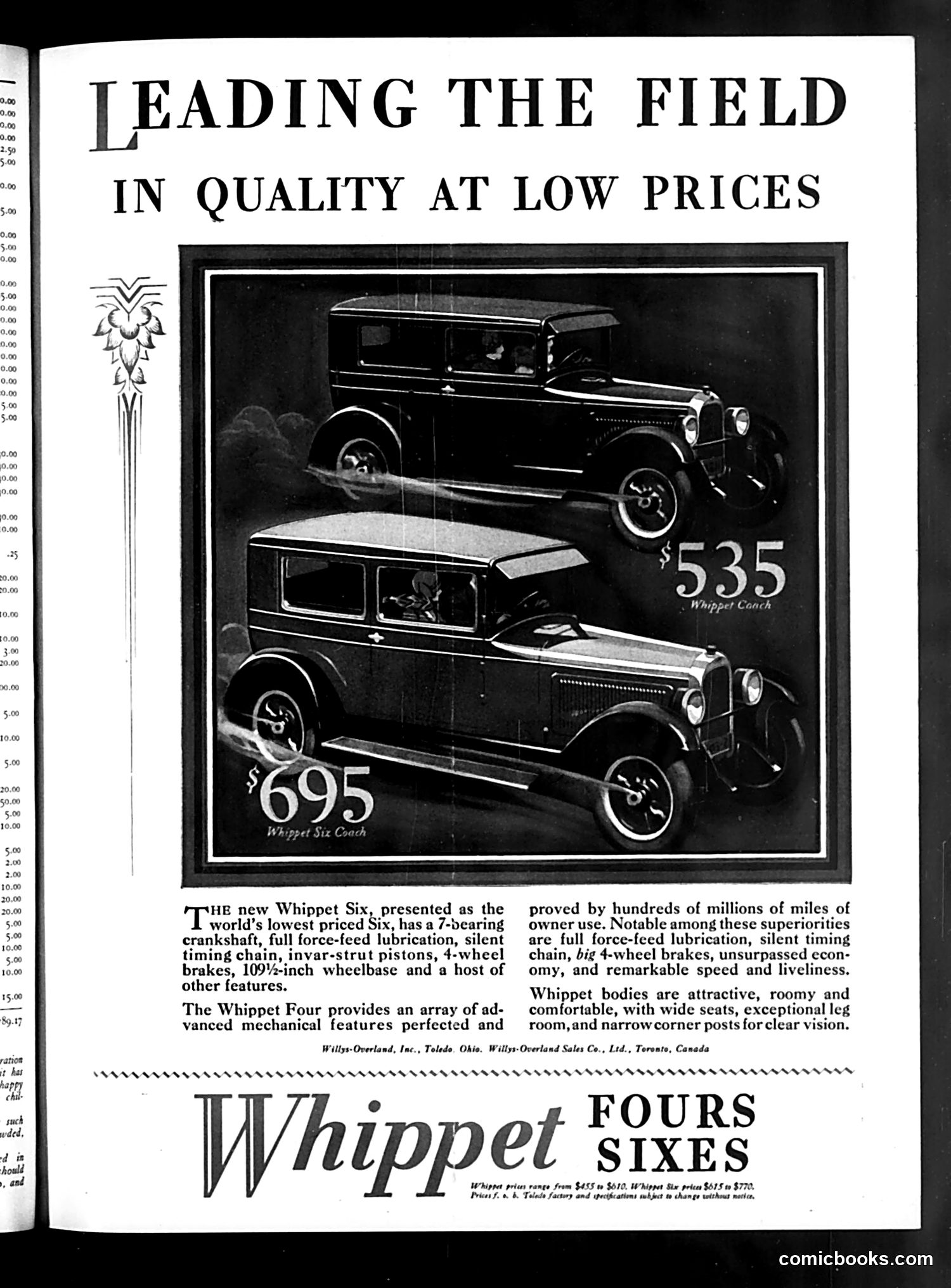
This is primarily an automobile advertisement, not a political cartoon. It's a Whippet car advertisement from Willys-Overland, promoting their Four and Six models. **The "satire" claim in your prompt appears mistaken.** This is straightforward 1920s advertising copy emphasizing affordable luxury—the headline "Leading the Field in Quality at Low Prices" targets middle-class buyers seeking value. The two vehicle photographs showcase the models side-by-side with their respective prices ($695 for the Six, $535 for the Whippet coach). The appeal is to practical concerns: mechanical features (7-bearing crankshaft, force-feed lubrication, 4-wheel brakes), comfort (roomy bodies, wide seats, leg room), and economy. There's no visible political commentary or caricature. This represents typical 1920s-30s consumer marketing positioning cars as accessible to ordinary Americans rather than wealthy elites.
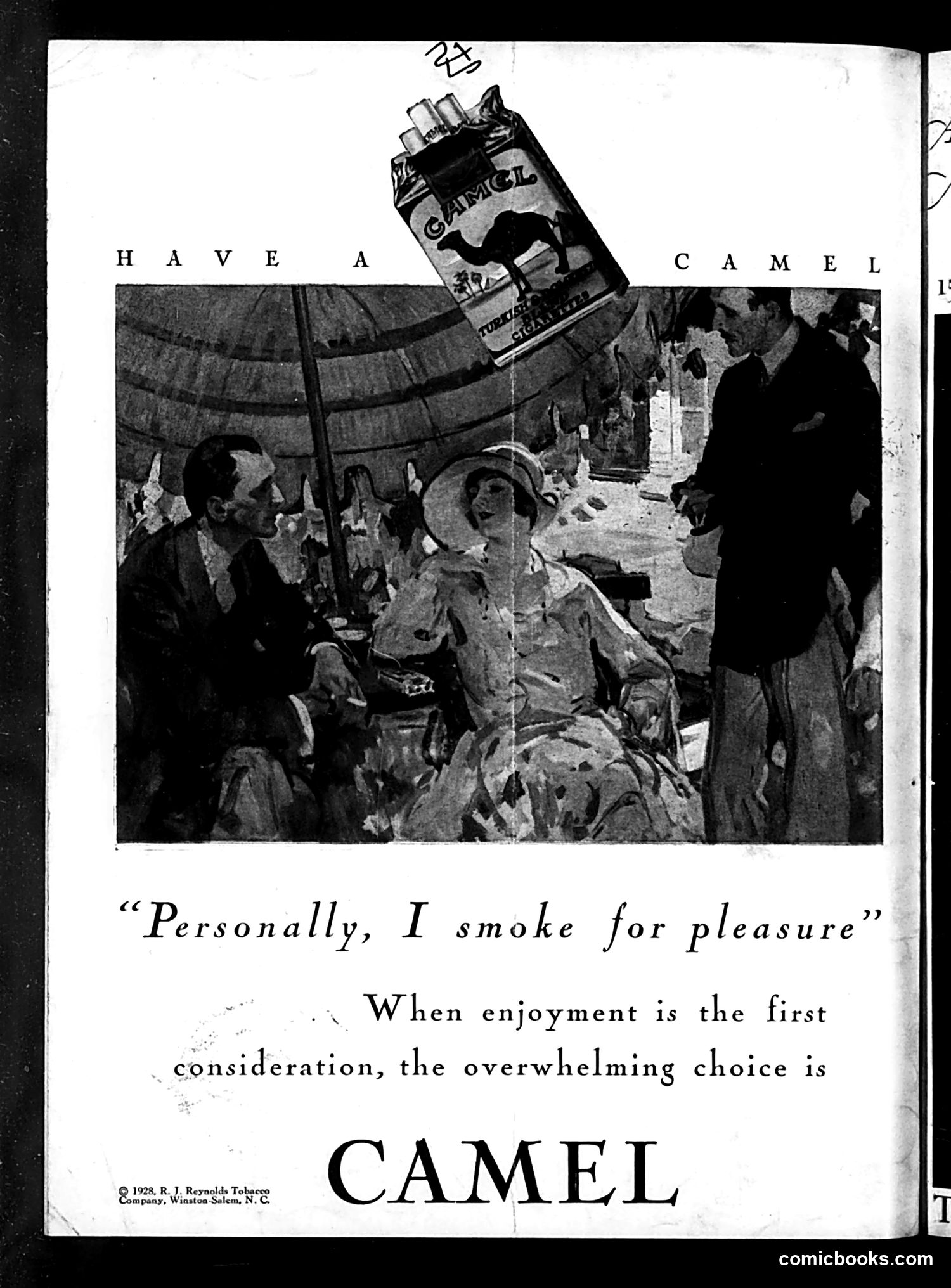
This is a **Camel cigarette advertisement**, not political satire. The page shows a scene at what appears to be a circus or carnival tent, with a well-dressed woman in the center stating she smokes "for pleasure." The ad's argument is straightforward: when enjoyment matters most, Camel is the overwhelming choice. The circus setting suggests leisure and entertainment, positioning smoking as a pleasure activity rather than a necessity. Dated 1928, this predates health warnings and represents an era when cigarette advertising could openly celebrate smoking without controversy. The aspirational imagery—stylish woman, social setting, leisure context—was typical advertising strategy to normalize and glamorize cigarette consumption among consumers, particularly women, who were an expanding market at that time.