
Life, 1928-07-12 · page 24 of 40
Life — July 12, 1928 — page 24: what you’re looking at
What you’re looking at
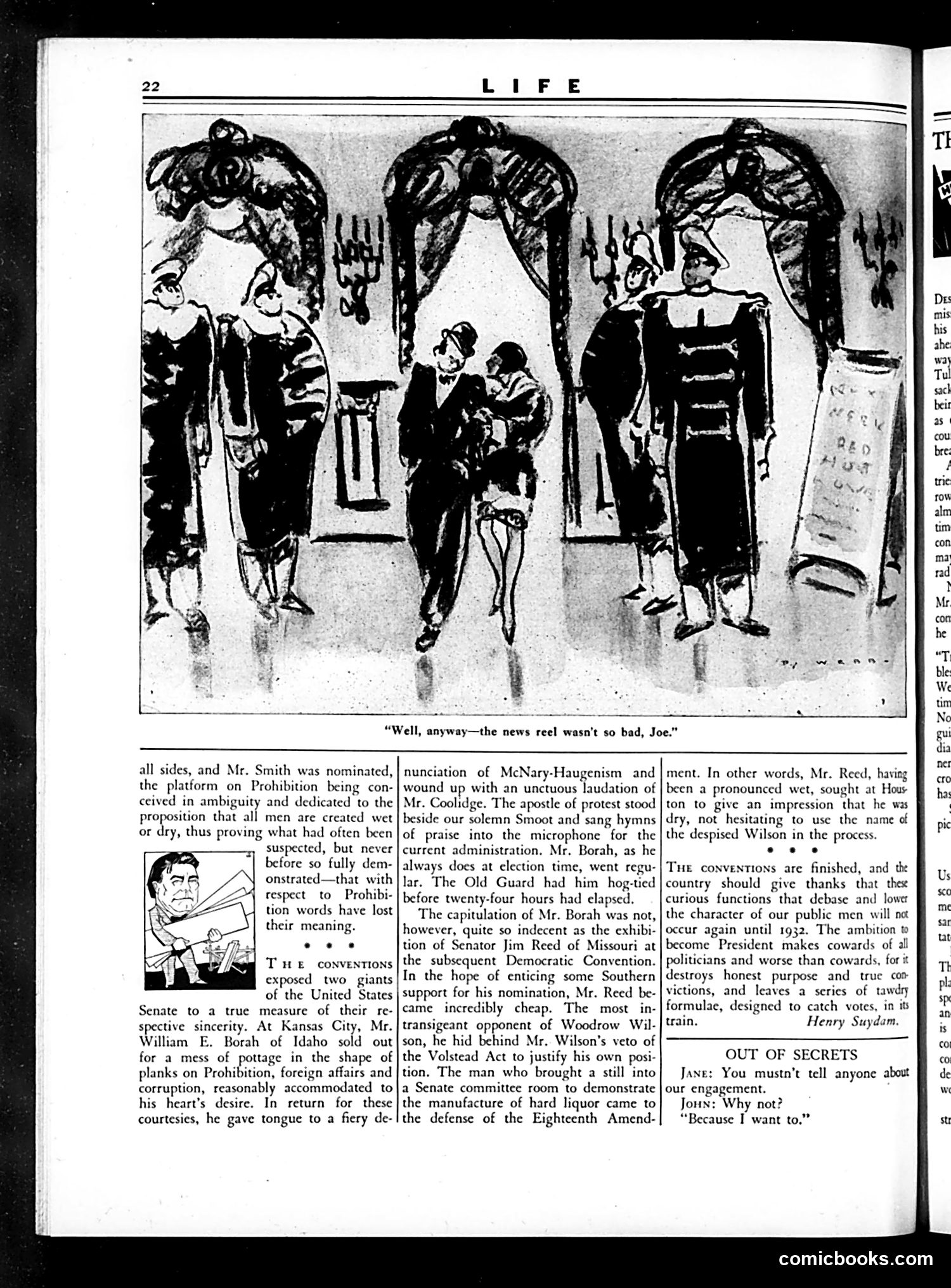
This page satirizes the 1928 Democratic and Republican national conventions, focusing on two prominent senators' compromises of principle for political advantage. **The main cartoon** depicts three women at what appears to be a social gathering; one comments "the news reel wasn't so bad, Joe"—suggesting even mundane coverage beats discussing the conventions' embarrassments. **The text attacks**: - **Senator William E. Borah** (Idaho Republican) who abandoned his progressive stance on farm relief (McNary-Haugenism) and corruption to secure party support, then hypocritically praised the Coolidge administration - **Senator Jim Reed** (Missouri Democrat) who, though a staunch "wet" (anti-Prohibition), pretended to support Prohibition and invoked the despised Woodrow Wilson to gain Southern convention support The author argues both men sacrificed integrity for presidential ambitions, exemplifying how "the ambition to become President makes cowards of all politicians." The conventions are condemned as events that "debase and lower the character of our public men."
📄 Transcribed text from this page (OCR, searchable)
Machine-transcribed from the original scan — historical spelling and the odd misread are preserved.
“Well, anyway—the news reel wasn't so bad, Joe.” all sides, and Mr. Smith was nominated, the platform on Prohibition being con- ceived in ambiguity and dedicated to the proposition that all men are created wet or dry, thus proving what had often been suspected, but never before so fully dem- onstrated—that with respect to Prohibi- tion words have lost their meaning. eee T HE CONVENTIONS exposed two giants of the United States Senate to a true measure of their re- spective sincerity. At Kansas City, Mr. William E. Borah of Idaho sold out for a mess of pottage in the shape of planks on Prohibition, foreign affairs and corruption, reasonably accommodated to his heart’s desire. In return for these courtesies, he gave tongue to a fiery de- nunciation of McNary-Haugenism and wound up with an unctuous laudation of Mr. Coolidge. The apostle of protest stood beside our solemn Smoot and sang hymns of praise into the microphone for the current administration. Mr. Borah, as he always does at election time, went regu- lar. The Old Guard had him hog-tied before twenty-four hours had elapsed. The capitulation of Mr. Borah was not, however, quite so indecent as the exhibi- tion of Senator Jim Reed of Missouri at the subsequent Democratic Convention. In the hope of enticing some Southern support for his nomination, Mr. Reed be- came incredibly cheap. The most in- transigeant opponent of Woodrow Wil- son, he hid behind Mr, Wilson's veto of the Volstead Act to justify his own posi- tion. The man who brought a still into a Senate committee room to demonstrate the manufacture of hard liquor came to the defense of the Eighteenth Amend- ment. In other words, Mr. Reed, having been a pronounced wet, sought at Hous ton to give an impression that he was dry, not hesitating to use the name of the despised Wilson in the process. eee Tue conventions are finished, and the country should give thanks that thee curious functions that debase and lower the character of our public men will not occur again until 1932. The ambition become President makes cowards of all politicians and worse than cowards, for it destroys honest purpose and true com victions, and leaves a series of tawdry formulae, designed to catch votes, in its train, Henry Suydam. OUT OF SECRETS Jane: You mustn’t tell anyone about our engagement. Joun: Why not? “Because I want to.” comicbooks.com