
Life, 1928-07-12 · page 17 of 40
Life — July 12, 1928 — page 17: what you’re looking at
What you’re looking at
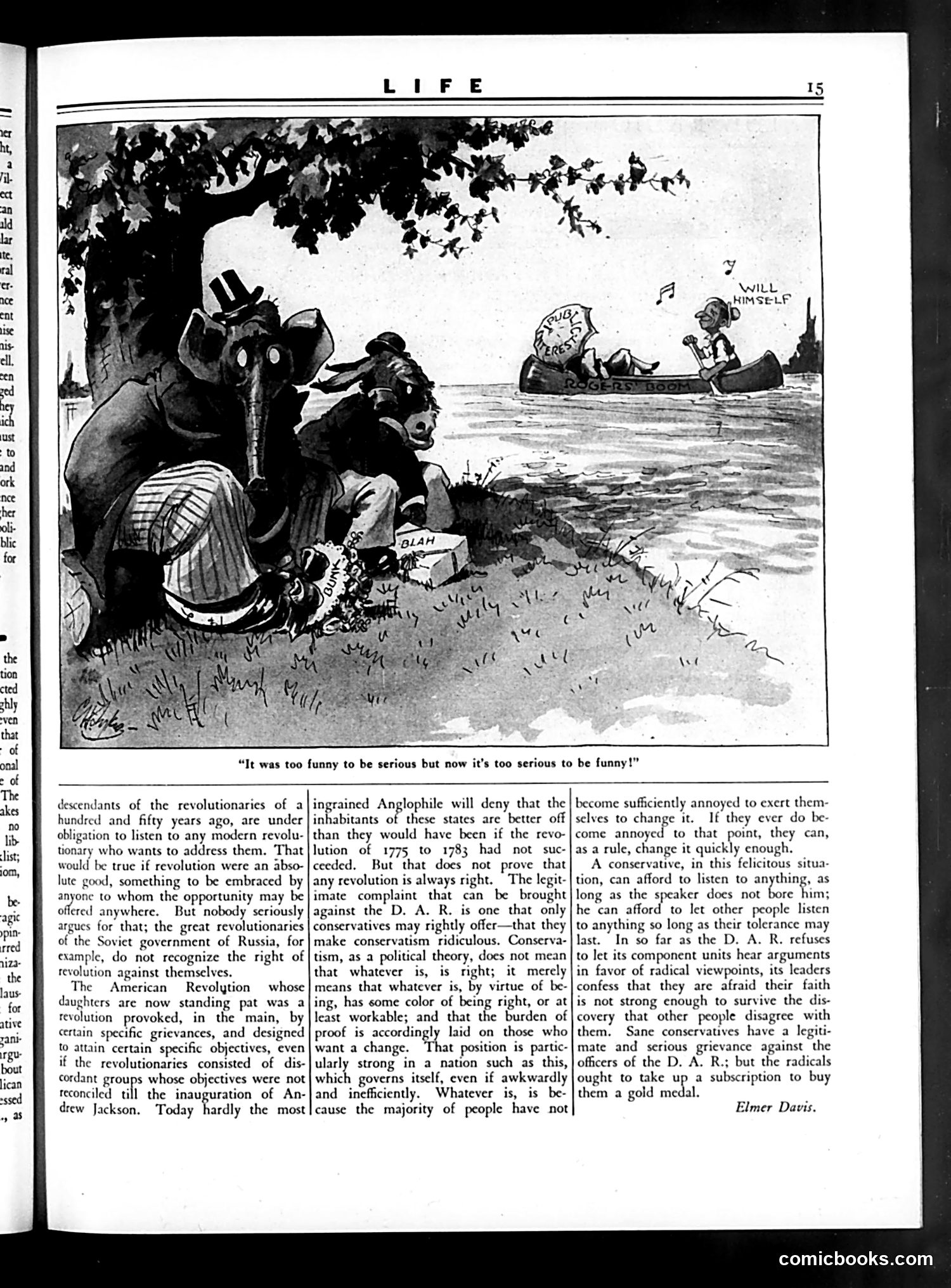
This cartoon satirizes the **Daughters of the American Revolution (D.A.R.)**, a patriotic hereditary organization for descendants of Revolutionary War veterans. The figures on shore—dressed in colonial costume—represent D.A.R. members, while those in boats represent modern Americans trying to enjoy themselves. The caption, "It was too funny to be serious but now it's too serious to be funny!" suggests the D.A.R. has become overly rigid and humorless about their patriotic mission. The accompanying article criticizes the D.A.R. for opposing change and reform, arguing that their conservatism and reverence for Revolutionary ideals has made them intolerant of modern viewpoints. The cartoon mocks how the organization uses historical nostalgia to dismiss contemporary concerns.
📄 Transcribed text from this page (OCR, searchable)
Machine-transcribed from the original scan — historical spelling and the odd misread are preserved.
the tion cted tly ven that - of onal : of The akes no lib list; jom, be agic 7 WILL HIMSELF “It was too funny to be serious but now it’s too serious to be funny!” descendants of the revolutionaries of a hundred and fifty years ago, are under obligation to listen to any modern revolu- tionary who wants to address them. That would be true if revolution were an abso- lute good, something to be embraced by anyone to whom the opportunity may be offered anywhere. But nobody seriously argues for that; the great revolutionaries of the Soviet government of Russia, for example, do not recognize the right of revolution against themselves. The American Revolytion whose daughters are now standing pat was a revolution provoked, in the main, by certain specific grievances, and designed to attain certain specific objectives, even if the revolutionaries consisted of dis- cordant groups whose objectives were not reconciled til the inauguration of An- drew Jackson, Today hardly the most ingrained Anglophile will deny that the inhabitants of these states are better off than they would have been if the revo- lution of 1775 to 1783 had not suc- ceeded. But that does not prove that any revolution is always right. The legit- imate complaint that can be brought against the D. A. R. is one that only conservatives may rightly offer—that they make conservatism ridiculous. Conserva- tism, as a political theory, does not mean that whatever is, is right; it merely means that whatever is, by virtue of be- ing, has some color of being right, or at least workable; and that the burden of proof is accordingly, laid on those who want a change. at position is partic- ularly strong in a nation such as this, which governs itself, even if awkwardly and inefficiently. Whatever is, is be- cause the majority of people have not become sufficiently annoyed to exert them- selves to change it. If they ever do be- come annoyed to that point, they can, as a rule, change it quickly enough. A conservative, in this felicitous situa- tion, can afford to listen to anything, as long as the speaker does not tore him; he can afford to let other people listen to anything so long as their tolerance may last. In so far as the D. A. R. refuses to let its component units hear arguments in favor of radical viewpoints, its leaders confess that they are afraid their faith is not strong enough to survive the dis- covery that other people disagree with them. Sane conservatives have a legiti- mate and serious grievance against the officers of the D. A. R.; but the radicals ought to take up a subscription to buy them a gold medal. Elmer Davis. comicbooks.com