
Life, 1928-07-12 · page 28 of 40
Life — July 12, 1928 — page 28: what you’re looking at
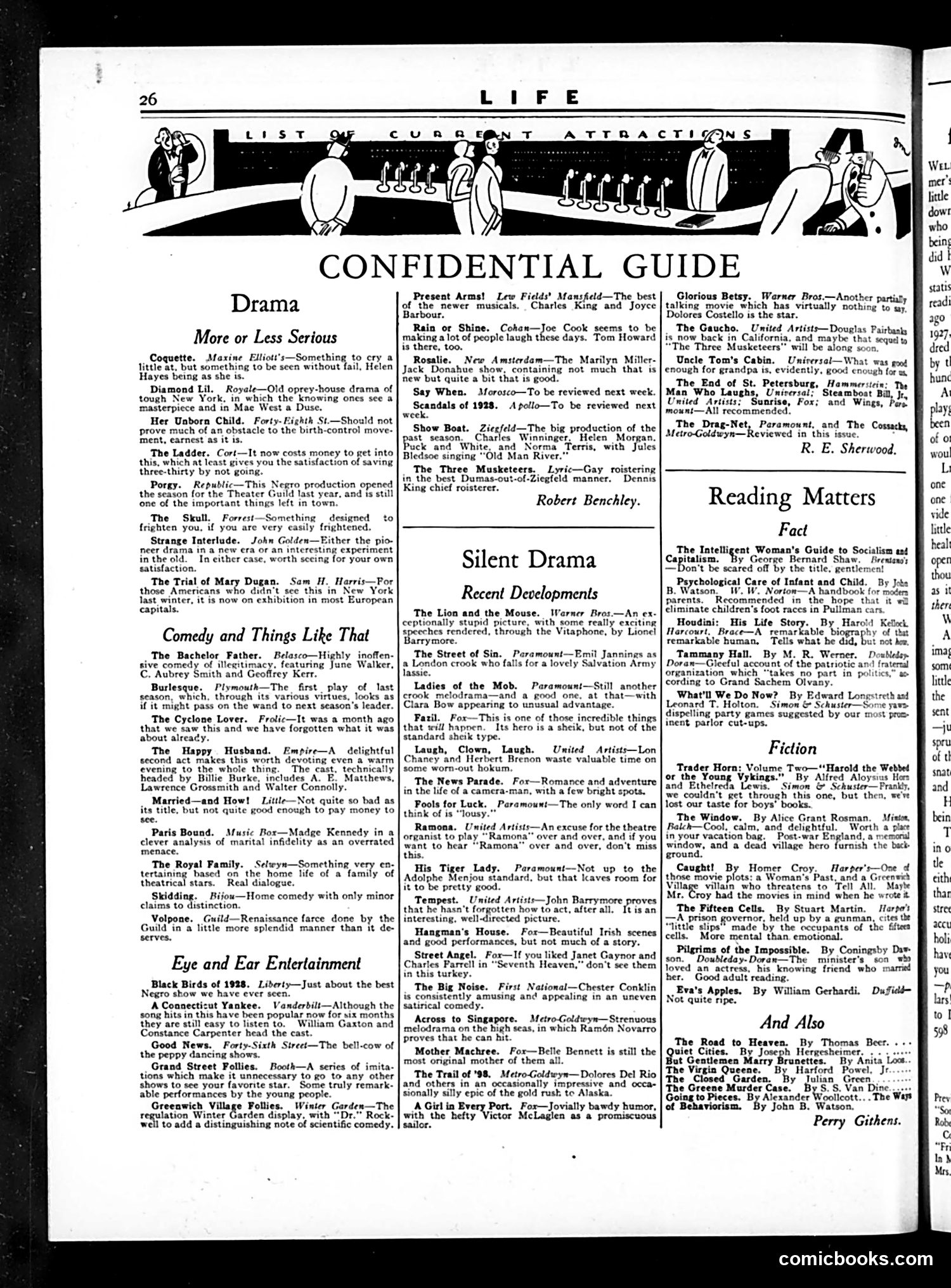
What you’re looking at
This page from *Life* magazine presents entertainment reviews rather than political cartoons. The decorative header showing stylized figures in formal dress establishes the satirical tone, but the content is primarily a theatrical guide. The "Confidential Guide" reviews Broadway productions across categories: serious drama, comedy, and musical entertainment. The writing employs *Life*'s characteristic irreverent humor—mocking poorly-written plays, praising performers like Helen Hayes and Mae West, and dismissing mediocre productions with cutting brevity (e.g., "The Cyclone Lover" was "forgotten" after one viewing). Notable references include *Strange Interlude* (described as either pioneering or experimental), *The Royal Family* (satirizing theatrical dynasties), and Negro productions like *Porgy*, which the reviewer identifies as "one of the important things left in town." The satire functions through condescending wit rather than visual caricature—*Life*'s approach to critiquing 1920s entertainment culture and theatrical pretension.
📄 Transcribed text from this page (OCR, searchable)
Machine-transcribed from the original scan — historical spelling and the odd misread are preserved.
LIFE CONFIDENTIAL GUIDE Drama More or Less Serious Coquette. Maxine Elliott's—Something to cry a little at, but something to be seen without fail, Helen Hayes being as she is. Diamond Lil. Royale—Old oprey-house drama of tough New York, in which the knowing ones see a masterpiece and in Mae West a Duse. Her Unborn Child. Forty-Fighth St.—Should not prove much of an obstacle to the birth-control move- ment, earnest as it is. The Ladder. Cort—It now costs money to get into this, which at least gives you the satisfaction of saving three-thirty by not going. Porgy. Republic—This Negro production opened the season for the Theater Guild last year, and ts still one of the important things left in town, The Skull, Forrest—Something _ designed frighten you, if you are very easily frightened. Strange Interlude. John Golden—Either the pio- neer drama in a new era or an interesting experiment in the old. In either case, worth sceing for your own satisfaction. The Trial of Mary Dugan. those Americans who didn't see this in ) last winter, it is now on exhibition in most capitals. Comedy and Things Like That _The Bachelor Father. Belasco—Highly inoffen- sive comedy of illegitimacy, featuring June Walker, C. Aubrey Smith and Geoffrey Kerr. Burlesque. Plymouth—The first play of last season, which, through its various virtues, looks as if it might pass on the wand to next season's leader. The Cyclone Lover. Frolic—It was a month ago that we saw this and we have forgotten what it was about already. The Happy Husband. Empire—A delightful second act makes this worth devoting even a warm evening to the whole thing. The cast, technically headed by Billie Burke, includes A. E. Matthews, Lawrence Grossmith and Walter Connoll Married—and How! Little—Not quite so bad as its title, but not quite good enough to pay money to see. Paris Bound. Music Bor—Madge Kennedy in a clever analysis of marital infidelity as an overrated menace. The Royal Family. Selwyn—Something very. en. tertaining based on the home life of a family of theatrical stars. Real dialogue. Skidding. Bijou—Home comedy with only minor claims to distinction. Volpone. Guild—Renaissance farce done by the Guild in a little more splendid manner than it de- serves. to Sam H. Harris—For ew York uropean Eye and Ear Entertainment Black Birds of 1928. Liberty—Just about the best Negro show we have ever seen. AConnecticut Yankee. Vanderbilt—Although the song hits in this have been popular now for six months they are still easy to listen to. William Gaxton and Constance Carpenter head the cast. Good News. Faorty-Sixth Street-—The bell-cow of the peppy dancing shows. Grand Street Follies. Booth—A series of imita- tions which make it unnecessary to go to any other shows to see your favorite star. Some truly remark- able performances by the young people. Greenwich Village Follies. Winter Garden—The regulation Winter Garden display, with “Dr.” Rock- well to add a distinguishing note of scientific comedy. A TTRACTIL Present Arms! Lew Fields’ Mansfeld—The best of the newer musicals. Charles King and Joyce Barbour. Rain or Shine. Cohan—Joe Cook seems to be making a lot of people laugh these days. Tom Howard is there, too. Rosalie. New Amsterdam—The Marilyn Miller Jack Donahue show, containing not much that is ew but quite a bit that is good. Say When. Morosco—To be reviewed next week. Scandals of 1928. A pollo—To be reviewed next week. Show Boat. Zierfeld—The big production of the st season. Charles Winninger. Helen Morgan. suck and White, and Norma Terris, with Jules Bledsoe singing “Old Man River.” The Three Musketeers. Lyric—Gay roistering in the best Dumas-out-of-Ziegfeld manner. Dennis King chief roisterer. Robert Benchley. Silent Drama Recent Developments The Lion and the Mouse. Warner Bros.—An ex- ceptionally stupid picture, with some really exciting specches rendered, through the Vitaphone, by Lionel Barrymore. The Street of Sin. Paramount—Emil Jannings as ‘ London crook who falls for a lovely Salvation Army Jassie. Ladies of the Mob. Paramount—Still another crook melodrama—and a good one, at that—with Clara Bow appearing to unusual advantage. Fazil. Fox—This is one of those incredible things that will happen. Its hero is a sheik, but not of the standard sheik type. Laugh, Clown, Laugh. United Artists—Lon Chaney and Herbert Brenon waste valuable time on some worn-out hokum. The News Parade, For—Romance and adventure in the life of a camera-man, with a few bright spots. Fools for Luck. | Paramoumt—The only word I can think of is “lousy."” Ramona. United Artists—An excuse for the theatre organist to play “Ramona” over and over, and if you want to hear “Ramona” over and over, don't miss this. His Tiger Lady. Paramount—Not up to the Adolphe Menjou standard, but that Icaves room for it to be pretty good. Tempest. United Artists—John Barrymore proves that he hasn't forgotten how to act, after all. It is an interesting, well-directed picture. Hangman's House. For—Beautiful Trish scenes and good performances, but not much of a story. Street Angel. Fox—If you liked Janet Gaynor and Charles Farrell in “Seventh Heaven,” don't see them in this turkey. The Big Noi is consistently satirical comedy Across to Singapore. Metro-Goldwyn—Strenuows melodrama on the high seas, in which Ramén Novarro proves that he can hit. Mother Machree. For—Belle Bennett is still the most original mother of them all. The Trail of "98, Metro-Goldwyn—Dolores Del Rio and others in an occasionally impressive and occa- sionally silly epic of the gold rusk to Alaska. A Girl in Every Port. Fox—Jovially bawdy humor, with the hefty Victor McLaglen as « promiscuous sailor. First National—Chester Conklin using and appealing in an uneven We mer’ litle dowr who beings did | W Glorious Betsy. WW Bi Anoth statis lorious Betsy. Warner Bros.—Anoth a talking movie which has virtually nothing tear, [fad Dolores Costello is the star. Bh ago The Gaucho. United Artists—Douglas Pai is now back in California. and maybe that seas, fa 1927: “The Three Musketeers" will be along soon dred Uncle Tom's Cabin. Unirersal—What was oot [by t enough for grandpa is, evidently, good enough for es, ; The End of St. Petersburg, Hammersicin: Ths [y OU% Man Who Laughs, Universal; Steamboat Bill, Jr A United Artists; Sunrise, Fox; and Wings, Pas a mount—All recommended. lays The Drag-Net, Paramount, and The Co n Maro Gedere—lavewed in the eae of 0 R. E. Sherwood. wou! Li . one Reading Matters one vide Fact little The Intelligent Woman's Guide to Socialism ant fp M2! Capitalism. By George Bernard Shaw. fvexenst [oper —Don't be scared off by the title, gentlemen! thou Psychological Care of Infant and Child. By Jobe B. Watson. W. W. Norton—A handbook for moder. asi parents. Recommended in the hope that it wil here ¢liminate children’s foot races in Pullman cars. fen Houdini: His Life Story. By Harold Kelock W Harcourt, Brace—A remarkable bi hy of that A remarkable human, Tells what he did, but not ke. J. Tammany Hall. By M. R. Werner. Doubleder 1M} Doran—Gieeful account of the patriotic and frateral [som organization which “takes no part in politics,” a cording to Grand Sachem Olvany. little What'll We Do Now? By Edward Longstreth ast JB the Leonard T. Holton. Simon & Schuster— ve yar> dispelling party games suggested by our most prom fH sent inent parlor cut-ups. ju taht, Spru Fiction a Trader Horn: Volume Two—‘Harold the Webdel Bonar or the Young Vykings.” By Alfred Aloysius Hor and Ethelreda Lewis. Simon & Schuster—Pranky, J and we couldn't get through this one, but then, we've lost our taste for boys’ books. H The Window. By Alice Grant Rosman. Misi, J bein Bakh—Cool, calm, and delightful. Worth a place T in your vacation bag. Post-war England, a memonal window, and a dead village hero furnish the back JB in o ground. th Caught! By Homer Croy., Har per's—One 4 e those movie plots: a Woman's Past, and a Greenwet BB cith Xitlage villain who threatens to Tell All. Mayte Mr. Croy had the movies in mind when he wrote it J thar The Fifteen Cells. By Stuart Martin. Harpe’ JB stree —A prison governor, held up by a gunman, cites the “little slips made by the accupants of the filter accu cells. More mental than. emotional. boli Pilgrims of the Impossible. By Coningsby Das Mh, son. " Doubleday-Doran—The minister's son ¥! loved an actress, his knowing friend who mamel [i you her. Good adult reading. f Apples. By William Gerhardi. Dufidé= p Not quite ripe. lars: to | And Also The Road to Heaven. By Thomas Beer. Quiet Cities. By Joseph Hermesheimer, - ;« jut Gentlemen Marry Brunettes. By Anita Low. The Virgin Queene. By Harford Powel, Jr... The Closed Garden, By Julian Green The Greene Murder Case. By S. S. Van Dine...... Going to Pieces. By Alexander Woollcott.. . The Ways of Behaviorism. By John B. Watson. Perry Githens. comicbooks.com