
Life, 1928-07-12 · page 16 of 40
Life — July 12, 1928 — page 16: what you’re looking at
What you’re looking at
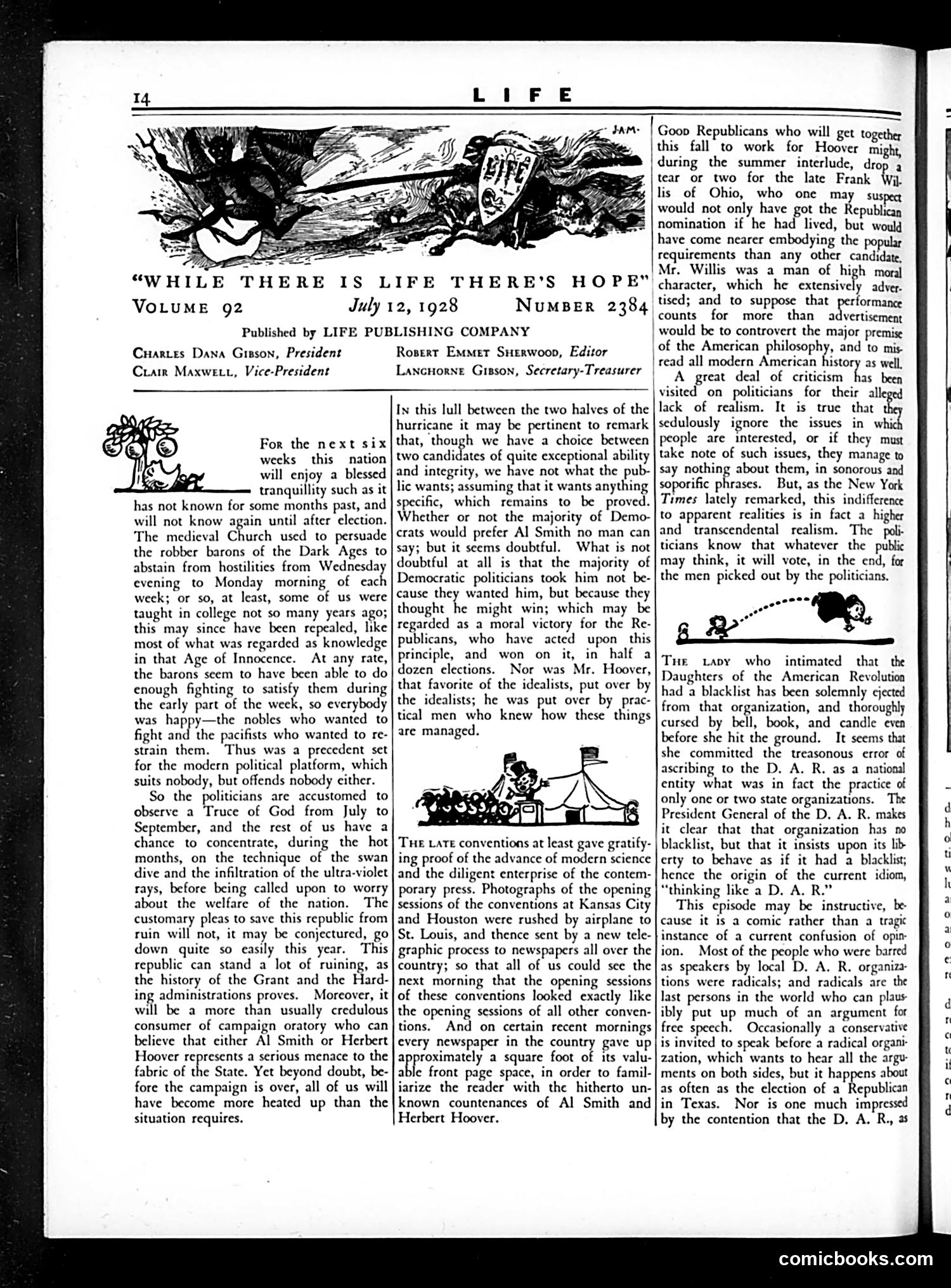
This editorial page critiques the 1928 presidential campaign. The main cartoon (bottom) depicts a mechanical voter-registration apparatus, satirizing how conventions and campaigns have become mechanized processes focused on producing predetermined outcomes rather than genuine democratic choice. The text discusses the Republican choice between Al Smith and Herbert Hoover. The editorial argues that Democratic politicians selected Hoover not because they wanted him, but because they calculated he might win—treating the election as a strategic game rather than a moral choice about who best serves the nation. The secondary cartoon references the Daughters of the American Revolution, mocking a controversy where the organization claimed a "blacklist" of radical speakers, illustrating how organizations ostensibly patriotic were suppressing political speech.
📄 Transcribed text from this page (OCR, searchable)
Machine-transcribed from the original scan — historical spelling and the odd misread are preserved.
~ EAM: “WHILE THERE IS LIFE THERE'S HOPE” VOLUME 92 July 12, 1928 NuMBER 2384 Published by LIFE PUBLISHING COMPANY Cuartes Dana Gisson, President Crain Maxwett, Vice-President Rosert Emmet Suerwoon, Editor LancHorne Grason, Secretary-Treasurer For the next six weeks this nation will enjoy a blessed tranquillity such as it has not known for some months past, and will not know again until after election. The medieval Church used to persuade the robber barons of the Dark Ages to abstain from hostilities from Wednesday evening to Monday morning of each week; or so, at least, some of us were taught in college not so many years ago; this may since have been repealed, like most of what was regarded as knowledge in that Age of Innocence. At any rate, the barons seem to have been able to do enough fighting to satisfy them during the early part of the week, so everybody was happy—the nobles who wanted to fight and the pacifists who wanted to re- strain them. Thus was a precedent set for the modern political platform, which suits nobody, but offends nobody either. So the politicians are accustomed to observe a Truce of God from July to September, and the rest of us have a chance to concentrate, during the hot months, on the technique of the swan dive and the infiltration of the ultra-violet rays, before being called upon to worry about the welfare of the nation. The customary pleas to save this republic from ruin will not, it may be conjectured, go down quite so easily this year. This republic can stand a lot of ruining, as the history of the Grant and the Hard- ing administrations proves. Moreover, it will be a more than usually credulous consumer of campaign oratory who can believe that cither Al Smith or Herbert Hoover represents a serious menace to the fabric of the State. Yet beyond doubt, be- fore the campaign is over, all of us will have become more heated up than the situation requires. Iv this lull between the two halves of the hurricane it may be pertinent to remark that, though we have a choice between two Candidates of quite exceptional ability and integrity, we have not what the pub- lic wants; assuming that it wants anything specific, which remains to be proved. Whether or not the majority of Demo- crats would prefer Al Smith no man can say; but it seems doubtful. What is not doubtful at all is that the majority of Democratic politicians took him not be- cause they wanted him, but because they thought he might win; which may be regarded as a moral victory for the Re- publicans, who have acted upon this principle, and won on it, in half a dozen elections. Nor was Mr. Hoover, that favorite of the idealists, put over by the idealists; he was put over by prac- tical men who knew how these things are managed. Tue Late conventions at least gave gratify- ing proof of the advance of modern science and the diligent enterprise of the contem- porary press. Photographs of the opening sessions of the conventions at Kansas City and Houston were rushed by airplane to St. Louis, and thence sent by a new tele- graphic process to newspapers all over the country; so that all of us could sce the next morning that the opening sessions of these conventions looked exactly like the opening sessions of all other conven- tions. And on certain recent mornings every newspaper in the country gave up approximately a square foot of its valu- able front page space, in order to famil- iarize the reader with the hitherto un- known countenances of Al Smith and Herbert Hoover. | Goo Republicans who will get to | this fall’ to work for Haske ire during the summer interlude, dro a tear or two for the late Frank Wil. lis of Ohio, who one may sus would not only have got the Republican nomination if he had lived, but would have come nearer embodying the popular requirements than any other candidate, Mr. Willis was a man of high moral character, which he extensively adver. tised; and to suppose that performance counts for more than advertisement would be to controvert the major premise of the American philosophy, and to mis read all modern American history as well, A. great deal of criticism has been visited on politicians for their alle; lack of realism. It is true that o sedulously ignore the issues in whi people are interested, or if they must take note of such issues, they manage to say poring about them, in sonorous and soporific phrases. But, as the New York Times lately remarked, this indifference to apparent realities is in fact a higher and transcendental realism. The _poli- ticians know that whatever the public may think, it will vote, in the end, for the men picked out by the politicians, Tue avy who intimated that the Daughters of the American Revolution had a blacklist has been solemnly ejected from that organization, and thoroughly cursed by bell, book, and candle even before she hit the ground. It seems that she committed the treasonous error of ascribing to the D. A. R. as a national entity what was in fact the practice of only one or two state organizations. The President General of the D, A. R. makes it clear that that organization has no blacklist, but that it insists upon its lib erty to behave as if it had a blacklist; hence the origin of the current idiom, “thinking like a D, A. R.” This episode may be instructive, be cause it is a comic rather than a tragic instance of a current confusion of opin- ion. Most of the people who were barred as speakers by local D. A. R. organiza- tions were radicals; and radicals are the last persons in the world who can plaus ibly put up much of an argument for free speech. Occasionally a conservative is invited to speak before a radical organi- zation, which wants to hear all the argu- ments on both sides, but it happens about as often as the election of a Republican in Texas. Nor is one much impressed by the contention that the D, A. R., a comicbooks.com