
Life, 1928-07-12 · page 25 of 40
Life — July 12, 1928 — page 25: what you’re looking at
What you’re looking at
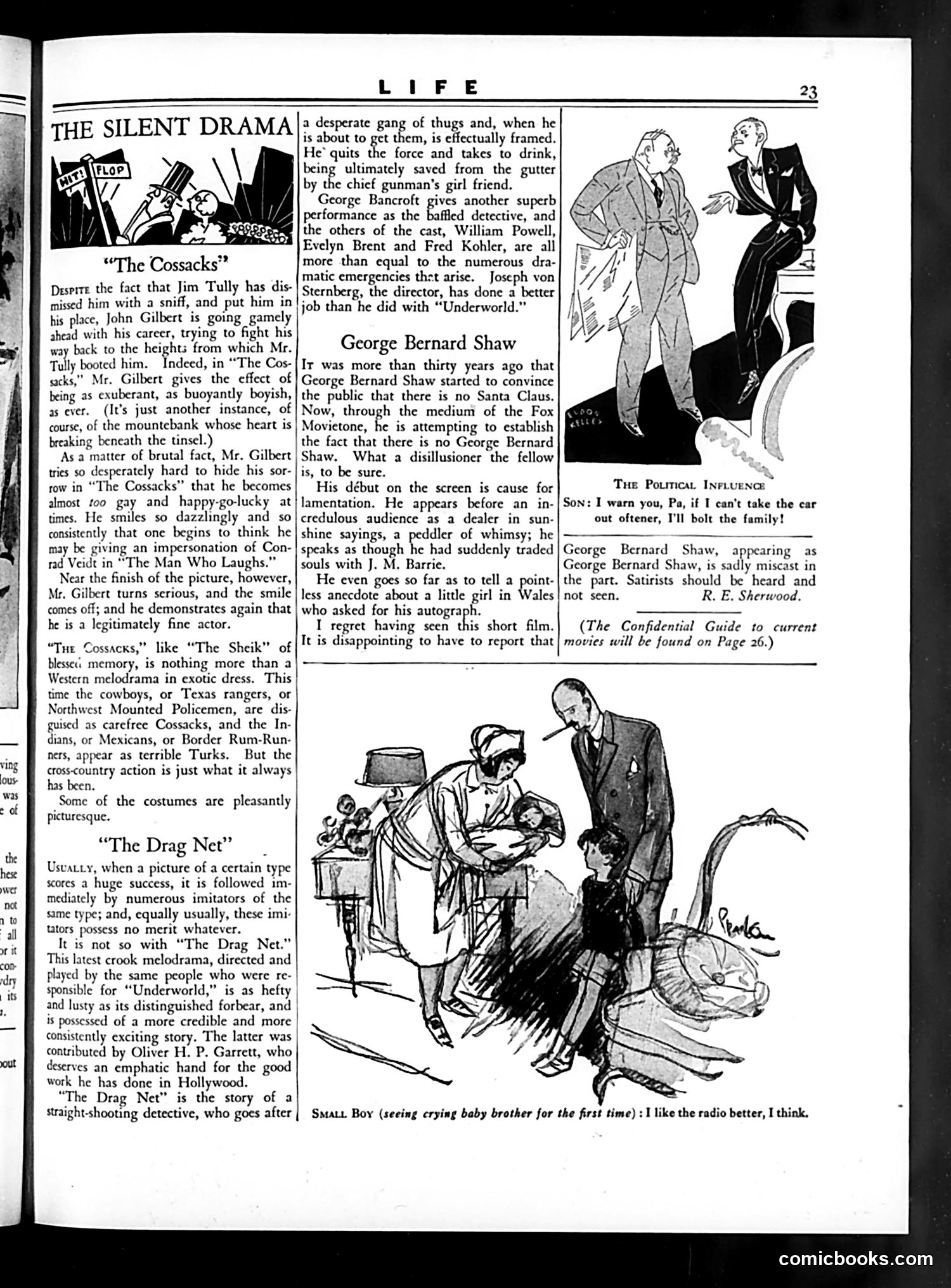
This page reviews three films and includes a political cartoon about parental authority. **Film Reviews:** The page critiques "The Cossacks" (starring John Gilbert), "The Drag Net," and a Movietone short featuring playwright George Bernard Shaw. The reviews note that Gilbert performs well despite personal struggles, while "The Drag Net" is praised as a superior gangster melodrama. Shaw's film appearance is mocked—the critic laments that Shaw, famous for his witty social criticism, appears on screen as a purveyor of saccharine platitudes, "trading souls" with sentimentalist J.M. Barrie. **Political Cartoon:** The cartoon titled "The Political Influence" depicts a son threatening his father that he'll "bolt the family" if denied use of the car. This satirizes 1920s youth rebellion and changing family dynamics—the son weaponizes abandonment to demand modern privileges, suggesting parental authority is collapsing. The joke reflects contemporary anxiety about generational conflict and automobile culture's social impact.
📄 Transcribed text from this page (OCR, searchable)
Machine-transcribed from the original scan — historical spelling and the odd misread are preserved.
LIFE “The Cossacks” Desprre the fact that Jim Tully has dis- missed him with a sniff, and put him in his place, John Gilbert is going gamely ahead with his career, trying to fight his way back to the heights from which Mr. Tully booted him. Indeed, in ““The Cos- sacks,” Mr. Gilbert gives the effect of being as exuberant, as buoyandy boyish, as ever. (It’s just another instance, of course, of the mountebank whose heart is breaking beneath the tinsel.) Asa matter of brutal fact, Mr. Gilbert tries so desperately hard to hide his sor- row in “The Cossacks” that he becomes almost too gay and happy-go-lucky at times. He smiles so dazzlingly and so consistently that one begins to think he may be giving an impersonation of Con- rad Veidt in “The Man Who Laughs.” Near the finish of the picture, however, Mr. Gilbert turns serious, and the smile comes off; and he demonstrates again that he is a legitimately fine actor. “Tue Cossacks,” like “The Sheik” of blesseci: memory, is nothing more than a Western melodrama in exotic dress. This time the cowboys, or Texas rangers, or Northwest Mounted Policemen, are dis- guised as carefree Cossacks, and the In- dians, or Mexicans, or Border Rum-Run- ners, appear as terrible Turks. But the cross-country action is just what it always has been. Some of the costumes are pleasantly picturesque. “The Drag Net” Usvatty, when a picture of a certain type scores a huge success, it is followed im- mediately by numerous imitators of the same type; and, equally usually, these imi- lators possess no merit whatever. It is not so with “The Drag Net.” This latest crook melodrama, directed and played by the same people who were re- sponsible for “Underworld,” is as hefty and lusty as its distinguished forbear, and is possessed of a more credible and more consistently exciting story. The latter was contributed by Oliver H. P. Garrett, who deserves an emphatic hand for the good work he has done in Hollywood. “The Drag Net” is the story of a straight-shooting detective, who goes after a desperate gang of thugs and, when he is about to get them, is effectually framed. He* quits the force and takes to drink, being ultimately saved from the gutter by the chief gunman’s girl friend. George Bancroft gives another superb performance as the baffled detective, and the others of the cast, William Powell, Evelyn Brent and Fred Kohler, are all more than equal to the numerous dra- matic emergencies that arise. Joseph von Sternberg, the director, has done a better job than he did with “Underworld.” George Bernard Shaw Ir was more than thirty years ago that George Bernard Shaw started to convince the public that there is no Santa Claus. Now, through the medium of the Fox Movietone, he is attempting to establish the fact that there is no George Bernard Shaw. What a disillusioner the fellow is, to be sure. His début on the screen is cause for lamentation. He appears before an in- credulous audience as a dealer in sun- shine sayings, a peddler of whimsy; he speaks as though he had suddenly traded souls with J. M. Barrie. He even goes so far as to tell a point- less anecdote about a little girl in Wales who asked for his autograph. I regret having seen this short film. Tt is disappointing to have to report that Tue Poumica, INeLuence Son: I warn you, Pa, if I can't take the car out oftener, I'll bolt the family! George Bernard Shaw, appearing as George Bernard Shaw, is sadly miscast in the part. Satirists should be heard and not seen. R. E. Sherwood. (The Confidential Guide to current movies will be found on Page 26.) Smart Boy (seeing crying baby brother for the first time) :1 like the radio better, I think. comicbooks.com