
Life, 1928-07-12 · page 20 of 40
Life — July 12, 1928 — page 20: what you’re looking at
What you’re looking at
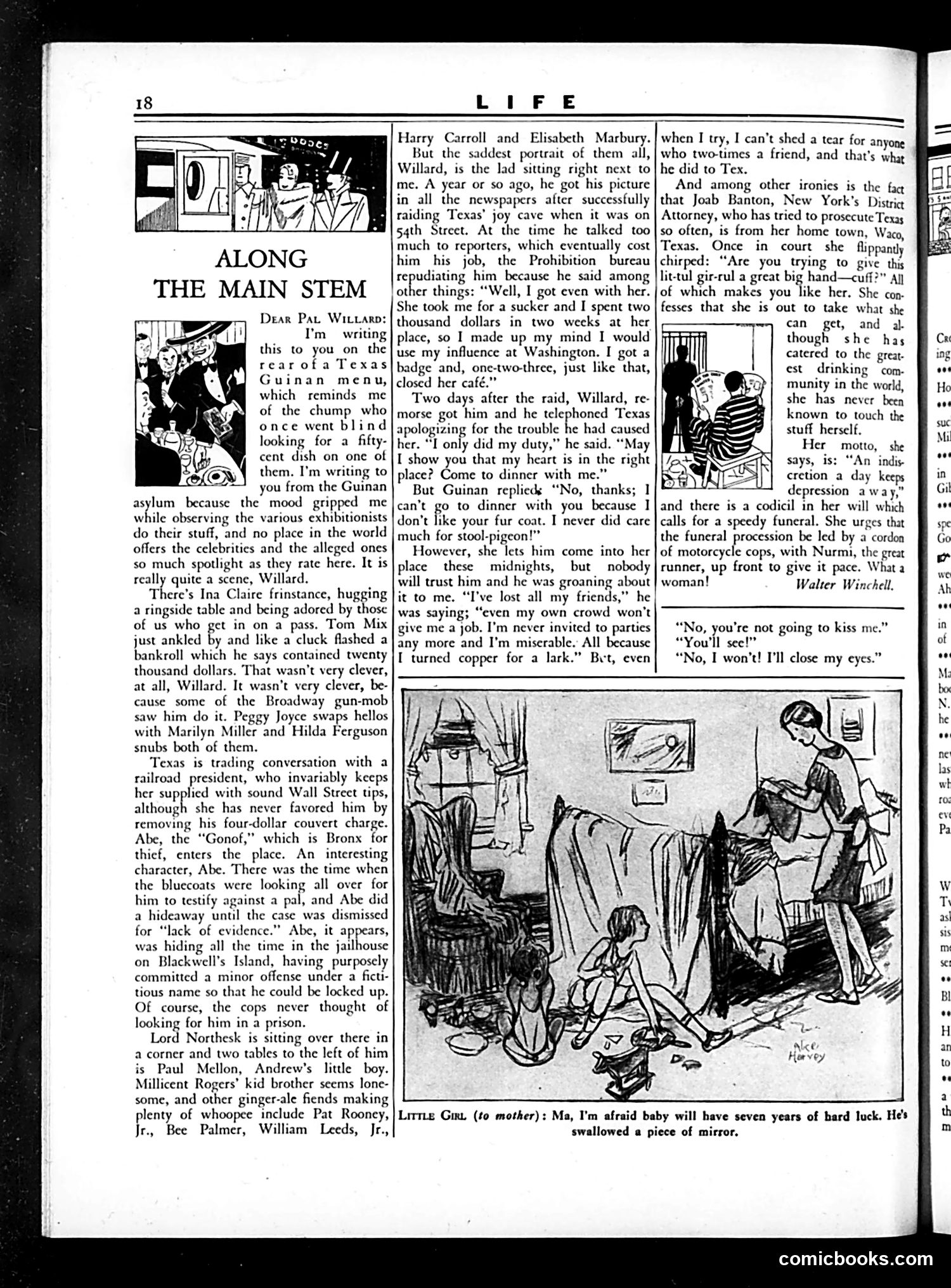
This page satirizes 1920s Manhattan nightclub culture, specifically Texas Guinan's famous speakeasy during Prohibition. The column mocks various celebrities and hangers-on frequenting these illegal establishments. The central irony concerns a Prohibition enforcement agent who raided Guinan's club, then apologized and sought her friendship—only to be shunned by the very social circle he'd courted. The satire critiques his hypocrisy: he betrayed his friend for a government "badge," destroying his reputation among Broadway's elite. The cartoon below (captioned about a child swallowing mirror glass) appears unrelated to the main text—typical of Life's mixed-content format. The piece mocks both Prohibition's ineffectiveness (speakeasies openly operated) and the moral bankruptcy of those seeking social status by informing on their peers. It's essentially a gossip column dressed as social criticism, naming actual celebrities (Ina Claire, Peggy Joyce) who frequented such venues.
📄 Transcribed text from this page (OCR, searchable)
Machine-transcribed from the original scan — historical spelling and the odd misread are preserved.
LIFE THE MAIN STEM Dear Pac Witvarp: I'm writing this to you on the rearofa Texas Guinan menu, which reminds me of the chump who once went blind looking for a fifty- cent dish on one of them. I'm writing to you from the Guinan sue because the mood gripped me while observing the various exhibitionists do their stuff, and no place in the world offers the celebrities and the alleged ones so much spotlight as they rate here. It is really quite a scene, Willard. There’s Ina Claire frinstance, hugging a ringside table and being adored by those of us who get in on a pass. Tom Mix just ankled by and like a cluck flashed a bankroll which he says contained twenty thousand dollars. That wasn’t very clever, at all, Willard. It wasn’t very clever, be- cause some of the Broadway gun-mob saw him do it. Peggy Joyce swaps hellos with Marilyn Miller and Hilda Ferguson snubs both of them. Texas is trading conversation with a railroad president, who invariably keeps her supplied with sound Wall Strect tips, although she has never favored him by removing his four-dollar couvert charge. Abe, the “Gonof,” which is Bronx for thicf, enters the place. An_ interesting character, Abe. There was the time when the bluecoats were looking all over for him to testify against a pal, and Abe did a hideaway until the case was dismissed for “lack of evidence.” Abe, it appears, was hiding all the time in the jailhouse on Blackwell's Island, having purposely committed a minor offense under a ficti- tious name so that he could be locked up. Of course, the cops never thought of looking for him in a prison. Lord Northesk is sitting over there in a corner and two tables to the left of him is Paul Mellon, Andrew’s little boy. Millicent Rogers’ kid brother seems lone- some, and other ginger-ale fiends making plenty of whoopce include Pat Rooney, Jr., Bee Palmer, William Leeds, Jr., Harry Carroll and Elisabeth Marbury. But the saddest portrait of them all, Willard, is the lad sitting right next to me. A year or so ago, he got his picture in all the newspapers after successfully raiding Texas’ joy cave when it was on 54th Street. At the time he talked too much to reporters, which eventually cost him his job, the Prohibition bureau repudiating him because he said among other things: “Well, I got even with her. She took me for a sucker and I spent two thousand dollars in two weeks at her place, so I made up my mind I would use my influence at Washington. I got a badge and, one-two-three, just like that, closed her café."” Two days after the raid, Willard, re- morse got him and he telephoned Texas apologizing for the trouble he had caused her. “I only did my duty,” he said. “May I show you that my heart is in the right place? Come to dinner with me.” But Guinan replieds ‘No, thanks; 1 can’t go to dinner with you because I don’t like your fur coat. I never did care much for stool-pigeon!”” However, she lets him come into her place these midnights, but nobody will trust him and he was groaning about it to me. “I've lost all my friends,” he was saying; “even my own crowd won't give me a job. I’m never invited to parties any more and I'm miserable. All because I turned copper for a lark.” But, even when I try, I can’t shed a tear for anyone who two-times a friend, and that’s what he did to Tex. And among other ironies is the fact that Joab Banton, New York's District Attorney, who has tried to prosecute Texas so often, is from her home town, Waco Texas. Once in court she flippantly chirped: “Are you trying to give this lit-tul gir-rul a great big hand—cuff?” Al] of which makes you like her. She con. fesses that she is out to take what she can get, and al. though she has catered to the great est drinking com. munity in the world, she has never been known to touch the stuff herself. Her motto, she says, is: “An indis cretion a day keeps depression away,” and there is a codicil in her will which calls for a speedy funeral. She urges that the funeral procession be led by a cordon of motorcycle cops, with Nurmi, the great runner, up front to give it pace. What a woman! Walter Winchell, “No, you're not going to kiss me.” “You'll see!” “No, I won't! I'll close my eyes.” alce Harvey Lrrmte Gint (to mother): Ma, I'm afraid baby will have seven years of bard luck. He's swallowed a piece of mirror. comicbooks.com