
Life, 1928-07-12 · page 11 of 40
Life — July 12, 1928 — page 11: what you’re looking at
What you’re looking at
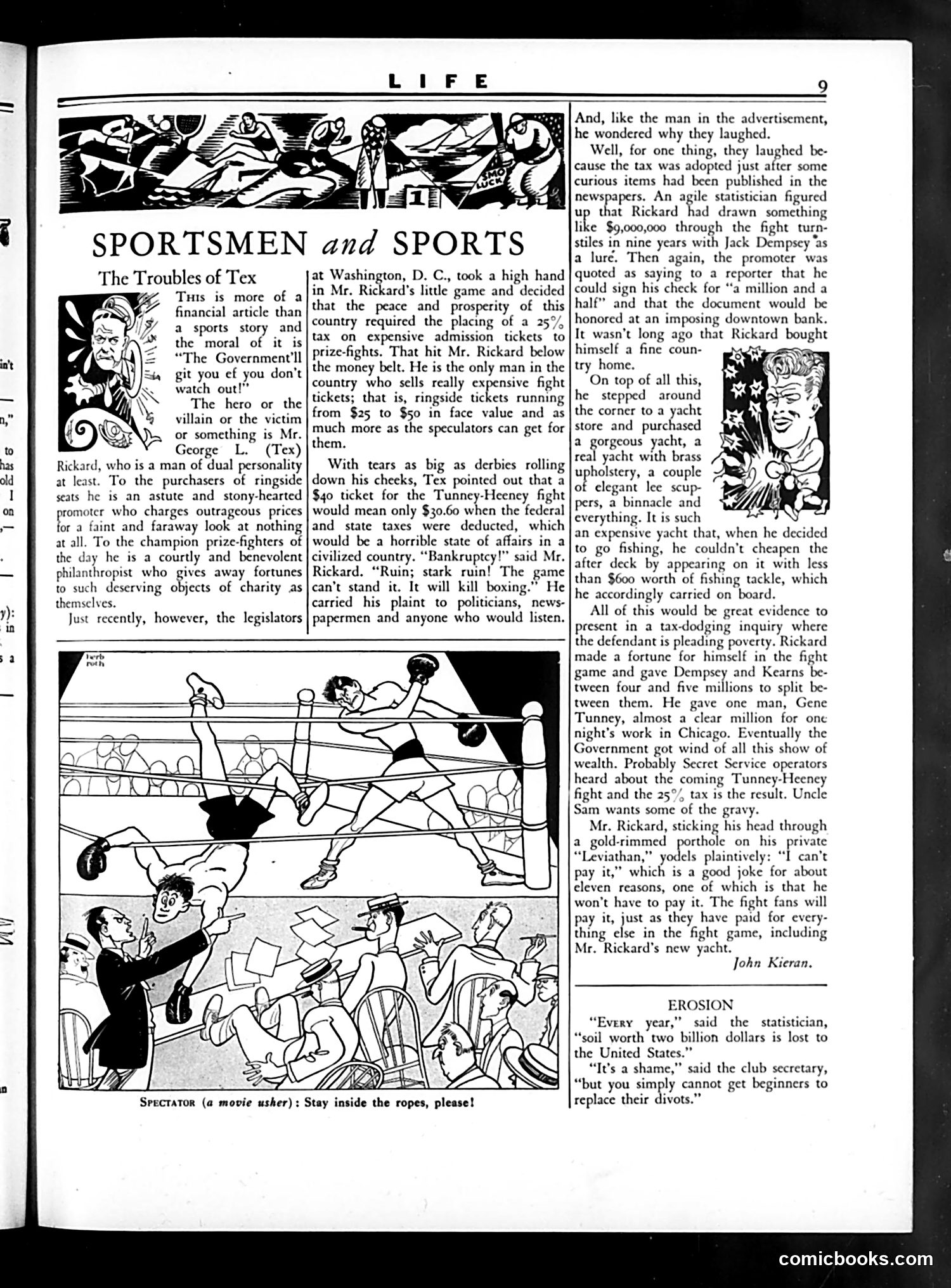
This article satirizes a real controversy over a 25% federal tax on expensive boxing tickets, championed by promoter George L. "Tex" Rickard. The piece mocks Rickard's complaint that the tax is economically destructive, while noting his hypocrisy: he made enormous wealth from fights (the article mentions $9 million from a Dempsey-Carpentier bout) and even purchased a yacht afterward. The satire's point: Rickard profited vastly from boxing but complained when the *government* taxed fight tickets, claiming poverty. The cartoon illustrating the piece shows a boxing match's chaotic scene, emphasizing the sport's rowdy nature. John Kieran's byline indicates this is serious sports criticism disguised as humor, targeting wealthy promoters' tax avoidance and self-serving arguments.
📄 Transcribed text from this page (OCR, searchable)
Machine-transcribed from the original scan — historical spelling and the odd misread are preserved.
9 SPORTSMEN and SPORTS The Troubles of Tex Tuts is more of a financial article than a sports story and the moral of it is “The Government'll git you ef you don’t watch out!” The hero or the villain or the victim or something is Mr. George L. (Tex) Rickard, who is a man of dual personality at least. To the purchasers of ringside seats he is an astute and stony-hearted promoter who charges outrageous prices for a faint and faraway look at nothing at all. To the champion prize-fighters of the day he is a courtly and benevolent philanthropist who gives away fortunes to such deserving objects of charity as themselves. Just recently, however, the legislators at Washington, D. C., took a high hand in Mr. Rickard’s little game and decided that the peace and prosperity of this country required the placing of a 25% tax on expensive admission tickets to prize-fights. That hit Mr. Rickard below the money belt. He is the only man in the country who sells really expensive fight tickets; that is, ringside tickets running from $25 to $50 in face value and as much more as the speculators can get for them. With tears as big as derbies rolling down his cheeks, Tex pointed out that a $40 ticket for the Tunney-Heeney fight would mean only $30.60 when the federal and state taxes were deducted, which would be a horrible state of affairs in a civilized country. “Bankruptcy!” said Mr. Rickard. “Ruin; stark ruin! The game can’t stand it. It will kill boxing.” He carried his plaint to politicians, news- papermen and anyone who would listen. Spectator (a movie usher): Stay inside the ropes, please! And, like the man in the advertisement, he wondered why they laughed. Well, for one thing, they laughed be- cause the tax was adopted just ater some curious items had been published in the newspapers. An agile statistician figured up that Rickard had drawn something like $9,000,000 through the fight turn- stiles in nine years with Jack Dempsey “as a lure. Then again, the promoter was quoted as saying to a reporter that he could sign his check for ‘‘a million and a half” and that the document would be honored at an imposing downtown bank. It wasn’t long ago that Rickard bought himself a fine coun- try home. On top of all this, he stepped around the corner to a yacht store and purchased a gorgeous yacht, a real yacht with brass upholstery, a couple of elegant lee scup- pers, a binnacle and everything. It is such an expensive yacht that, when he decided to go fishing, he couldn't cheapen the after deck by appearing on it with less than $600 worth of fishing tackle, which he accordingly carried on board. All of this would be great evidence to present in a tax-dodging inquiry where the defendant is pleading poverty. Rickard made a fortune for himself in the fight game and gave Dempsey and Kearns be- tween four and five millions to split be- tween them. He gave one man, Gene Tunney, almost a clear million for one night’s work in Chicago. Eventually the Government got wind of all this show of wealth. Probably Secret Service operators heard about the coming Tunney-Heeney fight and the 25°, tax is the result. Uncle Sam wants some of the gravy. Mr. Rickard, sticking his head through a gold-rimmed porthole on his private “Leviathan,” yodels plaintively: “I can't pay it,” which is a good joke for about eleven reasons, one of which is that he won't have to pay it. The fight fans will pay it, just as they have paid for every- thing else in the fight game, including Mr. Rickard’s new yacht. John Kieran. EROSION “Every year,” said the statistician, “soil worth two billion dollars is lost to the United States.” “It’s a shame,” said the club secretary, “but you simply cannot get beginners to replace their divots.”” comicbooks.com