
Life, 1928-07-12 · page 14 of 40
Life — July 12, 1928 — page 14: what you’re looking at
What you’re looking at
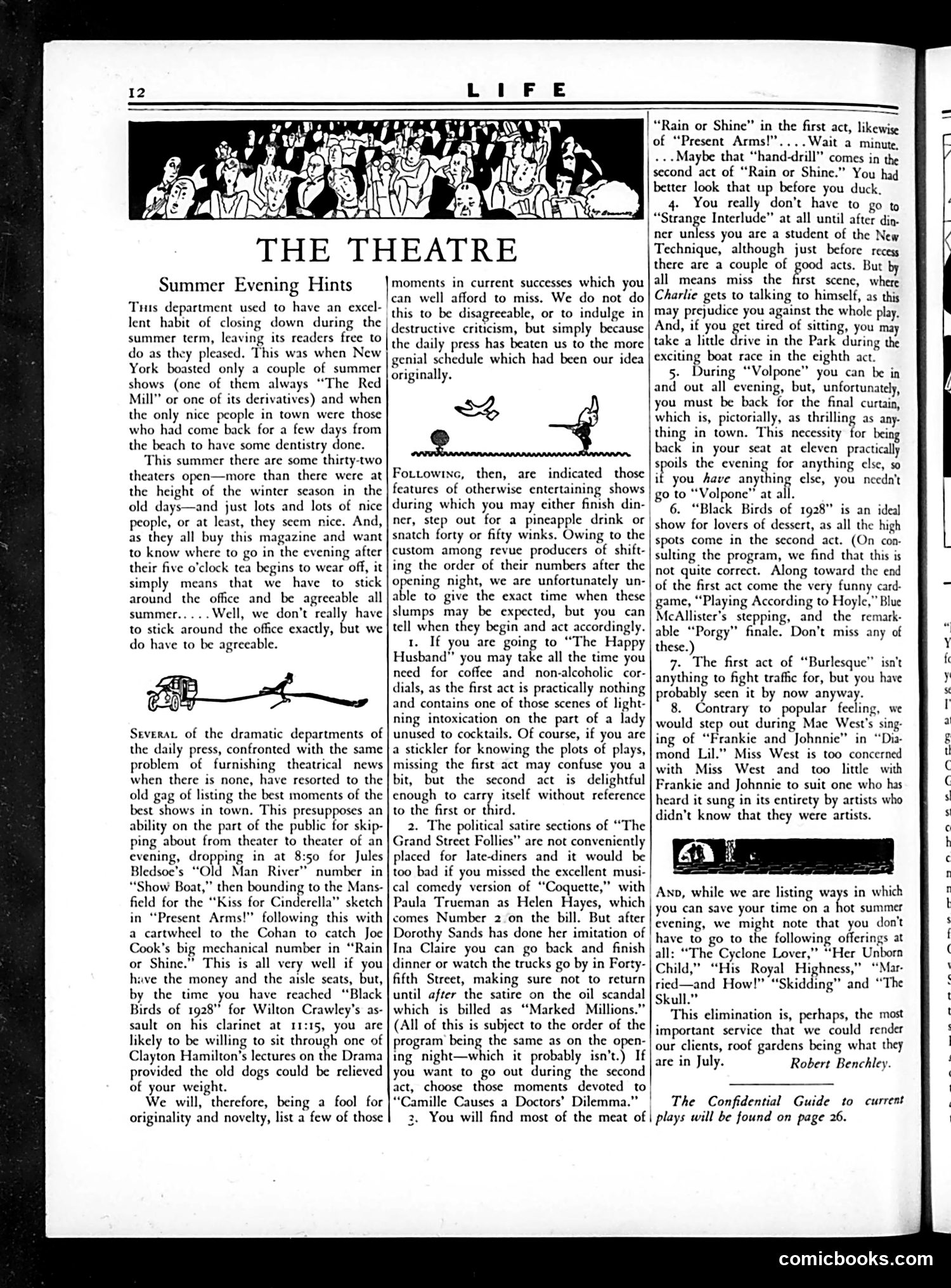
This is a theater column offering summer entertainment advice for New York theatergoers. The small decorative cartoons show simplified figures in leisure poses—one appears to be relaxing, another fishing—illustrating the "summer evening hints" theme. The column discusses which Broadway shows are worth seeing during summer, when many venues close and attendance drops. It references specific productions like "Rain or Shine," "Present Arms," "Strange Interlude," "Volpone," and "Black Birds of 1928," offering guidance on which acts can be skipped or which moments justify the ticket price. The satire is gentle: the author pokes fun at the theatrical custom of listing only the "best moments" of shows, suggesting readers strategically time their arrivals to catch highlights while avoiding slower passages—practical advice for a summer audience tired of sitting indoors.
📄 Transcribed text from this page (OCR, searchable)
Machine-transcribed from the original scan — historical spelling and the odd misread are preserved.
’ rx a ie y j as v, £4 THE THEATRE Summer Evening Hints Tuts department used to have an excel- lent habit of closing down during the summer term, leaving its readers free to do as they pleased. This was when New York boasted only a couple of summer shows (one of them always “The Red Mill” or one of its derivatives) and when the only nice people in town were those who had come back for a few days from the beach to have some dentistry done. This summer there are some thirty-two theaters open—more than there were at the height of the winter season in the old days—and just lots and lots of nice people, or at least, they seem nice. And, as they all buy this magazine and want to know where to go in the evening after their five o'clock tea begins to wear off, it simply means that we have to stick around the office and be agreeable all summer... ..Well, we don’t really have to stick around the office exactly, but we do have to be agreeable. <e_—_ Severat of the dramatic departments of the daily press, confronted with the same problem of furnishing theatrical news when there is none, have resorted to the old gag of listing the best moments of the best shows in town. This presupposes an ability on the part of the public for skip- ping about from theater to theater of an evening, dropping in at 8:50 for Jules Bledsoe’s “Old Man River” number in “Show Boat,” then bounding to the Mans- field for the “Kiss for Cinderella” sketch in “Present Arms!" following this with a cartwheel to the Cohan to catch Joe Cook’s big mechanical number in “Rain or Shine.” This is all very well if you have the money and the aisle seats, but, by the time you have reached “Black Birds of 1928” for Wilton Crawley’s as- sault on his clarinet at 11:15, you are likely to be willing to sit through one of Clayton Hamilton’s lectures on the Drama provided the old dogs could be relieved of your weight. We will, therefore, being a fool for originality and novelty, list a few of those woare BR, i, | moments in current successes which you can well afford to miss. We do not do this to be disagreeable, or to indulge in destructive criticism, but simply because the daily press has beaten us to the more genial schedule which had been our idea originally, Fottowinc, then, are indicated those features of otherwise entertaining shows during which you may either finish din- ner, step out for a pineapple drink or snatch forty or fifty winks. Owing to the custom among revue producers of shift- ing the order of their numbers after the opening night, we are unfortunately un- able to give the exact time when these slumps may be expected, but you can tell when they begin and act accordingly. 1. If you are going to “The Happy Husband” you may take all the time you need for coffee and non-alcoholic cor- dials, as the first act is practically nothing and contains one of those scenes of light- ning intoxication on the part of a lady unused to cocktails, Of course, if you are a stickler for knowing the plots of plays, missing the first act may confuse you a bit, but the second act is delightful enough to carry itself without reference to the first or third. 2. The political satire sections of “The Grand Street Follies” are not conveniently placed for late-diners and it would be too bad if you missed the excellent musi- cal comedy version of “Coquette,” with Paula Trueman as Helen Hayes, which comes Number 2 0n the bill. But after Dorothy Sands has done her imitation of Ina Claire you can go back and finish dinner or watch the trucks go by in Forty- fifth Street, making sure not to return until after the satire on the oil scandal which is billed as “Marked Millions.” (All of this is subject to the order of the program’ being the same as on the open- ing night—which it probably isn’t.) If you want to go out during the second act, choose those moments devoted to] “Camille Causes a Doctors’ Dilemma.” 2. You will find most of the meat of | | “Rain or Shine” in the first act, likewise of “Present Arms!”....Wait a minute, .»»Maybe that “hand-drill” comes in the second act of “Rain or Shine.” You had better look that up before you duck, 4. You really don’t have to go to “Strange Interlude” at all until after din ner unless you are a student of the New Technique, although just before recess there are a couple of good acts. But by all means miss the a scene, where Charlie gets to talking to himself, as this may prejudice you against the whole play, And, if you get tired of sitting, you may take a little drive in the Park during the exciting boat race in the eighth act. 5. During “Volpone” you can be in and out all evening, but, unfortunately, you must be back for the final curtain, which is, pictorially, as thrilling as any- thing in town. This necessity for being back in your seat at eleven practically spoils the evening for anything else, so if you have anything else, you needn't go to “Volpone”’ at all. 6. “Black Birds of 1928” is an ideal show for lovers of dessert, as all the high spots come in the second act. (On con- sulting the program, we find that this is not quite correct. Along toward the end of the first act come the very funny card- game, “Playing According to Hoyle,” Blue McAllister’s stepping, and the remark- able “Porgy” finale. Don’t miss any of these.) 7. The first act of “Burlesque” isn’t anything to fight traffic for, but you have probably seen it by now anyway. 8. Contrary to popular feeling, we would step out during Mae West's sing- ing of “Frankie and Johnnie” in “Dia- mond Lil.” Miss West is too concerned with Miss West and too little with Frankie and Johnnie to suit one who has heard it sung in its entirety by artists who didn’t know that they were artists. Ano, while we are listing ways in which you can save your time on a foe summer evening, we might note that you don’t have to go to the following offerings at all: “The Cyclone Lover,” “Her Unborn Child,” “His Royal Highness,” “Mar- ricd—and How!” “Skidding” and “The Skull.” This elimination is, perhaps, the most important service that we could render our clients, roof gardens being what they are in July. Robert Benchley. The Confidential Guide to current plays will be found on page 26. comicbooks.com