
A complete issue · 50 pages · 1928
Life — May 10, 1928

This appears to be a **cover or title page** for Life magazine's May 1928 issue, priced at 15 cents. The masthead indicates sections for "Amusement News," "Personalities," and "Sport." The large typography reading "this is the NOW LIFE" likely references the **contemporary moment** of the 1920s—the Jazz Age and modern era. Without additional page content visible, I cannot identify specific cartoons or political commentary. The design emphasizes bold, modern typography typical of 1920s graphic style. The library stamp indicates this copy was archived at the University of Chicago. The overall layout suggests this is primarily a title/cover page rather than substantive satirical content.
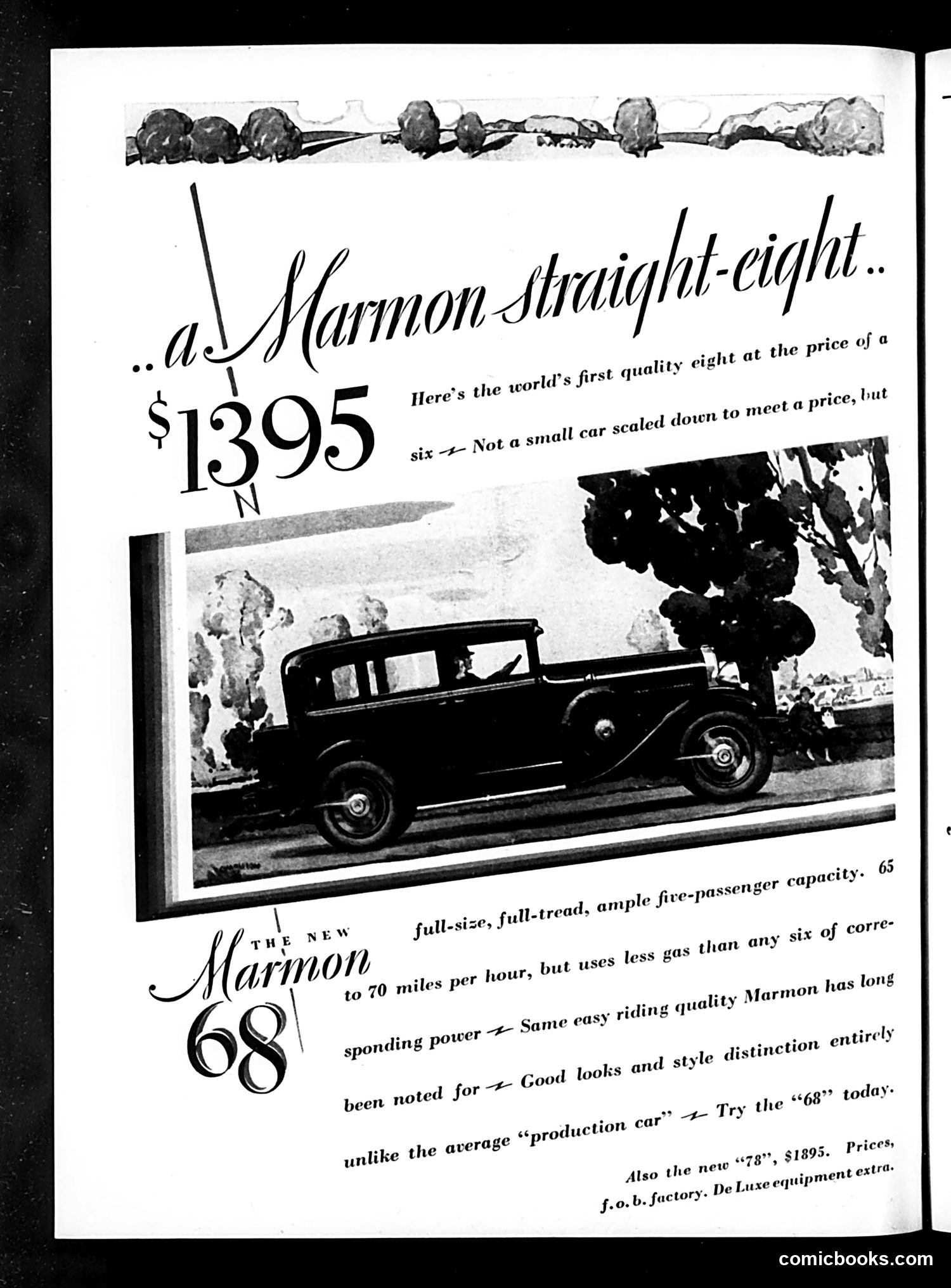
This is **an automobile advertisement, not a cartoon or satire**. It promotes the Marmon "68" automobile at $1,395, marketed as "the world's first quality eight at the price of a six." The ad emphasizes the vehicle is full-size with five-passenger capacity, capable of 70 mph while using less gas than competing six-cylinder cars. It highlights "good looks and style distinction" and claims superior riding quality. The small illustration at top shows a rural landscape with trees. The main image depicts the Marmon sedan in profile against a scenic background. This represents typical 1920s automotive advertising, emphasizing technical specifications and value proposition during the era when eight-cylinder engines were becoming desirable luxury features.
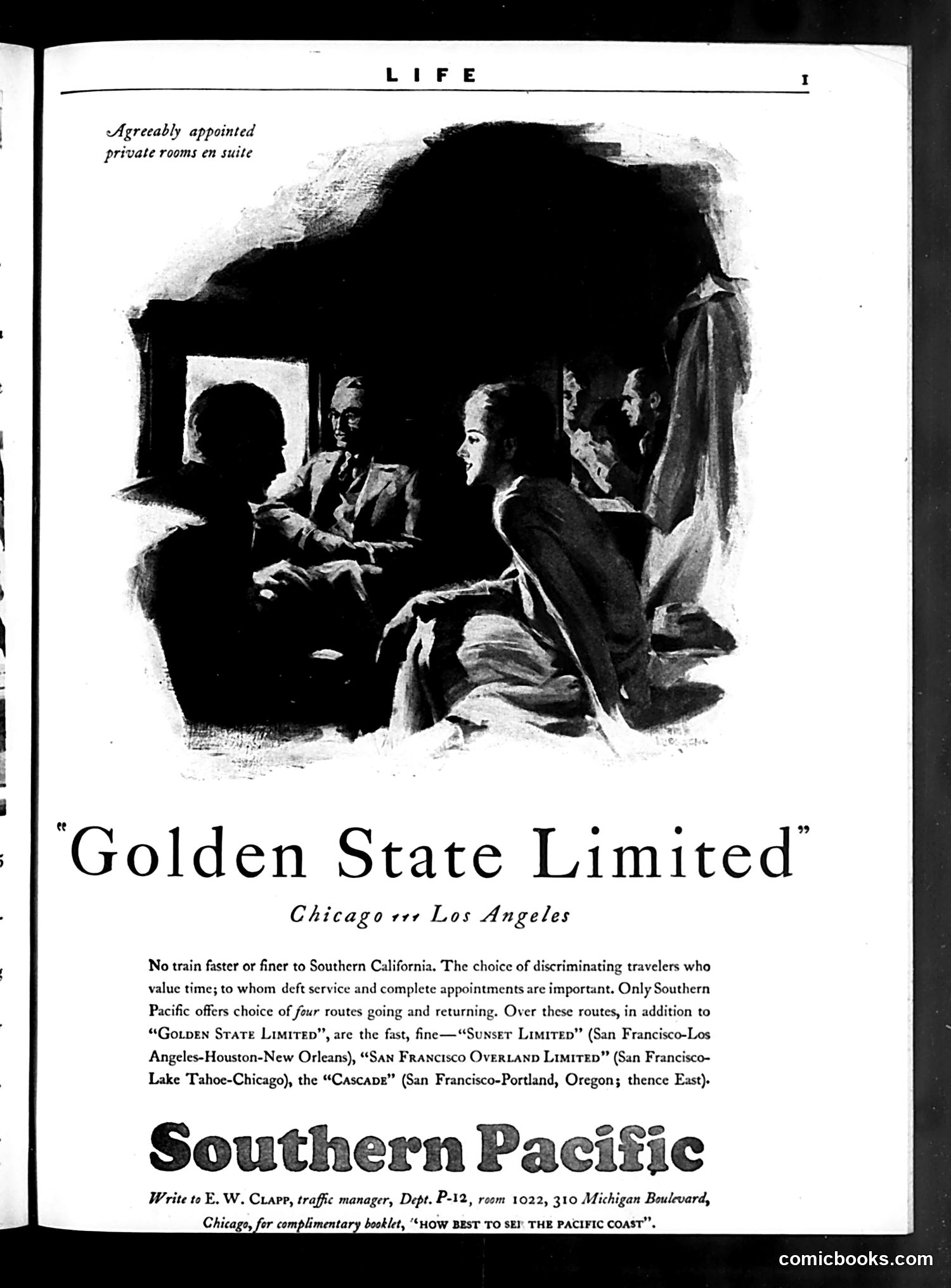
This page is primarily a **railroad advertisement**, not satire or political commentary. The illustration depicts well-dressed passengers in luxurious private train accommodations—the "agreeable appointed private rooms en suite" mentioned in the caption. The ad promotes Southern Pacific Railroad's "Golden State Limited," a premium train service between Chicago and Los Angeles. The text emphasizes speed, comfort, and exclusivity, targeting "discriminating travelers who value time" and offering superior service compared to competitors. The four other named routes ("Sunset Limited," "San Francisco Overland Limited," and "Cascade") are listed to showcase Southern Pacific's comprehensive network. This reflects early 20th-century railroad competition and marketing to wealthy travelers during the era of luxury passenger rail service.
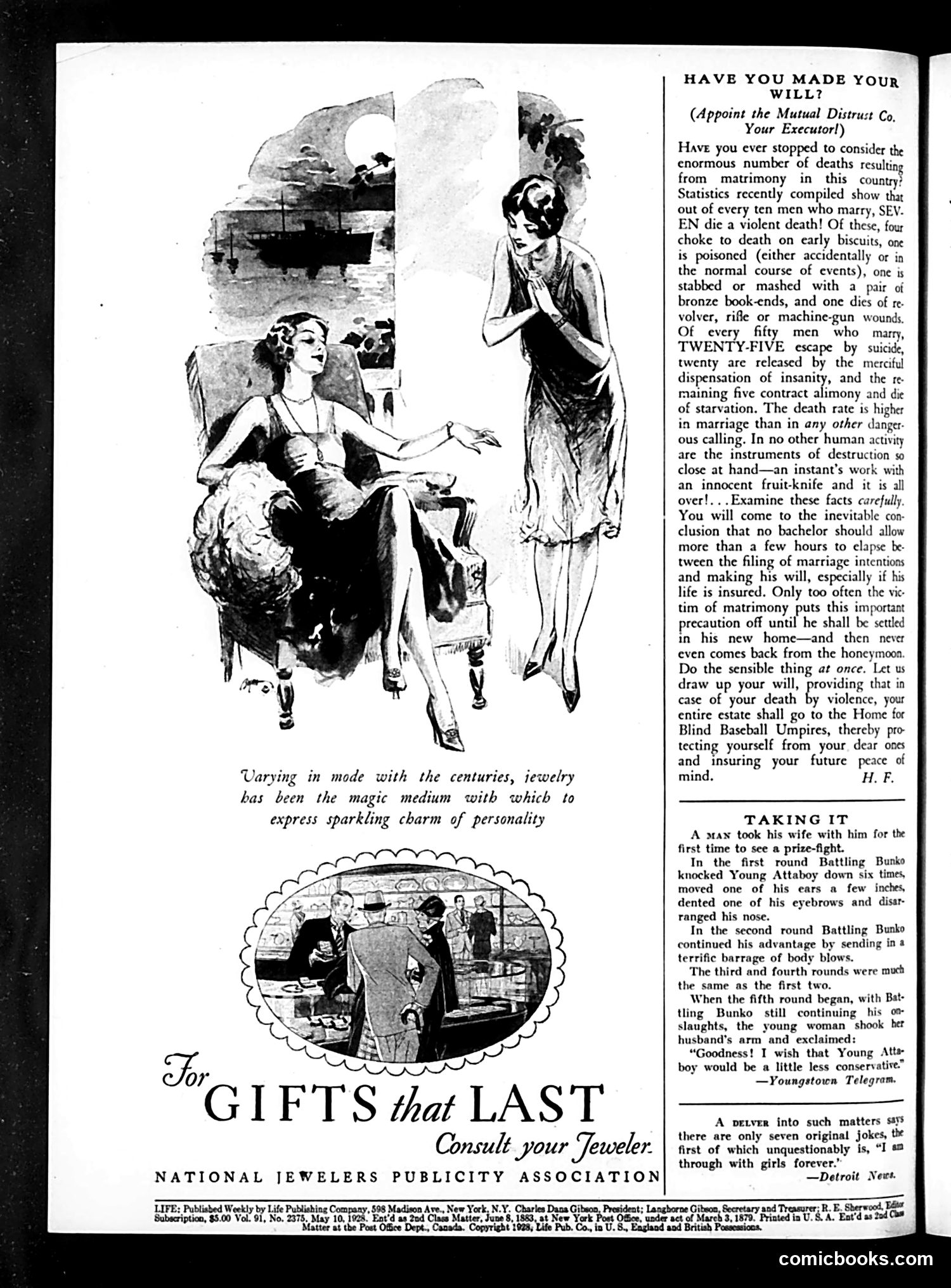
This page contains two distinct elements: **Right column ("Have You Made Your Will?"):** A dark satirical piece by the Mutual Distrust Co., using statistics about marital violence to argue that bachelors should immediately make wills before marriage, naming the "Home for Blind Baseball Umpires" as beneficiary. The humor is cynical—presenting matrimony as inherently dangerous, with wives as threats to husbands' lives. This reflects early-20th-century misogynistic comedy common to the era. **Left side:** Fashion illustration captioned about jewelry's role in expressing personality across centuries, accompanied by a jewelers' association advertisement ("For GIFTS that LAST"). The "Taking It" anecdote describes a prize fight between "Battling Bunko" and "Young Attaboy," with a wife's commentary about her husband being "too conservative"—likely satirizing both boxing culture and marital dynamics.
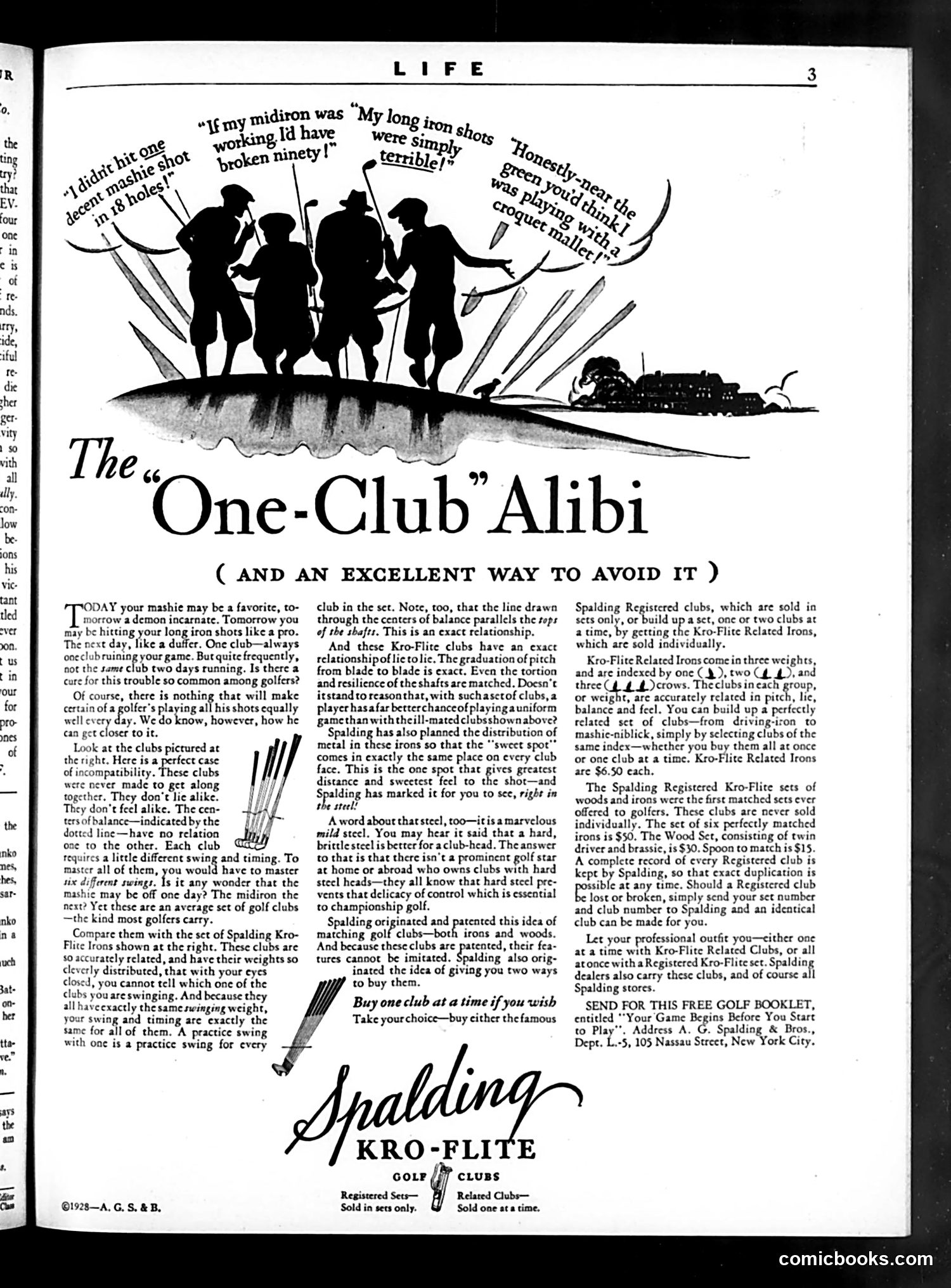
This 1928 advertisement disguised as editorial content satirizes golfers' excuses for poor play. The cartoon shows four silhouetted golfers making excuses—blaming broken equipment, bad luck, and other factors—rather than admitting to poor skill. The humor targets the "one-club alibi": golfers claiming they could play better if they had proper matching club sets. The article debunks this excuse, arguing that matching Spalding Kro-Flite clubs have exact weight and balance relationships making them superior, but that blaming equipment is ultimately just an excuse. The satire mocks common golfing culture—the tendency of amateur players to attribute failures to circumstances rather than ability. It's simultaneously an advertisement promoting Spalding's superior clubs as an actual solution to these manufactured excuses.
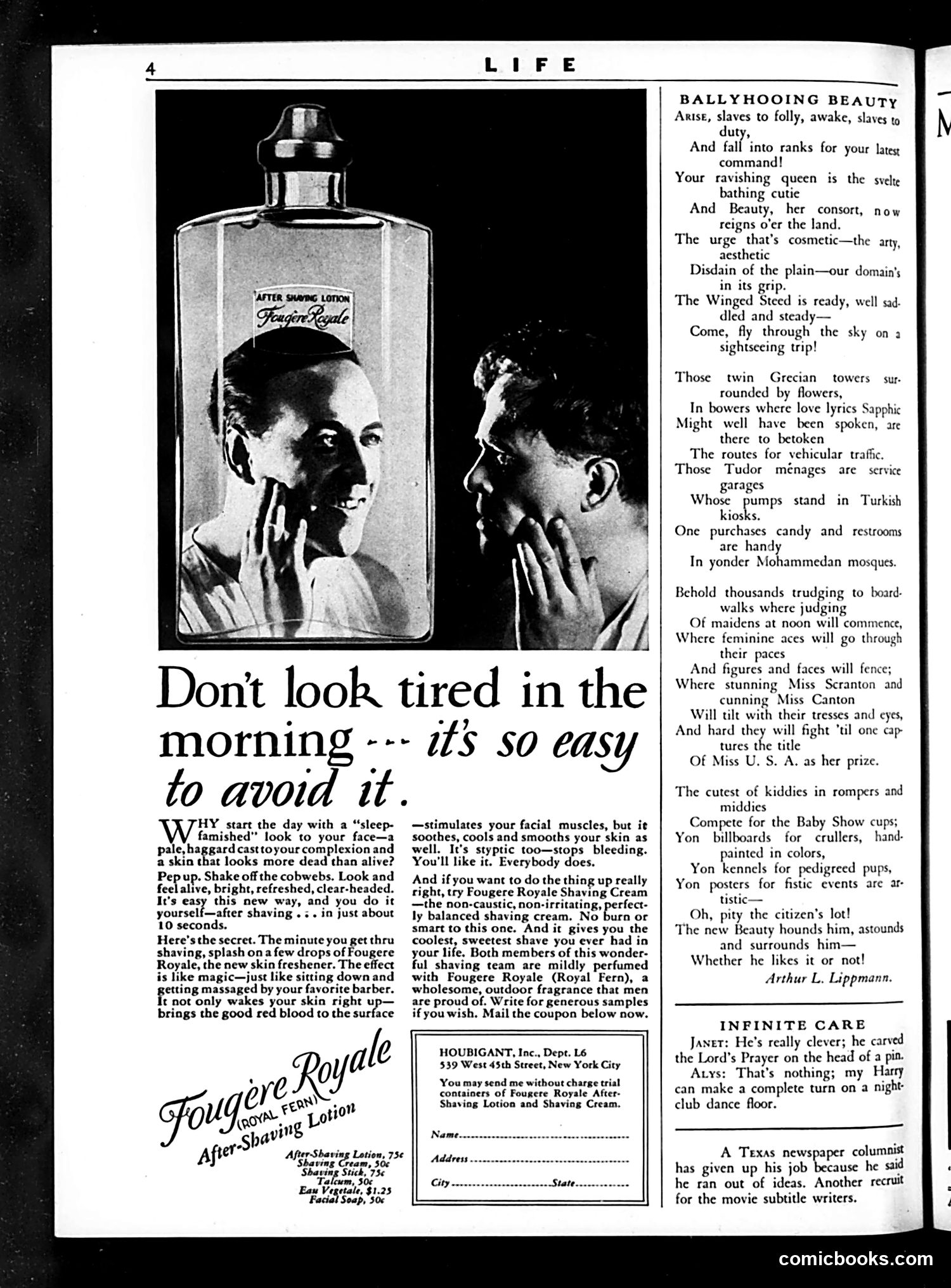
This page is primarily a **Fougère Royale aftershaving lotion advertisement** with accompanying prose. The ad shows two men's faces examining their complexions, promoting the product's ability to prevent a tired morning appearance. The ad copy uses humor typical of 1920s-30s marketing: it jokingly addresses male vanity while emphasizing practical benefits (non-irritating formula, pleasant fragrance). The heading "Don't look tired in the morning" plays on social anxieties about appearance. The right column contains unrelated "Life" magazine content—a poem titled "Ballyhooing Beauty" (satirizing beauty pageants and commercial promotion) and a humor section called "Infinite Care" with brief comedic anecdotes. **No political cartoons appear on this page.** It's primarily commercial advertising with light satirical humor about consumer culture and gender expectations.
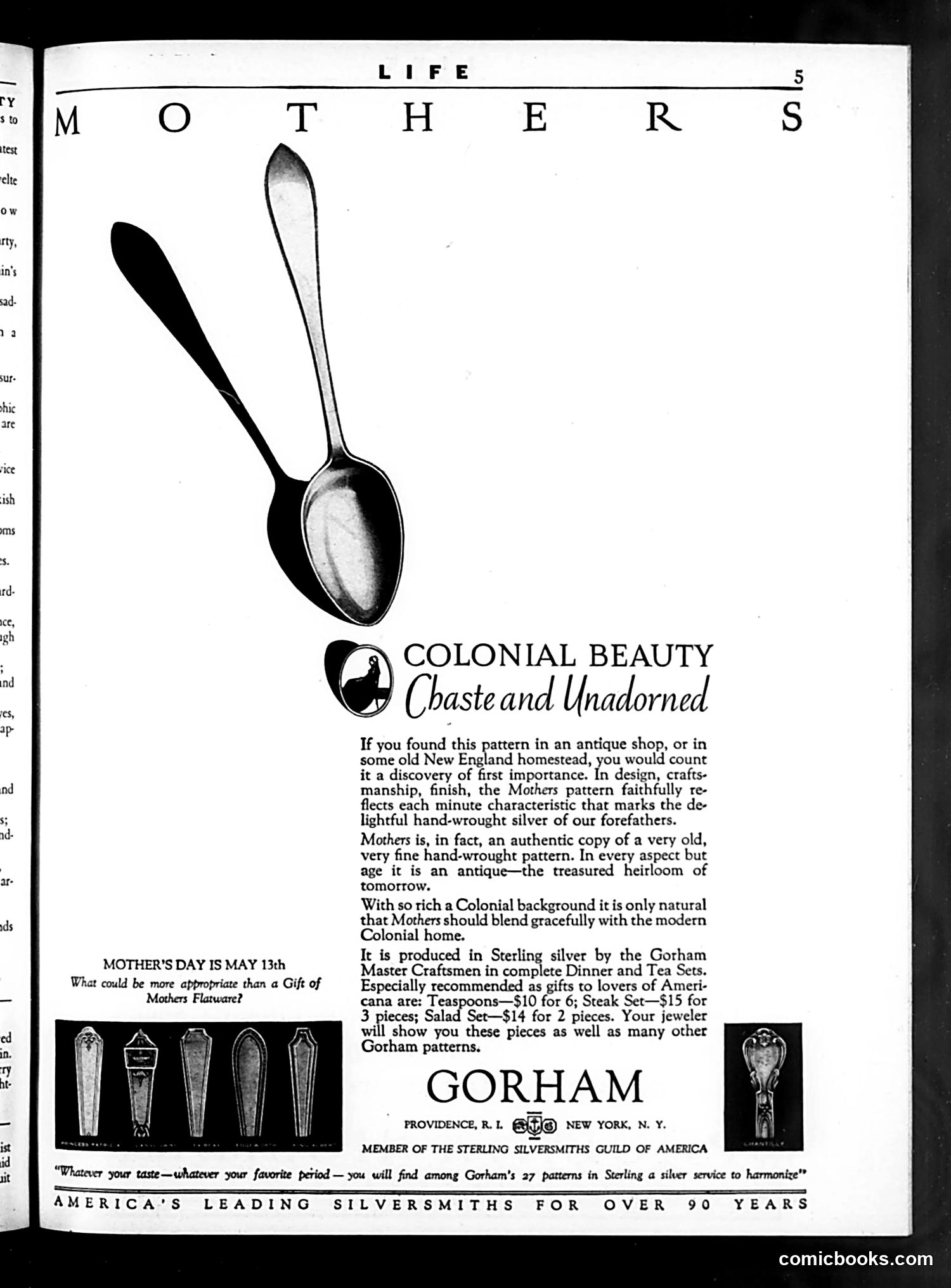
This is a **Gorham silverware advertisement**, not a political cartoon. The page promotes the "Mothers" pattern of sterling silver flatware, marketed as "Colonial Beauty—Chaste and Unadorned." The ad emphasizes the pattern's authenticity as a copy of hand-wrought colonial silver, positioning it as an heirloom quality product suitable for modern Colonial-style homes. The visual shows two spoons—one solid black (representing the original antique) and one detailed (the Mothers pattern reproduction)—demonstrating the design's fidelity to historical precedent. The text targets affluent buyers seeking Americana authenticity, noting Mother's Day (May 13th) as the ideal gift occasion. Pricing for teaspoons, steak sets, and salad sets is provided. This reflects mid-20th-century marketing that capitalized on colonial revival aesthetics and nostalgia.
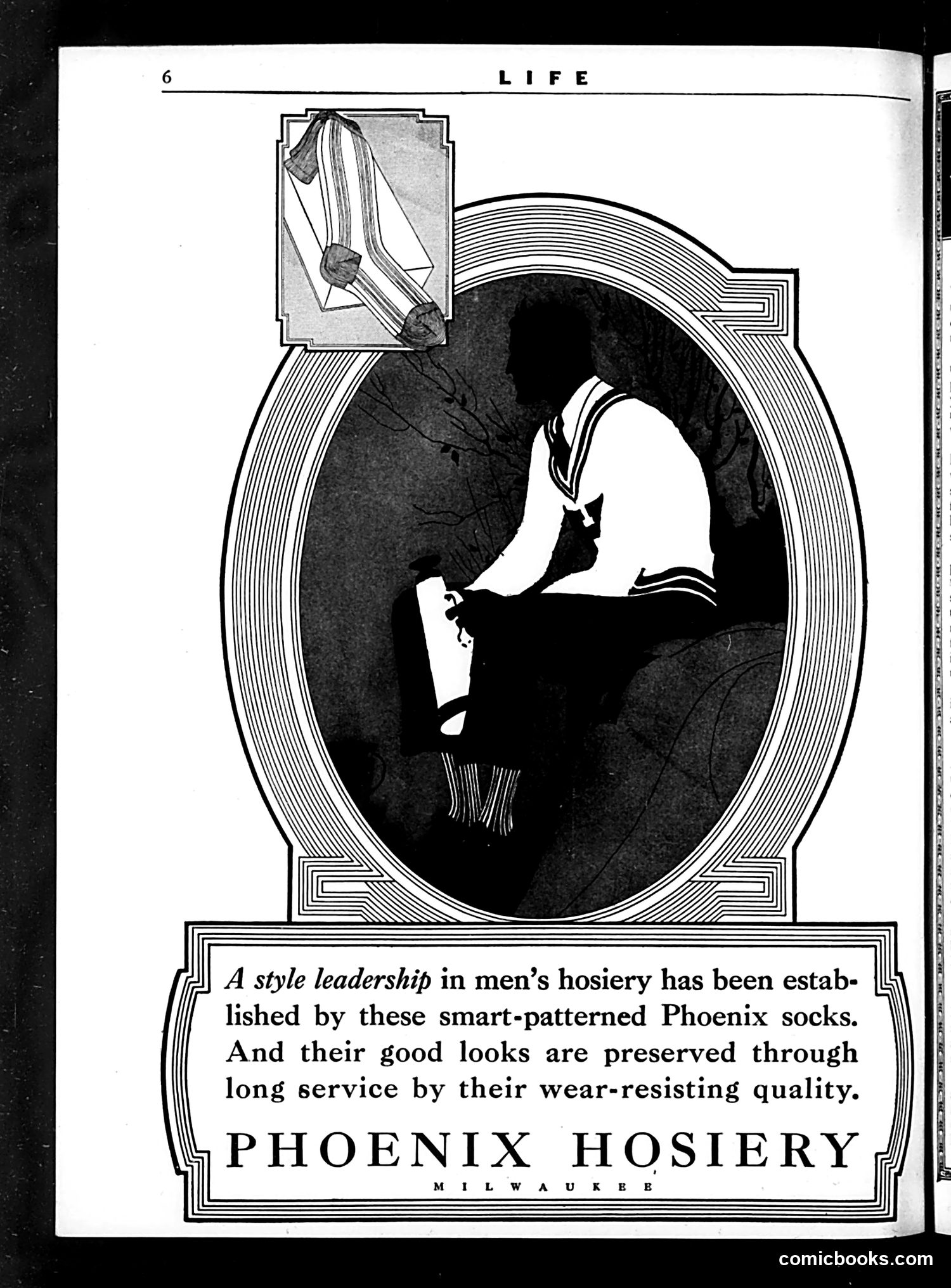
This is a straightforward **men's hosiery advertisement**, not political satire. The page shows a stylized illustration of a man in sailor-style clothing examining or adjusting his socks, positioned within a decorative oval frame. The ad copy emphasizes that Phoenix brand socks establish "style leadership in men's hosiery" through "smart-patterned" designs while maintaining durability through "wear-resisting quality." The sailor outfit appears chosen to suggest active use and ruggedness—implying these socks can withstand demanding conditions while remaining fashionable. The Art Deco styling and elegant framing suggest this appeals to style-conscious male consumers of the era. This is a **commercial advertisement**, not editorial content or political commentary.
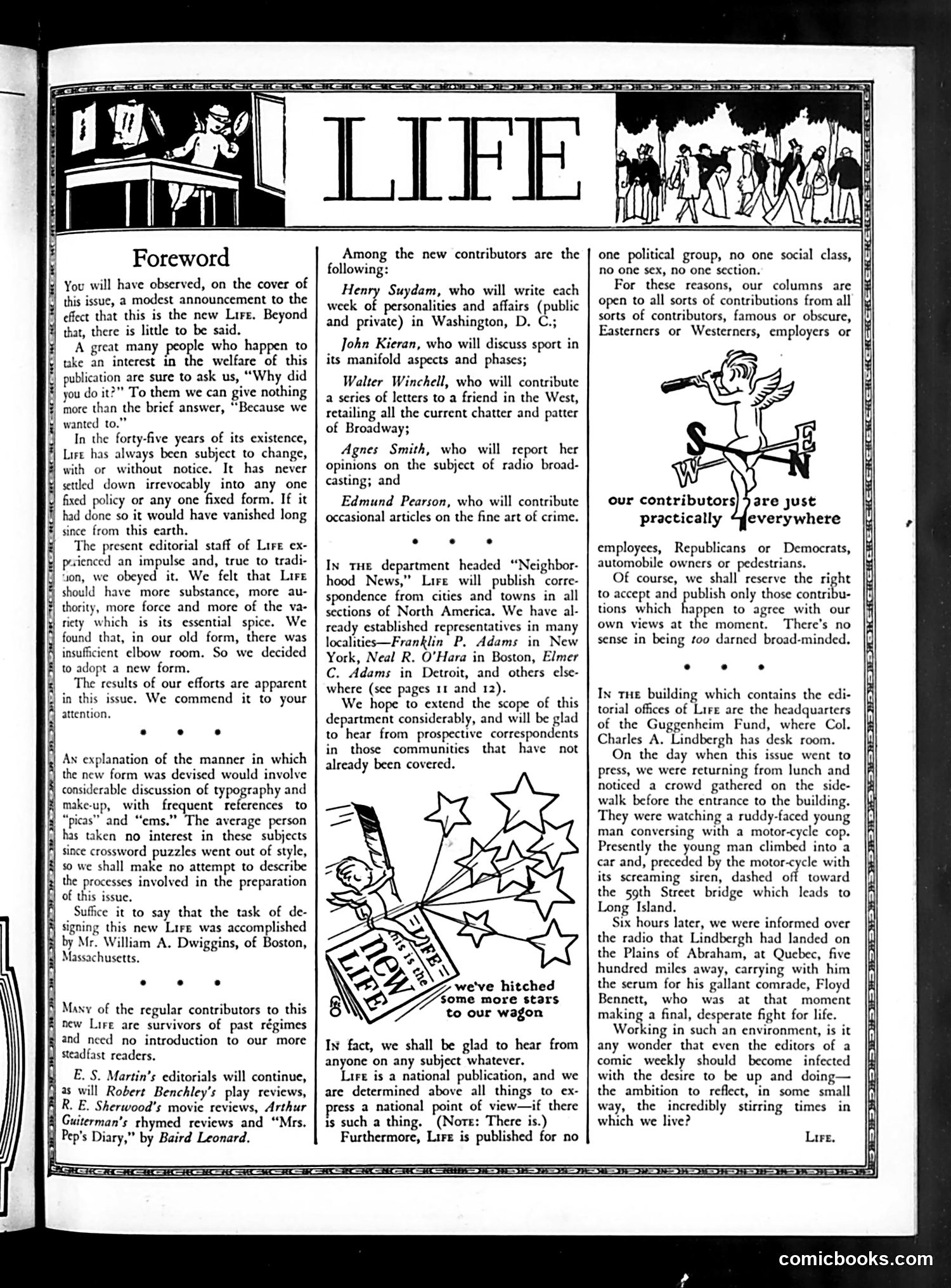
This is primarily a **foreword/editorial page**, not a political cartoon. It announces new contributors to Life magazine and explains the publication's editorial philosophy. The page introduces writers including Henry Saydam (personalities and affairs), John Kieran (sports), and others who will cover diverse topics. A small **illustration shows a hand holding a crossbow or arrow labeled "LIFE,"** with stars trailing behind it—a visual metaphor suggesting the magazine is "shooting for" expanded ambitions. The key message emphasizes Life's commitment to **non-partisan coverage**: accepting contributions from "Republicans or Democrats, automobile owners or pedestrians." The editors stress they seek truthful reporting over ideological consistency, positioning themselves as a national publication serving varied readerships across America. This reflects Life's mid-20th-century positioning as a mainstream, relatively centrist publication.
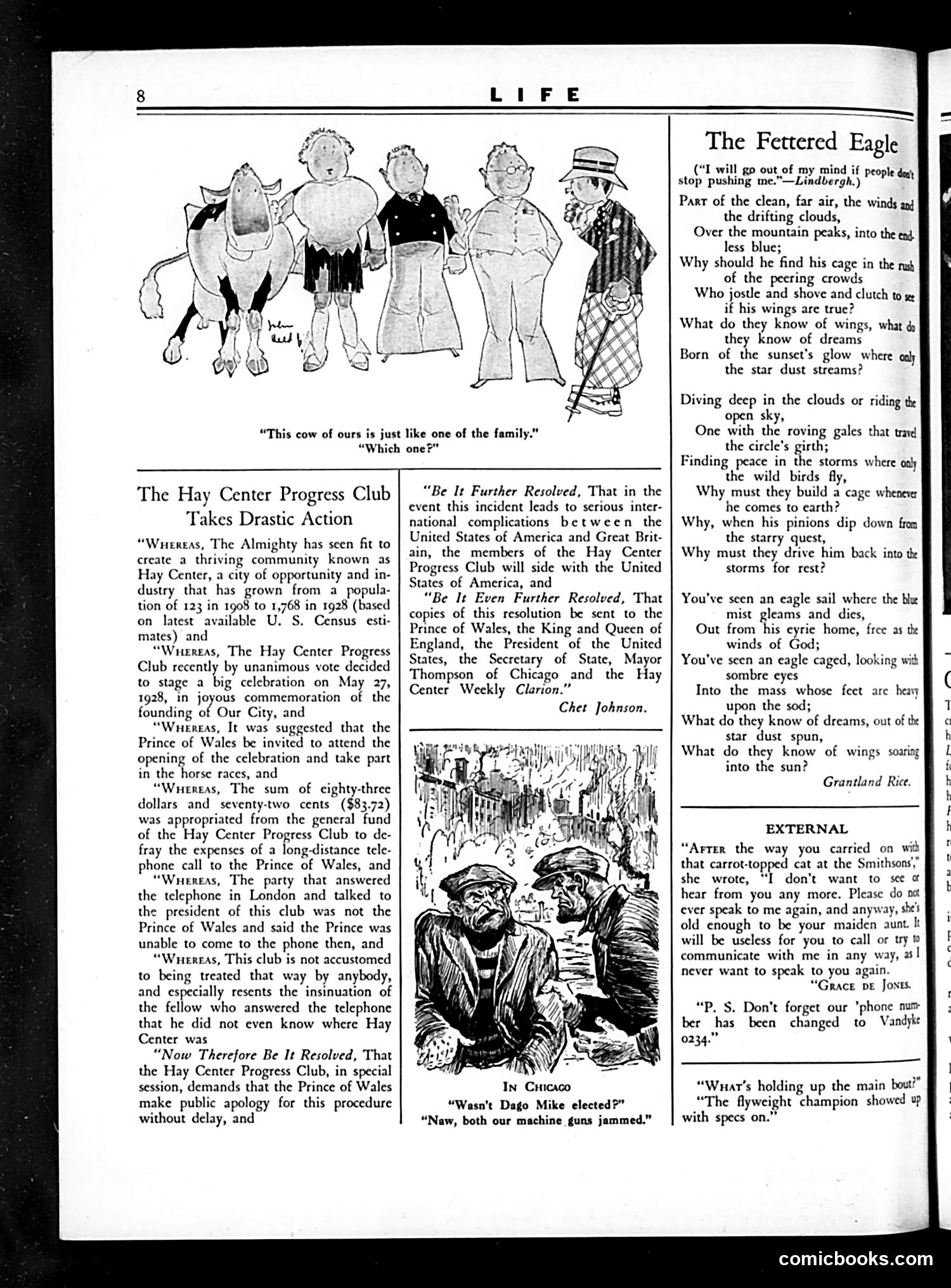
The top cartoon depicts a cow standing among five human figures with the caption "This cow of ours is just like one of the family. Which one?" The joke satirizes how families anthropomorphize their livestock, treating animals as family members—a gentle mockery of rural or farming life sentimentality. The main article, "The Hay Center Progress Club Takes Drastic Action," describes a small-town civic organization's humorous overreaction to an unspecified incident involving the Prince of Wales. The club staged an elaborate international incident response, demanding the Prince apologize, involving long-distance phone calls and formal resolutions sent to British officials. The satire targets small-town pretentiousness and civic organizations' self-importance in matters beyond their actual influence.
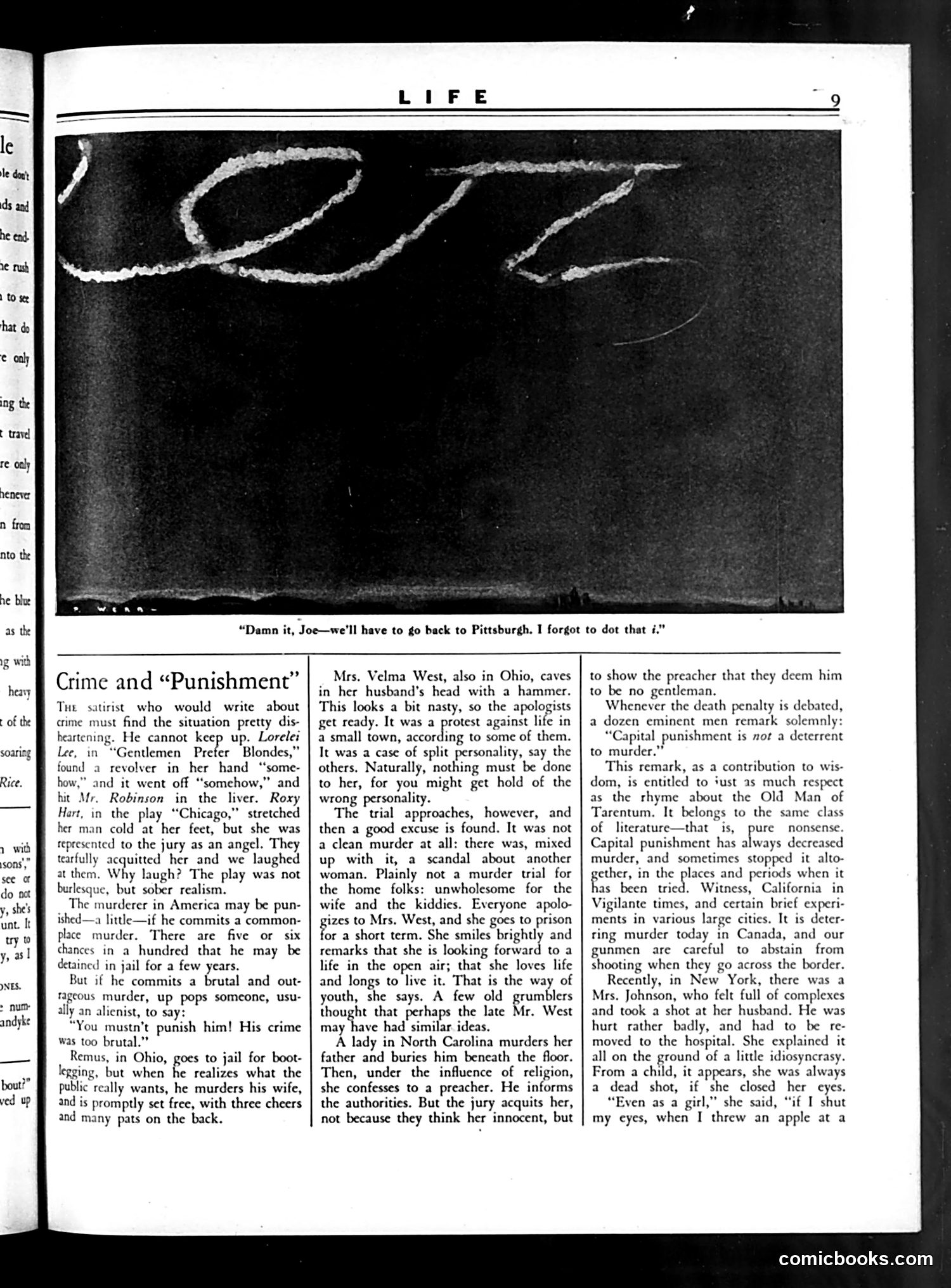
The cartoon at top shows a man drawing crude letters on a blackboard, with the caption: "Damn it, Joe—we'll have to go back to Pittsburgh. I forgot to dot that i." This is a simple visual gag about absent-mindedness or careless handwriting rather than political satire. The humor relies on the absurdity of someone traveling specifically to correct a minor typographical error. Below is an article titled "Crime and 'Punishment'" discussing capital punishment and murder trials in America. The text references specific cases involving women accused of murder in Ohio, North Carolina, and New York, examining how juries reach verdicts and public attitudes toward execution versus imprisonment as punishment. The page combines lighthearted humor with serious social commentary on criminal justice.
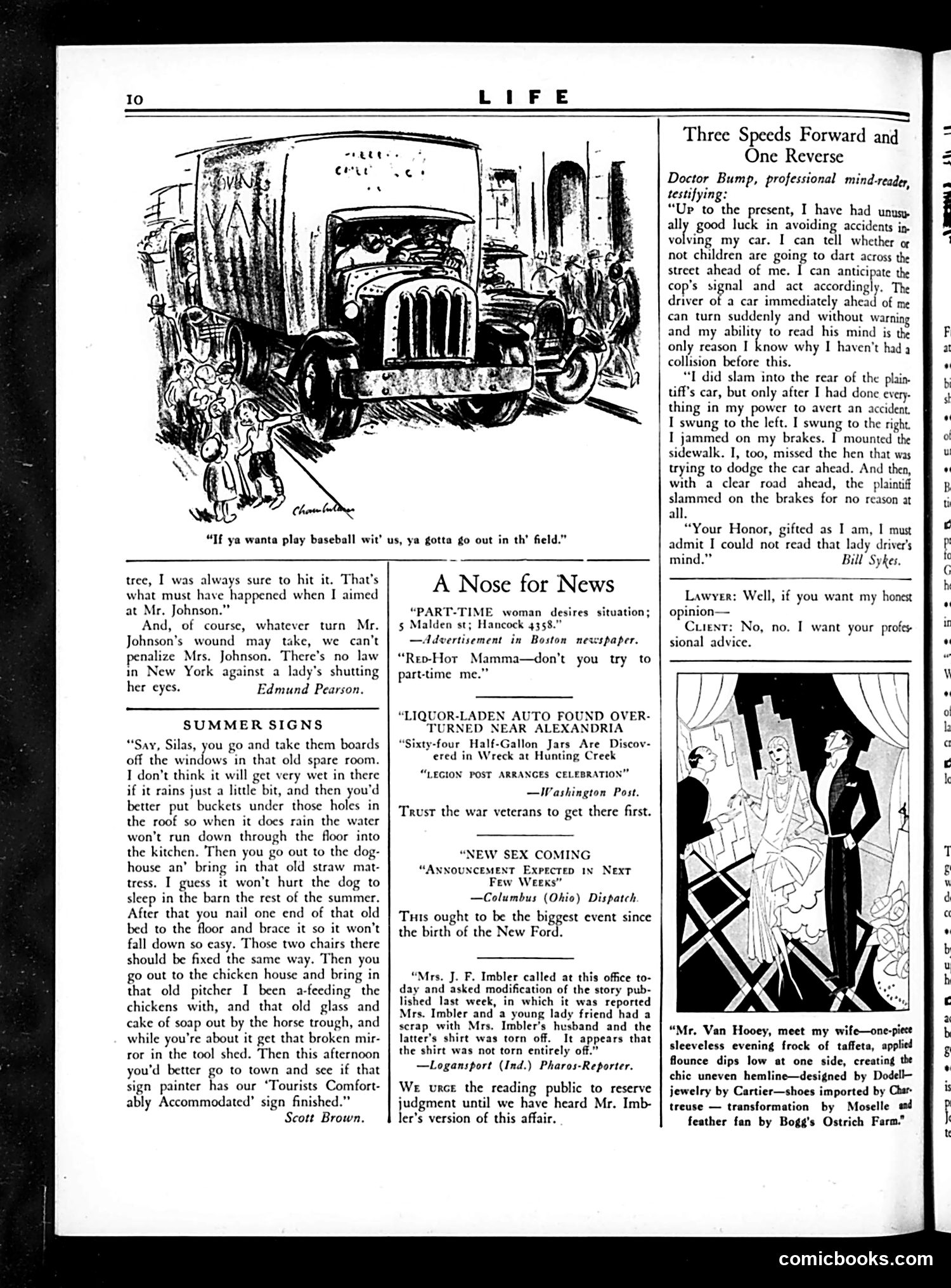
The main cartoon depicts a crowded street scene with a car nearly hitting pedestrians, captioned "If ya wanta play baseball wit' us, ya gotta go out in th' field." The joke satirizes urban traffic dangers by using baseball vernacular—suggesting that if children want to play safely, they should go to an actual field rather than the street. This reflects 1920s-30s concerns about automobile accidents in cities, where increased car traffic created hazards for pedestrians and children playing in streets. The surrounding "A Nose for News" section contains humorous brief items from newspapers, typical of Life's satirical commentary on contemporary events and social absurdities. These include references to vehicle accidents, marital situations, and other domestic humor reflecting period concerns about modern life, automobiles, and changing social customs.
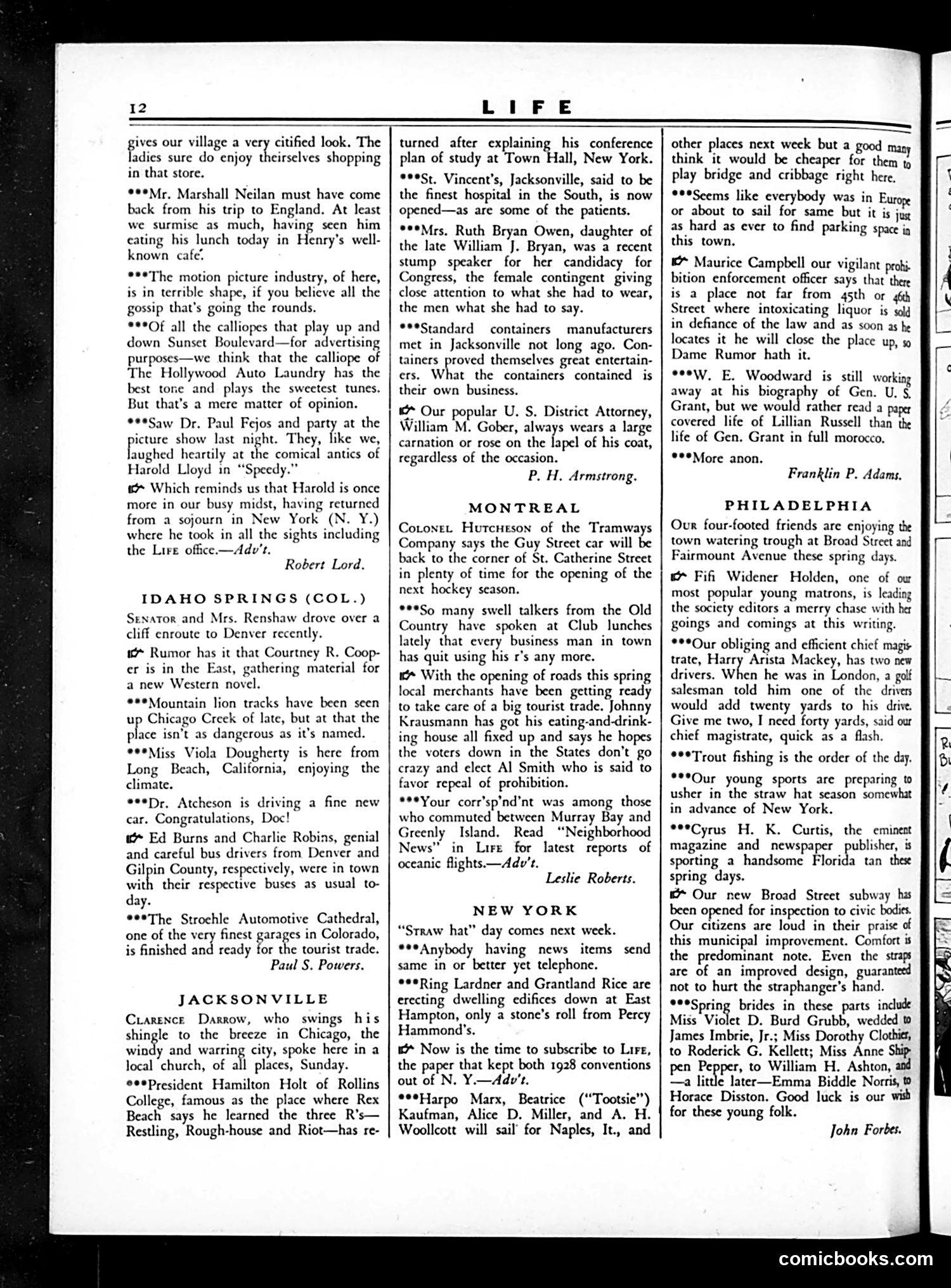
This is a **gossip and society notes page** from Life magazine, not a political cartoon page. It contains short, chatty items about notable people and social happenings organized by city (Jacksonville, Idaho Springs, Montreal, New York, Philadelphia). The brief items mock or celebrate local figures: a senator's road trip, rumors about business leaders, society weddings, and prominent individuals' activities. References include Senator Renshaw, President Hamilton Holt of Rollins College, and various society figures. The humor is **light and social** rather than political—poking fun at small-town gossip, fashionable behaviors, and the comings-and-goings of the local elite. This reflects Life's role as a satirical publication focused on American society and manners rather than hard politics.
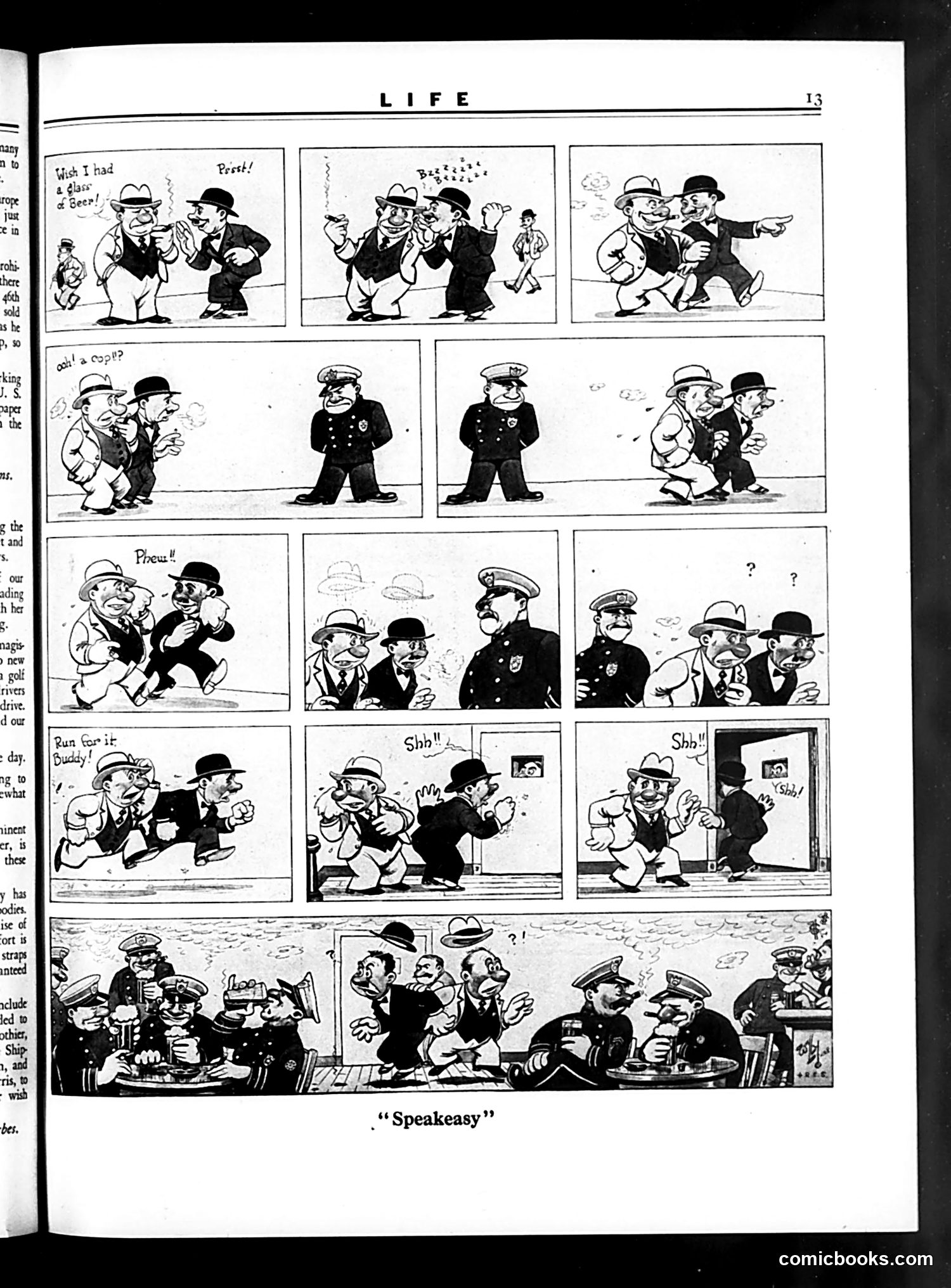
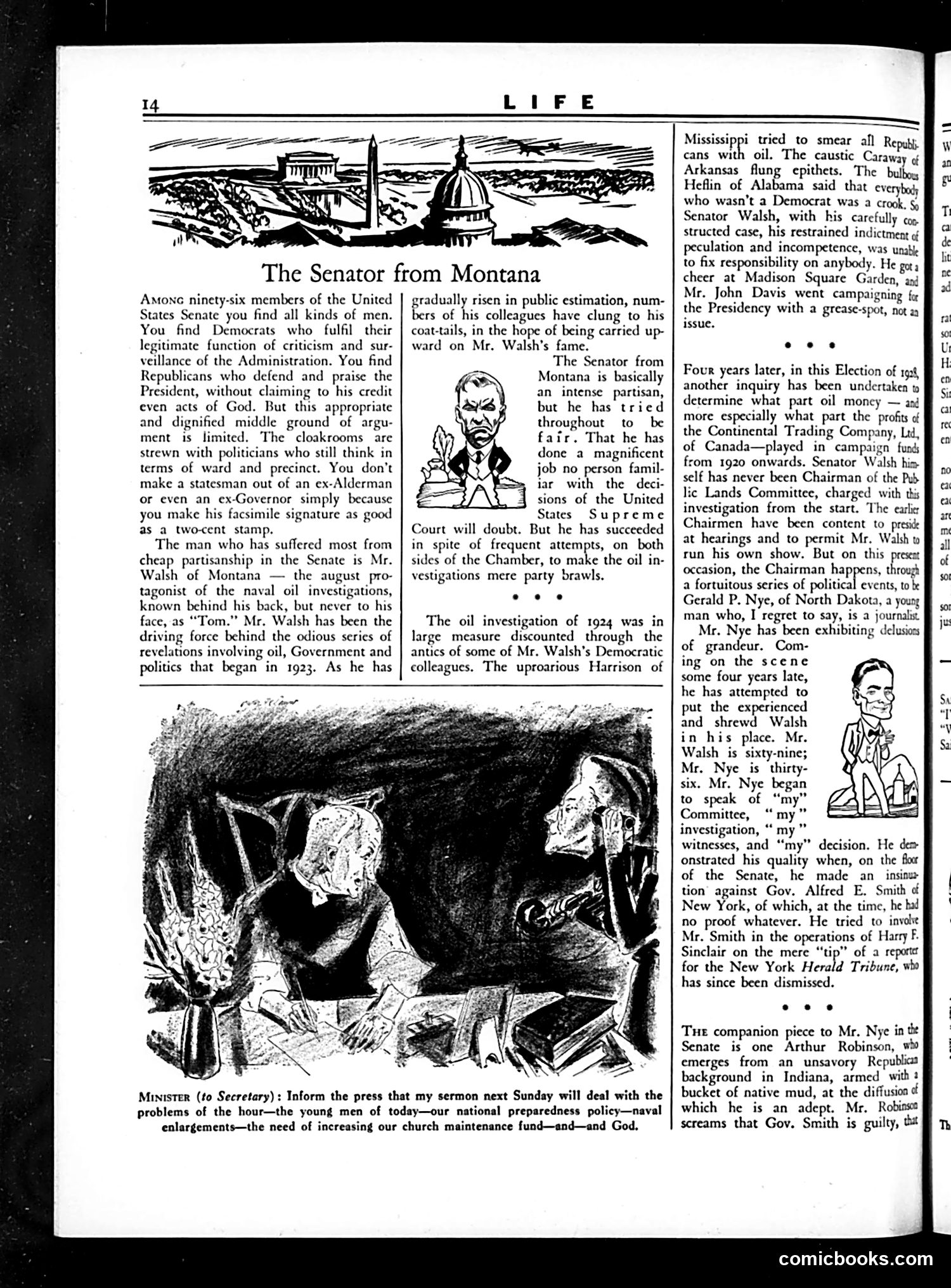
This Life magazine article criticizes Senator Thomas Walsh of Montana, a prominent investigator of government corruption. The caricature (upper right) portrays Walsh as an intense partisan rather than an impartial arbiter of justice. The text describes Walsh's role in the 1924 oil scandal investigations (Teapot Dome era), noting his effectiveness but questioning his fairness. The article suggests he used investigations to attack political opponents while being lenient toward Democrats. The lower cartoon depicts a Minister instructing his secretary to craft a sermon about national preparedness—a satirical jab suggesting politicians exploited religious institutions to advance their own agendas under patriotic pretenses. The piece essentially argues Walsh weaponized investigations for partisan advantage rather than genuine reform.
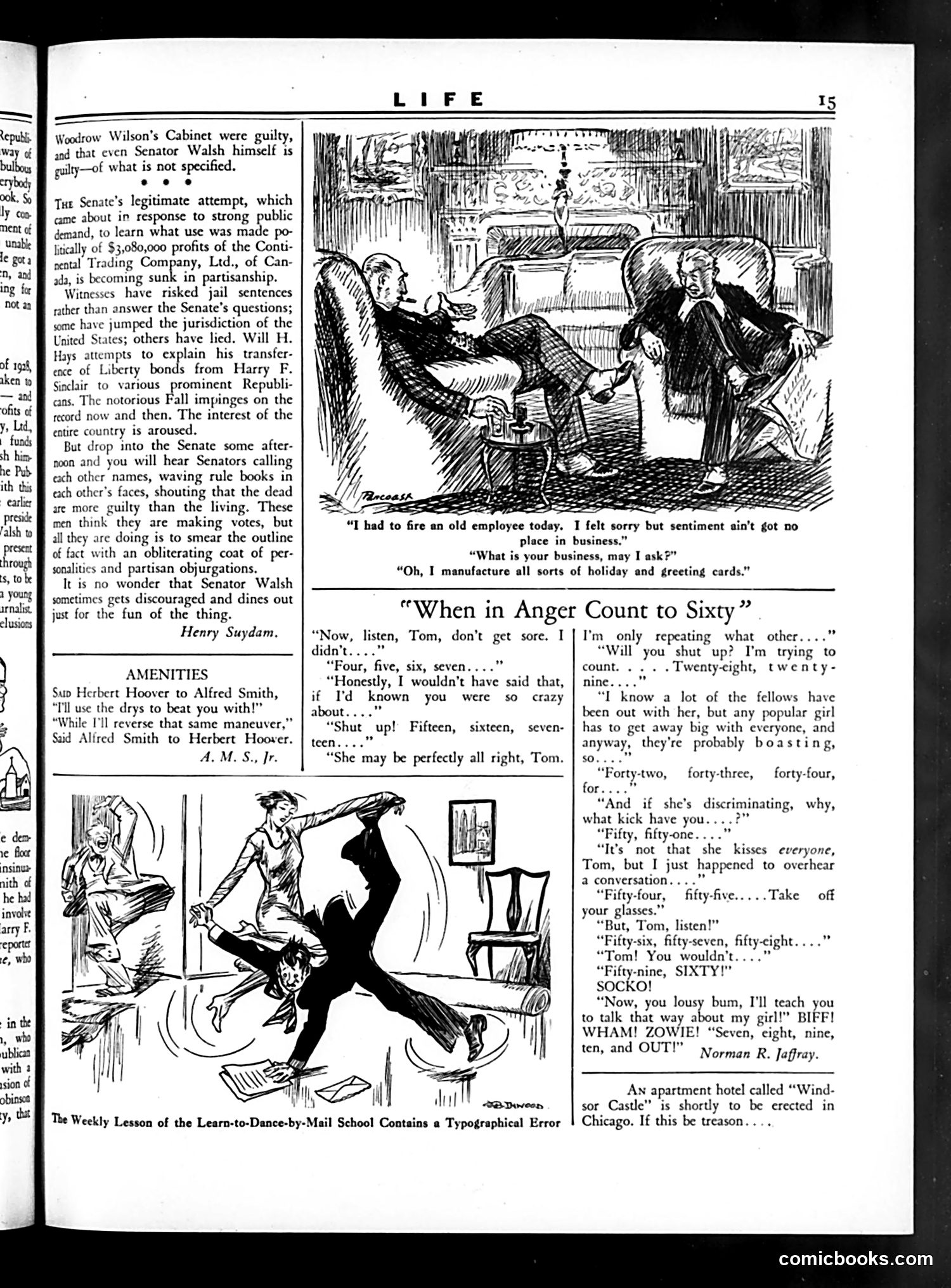
The page contains two distinct pieces: **Top Cartoon:** Shows a businessman firing an employee, stating "I had to fire an old employee today. I felt sorry but sentiment isn't got no place in business." This satirizes capitalist callousness during the economic era (likely 1920s-1930s based on style), mocking the disconnect between business ruthlessness and human sentiment. **Bottom Section:** "The Weekly Lesson of the Learn-to-Dance-by-Mail School Contains a Typographical Error" lampoons mail-order dance instruction, a common Depression-era advertised service. The humor derives from a counting mistake in dance steps—the instructor gets flustered during numbered instruction, revealing the absurdity of learning dance through correspondence rather than in-person. Both pieces target American commercial culture and correspondence-based self-improvement schemes.
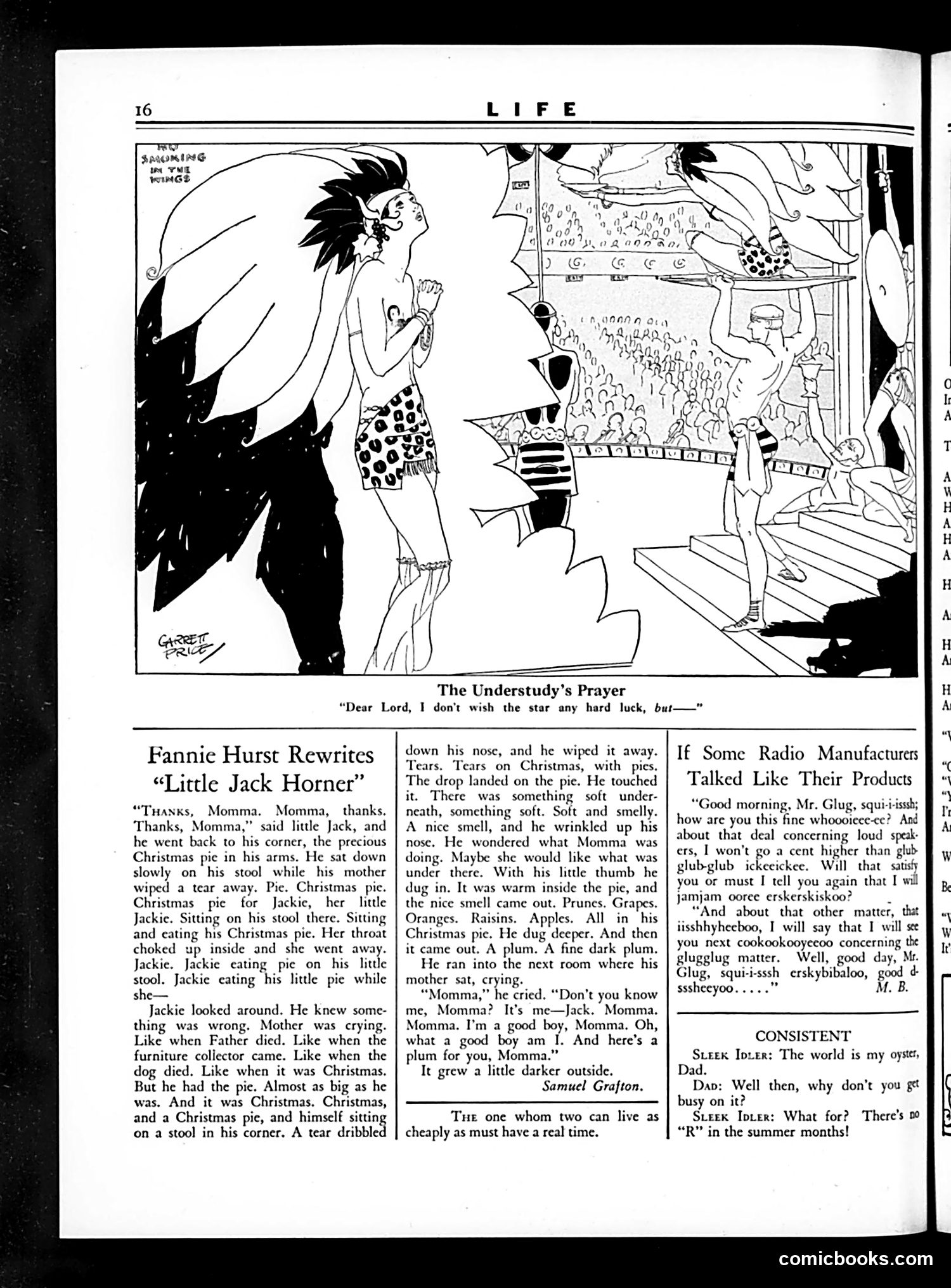
**Top Cartoon**: Shows a caveman-like figure in primitive dress at what appears to be a modern beach or pool scene. The caption reads "The Understudy's Prayer: 'Dear Lord, I don't wish the star any hard luck, *but—*'" This satirizes the common theater superstition about understudies hoping the lead performer will get sick or injured so they can perform. The primitive-dressed figure represents the understudy as someone "under" the star, making a hypocritical prayer—claiming not to wish harm while clearly wanting the opportunity. **Text Content**: The page contains Fannie Hurst's rewrite of "Little Jack Horner" and humor columns. These are satirical retellings and jokes typical of Life's comedic content during this era. The page demonstrates Life's use of visual humor to mock human nature and social conventions.
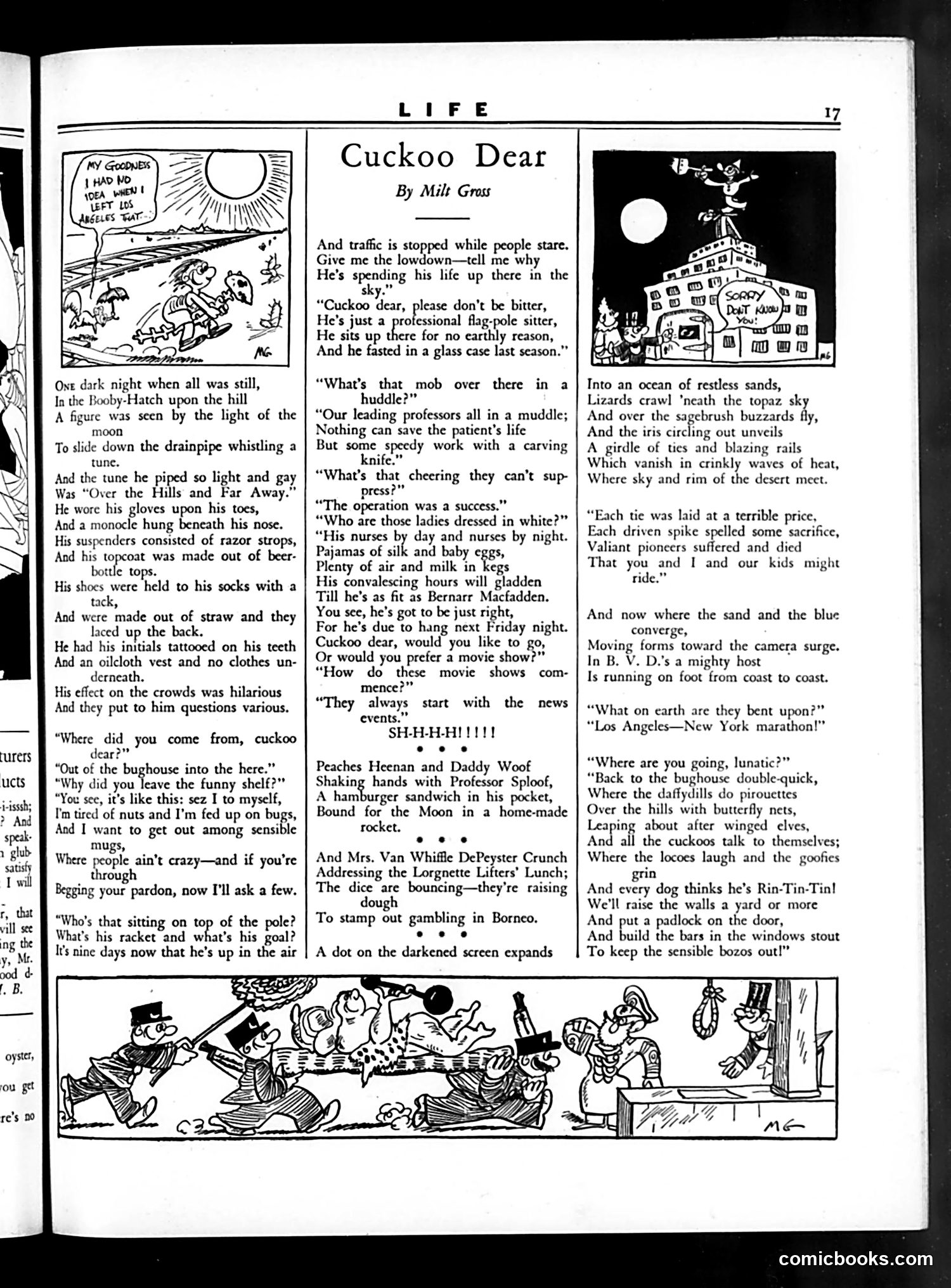
This is a humorous poem by cartoonist Milt Gross satirizing early 20th-century American culture. The poem follows an eccentric character—a "cuckoo"—who abandoned conventional life (the "bughouse") and now wanders deserts and rails, observing modern absurdities. The satire targets: - **Movie culture** and its obsession with sensational newsreels - **Desert development** and railroad expansion in the American West - **Los Angeles and cross-country marathons** as symbols of frivolous modern entertainment - **Urban restlessness** and people's fascination with spectacle over substance The accompanying cartoons (by Gross, signed "MG") depict slapstick chaos, reinforcing the poem's mockery of modern life's absurdity. The "cuckoo" protagonist serves as an outsider-observer critiquing 1920s American consumer culture and entertainment obsession.
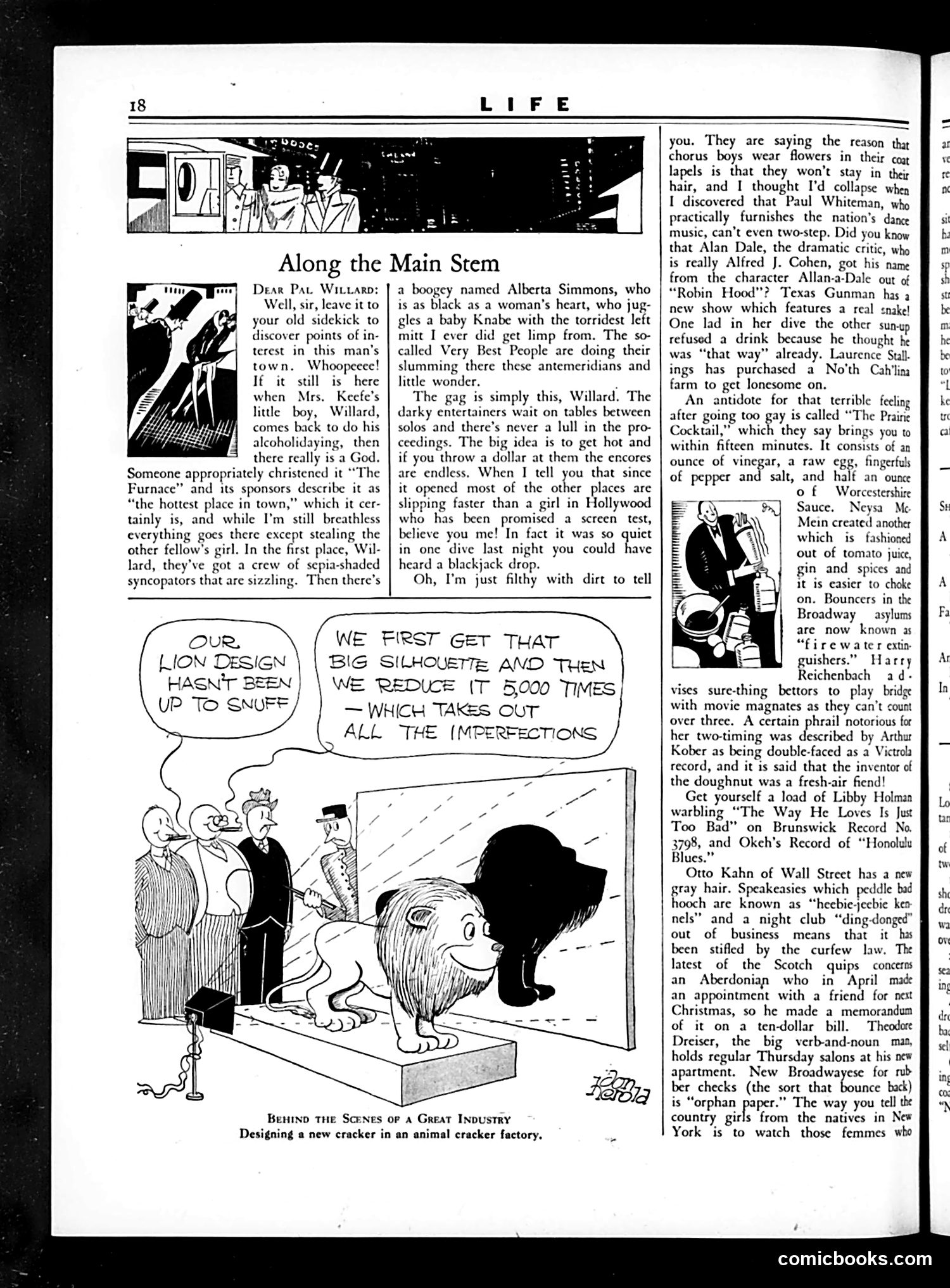
This page contains two distinct pieces of 1920s entertainment commentary: **Main Article**: A gossipy letter describing "The Furnace," a Harlem nightclub featuring Black entertainers (notably "Alberta Simmons," a pianist). The writer uses period-typical racist language ("sepia-shaded syncopators," "darky entertainers") while describing the venue's popularity with wealthy "Very Best People" doing "slumming"—a practice where affluent whites visited Black entertainment districts as a novelty. **Cartoon**: Satirizes industrial design, showing engineers discussing animal cracker production. They debate whether to create a large silhouette design then reduce it 5,000 times to "take out all the imperfections"—mocking pretentious design philosophy through absurdist logic. The overall tone is gossipy, name-dropping, and reflects 1920s attitudes toward race, entertainment, and modernity—revealing attitudes modern readers would find offensive.
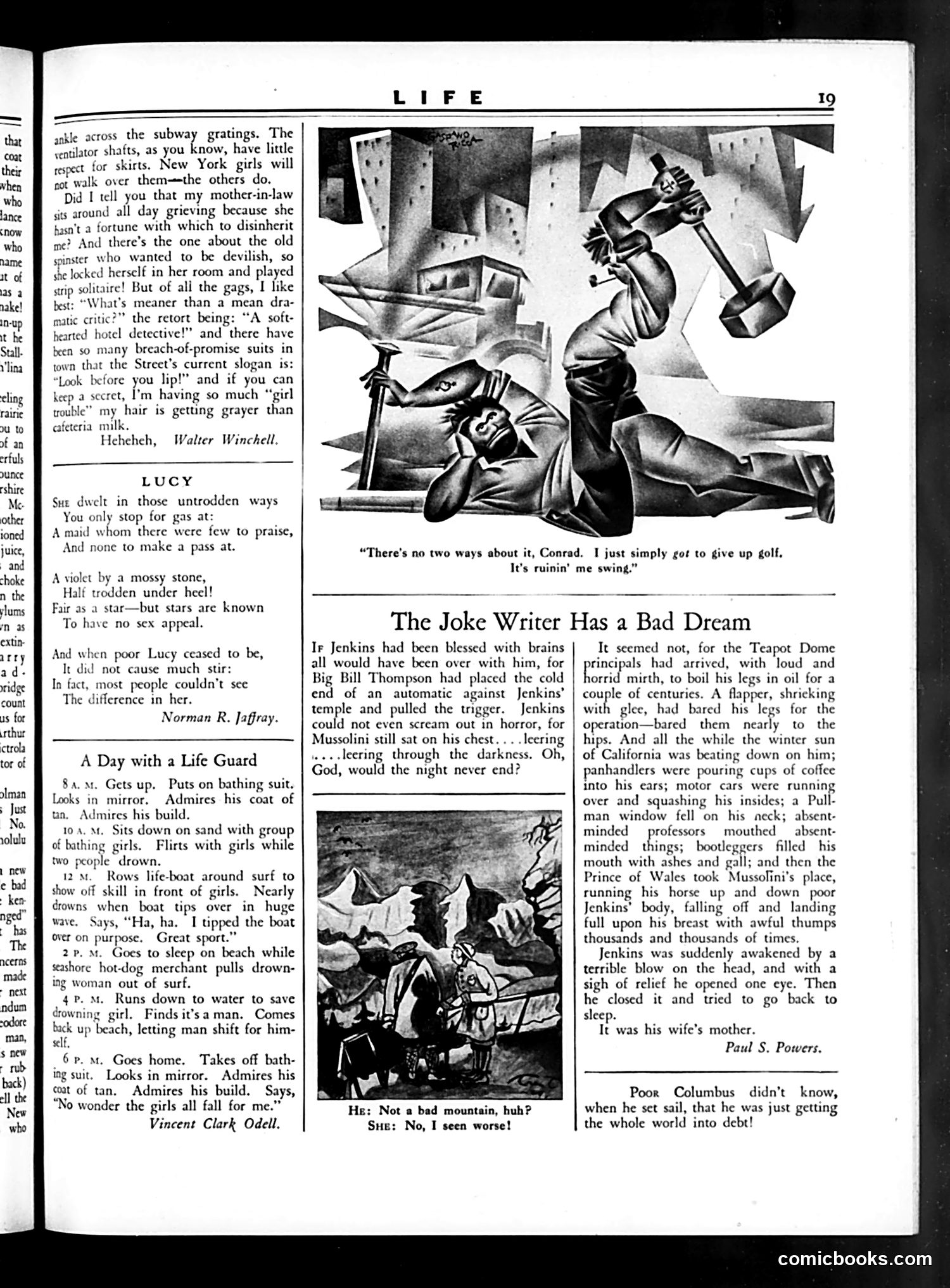
This surreal nightmare illustration satirizes early 1920s American anxieties and scandals. The dreaming protagonist (Jenkins, a joke writer) is tormented by figures and events representing contemporary controversies: **Key References:** - **Big Bill Thompson**: Chicago's notoriously corrupt mayor, symbol of urban crime - **Mussolini**: Italian fascist dictator, representing foreign threats - **Teapot Dome principals**: Corrupt Harding administration officials involved in the major 1921-1923 oil-lease scandal - **Flappers**: Modern young women symbolizing social upheaval - **Prince of Wales**: British royalty, representing old-world disorder - **Bootleggers**: Prohibition-era criminals **The Satire's Point:** The cartoon mocks how contemporary satirists and comedians were overwhelmed by real-world absurdity—actual events had become so bizarre and scandalous that fictional humor seemed inadequate. The nightmarish piling-on of disasters suggests American culture felt chaotic, corrupt, and out of control during this turbulent period.
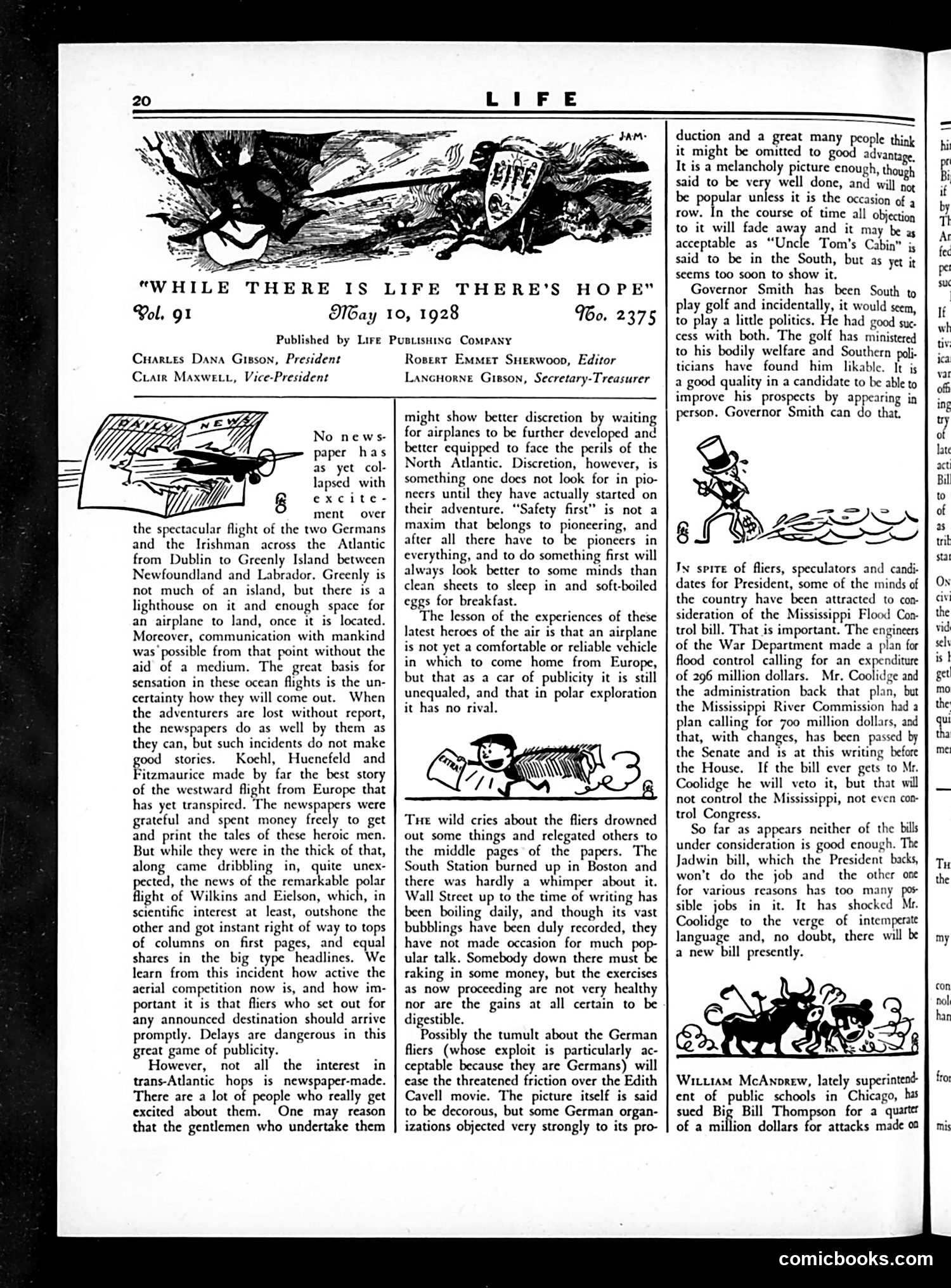
This editorial page discusses competing news stories dominating 1928 headlines. The main focus critiques how newspapers sensationalize transatlantic aviation feats—specifically recent German and Irish/American polar flights—over more substantive but less dramatic news. The piece argues newspapers prioritize publicity-generating stunts (Koehl, Huenefeld, Fitzmaurice's westward crossing; Wilkins and Eielson's polar flight) while burying genuinely important stories: a Boston South Station fire and volatile Wall Street activity. The author celebrates aviation pioneers' courage while gently mocking the public's fascination with aerial spectacle over reliable reporting. A final paragraph references the "Edith Cavell movie"—a sensitive film about the WWI British nurse executed by Germans—noting German organizations' objections may paradoxically be overshadowed by aviation mania. The small cartoons illustrate aviation and financial themes. The satire targets both reckless media sensationalism and public appetite for thrilling but ultimately frivolous headlines.
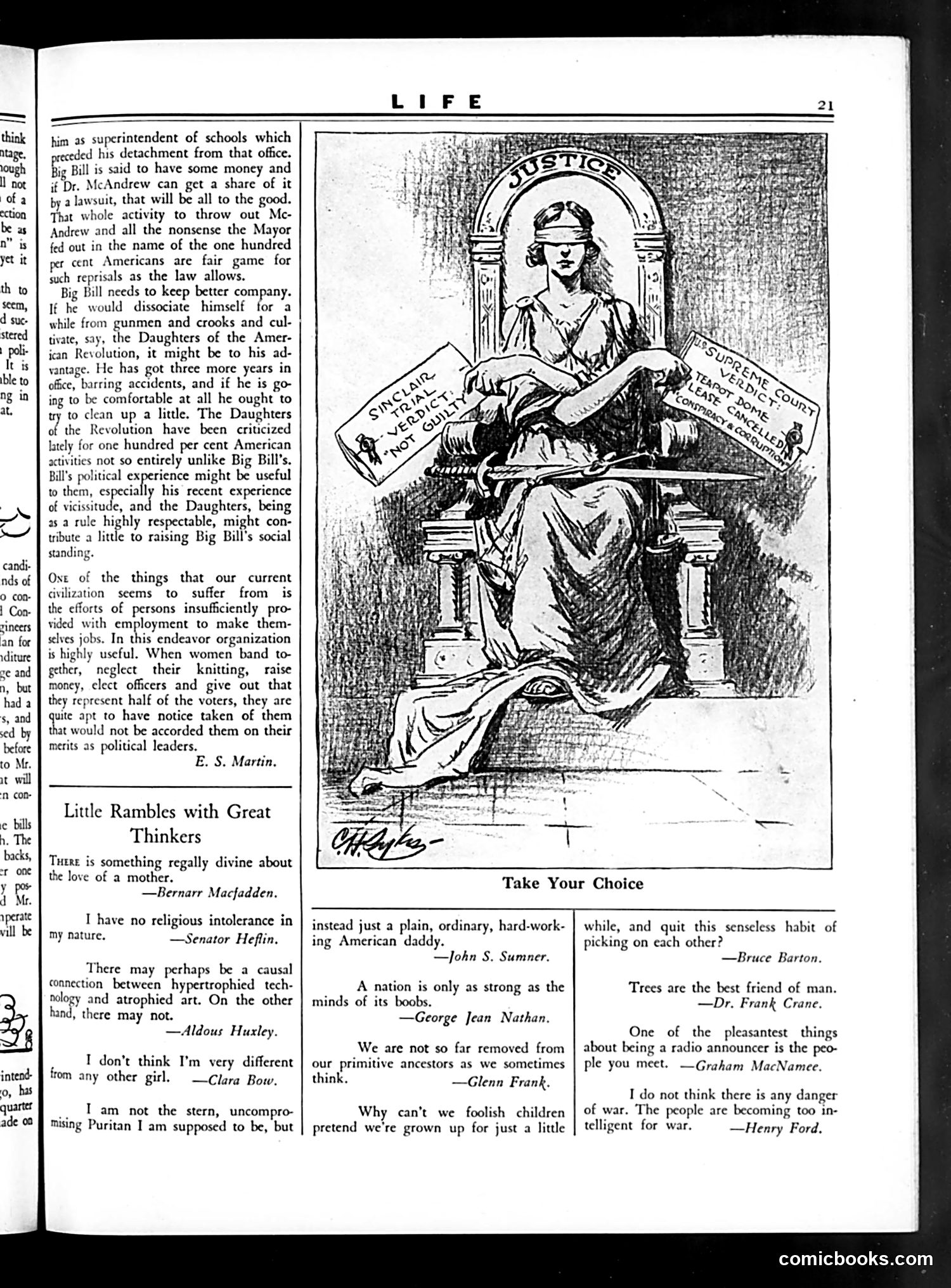
This page satirizes American political and social hypocrisy of the 1920s. The main cartoon depicts **Justice** holding a tablet inscribed with principles of "sincere, impartial, and veracity" alongside references to "Tammany," the corrupt New York political machine. The image mocks the gap between justice's ideals and actual municipal corruption. The accompanying text discusses **"Big Bill"** (likely William "Big Bill" Thompson, Chicago's scandal-plagued mayor) and his conflicts with Dr. McAndrew over school superintendent positions. The satire criticizes Thompson's association with "gunmen and crooks" while suggesting he curry favor with respectable organizations like the Daughters of the American Revolution to improve his image—highlighting the performative nature of political respectability. The lower section, "Little Rambles with Great Thinkers," presents famous figures' self-serving or contradictory quotes (a senator denying intolerance, Henry Ford claiming people are too intelligent for war), further mocking public figures' dubious self-presentations and the gap between rhetoric and reality.
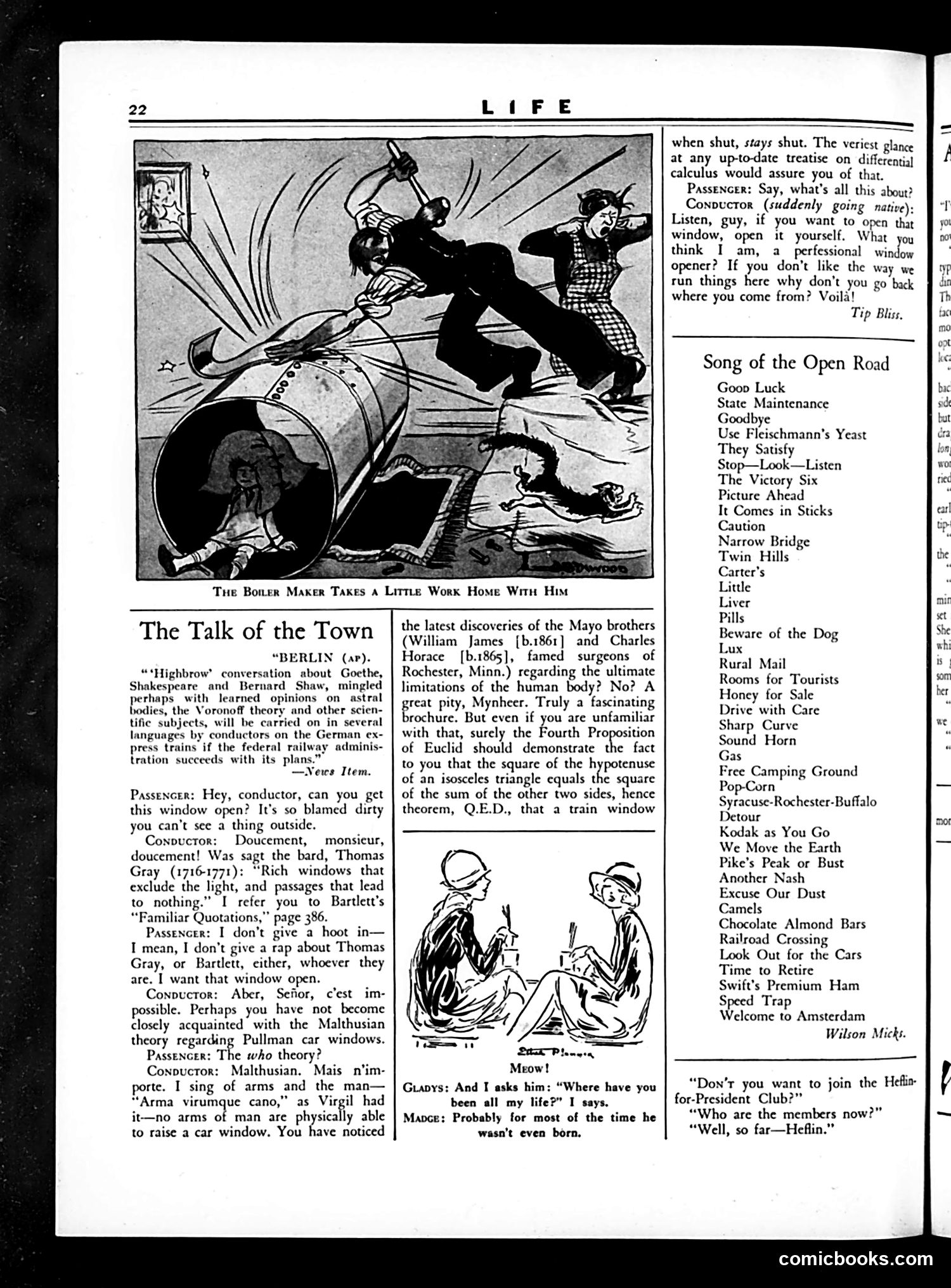
This cartoon satirizes pretentious intellectualism masquerading as expertise. A passenger simply wants to open a train window, but a conductor responds with absurdly elaborate pseudo-scholarly justifications—citing Thomas Gray, the Malthusian theory, the Mayo brothers' medical research, and Euclid's geometry—to explain why the window cannot open. The joke exposes how intellectuals (particularly in early 20th-century Europe, suggested by the multilingual conductor) hide behind obscure references and complex theories to avoid straightforward answers. When the frustrated passenger finally demands action, the conductor abandons his pretense entirely, reverting to blunt working-class speech: "Listen, guy, if you want to open that window, open it yourself." The satire targets both pompous authority figures who cloak simple matters in unnecessary complexity, and the absurdity of applying grand philosophical and mathematical principles to mundane practical problems.
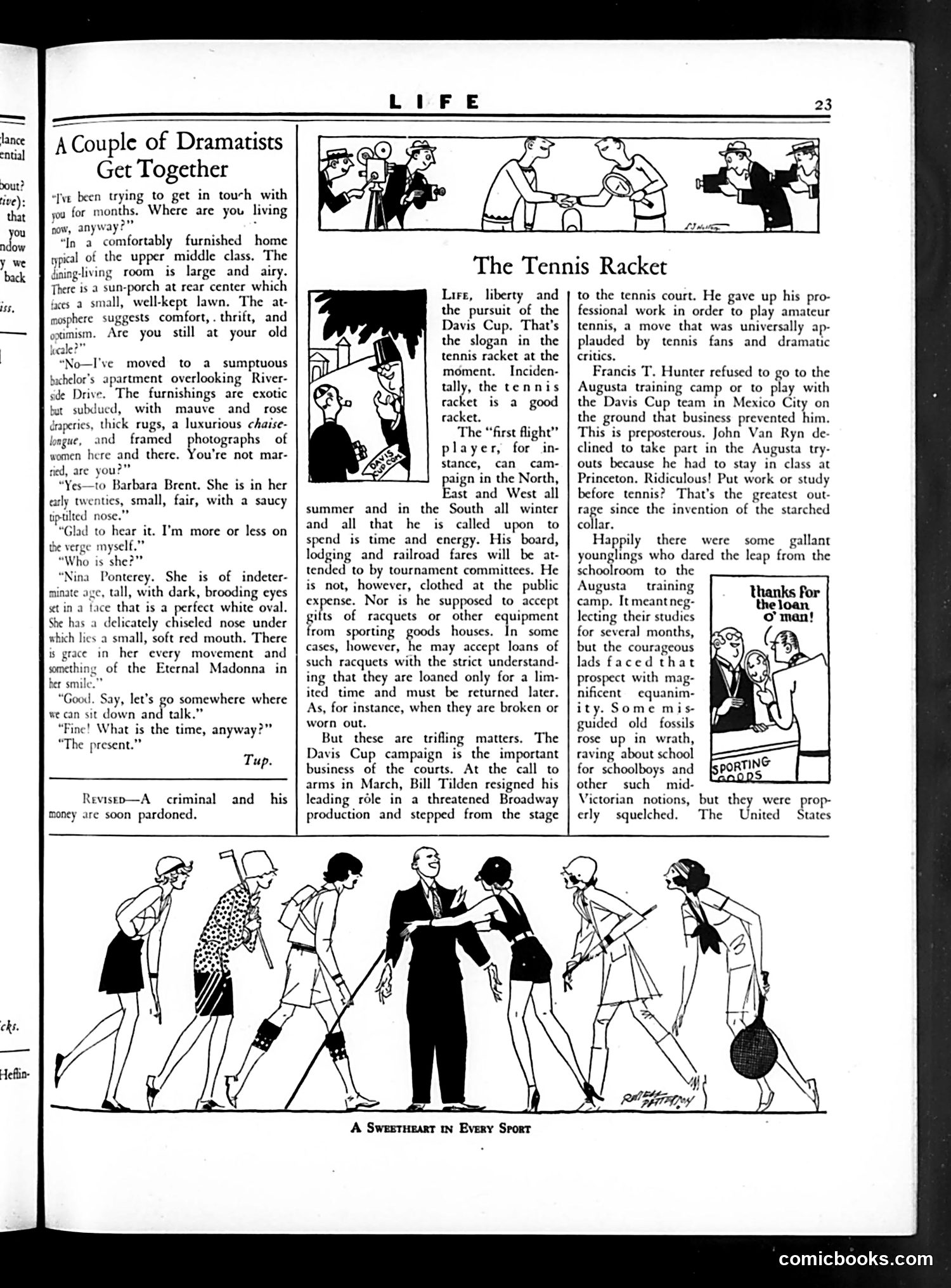
This article satirizes the hypocrisy of "amateur" tennis during the Davis Cup era. The piece exposes how top players like Bill Tilden and Francis T. Hunter claimed amateurism while receiving substantial benefits—free travel, lodging, and tournament expenses—unavailable to ordinary people. The satire targets the absurdity of prioritizing tennis over education and work. It mocks older critics ("mid-Victorian notions") who objected when students like those at Princeton abandoned studies for tournaments, yet celebrates the young players' "courage" in doing so. The central joke: tennis operates as a lucrative "racket" (a corrupt scheme) masquerading as pure amateur sport. Players accept gifts of racquets under the pretense they're only "loans," exploiting loopholes while maintaining amateur status—and the social prestige it conveyed in that era. The cartoon below reinforces this by showing various female athletes surrounding a male figure, captioned "A Sweetheart in Every Sport"—suggesting amateur athletics were pursued for glamour and romance rather than genuine sportmanship.
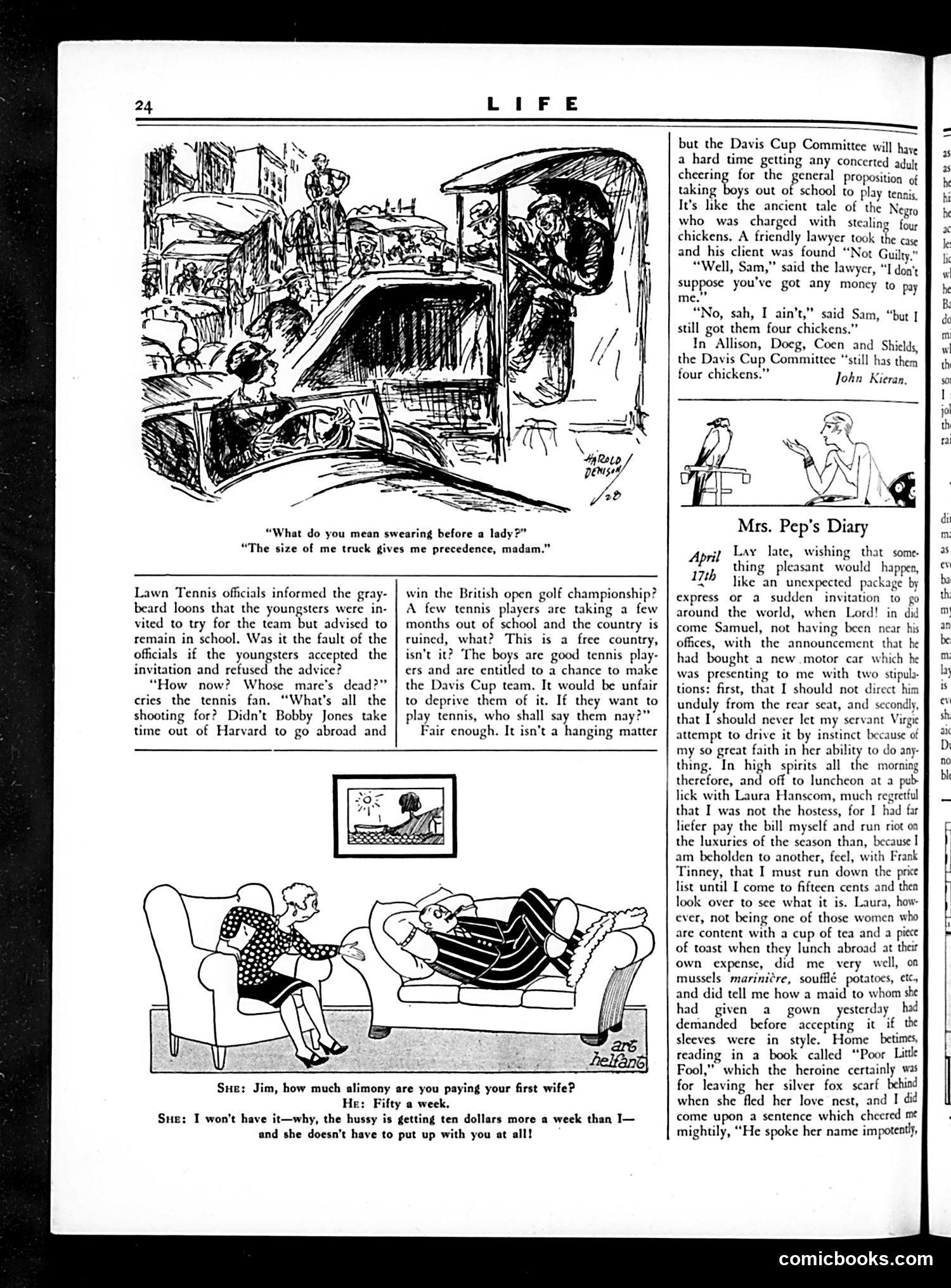
This LIFE magazine page contains three distinct satirical pieces: **Top cartoon**: A truck driver swearing before a lady claims his vehicle gives him "precedence." The joke mocks working-class vulgarity and the assumption that size or status excuses rudeness. **Middle section**: Commentary on young tennis players leaving school to compete for the Davis Cup team. The author uses a racial anecdote (a Black defendant acquitted of stealing chickens who keeps the chickens anyway) to satirize the hypocrisy: officials permit boys to skip school for tennis, then act shocked when they do. The "four chickens" metaphor suggests getting away with rule-breaking while technically winning the argument. **Bottom cartoon**: A husband and wife debate alimony. The wife complains his first wife receives ten dollars weekly without "putting up with" him—implying the second wife deserves more for enduring his presence. This satirizes the financial absurdities and resentments of divorce settlements. **Mrs. Pep's Diary** (right column): Humorous domestic narrative about receiving a motor car gift with controlling conditions.
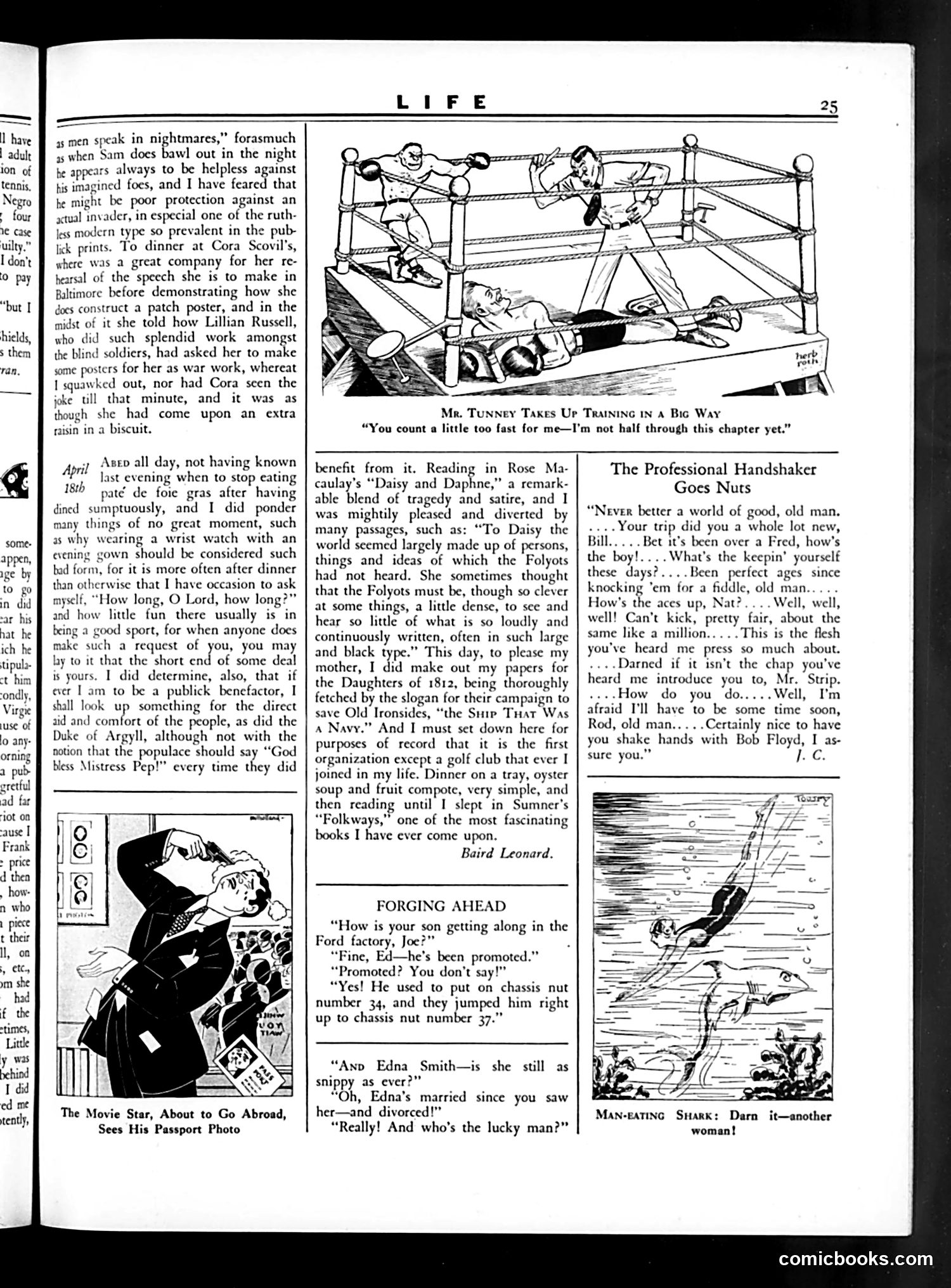
**Top Cartoon**: "Mr. Tunney Takes Up Training in a Big Way" depicts boxer Gene Tunney in a boxing ring, with the caption suggesting he's training so intensely that his sparring partner protests he's counting the rounds too fast. This is a humorous take on Tunney's famous dedication to training and conditioning—he was known as an unusually scientific, serious fighter compared to rougher boxers of the era. **Middle Cartoon**: Shows a movie star examining his passport photo with dismay. This plays on the common complaint that passport photos are unflattering—a timeless joke about bad official photography. **"Man-Eating Shark" Cartoon**: A diving scene showing a shark attacking a woman, captioned "Darn it—another woman!" This is dark humor treating the shark's repeated attacks on women as an annoying inconvenience rather than tragedy. The page also contains diary entries and literary discussion reflecting upper-class 1910s-20s social life, including references to Lillian Russell's WWI poster work and the Daughters of 1812 organization.
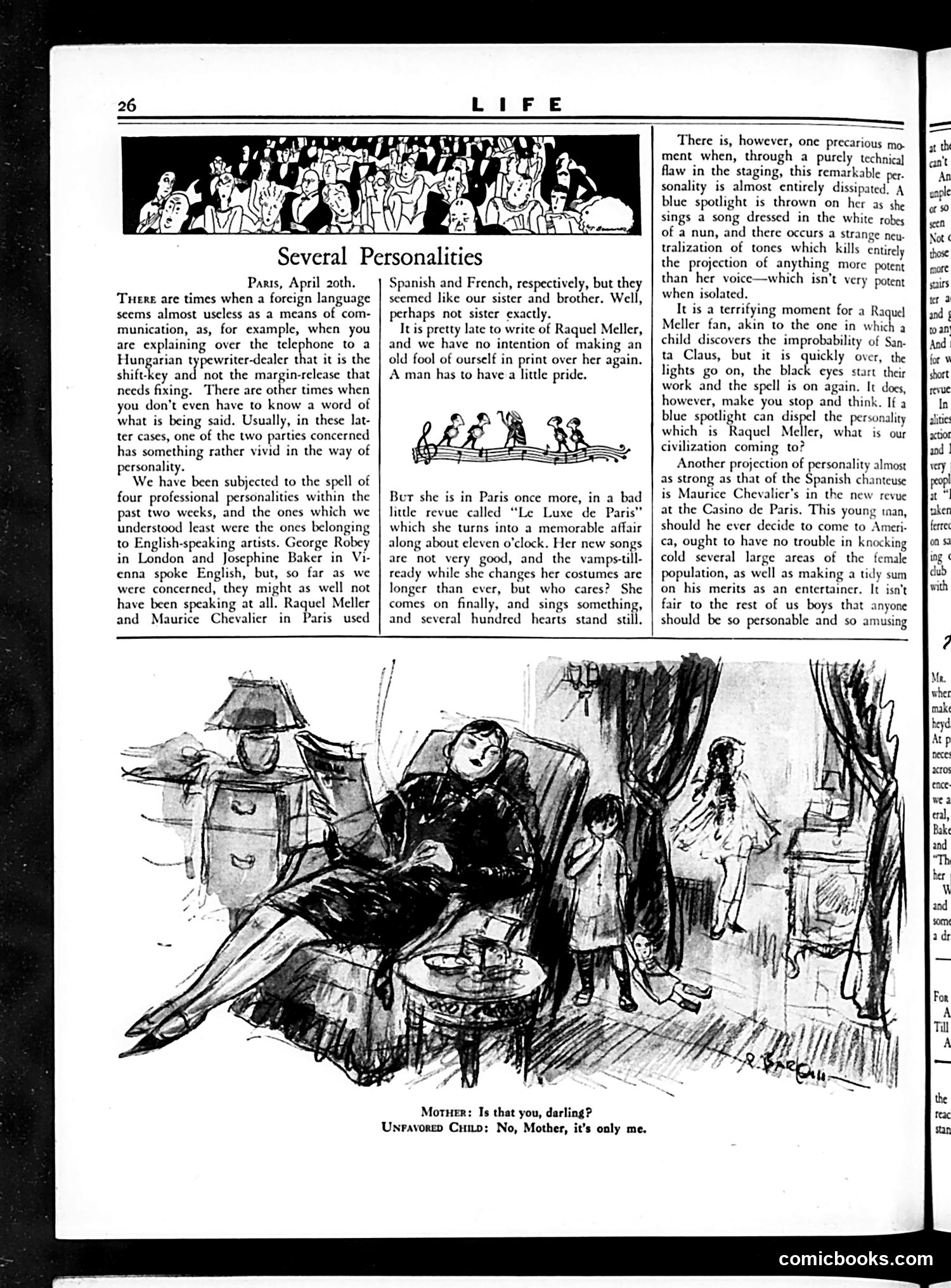
This page celebrates European entertainers performing in Paris circa April 1920, focusing on the magnetic personalities of performers whose appeal transcends language barriers. **The Main Article** discusses four "professional personalities": George Robey and Josephine Baker (English-speakers whose appeal was unclear to the writer), and Spanish-French performers Raquel Meller and Maurice Chevalier (whose non-English performances were somehow more compelling). The writer expresses particular admiration—bordering on infatuation—for the Spanish singer Raquel Meller, describing a moment when poor stage lighting briefly diminishes her captivating presence during a Paris revue performance. **The Cartoon Below** depicts a domestic scene with a mother discovering an "unfavored child" in her bedroom, captioned: "Is that you, darling?" / "No, Mother, it's only me." The humor likely references the contrast between expectation and reality—possibly alluding to the article's theme about personality and presentation, or making a joke about disappointing appearance/identity.
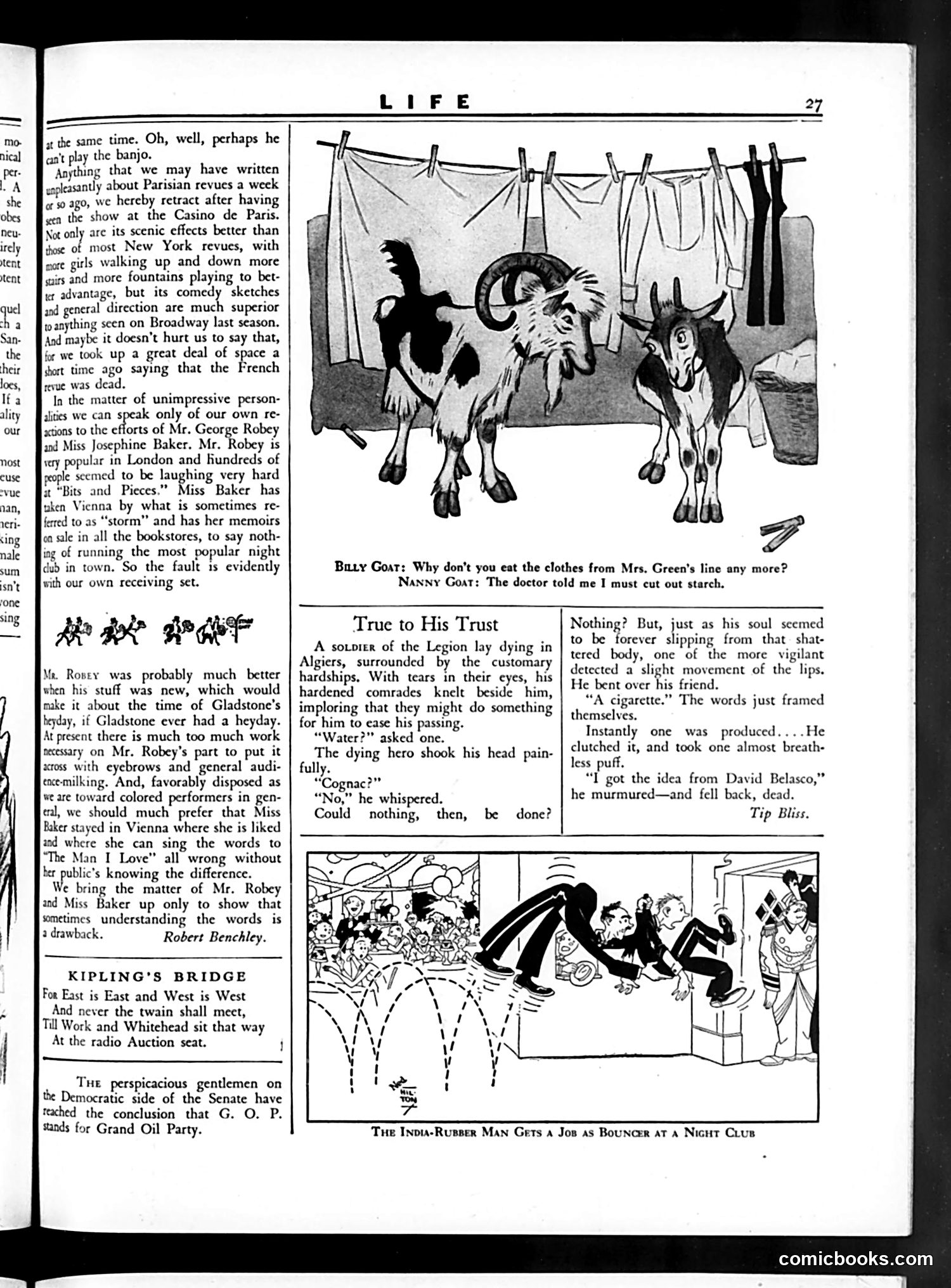
**Top Cartoon (Billy & Nanny Goat):** A simple domestic joke. A billy goat asks why the nanny goat no longer eats clothes from the clothesline. She explains the doctor told her to "cut out starch"—a pun playing on starch used in laundry versus dietary starch. **"True to His Trust" Story:** A satirical anecdote about a dying soldier of the French Foreign Legion in Algeria. Despite comrades offering water and cognac, the soldier's final request is a cigarette—which he smokes while crediting the theatrical producer David Belasco for the idea. The humor lies in the absurdity: even facing death, the soldier prioritizes theatrical pretension over practical comfort. **Bottom Cartoon:** Depicts what the caption describes as "The India-Rubber Man Gets a Job as Bouncer at a Night Club"—showing a contortionist working as security, using his flexibility to eject rowdy patrons from the establishment. All content represents typical Life magazine humor: sophisticated wordplay, theatrical references, and physical comedy aimed at educated readers.
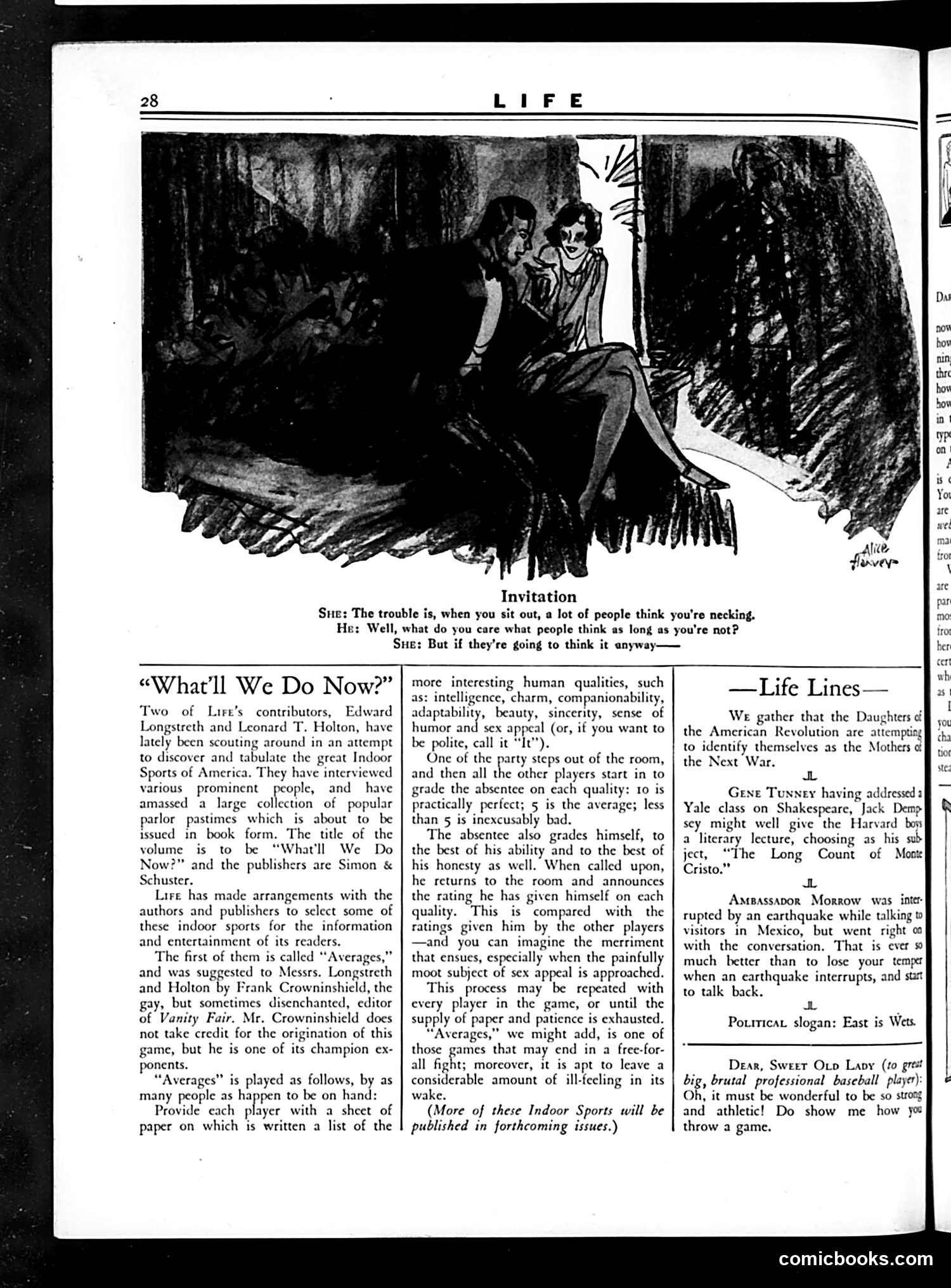
**Main Cartoon ("Invitation"):** A sketch depicting a couple sitting together outdoors, with dialogue about social perception. The joke satirizes dating etiquette: the woman worries that sitting out together will make people think they're "necking" (kissing/making out). The man's pragmatic response—"what do you care what people think as long as you're not?"—mocks both social propriety and the gap between appearance and reality in courtship behavior. This reflects 1920s-era anxiety about reputation and changing sexual attitudes. **"Averages" Game Section:** Life describes a parlor game where players grade an absent person on qualities (intelligence, charm, sex appeal, etc.) on a scale of 1-10, then compare their ratings to the person's self-assessment. The satire targets middle-class entertainment and the awkwardness of honest personal evaluation—the article notes it "may end in a free-for-all fight" and "leave considerable ill-feeling." **Life Lines (Sidebar Jokes):** Brief satirical observations about the Daughters of the American Revolution, boxer Gene Tunney's Shakespeare lecture, and athlete behavior—typical period social commentary.
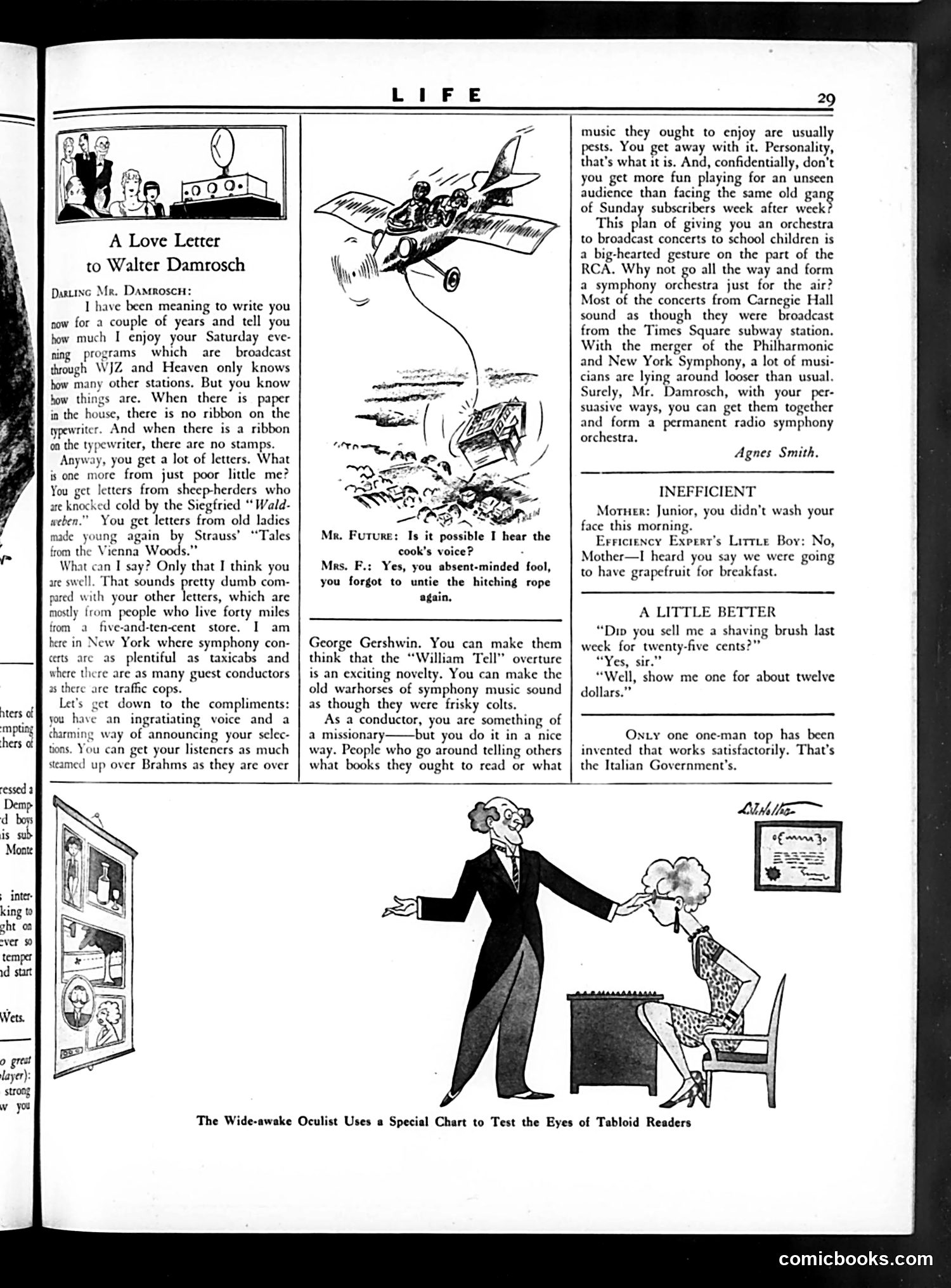
This page contains several humor items typical of 1920s Life magazine satire: **Main Feature: "A Love Letter to Walter Damrosch"** Walter Damrosch was a prominent conductor who broadcast classical music on radio (WJZ network). The letter humorously praises his ability to make classical music accessible and exciting to ordinary people—even making old standards like the "William Tell" overture seem novel. The writer suggests Damrosch could organize an orchestra specifically for radio broadcast, since Carnegie Hall concerts sound poor when transmitted through Times Square subway stations (mocking radio transmission quality). **Bottom Cartoons:** These are brief gag comics: - "Inefficient" jokes about a child avoiding washing up before grapefruit breakfast - "A Little Better" is a shaving brush sales gag - The final caption about "the Italian Government" appears to reference Mussolini's regime, though the specific joke is unclear The page satirizes both radio's emerging role in democratizing classical music and period advertising/consumer culture.
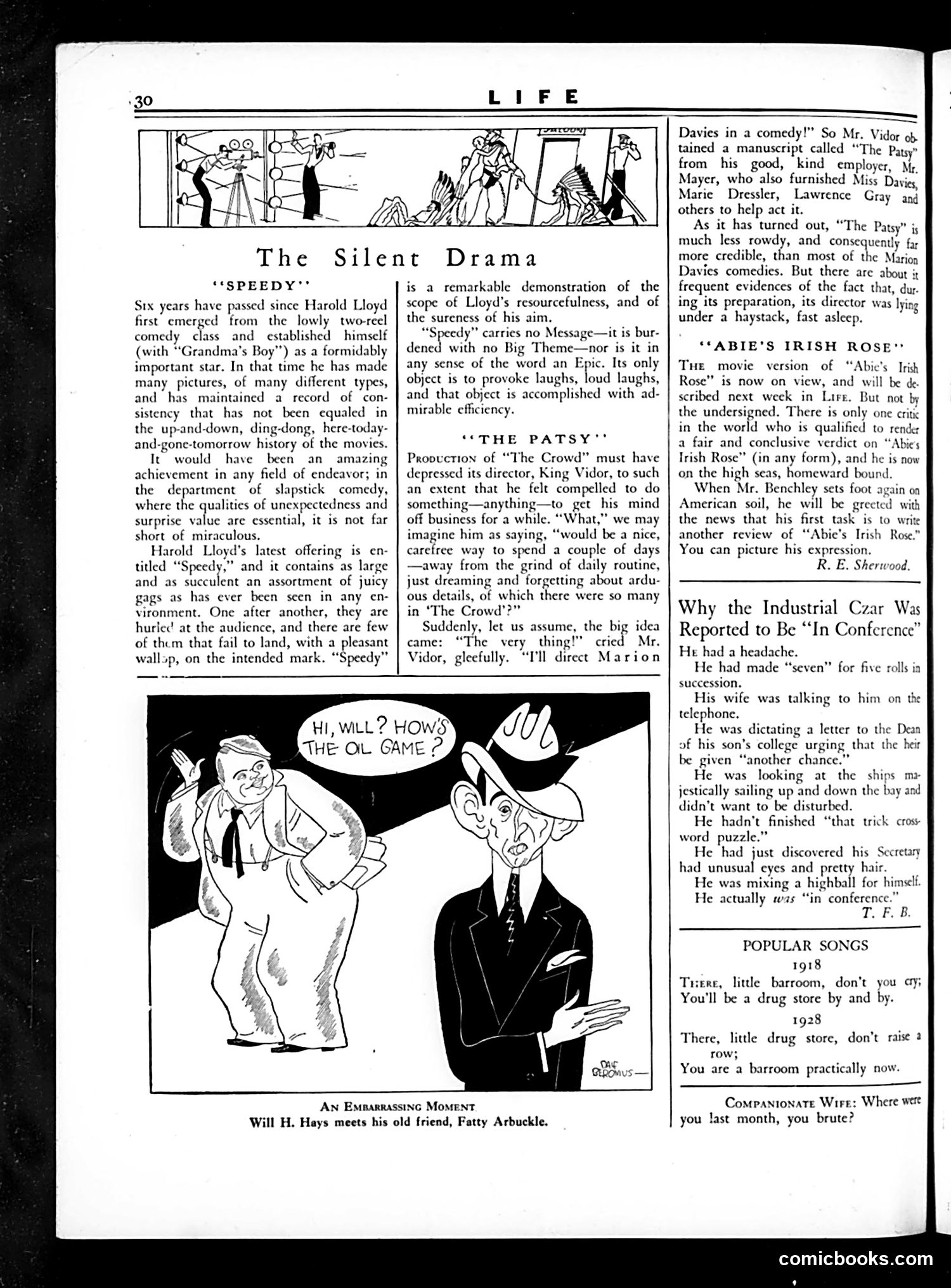
This page reviews silent films from the late 1920s. The main cartoon depicts **Will H. Hays meeting Fatty Arbuckle**, a reference to a genuine scandal: Arbuckle, a major silent film star, faced multiple rape accusations in 1921-22 (charges were eventually dropped). Hays, head of the film industry's censorship board, implemented strict moral codes partly to rehabilitate Hollywood's public image after such scandals. The joke's awkwardness—"Hi, will? How's the ol' game?"—captures the discomfort of encountering someone whose reputation had been destroyed by controversy. The page also reviews films by Harold Lloyd ("Speedy") and director King Vidor ("The Patsy"), praising their entertainment value. A separate humor section jokes that industrial executives claim to be "in conference" while actually distracted by personal matters—a gentle satire on corporate pretense.
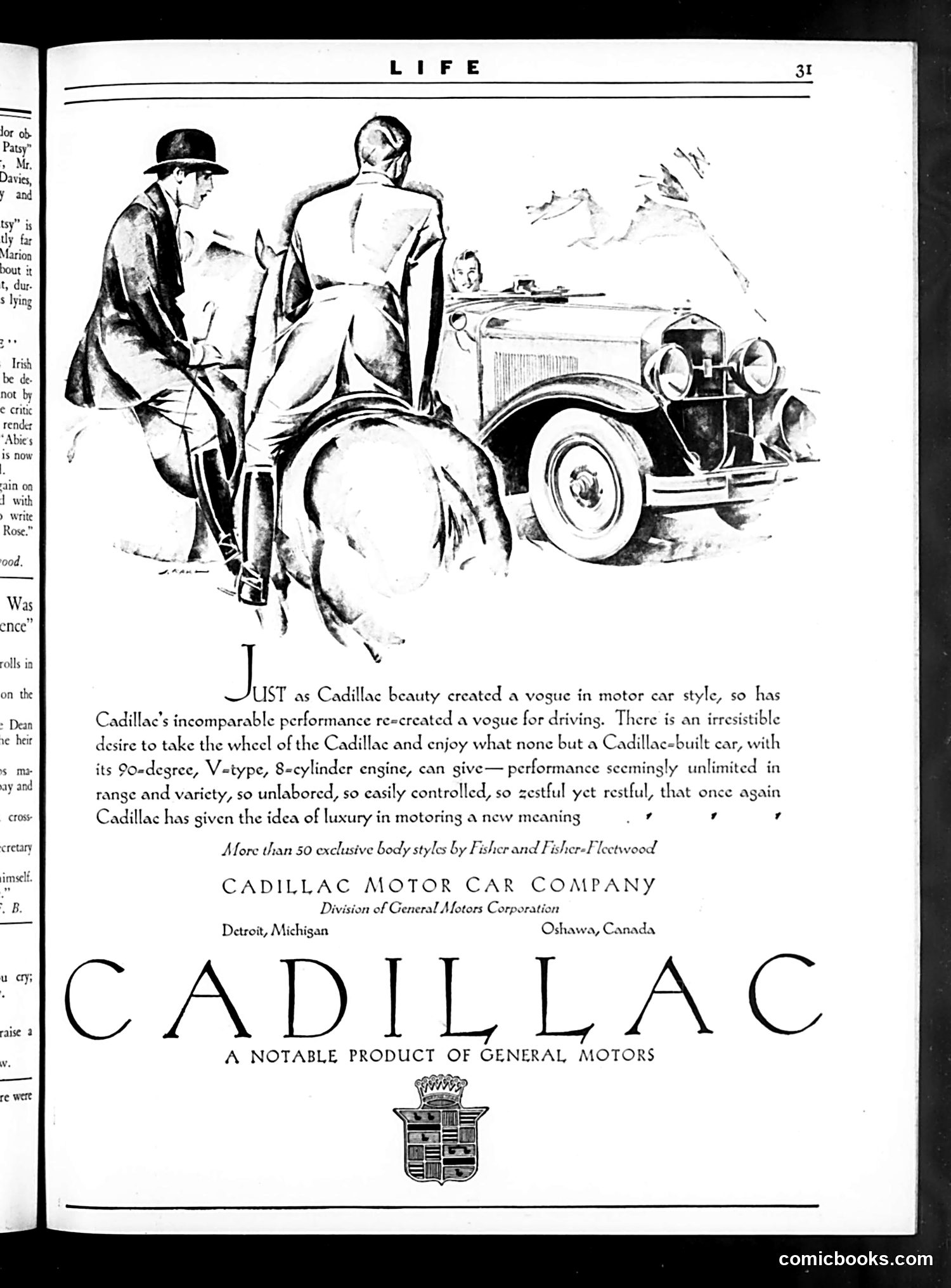
This is a **full-page Cadillac automobile advertisement**, not political satire or comics. The illustration depicts two well-dressed men examining a luxury Cadillac automobile, with a woman visible in the driver's seat. The ad's message targets wealthy consumers in the 1920s-1930s era, emphasizing Cadillac's superiority through performance specifications (90-degree V-type, 8-cylinder engine) and exclusive customization options (50+ body styles by Fisher and Fisher-Fleetwood). The text uses the rhetorical device of comparing Cadillac's influence on automotive style to its influence on driving culture itself—establishing the brand as a trendsetter among the luxury class. The casual, confident poses of the figures and the refined illustration style reinforce an aspirational message: Cadillac ownership signals both taste and status. This represents typical early 20th-century automotive advertising targeting the upper class, emphasizing engineering, luxury customization, and social prestige.
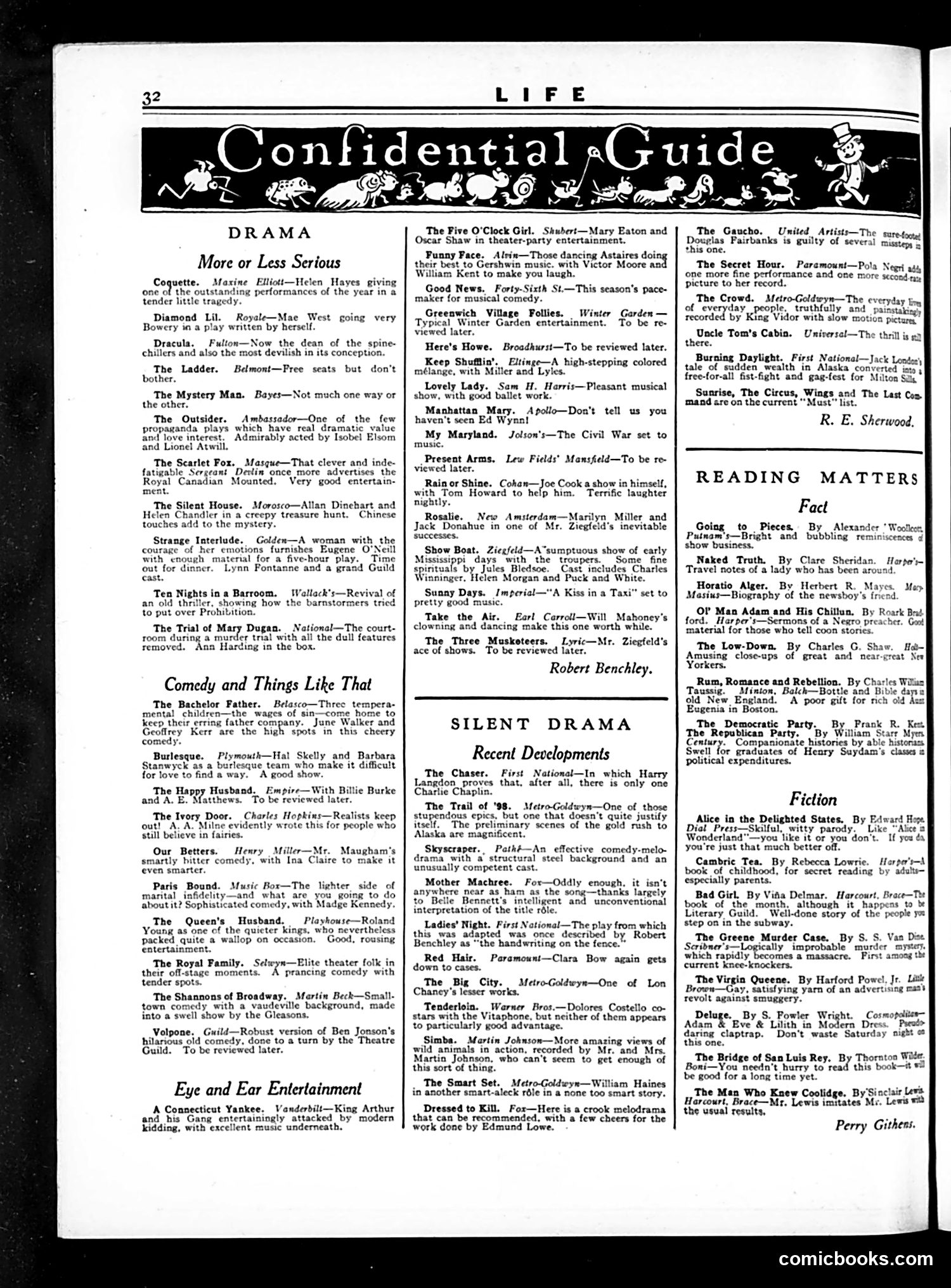
This page from *Life* magazine presents theater reviews and entertainment listings—primarily **not political content**. It catalogs Broadway shows from what appears to be the late 1920s, organized by genre: drama, comedy, musicals, and entertainment. The reviews are brief, often sarcastic assessments. Notable entries include Mae West in *Diamond Lil* (written by herself), Eugene O'Neill's *Strange Interlude*, and Fred Astaire in *Funny Face*. The tone is gossipy and sophisticated—typical of *Life*'s satirical approach to high culture. The right column offers book reviews under "Reading Matters" and "Fiction," covering contemporary literature. No visible cartoons or political commentary appear on this page—it's primarily a cultural/entertainment guide for urban, educated readers of the era, reflecting what plays and books the magazine's audience should know about.
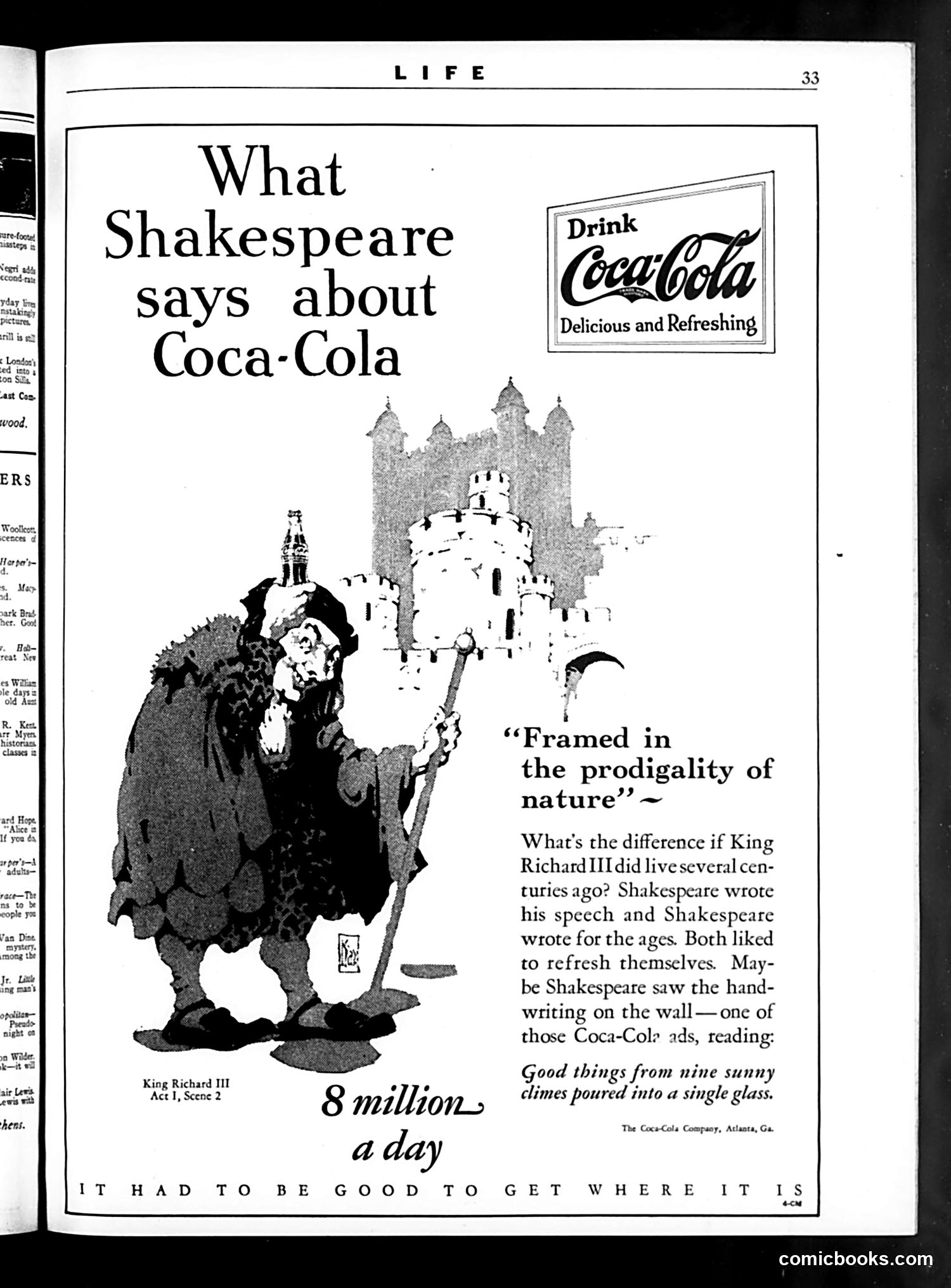
This is a **Coca-Cola advertisement** disguised as satirical content, likely from the 1920s-30s. The "joke" claims Shakespeare himself would have endorsed Coca-Cola. It shows King Richard III (a famously villainous Shakespeare character) alongside a castle, using a fake quote: "Framed in the prodigality of nature." The ad suggests Shakespeare would have appreciated Coca-Cola's refreshing qualities, just as Richard III supposedly did. The humor relies on anachronism—attributing modern product awareness to a 16th-century playwright—and the absurdity of treating a villain as a reliable endorser. The statistic "8 million a day" advertises Coca-Cola's popularity. The actual Shakespeare quote about Richard III is fabricated to serve marketing purposes. This represents aggressive early 20th-century advertising that co-opted high culture and literary authority to sell a mass-market product, treating consumers as credulous enough to believe Shakespeare would pitch soda.
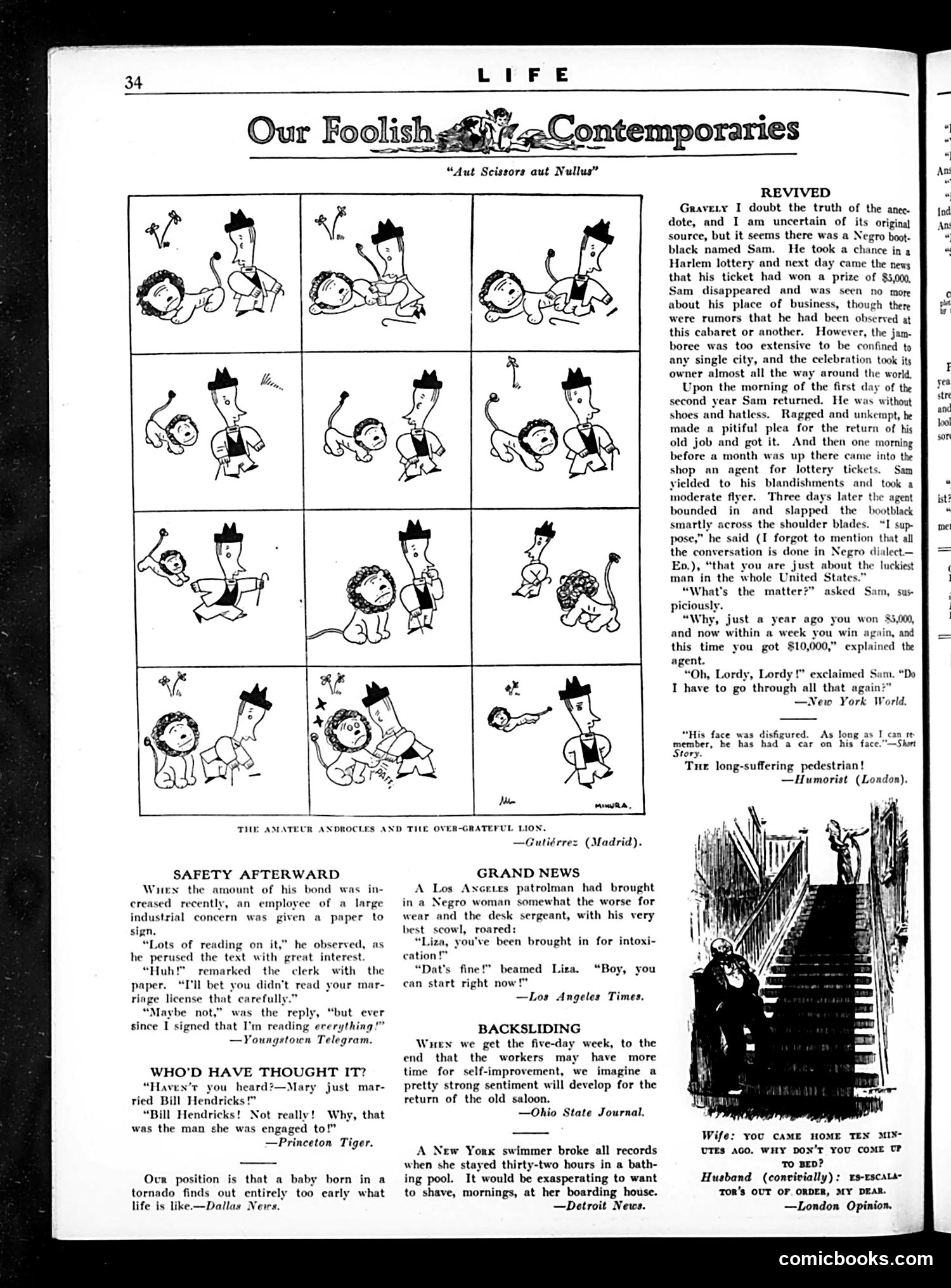
This page from *Life* magazine collects short humorous anecdotes and a comic strip. The main cartoon, "The Amateur Androcles and the Over-Grateful Lion," depicts slapstick physical comedy between two men and appears to be a visual gag (the reference to Androcles alludes to the classical tale of gratitude). The text humor largely relies on racial stereotypes common to early 20th-century American comedy. "Grand News" and "Revived" feature African American characters speaking in exaggerated dialect ("Dat's fine!"). These pieces mock both gambling addiction and racial caricatures. Other jokes satirize marriage, industrial workplace safety bonds, and the proposed five-day work week—treating self-improvement cynically as likely to drive workers back to saloons. The page's overall tone is light satirical commentary on contemporary American life, though the racial content reflects deeply offensive period attitudes now unacceptable.
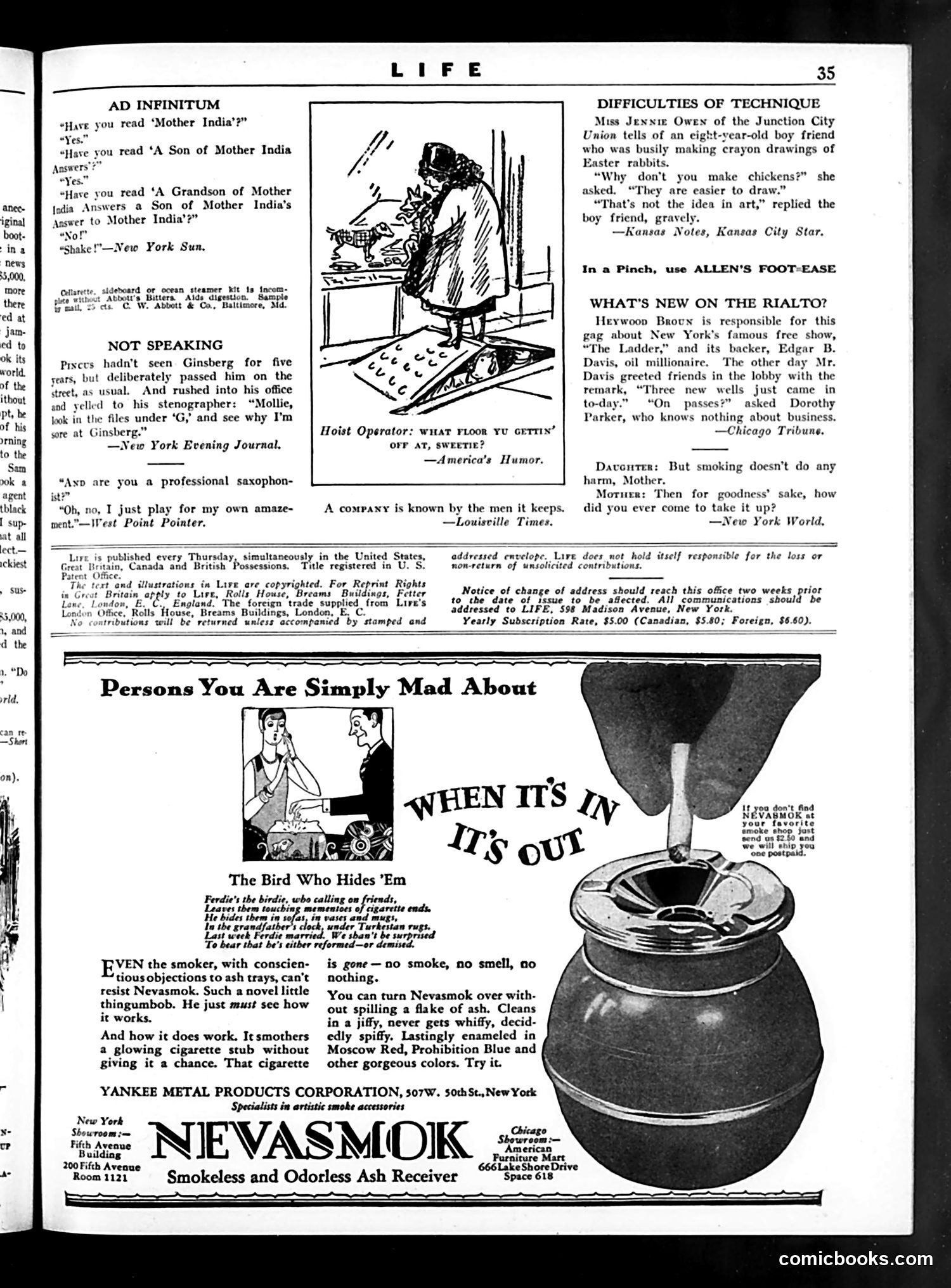
This page contains several brief humorous pieces typical of Life's satirical format, plus advertisements. **Top Section - "Ad Infinitum":** A joke mocking the seemingly endless sequels to the controversial book *Mother India* (published 1927), which criticized British colonial rule in India. The humor lies in the absurdist chain of responses and counter-responses. **"Not Speaking":** A workplace humor piece about a man so angry at someone named Ginsberg he can't even remember why—poking fun at petty grudges. **"Difficulties of Technique":** A brief anecdote about a child preferring to draw difficult subjects (Easter rabbits) over easier ones, valuing artistic challenge. **Dorothy Parker Reference:** A quip about Parker's famous wit—she dismissively asks about "passes" (free theater tickets) when an oil millionaire mentions new oil wells, feigning ignorance of business matters. **Main Advertisement - Nevasmok Ashtray:** The substantial lower half advertises a novelty smokeless ashtray that supposedly contains cigarette ash without mess or smell. The phrase "When It's In, It's Out" plays on the product's containment appeal, a key selling point for conscientious smokers of the era.
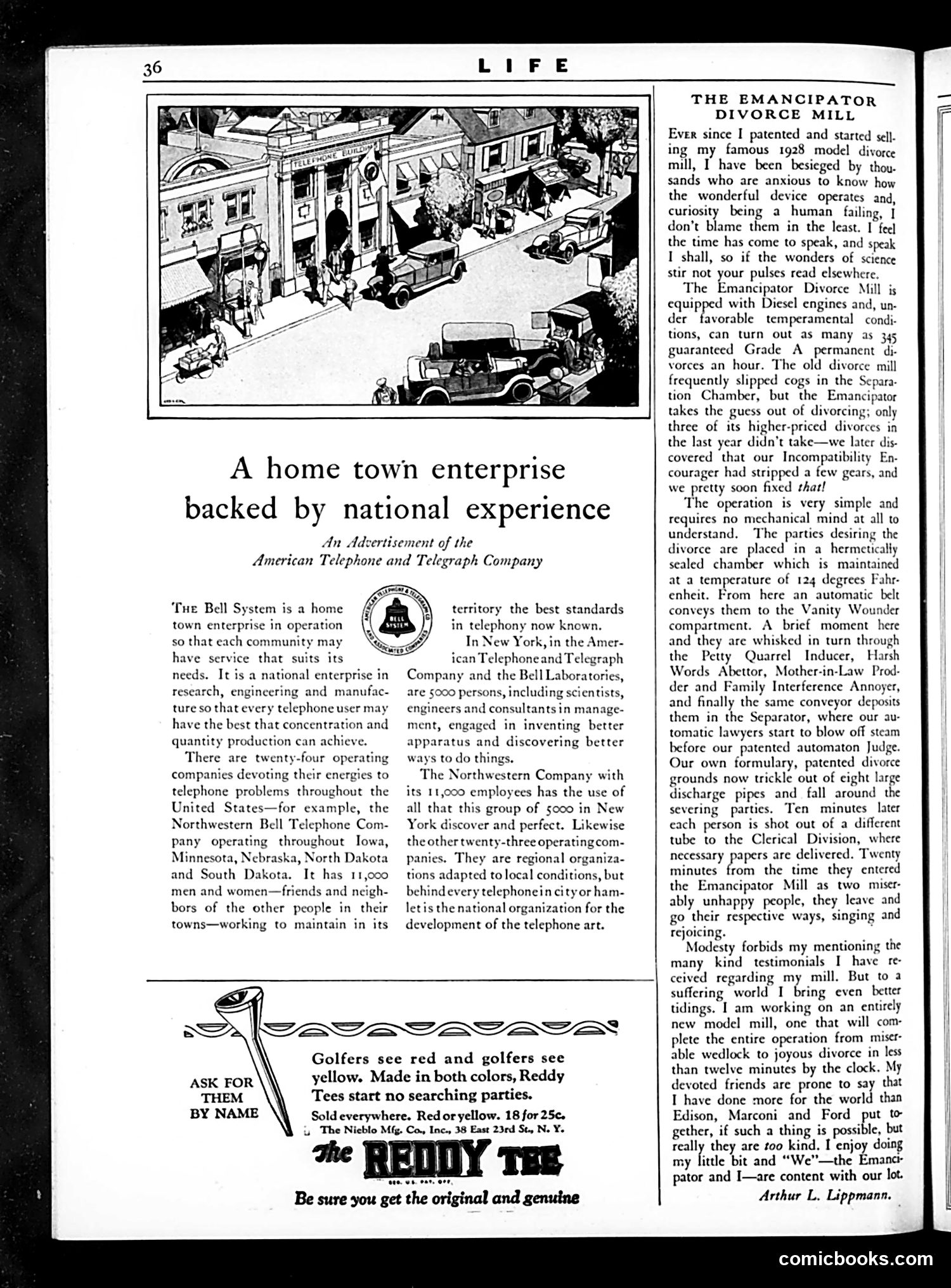
This page contains a humorous satirical piece titled "The Emancipator Divorce Mill," presented as a mock patent/advertisement by inventor Arthur L. Lippmann. The satire mocks the industrialization of American life and the increasing ease of obtaining divorces in the 1920s-30s. Lippmann describes an absurd factory machine that processes divorces with industrial efficiency—producing "345 guaranteed Grade A permanent divorces an hour." The contraption includes comically named components like "Petty Quarrel Inducer," "Harsh Words Abettor," and "Mother-in-Law Prodder," which automatically manufacture marital conflict. The joke critiques how divorce had become routinized and accessible, transforming what was once a serious legal matter into something as mechanical and impersonal as factory production. The piece pokes fun at both modern industrial culture and society's changing attitudes toward marriage dissolution. The accompanying illustration shows an industrial building resembling a factory, reinforcing this satirical vision.
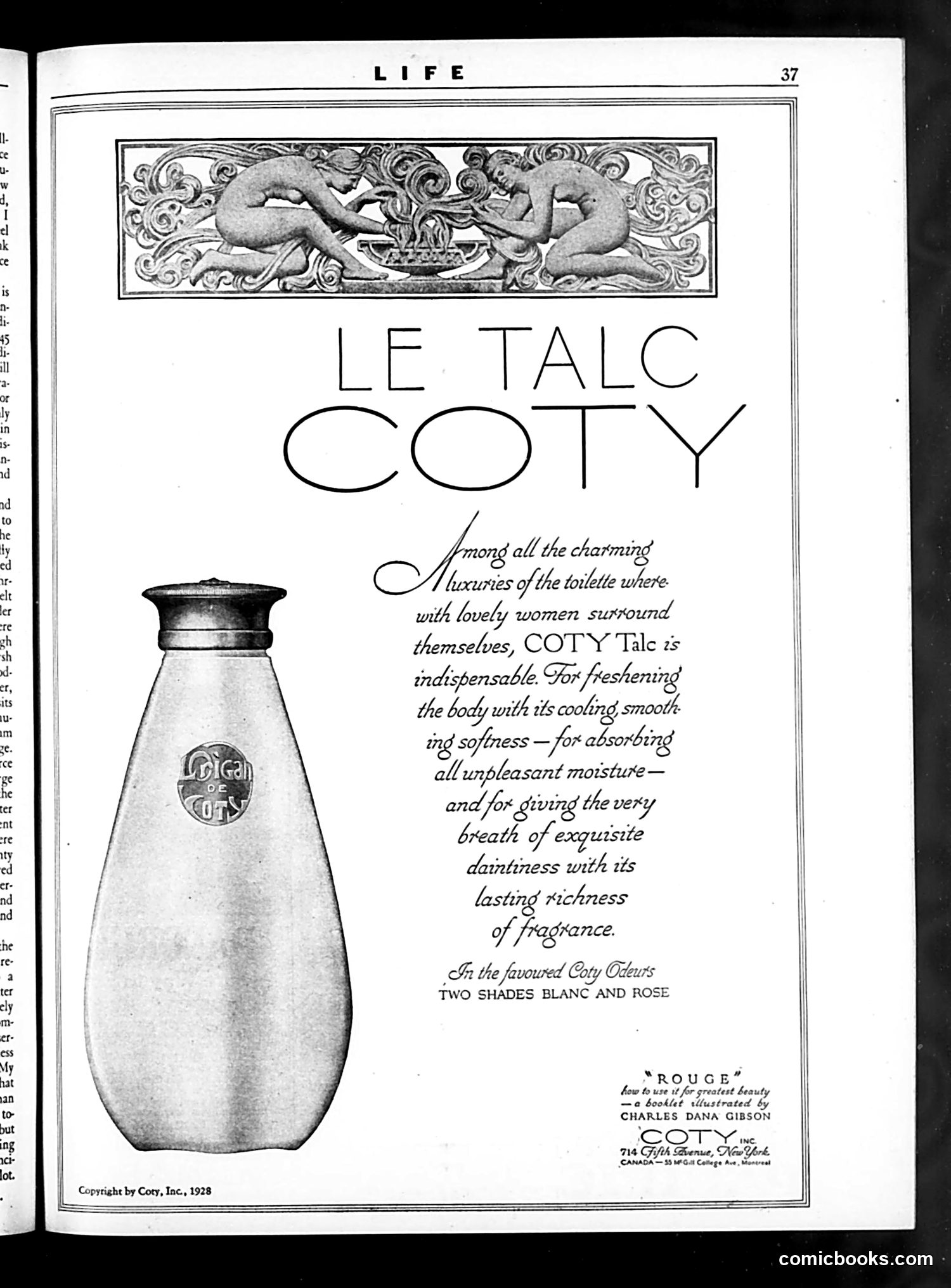
This page is **not a political cartoon or satire**—it is a **1928 advertisement** for Coty talcum powder, placed in *Life* magazine. The ornamental header features two cherubs flanking a classical vessel, establishing luxury branding. The advertisement targets women, emphasizing talc's practical benefits: cooling, moisture absorption, and fragrance. The copy uses flowery, period-appropriate language ("breath of exquisite daintiness") typical of cosmetics marketing of the era. A notable detail: the ad references a booklet illustrated by **Charles Dana Gibson**, the famous cartoonist known for the "Gibson Girl" aesthetic—a cultural touchstone of early 20th-century femininity that the company leveraged for credibility and elegance. The product came in two scents: "Blanc and Rose." This is straightforward commercial content reflecting 1920s beauty standards and marketing strategies, not editorial commentary or satire.
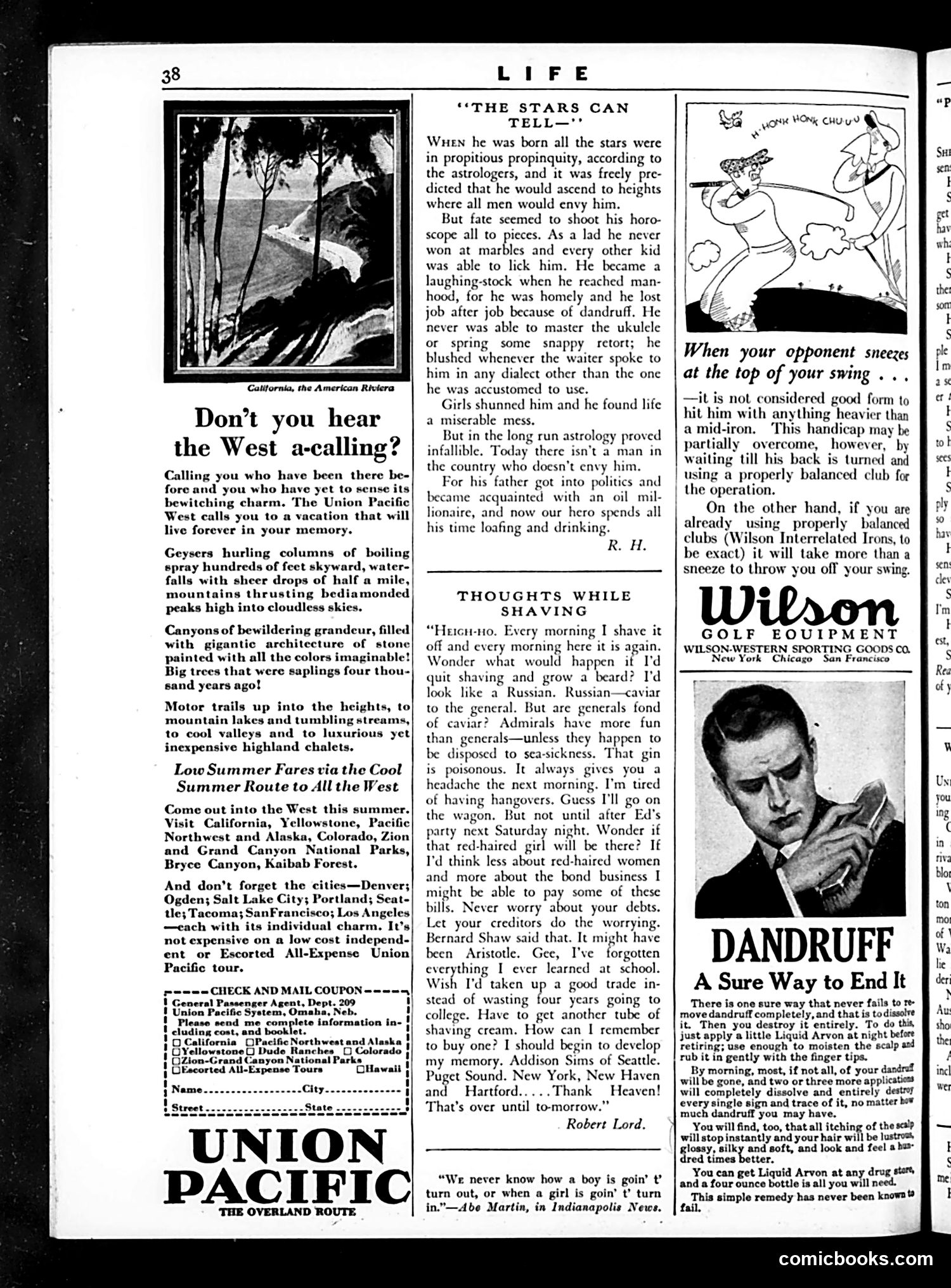
This page contains **three distinct pieces of satirical content**: 1. **"The Stars Can Tell"** (center): A short story mocking astrology and social climbing. It describes a man whose horoscope predicted greatness, but who failed at everything (marbles, romance, jobs) due to personal defects like unattractiveness and dandruff. The ironic twist: he eventually becomes enviable—not through merit, but because his father befriended an oil millionaire, allowing the son to spend life "loafing and drinking." The satire targets both false fortune-telling and how wealth, not character, determines social status. 2. **"Thoughts While Shaving"** (right): A stream-of-consciousness monologue capturing a man's scattered, self-indulgent musings—beards, generals, gin hangovers, red-haired women, unpaid bills, forgotten education. It satirizes the superficiality and self-deception of the modern middle-class male. 3. **Advertisements** (left and bottom): Union Pacific railroad promotions emphasizing Western tourism and vacation travel. The page reflects 1920s-era satirical humor about wealth, pretension, and American materialism.
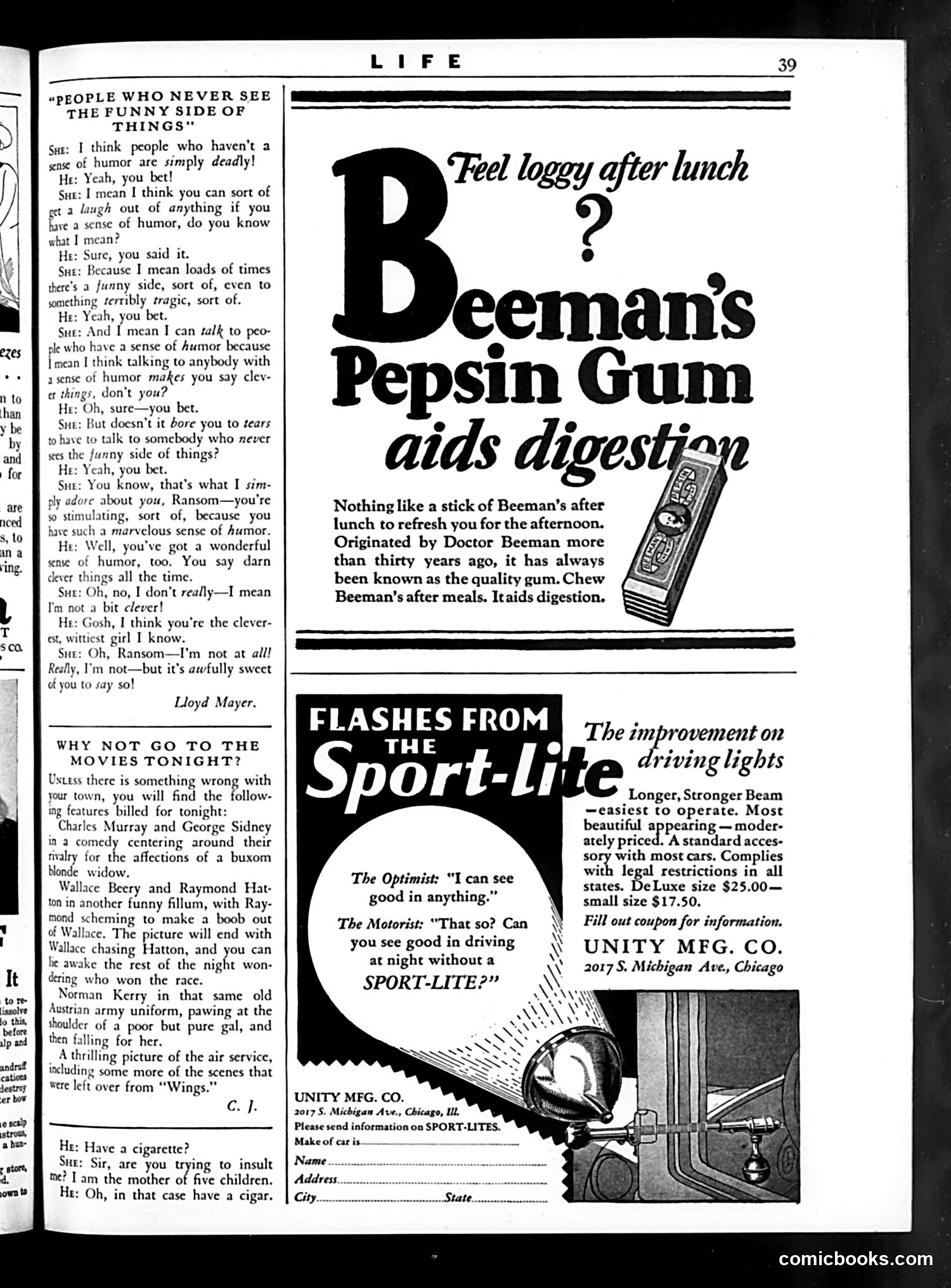
This page contains two distinct pieces: **"People Who Never See the Funny Side of Things"** (by Lloyd Mayer): A satirical dialogue where a woman named Sue endlessly flatters a man named Ransom about his sense of humor while simultaneously denying her own wit. The joke targets social pretense—Sue claims people without humor are "deadly," yet she and Ransom engage in vapid mutual compliments, revealing they lack the very humor they celebrate. It's satire on insincere flattery and shallow social conversation. **Advertisements**: The rest of the page consists of period product ads (Beeman's Pepsin Gum, Sport-Lite driving lights, and movie listings). These are straightforward marketing with no satirical content. The page also includes a brief joke exchange about cigarettes/cigars referencing motherhood, typical of the era's light humor. Overall, this is primarily an advertising-heavy page with one genuine satirical piece about social fakery.
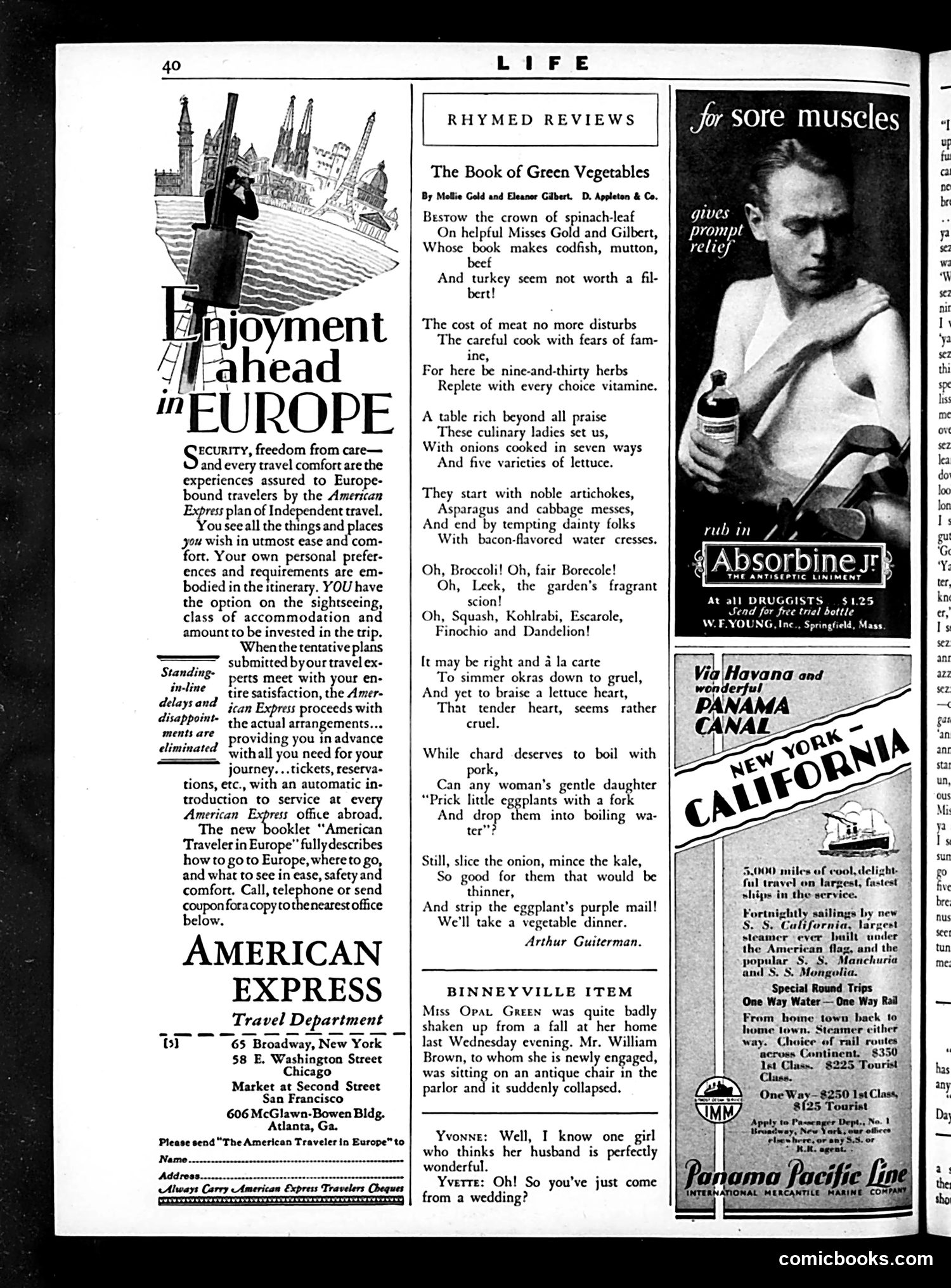
This page comprises **three distinct sections**: travel advertising, literary content, and product advertisements. The **American Express ad** (left) promotes European travel, emphasizing convenience and personalized itineraries that eliminate "standing-in-line delays and disappointments"—likely referencing post-WWI tourism expansion. The **"Rhymed Reviews" section** (center) humorously critiques a cookbook about vegetables by Gold and Gilbert, using playful verse to mock the era's health-conscious obsession with vitamins and meatless diets. The satire suggests this vegetable-focused cooking was becoming fashionable yet somewhat pretentious. The **"Binneyville Item"** (a gossip column) includes a mild joke about a woman's fiancé sitting on a collapsing antique chair, plus a quip about newlyweds—light social humor typical of the period. The **right column** contains period advertisements: Absorbine Jr. liniment for muscle soreness, and shipping lines (Panama Canal and Pacific routes), reflecting 1920s consumer culture and leisure travel.
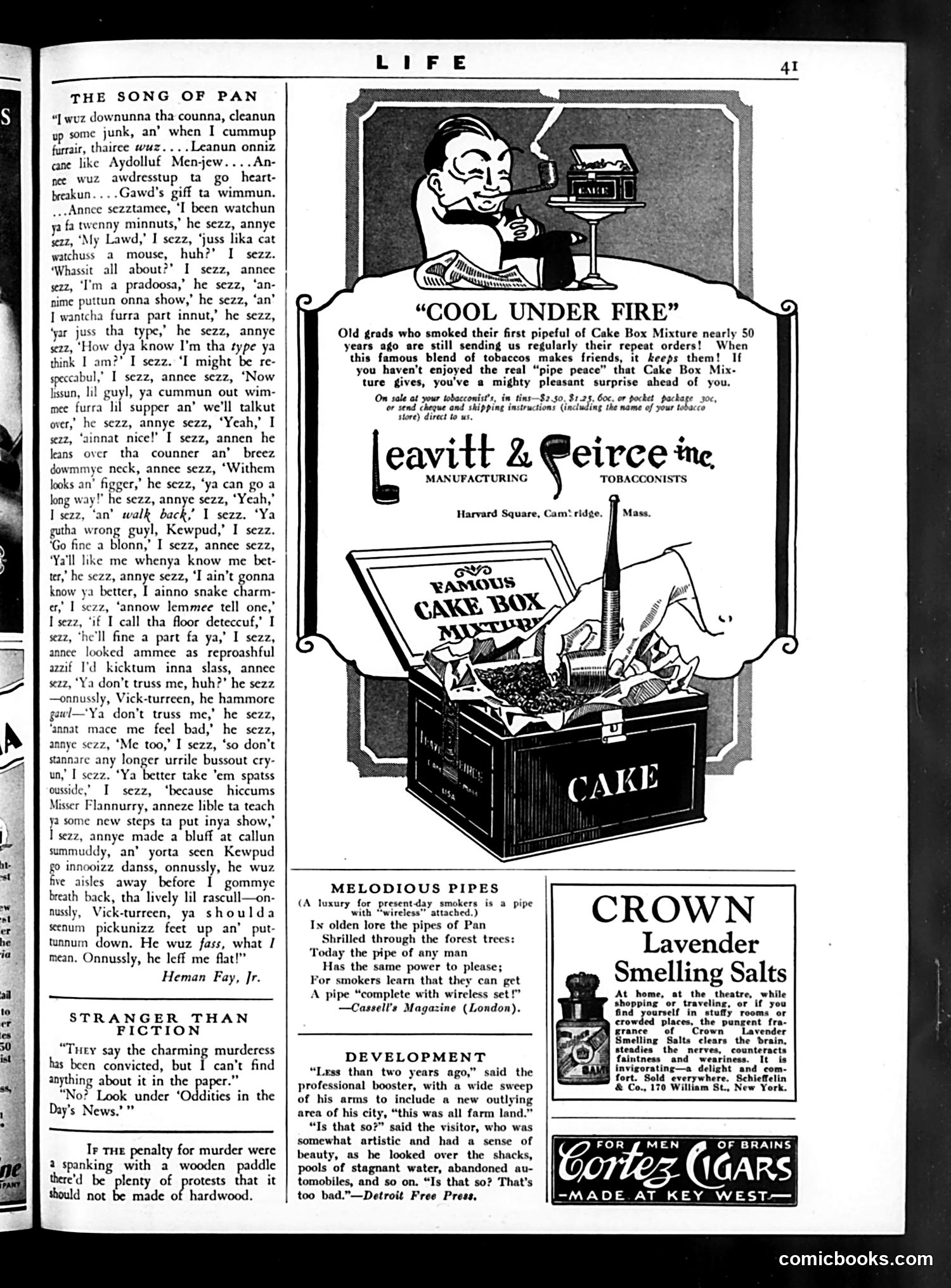
This page is primarily **advertising**, with a humorous short story and satirical poems as filler content. **"The Song of Pan"** is a comedic monologue in exaggerated working-class dialect about a woman approached by a theatrical producer offering her a stage role. The satire targets predatory behavior in early entertainment—the producer's manipulative pickup lines ("Ya can go a long way") are transparently sleazy, and the woman repeatedly rejects his advances, ultimately threatening to call security. The humor derives from her sharp comebacks deflating his smooth talk. The **advertisements** promote tobacco products (Cake Box Mixture pipe tobacco, Cortez Cigars) and Crown Lavender Smelling Salts. These are period-appropriate luxury goods marketed to affluent readers. **"Melodious Pipes"** is a light poem praising modern smoking pipes, punning on "wireless" (contemporary technology) while referencing Pan, the mythological god of pipes. The overall page reflects 1920s urban culture, gender dynamics, and consumer marketing to middle/upper-class audiences.
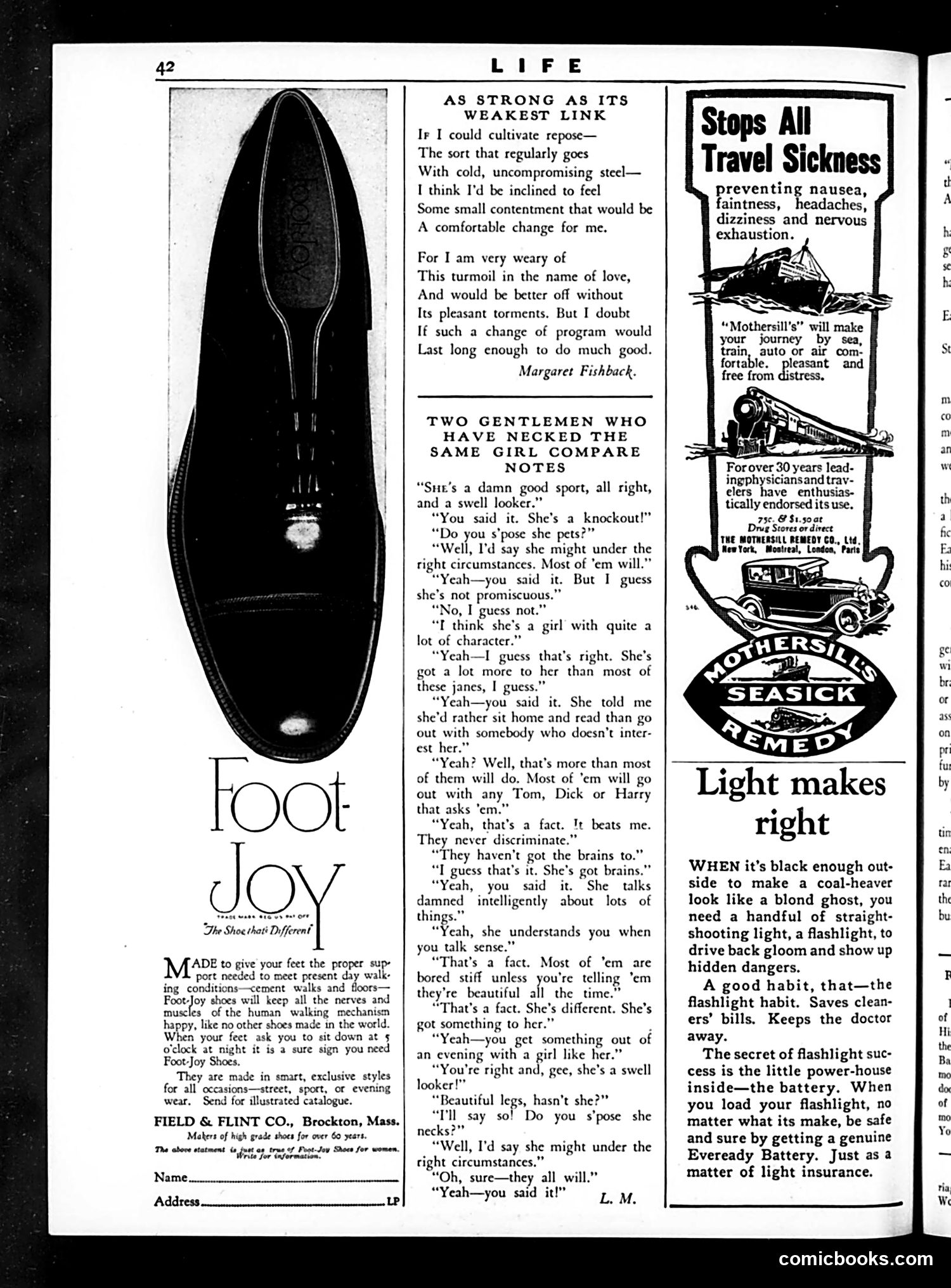
This page combines advertising with satirical content typical of *Life* magazine's format. The main satirical piece, "Two Gentlemen Who Have Necked the Same Girl Compare Notes," mocks male attitudes toward women in the 1920s. Two men discuss a girl they've both dated, praising her as intelligent and having "character"—yet repeatedly circling back to whether she's attractive and willing to "pet" (make out). The humor lies in the repetitive hypocrisy: they claim to value her mind while actually focused on physical appearance and sexual availability. The joke ending—reverting to "she's a swell looker"—undercuts all their earlier praise of her intellect. The surrounding ads (Foot Joy shoes, Mothersill's travel remedy, Eveready batteries) are period products marketed through practical appeals rather than satire. The poem "As Strong as Its Weakest Link" by Margaret Fishback expresses romantic frustration in a more literary register—a common *Life* feature pairing advertising with light verse.
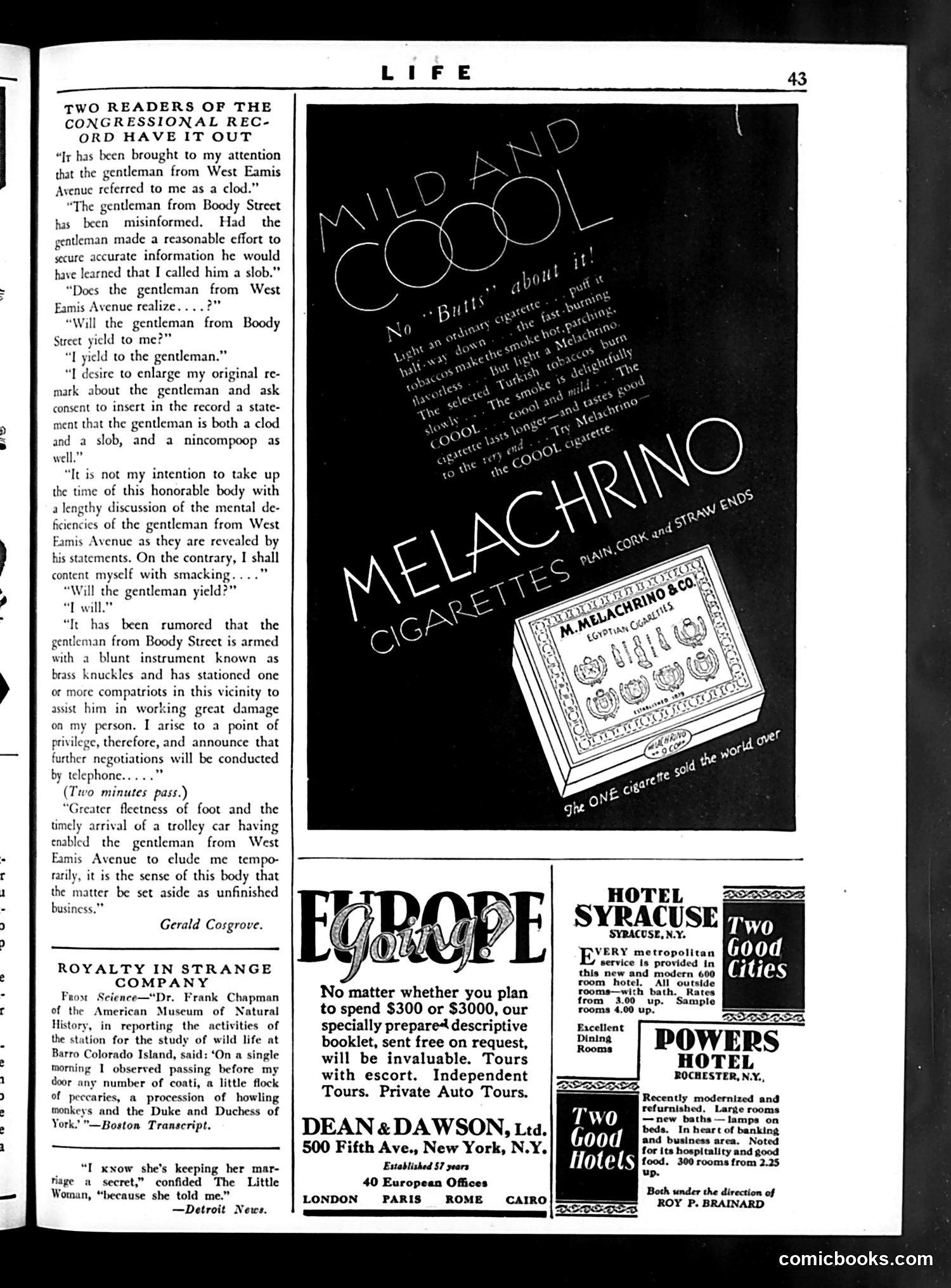
This page satirizes the absurdity of Congressional debate through a mock exchange between two fictitious representatives from trivial Boston neighborhoods (West Eamis Avenue and Boody Street). The joke escalates from petty name-calling ("clod" vs. "slob") to increasingly formal parliamentary procedure, with each speaker invoking Congressional rules to expand their insults into the official record. The humor peaks when one representative mentions rumors of brass knuckles and armed compatriots—forcing the "debate" to conclude hastily as the threatened gentleman flees via trolley car. The satire mocks both the pretentious formality of Congressional language and the pettiness underlying many legislative disputes. By treating absurd personal quarrels with full parliamentary gravitas, the piece critiques how Congress dignifies trivial conflicts through procedural rules and verbose oratory.
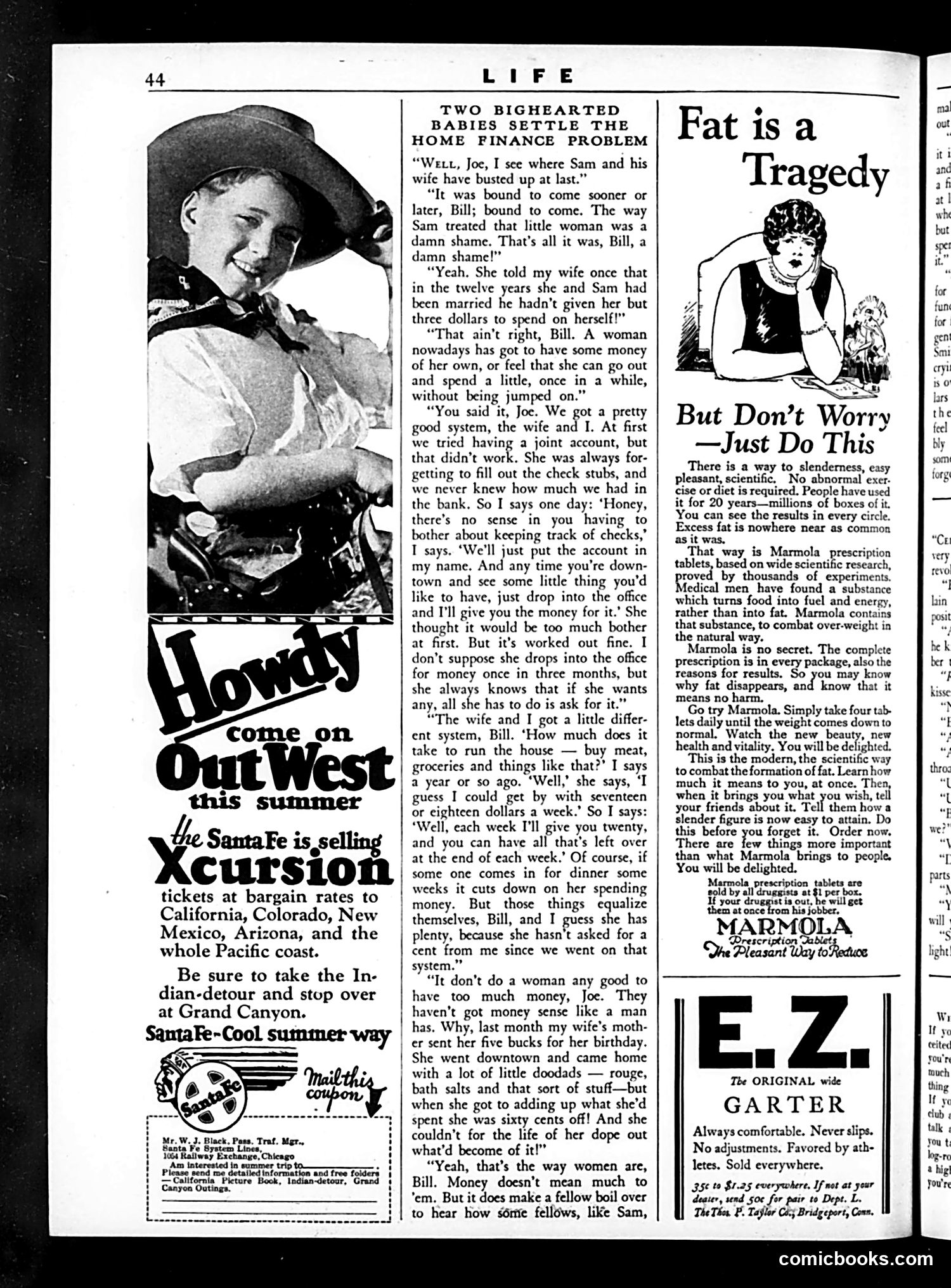
This page contains two distinct sections: **Left side**: A satirical dialogue between two men ("Joe" and "Bill") discussing marital finances. They present themselves as having superior systems to their friend Sam, who allegedly gave his wife minimal spending money, leading to divorce. Joe and Bill describe giving their wives allowances—either on-demand or weekly stipends—framing this as generous and modern. The satire's target is unclear to modern readers, but the piece appears to mock either: working-class men's self-congratulation about controlling household finances, or conversely, the patronizing attitude toward women's financial autonomy. **Right side**: A straightforward advertisement for "Marmola" weight-loss tablets, claiming scientific validation and widespread use. It promises slenderness without diet or exercise—a common early 20th-century patent medicine pitch. The cowboy illustration advertises Santa Fe Railway excursions.
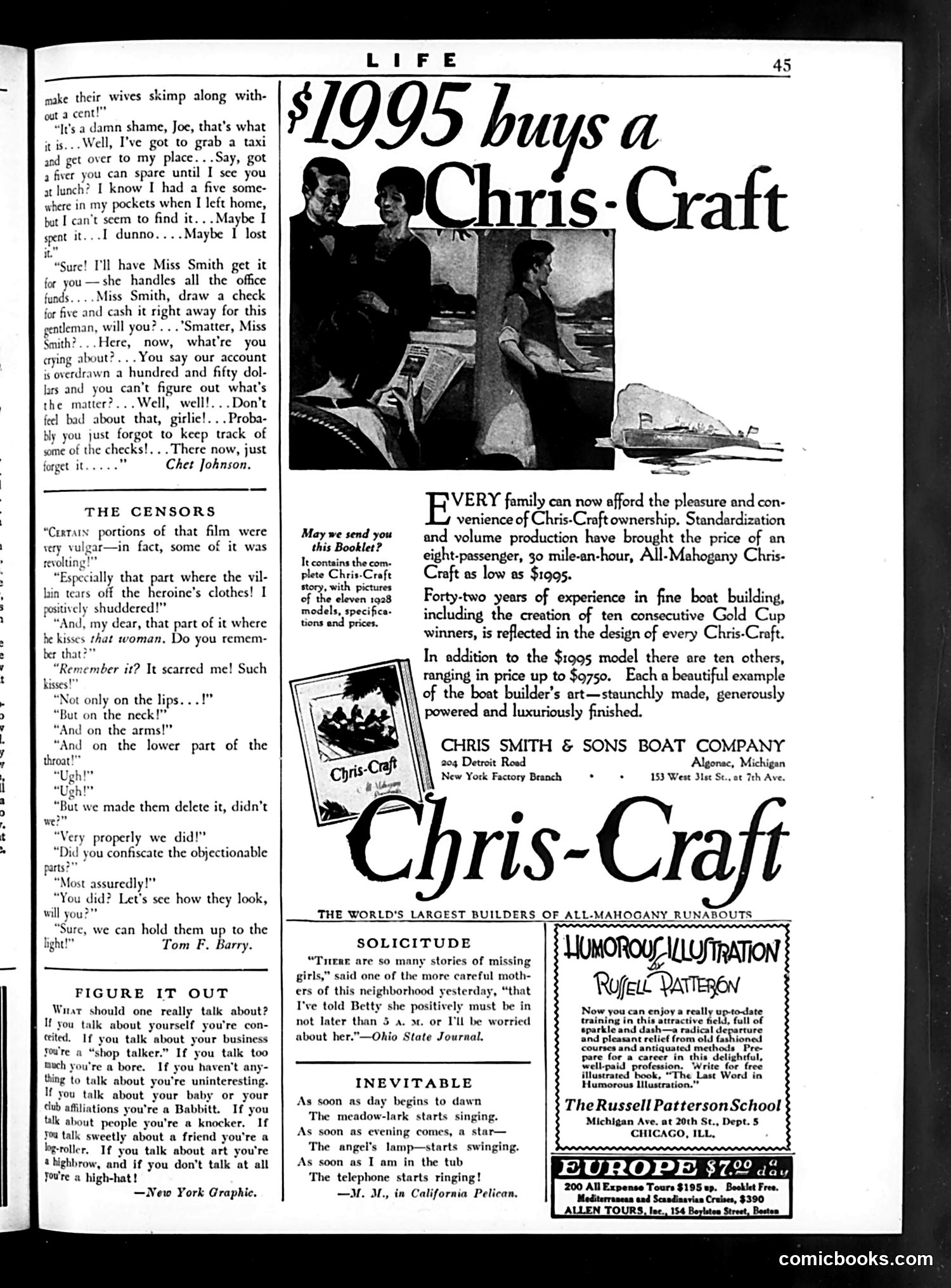
This page contains multiple satirical pieces typical of Life magazine's format: **"The Censors" cartoon** (by Tom F. Barry): Mocks film censors who obsessively remove "immoral" content from movies—particularly scenes of physical intimacy. The joke is that these self-righteous censors then request to view the deleted material "held up to the light," revealing their hypocrisy and prurient interest. **"Figure It Out"**: A humorous etiquette piece satirizing modern social conversation—whatever topic one chooses (business, personal life, children, gossip, or art) invites criticism. It reflects 1920s anxieties about social propriety and the impossibility of pleasing everyone. **Advertisements dominate the lower half**, including a Chris-Craft boat ad emphasizing affordable luxury ($1,995), and various other commercial pitches. **"Solicitude" and "Inevitable"** are brief humorous verses about parental worry and domestic interruptions. The page reflects 1920s concerns: film censorship debates, social conformity pressures, and consumer culture advertising.
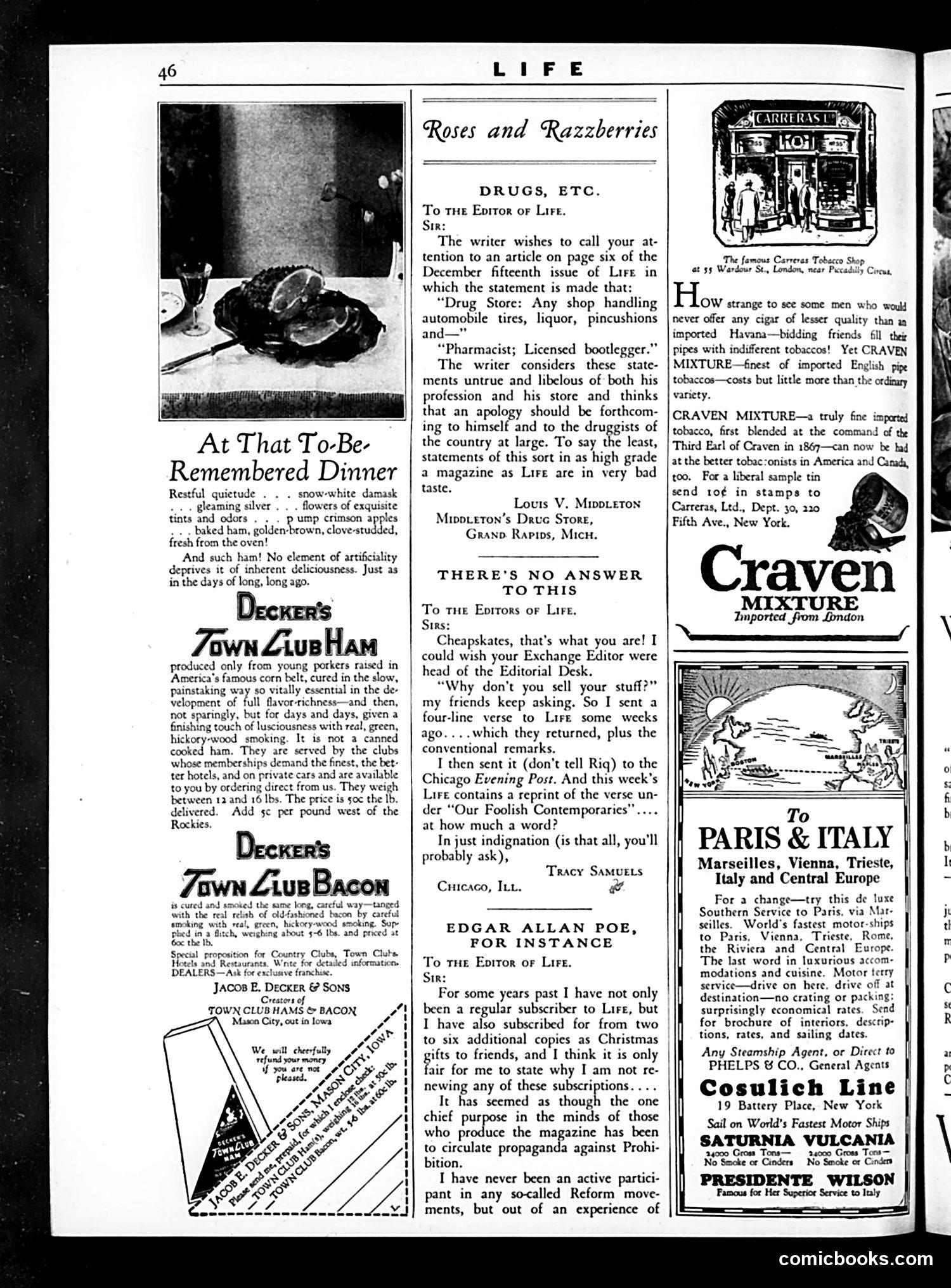
This page is primarily **advertisements and readers' letters**, not political cartoons. The "Roses and Razzberries" section contains reader complaints and praise: 1. **First letter**: A druggist protests Life's satirical definition of "Drug Store" as a place selling tires, liquor, and pincushions, and "Pharmacist" as a "Licensed bootlegger." He calls this libelous. This references **Prohibition-era tensions**—the implication that pharmacists illegally sold alcohol under the guise of medicine. 2. **Second letter**: A frustrated writer complains that Life rejected his poem, then reprinted it in another publication credited to "Our Foolish Contemporaries"—essentially stealing his work. 3. **Third letter**: A subscriber cancels because Life allegedly promotes anti-Prohibition propaganda. The bulk of the page features product advertisements (Decker's ham and bacon, Craven tobacco, travel services). There are no political cartoons visible—this is a typical early 20th-century magazine letters section combined with commercial content.
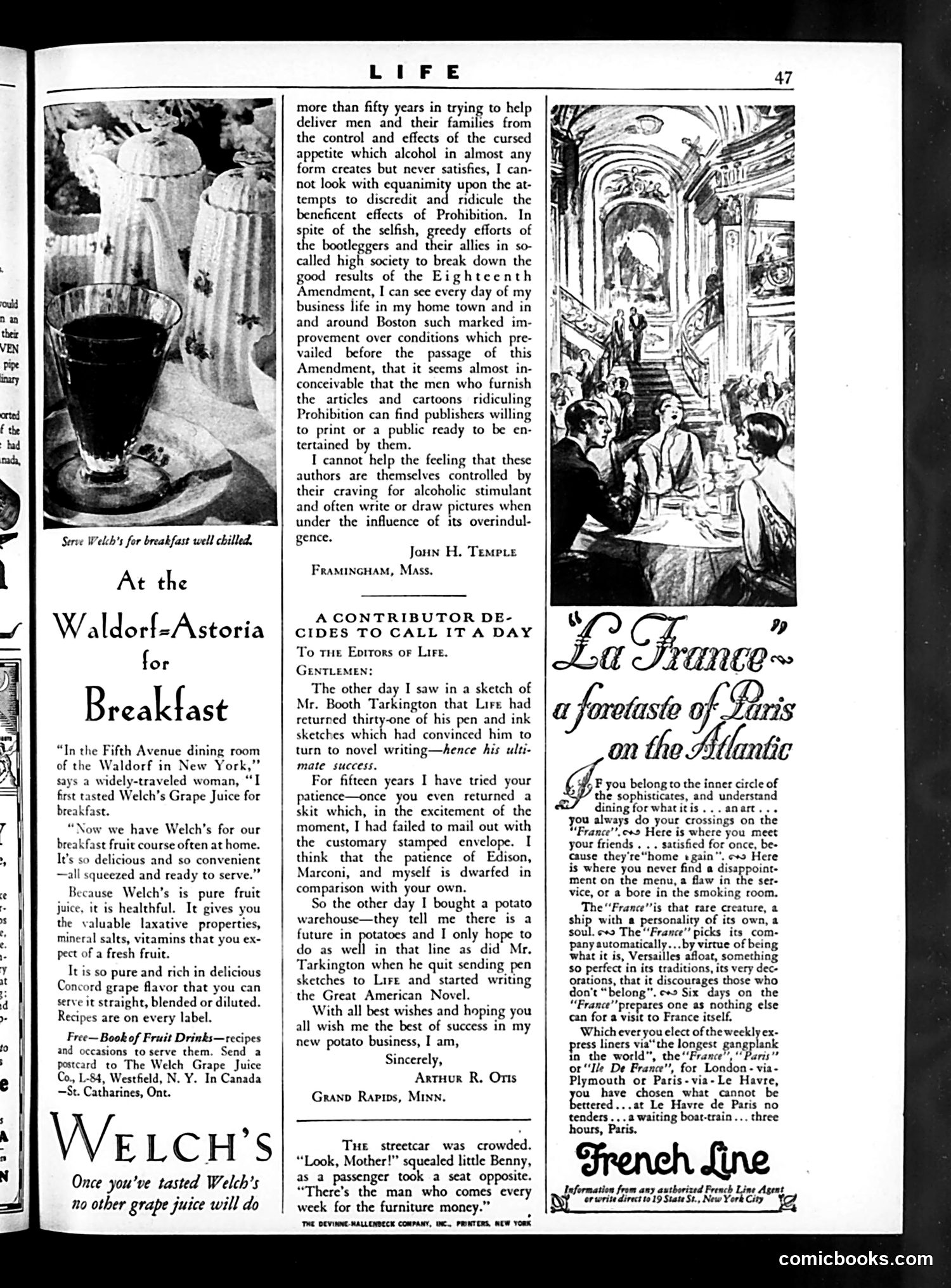
This page contains **reader letters to Life magazine debating Prohibition** (the 1920-1933 ban on alcohol sales). **John H. Temple's letter** defends Prohibition's benefits, claiming he's observed improved community conditions since its passage. He attacks critics—cartoonists and authors who ridicule Prohibition—suggesting they're "controlled by their craving for alcoholic stimulant" and write while intoxicated. **Arthur R. Otis's letter** is humorous: he claims to have submitted pen sketches to Life for 15 years without success (referencing Booth Tarkington's career pivot), so he's now abandoning writing to become a potato warehouse operator. The remaining content is **advertisements** (Welch's Grape Juice, the Waldorf-Astoria, French Line shipping) and a brief joke about a furniture collector. The Prohibition debate was deeply polarizing in 1920s America, with supporters viewing it as moral reform and critics seeing it as government overreach that enabled bootlegging.
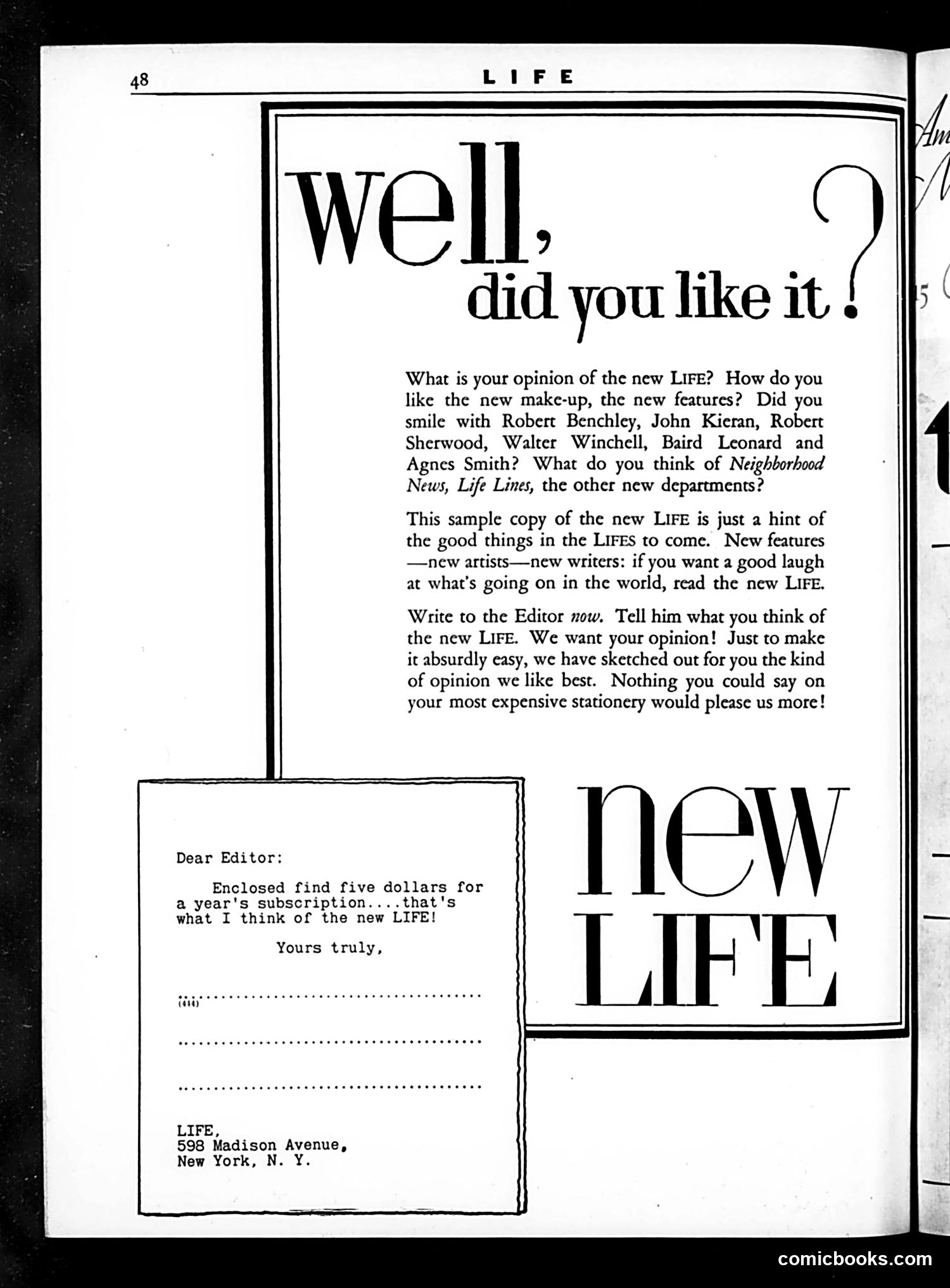
This is a promotional page for *Life* magazine's redesign, not a political cartoon. The page solicits reader feedback by featuring a mock letter template praising the new publication. The text mentions prominent contributors—Robert Benchley, John Kieran, Robert Sherwood, Walter Winchell, Baird Leonard, and Agnes Smith—who were well-known humorists and columnists of the era. New departments like "Neighborhood News" and "Life Lines" are highlighted. The humor lies in the final paragraph: the editors openly admit they've "sketched out for you the kind of opinion we like best," then cheekily suggest readers send a subscription payment ($5/year) instead of written feedback. It's self-aware satire about soliciting praise—the magazine essentially provides a pre-written endorsement and jokingly implies that money speaks louder than words.