
Life, 1928-05-10 · page 16 of 50
Life — May 10, 1928 — page 16: what you’re looking at
What you’re looking at
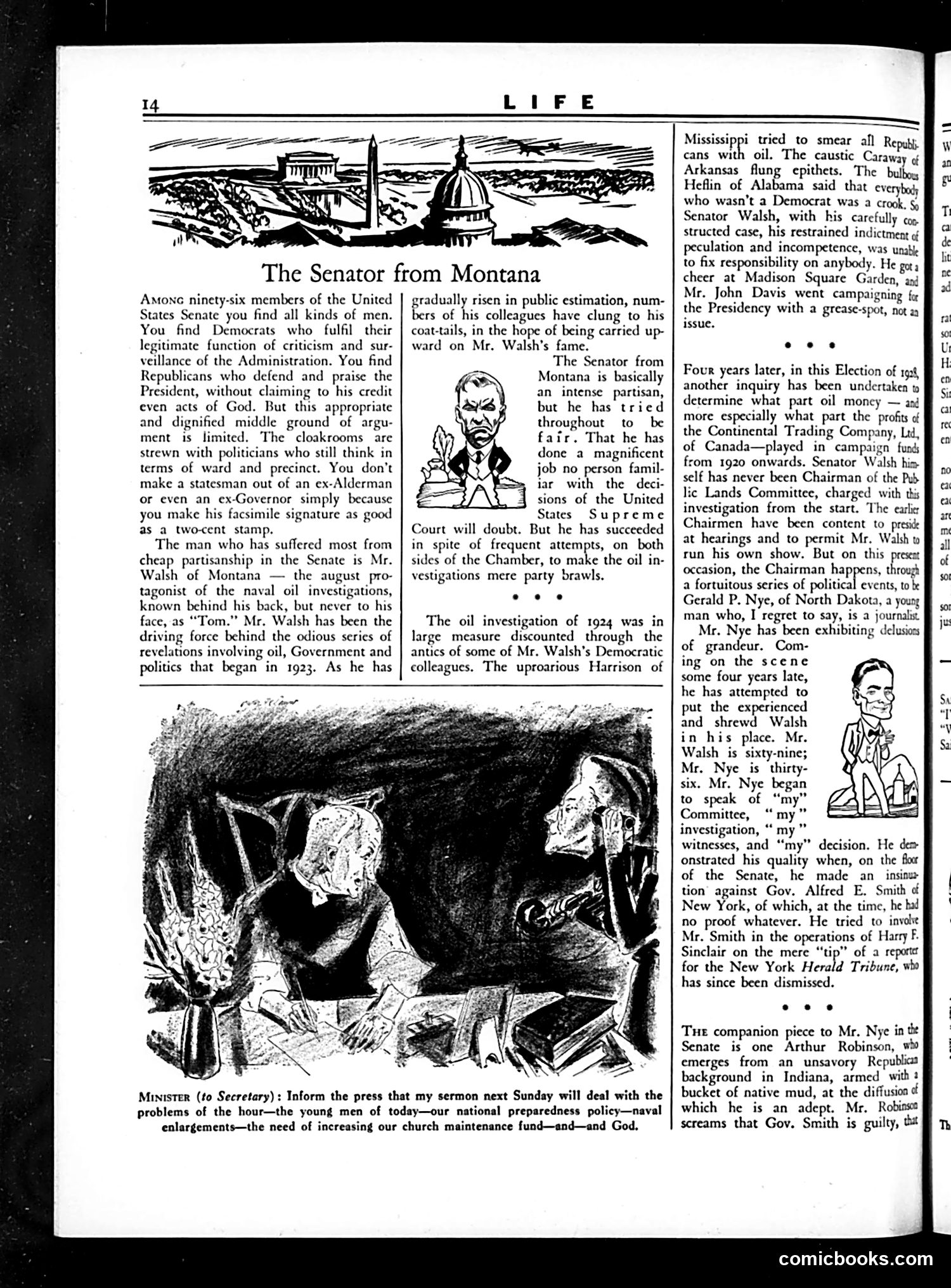
This Life magazine article criticizes Senator Thomas Walsh of Montana, a prominent investigator of government corruption. The caricature (upper right) portrays Walsh as an intense partisan rather than an impartial arbiter of justice. The text describes Walsh's role in the 1924 oil scandal investigations (Teapot Dome era), noting his effectiveness but questioning his fairness. The article suggests he used investigations to attack political opponents while being lenient toward Democrats. The lower cartoon depicts a Minister instructing his secretary to craft a sermon about national preparedness—a satirical jab suggesting politicians exploited religious institutions to advance their own agendas under patriotic pretenses. The piece essentially argues Walsh weaponized investigations for partisan advantage rather than genuine reform.
📄 Transcribed text from this page (OCR, searchable)
Machine-transcribed from the original scan — historical spelling and the odd misread are preserved.
14 eS The Senator from Montana Amonc ninety-six members of the United States Senate you find all kinds of men. You find Democrats who fulfil their legitimate function of criticism and sur- veillance of the Administration. You find Republicans who defend and praise the President, without claiming to his credit even acts of God. But this appropriate and dignified middle ground of argu- ment is limited. The cloakrooms are strewn with politicians who still think in terms of ward and precinct. You don’t make a statesman out of an ex-Alderman or even an ex-Governor simply because you make his facsimile signature as good as a two-cent stamp. The man who has suffered most from cheap partisanship in the Senate is Mr. Walsh of Montana — the august pro- tagonist of the naval oil investigations, known behind his back, but never to his face, as “Tom.” Mr. Walsh has been the driving force behind the odious series of revelations involving oil, Government and politics that began in 1923. As he has gradually risen in public estimation, num- bers of his colleagues have clung to his coat-tails, in the hope of being carried up- ward on Mr. Walsh’s fame. The Senator from Montana is basically an intense partisan, but he has tried throughout to be fair. That he has done a magnificent job no person famil- jar with the deci- sions of the United States Supreme Court will doubt. But he has succeeded in spite of frequent attempts, on both sides of the Chamber, to make the oil in- vestigations mere party brawls. The oil investigation of 1924 was in large measure discounted through the antics of some of Mr. Walsh’s Democratic colleagues. The uproarious Harrison of Minister (to Secretary): Inform the press that my sermon next Sunday will deal with the problems of the hour—the young men of today—our national preparedness policy—naval enlargements—the need of increasing our church maintenance fund—and—and God. SS Mississippi tried to smear all Re, cans with oil. The caustic Caraway of Arkansas flung epithets. The bulboes Heflin of Alabama said that everybody who wasn’t a Democrat was a crook, % Senator Walsh, with his carefully cop. structed case, his restrained indictment of peculation and incompetence, was unable to fix responsibility on anybody. He got: cheer at Madison Square Garden, an Mr. John Davis went campaigning fy the Presidency with a grease-spot, not an issuc, Four years later, in this Election of Ig2f, another inquiry has been undertaken t determine what part oil money — and more especially what part the profits of the Continental Trading Company, Ltd, of Canada—played in campaign funds from 1920 onwards. Senator Walsh hin self has never been Chairman of the Pub ic Lands Committee, charged with ths investigation from the start. The earlie Chairmen have been content to preside at hearings and to permit Mr. Walsh run his own show. But on this preseat occasion, the Chairman happens, through a fortuitous series of political events, to be Gerald P. Nye, of North Dakota, a young man who, I regret to say, is a journalis. Mr. Nye has been exhibiting delusioss of grandeur. Com- ing on the scene some four years late, he has attempted to put the experienced and shrewd Walsh in his place. Mr. Walsh is sixty-nine; Mr. Nye is thirty- six. Mr. Nye began to speak of “my” Committee, investigation, “ my ” witnesses, and “my” decision. He dex onstrated his quality when, on the foo of the Senate, he made an_ insinur tion against Gov. Alfred E. Smith o New York, of which, at the time, he had no proof whatever. He tried to invole Mr. Smith in the operations of Harry F. Sinclair on the mere “tip” of a reporter for the New York Herald Tribune, who has since been dismissed. Tue companion piece to Mr. Nye in te Senate is one Arthur Robinson, w% emerges from an unsavory Republica background in Indiana, armed with + bucket of native mud, at the diffusion ¢ which he is an adept. Mr. Robinso screams that Gov. Smith is guilty, dt comicbooks.com