
Life, 1928-05-10 · page 22 of 50
Life — May 10, 1928 — page 22: what you’re looking at
What you’re looking at
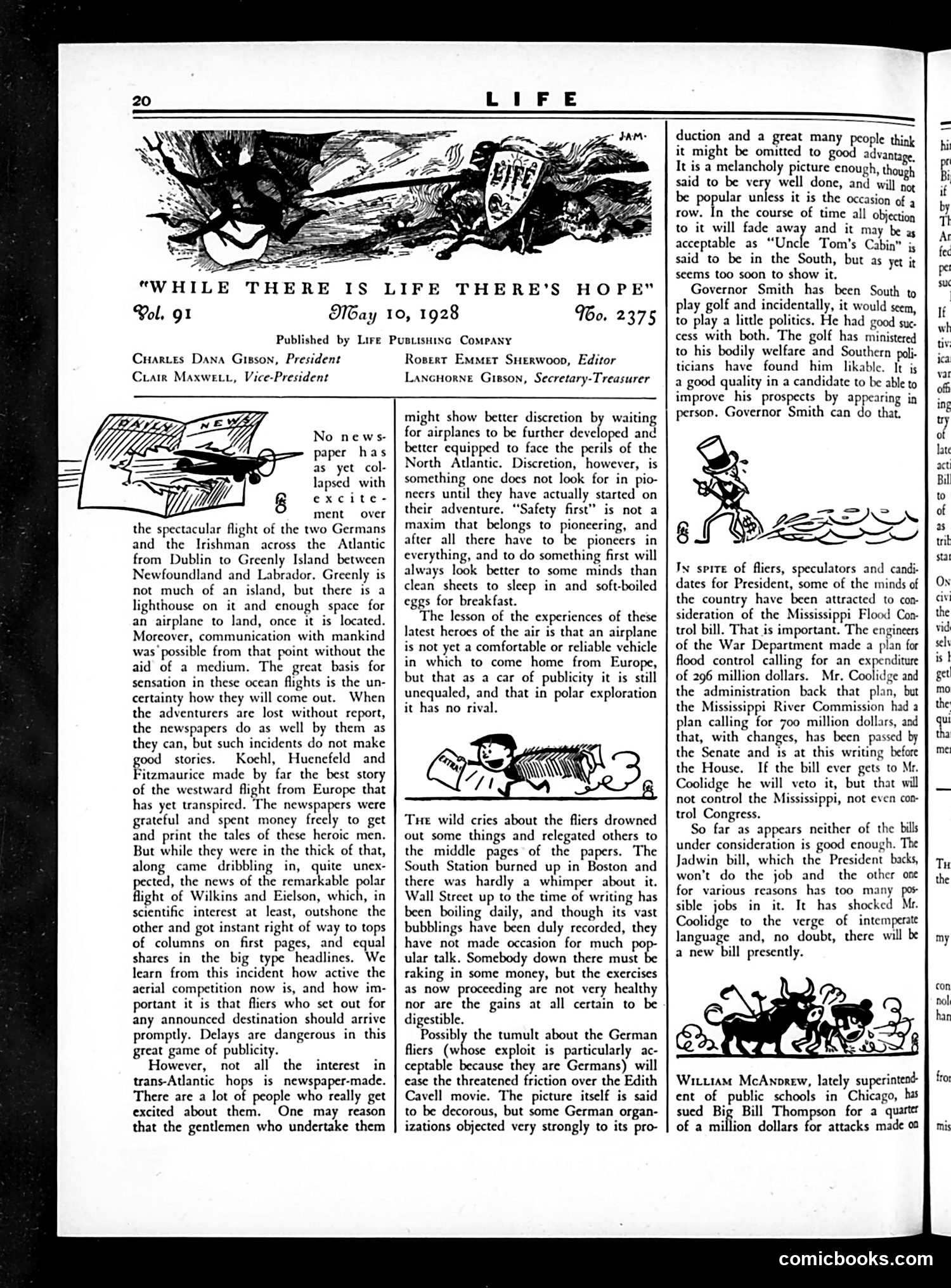
This editorial page discusses competing news stories dominating 1928 headlines. The main focus critiques how newspapers sensationalize transatlantic aviation feats—specifically recent German and Irish/American polar flights—over more substantive but less dramatic news. The piece argues newspapers prioritize publicity-generating stunts (Koehl, Huenefeld, Fitzmaurice's westward crossing; Wilkins and Eielson's polar flight) while burying genuinely important stories: a Boston South Station fire and volatile Wall Street activity. The author celebrates aviation pioneers' courage while gently mocking the public's fascination with aerial spectacle over reliable reporting. A final paragraph references the "Edith Cavell movie"—a sensitive film about the WWI British nurse executed by Germans—noting German organizations' objections may paradoxically be overshadowed by aviation mania. The small cartoons illustrate aviation and financial themes. The satire targets both reckless media sensationalism and public appetite for thrilling but ultimately frivolous headlines.
📄 Transcribed text from this page (OCR, searchable)
Machine-transcribed from the original scan — historical spelling and the odd misread are preserved.
“WHILE THERE IS LIFE THERE'S HOPE" Wo. 2375 Bol. 91 OGCay 10, 1928 Published by Lire Pustisinc Company Cuarces Dana Gisson, President Crate Maxwetr, Vice-President Rosert Emmet Suerwooo, Editor Lancuorne Gisson, Secretary-Treasurer No news- paper has as yet col- lapsed with excite- ment over the spectacular flight of the two Germans and the Irishman across the Adantic from Dublin to Greenly Island between Newfoundland and Labrador. Greenly is not much of an island, but there is a lighthouse on it and enough space for an airplane to land, once it is located. Moreover, communication with mankind was’ possible from that point without the aid of a medium. The great basis for sensation in these ocean flights is the un- certainty how they will come out. When the adventurers are lost without report, the newspapers do as well by them as they can, but such incidents do not make good stories. Kochl, Huenefeld and Fitzmaurice made by far the best story of the westward flight from Europe that has yet transpired. The newspapers were grateful and spent money freely to get and print the tales of these heroic men. But while they were in the thick of that, along came dribbling in, quite unex- pected, the news of the remarkable polar flight of Wilkins and Eielson, which, in scientific interest at least, outshone the other and got instant right of way to tops of columns on first pages, and equal shares in the big type headlines, We learn from this incident how active the aerial competition now is, and how im- portant it is that fliers who set out for any announced destination should arrive promptly. Delays are dangerous in this great game of publicity. However, not all the interest in trans-Atlantic hops is newspaper-made. There are a lot of people who really get excited about them. One may reason that the gentlemen who undertake them might show better discretion by waiting for airplanes to be further developed and better equipped to face the perils of the North Adantic. Discretion, however, is something one does not look for in pio- neers until they have actually started on their adventure. “Safety first” is not a maxim that belongs to pioneering, and after all there have to be pioneers in everything, and to do something first will always look better to some minds than clean sheets to sleep in and soft-boiled eggs for breakfast. The lesson of the experiences of these latest heroes of the air is that an airplane is not yet a comfortable or reliable vehicle in which to come home from Europe, but that as a car of publicity it is still unequaled, and that in polar exploration it has no rival. Tue wild cries about the fliers drowned out some things and relegated others to the middle pages of the papers. The South Station burned up in Boston and there was hardly a whimper about it. Wall Street up to the time of writing has been boiling daily, and though its vast bubblings have been duly recorded, they have not made occasion for much pop- ular talk. Somebody down there must be raking in some money, but the exercises as now proceeding are not very healthy nor are the gains at all certain to be digestible. Possibly the tumult about the German fliers (whose exploit is particularly ac- ceptable because they are Germans) will case the threatened friction over the Edith Cavell movie. The picture itself is said to be decorous, but some German organ- izations objected very strongly to its pro- duction and a great man ‘ople thi it might be paki to ok cee It is a melancholy picture enough, though said to be very well done, and will ie be popular unless it is the occasion of 3 row. In the course of time all objection to it will fade away and it may be as acceptable as “Uncle Tom's Cabin” js said to be in the South, but as yet it seems too soon to show it. Governor Smith has been South to play golf and incidentally, it would seem, to play a little politics. He had good suc. cess with both. The golf has ministered to his bodily welfare and Southern poli- ticians have found him likable. It is a good quality in a candidate to be able to improve his prospects by appearing in person. Governor Smith can do that. {ZEN BESS a6 Jy sprre of fliers, speculators and candi- dates for President, some of the minds of the country have been attracted to con- sideration of the Mississippi Flood Con- trol bill. That is important. The engineers of the War Department made a plan for flood control calling for an expenditure of 296 million dollars. Mr. Coolidge and the administration back that plan, but the Mississippi River Commission had a plan calling for 7oo million dollars, and that, with changes, has been passed by the Senate and is at this writing before the House. If the bill ever gets to Mr. Coolidge he will veto it, but that will not control the Mississippi, not even con- trol Congress. So far as appears neither of the bills under consideration is good enough. The Jadwin bill, which the President backs, won't do the job and the other one for various reasons has too many por sible jobs in it. It has shocked Mr. Coolidge to the verge of intemperate language and, no doubt, there will be a new bill presently. Wituam McAnorew, lately superintend- ent of public schools in Chicago, has sued Big Bill Thompson for a quarter of a million dollars for attacks made 0a comicbooks.com my con nol han frot mis