
Life, 1928-05-10 · page 23 of 50
Life — May 10, 1928 — page 23: what you’re looking at
What you’re looking at
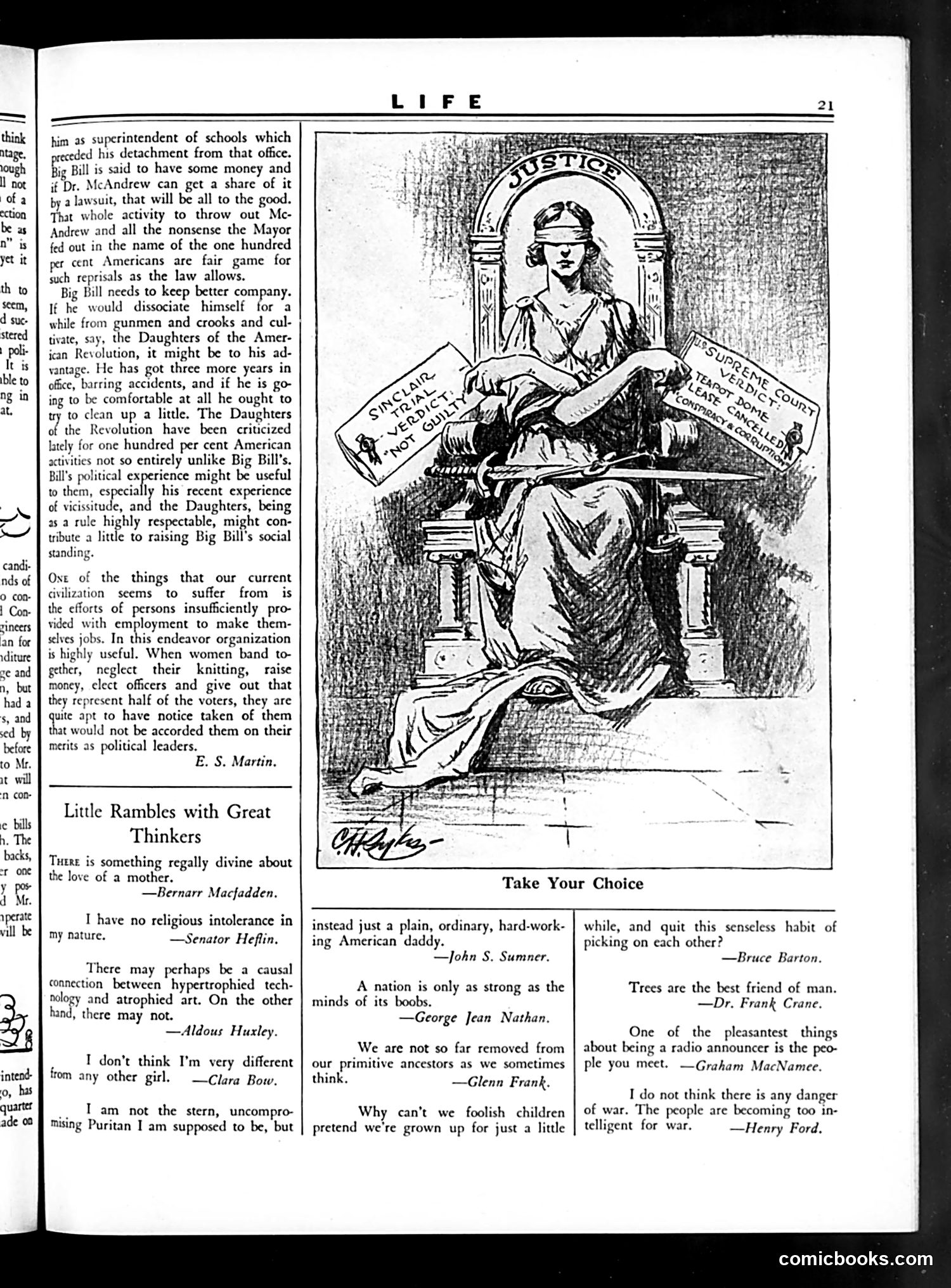
This page satirizes American political and social hypocrisy of the 1920s. The main cartoon depicts **Justice** holding a tablet inscribed with principles of "sincere, impartial, and veracity" alongside references to "Tammany," the corrupt New York political machine. The image mocks the gap between justice's ideals and actual municipal corruption. The accompanying text discusses **"Big Bill"** (likely William "Big Bill" Thompson, Chicago's scandal-plagued mayor) and his conflicts with Dr. McAndrew over school superintendent positions. The satire criticizes Thompson's association with "gunmen and crooks" while suggesting he curry favor with respectable organizations like the Daughters of the American Revolution to improve his image—highlighting the performative nature of political respectability. The lower section, "Little Rambles with Great Thinkers," presents famous figures' self-serving or contradictory quotes (a senator denying intolerance, Henry Ford claiming people are too intelligent for war), further mocking public figures' dubious self-presentations and the gap between rhetoric and reality.
📄 Transcribed text from this page (OCR, searchable)
Machine-transcribed from the original scan — historical spelling and the odd misread are preserved.
rperate vill be ——— him as superintendent of schools which eceded his detachment from that office. Bie Bill is said to have some money and if Dr. McAndrew can get a share of it by a lawsuit, that will be all to the good. That whole activity to throw out Mc- Andrew and all the nonsense the Mayor fed out in the name of the one hundred per cent Americans are fair game for such reprisals as the law allows. Big Bill needs to keep better company. If he would dissociate himself tor a while from gunmen and crooks and cul- tivate, say, the Daughters of the Amer- ican Revolution, it might be to his ad- vantage. He has got three more years in office, barring accidents, and if he is go- ing to be comfortable at all he ought to to clean up a little. The Daughters aLitke Revolution have been criticized lately for one hundred per cent American xtivities not so entirely unlike Big Bill's. Bill's political caperience might be useful to them, especially his recent experience of vicissitude, and the Daughters, being asa rule highly respectable, might con- tribute a little to raising Big Bill's social standing. Oxe of the things that our current civilization seems to suffer from is the efforts of persons insufficiently pro- vided with employment to make them- selves jobs. In this endeavor organization is highly useful. When women band to- gether, neglect their knitting, raise money, clect officers and give out that they represent half of the voters, they are ite apt to have notice taken of them that would not be accorded them on their merits as political leaders. E. S. Martin, Little Rambles with Great Thinkers Tutre is something regally divine about the love of a mother. —Bernarr Macfadden. I have no religious intolerance in my nature. —Senator Heflin. There may perhaps be a causal connection between hypertrophied tech- nology and atrophied art. On the other hand, there may not. —Aldous Huxley. I don’t think I'm very different from any other girl, = —Clara Bow. _, Iam not the stern, uncompro- nising Puritan I am supposed to be, but Take Your Choice instead just a plain, ordinary, hard-work- ing American daddy. —John S. Sumner. A nation is only as strong as the minds of its boobs. —George Jean Nathan. We are not so far removed from our primitive ancestors as we sometimes think. —Glenn Frank. Why can’t we foolish children pretend we're grown up for just a little while, and quit this senseless habit of picking on each other? —Bruce Barton. Trees are the best friend of man. —Dr. Frank Crane. One of the pleasantest things about being a radio announcer is the peo- ple you meet. —Graham MacNamee. I do not think there is any danger of war. The people are becoming too in- telligent for war. —Henry Ford. comicbooks.com