
Life, 1928-05-10 · page 25 of 50
Life — May 10, 1928 — page 25: what you’re looking at
What you’re looking at
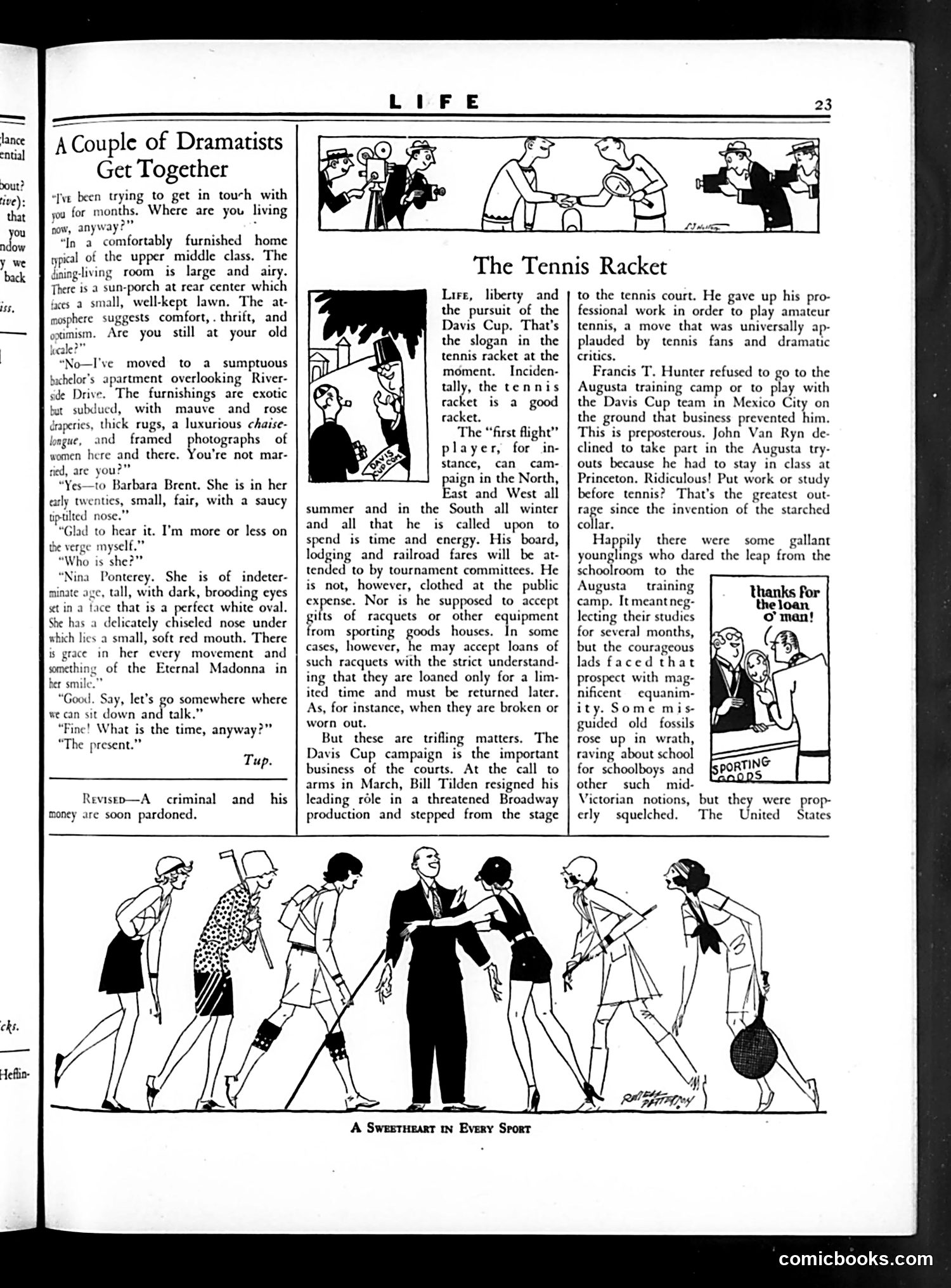
This article satirizes the hypocrisy of "amateur" tennis during the Davis Cup era. The piece exposes how top players like Bill Tilden and Francis T. Hunter claimed amateurism while receiving substantial benefits—free travel, lodging, and tournament expenses—unavailable to ordinary people. The satire targets the absurdity of prioritizing tennis over education and work. It mocks older critics ("mid-Victorian notions") who objected when students like those at Princeton abandoned studies for tournaments, yet celebrates the young players' "courage" in doing so. The central joke: tennis operates as a lucrative "racket" (a corrupt scheme) masquerading as pure amateur sport. Players accept gifts of racquets under the pretense they're only "loans," exploiting loopholes while maintaining amateur status—and the social prestige it conveyed in that era. The cartoon below reinforces this by showing various female athletes surrounding a male figure, captioned "A Sweetheart in Every Sport"—suggesting amateur athletics were pursued for glamour and romance rather than genuine sportmanship.
📄 Transcribed text from this page (OCR, searchable)
Machine-transcribed from the original scan — historical spelling and the odd misread are preserved.
‘ACouple of Dramatists Get Together *[ve been trying to get in touch with you for months. Where are you living now, anyway?” . “In a comfortably furnished home ypical of the upper middle class. The dning-living room is large and airy. There is a sun-porch at rear center which faces a small, well-kept lawn. The at- mosphere suggests comfort, . thrift, and oximism. Are you still at your old kecale? “No—I've moved to a_ sumptuous tuchelor’s apartment overlooking River- sde Drive. The furnishings are exotic but subdued, with mauve and rose Jraperies, thick rugs, a luxurious chaise- longue, and framed photographs of women here and there. You're not mar- ried, are you?” s—to Barbara Brent. She is in her arly twenties, small, fair, with a saucy uptlted nose.” “Glad to hear it. I'm more or less on the verge myself.” “Who is she?” “Nina Ponterey. She is of indeter- minate age, tall, with dark, brooding eyes st in a tace that is a perfect white oval. She has a delicately chiseled nose under which lies a small, soft red mouth. There is grace in her every movement and something of the Eternal Madonna in ber smile “Good. Say, let’s go somewhere where we can sit down and talk.” “Fine! What is the time, anyway?” ‘The present.” Tup. Reviseo—A criminal and_ his money are soon pardoned. The Tennis Racket Lire, liberty and the pursuit of the Davis Cup. That's the slogan in the tennis racket at the moment. Inciden- tally, the tennis racket is a good racket. The “first flight” player, for in- stance, can cam- aign in the North, st and West all summer and in the South all winter and all that he is called upon to spend is time and energy. His board, lodging and railroad fares will be at- tended to by tournament committees. He is not, however, clothed at the public expense. Nor is he supposed to accept gifts of racquets or other equipment from sporting goods houses. In some cases, however, he may accept loans of such racquets with the strict understand- ing that they are loaned only for a lim- ited time and must be returned later. As, for instance, when they are broken or worn out. But these are trifling matters. The Davis Cup campaign is the important business of the courts. At the call to arms in March, Bill Tilden resigned his leading role in a threatened Broadway production and stepped from the stage A Swestueart tn Every Sport to the tennis court. He gave up his pro- fessional work in order to play amateur tennis, a move that was universally ap- plauded by tennis fans and dramatic critics. Francis T. Hunter refused to go to the Augusta training camp or to play with the Davis Cup team in Mexico City on the ground that business prevented him. This is preposterous. John Van Ryn de- clined to take part in the Augusta try- outs because he had to stay in class at Princeton. Ridiculous! Put work or study before tennis? That's the greatest out- rage since the invention of the starched collar. Happily there were some gallant younglings who dared the leap from the schoolroom to the Augusta training camp. It meantneg- lecting their studies for several months, but the courageous lads faced that Prospect with mag- nificent equanim- ity. Some mis- guided old fossils rose up in wrath, raving about school for schoolboys and other such mid- Victorian notions, but they were prop- erly —squelched. The United States comicbooks.com