
Life, 1928-05-10 · page 30 of 50
Life — May 10, 1928 — page 30: what you’re looking at
What you’re looking at
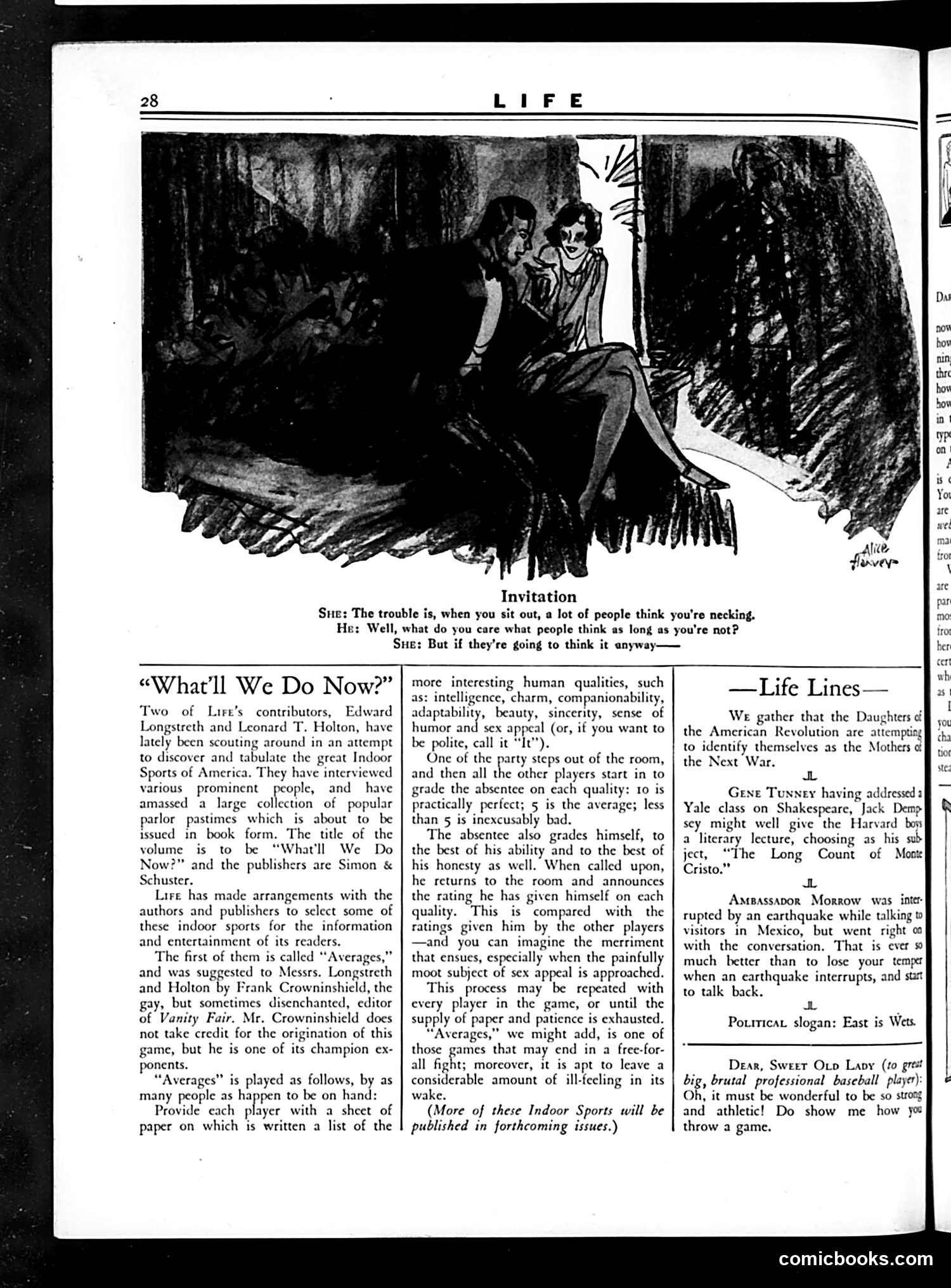
**Main Cartoon ("Invitation"):** A sketch depicting a couple sitting together outdoors, with dialogue about social perception. The joke satirizes dating etiquette: the woman worries that sitting out together will make people think they're "necking" (kissing/making out). The man's pragmatic response—"what do you care what people think as long as you're not?"—mocks both social propriety and the gap between appearance and reality in courtship behavior. This reflects 1920s-era anxiety about reputation and changing sexual attitudes. **"Averages" Game Section:** Life describes a parlor game where players grade an absent person on qualities (intelligence, charm, sex appeal, etc.) on a scale of 1-10, then compare their ratings to the person's self-assessment. The satire targets middle-class entertainment and the awkwardness of honest personal evaluation—the article notes it "may end in a free-for-all fight" and "leave considerable ill-feeling." **Life Lines (Sidebar Jokes):** Brief satirical observations about the Daughters of the American Revolution, boxer Gene Tunney's Shakespeare lecture, and athlete behavior—typical period social commentary.
📄 Transcribed text from this page (OCR, searchable)
Machine-transcribed from the original scan — historical spelling and the odd misread are preserved.
Invitation Sue: The trouble is, when you sit out, a lot of people think you're necking. He: Well, what do you care what people think as long as you're not? “What'll We Do Now?” Two of Lire’s contributors, Edward Longstreth and Leonard T. Holton, have lately been scouting around in an attempt to discover and tabulate the great Indoor Sports of America, They have interviewed various prominent people, and have amassed a large collection of popular parlor pastimes which is about to be issued in book form. The title of the volume is to be “What'll We Do Now?” and the publishers are Simon & Schuster. Lire has made arrangements with the authors and publishers to select some of these indoor sports for the information and entertainment of its readers. The first of them is called “Averages,” and was suggested to Messrs. Longstreth and Holton by Frank Crowninshield, the gay, but sometimes disenchanted, editor of Vanity Fair. Mr. Crowninshield does not take credit for the origination of this game, but he is one of its champion ex- ponents. “Averages” is played as follows, by as many people as happen to be on hand: Provide each player with a sheet of paper on which is written a list of the Sue: But if they’re going to think it anyway—— more interesting human qualities, such as: intelligence, charm, companionability, adaptability, beauty, sincerity, sense of humor and sex appeal (or, if you want to be polite, call it “Iv’). One of the party steps out of the room, and then all the other players start in to grade the absentee on each quality: 10 is practically perfect; 5 is the average; less than 5 is inexcusably bad. The absentee also grades himself, to the best of his ability and to the best of his honesty as well. When called upon, he returns to the room and announces the rating he has given himself on each quality. This is compared with the ratings given him by the other players —and you can imagine the merriment that ensues, especially when the painfull moot subject of sex appeal is approached. This process may be repeated with every player in the game, or until the supply of paper and patience is exhausted. “Averages,” we might add, is one of those games that may end in a free-for- all fig t; moreover, it is apt to leave a considerable amount of ill-feeling in its wake. (More of these Indoor Sports will be published in forthcoming issues.) — Life Lines— We gather that the Daughters of the American Revolution are attempting to identify themselves as the Mothers o the Next War. aL Gene Tunney having addressed Yale class on Shakespeare, Jack Demp sey might well give the Harvard bop a literary lecture, choosing as his sub ject, “The Long Count of Mont Cristo.” aL Ampassapor Morrow was inte rupted by an earthquake while talking » visitors in Mexico, but went right 0 with the conversation, That is ever 9 much better than to lose your temper when an earthquake interrupts, and stat to talk back. a . Pottticat slogan: East is Wets Dear, Sweet Orv Lapy (to grést big, brutal professional baseball player): Oh, it must be wonderful to be so stroag and athletic! Do show me how yo throw a game. comicbooks.com