
Life, 1928-05-10 · page 11 of 50
Life — May 10, 1928 — page 11: what you’re looking at
What you’re looking at
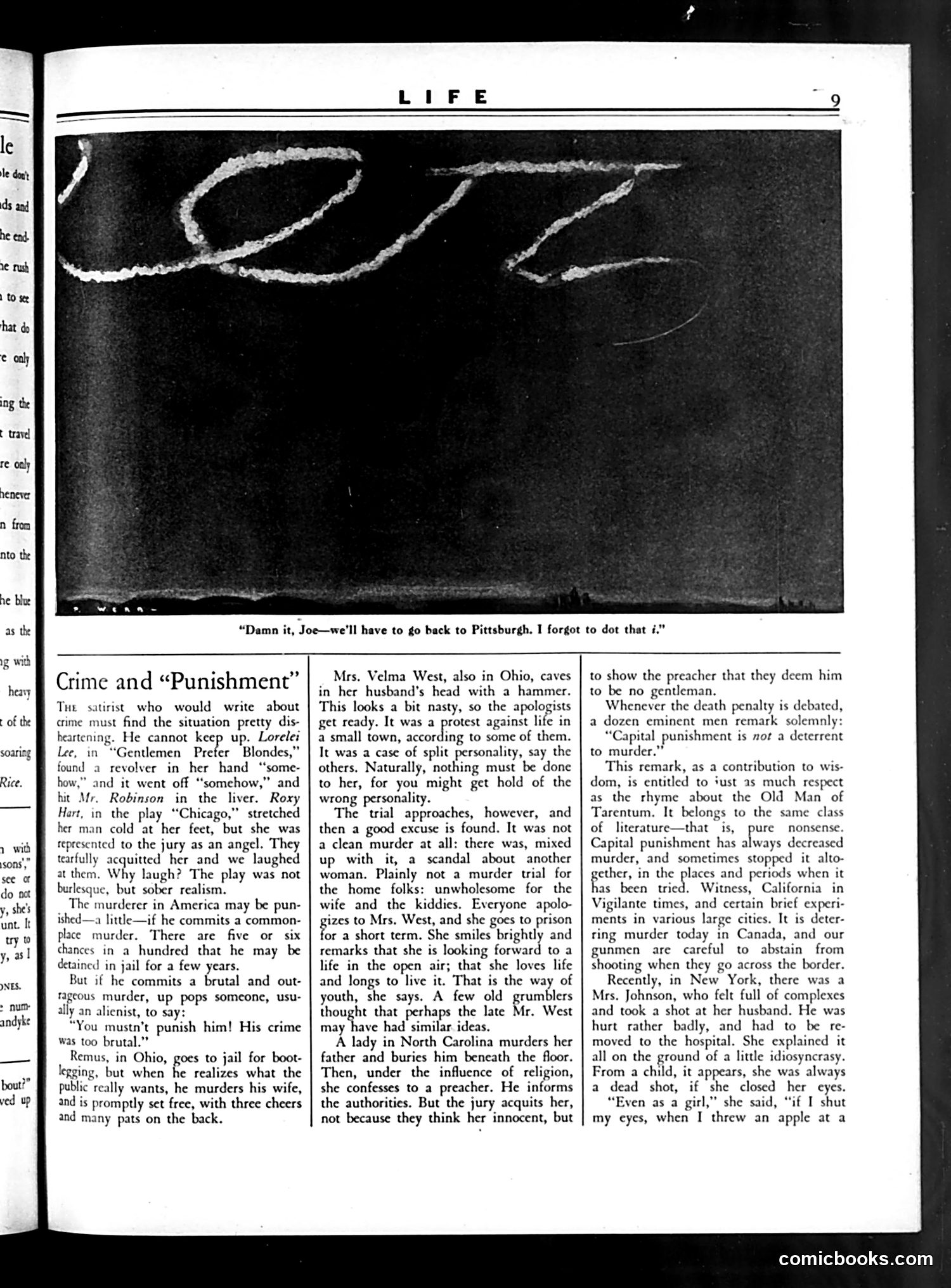
The cartoon at top shows a man drawing crude letters on a blackboard, with the caption: "Damn it, Joe—we'll have to go back to Pittsburgh. I forgot to dot that i." This is a simple visual gag about absent-mindedness or careless handwriting rather than political satire. The humor relies on the absurdity of someone traveling specifically to correct a minor typographical error. Below is an article titled "Crime and 'Punishment'" discussing capital punishment and murder trials in America. The text references specific cases involving women accused of murder in Ohio, North Carolina, and New York, examining how juries reach verdicts and public attitudes toward execution versus imprisonment as punishment. The page combines lighthearted humor with serious social commentary on criminal justice.
📄 Transcribed text from this page (OCR, searchable)
Machine-transcribed from the original scan — historical spelling and the odd misread are preserved.
1 wid sons’,” see of do net y, she's unt. It uy wo y, as] “Damn it, Joe—we'll have to go back to Pittsburgh. I forgot to dot that i.” Crime and “Punishment” Tue satirist. who would write about crime must find the situation pretty dis- heartening. He cannot keep up. Lorelei Lee, in “Gentlemen Prefer Blondes,” fc a revolver in her hand “some- * and it went off “somehow,” and r. Robinson in the liver. Roxy Hart, in the play “Chicago,” stretched her man cold at her feet, but she was represented to the jury as an angel. They tearfully acquitted her and we laughed at them. Why laugh? The play was not burlesque, but sober realism. The murderer in America may be pun- ished—a little—if he commits a common- place murder. There are five or six chances in a hundred that he may be detained in jail for a few years. But if he commits a brutal and out- tageous murder, up pops someone, usu- ally an alienist, to say: “You mustn’t punish him! His crime was too brutal.” Remus, in Ohio, goes to jail for boot- legging, but when he realizes what the public really wants, he murders his wife, and is promptly set free, with three cheers and many pats on the back. Mrs, Velma West, also in Ohio, caves in her husband's head with a hammer. This looks a bit nasty, so the apologists get ready. It was a protest against life in a small town, according to some of them. It was a case of split personality, say the others. Naturally, nothing must be done to her, for you might get hold of the wrong personality. The trial approaches, however, and then a good excuse is found. It was not a clean murder at all: there was, mixed up with it, a scandal about another woman. Plainly not a murder trial for the home folks: unwholesome for the wife and the kiddies. Everyone apolo- gizes to Mrs. West, and she goes to prison for a short term. She smiles brightly and remarks that she is looking forward to a life in the open air; that she loves life and longs to live it. That is the way of youth, she says. A few old grumblers thought that perhaps the late Mr. West may have had similar ideas. A lady in North Carolina murders her father and buries him beneath the floor. Then, under the influence of religion, she confesses to a preacher. He informs the authorities. But the jury acquits her, not because they think her innocent, but to show the preacher that they deem him to be no gentleman, Whenever the death penalty is debated, a dozen eminent men remark solemnly: “Capital punishment is not a deterrent to murder.” This remark, as a contribution to wis- dom, is entitled to ‘ust as much respect as the rhyme about the Old Man of Tarentum. It belongs to the same class of literature—that is, pure nonsense. Capital punishment has always decreased murder, and sometimes stopped it alto- gether, in the places and periods when it fs been tried. Witness, California in Vigilante times, and certain brief experi- ments in various large cities. It is deter- ring murder today in Canada, and our gunmen are careful to abstain from shooting when they go across the border. Recently, in New York, there was a Mrs. Johnson, who felt full of complexes and took a shot at her husband. He was hurt rather badly, and had to be re- moved to the hospital. She explained it all on the ground of a little idiosyncrasy. From a child, it appears, she was always a dead shot, if she closed her eyes. “Even as a girl,” she said, “if I shut my eyes, when I threw an apple at a comicbooks.com