
Life, 1928-05-10 · page 32 of 50
Life — May 10, 1928 — page 32: what you’re looking at
What you’re looking at
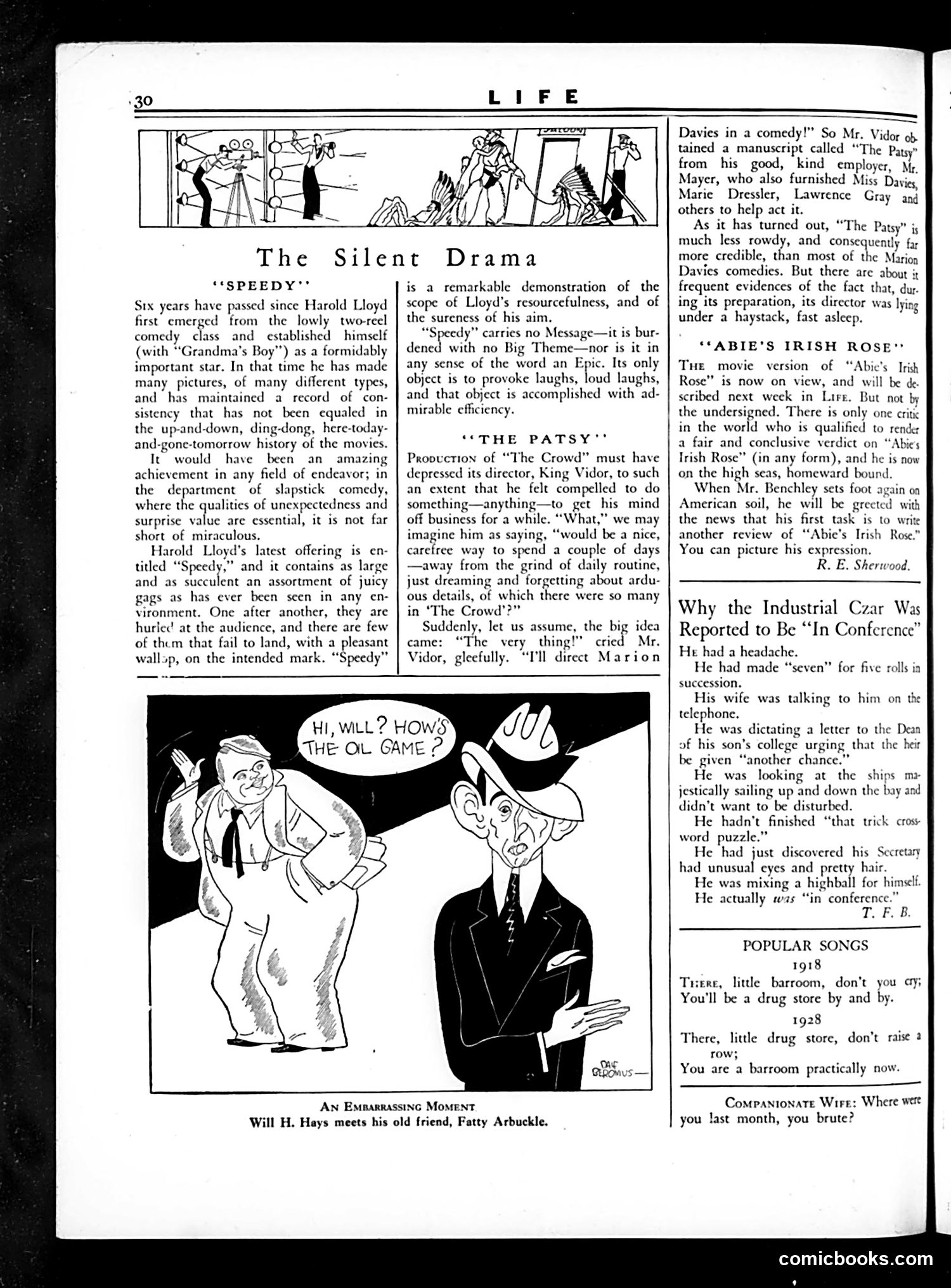
This page reviews silent films from the late 1920s. The main cartoon depicts **Will H. Hays meeting Fatty Arbuckle**, a reference to a genuine scandal: Arbuckle, a major silent film star, faced multiple rape accusations in 1921-22 (charges were eventually dropped). Hays, head of the film industry's censorship board, implemented strict moral codes partly to rehabilitate Hollywood's public image after such scandals. The joke's awkwardness—"Hi, will? How's the ol' game?"—captures the discomfort of encountering someone whose reputation had been destroyed by controversy. The page also reviews films by Harold Lloyd ("Speedy") and director King Vidor ("The Patsy"), praising their entertainment value. A separate humor section jokes that industrial executives claim to be "in conference" while actually distracted by personal matters—a gentle satire on corporate pretense.
📄 Transcribed text from this page (OCR, searchable)
Machine-transcribed from the original scan — historical spelling and the odd misread are preserved.
The ‘*SPEEDY"’ Six years have passed since Harold Lloyd first emerged from the lowly two-reel comedy class and_ established himself (with “Grandma’s Boy") as a formidably important star. In that time he has made many pictures, of many different types, and has maintained a record of con- sistency that has not been equaled in the up-and-down, ding-dong, here-today- and-gone-tomorrow history of the movies. It would have been an amazing achievement in any field of endeavor; in the department of | slapstick comedy, where the qualities of unexpectedness and surprise value are essential, it is not far short of miraculous. Harold Lloyd's latest offering is en- titled “Speedy,” and it contains as large and as succulent an assortment of juicy gags as has ever been seen in any en- vironment. One after another, they are hurled at the audience, and there are few of them that fail to land, with a pleasant wallp, on the intended mark. “Speedy” Silent Drama is a remarkable demonstration of the scope of Lloyd's resourcefulness, and of the sureness of his aim. “Speedy” carries no Message—it is bur- dened with no Big Theme—nor is it in any sense of the word an Epic. Its only object is to provoke laughs, loud laughs, and that object is accomplished with ad- mirable efficiency. ‘*THE PATSY'"' Proouction of “The Crowd” must have depressed its director, King Vidor, to such an extent that he felt compelled to do something—anything—to get his mind off business for a while. “What,” we may imagine him as saying, “would be a nice, carefree way to spend a couple of days —away from the grind of daily routine, just dreaming and forgetting about ardu- ous details, of which there were so many in ‘The Crowd’?” Suddenly, let us assume, the big idea came: “The very thing!’ cried Mr. Vidor, gleefully. “I'll direct Marion HI, WiLL? HOWS THE OL GAME 7 An Emparrassinc Moment Will H. Hays meets his old friend, Fatty Arbuckle. Davies in a comedy!” So Mr. Vidor ob. tained a manuscript called “The Patsy” from his good, kind employer, My Mayer, who also furnished Miss Davies, Marie Dressler, Lawrence Gray and others to help act it. As it has turned out, “The Patsy” is much less rowdy, and consequently far more credible, than most of the Marion Davies comedies. But there are about it frequent evidences of the fact that, dur. ing its preparation, its director was lying under a haystack, fast asleep. os **ABIE'S IRISH ROSE" Tue movie version of “Abic’s Irish Rose” is now on view, and will be de scribed next week in Lire. But not by the undersigned. There is only one critic in the world who is qualified to render a fair and conclusive verdict on “Abies Trish Rose” (in any form), and he is now on the high seas, homeward bound. When Mr. Benchley sets foot again oa American soil, he will be greeted with the news that his first task is to write another review of “Abic’s Irish Rose.” You can picture his expression. R. E. Sherwood. Why the Industrial Czar Was Reported to Be “In Conference” He had a headache. He had made “seven” for five rolls ia succession. His wife was talking to him on the telephone, He was dictating a letter to the Dean | of his son’s college urging that the heir be given “another chance.” He was looking at the ships m2 jestically sailing up and down the bay and didn’t want to be disturbed. He hadn't finished “that trick cross word puzzle.” He had just discovered his Secretary had unusual eyes and pretty hair. He was mixing a highball for himslt. He actually was “in conference.” Ts F.:8, POPULAR SONGS 1918 Ture, little barroom, don’t you ay; You'll be a drug store by and by. 1928 There, little drug store, don’t raise 2 row; You are a barroom practically now. a ee Compantonate Wire: Where wert you last month, you brute? comicbooks.com ’