
Life, 1928-05-10 · page 9 of 50
Life — May 10, 1928 — page 9: what you’re looking at
What you’re looking at
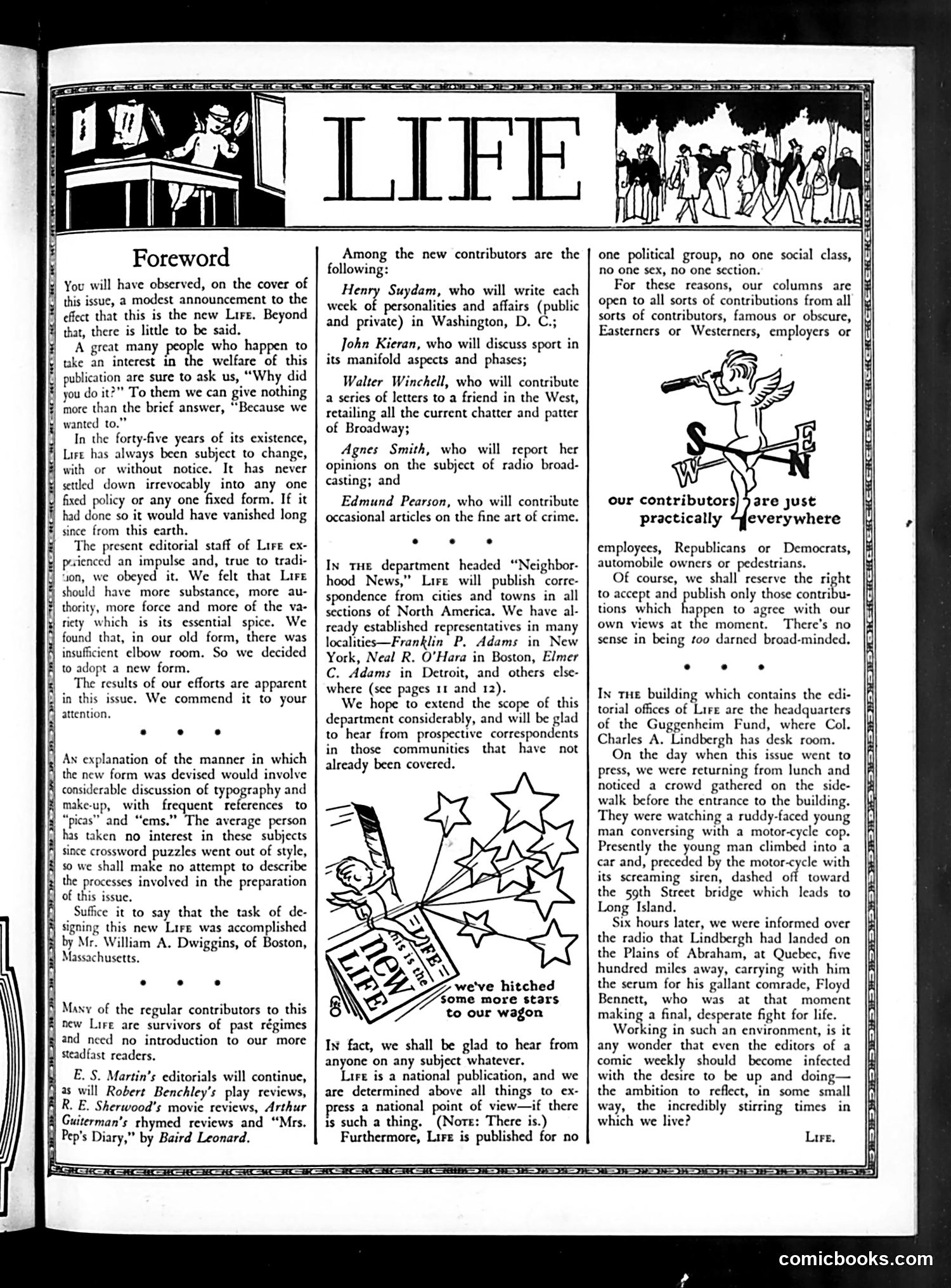
This is primarily a **foreword/editorial page**, not a political cartoon. It announces new contributors to Life magazine and explains the publication's editorial philosophy. The page introduces writers including Henry Saydam (personalities and affairs), John Kieran (sports), and others who will cover diverse topics. A small **illustration shows a hand holding a crossbow or arrow labeled "LIFE,"** with stars trailing behind it—a visual metaphor suggesting the magazine is "shooting for" expanded ambitions. The key message emphasizes Life's commitment to **non-partisan coverage**: accepting contributions from "Republicans or Democrats, automobile owners or pedestrians." The editors stress they seek truthful reporting over ideological consistency, positioning themselves as a national publication serving varied readerships across America. This reflects Life's mid-20th-century positioning as a mainstream, relatively centrist publication.
📄 Transcribed text from this page (OCR, searchable)
Machine-transcribed from the original scan — historical spelling and the odd misread are preserved.
Foreword You will have observed, on the cover of "| this issue, a modest announcement to the effect that this is the new Lire, Beyond that, there is little to be said. A great many people who happen to {) wke an interest in the welfare of this | publication are sure to ask us, “Why did you do it?” To them we can give nothing | more than the brief answer, “Because we wanted to.” In the forty-five years of its existence, Lire has always been subject to change, with or without notice. It has never settled down irrevocably into any one fixed policy or any one fixed form. If it had done so it would have vanished long # since from this earth, The present editorial staff of Lire ex- peienced an impulse and, true to tradi- son, we obeyed it. We felt that Lire * should have more substance, more au- thority, more force and more of the va- riety which is its essential spice. We found that, in our old form, there was insufficient elbow room. So we decided to adopt a new form, The results of our efforts are apparent in this issue. We commend it to your attention, | . e ° Aw explanation of the manner in which f] the new form was devised would involve | considerable discussion of typography and ® make-up, with frequent references to “picas” and “ems.” The average person has taken no interest in these subjects | since crossword puzzles went out of style, so we shall make no attempt to describe the processes involved in the preparation | of this issue. Suffice it to say that the task of de- signing this new Lire was accomplished ® by Mr. William A. Dwiggins, of Boston, Massachusetts. Maxv of the regular contributors to this 4 new Lire are survivors of past régimes ¢ 2nd need no introduction to our more ) steadfast readers. E. S. Martin's editorials will continue, as will Robert Benchley’s play reviews, ) R. E. Sherwood’s movie reviews, Arthur Guiterman's rhymed reviews and “Mrs. Pep’s Diary,” by Baird Leonard. Among the new contributors are the following: Henry Suydam, who will write each week of personalities and affairs (public and private) in Washington, D. C.; John Kieran, who will discuss sport in its manifold aspects and phases; Walter Winchell, who will contribute a series of letters to a friend in the West, retailing all the current chatter and patter of Broadway; Agnes Smith, who will report her opinions on the subject of radio broad- casting; and Edmund Pearson, who will contribute occasional articles on the fine art of crime. In tHE department headed “Neighbor- hood News,” Lire will publish corre- spondence from cities and towns in all sections of North America. We have al- ready established representatives in many localities—Franklin P. Adams in New York, Neal R. O'Hara in Boston, Elmer C. Adams in Detroit, and others else- where (see pages 11 and 12). We hope to extend the scope of this department considerably, and will be glad to hear from prospective correspondents in those communities that have not already been covered. In fact, we shall be glad to hear from anyone on any subject whatever. Lire is a national publication, and we are determined above all things to ex- ress a national point of view—if there is such a thing. (Nore: There is.) Furthermore, Lire is published for no one political group, no one social class, No one sex, no one section. For these reasons, our columns are open to all sorts of contributions from all sorts of contributors, famous or obscure, Easterners or Westerners, employers or & our contributors practically employees, Republicans or Democrats, automobile owners or pedestrians. Of course, we shall reserve the right to accept and publish only those contribu- tions which happen to agree with our own views at the moment. There’s no sense in being too darned broad-minded. In tHe building which contains the edi- torial offices of Lire are the headquarters of the Guggenheim Fund, where Col. Charles A. Lindbergh has desk room. On the day when this issue went to press, we were returning from lunch and noticed a crowd gathered on the side- walk before the entrance to the building. They were watching a ruddy-faced young man conversing with a motor-cycle cop. Presently the young man climbed into a car and, preceded by the motor-cycle with its screaming siren, dashed off toward the 59th Street bridge which leads to Long Island. Six hours later, we were informed over the radio that Lindbergh had landed on the Plains of Abraham, at Quebec, five hundred miles away, carrying with him the serum for his gallant comrade, Floyd Bennett, who was at that moment making a final, desperate fight for life. Working in such an environment, is it any wonder that even the editors of a comic weekly should become infected with the desire to be up and doing— the ambition to reflect, in some small way, the incredibly stirring times in which we live? comicbooks.com