
A complete issue · 112 pages · 1913
Life — December 4, 1913
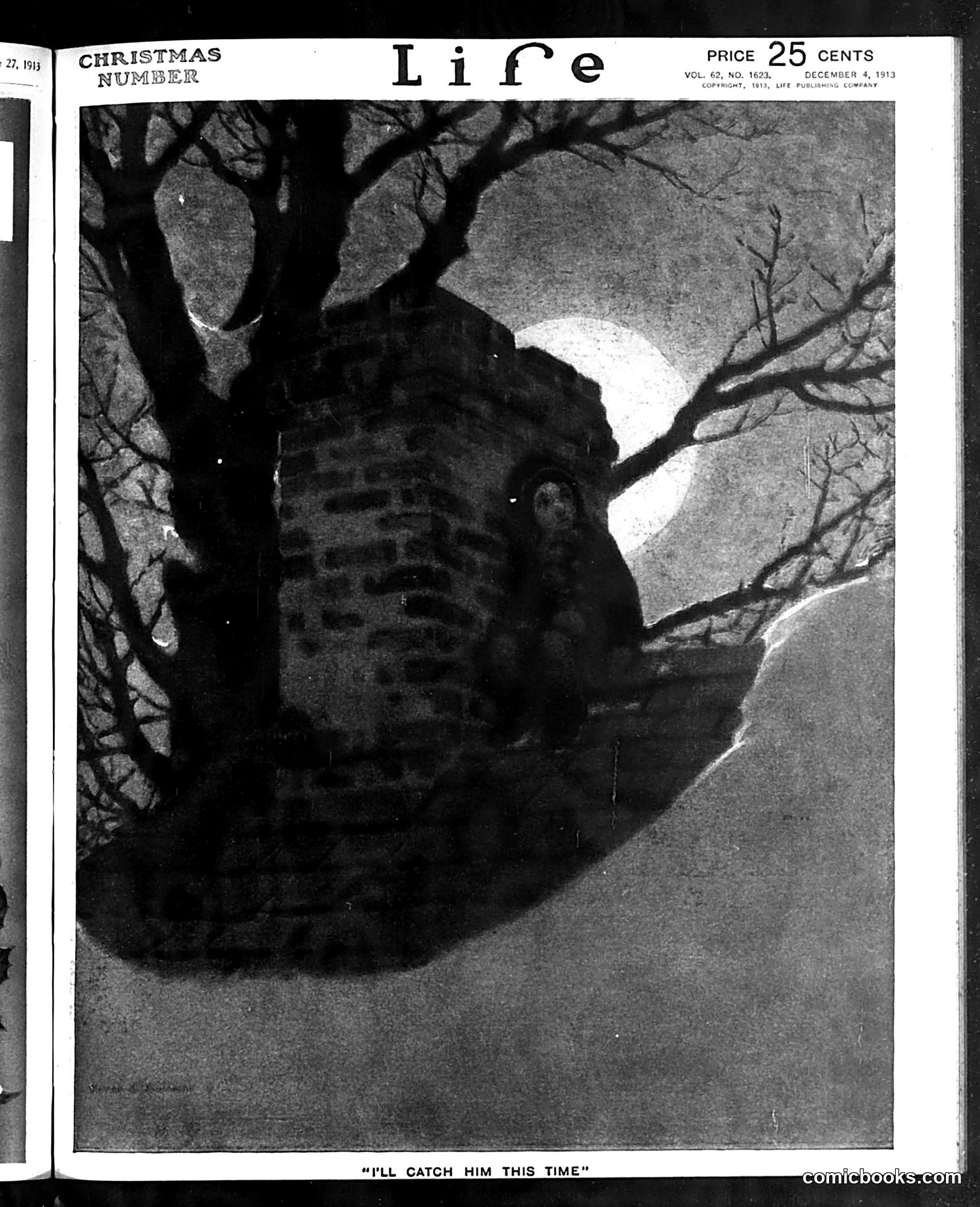
This appears to be a dramatic illustration titled "I'll Catch Him This Time" showing a figure in heavy winter clothing emerging from or being pursued through deep snow near bare trees and moonlight. Without additional OCR text or caption context visible on this page, the specific political or satirical meaning is unclear. The image has a noir-like, somewhat menacing quality typical of early 20th-century magazine illustration. The phrase "I'll Catch Him This Time" suggests pursuit or capture, possibly referencing a news event or popular story from late 1913. The Christmas Number designation indicates this is a holiday-themed edition, which may contextualize the imagery within seasonal narratives or yuletide-specific satire. More surrounding text would be necessary to identify the intended targets or meaning.
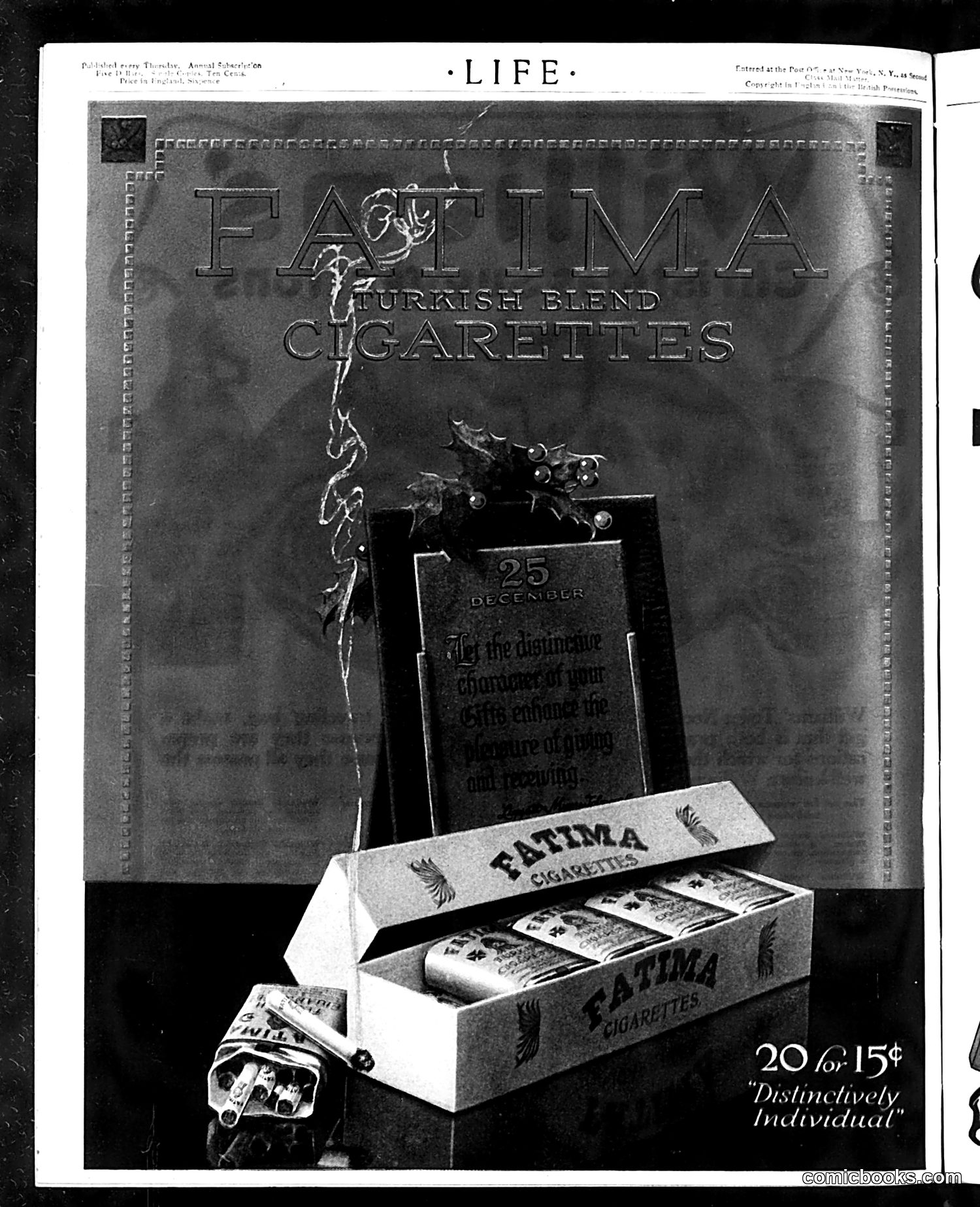
This page is primarily a **product advertisement** for Fatima Turkish Blend cigarettes, not political satire. The ad features: - A large calendar marking December 25th (Christmas) - An open box displaying individual cigarette packs - Marketing copy emphasizing the product is "Distinctively Individual" - A price point of "20 for 15¢" The Christmas imagery appears designed to position Fatima cigarettes as an appropriate holiday gift. The "distinctive" messaging suggests brand differentiation in the competitive early-20th-century cigarette market. There is **no apparent political cartoon or satire** on this page—it's straightforward commercial advertising typical of Life magazine's revenue model during this era.
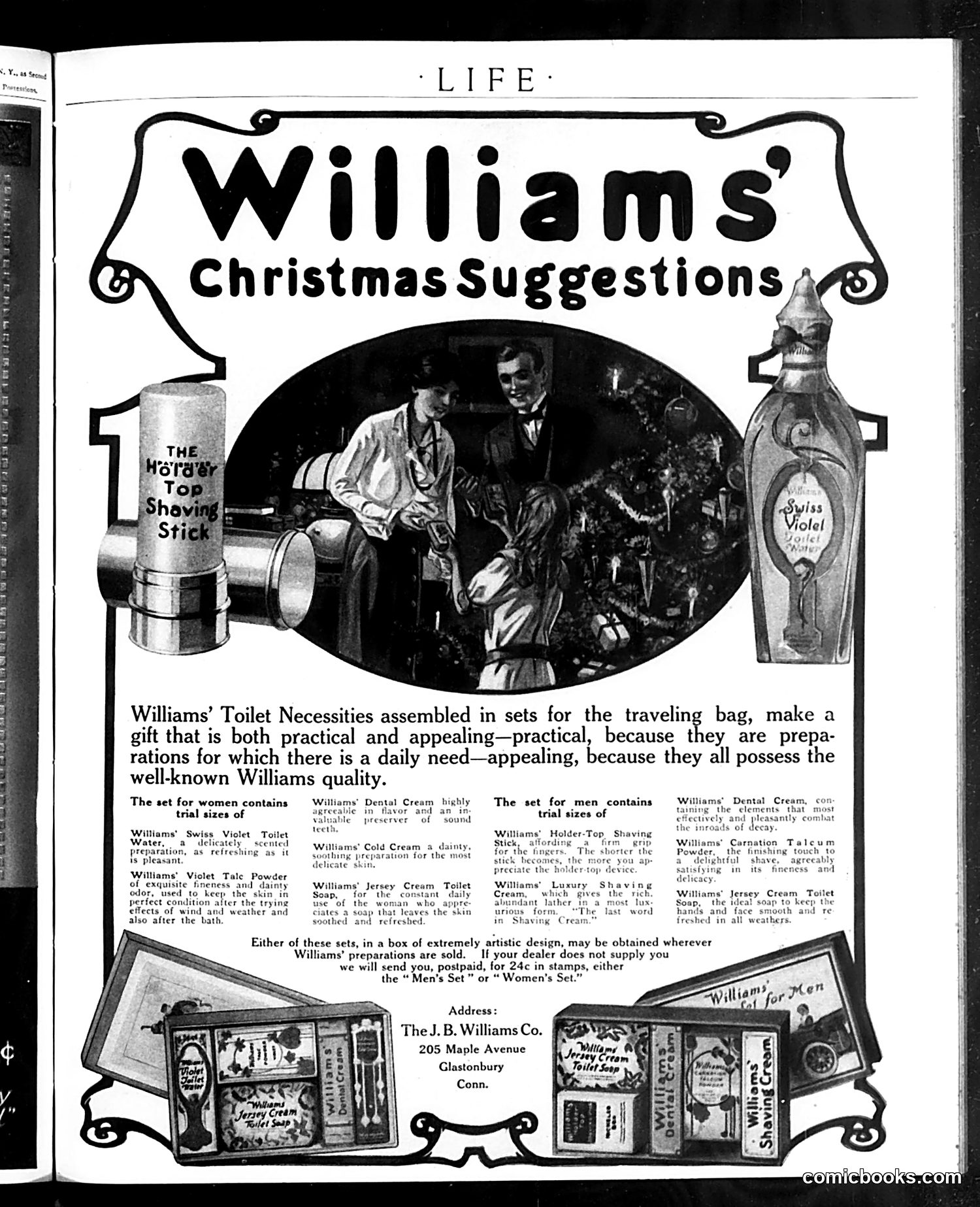
This page is **primarily advertising**, not political satire or comics. It's a Williams' brand advertisement for toilet necessities and grooming products marketed as Christmas gift sets. The central oval photograph shows what appears to be a domestic scene with two men, likely meant to evoke an intimate or humorous moment, though its specific reference is unclear from context alone. The ad promotes two assembled gift sets—one for women and one for men—containing trial-sized Williams' products like shaving cream, toilet water, powder, and soap. The layout uses decorative art deco framing typical of 1920s advertising design. The bottom shows product packaging images. The address lists J.B. Williams Co. in Glastonbury, Connecticut. There is no evident political or social satire—this is straightforward vintage commercial advertising.
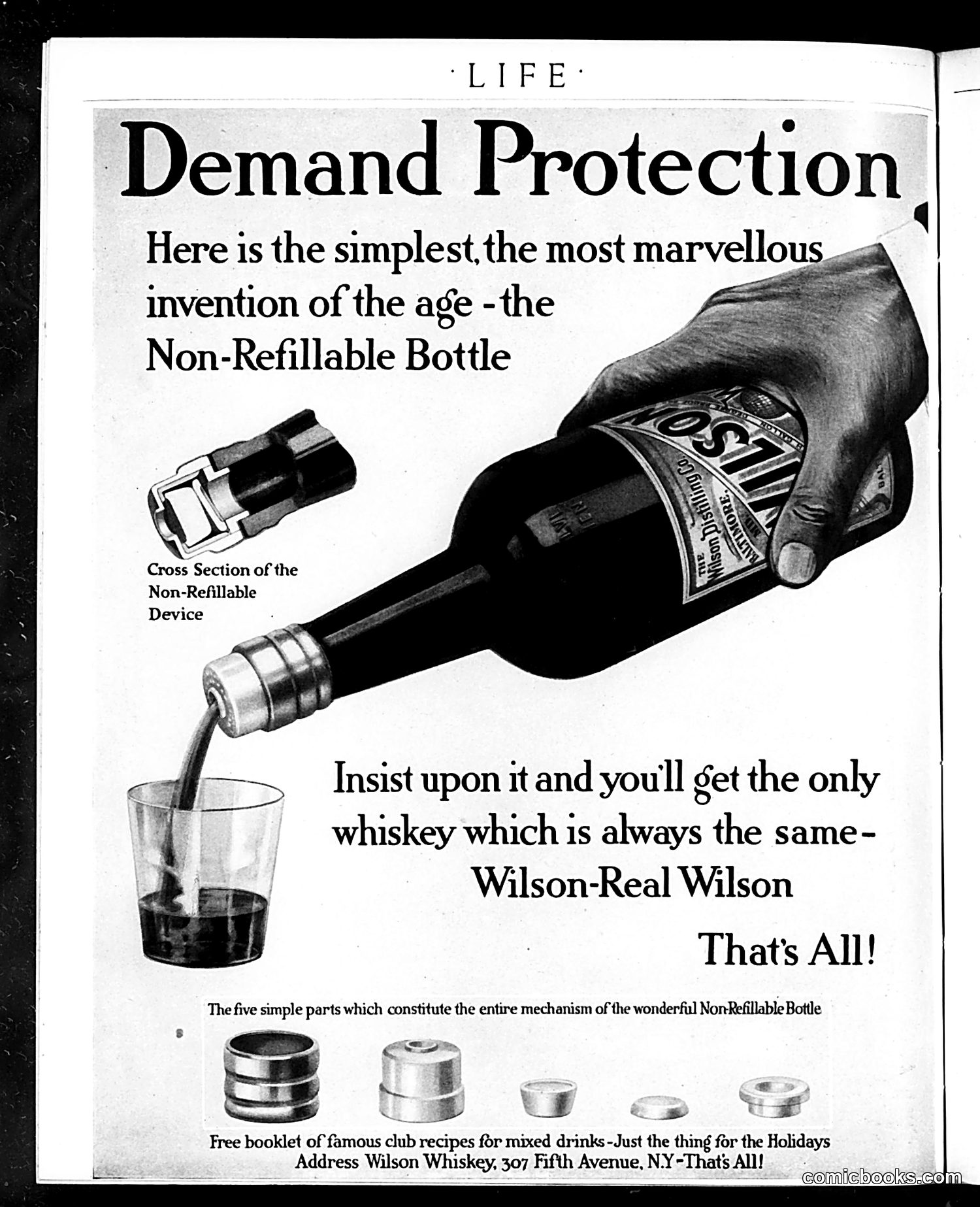
This is primarily **advertising, not satire or editorial content**. It's a Wilson Whiskey advertisement from Life magazine promoting their "Non-Refillable Bottle." The ad's pitch: this bottle design prevents refilling with cheaper liquor, guaranteeing consumers authentic Wilson whiskey. The headline "Demand Protection" frames this as consumer safeguarding during Prohibition era (likely 1920s-1930s), when illegal alcohol sales and counterfeiting were rampant. The bottle's special mechanism—shown in cross-section—mechanically prevents resealing. The ad emphasizes this protects buyers from bootleg substitutes, positioning Wilson as the trustworthy, quality option. The phrase "That's All!" serves as the brand's slogan. This reflects genuine Prohibition-era concerns about product authenticity in illegal liquor markets.
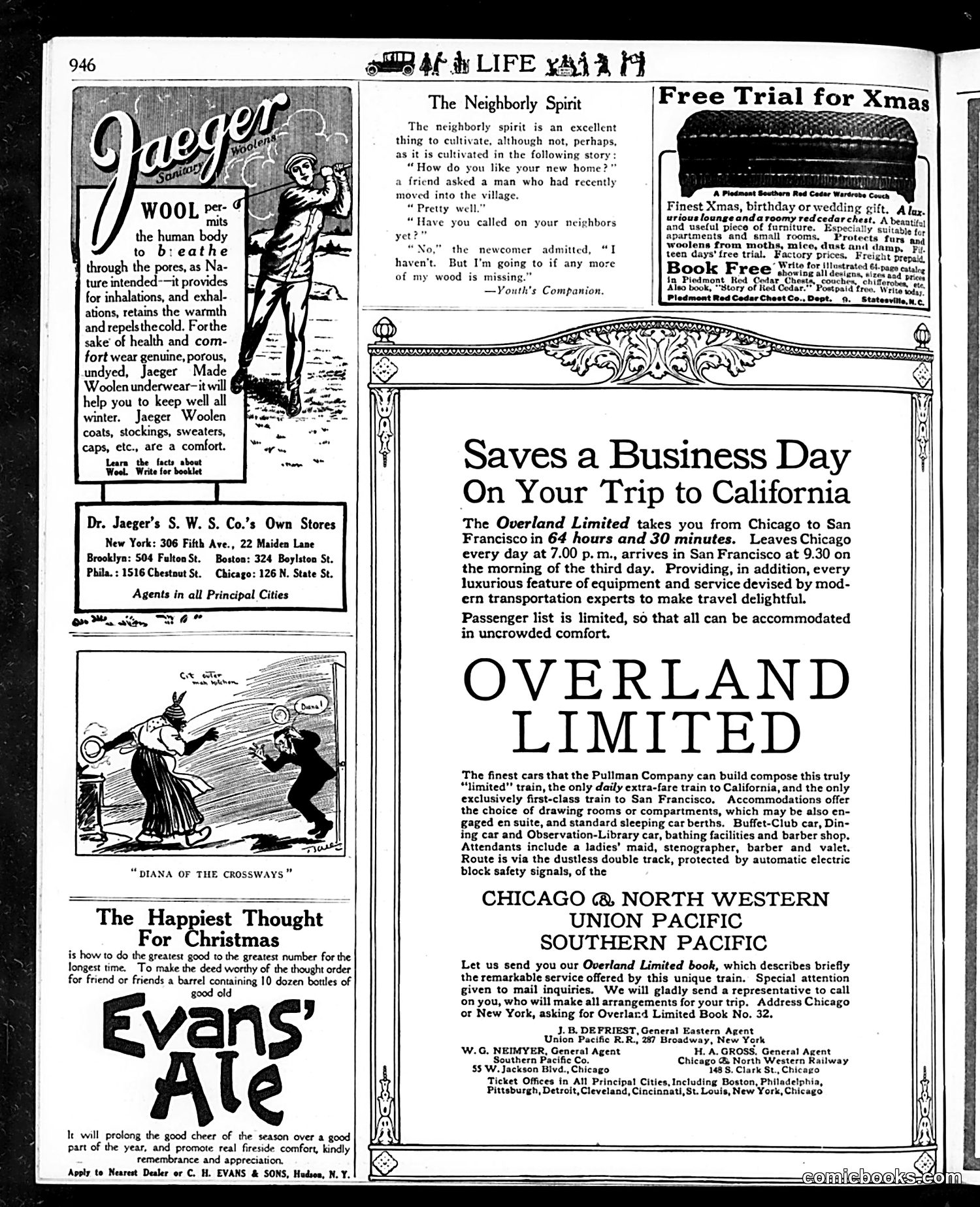
This page is primarily **advertising**, with limited editorial content. The main cartoon, titled "Diana of the Crossways," shows a woman in classical dress appearing to direct traffic or navigate a street intersection. The reference is to a literary work, likely evoking themes of female independence or agency in navigating modern urban life. The editorial section "The Neighborly Spirit" contains a brief anecdote about community cooperation—a man borrows wood from a neighbor, illustrating small-town social bonds. The bulk of the page advertises commercial products: Jaeger wool clothing, Evans' Ale (promoting it as a Christmas gift), and most prominently, the Overland Limited passenger train service from Chicago to San Francisco. These ads reflect early 20th-century consumer culture and transportation infrastructure rather than political satire.
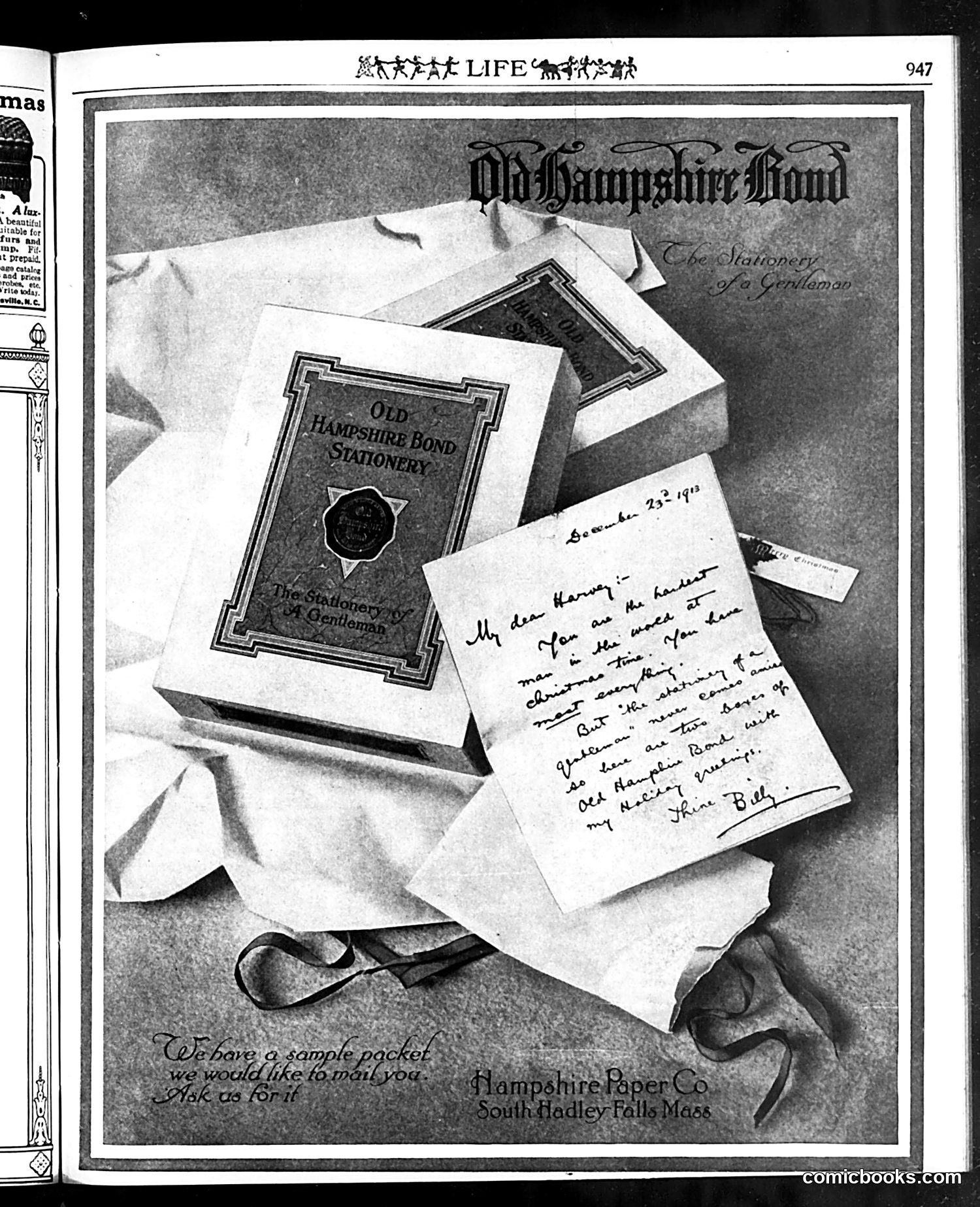
This page is primarily an **advertisement** for Hampshire Bond stationery, not a political cartoon. The ad features a styled photograph of stationery products—letterhead, envelopes, and a handwritten letter dated "December 23rd 1913"—arranged artistically with ribbon. The advertisement emphasizes "The Stationery of a Gentleman" and appeals to social status through elegant presentation. The handwritten letter and formal packaging suggest quality and sophistication desired by upper-class consumers. The Hampshire Paper Co. of South Hadley Falls, Massachusetts uses this upscale imagery to market their stationery as a luxury product. At bottom, the copy invites readers to request a sample packet, a common direct-mail marketing tactic of the era. This reflects early 20th-century advertising strategy targeting affluent readers of *Life* magazine.
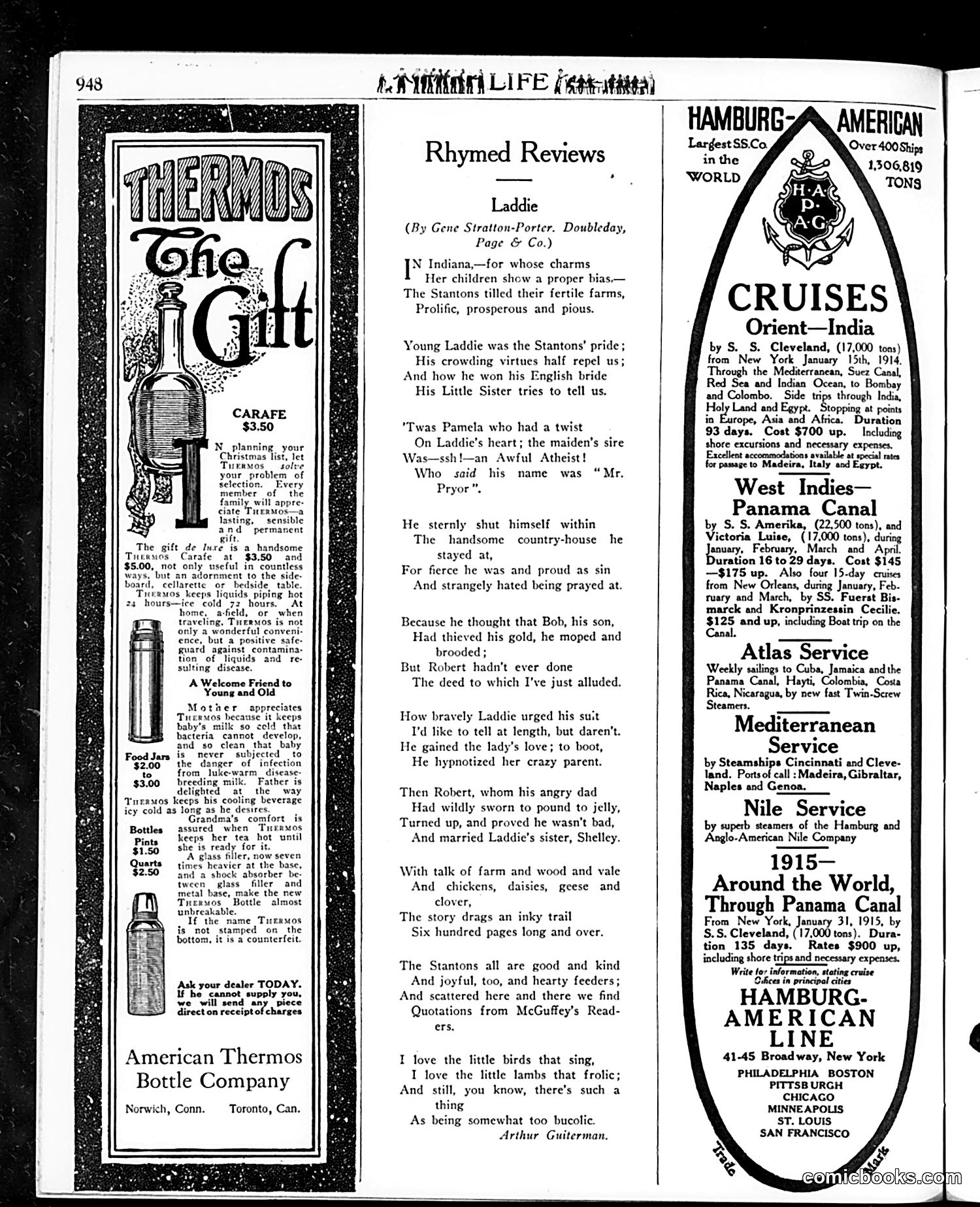
This page is primarily **advertising and poetry**, not political cartoons. The left side features a **Thermos bottle advertisement** emphasizing its practical uses—keeping liquids hot or cold, preventing bacterial contamination, and being "a Welcome Friend to Young and Old." The center contains a **rhymed poem titled "Laddie"** by Gene Stratton-Porter about a rural Indiana family. It tells of young Laddie winning an English bride despite his father's atheism and pride, culminating in Laddie marrying the lady's sister Shelley. The poem celebrates wholesome farm life and family reconciliation. The right side displays **Hamburg-American shipping line advertisements** for luxury cruises to the Orient, West Indies, Panama Canal, and Mediterranean—typical early-20th-century leisure travel promotions. There is **no political satire or social commentary** on this page.
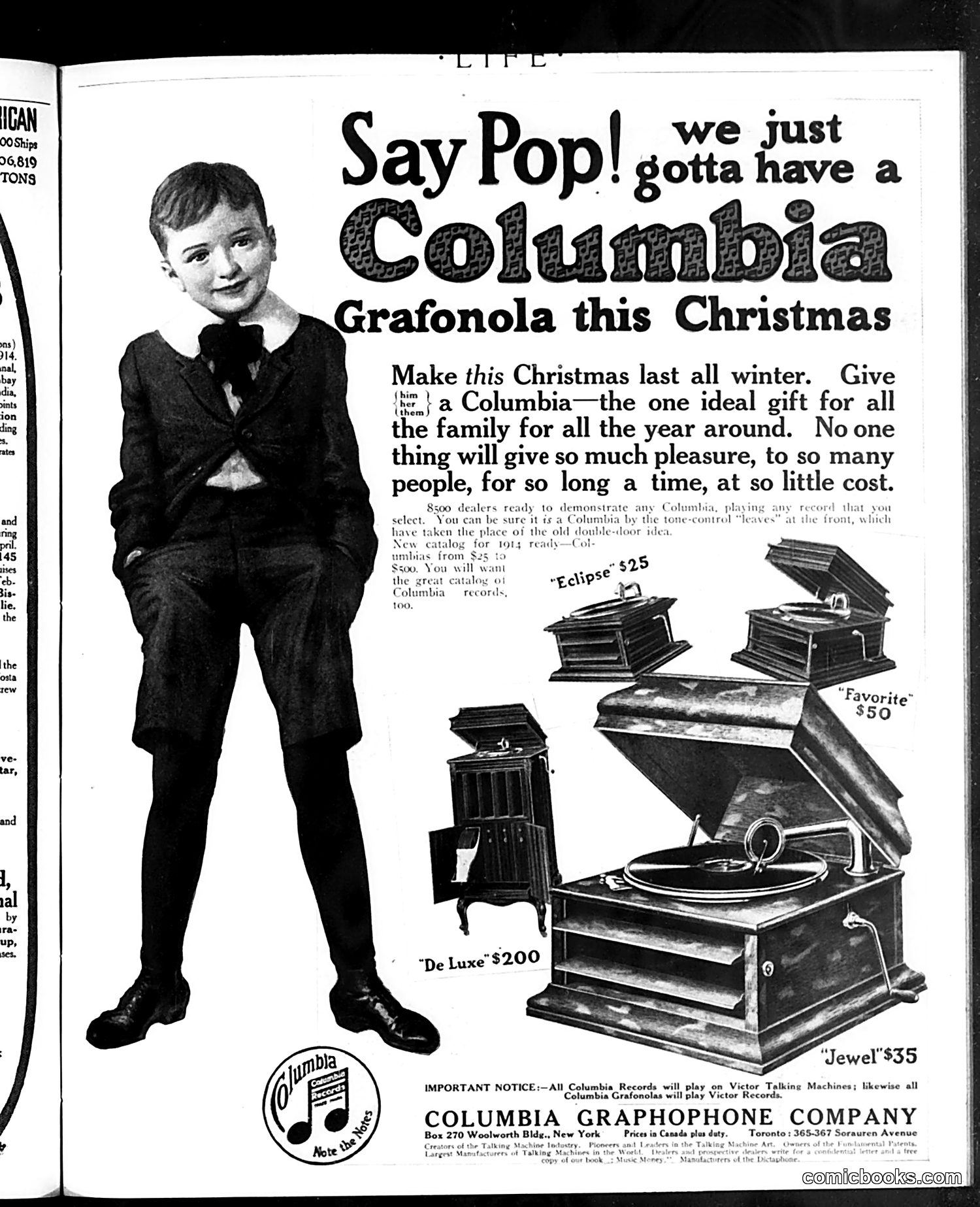
This is a **Columbia Grafonola advertisement**, not political satire. The page features a young boy in formal attire (suit and dress shoes) posed with an enthusiastic expression next to four gramophone models at different price points: "De Luxe" ($200), "Eclipse" ($25), "Favorite" ($50), and "Jewel" ($35). The ad's pitch—"Say Pop! we just gotta have a Columbia Grafonola this Christmas"—uses the boy character to appeal to parents by suggesting the gift will provide year-round family entertainment at modest cost. The only notable element is the outdated gender presentation: the advertiser uses a boy (not girl) as the aspirational consumer, reflecting early 20th-century marketing assumptions. The Columbia Graphophone Company logo appears at bottom.
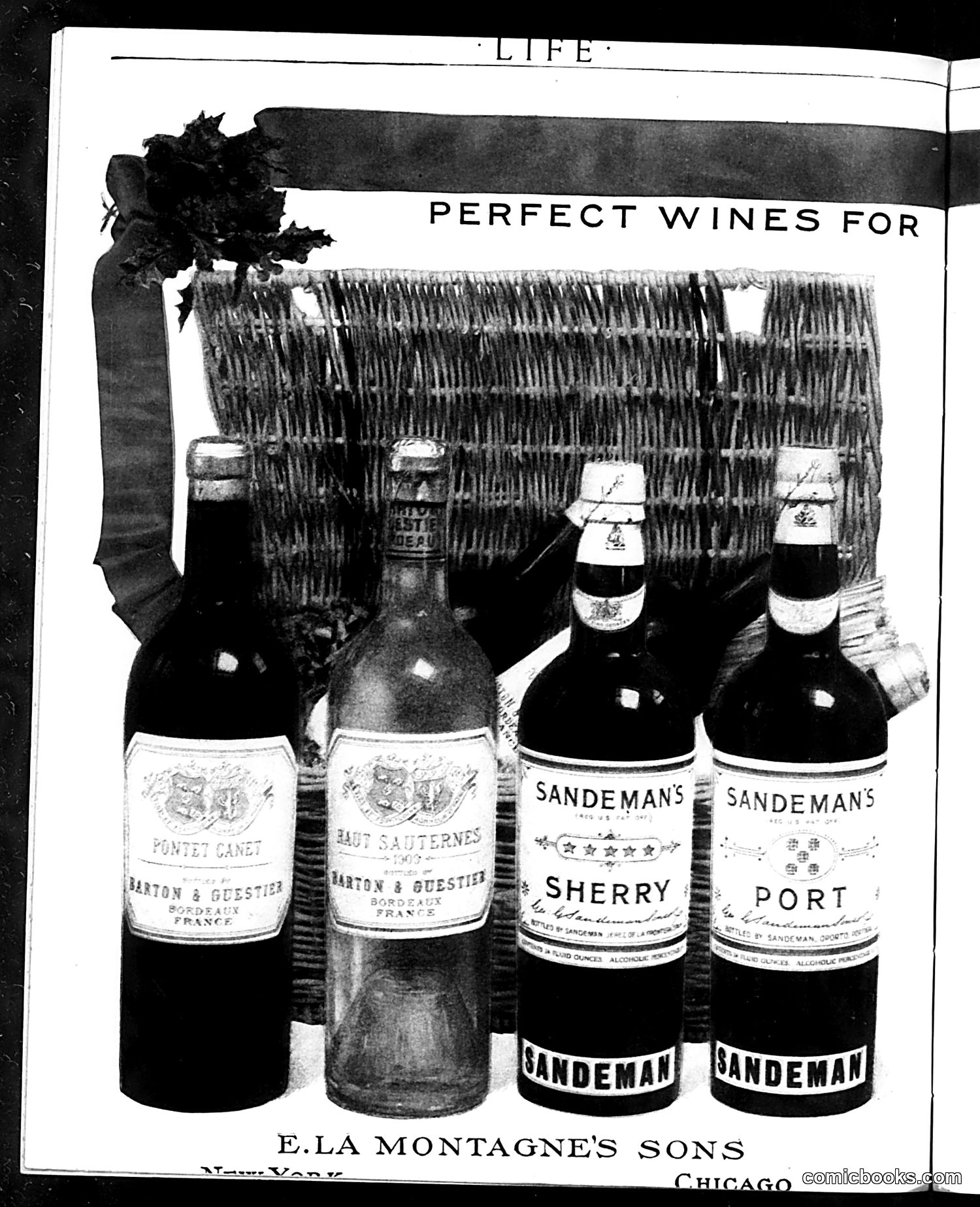
This is a **wine advertisement**, not political satire. The page promotes "Perfect Wines For" various occasions from E. La Montagne's Sons, with locations in New York and Chicago. The ad displays four wine bottles from different producers: - Pontet Canet (Bordeaux) - Haut Sauternes (Bordeaux) - Sandeman's Sherry - Sandeman's Port The decorative elements include grape vines at the top and a wicker basket background, emphasizing the wine's quality and heritage. For modern readers: this appears to be a pre-Prohibition or early-Prohibition era advertisement, when wine was still legally and openly marketed in American publications. The focus on French and Portuguese imports suggests wine appreciation was positioned as a sophisticated, cosmopolitan luxury good for affluent consumers.
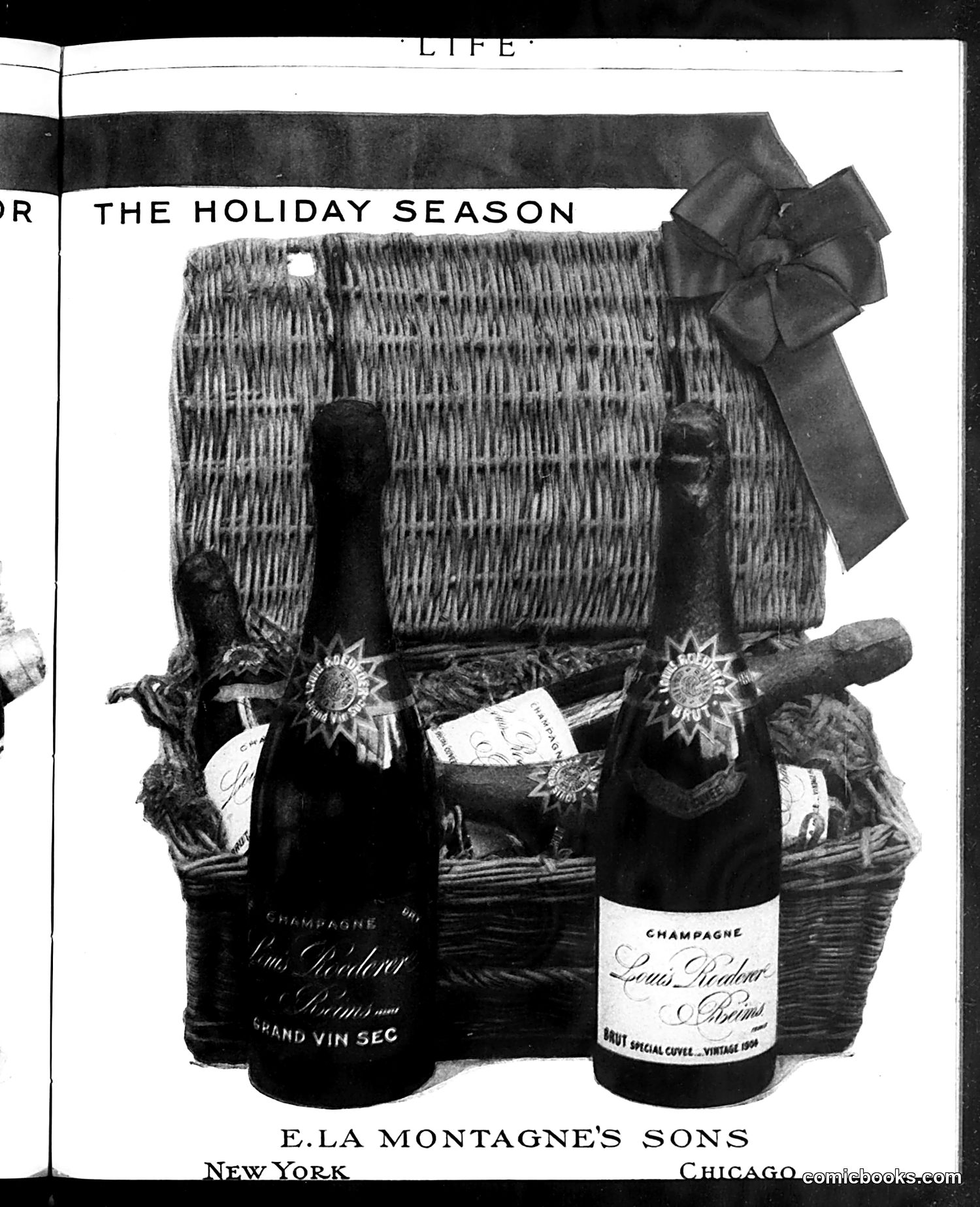
This is a **champagne advertisement** from Life magazine, not a political cartoon. It promotes **Louis Roederer champagne** through E. La Montagne's Sons (distributors in New York and Chicago). The ad uses holiday gift-giving as its appeal: a wicker basket filled with champagne bottles, luxury food items, and decorative elements tied with a black ribbon bow. Two specific champagne varieties are displayed: "Grand Vin Sec" and what appears to be a vintage special cuvée. The imagery suggests **upscale gift-giving during Prohibition-era America** (based on the vintage styling), when champagne represented luxury and celebration. The presentation targets wealthy consumers seeking sophisticated holiday presents.
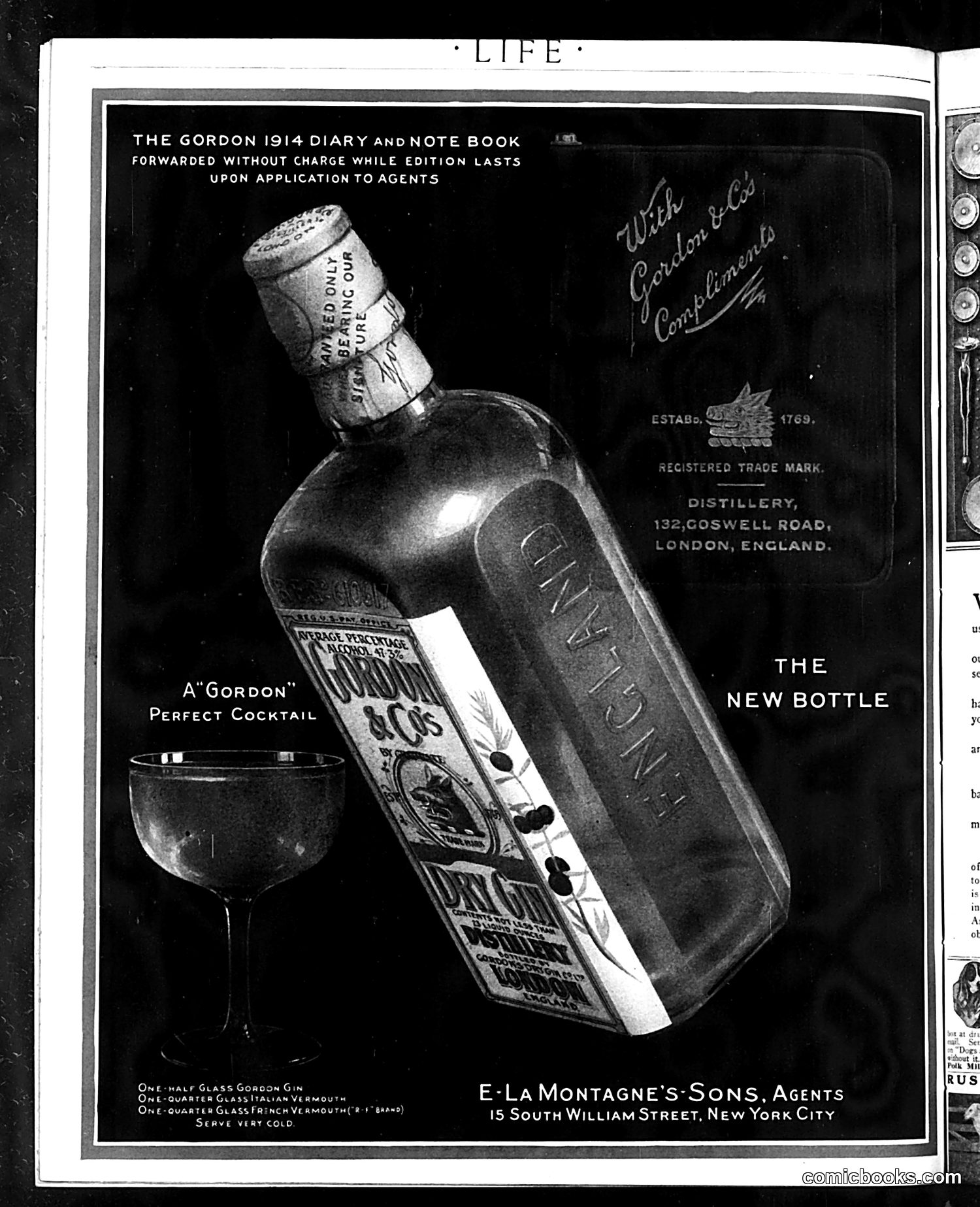
This page is **not a political cartoon** but rather a **full-page advertisement** for Gordon's Gin, appearing in *Life* magazine. The ad promotes "The New Bottle" design for Gordon's gin and advertises a cocktail recipe called "A 'Gordon' Perfect Cocktail" (made with gin, Italian vermouth, and French vermouth). The advertisement includes: - A photograph of the Gordon's bottle with its new design - An illustration of the prepared cocktail in a coupe glass - Instructions for preparation ("Serve very cold") - Contact information for E. La Montagne's Sons, the New York agents - Reference to the Gordon's 1914 Diary and Note Book available to agents There is no satire or political commentary present—this is straightforward commercial advertising from the early 20th century.
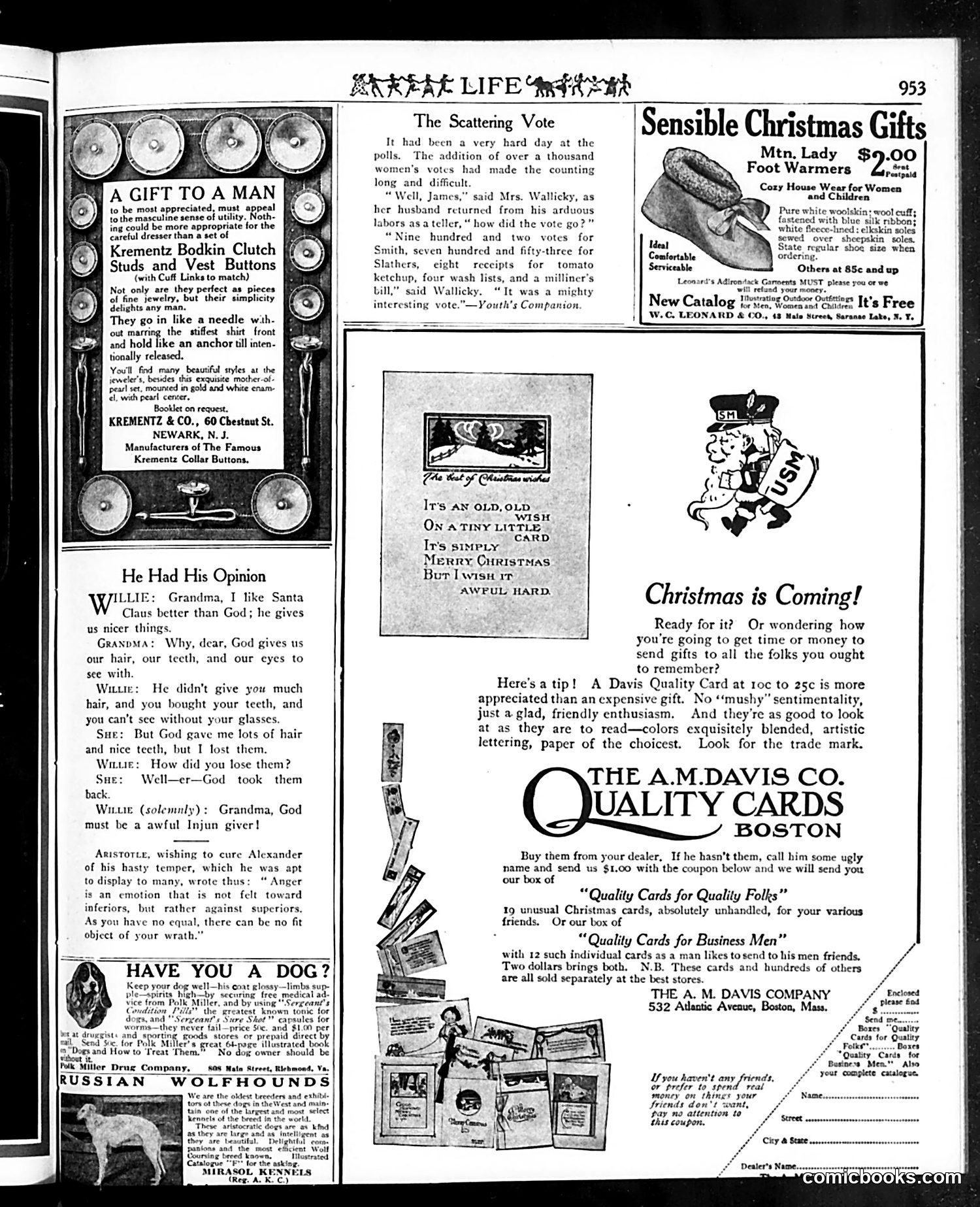
This page is primarily **advertising and humor content** rather than political satire. The visible cartoons include: 1. **"He Had His Opinion"** — A dialogue joke between Willie and his Grandmother about God versus Santa Claus, using the child's literal interpretation for humor. 2. **"Have You a Dog?"** — An advertisement promoting dog care products, featuring what appears to be a Russian Wolfhound breed. 3. **"The Scattering Vote"** — A brief anecdote about election counting difficulties, illustrating voting confusion in a humorous way. The page also contains substantial **Christmas gift advertising** (foot warmers, quality cards) typical of early 20th-century holiday publications. No specific political figures or events are referenced—the humor relies on domestic situations and gentle satire of everyday life rather than contemporary politics.
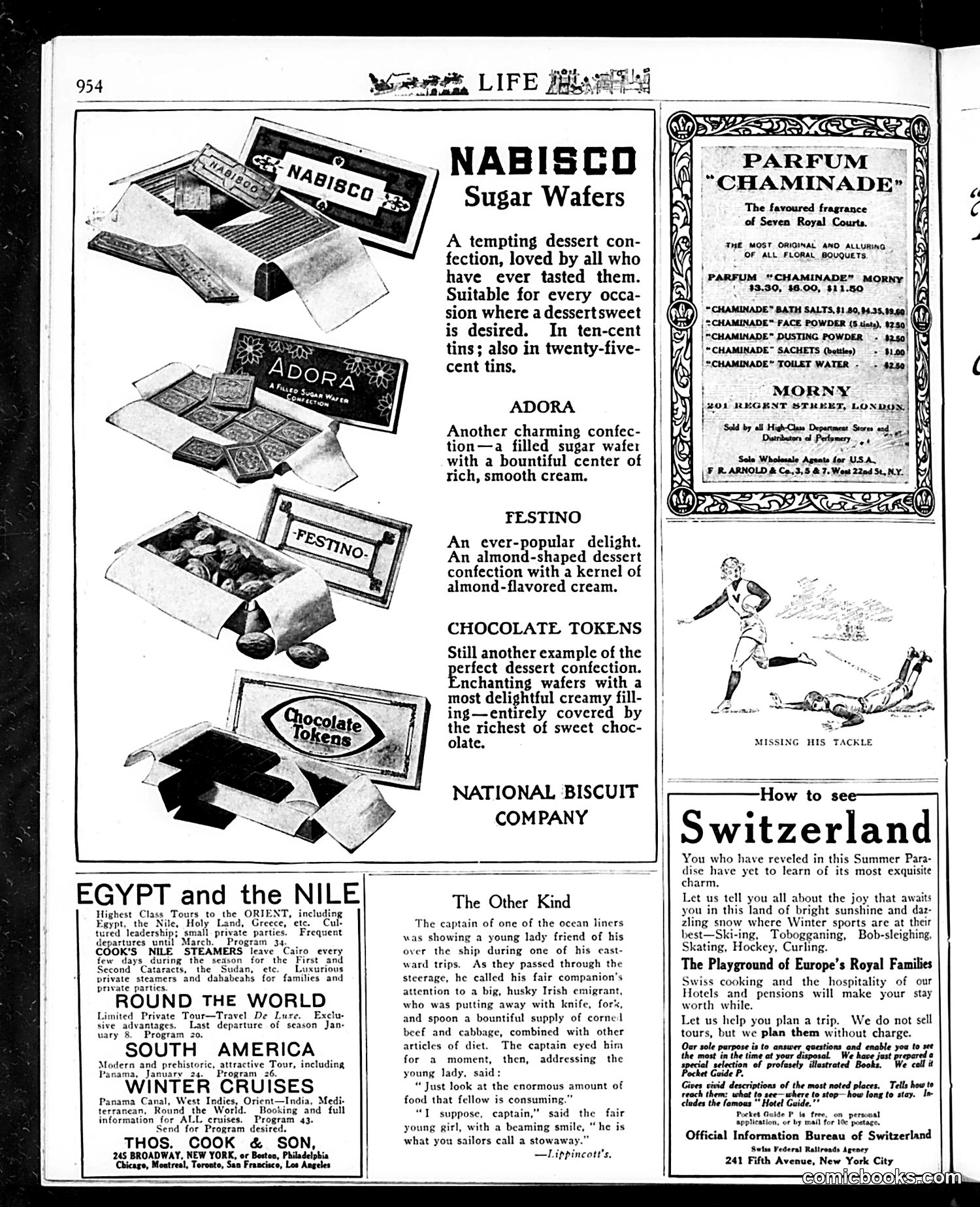
This is primarily an **advertising page** from Life magazine, not political satire or comics. The page features: **Main Content:** Advertisements for confectionery products from the National Biscuit Company (Nabisco), including sugar wafers, cream-filled wafers, and chocolate-covered cookies. Each product includes descriptive copy about taste and packaging options. **Secondary Advertisements:** A perfume ad for "Chaminade," travel tour advertisements (Egypt, South America, Switzerland), and a brief humorous anecdote titled "The Other Kind" about a ship captain and stowaway. **The Cartoon:** A small illustrated vignette showing a figure missing a tackle during what appears to be a sports game—a simple visual joke with no political significance. This is a typical early 20th-century magazine advertising layout with no satirical content requiring historical context.
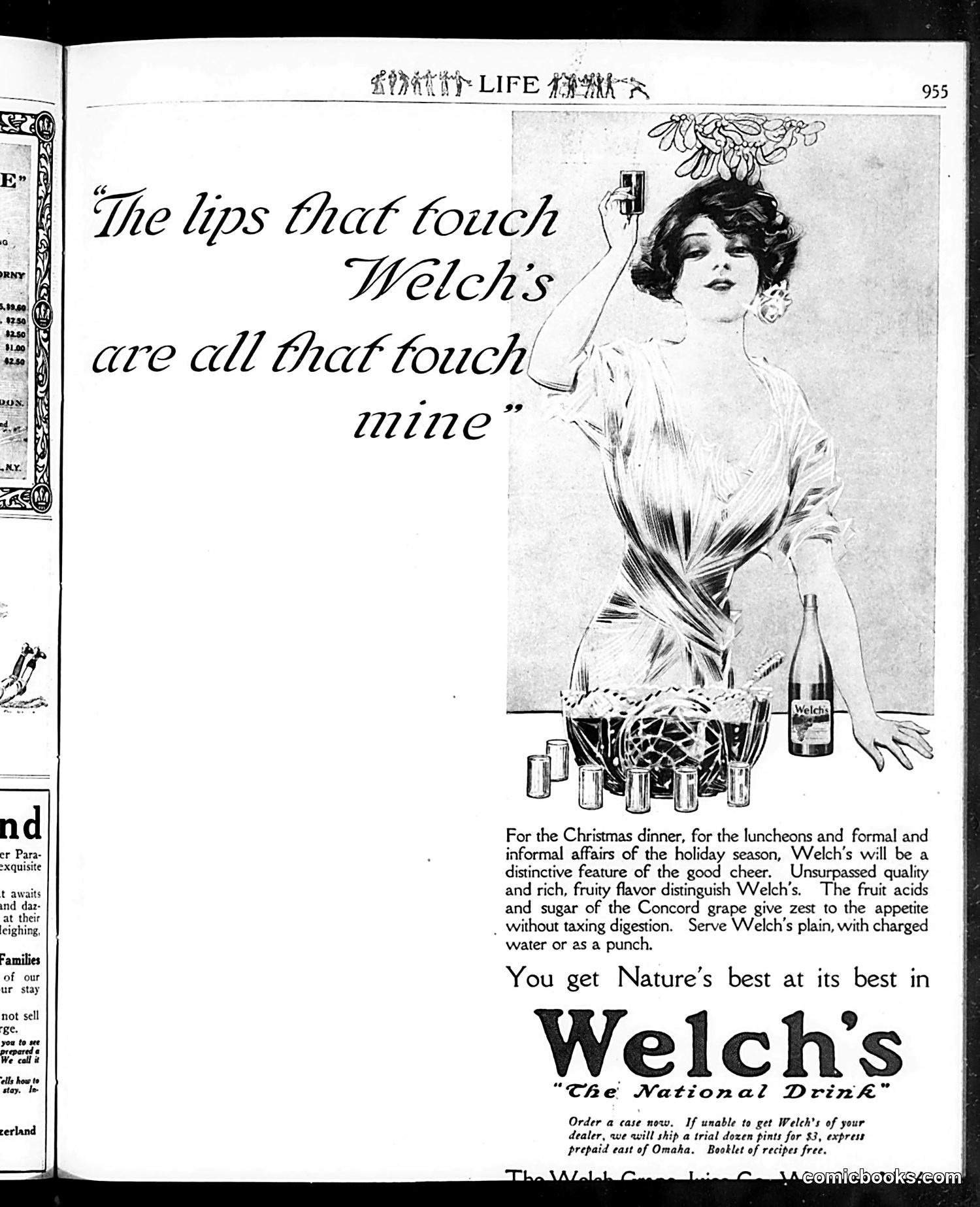
This is a **Welch's grape juice advertisement**, not political satire or editorial cartoon. The page features a stylized illustration of an elegant woman holding a bottle of Welch's, positioned beneath mistletoe. The romantic imagery—"The lips that touch Welch's are all that touch mine"—uses a flirtatious appeal to market the product for holiday entertaining. The advertisement emphasizes Welch's as "The National Drink," promoting it for Christmas dinners, formal gatherings, and punches. The copy highlights the product's "unsurpassed quality" and natural fruit acids from Concord grapes, positioning it as both sophisticated and healthful—a premium beverage for refined social occasions. This reflects early 20th-century advertising conventions: aspirational imagery, romance-tinged messaging, and appeals to genteel hospitality to sell consumer goods to middle and upper-class readers.
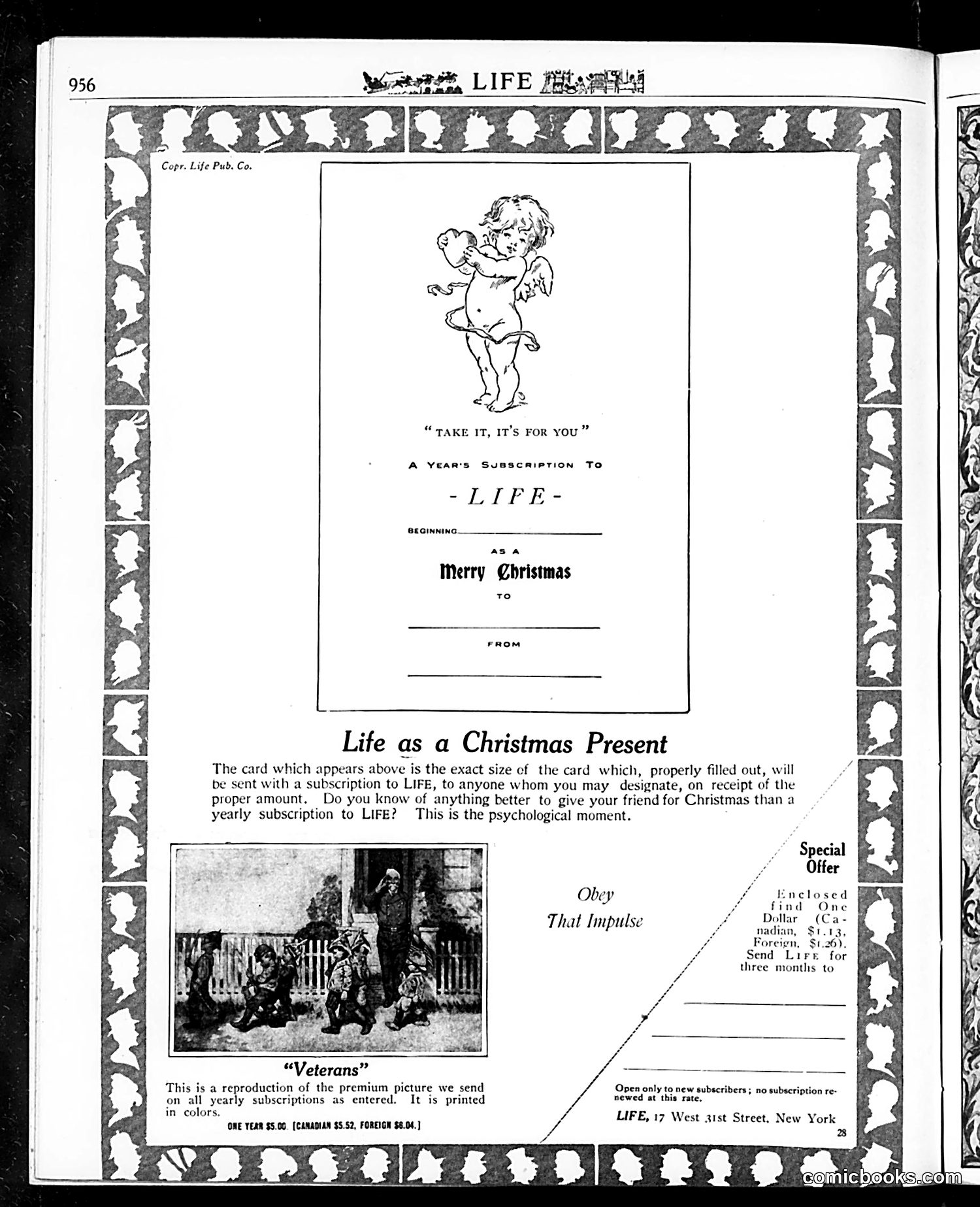
This is primarily a **subscription advertisement**, not a political cartoon. The page promotes gifting a yearly subscription to *Life* magazine as a Christmas present. The cherub illustration at top ("Take it, it's for you") uses the classical cupid motif to suggest the gift is appealing and desirable. Below, there's a reproduction of a premium picture titled **"Veterans"**—appears to be a sentimental scene—sent with yearly subscriptions. The ad emphasizes the "psychological moment" of Christmas giving, positioning the magazine subscription as superior to typical gifts. A special offer allows new subscribers to send *Life* for three months at reduced rates (one dollar Canadian, $1.13 foreign). The decorative border with repeated profile silhouettes is typical period design. **For modern readers**: This reflects early 20th-century magazine marketing, when subscriptions were luxury gifts, and *Life*'s positioning as sophisticated, culturally valuable reading matter worthy of Christmas gifting.
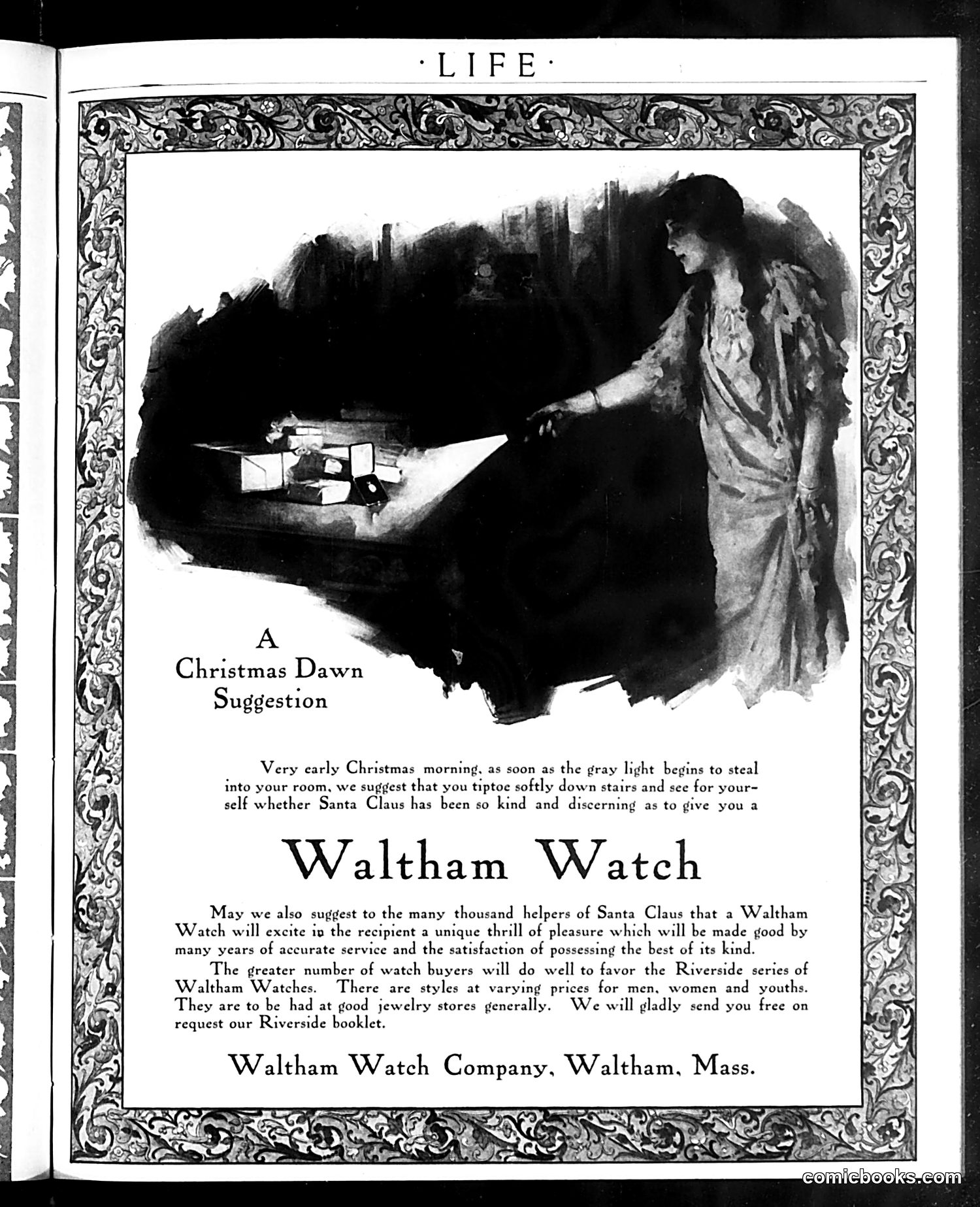
This is a **Waltham Watch Company advertisement**, not satire or political commentary. The page depicts a Christmas morning scene: a woman in a nightgown peers downstairs to discover whether Santa has left her a Waltham Watch as a gift. The "joke" or appeal is gentle and straightforward—the ad suggests that a quality watch makes an ideal, memorable Christmas present that will provide "years of accurate service." The romantic illustration (a woman in classical dress) and the early-morning scenario create an emotional connection to the product. The advertisement also targets gift-givers ("helpers of Santa Claus"), encouraging them to choose Waltham's "Riverside series" watches available at jewelry stores in various styles and price points. The company offers a free booklet upon request. This represents typical early 20th-century luxury goods advertising, appealing to middle and upper-class readers of *Life* magazine through sentiment and lifestyle association rather than satire.
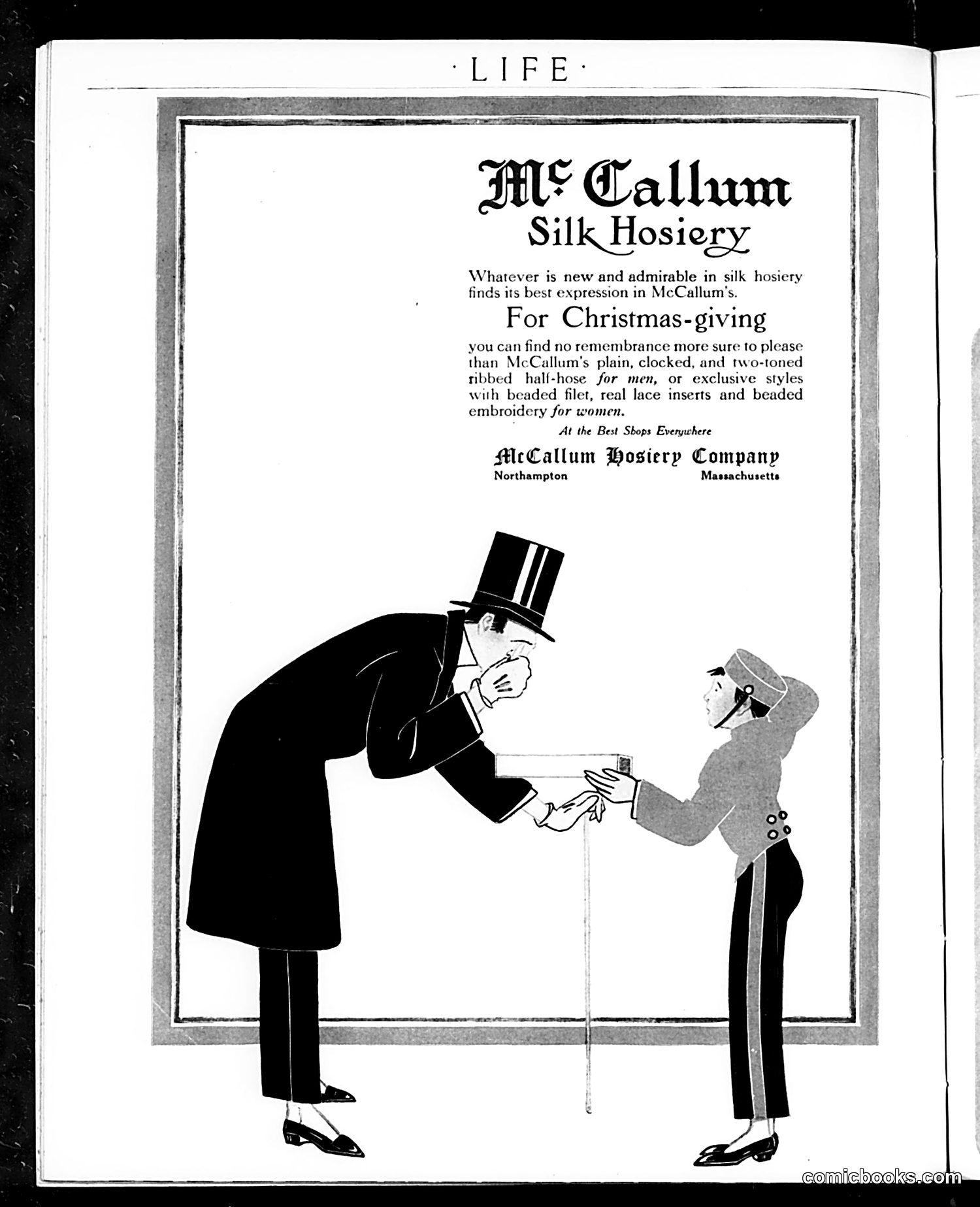
This is a **product advertisement**, not satire or political commentary. It promotes McCallum brand silk hosiery as Christmas gifts for both men and women. The illustration shows a gentleman in formal attire (top hat, overcoat) presenting a gift box to a young woman—a common early-20th-century marketing trope suggesting elegance and romance. The ad emphasizes different styles: plain and ribbed half-hose for men; ornate styles with "beaded filet, real lace inserts and beaded embroidery" for women. The copy appeals to gift-givers seeking prestigious presents available "at the Best Shops Everywhere." The McCallum Hosiery Company, based in Northampton, Massachusetts, was a real manufacturer marketing luxury goods to affluent consumers during this era.
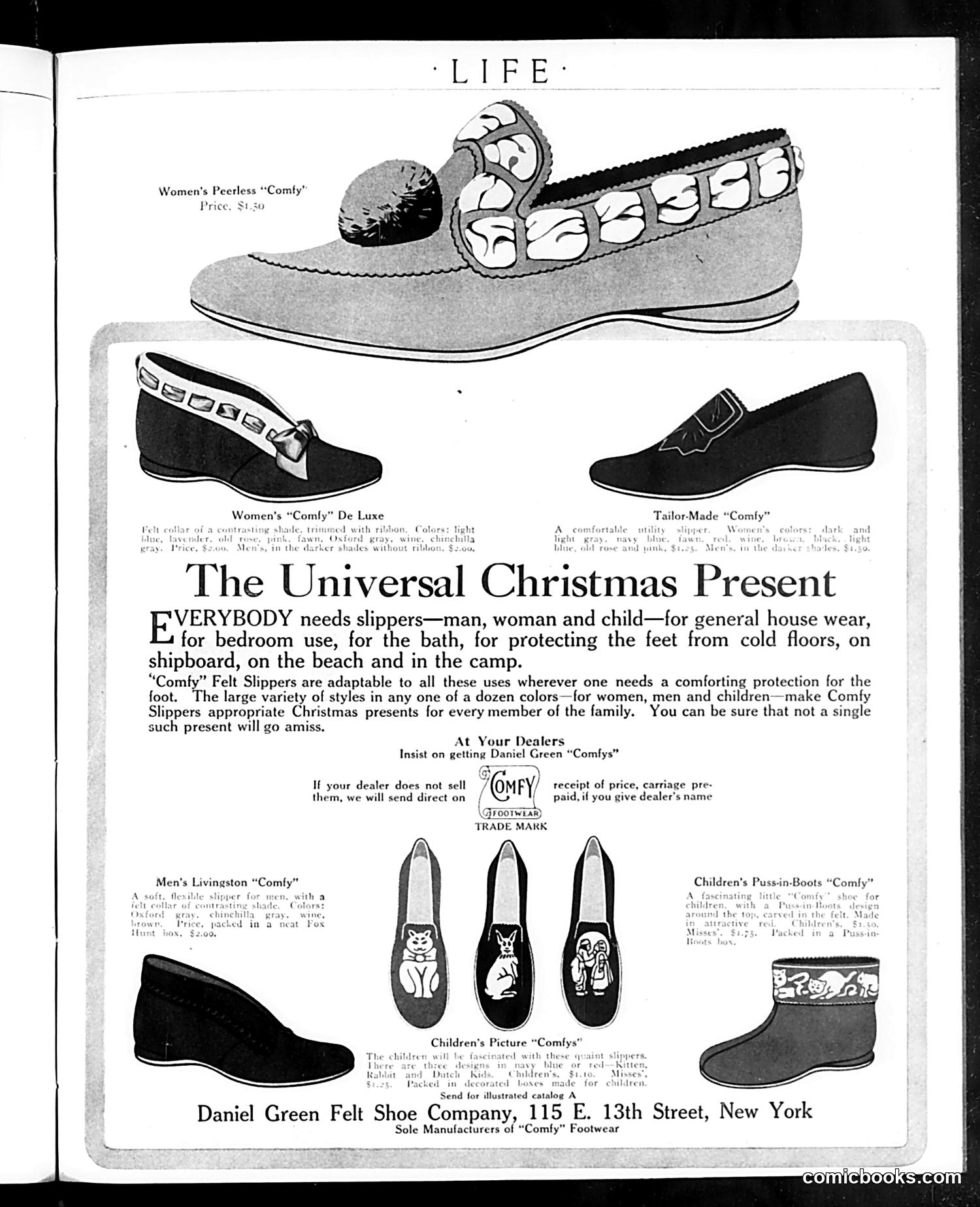
This is a **full-page advertisement**, not satire or political commentary. It promotes Daniel Green "Comfy" felt slippers as ideal Christmas gifts for "man, woman and child." The page displays multiple slipper styles with whimsical names: Women's "Peerless Comfy," Men's "Livingston Comfy," Children's "Puss-in-Boots Comfy," and others available in various colors. The advertising copy emphasizes versatility—slippers work "for general house wear, for bedroom use, for the bath...on shipboard, on the beach and in the camp." **Key marketing angle**: The slippers are presented as universally appropriate gifts requiring no guesswork; "not a single such present will go amiss." The children's versions feature decorative animal designs (cats, owls). **For modern readers**: This reflects early 20th-century Christmas shopping culture where practical comfort items were desirable gifts. The emphasis on direct mail ordering ("we will send direct") shows emerging mail-order retail. There is no satire here—simply vintage advertising copy and product illustration.
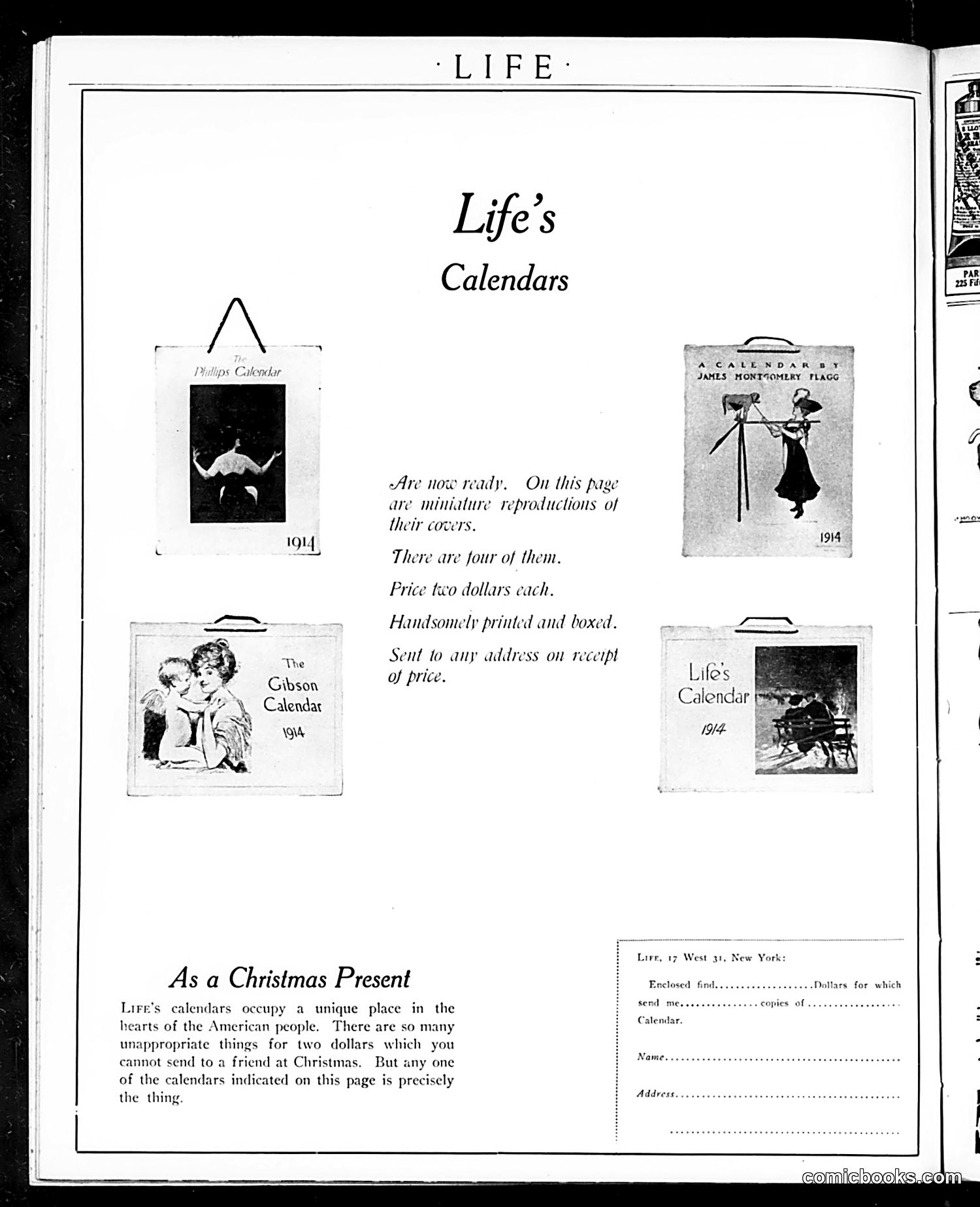
This is primarily an **advertisement** for Life magazine's 1914 calendars rather than satirical content. The page promotes four different calendar designs available for purchase at two dollars each, featuring cover art by various artists including James Montgomery Flagg. The calendars shown include "The Phillips Calendar," "The Gibson Calendar" (featuring Charles Dana Gibson's famous illustration style), "A Calendar by James Montgomery Flagg," and "Life's Calendar." The marketing copy emphasizes these calendars as ideal Christmas gifts—arguing that at this price point, they're more appropriate presents than many other two-dollar items one might give. This reflects early 20th-century gift-giving conventions and the popularity of illustrated calendars as home décor and functional items during the era. There is no political satire or social commentary visible on this page—it's straightforward commercial promotion using prominent illustrators' names and artwork to drive sales.
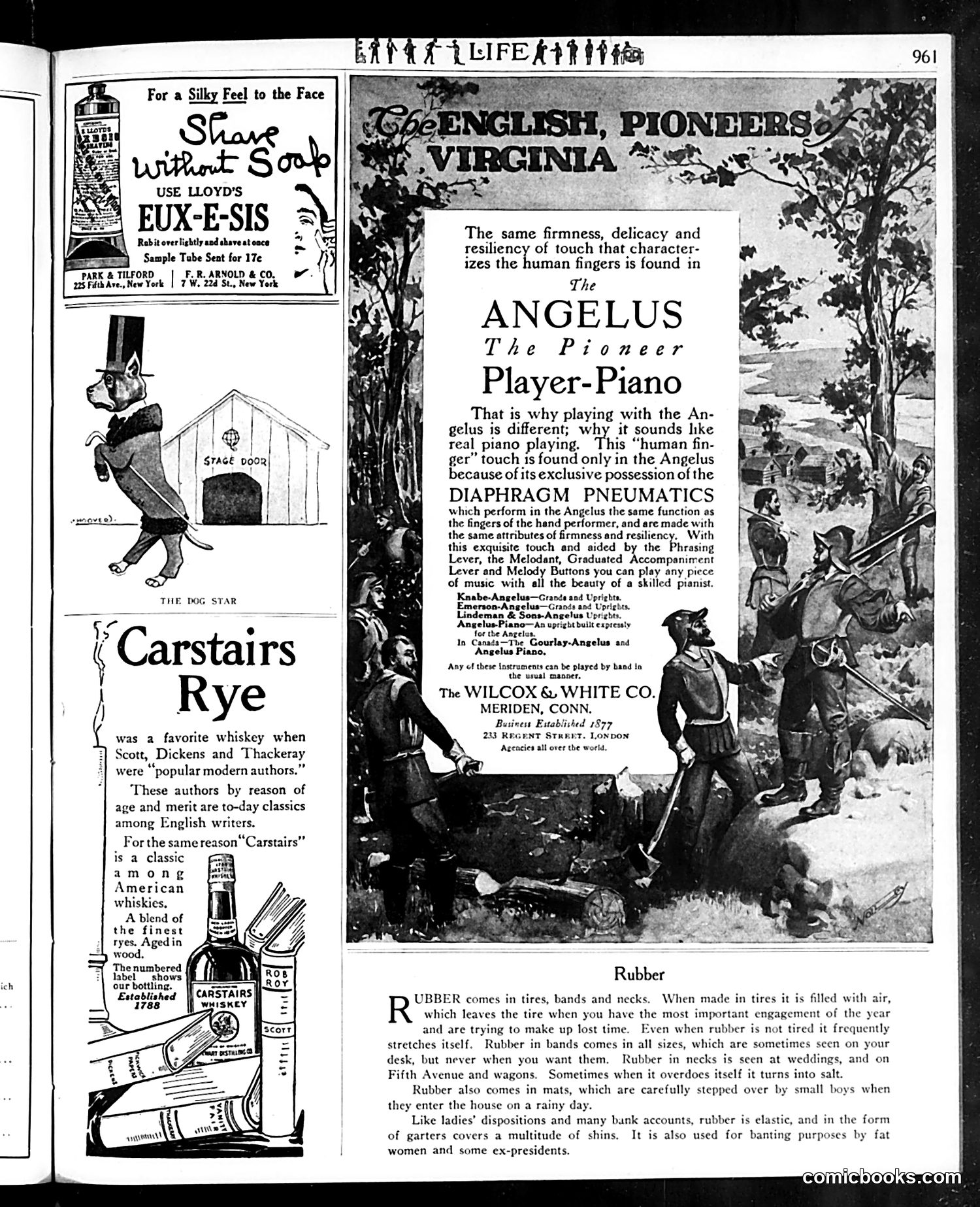
This page is primarily **advertising** with one brief satirical piece. The main content consists of period product ads (EUX-E-SIS shaving cream, Carstairs Rye whiskey, and Angelus player-pianos). The only satirical element is the short "Rubber" essay at bottom—a humorous commentary on rubber's practical failures in everyday life. The piece mocks rubber's unreliability: tires deflate at crucial moments, rubber bands disappear when needed, and rubber matting gets ignored by boys entering on rainy days. The final jab—comparing rubber garters to "ladies' dispositions" and suggesting they hide physical flaws ("cover a multitude of shins")—reflects period attitudes toward women as objects of appearance management. The reference to "fat women and some ex-presidents" using rubber for "banting" (dieting) adds crude period humor about weight loss. This is lighthearted consumer satire rather than political commentary.
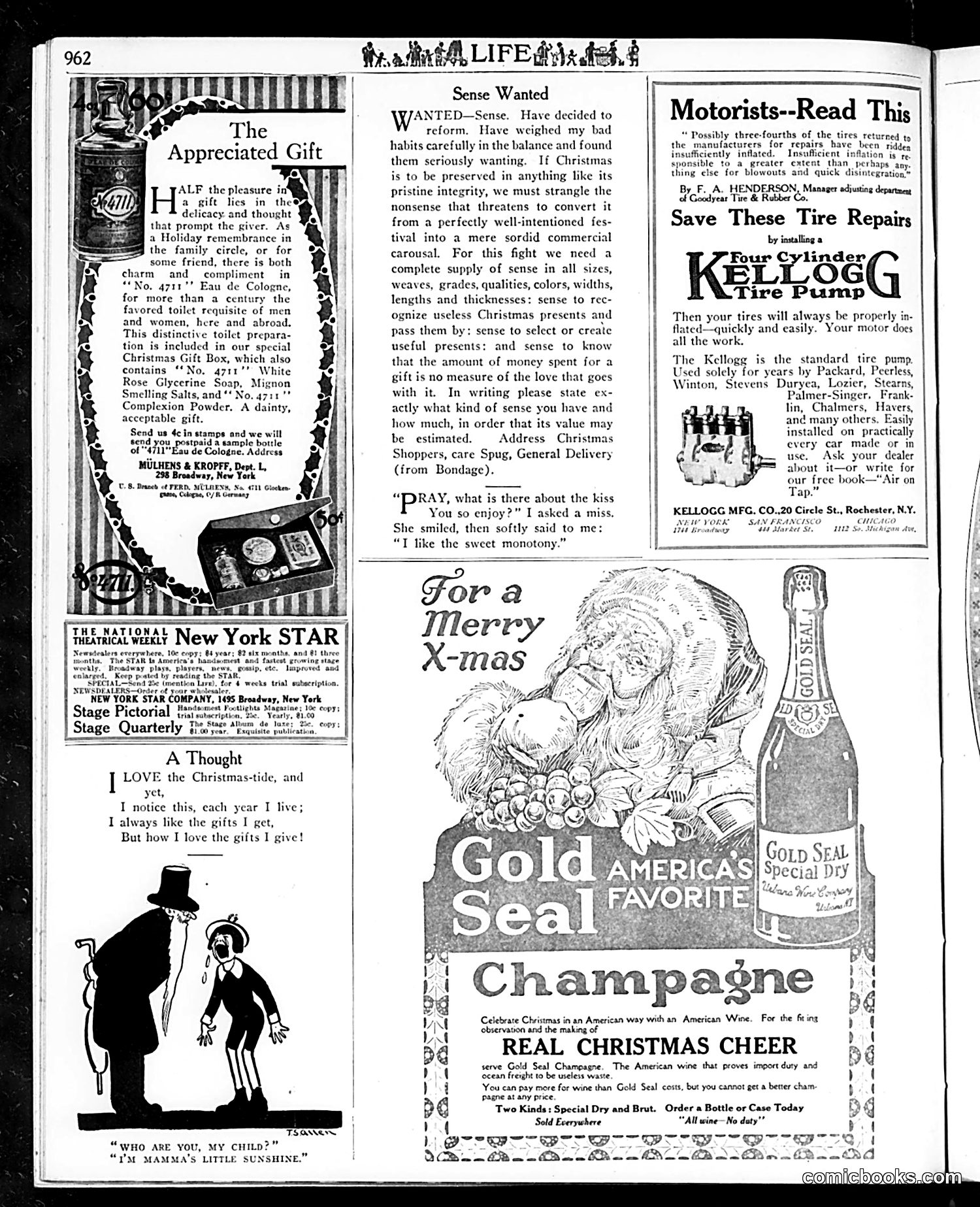
This is primarily an **advertising and humor page** from an early 20th-century American magazine. The main satirical piece is a "Sense Wanted" advertisement—a tongue-in-cheek classified ad lamenting the commercialization of Christmas. It criticizes how the holiday has devolved into "sordid commercial carousal" and calls for "sense in all sizes" to distinguish between truly meaningful and merely expensive gifts. This reflects genuine Progressive-era anxiety about unchecked consumerism corrupting holiday values. The cartoon below shows a well-dressed gentleman asking a child, "Who are you, my child?" The child replies, "I'm Mamma's Little Sunshine"—a sentimental domestic scene typical of sentimental advertising of the period. The page otherwise consists of **product advertisements**: eau de cologne (No. 4711), a tire pump (Kellogg), tire repair services, and Gold Seal Champagne. The champagne ad ironically promotes "Real Christmas Cheer" while arguing that expensive imports are wasteful—positioning American wine as economical patriotism. The humor lies in juxtaposing commercialism critique with aggressive product placement.
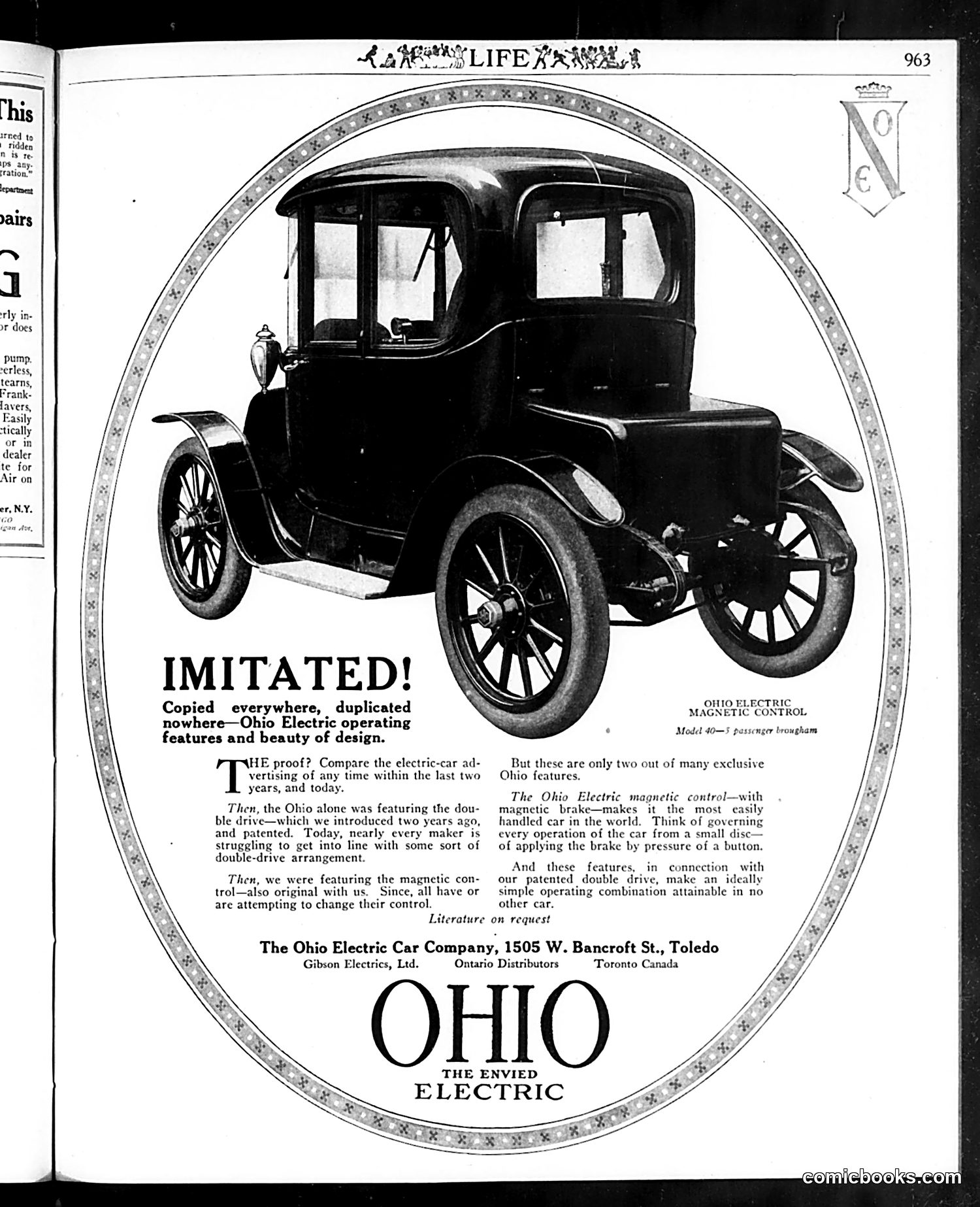
This is primarily **advertising, not satire**—a full-page promotion for the Ohio Electric automobile in *Life* magazine (page 963). The ad claims that Ohio Electric has been copied by competitors. It boasts of two innovative features introduced two years prior: the "double drive" and "magnetic control" system. The company argues that nearly every other electric car manufacturer has since attempted to imitate these patented technologies. The headline "IMITATED!" frames this as proof of Ohio Electric's superiority and originality. The ad emphasizes that their magnetic brake system allows the driver to control all car operations from a single button—presented as uniquely advanced. For modern readers: this reflects the early electric vehicle market (pre-1920s), when electric cars were luxury items competing with gasoline vehicles. The ad's boastful tone about imitation suggests intense competition and patent disputes were common in nascent automotive technology.
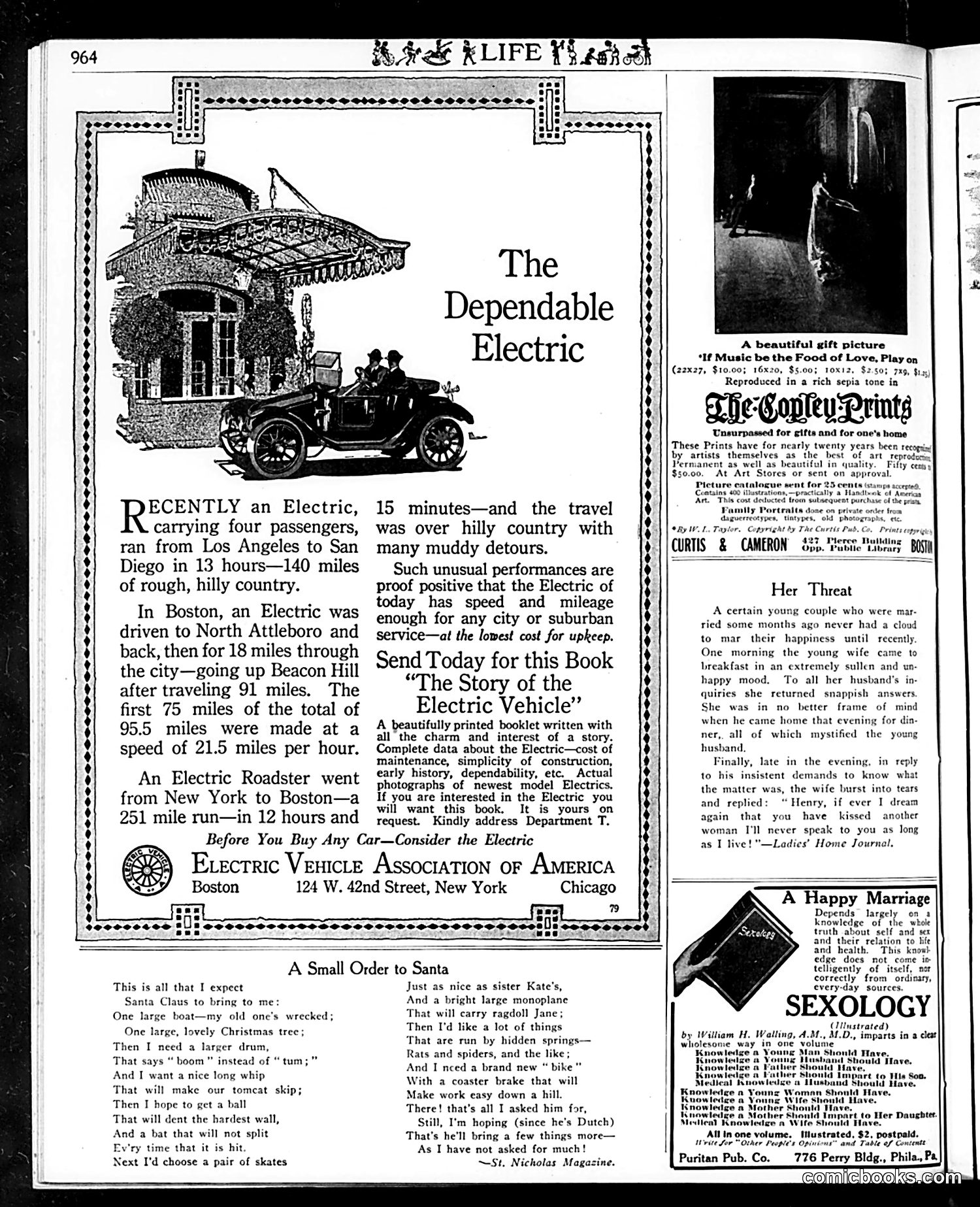
This page is primarily **advertising and feature content** rather than political satire. The main content comprises: **The "Dependable Electric" advertisement** (left) promotes electric automobiles through the Electric Vehicle Association of America. It cites performance examples—Los Angeles to San Diego in 13 hours, New York to Boston in 12 hours—to demonstrate that electric cars offer speed and reliability comparable to gasoline vehicles, while maintaining "the lowest cost for upkeep." This reflects early 1900s competition between electric and gas-powered cars, before gasoline engines ultimately dominated. **The remaining content** includes: - A short humorous domestic story ("Her Threat") about marital jealousy - A children's Christmas wish-list poem - Advertisement for "Sexology" books promoting marriage education - Art print advertisements **For modern readers:** This page documents a now-vanished technology—when electric vehicles were serious competitors in the automotive market, marketed as clean, reliable urban transportation before internal combustion engines became standard.
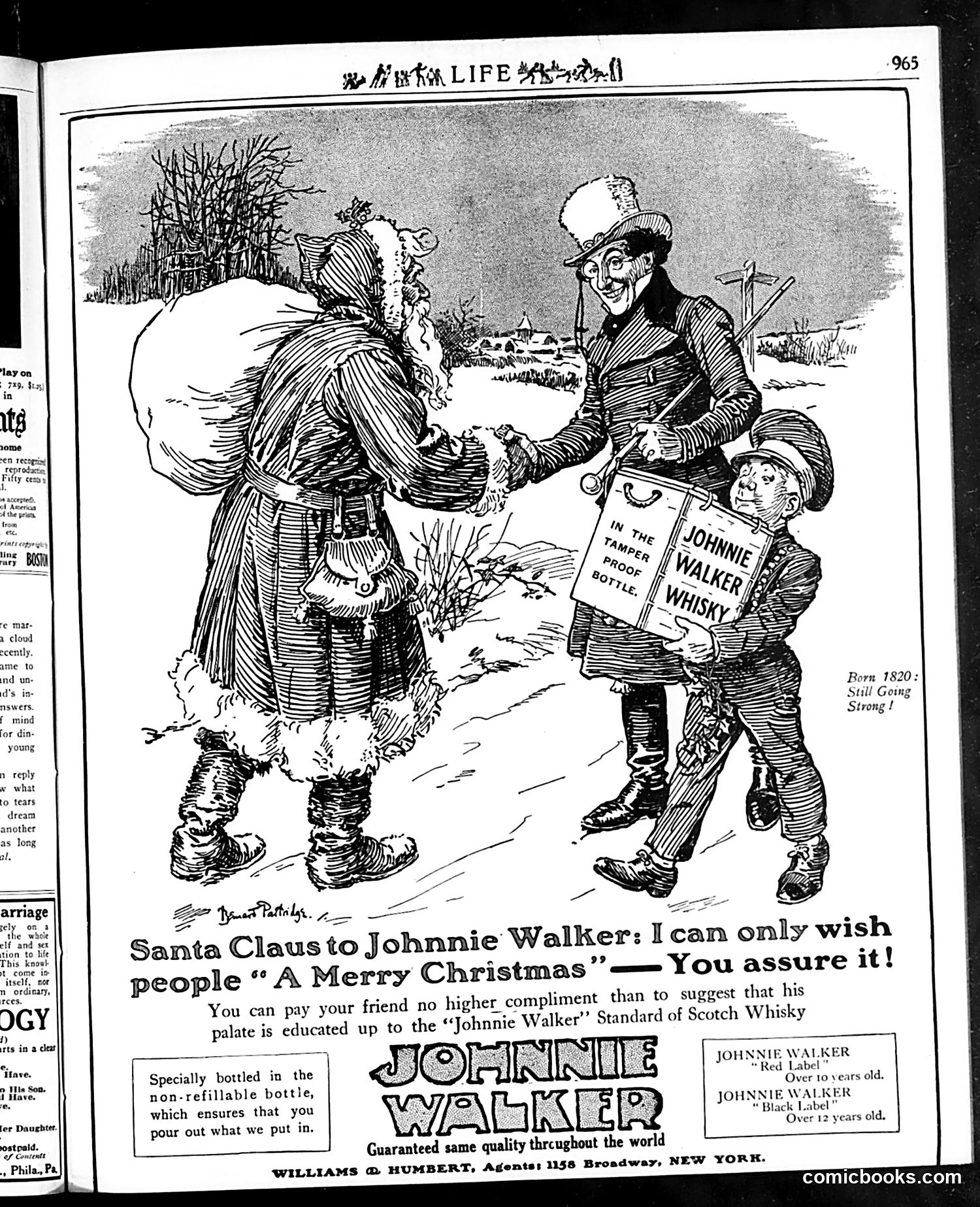
This is primarily a **Johnnie Walker Scotch Whisky advertisement**, not political satire. The illustration depicts Santa Claus meeting a small boy holding a bottle labeled "In the Tamper Proof Bottle: Johnnie Walker Whisky." The tagline plays on Christmas sentiment: Santa says he can only wish people "A Merry Christmas"—but Johnnie Walker whisky can assure it. The joke suggests that giving this Scotch is the ultimate holiday gift, implying whisky consumption equals Christmas happiness. The advertisement emphasizes the product's "tamper-proof bottle" (newly developed technology) and notes the brand's longevity: "Born 1820: Still Going Strong!" This dates to an era when whisky advertising directly associated the product with festive celebration and male gift-giving. For modern readers: this represents how openly alcohol advertising marketed to holiday shoppers and normalized whisky as essential to Christmas cheer—practices heavily restricted in contemporary advertising.
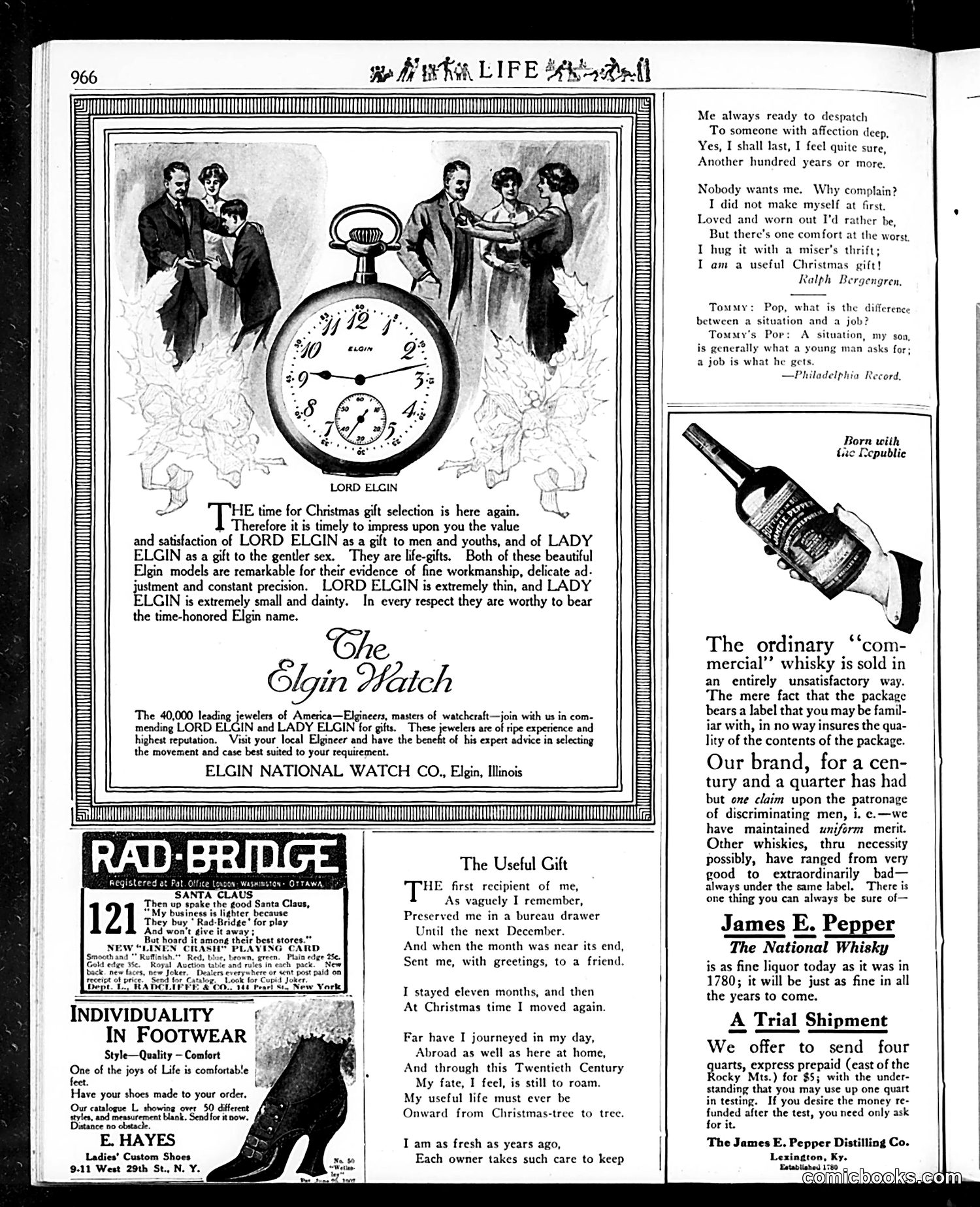
This page is primarily **advertisements interspersed with light verse and humor**. The main cartoon (top left) shows a pocket watch labeled "LORD ELGIN" surrounded by figures exchanging Christmas gifts—a straightforward product advertisement using the holiday season as context. The accompanying verses are humorous commentary on gift-giving: - A poem from Ralph Bergengren personifies a gift as something "useful" but unwanted, passed from person to person - A joke distinguishes between a "situation" (what young men desire) and a "job" (what they actually get)—social satire on employment prospects The remaining content advertises luxury goods: Elgin watches, James E. Pepper whisky (claiming consistency since 1780), custom shoes, and Rad-Bridge playing cards. Each ad emphasizes quality and tradition as Christmas gift options. There is no political satire here. The page reflects early-20th-century consumer culture and gendered gift-giving norms (watches for men, smaller watches for women).
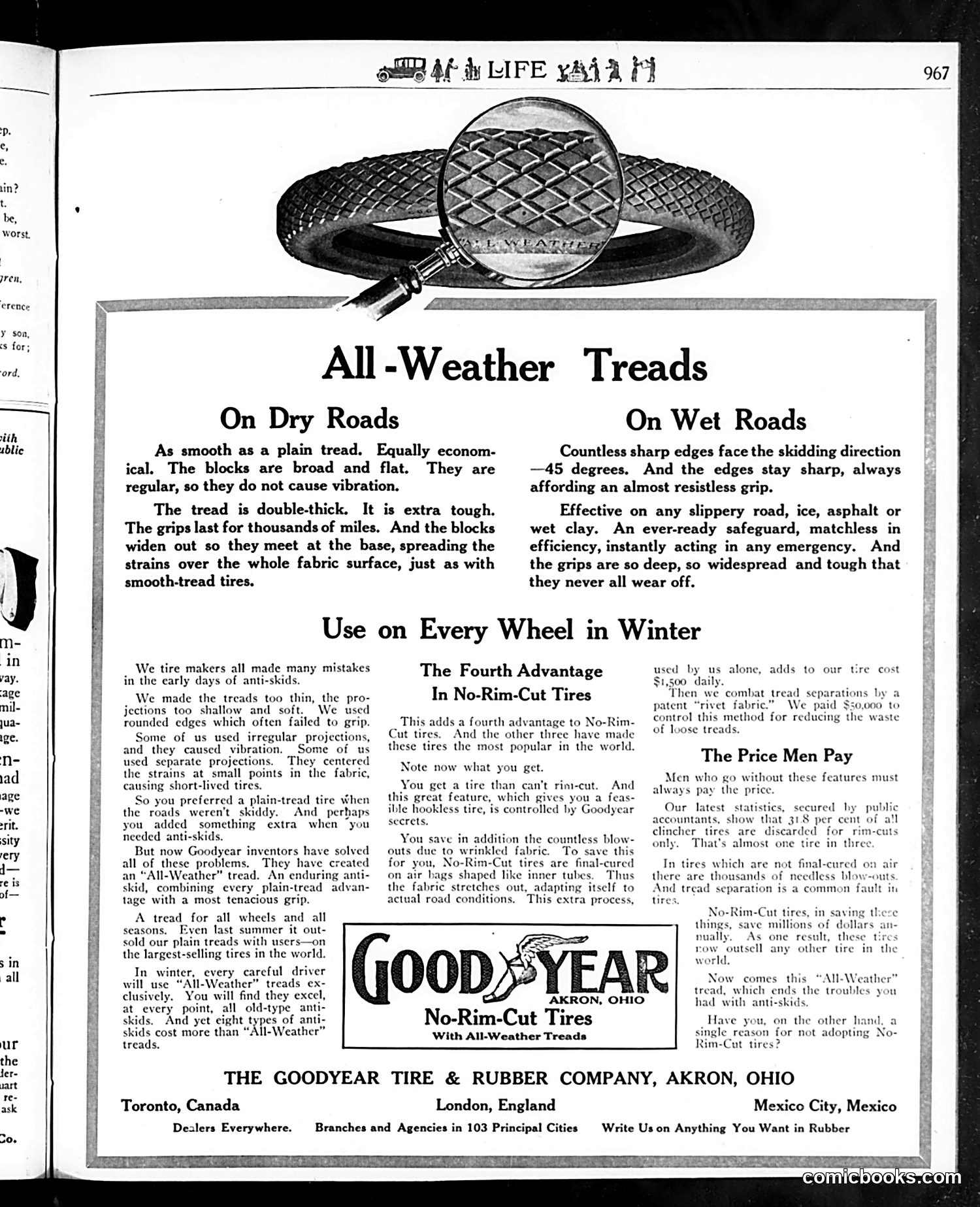
This page is entirely a **Goodyear tire advertisement**, not political satire. There are no cartoons or caricatures to interpret. The ad promotes Goodyear's "All-Weather Treads" and "No-Rim-Cut Tires" by explaining technical features to consumers. The magnifying glass image at top illustrates tire tread detail. The text compares performance on dry versus wet roads, emphasizing safety advantages. The marketing strategy addresses consumer hesitations: it acknowledges past tire failures ("we tire makers all made many mistakes"), positions Goodyear's innovations as solutions, and uses pricing data ("31.8 per cent of all blowouts are discarded for rim-cuts only") to justify why buyers should pay more for superior tires. The bottom section directly challenges readers: "Have you...a single reason for not adopting No-Rim-Cut tires?"—a rhetorical sales pitch. This reflects early-20th-century automobile safety concerns, when tire failures were common and dangerous.
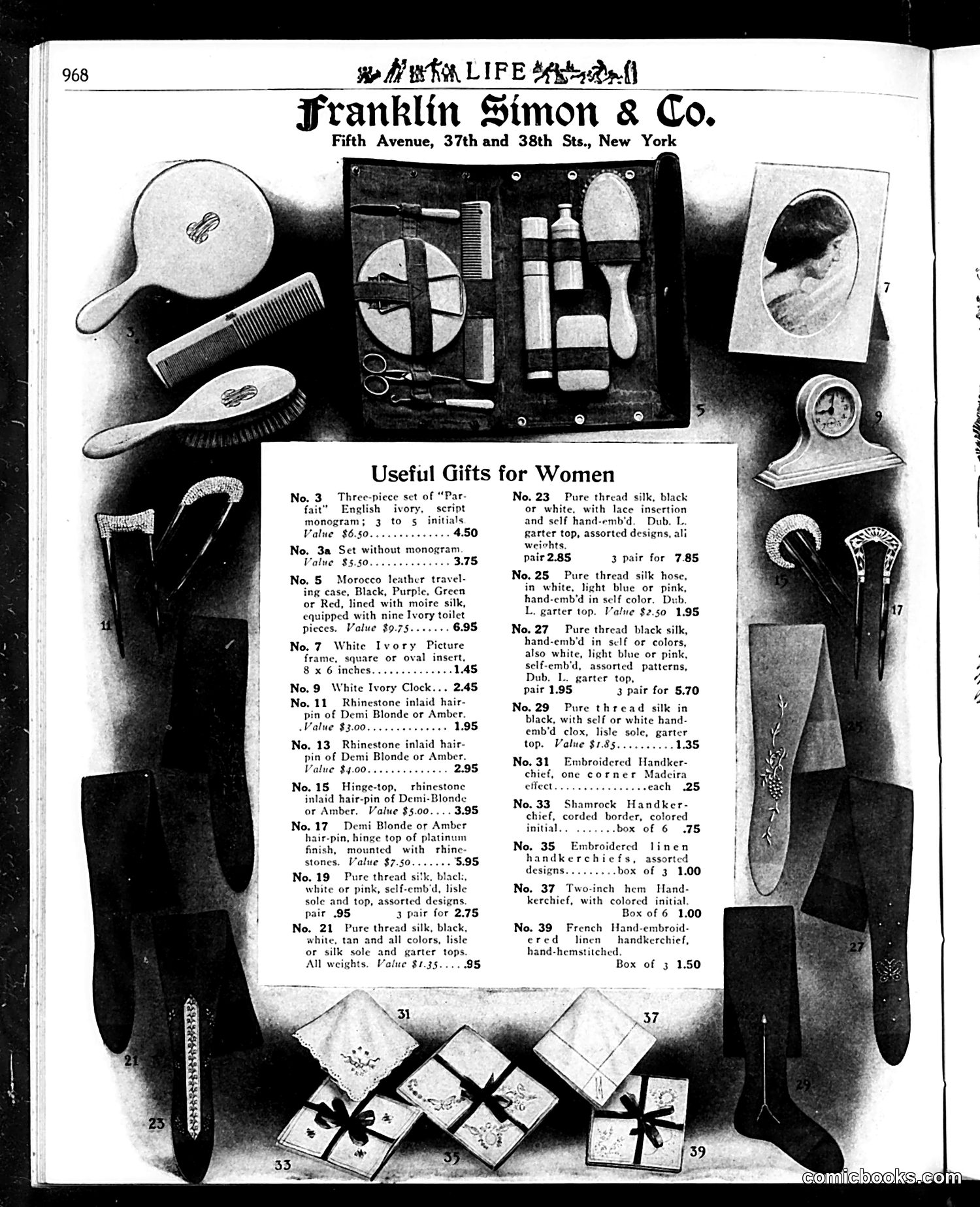
This is a **product advertisement**, not a cartoon or satirical content. Franklin Simon & Co., a New York department store, is showcasing "Useful Gifts for Women" from their inventory. The page displays photographs of luxury personal care items arranged decoratively around a price list: combs, brushes, mirrors, manicure sets, traveling cases, picture frames, clocks, decorative hairpins, silk stockings, and embroidered handkerchiefs. These are high-end goods typical of early 20th-century women's fashion and grooming. The satire here is **implicit rather than explicit**: the products themselves—rhinestone hairpins, monogrammed items, silk hose with hand-embroidered details—reflect the era's emphasis on women's appearance and domestic refinement. There are no political figures or caricatures to identify; this is straightforward commercial advertising masquerading as lifestyle content in a magazine known for humor.
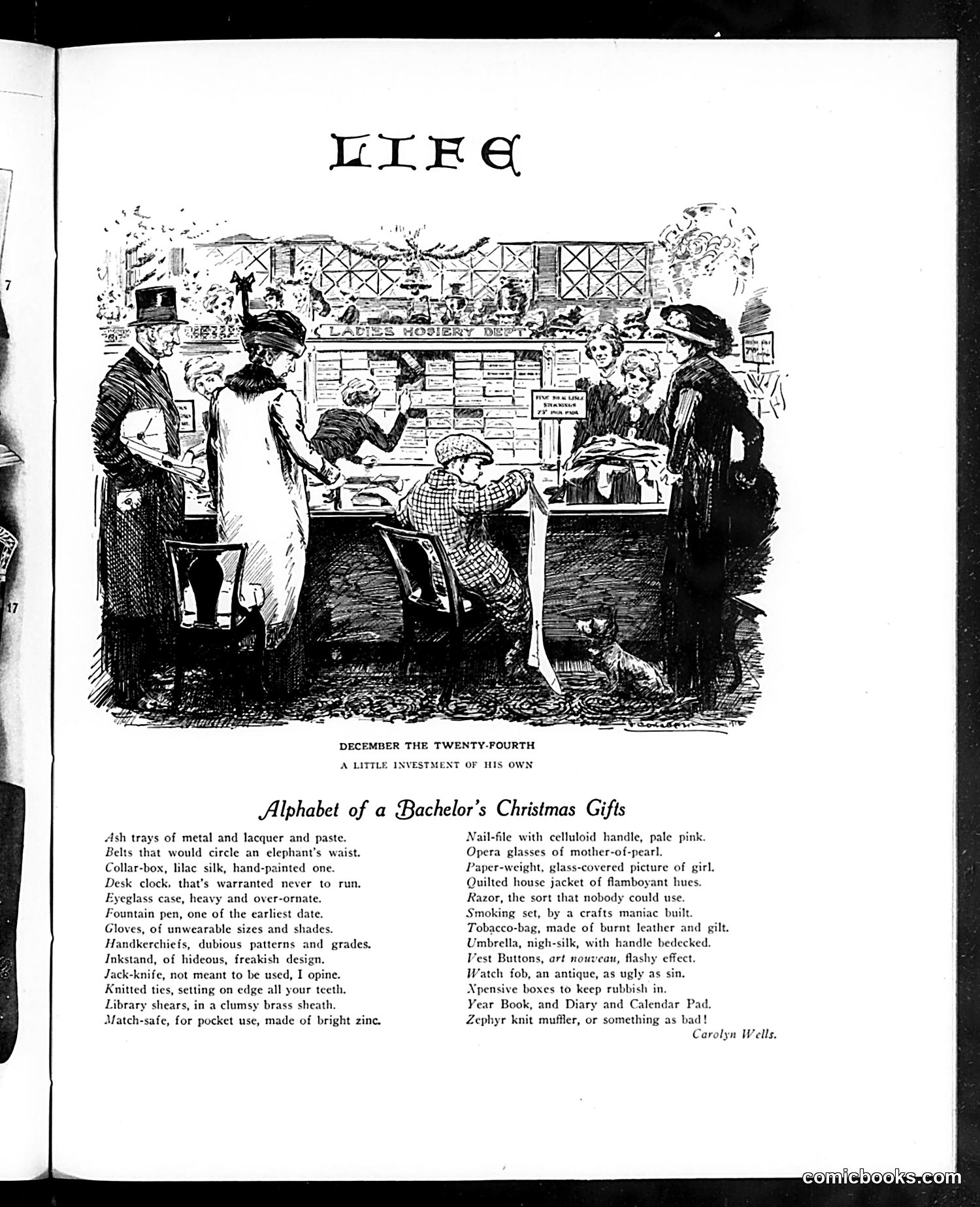
This is a humorous "alphabet" poem satirizing the impracticality of typical bachelor Christmas gifts in early 20th-century America. The accompanying illustration shows a store counter scene where a man (presumably a bachelor) receives unwanted presents. The joke is that each gift—from ash trays to zephyr mufflers—is either useless, poorly chosen, or actively unpleasant. Examples include a "desk clock that's warranted never to run," a razor "nobody could use," and ties "setting on edge all your teeth." The satire targets both gift-givers' poor judgment and the commercialism of Christmas shopping. The title "A Little Investment of His Own" suggests bachelors must spend money on inferior gifts to maintain social obligations, making Christmas an expensive burden rather than a genuine expression of care. Author Carolyn Wells was a well-known American humorist, making this likely a lighthearted social commentary on holiday consumption and bachelor life.
This page is primarily a Christmas editorial essay rather than a political cartoon (the small illustrations are decorative vignettes). The piece discusses contemporary Progressive Era debates about wealth distribution and social responsibility. The editorial argues that Christmas represents acceptance of existence's challenges as solvable through human effort and cooperation. It praises recent shifts in wealthy Americans' attitudes: rather than accumulating riches for family power and palaces, the affluent increasingly fund public goods—hospitals, libraries, schools, parks, and social services. The text celebrates this as evidence of moral progress, noting that both wealthy philanthropists and working people laboring "unostentatiously" contribute to societal improvement. The piece encourages readers' charitable efforts while acknowledging widespread laziness and discouragement about incomplete progress. This reflects 1913 Progressive optimism about capitalist reform and voluntary charity addressing social problems.
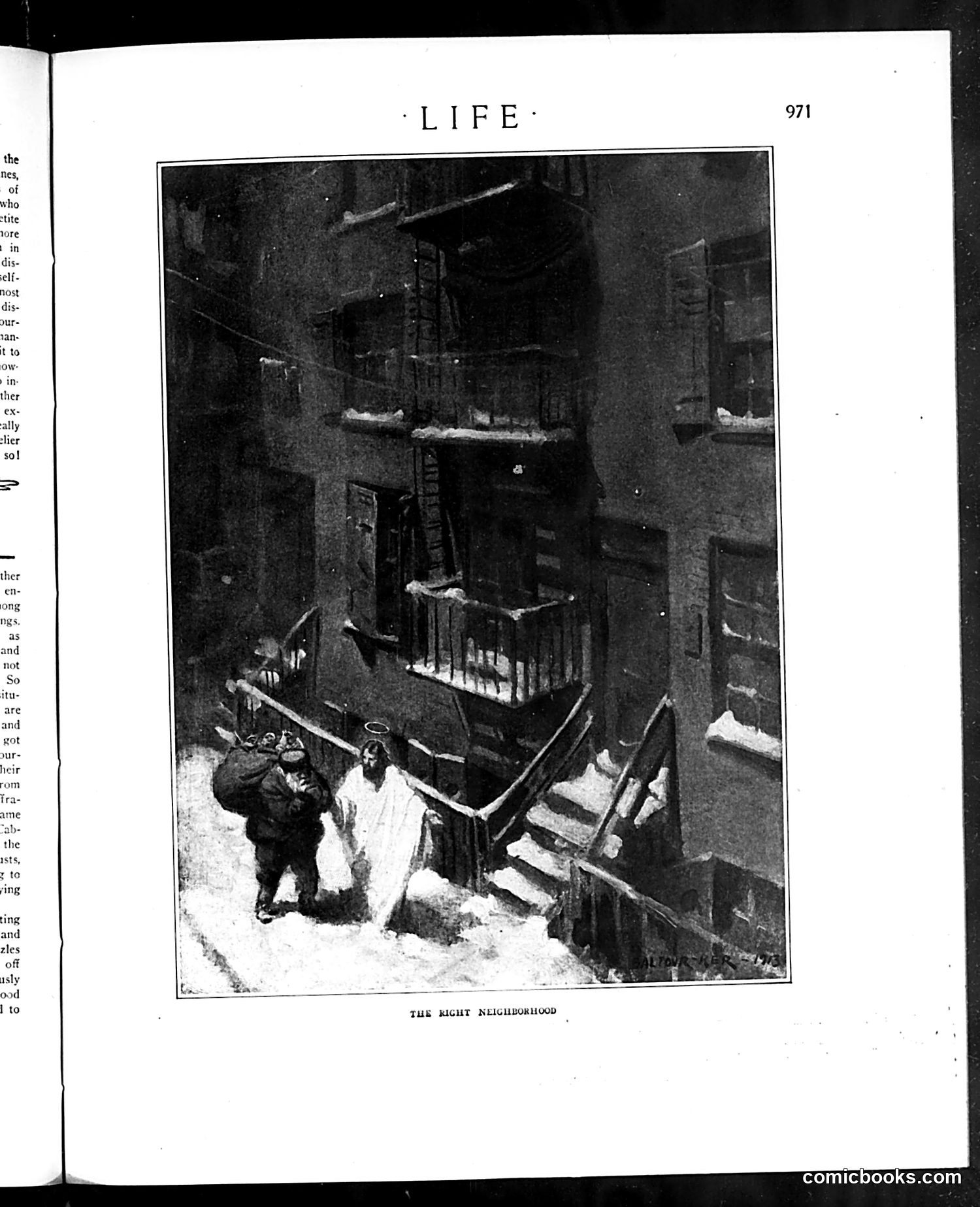
This image from *Life* magazine (page 971) depicts a snowy urban alleyway scene with two figures standing near building stoops and stairs. The caption reads "THE RIGHT NEIGHBORHOOD," suggesting social commentary about residential segregation or class distinctions. The photograph appears to be satirizing notions of desirable versus undesirable neighborhoods—likely referencing early-to-mid 20th century urban housing discrimination. The snow-covered, cramped alley with modest buildings contrasts with period ideals of "right" neighborhoods, which typically meant wealthy, exclusive areas. Without additional context about the specific publication date, the precise satirical target remains somewhat unclear, though the image likely critiques either class-based housing segregation or racial residential patterns common to that era.
This is a short story (not a cartoon), likely from *Life* magazine's satirical fiction section. The narrative satirizes **sensationalist newspaper journalism** and the ethics of reporters. The plot involves a **scandal reporter** attempting to exploit a society story: Mrs. Jenkins, supposedly caught "eloping" with an admirer, has been injured. The reporter seeks damaging details, hoping to write a lurid piece about "alienation of affection" lawsuits. The satire targets: - **Yellow journalism**: The reporter's ghoulish pursuit of private family scandals for profit - **Class dynamics**: A wealthy man (Jenkins) easily uses social connections and bribes (offering money) to silence potential problems - **Professional ethics**: The reporter openly admits his work stems from "native imbecility" and morbid curiosity about others' affairs The chauffeur becomes an unlikely foil, representing working-class dignity—he refuses Jenkins's money and eventually walks away, contrasting with the reporter's mercenary exploitation of human tragedy. The satire suggests mainstream journalism prioritizes sensationalism over ethics or human decency.
This page contains a serialized short story rather than a cartoon. The narrative follows a character named Riggs, a chauffeur speaking with a reporter about his recent elopement with "Letty." The story satirizes **class conflict and paternal control**: Riggs's wealthy father, a publisher of religious books ("Heavenly Footfalls"), disapproves of Letty as a gold-digger and offers ten thousand dollars to buy her off. Riggs's father represents the hypocritical wealthy class—making money from "gulling poor farmers' wives" while judging others' morality. The satire targets **parental tyranny over adult children** and **the corruption of inherited wealth**. Letty emerges as the sympathetic character, refusing "tainted money" and insisting on financial independence through her own work—a surprisingly progressive stance for the era. The story's humor derives from Riggs's self-aware passivity ("My red hair's a false alarm") contrasted with Letty's moral fortitude, suggesting satirical commentary on masculine weakness and feminine strength in marriage.
This page is primarily **narrative fiction**, not a political cartoon. It depicts a domestic drama involving two brothers: Joe, a struggling young man who has recently married a woman named Letty against his family's wishes, and Emerson, his disapproving older brother. The story satirizes **class tensions and romantic idealism versus practical reality**. Emerson represents upper-class pragmatism—he attempts to convince Joe that his wife should leave him for a wealthier suitor (Abramson, a manager) who can provide "luxury." Emerson frames this cynically, suggesting Joe is selfish for "holding her back." The satire targets **moral hypocrisy**: Emerson uses reasonable arguments about financial security to justify what amounts to encouraging infidelity, while claiming this is somehow in Joe's interest. The reference to "Juliet" mocks the romantic ideal. Joe's poverty (three dollars daily, shabby room) contrasts with Letty's apparent glamour, highlighting anxieties about **social mobility and marriage across economic lines** common in early 20th-century America. The narrative questions whether love or material comfort should determine one's choices.
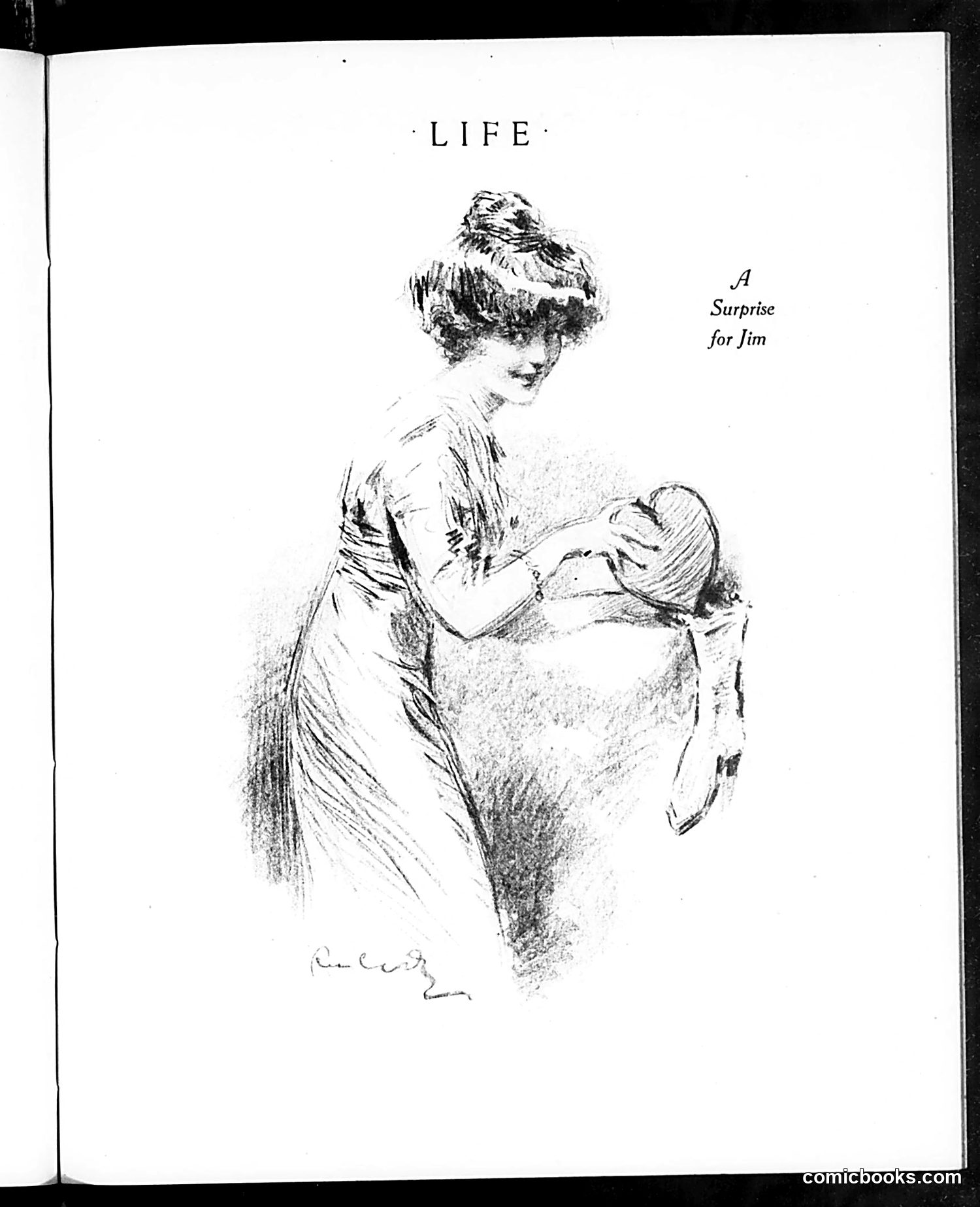
This appears to be an illustration from *Life* magazine titled "A Surprise for Jim." The sketch shows a woman in early 20th-century dress presenting what appears to be a child or young person to someone named Jim, suggesting an unexpected revelation—likely implying an illegitimate child or secret pregnancy being revealed to the man in question. The drawing style and composition are typical of satirical magazine illustrations of that era. Without additional context about who "Jim" refers to or the specific historical moment, the exact target of satire remains unclear. However, the title and image suggest social commentary on romantic entanglements, domestic surprises, or relationship scandals—common themes in *Life* magazine's satirical humor.
This page contains text from a serialized short story (not a political cartoon). The narrative follows two parallel plotlines involving struggling men during apparent hard times. The first storyline depicts Joe, an unsuccessful suitor who cannot provide for his girlfriend Letty. She chooses her stage career over marriage to him, and he leaves in frustration. The second follows a character named Riggs, a man whose wife has abandoned him. He encounters a philosophical reporter and a sympathetic bartender at a saloon. Despite Riggs's desperation (he's skipped meals, resorted to cheap whiskey), the bartender shows compassion, offering hot soup rather than judgment. The story appears to satirize social attitudes toward poverty and failure, contrasting callousness (the legless beggar's earlier dismissal) with unexpected kindness. The narrative illustrates how desperation and poor choices intersect, likely commenting on early 20th-century class divisions and male vulnerability during economic hardship.
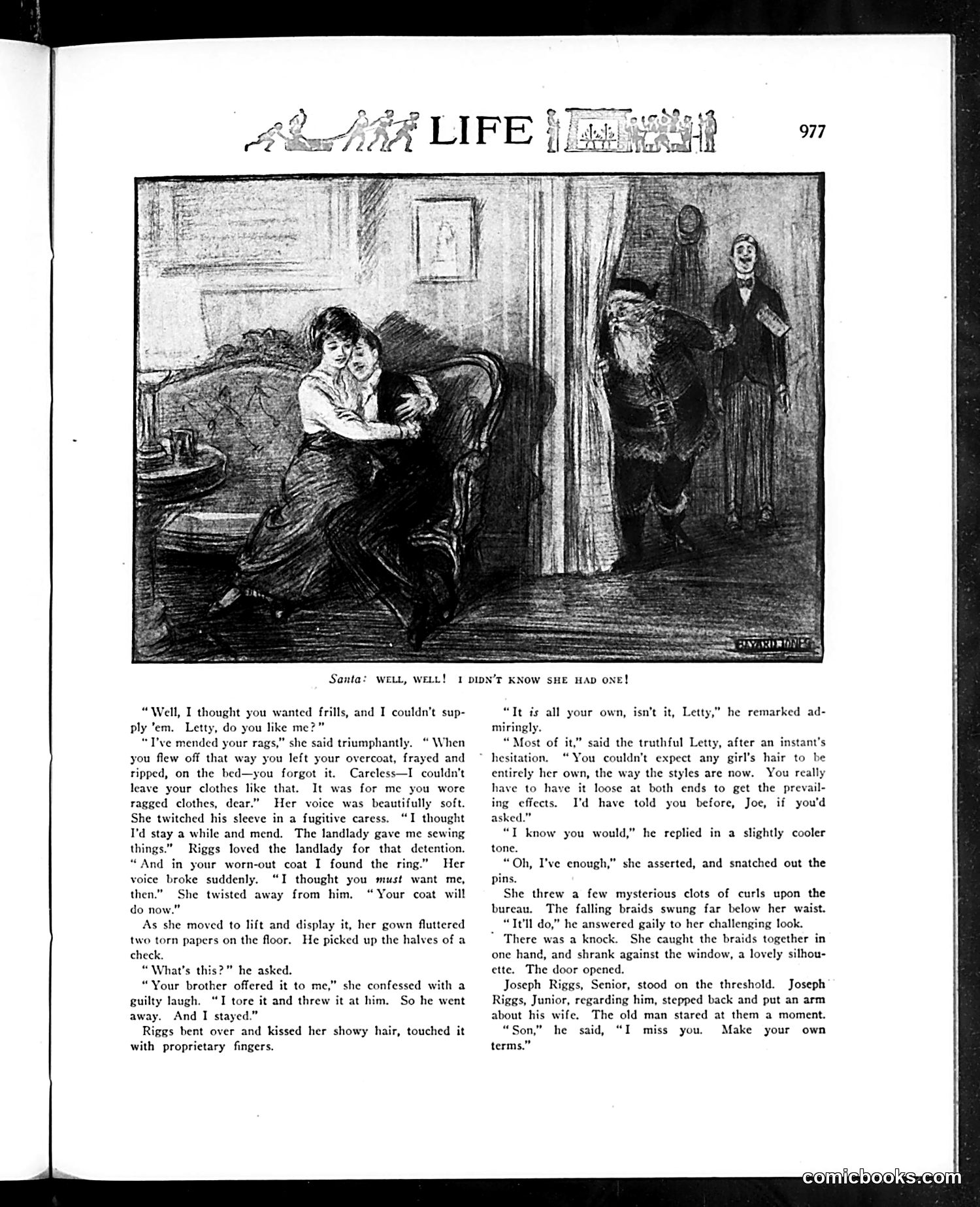
This is a domestic comedy piece illustrating early 1900s courtship anxieties. A young couple, Letty and Joseph Riggs Jr., have married after he left home in worn clothes to prove his love. Letty has mended his coat and worn ragged garments to match his circumstances. The humor centers on **female vanity and authenticity**: Letty confesses her hair isn't entirely her own—following contemporary fashion requiring added hairpieces ("loose at both ends"). This causes Joe's romantic ardor to cool momentarily, playing on male insecurity about female artificiality. The caption's Santa joke references her deception about possessing natural hair. The dramatic resolution shows Joseph Sr. arriving, observing his son's devotion, and reconciling with him—the domestic conflict resolved through filial loyalty. The story satirizes period concerns about materialism, feminine deception, and the tension between romantic ideals and social performance.
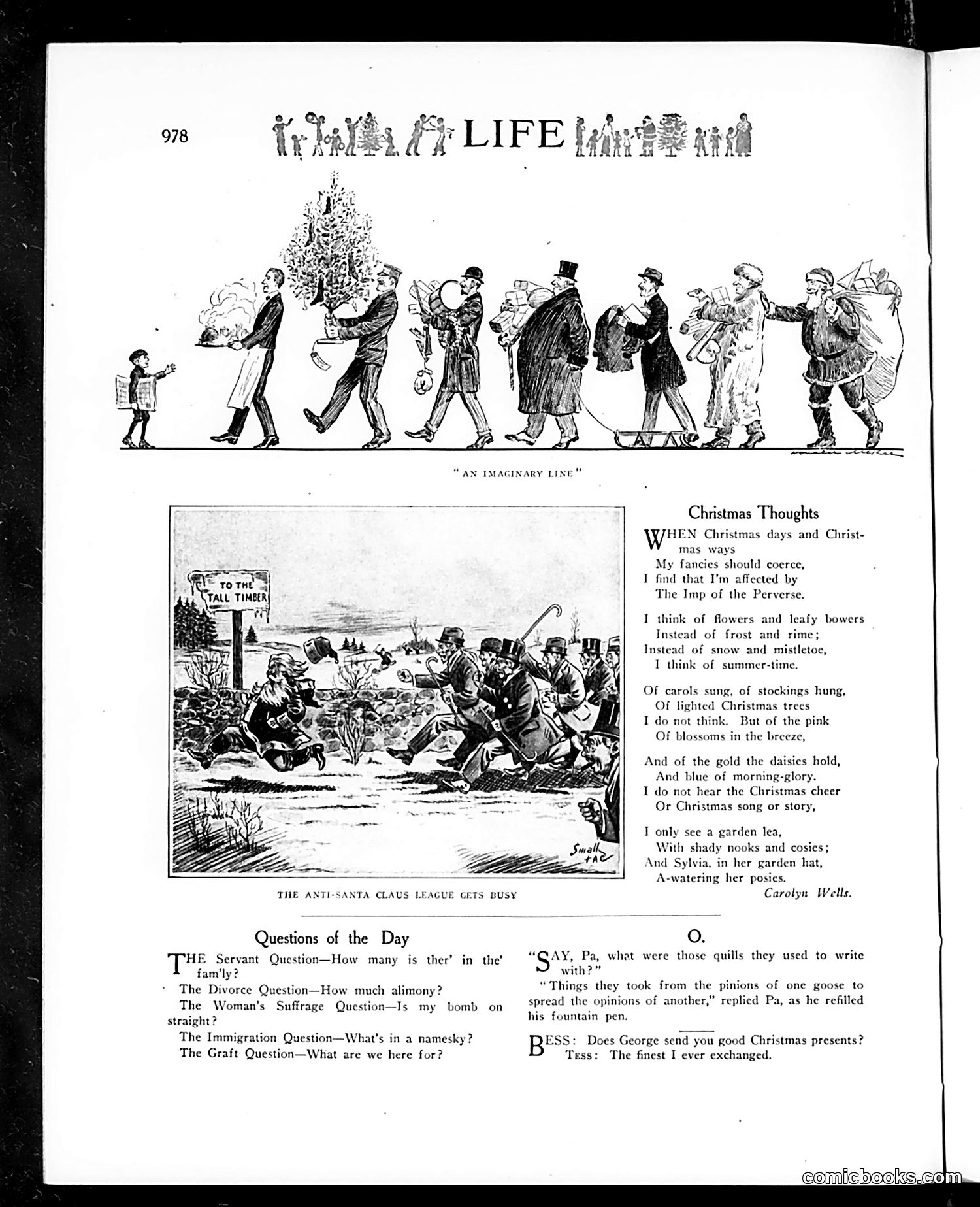
**"An Imaginary Line"** (top cartoon): Shows the progression of Christmas gift-giving across social classes—from a poor child receiving minimal gifts to increasingly wealthy figures with elaborate presents, ending with Santa distributing to the affluent. This satirizes economic inequality during the holiday season. **"The Anti-Santa Claus League Gets Busy"**: Depicts what appears to be labor activists or reformers disrupting Christmas celebrations outdoors. The "Anti-Santa Claus League" likely references anti-commercialism sentiment or labor movements critiquing the commodification of Christmas. **"Questions of the Day"**: Parodies contemporary social debates (servant labor, divorce laws, women's suffrage with a joke about bombs, immigration restrictions, government corruption). **The quill/fountain pen joke**: Contrasts old goose-quill pens (spreading one goose's opinions) with modern fountain pens—commentary on how technology changes communication and opinion-spreading. **Tess/Christmas presents exchange**: Humorous observation about gift-giving reciprocity. The page reflects early 20th-century progressive anxieties about labor, class, suffrage, and modernization.
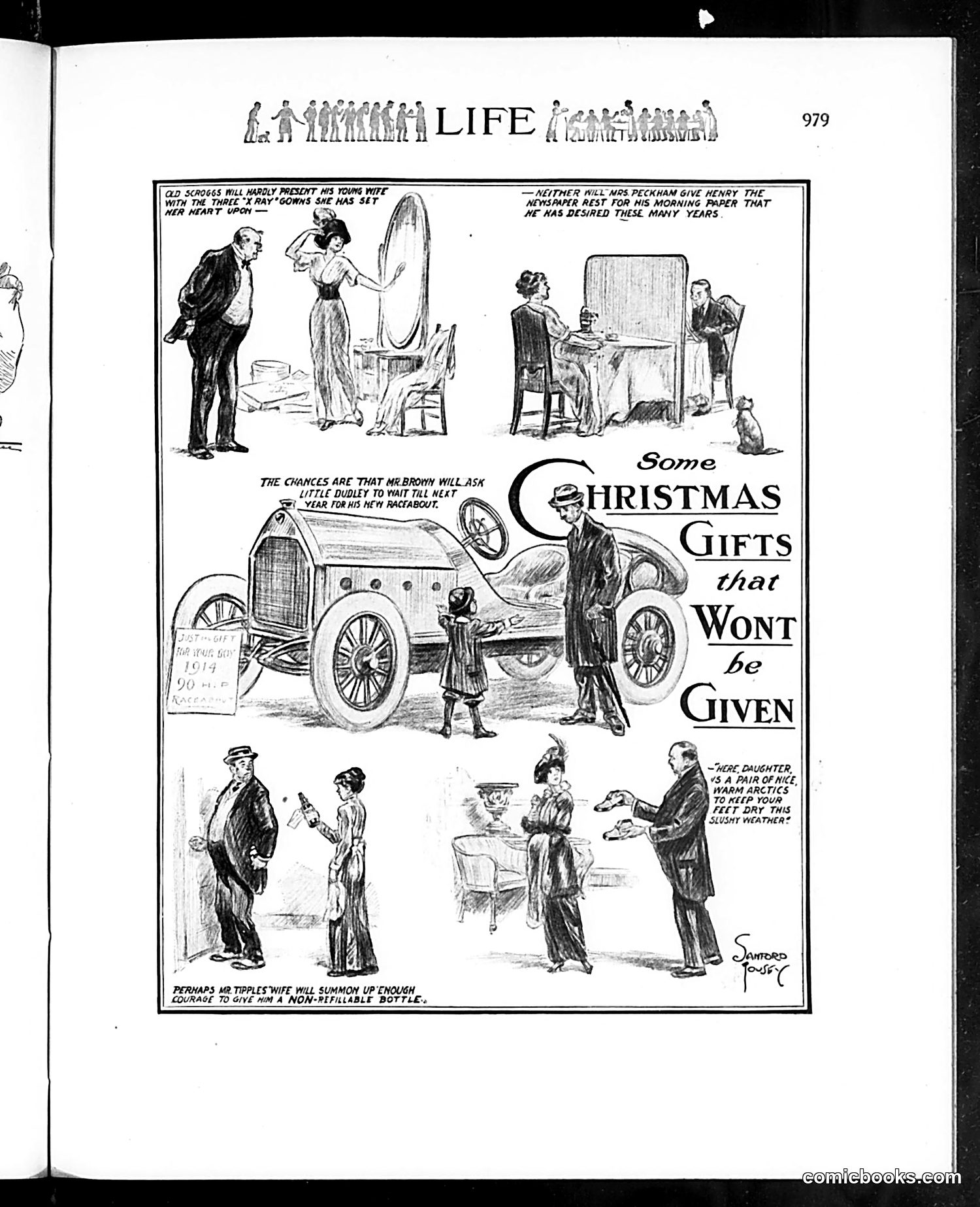
This satirical comic from *Life* magazine humorously illustrates impractical or unwanted Christmas gift ideas that recipients will never actually receive. The scenarios mock common domestic tensions: 1. **Mr. Serroges' "X-ray gowns"** — a joke about revealing clothing that no wife would accept as a gift 2. **Mr. Brown and the raceabout** — a father refusing his son an expensive toy car, postponing it to next year 3. **Mrs. Peckham's newspaper rest** — an impractical domestic gadget no husband wants 4. **Mr. Tipples' non-refillable bottle** — a temperance-era jab suggesting a teetotaler's wife might symbolically gift him a bottle he can't refill with alcohol The central image of a luxury automobile reinforces the theme: expensive gifts wealthy men want but won't receive during financially cautious times. The humor relies on recognizing the gap between desire and domestic reality, particularly around class anxieties and spousal disagreements over spending.
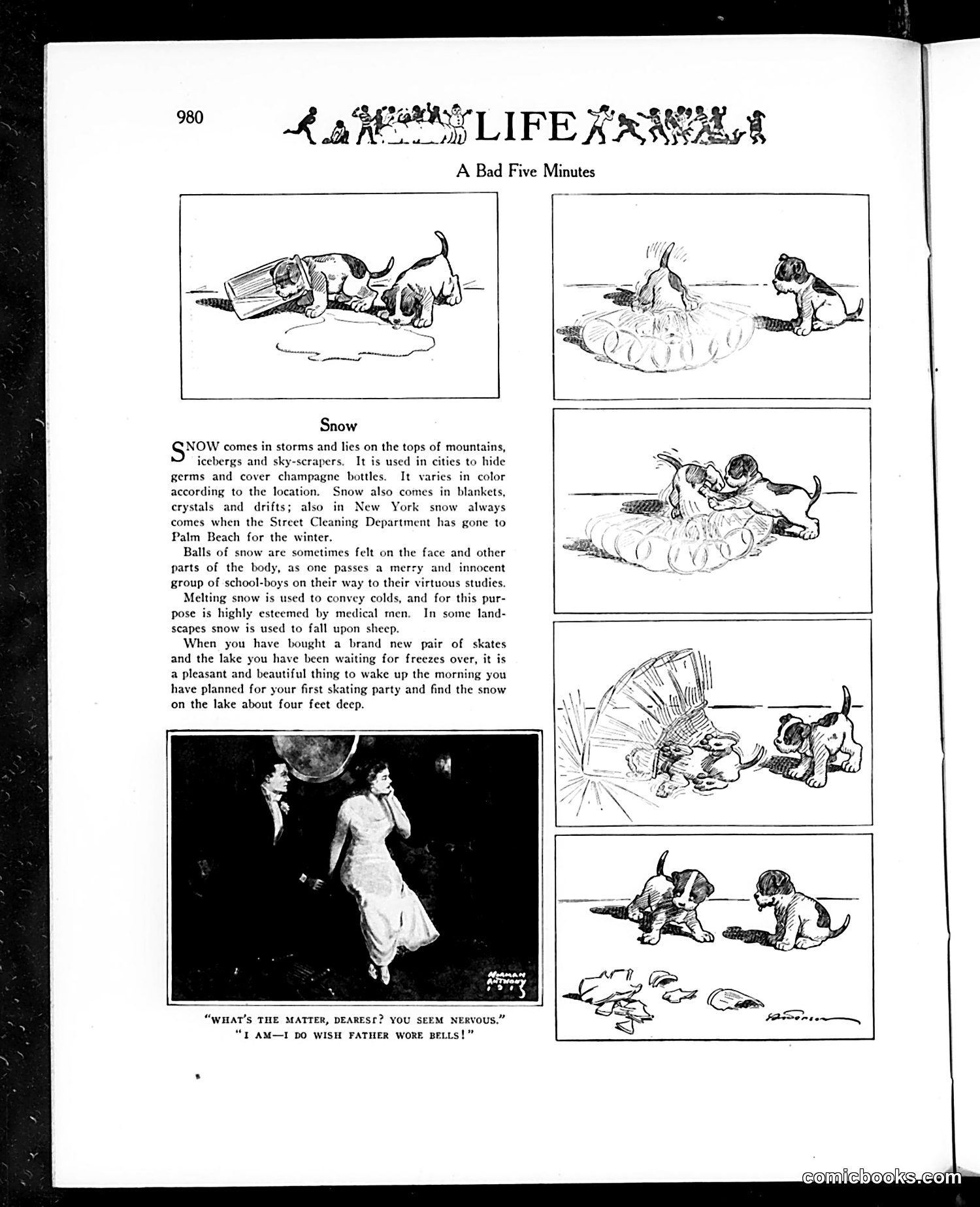
This page combines a humorous essay on snow with a satirical comic strip and photograph. The **essay** is characteristic early-20th-century Life satire: it begins with pseudo-scientific definitions of snow, then pivots to ironic social commentary. It mocks New York City's inefficient street cleaning (the department supposedly abandons the city for Palm Beach in winter) and ends with relatable domestic frustration—the disappointment of finding four feet of snow on a frozen lake meant for skating. The **photograph and dialogue** below depict a nervous woman reassuring her anxious male companion. Her comment—"I wish father wore bells"—is a dark joke: she's concerned about her father's movements, implying he poses some threat or behaves unpredictably, hence the wish that he'd wear bells (like livestock or lepers) to announce his presence. This suggests domestic anxiety or family tension, presented as comedic. The **comic strip** (right) shows dogs sledding and playing in snow—straightforward animal humor typical of the era.
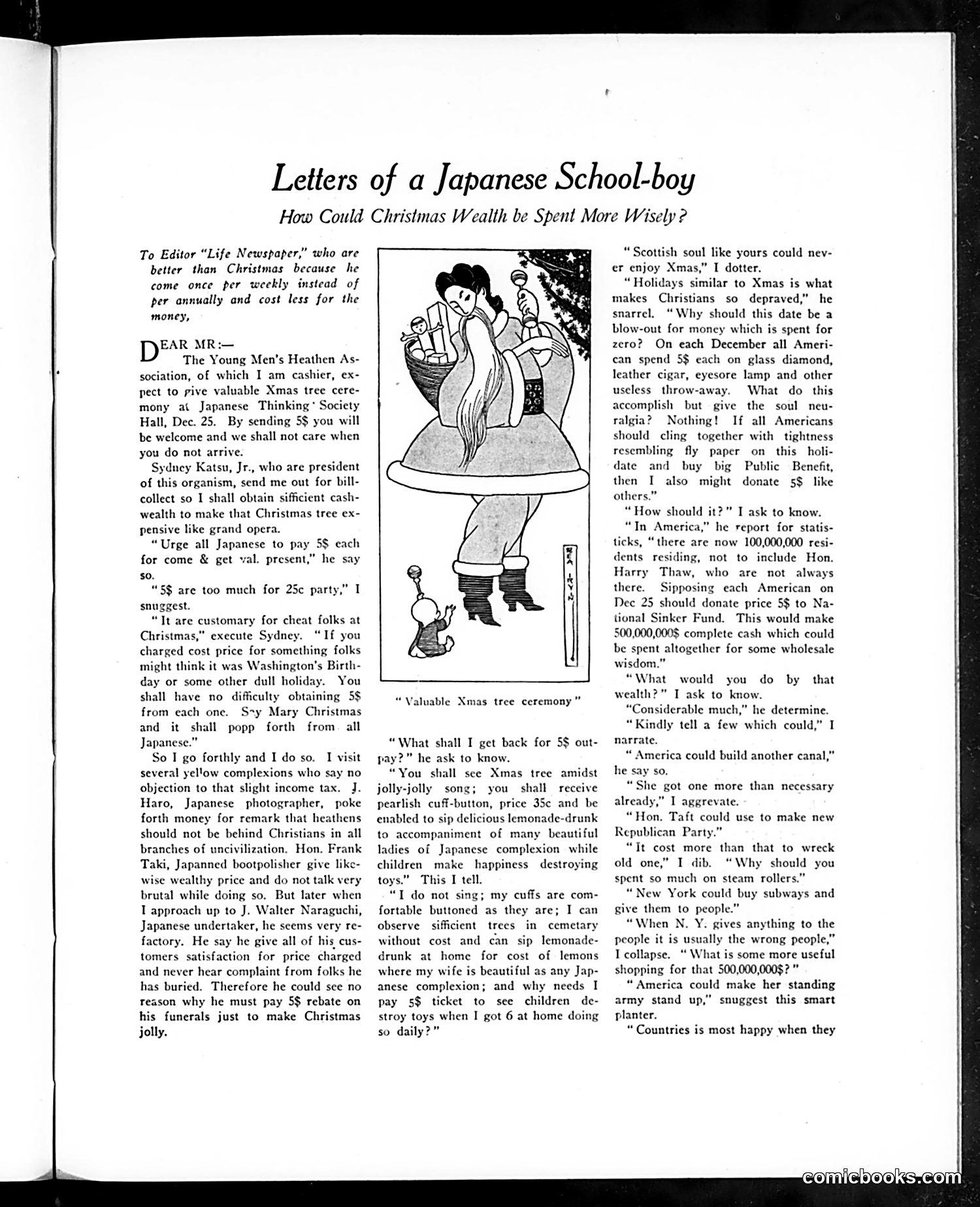
This satirical piece mocks both Japanese immigrants and American Christmas excess through deliberately fractured English spoken by a Japanese character soliciting donations for a Christmas tree ceremony. The humor targets multiple audiences: Japanese people are caricatured as financially shrewd and comically evasive (the undertaker refusing to donate), while Americans are mocked for wasteful holiday spending on "glass diamond, leather cigar, eyesore lamp and other useless throw-away." The undertaker character represents pragmatic self-interest—he profits from his business and sees no reason to subsidize Christmas festivities. The school-boy narrator proposes pooling American Christmas spending ($500 million) into a "National Sinker Fund" for collective benefit rather than individual indulgence. This reflects early 1900s attitudes: stereotyping Asian immigrants through dialect humor while simultaneously critiquing American consumerism and materialism. The satire works on the assumption that readers will find the broken English amusing rather than the actual social commentary about wealth distribution.
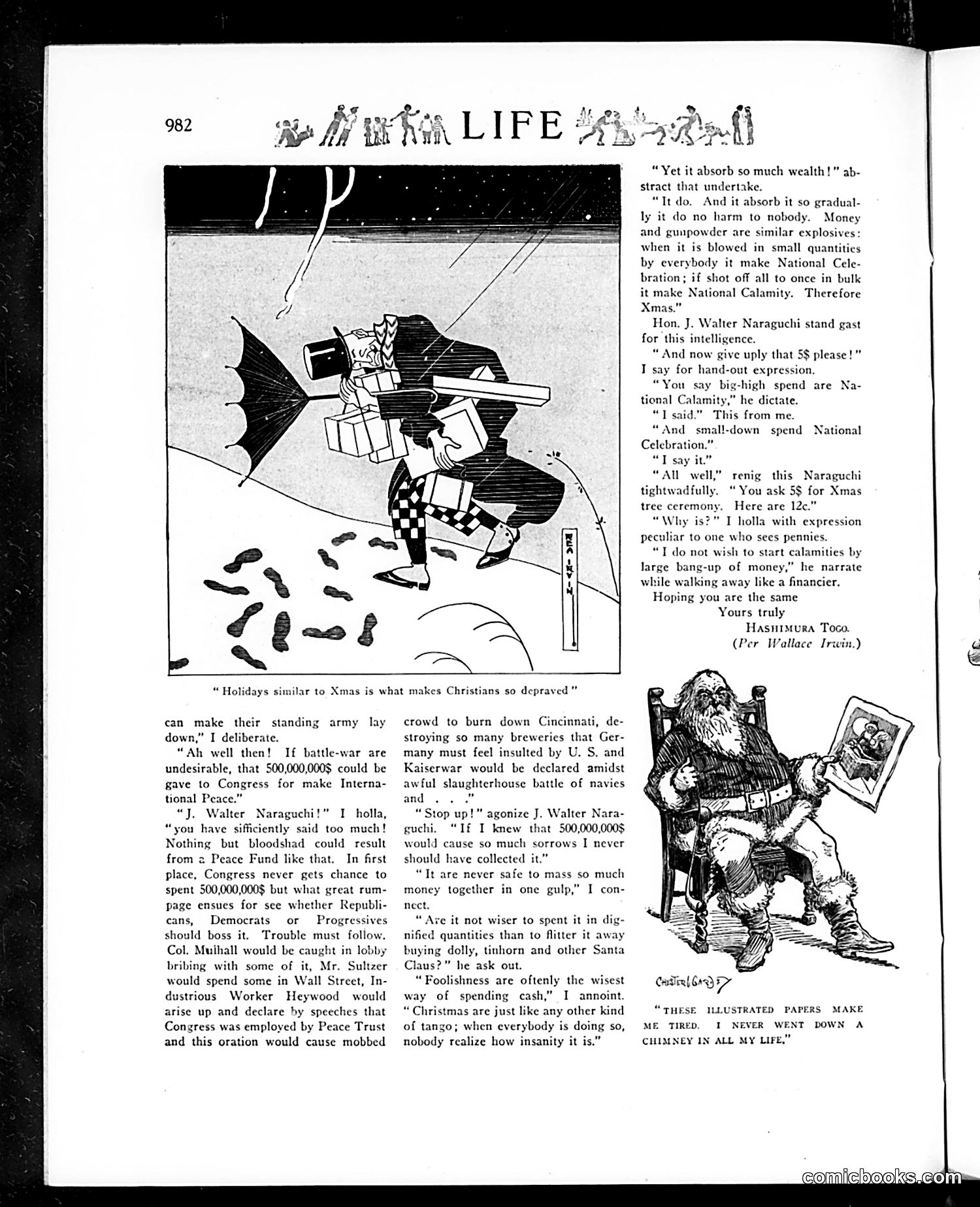
This page satirizes excessive Christmas spending through a dialogue between the narrator and "J. Walter Naraguchi," a Japanese character (indicated by broken English and the signature "Hashimura Togo"). The satire mocks the contradiction between advocating for international peace while defending frivolous holiday consumption. The cartoon depicts Naraguchi laden with Christmas purchases—dolls, gifts, and goods—while the text argues that dispersing $500 million on peace would cause political chaos (Congress infighting, corruption, labor agitation leading to riots). Yet spending that same sum piecemeal on Christmas celebration is deemed harmless. The joke targets American hypocrisy: citizens celebrate Christmas spending while criticizing military/government expenditure. The final exchange—Naraguchi refusing the narrator's donation request with only 12 cents—mocks wealthy individuals' stinginess despite their lavish personal spending. The bottom caption dismisses illustrated papers as tired propaganda, suggesting skepticism of media narratives.
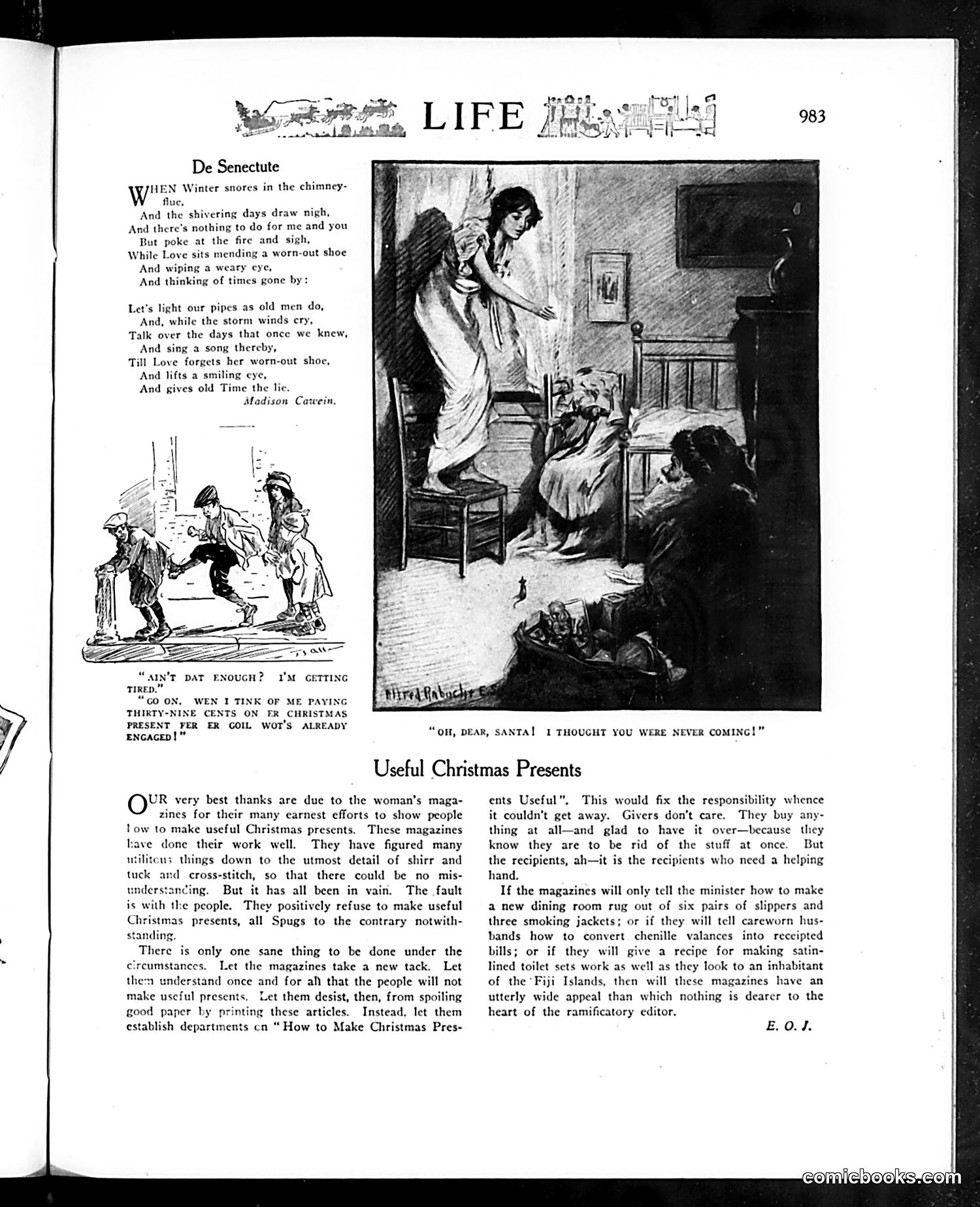
This page combines poetry, humor cartoons, and satirical editorial commentary on Christmas gift-giving practices. **The cartoons:** The lower-left sketch depicts working-class men complaining about financial strain—one protests having to pay installments on an engagement ring while also buying Christmas presents. The larger illustration shows a domestic scene where a woman (likely playing a maid or servant) greets Santa, suggesting ironic disappointment that even gift-givers arrive late or unprepared. **The editorial satire:** The main article mocks women's magazines for publishing endless "how-to" guides for making useful homemade Christmas presents—embroidered items, crafts, etc. The author argues people ignore this advice, preferring to buy anything disposable. He satirically suggests magazines instead teach *recipients* how to repurpose useless gifts (converting slippers into rugs, valances into receipts). **The point:** This critiques both consumer culture's wasteful gift-buying and the gap between idealized domestic labor promoted in women's magazines and actual behavior. It's commentary on class anxiety, marriage economics, and commercialization of Christmas.
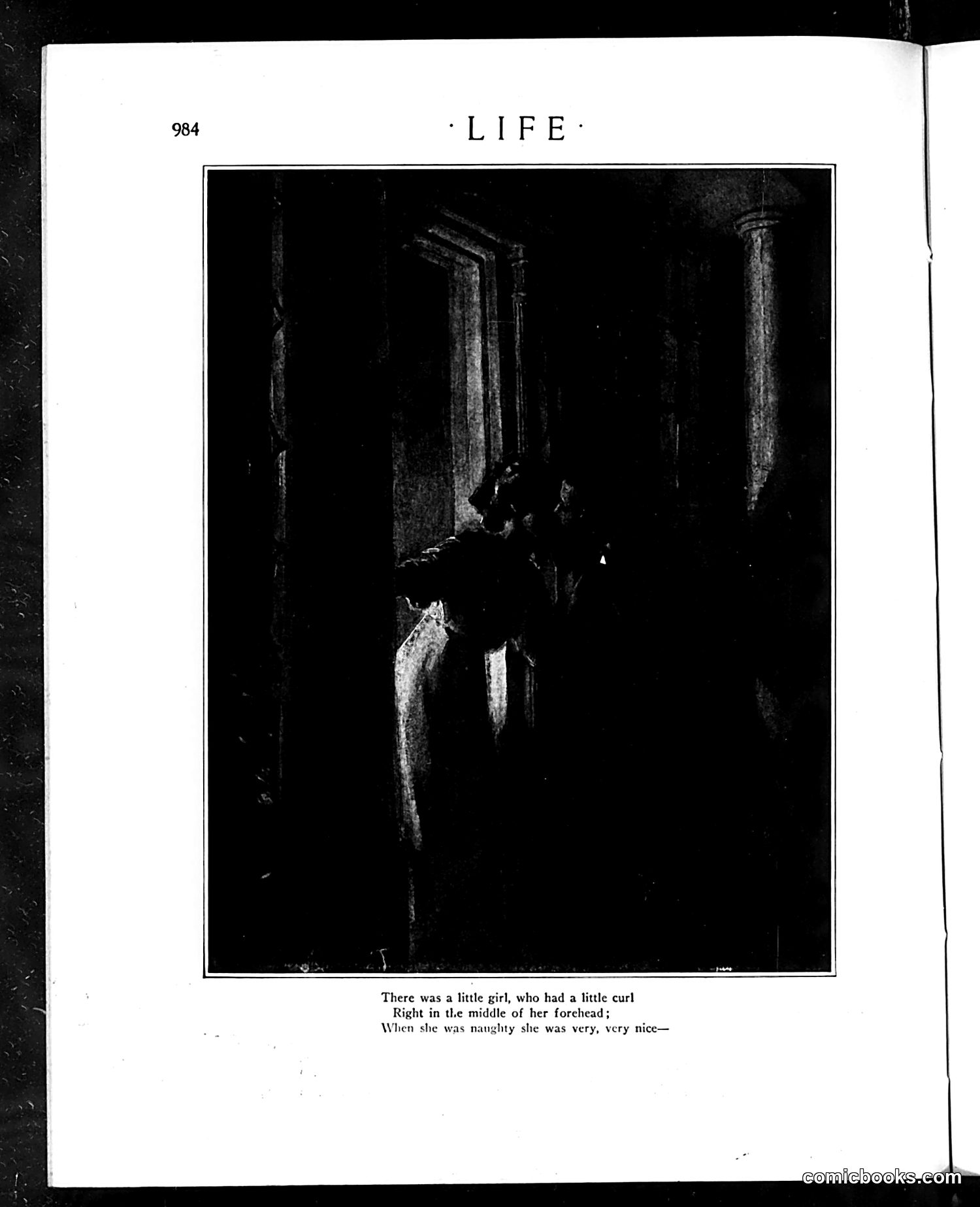
This page from *Life* magazine features a dark, atmospheric illustration accompanying a verse based on the nursery rhyme "There Was a Little Girl." The original rhyme ends "when she was good she was very good, but when she was bad she was horrid"—but this version inverts the moral: "when she was naughty she was very, very nice." The illustration shows shadowy figures in what appears to be an interior space, though specific identities are unclear from the image alone. The satirical point seems to be social commentary on the gap between outward respectability and hidden behavior—suggesting that bad behavior is actually rewarded or appreciated. Without additional context about the publication date or contemporary events, the precise target of satire remains uncertain, though it likely critiques hypocrisy or moral corruption in society.
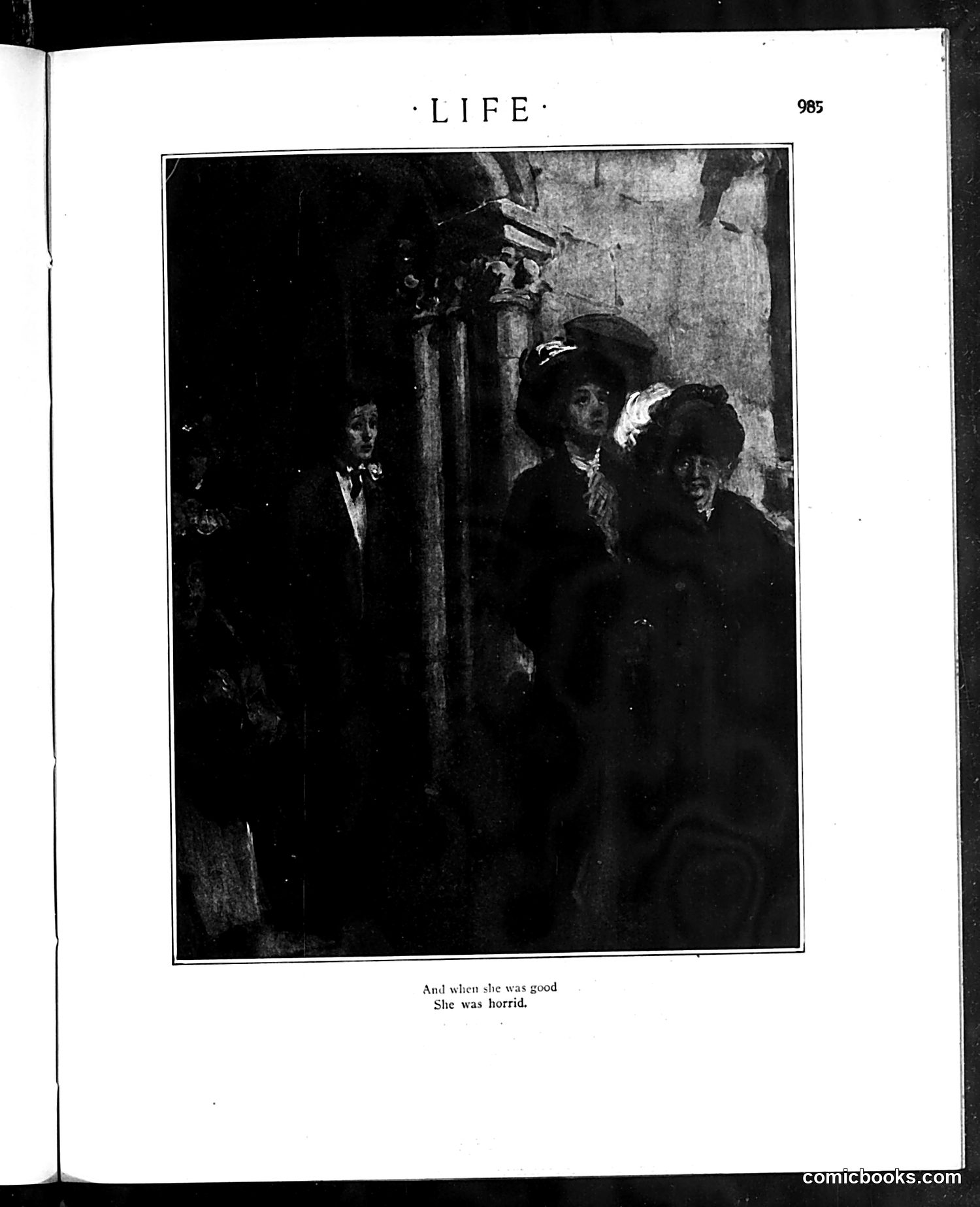
This page from *Life* magazine presents a darkly humorous illustration accompanying the caption "And when she was good / She was horrid." The image depicts what appears to be a woman in period dress (late 19th or early 20th century based on clothing and styling) surrounded by several figures in an interior setting. The severe contrast and shadowy quality suggests moral or social commentary. The caption references the nursery rhyme "There once was a girl who had a little curl," which concludes: "when she was good she was very, very good, / when she was bad she was horrid." The satire inverts this—suggesting that even her goodness was terrible or objectionable. Without additional context identifying the specific woman caricatured, the exact target remains unclear, though the piece critiques some contemporary female figure through this inversion of feminine virtue.
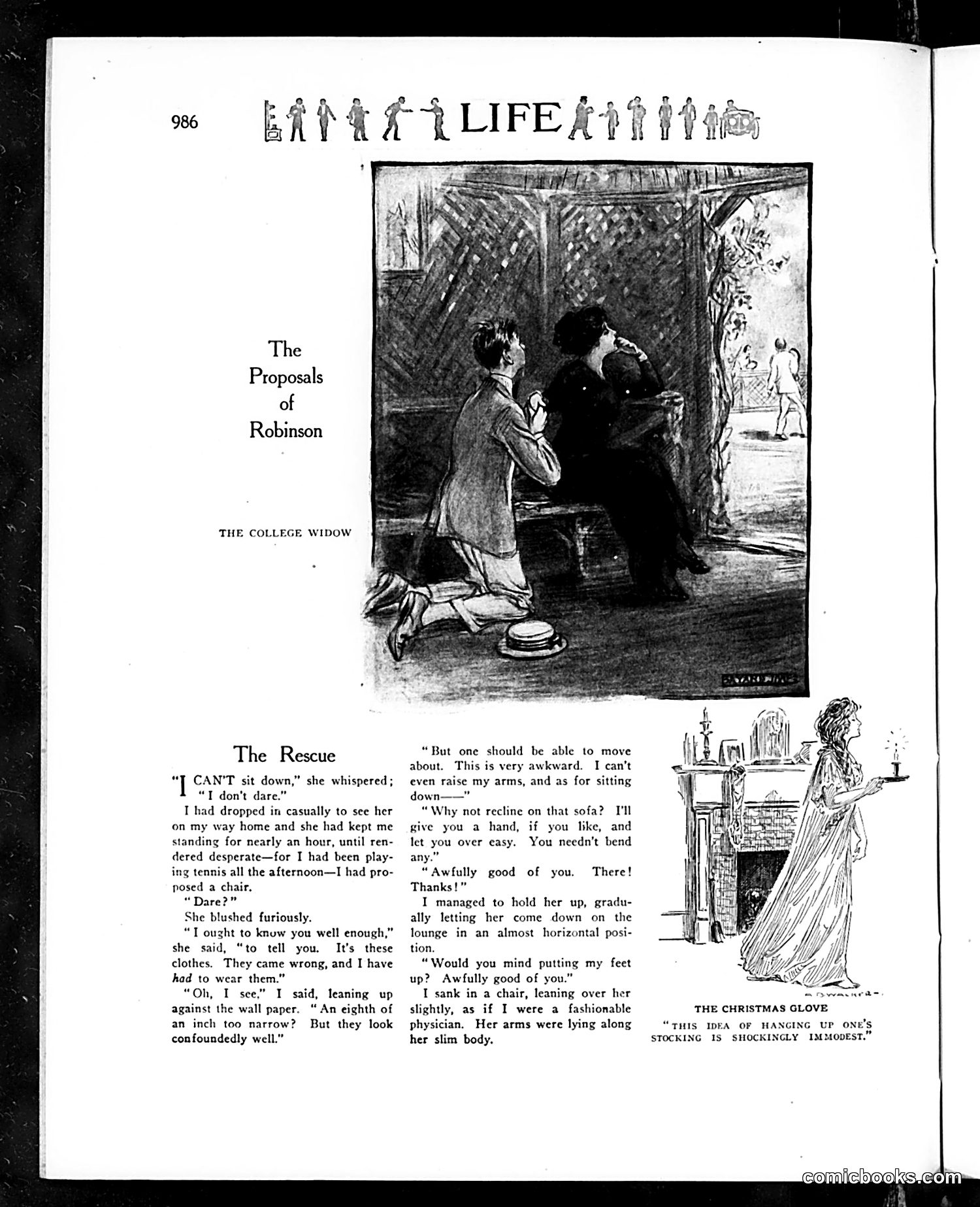
This page contains two satirical stories about courtship and social propriety in the early 20th century. **"The College Widow"** mocks the artificiality of romantic pursuit. A young woman claims her overly-tight clothes prevent her from sitting or raising her arms—a transparent excuse that allows her suitor to help her recline on a sofa in a compromising position. The humor lies in her obvious manipulation: she uses fashion constraints as a pretense for intimate assistance, while maintaining plausible deniability about impropriety. The narrator, playing along, adopts the pose of a "fashionable physician"—recognizing the transparent social game. **"The Christmas Glove"** (bottom right) offers a brief joke about Victorian sexual prudishness: the caption sarcastically calls the tradition of hanging stockings "shockingly immodest," mocking how some considered even this innocent custom dangerously suggestive. Together, these pieces satirize the gap between strict social rules governing male-female interaction and young people's creative workarounds to achieve intimacy within those constraints.
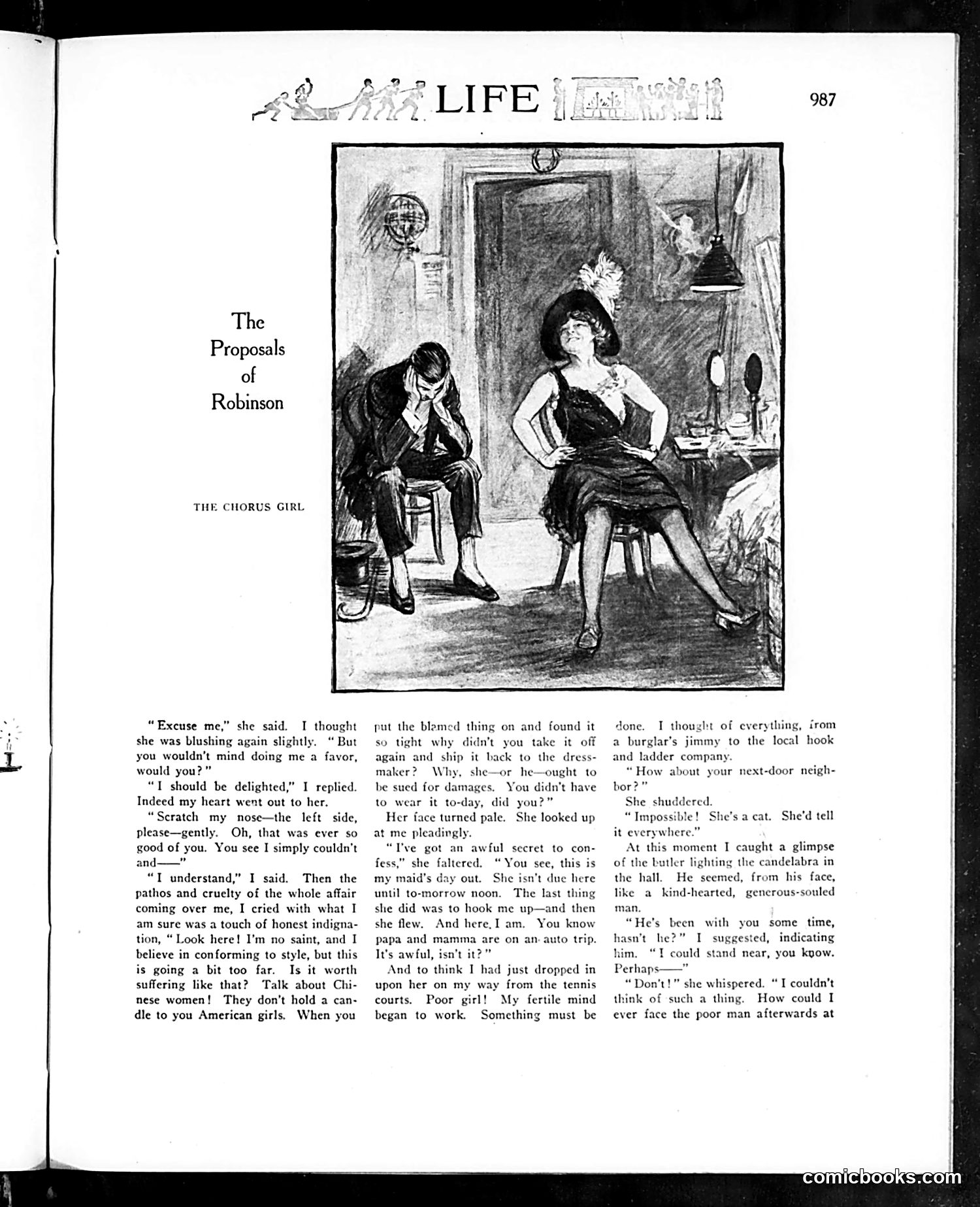
This is a humorous short story illustrated with a sketch showing a woman in an evening dress and a man in conversation in what appears to be a bedroom or dressing room. The joke concerns a woman (a chorus girl) who has been laced into her corset so tightly by her maid that she cannot move her arms to scratch an itch on her nose. When she asks the male narrator for help, he expresses exasperation at the impracticality of tight-laced corsets—comparing women's fashion constraints unfavorably even to foot-binding practices in China. The humor culminates when she reveals her maid has left for the day, trapping her. As solutions are proposed (a neighbor, the butler), she rejects each with embarrassment, fearing social consequences. The satire targets early 20th-century women's fashion and the restrictive corsetry that limited movement and independence—portraying such constraints as absurd and impractical while also mocking female social propriety and concern for reputation.
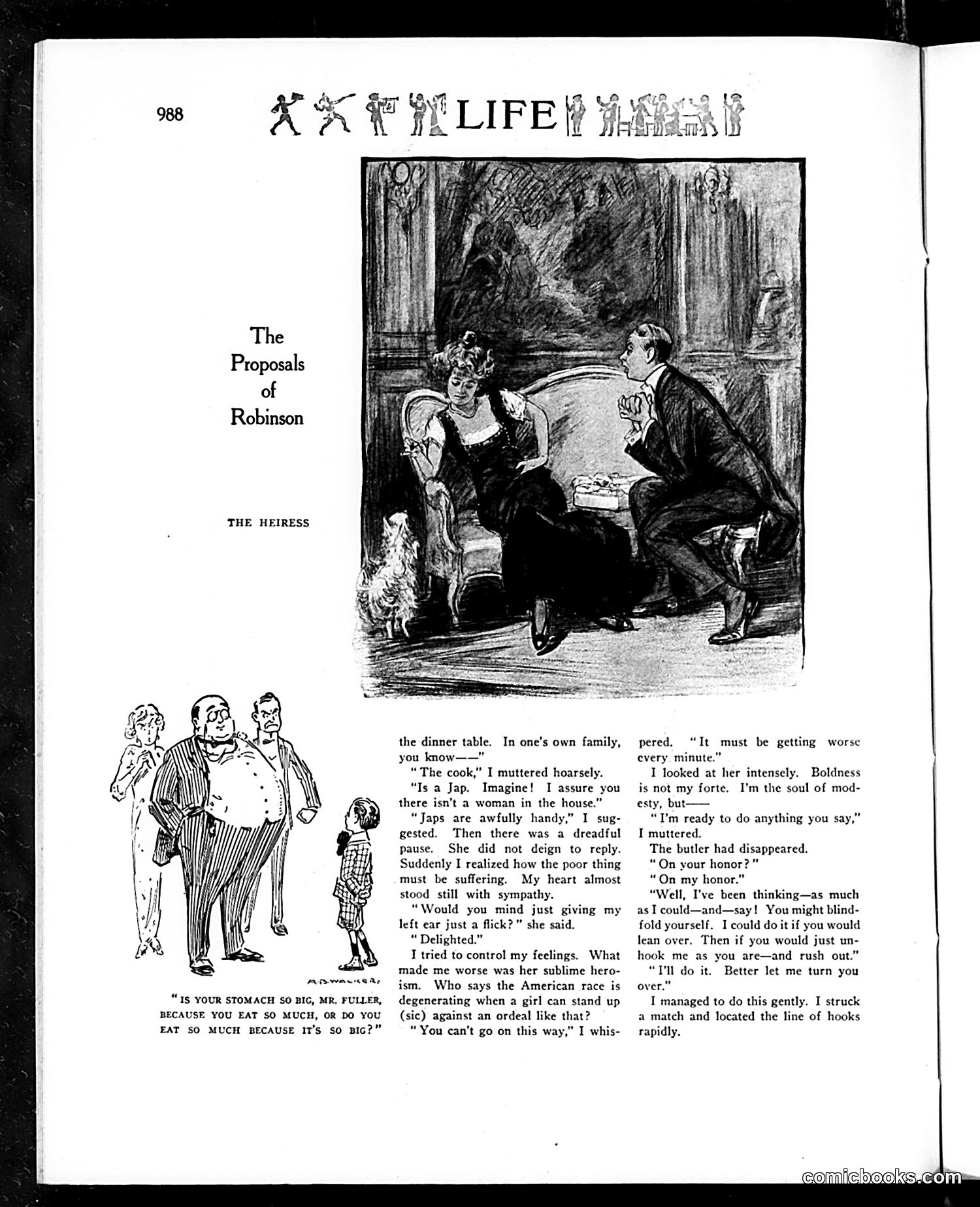
This satirical story mocks upper-class courtship rituals and feminine helplessness. The narrative follows a gentleman caller attempting to propose to a wealthy heiress. The humor centers on her melodramatic distress over a stuck dress hook—presented as a quasi-romantic crisis requiring his heroic intervention. The accompanying cartoon shows three figures (likely representing different social classes or types) and includes a crude joke about a character named Mr. Fuller's large stomach, typical of Life magazine's period humor. The satire targets: aristocratic pretension, the performative fragility of wealthy women, and the absurdity of romanticizing trivial domestic problems. The heiress's "sublime heroism" over a wardrobe malfunction parodies contemporary sentimental fiction and society's expectation that women be delicate, dependent creatures requiring male rescue—even from minor inconveniences.
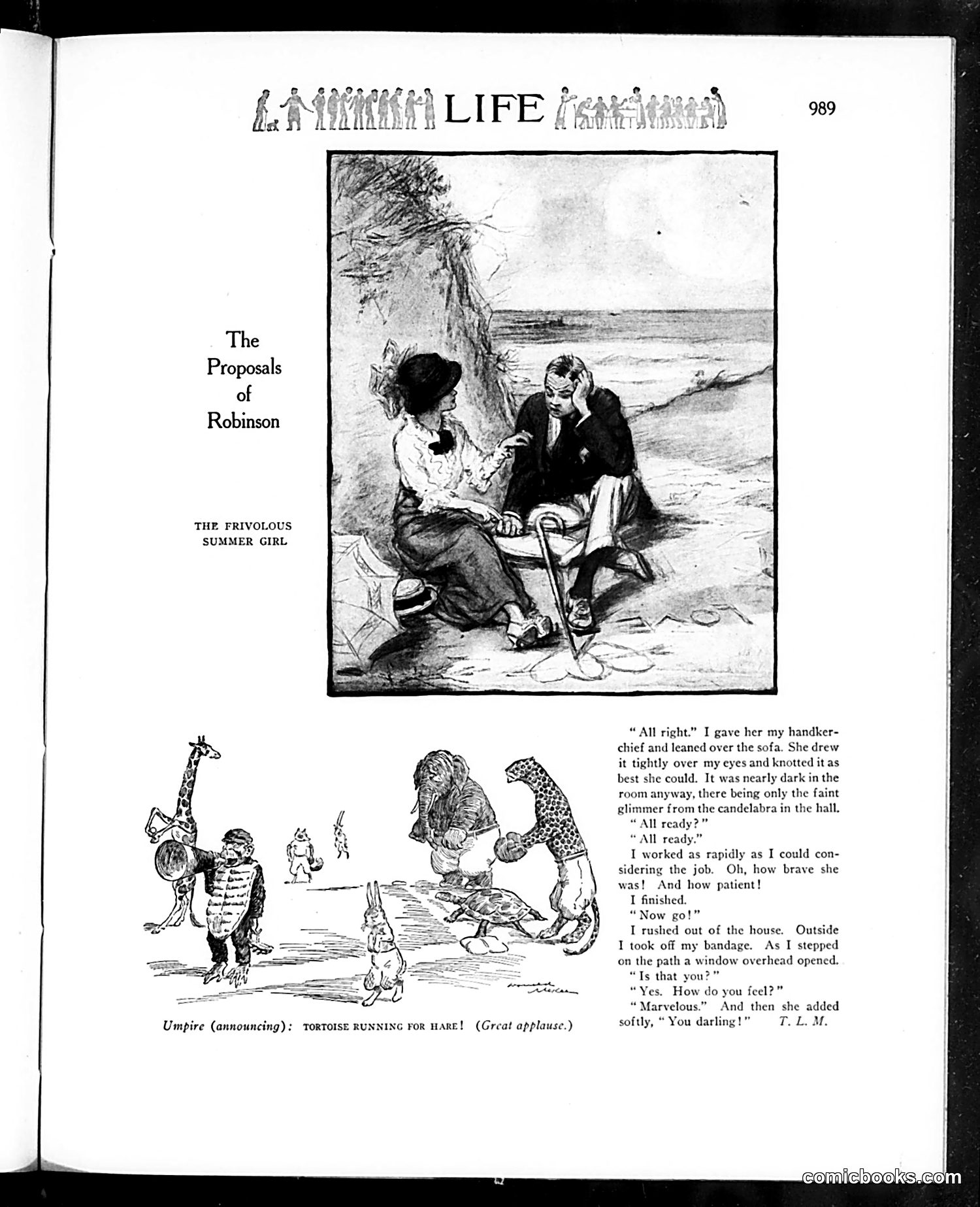
This page presents "The Proposals of Robinson," a serialized romantic story titled "The Frivolous Summer Girl." The narrative describes a playful intimate moment between a man and woman—he blindfolds her with his handkerchief while she performs some unspecified task requiring "bravery" and "patience." After he leaves and removes his blindfold, she calls from an overhead window, calling him "darling." The accompanying cartoon shows anthropomorphic animals (a tortoise racing a hare) with an umpire announcing the event—a humorous reference to Aesop's fable about the slow tortoise defeating the swift hare. For modern readers, the story's suggestive language and coy narrative style reflects early 20th-century *Life* magazine's approach to romance: playful, flirtatious, and deliberately ambiguous about physical intimacy, relying on innuendo rather than explicit description. The tone is lighthearted social commentary on courtship conventions.
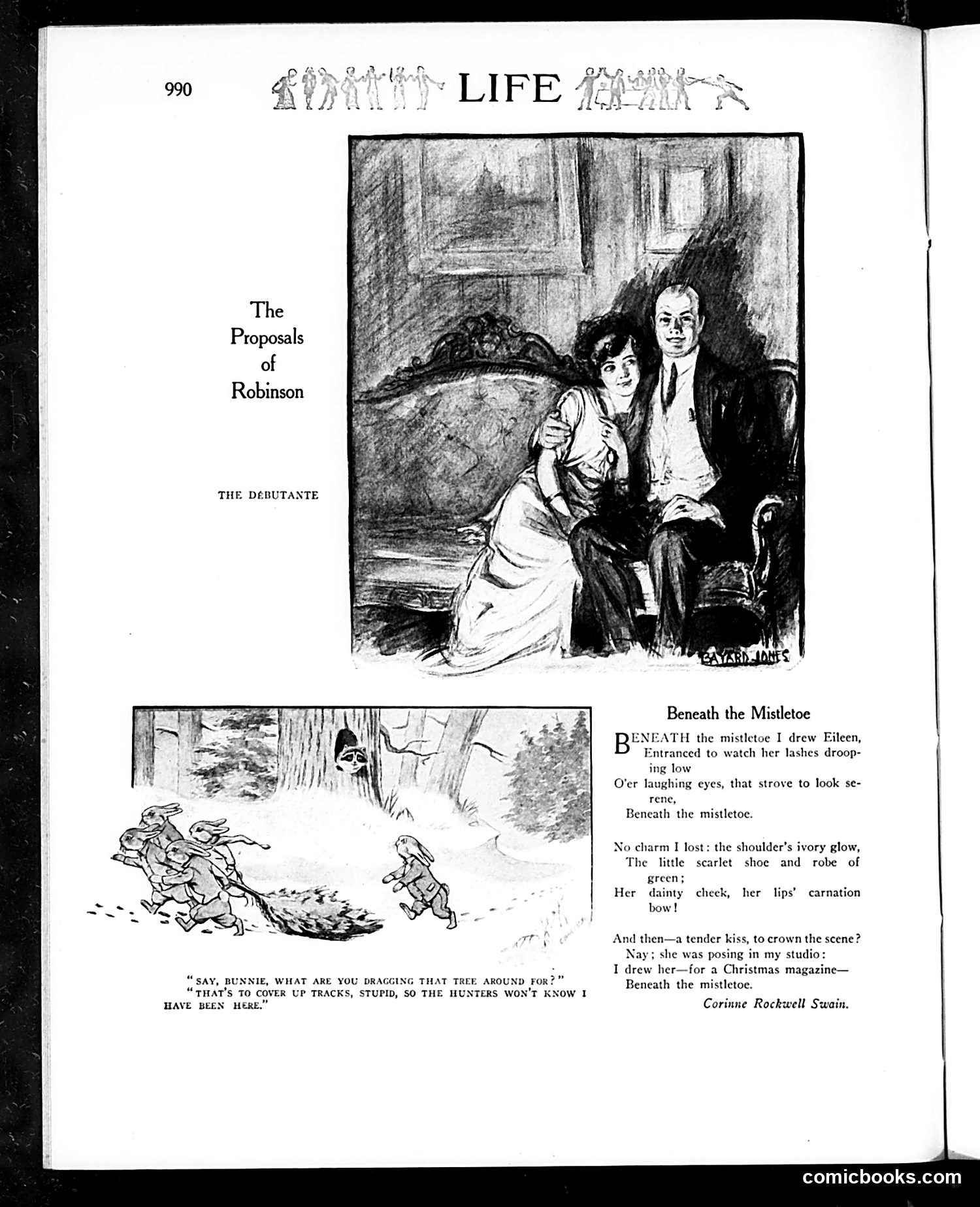
This page contains two separate humorous pieces from *Life* magazine: **"The Proposals of Robinson"** (top): A sentimental poem about a man drawing a portrait of a woman named Eileen beneath mistletoe, describing her beauty in romantic detail. The twist ending reveals he wasn't kissing her—he was merely sketching her for a Christmas magazine illustration. The joke plays on the reader's expectation of romance versus the mundane reality of commercial art. **"The Debutante"** (bottom): A cartoon showing a rabbit dragging a tree, explaining to another animal that it covers their tracks so hunters won't find them. The humor derives from the rabbit's practical, survival-focused reasoning contrasted with the absurdity of using a Christmas tree for camouflage—likely a seasonal joke playing on the holiday setting and animal cunning. Both pieces use gentle, domestic humor typical of early 20th-century satirical magazines targeting middle-class readers.
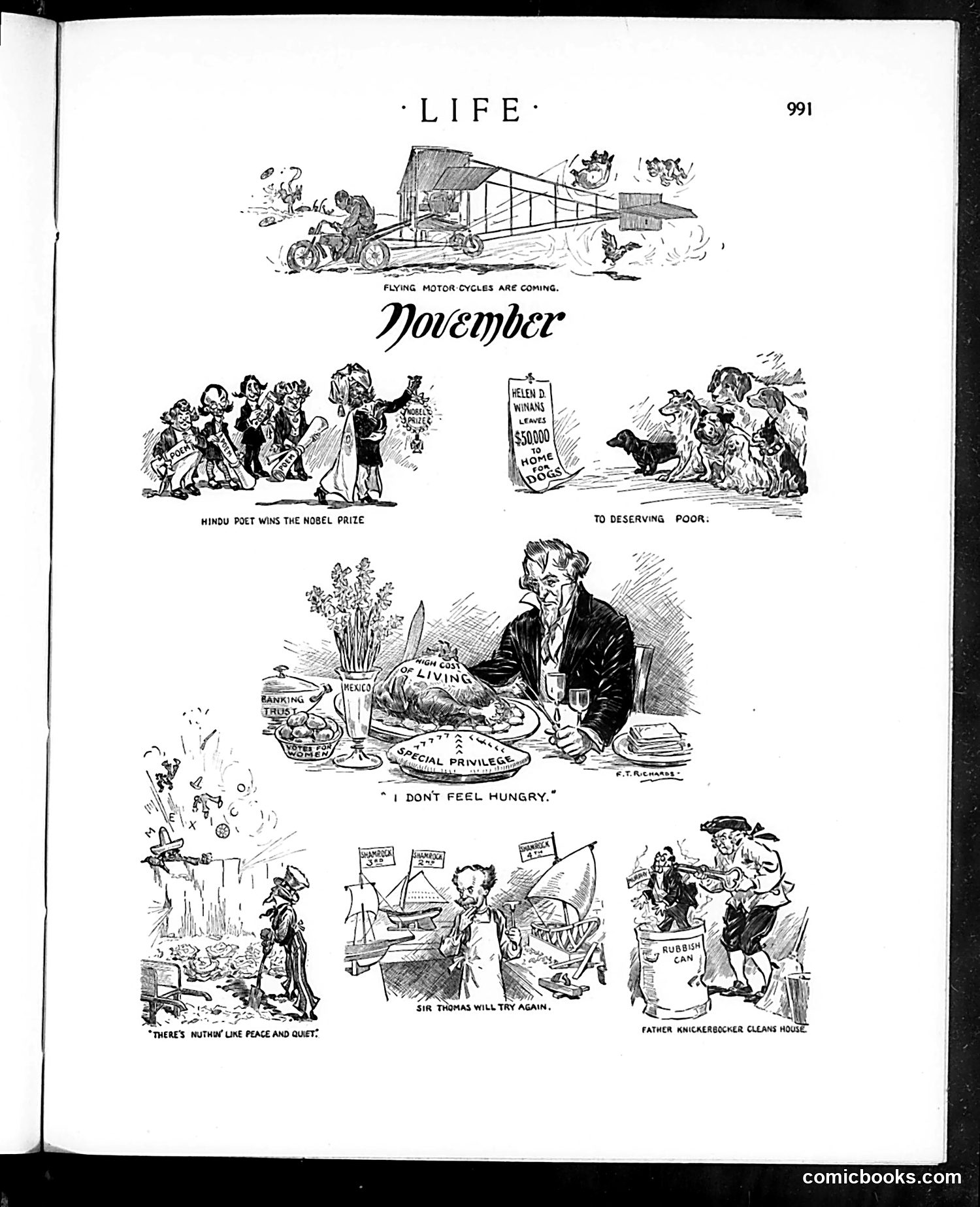
This satirical page from *Life* magazine presents six cartoon vignettes commenting on contemporary events and social issues: 1. **"Flying Motor Cycles Are Coming"** — futuristic speculation, likely mocking overhyped technological predictions. 2. **"Hindu Poet Wins the Nobel Prize"** — celebrates Rabindranath Tagore's 1913 Nobel Prize in Literature, a significant cultural milestone. 3. **"To Deserving Poor"** — satirizes charitable giving, showing Helen D. Winiams's bequest ($50,000 to "Home for Dogs"), critiquing misplaced philanthropy. 4. **"I Don't Feel Hungry"** — depicts a wealthy man surrounded by luxury ("Banking Trust," "Special Privilege") despite economic hardship, mocking the privileged class's obliviousness. 5. **"There's Nothin' Like Peace and Quiet"** and **"Sir Thomas Will Try Again"** — appear to reference political/military conflicts. 6. **"Father Knickerbocker Cleans House"** — likely references New York civic reform efforts.
This is a short story (not a cartoon) about social mobility and compassion in early 20th-century Paris. **The Plot:** Ninette, a poor café singer in Montmartre, becomes a famous dancer at the Folies-Bergères after attracting patronage from wealthy men (a Russian Grand Duke, Italian Count, and American millionaire). She quickly adapts to luxury, though she misses her simple freedom. Walking in the Tuileries gardens, she encounters a hungry, crying girl with a street organ—her former self, essentially. Wanting to help, Ninette discovers her purse is lost. **The Satire's Point:** The story explores the fragility of newfound wealth and the thin line between poverty and celebrity in Paris's entertainment world. Ninette's rapid ascent through male patronage, her quick adaptation to luxury, and her immediate empathy when confronted with her past all comment on Parisian society's treatment of working-class women and the luck involved in escaping poverty.
This page presents a serialized fictional story about two Parisian women—Nana, a poor, sickly street musician, and Ninette, her former friend who has become wealthy, apparently as a dancer or performer. The narrative depicts a sentimental melodrama common to turn-of-the-century popular fiction. Nana, suffering from consumption (tuberculosis), refuses charity despite poverty because she promised her dying father never to accept dishonestly earned money. Ninette, now prosperous, proposes they street-perform together—Nana playing organ, Ninette dancing as an Italian peasant girl—to help Nana earn money "honestly." The story romanticizes working-class struggle and virtue while satirizing bourgeois attitudes toward street performers. References to Montmartre and the Jardin des Tuileries ground the narrative in Paris. The moralistic tone—emphasizing honest labor and keeping deathbed promises—reflects period values about respectability and female virtue. This is **not a political cartoon** but rather serialized fiction typical of Life's content during this era.
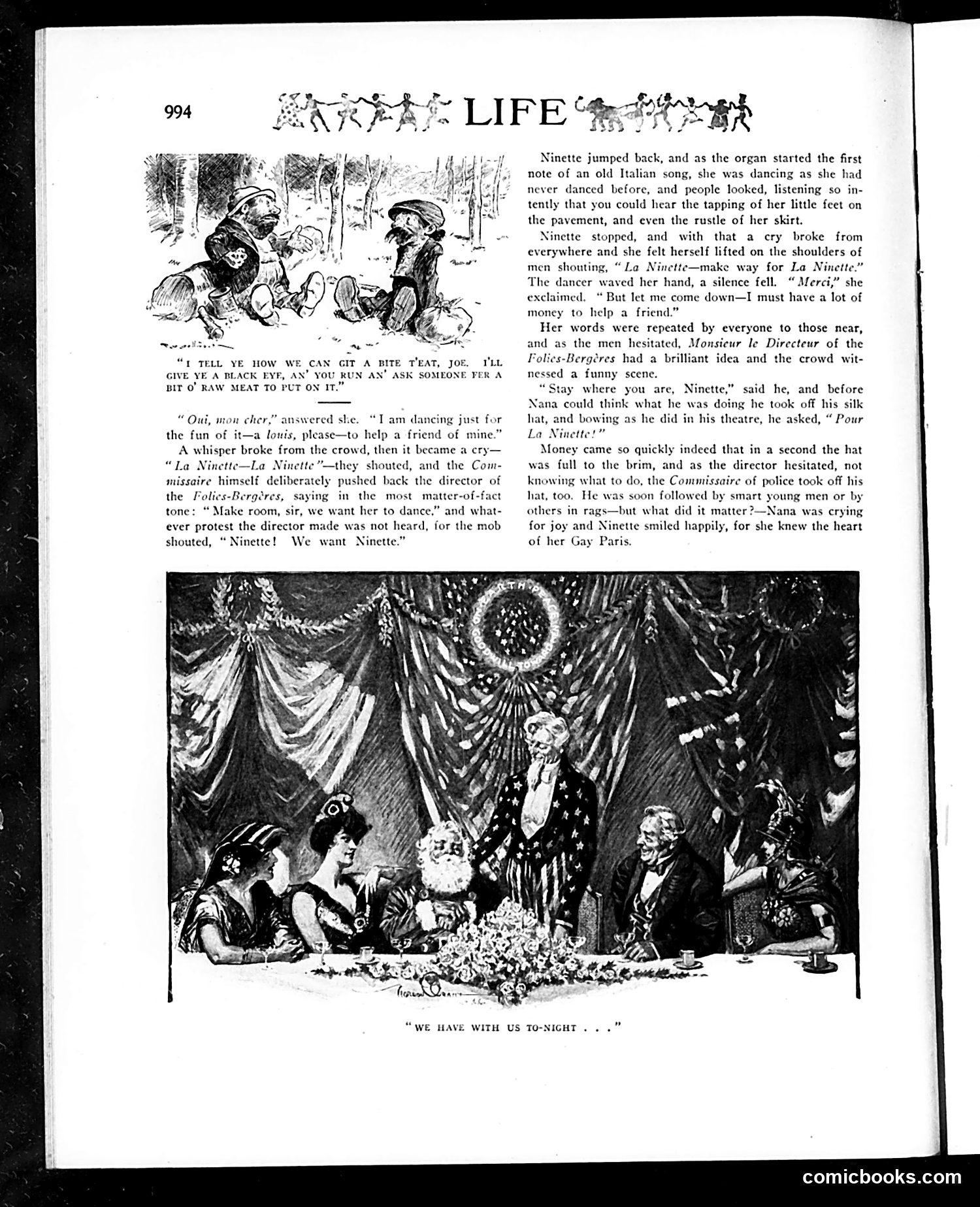
This page depicts a scene from Paris featuring a street dancer named Ninette at the Folies-Bergères music hall. The narrative shows Ninette dancing in the street to raise money for a friend in need. When a crowd gathers and demands she perform, the theater director has an inspired idea: he removes his silk hat and passes it for collection, asking "Pour La Ninette!" (For Ninette!). The satire celebrates Parisian character and generosity. The humor lies in the social reversal: a police commissioner and well-dressed gentlemen follow the director's lead, contributing to the hat alongside working-class men in rags—all moved by a performer's selfless cause. The piece sentimentalizes Paris as a city where class distinctions momentarily dissolve through appeals to charity and sentiment. The caption "WE HAVE WITH US TO-NIGHT..." suggests this is presented as charming Parisian culture for American *Life* magazine readers.
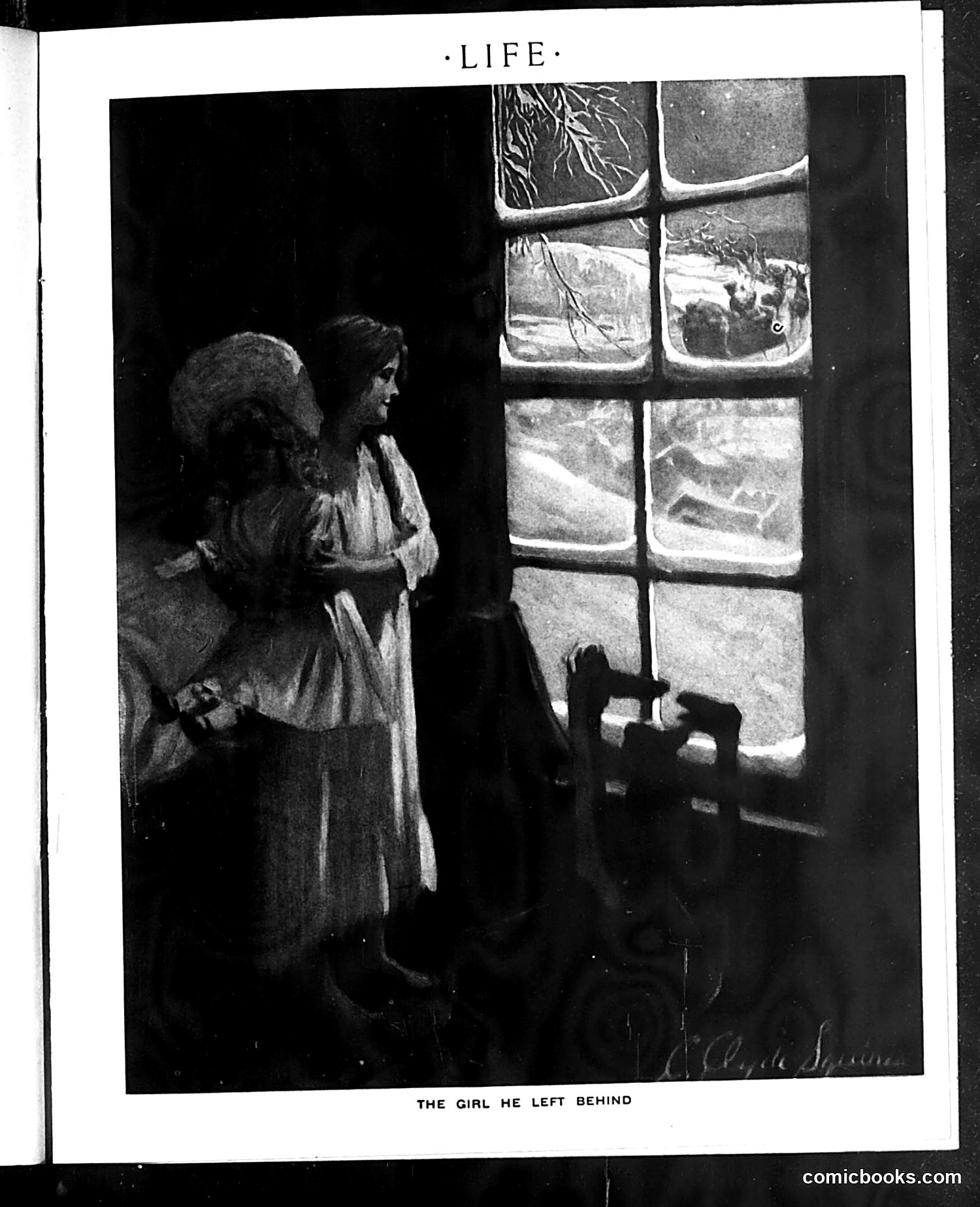
This appears to be an illustration from *Life* magazine depicting a domestic scene with romantic or sentimental undertones. Two figures stand at a window—a woman in a light dress and a man in dark clothing—gazing outward together. The composition suggests a moment of longing or remembrance, consistent with the caption "The Girl He Left Behind." The title likely references a soldier or traveler departing, leaving a woman waiting. This was a common romantic theme in early-to-mid 20th century popular culture, particularly during wartime when separation narratives resonated widely. Without additional context or visible caricatures, the specific satirical intent remains unclear, though the melancholic mood and window framing emphasize absence and memory.
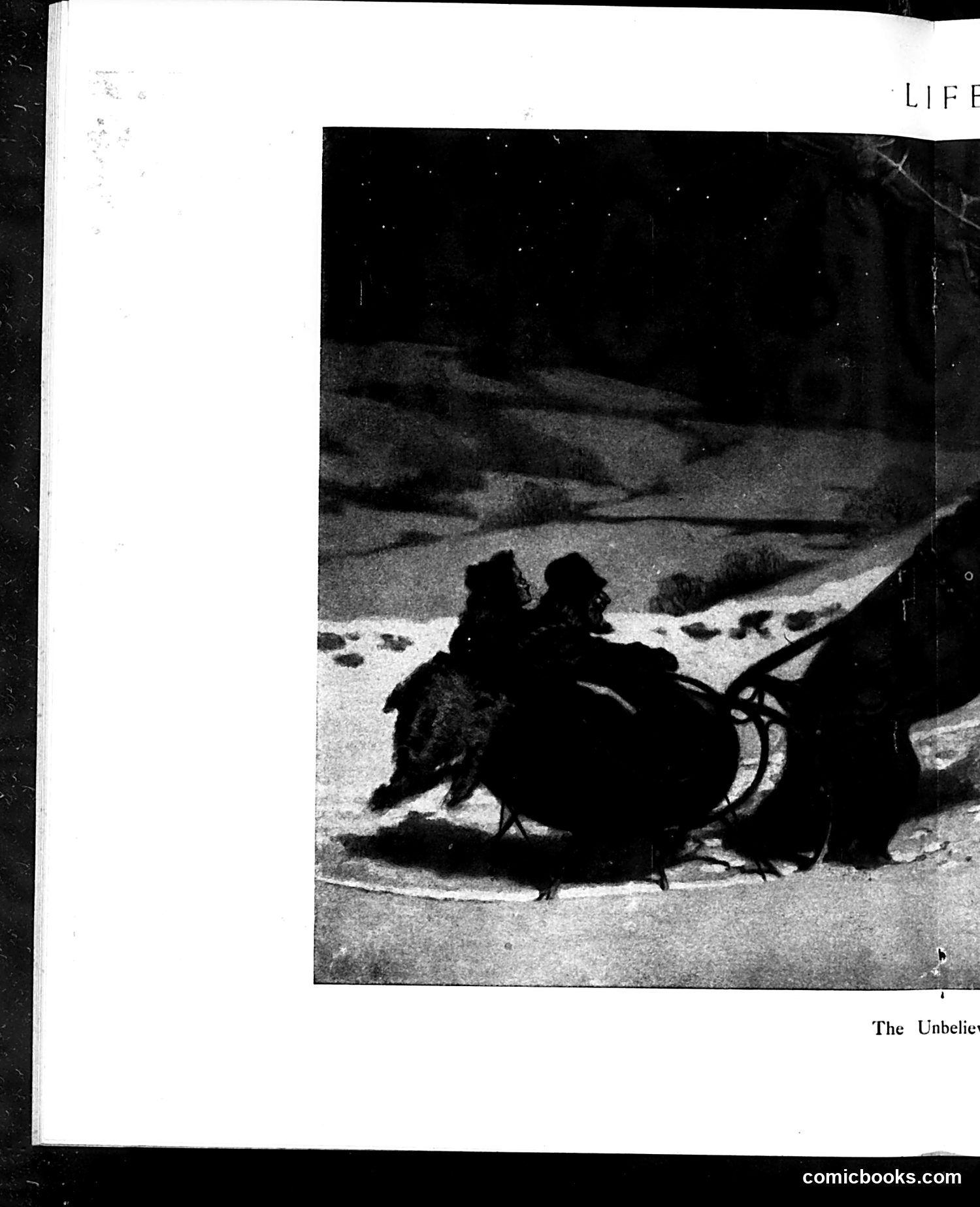
This appears to be a page from Life magazine featuring a photograph rather than a cartoon. The image shows two silhouetted figures sitting together outdoors at night, with a bicycle visible beside them. The landscape behind them is dark and hilly. The partially visible caption reads "The Unbelie[ved]" (text is cut off), but without the complete caption or additional context, the specific satirical point is unclear. The image could reference a romantic scene, social commentary, or a specific contemporary event or story from when this was published, but I cannot definitively identify the figures or the intended satire without more information. The page header indicates this is from Life magazine, though the specific issue date is not visible.
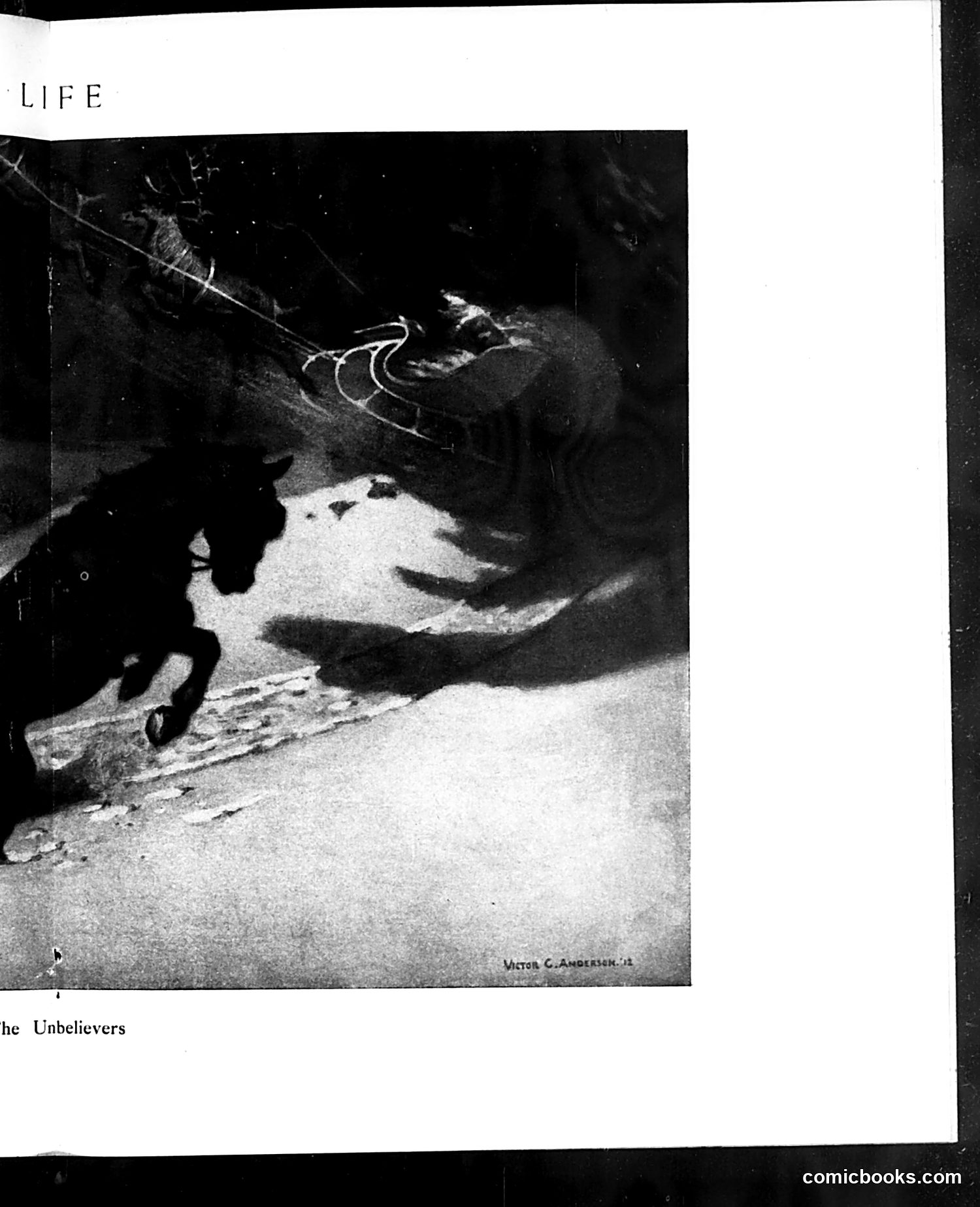
This Life magazine page shows a black and white photograph credited to Victor C. Anderson Jr. The image depicts what appears to be a white dog or similar animal in a dark, shadowy underground or cave-like setting, with stark lighting creating dramatic contrast. The title "The Unbelievers" suggests satirical commentary, likely social or political critique typical of Life magazine's satirical tradition. However, without additional context or visible captions explaining the specific reference, the exact target of the satire remains unclear from the image alone. The somewhat ominous tone and underground setting suggest it may reference skeptics, doubters, or those rejecting some contemporary belief or movement, but the specific reference cannot be determined from what's visible.
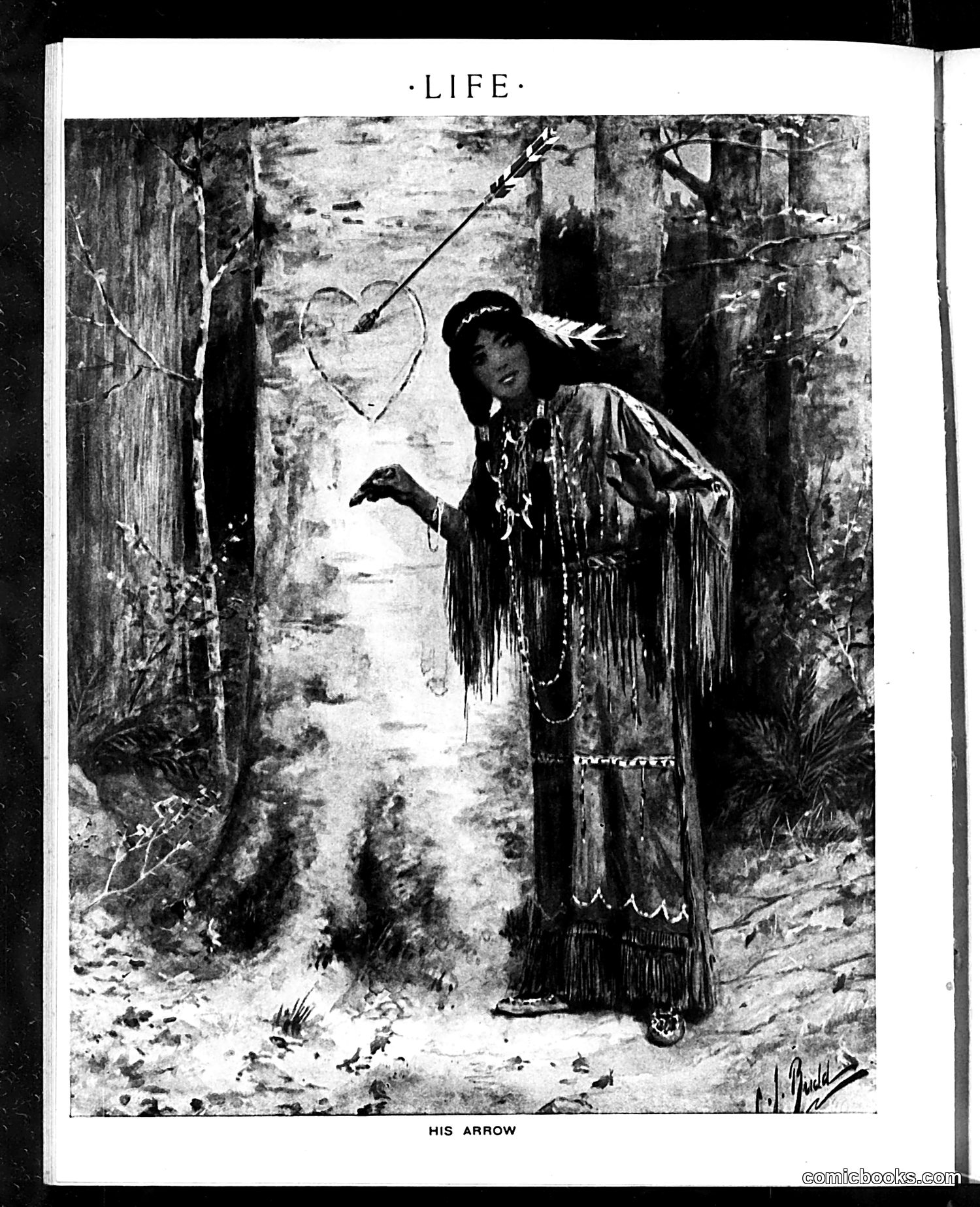
This is a satirical illustration from *Life* magazine titled "His Arrow." The image depicts a Native American figure in traditional dress (feathered headdress, fringed clothing) in a forest setting, drawing a bow with an arrow marked with a heart symbol aimed at a tree trunk that bears a carved heart. The satire appears to mock romantic sentimentality or possibly naive idealism—the juxtaposition of the "noble savage" stereotype with a clichéd romantic gesture (heart carving). The arrow's target suggests either cupid-like romance or perhaps ironic commentary on Indigenous peoples being portrayed through sentimental, romanticized lenses in popular culture. Without the publication date visible, the specific political context remains unclear, though it likely comments on contemporary attitudes toward Native Americans or American romanticism.
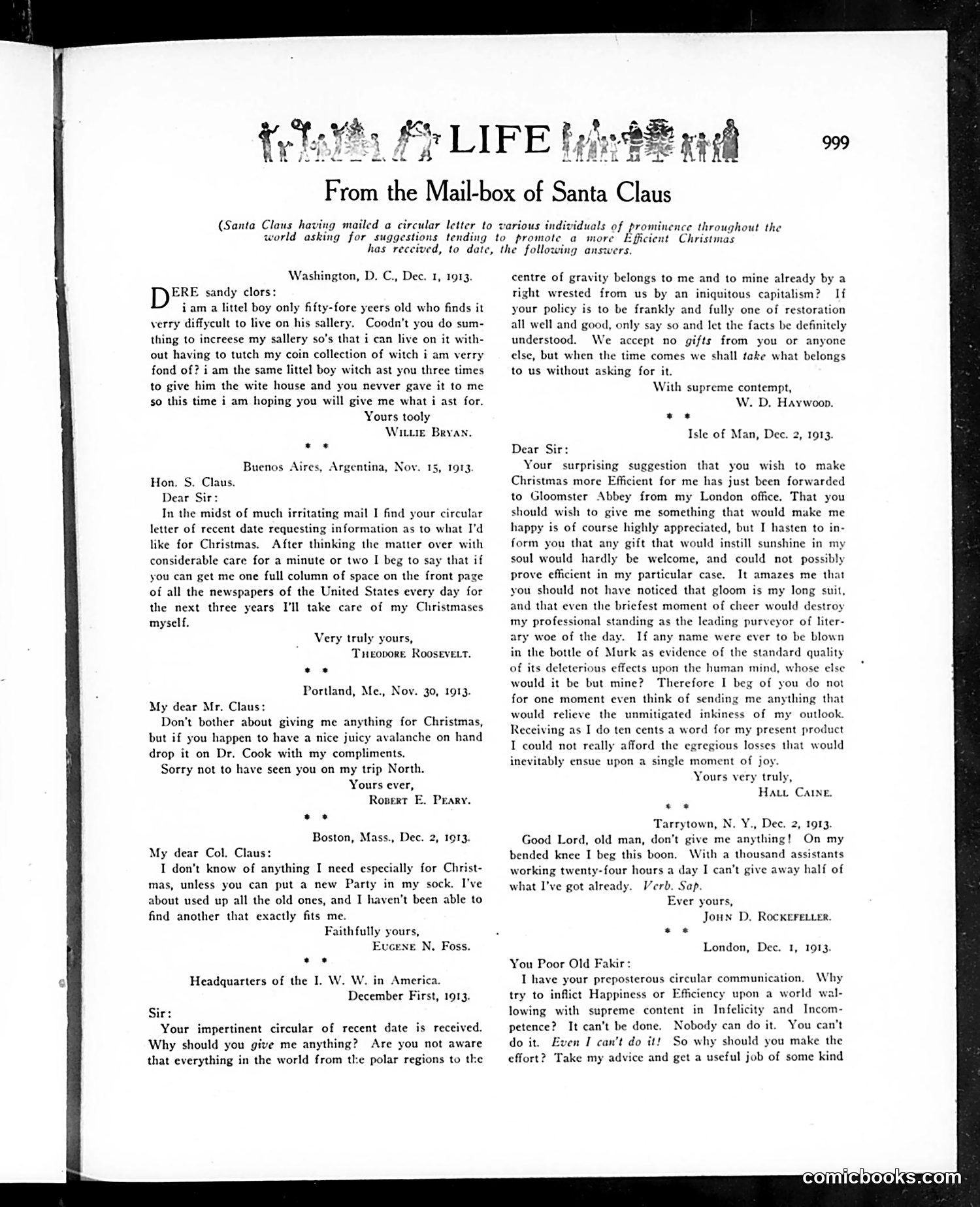
This is a satirical feature where Life magazine imagines responses to Santa Claus's circular letter asking prominent individuals what they want for Christmas. The humor lies in each figure's answer revealing their public obsessions or character flaws: **William Jennings Bryan** (identified by reference to "wite house") complains about his salary—mocking his perpetual political ambitions. **Theodore Roosevelt** demands front-page newspaper coverage daily for three years—satirizing his attention-seeking nature and dominance of media. **Robert Peary** (Arctic explorer) jokingly wishes an avalanche on rival "Dr. Cook"—referencing their famous dispute over North Pole discovery. **Eugene Foss** (Massachusetts governor) wants a new political "Party"—mocking his party-switching. **W.D. Haywood** (IWW radical labor leader) delivers a revolutionary screed claiming everything belongs to the working class—satirizing anarchist/socialist rhetoric. **Hall Caine** (the "Isle of Man" writer) insists he profits from misery and gloom—mocking his reputation for melodramatic novels. The satire exposes vanity, ambition, and ideological excess through each figure's revealing "wish list."
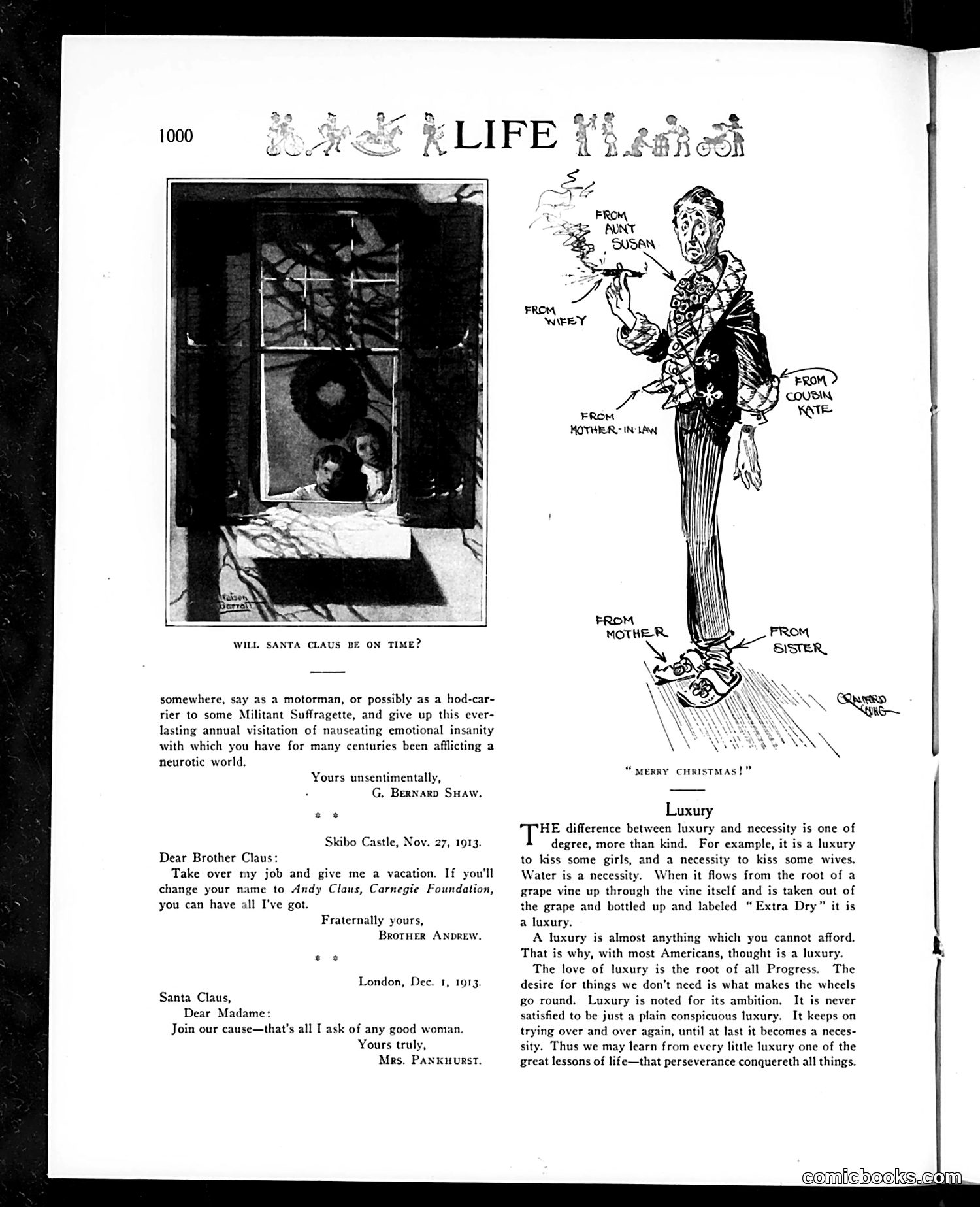
This page features satirical Christmas letters to Santa Claus from prominent public figures of the era: **G. Bernard Shaw** (Irish playwright) dismisses Santa as "nauseating emotional insanity," suggesting Santa work instead as a motorman or laborer for "Militant Suffragettes"—referencing the women's suffrage movement that Shaw supported. **Andrew Carnegie** (steel magnate) jokes that Santa should rename himself "Andy Claus, Carnegie Foundation" and take over his wealth-distribution work. **Emmeline Pankhurst** (British suffragette leader) recruits Santa to their cause, treating him as a potential supporter. The accompanying illustration shows a man buried under gifts labeled with sources (mother-in-law, sister, cousin Kate), satirizing the burdensome nature of holiday obligations. The "Luxury" essay below contrasts necessity with want, suggesting Americans' desire for unneeded luxuries drives progress—a commentary on American consumerism and materialism during this pre-WWI period.
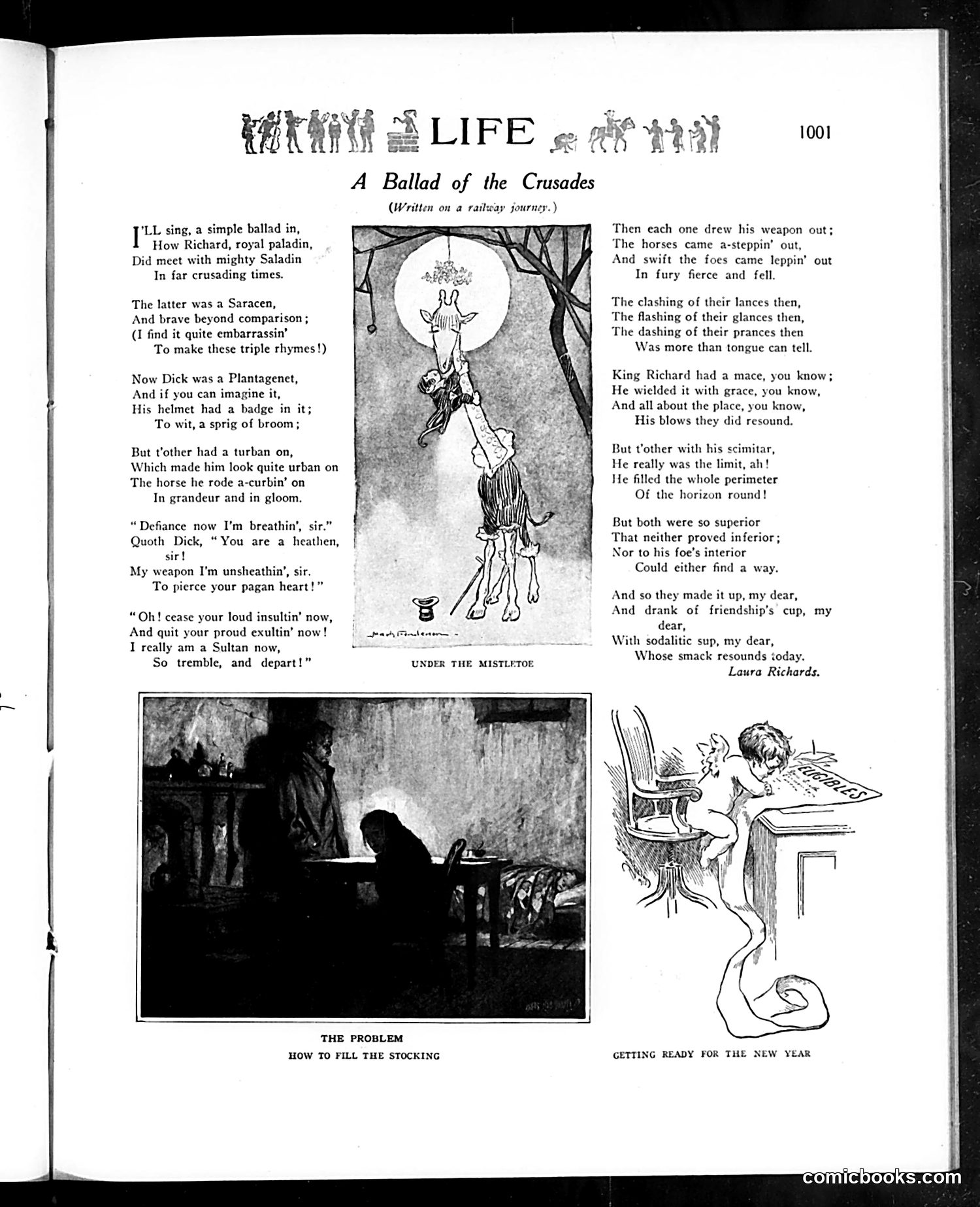
This page satirizes historical epic poetry through a deliberately silly, forced-rhyme ballad about King Richard (the Lionheart) meeting Saladin during the Crusades. The humor relies on: **The joke:** The author (Laura Richards) writes overly elaborate battle descriptions with terrible, obvious rhymes ("embarrassin'," "urban on," "perimeter") that undermine the subject matter's grandeur. The mock-heroic tone mocks both Victorian historical romance and strained poetic conventions. **The punchline:** After an epic, evenly-matched battle, the warriors simply "make it up" and become friends—a deflating anticlimax that parodies how historical conflicts are often romanticized. The accompanying illustrations include a hanging scene ("Under the Mistletoe") and a cherub preparing for New Year—unrelated vignettes typical of Life's mixed-content format. The satire targets pretentious historical poetry and overwrought verse rather than politics per se.

The caption reads "THE LORD'S DAY CLOSES," though the image quality makes detailed interpretation challenging. This appears to be a dark, atmospheric illustration—possibly depicting a landscape or architectural scene at dusk or nightfall, with dramatic contrasts between light and shadow. Without clearer visibility of specific figures or text identifying the subjects, I cannot definitively state what political or social satire is being referenced. The title suggests religious or moral themes related to Sunday observance, which was a common satirical topic in early 20th-century American magazines regarding labor practices, leisure, and religious hypocrisy. The illustration's shadowy, ominous tone suggests social commentary, but the specific target remains unclear from this reproduction.
This is a short story, not a political cartoon. It depicts early 1900s courtship customs through the tale of Maggie McCune, a young woman attempting to advance a stalled romance with the shy Mr. Mayo by hanging mistletoe—a bold but socially acceptable tactic for signaling romantic intent. The narrative satirizes Victorian-era dating conventions: the formal distance between unmarried people ("Miss McCune," "Mr. Mayo"), parental pressure about courting expenses (high gas bills), and the protagonist's elaborate setup using a French painting of a seminude nymph as narrative device to explore male-female dynamics. The story gently mocks masculine shyness and feminine constraint—Maggie's struggle to communicate her feelings within rigid social proprieties. The mistletoe device represents female agency within strict gender limitations.
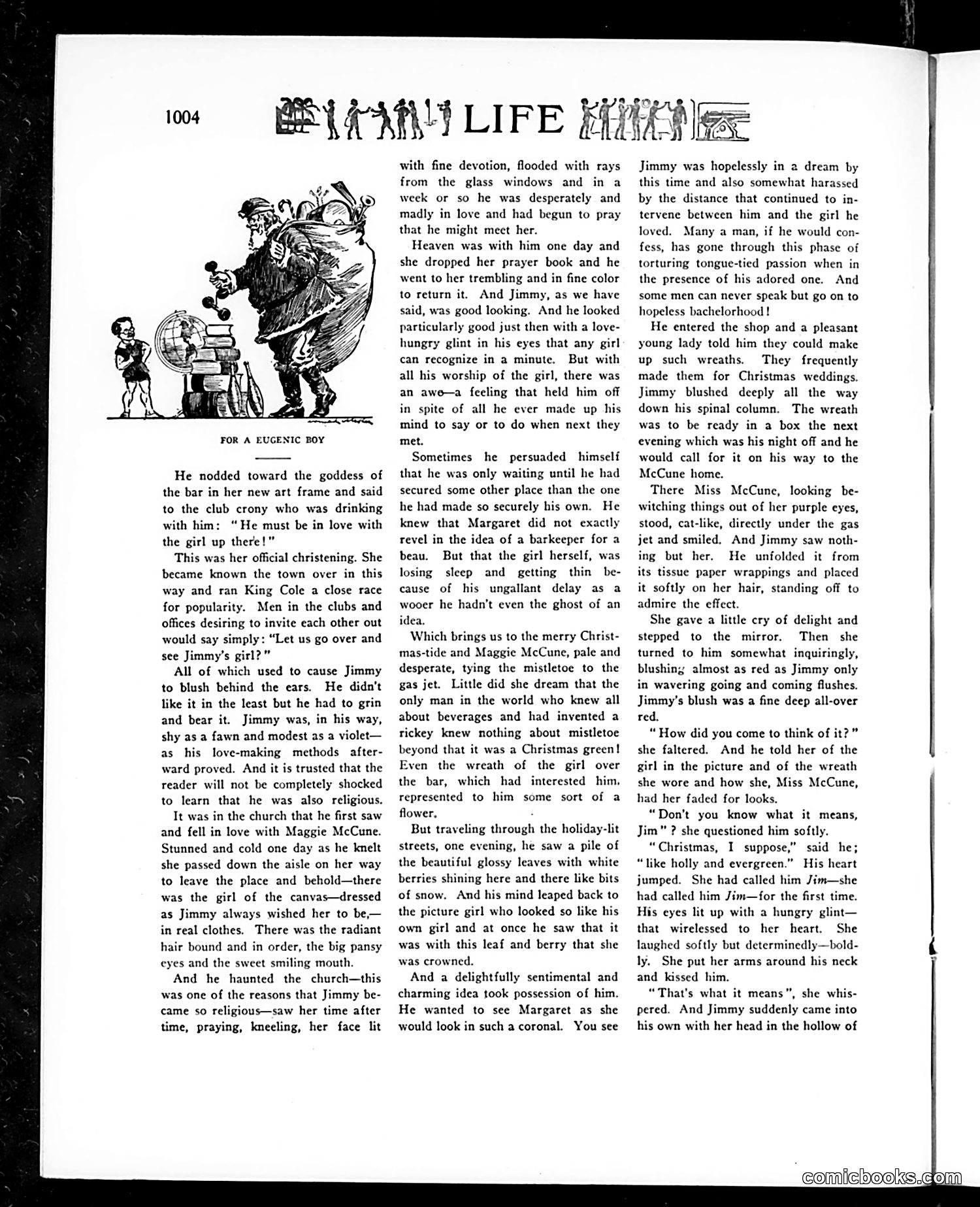
This page presents a romantic short story rather than political satire. The narrative follows Jimmy, a shy, religious barkeeper who falls in love with Margaret McCune after seeing her portrait displayed in a bar ("the girl up there"), then encounters her in church. The title's reference to "eugenic boy" reflects early 20th-century preoccupation with eugenics—the pseudoscientific movement promoting "better breeding." Here it appears to ironically describe Jimmy: modest, religious, good-looking, and earnest, embodying idealized masculine virtues of the era. The story emphasizes Jimmy's bashfulness and emotional restraint—he struggles to approach Margaret despite mutual attraction. The narrative celebrates his respectful hesitation and ultimate romantic gesture (obtaining mistletoe to crown her), positioning restraint and devotion as admirable masculine traits. This reflects period values emphasizing courtship propriety and emotional earnestness over casual pursuit.
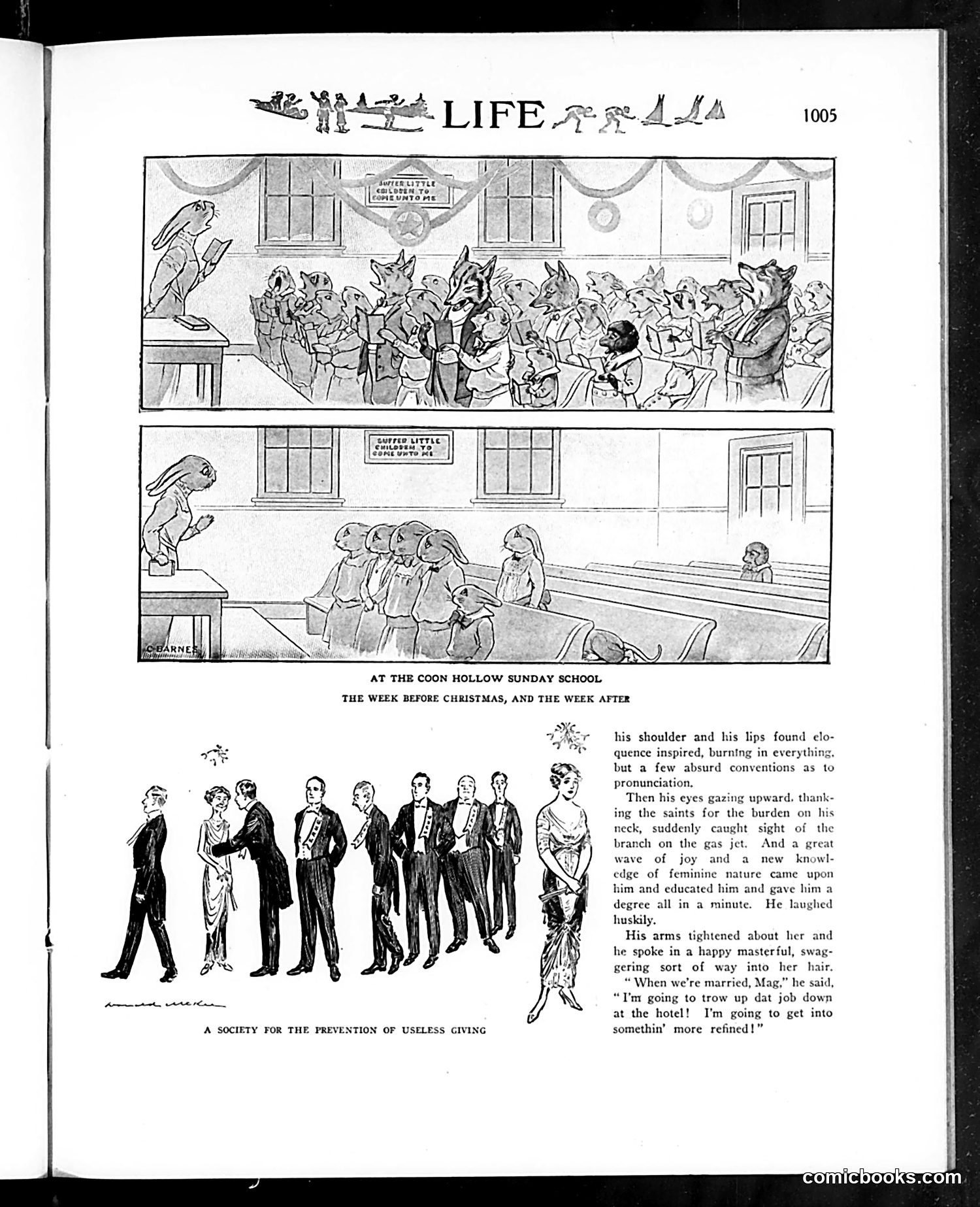
This page contains two distinct satirical pieces: **Top Comics:** "At the Coon Hollow Sunday School" depicts a Sunday school scene in two panels—the first showing chaotic Christmas week before the holiday, the second showing calm after. The title uses period terminology reflecting the magazine's era; the humor appears to target disruptive holiday behavior in religious settings. **Bottom Illustration:** "A Society for the Prevention of Useless Giving" shows well-dressed men and a woman, apparently members of an anti-gift organization. This satirizes excessive Christmas gift-giving culture, suggesting that wealthy society members were concerned about wasteful holiday spending. **The Text Below:** An unrelated romantic narrative about a working-class man (dialect suggests immigrant or lower-class character) who receives a romantic moment under mistletoe and dreams of leaving his hotel job for "somethin' more refined" after marriage—likely satirizing aspirational working-class romanticism. The page collectively mocks holiday excess, class pretensions, and sentimental working-class ambitions through separate but thematically linked vignettes.
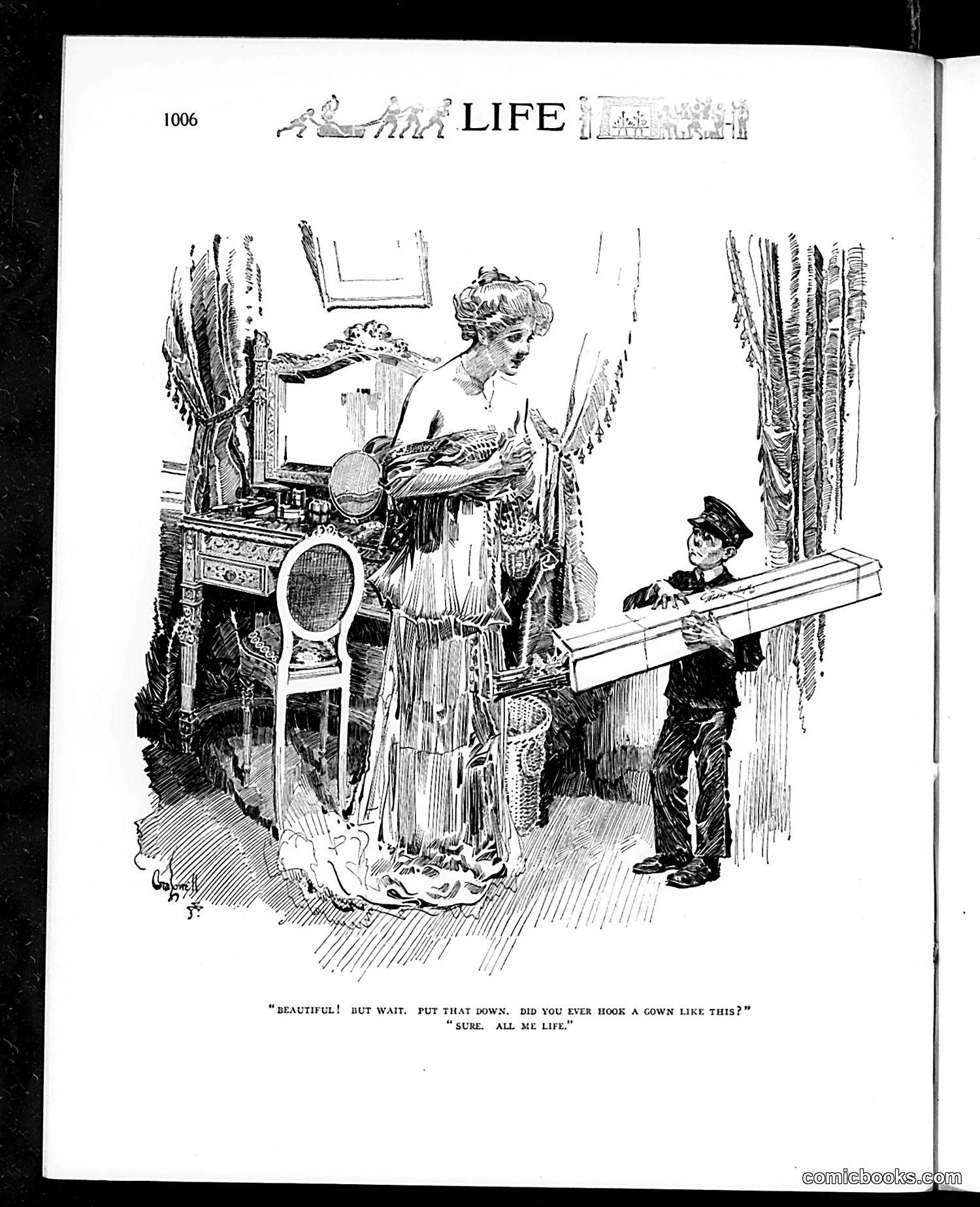
This is a humorous domestic scene from early 20th-century *Life* magazine. A well-dressed woman displays an elegant gown to a young boy (likely a delivery or shop worker), expecting amazement at its beauty. The boy's response—"Sure, all me life"—suggests he's from a working-class background where such fine garments are commonplace, either because he works around them or comes from a wealthier household than his appearance suggests. The satire mocks class pretensions: the woman assumes the boy will be impressed by luxury goods, but his casual familiarity deflates her social posturing. The joke relies on early 1900s class stereotypes and dialect humor, where a boy's rough accent contrasts with refined society.
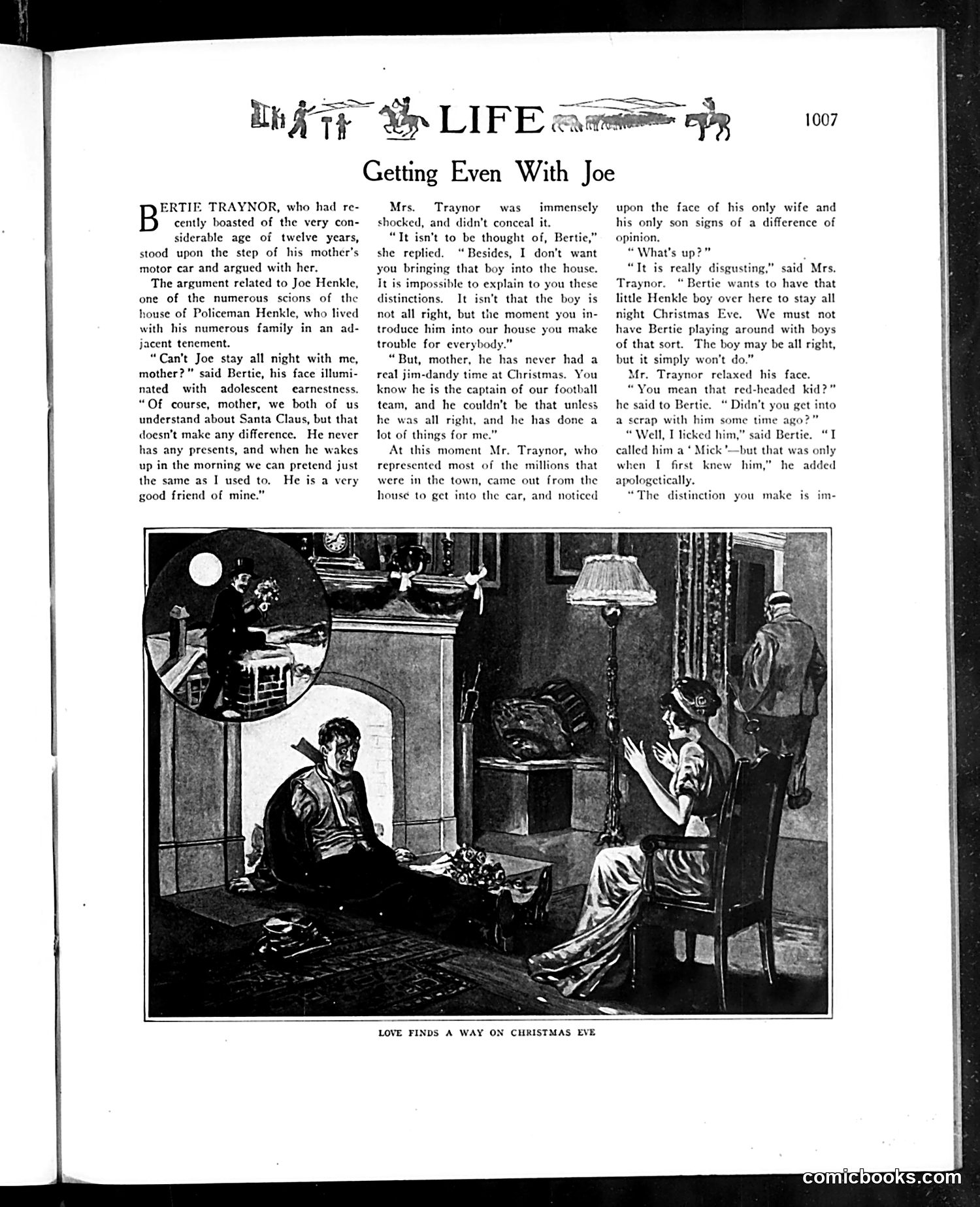
This is a *Life* magazine short story (not a political cartoon) about class conflict disguised as a Christmas moral tale. The plot centers on twelve-year-old Bertie Traynor, a wealthy boy, wanting his friend Joe Henkle—the poor, red-headed son of a policeman from a tenement—to stay overnight on Christmas Eve. The satire targets upper-class snobbery: Mrs. Traynor forbids the friendship based purely on class ("distinctions"), not character. The irony deepens when Mr. Traynor (representing "most of the millions" in town) recognizes Joe as the boy Bertie once called a "Mick" (a slur for Irish immigrants) in a fight—yet even this working-class Catholic connection doesn't validate the friendship for the parents. The story's title suggests "love finds a way," implying class barriers will be overcome, but the parents' resistance exposes the hypocrisy of wealth-based social hierarchies. This reflects early 20th-century American tensions between old-money WASP society and immigrant communities.
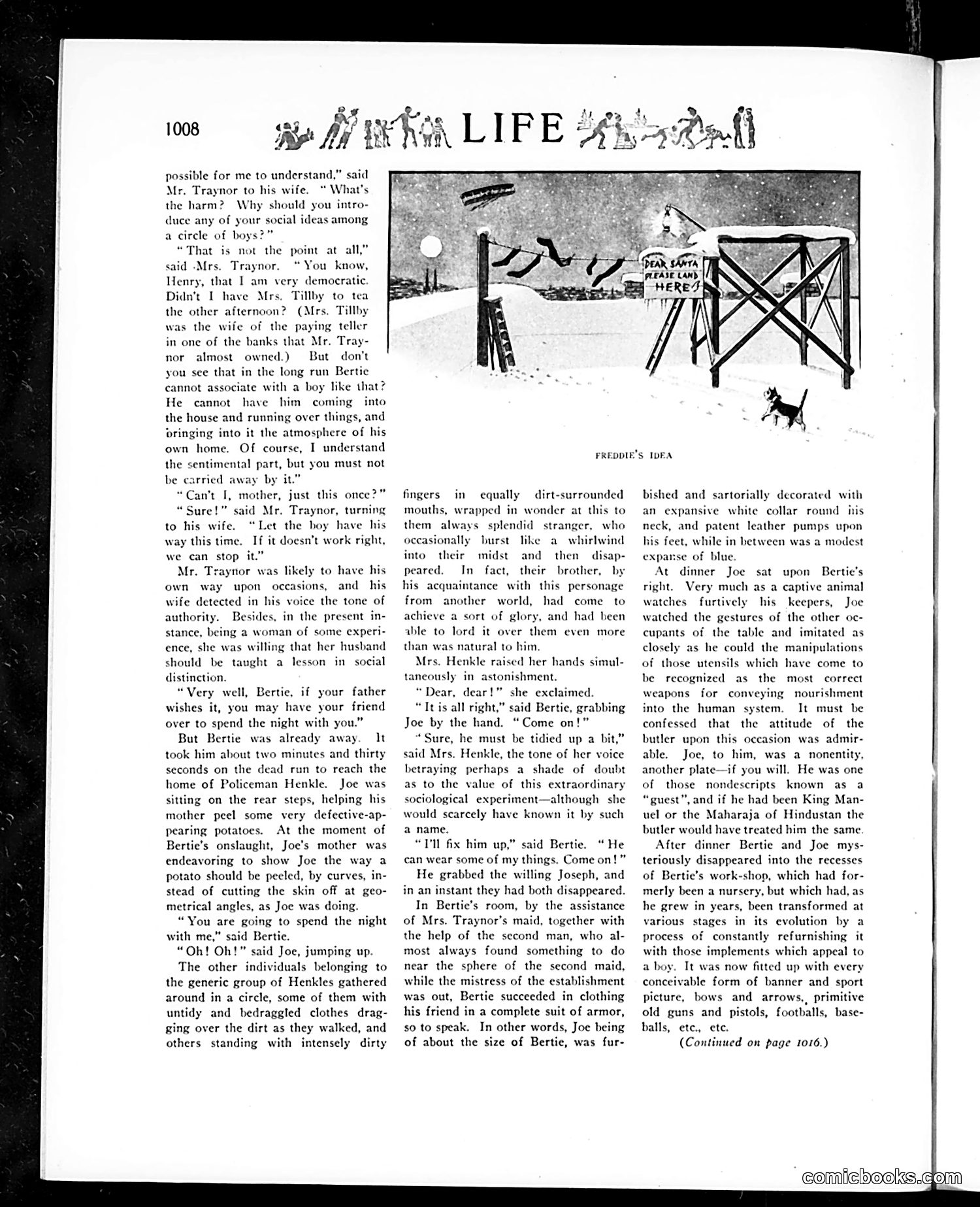
This page depicts a class-consciousness conflict in early 20th-century America. Mrs. Traynor, concerned about social distinction, opposes her son Bertie's friendship with Joe Henkle, son of a policeman. She fears association with someone from a lower socioeconomic background will corrupt her son's social standing. Mr. Traynor, more permissive, allows the sleepover. The narrative satirizes Mrs. Traynor's pretensions—she claims democratic values while carefully maintaining class barriers. The cartoon (captioned "Freddie's Idea") appears to show a makeshift Santa setup, likely illustrating childhood innocence contrasting with adult social anxieties. The satire mocks how the wealthy Traynors obsess over "atmosphere" and social propriety while Joe's working-class family shows genuine warmth. Bertie's transformation of Joe through proper clothing suggests superficial nature of class distinctions—appearance alone bridges the social gap.
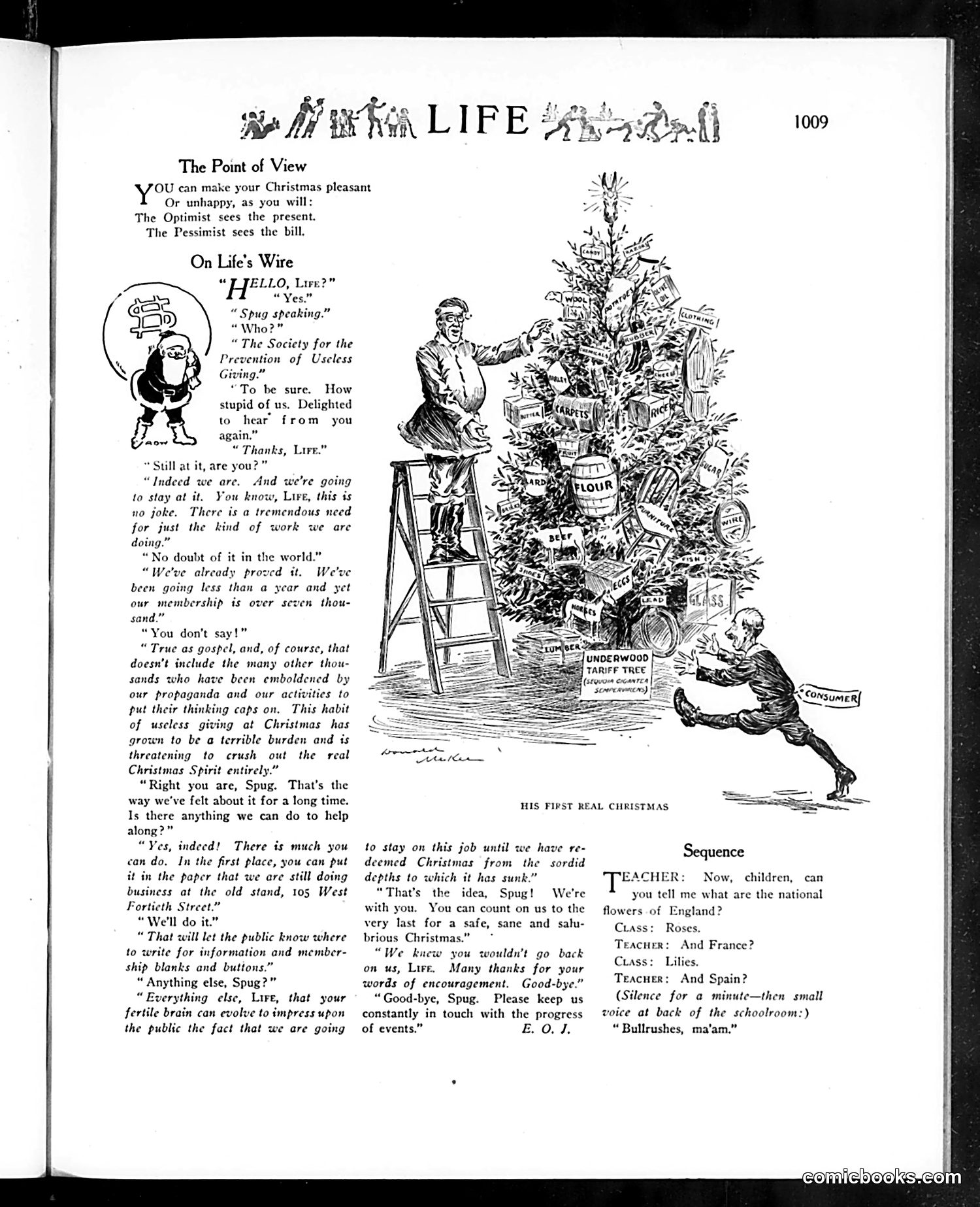
This page satirizes American consumer culture and charitable impulses around Christmas (circa 1910s-1920s). **"The Point of View"**: A simple joke contrasting optimist vs. pessimist attitudes toward Christmas—one enjoys the present, the other dreads the bills. **"On Life's Wire"**: The main satire features "Spug," spokesman for the "Society for the Prevention of Useless Giving." Life magazine's editor converses with him about their anti-consumerism campaign. The humor lies in the irony: Spug boasts that their organization opposing wasteful gift-giving has already grown to 7,000+ members and is "doing business" like any commercial enterprise. The satire mocks how anti-consumption movements themselves become commercialized and self-promotional. **"His First Real Christmas"**: The illustration shows a child decorating a tariff-protected Christmas tree laden with commercial products (flour, beer, etc.), suggesting how tariff policies inflate consumer goods prices—thus making even Christmas commercialized by government economics. **"Sequence"**: A simple schoolroom joke about national flowers, with the punchline that Spain's is "bullrushes"—likely a mild insult or nonsense answer.
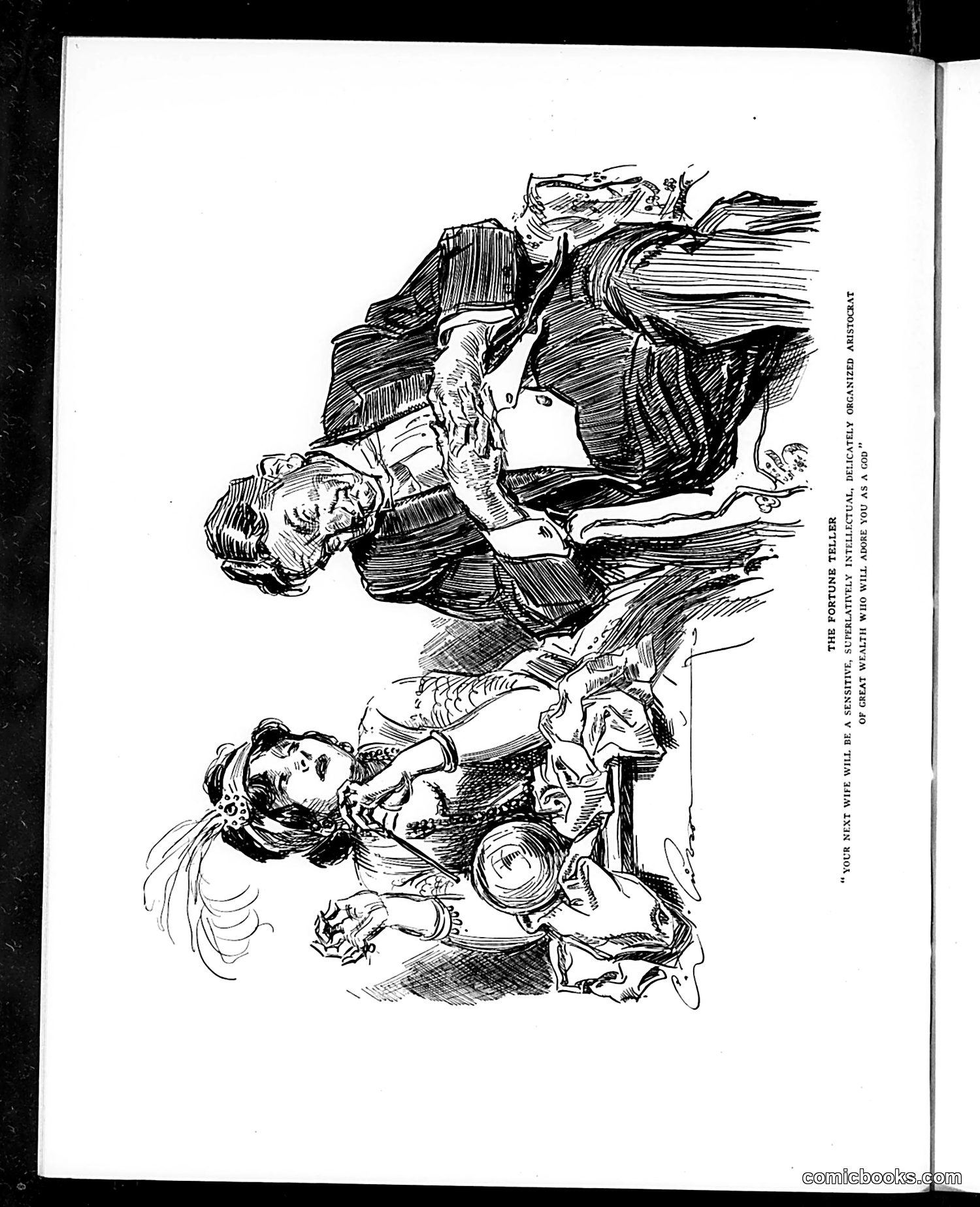
I cannot reliably decode this page. The OCR text appears corrupted or reversed, making it impossible to read the caption or identify the specific political/social references. The IMAGE shows a pen-and-ink sketch of two figures in what appears to be 19th-century dress in an interaction, drawn in a satirical style typical of Life magazine. However, without legible text identifying the figures or the cartoon's subject matter, I cannot accurately explain what political or social commentary it represents or who the caricatured individuals are meant to be. To properly analyze this cartoon, a clean image or accurate transcription of the caption would be necessary.
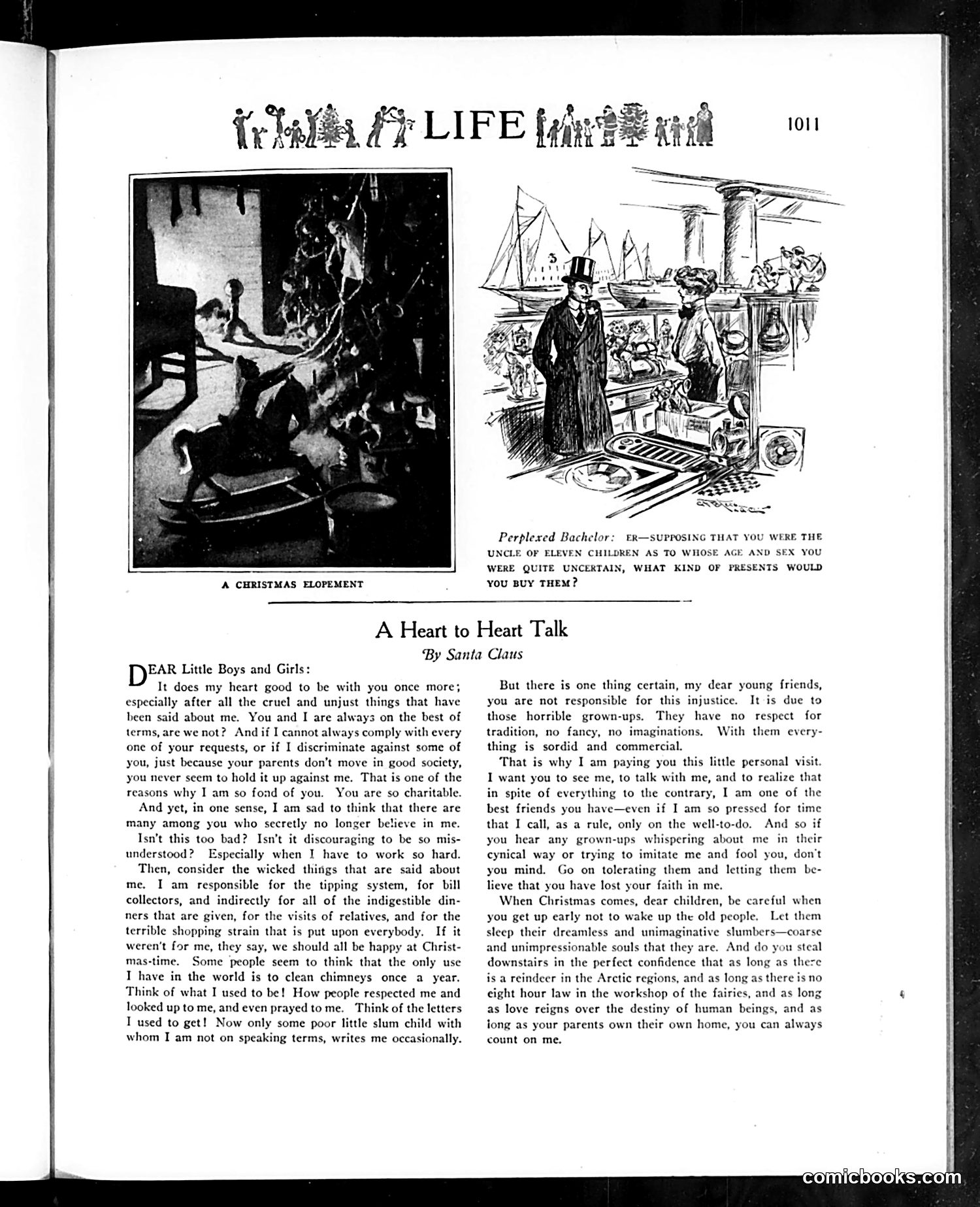
**Top cartoon ("A Christmas Elopement"):** A photograph showing a romantic scene of a couple embracing near a fireplace, likely depicting an elopement or secret romance. **Bottom cartoon ("Perplexed Bachelor"):** A sketch of a well-dressed man at a dock asking another gentleman about gift-giving strategy. The humor lies in the absurd specificity: he's supposedly the uncle of eleven children whose ages and sexes are unknown to him, asking what presents he'd buy. This satirizes wealthy men's detachment from family obligations and the challenge of Christmas shopping. **"A Heart to Heart Talk by Santa Claus":** A satirical piece where Santa complains about his damaged reputation. Adults blame him for the "tipping system, bill collectors," unwanted relatives' visits, and shopping strain—essentially holding him responsible for modern commercial and social annoyances rather than celebrating his traditional role. Santa's bitterness about no longer being respected or prayed to, and his admission he "only" visits the wealthy, critiques both commercialized Christmas and class inequality. The piece mocks how industrial-age society has corrupted Christmas traditions.
This is the opening of a satirical Christmas story by John Kendrick Bangs depicting a precocious, jaded child confronting Santa Claus. The humor targets early 20th-century anxiety about modern children's sophistication and cynicism. The six-year-old "Reginald Van Doodleton" dismisses Santa's gift-giving as inefficient "drivelling business," scorns toys (drums, tin soldiers, toy battleships) as foolish nonsense, and corrects Santa's grammar. The child represents the ultra-rational, efficiency-obsessed modern sensibility of the era—he values only practical utility and views tradition and childhood wonder as backward. Santa's bewilderment suggests generational conflict: the old-fashioned magic of Christmas cannot survive this child's precocious intellectualism. The satire mocks both the child's insufferable pretension and the era's obsession with "efficiency" as life's governing principle, even for Christmas traditions. The story appears to be social commentary on how modernization was allegedly ruining childhood innocence.
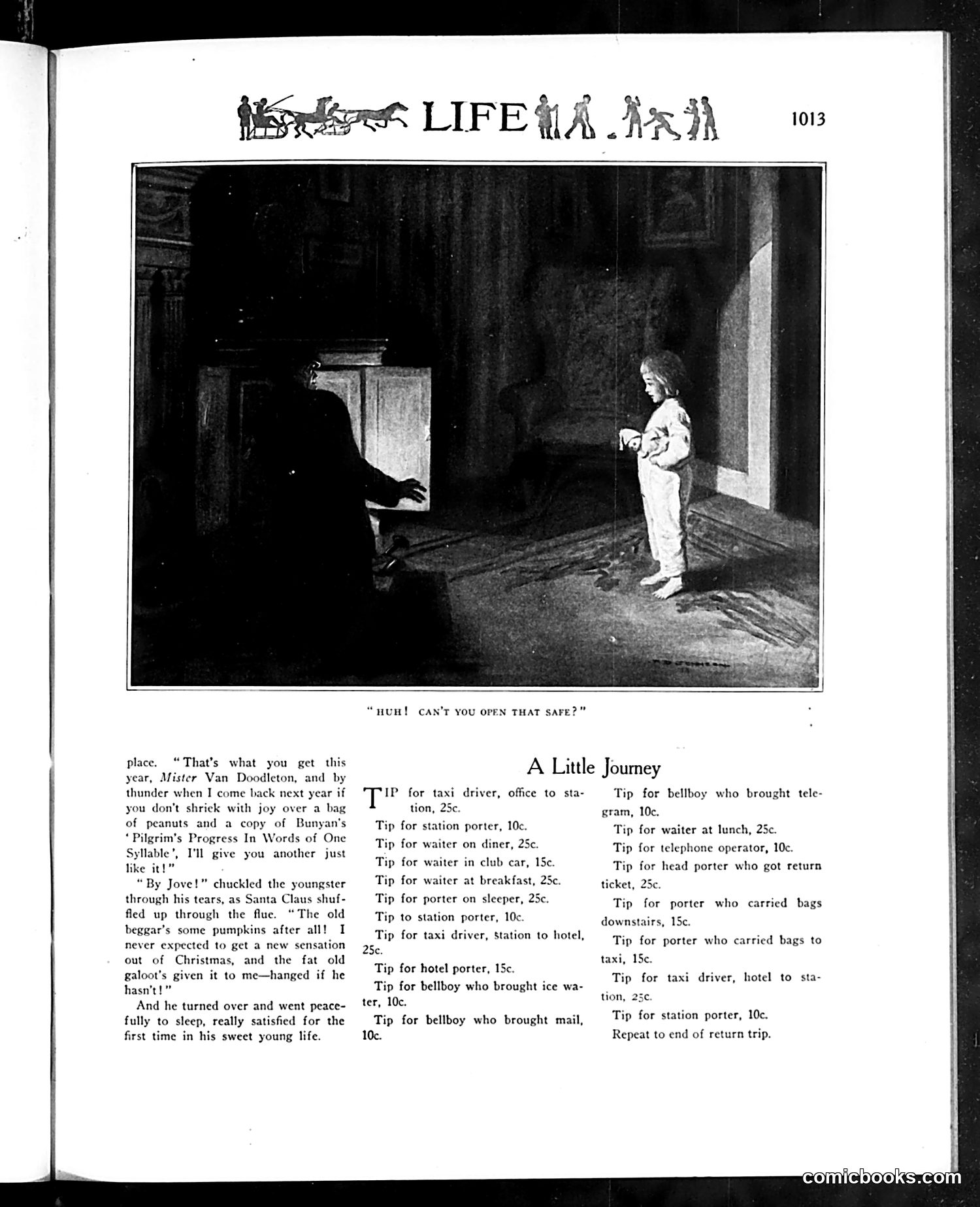
The page contains two distinct pieces: **The Christmas Story (left):** A sentimental narrative about a wealthy child (Van Doodleton) who receives modest gifts—peanuts and a simplified Pilgrim's Progress—from Santa Claus. The joke satirizes privilege: the boy is thrilled by deprivation because his usual abundance has made him jaded. The story mocks the wealthy child's disconnection from ordinary experience. **"A Little Journey" (right):** This is satirical commentary on tipping culture. It catalogs the seemingly endless succession of tips required during a simple train journey—to porters, bellboys, waiters, taxi drivers, operators, etc.—then instructs readers to "repeat to end of return trip." The satire highlights the absurdity and financial burden of the contemporary tipping system, where service workers at every stage expect compensation. The repetition emphasizes how exhausting and expensive such travel truly was for ordinary people. Both pieces critique aspects of American consumer culture and economic inequality.
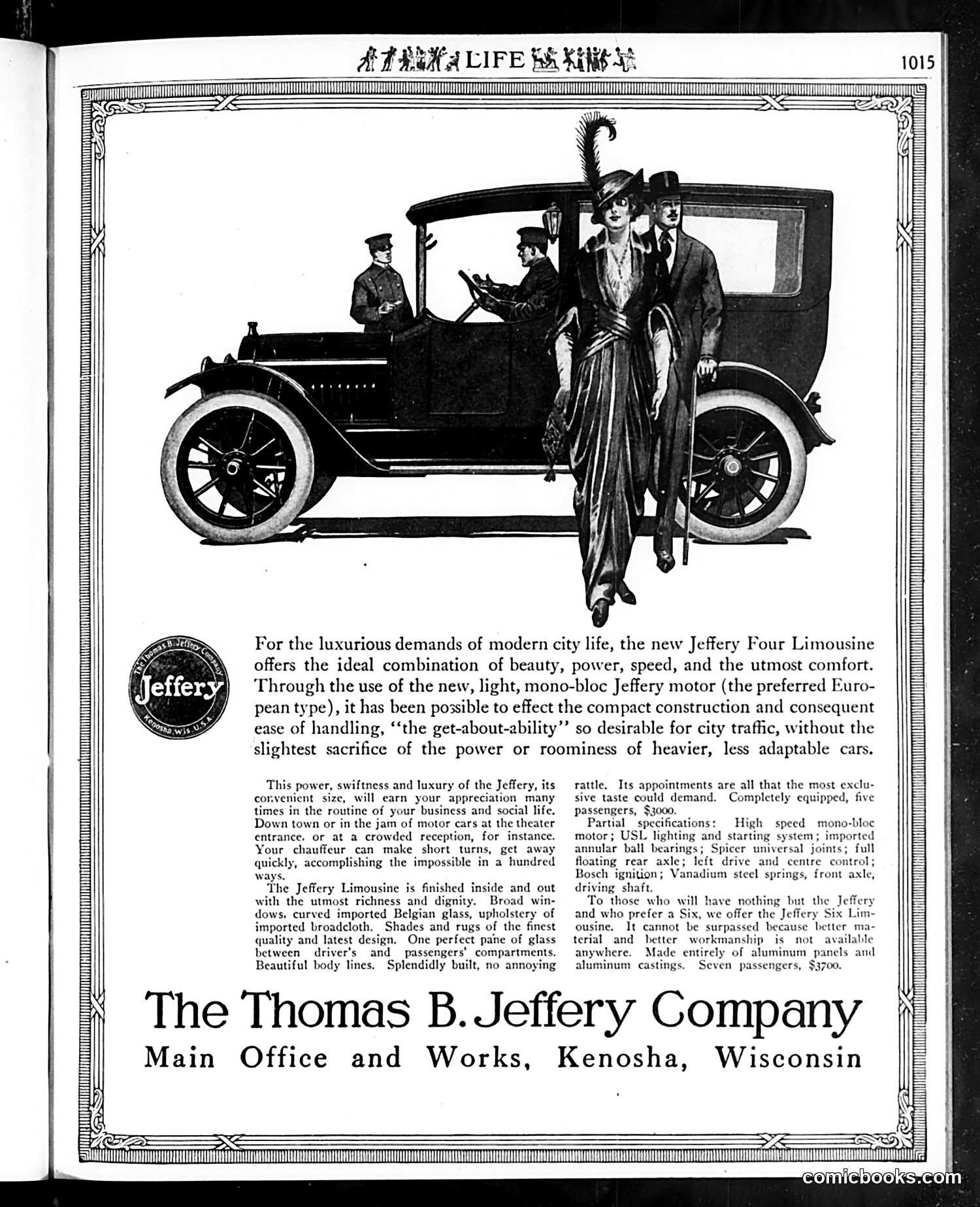
This is **not a cartoon or satire**—it's a straightforward automobile advertisement from Life magazine's pages. The image shows a 1910s-era Jeffery Four Limousine with elegantly dressed figures posed beside it, illustrating the vehicle's luxurious appeal to wealthy urban professionals. The ad emphasizes features that would impress the era's affluent audiences: compact design for maneuvering crowded city streets, European engineering, imported Belgian glass windows, and plush upholstery separating the chauffeur from passengers—a status marker indicating the owner didn't drive themselves. The price ($3,000-$3,700) positions this as premium. The text targets business owners and socialites who frequent theaters and formal receptions, positioning the car as both practical for city congestion and a symbol of refined taste and wealth. This represents early-20th-century automotive advertising's focus on luxury, technological superiority, and class distinction—not social commentary.
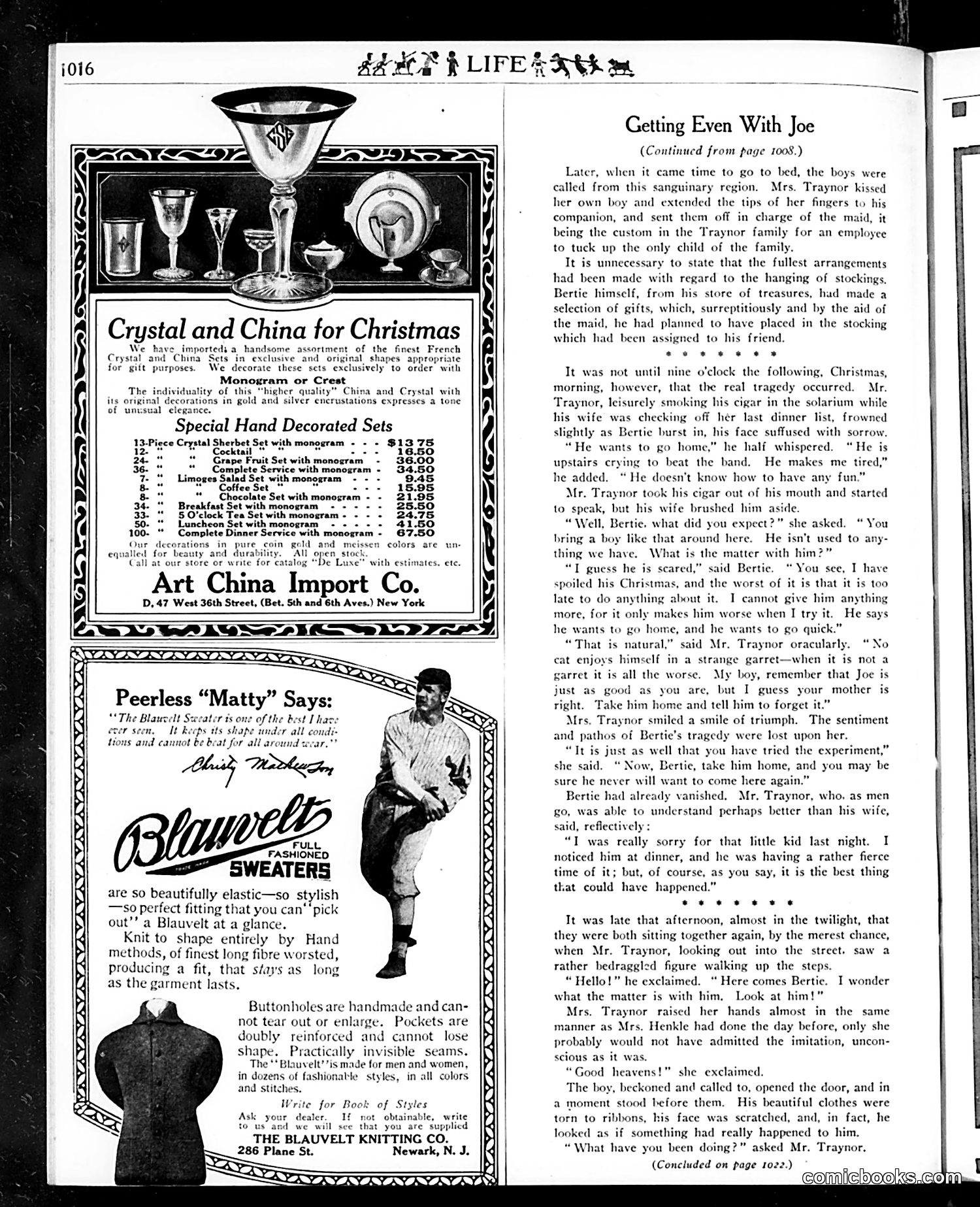
This page contains primarily **advertisements** rather than political satire or comics requiring historical context. The visible content includes: 1. **Art China Import Co. advertisement** - promoting decorated crystal and china dinnerware sets for Christmas gifts, with hand-decorated options and monograms available. 2. **Blauvelt Knitting Co. advertisement** - featuring "Peerless 'Matty'" (likely a baseball reference, though unclear which athlete), promoting full-fashioned sweaters with hand-knitted construction. 3. **"Getting Even With Joe" story** - a serialized narrative (continued from page 1008) about a boy named Bertie and his friend Joe during Christmas. The excerpt shows Joe is homesick and wants to leave the Traynor household despite Bertie's gift-giving efforts. The page reflects early 20th-century consumer culture and domestic storytelling rather than political commentary or satirical cartooning.
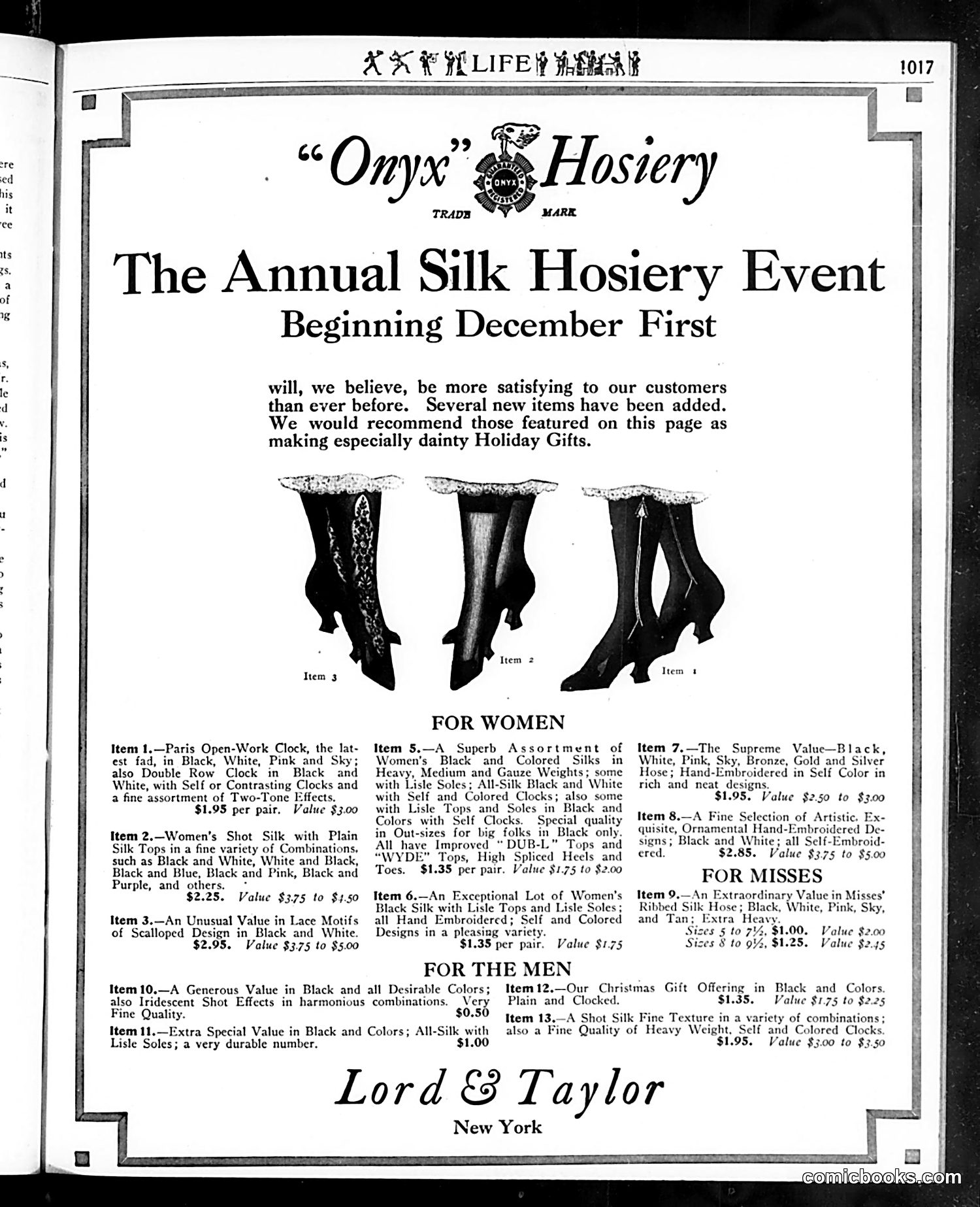
This page is **not a cartoon or satirical content**—it's a straightforward **advertisement for Lord & Taylor's annual silk hosiery sale**, beginning December 1st. The page features product listings for women's, misses', and men's silk stockings with prices and descriptions. Items include decorative styles like "Paris Open-Work Clock" (a knit pattern), "Shot Silk," and hand-embroidered designs. Prices range from $0.50 to $2.95, with stated "values" suggesting significant markups. The three illustrated items at the top show different stocking styles for women—likely the items referenced in the text below them. **Context for modern readers**: This reflects early 20th-century luxury retail, when fine silk hosiery was a premium holiday gift item. The emphasis on variety, quality, and value appeals to affluent customers during the Christmas shopping season. The "Onyx" brand (visible in the header) was an established hosiery manufacturer. There is no satire or political commentary on this page.
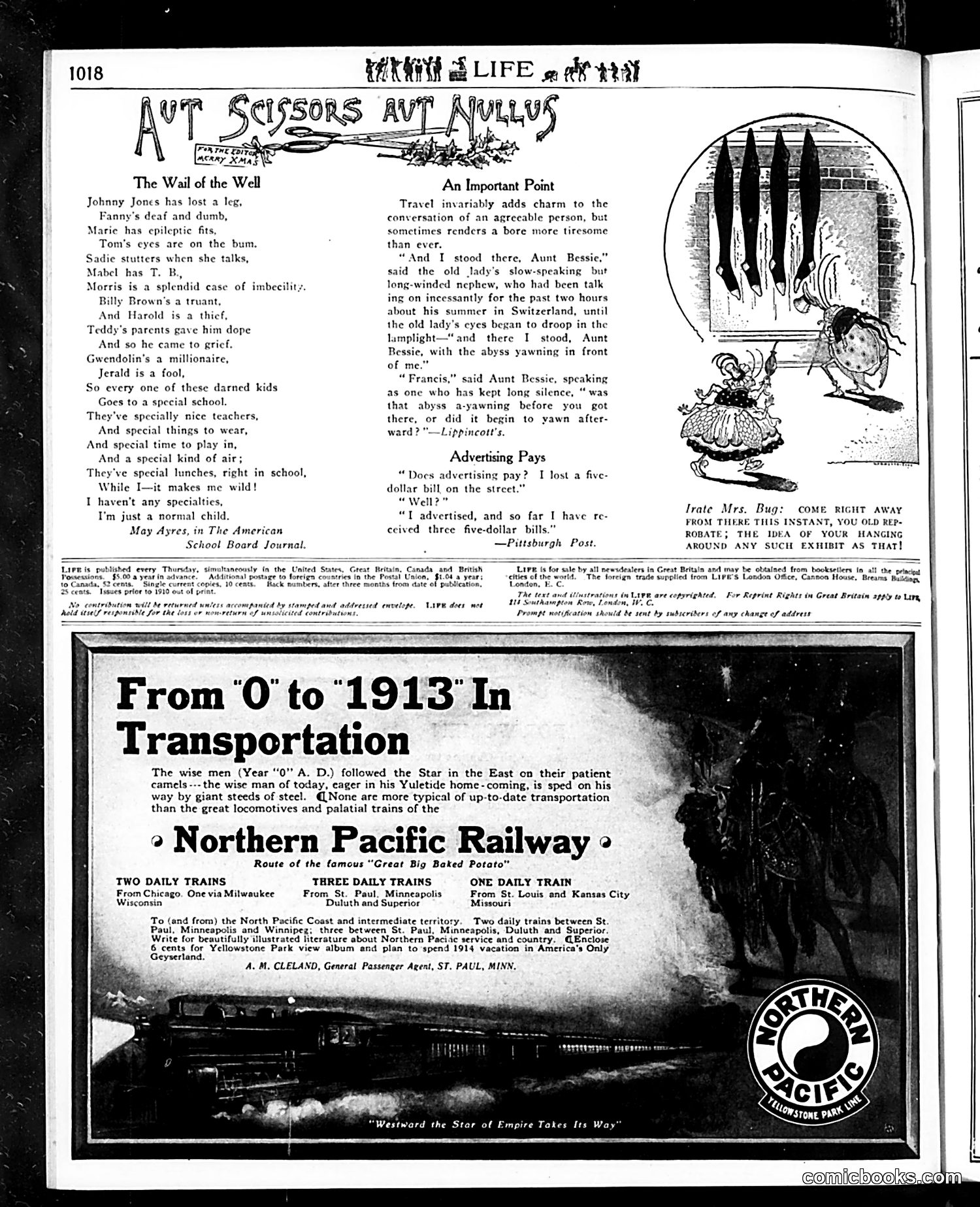
This Life magazine page (1918) contains satirical poetry and humor alongside period advertising. **Top Section - "The Wail of the Well":** A darkly comic poem listing children with various disabilities and social problems (lost limbs, deafness, epilepsy, tuberculosis, truancy, theft, drug addiction). The final child is "just a normal child" with "no specialties"—the joke being that normalcy itself has become the oddity. This reflects early-20th-century anxieties about social welfare and "special" institutional care for marginalized populations. **"An Important Point":** A brief humor piece mocking long-winded travel stories. A nephew's tedious Switzerland anecdote bores Aunt Bessie; she pointedly asks whether his existential crisis preceded or followed his story—gently mocking both his self-importance and his aunt's sarcasm. **"Advertising Pays":** A joke about advertising's effectiveness: someone advertises a lost five-dollar bill and receives three in response. **Bottom - Northern Pacific Railway Advertisement:** A full-page ad comparing ancient wise men following the Star of Bethlehem to modern travelers using locomotives, positioning rail travel as contemporary progress and Christmas travel necessity.
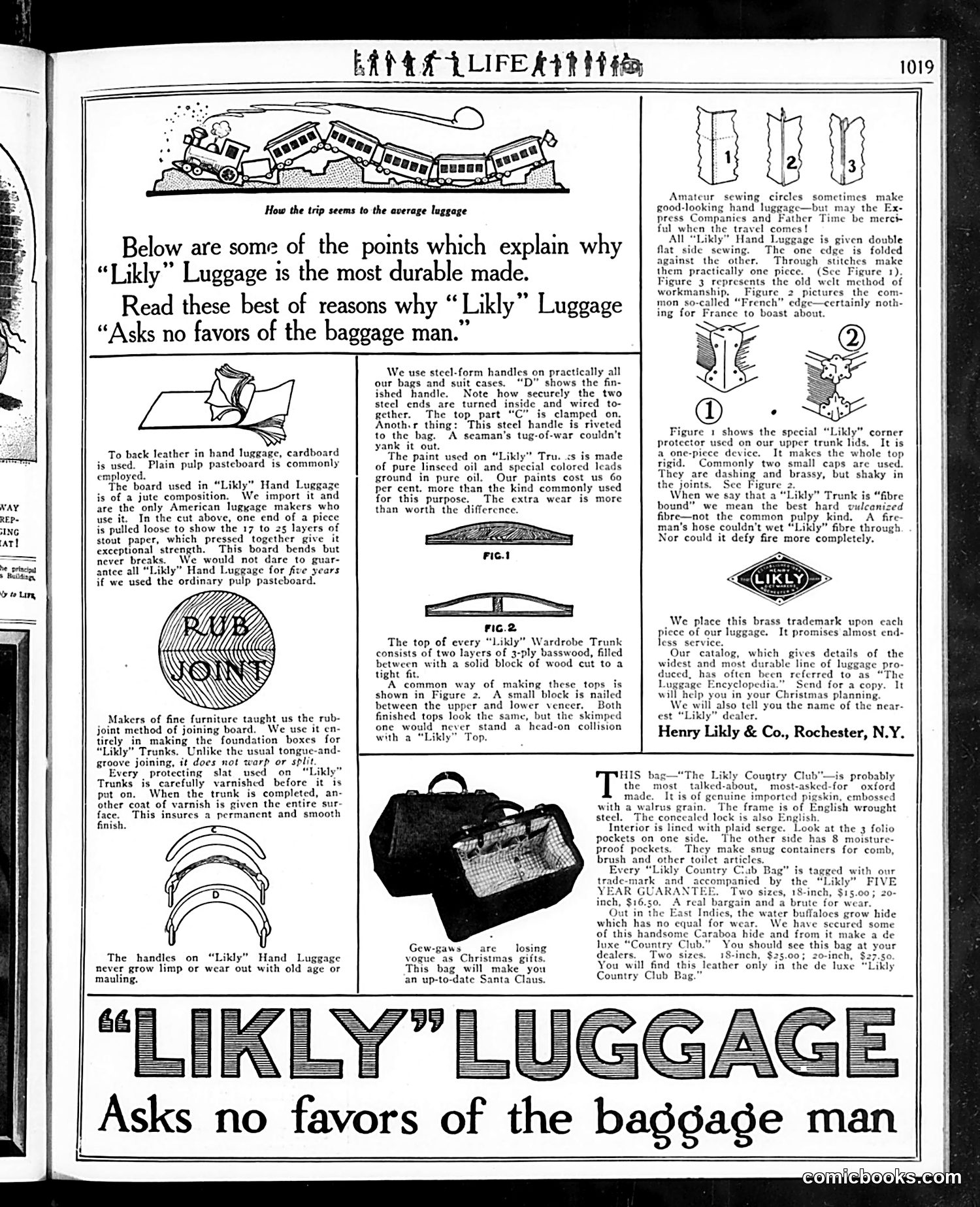
This is primarily a **product advertisement**, not political satire. The page promotes "Likely" brand luggage through detailed explanations of manufacturing superiority. The humorous element—suggested by the cartoon of luggage scattered after a train collision at the top—plays on the **anxiety of 1910s-era travelers** about baggage handling. The ad's tagline, "Asks no favors of the baggage man," appeals to travelers' concerns about rough treatment by railroad workers. The advertisement emphasizes durability through technical details: reinforced jute-composition cardboard, steel handles, quality varnish, and robust construction methods. The repeated phrase "Likely" Luggage promises reliability without depending on gentle handling. The secondary mention of the "Likely Country Club" bag suggests these products were marketed as aspirational, fashionable goods for affluent travelers—appealing to Christmas gift-giving among the wealthy. The satire, if any, is gentle mockery of traveler anxieties rather than social critique.
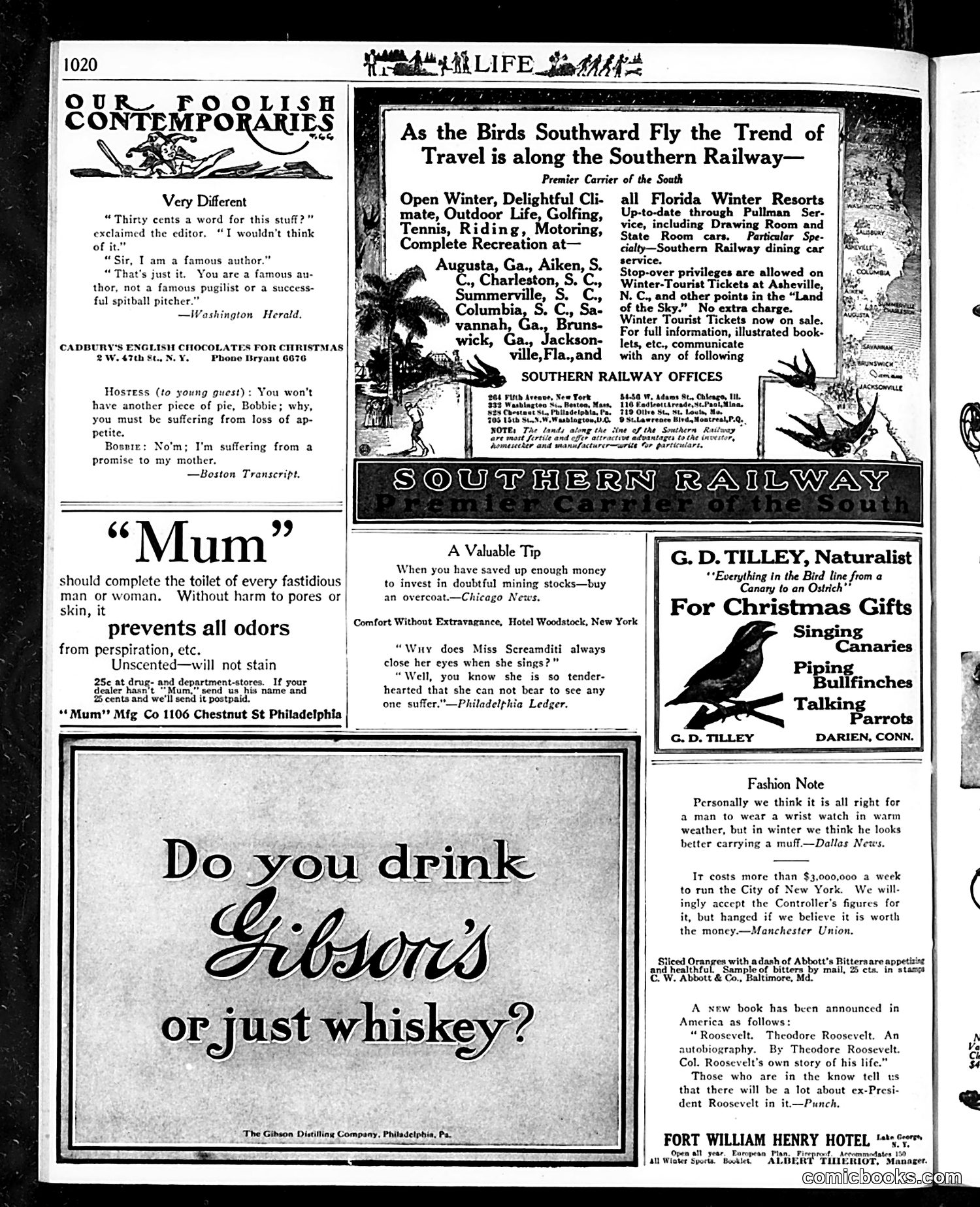
This page contains mostly **advertisements and brief humor items** rather than political cartoons. The satirical content is minor: **"Our Foolish Contemporaries"** presents a joke about authorship: an editor rejects a famous author's work at 30 cents per word, noting that being a "famous author" doesn't make one a "famous pugilist or successful spitball pitcher"—mocking the gap between literary prestige and commercial value. The **two short humor pieces** comment on etiquette: one child promises his mother he won't eat more pie (pretending loss of appetite is polite); another suggests men shouldn't wear wrist watches in winter but should carry muffs instead—likely satirizing changing fashion norms during this era. The page is primarily dominated by **travel and product advertisements**: Southern Railway promotes winter tourism, Cadbury's advertises chocolates, "Mum" deodorant, Gibson whiskey, and G.D. Tilley offers exotic birds for Christmas gifts. The satire is mild and social rather than political—typical of Life's lighter, advertisement-heavy pages during this period.
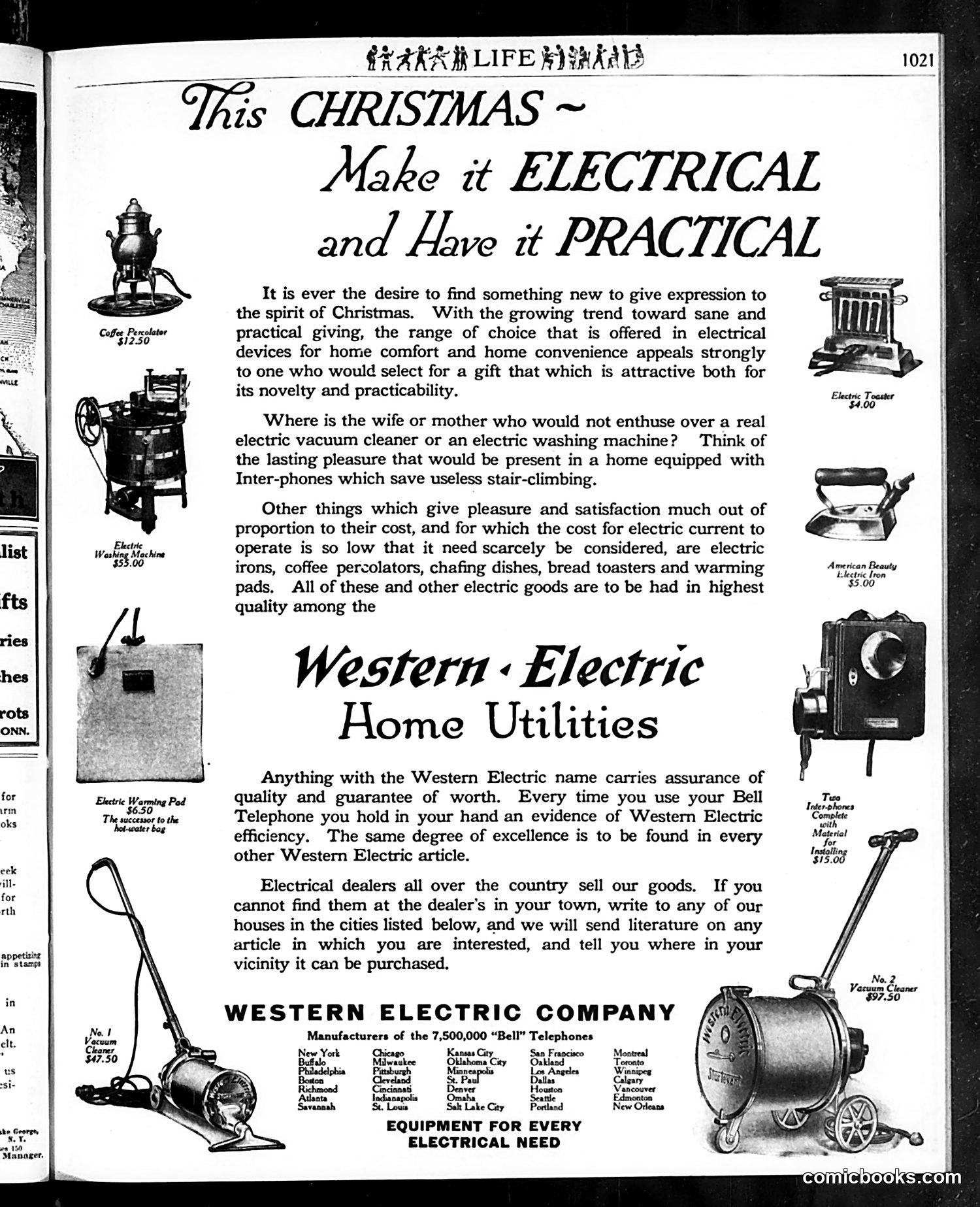
This page is entirely a **Christmas advertisement** for Western Electric Company, not satire or political commentary. There are no cartoons or caricatures to analyze. The ad promotes electrical appliances as practical Christmas gifts during an era (early 20th century) when home electrification was still novel. It appeals to "sane and practical giving"—a subtle shift from luxury items toward household utilities. The copy emphasizes labor-saving devices (vacuum cleaners, washing machines, irons) that would appeal to wives and mothers, reflecting gender assumptions of the era. Western Electric leverages its reputation as manufacturer of Bell Telephones ("7,500,000") to assure quality across its product line. The ad lists offices nationwide and encourages mail inquiries, reflecting the mail-order distribution model of the period. This represents early-1900s consumer marketing during America's electrification boom.
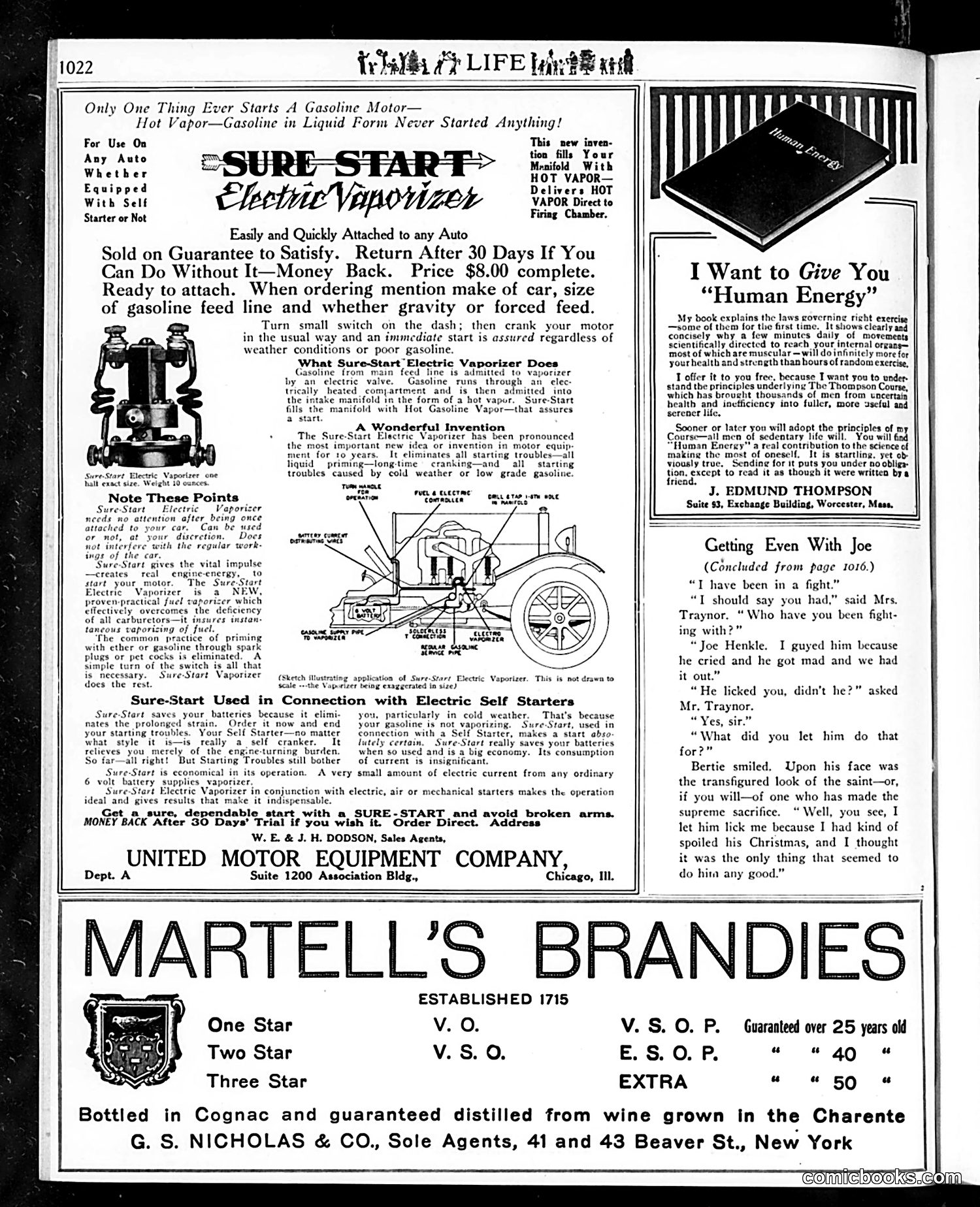
This page consists primarily of **advertisements rather than editorial cartoons or satire**. The dominant content is a product ad for the "Sure-Start Electric Vaporizer"—a automotive starting device claiming to solve cold-weather engine-starting problems by vaporizing gasoline before it enters the engine. The ad uses technical diagrams and testimonial-style language to promote the $8 device, with guarantees and money-back offers typical of early 20th-century marketing. A secondary ad promotes Edmund Thompson's book on "Human Energy" and exercise principles. At the bottom, a **Martell's Brandies advertisement** displays liquor ratings (One/Two/Three Star varieties) with age guarantees, marketed through New York distributors. The only narrative content is a brief story excerpt titled "Getting Even With Joe," continuing from an earlier page, depicting domestic conflict between characters named Joe, Mrs. Traynor, and Bertie. **No political satire or social commentary is present on this page.** It represents typical early 1900s magazine advertising and light fiction content.
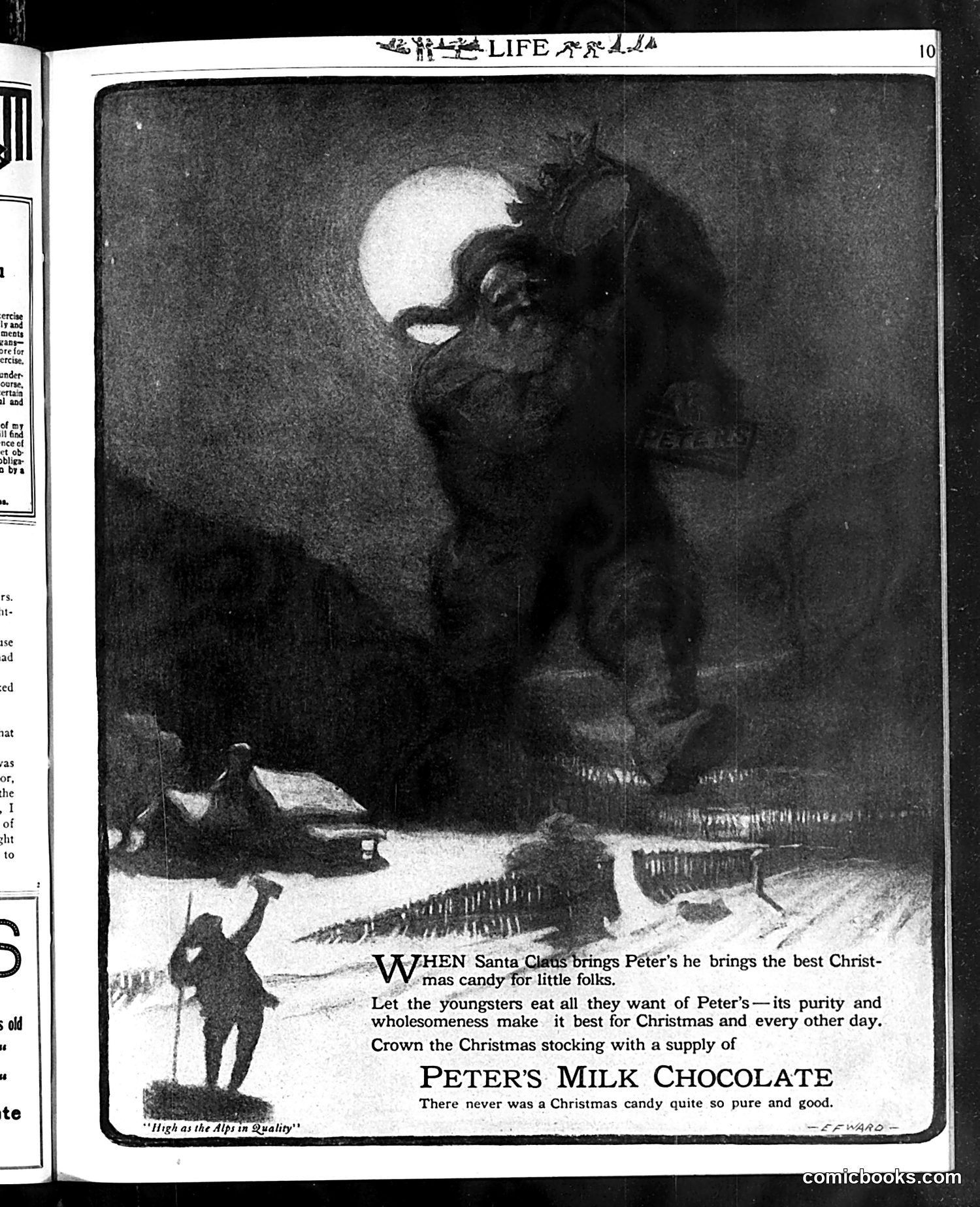
This is a **Peter's Milk Chocolate advertisement** disguised as editorial content in Life magazine. The dramatic illustration shows Santa Claus descending a snowy Alpine mountain at night under a full moon, with a figure skiing below—the caption notes it's "High as the Alps in Quality." The ad uses Christmas sentiment and Santa's authority to market the chocolate as pure and wholesome for children's stockings. The Alps reference suggests Swiss quality (a premium association). There's no satire here—this is straightforward early 20th-century advertising exploiting holiday nostalgia and parental concern for child safety through claims of purity. The theatrical artwork was typical of period print advertising, blending illustrated fantasy with product endorsement.
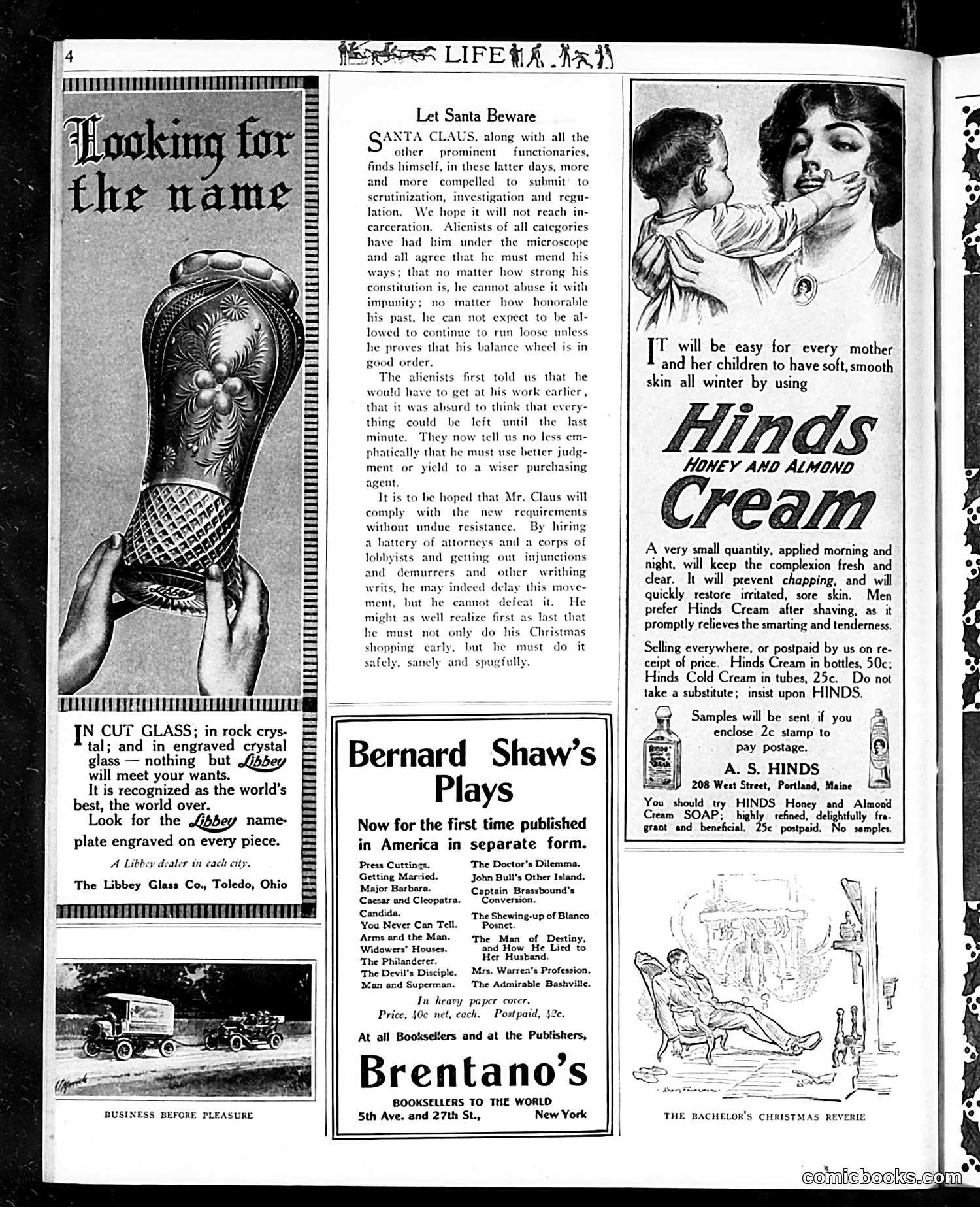
This editorial cartoon satirizes early 20th-century Progressive Era regulatory fervor by imagining Santa Claus subjected to modern scrutiny. The piece mocks how reformers and "alienists" (psychiatrists/reformers) were applying intense investigation to prominent figures, demanding behavioral compliance. The joke: Santa—traditionally autonomous and operating on his own schedule—now faces pressure from authorities to start Christmas shopping earlier, hire lawyers to fight regulations, and prove his "mental balance" is sound. The satire suggests this regulatory zeal has become absurdly intrusive, even targeting beloved institutions. The accompanying illustration shows an ornate sleigh bell—a visual pun on Santa's world being turned upside down by bureaucratic demands. This reflects real Progressive anxieties about government reform overreach, wrapped in humorous fantasy. The page is primarily advertisements with this one satirical article.
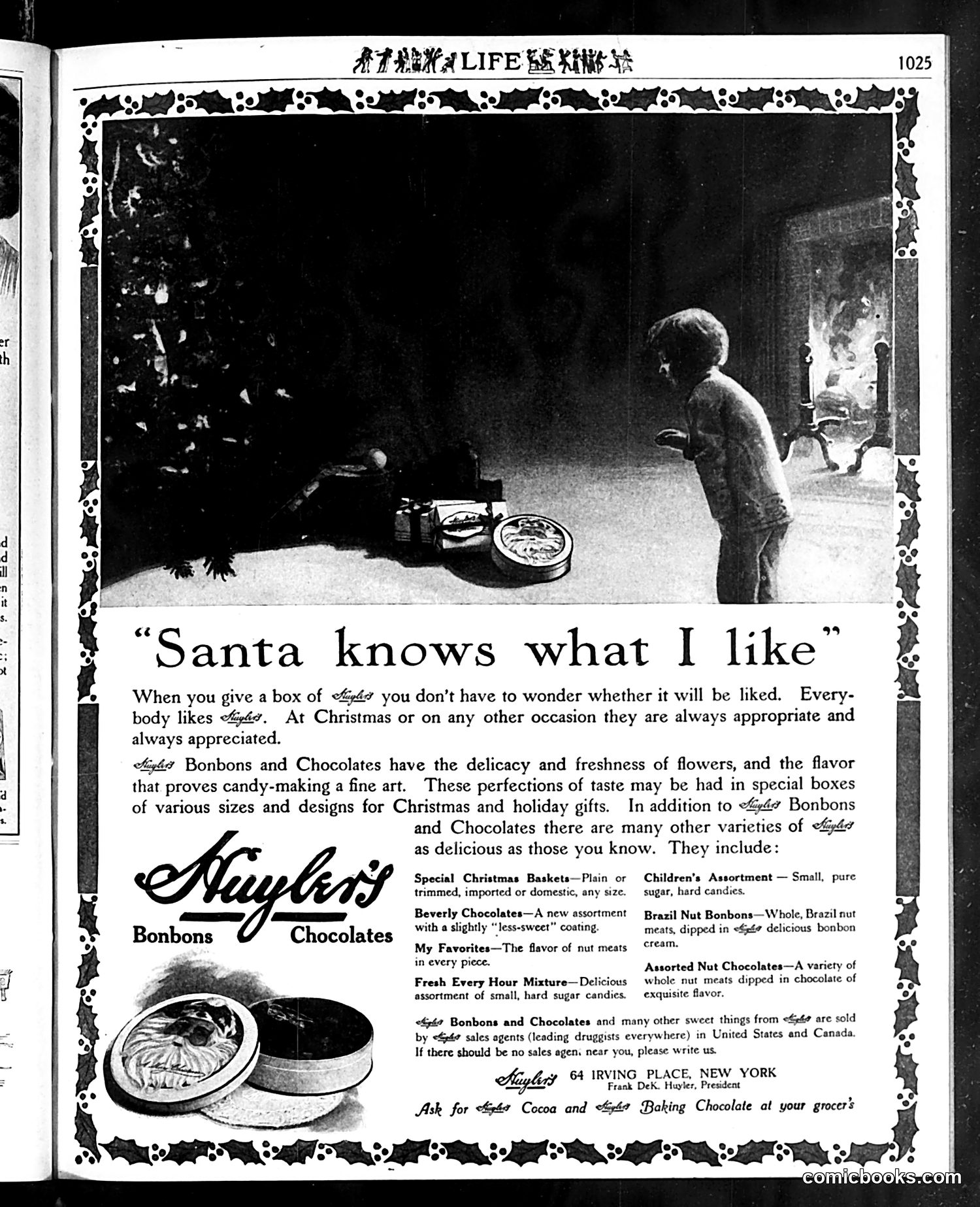
This is primarily a **Christmas advertisement** for Huyler's Bonbons and Chocolates, not a political cartoon. The page features a staged photograph showing a young child on Christmas morning discovering wrapped gifts and a decorated tree, with the tagline "Santa knows what I like." The advertisement's appeal is straightforward: Huyler's chocolates are presented as a reliable, universally appreciated gift suitable for any occasion. The copy emphasizes quality ("delicacy and freshness of flowers") and variety of offerings—from special Christmas baskets to Beverly Chocolates to nut assortments. The company address (64 Irving Place, New York) and distribution method (sold through drugstores nationwide) indicate this is an early 20th-century luxury product marketed to middle and upper-class consumers. No satire or political content is present; this is standard period advertising using sentimentality around childhood and Christmas to sell premium candy products.
This page is primarily **advertising and light humor**, not political satire. The main content includes: **Advertisements:** - Maillard luxury gifts (chocolates, lamps, dolls, decorative items) positioned as exclusive holiday offerings - Hopewell Dainties chocolates ($1/pound) - Chartruse cordial - John W. Mealy & Sons watch bracelet **Humor Pieces:** Two brief anecdotes appear: 1. **"Absent-Minded"** — A college professor, deep in thought, hears a noise under his bed. An intruder answers "No," and the professor remarks he was "positive" someone was there—suggesting his absent-mindedness makes him doubt reality. 2. **"The Usual Result"** — A dialect story (using period-typical racial caricature) about an elderly Black man calling his employer about a mule blocking the street. The joke builds through increasingly absurd solutions (tying strings on ears, building fires) before someone twists the mule's tail, and it gets taken to the hospital—unclear if referring to the mule or the man. Both jokes rely on simple, formulaic humor typical of early 20th-century Life magazine.
This is a full-page advertisement for Club Cocktails, a pre-Prohibition or early Prohibition-era product by G.F. Heublein & Brother. The ad targets holiday hosts by positioning ready-made cocktails as convenient solutions to entertaining during the busy Christmas season. The visual shows decorative Art Deco-style hands pouring from a bottle into glasses, with ornamental grape bunches and classical scrollwork. The text emphasizes the product's reliability and quality—pre-mixed, accurately measured, and aged in wood—contrasting with the potential errors of amateur mixers ("even the best mixer may add too much bitters"). This is straightforward commercial messaging rather than satire. The ad's appeal to hospitality and holiday entertaining reflects early 20th-century affluent drinking culture, when serving cocktails signaled sophistication and social status.
This page is primarily **advertisements** for consumer products (toothbrushes, billiard tables, hosiery), not political satire. The only satirical content appears in "Our Patent Department" section, which presents **fictional humorous "inventions"** mocking domestic life and marriage. The jokes target husbands' frustrations: a buttoner for wives' dresses (implying dependency/helplessness), an "insulter" device for travel, a "gullometer" to measure wives' truthfulness about whether they're awake, and a handkerchief retainer to stop wives from losing items. There's also a joke about wives "winning" arguments through sheer persistence. These reflect **early 20th-century gender stereotypes**—depicting wives as dependent, forgetful, argumentative, and requiring male assistance. The humor assumes male readership frustrated with domestic responsibilities and marital dynamics. The satire is gentle domestic comedy, not political commentary. It reflects the era's attitudes about marriage and gender roles rather than criticizing them.
This page is primarily a **commercial advertisement**, not political satire or editorial cartooning. It advertises **Kelly-Springfield Automobile Tires**, featuring an image of a tire with a woman's face visible through its center hole. The ad's message contrasts hand-made versus machine-made tires, arguing that while factory tires maintain consistent minimum quality, Kelly-Springfield's hand-crafted approach achieves superior standards through individual workmanship. The woman's image appears to be decorative branding rather than satirical commentary. The advertisement lists branch offices across major American cities and associated distributors, indicating this was a nationally distributed product in the early 20th century. There is no political cartoon or satire on this page—it is straightforward commercial marketing typical of *Life* magazine's revenue model.
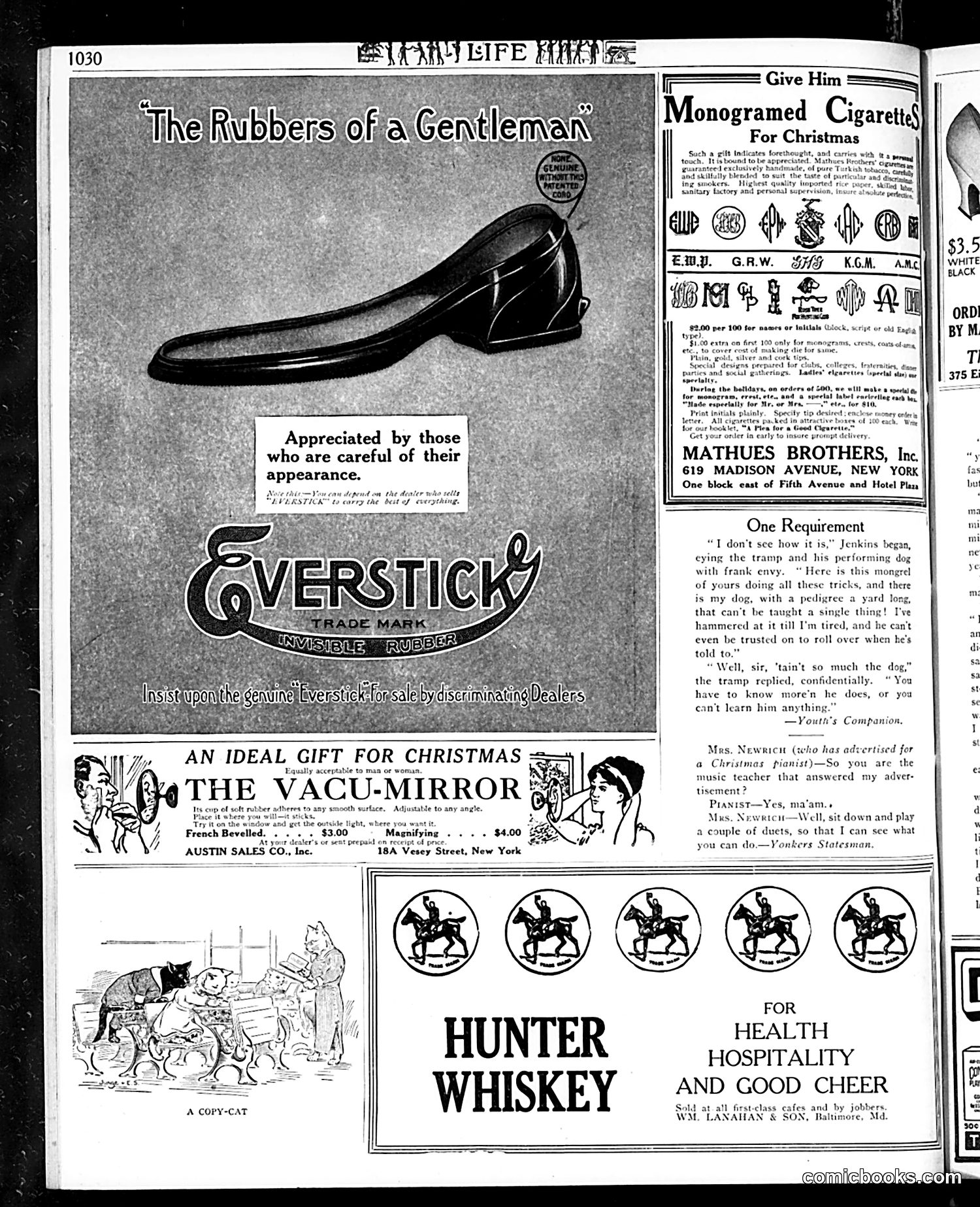
**Main Content:** This page is primarily **advertising** for Christmas gifts, with small humorous columns. The dominant advertisement is for "Everstick" invisible rubber (likely rubbers/galoshes)—marketed to appearance-conscious gentlemen. **The Cartoon & Jokes:** Three brief comedic pieces appear: 1. "One Requirement"—A joke about teaching dogs: a tramp's mongrel performs tricks while an educated gentleman's purebred pedigree dog cannot. The point: knowledge of training matters more than the dog's breeding. This mocks class pretensions about pedigree. 2. Two short advice-column jokes about hiring a pianist and musicians. **Social Context:** The satire reflects early-20th-century anxieties about appearance, class status, and consumer goods as markers of refinement. The invisible rubber ad's tagline—appreciated by those "careful of their appearance"—targets insecure upper-class consumers. The pedigree-dog joke ironizes assumptions that expensive lineage guarantees superiority. This page primarily serves as **Christmas shopping guidance** wrapped around light social satire.
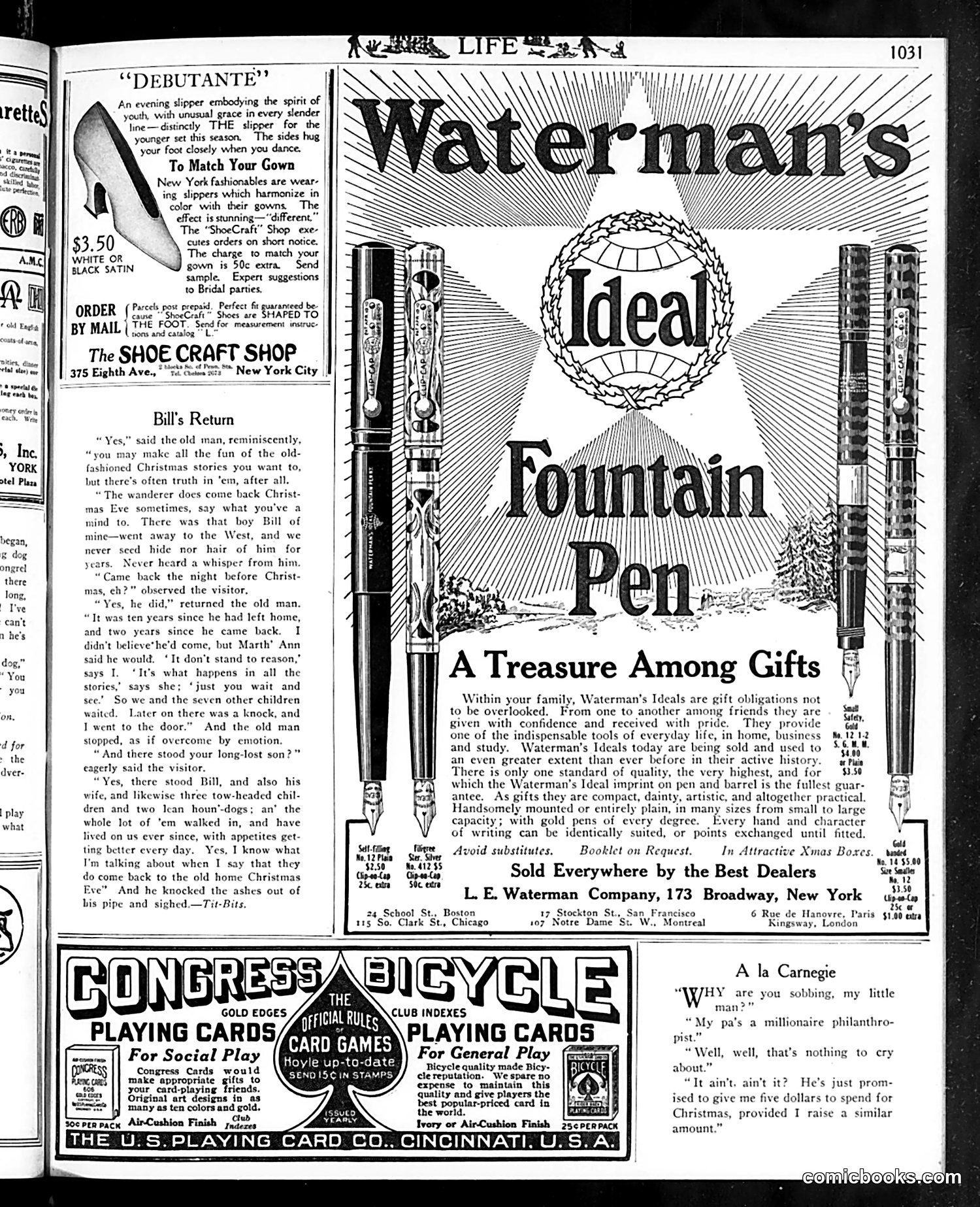
This page is primarily **advertising and light humor**, not political satire. The main content consists of: 1. **"Debutante" shoe advertisement** - promoting fashionable evening slippers that match gown colors, a luxury service for wealthy young women entering society. 2. **"Bill's Return" short story** - a sentimental Christmas tale about a wayward son who unexpectedly returns home after ten years, bringing his wife and children. The humor is gentle irony: the father jokes that while the old-fashioned Christmas story came true, Bill's extended family has now become permanent dependents, eating them "out of house and home" with increasingly hearty appetites. It's a wry commentary on unexpected blessings becoming burdens. 3. **Waterman's Ideal Fountain Pen advertisement** - emphasizing pens as quality gift choices. 4. **Congress Playing Cards advertisement** - promoting card games. The page reflects 1920s consumer culture and mass-market advertising, with no significant political commentary.
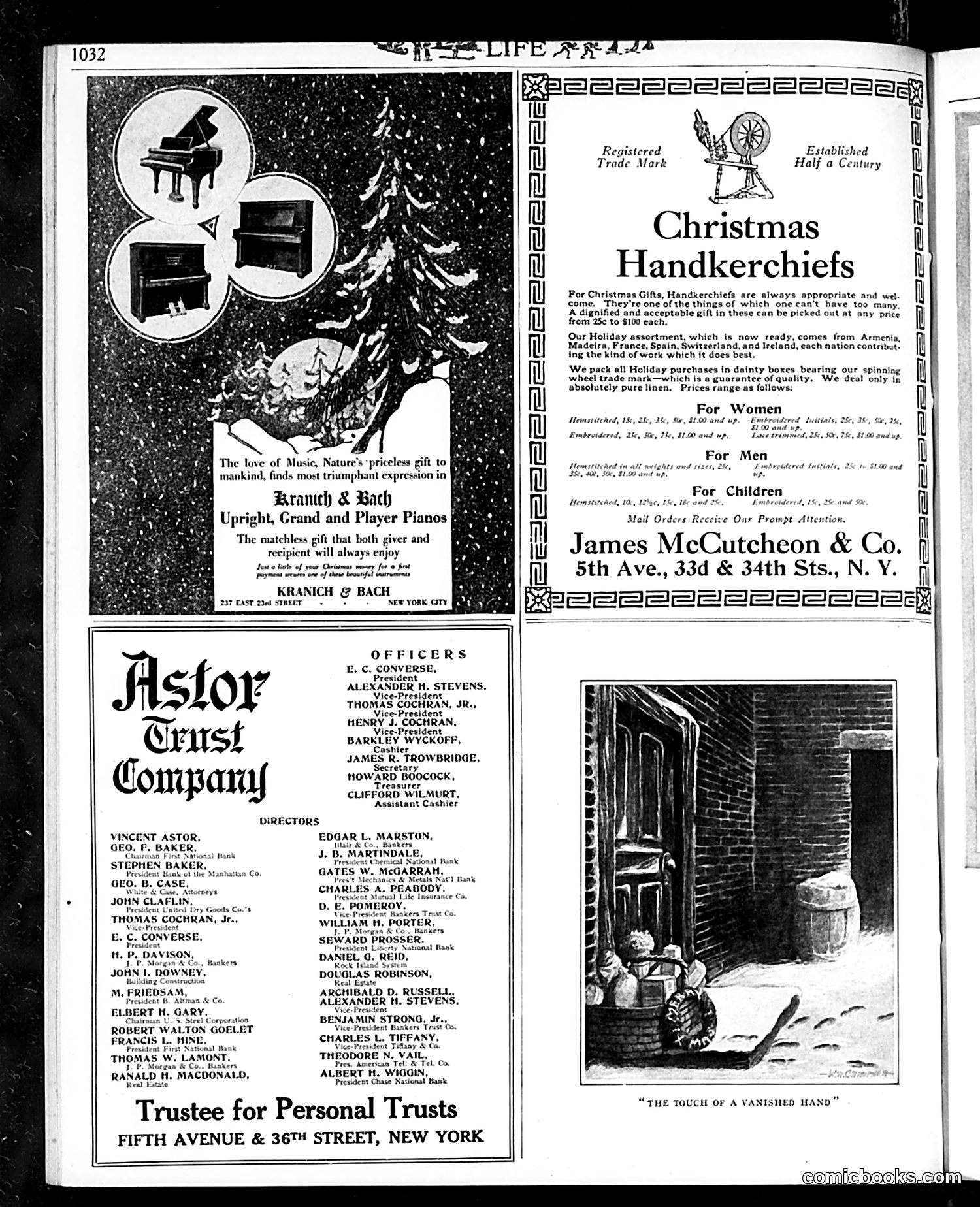
This page is primarily **advertising**, not political commentary. It contains: 1. **Piano advertisement** (top left): Kranich & Bach promotes upright, grand, and player pianos as Christmas gifts, appealing to music lovers. 2. **Handkerchief advertisement** (top right): James McCutcheon & Co. markets imported handkerchiefs from Armenia, Madeira, France, Spain, Switzerland, and Ireland—luxury goods for Christmas giving at various price points. 3. **Astor Trust Company** (bottom left): Listings of corporate officers and directors, establishing credibility as a financial institution. 4. **Illustration** (bottom right): "The Touch of a Vanished Hand"—appears to be sentimental Christmas imagery, likely depicting holiday charity or nostalgia. The page reflects early 20th-century consumer culture: luxury imports, genteel gift-giving, and financial institutions advertising stability. No political satire is evident here.
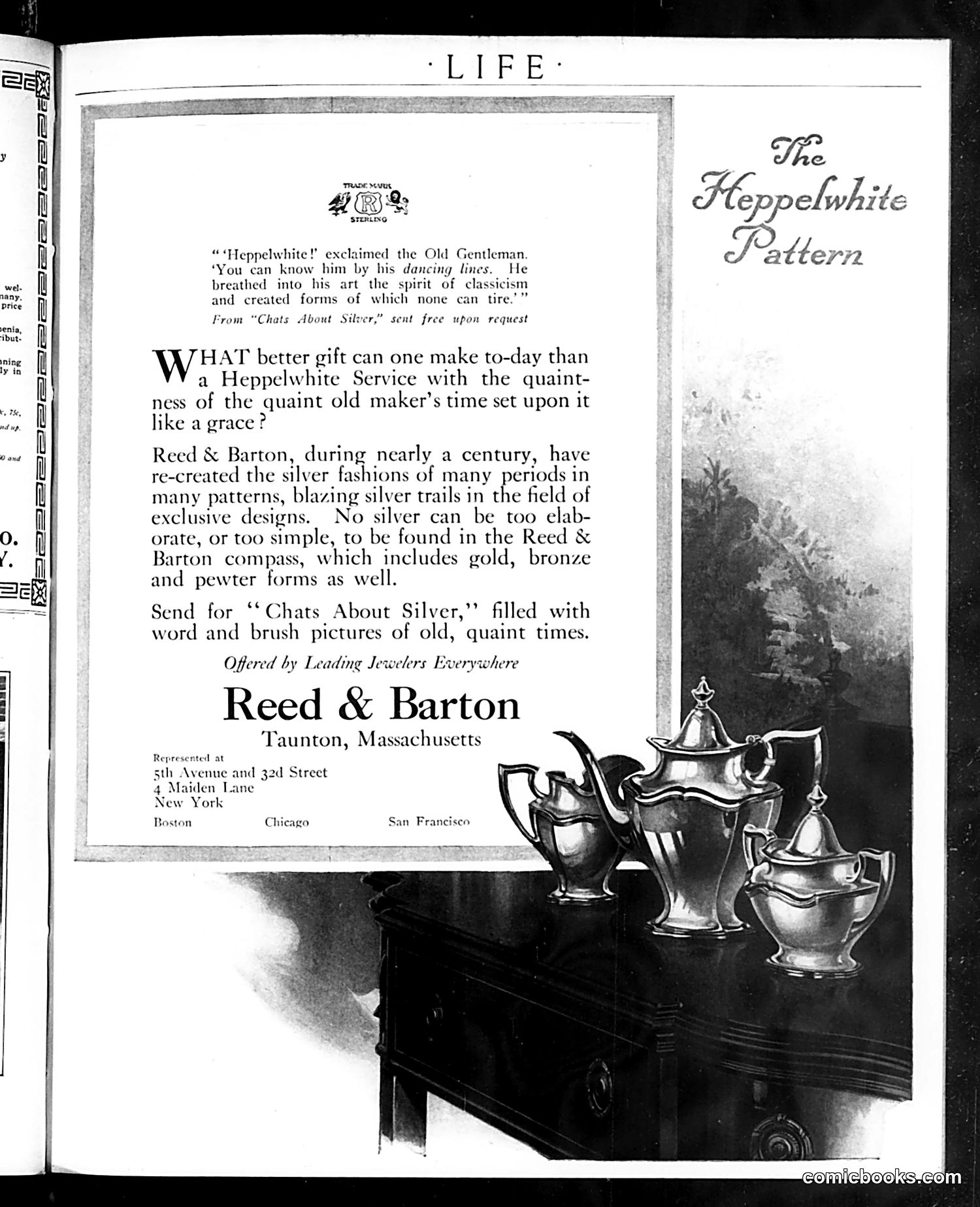
This is primarily an **advertisement**, not a cartoon or satire. It appears in *Life* magazine's advertising section and promotes Reed & Barton, a silverware manufacturer based in Taunton, Massachusetts. The ad features an elaborate quote about "Hepplewhite" (referencing the classical 18th-century furniture style) and positions Reed & Barton's silver products as refined gift options with historical craftsmanship. The decorative silver vessels shown at bottom reinforce this elegant aesthetic. The "Hepplewhite Pattern" title suggests the company marketed their silverware using historical design references to appeal to consumers seeking traditional, sophisticated goods. The ad emphasizes nearly a century of production and availability through leading jewelers nationwide—a standard luxury-goods marketing approach of the era.
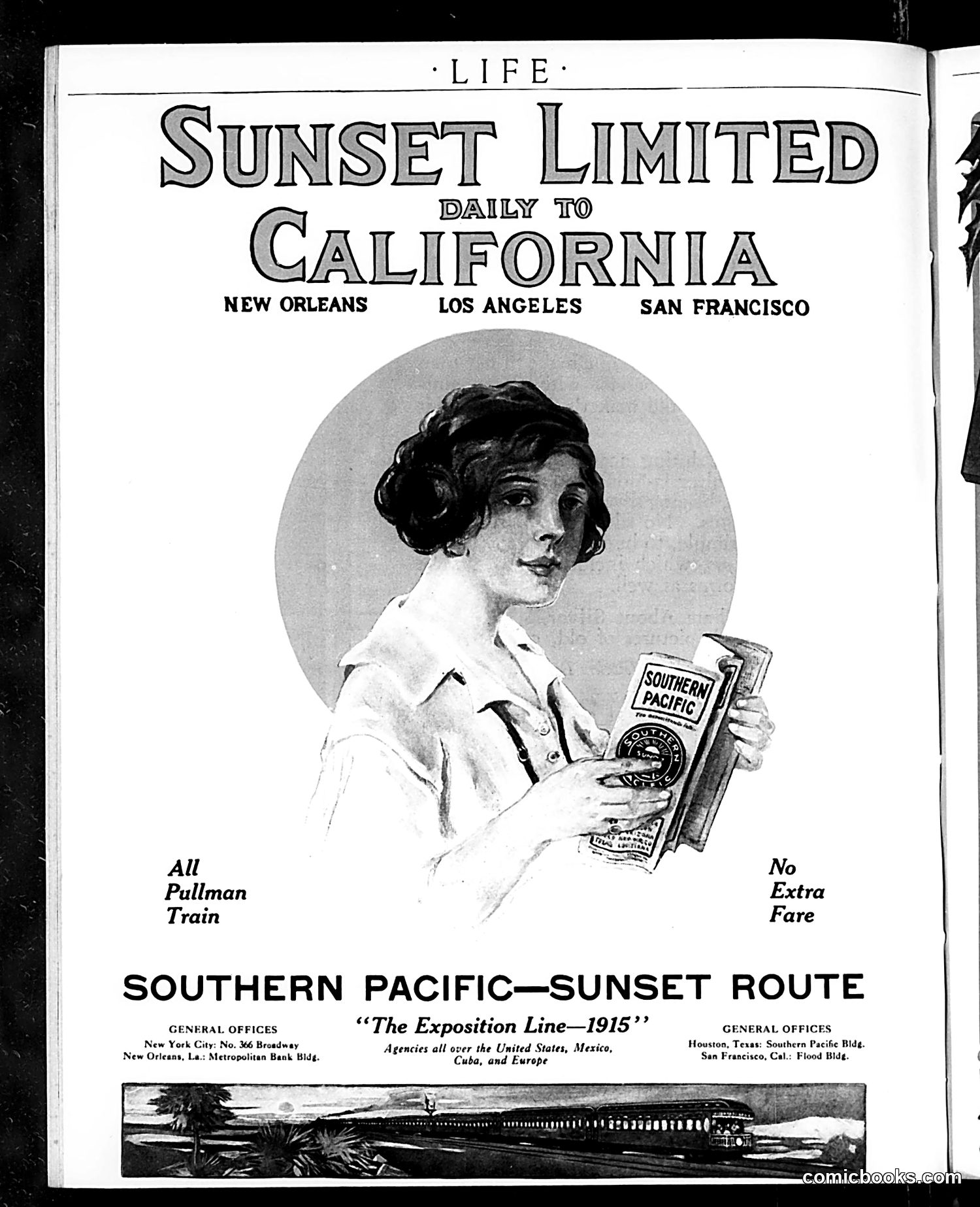
This is primarily a **railroad advertisement**, not political satire. It promotes the Southern Pacific Railroad's "Sunset Limited" train service connecting New Orleans, Los Angeles, and San Francisco. The illustration features a stylized woman in 1910s attire holding a Southern Pacific travel guide or brochure, positioned as an aspirational figure representing leisure travel to California. The "Exposition Line—1915" reference likely alludes to the Panama-Pacific Exposition in San Francisco that year, a major event driving tourism. Key selling points emphasized: all-Pullman train (luxury sleeping cars) and "No Extra Fare" — meaning premium accommodations cost no additional fee beyond the ticket price. The train image at bottom showcases the modern rail service. This represents straightforward commercial promotion rather than satire or social commentary.
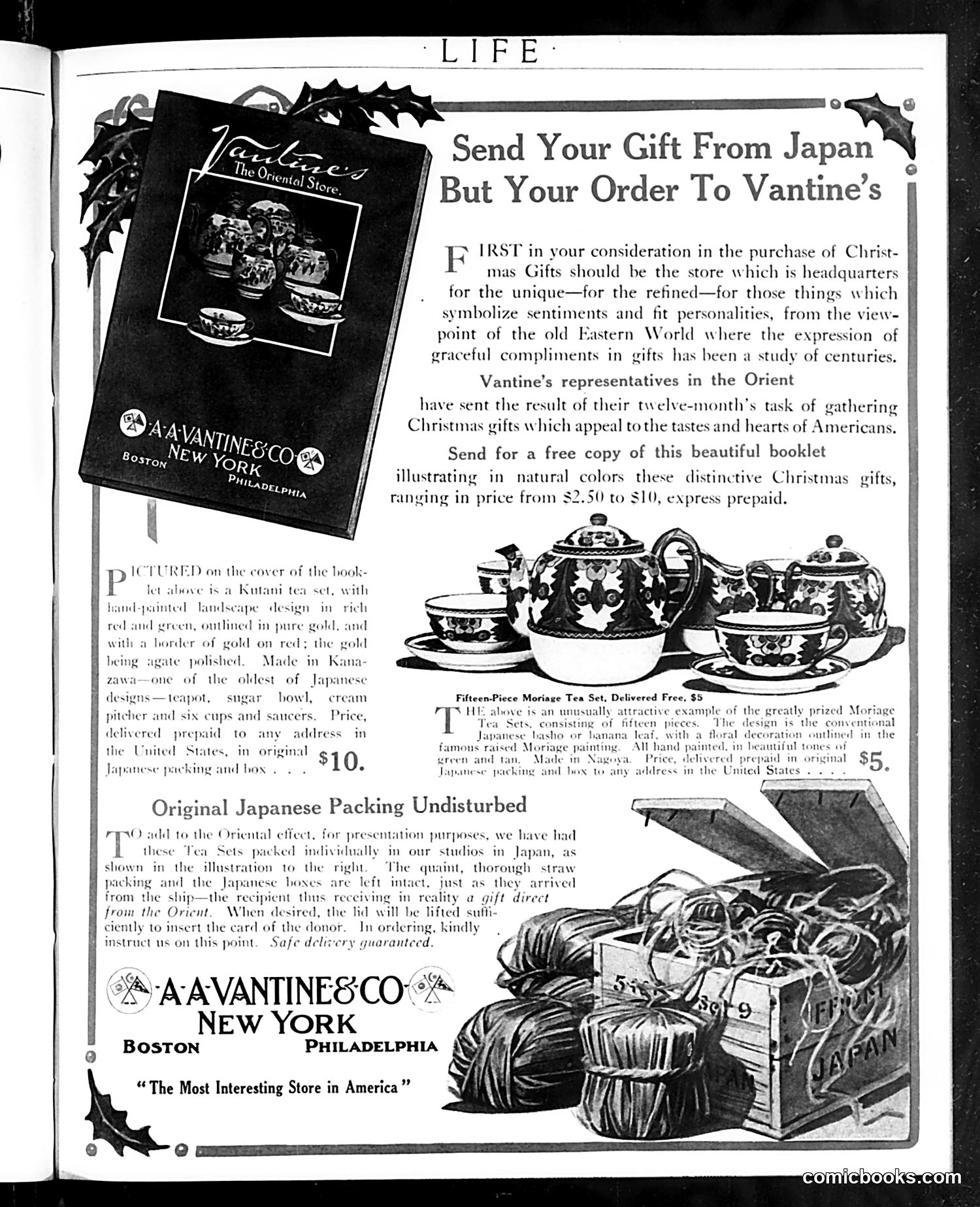
This page is **entirely an advertisement** for A.A. Vantine & Co., a luxury import store. There are no cartoons or satirical content. The ad promotes Japanese tea sets and decorative items as Christmas gifts, priced $2.50–$10. The pitch emphasizes exclusivity and "Eastern refinement"—appealing to early 20th-century American tastes for Japanese aesthetics, which were fashionable following increased trade with Japan. Key selling points include: - Hand-painted Kutani tea sets with gold detailing - "Original Japanese Packing Undisturbed" (goods arrive in authentic Japanese straw packaging) - Free booklet available by mail - Safe delivery guaranteed The ad reflects the period's orientalism—the romanticized Western fascination with Asian culture as exotic and refined. Vantine's positioned itself as the authoritative source for "graceful compliments in gifts" understood through "old Eastern World" traditions, targeting affluent American consumers seeking distinctive holiday presents.
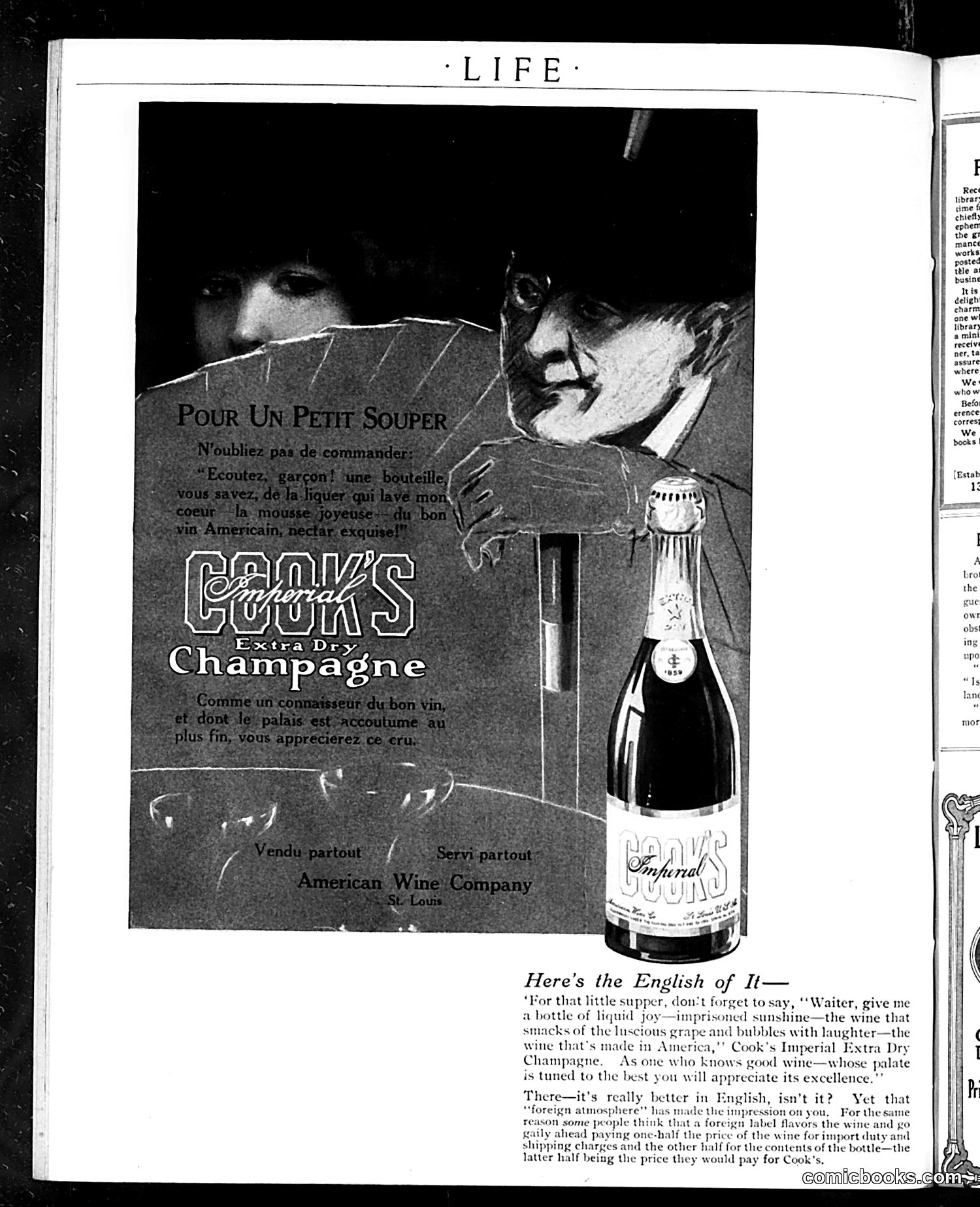
This is primarily a **champagne advertisement**, not political satire. The ad promotes American-made Cook's champagne by mocking consumers' preference for imported French champagne. The "cartoon" shows two figures (a waiter and diner) discussing wine. The French text ("Pour Un Petit Souper") establishes a fancy dining scenario. The advertisement's humor targets American snobbery: it suggests people pay premium prices for French imports solely because of the foreign label and prestige, not superior quality. The "English of It" section translates the supposed sophistication into plainspoken American praise, essentially arguing: Cook's American champagne is equally good but costs half the price—the difference being import duties and shipping fees, not actual quality. It's nationalist marketing exploiting post-WWI American confidence in domestic products while mocking Francophile pretension.
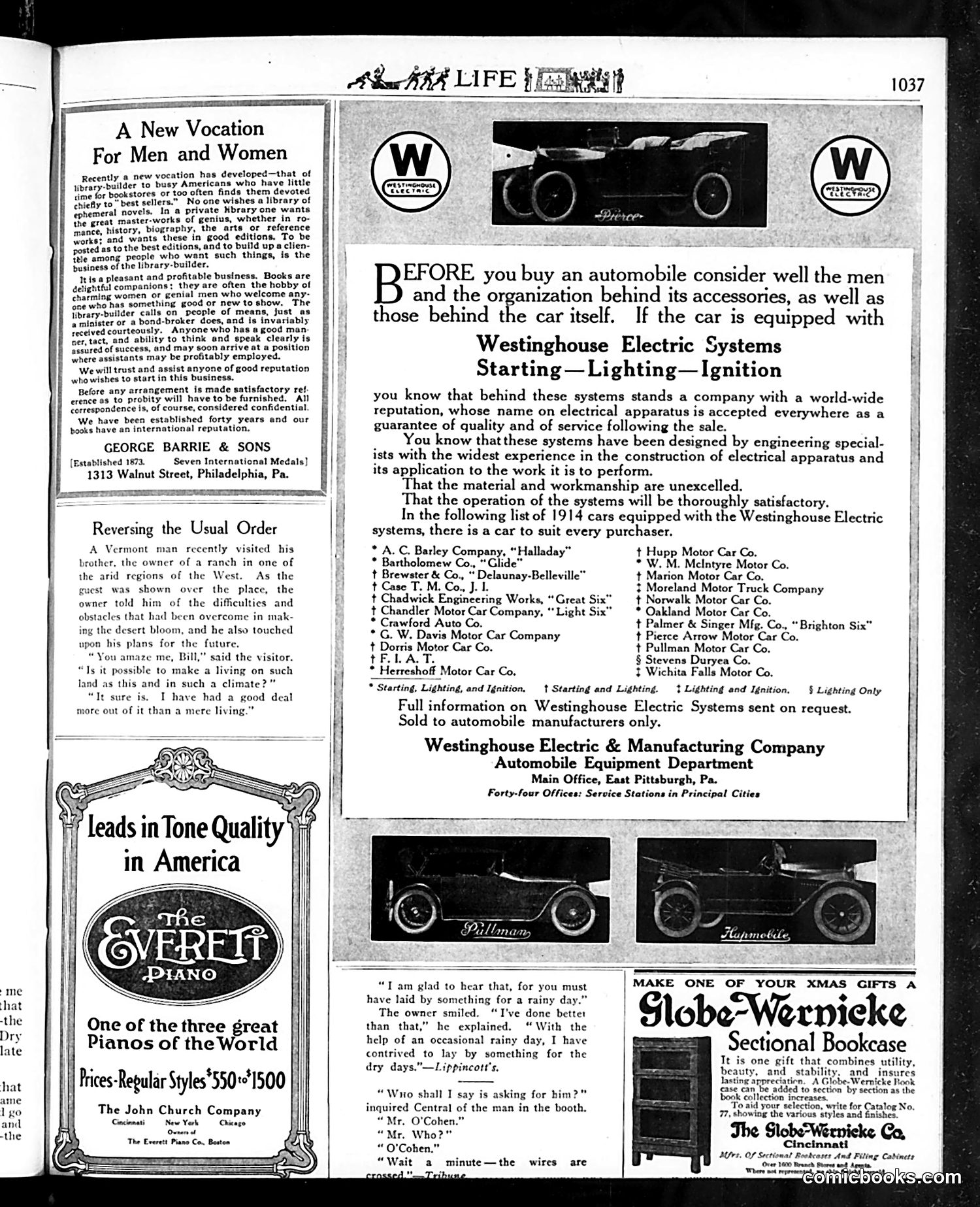
This page contains primarily **advertising, not political cartoons**. The page layout consists of several distinct advertisements and notices: **"A New Vocation For Men and Women"** (left) promotes library-building as a business opportunity—essentially book consulting for wealthy clients. This reflects early 20th-century interest in cultivating private libraries among the affluent. **"Reversing the Usual Order"** (left, middle) is a brief anecdote about a Vermont man surprised that his brother prospers ranching in an arid climate—a modest humor piece about American expansion. **The main advertisement** (center/right) promotes Westinghouse Electric Systems for automobiles, listing 1914 car models equipped with their electrical starting, lighting, and ignition systems. This reflects the era when electric systems were competitive selling points. **Additional ads** promote pianos and a sectional bookcase. The page represents typical Life magazine content from 1914—a mix of light editorial humor and large-scale commercial advertising targeting affluent readers.
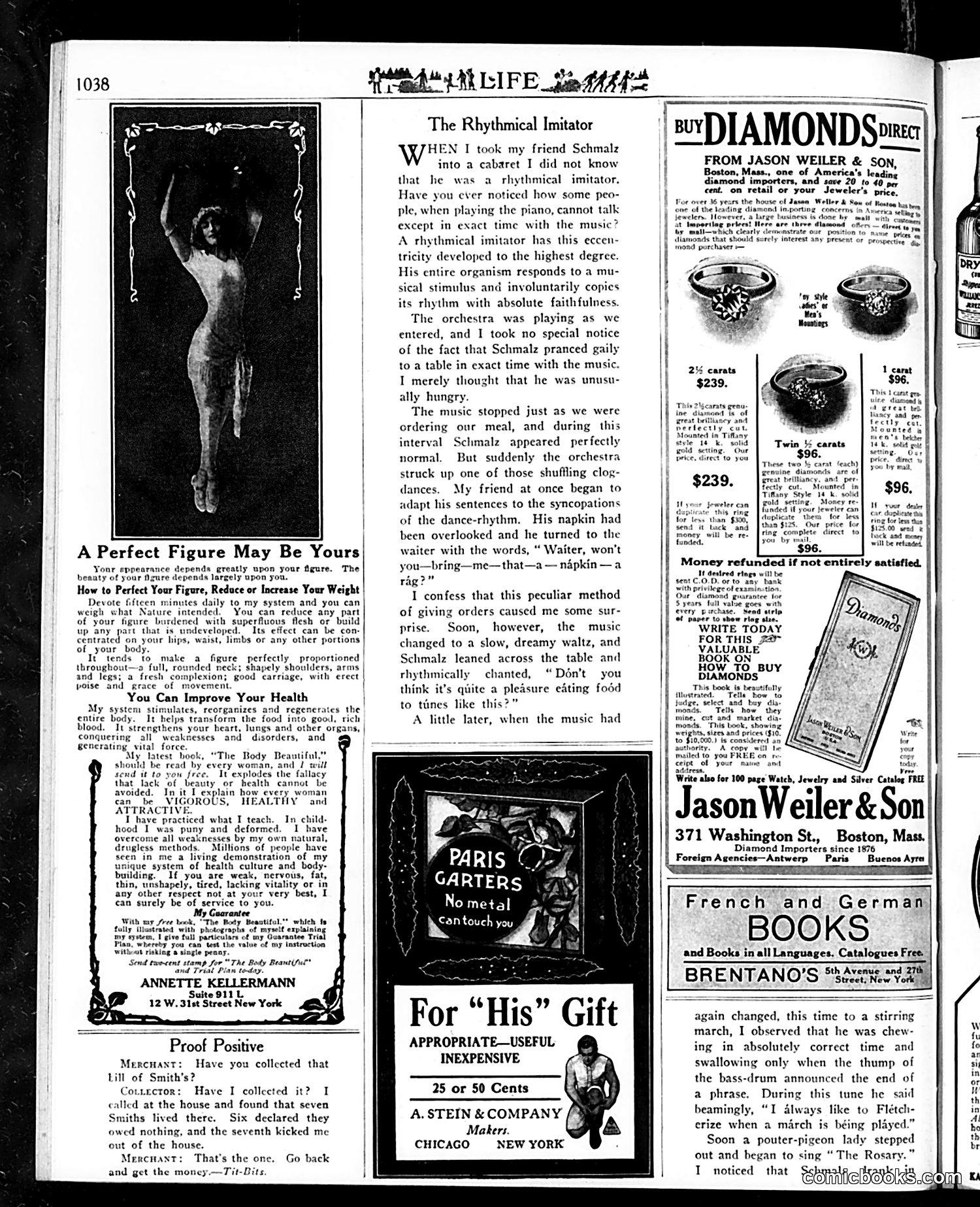
This humorous anecdote describes a man with an exaggerated medical condition: he involuntarily synchronizes all his movements and speech to whatever music is playing. The joke relies on the early 20th-century fascination with oddities and behavioral peculiarities—treating unusual traits as curiosities worthy of observation. When a clogging dance plays, the friend Schmalz speaks in syncopated rhythm, asking the waiter for a napkin by breaking his request into dance-beat syllables: "you—bring—me—that—a—napkin—a—rag?" When the music shifts to a slow waltz, his manner changes accordingly. The satire targets people's tendency to be involuntarily influenced by their surroundings, and perhaps mocks the pseudo-scientific categorization of minor personality quirks as medical conditions. It's a gentle mockery of both the subject and the observer's fascination with human oddities—common entertainment fare in Life magazine's satirical tradition.
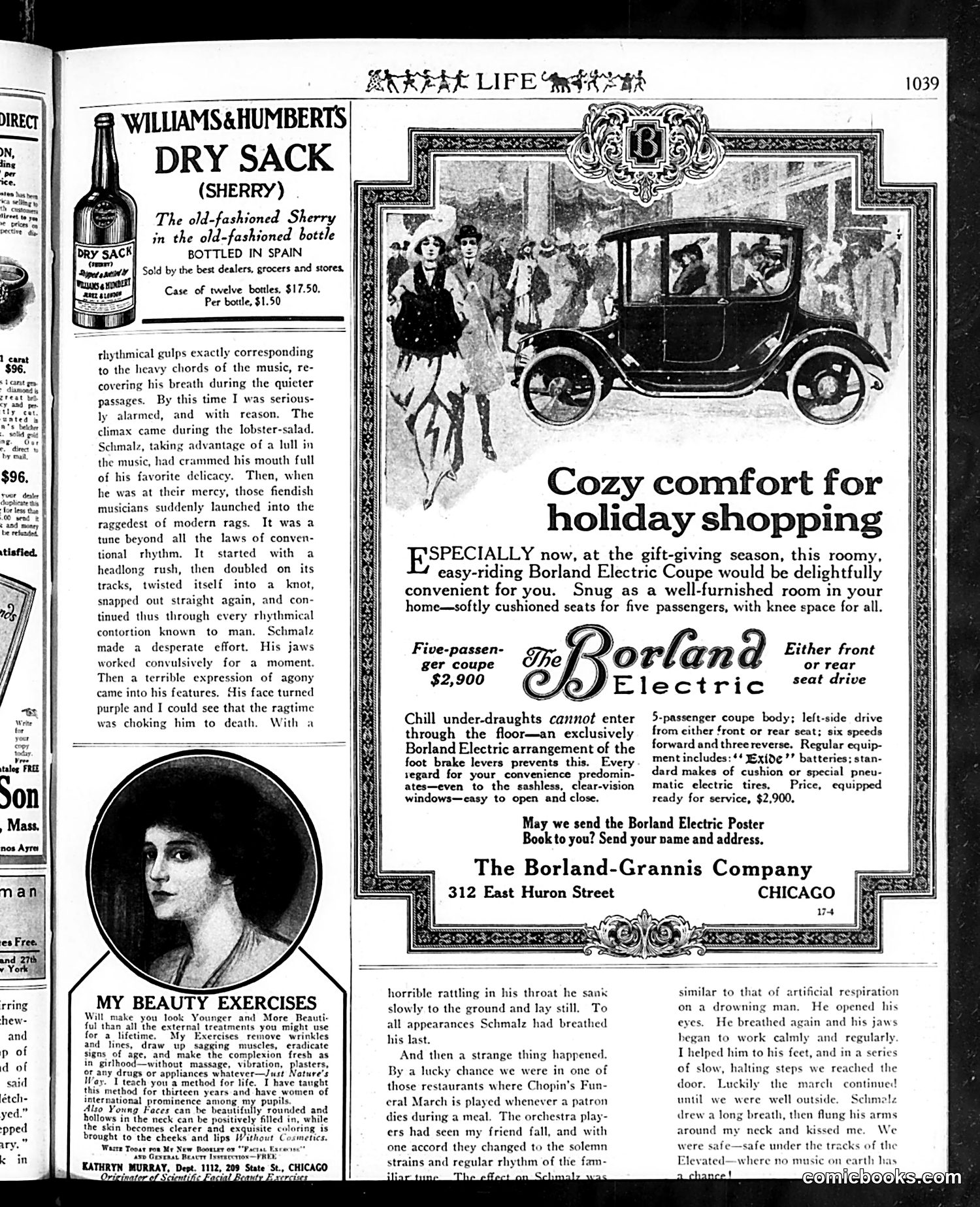
This page is primarily **advertising**, not political satire. The main content consists of three advertisements: 1. **Williams & Humberts Dry Sack Sherry** — a Spanish wine ad 2. **Borland Electric Coupe** — an early electric automobile marketed as convenient holiday shopping transportation 3. **My Beauty Exercises** — a beauty treatment advertisement The text column contains a humorous narrative (likely fiction) about a character named Schmalz who chokes on lobster salad while listening to ragtime music in a restaurant. The story's payoff is ironic: he's revived when the orchestra switches to Chopin's Funeral March—a somber piece ironically played whenever restaurant patrons die. The satire targets ragtime's frantic, "chaotic" rhythms versus classical music's orderliness. The electric car ad emphasizes comfort and practicality for holiday shopping—reflecting 1920s consumer culture and the novelty of electric vehicles as convenient urban transportation.
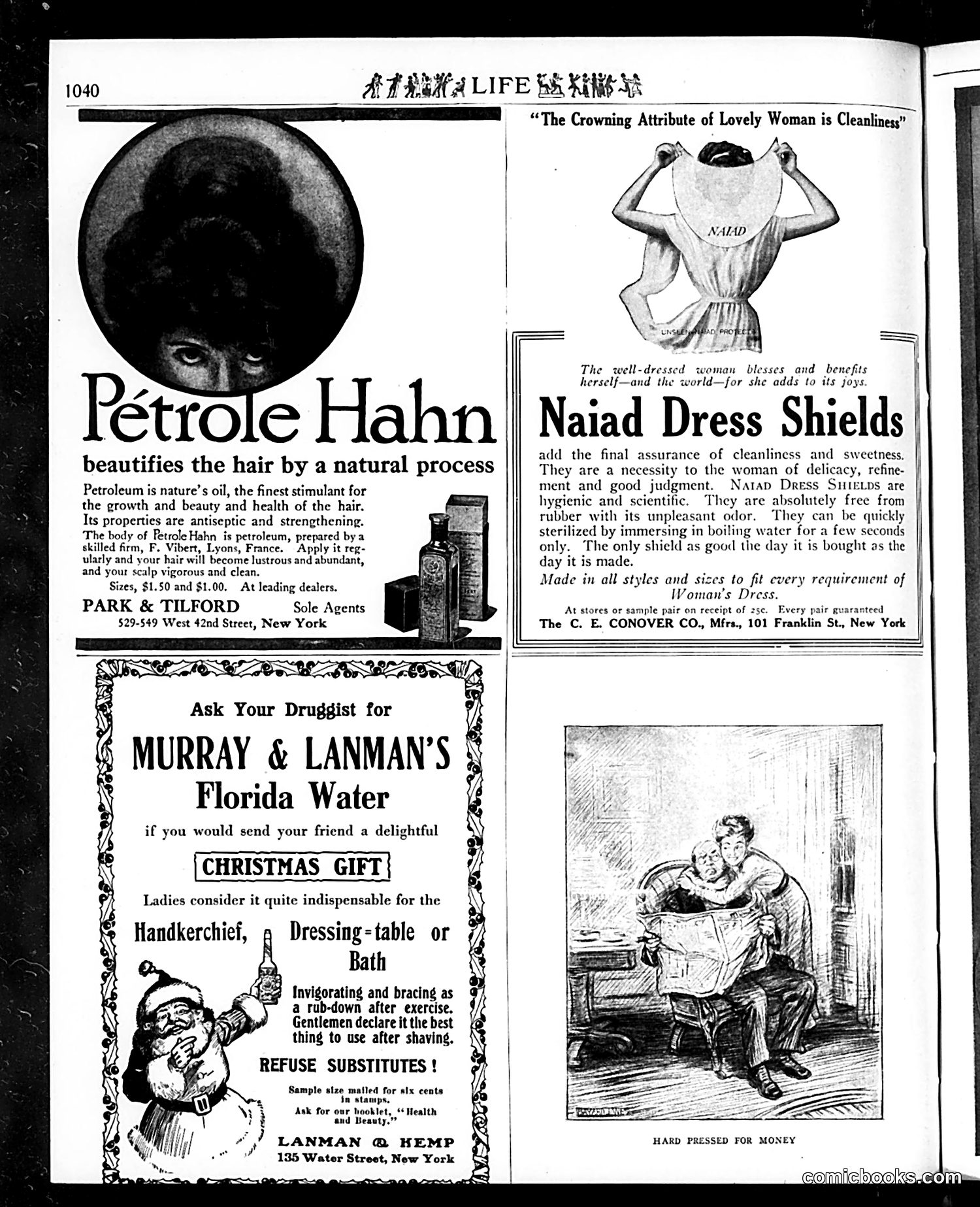
This is primarily an **advertising page** with no political cartoons or satire. It contains four product advertisements from the early 20th century targeting women's hygiene and beauty. The ads reveal period anxieties about cleanliness and femininity: - **Pétrole Hahn**: A petroleum-based hair product claiming antiseptic properties - **Naiad Dress Shields**: Undergarment accessories designed to absorb sweat, emphasizing that cleanliness is "the crowning attribute of lovely woman" - **Murray & Lanman's Florida Water**: A fragrant toilet water marketed as essential for ladies' hygiene - **One illustration** (bottom right, labeled "Hard Pressed for Money") shows a man in distress—likely a cartoon joke, though its specific context is unclear from this page alone The advertisements reflect Victorian/Edwardian concerns with bodily odor and perspiration as social liabilities for women, positioning commercial products as solutions to embarrassment and moral respectability.
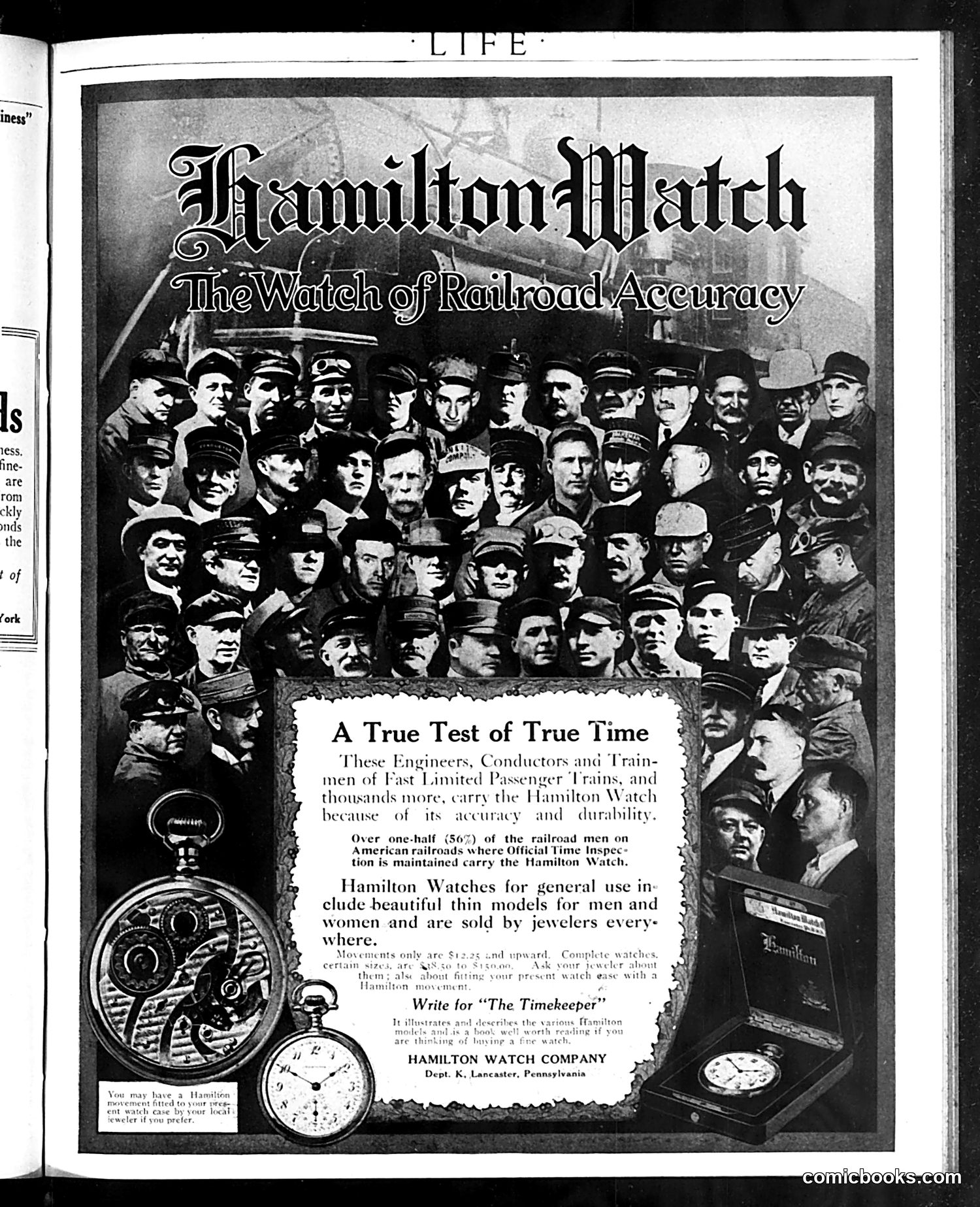
This is primarily a **Hamilton Watch advertisement**, not political satire. The page features a large group photograph of railroad engineers, conductors, and trainmen posed together, with the headline "A True Test of True Time." The advertisement argues that these railroad professionals—responsible for operating fast passenger trains on time—trust Hamilton Watches for their accuracy and reliability. The implication is that railroad workers, whose jobs demand precise timekeeping, validate the product's quality. The page includes images of Hamilton pocket watches and wristwatches. Text promotes general consumer models sold by jewelers, and invites readers to write for "The Timekeeper," a promotional booklet. This represents **early 20th-century industrial advertising**, using working-class credibility and occupational expertise to market consumer goods—a common sales strategy of the era.
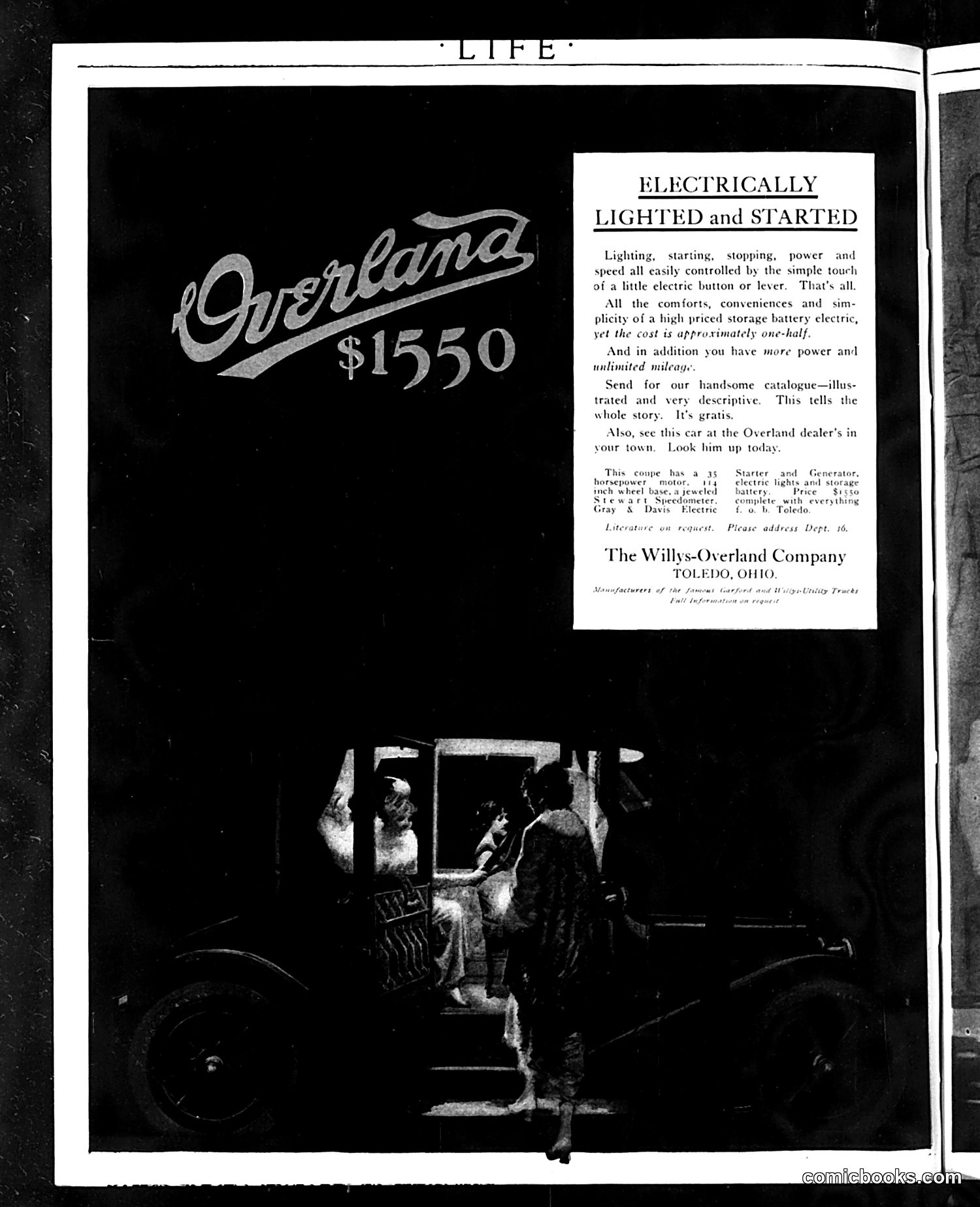
This is primarily a **car advertisement**, not a political cartoon. It promotes the Willys-Overland Company's electric automobile, priced at $1,550. The ad emphasizes the car's modern conveniences: electric lighting and starting via button/lever control—innovations that were still relatively novel in the early automotive era. The text highlights competitive advantages: comparable luxury to expensive electric vehicles but at roughly half the cost, plus superior power and range. The photograph shows a woman seated in the open-air vehicle, likely chosen to demonstrate the car's ease of operation and appeal to affluent consumers. The implicit message is that this sophisticated technology is now accessible to the middle class. This reflects early 20th-century automotive marketing, when electric cars competed vigorously with gasoline models before eventually losing market dominance.
This is a cigarette advertisement from *Life* magazine featuring "Egyptian Deities" branded cigarettes, marketed as "The Utmost in Cigarettes" with "Plain or Cork Tip" options. The ad uses Egyptian imagery—colossal statues flanking a temple entrance with crowds of tiny figures below—to associate the product with ancient grandeur and exoticism. A cigarette package floats prominently in the center. The accompanying text (partially visible on the left) appears to make a humorous comparison, though it's difficult to read completely in this image. The satire likely plays on the absurdity of marketing cigarettes using monumental Egyptian architecture, or makes a joke connecting smoking to Egyptian mummies or mortality. This reflects early 20th-century advertising's casual use of exotic imagery and *Life* magazine's satirical approach to commercial culture.
This is primarily a **beer advertisement**, not political satire. The ad promotes Pabst Blue Ribbon beer with the tagline "The Beer of Quality." The image depicts a domestic scene: a woman in an elegant white dress pours beer for a seated man in formal attire. The headline "The Evening Glass of Cheer" frames beer consumption as a refined, leisurely evening ritual for the middle class. The advertisement reflects early 20th-century gender roles and marketing: the woman serves while the man relaxes, presenting beer-drinking as a civilized, domestic pleasure rather than saloon excess. This type of advertising was common before Prohibition (1920-1933), normalizing alcohol consumption within respectable households. There is no political cartoon or satire visible on this page—it's straightforward commercial messaging using idealized imagery of domesticity and leisure.
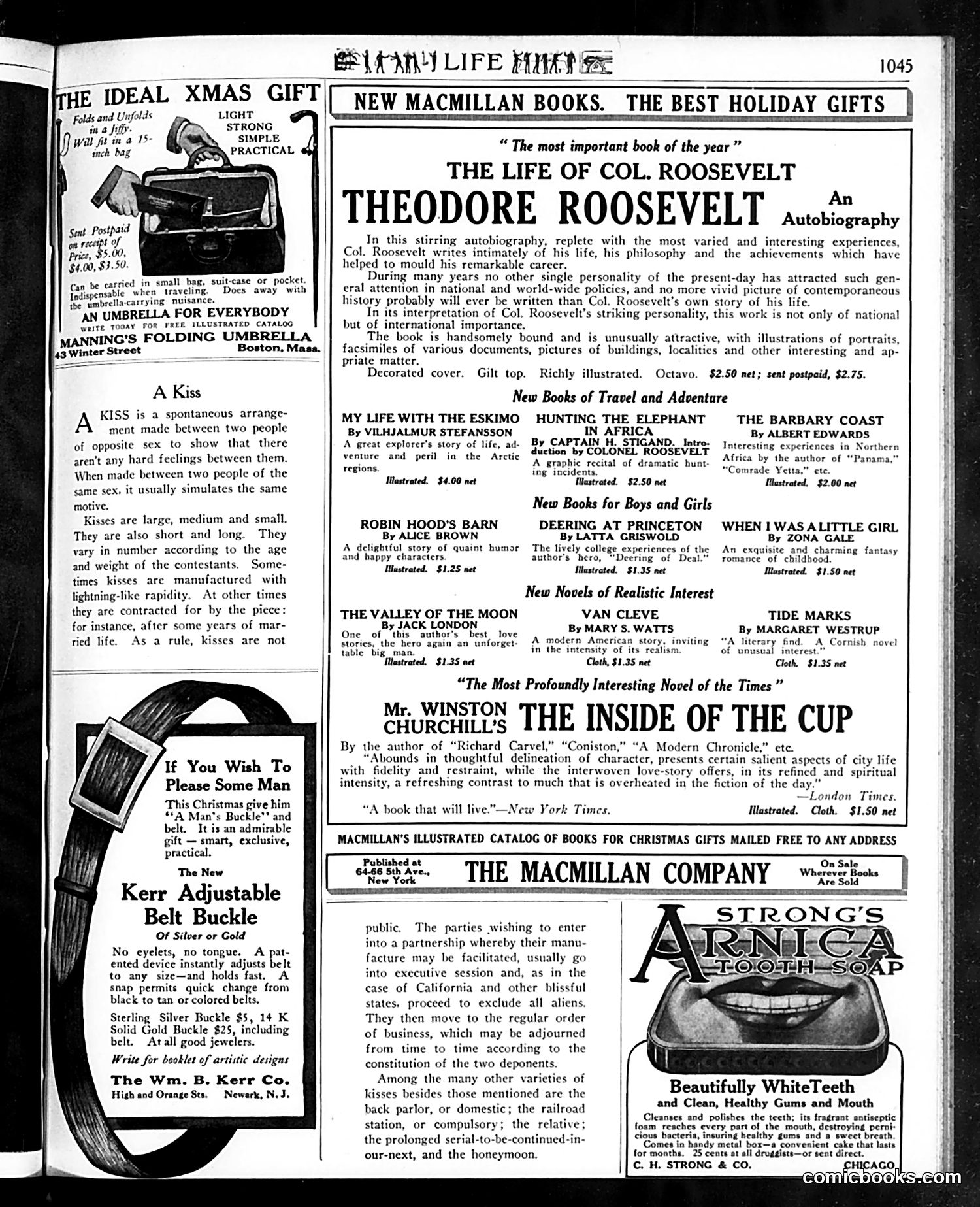
This is primarily a **book advertisement page** from *Life* magazine, not a satirical cartoon page. The main content promotes new Macmillan publications as Christmas gifts. The notable editorial content is a humorous essay titled "A Kiss" that defines kisses between opposite-sex and same-sex pairs, observing their variations in size, duration, and frequency—including the sardonic note that married couples "contract for" kisses "by the piece" after years together. This is gentle domestic satire about marital affection cooling over time. The page also advertises Theodore Roosevelt's autobiography prominently, reflecting his significant cultural prominence in this era. Several travel and adventure books are promoted, some with Roosevelt's endorsement, indicating his influence as a public figure. The remaining advertisements (umbrellas, belt buckles, tooth soap) are standard commercial notices. There are **no political cartoons** on this page—it's essentially a holiday shopping guide masquerading as editorial content.
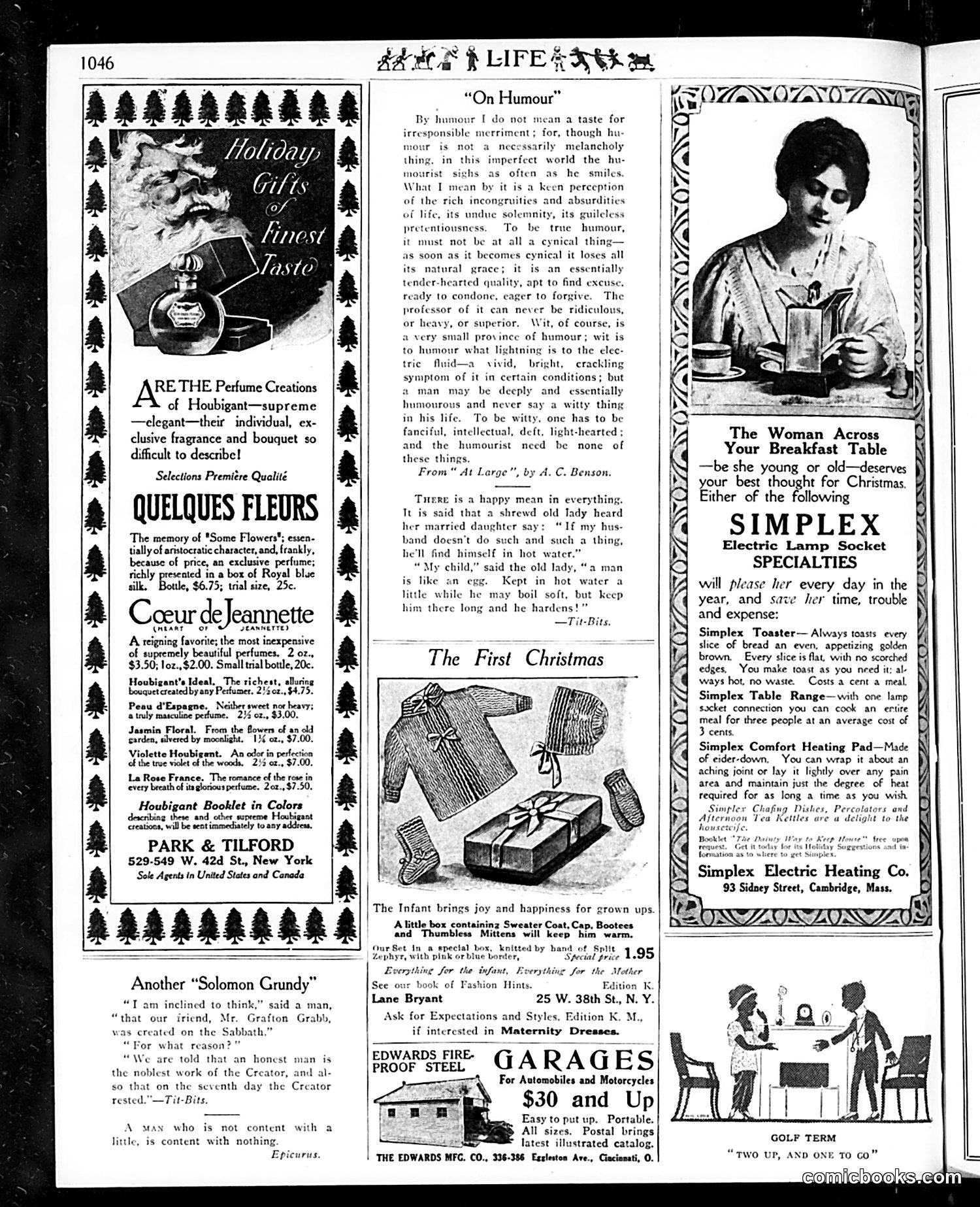
This page is primarily **advertising and light humor content**, not political satire. **The Advertisements:** The dominant left column promotes luxury perfumes from Houbigant (via Park & Tilford), emphasizing exclusivity and high prices—targeting affluent readers. The right side advertises practical gift items: Simplex electric appliances (toasters, heating pads, lamp sockets), Lane Bryant maternity clothing, and Edwards fireproof steel garages. **The Humor Pieces:** Brief anecdotes and quotes occupy the center and bottom: - An essay "On Humour" defining humor as sympathetic perception of life's contradictions, distinct from mere wit - A "Solomon Grundy" joke about Mr. Grafton Grabb being "created on the Sabbath"—playing on the biblical paradox that God rested on the seventh day yet created man as His noblest work - A domestic anecdote about hardening husbands through prolonged "hot water" **Context:** This reflects early 20th-century Life magazine's blend of luxury consumer culture with gentle, whimsical humor aimed at educated middle-to-upper-class readers. No significant political content is present.
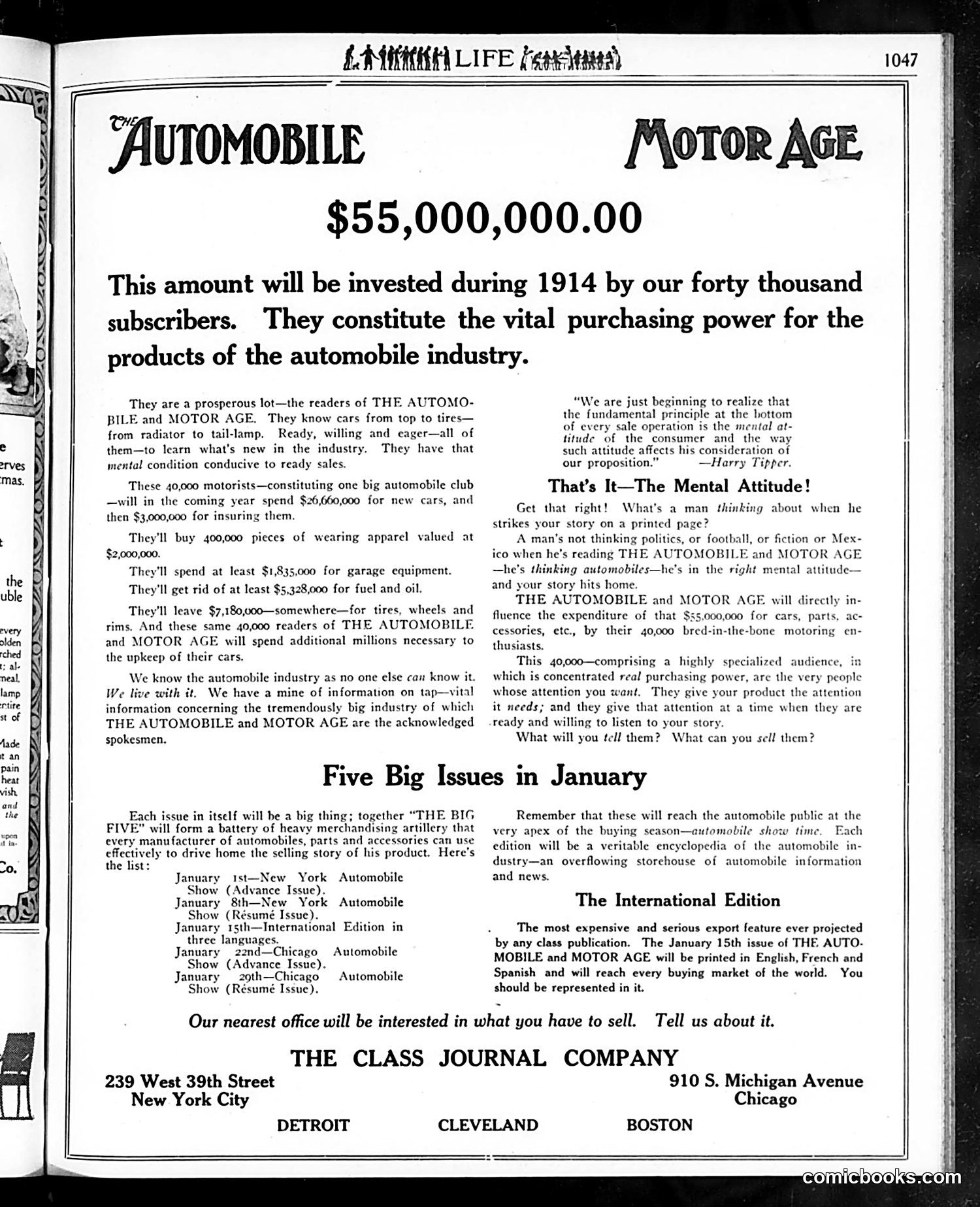
This is primarily an **advertising pitch**, not satire or political cartoon. The Class Journal Company is promoting *The Automobile* and *Motor Age* magazines to potential advertisers. The "satire" is subtle: the ad mocks consumer behavior by claiming 40,000 magazine subscribers represent the automobile industry's "vital purchasing power," then meticulously calculates their spending down to $5.3 million on fuel and oil. This obsessive quantification of consumer habits—treating readers as predictable purchasing units—ironically reveals the era's emerging **consumer marketing psychology**. The key phrase "mental attitude" appears twice, referencing advertising executive Harry Tipper's then-novel concept that consumers in the "right mindset" (reading car magazines while thinking about cars) are primed to buy. The humor lies in treating readers as market demographics to be manipulated rather than thinking individuals—a proto-modern advertising cynicism that would have struck 1914 readers as both clever and vaguely unsettling. No political figures or events are referenced; this reflects early 20th-century marketing innovation itself.
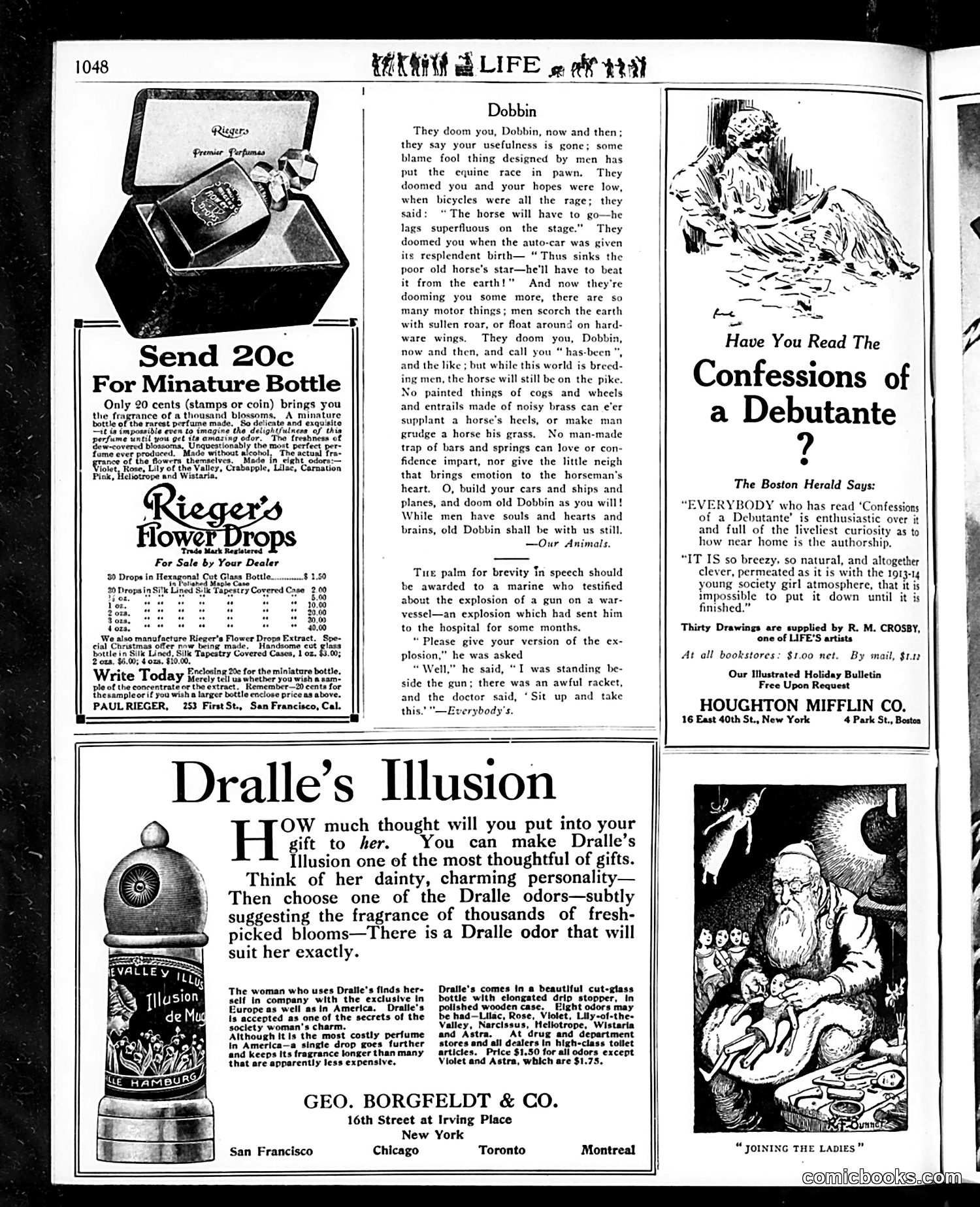
This page is primarily **advertising**, with one notable satirical poem. The dominant feature is a sentimental poem titled "Dobbin" addressing a horse facing obsolescence. The poem defends horses against repeated predictions of their demise—first from bicycles, then automobiles, and various mechanical innovations. The satire lies in its earnest, emotional defense: while men invent "painted things of cogs and wheels," horses possess irreplaceable qualities—loyalty, emotion, the meaningful "little neigh" that connects to the horseman's heart. The joke is that despite constant technological disruption, horses will endure because humans need authentic connection, not just mechanical efficiency. The remainder consists of period perfume and flower drop advertisements from Rieger and Dralle brands, typical of early 20th-century luxury goods marketing, plus a brief anecdote about military brevity. **Social context**: This reflects anxieties about rapid mechanization and industrial displacement circa 1900s-1910s.
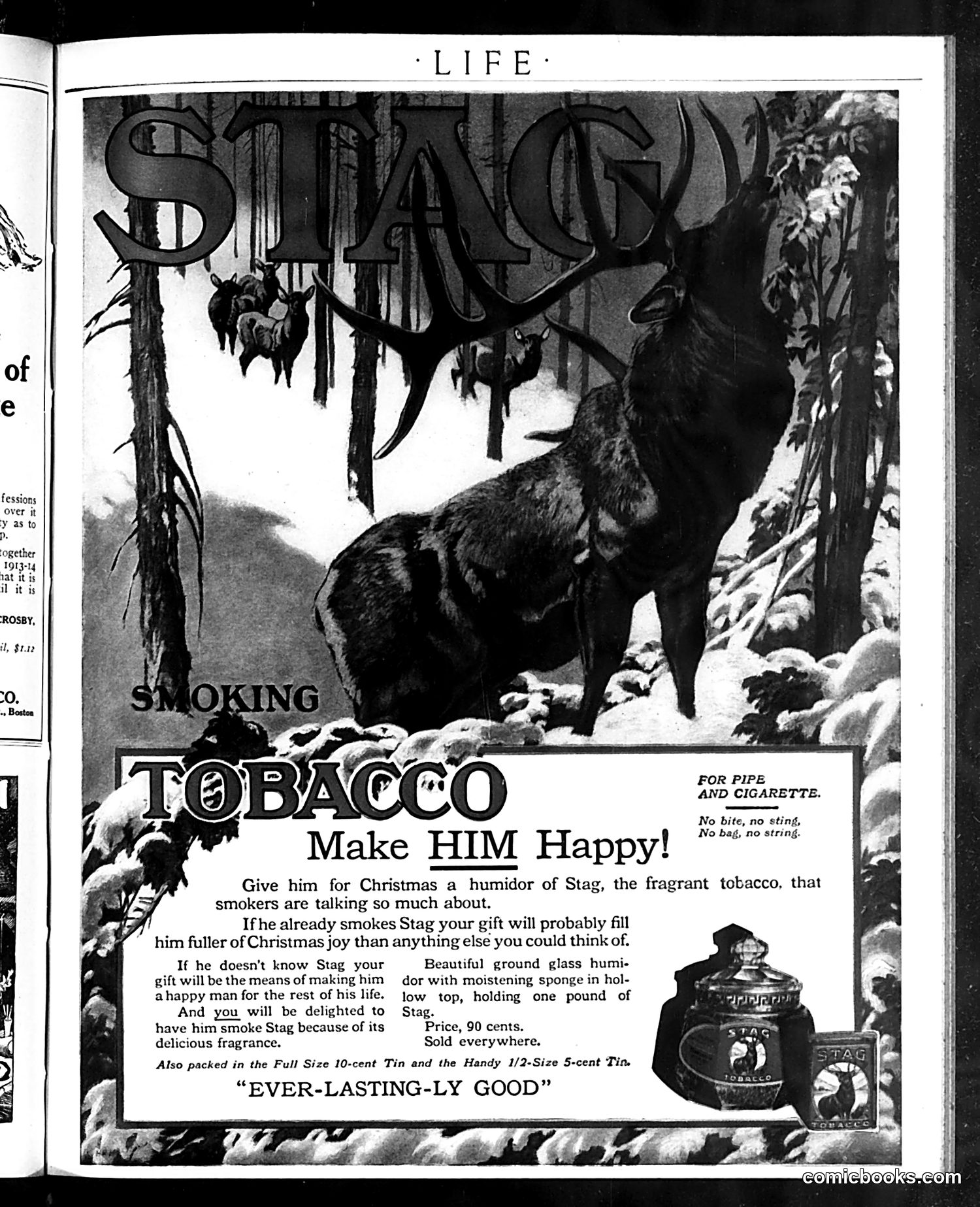
This page is primarily a **Christmas advertisement for Stag tobacco**, not political satire. The large illustration shows a deer (stag) in a snowy winter landscape, reaching up toward hanging tobacco leaves—a literal visual pun on the product name. The ad copy promotes Stag as an ideal Christmas gift for male smokers, emphasizing it as "fragrant" tobacco for "pipe and cigarette" use. It highlights a humidor gift option priced at 90 cents, marketed with the slogan "EVER-LASTING-LY GOOD" and claims of "no bite, no sting, no bag, no string." The deer imagery is purely decorative branding rather than satirical commentary. This represents early-20th-century consumer advertising conventions—using animal mascots and holiday framing to market tobacco products to men, without the health warnings modern readers would expect.
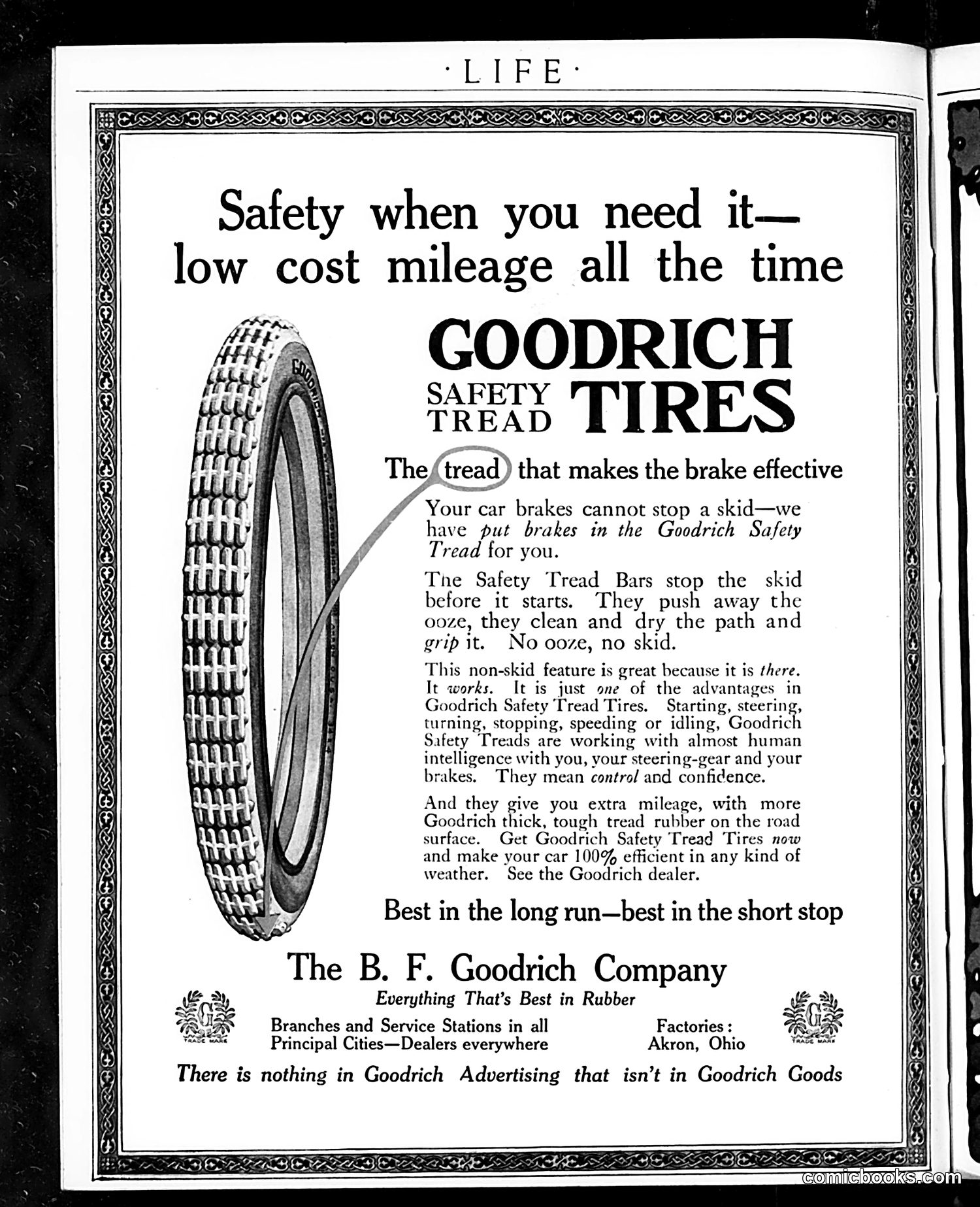
This page is **not a cartoon or satire** — it's a straightforward advertisement for B.F. Goodrich Safety Tread Tires, appearing in *Life* magazine (likely 1910s-1920s, based on typography and automobile context). The ad promotes a tire with "Safety Tread Bars" designed to prevent skidding by pushing away moisture and maintaining grip on wet roads. The key selling points are: - Non-skid safety features - Enhanced braking control - Extra mileage and durability - All-weather reliability The ad uses quasi-scientific language ("almost human intelligence") typical of early automotive advertising, positioning tire safety as a modern innovation. The tagline "Best in the long run—best in the short stop" emphasizes both longevity and emergency braking performance. There is no political satire, caricature, or commentary here — this is period advertising content included in *Life*'s editorial pages.
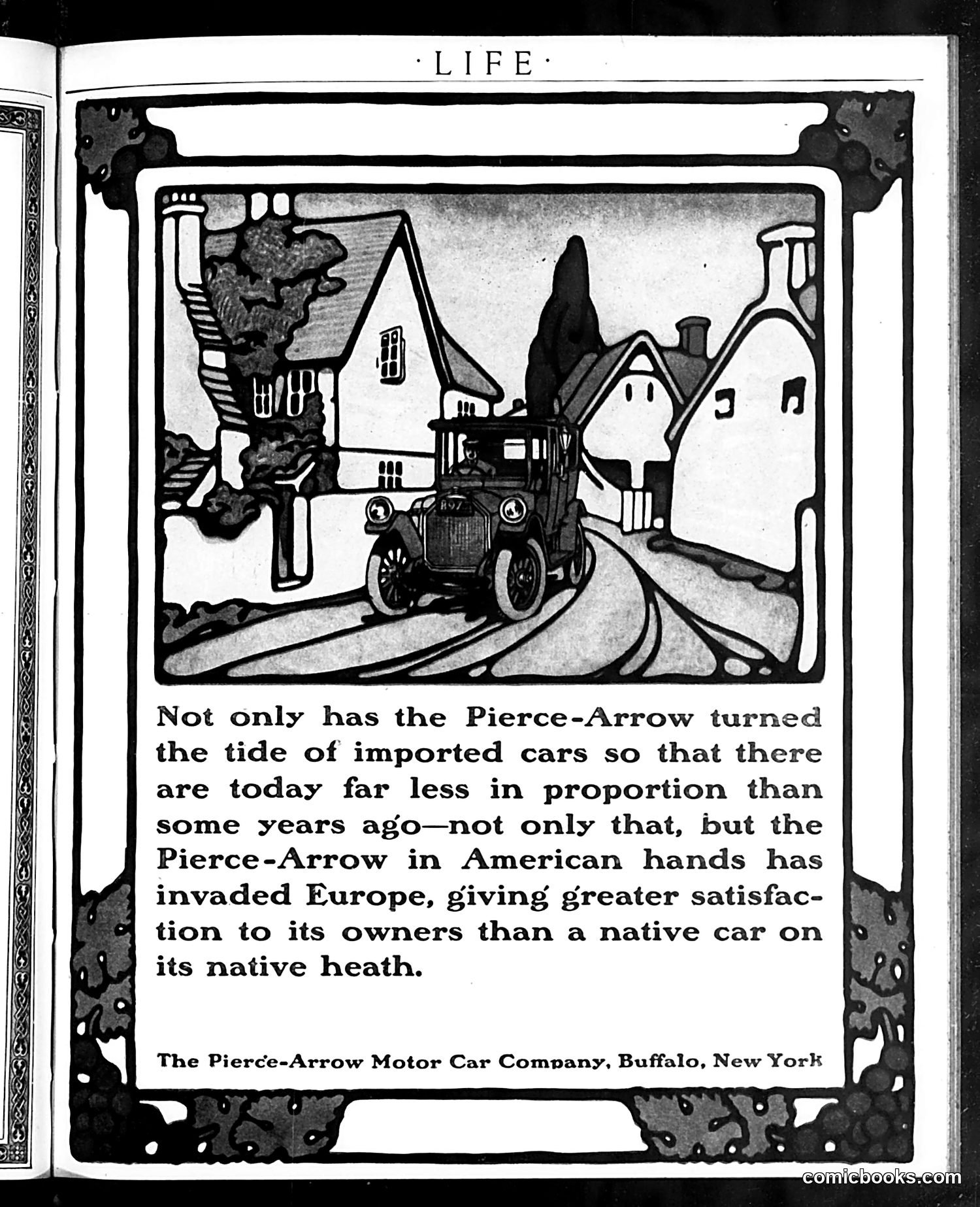
This is a **Pierce-Arrow automobile advertisement**, not political satire. The illustration shows an early 1900s motorcar arriving at a European village, suggesting American automotive superiority. The ad claims Pierce-Arrow cars have: 1. Reversed the trend of imported vehicles dominating the American market 2. Successfully exported to Europe, where they allegedly outperform European cars on their home territory The text boasts of American manufacturing prowess during an era when European cars (particularly German and French brands) were considered technically superior. The romantic European setting emphasizes Pierce-Arrow's ability to compete globally. This reflects early 20th-century American industrial confidence and emerging automotive dominance.
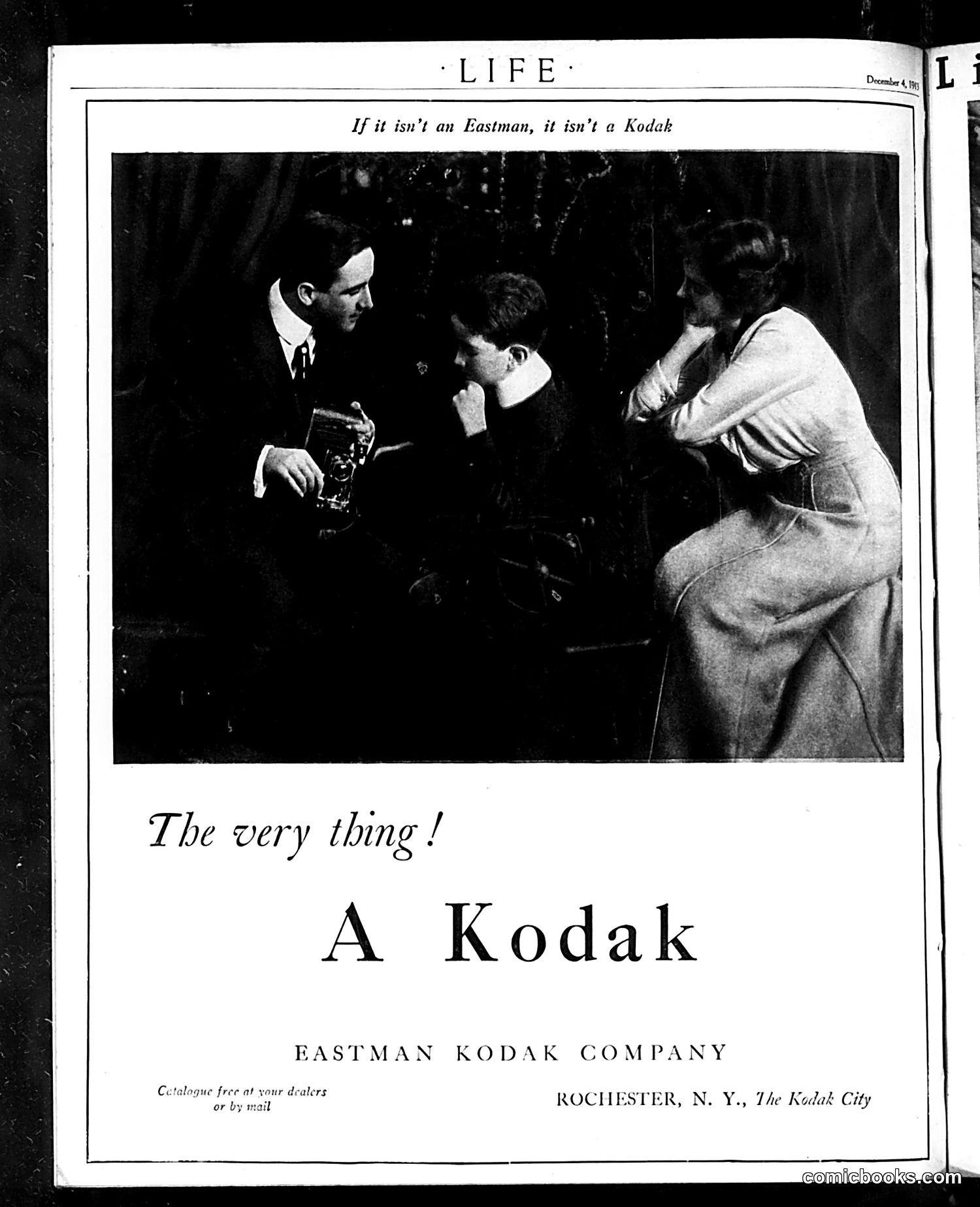
This is a **Kodak camera advertisement** from Life magazine, not political satire. The headline "If it isn't an Eastman, it isn't a Kodak" emphasizes brand exclusivity. The image shows three people in formal attire examining a camera—likely depicting a social scenario where someone presents a Kodak as a gift or subject of admiration. The phrase "The very thing!" suggests the camera is the perfect, desirable object. The ad capitalizes on Kodak's market dominance and aspirational appeal in the early 20th century, when photography was becoming accessible to middle-class consumers. By framing the camera within an elegant social interaction, Eastman Kodak positions their product as a status symbol and essential possession for refined people.