
Life, 1913-12-04 · page 68 of 112
Life — December 4, 1913 — page 68: what you’re looking at
What you’re looking at
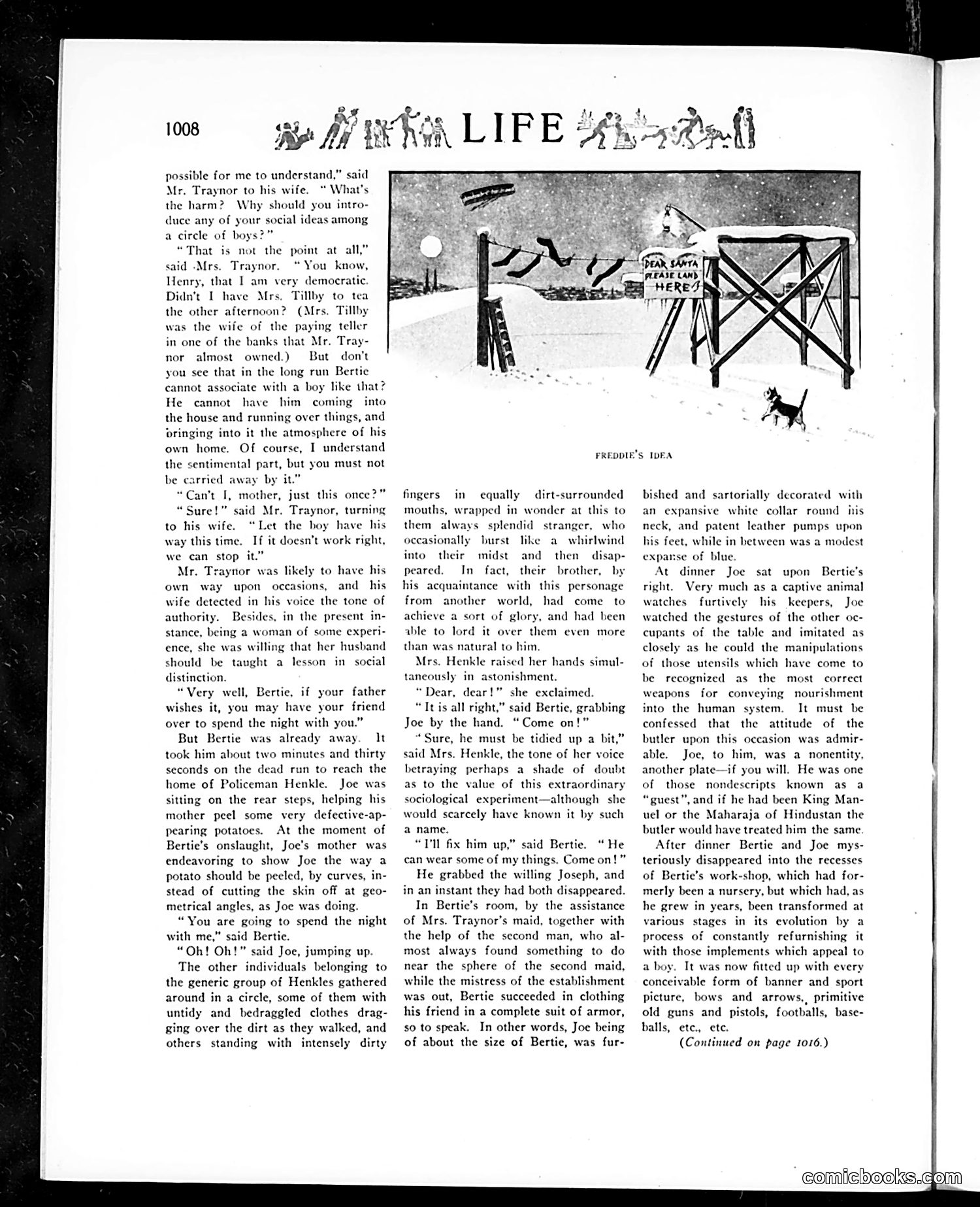
This page depicts a class-consciousness conflict in early 20th-century America. Mrs. Traynor, concerned about social distinction, opposes her son Bertie's friendship with Joe Henkle, son of a policeman. She fears association with someone from a lower socioeconomic background will corrupt her son's social standing. Mr. Traynor, more permissive, allows the sleepover. The narrative satirizes Mrs. Traynor's pretensions—she claims democratic values while carefully maintaining class barriers. The cartoon (captioned "Freddie's Idea") appears to show a makeshift Santa setup, likely illustrating childhood innocence contrasting with adult social anxieties. The satire mocks how the wealthy Traynors obsess over "atmosphere" and social propriety while Joe's working-class family shows genuine warmth. Bertie's transformation of Joe through proper clothing suggests superficial nature of class distinctions—appearance alone bridges the social gap.
📄 Transcribed text from this page (OCR, searchable)
Machine-transcribed from the original scan — historical spelling and the odd misread are preserved.
1008 possible for me to understand,” said Mr. Traynor to his wife. “ What's the harm? Why should you intro- duce any of your social ideas among a circle of boys?” That is not the point at all,” said Mrs. Traynor. “You know, Henry, that I] am very democratic. Didn't I have Mrs. Tillby to tea the other afternoon? (Mrs. Tillby was the wife of the paying teller in one of the banks that Mr. Tray- nor almost owned.) But don’t you see that in the long run Bertie cannot associate with a boy like that? He cannot have him coming into the house and running over things, and bringing into it the atmosphere of his own home. Of course, I understand the sentimental part, but you must not be carried away by it.” “Can't I, mother, just this once?” “Sure!” said Mr. Traynor, turning to his wife. “Let the boy have his way this time. If it doesn’t work right, we can stop it.’ Mr. Traynor was likely to have his own way upon occasions, and his wife detected in his voice the tone of authority. Besides, in the present in- stance, being a woman of some experi- ence, she was willing that her husband should be taught a lesson in social distinction. “Very well, Bertie, if your father wishes it, you may have your friend over to spend the night with you.” But Bertie was already away. lt took him about two minutes and thirty seconds on the dead run to reach the home of Policeman Henkle. Joe was sitting on the rear steps, helping his mother peel some very defective-ap- pearing potatoes. At the moment of Bertie’s onslaught, Joe's mother was endeavoring to show Joe the way a potato should be pecled, by curves, in- stead of cutting the skin off at geo- metrical angles, as Joe was doing. “You are going to spend the night with me,” said Bertie. “Oh! Oh!” said Joe, jumping up. The other individuals belonging to the generic group of Henkles gathered around in a circle, some of them with untidy and bedraggled clothes drag- ging over the dirt as they walked, and others standing with intensely dirty ge Oe WRG LIFE FREDDL fingers in equally dirt-surrounded mouths, wrapped in wonder at this to them always splendid stranger, who occasionally burst like a whirlwind into their midst and then peared. In fact, their brother, by his acquaintance with this personage from another world, had come to achieve a sort of glory, and had been able to lord it over them even more than was natural to him. Mrs. Henkle raised her hands simul- taneously in astonishment. “Dear, dear!” she exclaimed. “Ttis all right,” said Bertie, grabbing Joe by the hand. “Come on!" “Sure, he must be tidied up a bit,” said Mrs. Henkle, the tone of her voice betraying perhaps a shade of doubt as to the value of this extraordinary sociological experiment—although she would scarcely have known it by such a name. I'll fix him up,” said Bertie. “He can wear some of my things. Come on!” He grabbed the willing Joseph, and in an instant they had both disappeared. In Bertie’s room, by the assistance of Mrs. Traynor’s maid, together with the help of the second man, who al- most always found something to do near the sphere of the second maid, while the mistress of the establishment was out, Bertie succeeded in clothing his friend in a complete suit of armor, so to speak. In other words, Joe being of about the size of Bertie, was fur- disap- bished and sartorially decorated with an expansive white collar round iis neck, and patent leather pumps upon his feet, while in between was a modest expanse of blue. At dinner Joe sat upon Bertie’s Very much as a captive animal furtively his keepers, Joe watched the gestures of the other oc- cupants of the table and imitated as closely he could the manipulations of those utensils which have come to be recognized as the most correct weapons for conveying nourishment into the human system. It must be confessed that the attitude of the butler upon this occasion was admir- able. Joe, to him, was a nonentity, another plate—if you will. He was one of those nondescripts known as a “guest”, and if he had been King Man- uel or the Maharaja of Hindustan the butler would have treated him the same. After dinner Bertie and Joe mys- teriously disappeared into the recesses of Bertie’s work-shop, which had for- merly been a nursery, but which had, as he grew in years, been transformed at various stages in its evolution by a process of constantly refurnishing it with those implements which appeal to boy. It was now fitted up with every conceivable form of banner and sport picture, bows and arrows,, primitive old guns and pistols, footballs, base- balls, ete., ete. (Continued on page 1016.) right. watches comichooks.gom