
A complete issue · 84 pages · 1917
Life — April 26, 1917
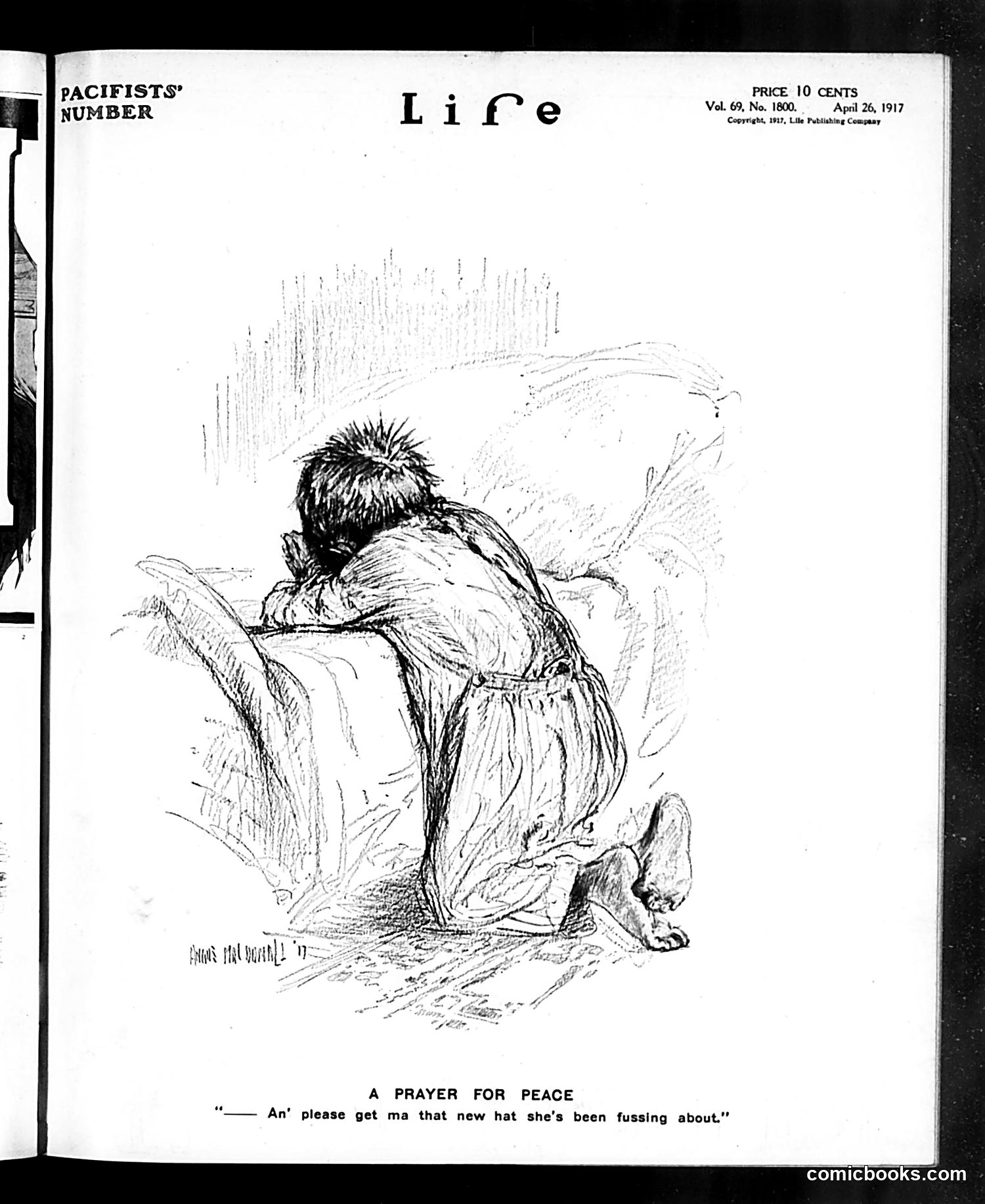
This is the cover of Life magazine from April 26, 1917, labeled "Pacifists' Number." The cartoon depicts a child kneeling in prayer, with the caption "A PRAYER FOR PEACE" and the child's plea: "An' please get ma that new hat she's been fussing about." The satire targets American pacifists during World War I. The joke contrasts the stated concern for peace with trivial materialism—the child's prayer juxtaposes a grand moral principle (peace) with a selfish, mundane desire (a hat). This suggests pacifists' rhetoric about peace is similarly hollow or hypocritical, masking self-interest. Given the April 1917 date (two weeks after U.S. entry into WWI), Life mocks those opposing American military involvement as lacking genuine conviction or moral seriousness.
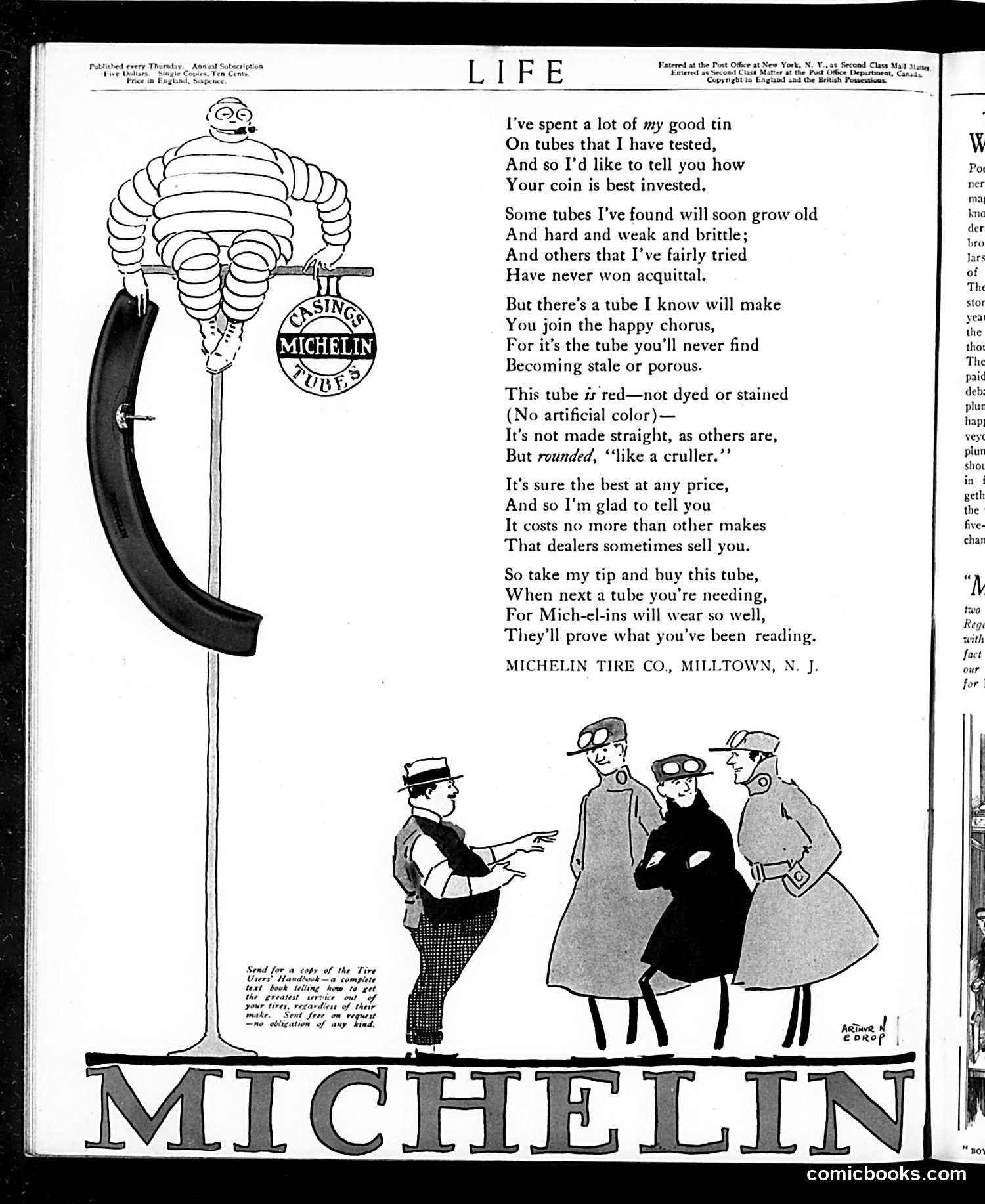
This is primarily a **Michelin Tire Company advertisement**, not political satire. The page features the Michelin Man (Bibendum), the company's mascot—a rotund, tire-like figure made of stacked rings—endorsing their tire tubes. The ad uses verse to argue Michelin tubes are superior: they won't become "stale or porous," are naturally red (not artificially dyed), and have a "rounded" shape "like a curler." The testimonial claims they outlast competitors and won't be "sometimes sell you." The lower illustration shows the mascot recommending the product to potential customers—three figures in 1920s-era clothing and goggles (suggesting early motorists). This is straightforward commercial messaging with no political content—typical early 20th-century advertising humor.
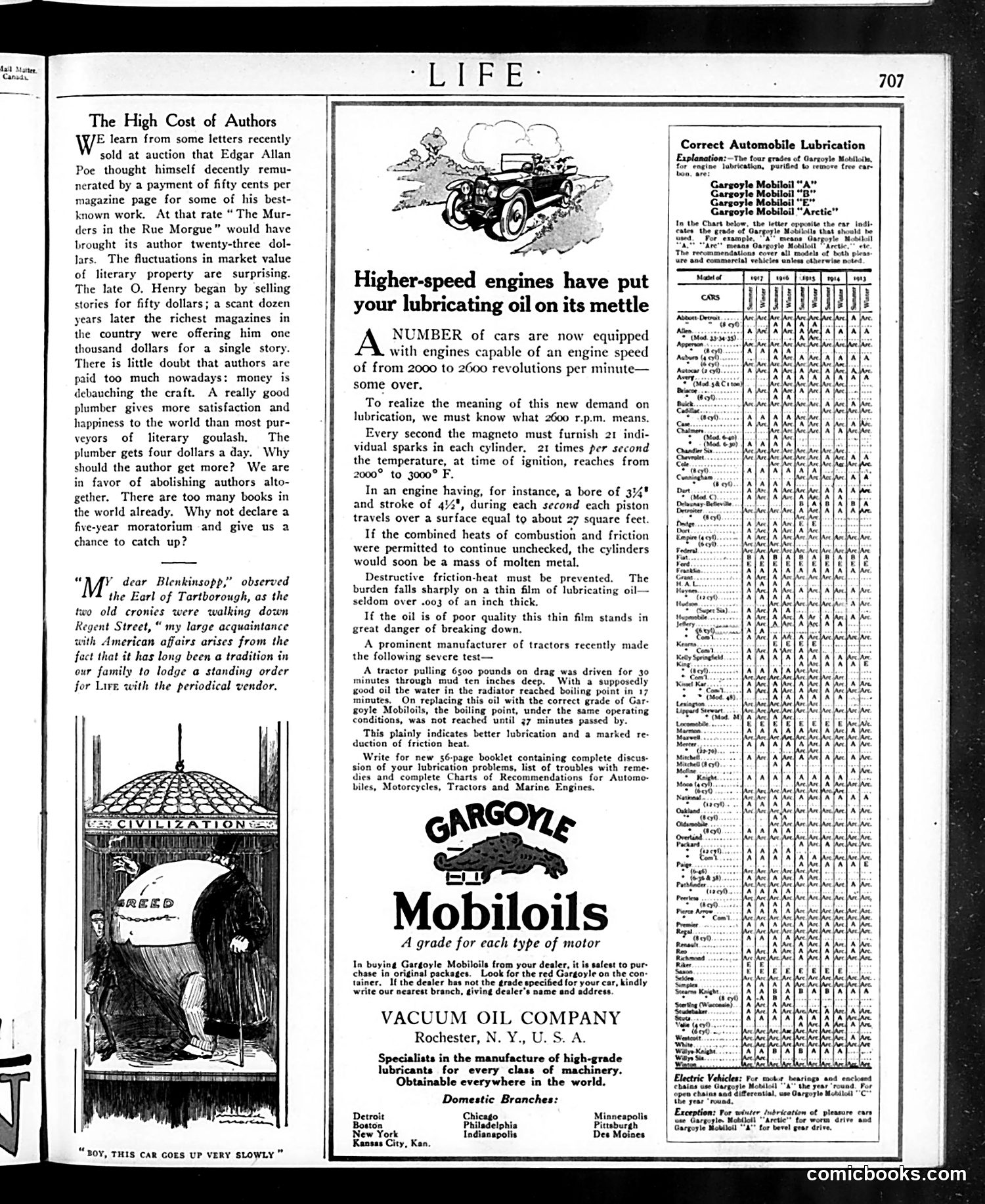
This page is primarily **advertising content** rather than political satire. The dominant feature is a Gargoyle Mobiloils advertisement promoting motor oil grades for different vehicle types, with an accompanying technical article about higher-speed engine lubrication demands. The only cartoon appears on the left: a satirical illustration labeled "Boy, This Car Goes Up Very Slowly," depicting a figure struggling to push an enormous spherical object (labeled "Heed") up an incline toward "Civilization." This appears to be **social commentary** on economic or social progress—likely referencing post-WWI struggles or inflation concerns—though the specific historical reference is unclear without additional context. The page also contains an unrelated article about literary property values and author compensation in the upper left.
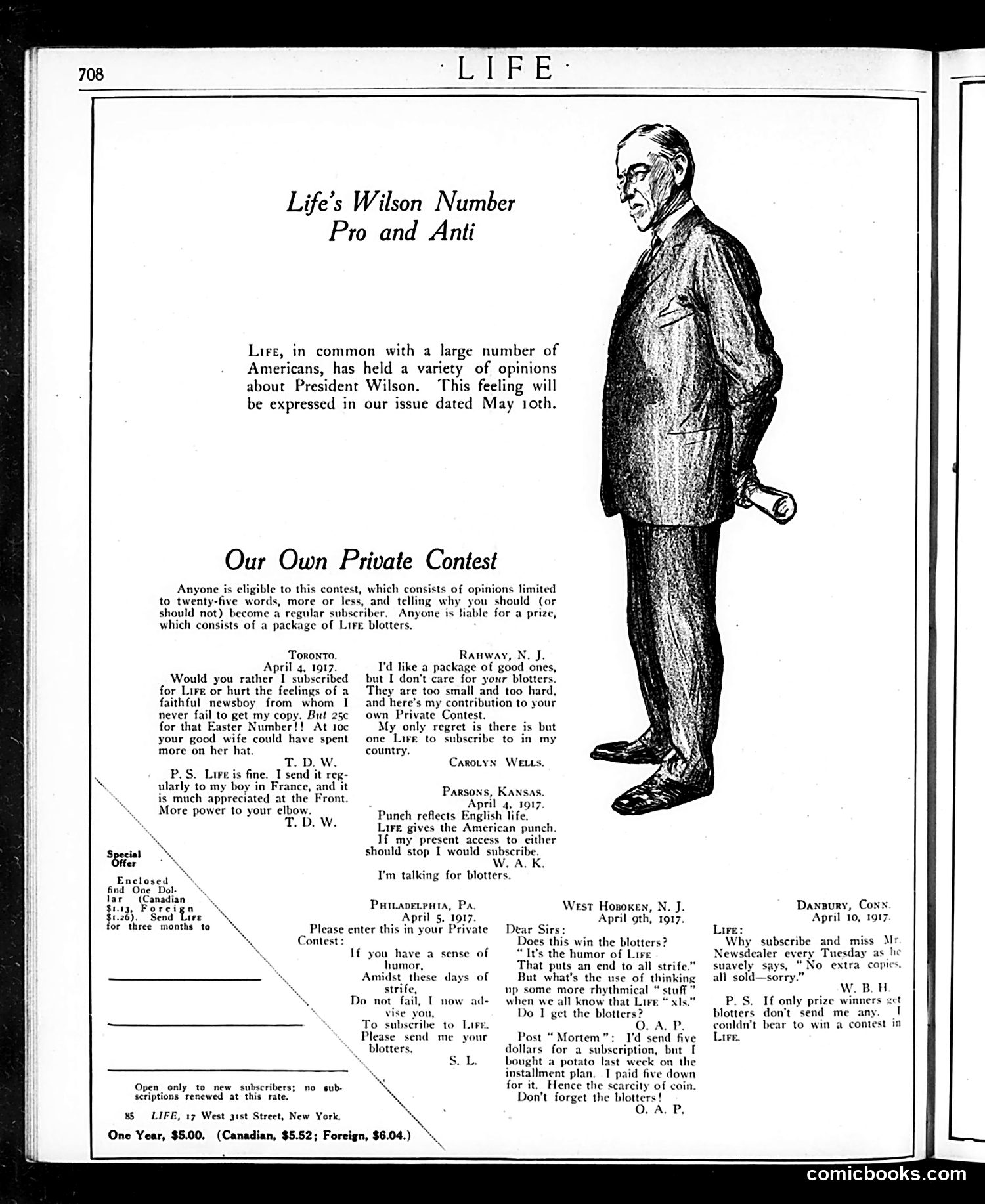
This page from Life magazine announces an upcoming issue (May 10th) featuring competing opinions about President Woodrow Wilson. The tall figure illustrated appears to be Wilson himself, drawn in profile. The page hosts a "Private Contest" inviting readers to submit brief opinions (twenty-five words maximum) on whether they support or oppose Wilson, with winners receiving Life subscription packages. The reader submissions shown reveal genuine contemporary division: some praise Wilson's leadership and the magazine itself, while others criticize Wilson and express frustration with Life. One contributor from Danbury sarcastically questions whether Life readers actually want the magazine. This reflects America's heated political debates during Wilson's presidency, likely during or around his 1917 World War I involvement.
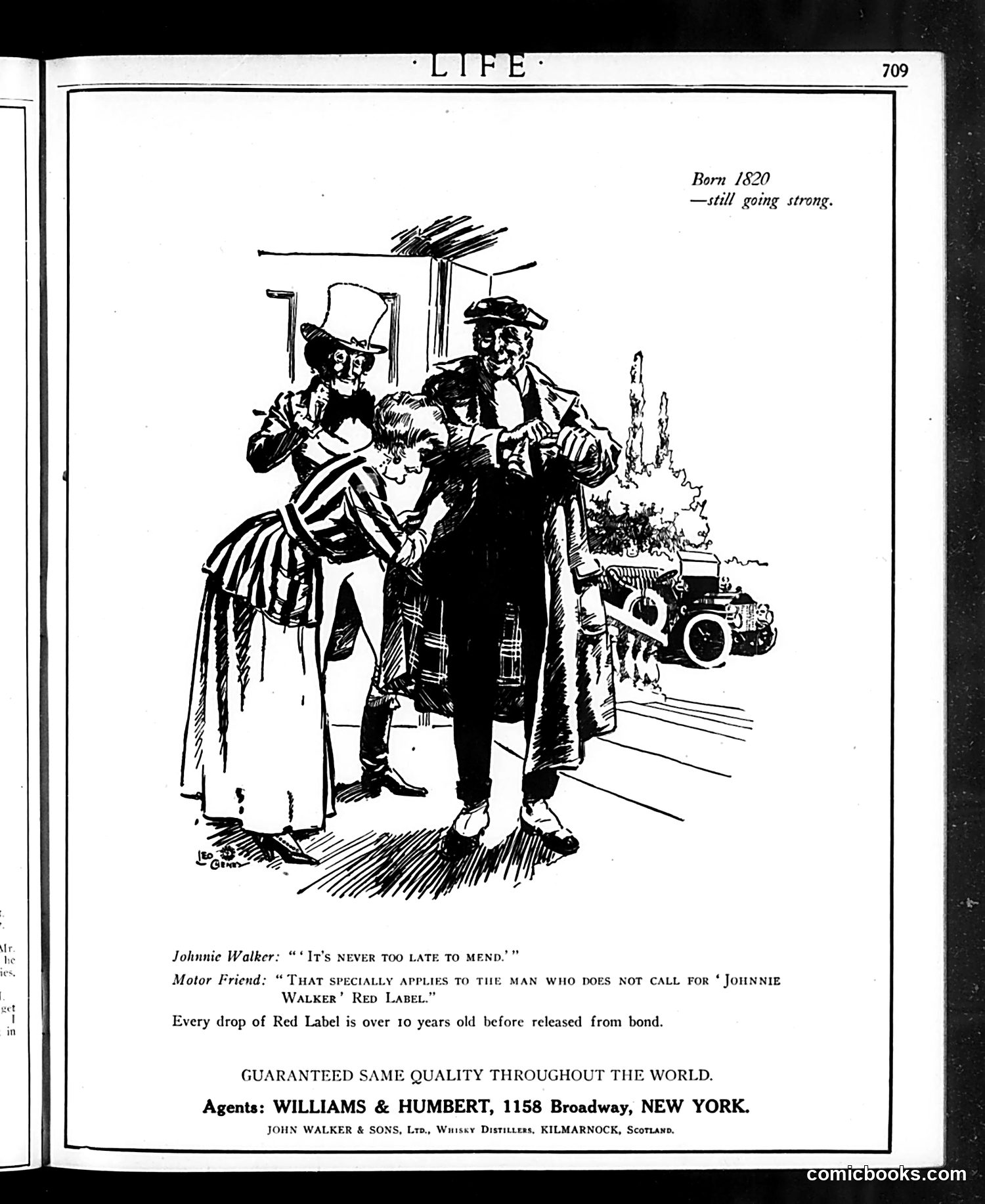
This is primarily a **Johnnie Walker whisky advertisement** disguised as satirical content. The illustration shows an elderly man ("Born 1820—still going strong") with two other figures in period dress, accompanied by an automobile. The advertisement plays on Johnnie Walker's famous slogan "It's never too late to mend," suggesting the product's longevity and reliability. The caption about the "Motor Friend" implies that even someone who hasn't adopted modern innovations (like automobiles) should trust this whisky brand. The phrase "Every drop of Red Label is over 10 years old before released" emphasizes quality through aging. The "Born 1820" reference dates to when Johnnie Walker was founded, positioning the brand as enduring and time-tested—a common advertising strategy equating age with superiority and trustworthiness.
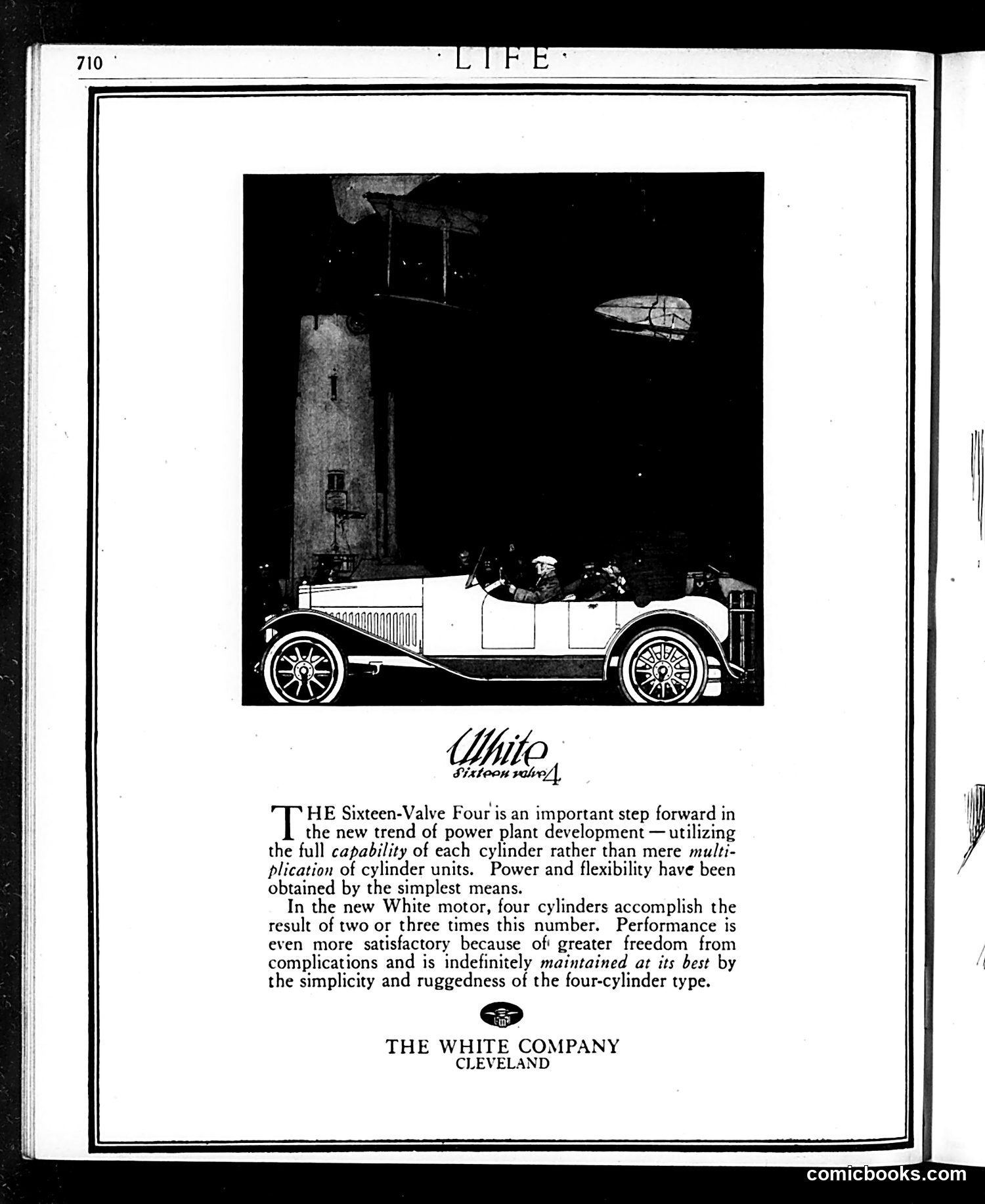
This is **not a political cartoon or satire**—it's a straightforward automobile advertisement from *Life* magazine (page 710). The page promotes the White Company's "Sixteen-Valve Four," a four-cylinder automobile. The image shows a side-view illustration of an open touring car with passengers. The accompanying text argues that four cylinders can match the performance of engines with many more cylinders through superior engineering and simplicity. The ad emphasizes that the White motor achieves "power and flexibility" through "the simplest means" rather than mechanical complexity. This reflects early automotive marketing strategy: positioning elegant mechanical design as superior to brute-force approaches. The small airplane sketched in the upper right appears to be decorative—possibly comparing the car to modern aviation technology to suggest innovation. This is purely commercial advertising with no satirical content.
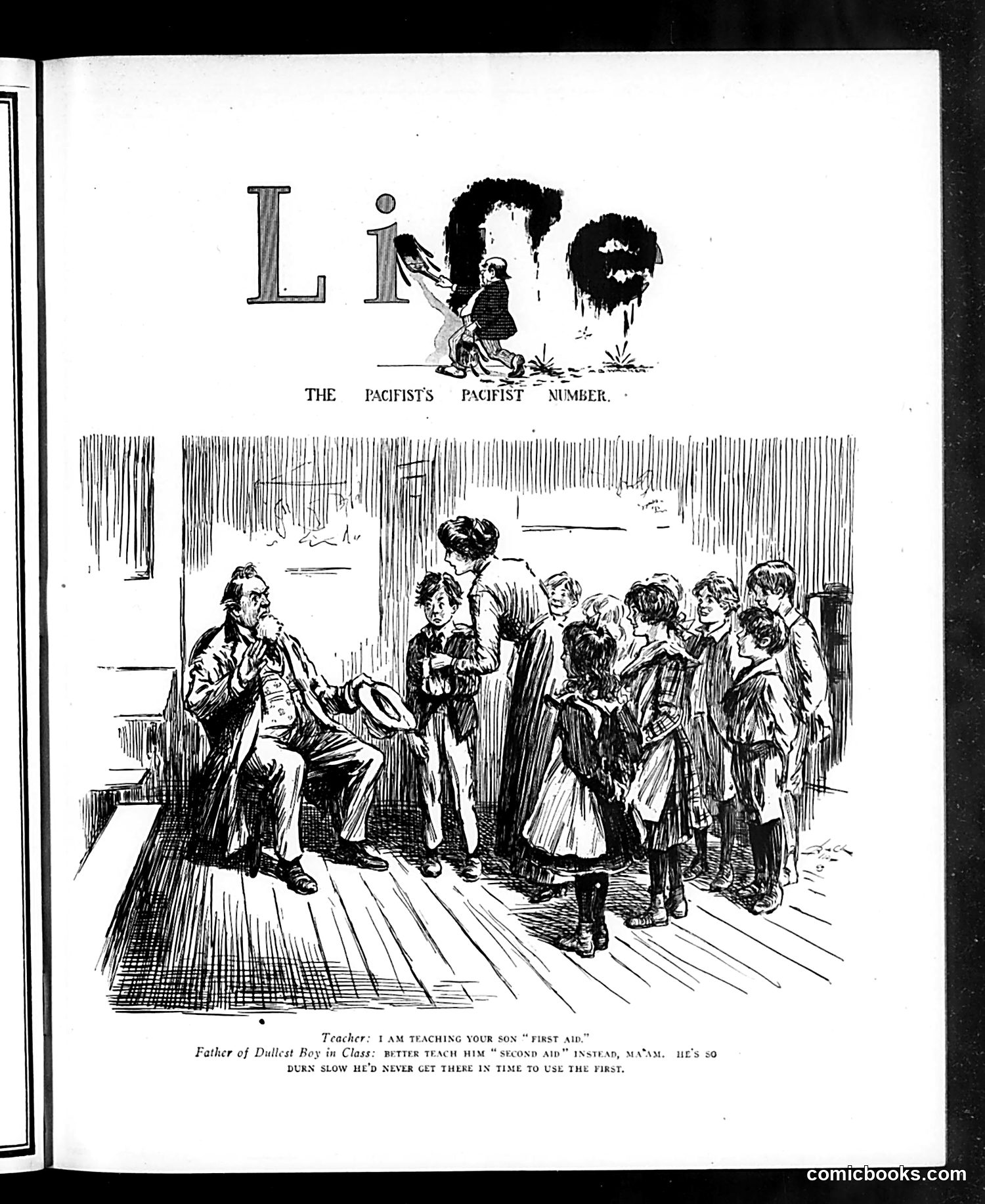
This page from *Life* magazine contains two satirical pieces about education and parenting. The header "The Pacifist's Pacifist Number" appears to mock pacifism through visual symbolism—the letter "L" is destroyed/blackened, suggesting pacifist weakness or ineffectuality. The lower cartoon depicts a classroom scene where a teacher addresses a father about his son's "first aid" instruction. The caption's joke concerns teaching priorities: the father worries the boy learns "second aid" before "first aid," fearing he'll be too slow to use the first aid. This satirizes both parental overprotectiveness and educational inefficiency—suggesting anxious parents create backward learning priorities that handicap children. The humor relies on the absurdity of this reversed educational logic and parental anxiety about practical skills.
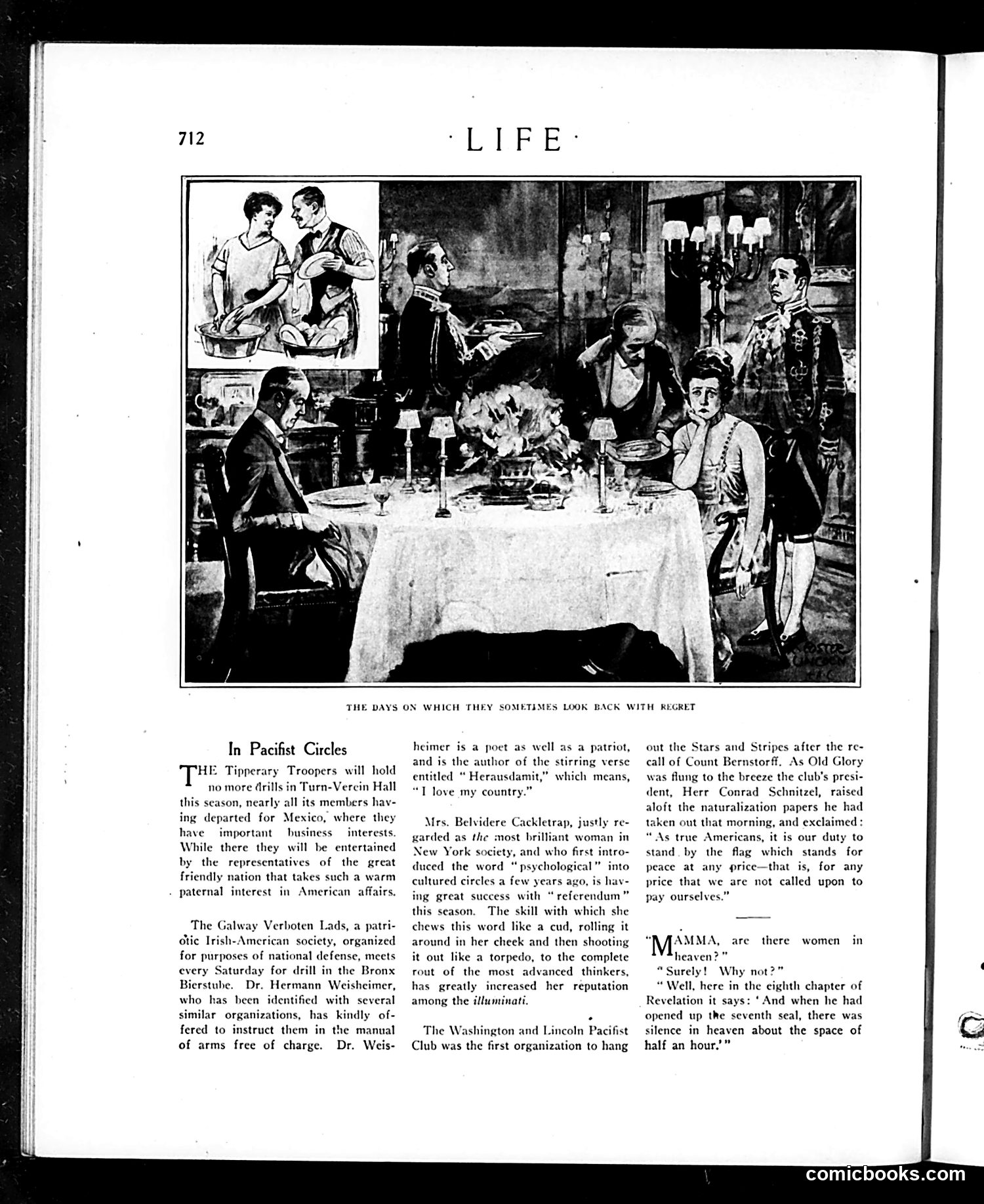
This page contains a satirical illustration titled "The Days on Which They Sometimes Look Back With Regret," depicting an elegant formal dinner scene. The image shows well-dressed figures at a dining table with candelabras and fine furnishings, suggesting high society. The accompanying text discusses patriotic Irish-American and German-American organizations, including the Tippperary Troopers and Galway Verloten Lads, who conducted military drills. It references Dr. Hermann Weisheimer's efforts to instruct these groups in firearms. The satire appears to target immigrant communities' military activities and ethnic pride organizations during a period (likely pre-WWI) when such activities raised concerns about divided loyalties and foreign influence on American soil. The formal dinner scene may ironically contrast civilized society with martial preparations.
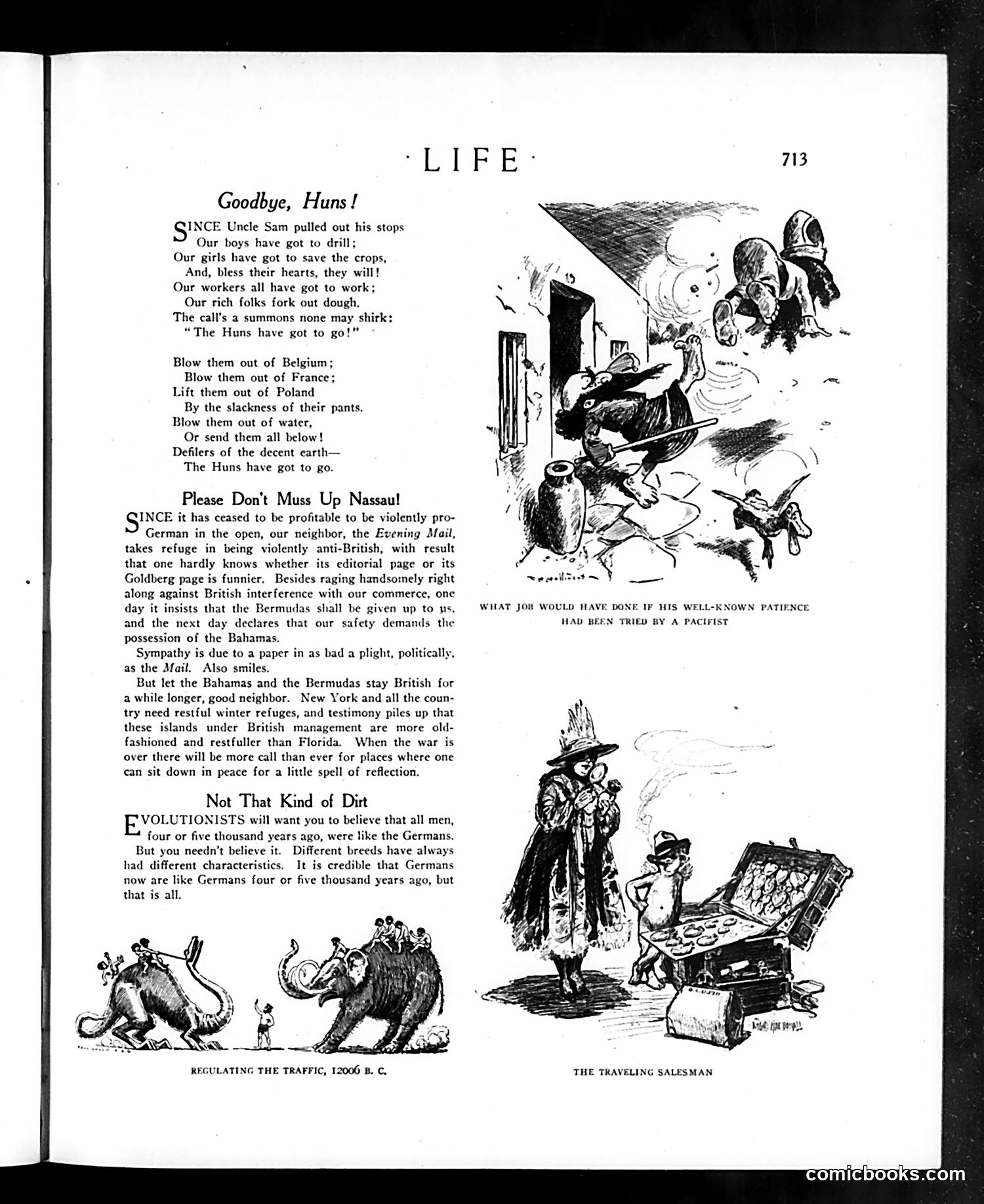
This page contains three satirical pieces about World War I-era politics: **"Goodbye, Huns!"** - A poem urging military action against German forces, using "Huns" as a derogatory term for Germans. It calls for driving them from Belgium, France, and Poland. **"Please Don't Muss Up Nassau!"** - Criticizes the *Evening Mail* newspaper for anti-British editorial positions, arguing that sympathy toward Germany is bad business. It suggests keeping Caribbean islands (the Bahamas, Bermudas) under British control for stability. **"Not That Kind of Dirt"** - Mocks evolutionary theory, claiming Germans' aggressive nature stems from inherent "breed" characteristics rather than evolution. The cartoon "Regulating the Traffic, 12006 B.C." depicts primitive humans and animals, while "The Traveling Salesman" shows wartime profiteering. The overall tone reflects pro-British, anti-German American sentiment during WWI.
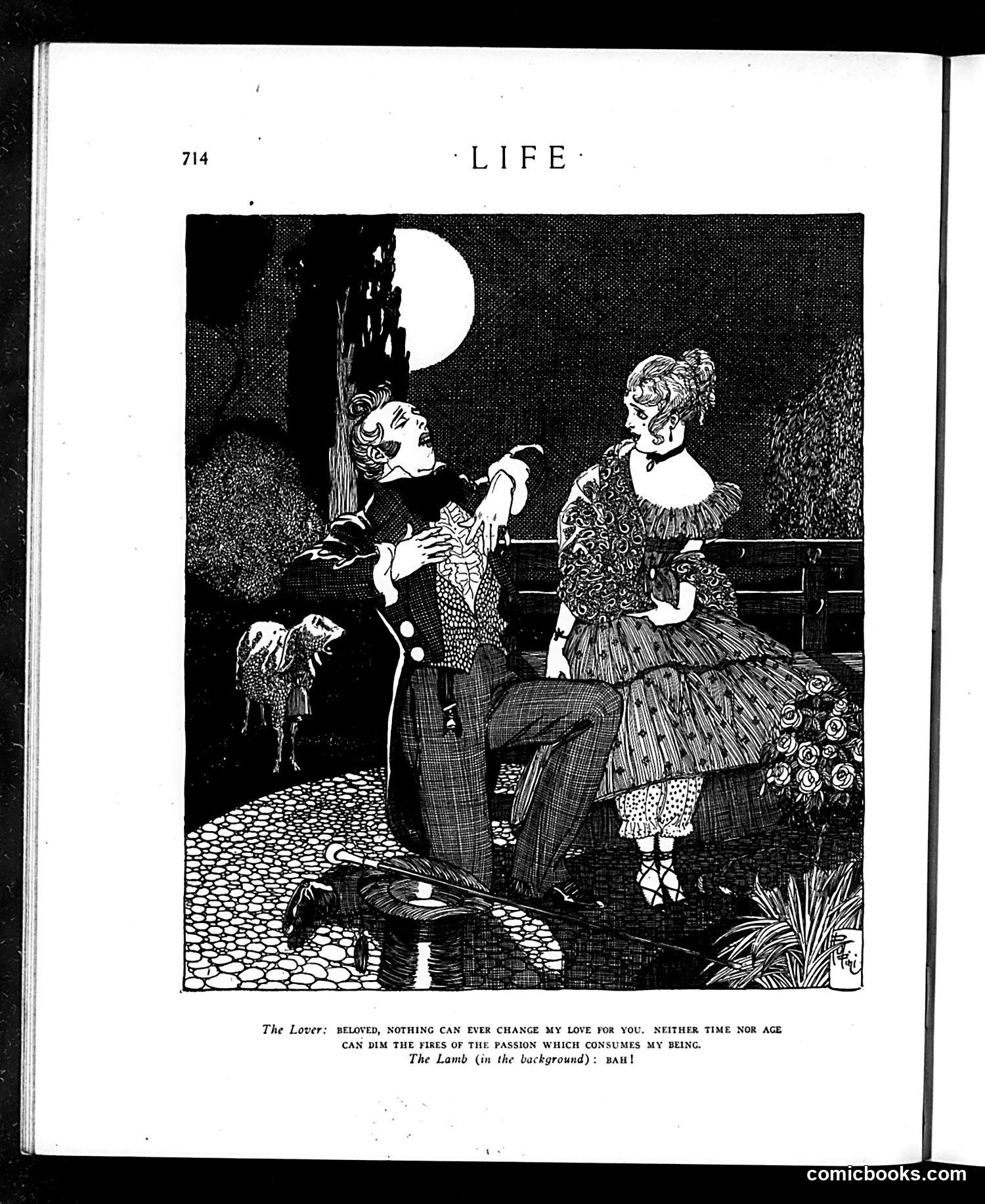
This is an illustration from Life magazine (page 714) depicting a romantic scene. The image shows two well-dressed figures in an ornate nighttime garden setting under a full moon. A man in patterned clothing kneels before a woman in an elaborate dress, while small animals (appearing to be lambs or dogs) are present in the background. The caption attributes a passionate declaration to "The Lover," stating: "BELOVED, NOTHING CAN EVER CHANGE MY LOVE FOR YOU. NEITHER TIME NOR AGE CAN DIM THE FIRES OF THE PASSION WHICH CONSUMES MY BEING." A secondary note references "The Lamb (in the background): BAH!" The humor appears to be the lamb's skeptical reaction to the lover's overwrought romantic declaration—a gentle satire of excessive sentimentality and theatrical courtship displays common in period literature and theater.
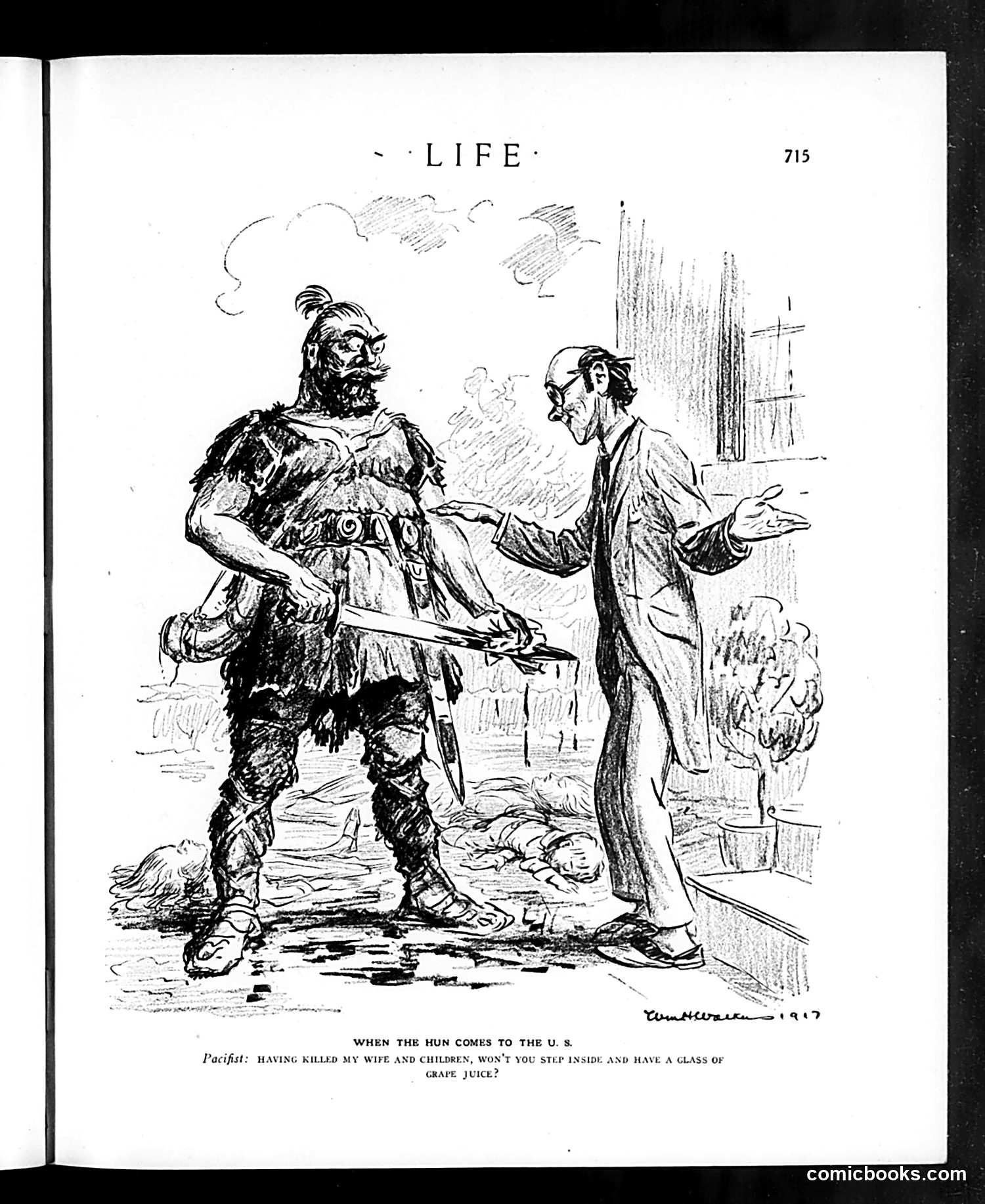
This 1917 cartoon depicts a brutish German soldier (the "Hun," a WWI-era slur for Germans) confronting a civilian man at what appears to be an American home. The soldier, dressed in military gear and appearing violent, addresses the civilian with a chilling proposition: "Having killed my wife and children, won't you step inside and have a glass of grape juice?" The satire references German atrocities in Belgium and France during WWI—particularly allegations of mass killings of civilians. The darkly ironic "grape juice" reference mocks American pacifists or isolationists who hoped to coexist peacefully with Germany, suggesting such naive hospitality would be obscene given German brutality. The cartoon warns Americans of the danger posed by failing to oppose German militarism.
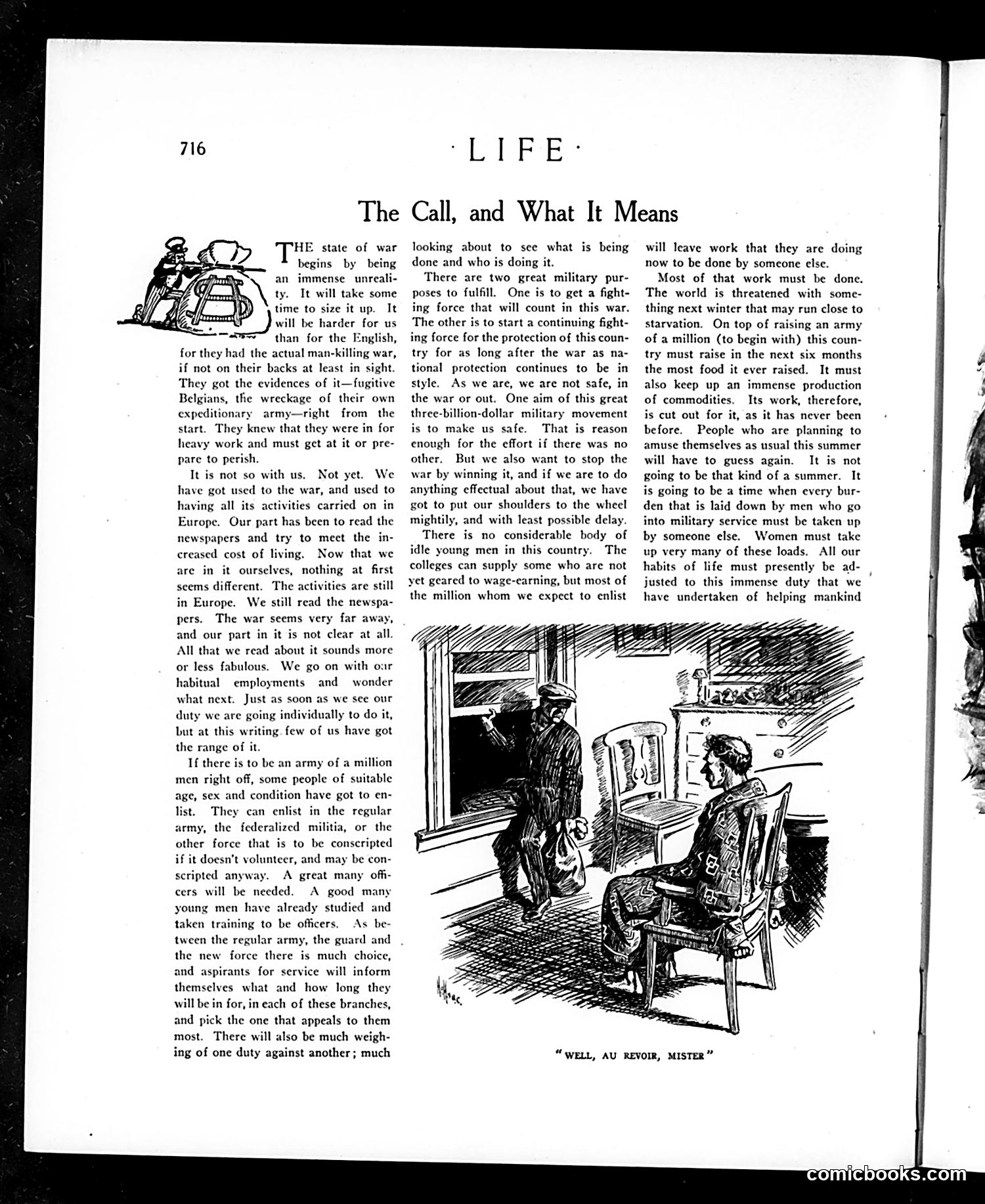
This article discusses military conscription during wartime (likely WWI era, given the reference to "the English" and European conflict). The text explains two military objectives: raising a fighting force and maintaining home-front protection. The accompanying sketch shows a domestic scene where a man in a coat (likely a military recruiter or official) stands at a doorway speaking to a woman seated indoors. The caption reads "WELL, AU REVOIR, MISTER"—French for "goodbye"—suggesting farewell to departing soldiers. The satire critiques how conscription disrupts civilian life: women must adjust their habits to manage without male workers, and summer will be different because men have been called to service. The piece conveys how war penetrates everyday domestic existence.
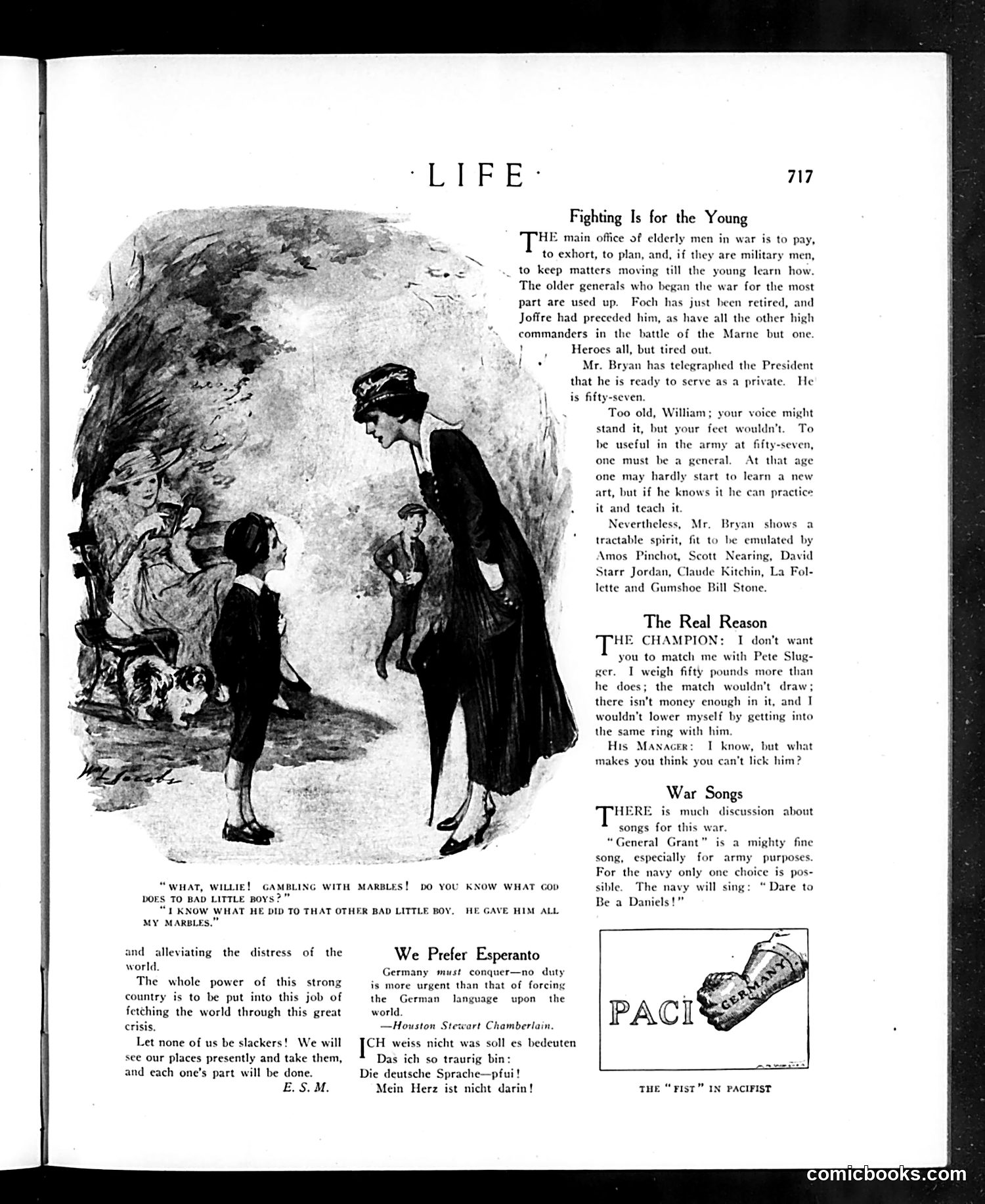
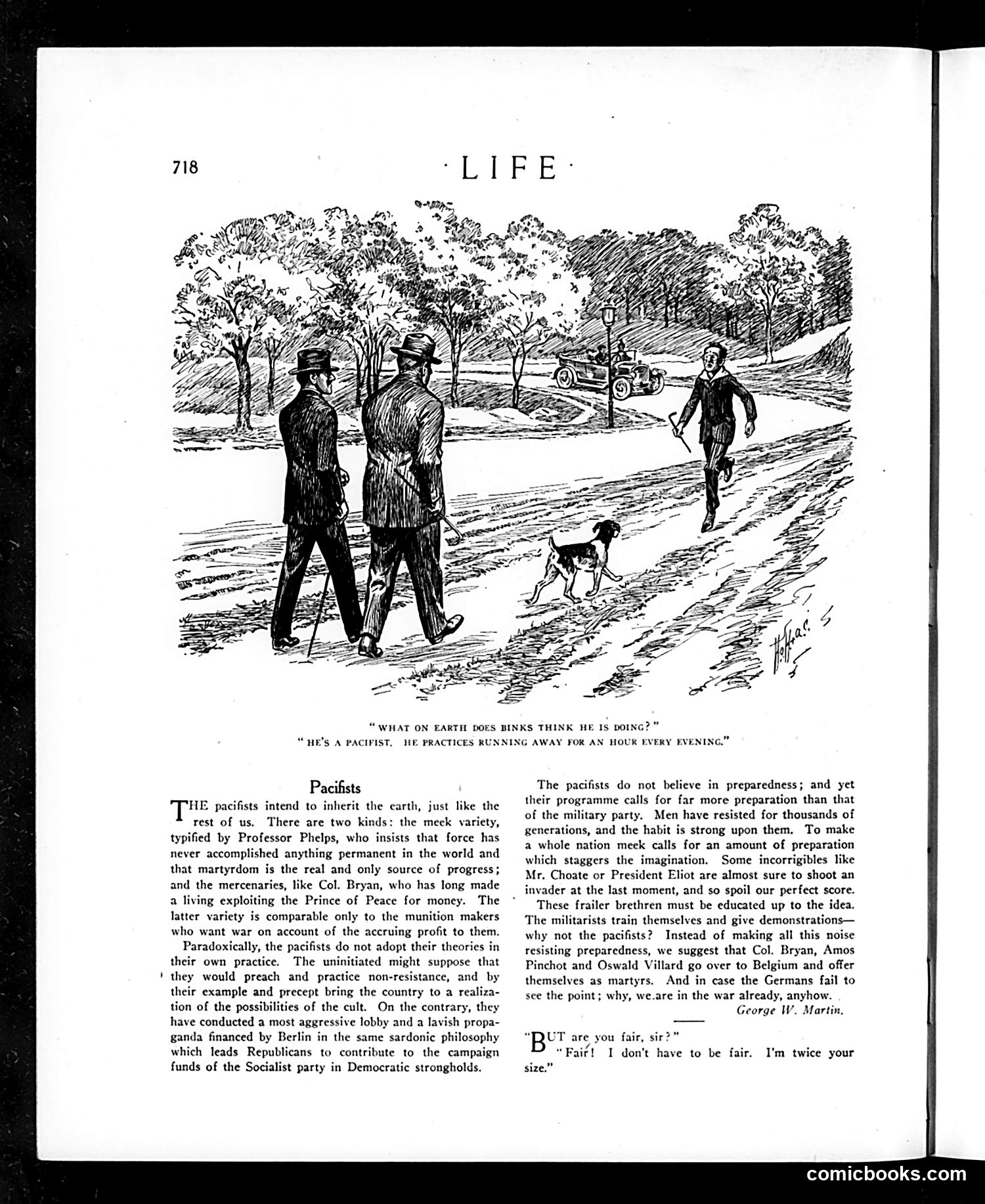
This cartoon satirizes American pacifists during what appears to be the WWI era. Two well-dressed men in suits observe a jogger and a dog, with one asking "What on earth does Binks think he is doing?" The caption explains Binks is "a pacifist. He practices running away for an hour every evening." The accompanying essay by George W. Martin attacks pacifists as hypocritical and ineffective, criticizing their opposition to military preparedness while noting their resistance comes from those who profit from war. The text references figures like "Professor Phelps," "Col. Bryan," and "Oswald Villard" as pacifist leaders. The joke equates pacifism with cowardice through the image of constant running away.
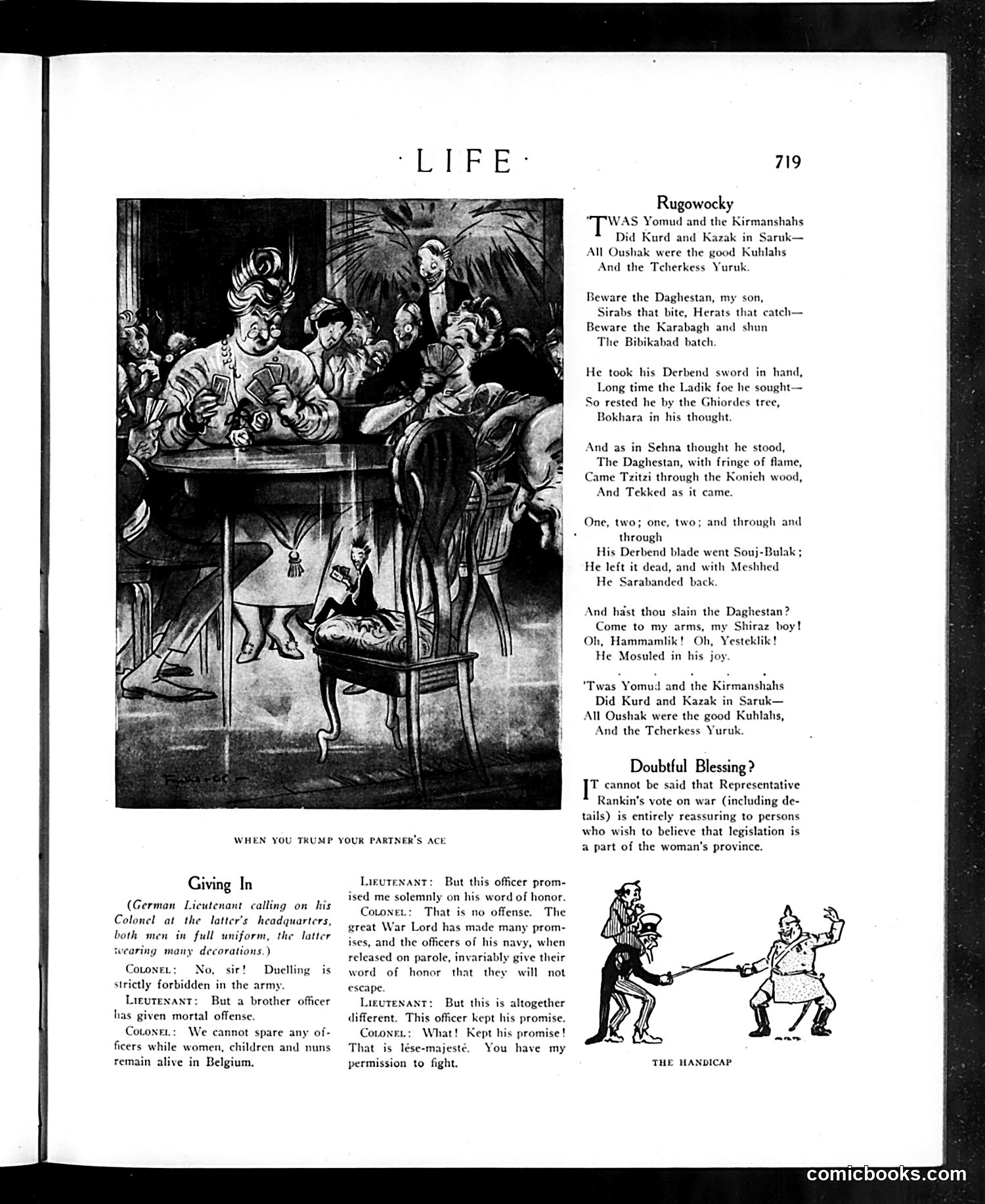
This page contains two distinct pieces: **"Rugowocky"** (top): A poem parodying Russian/Caucasian epic literature, likely mocking either Russian imperial ambitions or specific military conflicts. References to "Daghestan" and various warriors suggest satire of exotic military romanticism. **"Giving In"** (middle): A dialogue between a German Lieutenant and Colonel about military honor and a promise made by an officer. The Colonel refuses to spare officers while civilians die in Belgium, but the Lieutenant argues this particular officer kept his word—making him "less-majestic" and thus deserving of a duel. This satirizes the gap between military codes of honor and wartime brutality, particularly regarding German conduct in Belgium (a WWI reference). **"The Handicap"** (bottom right): A small cartoon of two figures in exaggerated poses—likely commenting on social inequality or class conflict through physical caricature. The overall theme appears critical of militarism and honor codes in wartime.
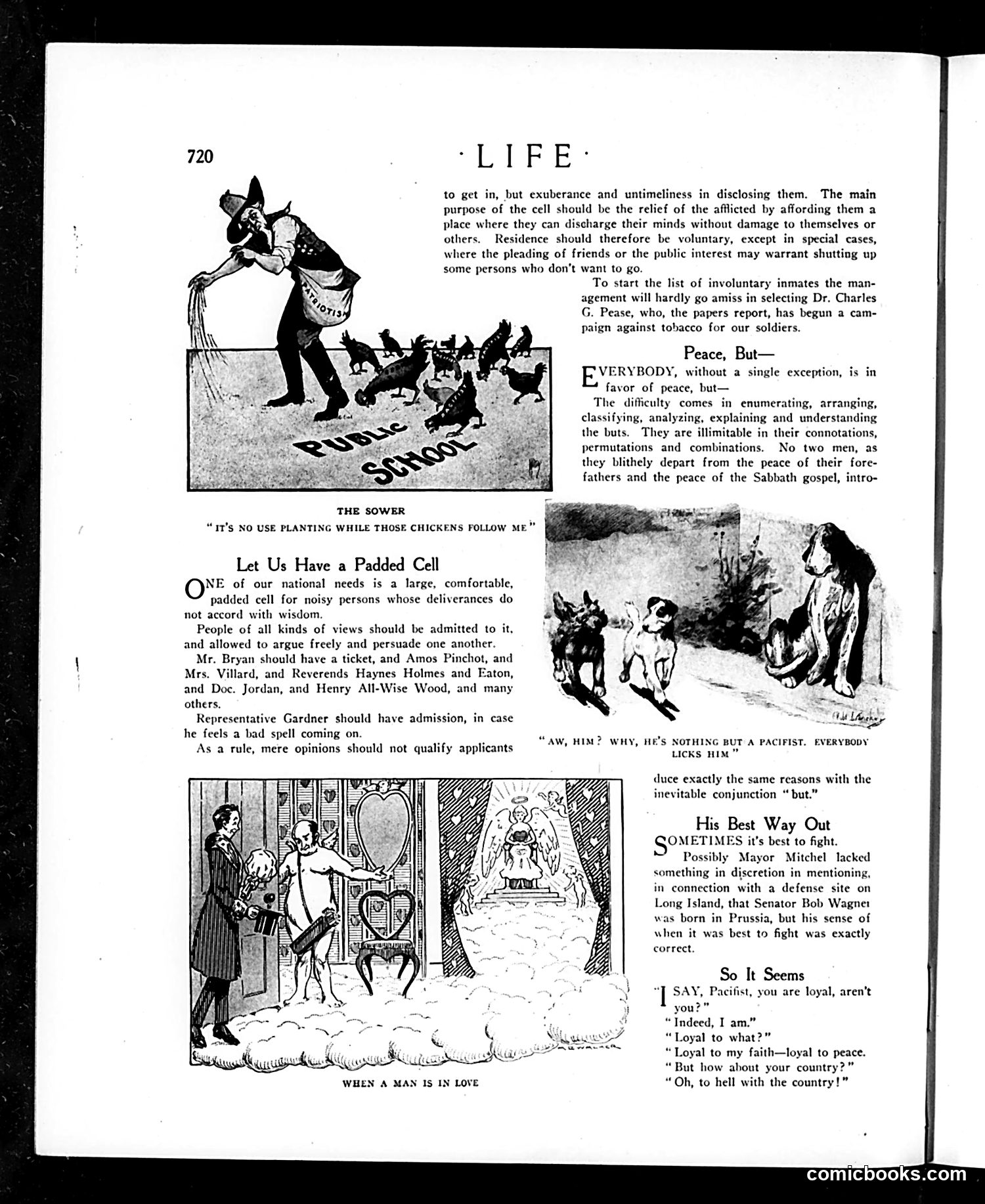
This page satirizes American pacifists during World War I, mocking their perceived priorities and consistency. **"Let Us Have a Padded Cell"** proposes an asylum for vocal anti-war figures, naming William Jennings Bryan, Amos Pinchot, and others as "noisy persons whose deliverances do not accord with wisdom." The satire suggests pacifists should be institutionalized for their views. **"The Sower"** cartoon ridicules Dr. Charles G. Pease's anti-tobacco campaign for soldiers, implying misplaced priorities during wartime. **"Peace, But—"** mocks pacifists' rhetorical inconsistency, suggesting everyone claims to want peace while offering contradictory justifications. The bottom dialogue mocks pacifists' loyalty claims, depicting a pacifist willing to betray his country for abstract principles of peace—portrayed as absurd and unpatriotic. The overall message: pacifists are impractical ideologues endangering the nation during wartime.
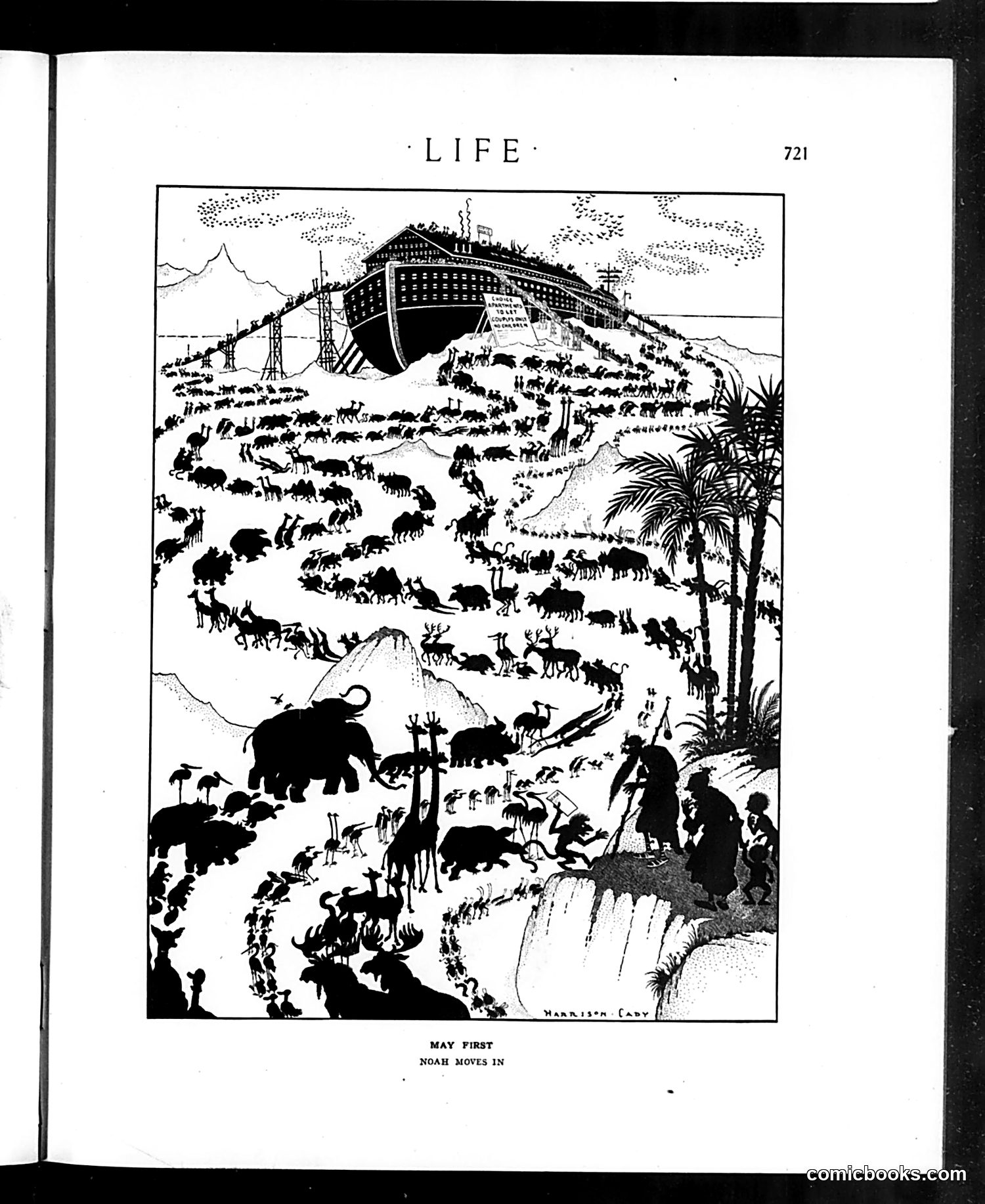
This satirical cartoon depicts Noah's Ark arriving with pairs of animals disembarking onto land. The caption "May First / Noah Moves In" likely references May Day (May 1st), historically associated with labor movements and socialist activism. The cartoon appears to satirize either: - A massive influx of immigrants or workers arriving on a specific date - Communist or socialist movements (May Day being their symbolic holiday), depicting them as an overwhelming "invasion" comparable to the biblical flood The crowded scene with countless animals suggests the cartoonist views the arrival as excessive or chaotic. The ark itself looms large and industrial, reinforcing the sense of scale and potential disruption. This reflects early 20th-century American anxieties about immigration and radical political movements, using biblical imagery for satirical effect.
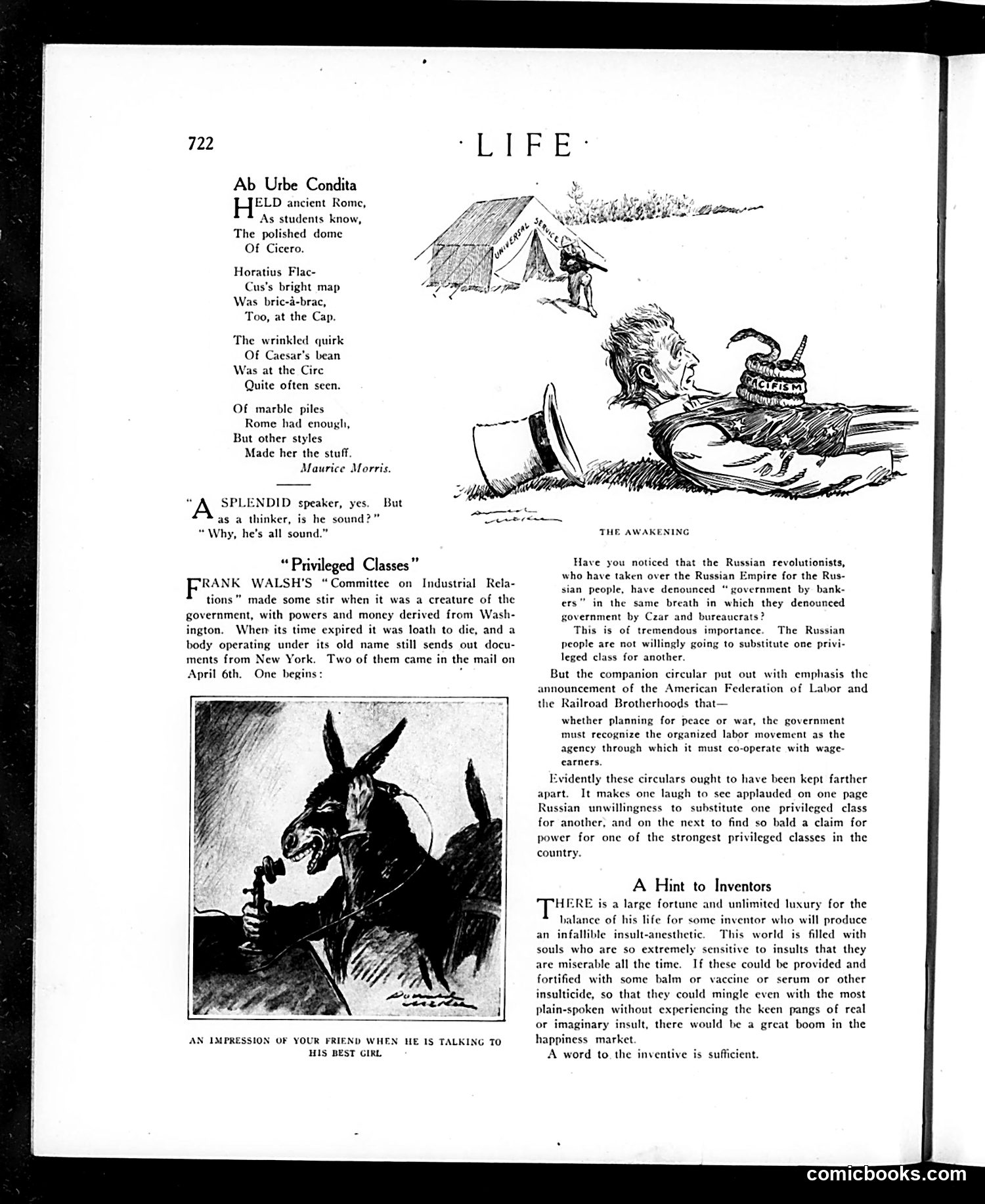
This page contains satirical commentary on post-WWI labor and class politics: **Main cartoon ("An Impression of Your Friend When He Is Talking to His Best Girl"):** A donkey—symbol of stubbornness or foolishness—depicts a man behaving absurdly while courting. It satirizes male behavior in romantic contexts. **"Privileged Classes" article:** The satire targets hypocrisy in American labor politics. The piece notes that Russian revolutionaries denounced both Czarist rule AND "government by bankers," rejecting privileged-class power entirely. Yet American labor organizations (Federation of Labor, Railroad Brotherhoods) simultaneously demand government recognition of *their* power as a "privileged class." The author mocks this contradiction: Americans applaud Russian refusal to swap one elite for another, yet advocate doing exactly that themselves. **Context:** This reflects 1920s anxiety about labor organizing, class conflict, and whether American unions represented workers or were becoming another self-interested power structure. The opening poem about ancient Rome appears decorative/classical, establishing learned tone for the satirical commentary.
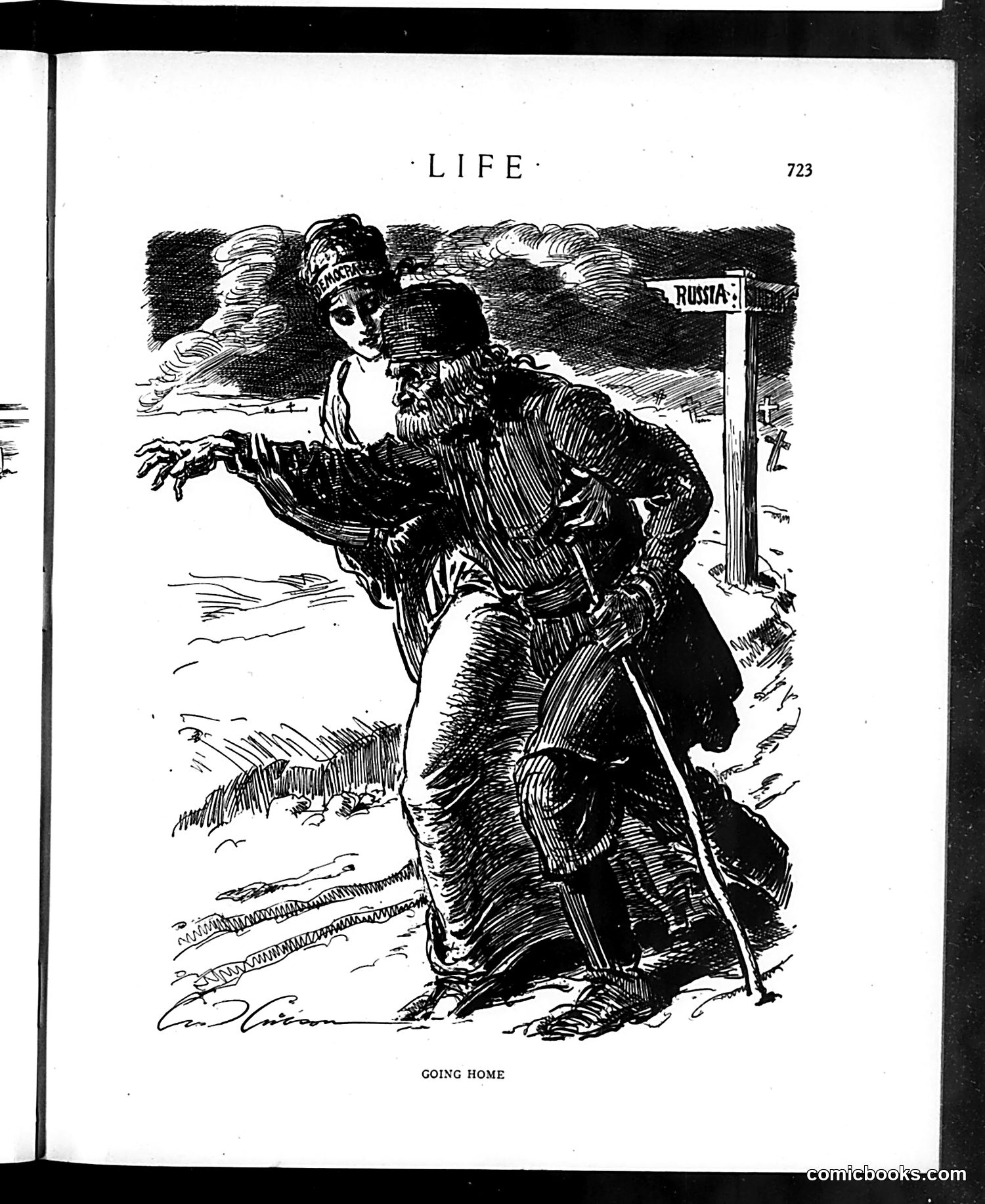
This satirical cartoon depicts a Russian soldier (identifiable by the "RUSSIA" signpost) helping or escorting a woman away from the border. The woman appears to be personified as a European nation, suggested by her elegant dress and the classical allegorical style common to political cartoons of this era. The cartoon likely comments on Russian military intervention or expansion into European territory—possibly depicting Russia as either "bringing home" conquered territory or, conversely, being forced to retreat. Without the publication date, the specific historical moment is unclear, but the imagery suggests Cold War-era tensions or earlier 20th-century conflicts involving Russian imperial ambitions in Europe.
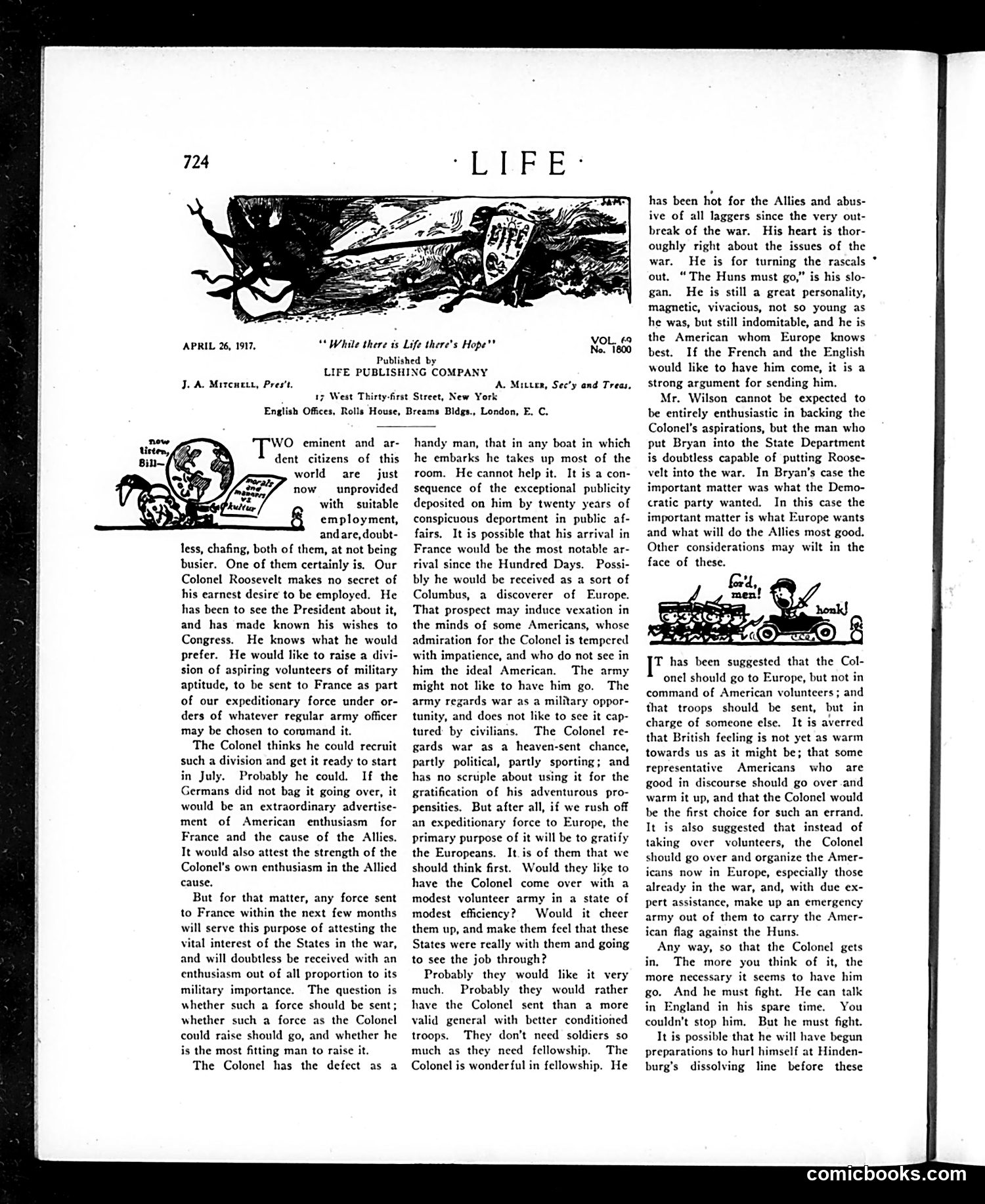
This *Life* editorial discusses **Colonel Theodore Roosevelt's** desire to lead a volunteer military division to France during World War I (America had recently entered the war). The piece debates whether Roosevelt should be sent to Europe. It acknowledges his genuine Allied enthusiasm and "wonderful" fellowship but notes his tendency to dominate any situation—he "takes up most of the room" due to his outsized public persona. The editorial suggests Europeans might value his moral support and energy more than military efficiency, yet questions whether he's the "most fitting man to raise" such a force. The cartoon header (artist: J.A. Mitchell) depicts a war-damaged landscape, illustrating the stakes of the debate. Ultimately, the text presents Roosevelt as an earnest but potentially problematic choice—his celebrity could overshadow military objectives, though his personal magnetism and unshakeable commitment to defeating "the Huns" held undeniable value.
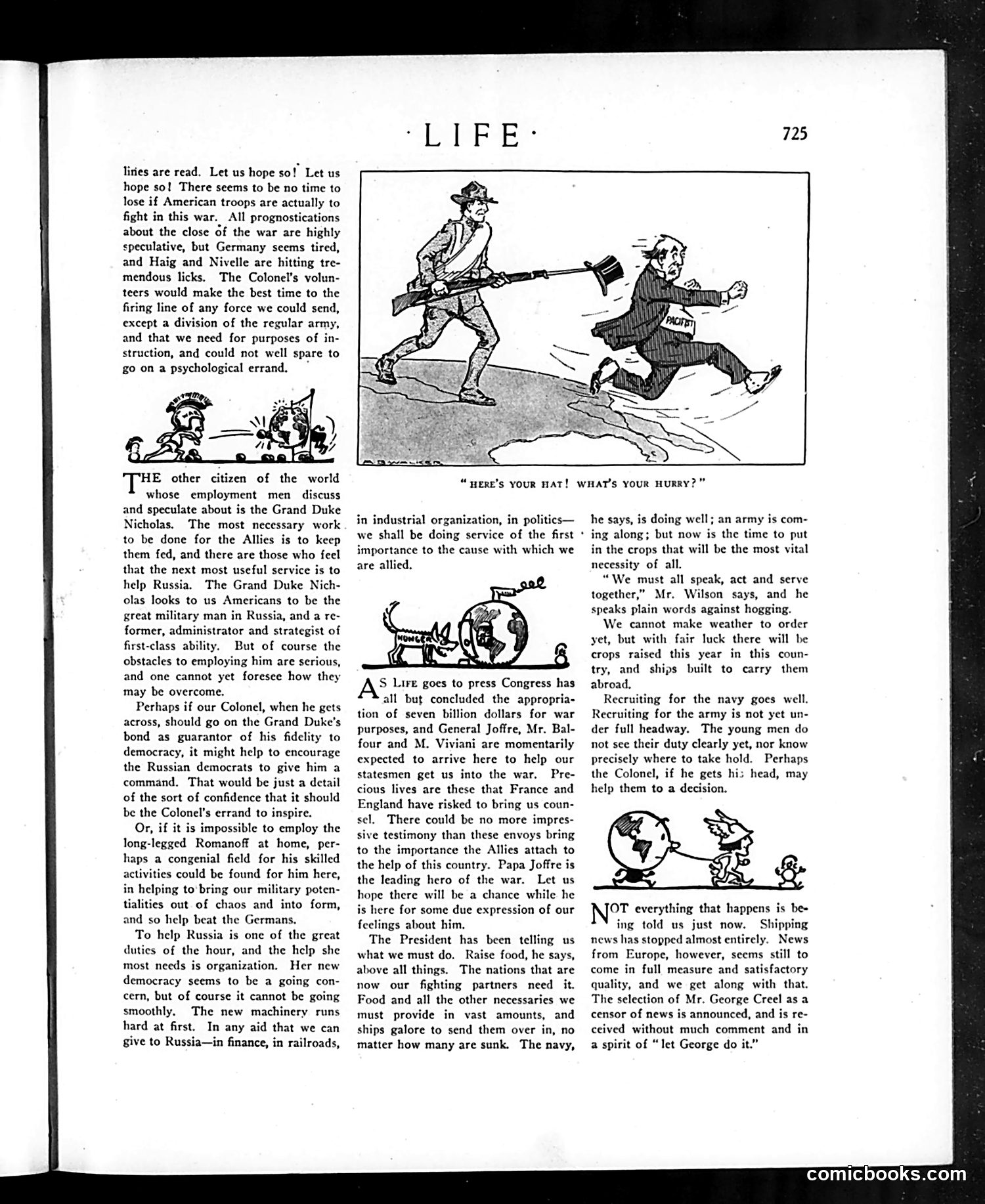
This WWI-era satirical piece critiques American military preparedness and Allied support efforts. The main cartoon shows a caricatured German ("KULTUR" on his jacket) being chased away by an American soldier with a bayonet-equipped rifle, captioned "HERE'S YOUR HAT! WHAT'S YOUR HURRY?" — mocking Germany's apparent military exhaustion. The accompanying text discusses deploying American troops and utilizing Russian Grand Duke Nicholas in the war effort. The satire targets slow U.S. military mobilization, suggesting that while Allied generals like Haig and Nivelle are "hitting tremendous licks," American volunteers could reach the front faster than regular army divisions. The piece also emphasizes urgent needs: organizing post-revolutionary Russia, feeding Allied nations, and building ships for supply lines. References to President Wilson's directives on crop production and cooperation underscore America's crucial material role rather than immediate combat contribution. The overall tone is impatient—pushing Americans to accelerate their practical and military support for the Allies.
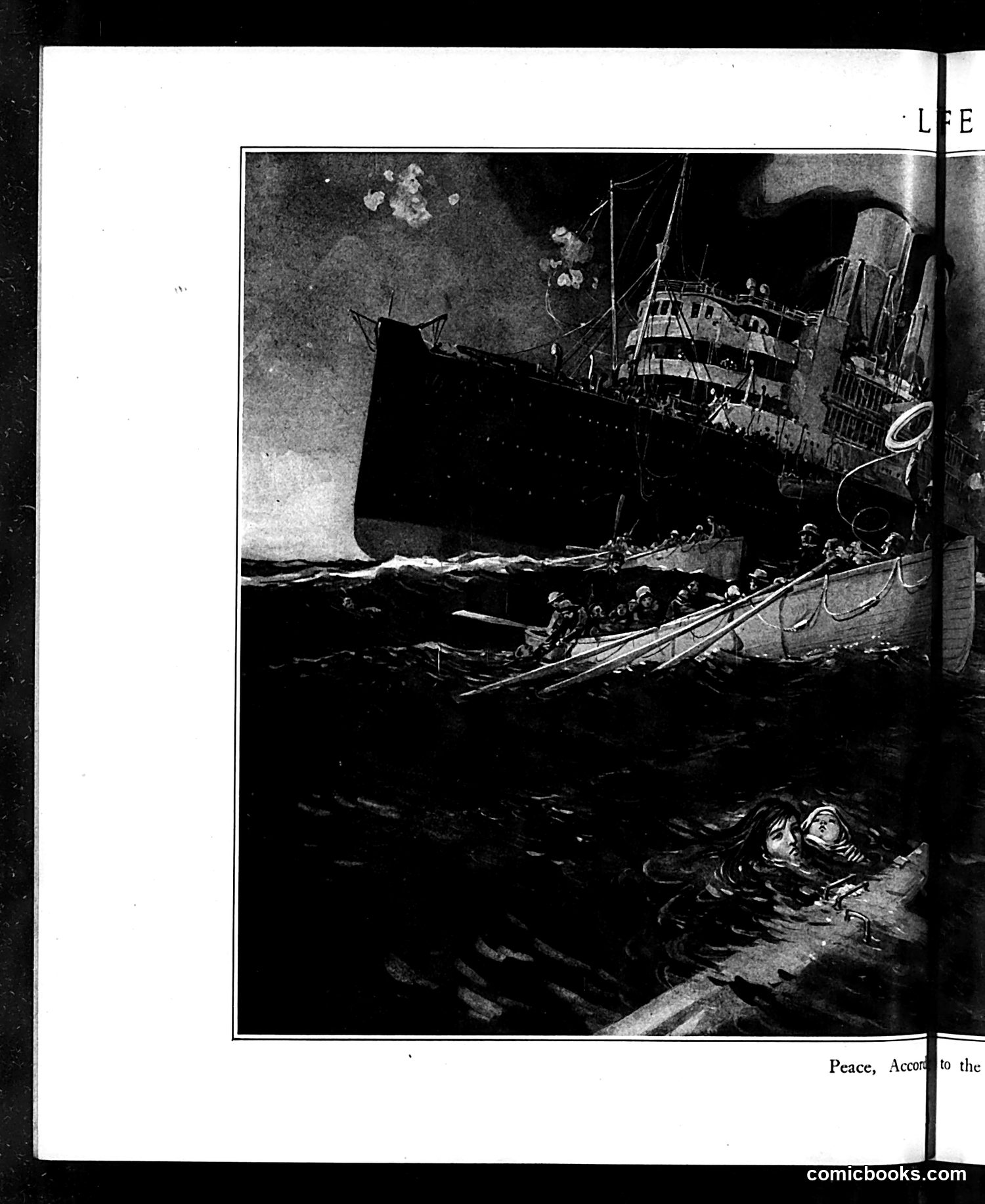
This appears to be a dramatic illustration from *Life* magazine depicting a maritime disaster or rescue scene. The image shows a large ship in the background with lifeboats in turbulent waters below. Multiple figures are visible in the water and boats, suggesting a emergency evacuation scenario. The caption reads "Peace, Accord to the..." (text is cut off), which seems incomplete. Without the full caption, the specific political or satirical reference is unclear. The illustration's style and the magazine's satirical nature suggest this may be commenting on a contemporary political event using maritime metaphor—possibly relating to international relations or diplomacy—but the incomplete text prevents certain identification of the intended meaning or targets.
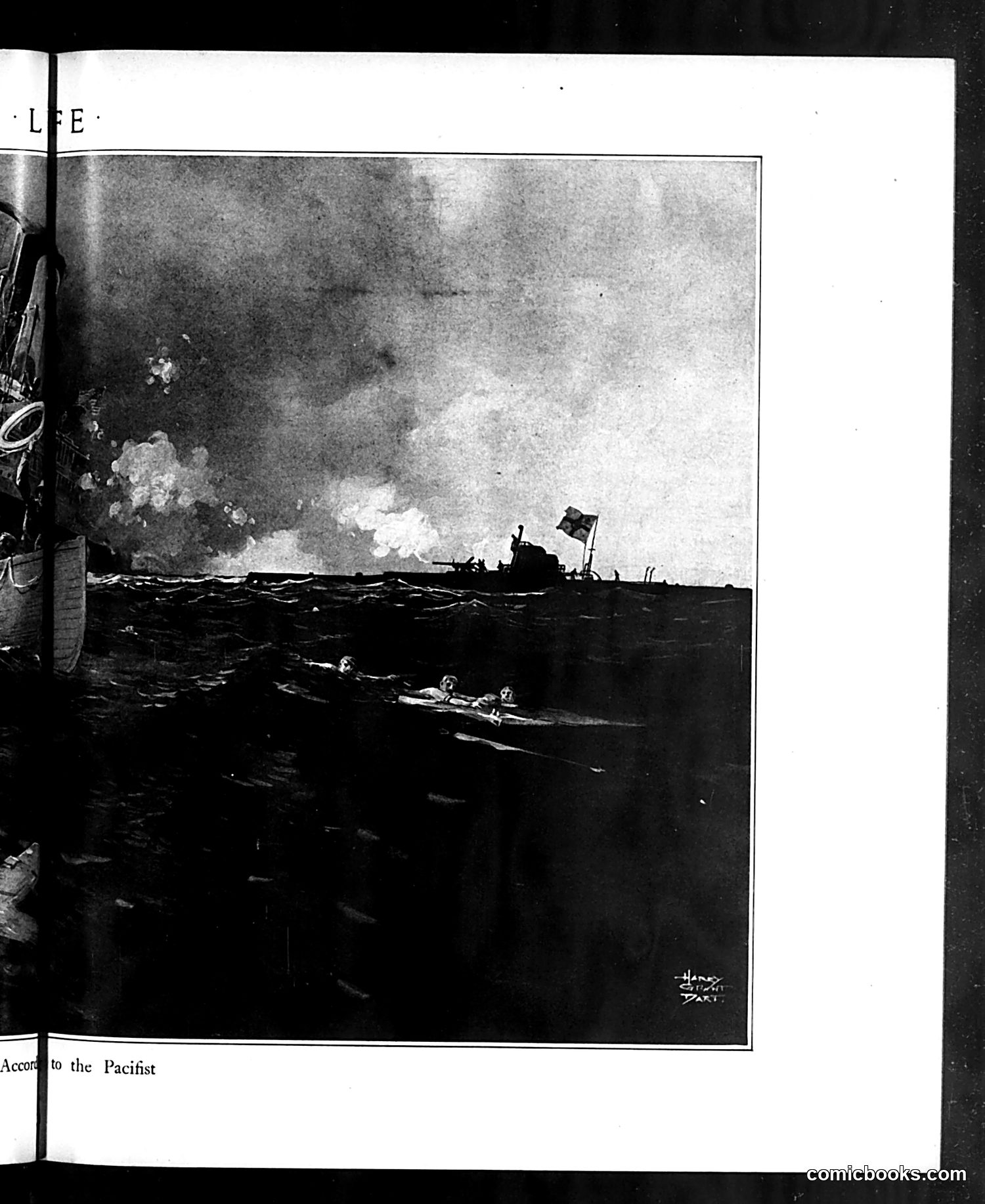
This appears to be a WWI-era Life magazine illustration titled "to the Pacifist." The image shows a naval battle scene with explosions and smoke on the horizon, while in the foreground, several people swim in the water near what appears to be a ship or vessel on the left. The satire targets pacifists—those opposing American military involvement. The cartoon suggests pacifism is naive or dangerous by juxtaposing peaceful swimmers with active naval warfare. The implication appears to be that pacifists' ideology cannot protect them from the harsh realities of actual combat at sea. The tone is mocking, suggesting pacifist positions were seen as impractical during wartime by Life's editors and intended audience.
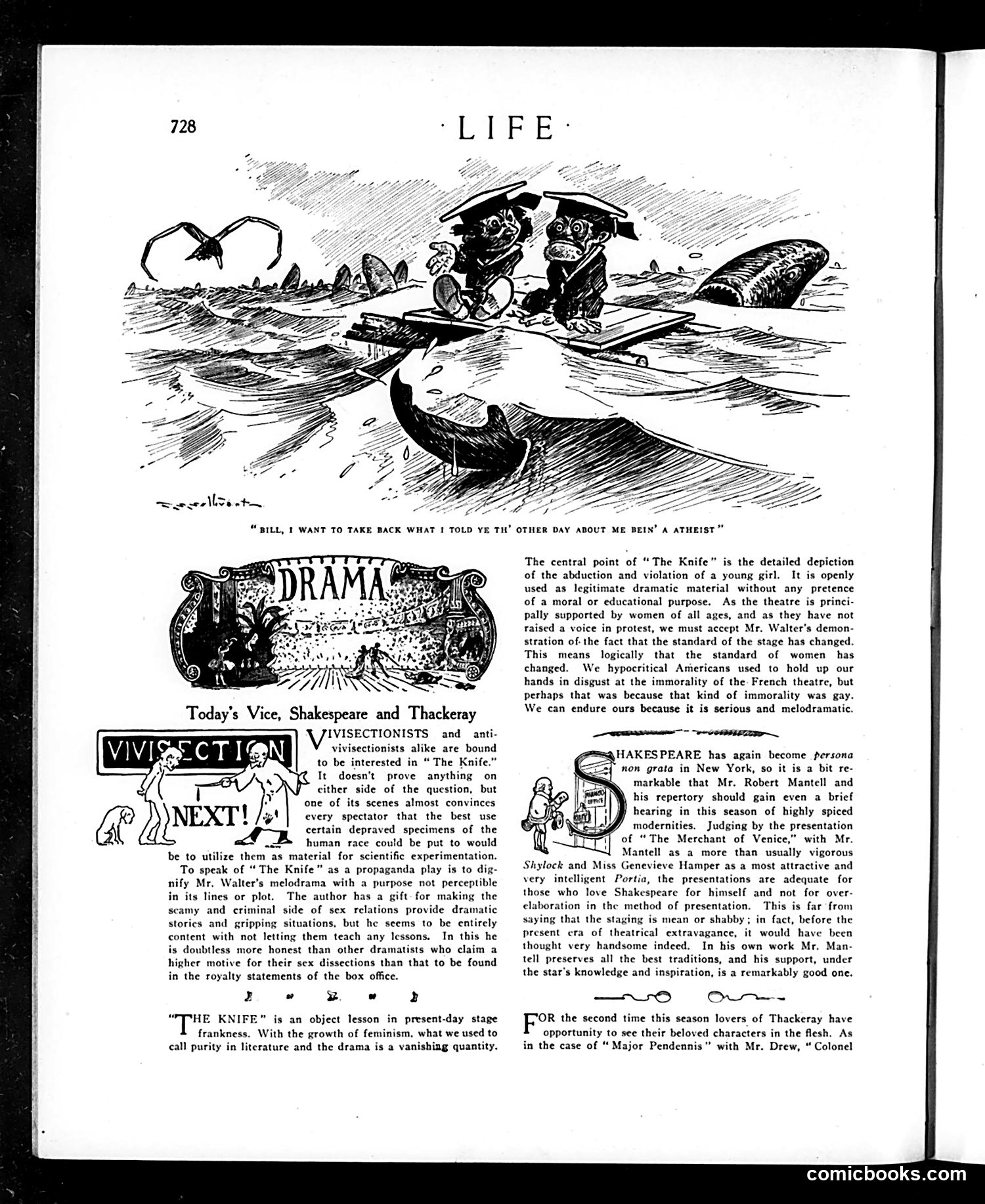
The top cartoon depicts two anthropomorphized animals (appearing to be dogs or similar creatures) in a small boat during rough seas, with one saying to the other: "Bill, I want to take back what I told ye th' other day about me bein' a atheist." **The joke:** This is a survival-situation humor cartoon playing on the common expression that "there are no atheists in foxholes"—the implication being that when facing death (here, being lost at sea), even a self-proclaimed atheist reconsiders their non-belief and turns to prayer. The page's main text reviews the play "The Knife," criticizing it as exploitative melodrama depicting sexual violence against a young woman. The critic argues the play has no moral purpose beyond sensationalism, and notes that because female theatergoers haven't protested, it reflects changed standards of propriety. The reviewer contrasts this with hypocritical American attitudes toward supposedly immoral French theatre. Additional brief reviews discuss Shakespeare's continued popularity and Thackeray adaptations on the New York stage.
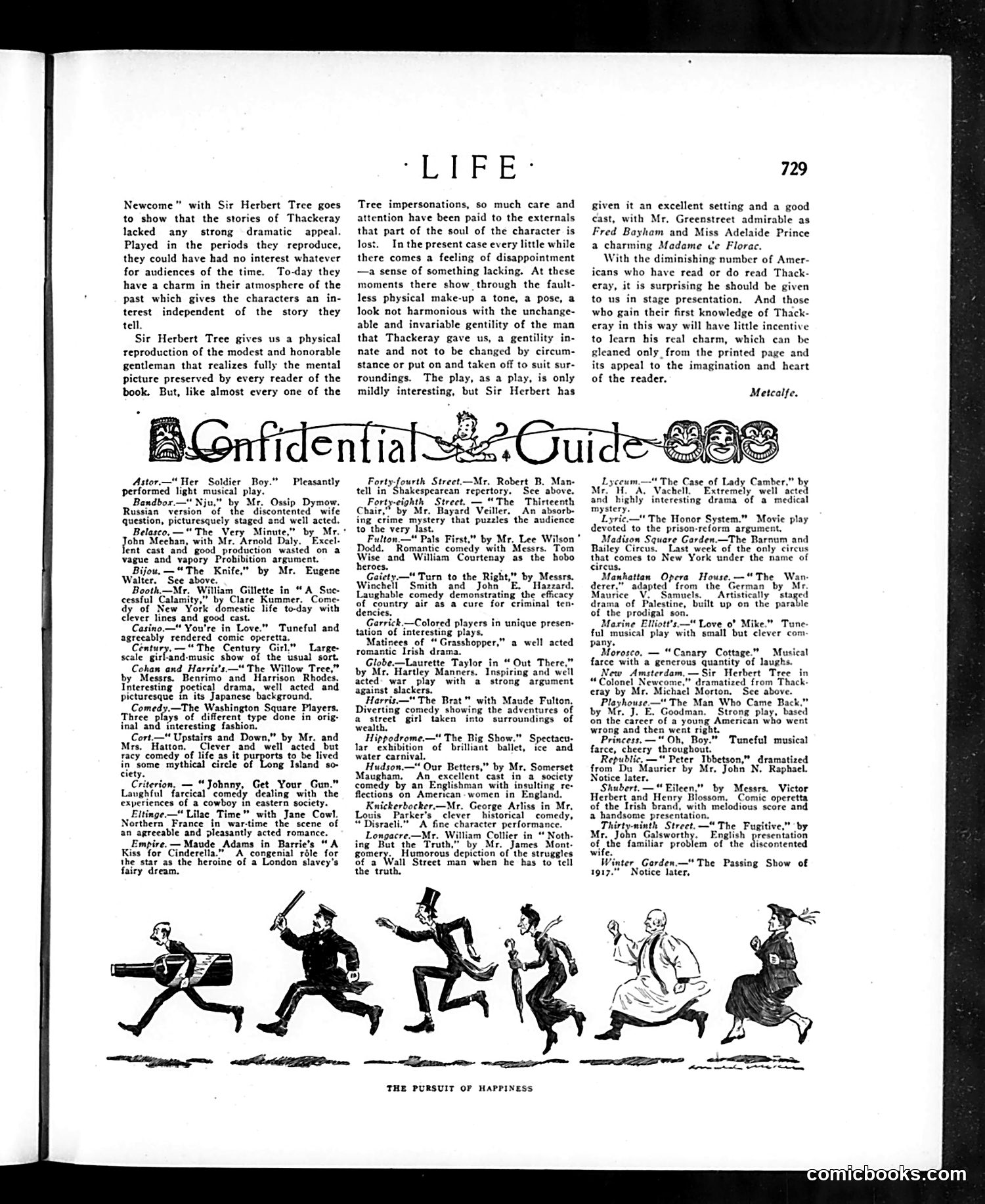
This page from *Life* magazine reviews theatrical productions. The bottom cartoon, titled "The Pursuit of Happiness," depicts six figures in sequential motion—a visual gag showing various people chasing what appears to be elusive contentment or success. The cartoon illustrates a common *Life* magazine theme: satirizing American social aspirations. Each figure (appearing to represent different social types or professions based on their dress and manner) runs frantically in pursuit of something just beyond reach. The progression suggests the futility and comedy of human ambition—everyone perpetually chasing happiness they cannot quite grasp. This reflects early-20th-century satirical commentary on American materialism and social climbing, a recurring subject in *Life*'s humor. The cartoon works as visual commentary accompanying the theater reviews above, which themselves critique contemporary productions and social pretensions depicted on stage.
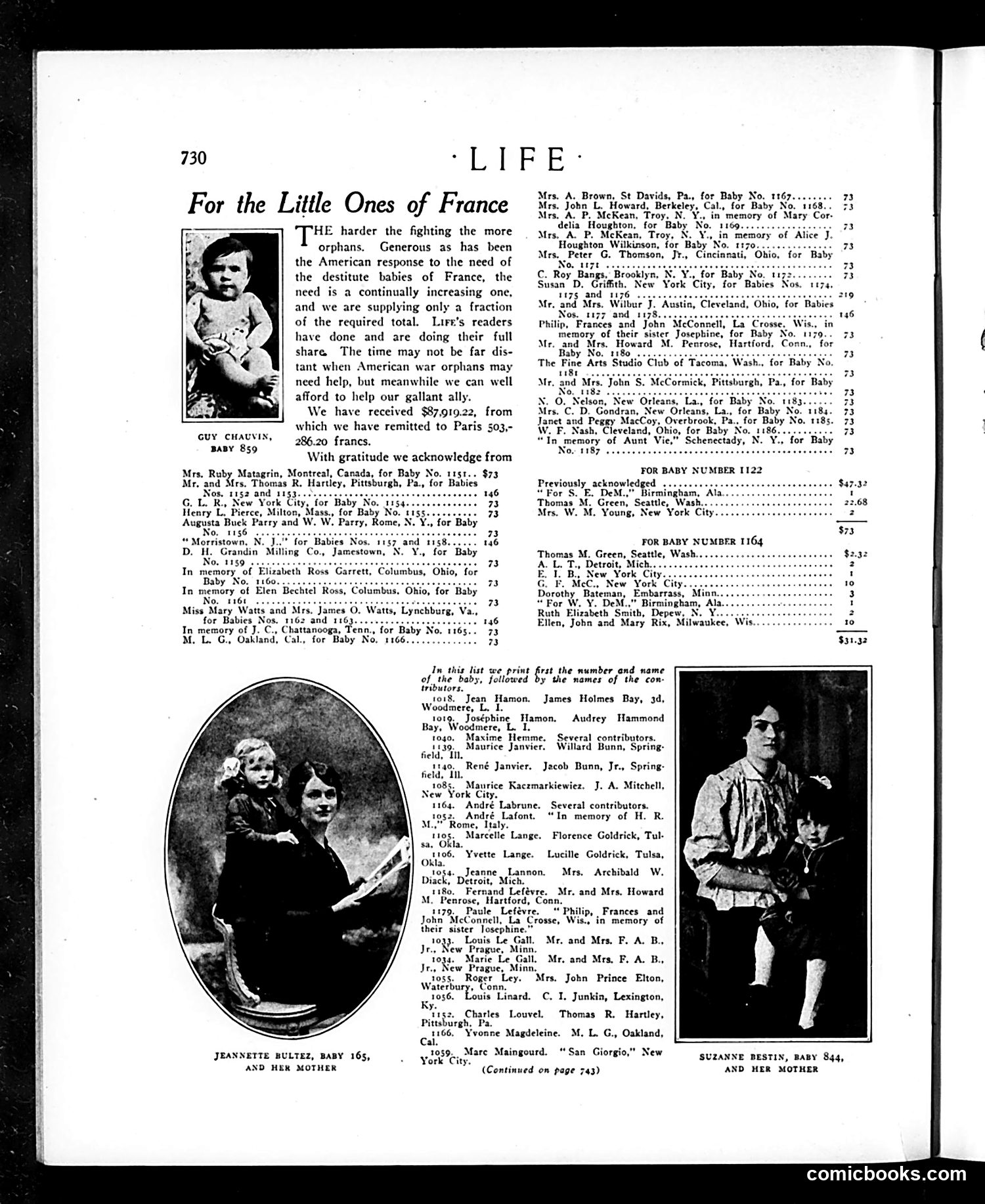
This page documents American charitable donations supporting French war orphans during World War I. The article explains that while American generosity has been substantial ($87,910.22 collected, 503,286.20 francs remitted to Paris), the need among French orphans continues growing faster than aid can meet it. The bulk of the page lists individual and group donors—Americans from cities nationwide who have contributed money to support specific French babies, often "in memory of" deceased relatives. This practice appears to have assigned individual orphans to American sponsors. The two photographs show beneficiaries: "Guy Chauvin, Baby 859" (upper left) and "Jeannette Bultez, Baby 165, and Her Mother" (lower left), alongside "Susanne Bestin, Baby 844" (right). The content reflects early 20th-century American civic engagement with European allies and the scale of civilian casualties in WWI.
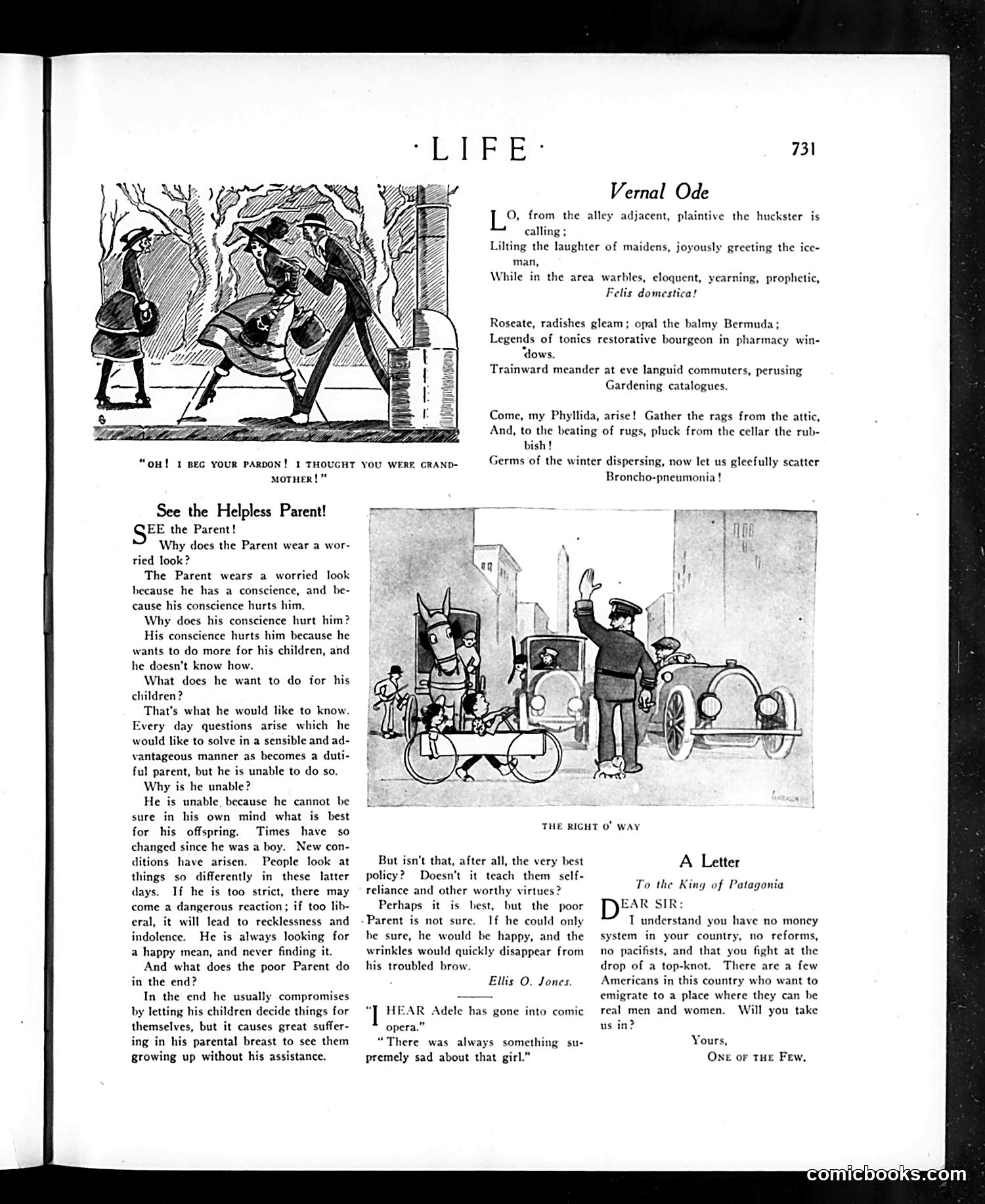
**"The Helpless Parent"** satirizes modern parenting anxiety. The cartoon depicts a father's worried expression, with accompanying text explaining his dilemma: he wants to help his children but is paralyzed by uncertainty about proper discipline. Times have changed since his youth—he fears being too strict (causing "dangerous reaction") or too lenient (leading to "recklessness"). His solution: let children decide for themselves, which ironically undermines his parental authority. The satire targets early 20th-century middle-class confusion about evolving child-rearing practices and generational gaps. **"The Right O' Way"** appears to mock urban congestion and transportation chaos, though details are unclear. **"Vernal Ode"** is mock-heroic poetry celebrating spring's arrival while darkly joking about spreading "broncho-pneumonia"—spring cleaning's dust dispersal. **"A Letter to the King of Patagonia"** satirizes Americans nostalgic for a pre-modern society with no bureaucracy, pacifism, or reform movements—suggesting escapism from progressive American culture.
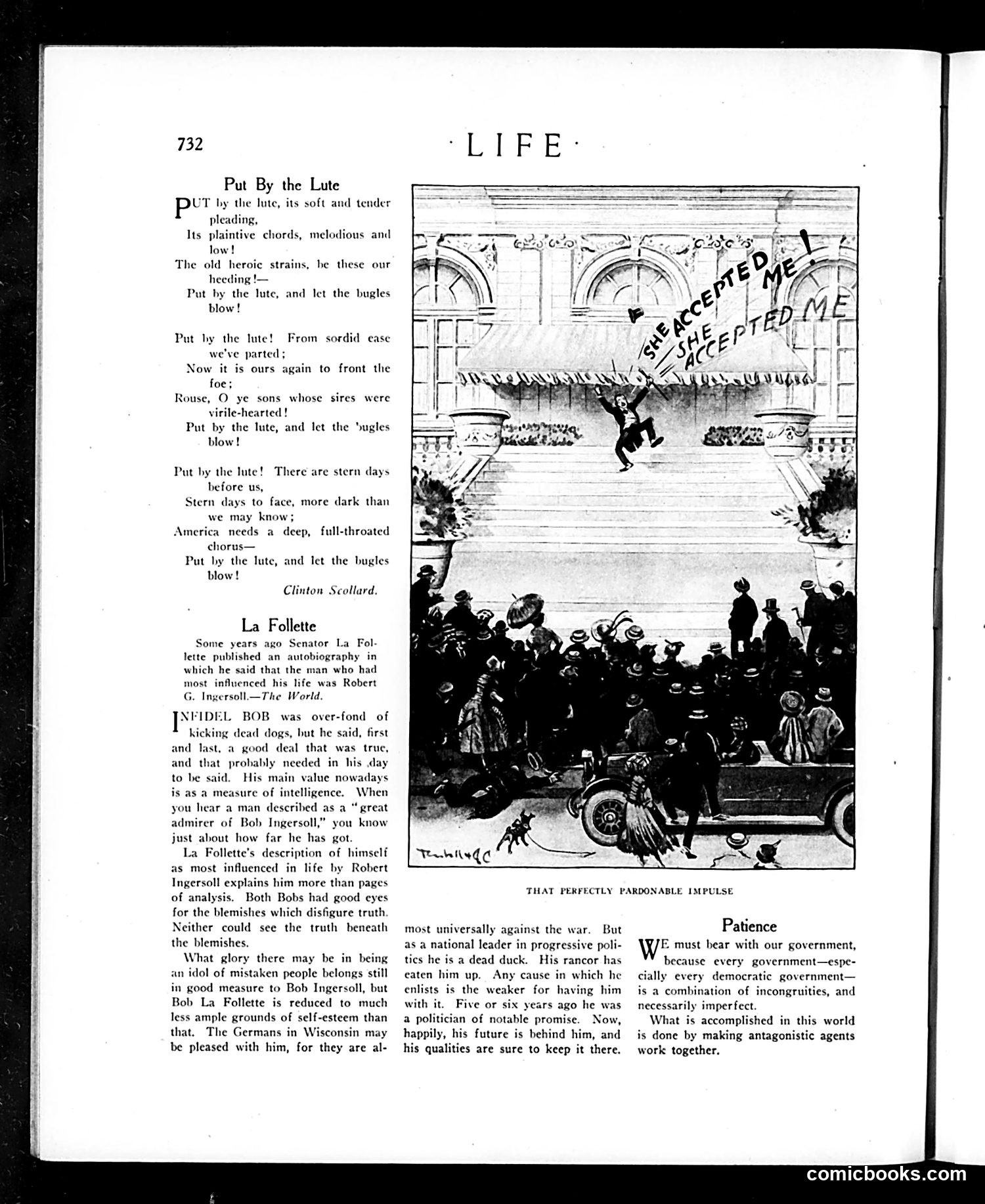
This page contains two distinct pieces of political commentary from what appears to be World War I era America. **"Put By the Lute"** is a patriotic poem by Clinton Scollard urging Americans to abandon peaceful pursuits and embrace military action ("let the bugles blow"). It uses martial rhetoric to rally support for war. **"La Follette"** is a scathing editorial attacking Senator Robert La Follette, a Wisconsin Progressive politician who opposed U.S. entry into World War I. The piece compares him unfavorably to Robert Ingersoll (a 19th-century agnostic intellectual) and dismisses him as a "dead duck" politically. The editorial suggests La Follette's anti-war stance—popular among German-Americans in Wisconsin—disqualifies him from national leadership. **The cartoon** depicts what appears to be a public event (possibly a political rally or speech) where someone is being rejected or falling, with text reading "SHE ACCEPTED ME / SHE ACCEPTED ME"—likely satirizing La Follette's failed political ambitions. The page essentially mocks anti-war sentiment as unpatriotic during the war period.
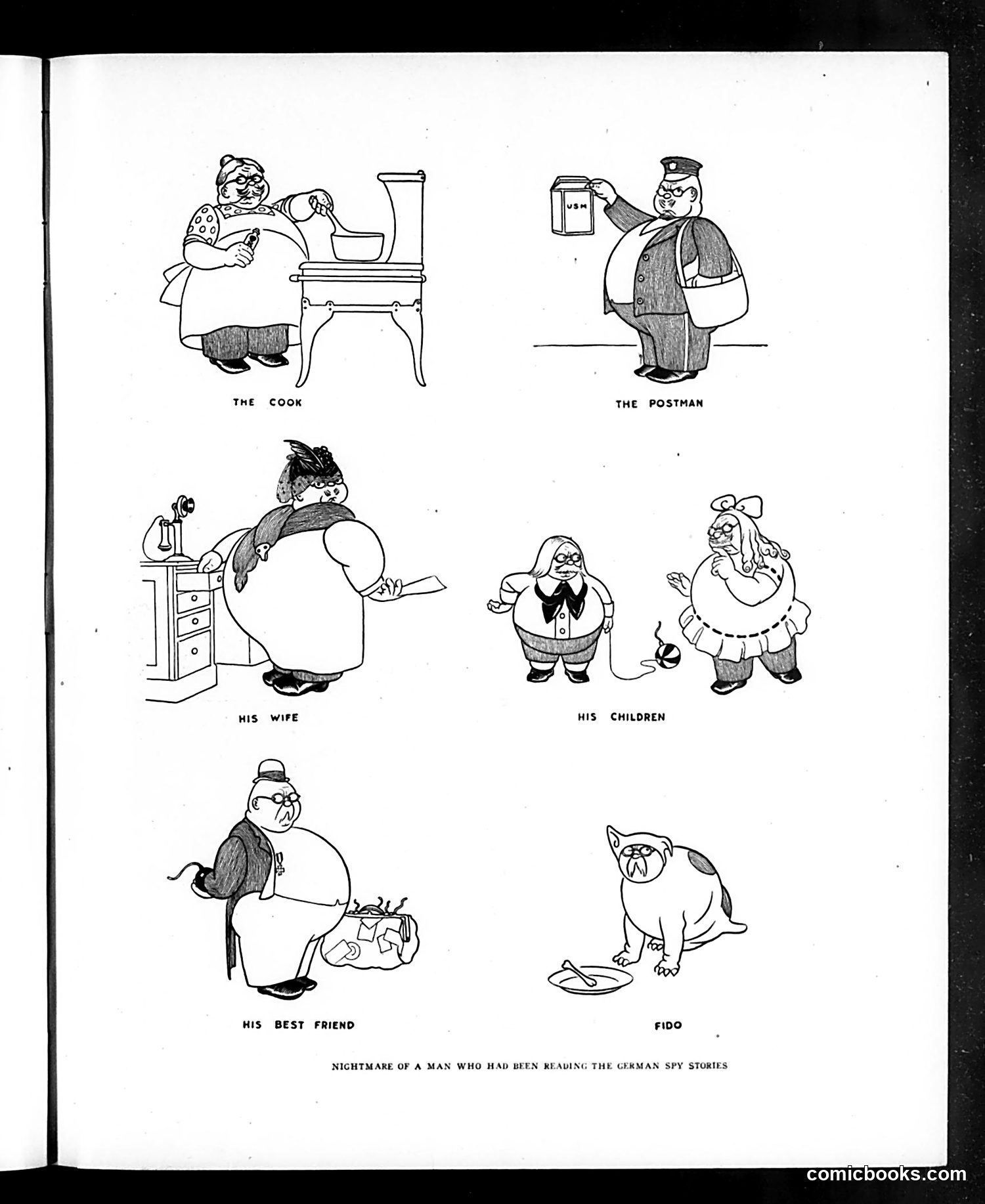
This is a satirical cartoon from Life magazine depicting the paranoid fantasies of someone who has been reading German spy fiction. The title explains the joke: a man becomes so immersed in spy stories that he experiences anxiety about the everyday people around him. Each figure represents his suspicion of those closest to him: - **The Cook** and **The Postman** are portrayed as potential spies - **His Wife, Children, and Best Friend** are similarly viewed with paranoia - Even **Fido** (his dog) appears suspicious The humor lies in the exaggeration—the spy stories have made him irrationally distrust everyone in his domestic life, transforming ordinary household members into imagined enemy agents. This likely reflects early 20th-century anxiety about German espionage and the power of sensational fiction to distort perception.
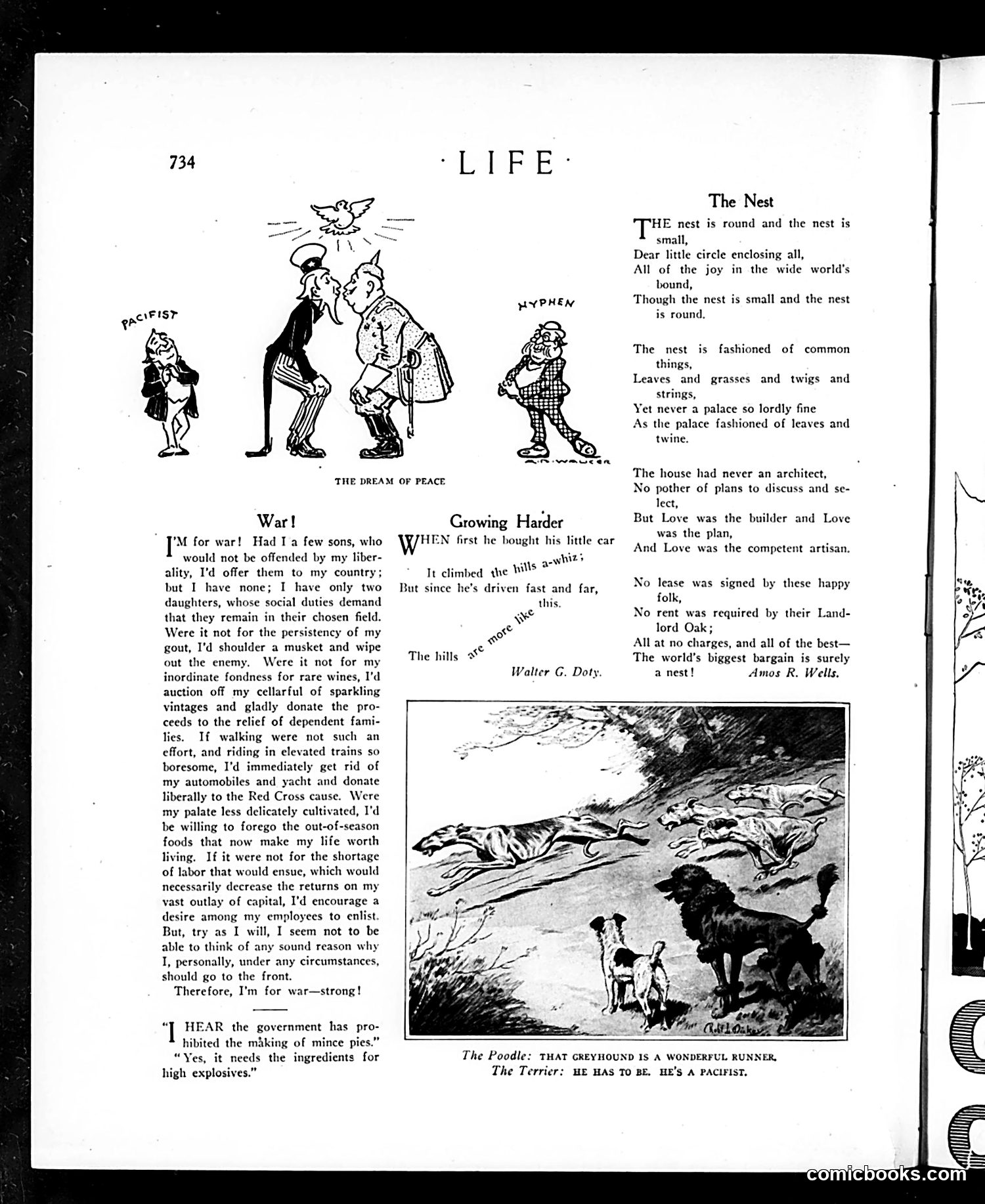
This page contains WWI-era social commentary. The central "War!" piece mocks wealthy Americans claiming patriotic support while offering elaborate excuses to avoid personal sacrifice—gout, wine cellars, automobiles, delicate palates, business concerns. The speaker supports war enthusiastically *for others* while finding reasons he personally cannot serve. "The Dream of Peace" cartoon shows three figures (labeled Pacifist and Hyphen) meeting under a dove, satirizing pacifist and immigrant positions during wartime nationalism. "Growing Harder" jokes about a motorist becoming desensitized to dangerous driving after repeated trips. A brief exchange mocks government rationing: mince pies are prohibited because ingredients are needed for explosives. "The Nest" is sentimental poetry celebrating home and family. The bottom cartoon contrasts a greyhound (described as wonderful runner) with a terrier labeled pacifist—likely suggesting pacifists must "run away" from conflict, a common WWI-era insult. Overall, the page ridicules wealthy draft-avoiders and pacifism while celebrating patriotic sacrifice and domestic values.
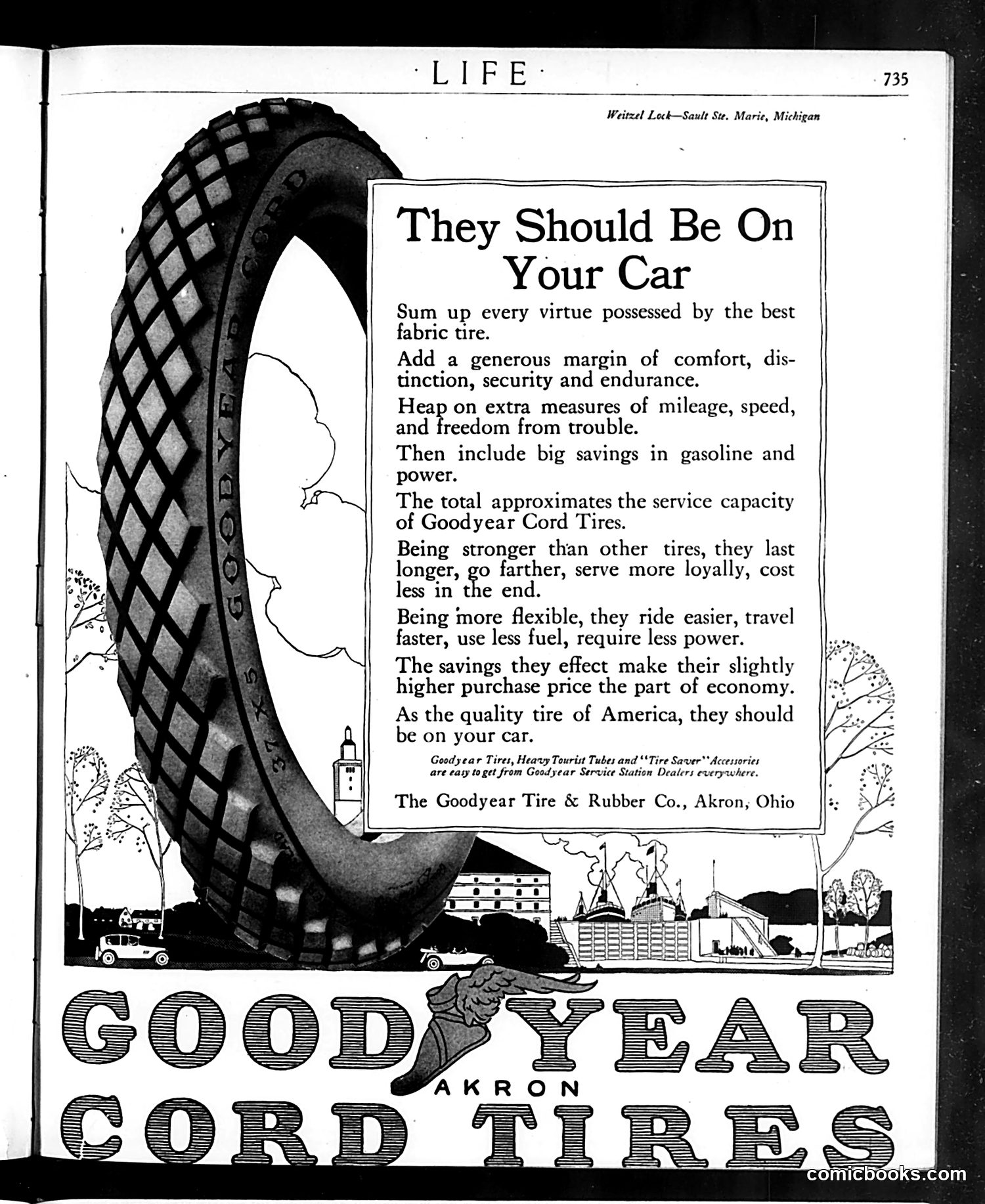
This is a **Goodyear tire advertisement**, not satire or political commentary. The page features a massive illustrated tire dominating the composition, with a townscape beneath showing cars, buildings, and a lighthouse—emphasizing Goodyear's American manufacturing heritage (Akron, Ohio is their headquarters). The text employs characteristic early 20th-century advertising rhetoric, listing abstract virtues ("distinction, security, endurance") alongside practical benefits (mileage, fuel economy, durability). The argument that Goodyear's "slightly higher purchase price" offers better economy through longevity was a common sales strategy during this era of automobile expansion. The visual scale—an enormous tire looming over civilization—underscores the product's importance to modern life. This appears in *Life* magazine's advertising section (page 735), where such full-page pitches were standard. There is no cartoon or satirical content here; it is straightforward commercial messaging.
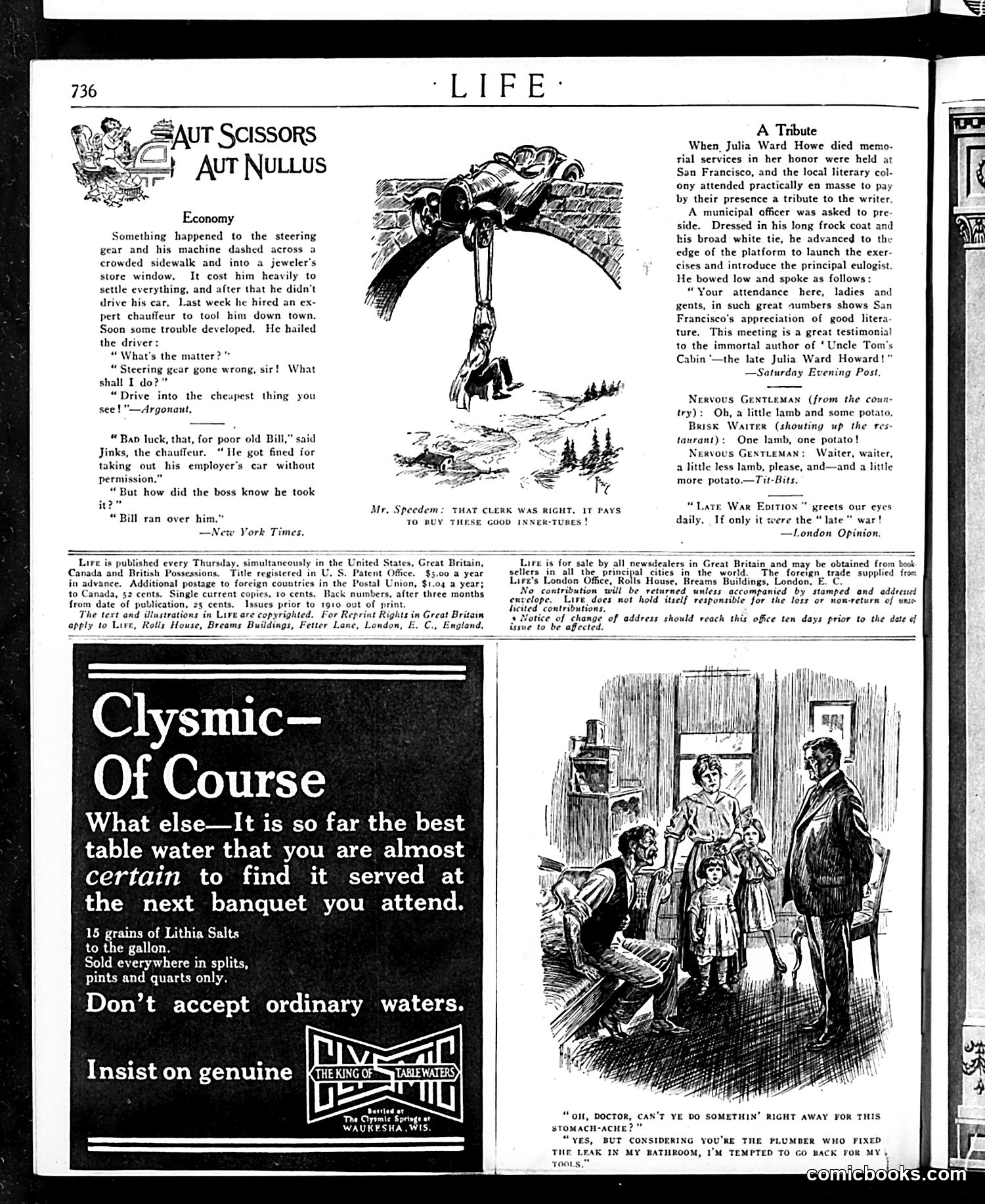
This page contains three unrelated satirical pieces typical of early Life magazine: **"Aut Scissors Aut Nullus" (top left):** A brief comic anecdote about a man who, after his steering gear fails and damages a jewelry store, hires a chauffeur. The chauffeur similarly claims steering trouble, but the punchline reveals he actually hit and killed his employer—darkly suggesting the boss discovered the unauthorized car use fatally. **"A Tribute" (top right):** A humorous account of a municipal official at Julia Ward Howe's memorial service (the author of "Battle Hymn of the Republic"). The officer confuses her identity, calling her "the late Julia Ward Howard," author of "Uncle Tom's Cabin"—attributing Harriet Beecher Stowe's famous work to Howe. The satire mocks ceremonial incompetence and public ignorance about literary figures. **Bottom cartoon:** A doctor-patient exchange where a stomach-ache sufferer seeks help, but the doctor (recognizing him as the plumber who poorly fixed his bathroom) threatens revenge by retrieving tools—reciprocal payback humor. The page is primarily comedic rather than political.
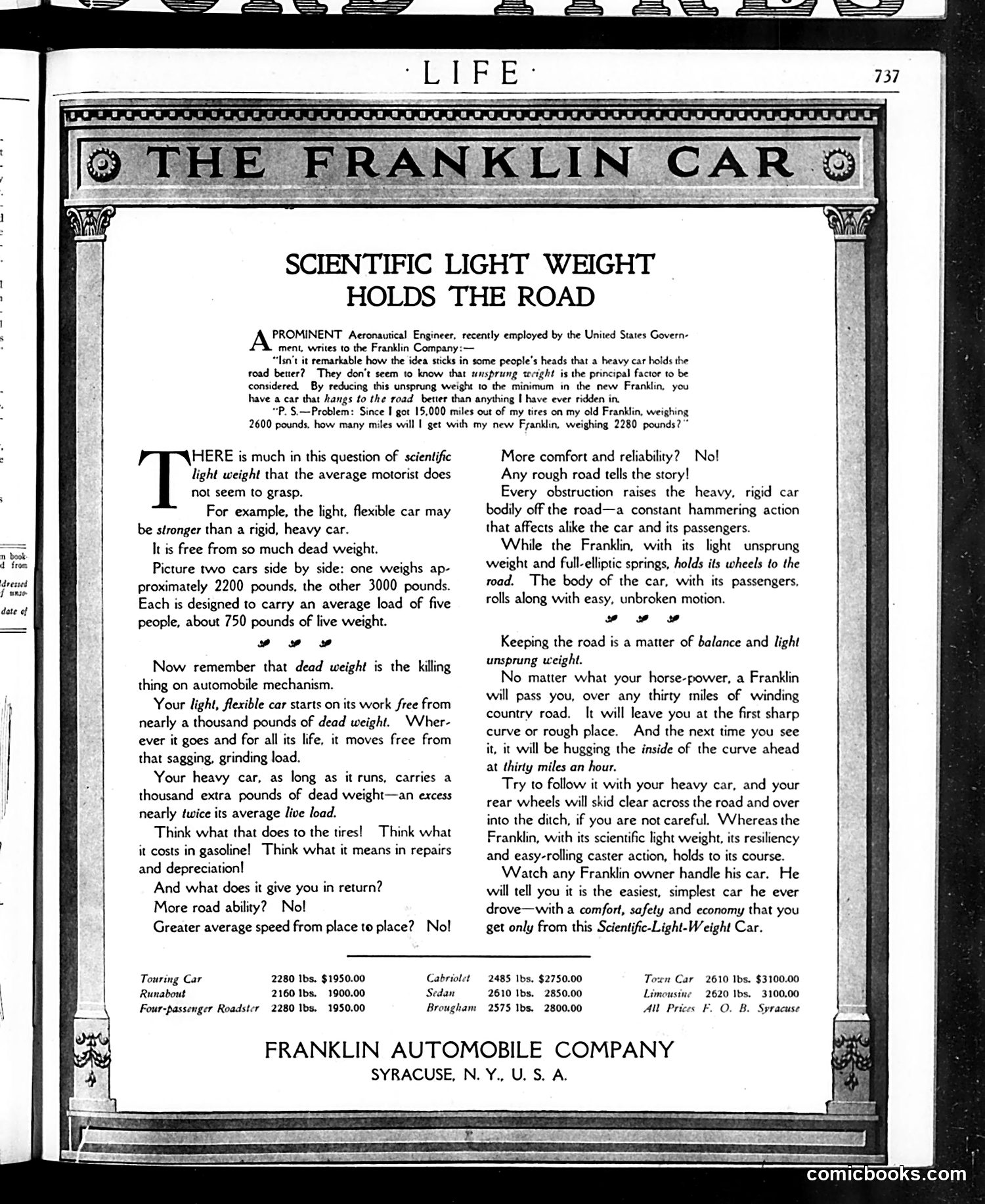
This is a **Franklin automobile advertisement**, not a cartoon or satire. It appears in *Life* magazine's advertising section (page 737). The ad argues that the Franklin car's lighter weight (2,280 pounds versus competitors' ~3,000 pounds) provides superior road handling. It marshals an appeal to authority—citing a government aeronautical engineer—to counter the common automotive belief that heavier cars grip roads better. The core sales pitch: reduced "dead weight" (the car's own mass, versus passenger load) means better tire wear, fuel economy, handling on curves, and less mechanical stress. The ad contrasts a light, flexible car with a heavy, rigid one, claiming the Franklin's lighter construction allows wheels to maintain road contact on rough terrain while heavy competitors bounce and skid. The message targets middle-class motorists concerned with economy and reliability. While framed as scientific reasoning, it's fundamentally marketing copy using technical language to justify premium pricing ($1,950–$3,100).
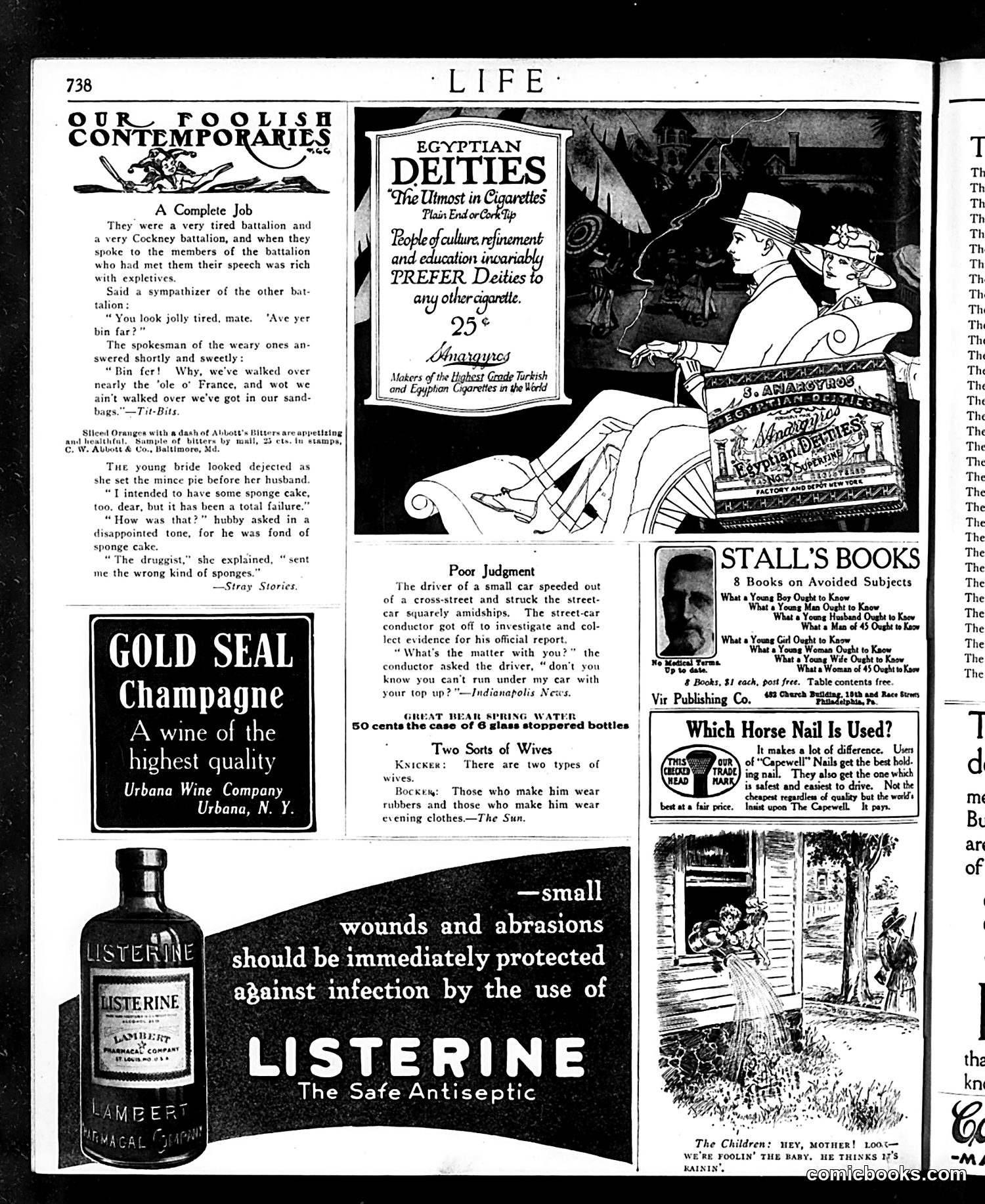
This page is primarily **advertising** with minimal satirical content. The main cartoon appears at the bottom, showing children playing peek-a-boo with an infant, captioned "WE'RE FOOLIN' THE BABY. HE THINKS IT'S RAININ'."—a simple joke about infant perception. The page otherwise consists of brief humorous anecdotes and product advertisements typical of early 20th-century Life magazine. One story mocks a bride's failed baking ("wrong kind of sponges"), another depicts British soldiers' exhaustion from marching in World War I, and a third involves a street-car conductor and a reckless driver. The advertisements promote champagne, cigarettes, antiseptic mouthwash, and instructional books on etiquette. The Egyptian Deities cigarette ad uses orientalist imagery common to the era. **There is no significant political satire or caricature requiring historical context to understand.**
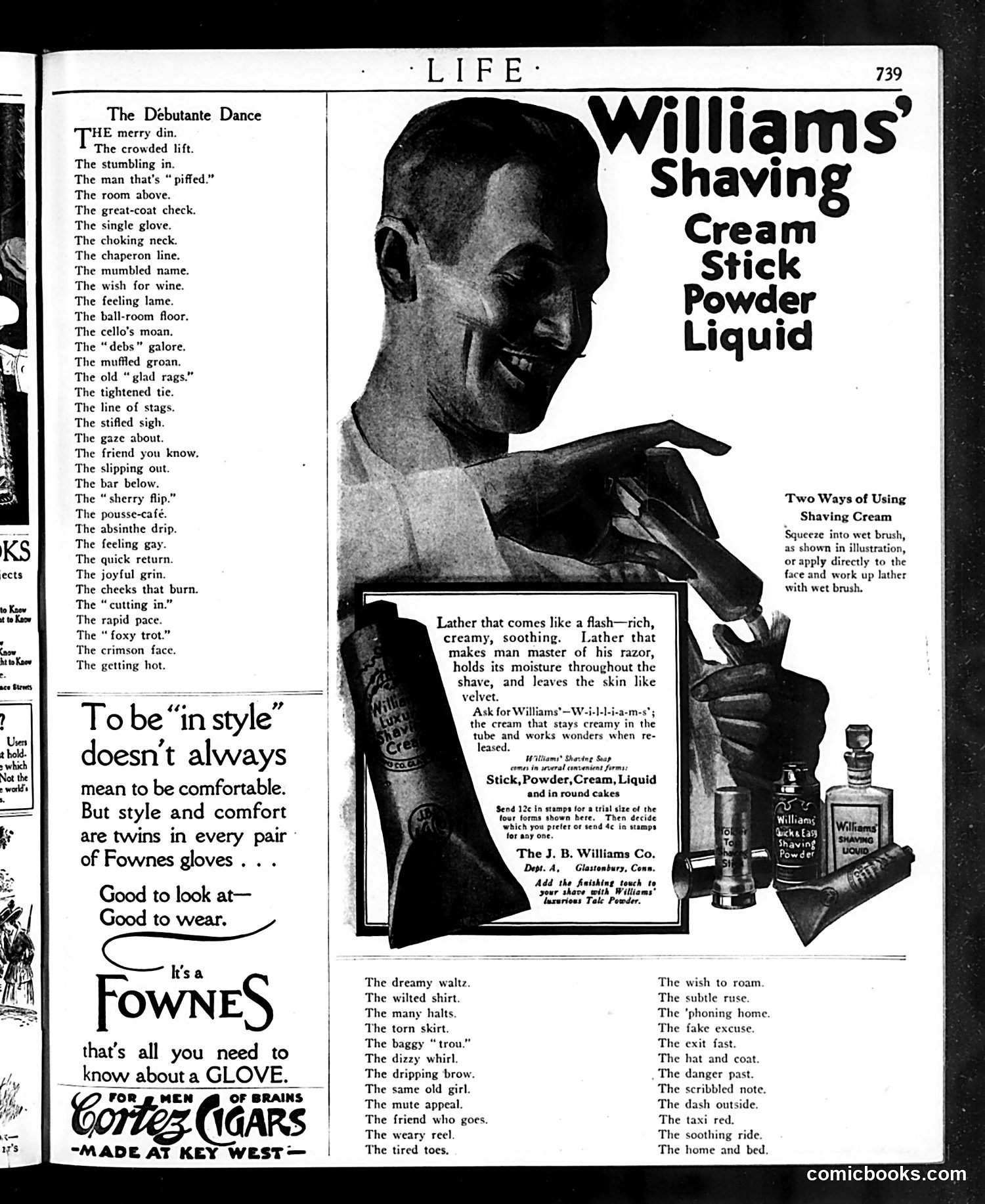
This page contains two distinct elements: **advertising and satirical poetry**. The left side presents "The Debutante Dance," a humorous poem cataloging the awkward, ridiculous details of attending a formal ball—from arriving drunk ("piffed") to sneaking out to the bar below. It satirizes upper-class social pretension by itemizing the discomfort and hypocrisy: the forced propriety, the desperate drinking, the exhaustion. The poem mocks debutante culture and formal society's veneer of elegance masking juvenile behavior and desperation. The right side contains two product advertisements: **Fownes gloves** (emphasizing style and comfort) and **Williams' Shaving Cream** (showing application methods). These are standard commercial ads with no satirical content. The contrast between the satirical poem's deflation of high society and the earnest, dignified advertising below creates an ironic juxtaposition typical of Life's format—mixing social commentary with commercial messaging.
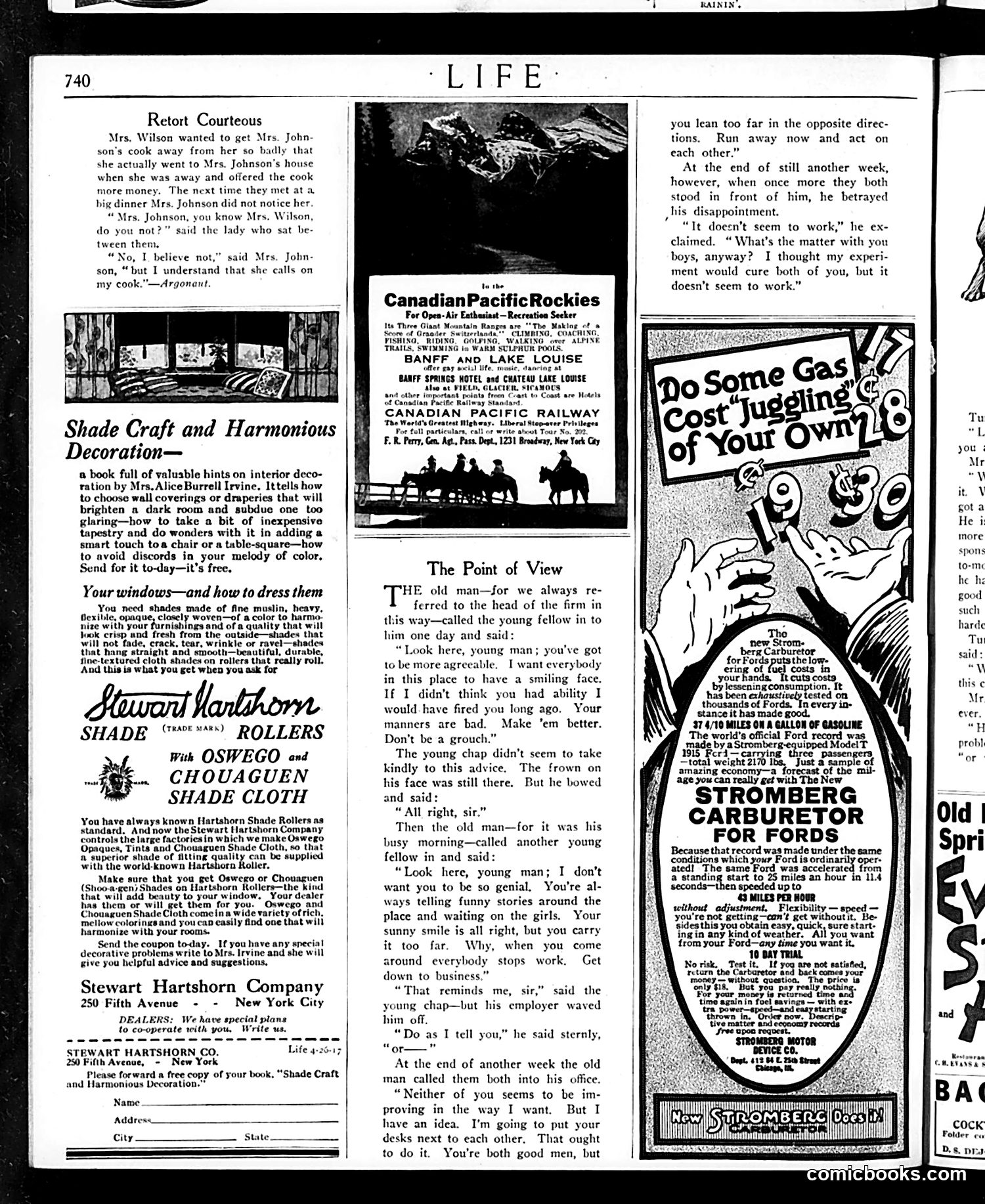
This page contains primarily **advertisements and short humorous anecdotes** rather than political cartoons. **"Retort Courteous"** is a brief social satire about class dynamics: Mrs. Wilson attempts to poach Mrs. Johnson's cook by offering higher wages. When they later meet socially, Mrs. Johnson coldly denies knowing Wilson, pointedly remarking she only knows her through the cook—a cutting reminder that Wilson's behavior was socially unacceptable and that she'll be remembered only for this transgression. **"The Point of View"** depicts a workplace scenario where an employer repeatedly tells a sullen young employee to improve his attitude and smile. After weeks of failed attempts at correction, the boss expresses frustration that his advice hasn't worked—the joke being that forced cheerfulness cannot be mandated, and the employee's fundamental disposition remains unchanged regardless of employer demands. Both anecdotes mock rigid social expectations and the gap between outward compliance and genuine sentiment—common themes in *Life's* satirical humor about American manners and workplace relations.
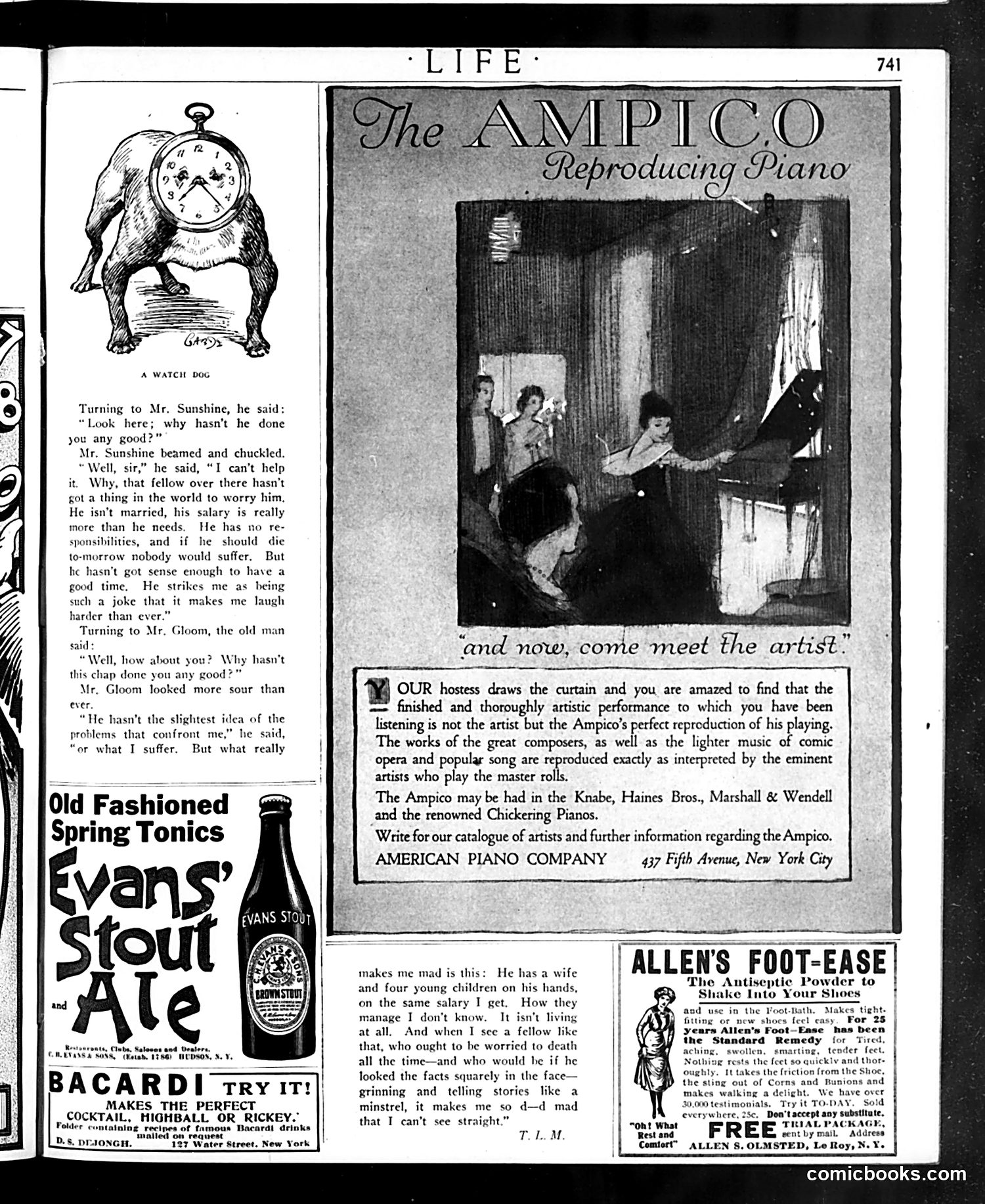
This page contains a satirical cartoon titled "A Watch Dog" about the nature of happiness and worry. An old man questions two personified figures—Mr. Sunshine (cheerful) and Mr. Gloom (pessimistic)—about why neither has improved a carefree man's life. The joke: Mr. Sunshine says the man is too foolish to worry despite having no real problems. Mr. Gloom is angry that this same man grins and tells jokes despite having a wife and four children to support on a modest salary—the very circumstances that should crush him with anxiety. The satire critiques how personality shapes perception: the same man appears either absurdly fortunate or impossibly burdened depending on one's temperament. It's commentary on how outlook (rather than circumstances) determines contentment—a theme relevant to early 20th-century philosophy about positive thinking versus realistic worry. The remainder is period advertising for pianos, beer, and foot powder.
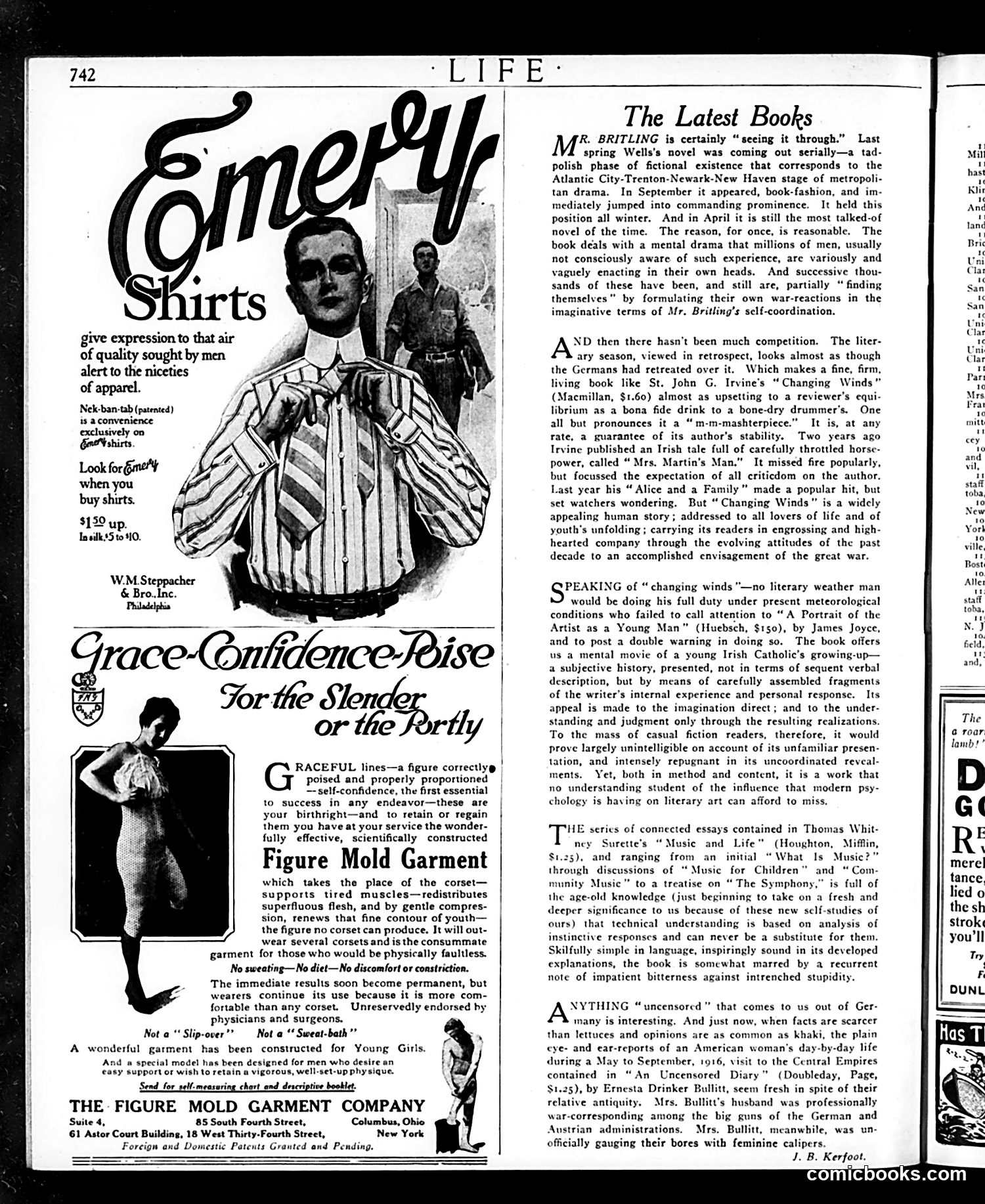
This page is primarily **advertising and book reviews**, not political satire. The main advertisements promote **corsetry and shapewear** from the era: "Emery Shirts" (top left) and "Figure Mold Garment" (center/bottom). These ads use period-typical appeals to masculine refinement and female body-shaping, positioning undergarments as solutions for maintaining "grace" and "confidence." The book reviews discuss H.G. Wells's *Mr. Britling Sees It Through* and St. John G. Irvine's *Changing Winds*—both WWI-era novels addressing the mental and emotional experience of the war. The reviewer notes Wells's novel resonated because it articulated what millions of men were unconsciously experiencing during the conflict. There is **no political cartoon here**. The page reflects early-20th-century consumer culture and wartime literary discourse, with the war's psychological impact emerging as a major literary concern.
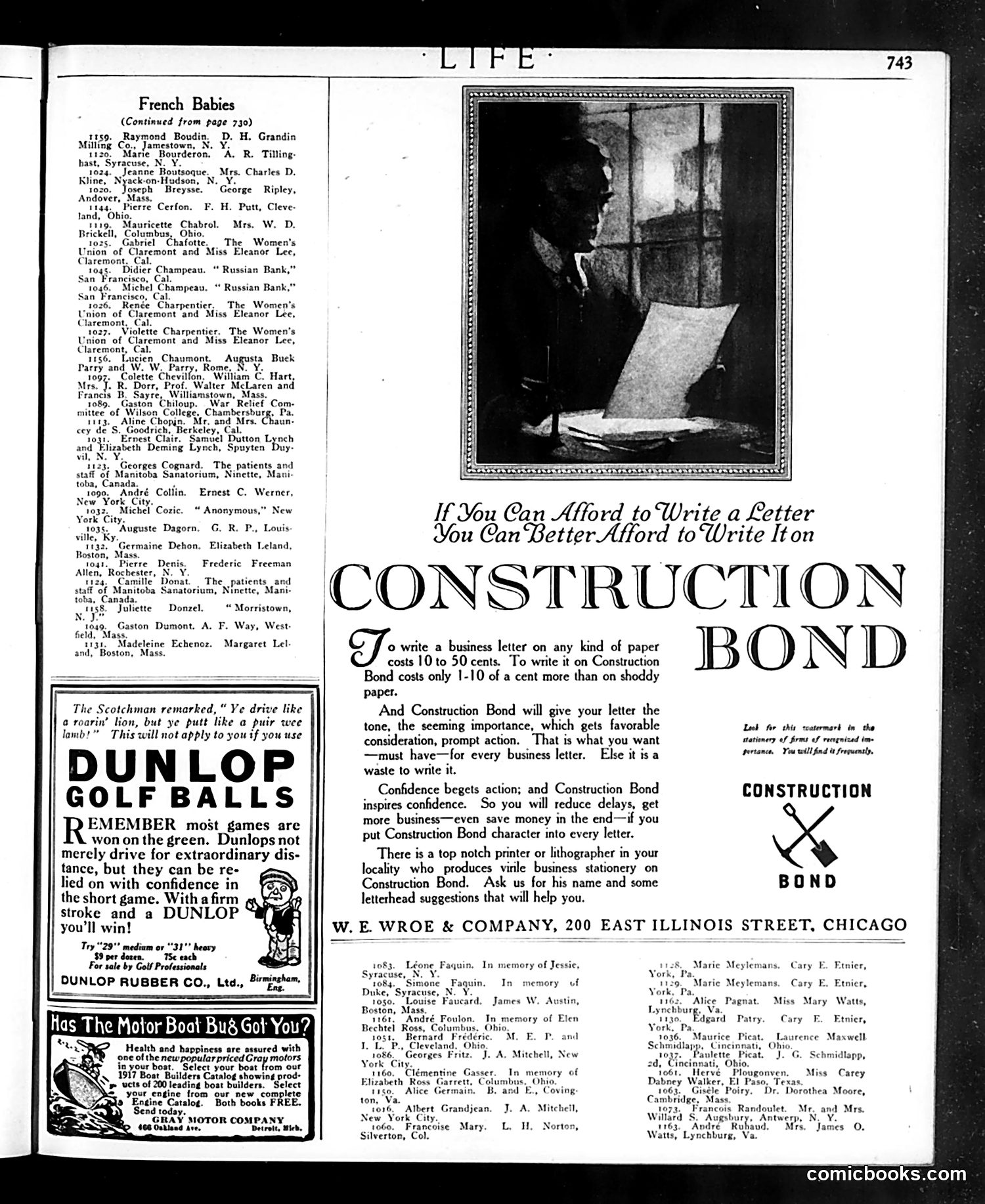
This page is primarily **advertising and administrative content**, not satirical cartoon material. The main elements are: 1. **"French Babies" list** (continued from previous page): Names and donors supporting French war orphans/relief efforts—typical of WWI-era American charity campaigns. 2. **Construction Bond stationery advertisement** (center-right): A business pitch arguing quality paper conveys professionalism and inspires confidence, increasing transaction speed and reducing delays. The accompanying image shows a figure writing by lamplight. 3. **Dunlop Golf Balls advertisement** (lower left): A Scottish character ("Ye drive like a roarin' lion...") endorses the product's reliability in short games. 4. **Motor Boat Bus advertisement** (lower left): Promotes recreational boating. The page contains **no political satire or caricature worthy of note**. It's a typical early 20th-century magazine layout mixing charitable donor lists with period consumer advertising. The Scottish dialect in the Dunlop ad is era-typical marketing, not satirical commentary.
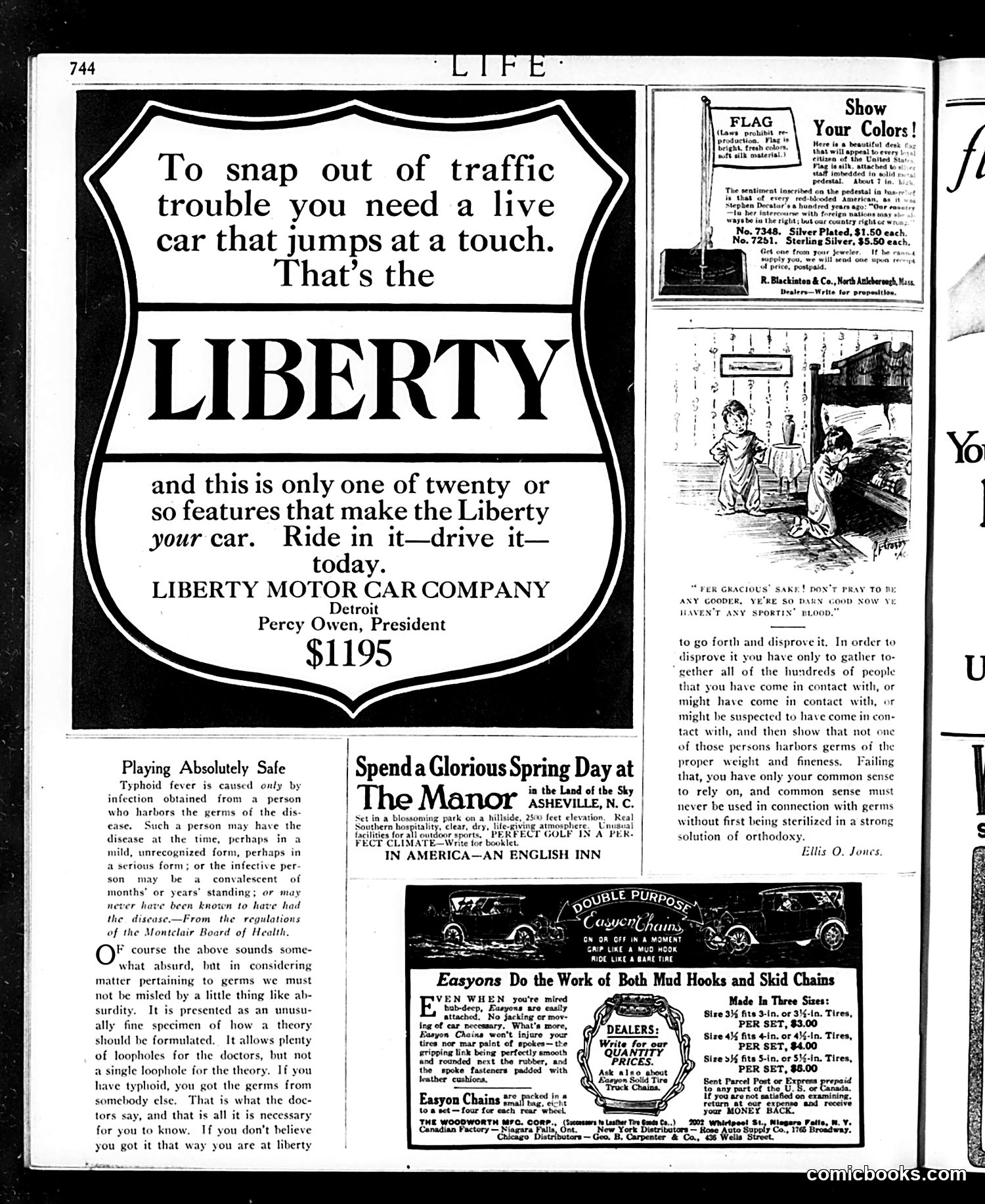
This page is primarily **advertising**, not satire or political commentary. The main advertisement promotes the **Liberty Motor Car** ($1,195, made in Detroit by Percy Owen's company), emphasizing it as responsive and reliable for navigating traffic congestion—a practical concern for early automotive buyers. The secondary content includes genuine health and safety advice: a piece on typhoid transmission (citing Montclair Board of Health regulations) uses deliberately circular logic as an example of how medical authorities overcomplicate simple facts; an article mocking this bureaucratic obfuscation; resort and automotive accessory ads (Easyon Chains for tires, The Manor hotel in Asheville). The only satirical element is the **health article's critique of official jargon**—it ridicules how authorities construct theories with "loopholes for doctors but not for the theory," poking fun at bureaucratic language rather than targeting specific people or events. This is a typical Life magazine page: advertisements interspersed with light social commentary and practical information, not political cartooning.
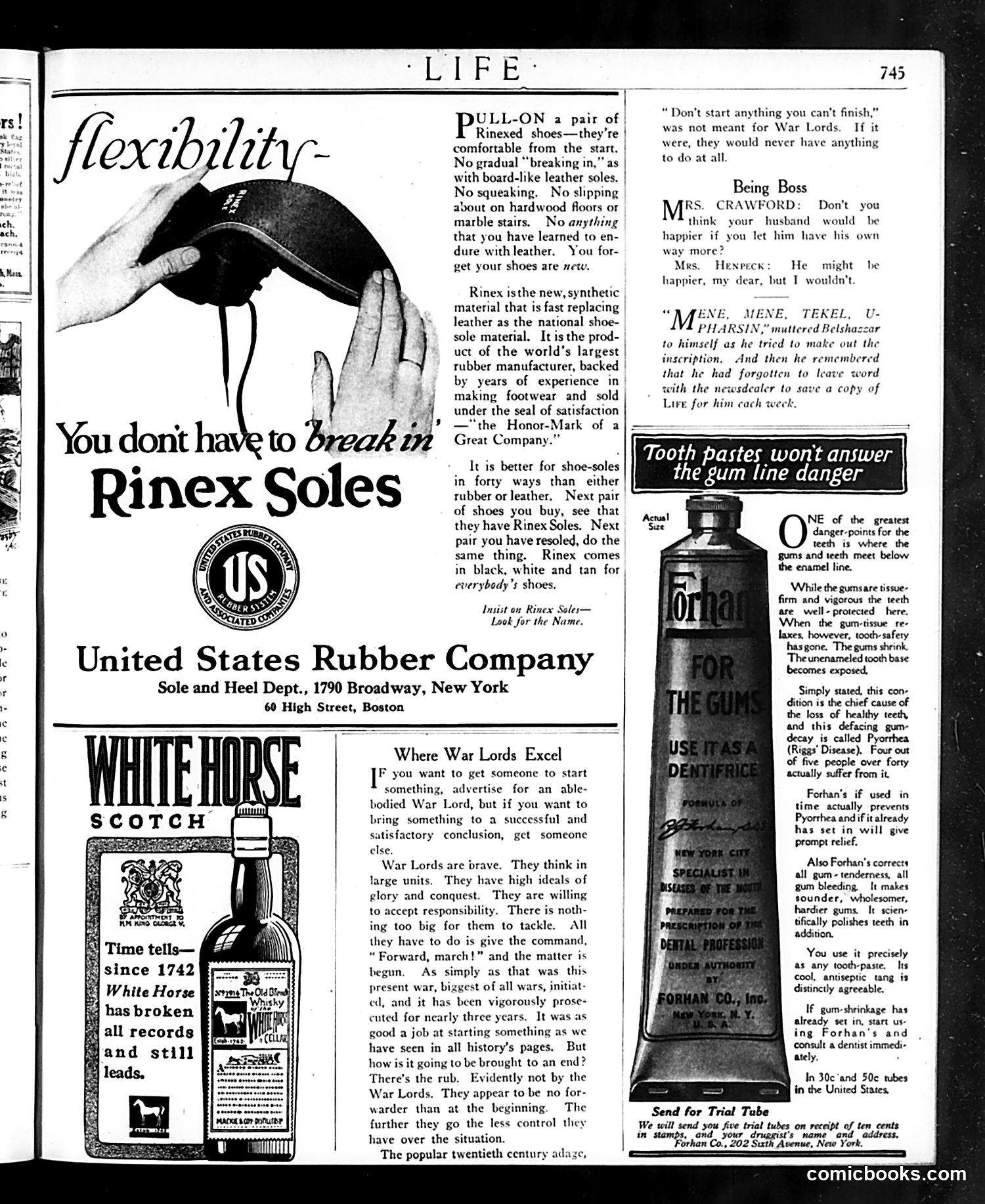
This page contains three distinct sections: a **Rinex shoe sole advertisement** (top left), a **humor column** (top right), and a **White Horse Scotch whisky ad** (bottom left), with smaller advertisements for Forhan's toothpaste and dentifrice interspersed. The most substantive content is the editorial piece titled "Where War Lords Excel" (center-right). It satirizes military leadership during World War I, arguing that while War Lords excel at *initiating* military action—issuing brave commands like "Forward, march!"—they prove incapable of *concluding* conflicts successfully. The piece notes the current war has raged "nearly three years" with no end in sight, suggesting the leadership lacks the strategic competence for resolution. This is pointed social criticism of WWI's apparent stalemate and the perceived failure of military commanders to achieve victory despite their willingness to wage war. The humor items mock domesticity and gender relations, typical of the era's comic conventions.
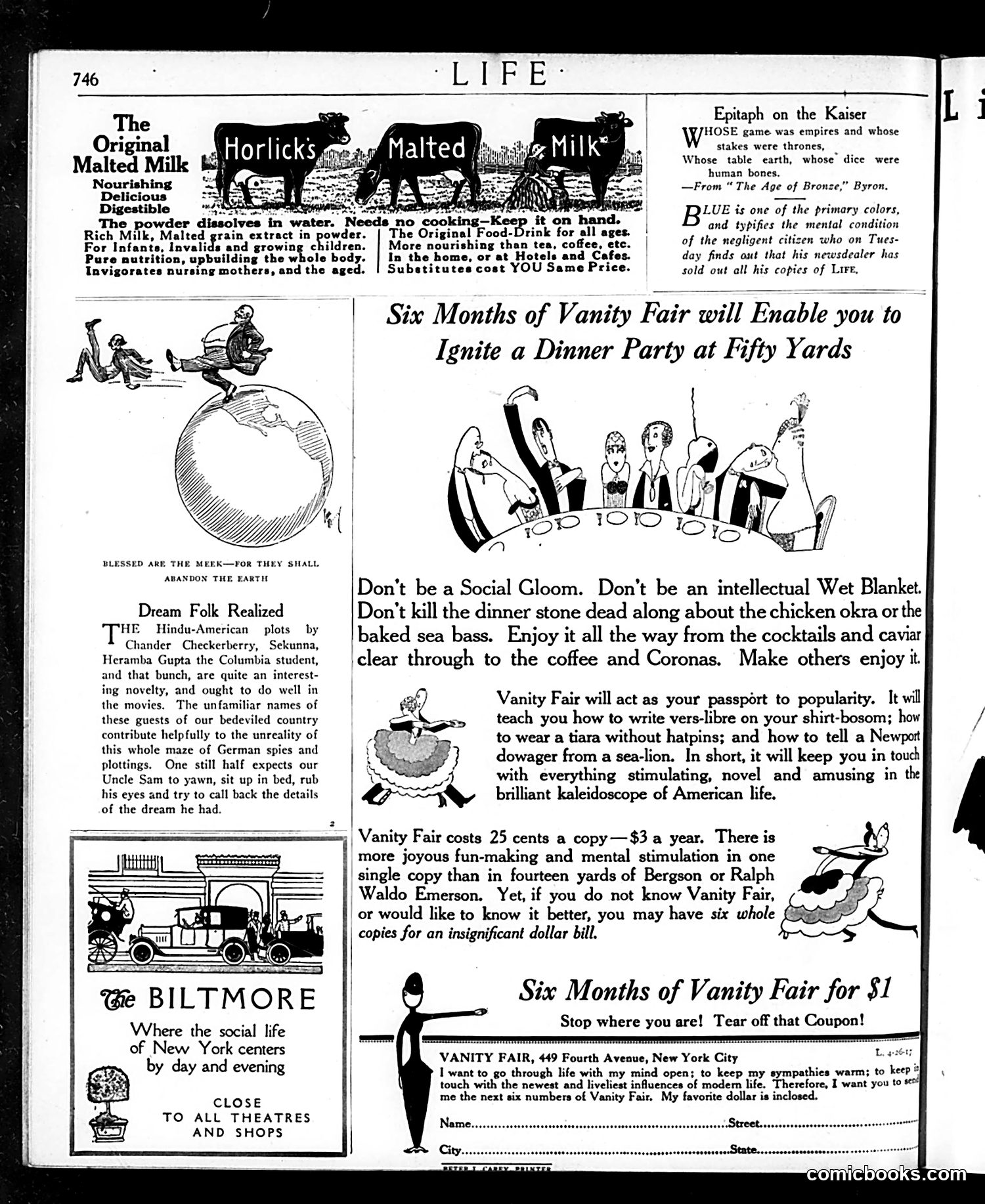
This page is primarily **advertising**, dominated by a promotional campaign for *Vanity Fair* magazine. The satirical content is minimal. The notable elements: **"Epitaph on the Kaiser"**: A brief, sharp poem (quoting Byron) mocking the German Kaiser—likely Wilhelm II—characterizing him as a ruthless gambler with empires and human lives. This reflects post-WWI sentiment treating the Kaiser as responsible for the war's carnage. **The Vanity Fair Advertisement**: The bulk of the page promotes a subscription offer ($1 for six months). The copy humorously positions the magazine as essential social training—teaching readers to wear tiaras without hatpins, distinguish Newport dowagers from sea-lions, and avoid being a "Social Gloom" or "intellectual Wet Blanket" at dinner parties. It's light satire of 1920s upper-class pretension and anxiety about social sophistication. **Supporting ads**: Horlicks malted milk and the Biltmore hotel round out the page's luxury consumer focus. The overall tone is **post-war American leisure culture**—celebrating consumption and social climbing while taking a pointed jab at wartime leadership.
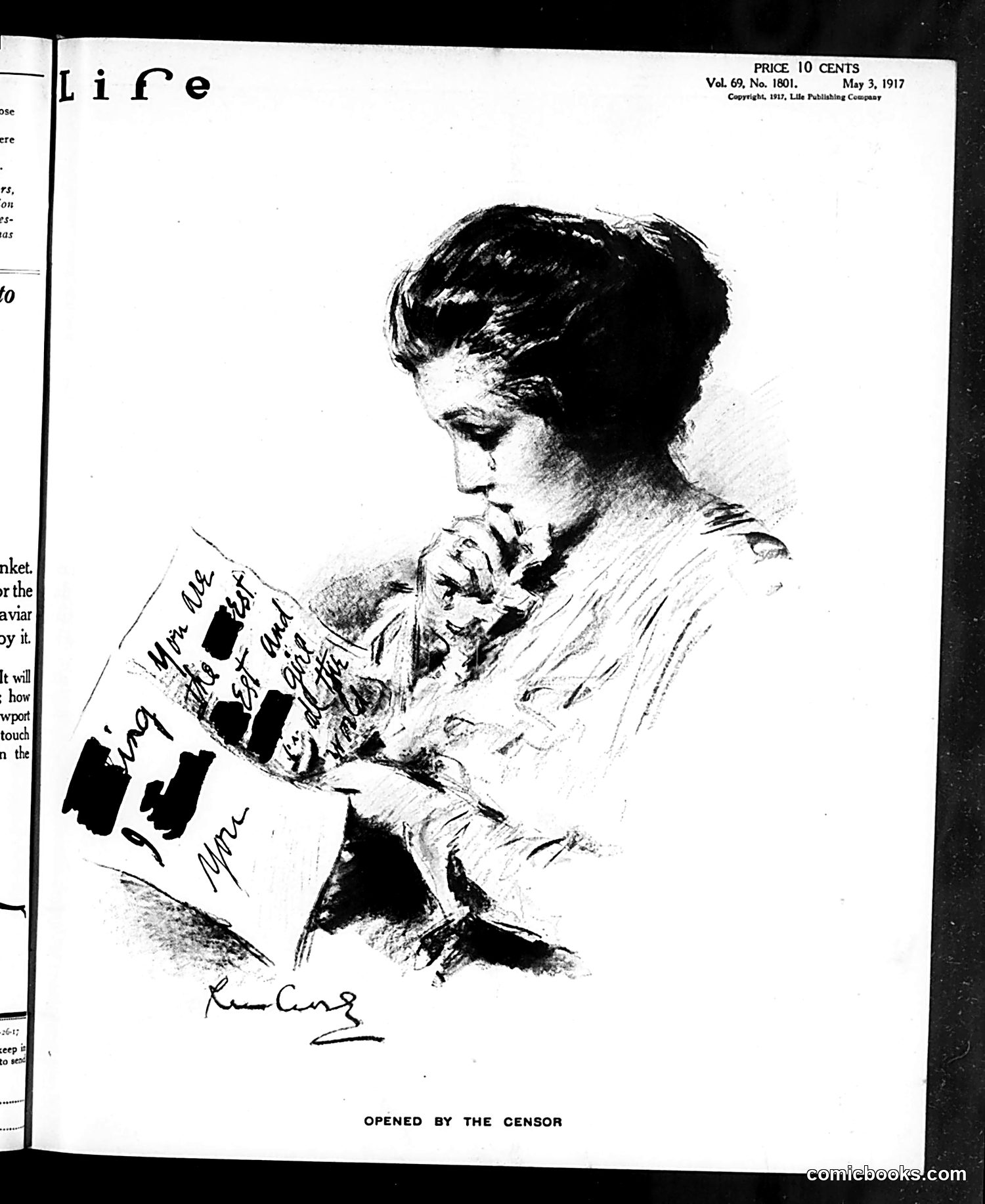
This is a Life magazine cover from May 1917, during America's entry into World War I. The illustration, signed by artist Ralph Barton, depicts a woman reading mail that has been opened and censored—evidenced by the black redaction marks visible on the letters she holds. The cartoon satirizes wartime censorship, a major concern when the U.S. entered WWI. The censor's heavy hand literally obscured correspondence, preventing citizens from receiving complete information. The woman's contemplative expression suggests frustration or resignation at this invasion of privacy. The caption "OPENED BY THE CENSOR" makes explicit what was implicit—government surveillance of civilian mail was now normalized. This reflected genuine public anxiety about expanded federal power and restricted freedoms during wartime.
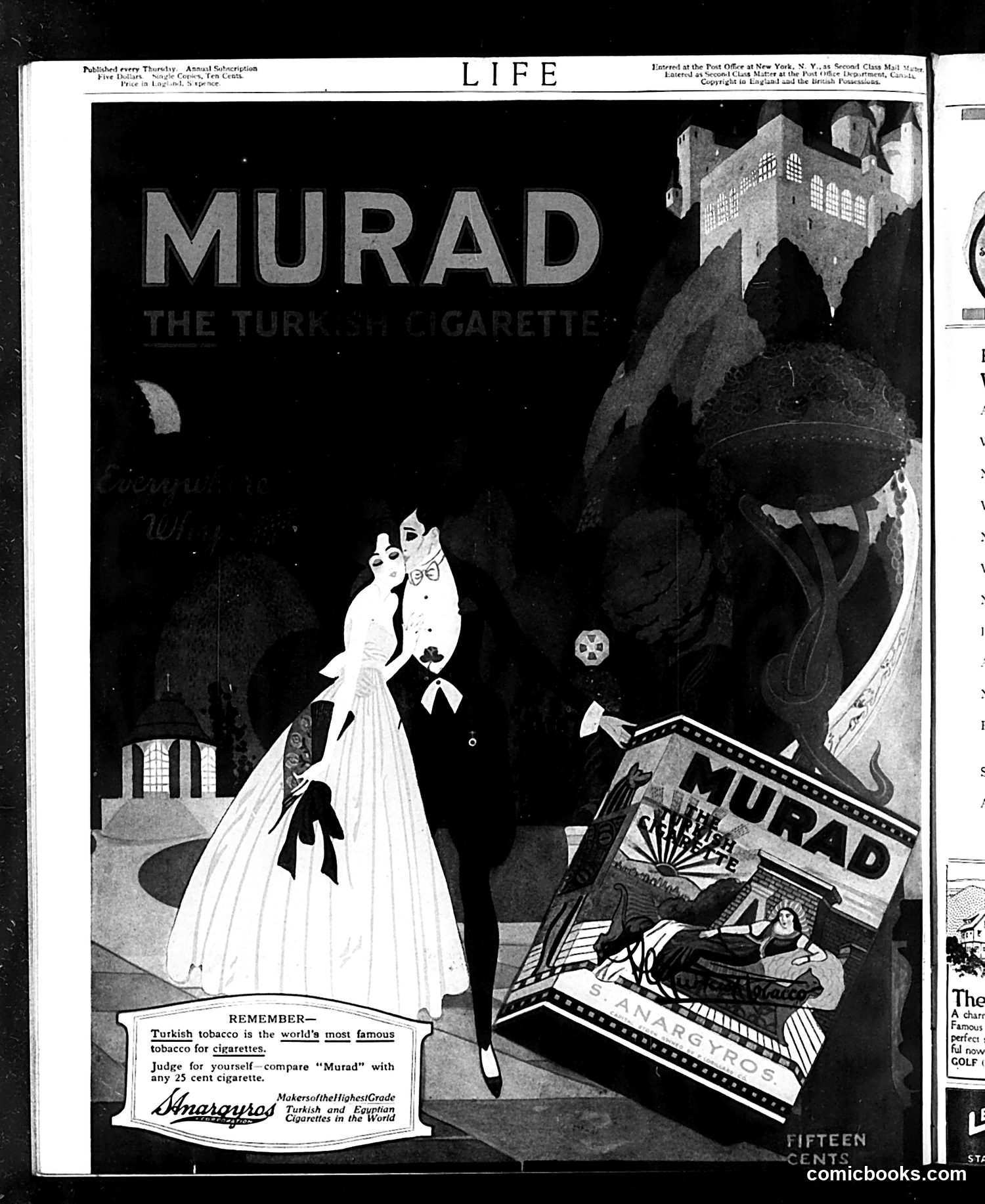
This is primarily a **cigarette advertisement** for Murad brand Turkish cigarettes, not political satire. The full-page ad features an art deco illustration of an elegantly dressed woman in a white gown admiring Murad cigarette packages displayed against a stylized Middle Eastern architectural backdrop (tower, dome). The imagery evokes exoticism and luxury associated with "Turkish" products. The text claims Turkish tobacco is "the world's most famous" and invites consumers to compare Murad with any 25-cent cigarette, positioning it as superior quality. The price point of "fifteen cents" is emphasized at bottom. This reflects early 20th-century advertising conventions: using glamorous imagery, appeals to sophistication, and claims of international prestige to market cigarettes to consumers.
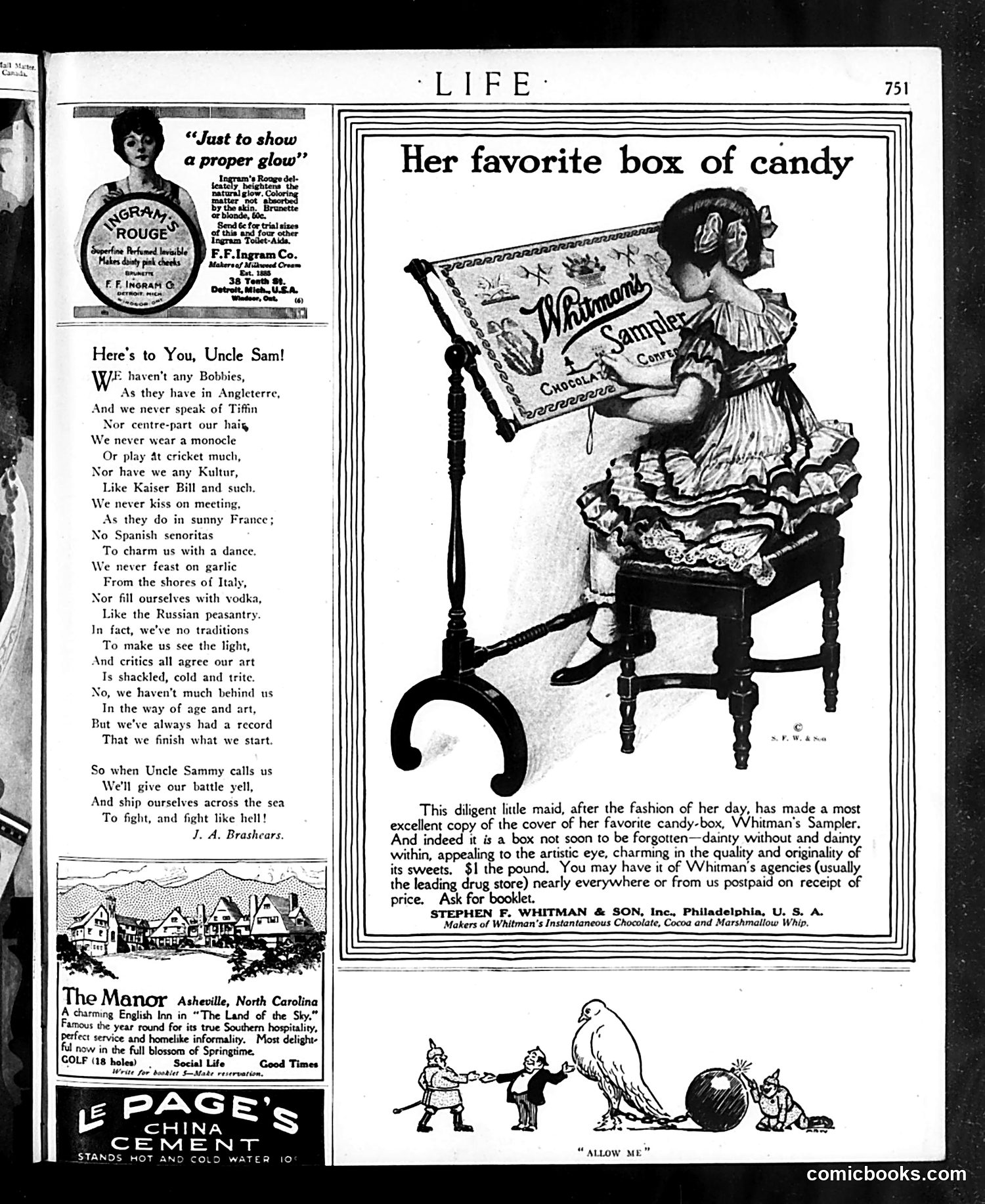
This page contains patriotic verse and candy advertising from the World War I era. **The Poem "Here's to You, Uncle Sam!"** by J.A. Brashears is nationalist satire contrasting American straightforwardness with European affectations. It mocks foreign customs—British "Bobbies," French kissing, Spanish serenades, Italian garlic, Russian vodka, German "Kultur" and the Kaiser—while asserting Americans lack pretension but possess determination. The closing rallies support for U.S. military intervention ("ship ourselves across the sea / To fight, and fight like hell!"), making this propaganda poetry for WWI enlistment. **The Main Advertisement** depicts a fashionable young woman displaying a Whitman's Sampler candy box. The text praises both the box's artistic design and the candy's quality, positioned as a refined luxury item at $1 per pound—expensive for the era. The accompanying illustration at bottom ("Allow Me") shows cherubic figures, emphasizing gentility and femininity as selling points. The page blends jingoistic messaging with consumer advertising typical of early 20th-century American magazines.
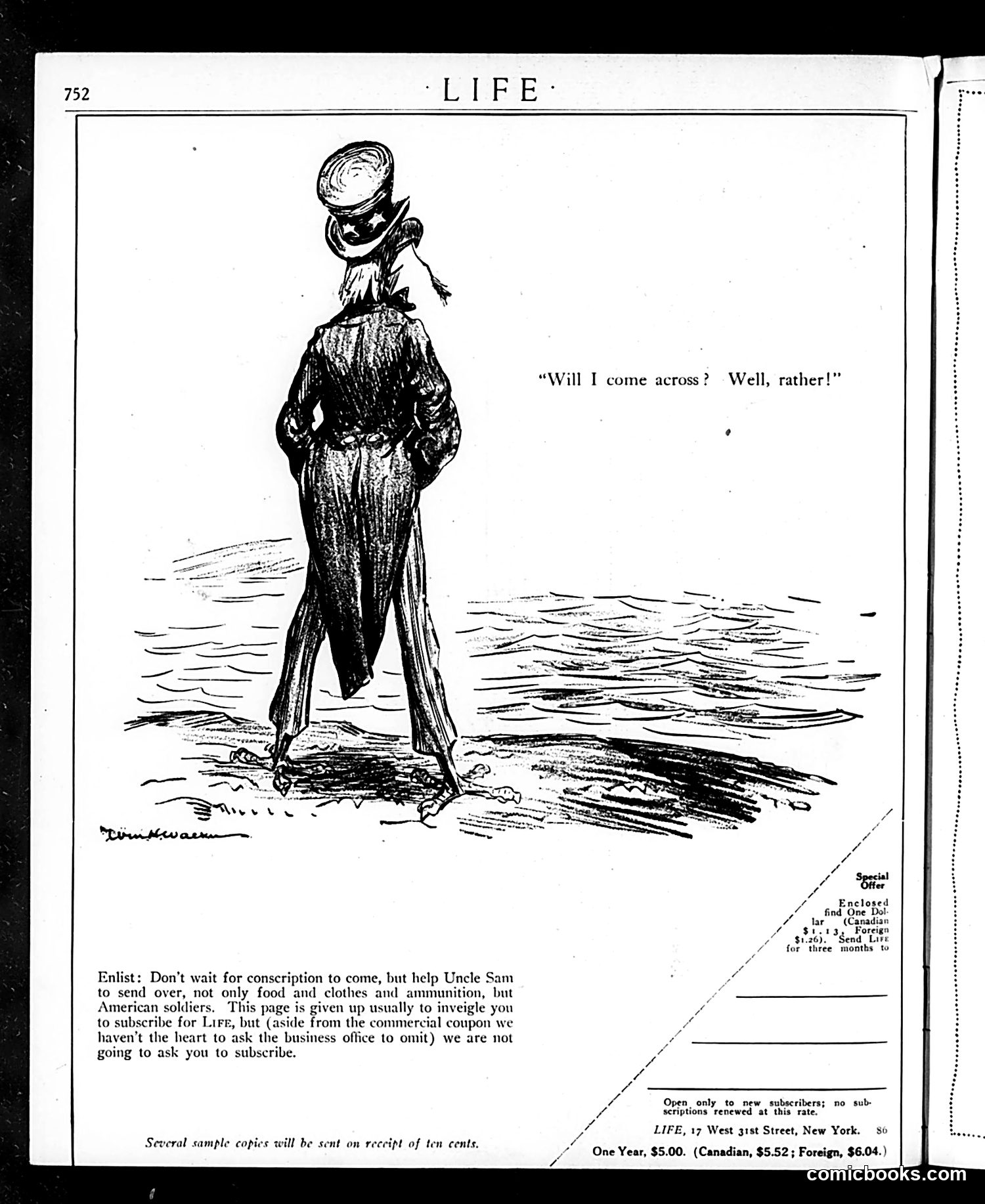
This is a World War I recruitment appeal disguised as subscription advertising. The illustration depicts a young soldier in military uniform standing at attention, asking "Will I come across? Well, rather!"—military slang expressing determination to fight overseas. The text explicitly urges readers to "Enlist" and help "Uncle Sam" send American soldiers abroad, not merely supplies. The magazine unusually foregoes its typical commercial pitch for subscriptions, instead using this page as a patriotic appeal during America's involvement in WWI. The soldier figure represents the idealized American serviceman, while the phrase "come across" references American troops being transported across the Atlantic to European battlefields. This represents wartime propaganda emphasizing duty and sacrifice rather than satire—Life magazine temporarily suspending its satirical function to serve the national war effort.
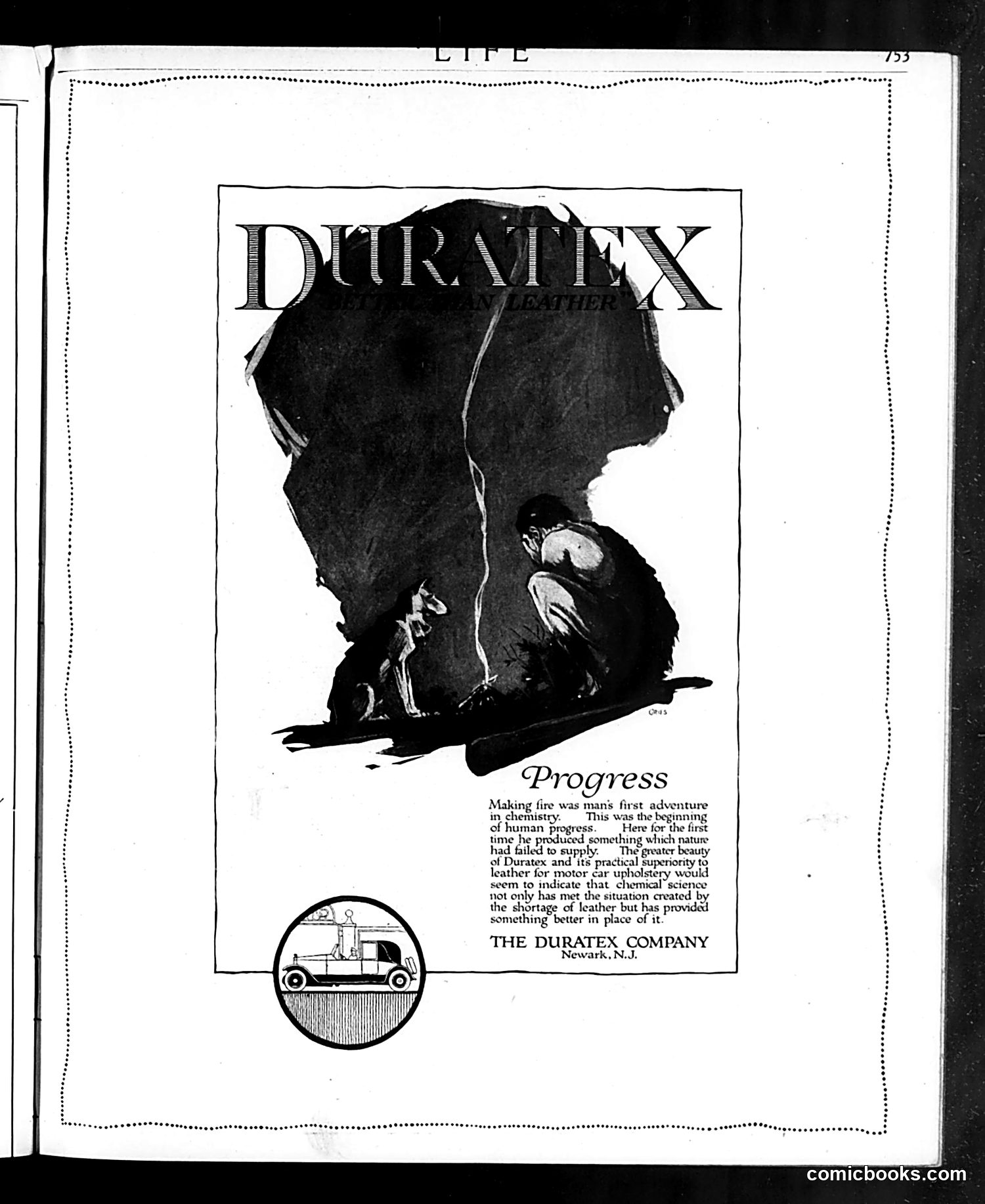
This is a **Duratex Company advertisement**, not political satire. The "Progress" heading references humanity's advancement through chemistry, using fire-making as a historical analogy. The silhouette imagery depicts **Prometheus or primitive man** discovering fire—a classical reference to humanity's first chemical achievement. This visual metaphor introduces the product: **Duratex**, a synthetic leather substitute for automobile upholstery. The ad's argument is pragmatic rather than satirical: during what appears to be a **leather shortage** (likely WWI or post-war scarcity), chemical science has produced a superior alternative. The ad claims Duratex is both more beautiful and more practical than natural leather. The small car illustration at bottom reinforces the automotive application. This reflects early 20th-century advertising's practice of connecting consumer products to human progress and modernity.
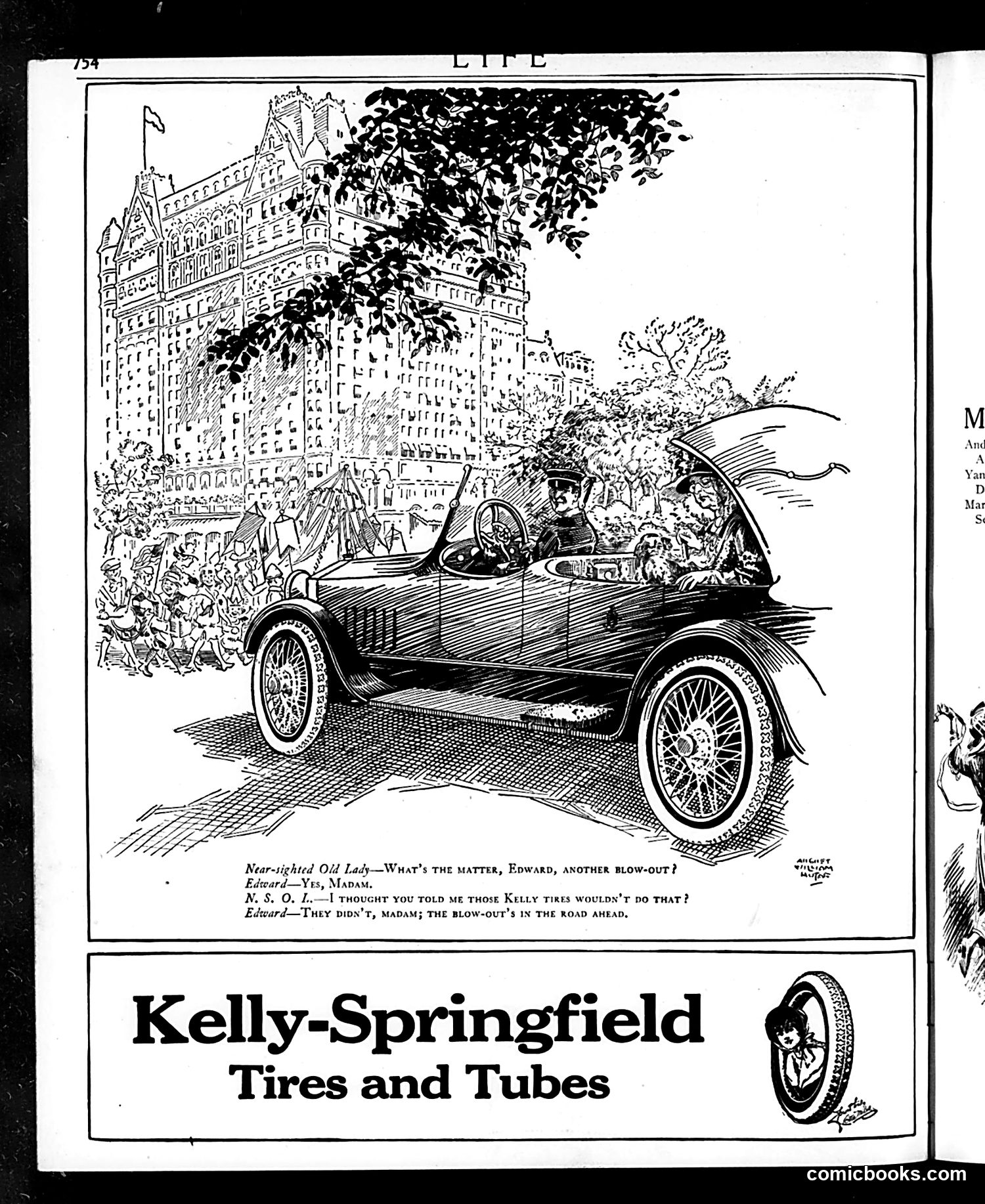
This is a satirical advertisement for Kelly-Springfield Tires and Tubes, presented as a humorous comic scenario. The illustration depicts an early automobile with well-dressed passengers (appearing to be an older woman and a man named Edward) stopped on a city street near a grand hotel. The woman complains about "another blow-out," blaming Edward for the tire failure. The satire works by reversing expectations: instead of acknowledging the tire's defect, Edward claims the blow-outs didn't happen—they're "in the road ahead," suggesting the bad road conditions caused the problem. The advertisement's point is that Kelly-Springfield tires are reliable enough that customers shouldn't experience blow-outs. The humor lies in Edward's illogical denial, which humorously reinforces the product's dependability by contrast. This was typical early automotive-era advertising that used comedic situations to sell tire durability to affluent car owners.
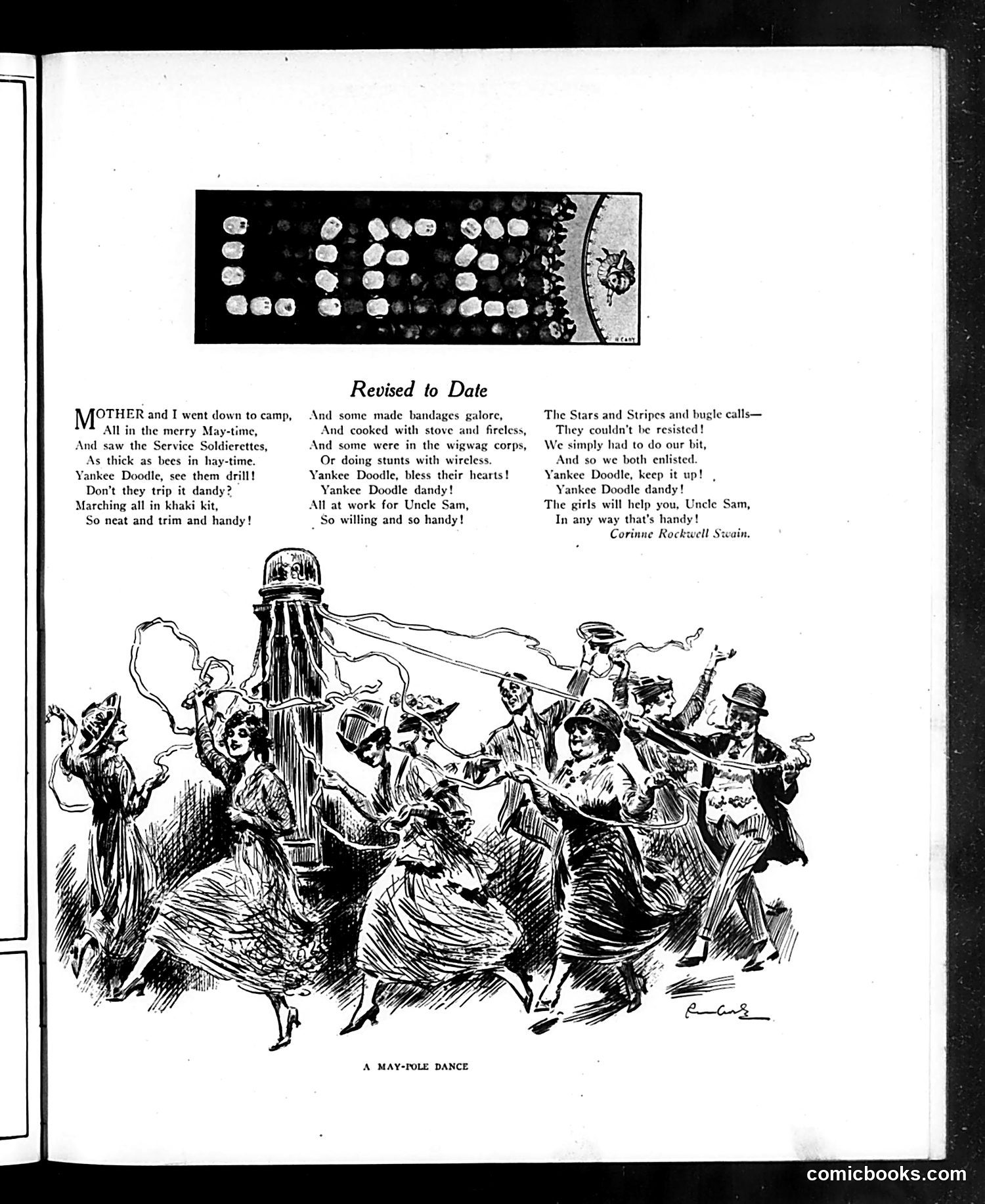
This is a WWI-era satirical revision of "Yankee Doodle" celebrating female military support workers. The poem describes women—called "Service Soldierettes"—performing various wartime duties: drilling in khaki uniforms, making bandages, cooking, operating wireless and signal equipment. The satire's point appears to be **patriotic mockery tinged with admiration**. The "Revised to Date" subtitle signals that this updates the famous Revolutionary War song for modern (WWI) circumstances. The repeated refrain "Yankee Doodle dandy" applies the historical male soldier's song to women now actively contributing to the war effort. The illustration shows women dancing around a maypole in jubilant celebration, reinforcing the lighthearted but earnest message that female volunteers are essential ("Uncle Sam" needs them) and enthusiastically enlisted. The satire gently mocks the newness of women in military roles while ultimately celebrating their patriotic participation—treating their service with humor rather than skepticism or dismissal.
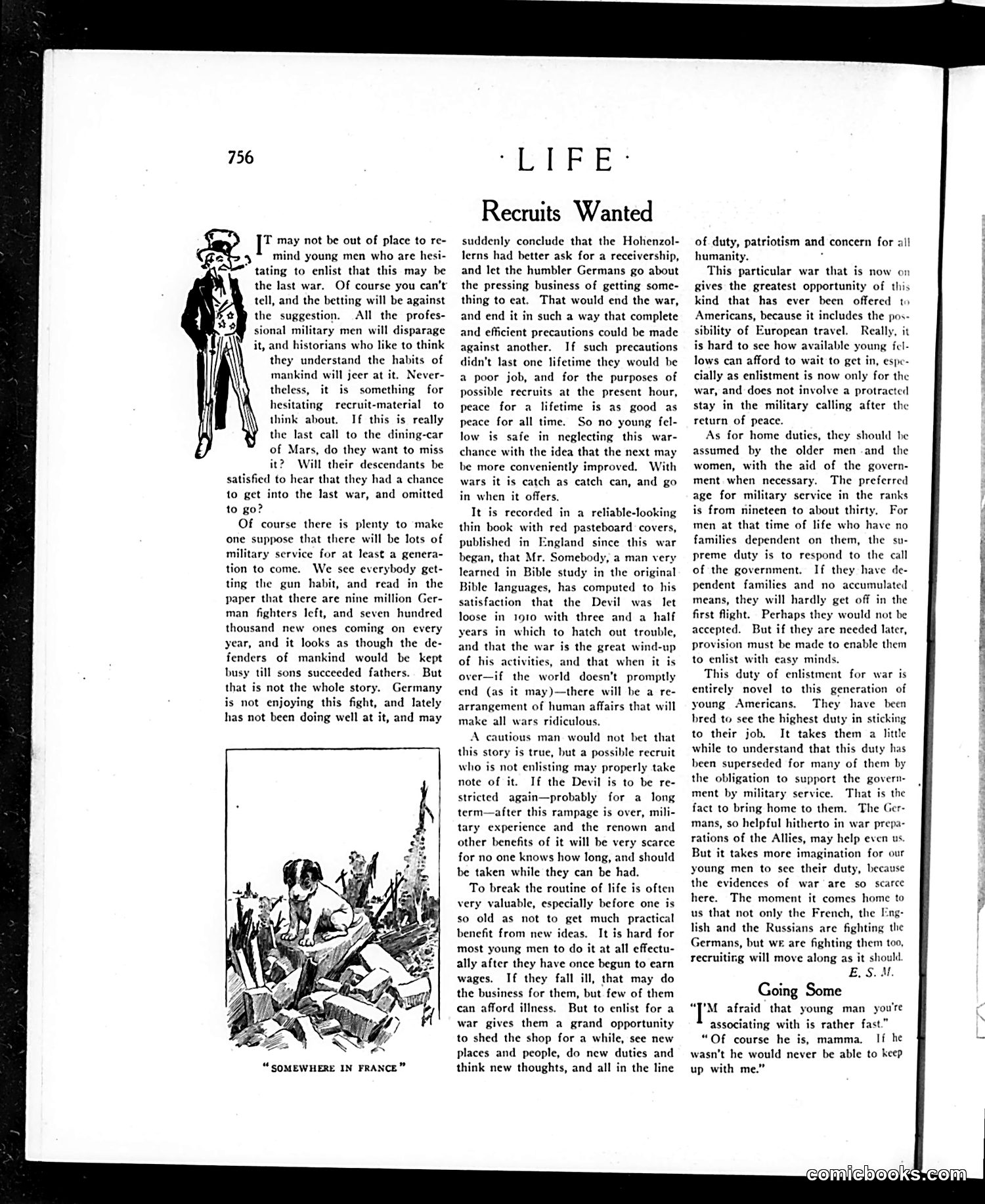
This WWI-era recruitment article uses satire to encourage young American men to enlist. The main argument is provocative: this may be "the last war," so hesitant recruits shouldn't miss this opportunity. The two illustrations depict soldiers—one appears to be Uncle Sam (identifiable by his distinctive hat and patriotic clothing), and another labeled "SOMEWHERE IN FRANCE" shows combat conditions. The satire works by inverting typical recruitment logic: rather than promising glory or necessity, the author argues enlisting offers practical benefits—escape from routine work, travel to Europe, and "new thoughts"—while framing it as possibly the final war mankind will fight (citing a religious text predicting the Devil's binding). The piece acknowledges skepticism from "professional military men" and "historians," adding credibility through candor. The underlying message: seize this unique historical moment for personal growth while serving patriotism. Modern readers should note this represents American pro-intervention sentiment before official U.S. entry into WWI.
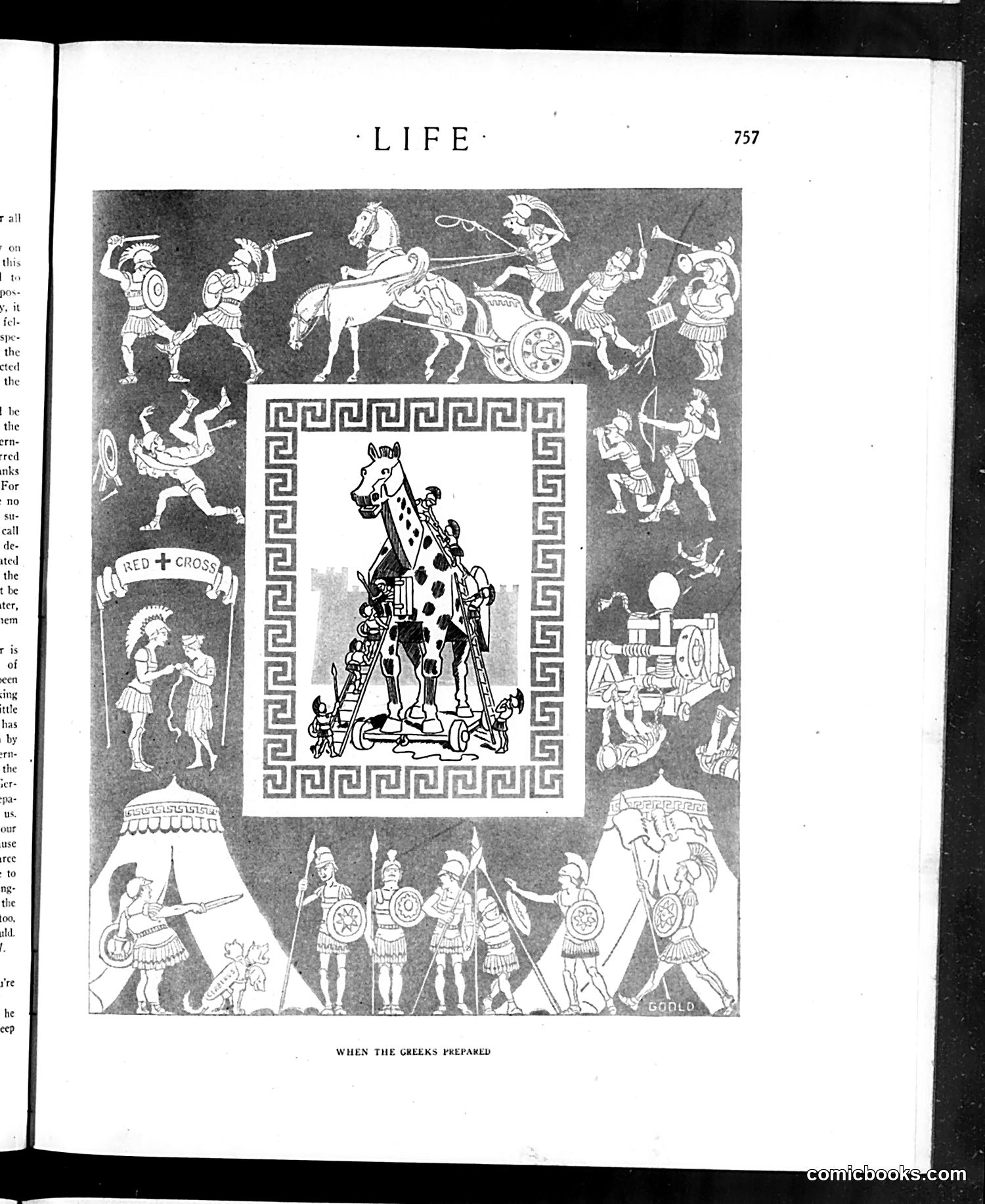
This illustration depicts ancient Greek military preparation, showing warriors, chariots, and horses arranged around a central image of a giraffe being used as some form of siege weapon or military apparatus. The composition appears to be a satirical commentary on Greek warfare tactics, with soldiers in classical armor surrounding various implements of war. The Greek key pattern border frames the scene in an authentically classical style. The title "When the Greeks Prepared" suggests this is either a humorous take on historical Greek military strategy or possibly a contemporary political satire using classical Greek imagery as metaphor. However, without additional context about Life magazine's publication date or specific historical events referenced, the precise satirical target remains unclear from the image alone.
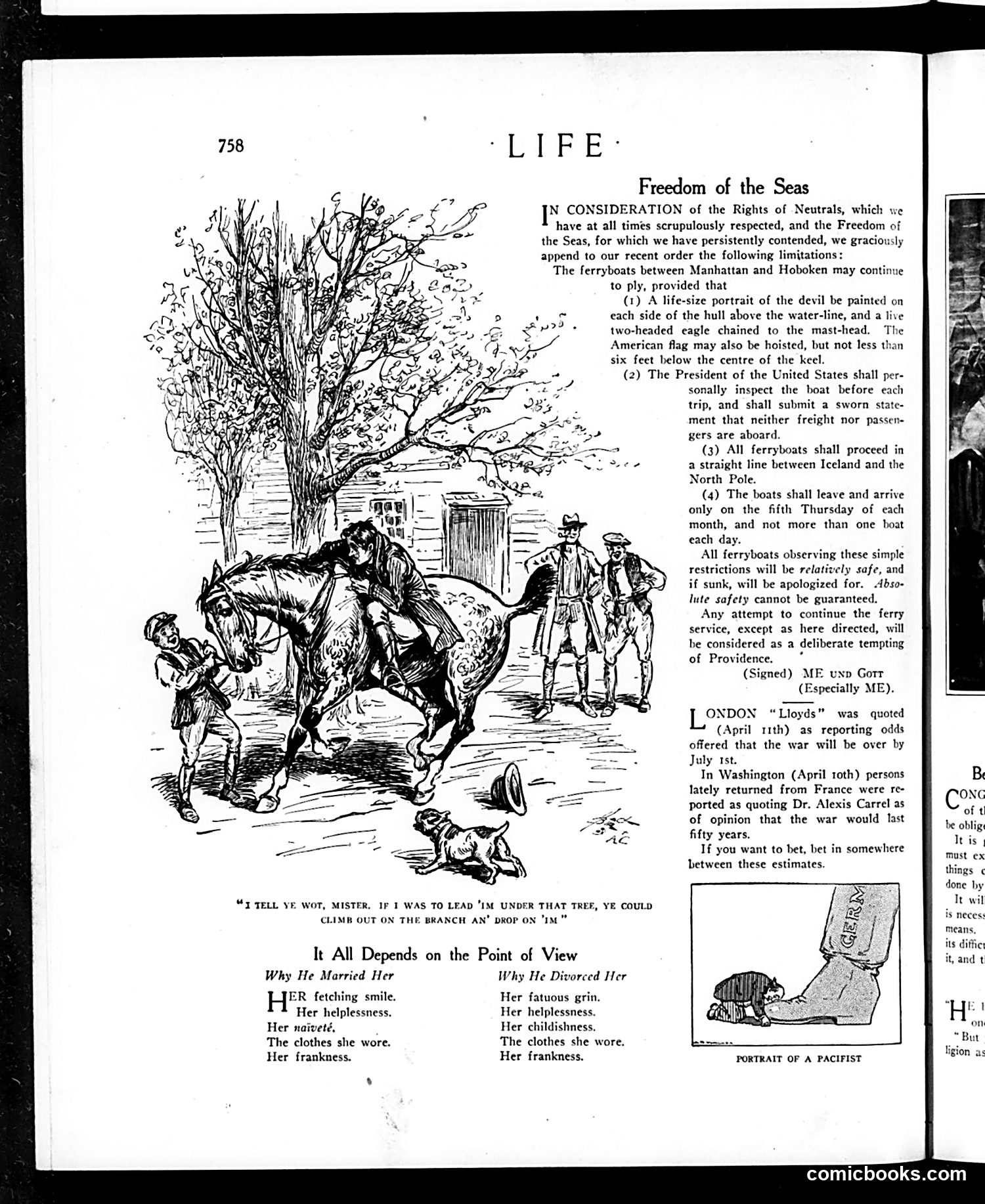
This page contains WWI-era political satire mocking German restrictions on neutral shipping rights. **"Freedom of the Seas"**: The main text parodies an official German proclamation supposedly governing ferryboats between Manhattan and Hoboken. It's signed "ME und GOTT" (Me and God)—likely referencing Kaiser Wilhelm II's famous claim that God was on Germany's side. The absurdly impossible restrictions (painting devils on hulls, routing boats to Iceland and the North Pole, inspections by the U.S. President, departures only on non-existent "fifth Thursdays") mock Germany's actual interference with neutral American maritime commerce, which was a major grievance leading to U.S. entry into WWI. **Lower sections**: Brief war commentary and domestic humor sketches unrelated to the main satire. **Context**: This likely dates to early 1917, when German U-boat warfare was intensifying, threatening American neutrality and trade.
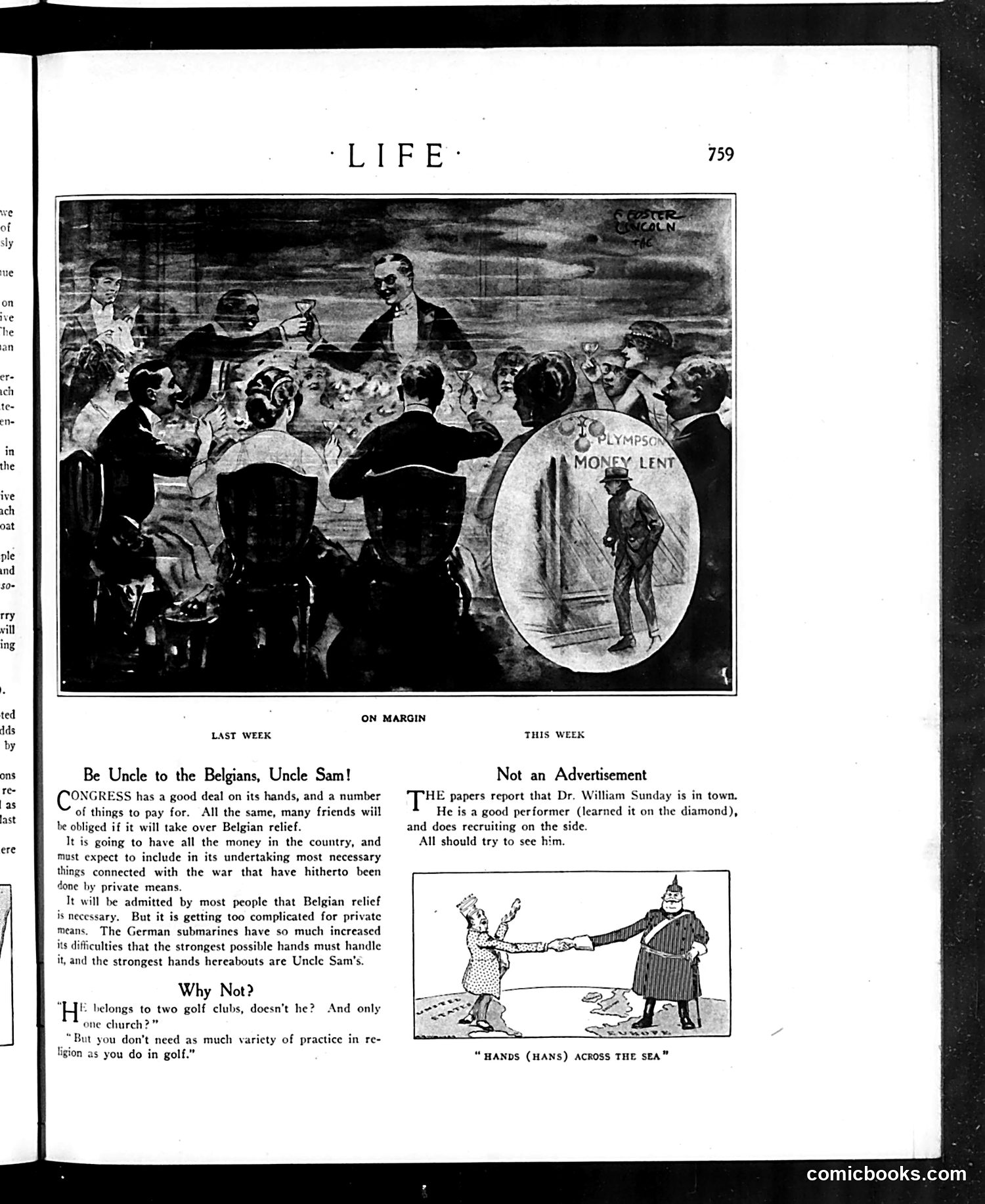
This page contains two satirical pieces about American involvement in World War I relief efforts. **"Be Uncle to the Belgians, Uncle Sam!"** argues that Congress should assume direct control of Belgian relief efforts from private charities. The piece suggests German submarines have made private relief efforts too difficult and dangerous, requiring the U.S. government's stronger capacity to handle the task. **"Hangs (Hans) Across the Sea"** cartoon depicts a German figure (labeled "Hans") shaking hands with an American woman across the Atlantic. The caption's pun on "hands across the sea" sarcastically comments on U.S.-German relations—likely critiquing either pacifist sentiment, trade relations, or diplomatic dealings with Germany during the war. **"Why Not?"** is a brief joke contrasting religious and golf club membership, unrelated to the war content. **"Not an Advertisement"** mentions evangelist Billy Sunday (a former baseball player) doing recruiting—linking religious leadership with military recruitment efforts, a common wartime practice. The page reflects American debates over war involvement and civilian relief circa 1916-1917.
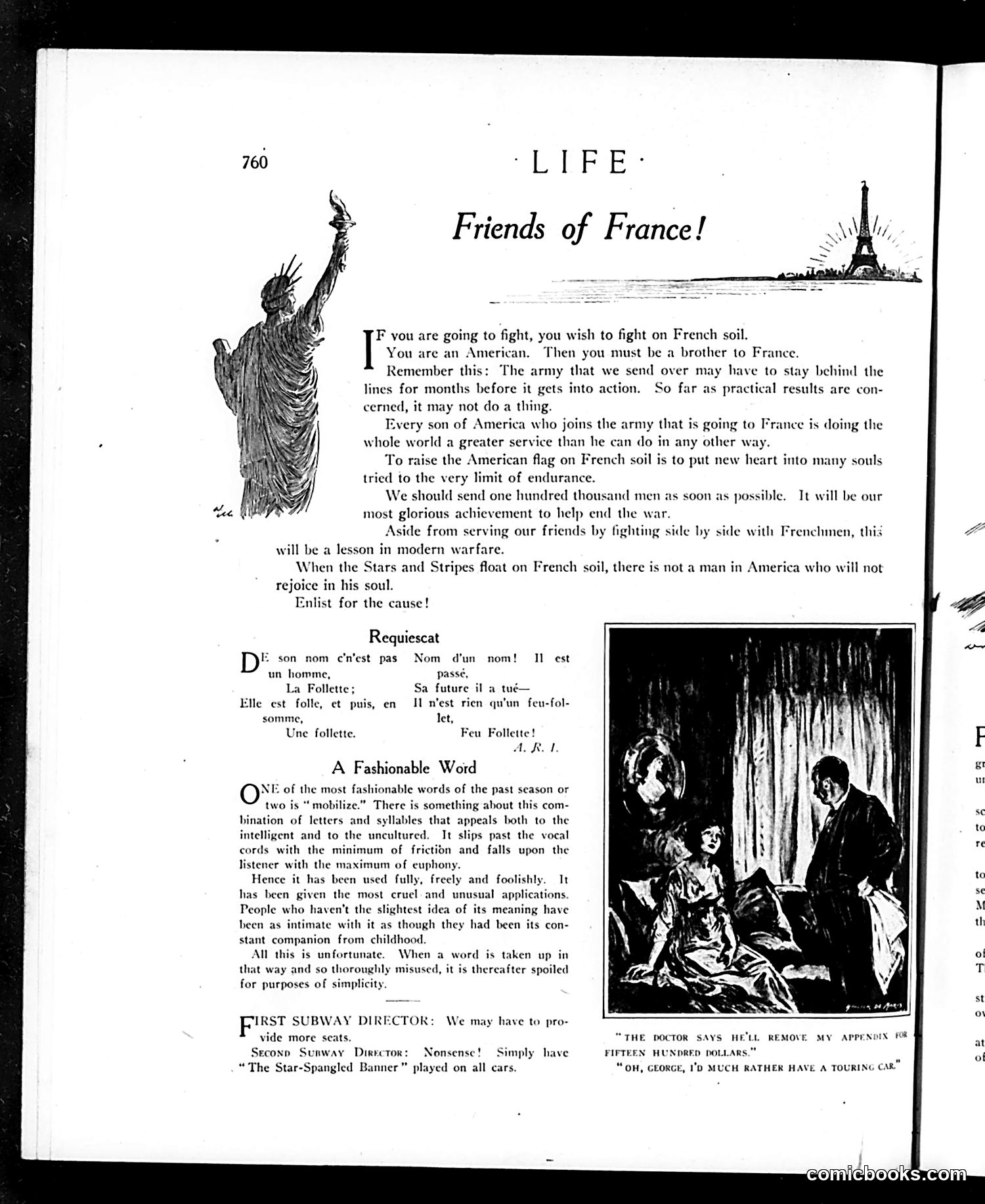
This WWI-era recruitment page urges American military support for France. The main "Friends of France!" editorial argues that American soldiers fighting on French soil will boost French morale and represent America's greatest contribution to ending the war. It advocates sending 100,000 troops immediately. The **Requiescat** section is a satirical French poem mocking **Senator Robert La Follette**, a prominent anti-war progressive politician. The wordplay on "La Follette" (literally "the madwoman") suggests he's mentally unstable for opposing war mobilization. **"A Fashionable Word"** critiques overuse of the term "mobilize," noting it's been applied carelessly and foolishly by people who don't understand its meaning—likely a jab at politicians and civilians who invoke military readiness without grasping its implications. The bottom cartoon jokes about American consumerism during wartime: a subway director suggests playing patriotic music to solve crowding, while a woman prefers a touring car to appendix surgery, satirizing misplaced priorities.
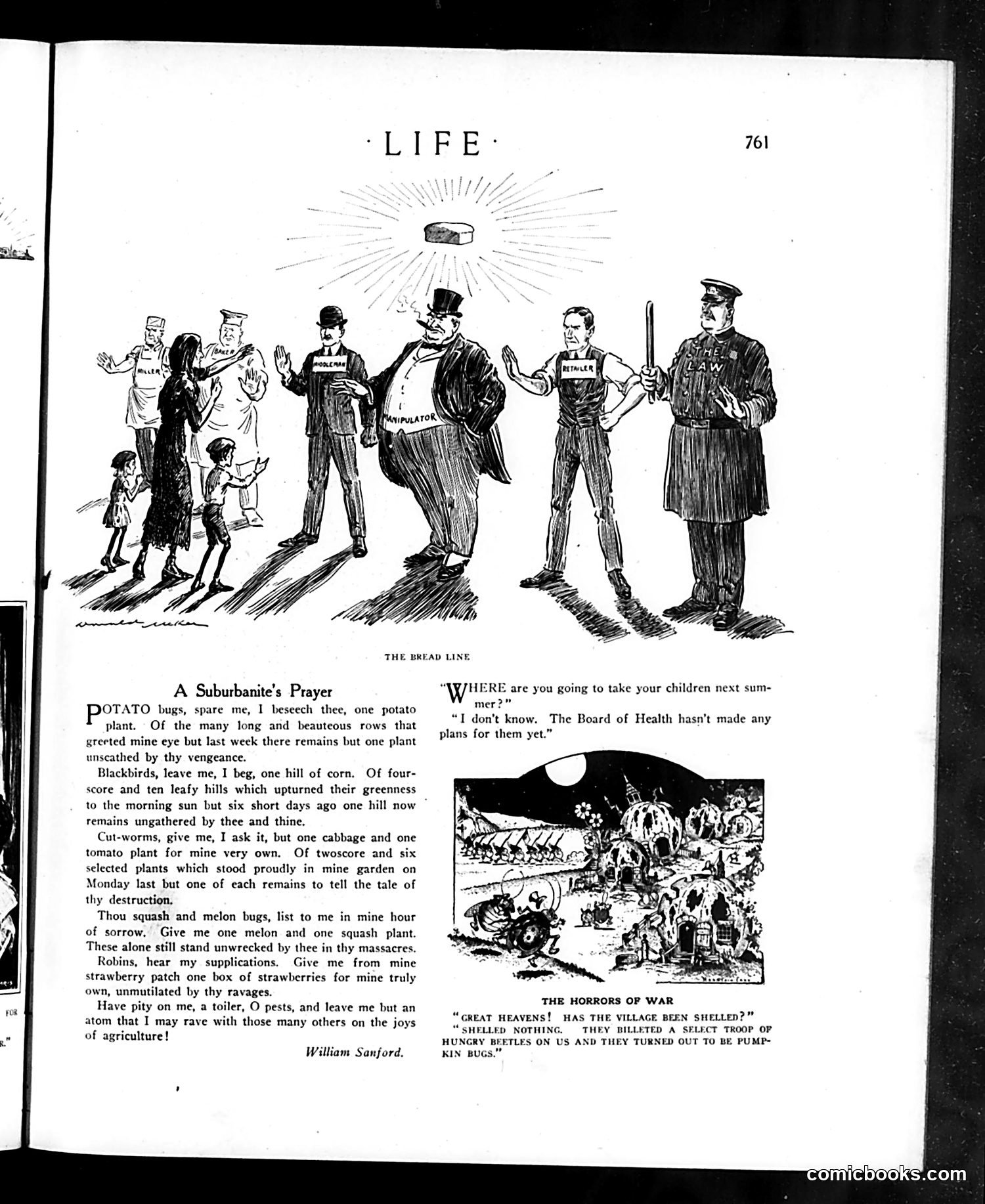
**"The Bread Line" cartoon** depicts figures labeled with roles (Police, Politician, Profiteer) surrounding a glowing bread loaf, satirizing how various authority figures and opportunists control access to basic food—a reference to bread rationing or food scarcity, likely from World War I era. **"A Suburbanite's Prayer"** parodies biblical supplication language as a suburban gardener pleads with agricultural pests (potato bugs, birds, worms) to spare at least some crops. The satire mocks both the suburban gentleman farmer and the very real crop destruction threatening food supply. **"The Horrors of War"** cartoon darkly compares military shelling to an infestation of beetles destroying crops—suggesting that war's indirect consequences (pest damage to food production) rival direct combat as threats to civilian welfare. Together, these pieces satirize widespread anxiety about food scarcity and agricultural collapse during wartime, positioning pests and profiteers as equivalent threats to survival.
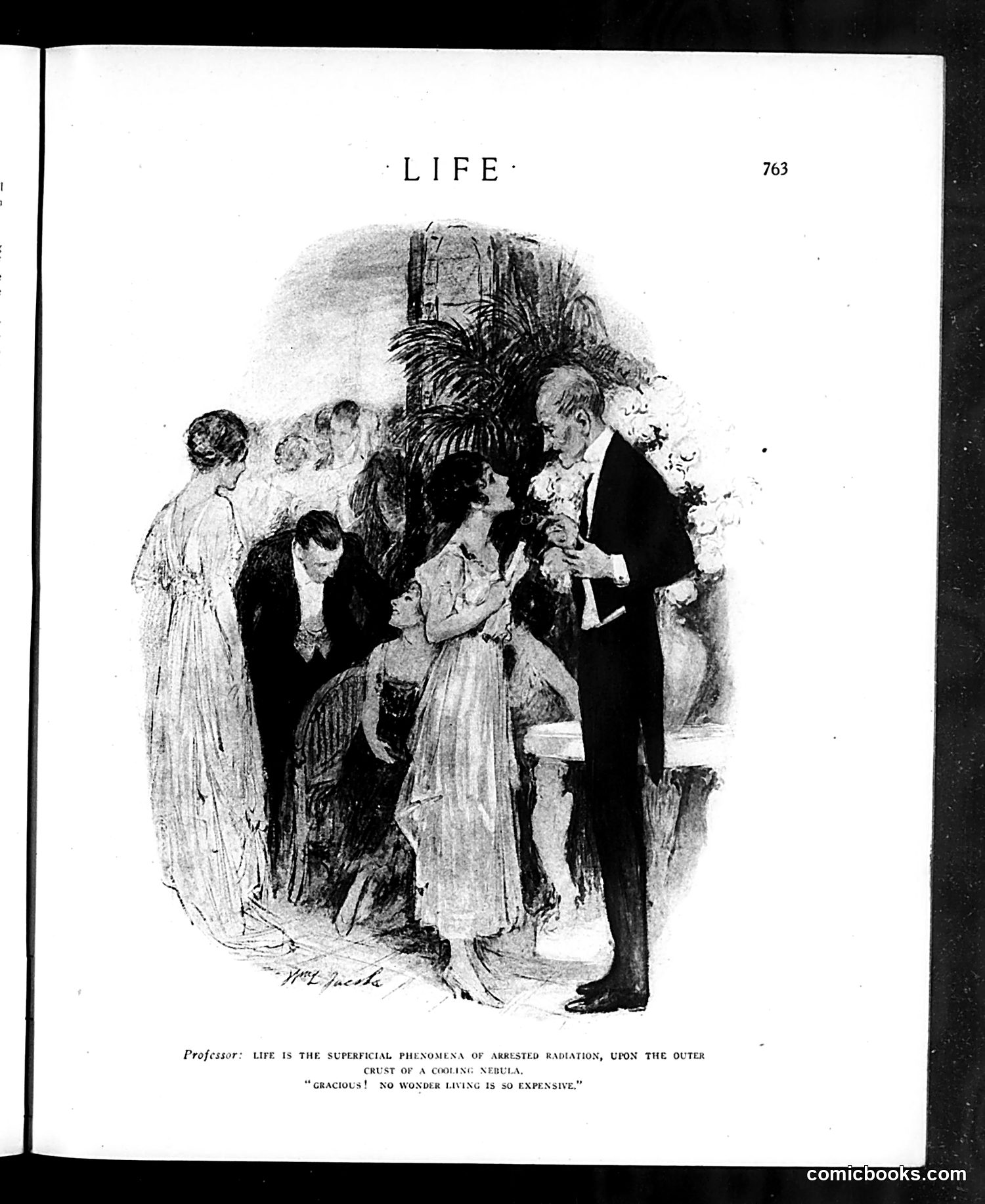
This cartoon satirizes pompous academic overexplanation. A professor (right, in formal attire) delivers an absurdly complex scientific definition of "life" to an elegantly-dressed woman (center), while other society figures listen in an ornate interior setting with potted plants. The joke plays on the gap between elaborate theoretical language and practical reality: the woman's response—"Gracious! No wonder living is so expensive"—suggests that if life is merely "arrested radiation upon a cooling nebula's crust," no wonder it's costly to maintain. The humor mocks both pretentious academics who obscure simple concepts with jargon, and upper-class anxiety about living expenses. It's a satire of intellectual pretension meeting everyday economic concerns in early 20th-century American society.
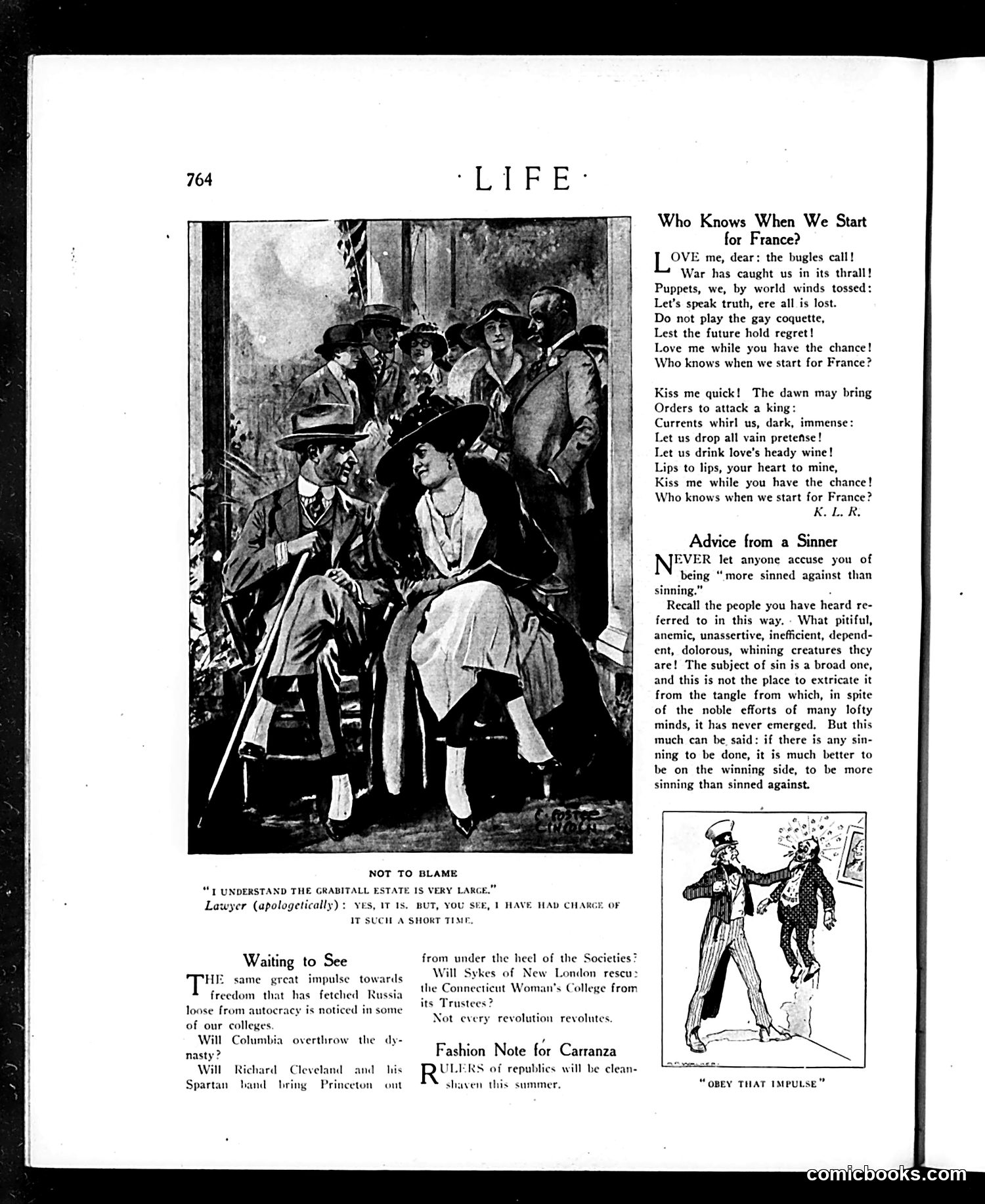
**Main Cartoon ("Not to Blame"):** Shows a lawyer apologetically explaining to a client that he's had little time to manage the "Grabitall Estate." The satire targets wealthy estate lawyers who plunder or mismanage inherited fortunes—the lawyer's excuse ("such a short time") is transparently absurd given his apparent incompetence, mocking legal professionals who exploit client assets. **Poetry ("Who Knows When We Start for France?"):** Written during WWI, this urges lovers to seize the moment before military deployment to France. It captures wartime anxiety about uncertain futures. **"Waiting to See":** Satirizes college revolutionaries mimicking Russian anti-autocracy movements. It mockingly questions whether Columbia, Princeton, and Connecticut Women's College will overthrow their "tyrannical" administrations and trustees—treating trivial campus politics as would-be revolutions that "not every...revolutes" (won't actually happen). **"Advice from a Sinner":** A cynical essay arguing it's better to be actively sinful than passively victimized—embrace wrongdoing rather than complain about mistreatment. These pieces reflect post-WWI American satirical attitudes toward institutions, war, and social hypocrisy.
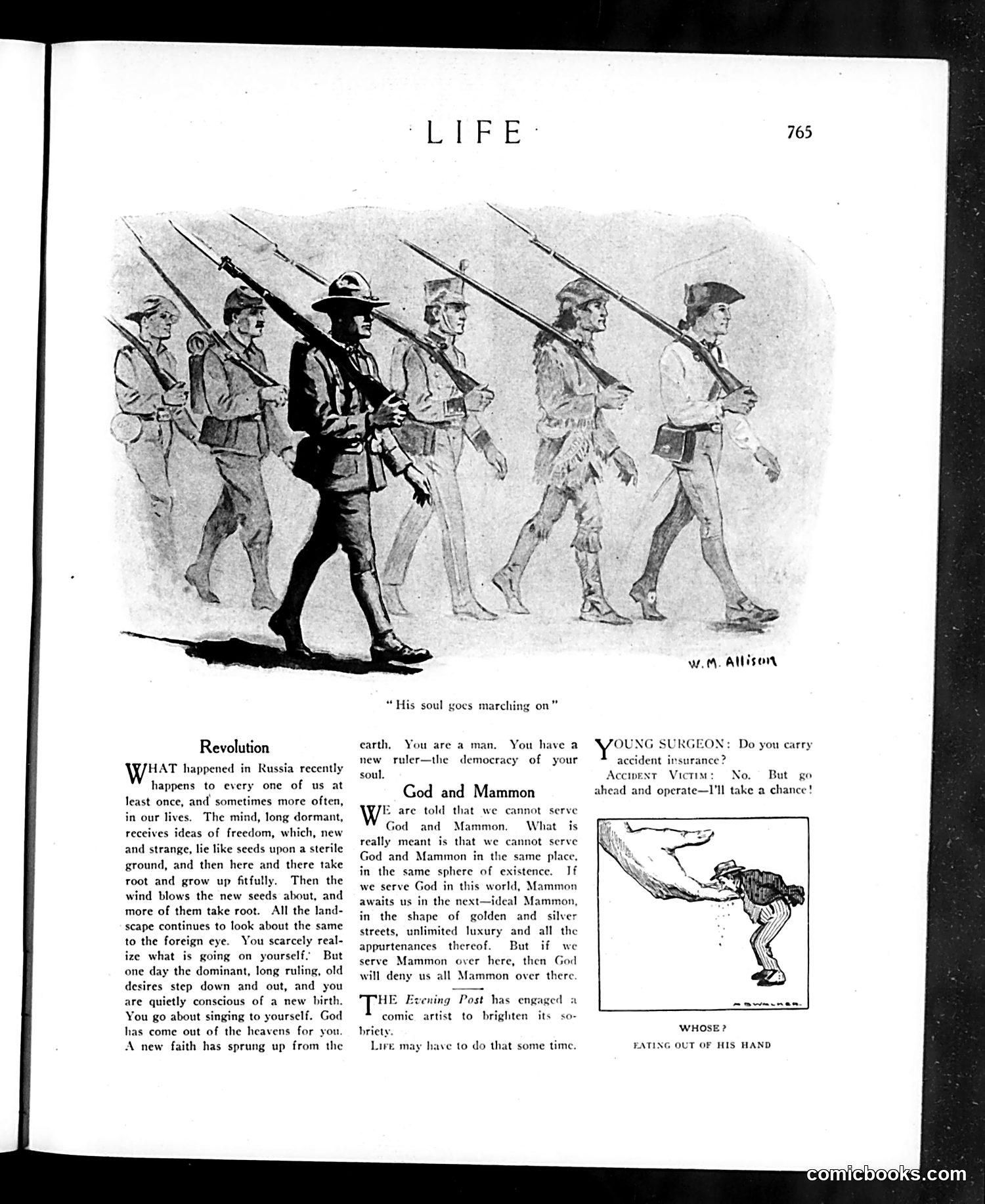
This page contains three distinct pieces of satirical content: **Top Cartoon ("His soul goes marching on"):** Depicts soldiers marching with rifles, illustrated by W.M. Allison. The caption references the famous abolitionist song "The Battle Hymn of the Republic" ("His soul goes marching on"), suggesting a commentary on military service or sacrifice. **"Revolution" Essay:** Uses the Russian Revolution as metaphor for personal spiritual awakening. It argues that revolutionary change—dormant ideas of freedom suddenly taking root—happens within individual consciousness, comparing geopolitical upheaval to internal transformation. **"God and Mammon":** A theological essay arguing these biblical opposites cannot coexist in the same sphere. It suggests those serving God in this world gain heavenly rewards, while those serving worldly wealth (Mammon) forfeit divine blessings. **Small Cartoon ("Whose? Eating Out of His Hand"):** Shows a figure with exaggerated features in a submissive pose, likely satirizing political obedience or manipulation. The page reflects early 20th-century Life magazine's blend of social commentary, humor, and moral philosophy.
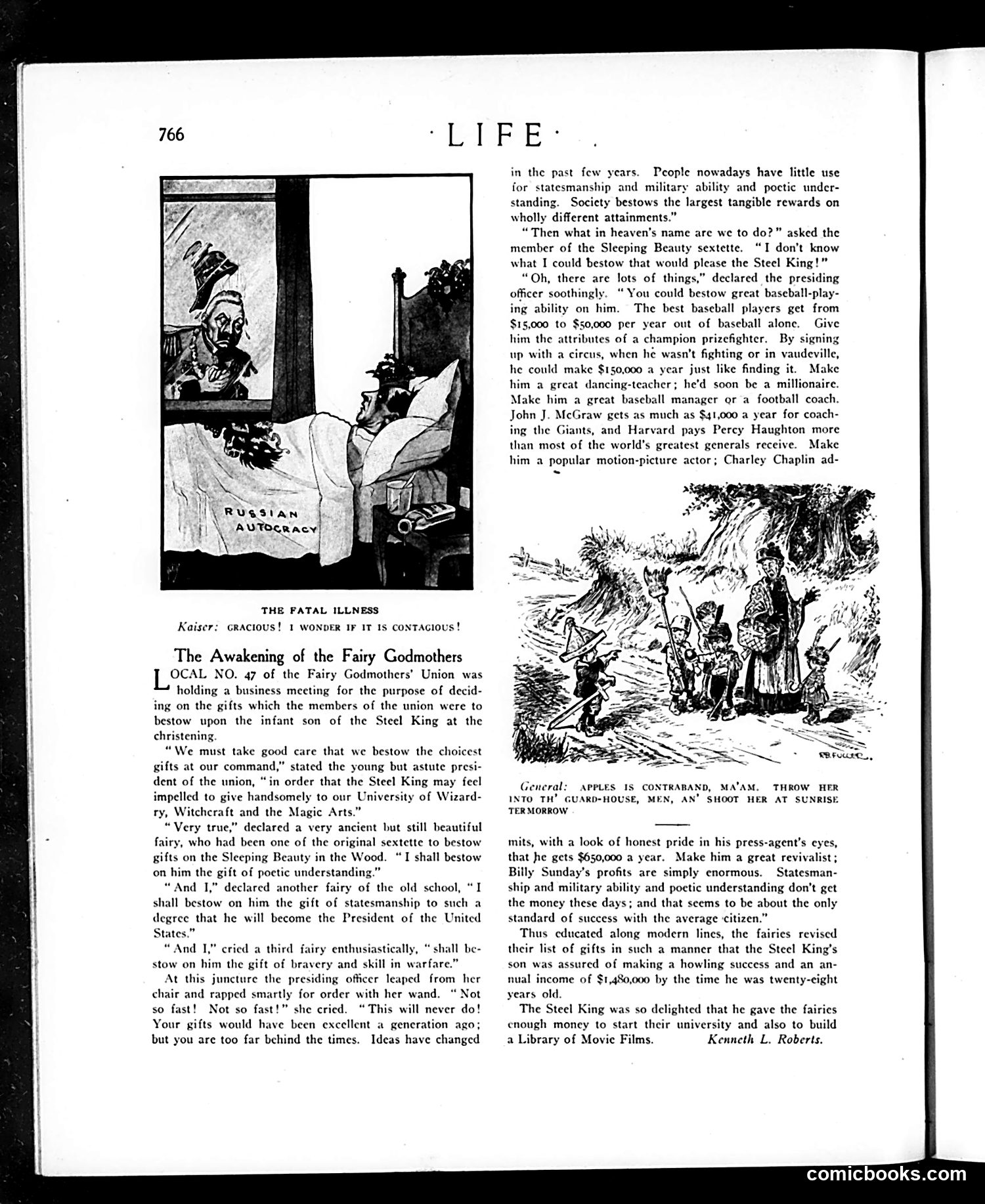
This page contains two satirical pieces mocking early 20th-century American values. **"The Fatal Illness"** (top cartoon): Shows Russian autocracy as a sickbed patient labeled "Russian Autocracy." A concerned observer wonders if it's contagious—satire on fears that revolutionary ideas might spread to other nations. **"The Awakening of the Fairy Godmothers"** (main story): Fairies meet to bestow gifts on a Steel King's newborn son. Traditional fairies propose statesmanship, poetry, and military skill—classical virtues. The presiding officer dismisses these as outdated, revealing modern society only rewards entertainment and spectacle: baseball players earning $15,000-$50,000 annually, circus performers making $150,000, motion-picture actors like Charlie Chaplin earning $650,000, and evangelist Billy Sunday's "enormous" profits. The satire criticizes how American capitalism has replaced noble values with celebrity worship and money-making—the child is predicted to earn $1,480,000 annually by age twenty-eight.
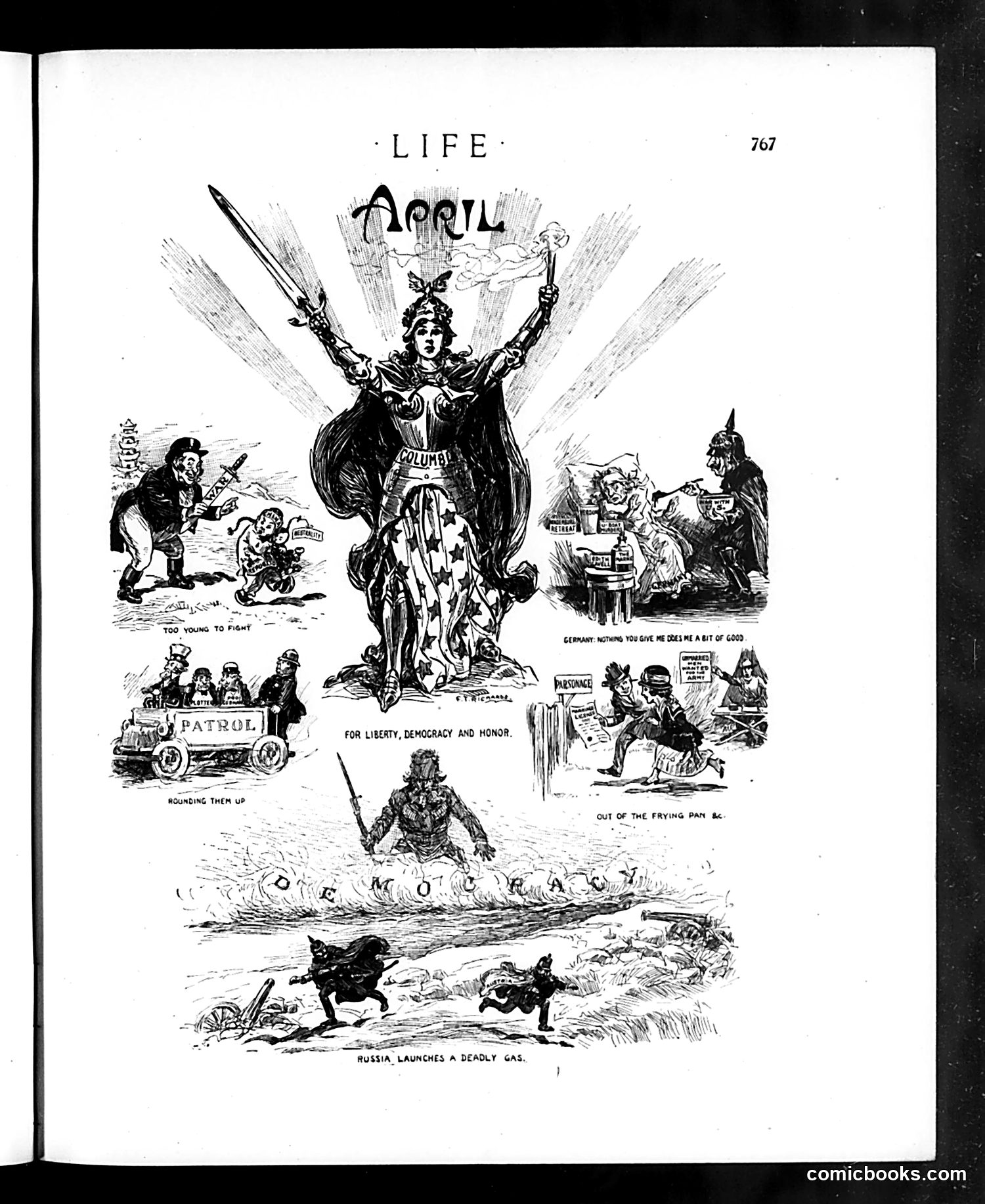
This page presents multiple satirical vignettes centered on an allegorical female figure labeled "COLUMBIA" (representing America), holding sword and torch, radiating patriotic light. The surrounding scenes critique WWI-era American concerns: - "Too Young to Fight" mocks child soldiers - "Rounding Them Up" depicts a patrol wagon collecting recruits - "Germany Intends You Give Me a Bit of Good" shows a caricatured German figure menacing civilians - "Out of the Frying Pan &c." suggests diplomatic complications - "Russia Launches a Deadly Gas" depicts chemical warfare The overall composition celebrates American ideals ("For Liberty, Democracy and Honor") while satirizing military recruitment, wartime hysteria, and foreign threats. This appears designed for American audiences anxious about involvement in the Great War.
This page celebrates the arrival of British diplomat **Arthur Balfour** and other Allied officials to the United States, shortly after America's entry into World War I (April 1917). The text praises Balfour as an exemplary statesman and welcomes him as a representative of British military expertise in fighting Germany. The article notes that **General Joffre** (French Marshal) is also arriving. Both visits are framed as compliments to American entry into the war, with practical purposes: sharing Allied combat experience and coordinating war strategies. The cartoons (though small and partially obscured) appear to illustrate recruitment and war preparation themes mentioned in the text—recruiting drives in shop windows, volunteer enlistment, and civilian mobilization efforts like vegetable gardening and chicken-raising for food production. The tone is patriotic and encouraging, emphasizing that Americans, despite seeing increased military uniforms (khaki), are still adjusting to wartime conditions while gradually embracing necessary preparations.
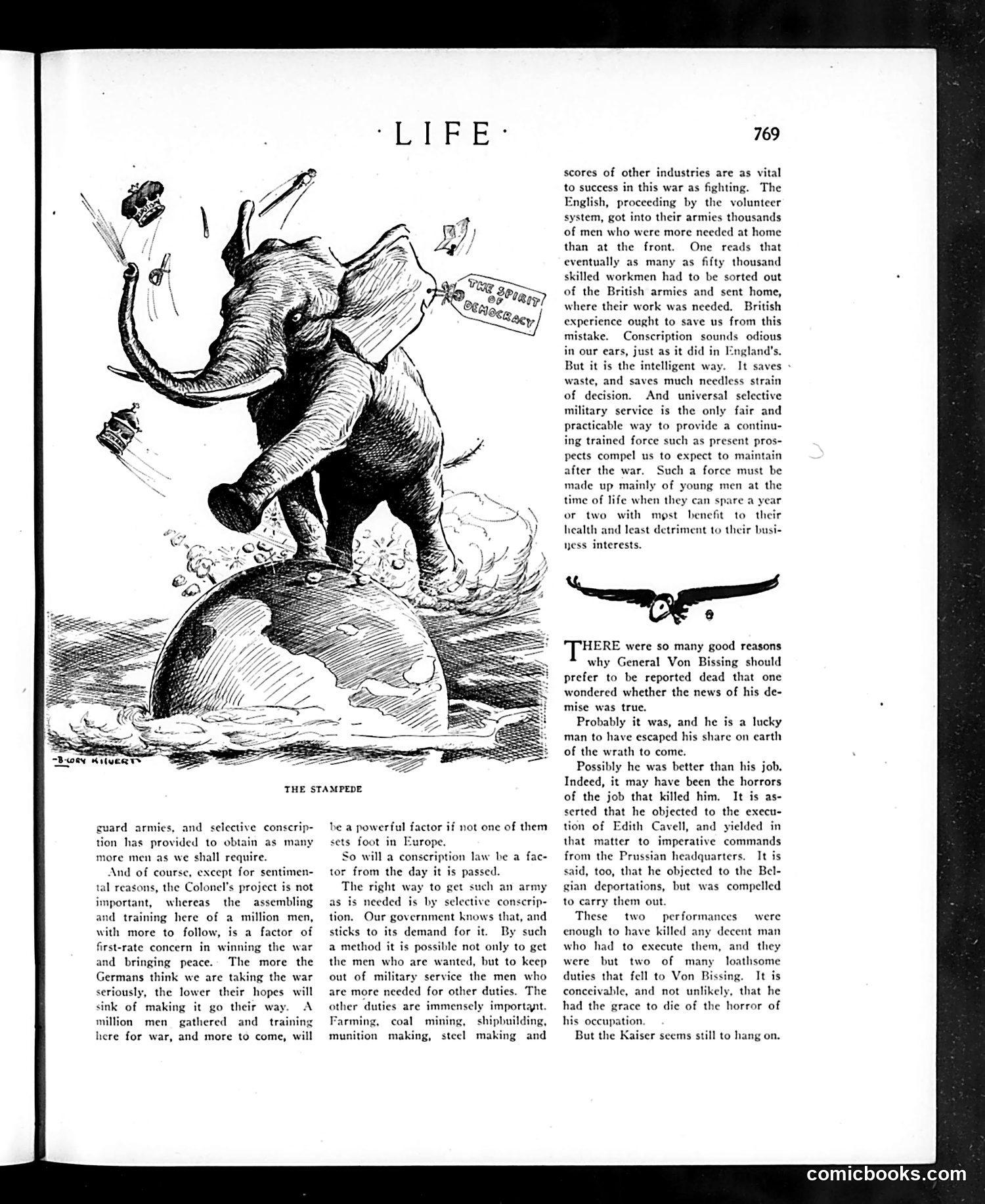
**The Cartoon ("The Stampede"):** An elephant balances precariously on a globe while juggling various military papers and supplies. The elephant likely represents the United States, depicted as unstable or struggling to manage wartime demands. **Main Editorial Arguments:** The text advocates for **selective military conscription** rather than voluntary enlistment. The writer argues this system keeps essential workers (farmers, coal miners, munitions makers) in civilian industries while building a trained military force. Britain's volunteer system is criticized for removing 50,000 skilled workmen from factories—a cautionary lesson. **Von Bissing Reference:** General Friedrich von Bissing was the German governor-general of occupied Belgium during World War I. The text reports his death and notes he allegedly objected to executing British nurse Edith Cavell and forced Belgian deportations, yet obeyed Prussian orders anyway. The piece suggests these moral horrors may have killed him. **Context:** This page reflects American WWI-era debates about military organization and conscription policy, published while the U.S. was weighing how to mobilize for war.
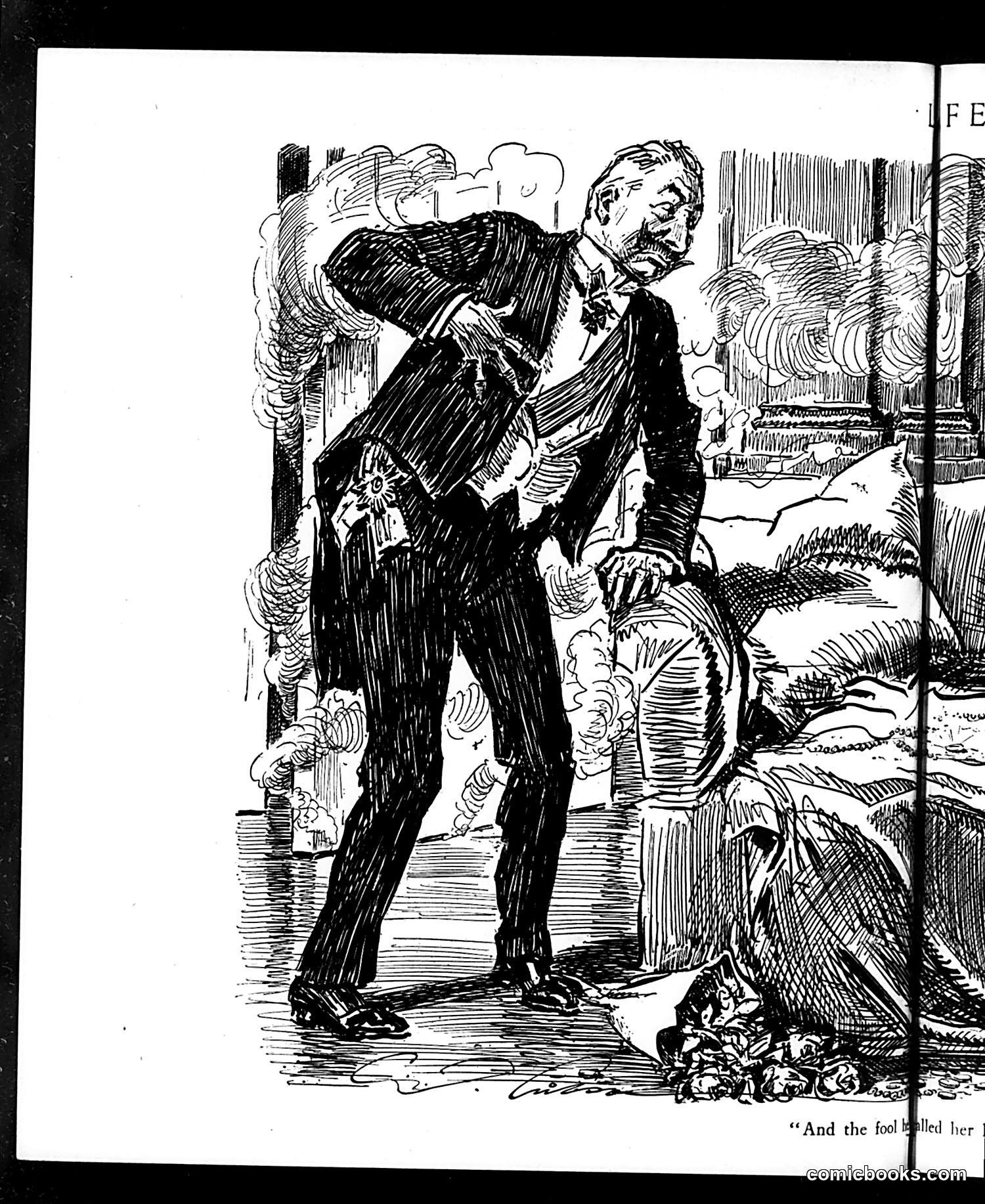
This is a satirical illustration from *Life* magazine showing a well-dressed military or government official in formal attire with decorative sash and medals, depicted in an exaggerated, somewhat foolish pose. The figure appears to be gesturing dramatically or gesturing to something out of frame. The caption begins: "And the fool kissed her..." but is cut off at the page edge. Without the complete caption or additional context, the specific political or social target remains unclear. The caricature's formal military dress and the implied romantic/foolish behavior suggest satire of an authority figure—likely a government official or military leader—being mocked for romantic folly or poor judgment. The exact historical reference and intended target cannot be definitively determined from the visible portions of this page alone.
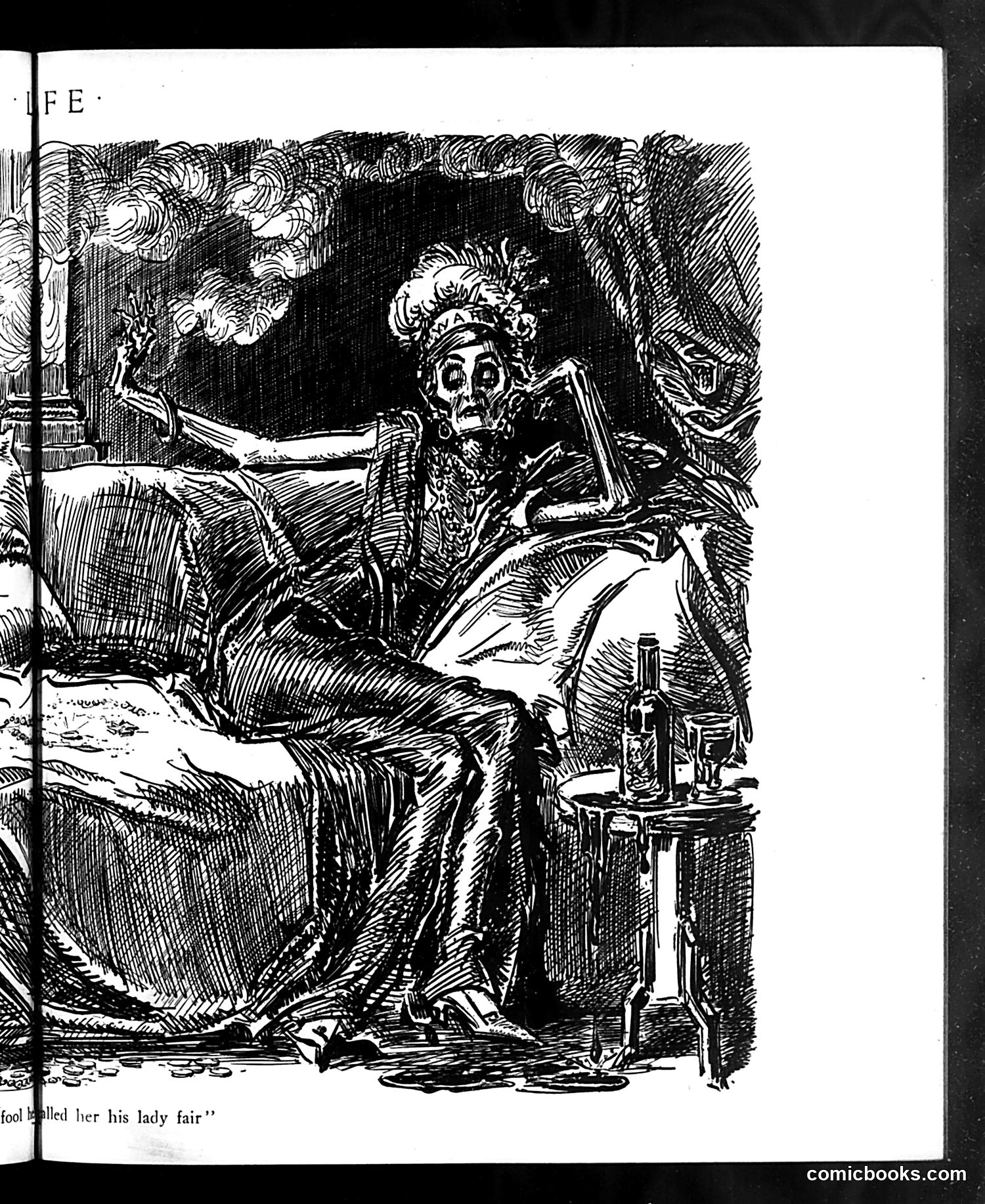
This appears to be an illustration from a satirical scene, likely from a serialized story or comic narrative in *Life* magazine. The image shows an elderly woman in ornate dress (elaborate headpiece, jewelry, decorated clothing) reclining on a bed or couch, with bottles visible on a nearby table—suggesting illness or indulgence. The OCR text fragment "fool pled her his lady fair" is too incomplete to definitively identify the specific reference or satire. However, the character's exaggerated appearance and setting suggest social commentary on wealth, vanity, or aging aristocracy—common targets of *Life*'s satire. Without clearer context or surrounding text, I cannot confidently identify the specific political/social target or the precise joke intended.
This page contains two distinct pieces. The top section is a patriotic poem titled "On Vimy Ridge" by Christopher Morley, celebrating American forces fighting alongside Canadians in World War I at the Battle of Vimy Ridge (1917). The poem uses romantic imagery—the American flag as a "Bride of Glory"—to commemorate soldiers' sacrifice. The longer section critiques a theatrical adaptation of George Du Maurier's novel *Peter Ibbetson*. The reviewer argues the dramatization misses Du Maurier's essential spirit. Du Maurier was known as a *Punch* cartoonist who balanced pathos with humor and "joy of life," but the play presents only unrelenting melancholy. The critic also faults actors for unclear diction—speaking naturally (realistic) but inaudibly to the audience. The point: stage realism shouldn't sacrifice intelligibility to the hundreds watching from the auditorium.
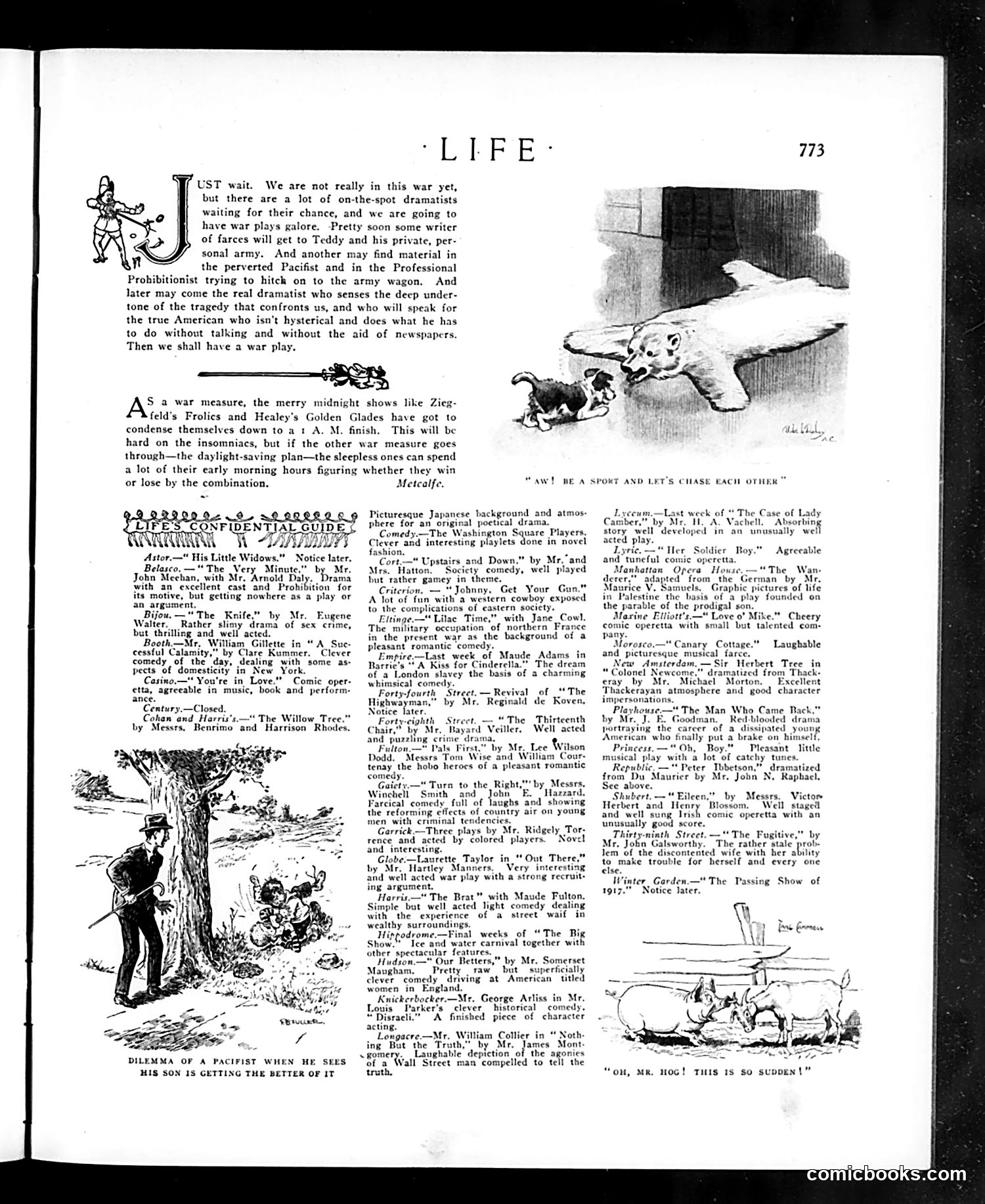
This page from Life magazine (published during WWI era) contains satirical commentary on American theater and war preparedness. **Main Editorial Piece:** The opening column satirizes anticipated war plays, mocking both frivolous dramatists eager to capitalize on military themes ("Teddy and his private, personal army") and specific social groups like Prohibitionists and Pacifists trying to exploit war sentiment. The author argues true drama will eventually emerge from genuine tragedy. **The Cartoons:** Two illustrations depict wartime absurdities: - Upper right: A large dog and small dog in mock combat, captioned "Aw! Be a sport and let's chase each other"—satirizing trivial entertainment during serious times - Lower left: A pacifist observing his son fighting, captioned about a "dilemma"—mocking pacifists' moral contradictions when their own children go to war **The "Confidential Guide":** A theater listing section reviews current Broadway productions, many with war-related themes ("Lilac Time," "Out There"), reflecting how quickly American theater responded to war as subject matter. The page's overall message: America's entertainers and public are exploiting serious wartime issues for profit and amusement rather than genuine artistic or moral engagement.
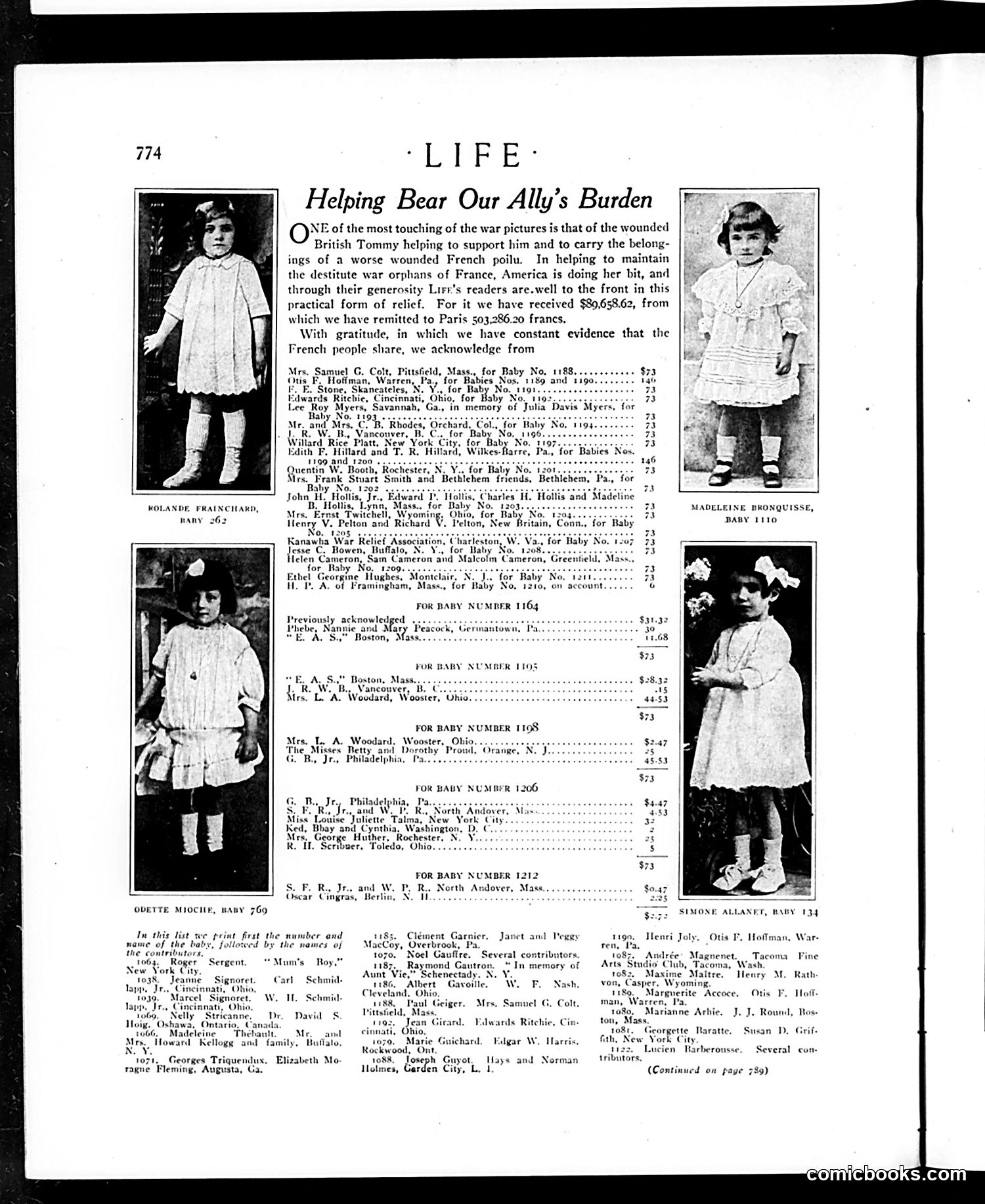
This page documents **Life magazine's charitable fundraising campaign** for French war orphans during World War I. The title references a touching wartime image of a wounded British soldier helping an even more severely wounded French soldier—used as emotional appeal for American donations. The page lists **donors and the "babies" (orphans) they've sponsored**, with amounts contributed. Life magazine organized this relief effort, collecting over $80,000 and remitting substantial funds to Paris. The accompanying photographs show **French orphan children** who benefit from American generosity. The layout presents this as a moral duty: America "doing her bit" to help maintain "destitute war orphans of France" through readers' donations. This reflects **WWI-era American sentiment**—positioning the U.S. as supporting its allies and acting charitably toward civilian war victims, before America officially entered the war in 1917. The campaign personalized distant suffering through individual child sponsorships.
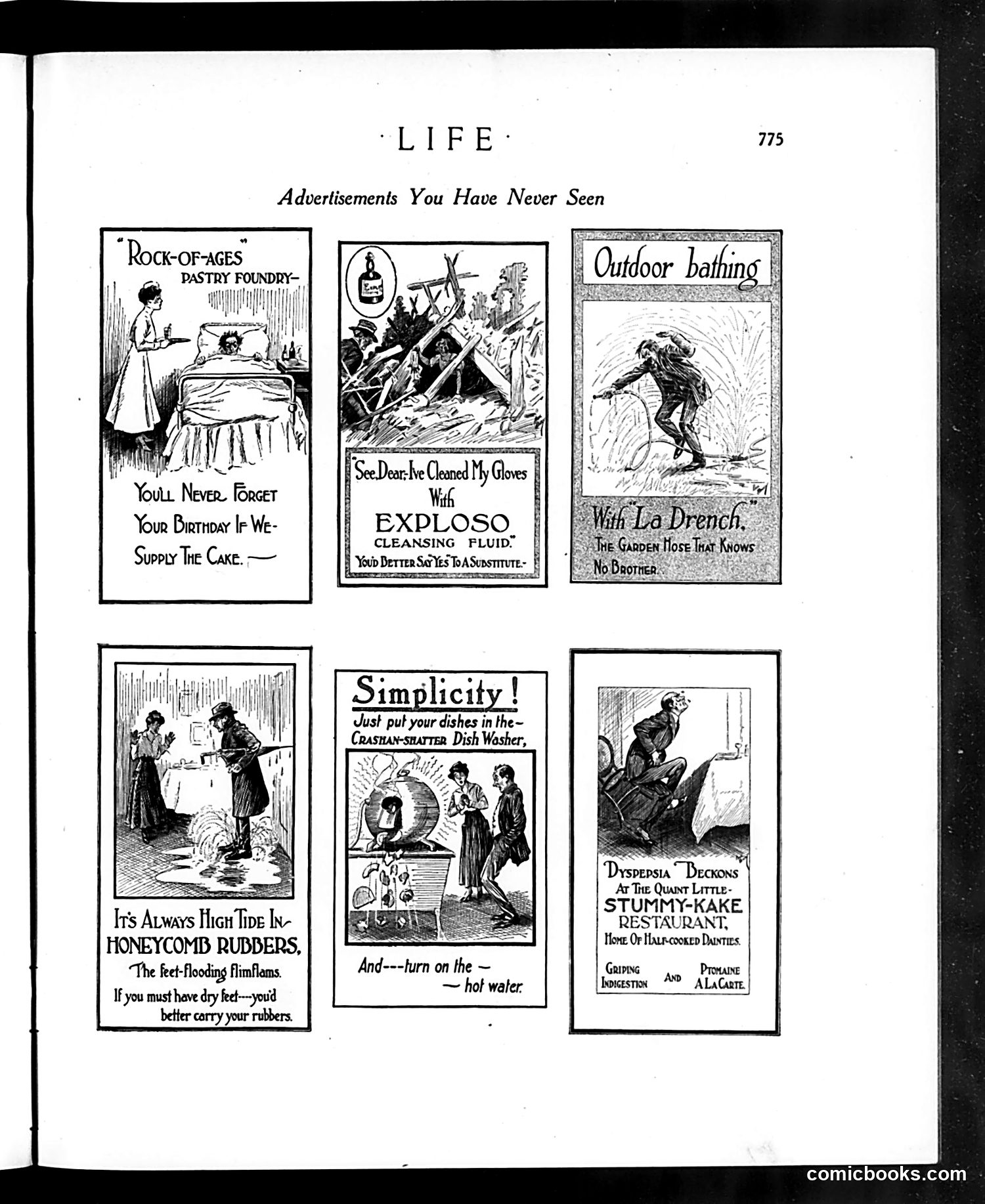
This page presents fake, absurd advertisements satirizing actual turn-of-the-century products and marketing claims. Each ad parodies real consumer goods with deliberately ridiculous premises: **Rock-of-Ages Pastry Foundry** mocks elaborate cake marketing by promising unforgettable birthdays through cake supply alone. **Explosо Cleansing Fluid** satirizes household cleaners with an implausibly violent name and exaggerated claims about glove protection. **La Drench Garden Hose** ridicules outdoor bathing products as solutions to non-problems. **Honeycomb Rubbers** lampoons waterproof footwear advertising, suggesting even carrying rubbers won't help with "feet-flooding flimflams." **Crasian-Shatter Dish Washer** and **Stummy-Kake Restaurant** mock kitchen appliance and restaurant marketing with deliberately unappealing names emphasizing digestive distress. The satire targets the era's aggressive advertising culture and dubious product claims, using deliberately crude names and absurd scenarios to expose the gap between marketing promises and actual utility.
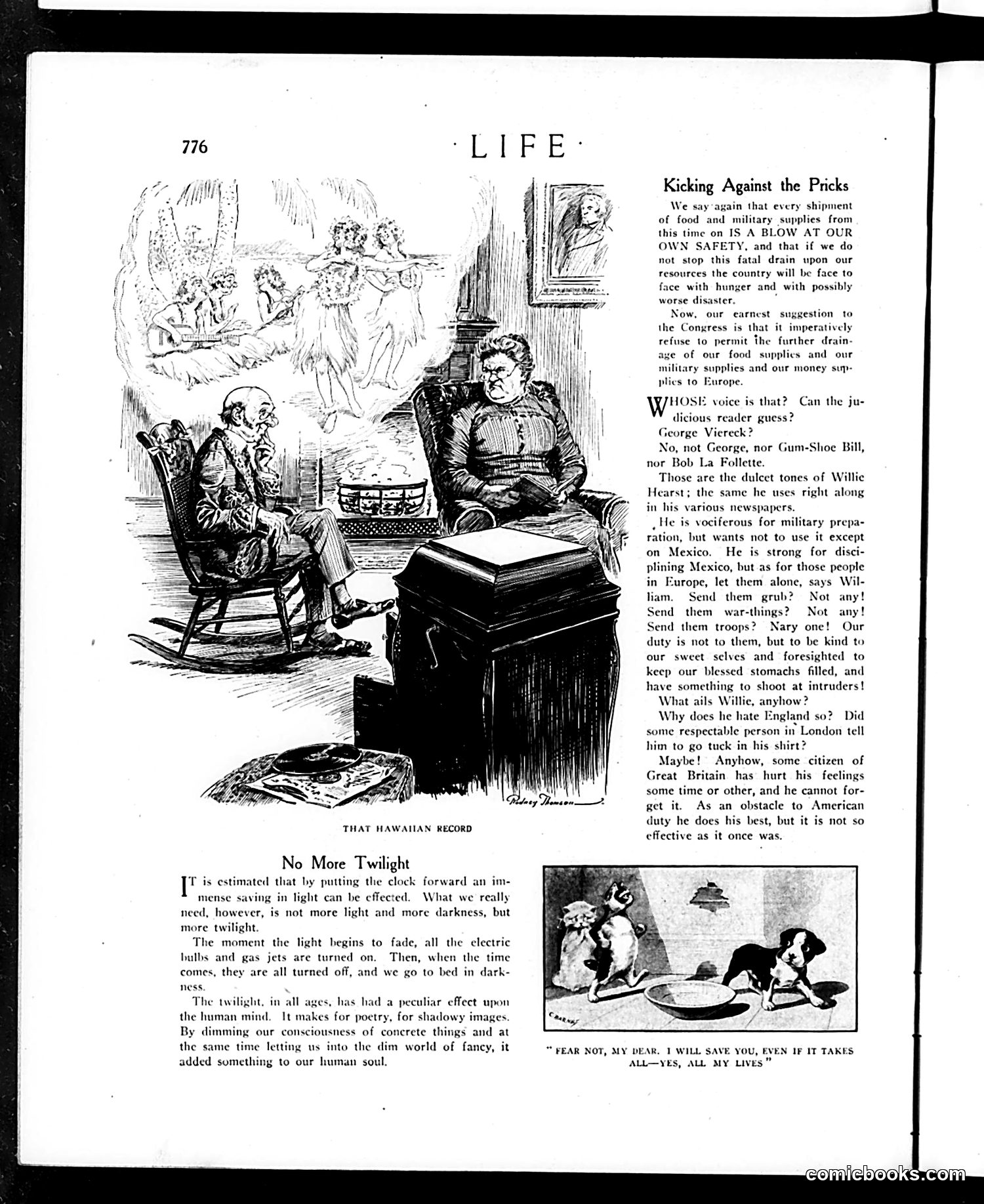
This *Life* magazine page contains two distinct satirical pieces: **"That Hawaiian Record"** (top cartoon): Depicts what appears to be a Hawaiian official or dignitary presenting a record to an American listener. The satire likely mocks either Hawaiian-American relations or a specific diplomatic incident involving Hawaii, though the exact historical reference is unclear without additional context. **"Kicking Against the Pricks"** (main text): A scathing editorial attack on William Randolph Hearst, the powerful newspaper publisher. Life accuses Hearst of hypocrisy: he vocally supports military preparation but opposes sending American food, money, or troops to aid Europe during (likely) World War I. The piece sarcastically suggests Hearst harbors anti-British sentiment and prioritizes American self-interest over international duty. The phrase "kicking against the pricks" suggests futile resistance. The bottom cartoon appears to show rescue/disaster imagery but its connection to the text is unclear. The satire targets Hearst's isolationist stance and perceived self-serving nationalism during wartime.
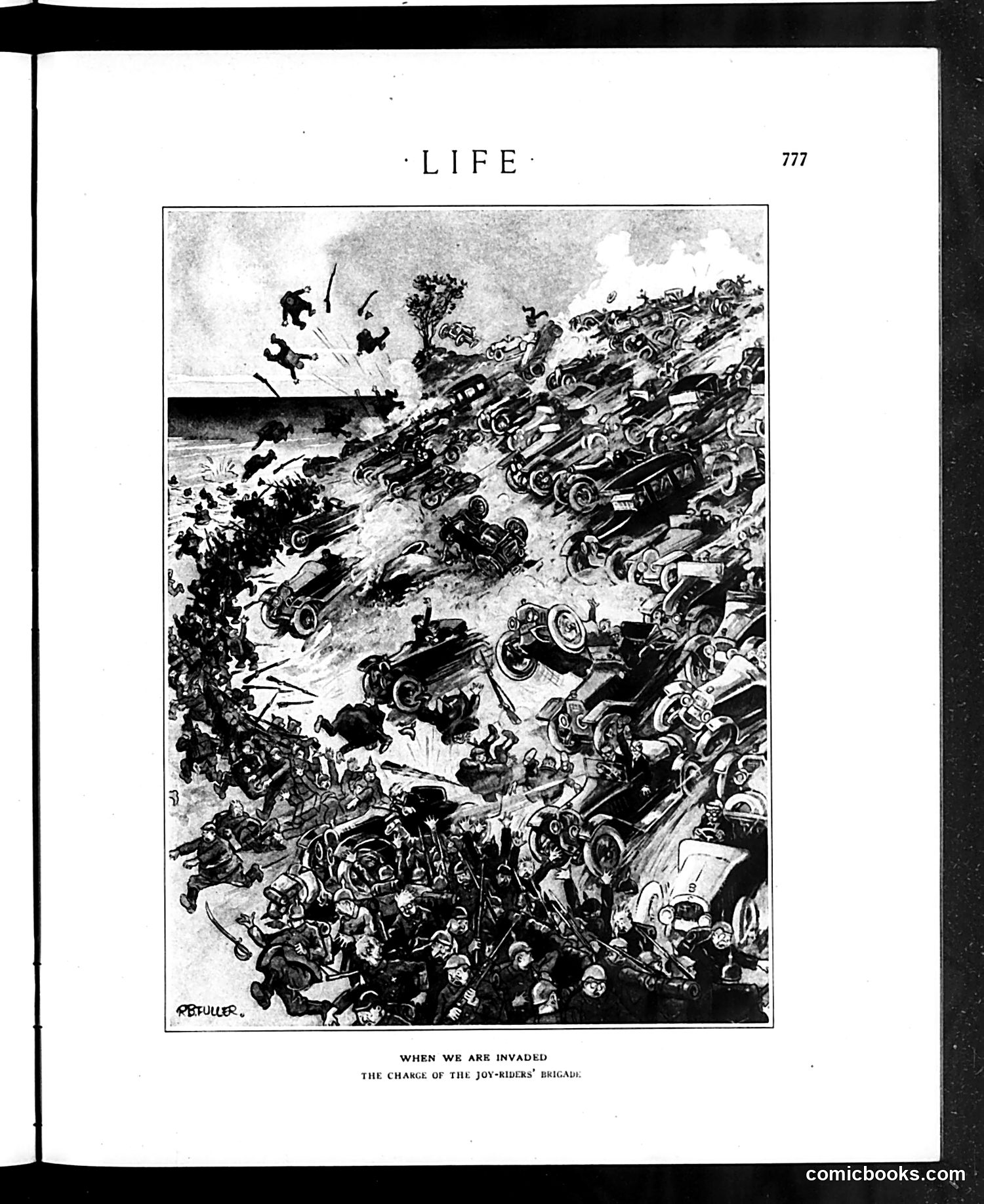
This satirical cartoon depicts a chaotic scene of automobiles and people in apparent disarray, titled "When We Are Invaded: The Charge of the Joy-Riders' Brigade." The satire mocks American civilian preparedness by contrasting the romantic military imagery of "The Charge of the Light Brigade" with the actual chaos that would result from untrained joy-riders (young people who drove automobiles recklessly for pleasure) attempting to respond to an invasion. The cartoon suggests that relying on casual car enthusiasts rather than organized military forces would be disastrous—showing crashed vehicles, people scattered in confusion, and general disorder. It's a critique of both the joy-riding subculture and, implicitly, national defense preparations of the era. The signed artist appears to be "Cestuller" or similar.
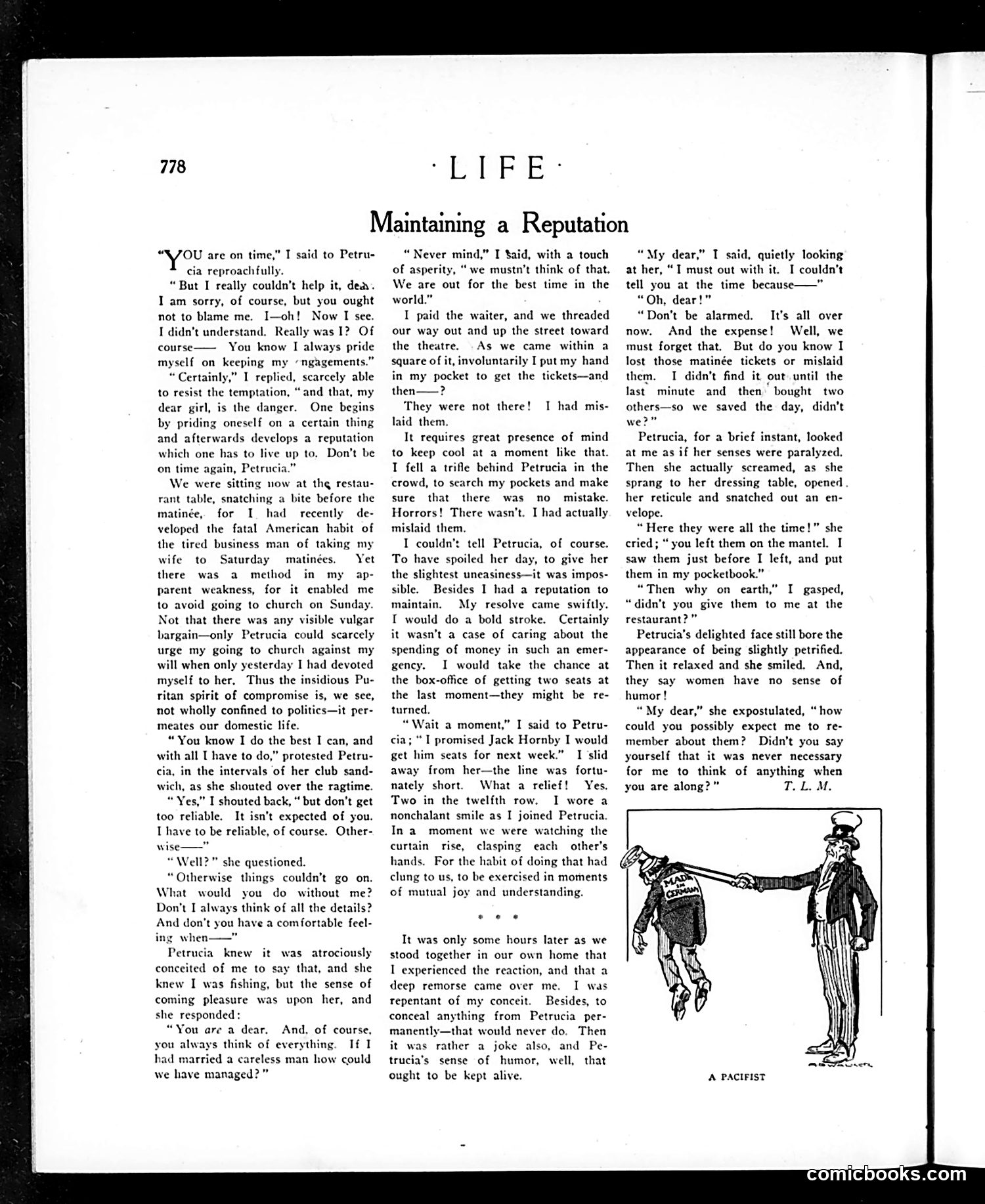
This is a humorous domestic narrative (not primarily a political cartoon) about a husband's anxiety over maintaining his carefully cultivated image of reliability. **The Setup:** The narrator prides himself on punctuality and competence. He lectures his wife Petrucia about not becoming *too* reliable, warning that reputations trap you into consistent behavior. **The Irony:** Minutes later, he loses the theatre tickets—but cannot admit this to Petrucia without shattering his reputation for managing all details. He frantically retrieves replacement seats while pretending to help a friend, maintaining his facade of flawless competence. **The Joke:** The story satirizes masculine vanity and the performative nature of domestic relationships. The narrator's elaborate scheme to hide a minor mistake reveals how marriages can be built on careful management of image rather than honest communication—a subtle critique of early 20th-century gender roles and masculine pride. **The Illustration:** "A Pacifist" shows two men shaking hands warmly, likely illustrating the narrator's relief at successfully maintaining his deception.
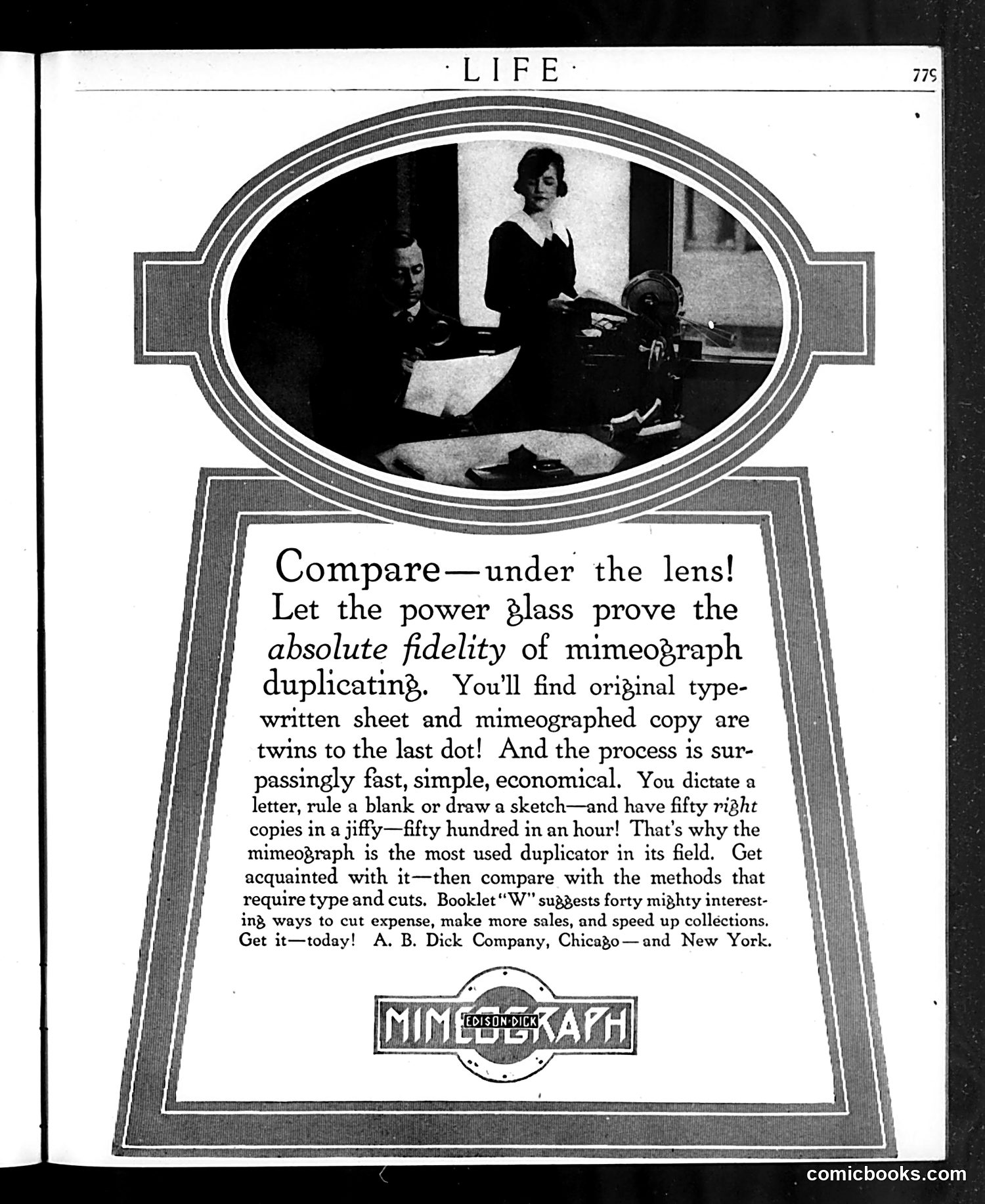
This is a **mimeograph machine advertisement**, not a political cartoon. The image shows an office scene with people examining documents under a magnifying glass to demonstrate the mimeograph's copying accuracy. The ad promotes the mimeograph as a superior duplicating technology compared to earlier methods requiring "type and cuts" (letterpress printing). It emphasizes speed ("fifty hundred in an hour"), simplicity, and economy—appealing to businesses seeking efficient document reproduction. The "power glass" visual demonstration serves as proof of fidelity: the original and copy are "twins to the last dot." This was relevant advertising for early-20th-century offices before photocopiers existed. The A.B. Dick Company was a major mimeograph manufacturer of the era.
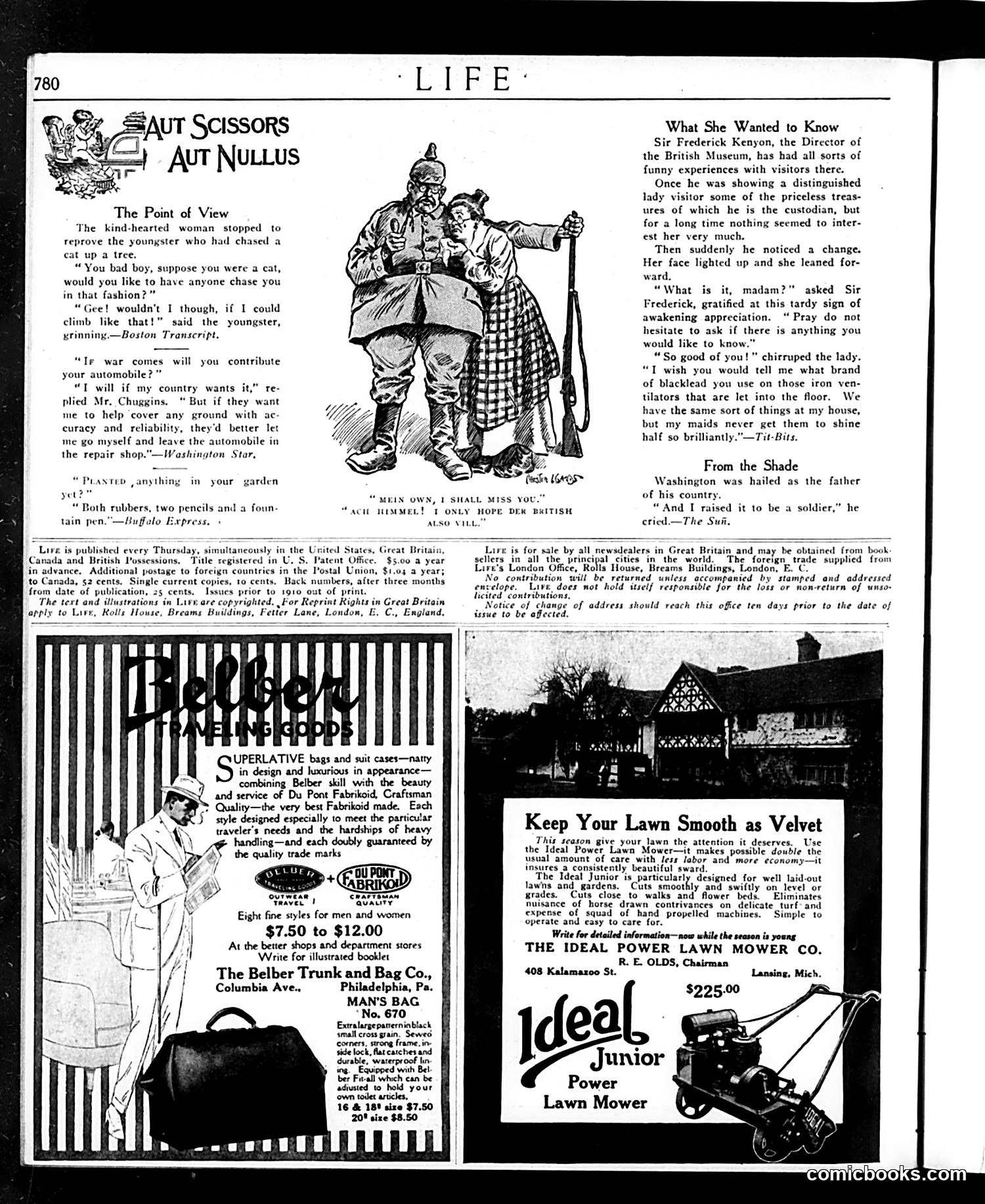
This page contains three brief satirical jokes and period advertisements. The opening cartoon depicts a woman scolding a boy for chasing a cat up a tree, using the reasoning "how would you like it?" The boy's response—that he'd enjoy it *if* he could climb like a cat—subverts her moral logic, suggesting children's values differ fundamentally from adults'. Two additional jokes follow: one about a man reluctant to donate his automobile to war effort (likely WWI-era, given the "if war comes" reference), preferring to volunteer himself instead; and another about someone who planted "both rubbers, two pencils and a fountain pen" in a garden—a play on the word "planted" meaning both gardening and losing/misplacing items. The remainder of the page consists of period advertisements for luggage, lawn mowers, and other consumer goods typical of early 20th-century Life magazine content.
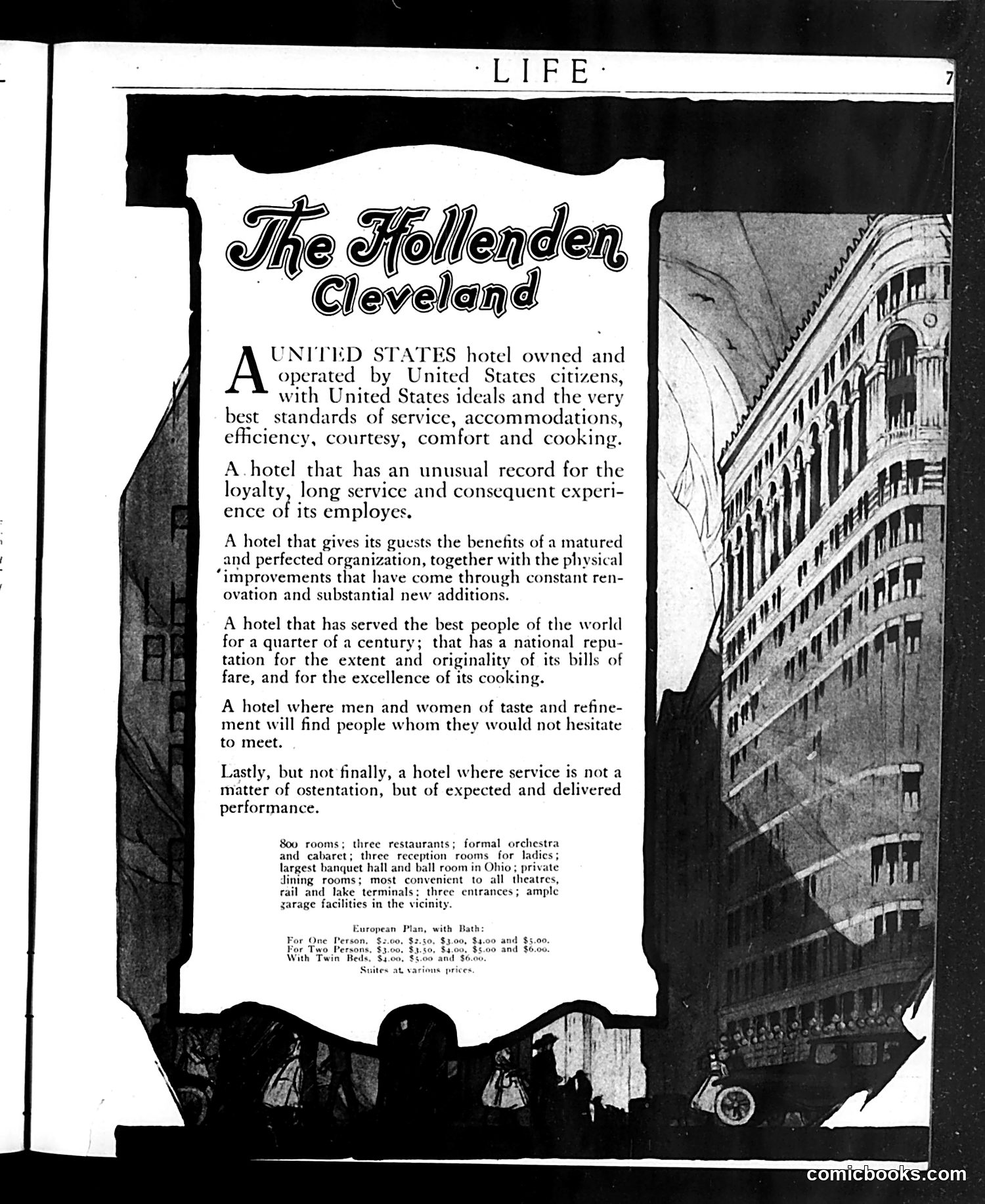
This is a **straightforward hotel advertisement**, not political satire. It promotes the Hollenden Hotel in Cleveland, Ohio, emphasizing its credentials as an American-owned establishment with patriotic appeals ("United States ideals," "United States citizens"). The ad emphasizes the hotel's prestige through a quarter-century of operation, superior service, excellent cuisine, and refined clientele. It lists practical amenities: 800 rooms, three restaurants, orchestras, banquet facilities, and convenient theater access—selling points for both leisure and business travelers of the era. The accompanying architectural photograph showcases the building's imposing, multi-story design as visual proof of the hotel's significance and permanence. This appears in *Life*'s advertising section rather than editorial content, making it a period commercial pitch rather than satirical commentary.
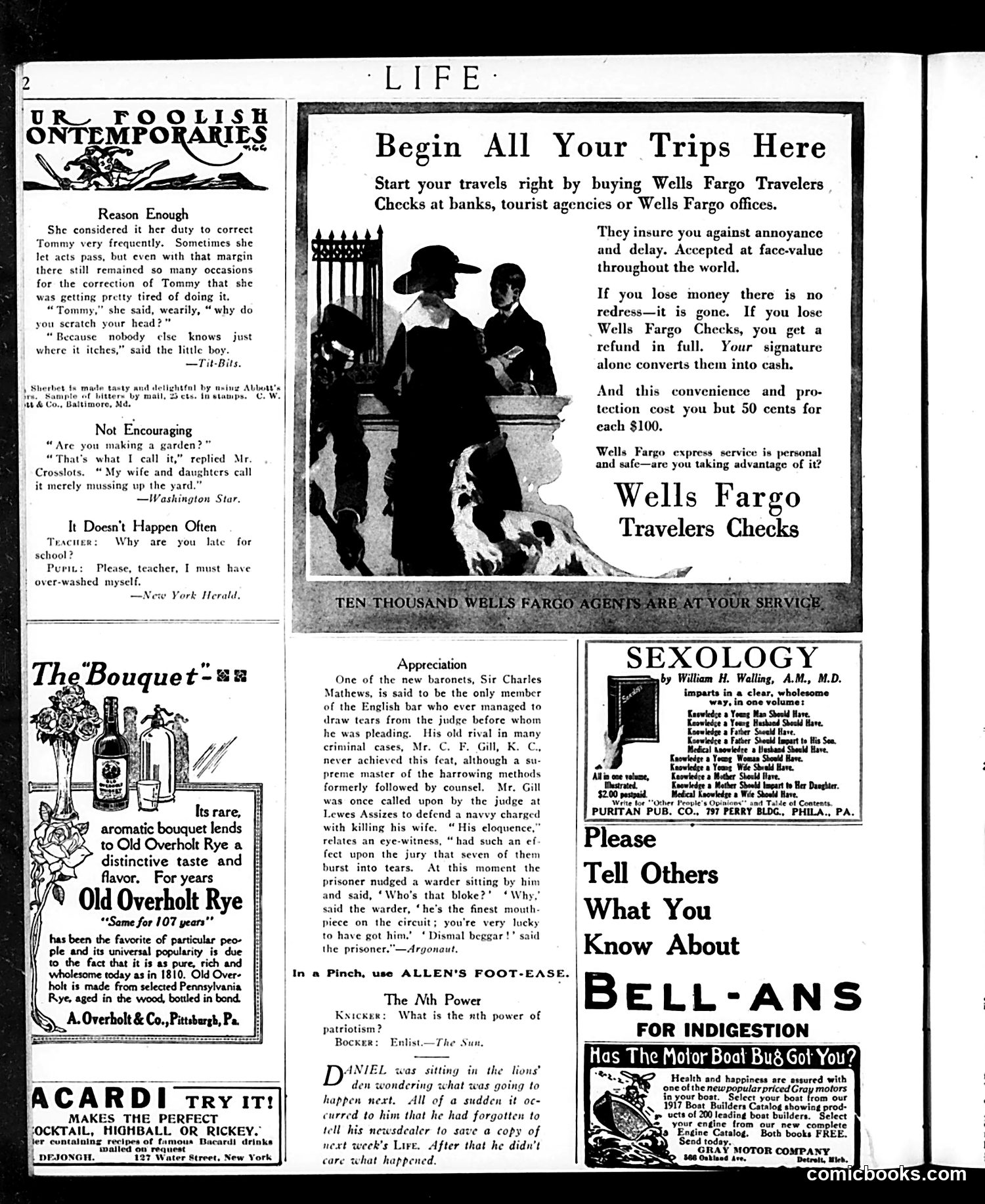
This is primarily an **advertising-heavy page** with brief satirical content typical of early-20th-century *Life* magazine. ## Cartoons/Humor: The small comic pieces are gentle domestic humor: - **"Reason Enough"**: A child justifies scratching his head because "nobody else knows just where it itches"—simple logic that amuses through childish literalism. - **"Not Encouraging"**: A man calls his messy yard a "garden"; his family disagrees—mild marital humor about gardening incompetence. - **"It Doesn't Happen Often"**: A student claims he's late because he "over-washed"—absurdist excuse humor. ## Advertisements: The page features period product ads: Wells Fargo traveler's checks, Old Overholt Rye whiskey, *Sexology* books, Bell-Ans indigestion remedy, and Gray Motor boat engines. These reflect early-1900s consumer culture and available luxuries (travel, alcohol, automobiles, motorboats). ## Context for Modern Readers: This represents *Life*'s mixed format: lightweight humor alongside commerce—a precursor to modern magazine layouts, though the humor itself is genteel and family-oriented by today's standards.
This page is primarily **advertising and book reviews**, not political satire. The "Latest Books" section reviews three contemporary works: 1. **Arthur Bullard's "Mobilizing America"** — reviewed as practical guidance for organizing American democratic energy for war preparation. The fire-extinguisher metaphor suggests turning the nation "upside down" to mobilize for conflict (likely WWI-era, given references to France and England). 2. **Herbert Adams Gibbons' "The New Map of Africa"** — addresses colonial competition in Africa as a cause of war. 3. **Margaret Prescott Montague's Atlantic Monthly piece** — describes a spiritual/mystical experience. The page also contains **commercial advertisements** for Tiffany & Co. jewelry and White Rose Glycerine Soap. There are **no political cartoons** visible. The content reflects early-20th-century concerns about war preparation and colonial politics, but presents these as earnest book recommendations rather than satirical commentary.
This page contains **book reviews, advertisements, and a satirical short story** rather than political cartoons. The main satirical content is "Life in the Suburbs," a comedic dialogue about social anxiety. Parsival, an anxious middle-class man, learns his employer Mulligan—a self-made businessman of humble origins—is moving next door and expects social integration into the couple's elite bridge club. The satire mocks **class snobbery and social climbing**: Parsival's wife considers Mulligan "coarse" and "impossible" despite his success, yet they're blackmailed by economic dependence into sponsoring him. The joke reveals the fragility and hypocrisy of social hierarchies—Parsival cannot escape his boss even by losing his job, since Mulligan will remain a neighbor. The advertisements (Nujol laxative, Fownes gloves, Standard Oil) are typical period marketing using dubious health claims and status appeals.
This page contains a short story satirizing newly wealthy Americans and social climbing. The narrative depicts Mr. Mulligan, a self-made businessman who has moved into an affluent neighborhood. Mrs. Parsival, an established society matron, initially dismisses him as uncultured (he "parts his coat-tails when he sits down"), but schemes to manipulate him into funding various community projects—a country club mortgage, church debt, and tennis courts. **The satire's point:** Mulligan ultimately escapes by subletting his house, exhausted by relentless solicitations from the wealthy community he sought to join. The joke reveals that American "society" cynically exploits newcomers' desire for acceptance, extracting donations through social pressure. Mrs. Parsival's final boast—that she orchestrated his departure by telling everyone to "act natural"—exposes her manipulation as the real con. The page also includes period advertisements, notably for Cat's Paw Cushion Rubber Heels, unrelated to the narrative's social commentary.
This page from Life magazine contains primarily **advertisements and satirical fiction**, not political cartoons. The main satirical piece is "From Heterogeneous to Homogeneous," a humorous story about a convention of "Feminine Tendencies" that satirizes women's movements and internal disagreements. The satire mocks the era's debates over women's roles by personifying different viewpoints (Highbrow, Political, Clinging-Vine, Motherhood, etc.) as competing factions. The joke culminates when these women's groups, unable to agree on anything, must hire a man to preside over them—and the Love party's requirement is that he be "young and handsome" rather than intelligent, a jab at perceived superficiality. The poem "The Diagnosis" uses dark humor about doctors disagreeing on a patient's ailment, with only the Devil knowing the true cause is death. The rest consists of **period advertisements** for liqueurs, confections, push-pins, and Boston Garter stockings—typical early 20th-century magazine content.
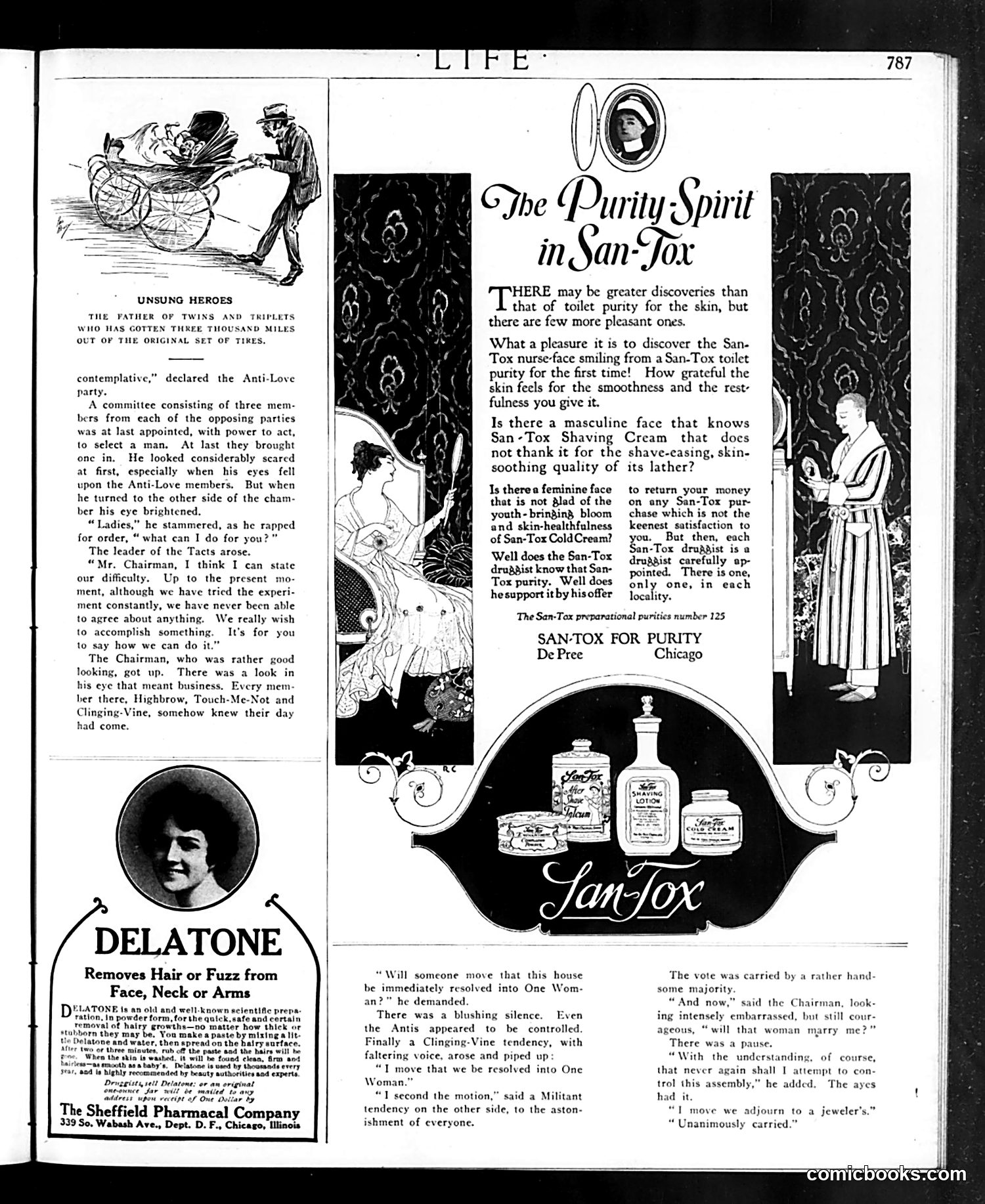
This Life magazine page satirizes early 20th-century feminist activism and suffrage debates. The main cartoon mocks women's political organizing by depicting competing female factions—"Anti-Love," "Highbrow," "Touch-Me-Not," and "Clinging-Vine" parties—unable to agree on anything substantive. The joke: when a handsome male chairman is brought in, all factions instantly unite and dissolve themselves "into One Woman" to marry him. The satire suggests that despite women's political aspirations and rhetoric about independence, their ultimate goal remains matrimony and male approval. The cartoon ridicules both suffragists' organizational efforts and implies women's political engagement is superficial—a common anti-suffrage trope. The "Unsung Heroes" heading sarcastically refers to the father who got multiple children from one set of tires, inverting the expected heroism. The page's advertisements (Delatone hair removal, San-Tox cosmetics) reinforce the underlying message: women should focus on beauty and appearance rather than politics.
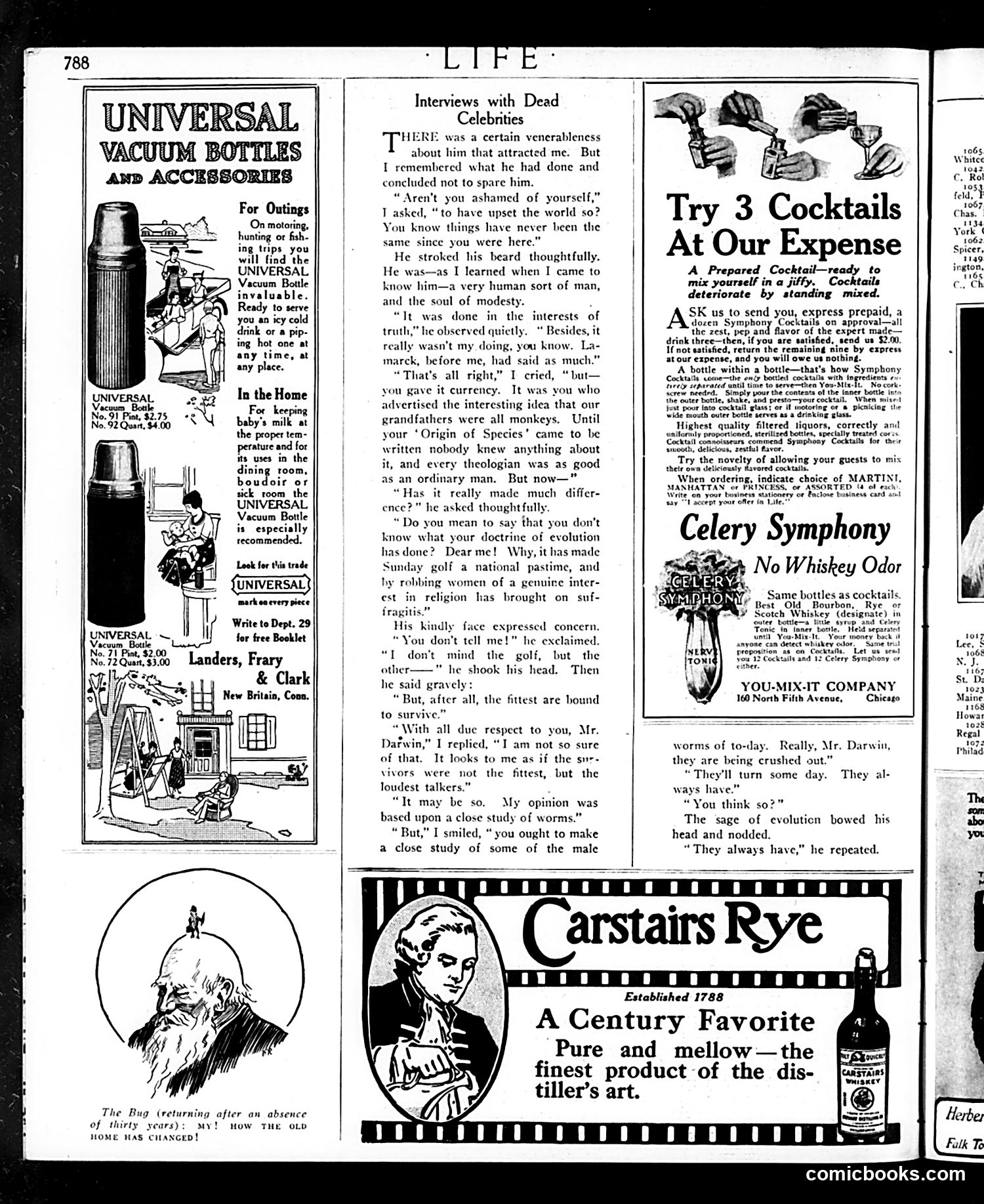
This is a satirical interview with a deceased Charles Darwin. The piece mocks Darwin's theory of evolution by having the narrator confront Darwin with unintended consequences of his ideas becoming popular. The joke: Darwin's doctrine of evolution has allegedly made Sunday golf a national pastime and damaged women's religious faith—outcomes Darwin never intended. When the narrator suggests "the fittest" aren't actually surviving (citing worms being "crushed out"), Darwin responds that they "always have" survived, missing the point entirely. The satire targets both Darwinism's cultural impact and the perceived gap between scientific theory and real-world social effects. The conversation implies evolution theory inadvertently undermined Victorian moral and religious structures, a common early-20th-century conservative critique. The cartoon is vintage *Life* magazine social commentary—using a famous dead figure to satirize contemporary anxieties about modernity and secularism.
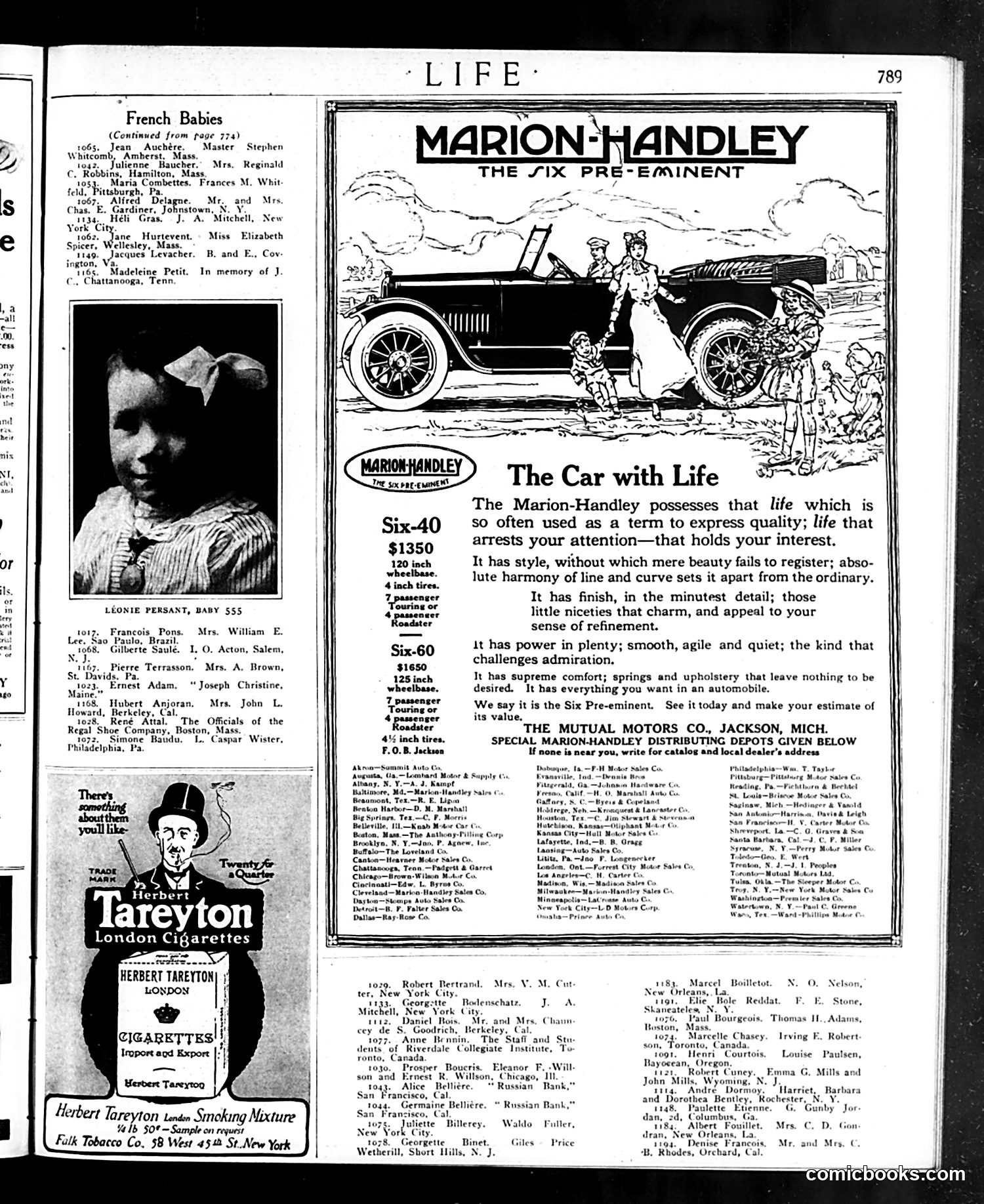
This page is primarily **advertising and announcements**, not satire or political commentary. The main content is a **Marion-Handley automobile advertisement** (right side), promoting their "Six-40" and "Six-60" models as luxury cars with "life"—using that era's marketing language equating automobiles with quality, style, and refinement. The illustration shows an elegant woman and children near a touring car, appealing to middle-class aspirations. The left side lists **French babies** (continuation from a previous article), apparently documenting infants born to French families, likely part of a human-interest feature common in early 20th-century magazines. Below is a **Herbert Tareyton cigarettes advertisement**, a minor placement typical of period publications. The overall page reflects 1920s consumer culture: automobile marketing targeting prosperous readers, documentation of notable births, and tobacco advertising—all standard Life magazine content of this era. No political commentary or satire is present.
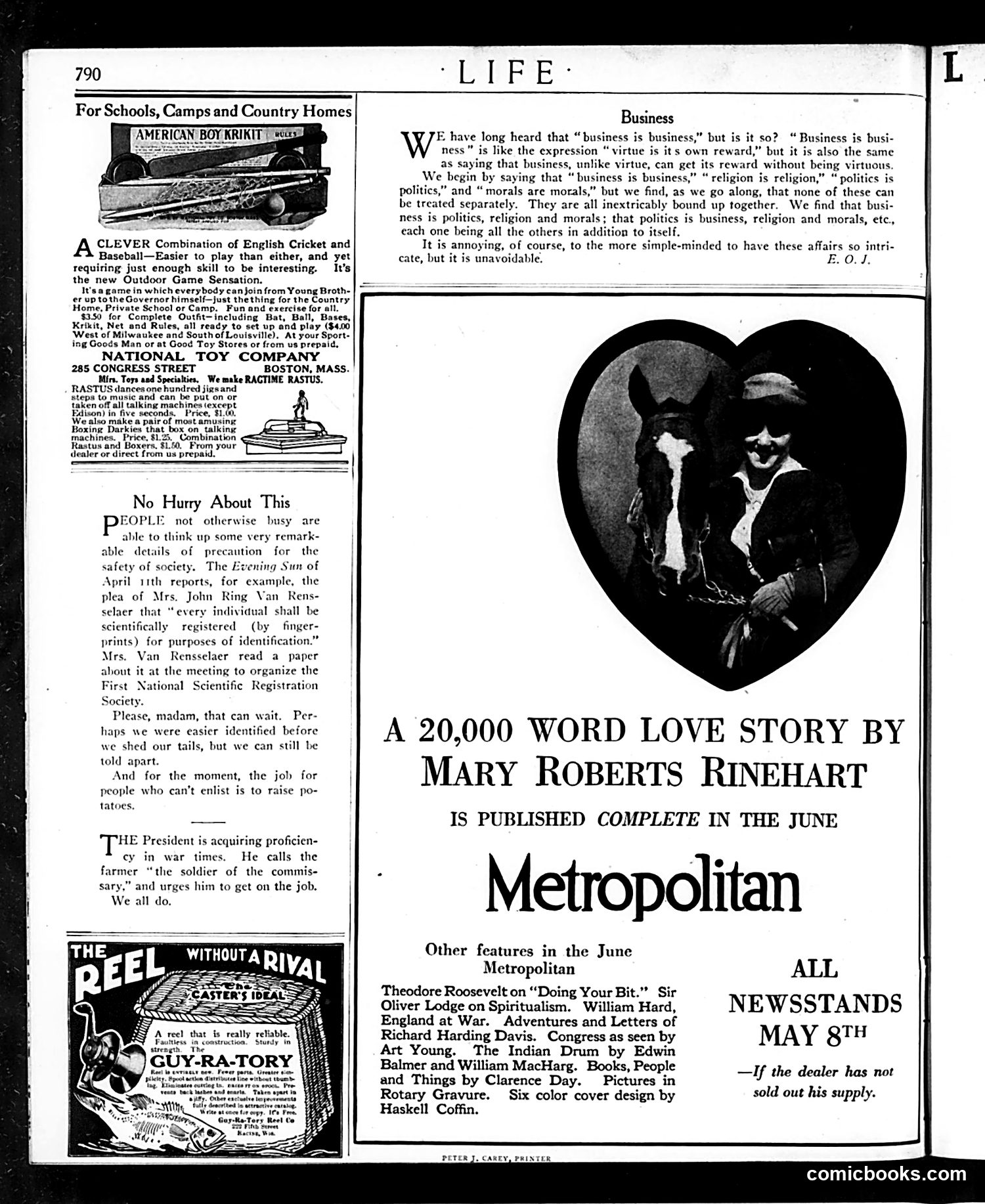
This is primarily an **advertising and promotional page** from Life magazine, likely from May 1917 (based on the "MAY 8TH" newsstand date). **Content overview:** The page features advertisements for children's toys (cricket/baseball hybrid game, mechanical dancing dolls using racist imagery labeled "Ragtime Rastus"), and an essay on business ethics arguing that business, religion, politics, and morals are inseparably interconnected. **Notable elements:** The "No Hurry About This" section mocks the proposal by socialite Mrs. John Ring Van Rensselaer for mandatory fingerprint registration of all citizens—framed as an amusing example of well-intentioned but impractical wartime safety measures. A reference to the President (likely Wilson) calling farmers "soldiers of the commissary" reflects WWI mobilization rhetoric. **The main feature** announces a 20,000-word love story by Mary Roberts Rinehart appearing in the June *Metropolitan* magazine—a significant literary promotion of the era.