
Life, 1917-04-26 · page 24 of 84
Life — April 26, 1917 — page 24: what you’re looking at
What you’re looking at
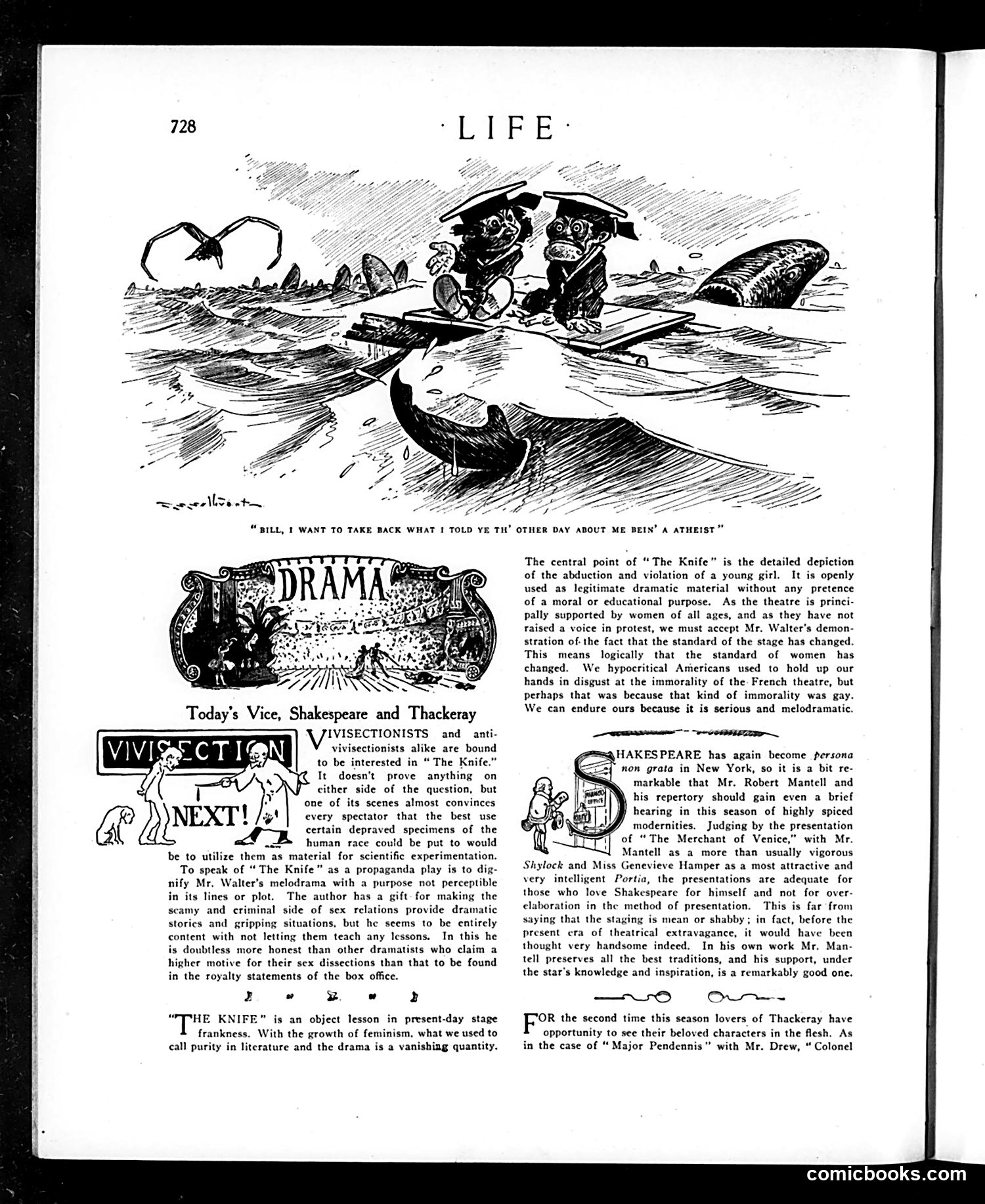
The top cartoon depicts two anthropomorphized animals (appearing to be dogs or similar creatures) in a small boat during rough seas, with one saying to the other: "Bill, I want to take back what I told ye th' other day about me bein' a atheist." **The joke:** This is a survival-situation humor cartoon playing on the common expression that "there are no atheists in foxholes"—the implication being that when facing death (here, being lost at sea), even a self-proclaimed atheist reconsiders their non-belief and turns to prayer. The page's main text reviews the play "The Knife," criticizing it as exploitative melodrama depicting sexual violence against a young woman. The critic argues the play has no moral purpose beyond sensationalism, and notes that because female theatergoers haven't protested, it reflects changed standards of propriety. The reviewer contrasts this with hypocritical American attitudes toward supposedly immoral French theatre. Additional brief reviews discuss Shakespeare's continued popularity and Thackeray adaptations on the New York stage.
📄 Transcribed text from this page (OCR, searchable)
Machine-transcribed from the original scan — historical spelling and the odd misread are preserved.
IVISECTIONISTS and anti- vivisectionists alike are bound to be interested in “ The Knife.” It doesn’t prove anything on cither side of the question, but one of its scenes almost convinces every spectator that the best use certain depraved specimens of the human race could be put to would be to utilize them as material for scientific experimentation. To speak of “The Knife” as a propaganda play is to dig- nify Mr, Walter's melodrama with a purpose not perceptible in its lines or plot. The author has a gift for making the seamy and criminal side of sex relations provide dramatic stories and gripping situations, but he seems to be entirely content with not letting them teach any lessons. In this he is doubtless more honest than other dramatists who claim a higher motive for their sex dissections than that to be found in the royalty statements of the box office. z ” 2B. ” 2 HE KNIFE” is an object lesson in present-day stage frankness. With the growth of feminism, what we used to call purity in literature and the drama is a vanishing quantity. The central point of “The Knife” is the detailed depiction of the abduction and violation of a young girl. It is openly used as legitimate dramatic material without any pretence of a moral or educational purpose. As the theatre is princi- pally supported by women of all ages, and as they have not raised a voice in protest, we must accept Mr. Walter's demon- stration of- the fact that the standard of the stage has changed. This means logically that the standard of women has changed. We hypocritical Americans used to hold up our hands in disgust at the immorality of the French theatre, but perhaps that was because that kind of immorality was gay. We can endure ours because it is serious and melodramatic. —- -recomenezone HAKESPEARE has again become persona non grata in New York, so it is a bit re- markable that Mr. Robert Mantell and ), his repertory should gain even a brief } hearing in this season of highly spiced modernities. Judging by the presentation of “The Merchant of Venice,” with Mr. Mantell as a more than usually vigorous Shylock and Miss Genevieve Hamper as a most attractive and very intelligent Portia, the presentations are adequate for those who love Shakespeare for himself and not for over- elaboration in the method of presentation. This is far from saying that the staging is mean or shabby; in fact, before the present cra of theatrical extravagance, it would have been thought very handsome indeed. In his own work Mr. Man- tell preserves all the best traditions, and his support, under the star's knowledge and inspiration, is a remarkably good one. —-Toe ow + 'OR the second time this season lovers of Thackeray have opportunity to see their beloved characters in the flesh. As in the case of “ Major Pendennis” with Mr. Drew, “ Colonel comicbooks.com