
Life, 1917-04-26 · page 38 of 84
Life — April 26, 1917 — page 38: what you’re looking at
What you’re looking at
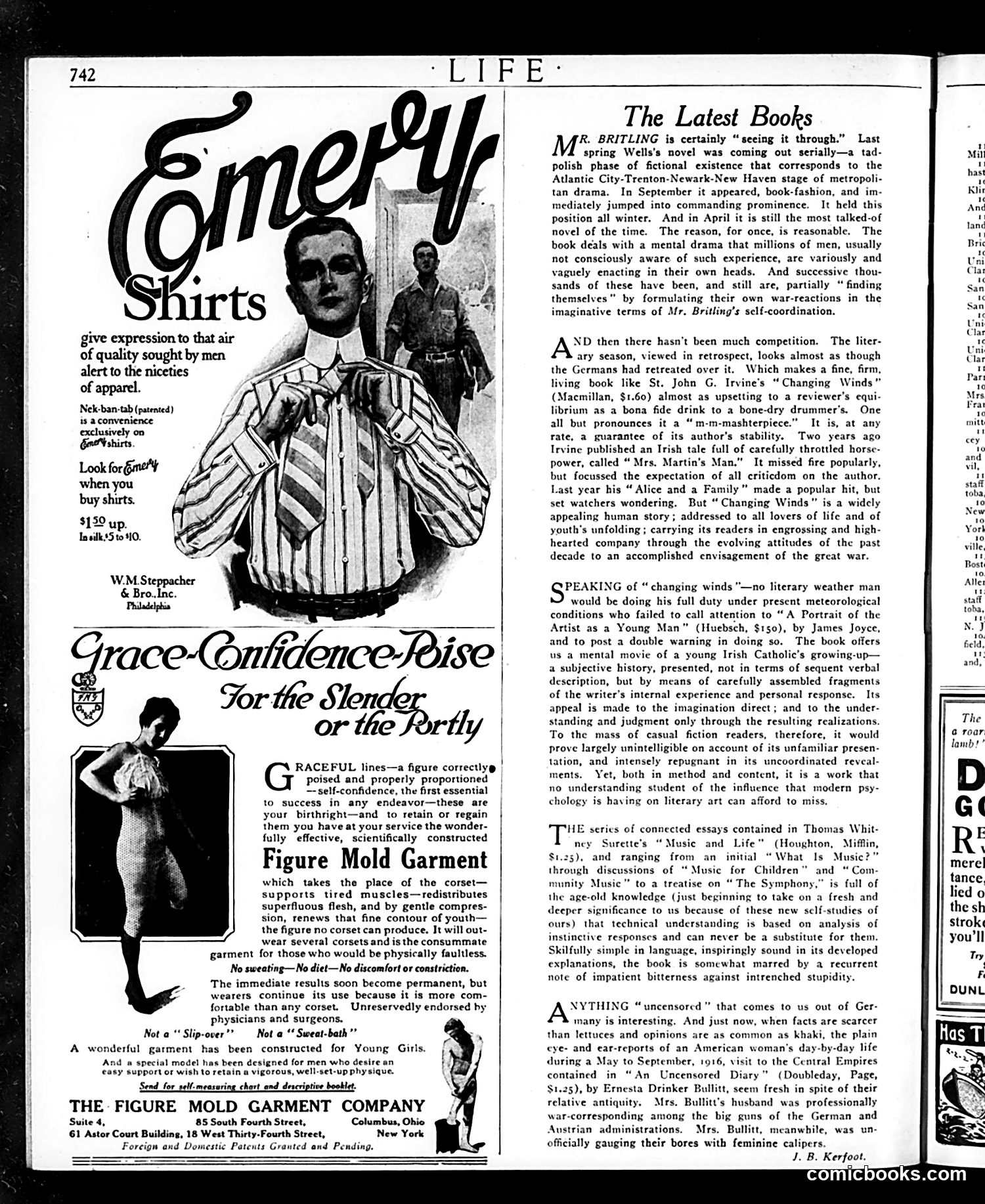
This page is primarily **advertising and book reviews**, not political satire. The main advertisements promote **corsetry and shapewear** from the era: "Emery Shirts" (top left) and "Figure Mold Garment" (center/bottom). These ads use period-typical appeals to masculine refinement and female body-shaping, positioning undergarments as solutions for maintaining "grace" and "confidence." The book reviews discuss H.G. Wells's *Mr. Britling Sees It Through* and St. John G. Irvine's *Changing Winds*—both WWI-era novels addressing the mental and emotional experience of the war. The reviewer notes Wells's novel resonated because it articulated what millions of men were unconsciously experiencing during the conflict. There is **no political cartoon here**. The page reflects early-20th-century consumer culture and wartime literary discourse, with the war's psychological impact emerging as a major literary concern.
📄 Transcribed text from this page (OCR, searchable)
Machine-transcribed from the original scan — historical spelling and the odd misread are preserved.
give expression to that air of quality sought by men alert to the niceties of apparel. Nek-ban-tab (patented) WM Steppacher & Bro. Inc. Philadelphia Grace-Cntic ference Poise. Jor the Sle: er or the tly | | Gy" poised lines—a figure correctly | poised and properly proportioned — self-confidence, the first essential to success in any endeavor—these are your birthright—and to retain or regain them you have at your service the wonder- fully “effective, scientifically constructed Figure Mold Garment which takes the place of the corset— supports tired muscles—redistributes superfluous flesh, and by gentle compres- sion, renews that fine contour of youth— the figure no corset can produce, It will out- wear several corsets and is the consummate garment for those who would be physically faultless. No sweating—No diet—No discomfort or constriction. The immediate results soon become permanent, but wearers continue its use because it is more com- fortable than any corset. Unreservedly endorsed by physicians and surgeons. Not a“ Slip-over’” Not a ‘‘ Sweat-bath”” A wonderful garment has been constructed for Young Girls. And a special model has been designed for men who desire an easy support or wish to retain a vigorous, well-set-up physique. Send for self-measaring chart and descriptive booklet. THE: FIGURE MOLD GARMENT COMPANY Suite 4, 85 South Fourth Street, Columbus, Ohio 61 Astor Court Building, 18 West Thirty-Fourth Street, New York Foreign and Domestic Patents Granted and Pending, The Latest Books ‘R. BRITLING is certainly “seeing it through.” Last spring Wells's novel was coming out serially—a tad- polish phase of fictional existence that corresponds to the Atlantic City-Trenton-Newark-New Haven stage of metropoli- tan drama. In September it appeared, book-fashion, and im- mediately jumped into commanding prominence. It held this position all winter, And in April it is still the most talked-of novel of the time. The reason, for once, is reasonable. The book deals with a mental drama that millions of men, usually not consciously aware of such experience, are variously and vaguely enacting in their own heads. And successive thou- sands of these have been, and still are, partially “ finding themselves” by formulating their own war-reactions in the imaginative terms of Mr. Britling’s sclf-coordination. ND then there hasn't been much competition. The liter- ary season, viewed in retrospect, looks almost as though the Germans had retreated over it. Which makes a fine, firm, living book like St. John G. Irvine's “Changing Winds” (Macmillan, $1.60) almost as upsetting to a reviewer's equi- librium as a bona fide drink to a bone-dry drummer's. One all but pronounces it a “m-m-mashterpiece.” It is, at any rate, a guarantee of its author's stability. Two years ago Irvine published an Irish tale full of carefully throttled horse- power, called “ Mrs. Martin’s Man,” It missed fire popularly, but focussed the expectation of all criticdom on the author. Last year his “ Alice and a Family” made a popular hit, but set watchers wondering. But “ Changing Winds” is a widely appealing human story ; addressed to all lovers of life and of youth's unfolding ; carrying its readers in engrossing and high- hearted company through the evolving attitudes of the past decade to an accomplished envisagement of the great war. PEAKING of “ changing winds "—no literary weather man would be doing his full duty under present meteorological conditions who failed to call attention to “A Portrait of the Artist as a Young Man” (Huebsch, $150), by James Joyce, and to post a double warning in doing so. The book offers us a mental movie of a young Irish Catholic’s growing-up— a subjective history, presented, not in terms of sequent verbal description, but by means of carefully assembled fragments of the writer's internal experience and personal response. Its appeal is made to the imagination direct; and to the under- standing and judgment only through the resulting realizations. To the mass of casual fiction readers, therefore, it would prove largely unintelligible on account of its unfamiliar presen- tation, and intensely repugnant in its uncoordinated reveal- ments. Yet, both in method and content, it is a work that no understanding student of the influence that modern psy- chology is having on literary art can afford to miss, HE series of connected essays contained in Thomas Whit- ney Surette’s “Music and Life” (Houghton, Mifflin, $1.25), and ranging from an initial “What Is Music?” through discussions of “ Music for Children” and “ Com- munity Music” to a treatise on “ The Symphon: is full of the age-old knowledge (just beginning to take on a fresh and deeper significance to us because of these new self-studies of ours) that technical understanding is based on analysis of instinctive responses and can never be a substitute for them. Skilfully simple in language, inspiringly sound in its developed explanations, the book is somewhat marred by a recurrent note of impatient bitterness against intrenched stupidity. YTHING “uncensored” that comes to us out of Ger- many is interesting. And just now, when facts are scarcer than lettuces and opinions are as common as khaki, the plain cye- and ear-reports of an American woman's day-b: during a May to September, 1916, visit to the Central contained in “An Uncensored Diary” (Doubleday, Page, $1.25), by Ernesta Drinker Bullitt, seem fresh in spite of their relative antiquity. Mrs. Bullitt’s husband was professionally war-corresponding among the big guns of the German and Austrian administrations. Mrs. Bullitt, meanwhile, was un- officially gauging their bores with feminine calipers. J. B. Kerfoot. The @ roar lamb!’ Ge comicbooks.com