
Life, 1917-04-26 · page 25 of 84
Life — April 26, 1917 — page 25: what you’re looking at
What you’re looking at
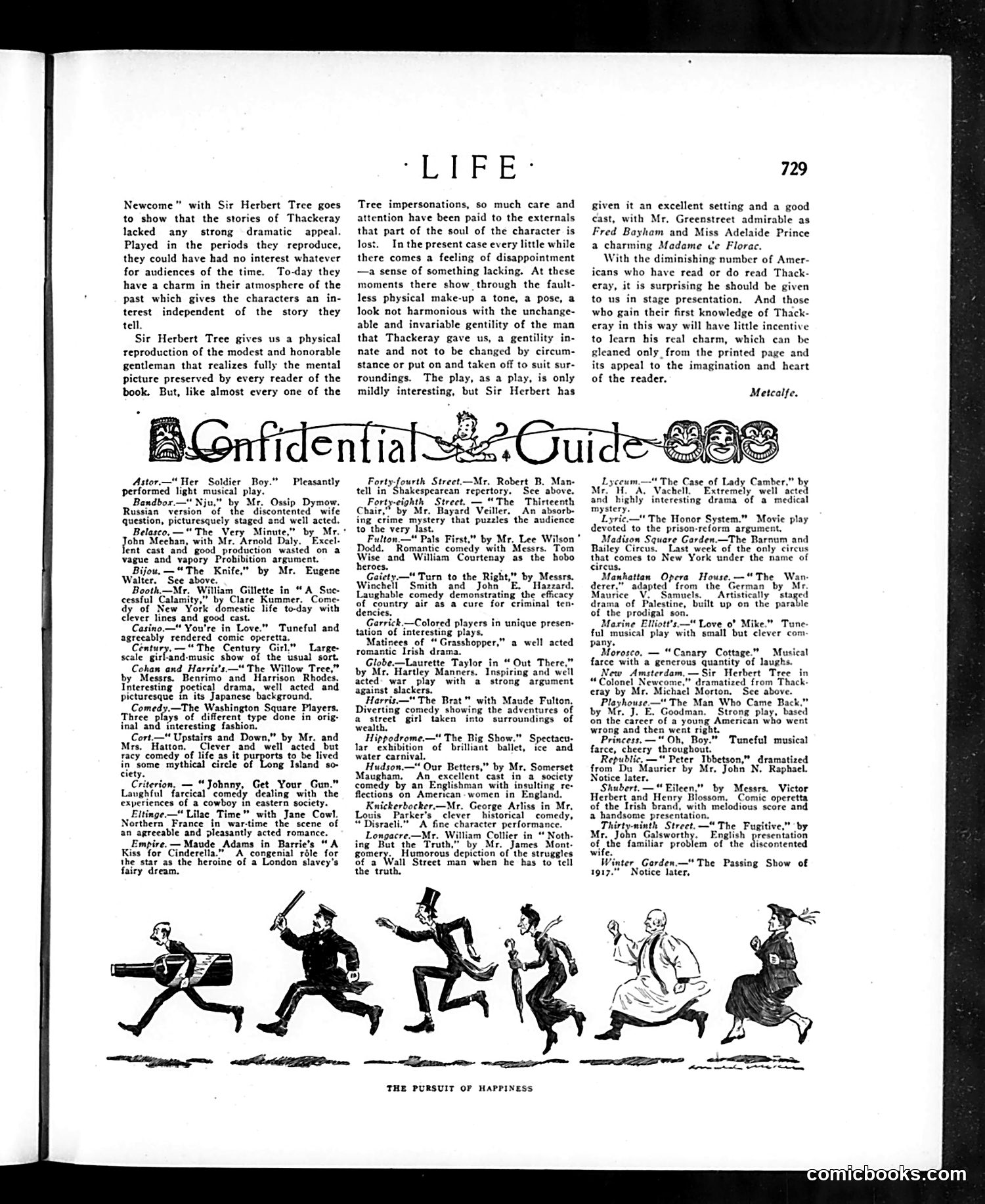
This page from *Life* magazine reviews theatrical productions. The bottom cartoon, titled "The Pursuit of Happiness," depicts six figures in sequential motion—a visual gag showing various people chasing what appears to be elusive contentment or success. The cartoon illustrates a common *Life* magazine theme: satirizing American social aspirations. Each figure (appearing to represent different social types or professions based on their dress and manner) runs frantically in pursuit of something just beyond reach. The progression suggests the futility and comedy of human ambition—everyone perpetually chasing happiness they cannot quite grasp. This reflects early-20th-century satirical commentary on American materialism and social climbing, a recurring subject in *Life*'s humor. The cartoon works as visual commentary accompanying the theater reviews above, which themselves critique contemporary productions and social pretensions depicted on stage.
📄 Transcribed text from this page (OCR, searchable)
Machine-transcribed from the original scan — historical spelling and the odd misread are preserved.
Newcome” with Sir Herbert Tree goes to show that the stories of Thackeray lacked any strong dramatic appeal. Played in the periods they reproduce, they could have had no interest whatever for audiences of the time. To-day they have a charm in their atmosphere of the past which gives the characters an in- terest independent of the story they tell, Sir Herbert Tree gives us a physical reproduction of the modest and honorable gentleman that realizes fully the mental picture preserved by every reader of the book. But, like almost every one of the Her Soldier Boy.” performed light musical play. Bandbor. by Mr. Ossip Dymow. Russian version of the discontented” wife question, picturesquely staged and well acted. Belasco. —" The Very John Meehan, with Mr. Arnold Daly. | Exce lent cast and good production wasted on a vague and vapory Prohibition argument. ijou.—“The Knife,” by Mr. Eugene Walter.” See above. Booth.—Mr. William Gillette in “ A_Suc- gesstul Calamity,” by Clare Kummer, Come. dy of New York domestic life today with clever lines and good cast. Casino.—" You're in Love.” Tuneful and agreeably rendered comic operetta. Century, —“ The Century Girl.” Large- scale girand-music show of the usual sort Cohan and Harris’s.—"“ The Willow Tree,” by Messrs. Benrimo and Harrison Rhodes. Interesting poetical drama, well acted and picturesque in its Japanese background. Comedy.—The Washington Square Players. Three plays of different type done in orig- inal and interesting fashion. Cort. Upstairs and Down,” by Mr. and Mrs, Hatton. Clever and well acted but racy comedy of life as it purports to be lived in some mythical circle of Long Island so ciety. Criterion, — “Johnny, Get Your Gun.” Laughful farcical” comedy dealing with the experiences of a cowboy in eastern society. Eltinge.—" Lilac Time” with Jane Cowl. Northern France in war-time the scene of an agreeable and pleasantly acted romance. Empire. — Maude Adams in Barrie's “A Kiss for Cinderella.” A congenial réle for the star as the heroine of a London slavey's fairy dream. Pleasantly Minute,” by Mr. + "LIFE* Tree impersonations, so much care and attention have been paid to the externals that part of the soul of the character is lost. In the present case every little while there comes a feeling of disappointment —a sense of something lacking. At these moments there show through the fault- less physical make-up a tone, a pose, a look not harmonious with the unchange- able and invariable gentility of the man that Thackeray gave us, a gentility in- nate and not to be changed by circum- stance or put on and taken off to suit sur- roundings. The play, as a play, is only mildly interesting, but Sir Herbert has fourth Street.—Mr. Robert B. Mane tell in Shakespearean repertory. Sce above. Forty-eighth Street, — “The Thirteenth Chair,” by Mr. Bayard Veiller. An absorb- ing crime mystery that puzzles the audience to the very last. Fulton.—" Pals First,” by Mr. Lee Wilson Dodd. Romantic comedy with Messrs. Tom Wise and William Courtenay as the hobo heroes. “Turn to the Right,” by Messrs. Smith and John Hazzard. Laughable comedy demonstrating the efficacy of country air as a cure for criminal ten dencies. Garrick.—Colored players in unique presen tation of interesting plays. Matinees of “Grasshopper,” a well acted romantic Irish drama. Globe-—Laurette Taylor in “ Out There,” by Mr. Hartley Manners, Inspiring and well acted: ‘war play with a strong argument against slackers. Harris.—" The Brat with Maude Fulton, Diverting comedy showing the adventures of a street girl taken into surroundings of wealth, Hippodrome.—" The Big Show.” Spectacu- exhibition of brilliant ballet, ice and water carnival. Hudson.—" Our Betters," by Mr. Somerset Maugham. An excellent’ cast in a. society comedy by an Englishman with insulting re- flections on American-women in England. Knickerbocker.—Mr. George Arliss in Mr, Louis Parker's clever historical comedy, “Disraeli.” A fine character performance. Longacre.—Mr. William Collier in “ Noth- ing But the Truth,” by Mr. James Mont- gomery.,_ Humorous depiction of the struggles of a Wall Street man when he has to tell the truth. THE PURSUIT OF HAPPINESS 729 given it an excellent setting and a good cast, with Mr. Greenstreet admirable as Fred Bayham and Miss Adelaide Prince a charming Madame ve Florac. With the diminishing number of Amer- icans who have read or do read Thack- eray, it is surprising he should be given to us in stage presentation. And those who gain their first knowledge of Thack- eray in this way will have little incentive to learn his real charm, which can be gleaned only from the printed page and its appeal to the imagination and heart of the reader. Metcalfe. The Case of Lady Camber,” by z A, Vachell. Extremely well acted and highly interesting drama of a medical Lyric.—" The Honor System.” Movie play devoted to the prison-reform argument, Madison Square Garden.—The Barnum and Bailey Circus. Last week of the only circus that comes to New York under the name of circus, Manhattan Opera House, —“ The Wan- derer.” adapted from the German by Mr. Maurice V. Samuels. Artistically staged drama of Palestine, built up on the parable of the prodigal sot Marine Eltiott Love 0? Mike.” Tune ful musical play with small but clever com: pany. Morosco. — “Canary Cottage.” Musical farce with a gencrous quantity of laughs. New Amsterdam, —Sir Herbert Tree in “ Colonel Newe dramatized from Thack- eray by Mr. Michael Morton. See above. Playhouse-—" The Man Who Came Back by Mr. J. E. Goodman, Strong play, based on the career of a young American who went wrong and then went right. Princess. —“ Oh, Boy.” farce, cheery throughout. Republic, —“ Peter Tbbetson,” dramatized from Du Maurier by Mr. John N, Raphael. Notice later. Tuneful musical een.” by Messrs. Victor ry Blossom, Comic operetta of the Irish brand, with meiodious score and a handsome presentation. Thirty-ninth Street. The Fugitive,” by Mr. John Galsworthy. English presentation of the familiar problem of the discontented ter Gorden.—" The Passing Show of Notice lat