
Life, 1917-04-26 · page 62 of 84
Life — April 26, 1917 — page 62: what you’re looking at
What you’re looking at
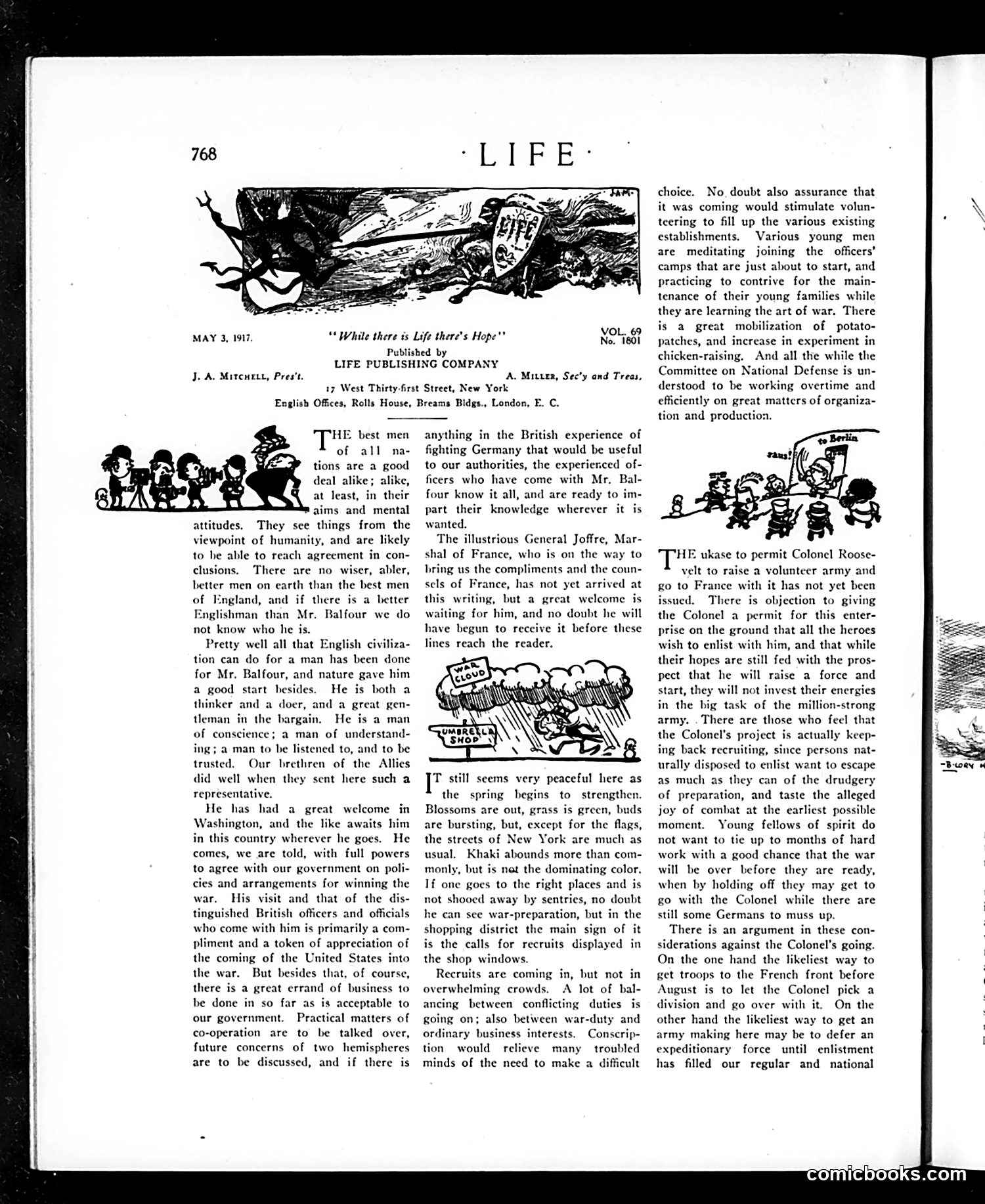
This page celebrates the arrival of British diplomat **Arthur Balfour** and other Allied officials to the United States, shortly after America's entry into World War I (April 1917). The text praises Balfour as an exemplary statesman and welcomes him as a representative of British military expertise in fighting Germany. The article notes that **General Joffre** (French Marshal) is also arriving. Both visits are framed as compliments to American entry into the war, with practical purposes: sharing Allied combat experience and coordinating war strategies. The cartoons (though small and partially obscured) appear to illustrate recruitment and war preparation themes mentioned in the text—recruiting drives in shop windows, volunteer enlistment, and civilian mobilization efforts like vegetable gardening and chicken-raising for food production. The tone is patriotic and encouraging, emphasizing that Americans, despite seeing increased military uniforms (khaki), are still adjusting to wartime conditions while gradually embracing necessary preparations.
📄 Transcribed text from this page (OCR, searchable)
Machine-transcribed from the original scan — historical spelling and the odd misread are preserved.
MAY 3, 1917. “*While there ts Life there's Hope"* VOL. 69 No. 1801 Published by LIFE PUBLISHING COMPANY J. A. Mitcnrit, Pres‘t. A. Miturr, Sec'y and Treas, 17 West Thirty-first Street, New York English Offices, Rolls House, Breams Bidgs., London, E. C. HE best men of all tions are a good deal alike; alike, at least, in their aims and mental attitudes. They see things from the wpoint of humanity, and are likely to be able to reach agreement in con- clusions, There are no wiser, abler, better men on earth than the best men of England, and if there is a better Englishman than Mr. Balfour we do not know who he is. Pretty well all that English civiliza- tion can do for a man has been done for Mr. Balfour, and nature gave him a good start hesid He is both a thinker and a doer, and a great gen- tleman in the bargain. He is a man of conscience; a man of understand- ing; a man to be listened to, and to be trusted. Our brethren of the Allies did well when they sent here such a representative. He has had a great welcome in Washington, and the like awaits him in this country wherever he goes. He comes, we are told, with full powers to agree with our government on poli- cies and arrangements for winning the war. His visit and that of the dis- tinguished British officers and officials who come with him is primarily a com- pliment and a token of appreciation of the coming of the United States into the war. But besides that, of course, there is a great errand of business to be done in so far as is acceptable to our government. Practical matters of co-operation are to be talked over, future concerns of two hemispheres are to be discussed, and if there is na- anything in the British experience of fighting Germany that would be useful to our authorities, the experienced of- ficers who have come with Mr, Bal- four know it all, and are ready to im- part their knowledge wherever it is wanted. The illustrious General Joffre, Mar- shal of France, who is on the way to bring us the compliments and the coun- sels of France, has not yet arrived at this writing, but a great welcome is waiting for him, and no doubt he will have begun to receive it before these lines reach the reader, T still seems very peaceful here as strengthen. Blossoms are out, grass is green, buds the spring begins to are bursting, but, except for the flags, the streets of New York are much as usual. Khaki abounds more than com- monly, but is net the dominating color. If one goes to the right places and is not shooed away by sentries, no doubt he can see war-preparation, but in the shopping district the main sign of it is the calls for recruits displayed in the shop windows. Reeruits are coming in, but not in overwhelming crowds. lot of bal- ancing between conflicting duties is going on; also between war-duty and ordinary business interests. Conscrip- tion would relieve many troubled minds of the need to make a difficult choice. No doubt also assurance that it was coming would stimulate volun- teering to fill up the various existing establishments. Various young men are meditating joining the officers’ camps that are just about to start, and practicing to contrive for the main- tenance of their young families while they are learning the art of war. There is a great mobilization of potato- patches, and increase in experiment in chicken-raising. And all the while the Committee on National Defense is un- derstood to be working overtime and efficiently on great matters of organiza- tion and production. HE ukase to permit Colonel Roose- velt to raise a volunteer army and go to France with it has not yet been issued. There is objection to giving the Colonel a permit for this enter- prise on the ground that all the heroes wish to enlist with him, and that while their hopes are still fed with the pros- pect that he will raise a force and start, they will not invest their energies. in the big task of the million-strong army. . There are those who feel that the Colonel's project is actually keep- ing back recruiting, since persons nat- urally disposed to enlist want to escape as much as they can of the drudgery of preparation, and taste the alleged joy of combat at the earliest possible moment. Young fellows of spirit do not want to tie up to months of hard work with a good chance that the war will be over before they are ready, when by holding off they may get to go with the Colonel while there are still some Germans to muss up. There is an argument in these con- siderations against the Colonel’s going. On the one hand the likeliest way to get troops to the French front before August is to let the Colonel pick a division and go over with it. On the other hand the likeliest way to get an army making here may be to defer an expeditionary force until enlistment has filled our regular and national