
Life, 1917-04-26 · page 63 of 84
Life — April 26, 1917 — page 63: what you’re looking at
What you’re looking at
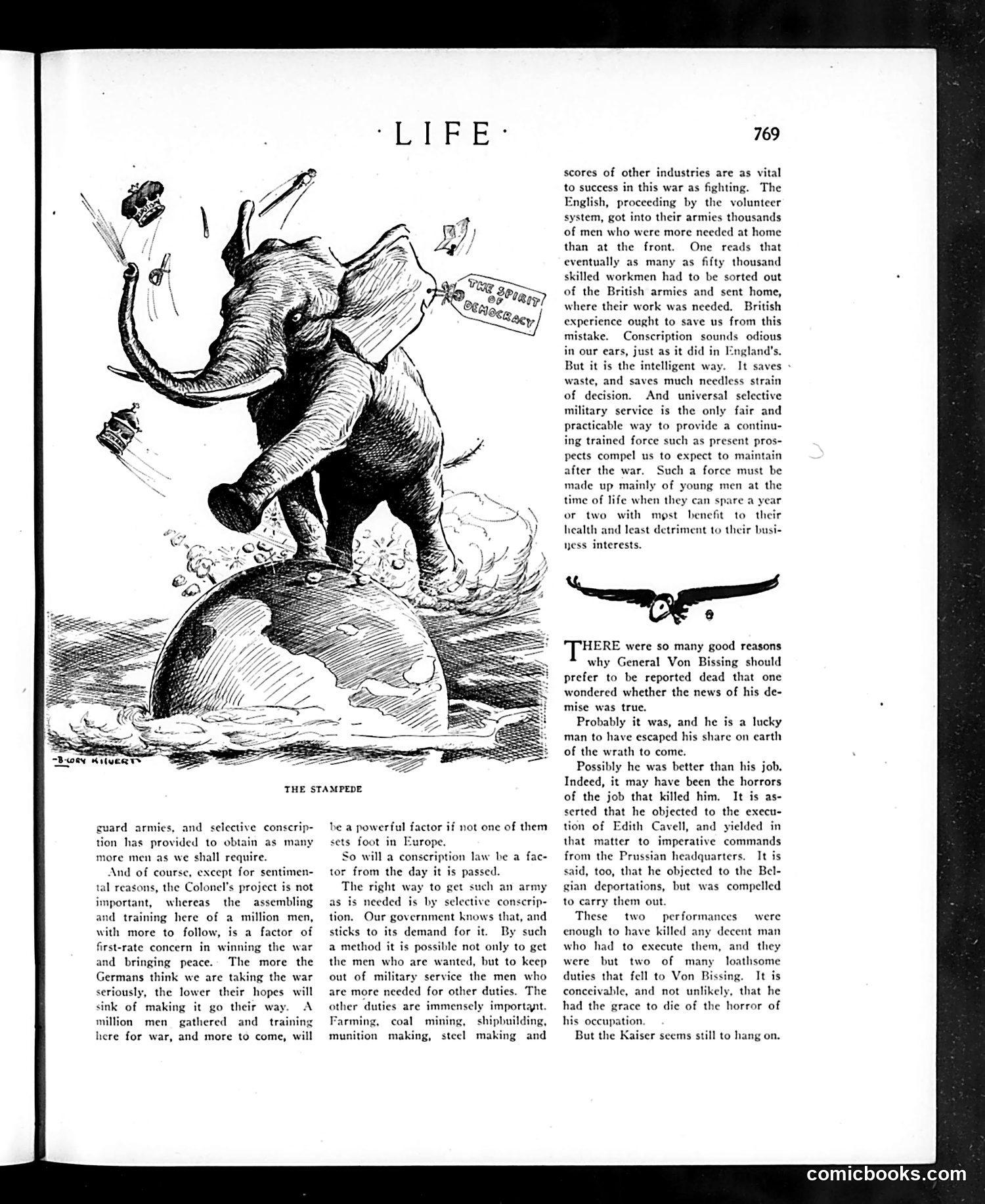
**The Cartoon ("The Stampede"):** An elephant balances precariously on a globe while juggling various military papers and supplies. The elephant likely represents the United States, depicted as unstable or struggling to manage wartime demands. **Main Editorial Arguments:** The text advocates for **selective military conscription** rather than voluntary enlistment. The writer argues this system keeps essential workers (farmers, coal miners, munitions makers) in civilian industries while building a trained military force. Britain's volunteer system is criticized for removing 50,000 skilled workmen from factories—a cautionary lesson. **Von Bissing Reference:** General Friedrich von Bissing was the German governor-general of occupied Belgium during World War I. The text reports his death and notes he allegedly objected to executing British nurse Edith Cavell and forced Belgian deportations, yet obeyed Prussian orders anyway. The piece suggests these moral horrors may have killed him. **Context:** This page reflects American WWI-era debates about military organization and conscription policy, published while the U.S. was weighing how to mobilize for war.
📄 Transcribed text from this page (OCR, searchable)
Machine-transcribed from the original scan — historical spelling and the odd misread are preserved.
THE STAMPEDE guard armies, and selective conscrip- tion has provided to obtain as many more men as we shall require. And of course, except for sentimen- tal reasons, the Colonel's project is not important, whereas the assembling and training here of a million men, with more to follow, is a factor of first-rate concern in winning the war and bringing peace. The more the Germans think we are taking the war seriously, the lower their hopes will sink of making it go their w: A million men gathered and _ trainin; here for war, and more to come, will be a powerful factor if not one of them sets foot in Europe, So will a conscription law be a fac- tor from the day it is passed. The right way to get such an army is needed is by selective conscrip- tion. Our government knows that, and sticks to its demand for it. By such a method it is possible not only to get the men who are wanted, but to keep out of military service the men who are more needed for other duties. The other duties are immensely important. Farming, coal mining, shipbuilding, munition making, steel making and 769 scores of other industries are as vital to success in this war as fighting. The English, proceeding by the volunteer system, got into their armies thousands of men who were more needed at home than at the front. One reads that eventually as many as fifty thousand skilled workmen had to be sorted out of the British armies and sent home, where their work was needed. British experience ought to save us from this mistake. Conscription sounds odious in our ears, just as it did in England's. But it is the intelligent way. waste, and saves much needless strain of decision. And universal selective military service is the only fair and practicable way to provide a continu- ing trained force such as present pros pects compel us to expect to maintain after the war. Such a force must be made up mainly of young men at the time of life when they can spare a year or two with most benefit. to their health and least detriment to their busi- yess interests. & 'HERE were so many good reasons why General Von Bissing should prefer to be reported dead that one wondered whether the news of his de- mise was true. Probably it was, and he is a lucky man to have escaped his share on earth of the wrath to come. Possibly he was better than his job. Indeed, it may have been the horrors of the job that killed him. It is as- serted that he objected to the execu- tion of Edith Cavell, and yielded in that matter to imperative commands from the Prussian headquarters. It is said, too, that he objected to the Bel- gian deportations, but was compelled to carry them out. These two performances were enough to have killed any decent man who had to execute them, and they were but two of many loathsome duties that fell to Von Bissing. It is conceivable, and not unlikely, that he had the grace to die of the horror of his occupation. But the Kaiser seems still to hang on. It saves + comicbooks.com