
Life, 1917-04-26 · page 21 of 84
Life — April 26, 1917 — page 21: what you’re looking at
What you’re looking at
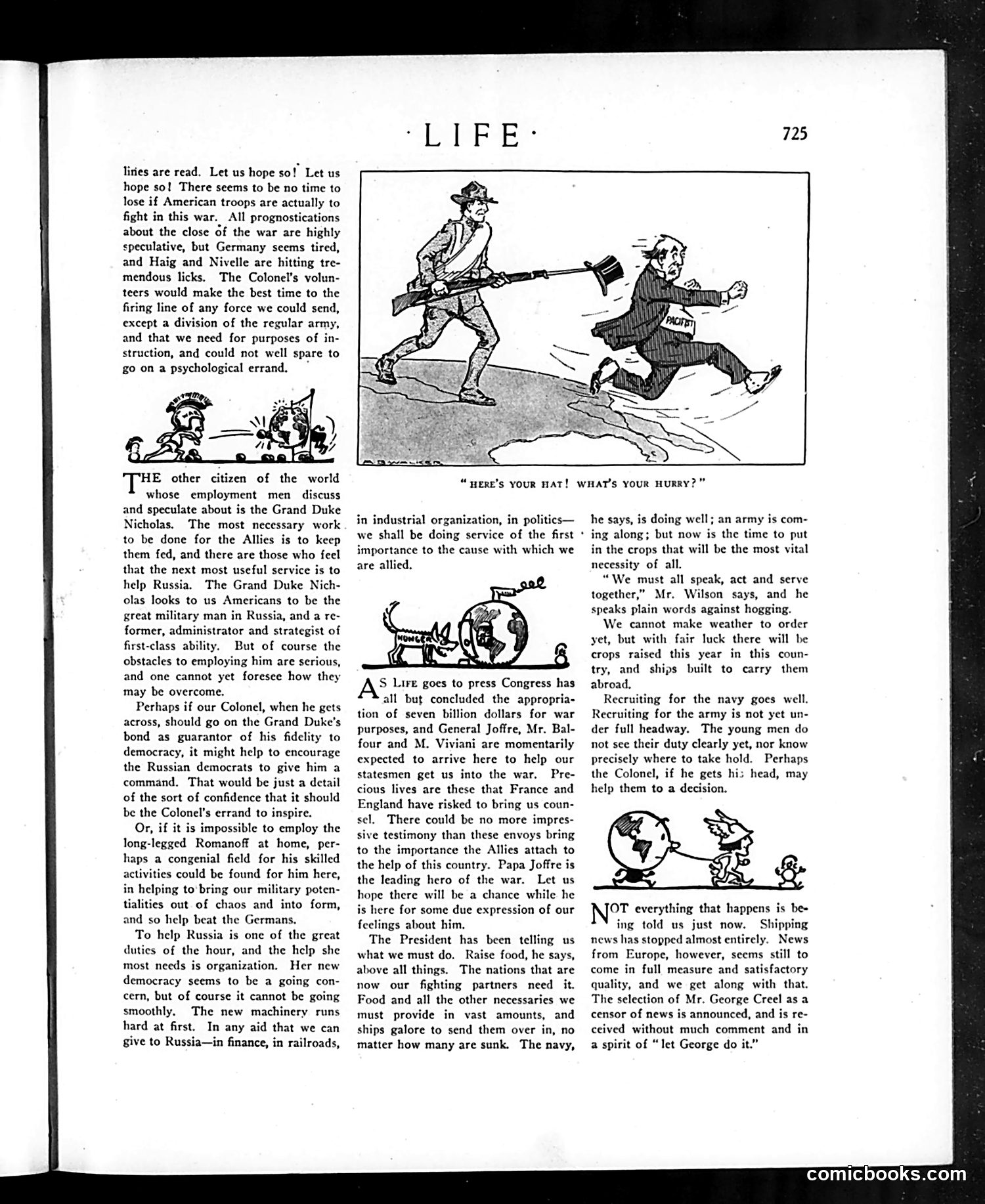
This WWI-era satirical piece critiques American military preparedness and Allied support efforts. The main cartoon shows a caricatured German ("KULTUR" on his jacket) being chased away by an American soldier with a bayonet-equipped rifle, captioned "HERE'S YOUR HAT! WHAT'S YOUR HURRY?" — mocking Germany's apparent military exhaustion. The accompanying text discusses deploying American troops and utilizing Russian Grand Duke Nicholas in the war effort. The satire targets slow U.S. military mobilization, suggesting that while Allied generals like Haig and Nivelle are "hitting tremendous licks," American volunteers could reach the front faster than regular army divisions. The piece also emphasizes urgent needs: organizing post-revolutionary Russia, feeding Allied nations, and building ships for supply lines. References to President Wilson's directives on crop production and cooperation underscore America's crucial material role rather than immediate combat contribution. The overall tone is impatient—pushing Americans to accelerate their practical and military support for the Allies.
📄 Transcribed text from this page (OCR, searchable)
Machine-transcribed from the original scan — historical spelling and the odd misread are preserved.
lities are read. Let us hope so! Let us hope so! There seems to be no time to lose if American troops are actually to fight in this war. All prognostications about the close of the war are highly speculative, but Germany seems tired, and Haig and Nivelle are hitting tre- mendous licks. The Colonel’s volun- teers would make the best time to the firing line of any force we could send, except a division of the regular army, and that we need for purposes of in- struction, and could not well spare to go on a psychological errand. ~ 'HE other citizen of the world whose employment men discuss and speculate about is the Grand Duke Nicholas. The most necessary work to be done for the Allies is to keep them fed, and there are those who feel that the next most useful service is to help Russia. The Grand Duke Nich- olas looks to us Americans to be the great military man in Russia, and a re- former, administrator and strategist of first-class ability. But of course the obstacles to employing him are serious, and one cannot yet foresee how they may be overcome. Perhaps if our Colonel, when he gets across, should go on the Grand Duke's bond as guarantor of his fidelity to democracy, it might help to encourage the Russian democrats to give him a command, That would be just a detail of the sort of confidence that it should be the Colonel’s errand to inspire. Or, if it is impossible to employ the long-legged Romanoff at home, per- haps a congenial field for his skilled activities could be found for him here, in helping to’ bring our military poten- tialities out of chaos and into form, and so help beat the Germans. To help Russia is one of the great duties of the hour, and the help she most needs is organization. Her new democracy seems to be a going con- cern, but of course it cannot be going smoothly, The new machinery runs hard at first. In any aid that we can give to Russia—in finance, in railroads, “were’s YOUR HAT! WHAT’s YOUR HURRY?” in industrial organization, in politics— we shall be doing service of the first * importance to the cause with which we are allied, S Lire goes to press Congress has all but concluded the appropria- tion of seven billion dollars for war purposes, and General Joffre, Mr. Bal- four and M. Viviani are momentarily expected to arrive here to help our statesmen get us into the war. Pre- cious lives are these that France and England have risked to bring us coun- scl. There could be no more impres- sive testimony than these envoys bring to the importance the Allies attach to the help of this country. Papa Joffre is the leading hero of the war. Let us hope there will be a chance while he is here for some due expression of our feelings about him. The President has been telling us what we must do. Raise food, he says, above all things. The nations that are now our fighting partners need it. Food and all the other necessaries we must provide in vast amounts, and ships galore to send them over in, no matter how many are sunk. The navy, he says, is doing well; an army is com- ing along; but now is the time to put in the crops that will be the most vital necessity of all. “We must all speak, act and serve together,” Mr. Wilson says, and he speaks plain words against hogging. We cannot make weather to order yet, but with fair luck there will be crops raised this year in this coun- try, and ships built to carry them abroad. Recruiting for the navy goes well. Recruiting for the army is not yet un- der full headway. The young men do not see their duty clearly yet, nor know precisely where to take hold. Perhaps the Colonel, if he gets his head, may help them to a decision. OT everything that happens is be- ing told us just now. Shipping news has stopped almost entirely. News from Europe, however, seems still to come in full measure and satisfactory quality, and we get along with that. The selection of Mr. George Creel as a censor of news is announced, and is re- ceived without much comment and in a spirit of “let George do it.” comicbooks.com