
Life, 1917-04-26 · page 28 of 84
Life — April 26, 1917 — page 28: what you’re looking at
What you’re looking at
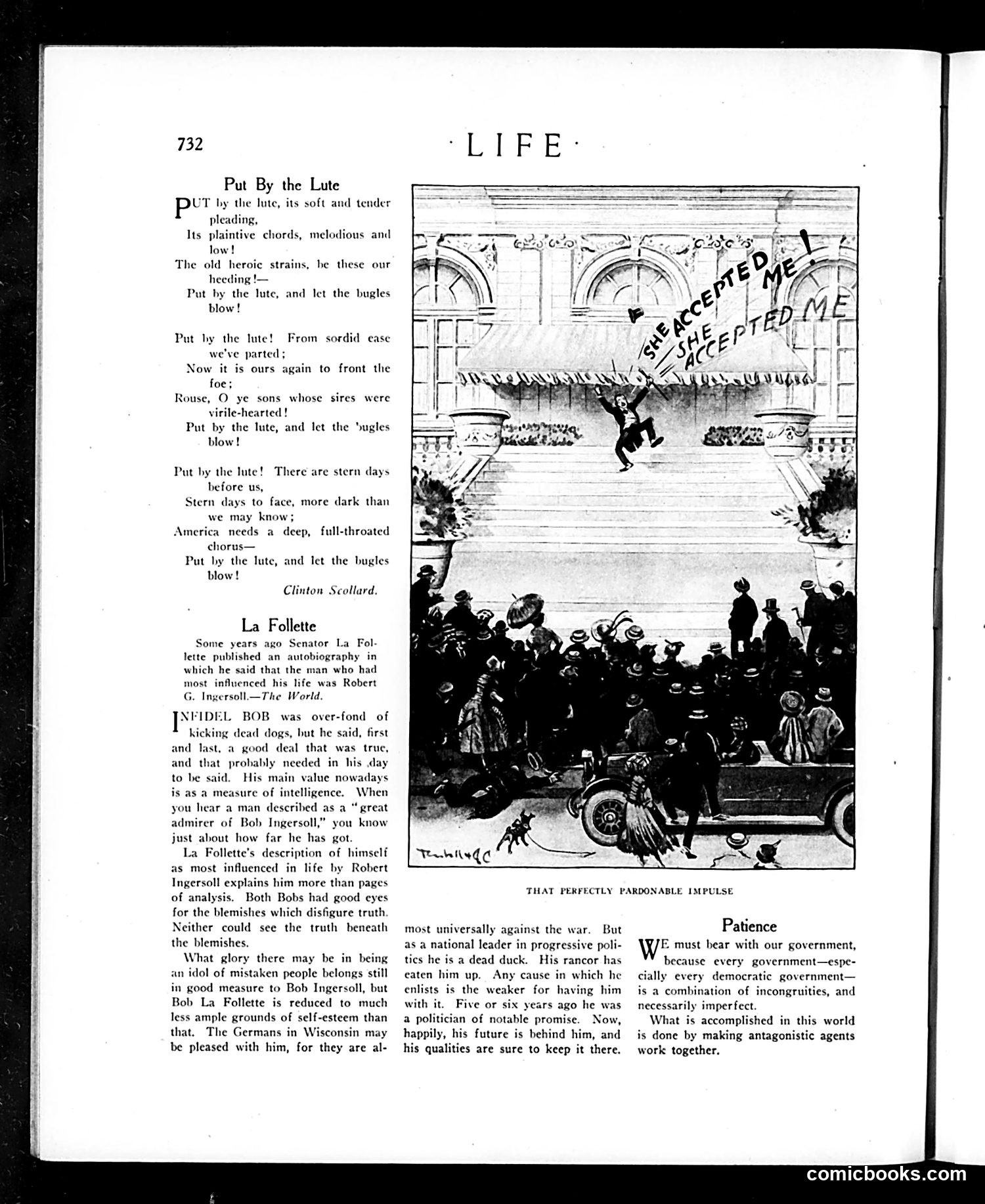
This page contains two distinct pieces of political commentary from what appears to be World War I era America. **"Put By the Lute"** is a patriotic poem by Clinton Scollard urging Americans to abandon peaceful pursuits and embrace military action ("let the bugles blow"). It uses martial rhetoric to rally support for war. **"La Follette"** is a scathing editorial attacking Senator Robert La Follette, a Wisconsin Progressive politician who opposed U.S. entry into World War I. The piece compares him unfavorably to Robert Ingersoll (a 19th-century agnostic intellectual) and dismisses him as a "dead duck" politically. The editorial suggests La Follette's anti-war stance—popular among German-Americans in Wisconsin—disqualifies him from national leadership. **The cartoon** depicts what appears to be a public event (possibly a political rally or speech) where someone is being rejected or falling, with text reading "SHE ACCEPTED ME / SHE ACCEPTED ME"—likely satirizing La Follette's failed political ambitions. The page essentially mocks anti-war sentiment as unpatriotic during the war period.
📄 Transcribed text from this page (OCR, searchable)
Machine-transcribed from the original scan — historical spelling and the odd misread are preserved.
732 Put By the Lute UT by the lute, its soft and tender pleading, Its plaintive chords, melo low! The old heroic strains, he these our heeding !. Put by the lute, and let the bugles blow! ious and the lute! From sordid case ve parted Now it is ours again to front the foe; O ye sons whose sires were virile-hearted ! Put by the lute, and let the ug! blow! Put by Rouse, Put by the lute!) There are stern days before us, Stern days to face, more dark than we may know; needs a deep, full-throated chorus— Put by the lute, and let the bugles blow! Ame Clinton Scollard. La Follette Some years ago Senator La Fol- lette published an autobiography in which he said that the man who had most influenced his life was Robert G. Ingersoll.—The World. | ‘IDEL BOB over-fond of kicking dead dogs, but he said, first and last, a good deal that was truce, and that probably needed in his day to be said. His main value nowadays measure of intelligence. When a “great you know was is as you hear a man described admirer of Bob Ingersoll, just about how far he has got. La Follette’s description of himself as most influenced in life by Robert Ingersoll explains him more than pages of analysis. Both Bobs had good eyes for the blemishes which disfigure truth. Neither could see the truth beneath the blemishes, What glory there may be in being an idol of mistaken people belongs still in good measure to Bob Ingersoll, but Bob La Follette is reduced to much less ample grounds of self-esteem than that. The Germans in Wisconsin may be pleased with him, for they are al- THAT PERFECTLY PARDONABLE IMPULSE most universally inst the war. But as a national leader in progressive poli- tics he is a dead duck. His rancor has eaten him up. Any cause in which he enlists is the weaker for having him with it. Five or six years ago he was a politician of notable promise. Now, happily, his future is behind him, and his qualities are sure to keep it there. Patience E must bear with our government, because every government—espe- cially every democratic government— is a combination of incongruities, and necessarily imperfect. What is accomplished in this world is done by making antagonistic agents work together, comicbooks.com