
Life, 1917-04-26 · page 20 of 84
Life — April 26, 1917 — page 20: what you’re looking at
What you’re looking at
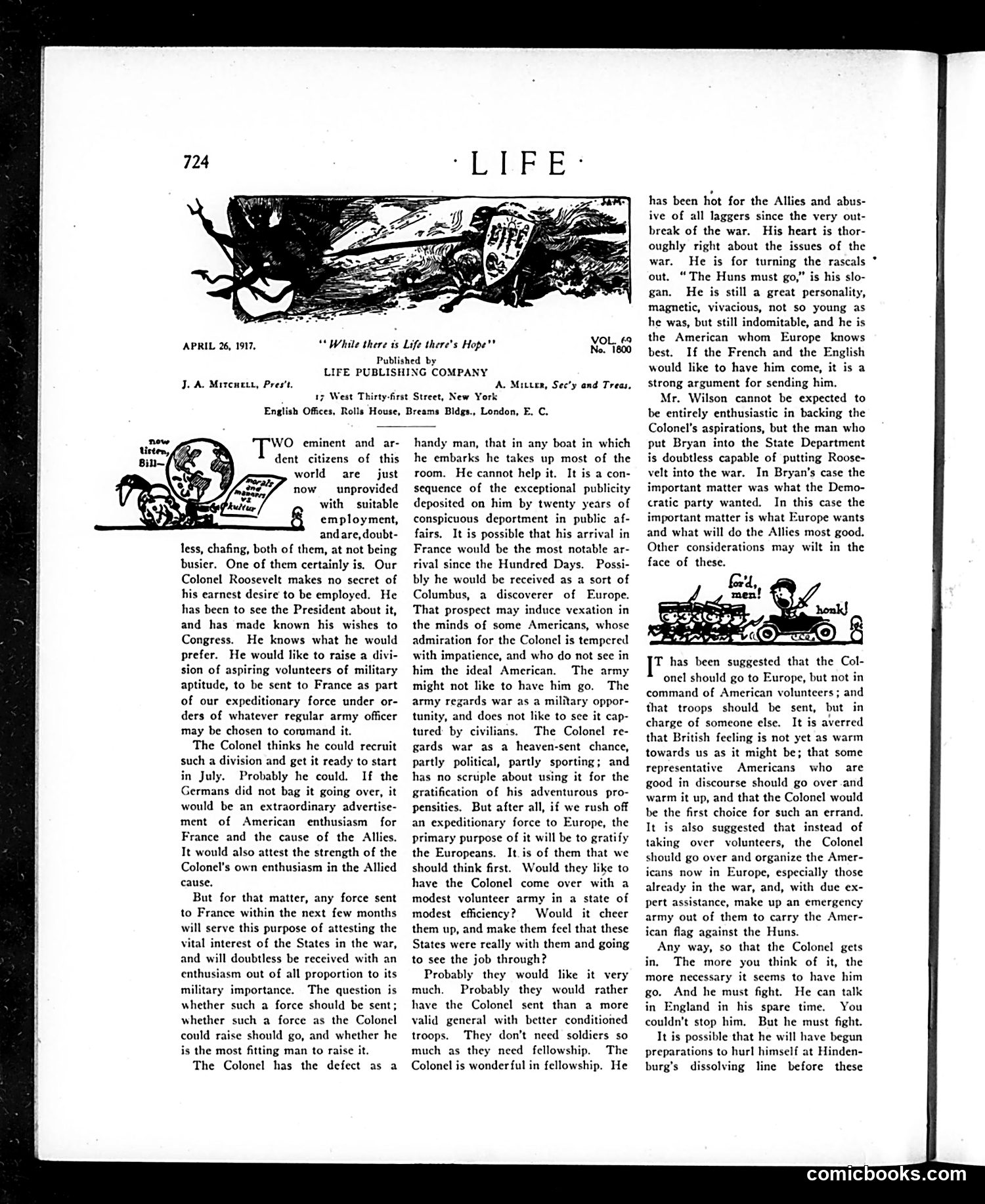
This *Life* editorial discusses **Colonel Theodore Roosevelt's** desire to lead a volunteer military division to France during World War I (America had recently entered the war). The piece debates whether Roosevelt should be sent to Europe. It acknowledges his genuine Allied enthusiasm and "wonderful" fellowship but notes his tendency to dominate any situation—he "takes up most of the room" due to his outsized public persona. The editorial suggests Europeans might value his moral support and energy more than military efficiency, yet questions whether he's the "most fitting man to raise" such a force. The cartoon header (artist: J.A. Mitchell) depicts a war-damaged landscape, illustrating the stakes of the debate. Ultimately, the text presents Roosevelt as an earnest but potentially problematic choice—his celebrity could overshadow military objectives, though his personal magnetism and unshakeable commitment to defeating "the Huns" held undeniable value.
📄 Transcribed text from this page (OCR, searchable)
Machine-transcribed from the original scan — historical spelling and the odd misread are preserved.
APRIL 26, 1917, ‘* While there is Life there's Hope"" Published by LIFE PUBLISHING COMPANY J. A. Mirenetn, Pres’t. A. Miter, Sec’y and Treas, 17 West Thirty-first Street, New York English Offices, Rolls House, Bre: 'WO eminent and ar- dent citizens of this world are just now —-unprovided with suitable employment, andare,doubt- less, chafing, both of them, at not being busier. One of them certainly is, Our Colonel Roosevelt makes no secret of his earnest desire to be employed. He has been to see the President about it, and has made known his wishes to Congress. He knows what he would prefer. He would like to raise a divi- sion of aspiring volunteers of military aptitude, to be sent to France as part of our expeditionary force under or- ders of whatever regular army officer may be chosen to command it. The Colonel thinks he could recruit such a division and get it ready to start in July. Probably he could. If the Germans did not bag it going over, it would be an extraordinary advertise- ment of American enthusiasm for France and the cause of the Allies. It would also attest the strength of the Colonel’s own enthusiasm in the Allied cause, But for that matter, any force sent to France within the next few months will serve this purpose of attesting the vital interest of the States in the war, and will doubtless be received with an enthusiasm out of all proportion to its military importance. The question is whether such a force should be sent; whether such a force as the Colonel could raise should go, and whether he is the most fitting man to raise it. The Colonel has the defect as a s Bldgs., London, E. C. handy man, that in any boat in which he embarks he takes up most of the room. He cannot help it. It is a con- sequence of the exceptional publicity deposited on him by twenty years of conspicuous deportment in public af- fairs. It is possible that his arrival in France would be the most notable ar- rival since the Hundred Days. Possi- bly he would be received as a sort of Columbus, a discoverer of Europe. That prospect may induce vexation in the minds of some Americans, whose admiration for the Colonel is tempered with impatience, and who do not see in him the ideal American. The army might not like to have him go. The army regards war as a milRary oppor- tunity, and does not like to see it cap- tured by civilians, The Colonel re- gards war as a heaven-sent chance, partly political, partly sporting; and has no scruple about using it for the gratification of his adventurous pro- pensities. But after all, if we rush off an expeditionary force to Europe, the primary purpose of it will be to gratify the Europeans. It.is of them that we should think first. Would they like to have the Colonel come over with a modest volunteer army in a state of modest efficiency? Would it cheer them up, and make them feel that these States were really with them and going to see the job through? Probably they would like it very much. Probably they would rather have the Colonel sent than a more valid general with better conditioned troops. They don’t need soldiers so much as they need fellowship. The Colonel is wonderful in fellowship. He has been hot for the Allies and abus- ive of all laggers since the very out- break of the war. His heart is thor- oughly right about the issues of the war. He is for turning the rascals out. “The Huns must go,” is his slo- gan. He is still a great personality, magnetic, vivacious, not so young as he was, but still indomitable, and he is the American whom Europe knows best. If the French and the English would like to have him come, it is a strong argument for sending him, Mr. Wilson cannot be expected to be entirely enthusiastic in backing the Colonel's aspirations, but the man who put Bryan into the State Department is doubtless capable of putting Roose- velt into the war. In Bryan's case the important matter was what the Demo- cratic party wanted. In this case the important matter is what Europe wants and what will do the Allies most good. Other considerations may wilt in the face of these. T has been suggested that the Col- onel should go to Europe, but not in command of American volunteers; and that troops should be sent, but in charge of someone else. It is averred that British feeling is not yet as warm towards us as it might be; that some representative Americans who are good in discourse should go over and warm it up, and that the Colonel would be the first choice for such an errand. It is also suggested that instead of taking over volunteers, the Colonel should go over and organize the Amer- icans now in Europe, especially those already in the war, and, with due ex- pert assistance, make up an emergency army out of them to carry the Amer- ican flag against the Huns. Any way, so that the Colonel gets in, The more you think of it, the more necessary it seems to have him go. And he must fight. He can talk in England in his spare time. You couldn't stop him. But he must fight. It is possible that he will have begun preparations to hurl himself at Hinden- burg’s dissolving line before these comicbooks.com