
Life, 1917-04-26 · page 50 of 84
Life — April 26, 1917 — page 50: what you’re looking at
What you’re looking at
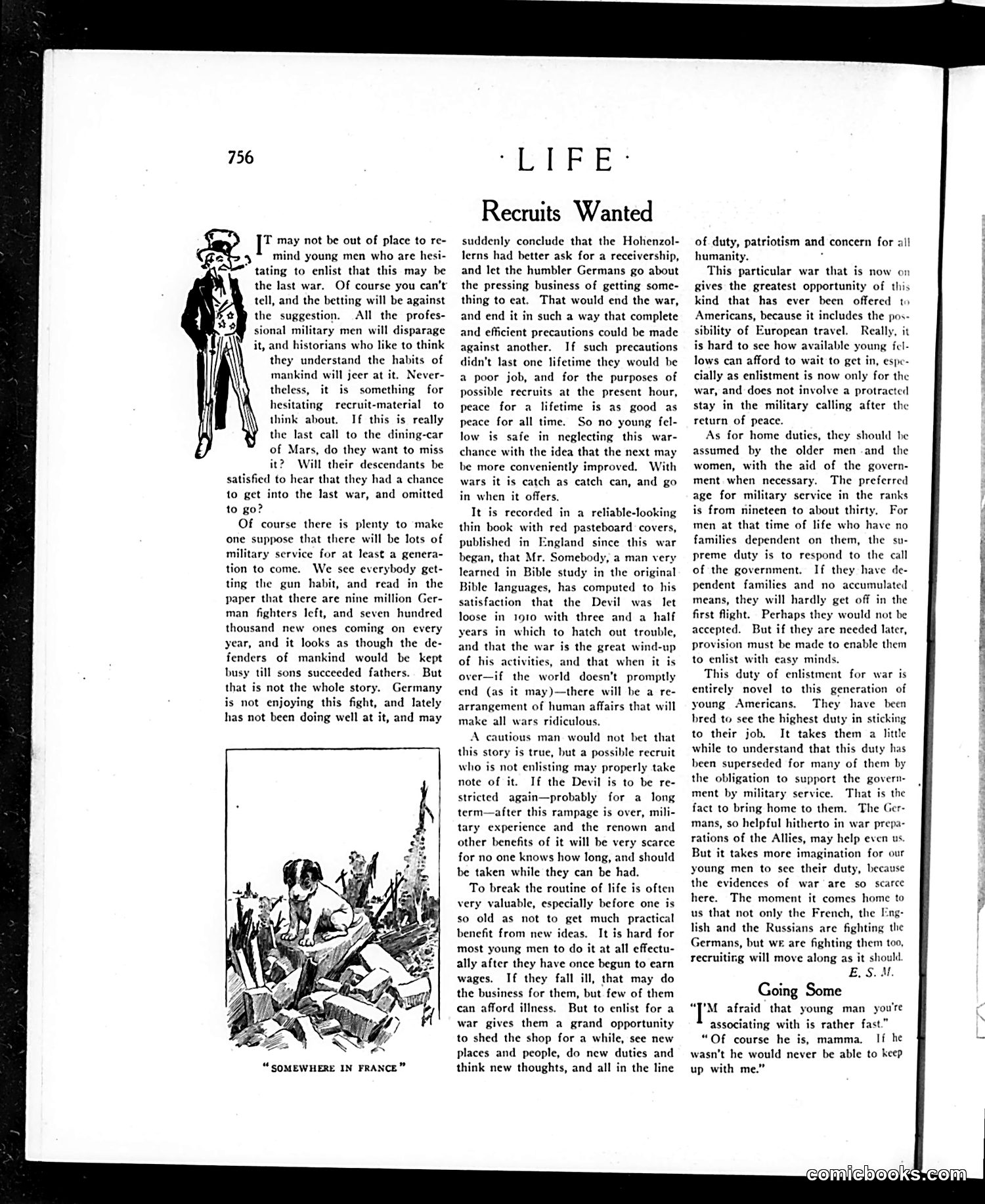
This WWI-era recruitment article uses satire to encourage young American men to enlist. The main argument is provocative: this may be "the last war," so hesitant recruits shouldn't miss this opportunity. The two illustrations depict soldiers—one appears to be Uncle Sam (identifiable by his distinctive hat and patriotic clothing), and another labeled "SOMEWHERE IN FRANCE" shows combat conditions. The satire works by inverting typical recruitment logic: rather than promising glory or necessity, the author argues enlisting offers practical benefits—escape from routine work, travel to Europe, and "new thoughts"—while framing it as possibly the final war mankind will fight (citing a religious text predicting the Devil's binding). The piece acknowledges skepticism from "professional military men" and "historians," adding credibility through candor. The underlying message: seize this unique historical moment for personal growth while serving patriotism. Modern readers should note this represents American pro-intervention sentiment before official U.S. entry into WWI.
📄 Transcribed text from this page (OCR, searchable)
Machine-transcribed from the original scan — historical spelling and the odd misread are preserved.
'T may not be out of place to re- mind young men who are hesi- tating to enlist that this may be the last war. Of course you can’t tell, and the betting will be against the suggestion. All the profes- sional military men will disparage it, and historians who like to think they understand the habits of mankind will jeer at it. Never- theless, it is something for hesitating recruit-material to think about. If this is really the last call to the dining-car of Mars, do they want to miss it? Will their descendants be satisfied to hear that they had a chance to get into the last war, and omitted to go? Of course there is plenty to make one suppose that there will be lots of military service for at least a genera- tion to come. We sce everybody get- ¥ ting the gun habit, and read in the paper that there are nine million Ger- man fighters left, and seven hundred thousand new ones coming on every year, and it looks as though the de- fenders of mankind would be kept busy till sons succeeded fathers. But that is not the whole story. Germany is not enjoying this fight, and lately has not been doing well at it, and may “ SOMEWHERE IN FRANCE” “LIFE: Recruits Wanted suddenly conclude that the Hohenzol- lerns had better ask for a receivership, and let the humbler Germans go about the pressing business of getting some- thing to eat. That would end the war, and end it in such a way that complete and efficient precautions could be made against another. If such precautions didn’t last one lifetime they would be a poor job, and for the purposes of possible recruits at the present hour, peace for a lifetime is as good as peace for all time. So no young fel- low is safe in neglecting this war- chance with the idea that the next may be more conveniently improved. With wars it is catch as catch can, and go in when it offers, It is recorded in a reliable-looking thin book with red pasteboard covers, published in England since this war began, that Mr. Somebody, a man very learned in Bible study in the original Bible languages, has computed to his satisfaction that the Devil was let loose in 1910 with three and a half years in which to hatch out trouble, and that the war is the great wind-up tivities, and that when it is f the world doesn't promptly end (as it may)—there will be a re- arrangement of human affairs that will make all wars ridiculous, A cautious man would not bet that this story is true, but a possible recruit who is not enlisting may properly take note of it. If the Devil is to be re- stricted again—probably for a long term—after this rampage is over, mili- tary experience and the renown and other benefits of it will be very scarce for no one knows how long, and should be taken while they can be had. To break the routine of life is often very valuable, especially before one is so old as not to get much practical benefit from new ideas. It is hard for most young men to do it at all effectu- ally after they have once begun to earn wages. If they fall ill, that may do the business for them, but few of them can afford illness. But to enlist for a war gives them a grand opportunity to shed the shop for a while, see new places and people, do new duties and think new thoughts, and all in the line of duty, patriotism and concern for all humanity. . This particular war that is now on gives the greatest opportunity of this kind that has ever been offered to Americans, because it includes the pos- sibility of European travel. Really, it is hard to see how available young fel- lows can afford to wait to get in, espe- cially as enlistment is now only for the war, and does not involve a protracted stay in the military calling after the return of peace. As for home duties, they should be assumed by the older men and the women, with the aid of the govern- ment when necessary. The preferred age for military service in the ranks is from nineteen to about thirty, For men at that time of life who have no families dependent on them, the su- preme duty is to respond to the call of the government. If they have de- pendent families and no accumulated means, they will hardly get off in the first flight. Perhaps they would not be accepted. But if they are needed later, provision must be made to enable them to enlist with easy minds. This duty of enlistment for war is entirely novel to this generation of young Americans. They have been bred to see the highest duty in sticking to their job. It takes them a little while to understand that this duty has been superseded for many of them by the obligation to support the govern- ment by military service. That is the fact to bring home to them. The Ger- mans, so helpful hitherto in war prepa- rations of the Allies, may help even us. But it takes more imagination for our young men to see their duty, because the evidences of war are so scarce here. The moment it comes home to us that not only the French, the Eng- lish and the Russians are fighting the Germans, but we are fighting them too, recruiting will move along as it should. ES. M. Going Some ‘M afraid that young man you're associating with is rather fast.” “Of course he is, mamma. Ii he wasn’t he would never be able to keep up with me.”