
Life, 1917-04-26 · page 67 of 84
Life — April 26, 1917 — page 67: what you’re looking at
What you’re looking at
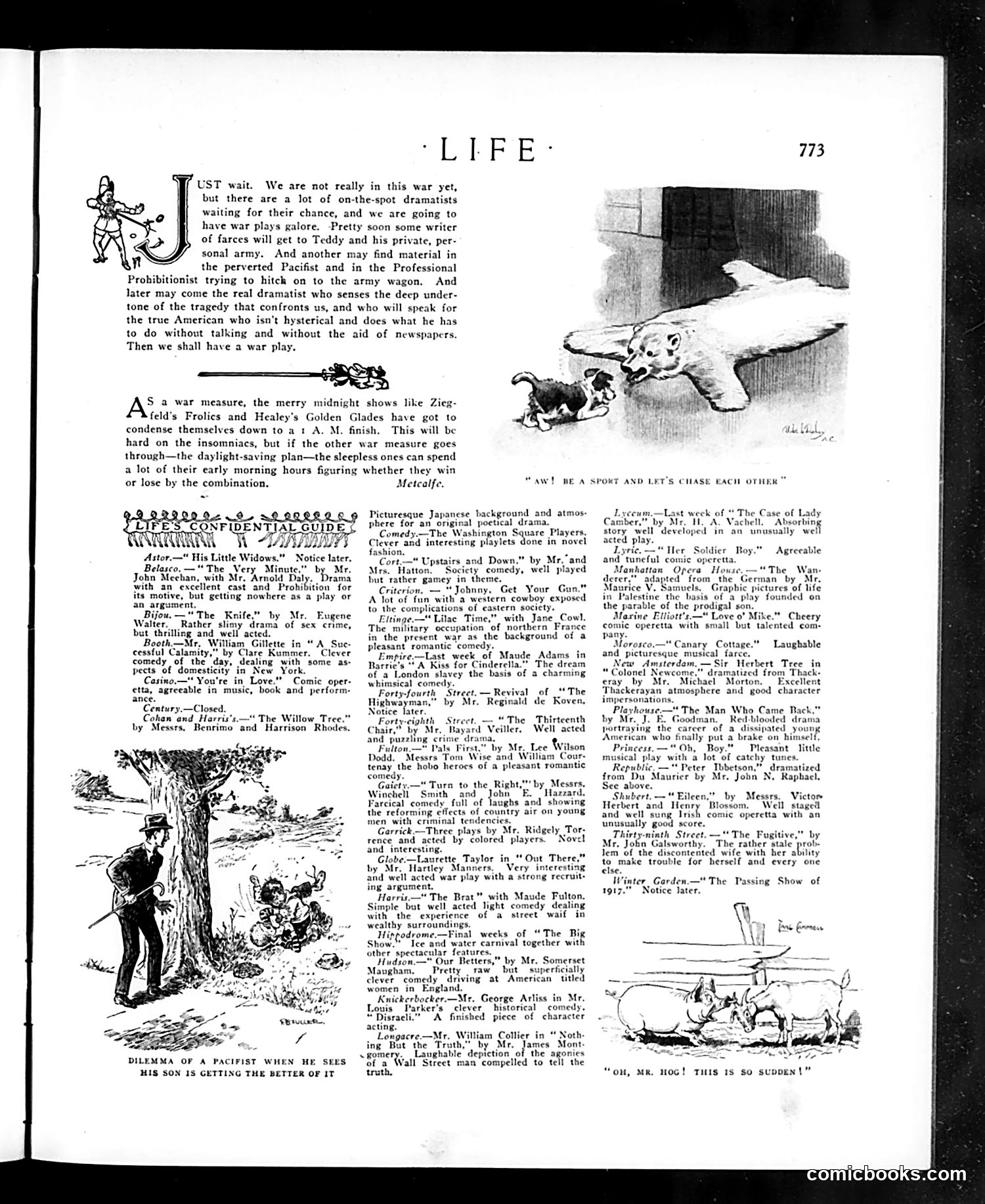
This page from Life magazine (published during WWI era) contains satirical commentary on American theater and war preparedness. **Main Editorial Piece:** The opening column satirizes anticipated war plays, mocking both frivolous dramatists eager to capitalize on military themes ("Teddy and his private, personal army") and specific social groups like Prohibitionists and Pacifists trying to exploit war sentiment. The author argues true drama will eventually emerge from genuine tragedy. **The Cartoons:** Two illustrations depict wartime absurdities: - Upper right: A large dog and small dog in mock combat, captioned "Aw! Be a sport and let's chase each other"—satirizing trivial entertainment during serious times - Lower left: A pacifist observing his son fighting, captioned about a "dilemma"—mocking pacifists' moral contradictions when their own children go to war **The "Confidential Guide":** A theater listing section reviews current Broadway productions, many with war-related themes ("Lilac Time," "Out There"), reflecting how quickly American theater responded to war as subject matter. The page's overall message: America's entertainers and public are exploiting serious wartime issues for profit and amusement rather than genuine artistic or moral engagement.
📄 Transcribed text from this page (OCR, searchable)
Machine-transcribed from the original scan — historical spelling and the odd misread are preserved.
UST wait. “LIFE: We are not really in this war yet, but there are a lot of on-the-spot dramatists ° waiting for their chance, and we are going to have war plays galore. ° > sonal army. Pretty soon some writer of farces will get to Teddy and his private, per- And another may find material in vt the perverted Pacifist and in the Professional Probibitionist trying to hitch on to the army wagon. And later may come the real dramatist who senses the deep under- tone of the tragedy that confronts us, and who will speak for the true American who isn't hysterical and to do without talking and without the aid of newspa Then we shall have a war play, does what he has pers. ———3es, S a war measure, the merry midnight shows like Zieg- feld’s Frolics and Healey’s Golden Glades have got to condense themselves down to hard on the insomniacs, 1 A. M. finish, but if the other war measure goes This will be through—the daylight-saving plan—the sleepless ones can spend a lot of their early morning hours figuring or lose by the combination. rw So SLLOLE QE G ES c¢ INFIDENTIAL GUIDE: ’ WARARAR OW AALS Aitor.—" His Little Widows.” Notice later. Belasco, —“ The Very Minute.” by Mr. John Mechan, with Mr, Arnold Daly. Drama with an excellent. cast and. Prohibition for its motive, but getting nowhere as a play or an_argument ‘Bijou. —""The Knife.” by Mr. Eugene Walter. Rather slimy drama of sex crime, but thrilling and well acted. Booth—Mer, William, Gillette in “A. Sue- cessful Calamity,” by Clare Kummer. Clever comedy of the day, dealing with some as- pects of domesticity in New York. Casino.—** You're in Love.” Comic oper- etta, agreeable in music, book and perform. ane. Century.—Closed. Cohan and Harris's.—* The Willow Tree.” by Messrs, Benrimo and Harrison Rhodes. DILEMMA OF A PACIFIST WHEN HE SEES MIS SON 18 GETTING THE BETTER OF IT whether they win Metcalfe. aw! Picturesque Japanese background and atmos- phere for an original poetical drama. Comeds.—The Washington Square Players: Clever and interesting playlets done in novel fashion. 6 Cort.—" Upstairs and Down.” by Mr. Mrs. Hatton. Society comedy, well but rather gamey in theme. Crite! Johnny, Get Your Gun.” A lot of fun with’a western cowboy exposed to the co Eltinge—" Lilac Time,” with Jane Cowl, The military occupation ‘of northern France in the present war as the background of a pleasant romantic comedy. " Empire-—Last week of Maude Adams in Rarrie's “\A Kiss for Cinderella.” The dream of a London slavey the basis of a charming whimsical comedy. ‘ Forty-fourth Street. — Revival of |‘ The Highwaym * by Mr, Reginald de Koven, ater Notice Forty-eighth Street. — “ The rd Veiller. Chair,” by Mr. Ra ‘drat y Mr. Lee Wilson and puzzling cri Fulto Pals First, Dodd. Messrs Tom Wise and William Cour- tenay the hobo heroes of a pleasant romantic comedy. aie »— Winchell Smith and John Farcical comedy. full of laughs a the reforming effects of country air on young men with criminal tendencies. Garrick.—Three plays by Mr. Ridgely, Tor- rence and acted by colored players. Novel and interesting. Globe.—Laurette Taylor in‘ Out There,” by Mr. Hartley Manners. Very interesting and well acted war play with a strong recruit- ing argument, Horris.—" The Brat" with Maude Fulton, Simple but well acted light comedy dealing with the experience of a street waif in wealthy surroundings. . Hirpodrome.—Final weeks of “The Big Show. Ice and water carnival together with other spectacular features. Hudson.—" Our Betters,” by Mr. Somerset Maugham, Pretty raw’ but superficially lever comedy driving at American titled women in England. Knickerbocker—Mr. George Arliss in Mr. Louis Parker's clever historical comedy, “Disraeli.” A finished piece of character acting. Longacre.—Mr. William Collier in“ Noth- ing But the Trath,” by Mr. James Mont. sgomery, Laughable’ depiction of the agonies of a Wall Street man compelled to tell the truth, Thirteenth Well acted Turn to the Right,’ by, Messrs BE A SPORT AND LET'S CHASE BACH OTHER” Last week of “T a by Mr. II. A. Vachell, story well developed in an unu: acted play. Lyric, —" Her Soldier Boy.” and tuneful comic operetta Manhattan Opera House, —“ The derer,” adapted from the German by Maurice V. Samuels. Graphic pictures of life in Palestine the basis of a play founded on the parable of the prodigal son. Marine Elliott's.—" Love 0’ Mike.” Chery comic operetta with small but talented com: pany. Laughable Agreeable Wan: Mr. anary Cottage.” and picturesque musical farce. New Amsterdam. —Sir Herbert Tree in “ Colonel Newcome,” dramatized from Thack- gray by Mr, Michael Morton. Excellent Thackerayan atmosphere and good character impersonations. Playhouse—" The Man Who Came Rack,” by Mr. J. E. Goodman, Red-blooded drania portraying the career of a dissipated young American who finally put a brake on himself, Princess. —" Oh, Boy.” Pleasant little musical play with a lot of catchy tunes. Republic. —" Peter Thbetson,” dramatized from Du Maurier by Mr. John N, Raphael, See above. Shubert. — Herbert and Henry and well sung Irish unusually good score. Thirty-ninth Street.“ The Fugitive,” by Mr. sworthy. The rather stale pro lem of the discontented wife with her ability to make trouble for herself and every one els Eileen,” by Messrs. Victow Blossom. Well staged comic operetta with an ter Garden.—" The Notice later. Passing Show of i) Th Bx Gene \ “on, MR. HOG! THIS IS So SUDDEN!”