
Life, 1917-04-26 · page 66 of 84
Life — April 26, 1917 — page 66: what you’re looking at
What you’re looking at
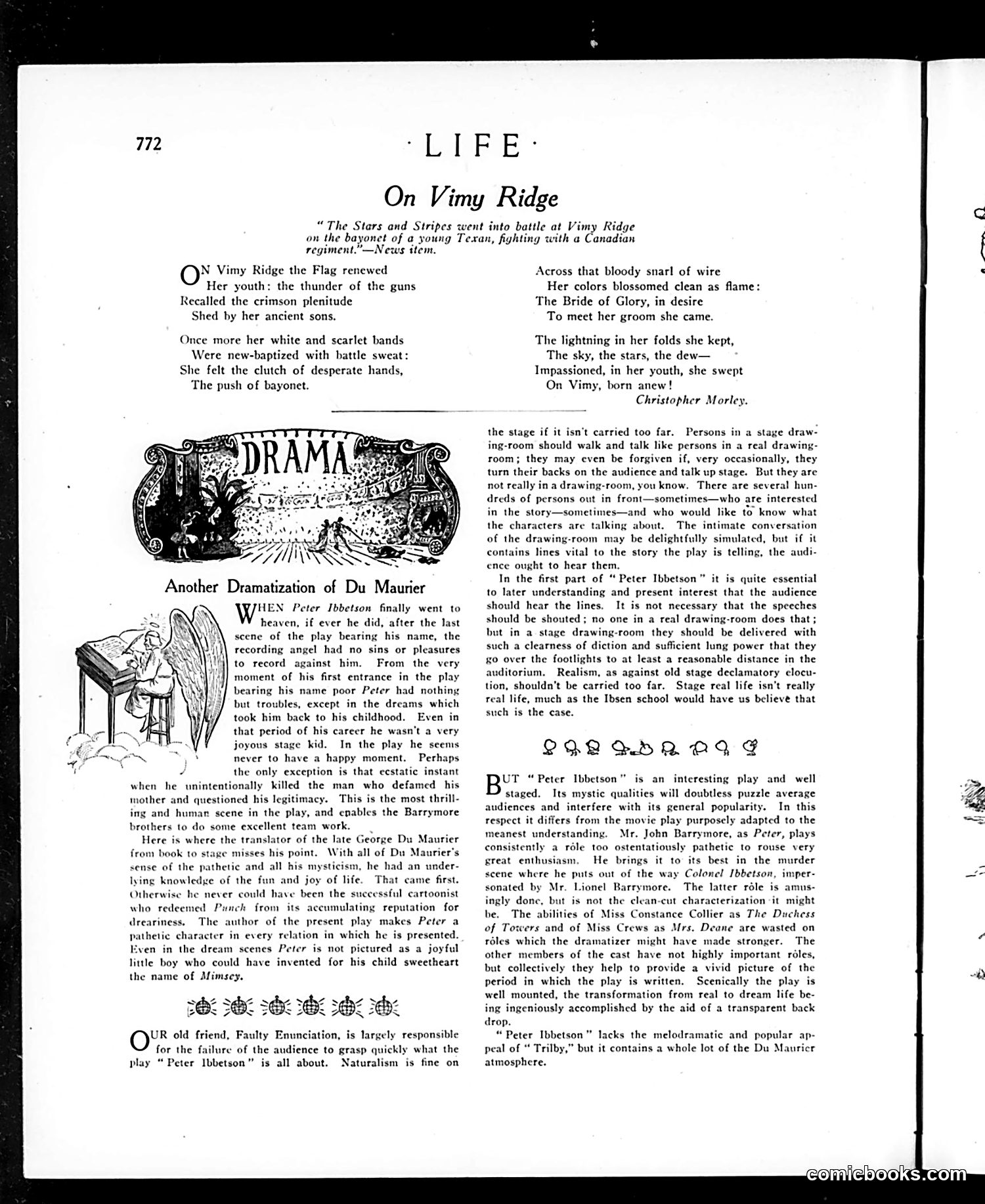
This page contains two distinct pieces. The top section is a patriotic poem titled "On Vimy Ridge" by Christopher Morley, celebrating American forces fighting alongside Canadians in World War I at the Battle of Vimy Ridge (1917). The poem uses romantic imagery—the American flag as a "Bride of Glory"—to commemorate soldiers' sacrifice. The longer section critiques a theatrical adaptation of George Du Maurier's novel *Peter Ibbetson*. The reviewer argues the dramatization misses Du Maurier's essential spirit. Du Maurier was known as a *Punch* cartoonist who balanced pathos with humor and "joy of life," but the play presents only unrelenting melancholy. The critic also faults actors for unclear diction—speaking naturally (realistic) but inaudibly to the audience. The point: stage realism shouldn't sacrifice intelligibility to the hundreds watching from the auditorium.
📄 Transcribed text from this page (OCR, searchable)
Machine-transcribed from the original scan — historical spelling and the odd misread are preserved.
RE * On Vimy Ridge “The Stars and Stripes went into battle at Vimy Ridge on the bayonet of a young Texan, fighting with a Canadian regiment.” —News item. Vimy Ridge the Flag renewed Her youth: the thunder of the guns Recalled the crimson plenitude Shed by her ancient sons. Once more her white and scarlet bands Were new-baptized with battle sweat: She felt the clutch of desperate hands, The push of bayonet. Another Dramatization of Du Maurier HEN Peter Ibbetson finally went to heaven, if ever he did, after the last scene of the play bearing his name, the recording angel had no sins or pleasures to record against him. From the very moment of his first entrance in the play bearing his name poor Peter had nothing but troubles, except in the dreams which took him back to his childhood. Even in that period of his career he wasn't a very joyous stage kid. In the play he seems never to have a happy moment. Perhaps the only exception is that ecstatic instant when he unintentionally killed the man who defamed his mother and questioned his legitimacy. This is the most thrill- ing and human scene in the play, and enables the Barrymore brothers to do some excellent team work. Here is where the translator of the late George Du Maurier from book to stage misses his point. With all of Du Maurier’s sense of the pathetic and all his mysticism, he had an under- lying knowledge of the fun and joy of life. That came first. Otherwise he never could have been the successful cartoonist who redeemed Punch from its accumulating reputation for dreariness. The author of the present play makes Peter a pathetic character in every relation in which he is presented. Even in the dream scenes Peter is not pictured as a joyful little boy who could have invented for his child sweetheart the name of Mimsey. phe sahz spike tahoe see se OS SE 3K BE SS Shs UR old friend, Faulty Enunciation, lary responsible for the failure of the audience to grasp quickly what the play “ Peter Ibbetson” is all about. Naturalism is fine on Across that bloody snarl of wire Her colors blossomed clean as flame: The Bride of Glory, in desire To meet her groom she came. The lightning in her folds she kept, The sky, the stars, the dew— Impassioned, in her youth, she swept On Vimy, born anew! Christopher Morley. the stage if it isn’t carried too far. Persons in a stage draw- ing-room should walk and talk like persons in a real drawing- room; they may even be forgiven if, very occasionally, they turn their backs on the audience and talk up stage. But they are not really in a drawing-room, you know. There are several hun- dreds of persons out in front—sometimes—who are interested in the story—sometimes—and who would like to know what the characters are talking about, The intimate conversation of the drawing-room may be delightfully simulated, but if it contains lines vital to the story the play is telling, the audi- ence ought to hear them, In the first part of “ Peter Ibbetson” it is quite essential to later understanding and present interest that the audience should hear the lines. It is not necessary that the speeches should be shouted; no one in a real drawing-room does that; but in a stage drawing-room they should be delivered with such a clearness of diction and sufficient lung power that they go over the footlights to at least a reasonable distance in the auditorium. Realism, as against old stage declamatory clocu- tion, shouldn't be carried too far. Stage real life isn't really real life, much as the Ibsen school would have us believe that such is the case. OBk@@bR a9 ¢g UT “Peter Ibbetson” is an interesting play and well staged. Its mystic qualities will doubtless puzzle average audiences and interfere with its general popularity. In this respect it differs from the movie play purposely adapted to the meanest understanding. Mr. John Barrymore, as Peter, plays consistently a réle too ostentatiously pathetic to rouse very great enthusiasm, He brings it to its best in the murder scene where he puts out of the way Colonel Ibbetson, imper- sonated by Mr. Lionel Barrymore. The latter réle is amus- ingly donc, but is not the clean-cut characterization it might be, The abilities of Miss Constance Collier as The Duchess of Towers and of Miss Crews as Mrs. Deane are wasted on réles which the dramatizer might have made stronger. The other members of the cast have not highly important roles, but collectively they help to provide a vivid picture of the period in which the play is written. Scenically the play is well mounted, the transformation from real to dream life be- ing ingeniously accomplished by the aid of a transparent back drop. “Peter Ibbetson” lacks the melodramatic and popular ap- peal of “ Trilby,” but it contains a whole lot of the Du Maurice atmosphere.