
Life, 1917-04-26 · page 27 of 84
Life — April 26, 1917 — page 27: what you’re looking at
What you’re looking at
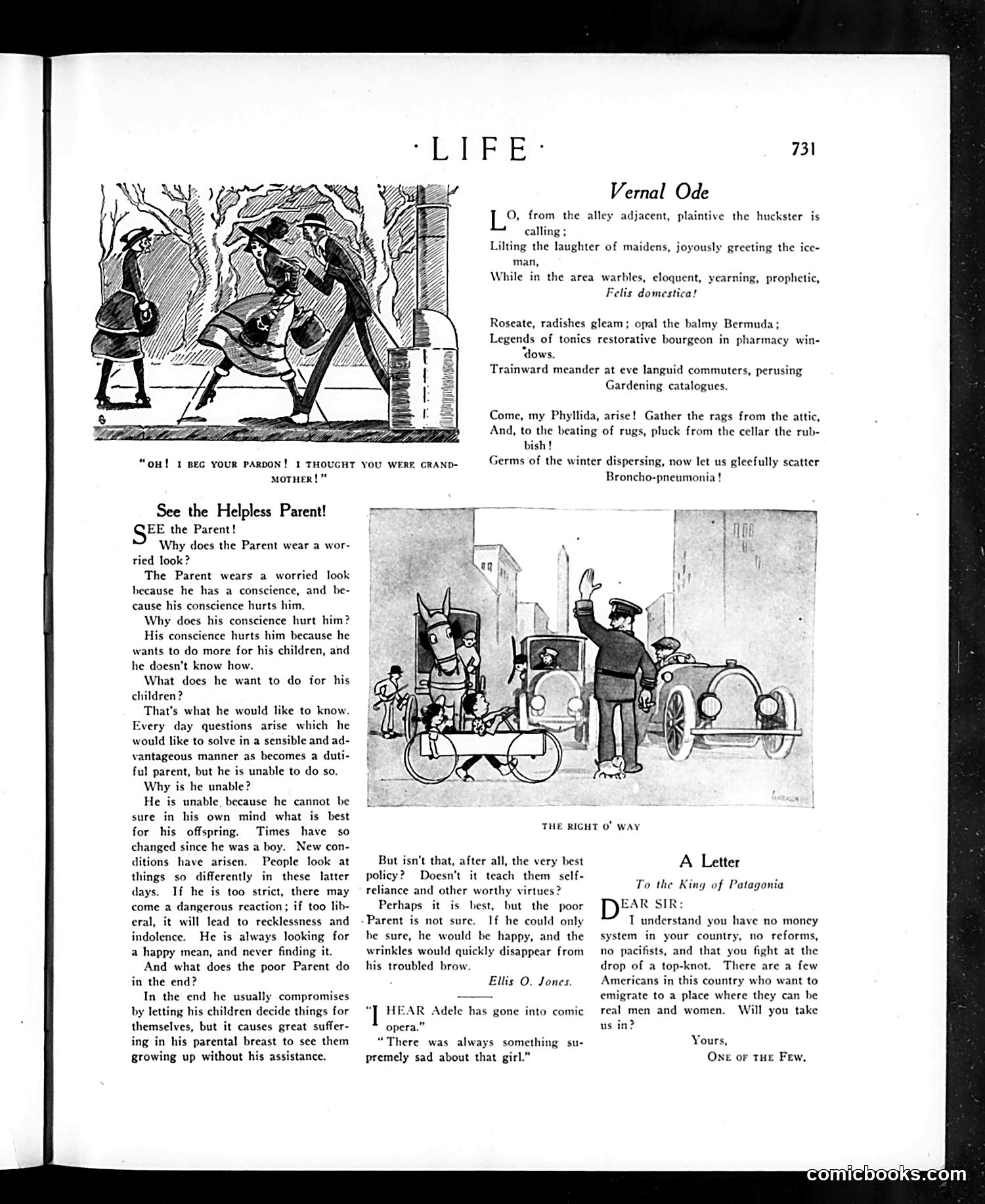
**"The Helpless Parent"** satirizes modern parenting anxiety. The cartoon depicts a father's worried expression, with accompanying text explaining his dilemma: he wants to help his children but is paralyzed by uncertainty about proper discipline. Times have changed since his youth—he fears being too strict (causing "dangerous reaction") or too lenient (leading to "recklessness"). His solution: let children decide for themselves, which ironically undermines his parental authority. The satire targets early 20th-century middle-class confusion about evolving child-rearing practices and generational gaps. **"The Right O' Way"** appears to mock urban congestion and transportation chaos, though details are unclear. **"Vernal Ode"** is mock-heroic poetry celebrating spring's arrival while darkly joking about spreading "broncho-pneumonia"—spring cleaning's dust dispersal. **"A Letter to the King of Patagonia"** satirizes Americans nostalgic for a pre-modern society with no bureaucracy, pacifism, or reform movements—suggesting escapism from progressive American culture.
📄 Transcribed text from this page (OCR, searchable)
Machine-transcribed from the original scan — historical spelling and the odd misread are preserved.
“oH! 1 BEG YOUR PARDON! I THOUGHT YOU WERE GRAND- MOTHER!” See the Helpless Parent! EE the Parent! Why does the Parent wear a wor- ried look? The Parent wears a worried look hecause he has a conscience, and be- cause his conscience hurts him. Why does his conscience hurt him? His conscience hurts him because he wants to do more for his children, and he doesn’t know how. What does he want to do for his children? That's what he would like to know. Every day questions arise which he would like to solve in a sensible and ad- vantageous manner as becomes a duti- ful parent, but he is unable to do so. Why is he unable? He is unable, because he cannot be sure in his own mind what is best for his offspring. Times have so changed since he was a boy. New con- ditions have arisen. People look at things so differently in these latter days. If he is too strict, there may come a dangerous reaction; if too lib- eral, it will lead to recklessness and indolence. He is always looking for a happy mean, and never finding it. And what does the poor Parent do in the end? In the end he usually compromises by letting his children decide things for themselves, but it causes great suffer- ing in his parental breast to see them growing up without his assistance. -Parent is not sure. 731 Vernal Ode O, from the alley adjacent, plaintive the huckster is calling ; Lilting the laughter of maidens, joyously greeting the ice- man, While in the area warbles, eloquent, yearning, prophetic, Felis domestica! Roseate, radishes gleam; opal the balmy Bermuda; Legends of tonics restorative bourgeon in pharmacy win- ‘dows, Trainward meander at eve languid commuters, perusing Gardening catalogues. Come, my Phyllida, arise! Gather the rags from the attic, And, to the beating of rugs, pluck from the cellar the rub- bish! Germs of the winter dispersing, now let us gleefully scatter Broncho-pneumonia! THE RIGHT 0" WAY But isn't that, after all, the very best policy? Does it teach them self- reliance and other worthy virtues? Perhaps it is best, but the poor If he could only be sure, he would be happy, and the wrinkles would quickly disappear from his troubled brow. Ellis O. Jones. ‘| HEAR Adele has gone into comic opera.” “There was always something su- premely sad about that girl.” A Letter To the King of Patagonia EAR SIR: T understand you have no money system in your country, no reforms, no pacifists, and that you fight at the drop of a top-knot. There are a few Americans in this country who want to emigrate to a place where they can be real men and women. Will you take us in? Yours, One or THE Few,