
Life, 1917-04-26 · page 12 of 84
Life — April 26, 1917 — page 12: what you’re looking at
What you’re looking at
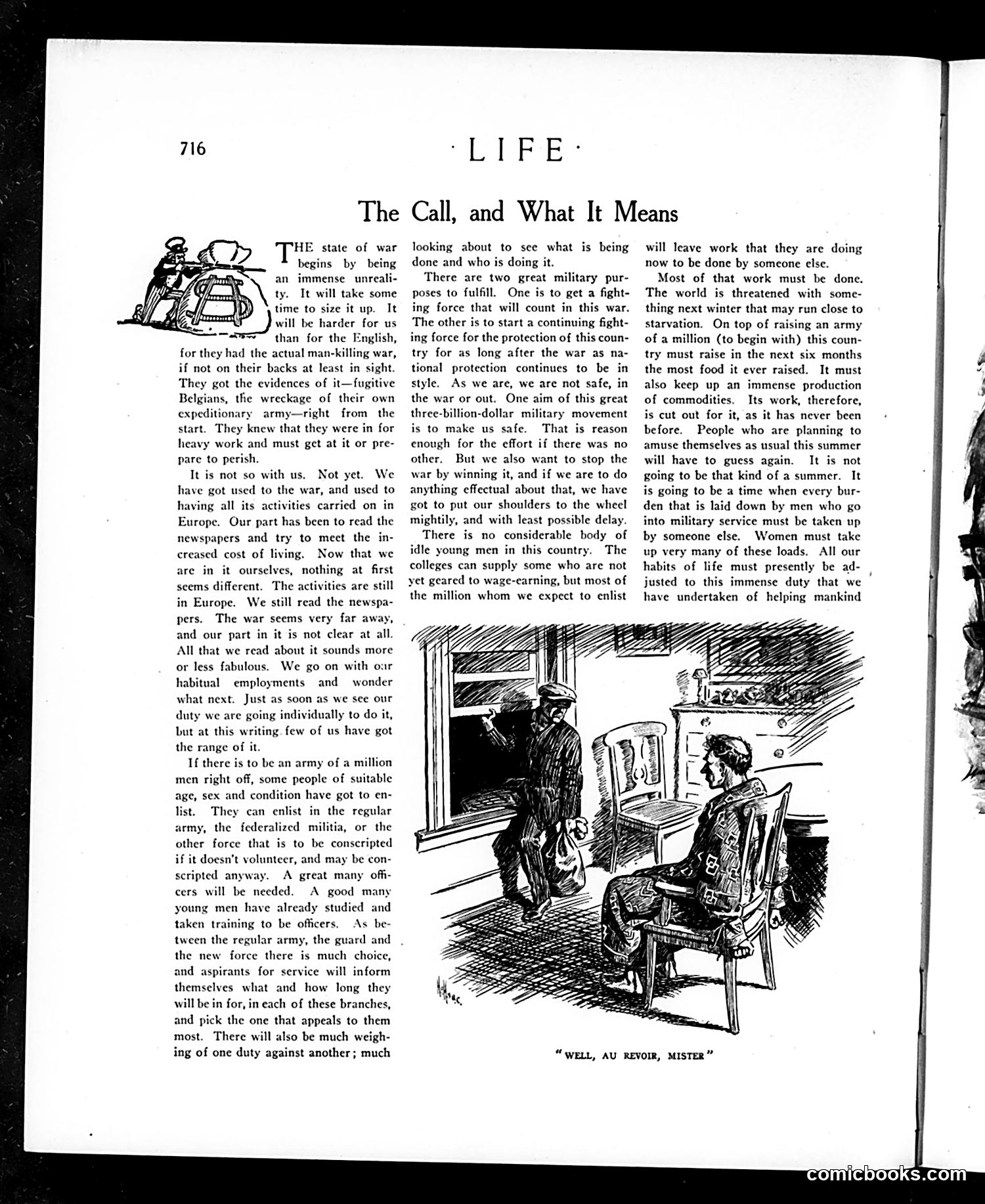
This article discusses military conscription during wartime (likely WWI era, given the reference to "the English" and European conflict). The text explains two military objectives: raising a fighting force and maintaining home-front protection. The accompanying sketch shows a domestic scene where a man in a coat (likely a military recruiter or official) stands at a doorway speaking to a woman seated indoors. The caption reads "WELL, AU REVOIR, MISTER"—French for "goodbye"—suggesting farewell to departing soldiers. The satire critiques how conscription disrupts civilian life: women must adjust their habits to manage without male workers, and summer will be different because men have been called to service. The piece conveys how war penetrates everyday domestic existence.
📄 Transcribed text from this page (OCR, searchable)
Machine-transcribed from the original scan — historical spelling and the odd misread are preserved.
Pe * The Call, and What It Means HE state of war begins by being an immense unreali- ty. It will take some time to size it up. It will be harder for us than for the English, for they had the actual man-killing war, if not on their backs at least in sight. They got the evidences of it—fugitive Belgians, the wreckage of their own expeditionary army—right from the start. They knew that they were in for heavy work and must get at it or pre- pare to perish. It is not so with us, Not yet. We have got used to the war, and used to having all its activities carried on in Europe. Our part has been to read the newspapers and try to meet the in- creased cost of living. Now that we are in it ourselves, nothing at first seems different. The activities are still in Europe. We still read the newspa- pers. The war seems very far away and our part in it is not clear at all. All that we read about it sounds more or less fabulous. We go on with our habitual employments and wonder what next. Just as soon as we sce our duty we are going individually to do it, but at this writing. few of us have got the range of it. If there is to be an army of a million men right off, some people of suitable age, sex and condition have got to en- list. They can enlist in the regular army, the federalized militia, or the other force that is to be conscripted if it doesn’t volunteer, and may be con- A great many off- A good many scripted any’ cers will be needed. young men have already studied and taken training to be officers, As be- tween the regular army, the guard and the new force there is much choice, and aspirants for service will inform themselves what and how long they will be in for, in each of these branches, and pick the one that appeals to them most. There will also be much weigh- ing of one duty against another; much looking about to sce what is being done and who is doing it. There are two great military pur- poses to fulfill. One is to get a fight- ing force that will count in this war. The other is to start a continuing fight- ing force for the protection of this coun- try for as long after the war as na- tional protection continues to be in style. As we are, we are not safe, in the war or out. One aim of this great three-billion-dollar military movement is to make us safe. That is reason enough for the effort if there was no other. But we also want to stop the war by winning it, and if we are to do anything effectual about that, we have got to put our shoulders to the wheel mightily, and with least possible delay. There is no considerable body of idle young men in this country. The colleges can supply some who are not yet geared to wage-carning, but most of the million whom we expect to enlist will leave work that they are doing now to be done by someone else. Most of that work must be done. The world is threatened with some- thing next winter that may run close to starvation. On top of raising an army of a million (to begin with) this coun- try must raise in the next six months the most food it ever raised. It must also keep up an immense production of commodities. Its work, therefore, is cut out for it, as it has never been before. People who are planning to amuse themselves as usual this summer will have to guess again. It is not going to be that kind of a summer. It is going to be a time when every bur- den that is laid down by men who go into military service must be taken up by someone else. Women must take up very many of these loads. All our habits of life must presently be ad- justed to this immense duty that we have undertaken of helping mankind “WELL, AU REVOIR, MISTER”