
Life, 1917-04-26 · page 54 of 84
Life — April 26, 1917 — page 54: what you’re looking at
What you’re looking at
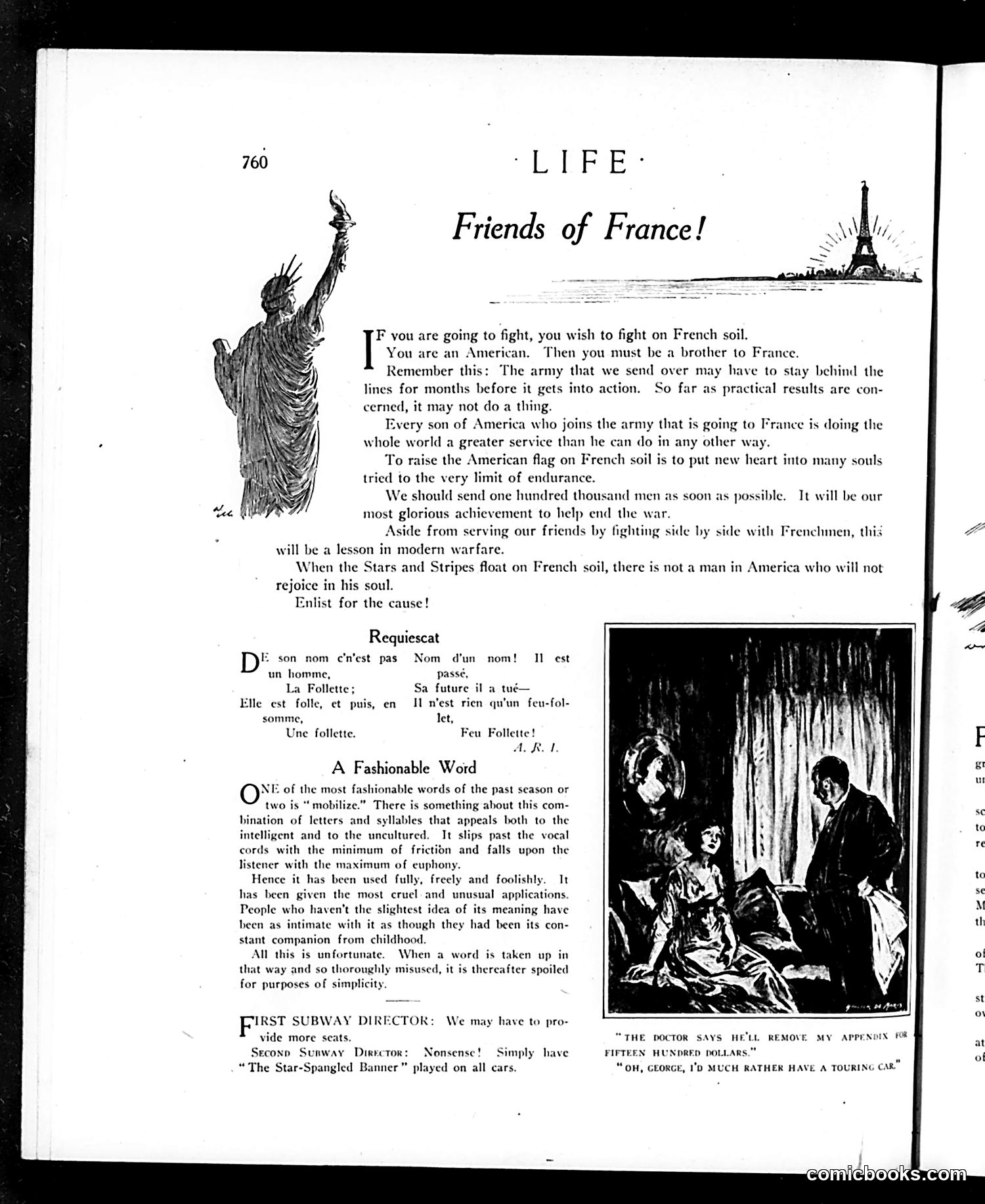
This WWI-era recruitment page urges American military support for France. The main "Friends of France!" editorial argues that American soldiers fighting on French soil will boost French morale and represent America's greatest contribution to ending the war. It advocates sending 100,000 troops immediately. The **Requiescat** section is a satirical French poem mocking **Senator Robert La Follette**, a prominent anti-war progressive politician. The wordplay on "La Follette" (literally "the madwoman") suggests he's mentally unstable for opposing war mobilization. **"A Fashionable Word"** critiques overuse of the term "mobilize," noting it's been applied carelessly and foolishly by people who don't understand its meaning—likely a jab at politicians and civilians who invoke military readiness without grasping its implications. The bottom cartoon jokes about American consumerism during wartime: a subway director suggests playing patriotic music to solve crowding, while a woman prefers a touring car to appendix surgery, satirizing misplaced priorities.
📄 Transcribed text from this page (OCR, searchable)
Machine-transcribed from the original scan — historical spelling and the odd misread are preserved.
‘LIFE: Friends of France! You are an American. Then you must be a brother to France. Remember this: The army that we send over may have to stay behind the lines for months before it gets into action. So far as practical results are con- cerned, it may not do a thing. Every son of America who joins the army that is going to France is doing the whole world a greater service than he can do in any other way. To raise the American flag on French soil is to put new heart into many souls tried to the very limit of endurance. We should send one hundred thousand men as soon as possible. It will be our I you are going to fight, you wish to fight on French soil. most glorious achievement to help end the war. Aside from serving our friends by fighting side by side with Frenchmen, this will be a lesson in modern warfare. When the Stars and Stripes float on French soil, there is not a man in America who will not rejoice in his soul. Enlist for the cause! Requiescat D son nom c'n’est pas Nom d'un nom! Il est un homme, passé, La Follette; Sa future il a tué— Elle est folle, et puis, en Il n'est rien qu'un feu-fol- somme, let, Une follette. Feu Follette! ART A Fashionable Word : of the most fashionable words of the past season or two is “mobilize.” There is something about this com- hination of letters and syllables that appeals both to the intelligent and to the uncultured. It slips past the vocal cords with the minimum of friction and falls upon the listener with the maximum of euphony. Hence it has been used fully, freely and foolishly. It has been given the most cruel and unusual applications. People who haven't the slightest idea of its meaning have heen as intimate with it as though they had been its con- stant companion from childhood. All this is unfortunate. When a word is taken up in that way and so thoroughly misused, it is thereafter spoiled for purposes of simplicity: IRST SUBWAY DIRECTOR: We may have to pro- vide more seats. “THE DOCTOR SAYS HE'LL REMOVE MY APPENDIX fO8 conn Sunway Director: Nonsense! Simply have FIFTEEN HUNDRED DOLLARS. “The Star-Spangled Banner” played on all cars. “OH, GEORGE, I'D MUCH RATHER HAVE A TOURING CAR