
A complete issue · 76 pages · 1910
Life — January 6, 1910
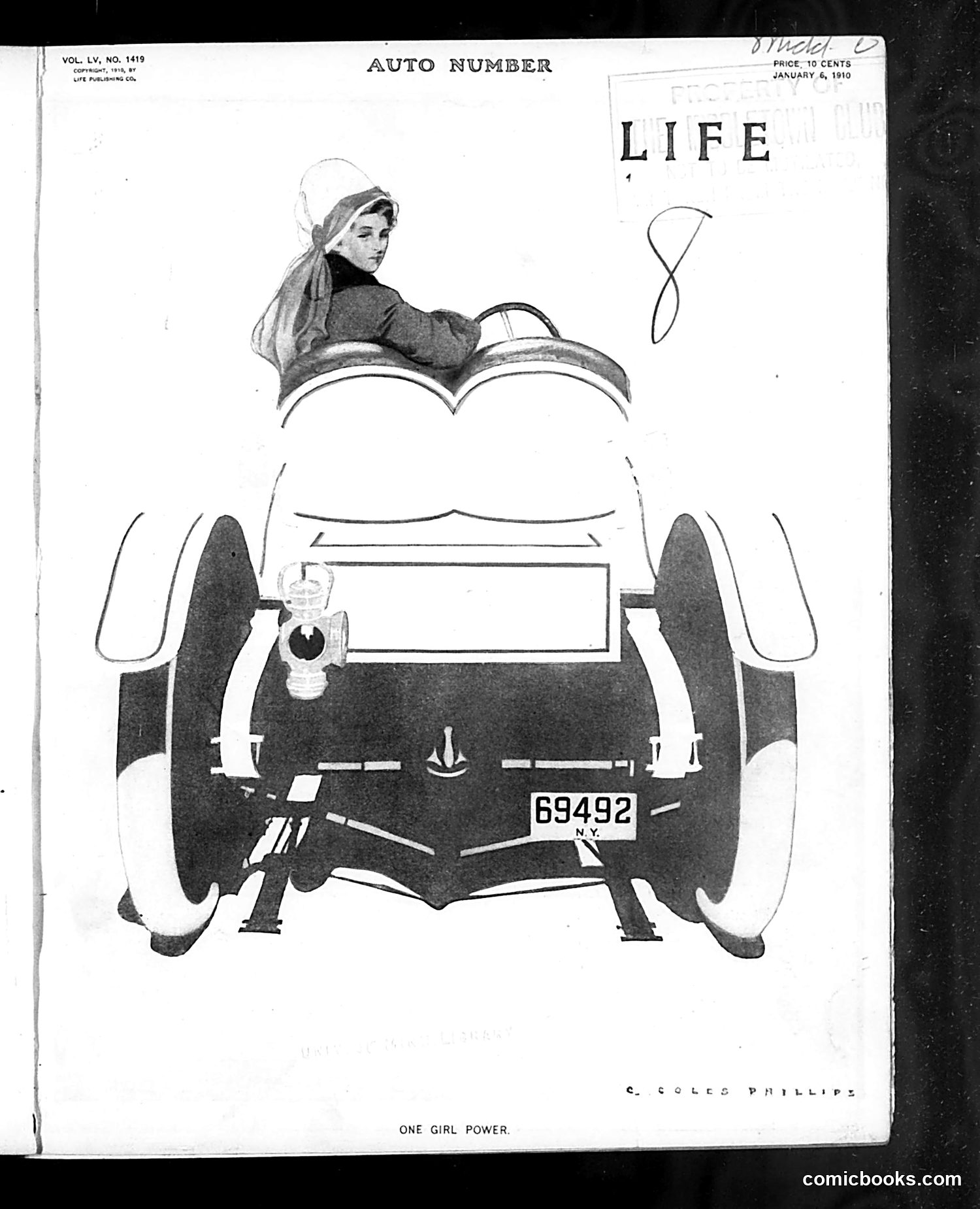
This satirical cover depicts a woman operating an automobile, depicted as an enormous, powerful vehicle that dwarfs her tiny frame. The woman sits atop the engine compartment, steering with exaggerated effort, while the car displays a New York license plate. The joke plays on contemporary anxieties about women's increasing independence and participation in modern life. The title "One Girl Power" sarcastically suggests that a single woman can harness such tremendous mechanical force—treating her driving ability as almost superhuman, which highlights how novel and transgressive women operating automobiles was in 1910. The image mocks both female drivers and society's sense that women entering the automotive age represented a seismic social shift.
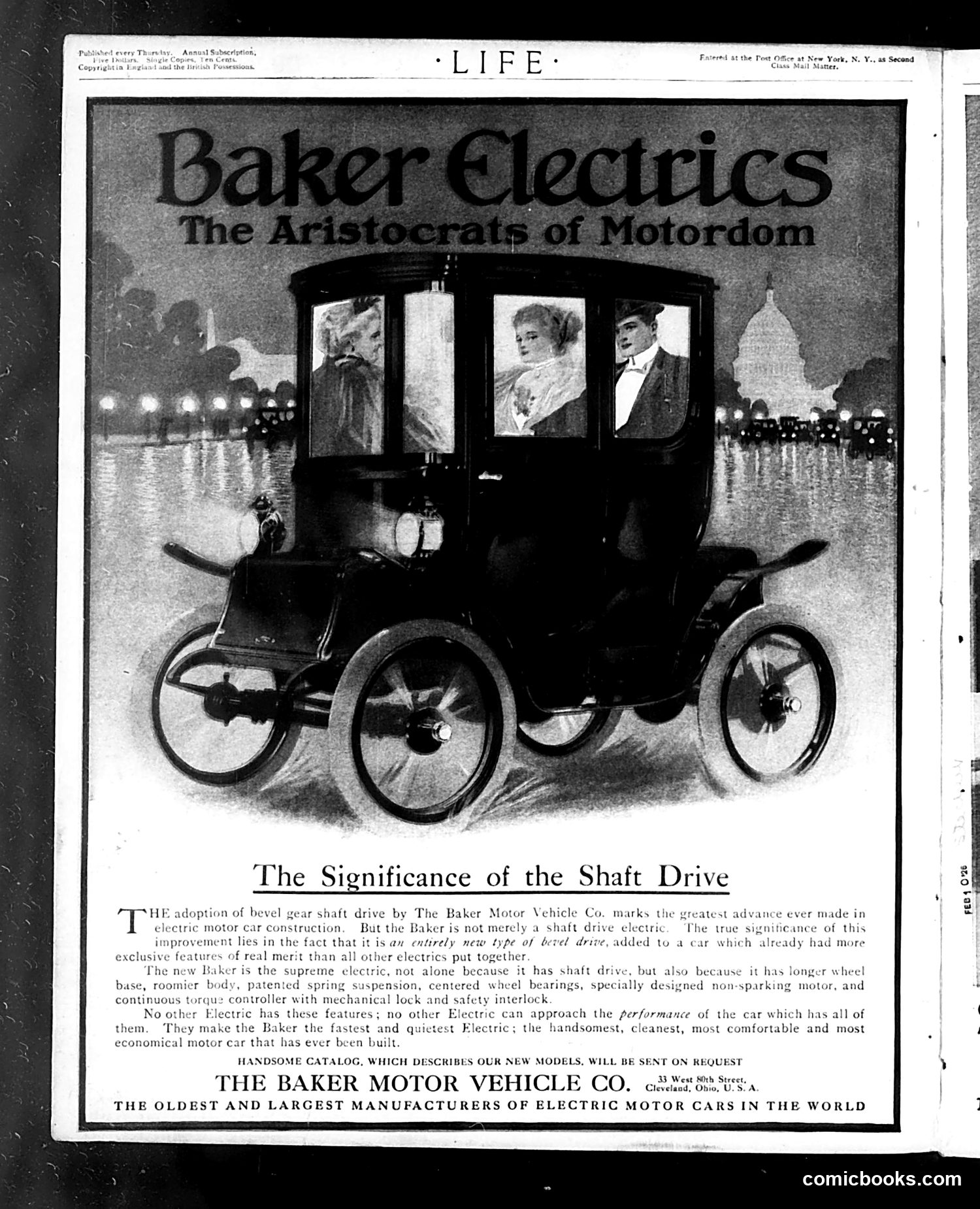
This is primarily a **Baker Motor Vehicle Company advertisement**, not satirical content. It features an electric automobile with well-dressed passengers visible through the windows, positioned against a nighttime cityscape with the Capitol building visible. The ad's tagline—"The Aristocrats of Motordom"—uses class imagery to market electric cars as luxury vehicles for wealthy clientele. The "shaft drive" innovation is highlighted as a technical advancement. The page appears in *Life* magazine as a paid advertisement rather than editorial content. There is **no apparent satire or political commentary**. The only quasi-humorous element is the aristocratic branding itself, which may gently play on electric cars' association with affluence during the early automotive era, but this is marketing language rather than satirical critique.
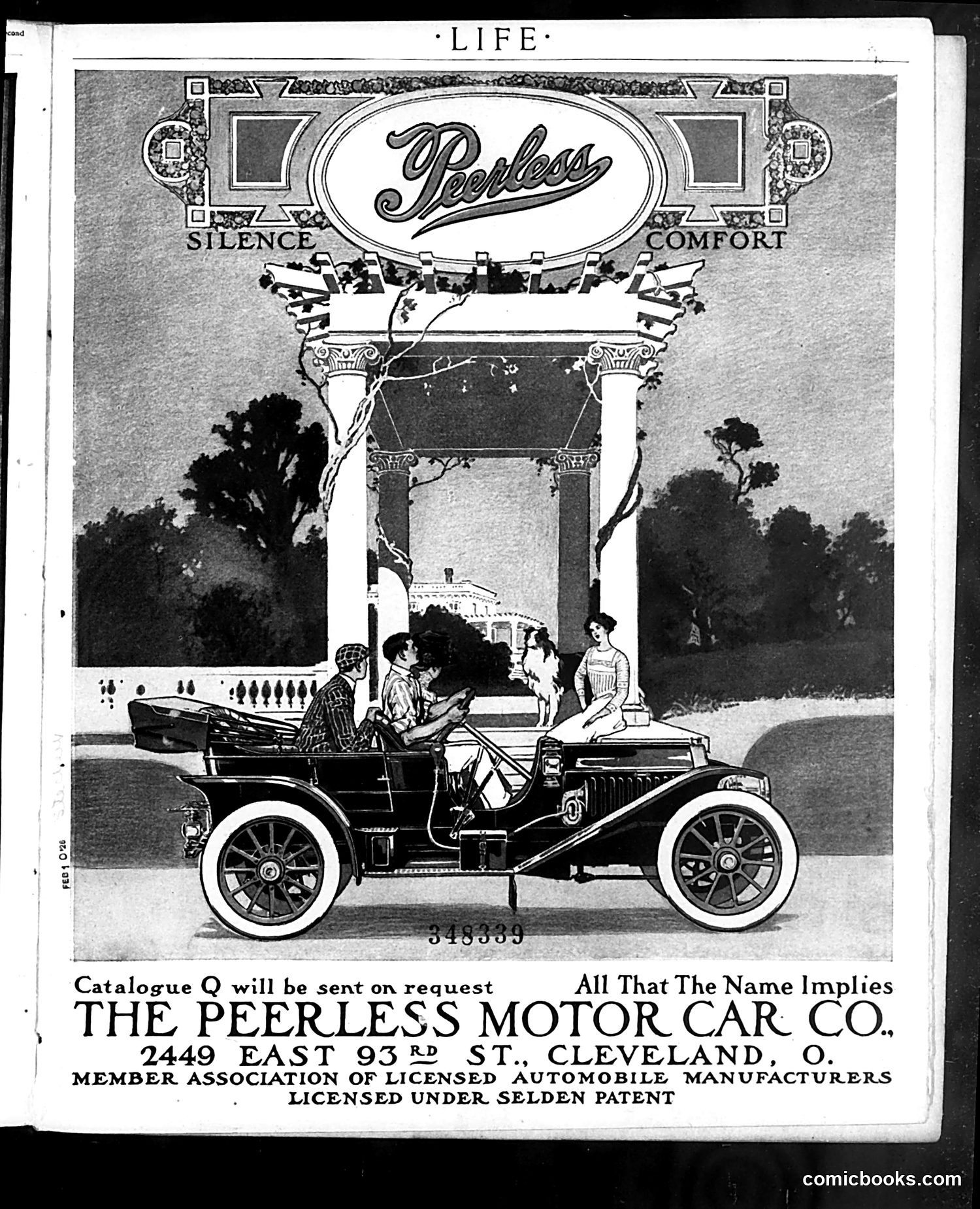
This is primarily a **commercial advertisement**, not political satire. It promotes the Peerless Motor Car Company of Cleveland, Ohio, emphasizing qualities of "Silence" and "Comfort" shown in the ornamental header. The image depicts an early automobile (appears to be from the 1910s era) positioned beneath a classical portico, suggesting luxury and permanence. Well-dressed passengers and onlookers are illustrated around the vehicle in an idealized garden setting, conveying refinement and social status. The advertisement's tagline—"All That The Name Implies"—markets the brand as synonymous with quality. The reference to "Catalogue Q" and licensing information indicates this is a trade publication aimed at potential buyers and dealers. No political satire is apparent; this is straightforward automotive marketing rhetoric.
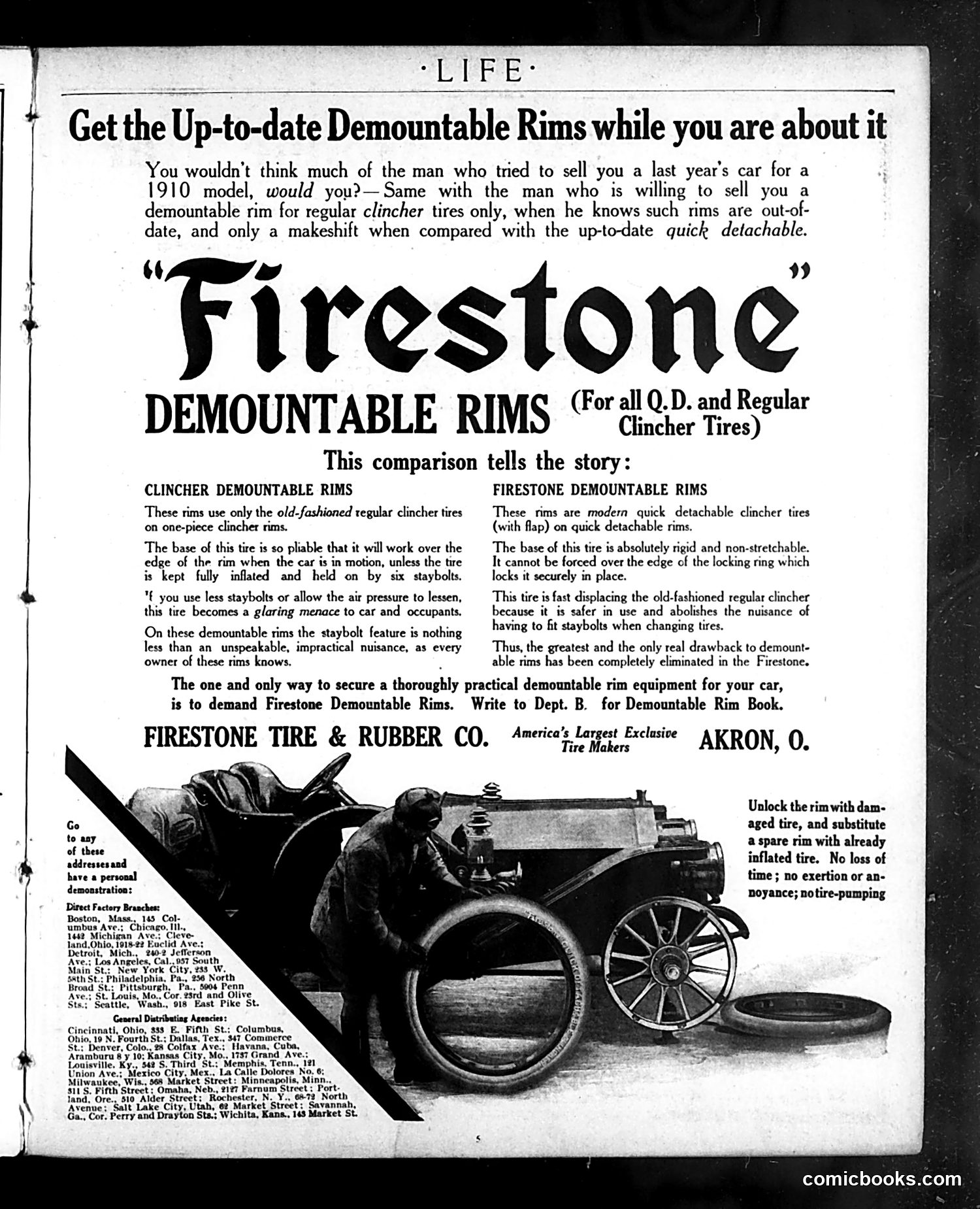
This page is primarily a **product advertisement**, not political satire. It promotes Firestone's "quick detachable" demountable rims for automobiles, contrasting them with competitors' older "clincher" rim technology. The ad uses comparative marketing rather than humor or satire. It argues that Firestone's modern rims are superior because they eliminate staybolt features found in older designs, making tire changes faster and safer. The image shows a man changing a tire on an early automobile. The only satirical element is the opening analogy: comparing a seller offering last year's car model to one pushing outdated tire technology—a mild jab at competitors' supposedly inferior products. This is straightforward commercial persuasion rather than political or social commentary.
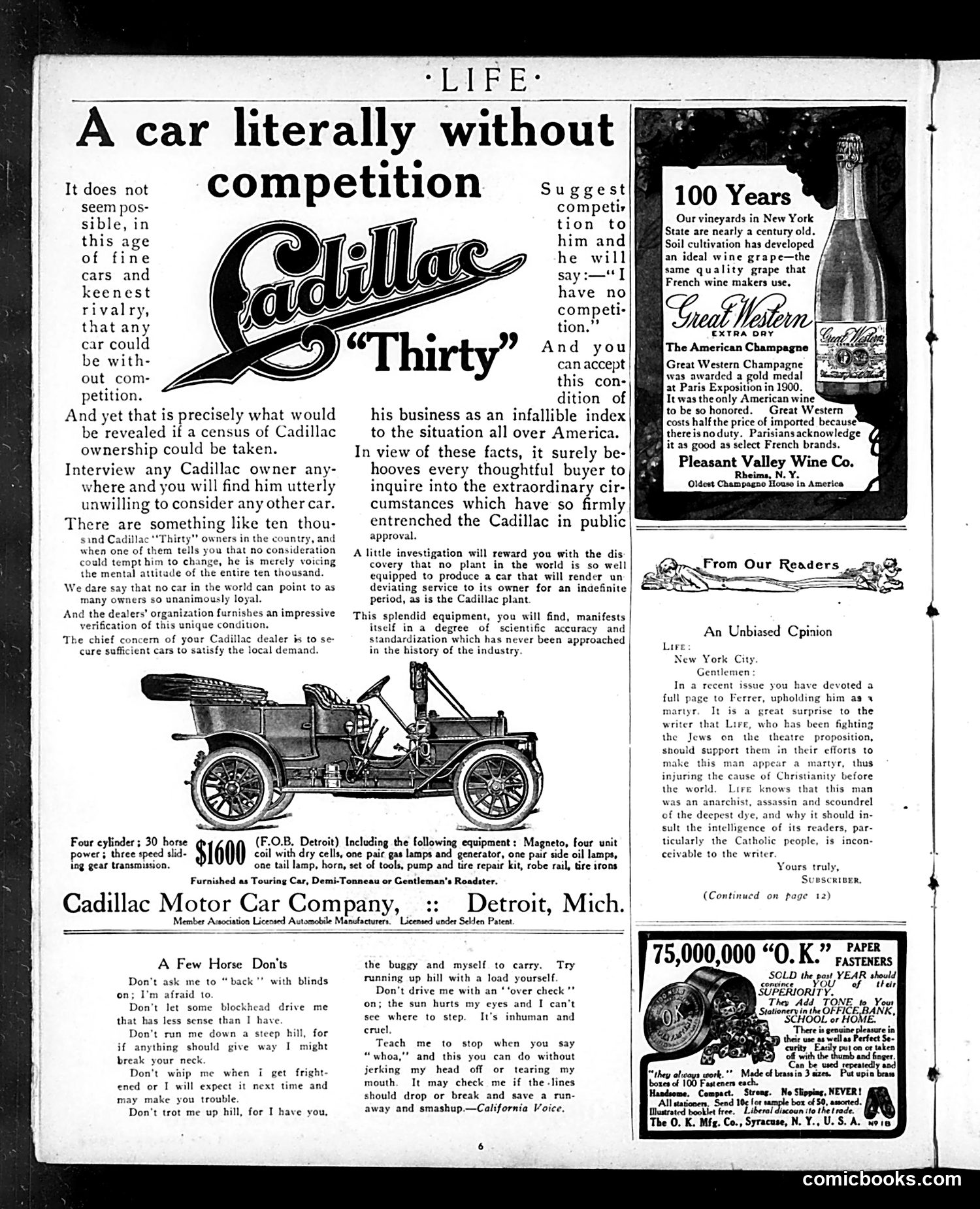
This page is primarily **advertising and promotional content** rather than political satire. The main feature is a large Cadillac "Thirty" automobile advertisement claiming the car has "literally without competition" — meaning no rivals in its market class. The ad emphasizes the car's superior engineering and manufacturing capabilities. A secondary advertisement promotes Great Western Champagne, claiming American vineyards near New York have achieved century-old quality comparable to French wines. Below the Cadillac ad is a humorous advice column titled "A Few Horse Don'ts," offering tongue-in-cheek driving etiquette tips for automobile owners — likely satirizing early motorists' often reckless behavior on roads. The "Unbiased Opinion" letter criticizes *Life* magazine's coverage of a controversial figure, but provides insufficient context to identify the specific person or issue referenced.
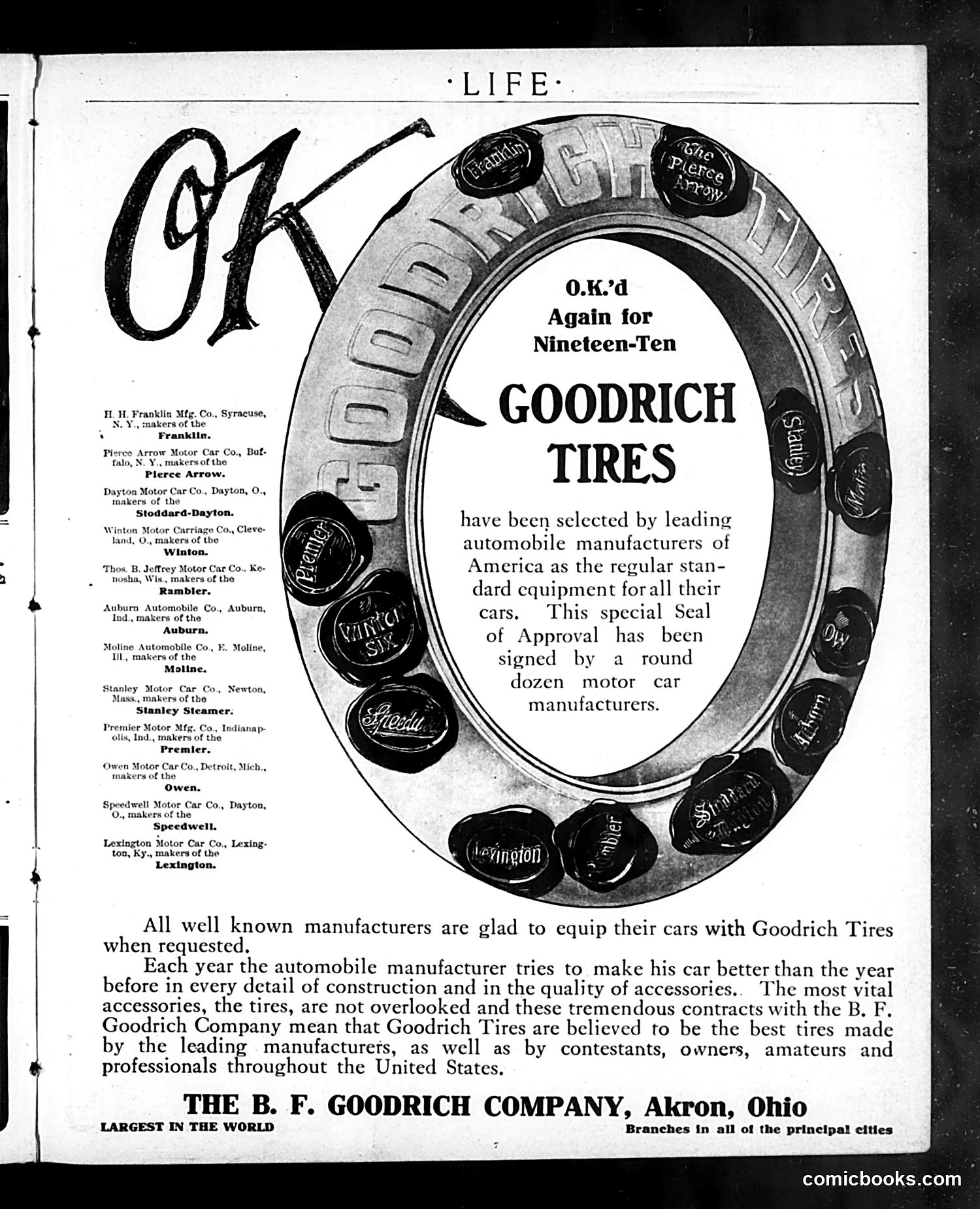
This is primarily a **Goodrich Tires advertisement**, not political satire. The page shows a large tire decorated with manufacturer seals/emblems arranged around its circumference. The text claims that leading American automobile manufacturers—listed on the left (Franklin, Pierce-Arrow, Rambler, Oldsmobile, etc.)—have adopted Goodrich Tires as standard equipment. The "OK'd Again for Nineteen-Ten" headline suggests this is from around 1910, positioning Goodrich as the trusted choice for quality automobiles. The seal imagery emphasizes endorsement and approval from multiple manufacturers. There is **no political cartoon or satire here**—this is straightforward commercial advertising in *Life* magazine, leveraging manufacturer endorsements to market tires to consumers and reinforce Goodrich's market dominance as "largest in the world."
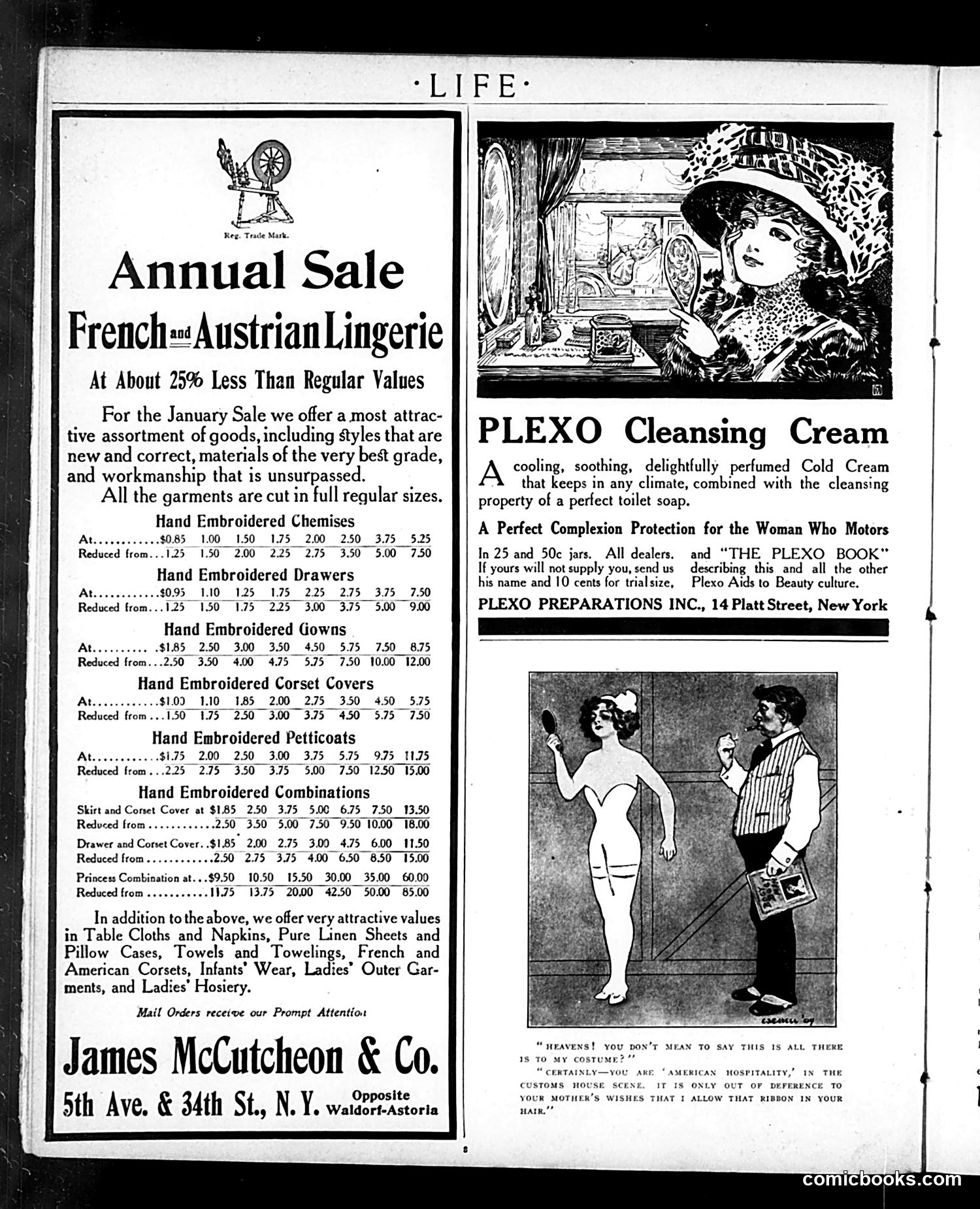
This page is primarily **commercial advertising** rather than satire or political commentary. The left side advertises James McCutcheon & Co.'s annual lingerie sale at 25% discount, listing various hand-embroidered undergarments with prices. The right side features two ads: one for "PLEXO Cleansing Cream" (a cosmetic product), and below it, a cartoon showing a woman in undergarments speaking with a man in a suit. The caption humorously addresses concerns about modesty and propriety—the woman defensively explains her attire is "American hospitality" in a "custom house scene," joking that she's merely following her mother's wishes about ribbon in her hair. The cartoon plays on era-appropriate anxiety about women's fashion and changing social norms regarding female dress and propriety.
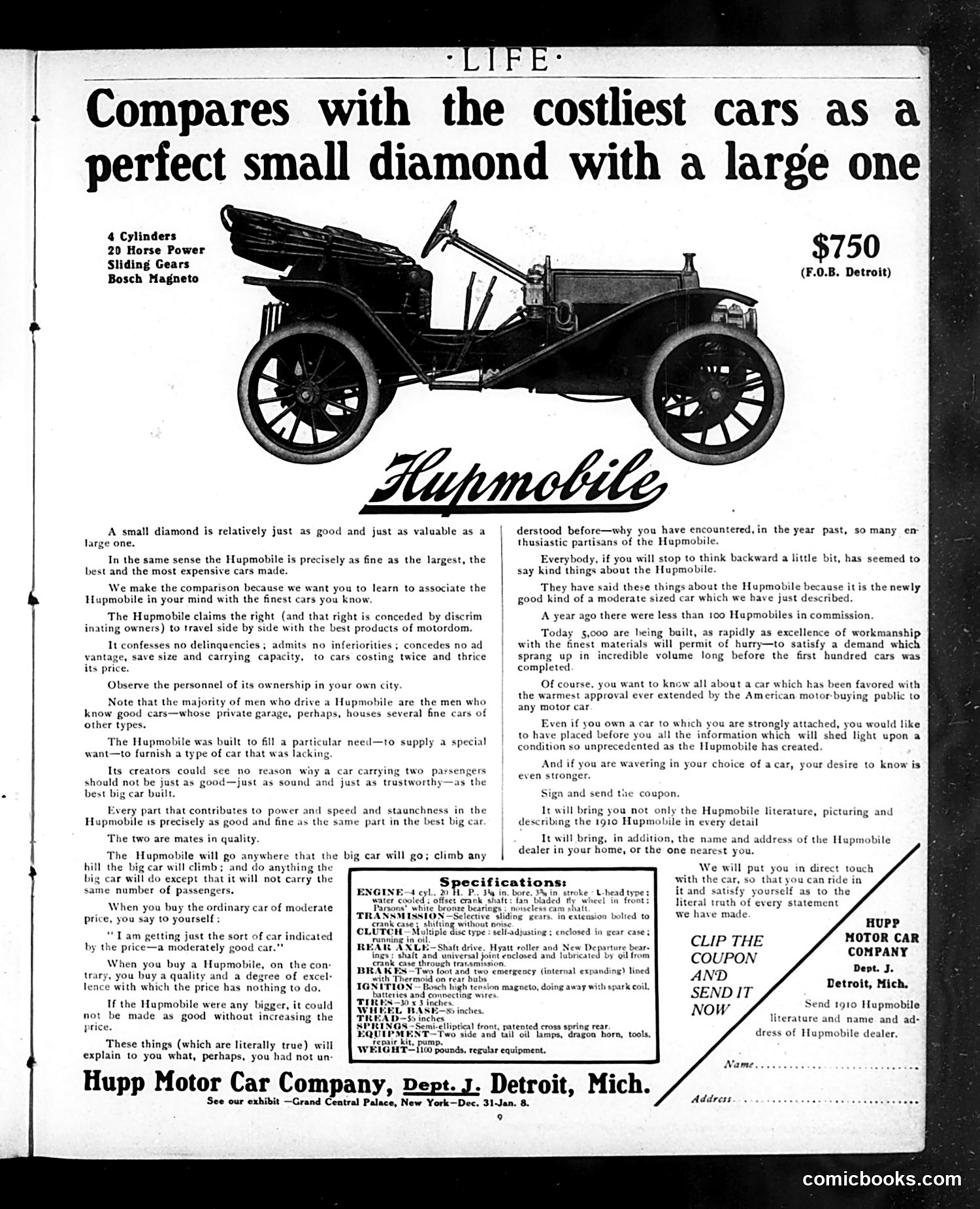
This is primarily an **advertisement for the Hupmobile automobile**, not a political cartoon. The page compares the Hupmobile to luxury cars using a jewelry metaphor: "a perfect small diamond with a large one." The ad's satire targets **perceived snobbery about car prices**. It argues that a smaller, cheaper car ($750) can be as valuable and well-made as expensive luxury vehicles—just as a small diamond equals a large one in quality. The text mocks wealthy car owners' assumptions and appeals to middle-class buyers seeking quality without extravagance. The specifications box demonstrates the Hupmobile's technical merits (4-cylinder engine, sliding gears, etc.). A coupon invites readers to request literature, indicating this is a **direct-mail marketing campaign** from Hupp Motor Car Company in Detroit.
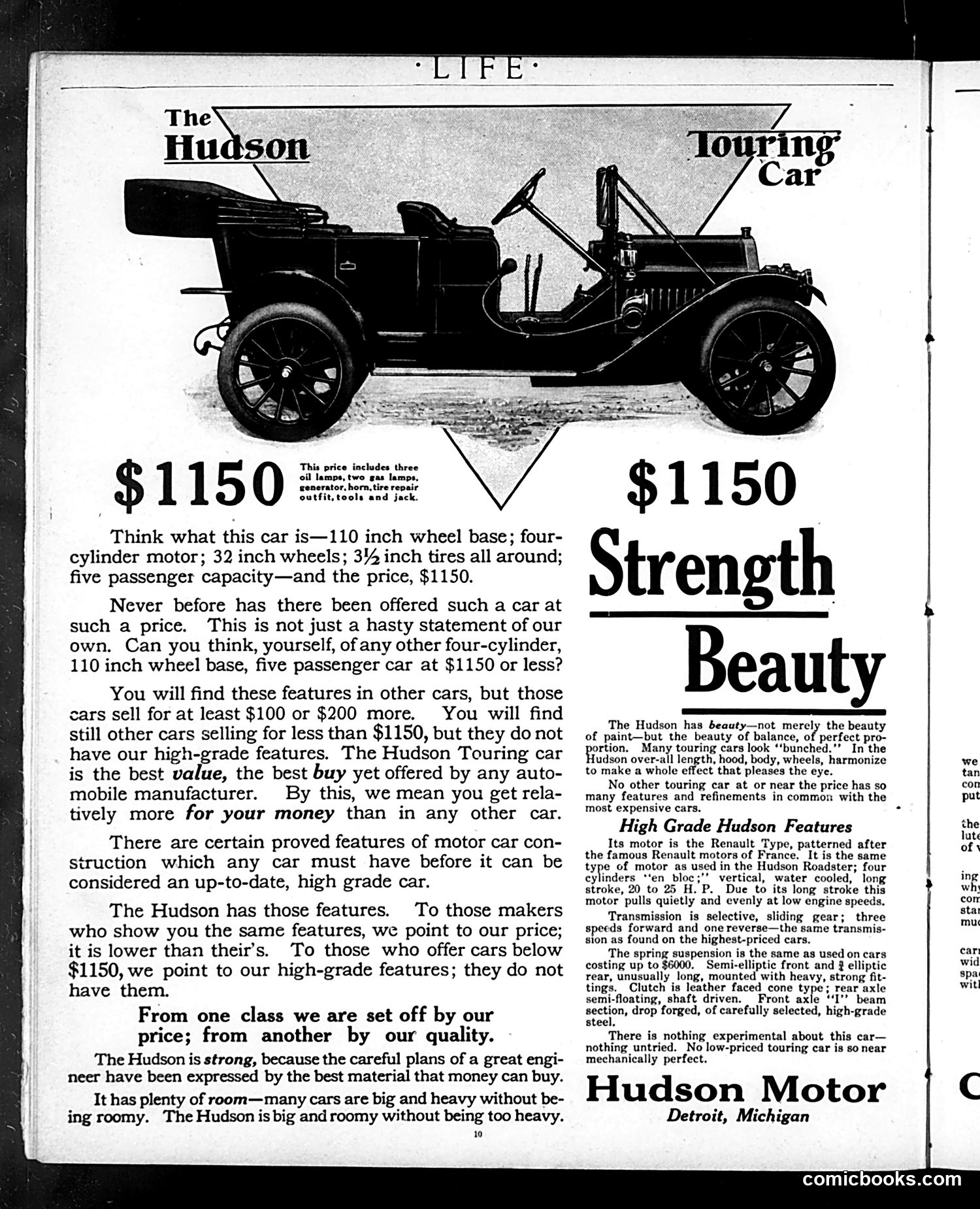
This is an advertisement, not a political cartoon. It's a Hudson Motor Company ad for their touring car model, priced at $1,150—positioning it as offering exceptional value for the features provided (four-cylinder motor, 110-inch wheelbase, five-passenger capacity). The "satire" here is commercial rather than political: the ad claims Hudson offers superior quality and features compared to competitors at the same or higher price point. It appeals to early automotive consumers by emphasizing practical engineering ("Strength") and balanced design ("Beauty"), suggesting buyers get more "for your money" with Hudson than elsewhere. This reflects 1910s-era automobile marketing, when the industry was young and manufacturers competed fiercely on value propositions to expand the mass market.
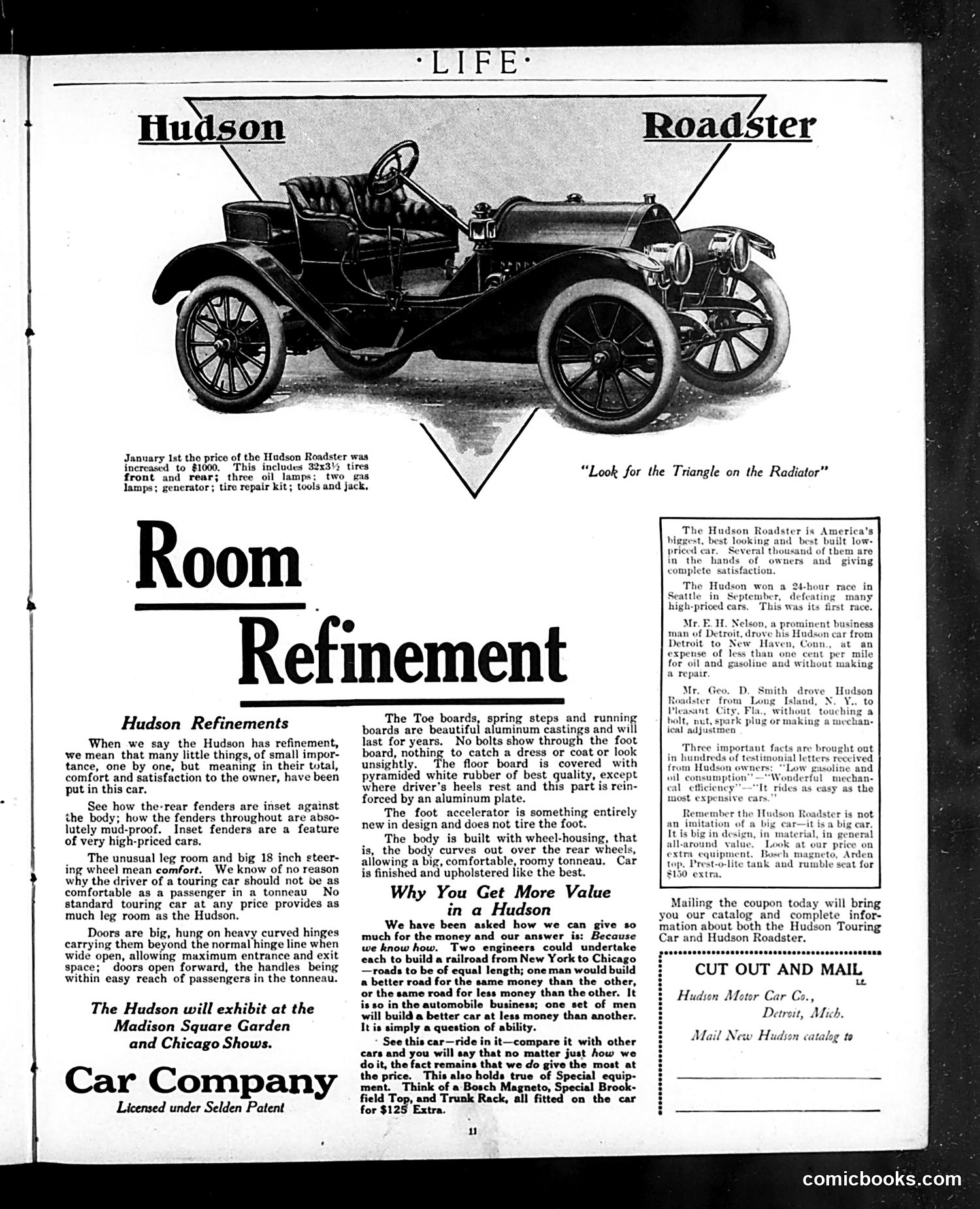
This page is primarily a **product advertisement** for the Hudson Roadster automobile, not a political cartoon. The image shows a detailed illustration of an early 1900s open-air motorcar with two seating areas labeled "Hudson" and "Roadster." The advertisement emphasizes the vehicle's refinement, comfort, and value—highlighting features like aluminum castings on the toe boards, mud-proof fenders, and spacious interior. The text emphasizes Hudson's manufacturing efficiency allows them to offer "more value" than competitors at comparable prices. A testimonial section includes positive feedback from owners in various cities. This represents early automotive marketing, promoting the Hudson as a quality, affordable alternative to other manufacturers' cars. The "Look for the Triangle on the Radiator" tagline served as the company's identifying mark.
This page is primarily **advertising and reader letters**, not satirical cartoons. The dominant content features: 1. **Remy Magnetos advertisement** (left side): Promotes automotive electrical equipment, boasting "Over 100,000 Remy Magnetos Sold for 1910." This appears aimed at manufacturers and buyers of early automobiles. 2. **Evans Ale advertisement** (center-bottom): A beer brand promoting health benefits with the slogan "124 Years Doing Good." 3. **Pennsylvania Railroad article** (right side): Describes luxury passenger train services between New York and Chicago, marketed to businessmen who can conduct work aboard. The "From Our Readers" section contains letters debating religious topics and social customs—typical of Life's reader-engagement format rather than satire. The overall page reflects early 1900s commercial culture and consumer interests.
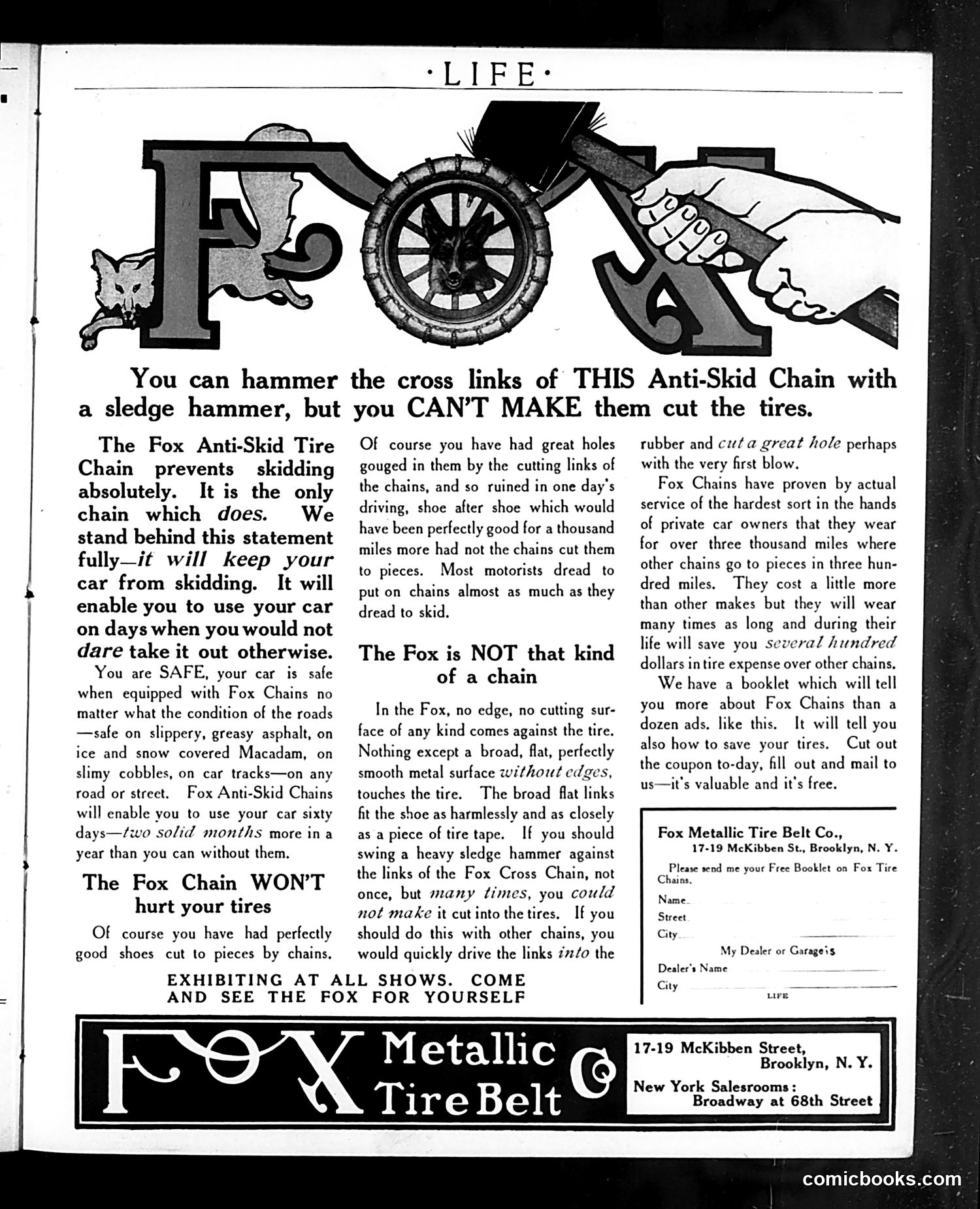
This is primarily a **Fox Metallic Tire Belt Company advertisement** from Life magazine, not political satire or comics. The decorative header features stylized letters "FOX" with a fox illustration and a ship's wheel, but these are ornamental branding elements rather than satirical commentary. The advertisement's central claim addresses a practical consumer concern: anti-skid tire chains that damage tires. Fox claims their chain design—with broad, flat links rather than cutting edges—prevents tire damage while maintaining safety on icy roads. The text emphasizes durability (chains lasting 3,000+ miles versus competitors' 300) and cost-effectiveness, positioning Fox chains as a premium product worth the higher price. This reflects early 20th-century winter driving challenges before modern tire technology, when tire chains were essential safety equipment.
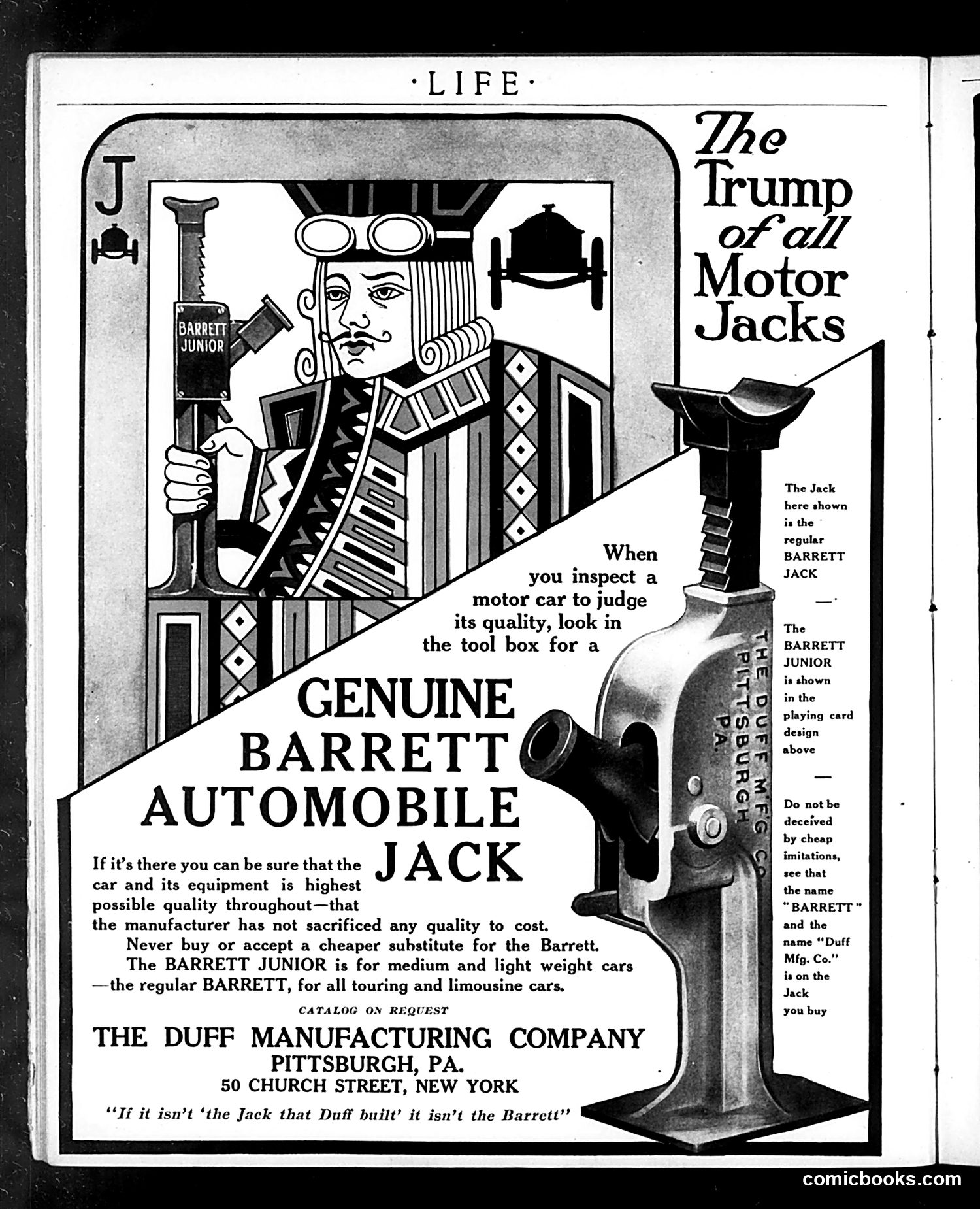
This is primarily **an advertisement**, not political satire. It promotes Barrett automobile jacks made by the Duff Manufacturing Company. The playing-card figure (a stylized Jack) is a **visual pun**—literally depicting a "Jack" character to advertise a car jack product. The ornate costume and exaggerated features are meant to make the ad memorable and distinctive. The advertisement's argument is straightforward: a quality Barrett jack in a car's tool box indicates the manufacturer uses quality components throughout. It positions the jack as a **mark of excellence**—a simple way consumers could verify a car's overall quality during an era when automobiles were still relatively new purchases requiring careful evaluation. The tagline plays on the brand name: "If it isn't 'the Jack that Duff built' it isn't the Barrett." There is no political or social satire here—this is purely commercial messaging from the early automotive era.
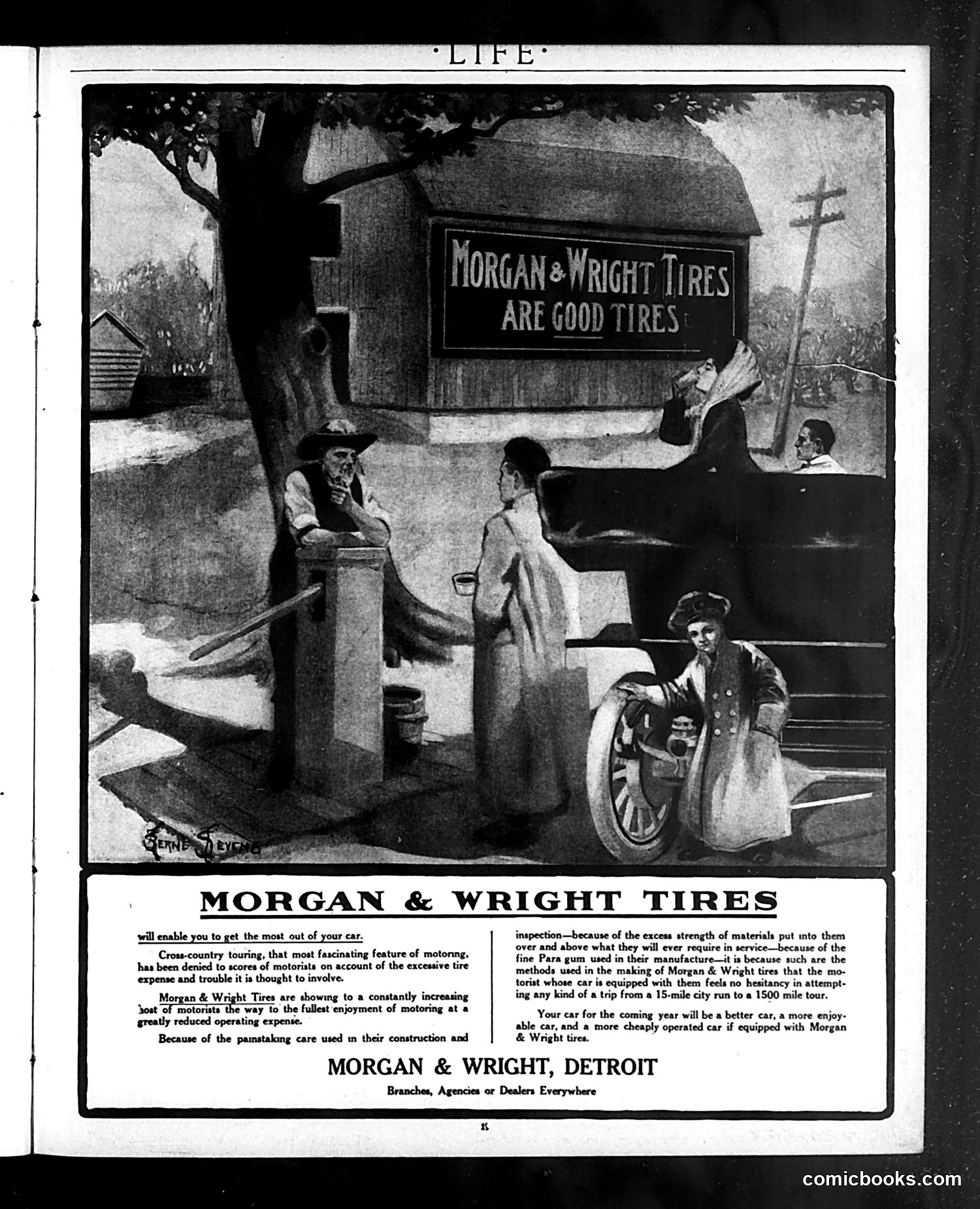
This is primarily **advertising copy**, not satire. The illustration depicts rural workers and motorists examining or discussing tires near a roadside sign reading "Morgan & Wright Tires Are Good Tires." The ad's appeal targets early-20th-century motorists concerned about tire durability and cost during long-distance travel. The text emphasizes that superior construction and materials justify higher initial expense through reduced operational costs—a practical argument for consumers skeptical about automobile reliability. The rural setting and working-class figures suggest the ad aims to convince ordinary people, not just wealthy enthusiasts, that cross-country touring is now economically feasible with quality tires. This reflects the emerging mass-market automotive culture of the era, when tire failure remained a genuine hazard and expense for motorists.
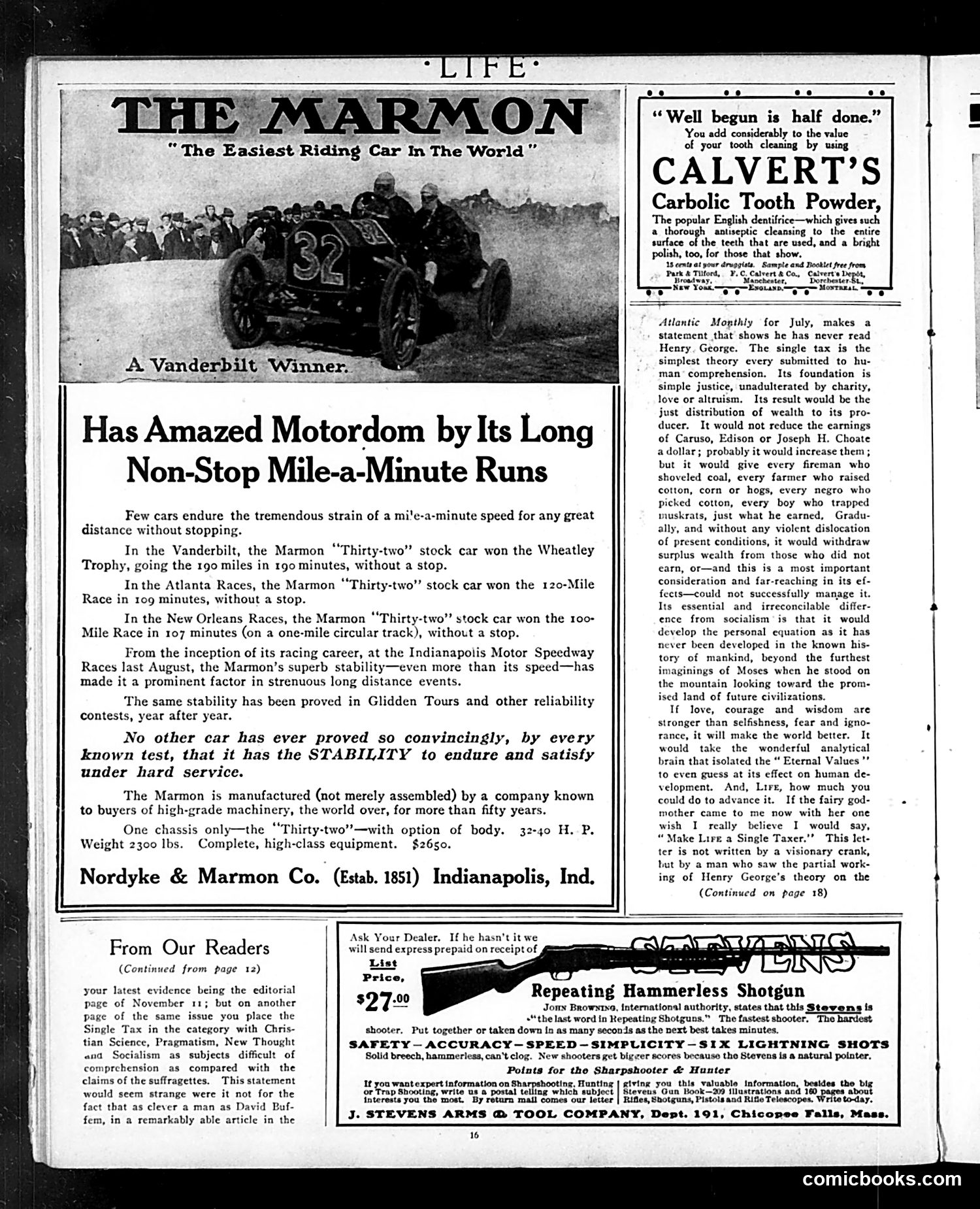
This page consists primarily of **period advertisements**, not political satire. The main content promotes two products: 1. **Calvert's Carbolic Tooth Powder** — a British dental product claiming antiseptic cleaning properties 2. **Marmon "Thirty-two" automobile** — emphasizing its racing achievements and mechanical stability through non-stop endurance runs at the Indianapolis Motor Speedway and other competitions The text repeatedly stresses the car's "stability to endure" hard service, supporting this claim with documented racing victories (Vanderbilt, Atlanta, New Orleans races). A reader's letter discusses **Henry George's "Single Tax" theory** — a late-19th-century economic proposal advocating a single tax on land value to distribute wealth more equitably. The writer argues it wouldn't harm successful individuals (Caruso, Edison) but would benefit workers and farmers. There is **no cartoon or satire** on this page — it's a typical early-20th-century magazine layout mixing advertisements with reader correspondence.
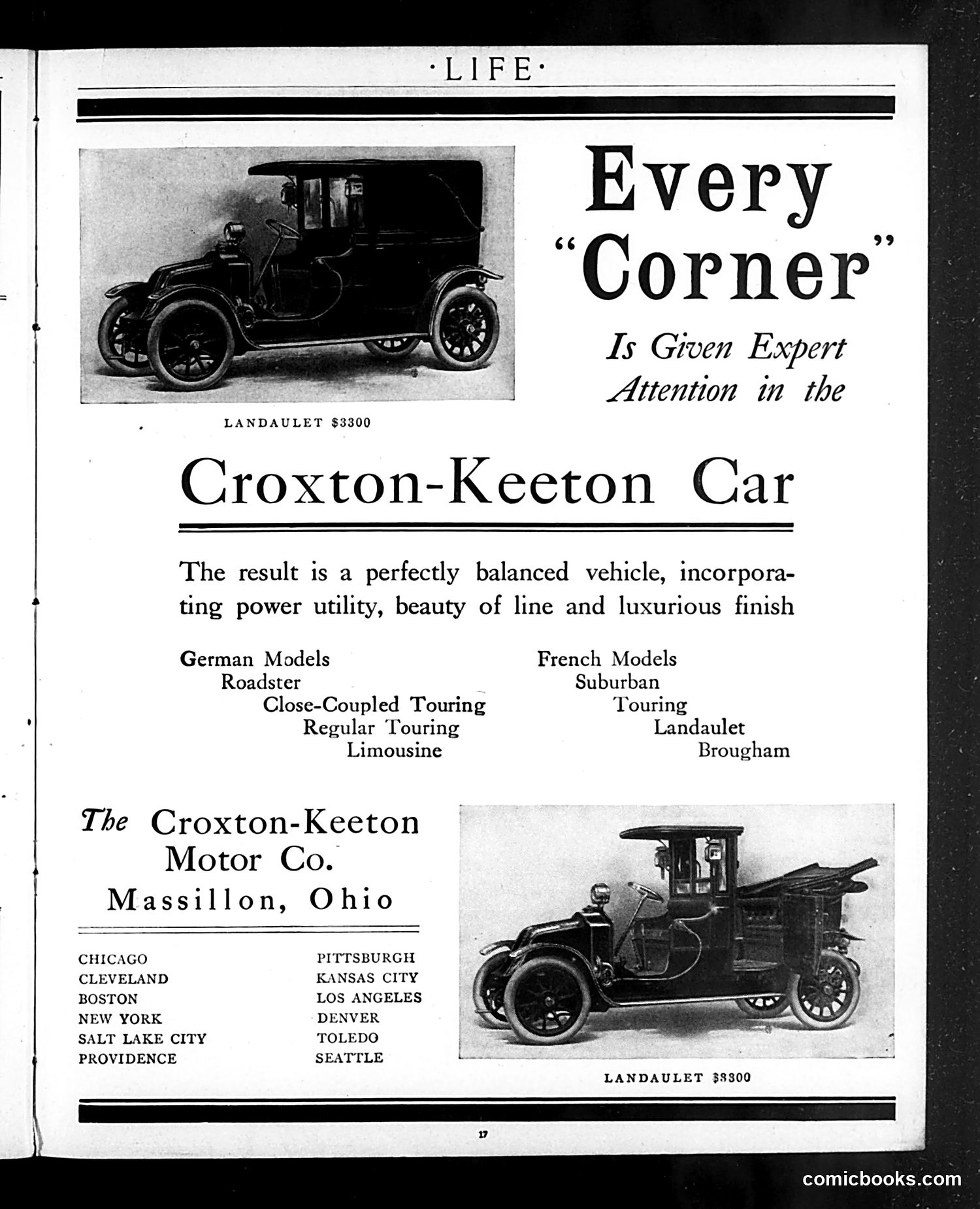
The page advertises the **Croxton-Keeton Motor Co.**, an early automobile manufacturer based in Massillon, Ohio. The ad promotes their vehicle models—available in both German and French styles (Roadster, Touring, Limousine, etc.)—emphasizing "power utility, beauty of line and luxurious finish." Two photographs show Landaulet models priced at $3,300. The phrase "Every 'Corner' Is Given Expert Attention" is a straightforward marketing claim about the car's construction quality, not a joke or reference. The company lists sales offices across major American cities (Chicago, Boston, New York, Denver, etc.), indicating national distribution. This represents typical early-1900s automotive advertising in *Life* magazine, which at this period mixed humor and satire with legitimate commercial content.
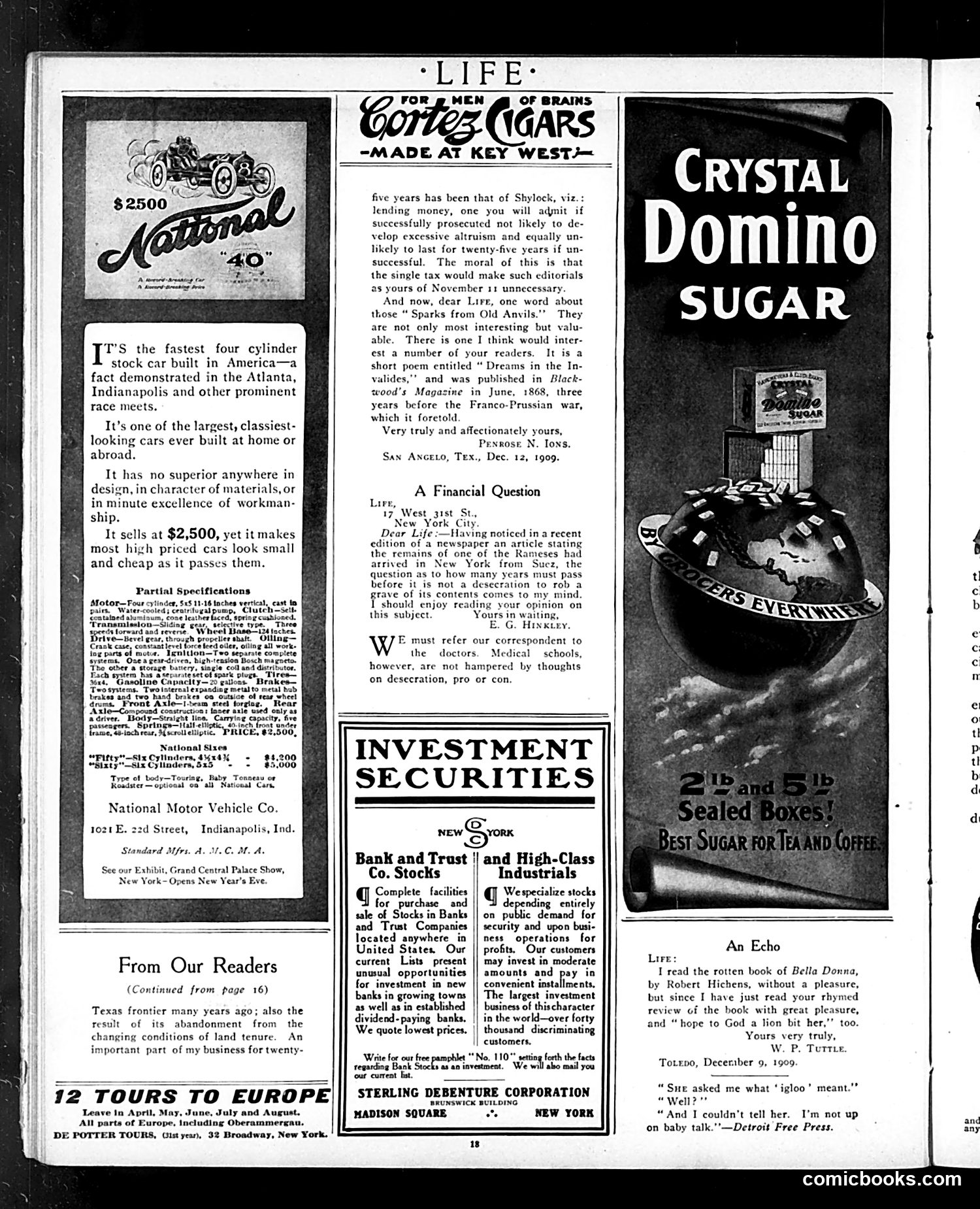
This page is primarily **advertising and reader correspondence**, not satire or political cartooning. The ads promote luxury automobiles (National Motor Vehicle Co.'s $2,500 "40" model), Cortez cigars ("for men of brains"), Crystal Domino Sugar, and investment securities. The "From Our Readers" section contains three letters to the editor addressing unrelated topics: a Texas land-tenure issue, a complaint about a previous article on historical poetry, and a question about the ethics of displaying Egyptian mummies in American museums. Life's editor responds dismissively to the last query, noting that medical schools face no such ethical qualms. The page reflects **early 1910s consumer culture and genteel magazine correspondence**, with no discernible political cartoon or satirical commentary targeting specific figures or events.
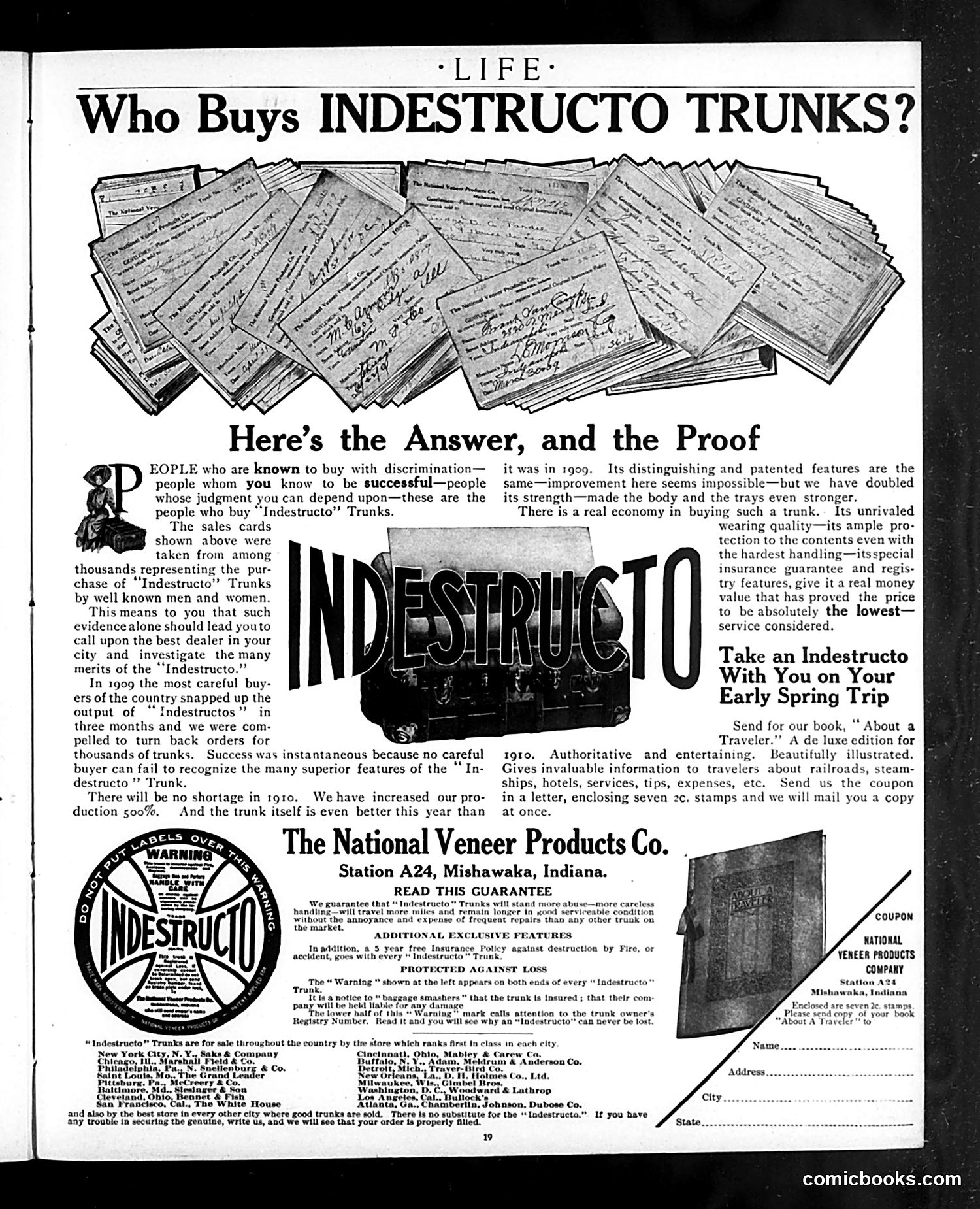
This is a full-page advertisement disguised as editorial content in *Life* magazine. It uses a satirical framing device common to the era: the ad claims to reveal who buys "Indestructo" trunks by showing handwritten sales cards from "thousands" of purchases by "well known men and women." The humor lies in the pretense of journalistic investigation—*Life* was a satirical magazine known for mocking consumer culture and advertising excess. By presenting customer testimonials as "proof," the ad ironically mimics *Life*'s own satirical expose style, essentially advertising *through* parody. The product itself (a reinforced travel trunk) targets affluent early-1900s travelers. Key selling points emphasize durability, insurance coverage, and social status ("people whose judgment you can depend upon"). The accompanying coupon and detailed guarantee reflect period advertising conventions. The joke is meta: *Life* readers would recognize this as both genuine advertising and self-aware mockery of advertising's persuasion techniques.
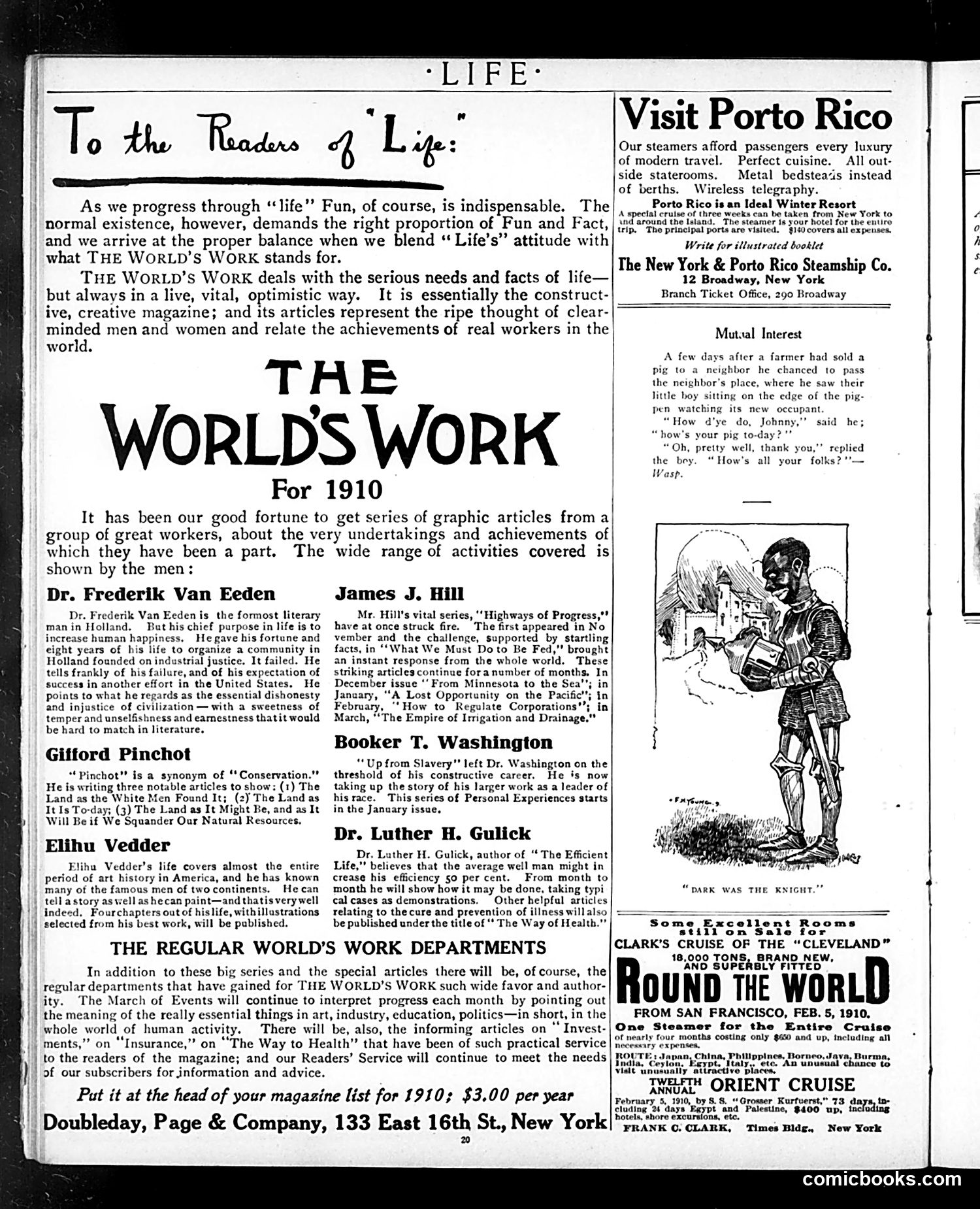
This is primarily a **promotional/title page** for "The World's Work," a companion publication to Life magazine, rather than a satirical cartoon page. The page announces the 1910 editorial lineup, featuring prominent American figures as contributors: **Dr. Frederik Van Eeden** (Dutch social reformer), **Gifford Pinchot** (conservation advocate), **Elihu Vedder** (artist), **James J. Hill** (railroad magnate), **Booker T. Washington** (African American educator), and **Dr. Luther H. Gulick** (efficiency expert). The single illustration shows a boy with a pig, accompanying a brief humorous anecdote titled "Dark Was the Knight"—a visual pun on "Dark" the pig's name and medieval knight imagery. This is mild comic relief rather than political satire. The page emphasizes The World's Work's philosophy: balancing "Fun and Fact" while addressing serious social progress through articles by "great workers." This reflects Progressive Era optimism about expertise, efficiency, and social improvement.
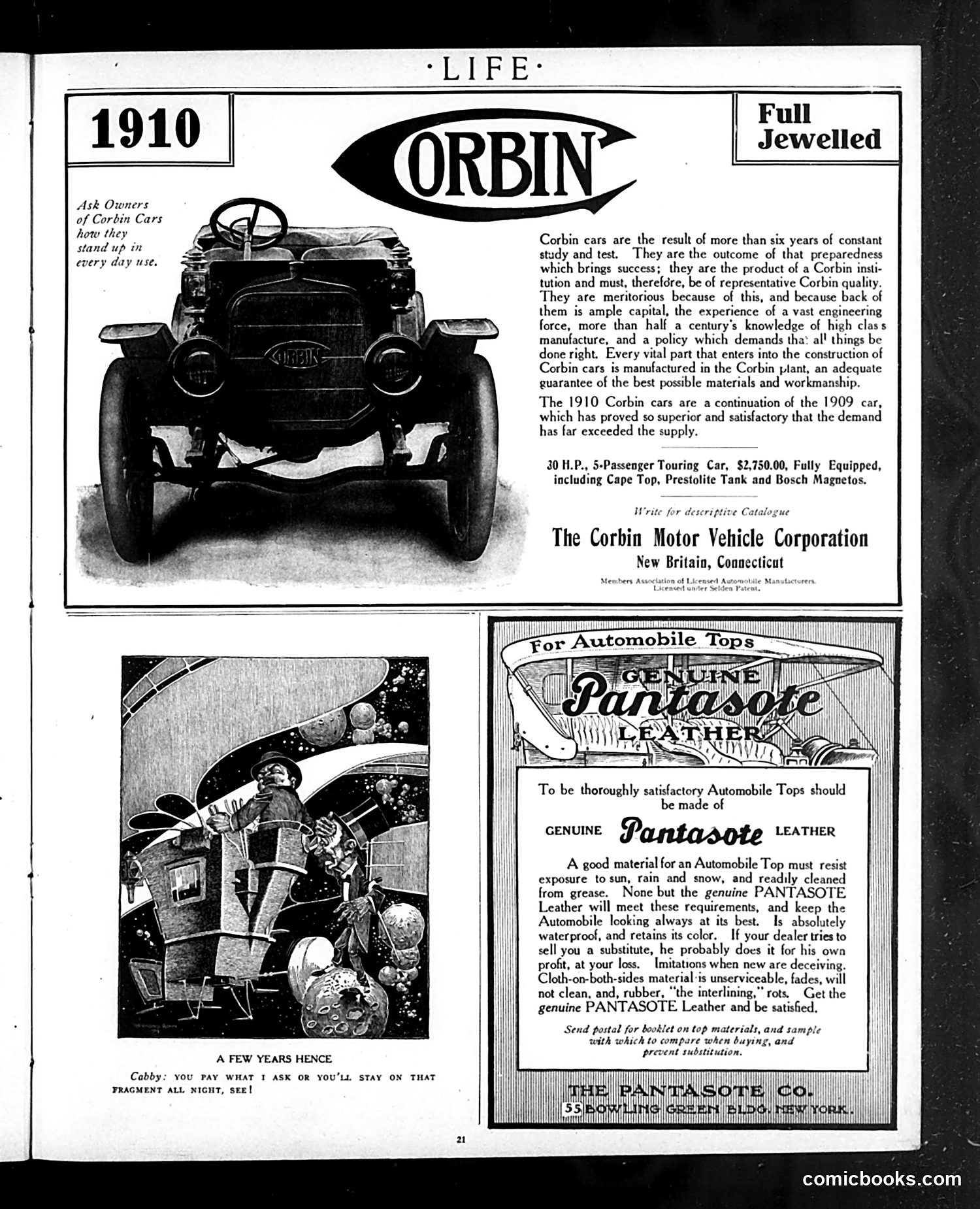
This page is primarily **advertising**, not satire or political commentary. It features three automobile-related ads: **Main content:** A Corbin Motor Vehicle Corporation advertisement for their 1910 "Full Jewelled" 30 H.P. touring car ($2,750), emphasizing six years of engineering development and quality manufacturing. **Bottom left:** A small cartoon captioned "A Few Years Hence" depicting a taxi driver threatening a passenger, suggesting future inflation or monopolistic pricing in the cab industry—a minor social commentary about potential exploitation as automobiles become commonplace. **Right side:** An advertisement for Pantasote leather for automobile tops, warning against inferior substitutes. The page reflects early 1910s automotive culture when cars were luxury goods, engineering quality was a major selling point, and the technology was new enough that material durability (leather, tops, magnetos) required explanation to consumers.
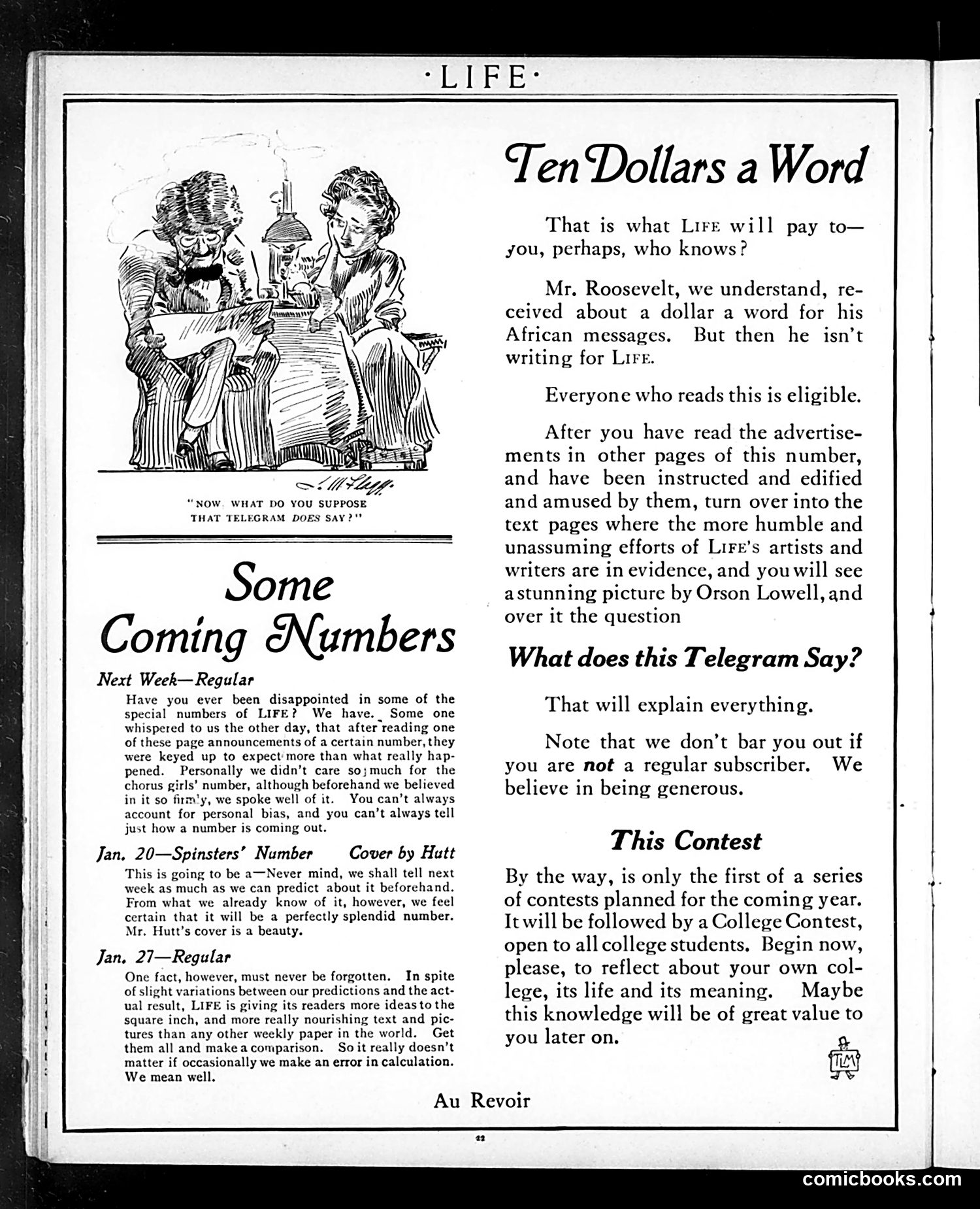
This page announces a writing contest where Life magazine will pay ten dollars per word to readers who can correctly interpret a mysterious telegram depicted in an Orson Lowell illustration (not visible here). The text references President Theodore Roosevelt, who reportedly earned one dollar per word writing about his African safari—Life humorously suggests their payment rate is superior. The cartoon at top shows two figures puzzling over a telegram, establishing the contest's central mystery. The page is largely self-promotional, with Life boasting superior content density compared to competitors and acknowledging past overhyped "special issues" (notably mentioning a disappointed "chorus girls' number"). Life positions itself as generous, welcoming non-subscribers to enter the contest. The page also previews upcoming issues and announces a future College Contest for students.
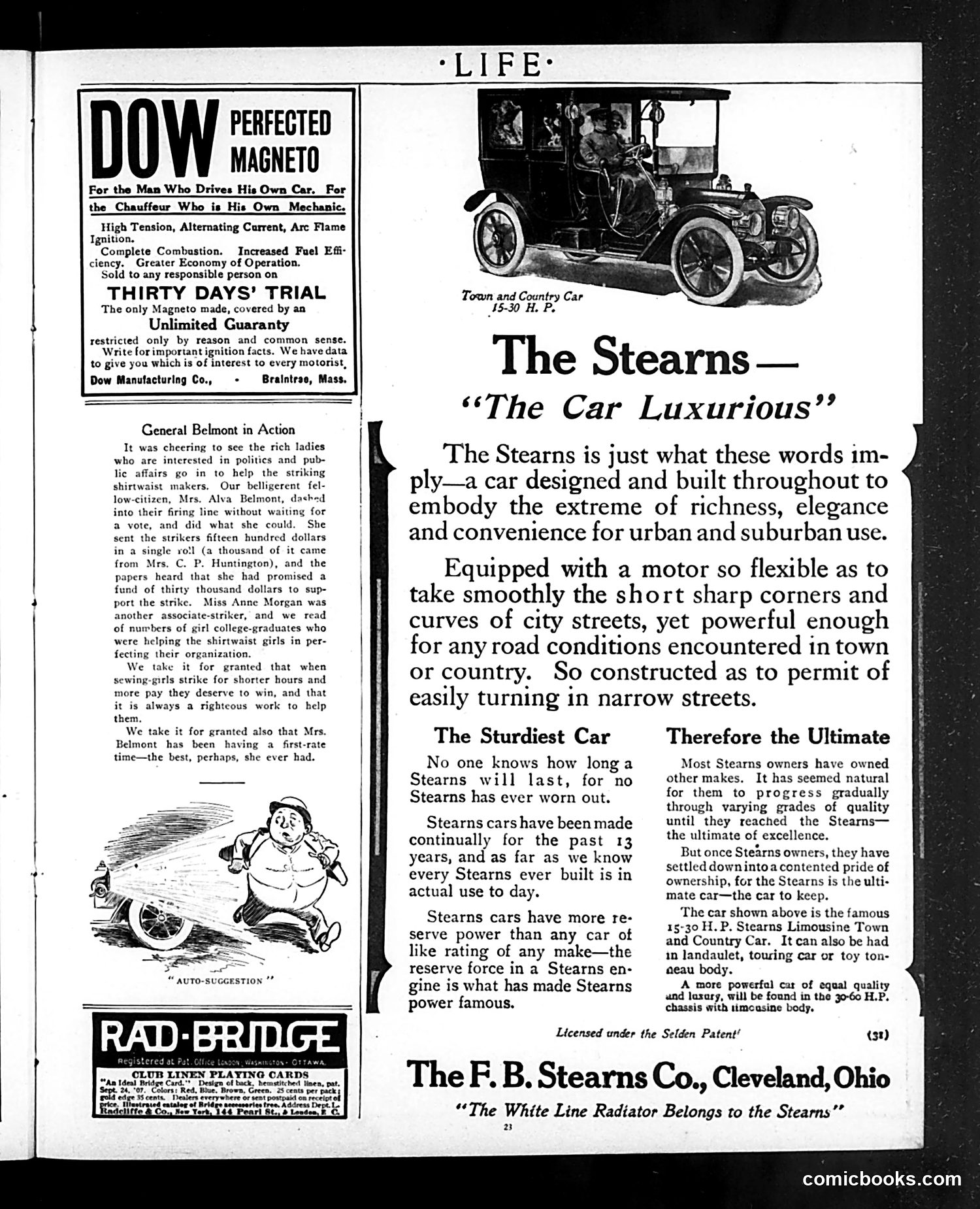
This is primarily an **advertising page** with one small satirical cartoon. The main content features luxury car advertisements (Dow Magneto ignition system and F.B. Stearns automobiles), typical of early 1900s publications. The notable satirical element is the brief article about **"General Belmont in Action,"** referencing wealthy socialite **Alva Belmont's** involvement in the shirtwaist workers' strike (a famous 1909 garment workers' labor dispute). The satire gently mocks wealthy activists: the author notes sardonically that Mrs. Belmont—despite her genuine financial support and that of other wealthy women—likely enjoyed the thrill of "activism" as entertainment, having perhaps "the best...time she ever had." The accompanying cartoon ("Auto-Suggestion") shows a rotund figure happily daydreaming beside an automobile tire, humorously suggesting cars inspire fantasies. The page reflects Progressive Era tensions between labor and capital, and Life's somewhat ambivalent attitude toward wealthy do-gooders.
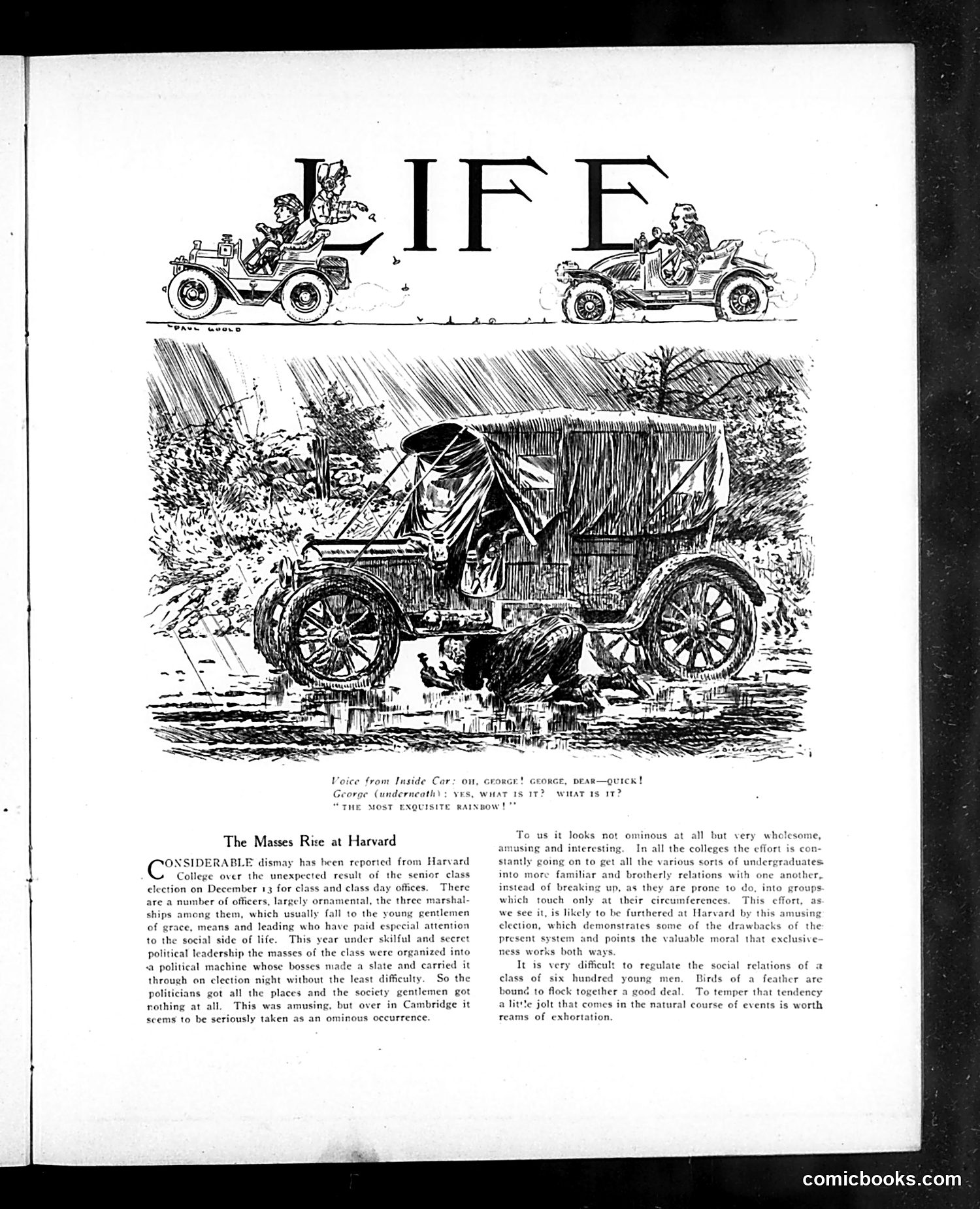
This Life magazine article satirizes Harvard's 1912 senior class election results as socially significant. The cartoon depicts a car stuck in mud—a visual metaphor for the "upset" that occurred. **The Context:** Traditionally, Harvard's class officer elections went to socially prominent, wealthy students ("society gentlemen"). In 1912, however, organized "masses" of ordinary students—"politicians" with a slate—won the positions instead, shocking the elite. **The Satire:** Life mocks the Harvard establishment's panic over this democratic result. The article argues this "ominous" outcome is actually healthy: it demonstrates that exclusive social groups can't control everything, and that mixing social classes teaches valuable lessons. **The Joke:** What horrifies Harvard's upper crust—ordinary students gaining power—Life presents as amusing and beneficial. The caption about the "exquisite rainbow" likely refers to the muddy mess, treating the elite's distress as ridiculous theater. This reflects Progressive Era themes: skepticism toward aristocratic privilege and celebration of democratic leveling.
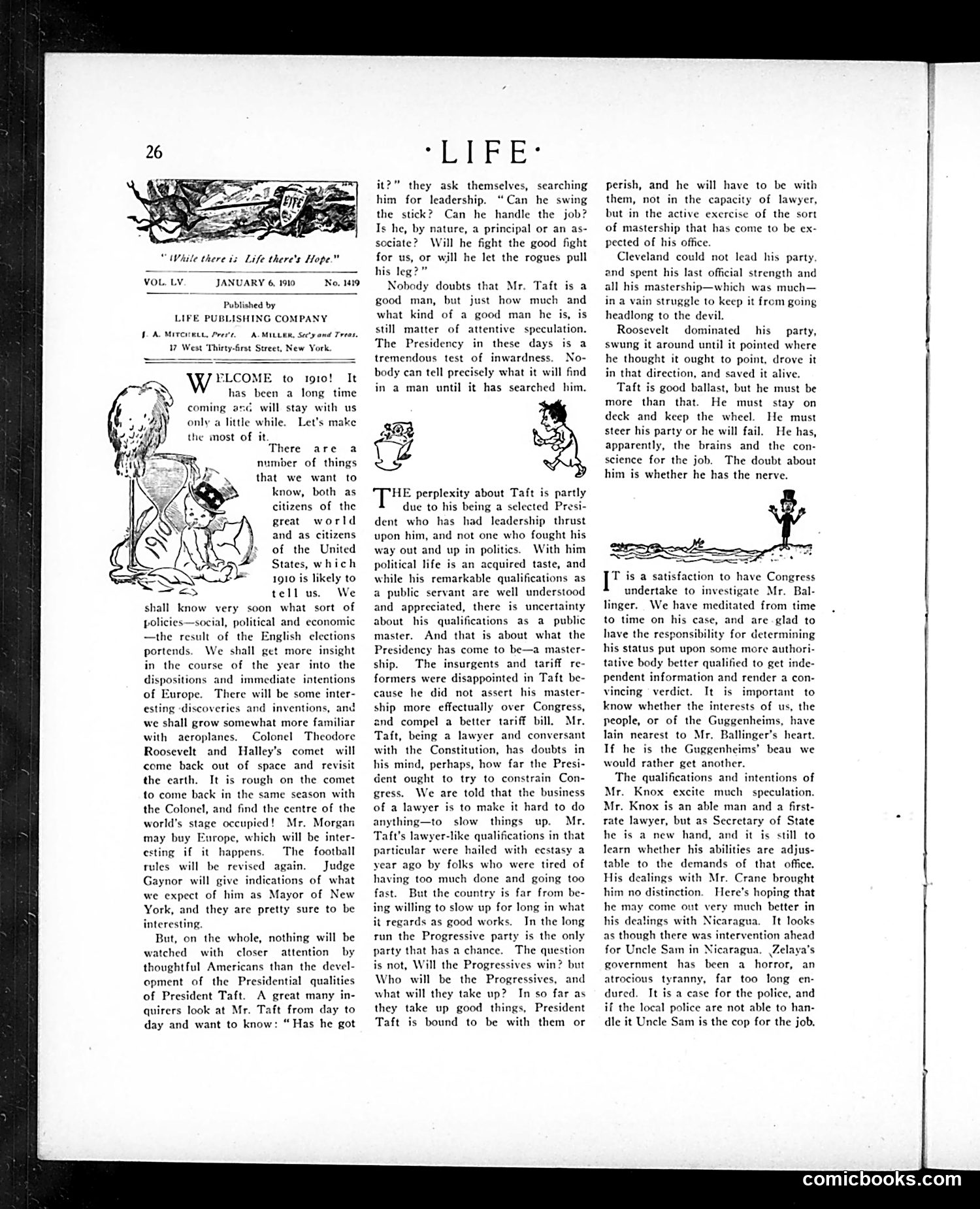
This *Life* magazine editorial assesses President William Howard Taft's leadership abilities as 1910 begins. The piece expresses uncertainty about whether Taft possesses genuine executive strength—asking repeatedly "Has he got it?" and "Can he swing the stick?" The author identifies a core problem: Taft was hand-picked as successor by Theodore Roosevelt rather than rising through political combat. This "selected President" lacks the aggressive mastery the office now demands. His legal background, while respectable, makes him cautious about constitutional limits on presidential power—a lawyer's tendency to complicate rather than act decisively. The editorial warns that the Progressive movement represents the nation's political future, and Taft must align with progressive goals or become irrelevant. The underlying concern: can this cerebral, constitutional lawyer provide the forceful leadership Americans expect, or will he prove merely an "associate" rather than a true "principal"?
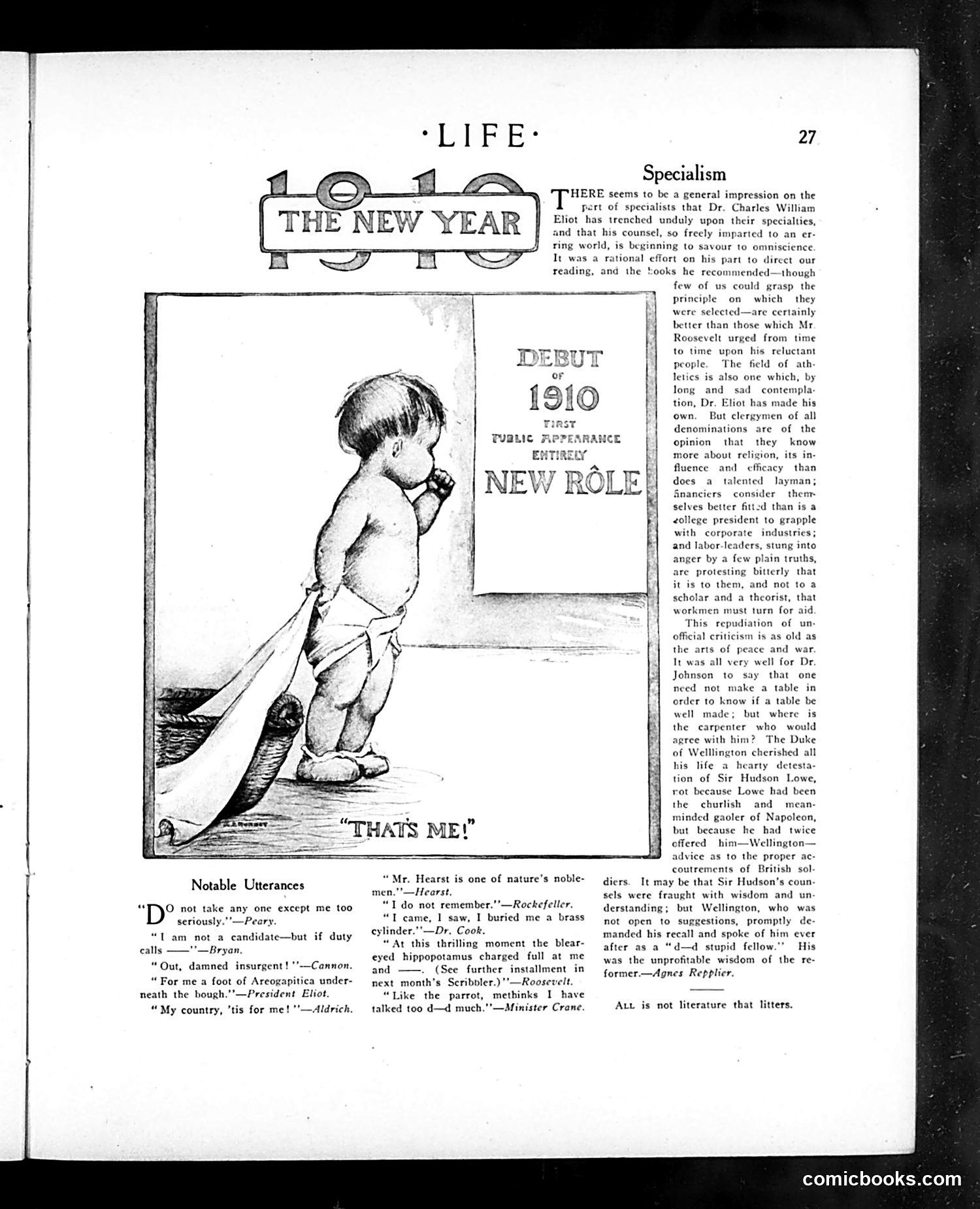
This page satirizes **Dr. Charles William Eliot**, president of Harvard, who had become known for offering unsolicited advice on numerous subjects—from reading lists to athletics to religion—despite lacking expertise in these fields. The cartoon depicts a baby (representing 1910) posting a sign announcing its "debut" and "new role," mocking Eliot's tendency to insert himself into domains beyond his authority. The "Notable Utterances" section below ridicules various public figures' self-serving or evasive statements from 1909-1910, including Theodore Roosevelt, William Jennings Bryan, and Frederick Cook (the fraudulent Arctic explorer). The accompanying essay by Agnes Repplier argues that specialists resent outsiders—even intelligent ones—offering criticism. She illustrates this with historical examples (Dr. Johnson, the Duke of Wellington) to suggest that expertise-based defensiveness is timeless and counterproductive. The satire targets both Eliot's presumption and the defensive attitude of specialists who reject legitimate outside perspective.
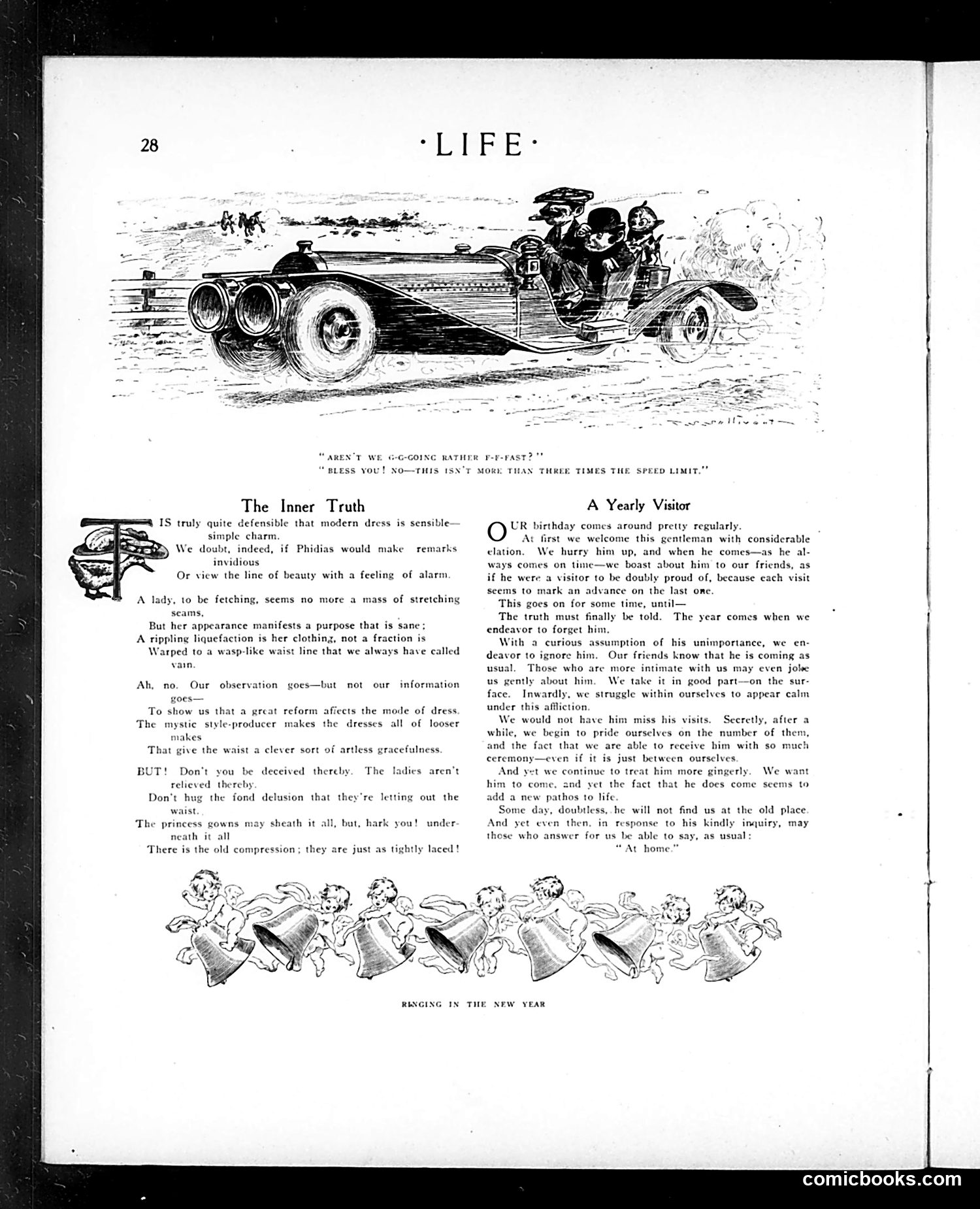
**Top Cartoon:** A speeding car with passengers violates speed limits while one occupant nervously asks if they're going "rather fast." The driver reassures them they're only going "three times the speed limit"—satirizing reckless driving and the absurdity of breaking safety rules while claiming restraint. This reflects early automobile-era anxieties about dangerous driving. **"The Inner Truth":** Critiques women's fashion reform. While modern dress appears looser and more sensible than restrictive Victorian corsets, the text reveals the truth: women still wear tight corsets *underneath* the looser outer garments. The satire mocks the illusion of progress—women haven't actually gained comfort or freedom; they've merely hidden their constraint beneath fashionable appearances. **"A Yearly Visitor":** An essay using "birthday" as a metaphor for aging. It describes how people enthusiastically celebrate birthdays initially, then gradually dread them as they accumulate, secretly resenting the reminder of advancing age while maintaining polite pretense ("At home").
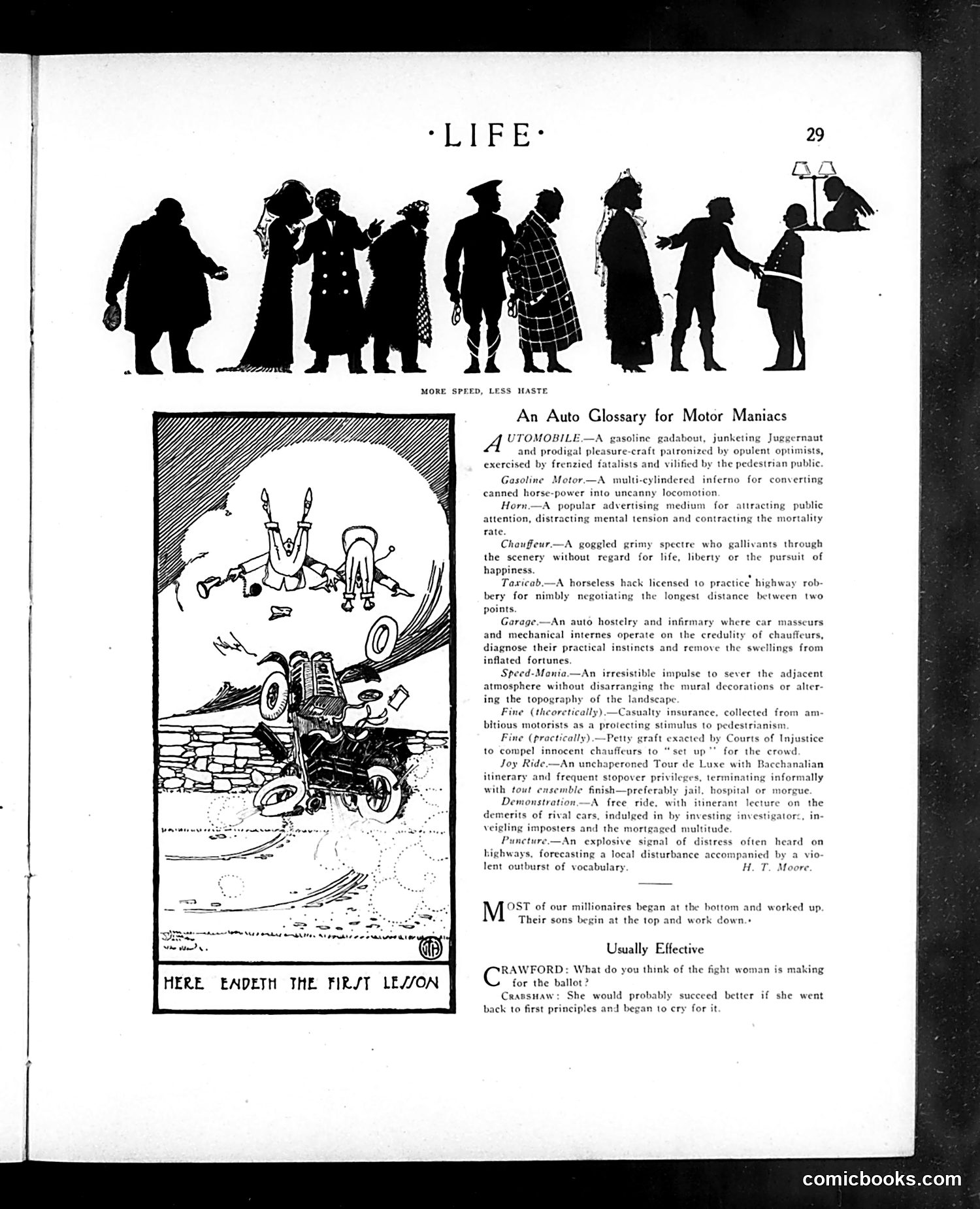
This page satirizes early automobile culture and its social impact. The top silhouette strip titled "More Speed, Less Haste" depicts various pedestrians—men, women, and children—endangered by reckless driving, illustrating the public safety crisis created by fast automobiles. The cartoon "Here Endeth the First Lesson" shows a violent car crash with multiple vehicles destroyed, mocking wealthy drivers' careless attitudes toward expensive machinery and human life. The "Auto Glossary" mockingly defines automobile-related terms: chauffeurs as "goggled grimy spectre[s]" indifferent to life; cars as destructive "Juggernaut[s]"; and horns as noise pollution. The definitions satirize wealthy car owners' arrogance and recklessness. The brief dialogue at bottom jokes about women's suffrage ("the fight woman is making for the ballot"), suggesting women should use emotional manipulation rather than rational argument—typical era sexism. Overall, the page criticizes automobile mania among the wealthy and the dangers this poses to the public.
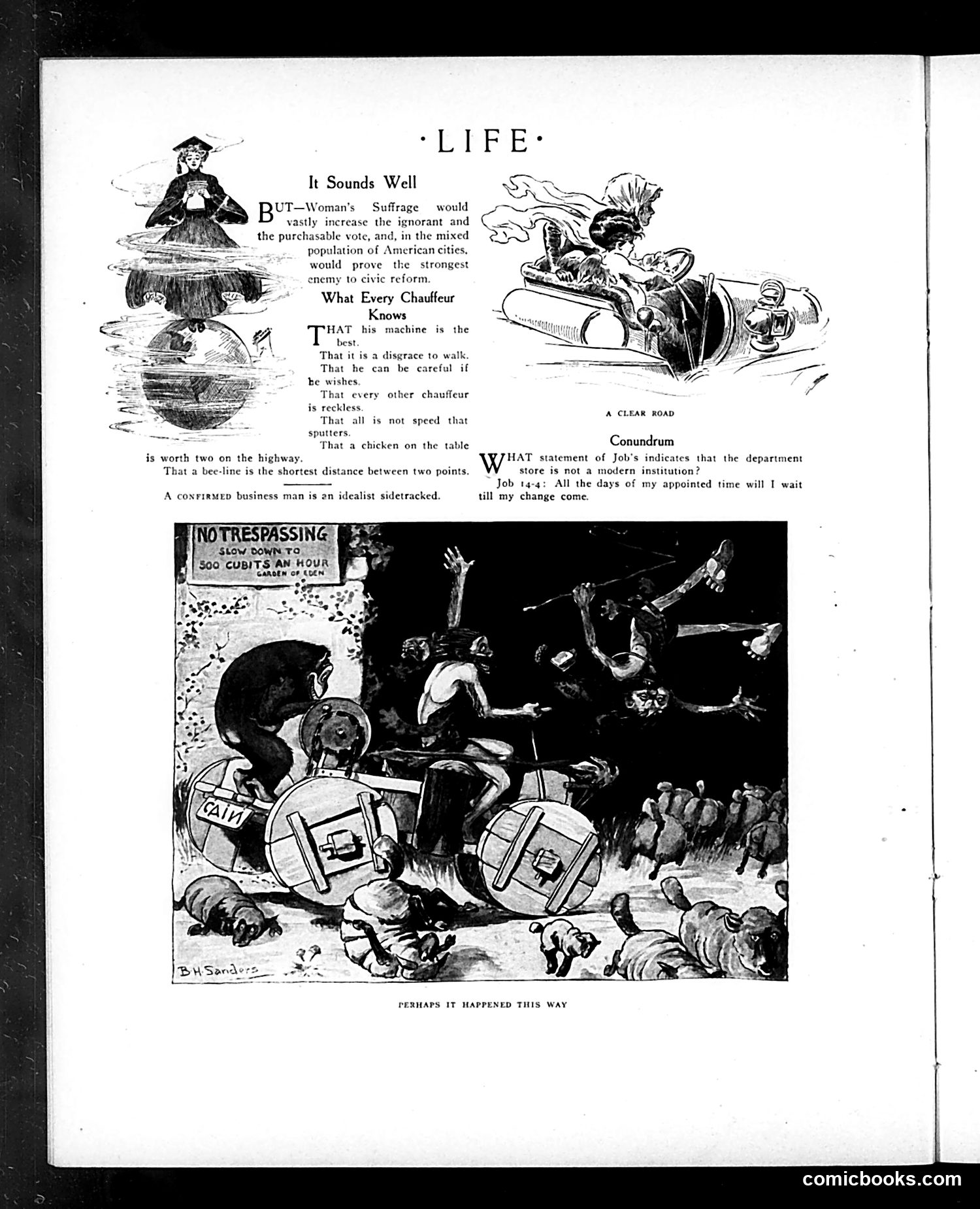
This satirical cartoon depicts a collision between a wealthy motorist (labeled "RAID") and pedestrians near a "No Trespassing" sign. The cartoon critiques reckless automobile driving and class conflict in early 20th-century America. The figure labeled "RAID" appears to represent either wealthy industrialists or corrupt business interests using automobiles as symbols of power. The scattered pedestrians and the "No Trespassing" sign suggest working-class people being literally run down by unchecked capitalism and the nouveau riche obsession with speed and automobiles. The accompanying text mocks chauffeurs' arrogance ("every other chauffeur is reckless") while the upper section satirizes anti-women's-suffrage arguments as hypocritical—opponents claim women voters would be ignorant, yet ignore elite male motorists endangering public safety. The cartoon's title "Perhaps It Happened This Way" suggests this collision represents how social chaos results from unchecked corporate power and wealthy individuals' disregard for ordinary citizens.
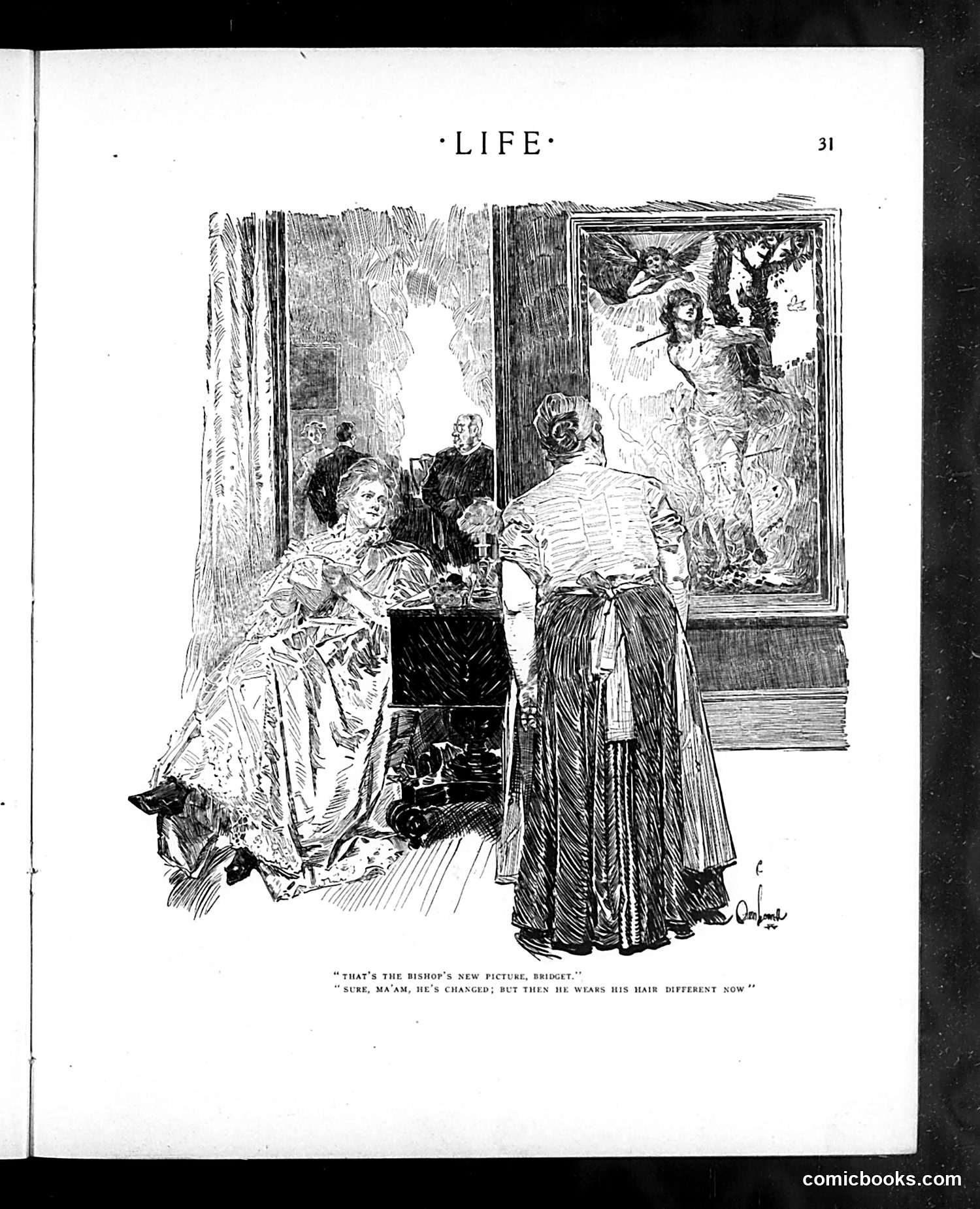
This satirical cartoon from *Life* magazine mocks a bishop's vanity and superficial change. Two women—apparently a servant ("Bridget") and her employer ("Ma'am")—discuss a newly acquired painting. The servant observes that while the bishop claims to have reformed ("he's changed"), the only real difference is his hairstyle. The joke targets clergy hypocrisy: the bishop presents himself as spiritually transformed, yet his actual improvement amounts to nothing more than a cosmetic change in appearance. The servant's working-class perspective cuts through pretense, humorously highlighting the gap between claimed moral improvement and actual substance. This reflects *Life's* satirical tradition of using ordinary people's common sense to expose elite affectation and religious pomposity.
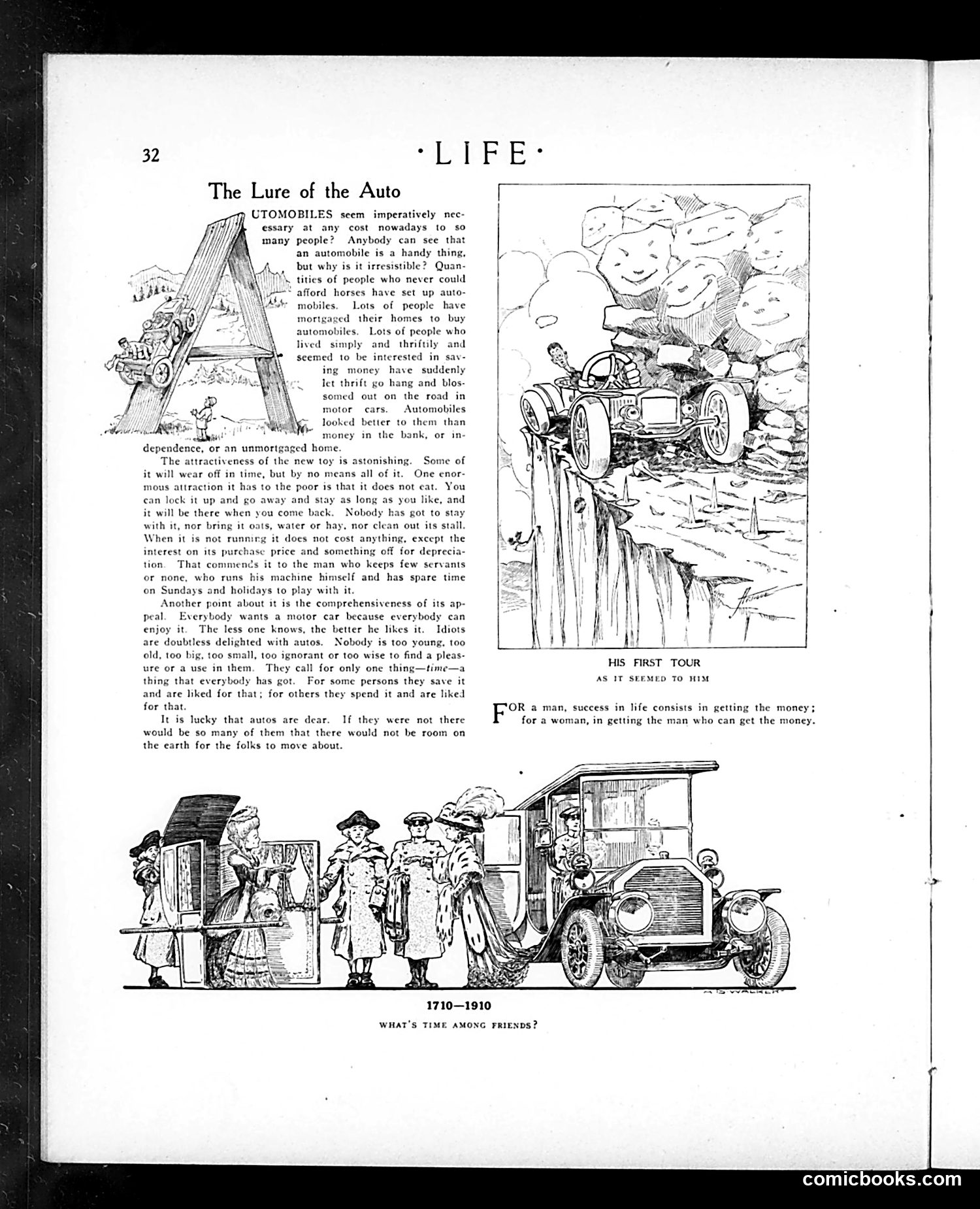
This 1910 article satirizes the automobile's irresistible appeal to Americans across all social classes. The text argues that cars have become a cultural obsession—people who "never could afford horses" are now "mortgaging their homes" to buy them, abandoning thrift and savings. The satire identifies the car's seductive power: unlike horses, it requires no daily maintenance; it's equally appealing to the ignorant and wise; and it offers democratic access—"everybody wants a motor car because everybody can enjoy it." The cartoon contrasts 1710 and 1910: where 18th-century travelers required elaborate horse-drawn coaches and attendants, the 1910 family arrives in a motorcar—suggesting technological progress but also social disruption through automobile adoption. The "His First Tour" illustration shows a wealthy driver joyfully motoring past rural poverty, capturing the era's class tensions as automobiles became status symbols and instruments of leisure for the wealthy.
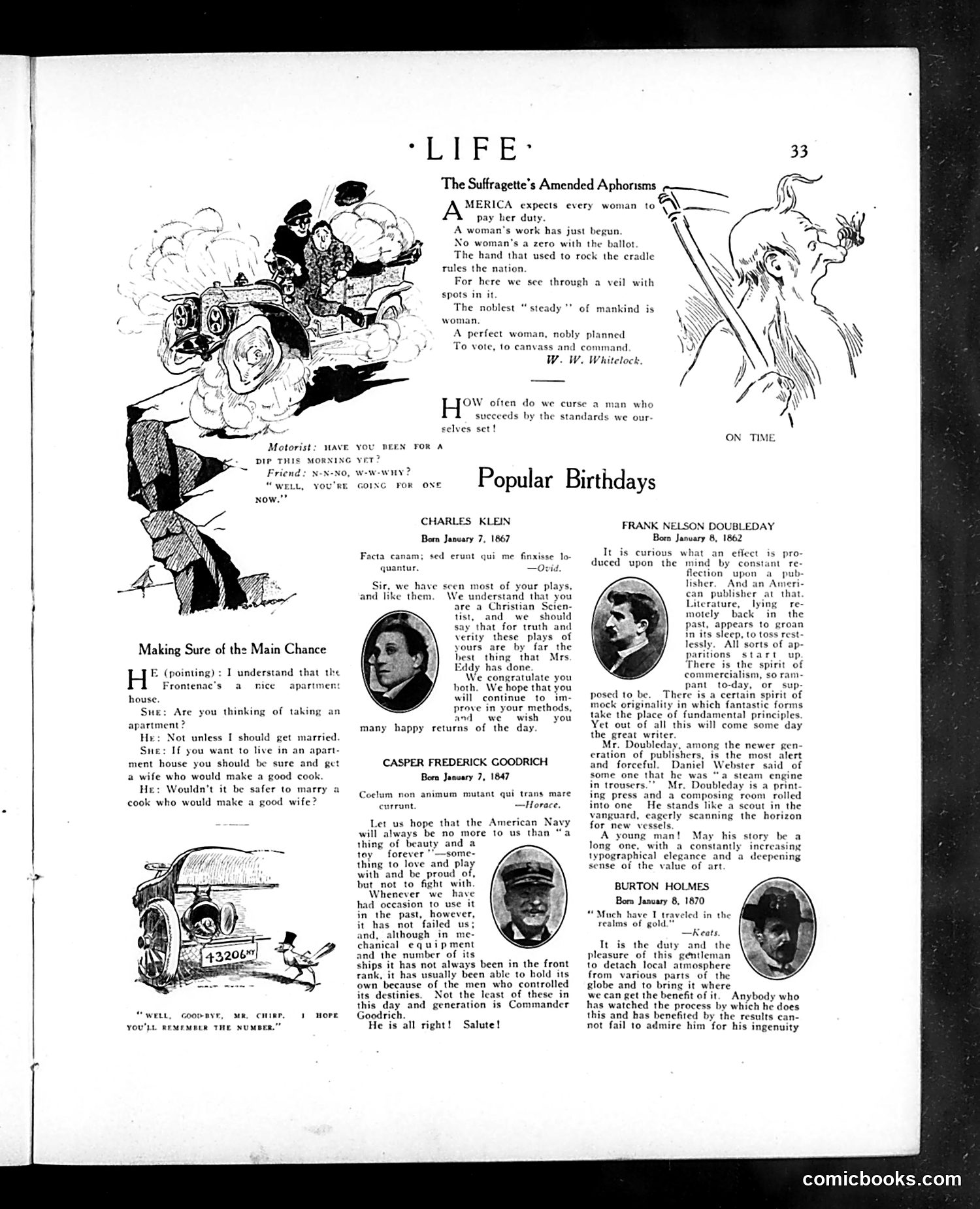
This page from Life magazine (dated January 1867-1870) contains humor and birthday tributes typical of the era. ## The Cartoons: **"Making Sure of the Main Chance"** presents domestic humor: a couple debates whether to marry for practical reasons—he jokes it's safer to marry a good cook who'd make a good wife, rather than a good wife who'd cook. The satirical point mocks matrimonial pragmatism and gender roles. **The motorist cartoon** shows an early automobile joke about remembering license plate numbers. ## "The Suffragette's Amended Aphorisms": This section satirizes women's suffrage advocacy (then a live political issue). It presents pro-suffrage statements like "America expects every woman to pay her duty" and "A woman's work has just begun"—likely mocking suffragette rhetoric by presenting their arguments in exaggerated form. The reference to "the hand that used to rock the cradle rules the nation" sardonically suggests women's political influence. ## Popular Birthdays: Brief celebratory profiles of notable figures: playwright Charles Klein, Navy Commander Casper Goodrich, publisher Frank Doubleday, and explorer Burton Holmes—standard magazine filler praising contemporary luminaries.
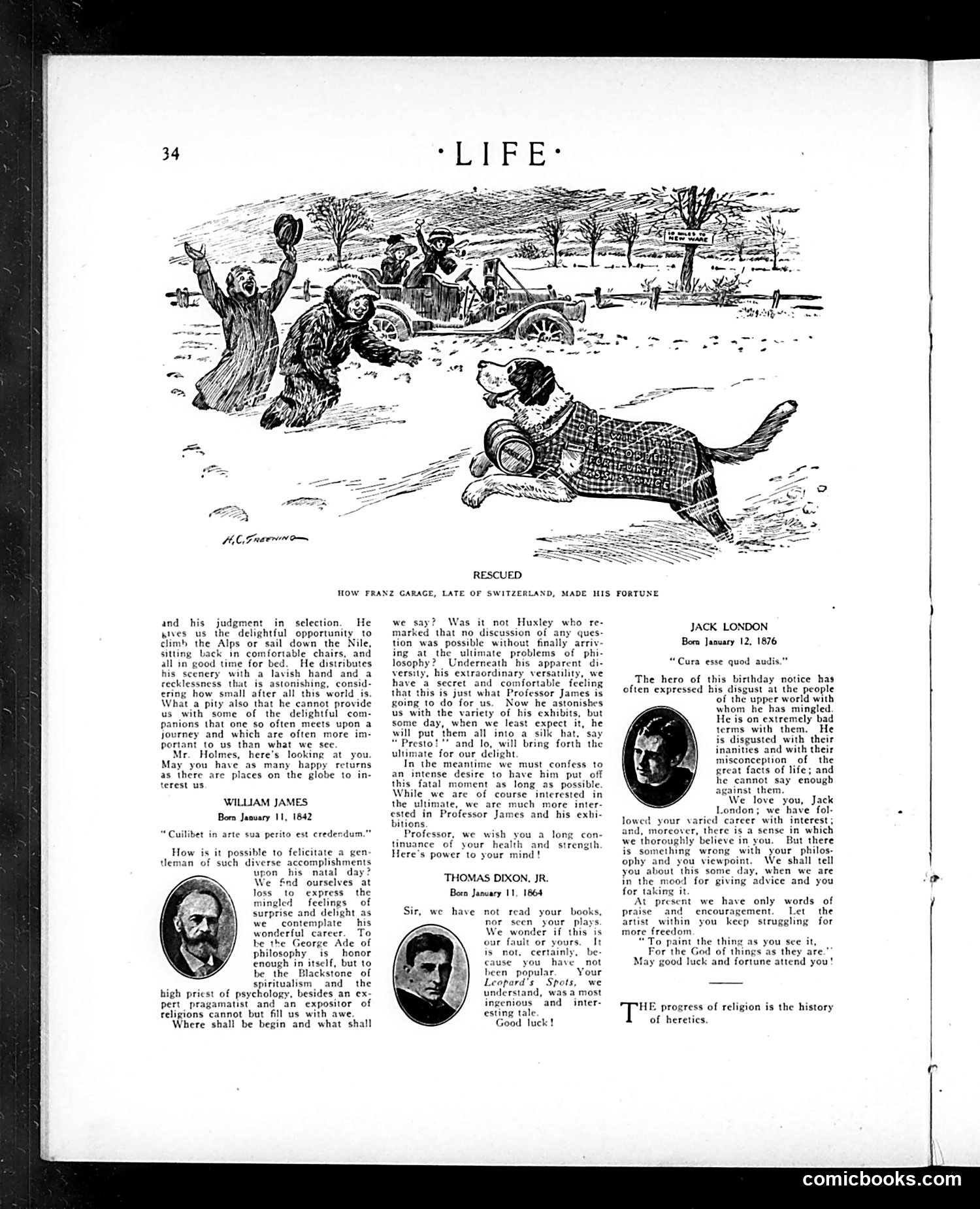
This page celebrates three prominent figures' birthdays: **William James** (philosopher/psychologist, born 1842), **Thomas Dixon Jr.** (playwright/author, born 1864), and **Jack London** (writer, born 1876). The top cartoon shows a dog retrieving a barrel, captioned "RESCUED: How Franz Garage, Late of Switzerland, Made His Fortune"—likely a humorous anecdote about a Swiss character's unlikely path to wealth. The birthday tributes are affectionate roasts. **James** is praised for his intellectual versatility across philosophy, psychology, and spiritualism—compared to literary figure George Ade and legal scholar Blackstone. **Dixon** receives a backhanded compliment: the writers haven't read his work (*The Leopard's Spots*), questioning whether that's his or their fault. **London** is celebrated as an artist but criticized for misanthropic philosophy and misconceptions about life, though the editors encourage his continued creative struggle. The page exemplifies *Life* magazine's satirical, intellectual humor—mixing gentle ribbing with genuine respect for cultural figures.
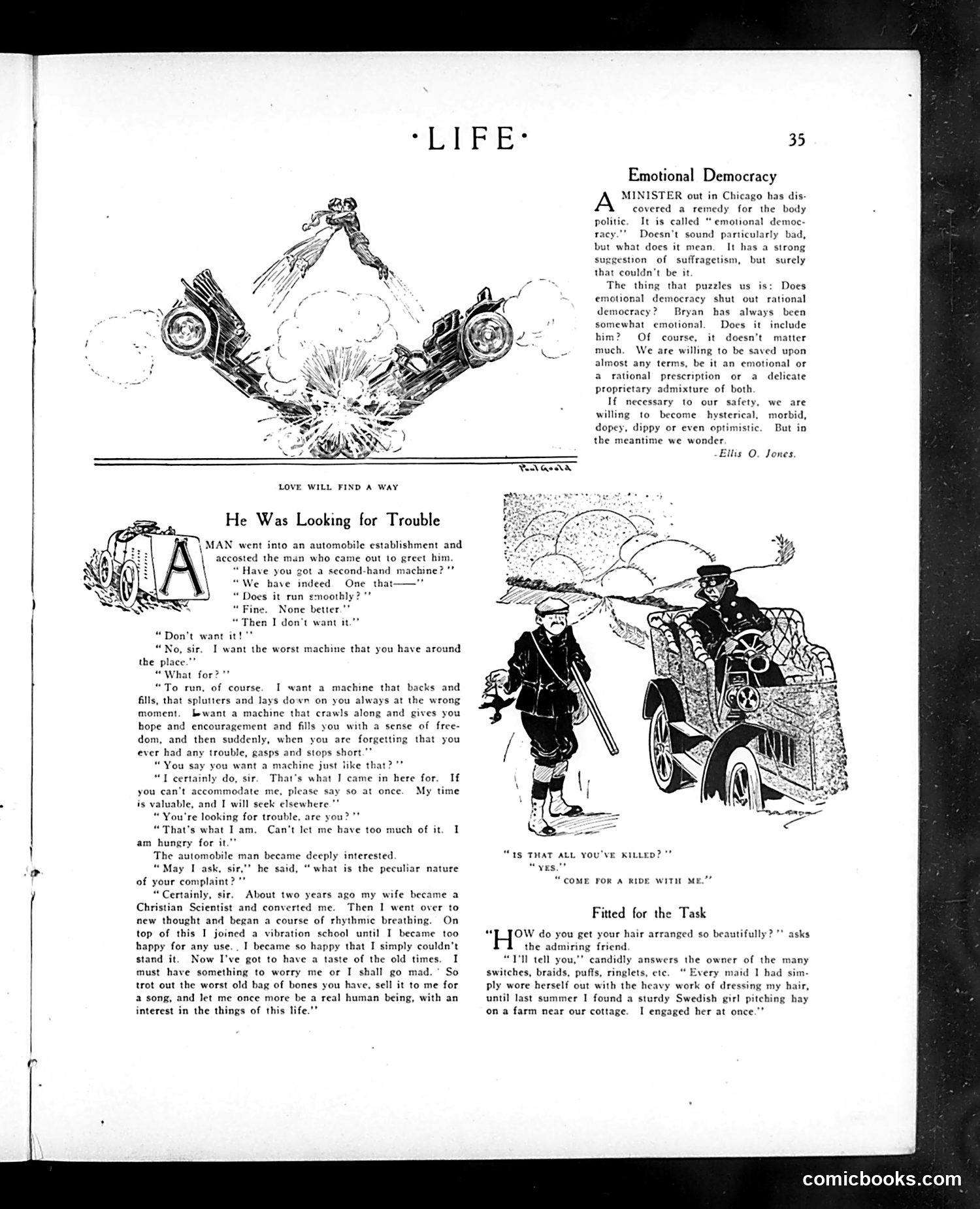
This page contains three satirical pieces: **"Emotional Democracy"** (top): A brief editorial mocking a Chicago minister's proposed cure for societal problems. The satire suggests the concept is vague and potentially connected to suffragism (women's voting rights), a contentious contemporary issue. The author (Ellis O. Jones) expresses willingness to accept any remedy—emotional, rational, or even "hysterical"—if it helps, while questioning what "emotional democracy" actually means. **"He Was Looking for Trouble"** (main story): A humorous dialogue where a man seeks the *worst* automobile rather than the best. He explains he's become too happy through Christian Science and "new thought" movements, and needs life's old problems back to feel human. This satirizes early-1900s wellness crazes (Christian Science, new thought, vibration therapy) by suggesting their promise of happiness is actually unhealthy. **"Fitted for the Task"** (bottom right): A brief joke about a woman employing a Swedish farm worker to do her elaborate hair styling—implying such labor-intensive beauty standards require hiring domestic help. The page satirizes contemporary fads and social movements through humor.
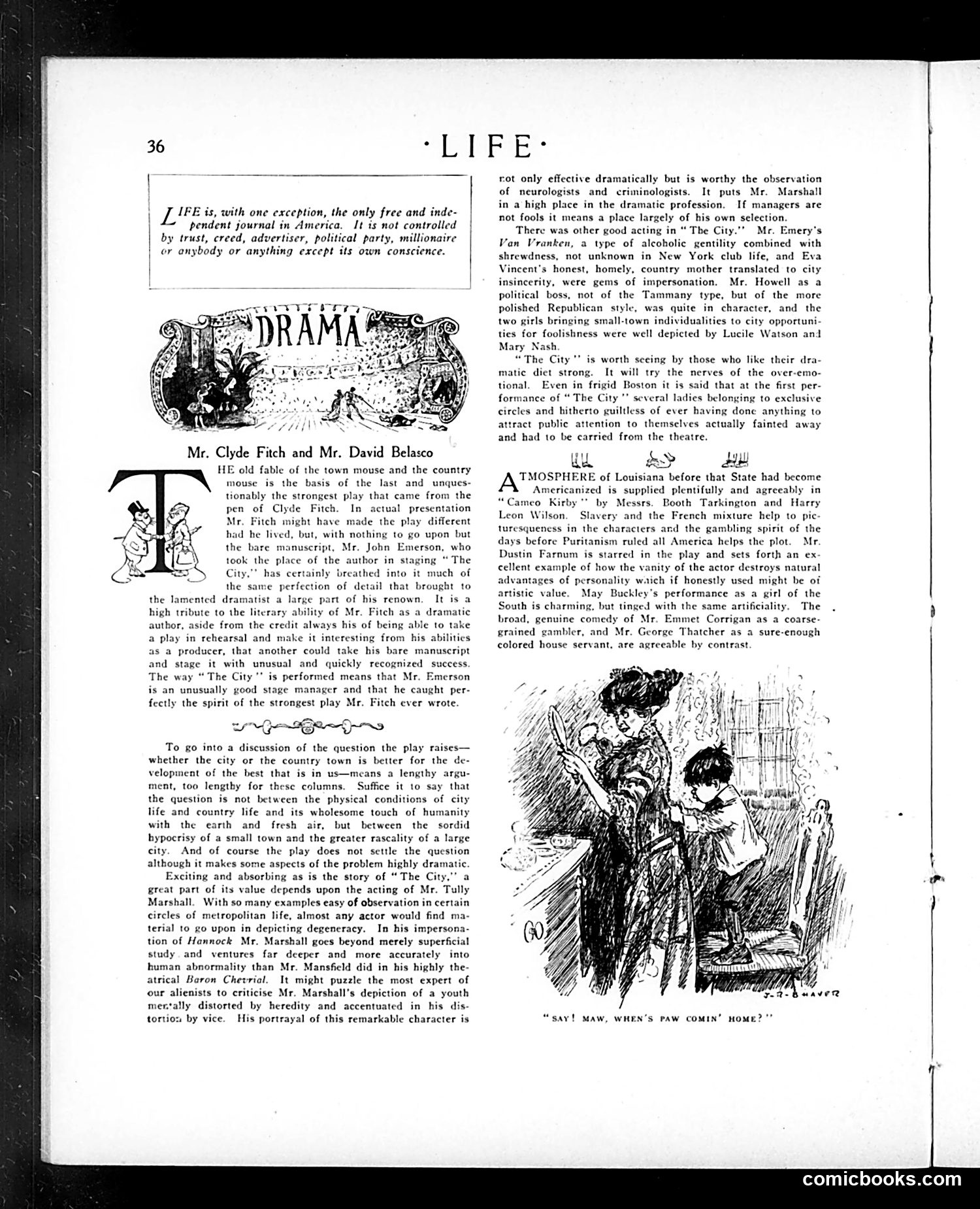
This page reviews **"The City,"** a play by the late dramatist Clyde Fitch, staged by director John Emerson after Fitch's death. The review praises Emerson's staging and particularly actor Tully Marshall's performance as the character Hannock, a youth morally corrupted by heredity and vice. The central dramatic tension involves the classic **town-mouse versus country-mouse fable**: comparing whether small-town or urban life better develops character. The play argues that small-town hypocrisy rivals big-city rascality—neither environment is morally superior. The sketch illustration (bottom right) shows what appears to be a domestic scene, likely depicting the play's action. The review is substantively about theater criticism and acting merit rather than political satire. It positions *Life* magazine itself (in the header box) as uniquely independent from commercial interests—a claim about editorial integrity rather than commentary on current events.
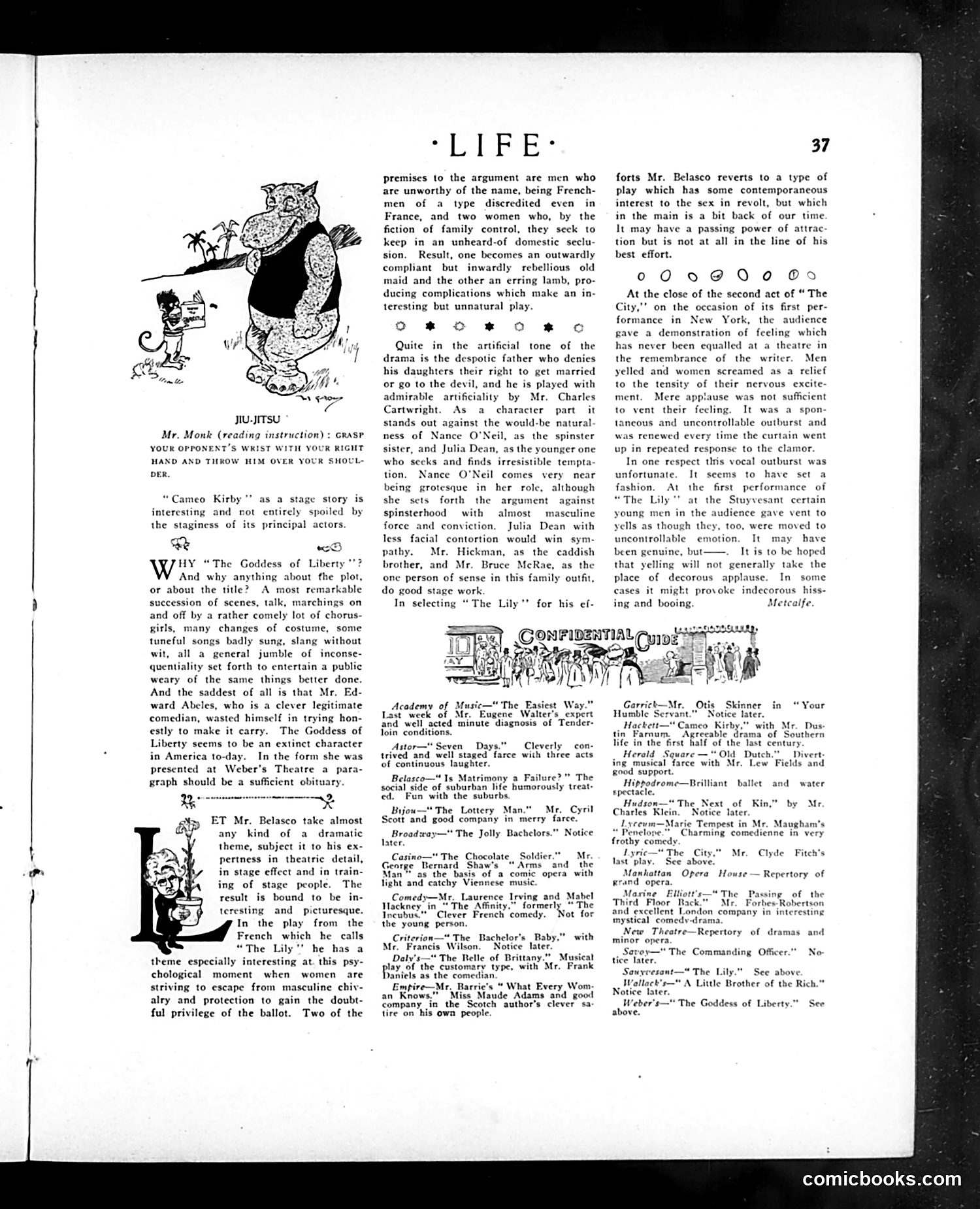
## The Cartoon The top cartoon illustrates "Wu-Jitsu," a martial arts instruction joke. Mr. Monk reads instructions on how to throw an opponent over one's shoulder using a wrist grip. The humor lies in the absurdity of the instruction itself—it's impractical self-help comedy about a fashionable martial art craze of the era. ## The Theater Reviews The bulk of this page contains reviews of Broadway productions. The main critique discusses "The Goddess of Liberty" at Weber's Theatre—a poorly constructed play featuring chorus girls, costume changes, and tuneful songs that the critic finds tedious. The reviewer praises actor Edward Abeles for his effort despite weak material. "The Lily" by David Belasco receives more favorable notice. The critic highlights its psychological relevance: the play explores women's struggle for independence from male "chivalry and protection" to gain "the doubtful privilege of the ballot"—a direct reference to the women's suffrage movement. The review discusses the cast's performances and the play's artificial but dramatically interesting treatment of familial control and female autonomy.
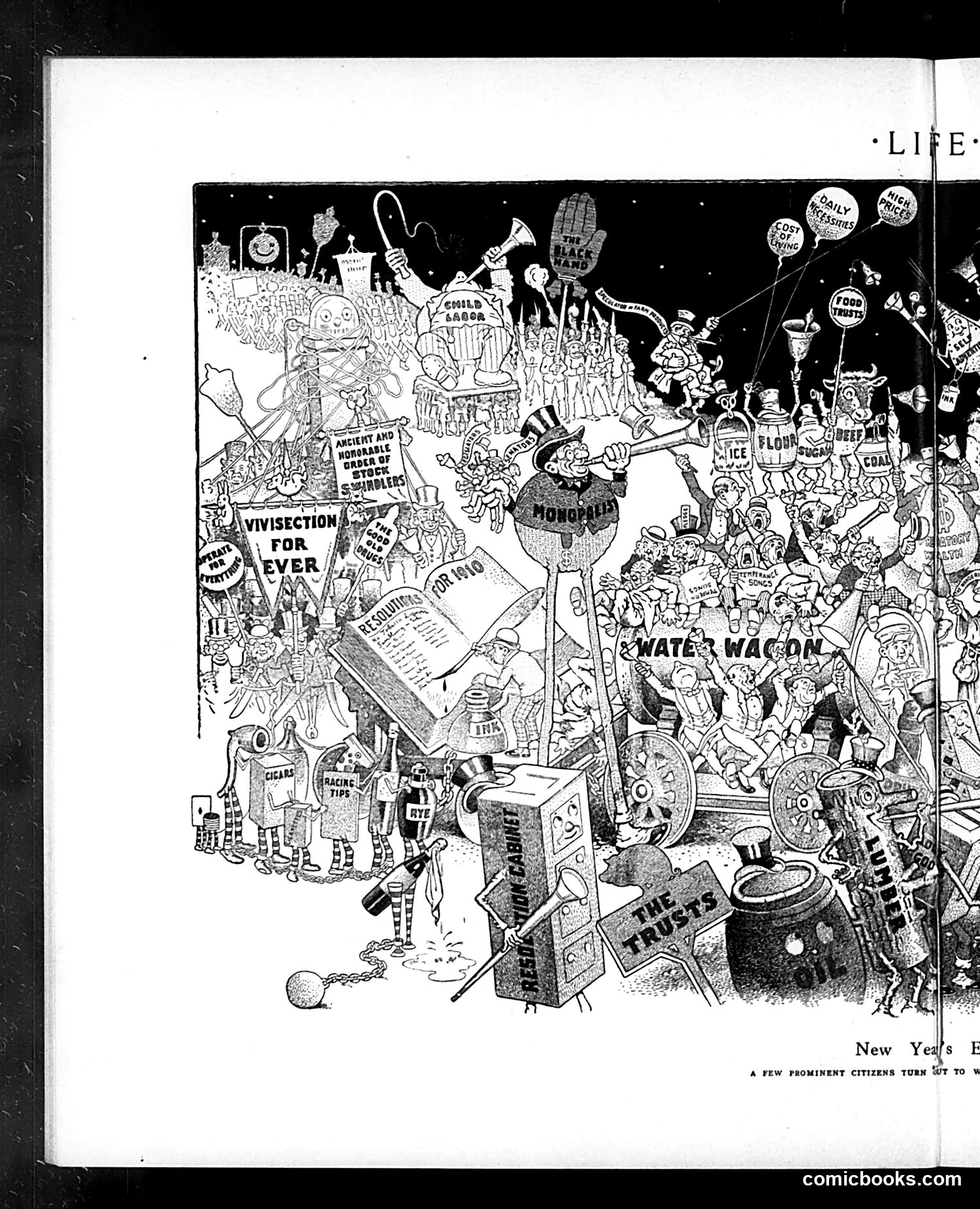
This is a densely packed satirical cartoon depicting New Year's Eve celebrations amid social criticism. The image shows crowds of revelers alongside figures representing corporate interests and monopolies—visible labels include "MONOPOLY," "THE TRUSTS," "FOOD TRUSTS," and references to coal and ice monopolies. The cartoon satirizes how wealthy industrialists and corporate monopolists celebrate while ordinary citizens party around them. Signs reading "VIVISECTION FOR EVER" and "ANCIENT AND HONORABLE ORDER OF SHIRKERS" suggest mockery of both business practices and social parasitism. The overall message appears to critique how robber barons and monopoly capitalists profit from essential goods while the public celebrates obliviously. This reflects early 20th-century American anxieties about corporate consolidation and economic inequality.
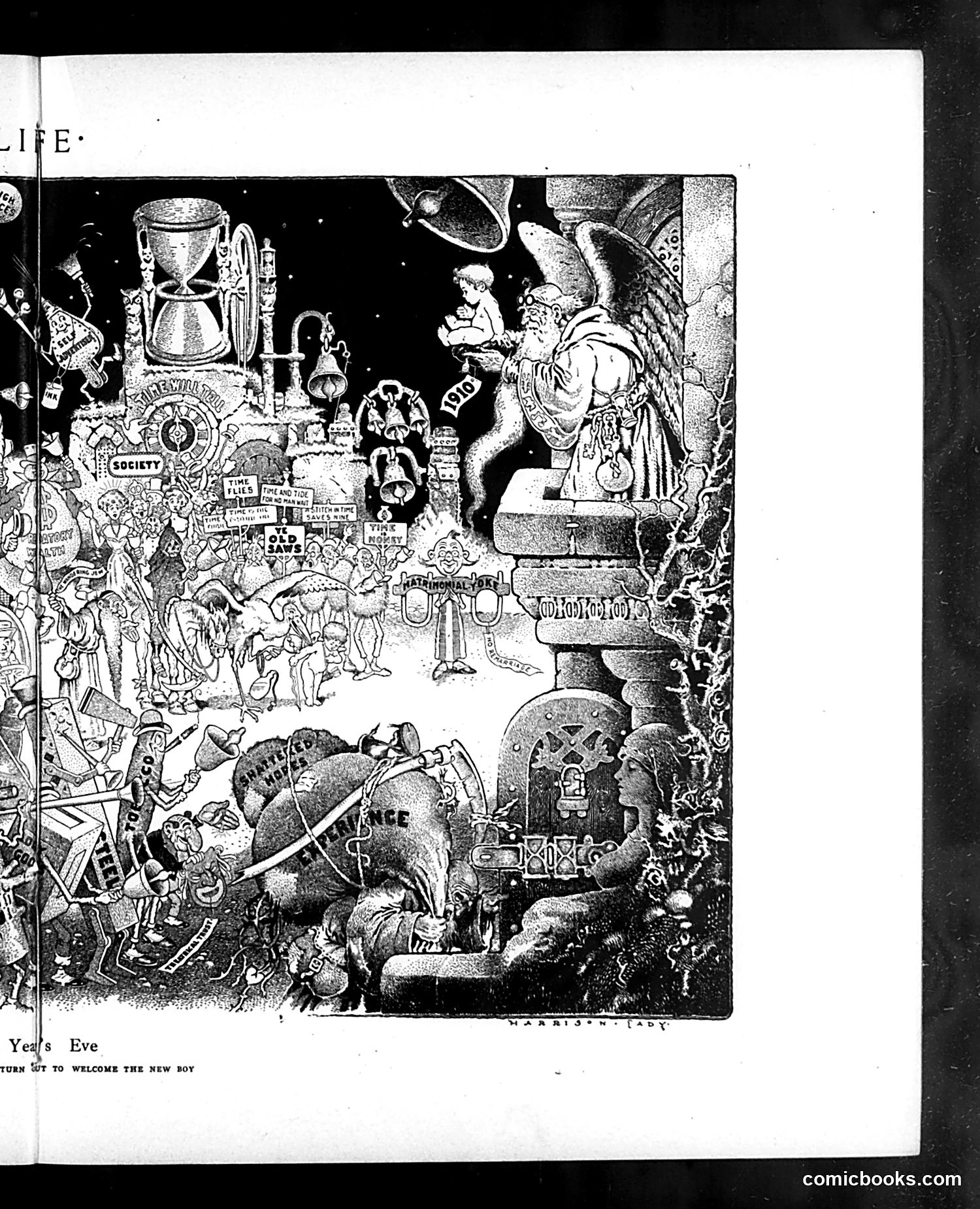
This is a densely packed satirical cartoon celebrating New Year's Eve. The illustration depicts a chaotic, allegorical scene welcoming the incoming new year (represented as "the new boy"). The composition includes numerous symbolic elements: Father Time with his hourglass and scythe appears prominently, alongside various figures representing society, institutions, and abstract concepts. Labels visible include "SOCIETY," "TIME," and references to social elements of the era. The satire critiques how society prepares to greet each new year—with fanfare, celebration, and often unrealistic hopes—despite the chaos and contradictions embedded in the existing social order. The crowded, intricate style emphasizes the complexity and absurdity of modern life the cartoonist is mocking.
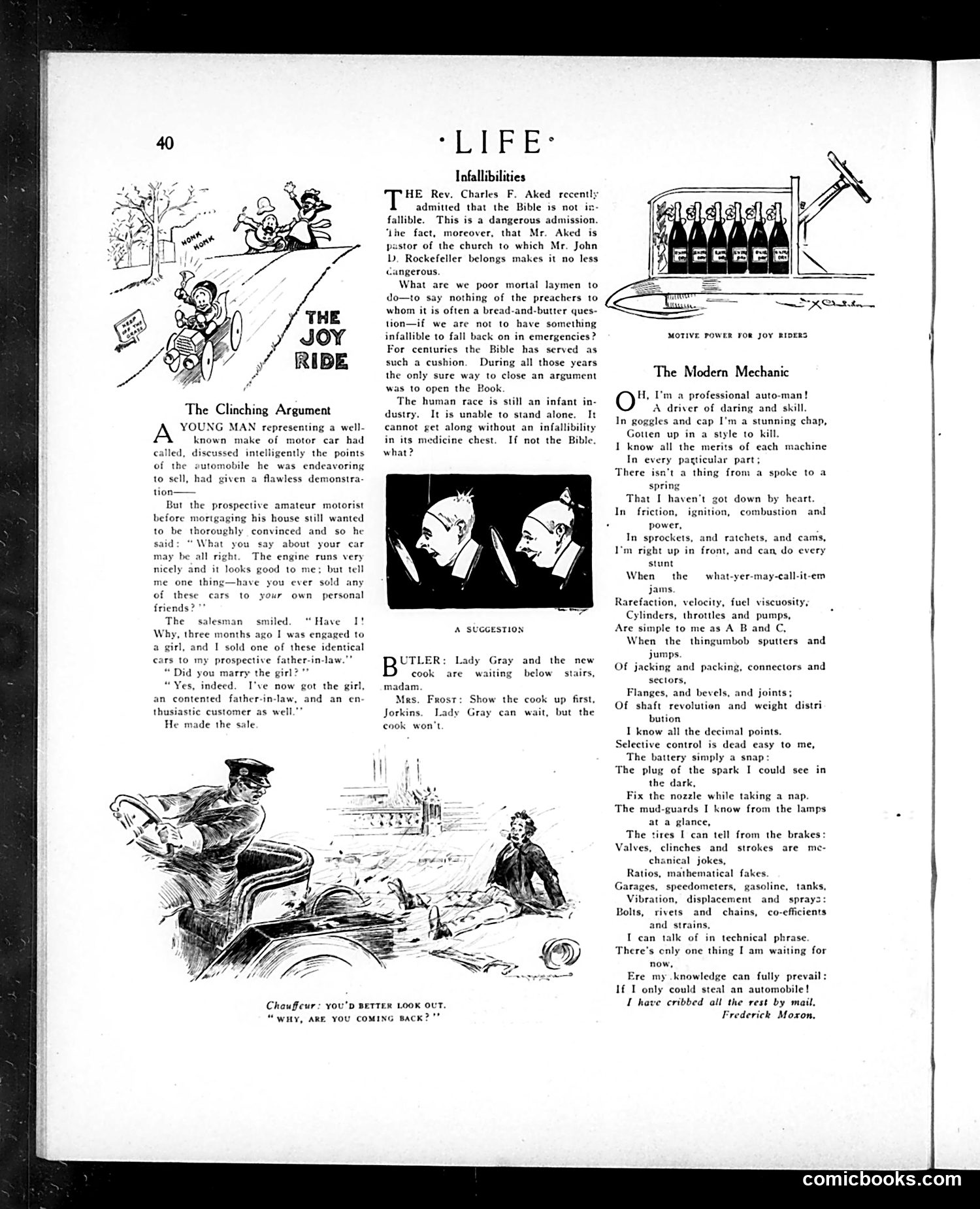
This page contains three satirical pieces targeting early 1900s American society: **"The Clinching Argument"** mocks automobile salesmen's persuasiveness. A car salesman clinches a sale by claiming he's sold identical cars to his fiancée and prospective father-in-law—implying the vehicles are so reliable they've strengthened family bonds. The joke: he's using personal relationships, not product merit, to overcome the buyer's hesitation. **"Infallibilities"** critiques Rev. Charles F. Aked's admission that the Bible isn't infallible. The satire targets religious uncertainty: if even clergy doubt scripture's perfection, what absolute authority remains for ordinary people in moral emergencies? The mention of Rockefeller (a major church donor) adds irony about wealth's influence on doctrine. **"The Modern Mechanic"** presents a boastful motorist who claims mastery of every automotive technical detail—yet admits he's "cribbed" this knowledge "by mail" and still hasn't actually owned a car. The satire mocks the gap between mechanical pretension and actual experience in the automobile age.
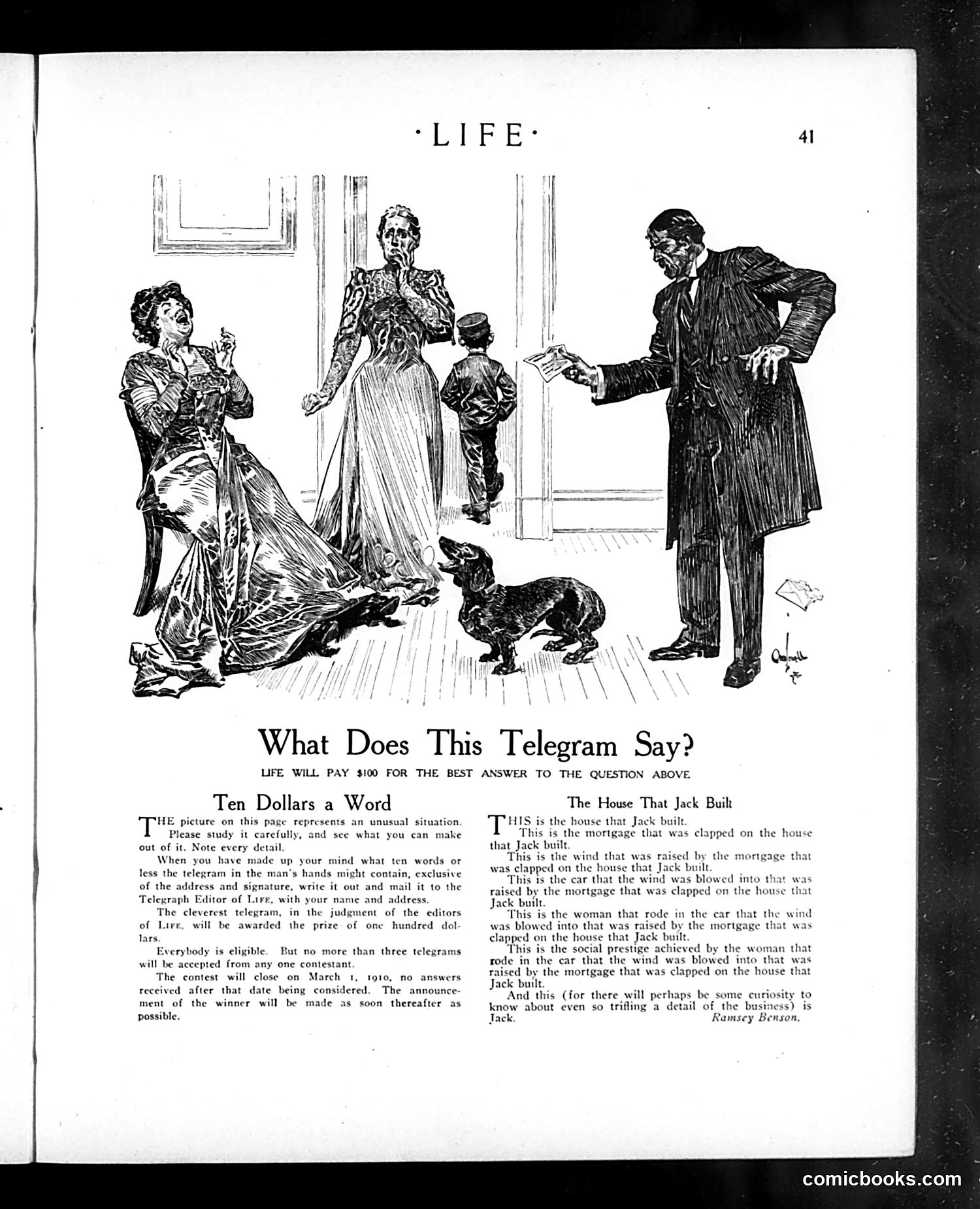
This page presents two distinct elements: **Main Contest**: "What Does This Telegram Say?" — A reader contest offering $100 for the cleverest ten-word interpretation of a telegram visible in an illustration. The image shows a domestic scene with well-dressed figures, a small child, and a dachshund, with a man holding what appears to be a telegram. The humor likely derives from guessing what dramatic or humorous message the telegram contains based on the characters' expressions and body language. **"The House That Jack Built"**: A satirical prose piece by Ramsey Benson that uses the cumulative structure of the nursery rhyme to mock financial excess and social climbing. It traces a chain of consequences: a mortgage leads to financial strain, which somehow results in a woman gaining "social prestige" through automobile ownership—suggesting that Depression-era debt and conspicuous consumption were intertwined paths to social status. The piece gently ridicules how mortgages and material goods became markers of respectability.
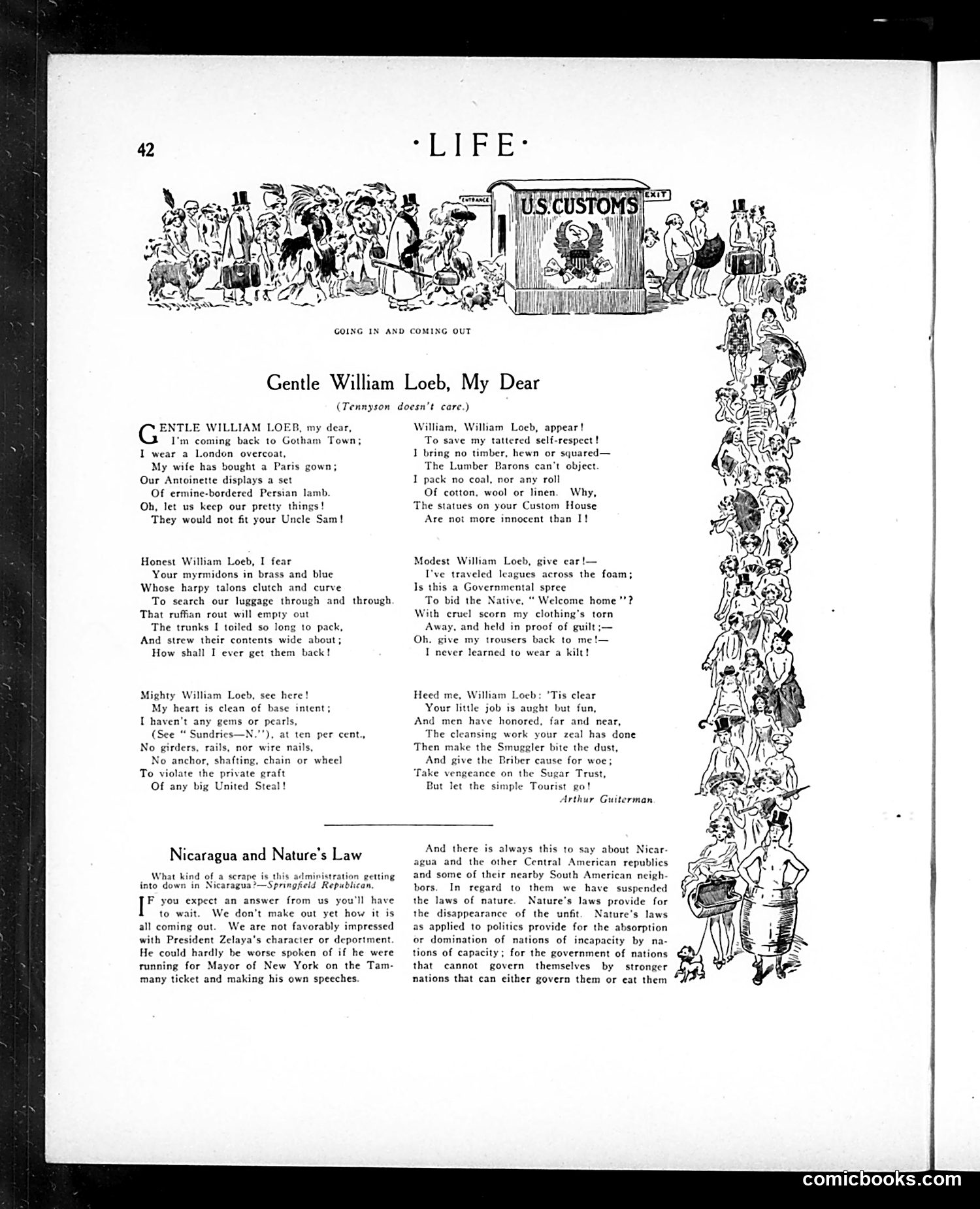
This page satirizes **William Loeb**, likely the U.S. Collector of Customs, who aggressively inspected returning American travelers' luggage for smuggled goods. The poem "Gentle William Loeb, My Dear" (parodying Tennyson) humorously presents a wealthy traveler's complaint: he's purchased fine European goods (London coats, Paris gowns, ermine) and fears Loeb's customs agents will ransack his trunks, yet he protests he's smuggling nothing of value—no industrial materials that would benefit "big United Steal" (monopolies). The satire mocks both the overzealous customs enforcement and the era's class tensions: the wealthy expect special treatment while ordinary commerce faces scrutiny. The bottom section, "Nicaragua and Nature's Law," references U.S. intervention in Nicaragua under President Zelaya, suggesting America suspends natural laws regarding weaker nations, implying imperialist double standards. The cartoons along the margins depict the customs inspection chaos.
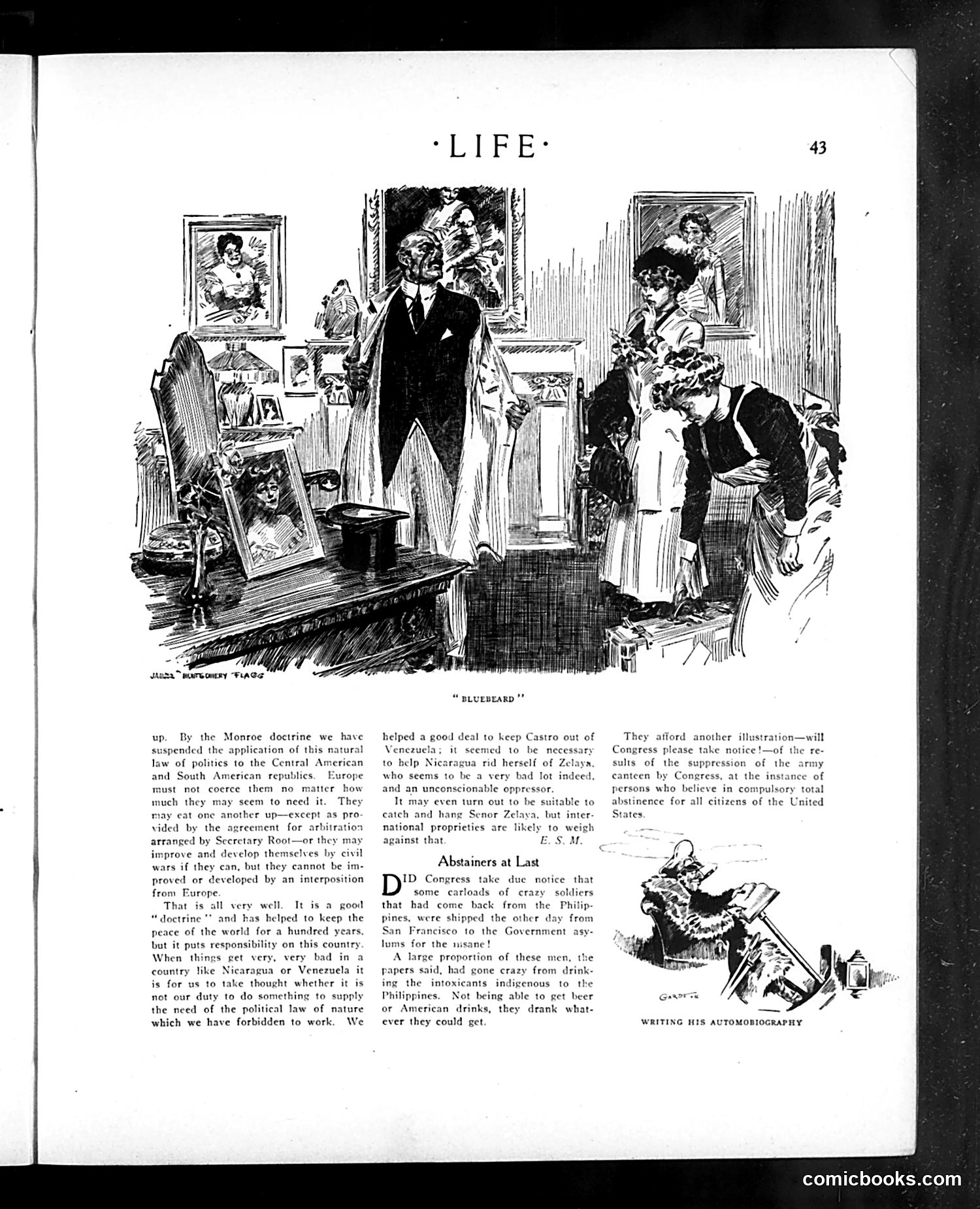
This *Life* magazine page contains political commentary on U.S. interventionism and domestic policy circa early 1900s. The main cartoon, titled "Bluebeard," depicts a man in formal dress surrounded by portraits and documents in an interior setting—likely satirizing U.S. foreign policy under the Monroe Doctrine. The text discusses whether America should intervene in Central American instability (mentioning Castro in Venezuela and Zelaya in Nicaragua), suggesting the policy creates moral responsibility while respecting non-interference. The second article, "Abstainers at Last," reports that soldiers returning from the Philippine-American War were institutionalized after drinking indigenous intoxicants because Congress had banned alcohol from military canteens. The satire mocks prohibition advocates: their policy to enforce sobriety backfired, driving desperate soldiers to consume whatever substitutes available—resulting in psychiatric casualties. The cartoon "Writing His Autobiography" appears to illustrate this ironic consequence.
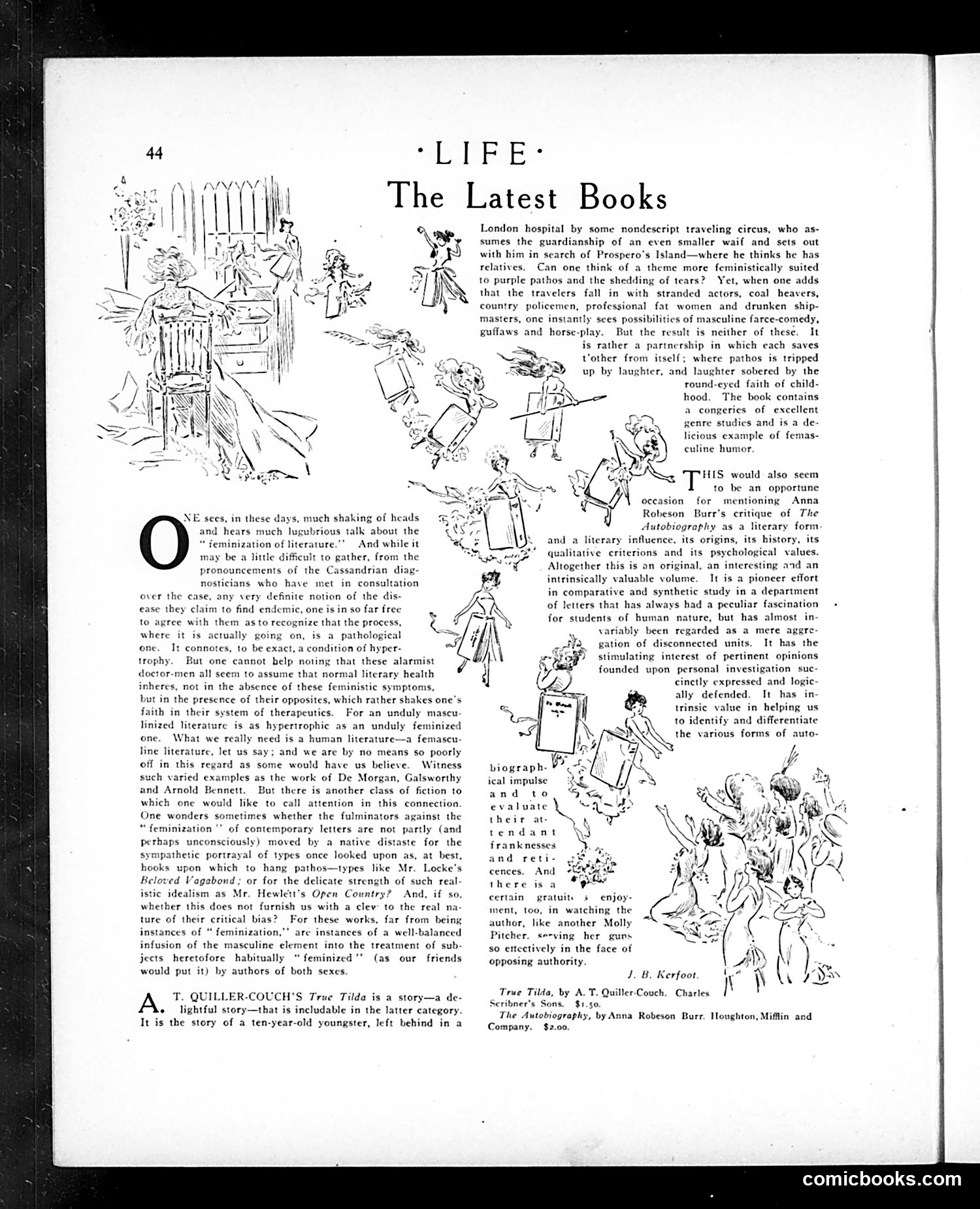
This page discusses the contemporary literary debate over "feminization of literature." Critics claimed modern writing was becoming too sentimental and emotionally focused—coded language for work by or about women. The reviewer argues this critique is flawed, noting that truly healthy literature requires balance rather than aggressive "masculinity." He defends works like Galsworthy's and Bennett's as well-balanced, and praises A.T. Quiller-Couch's *True Tilda*—a children's story that could seem sentimentally feminine (orphans seeking refuge) but combines pathos with masculine elements like farce and comedy. The cartoon illustrations appear to show characters from *True Tilda*, likely depicting the circus children and their various traveling-companion encounters. The review essentially argues: good literature transcends gendered categories; dismissing "feminine" work reflects critical bias rather than literary merit.
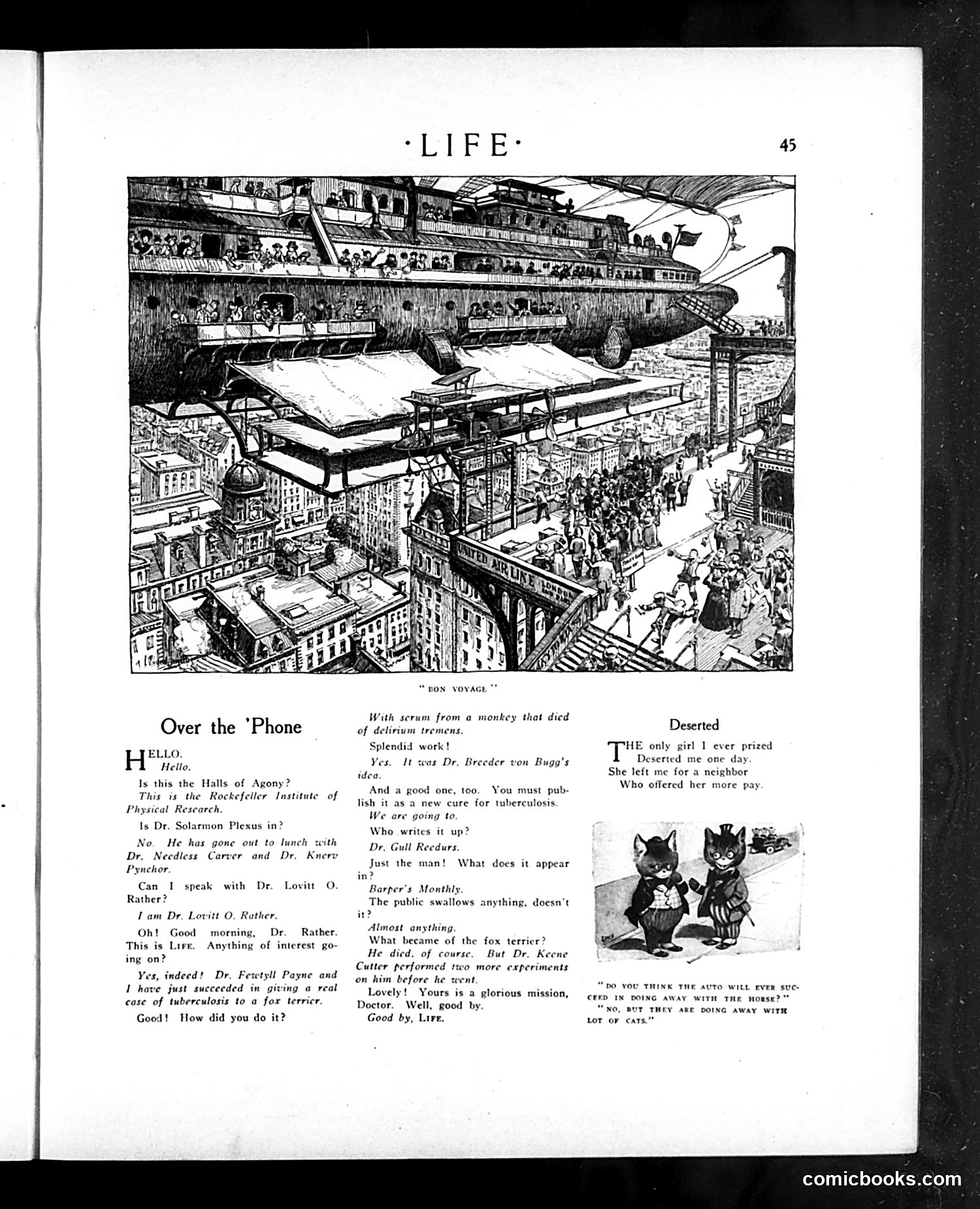
This page satirizes early 20th-century medical research ethics and sensationalism. The phone conversation mocks dubious scientific practices at prestigious institutions (the "Rockefeller Institute" and similar-sounding facilities). Researchers with absurd names (Dr. Needless Carver, Dr. Fenetyll Payne) deliberately infect a dog with tuberculosis—seemingly pointless cruelty—then plan to publish it as a "cure," knowing Harper's Monthly readers will believe anything. The satire targets both unethical experimentation and credulous public acceptance of pseudoscience. The magazine mockingly suggests doctors perform experiments simply to perform them, with no genuine medical benefit. The small cartoon about the auto abandoning the horse appears unrelated—likely a separate joke about automobiles replacing horse-drawn transportation, with the punchline that cats, not horses, are vanishing (possibly due to urban development or traffic dangers).
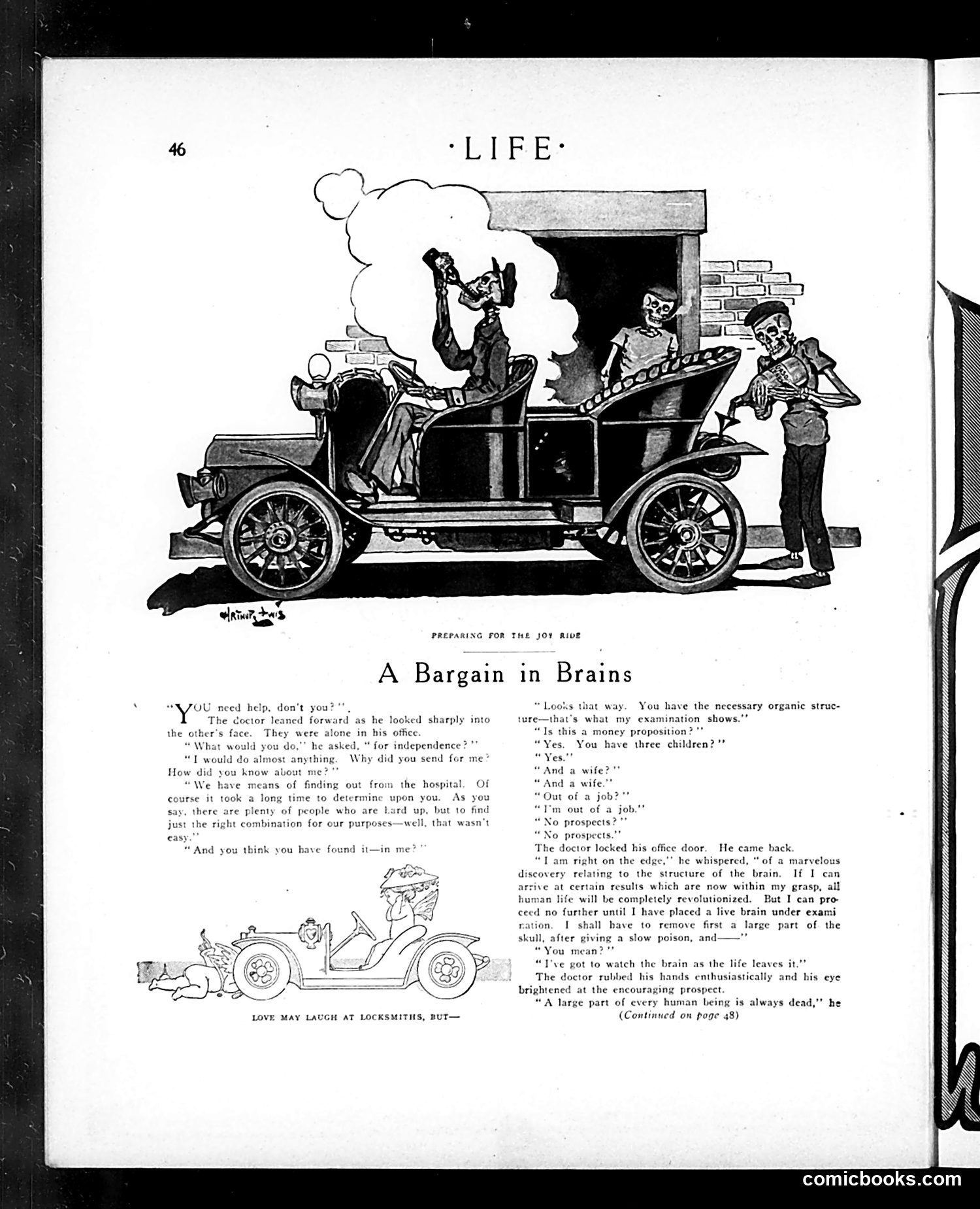
This story satirizes both scientific ambition and economic desperation in the early 20th century. A doctor seeks a desperate, unemployed man with a family to use as a human subject for brain experiments—literally removing part of his skull while poisoning him to death, observing the brain as it dies. The satire operates on multiple levels: it mocks mad-scientist pretensions to "revolutionize human life" through unethical experimentation, while simultaneously critiquing economic inequality—the doctor can only find a willing subject among the desperately poor with "no prospects." The title "A Bargain in Brains" suggests both the doctor's clinical assessment and the grim transaction: a poor man selling his life for money. The accompanying car illustration ("Love May Laugh at Locksmiths") appears unrelated, typical of magazine layout conventions of the era. The story's continuation on page 48 indicates this is serialized fiction, likely darkly comedic rather than realistic fiction.
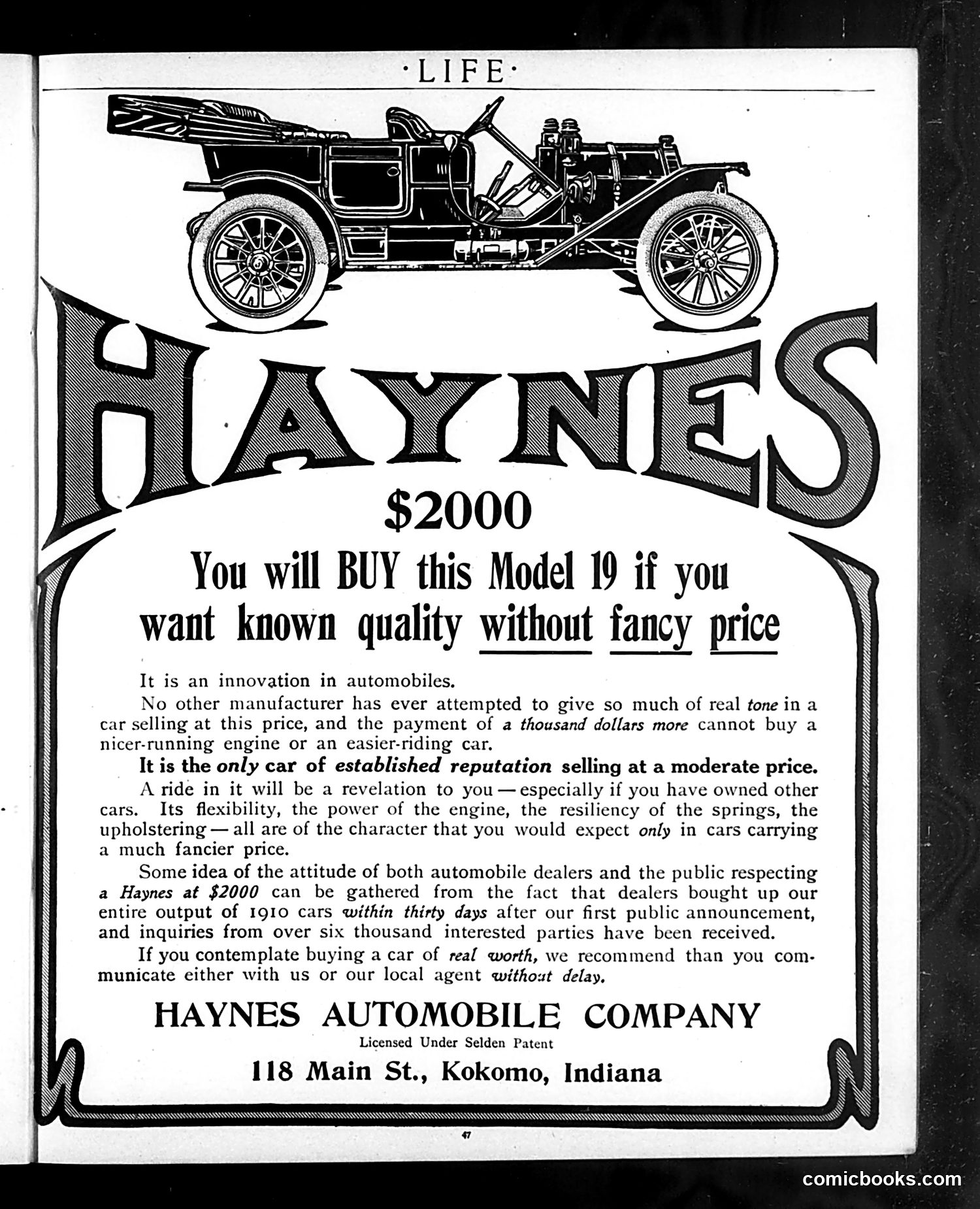
This is a **straightforward automobile advertisement**, not satire or political commentary. The Haynes Automobile Company advertises their Model 19 at $2,000, positioned as offering genuine quality at a moderate price without "fancy price" markup. The page's rhetoric—emphasizing that buyers get premium features (flexibility, engine power, springs, upholstering) typically found only in more expensive cars—reflects early 1910s automotive marketing. The advertisement boasts that dealers sold their entire 1910 output within thirty days and received six thousand inquiries, lending credibility through claimed consumer demand. The "Selden Patent" reference indicates licensing under a major automotive patent holder of the era. The Kokomo, Indiana address identifies this as a regional manufacturer competing in the growing mass-market automobile sector. There is no cartoon, caricature, or satirical content visible. This appears to be a standard period advertisement in *Life* magazine.
This page contains a serialized story (continued from page 46) about a doctor who offers a man money to participate in a fatal experiment. The narrative depicts a morally questionable transaction: the doctor proposes administering a slow-acting poison to the man in exchange for bonds worth one hundred thousand dollars. The story illustrates early-20th-century anxieties about scientific ethics and human exploitation. The man, desperate for his family's financial security, agrees to the scheme. He then conducts business transactions—depositing bonds, selling securities—before his scheduled death. The satire targets the dehumanizing potential of both modern science and capitalism: a human life becomes merely a commodity to be bought and sold like financial instruments. The matter-of-fact dialogue and the man's practical financial planning after accepting poison underscore the dark irony—treating impending death as simply another business arrangement. This reflects Progressive Era concerns about unchecked scientific ambition and economic inequality.
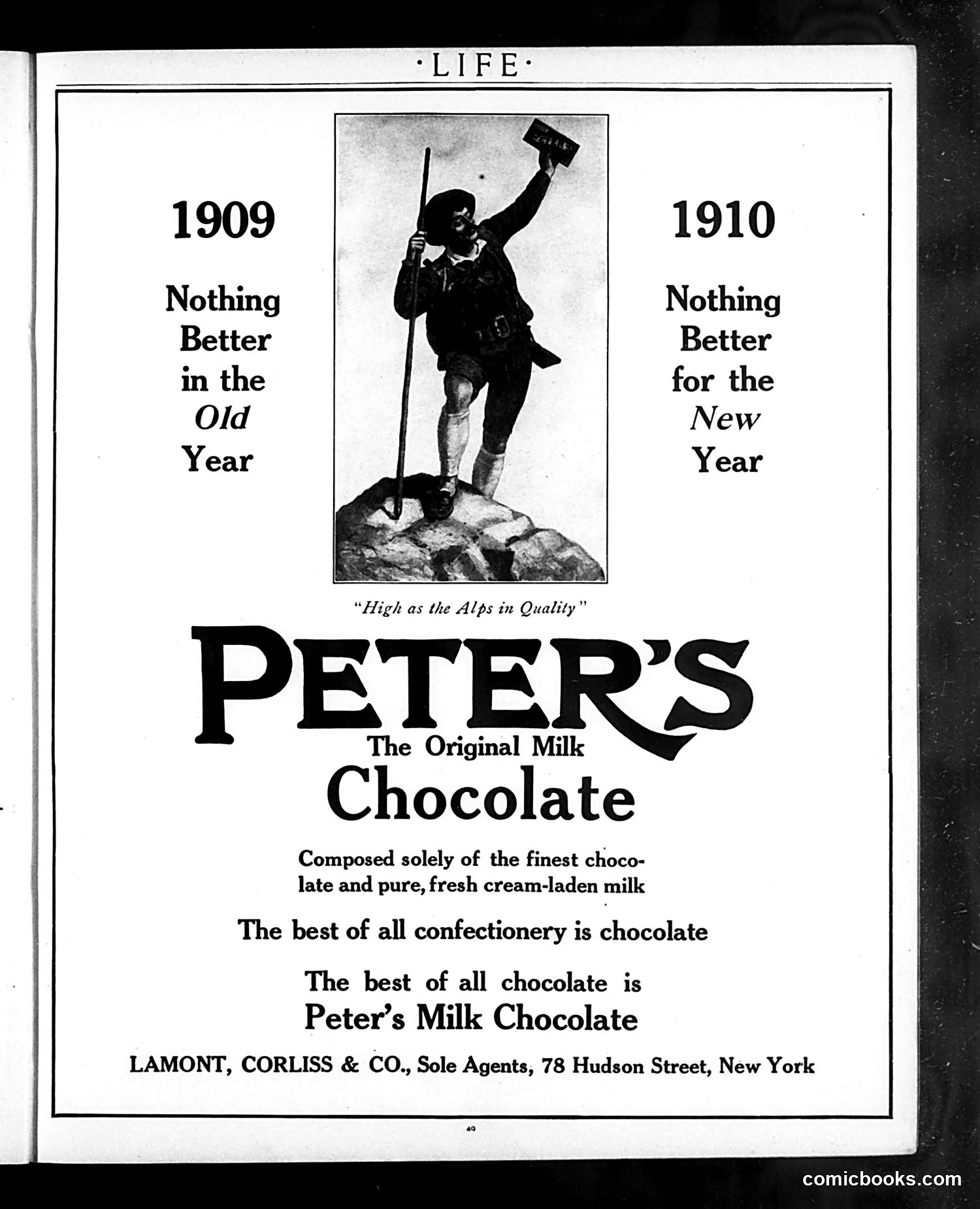
This is primarily a **product advertisement**, not political satire. It's a full-page ad for Peter's Milk Chocolate published in *Life* magazine around 1909-1910. The central image shows a figure in alpine/mountaineering gear standing triumphantly on a rocky peak, holding an axe aloft. The tagline "High as the Alps in Quality" creates a visual metaphor: just as the climber has reached a mountain summit, Peter's chocolate represents the peak of confectionery excellence. The left and right panels frame New Year's messaging ("Nothing Better in the Old Year" / "Nothing Better for the New Year"), positioning the product as an appropriate gift or indulgence for the holiday transition. There is no political commentary—this is straightforward advertising using mountaineering imagery to convey superiority and achievement, common marketing rhetoric of the era.
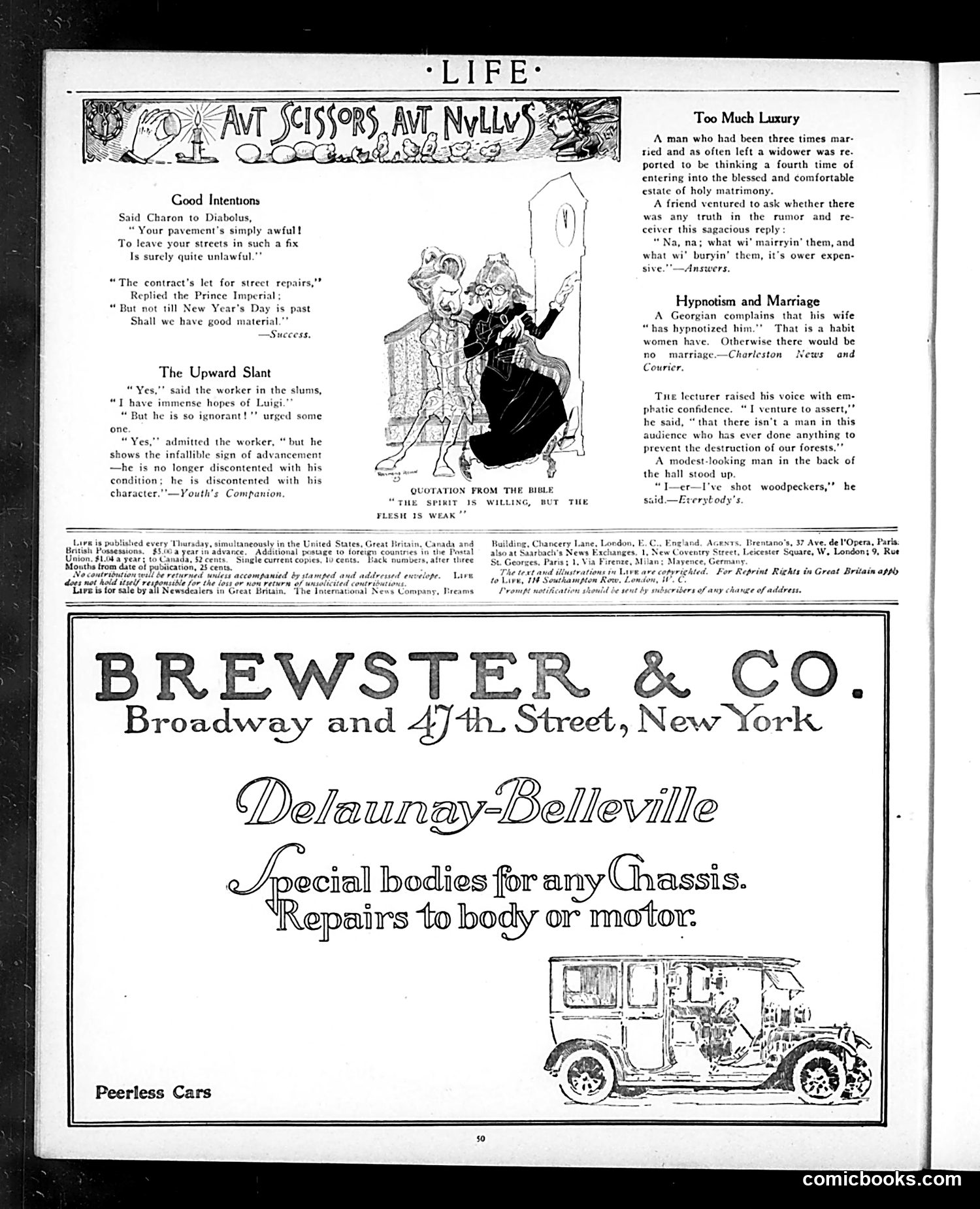
This *Life* magazine page contains several brief satirical pieces typical of early 20th-century humor: **"Good Intentions"** mocks government contractors' excuses—Charon (ferryman of the dead) complains to the Devil about poor street conditions, but the "Prince Imperial" (the Devil) delays repairs until after New Year's, claiming better materials will be available then. The satire targets bureaucratic procrastination and hollow promises. **"The Upward Slant"** ironically celebrates a worker's "advancement"—not material improvement, but his shift from accepting poor conditions to blaming his own character instead. **"Too Much Luxury"** and **"Hypnotism and Marriage"** are brief joke items mocking remarriage and female influence in marriage, respectively. **"The Lecturer"** humorously undercuts an environmentalist's sweeping claim when one audience member admits to shooting woodpeckers. The page is primarily **advertising** (Brewster & Co. automobiles dominate the lower half), with satirical content filling remaining space—typical *Life* format.
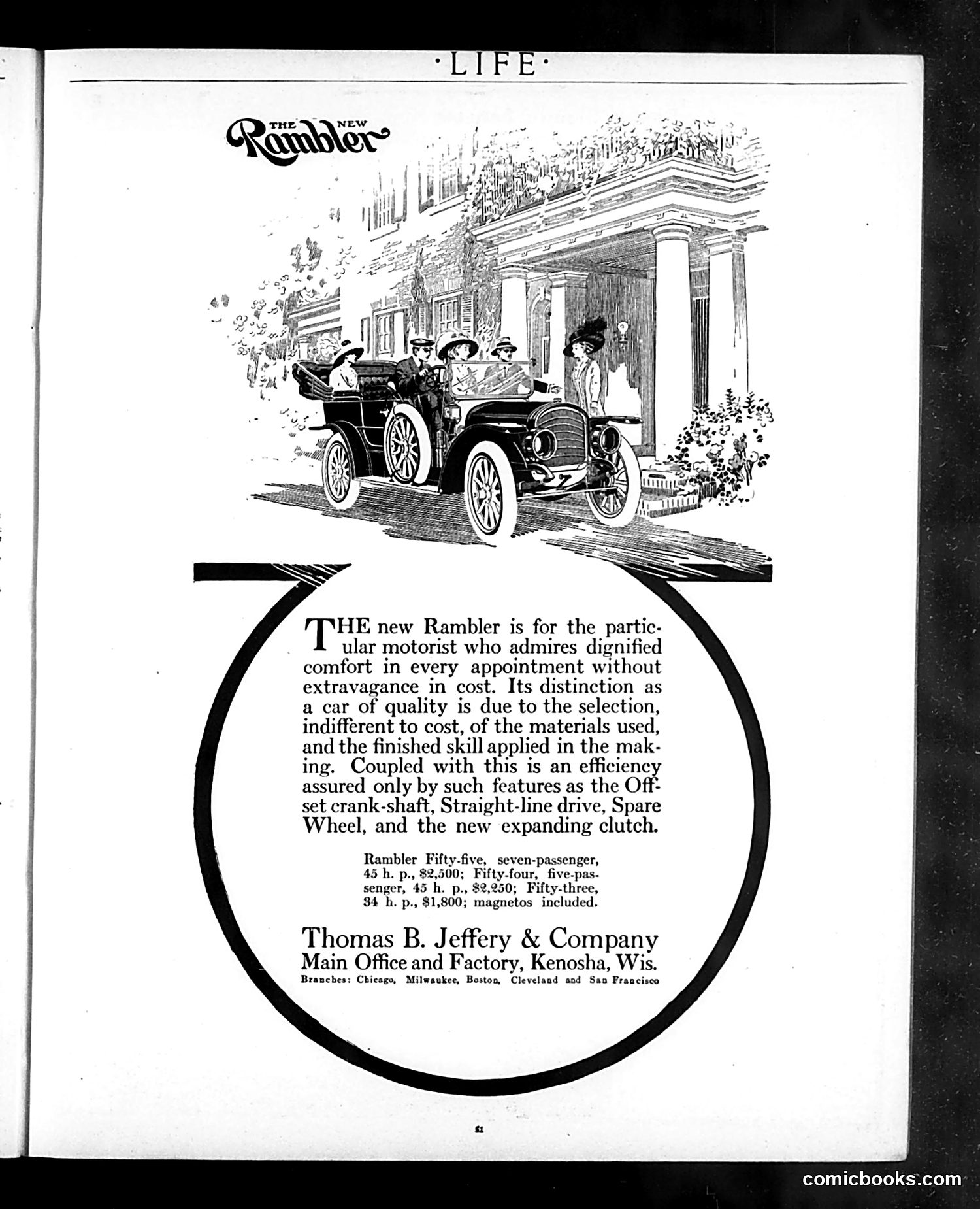
This is a straightforward automobile advertisement, not satirical content. It promotes the Rambler car, manufactured by Thomas B. Jeffery & Company in Kenosha, Wisconsin. The illustration shows well-dressed passengers in an early 1900s motorcar outside an elegant columned building, emphasizing luxury and respectability. The ad's text targets "the particular motorist" seeking "dignified comfort" without excessive cost—positioning the Rambler as quality-focused rather than extravagant. It highlights technical features (offset crank-shaft, straight-line drive, expanding clutch) meant to appeal to knowledgeable buyers. Three models are listed with prices ranging from $1,800 to $2,500 with varying horsepower and passenger capacity. The multiple branch offices indicate the company's national reach. This represents early automotive advertising's emphasis on mechanical innovation and middle-to-upper-class appeal.
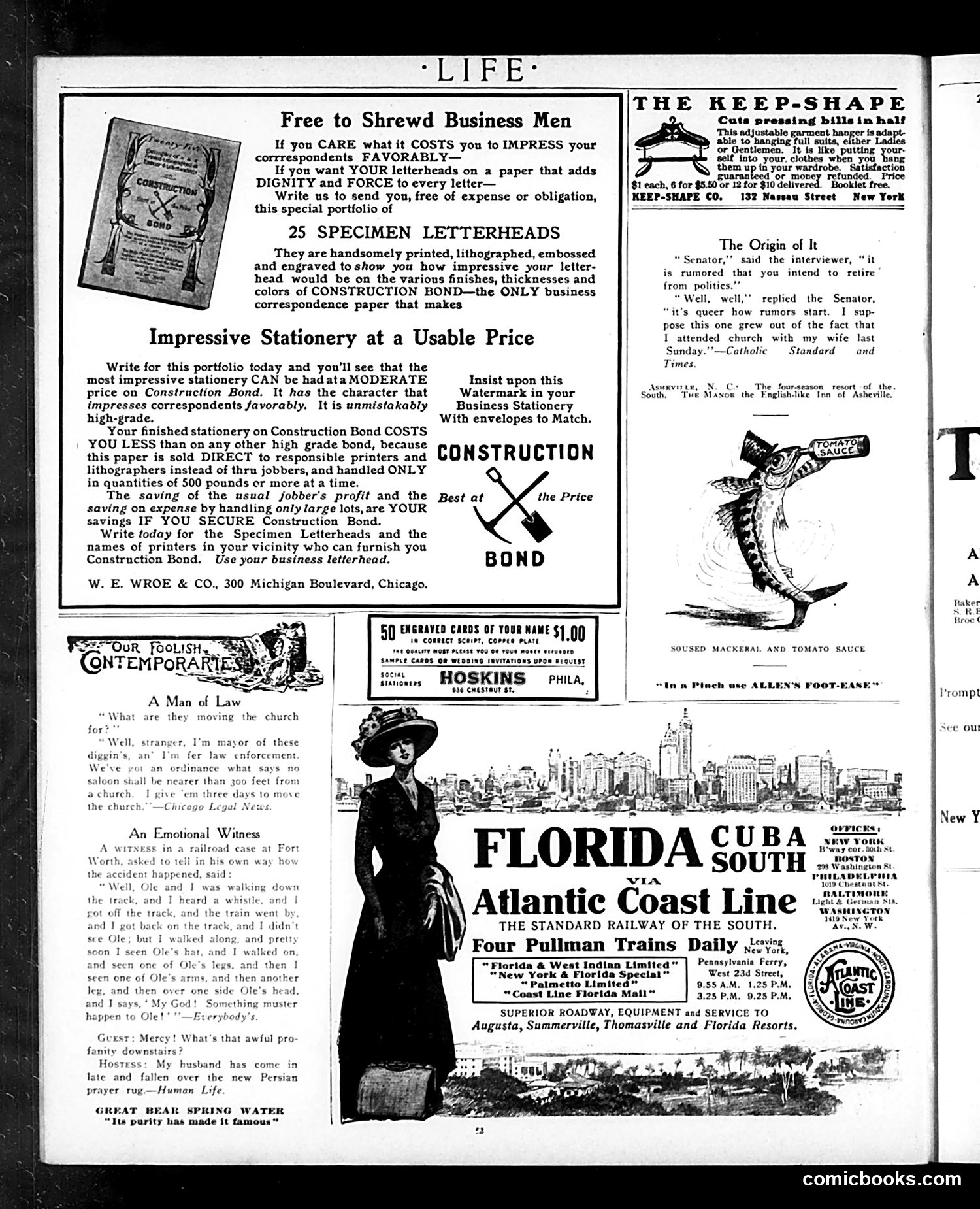
This page is primarily **advertising**, with brief satirical content interspersed. The main advertisements promote business stationery (Construction Bond paper) and railroad/travel services (Atlantic Coast Line to Florida). The **satirical humor** appears in short anecdotes: 1. **"A Man of Law"**: A small-town mayor explains he enforces church relocations—a joke about provincial authority and absurd priorities. 2. **"An Emotional Witness"**: A railroad accident witness's rambling, repetitive account humorously illustrates poor storytelling and exaggeration. 3. **"The Origin of It"**: A senator's rumored retirement is jokingly attributed to attending church with his wife—satirizing how trivial acts spawn political rumors. These vignettes mock small-town life, rural simplicity, and political gossip typical of early 20th-century American satire. The cartoonish drawing of a woman (possibly advertising Allen's Foot-Ease) and the "Tomato Sauce" mackerel advertisement represent typical period product endorsements.
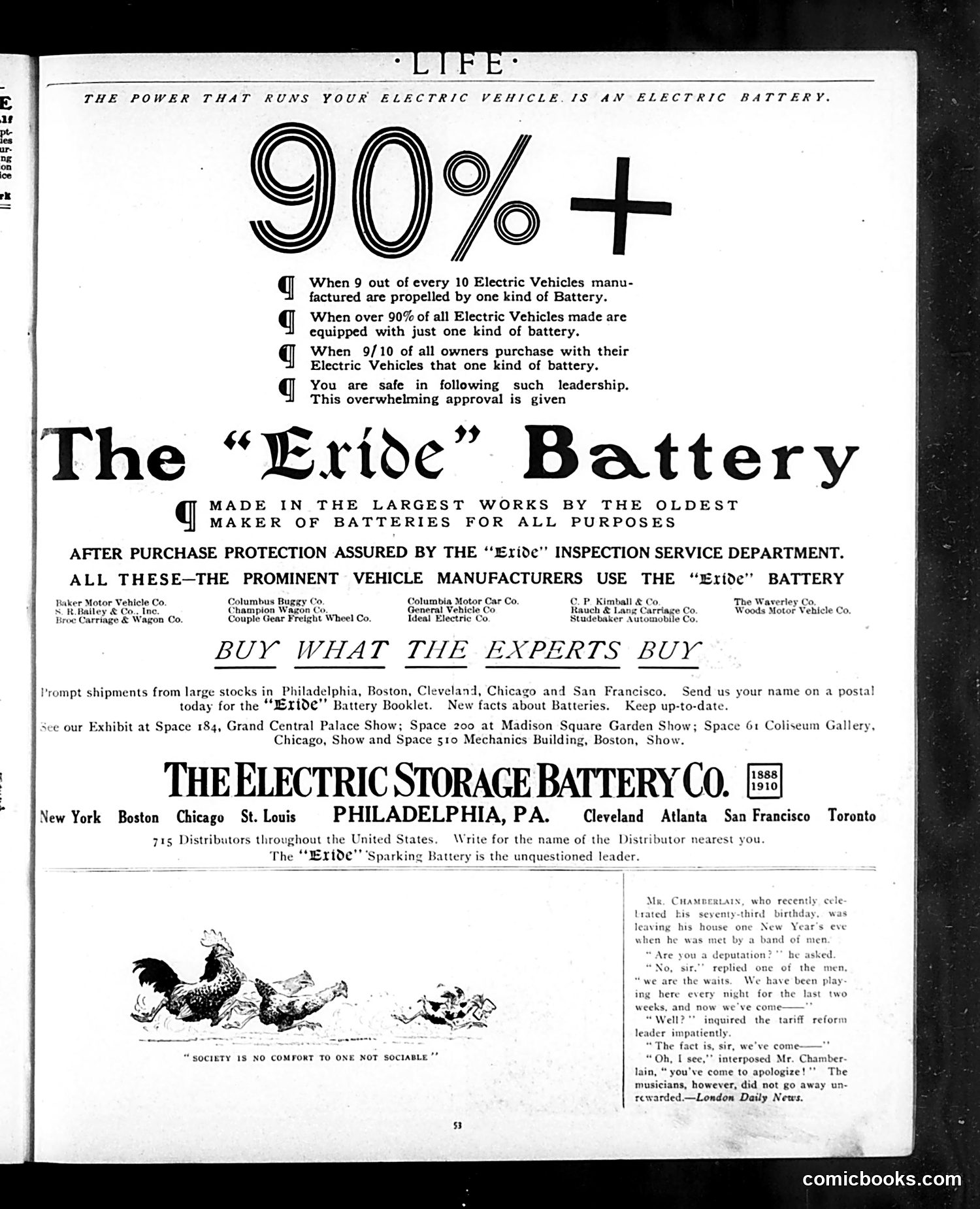
This page is primarily **advertising for the Eride Battery**, used in electric vehicles. The small cartoon at bottom left—showing roosters in disarray beneath the caption "Society is no Comfort to One Not Sociable"—is unrelated filler humor, depicting socially awkward behavior. The main content is a marketing pitch exploiting market dominance: the advertisement emphasizes that "90%+" of electric vehicles use Eride batteries, framing this overwhelming market share as proof of superiority and wisdom in choosing the brand. The logic is circular and designed to reassure buyers: everyone else buys it, therefore you should too. The separate anecdote (right column) about Mr. Chamberlain and New Year's carolers is also unrelated comic filler, illustrating an awkward social situation. **Context for modern readers**: This reflects an era when electric vehicles were commercially viable competitors to gasoline cars—a fact many assume is recent.
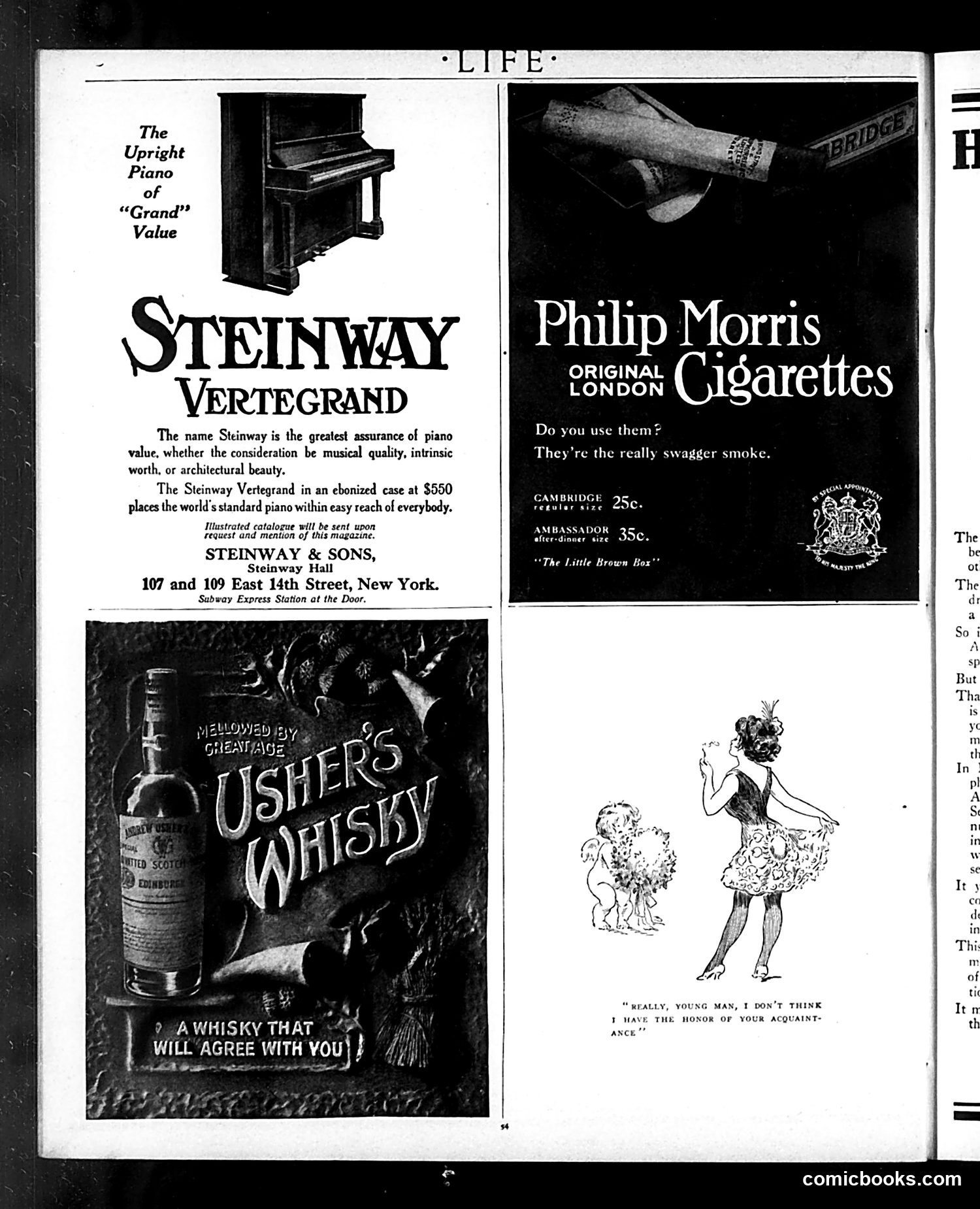
This page consists primarily of **advertisements** rather than editorial cartoons. Three products are promoted: 1. **Steinway Vertegrand Piano** — positioned as affordable luxury ($550) for middle-class consumers, emphasizing quality and accessibility. 2. **Philip Morris Cigarettes** — advertises Cambridge (25¢) and Ambassador (35¢) sizes, using the slang "swagger smoke" to appeal to sophisticated smokers. The hand holding the cigarette suggests elegance. 3. **Usher's Whisky** — features a bottle with text "A Whisky That Will Agree With You," marketing it as gentlemanly and digestible. The small cartoon at bottom shows a woman rejecting a young man's advances with "I don't think I have the honor of your acquaintance" — likely meant to humorously suggest Philip Morris cigarettes as a social facilitator or confidence-booster. These ads reflect 1920s consumer culture, before tobacco and alcohol health warnings, targeting aspirational, affluent readers.
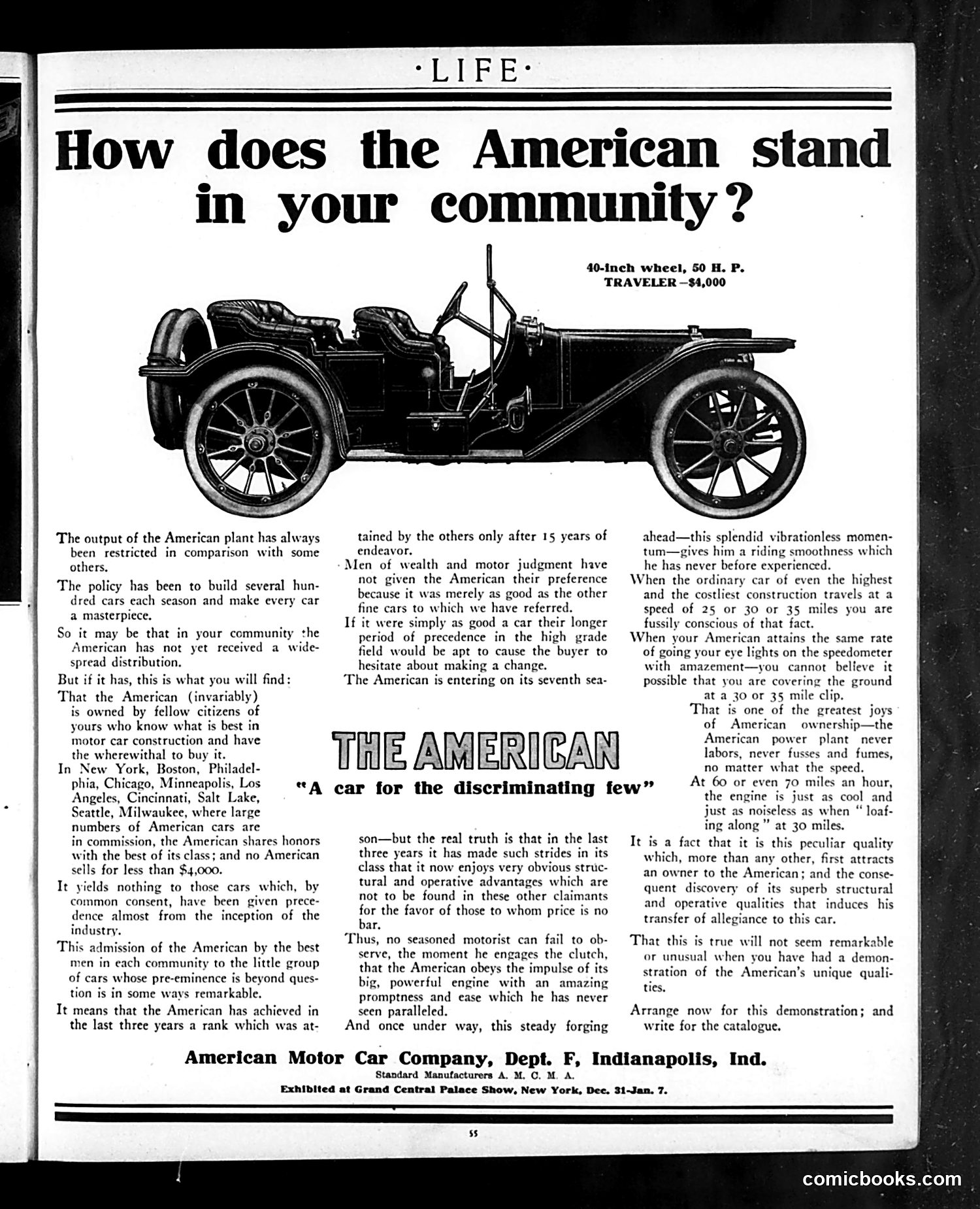
This is automobile advertising, not satire or a political cartoon. The American Motor Car Company advertises its "American" automobile as a premium luxury vehicle for the wealthy elite ("a car for the discriminating few"). The text argues that although the American car lacks widespread distribution compared to competitors, this reflects its exclusivity and superiority rather than failure. It claims that in major American cities, the American competes successfully with established luxury marques like those with 15+ years of precedence, achieving this status in just three years. The advertisement emphasizes smoothness, power, and reliability, with the tagline "How does the American stand in your community?" suggesting that owning one signals wealth and refined motor judgment. The $4,000 price (substantial for the era) underscores this positioning as an aspirational luxury good for the discriminating buyer.
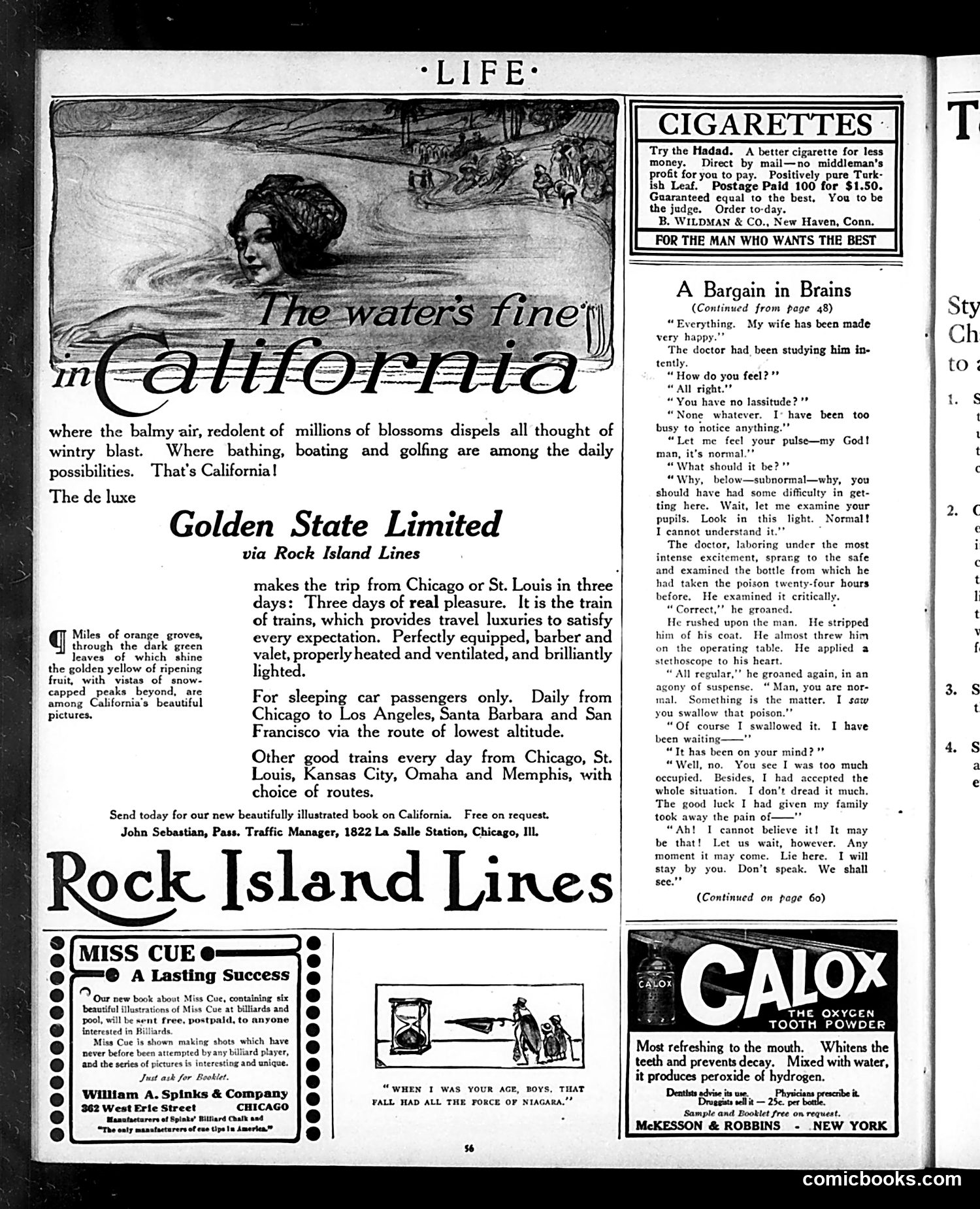
This page is primarily **advertising**, with a continuing serial story ("A Bargain in Brains") filling the right column. The main content includes: **Advertisements:** - **California travel** (Golden State Limited train): Romanticizes California's climate and leisure activities (bathing, golfing, boating) to attract wealthy Chicago/St. Louis travelers - **Cigarettes, billiards equipment, tooth powder**: Standard period product ads **Serial story excerpt**: A doctor discovers a patient with mysteriously low vitality despite good health. The patient confesses to having swallowed poison but remains calm, attributing his acceptance to family circumstances. The narrative emphasizes dramatic medical mystery. **Notable for modern readers**: The advertisements reflect early 1900s leisure culture, targeting affluent audiences with train travel to California and genteel pursuits like billiards. The "poison" plot appears melodramatic by contemporary standards. No political satire is evident on this particular page—it's a commercial magazine focused on entertainment and consumer products.
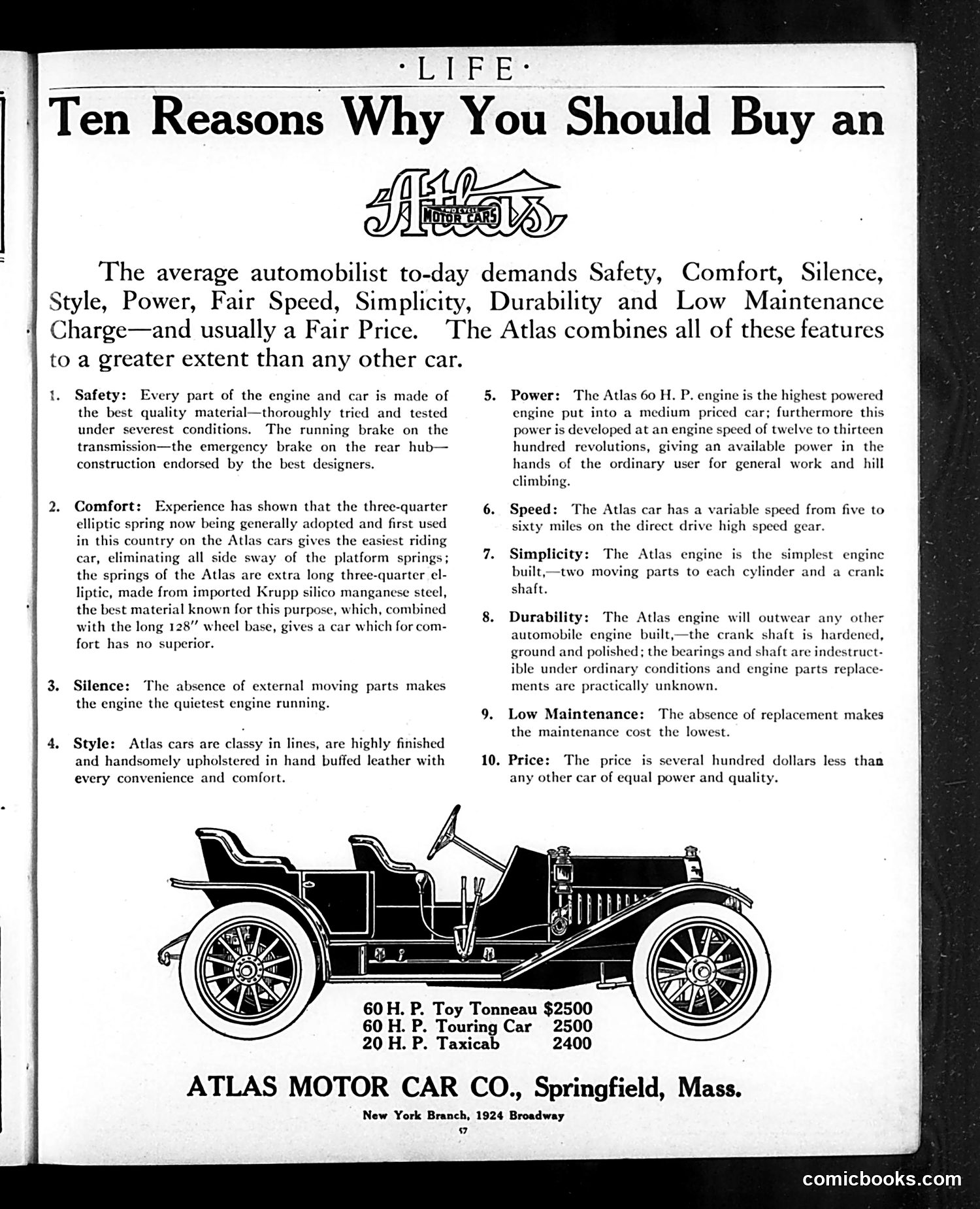
This is a straightforward **product advertisement**, not satire or a political cartoon. It promotes the Atlas automobile, manufactured in Springfield, Massachusetts, with a New York branch. The page lists ten selling points: safety, comfort, silence, style, power, speed, simplicity, durability, low maintenance, and competitive pricing. Each claim includes technical specifications—the 60 H.P. engine, 128-inch wheelbase, and simplified two-moving-parts-per-cylinder design. Three models are advertised: the 60 H.P. Toy Tonneau and Touring Car at $2,500 each, and a 20 H.P. Taxicab at $2,400. An illustration shows a period touring car with open seating. **Context for modern readers**: This reflects 1920s automotive marketing when manufacturers competed on engineering features and durability. The emphasis on "simplicity" and "low maintenance" reflects consumer concerns about early automobiles' mechanical complexity. The pricing suggests this was positioned as an affordable, quality option.
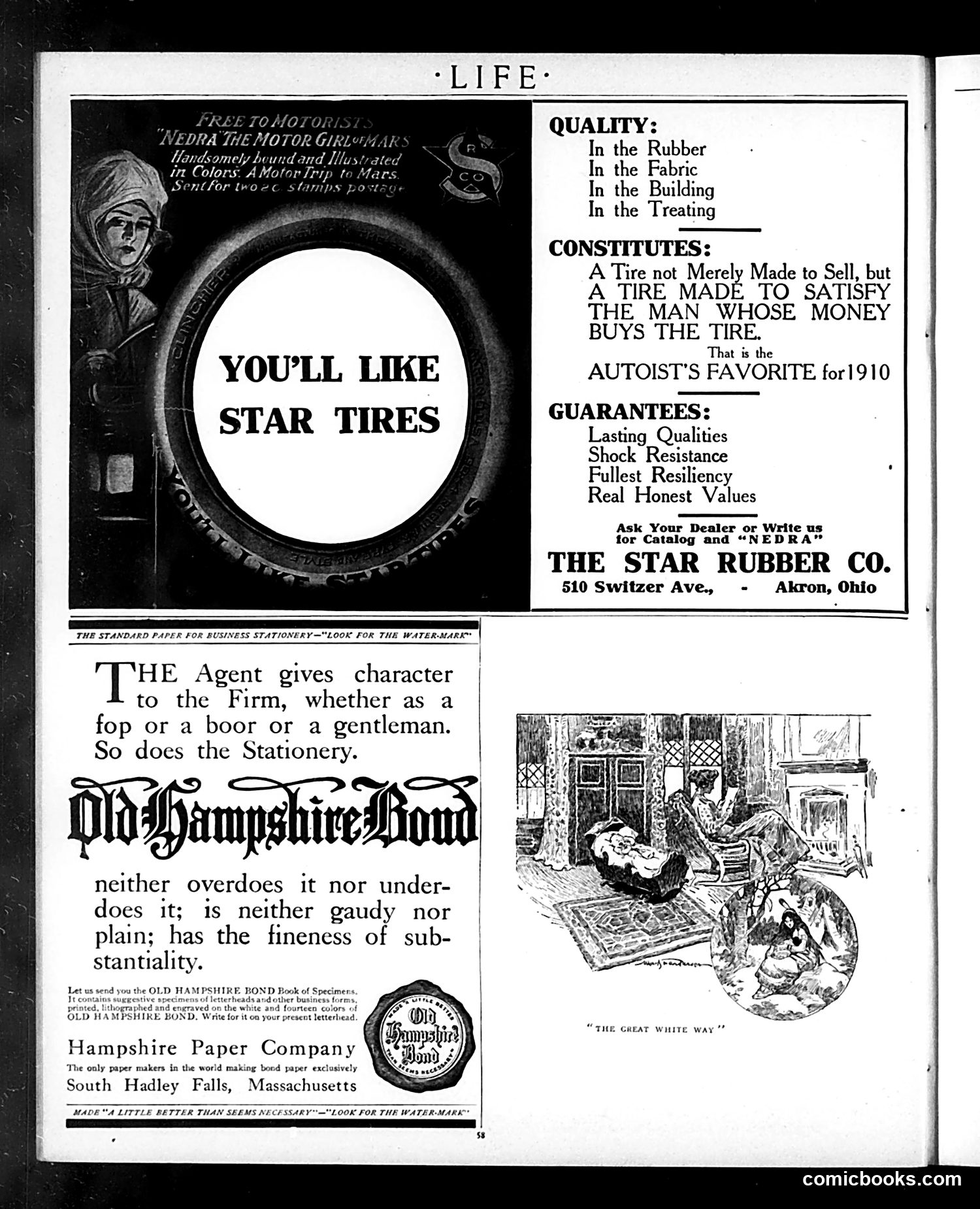
This page consists primarily of **advertisements** rather than satirical content, typical of early 1900s magazines. **Star Tires Ad** (top): Features "Nedra the Motor Girl" (unclear if this references a specific contemporary figure or is generic branding) promoting Star Rubber Company tires from Akron, Ohio. The messaging emphasizes quality and durability—tires built for customer satisfaction rather than mere profit. **Old Hampshire Bond Paper Ad** (bottom): Uses the philosophical claim that business stationery reflects a firm's character, whether "fop or boor or gentleman." The ornate script and illustration depicting leisurely domestic life suggest this premium paper conveys sophistication and refinement. Both ads reflect **1910 consumer culture**: automobiles were becoming mainstream (hence tire advertising prominence), and businesses invested in quality materials as status symbols. The ads' rhetoric emphasizes substantiality and honest value—appealing to emerging middle-class anxieties about authenticity in an increasingly commercialized marketplace.
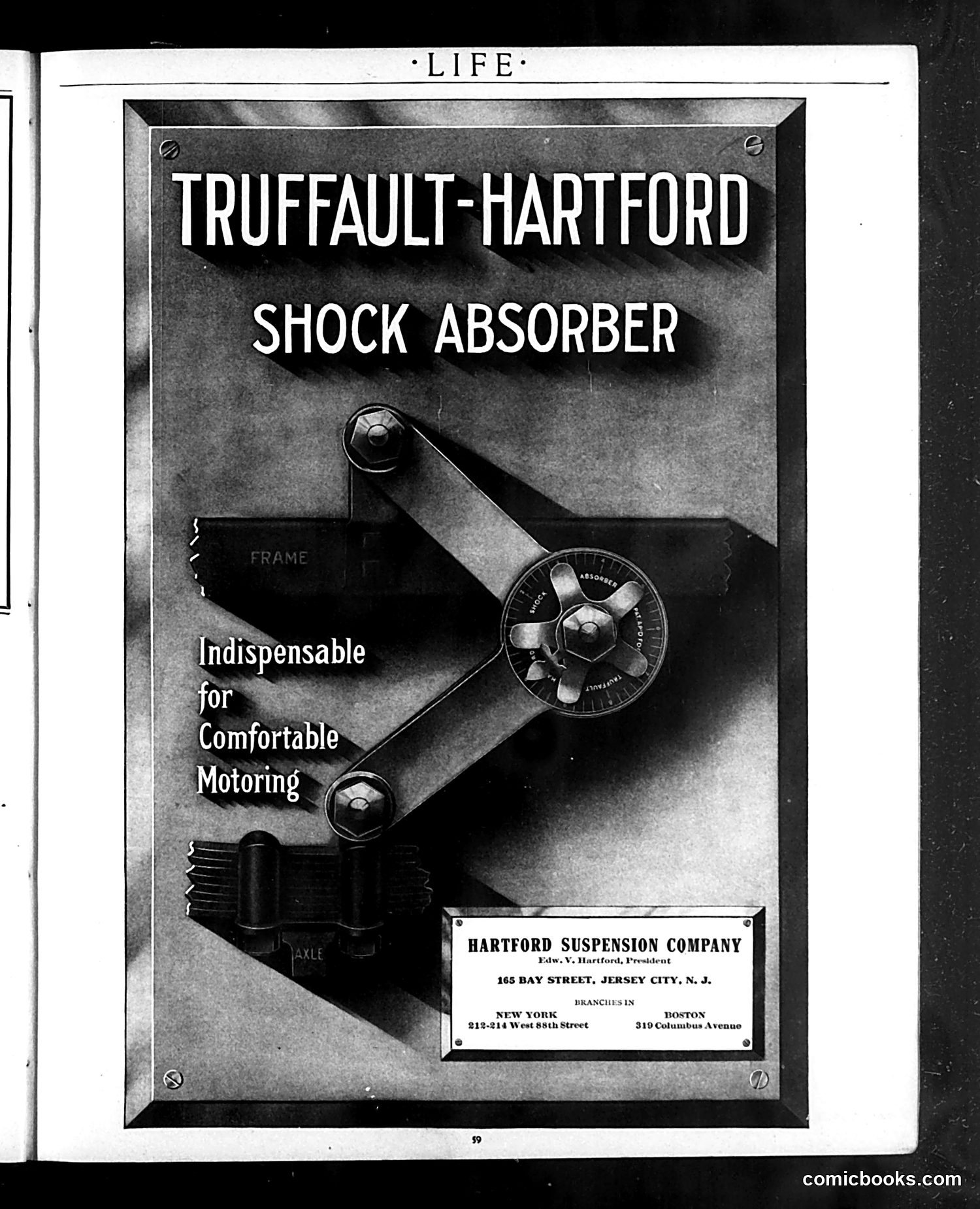
This is a full-page advertisement, not satire or political commentary. It promotes the Truffault-Hartford Shock Absorber, a suspension component manufactured by the Hartford Suspension Company. The ad features a technical diagram of the shock absorber mechanism with springs and dampers, labeled "Indispensable for Comfortable Motoring." The company's main office was in Jersey City, New Jersey, with branches in New York and Boston. This represents standard automotive advertising from the early-to-mid 20th century, when shock absorbers were relatively new technology worthy of highlighting as a selling point for comfortable vehicle rides. The page number "59" suggests this appeared in a magazine issue, likely amid other advertisements and editorial content.
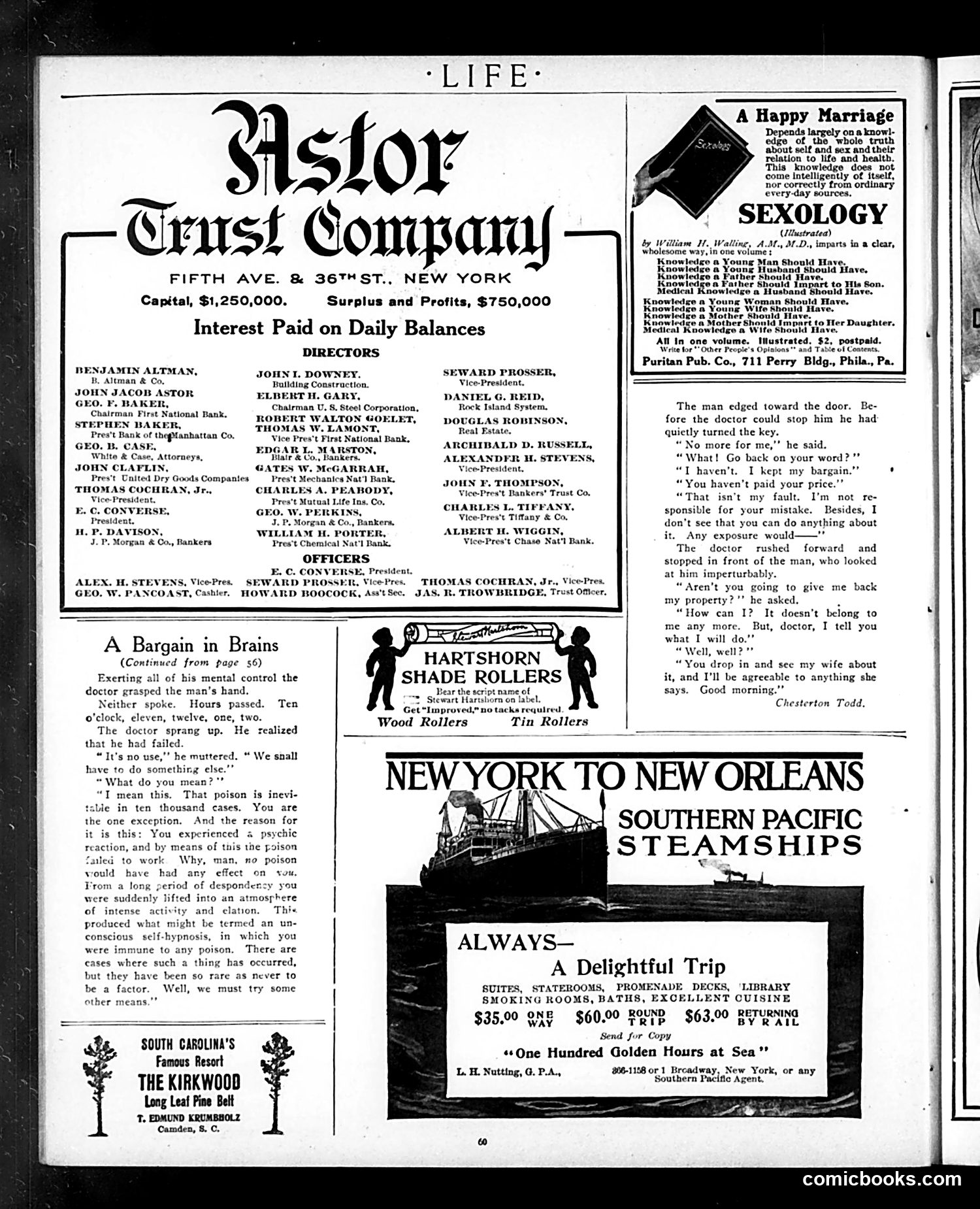
This page is primarily **commercial advertising and financial notices**, not satire or political cartoons. The main content features: 1. **Astor Trust Company advertisement** — listing prominent NYC financiers and industrialists as directors (Altman, Astor, Baker, Gary, etc.), promoting banking services. 2. **"A Bargain in Brains"** — a serialized fiction story about a doctor and a poisoning case involving psychological suggestion. 3. **Various product ads** — including a "Sexology" book (educational/marital advice), Hartshorn Shade Rollers, Southern Pacific Steamships, and The Kirkwood resort. The page represents typical early 20th-century *Life* magazine content: mixing financial/institutional advertising with serialized fiction and product promotions. There is no political satire or editorial cartooning visible. The "Sexology" ad reflects period attitudes toward sex education as mysterious/specialized knowledge requiring books.
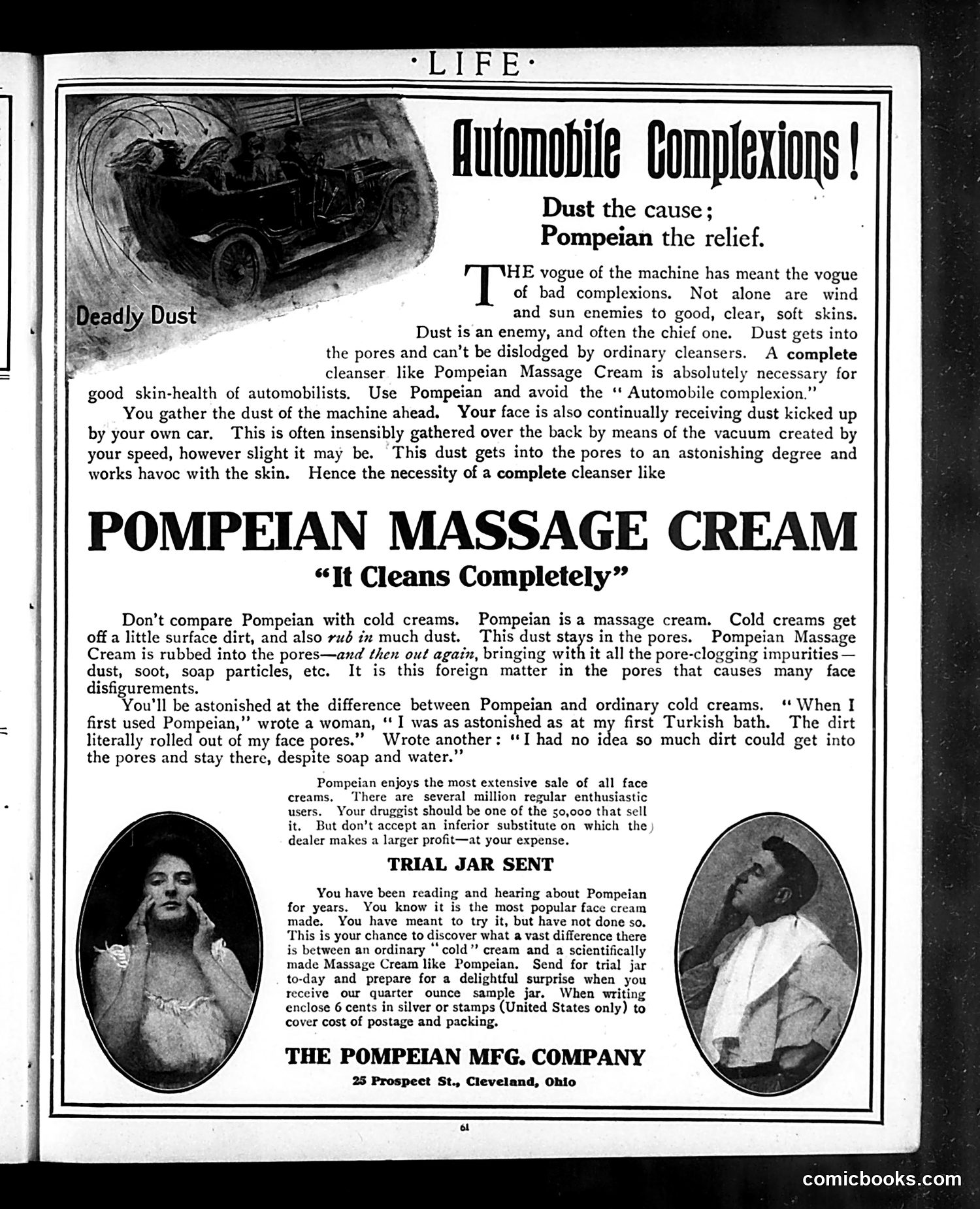
This is primarily a **beauty product advertisement**, not political satire. The page promotes Pompeian Massage Cream to early automobile owners. The "cartoon" element is conceptual rather than illustrated: the ad identifies a newly-emergent social problem—"Automobile Complexion"—caused by the recent mass adoption of automobiles. The pitch argues that car travel exposes drivers and passengers to unprecedented dust and exhaust that ordinary cold creams cannot remove from pores, resulting in visible skin damage. The two portrait photographs show before/after results, though facial features aren't clearly distinct enough to identify specific individuals. They appear to be testimonial examples rather than caricatures of recognizable figures. The satire is subtle: the ad exploits anxieties about new technology's unforeseen consequences—a common theme in 1910s-1920s consumer marketing. It positions the product as a necessary modern solution to a modern problem created by progress itself.
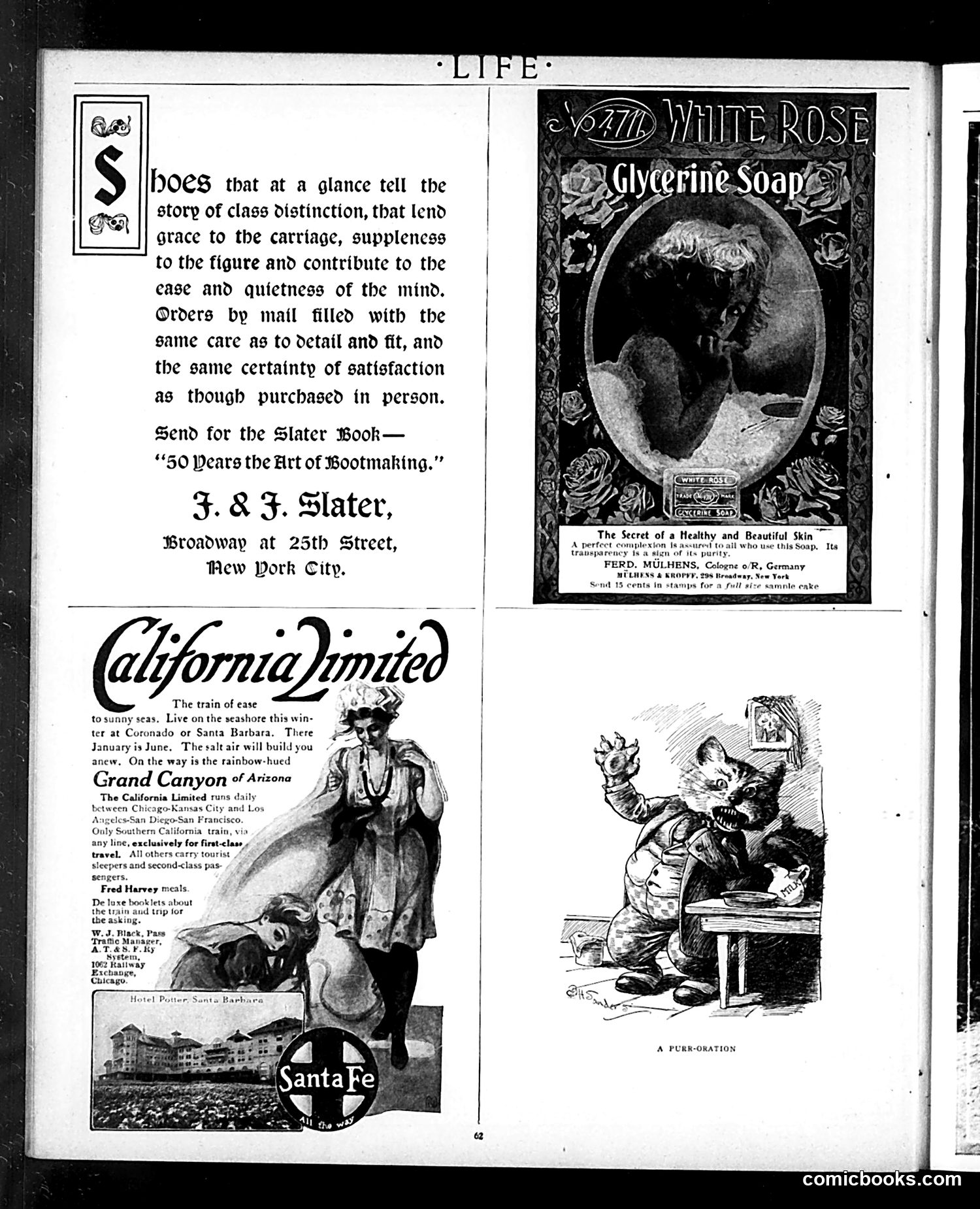
This page is primarily **advertising**, not political satire. It contains three commercial advertisements: 1. **J. & J. Slater shoes** (top left): A luxury footwear ad emphasizing class distinction and mail-order service. 2. **White Rose Glycerine Soap** (top right): Features a woman's face in an ornate oval frame, promising "healthy and beautiful skin." 3. **California Limited train** (bottom left): Promotes luxury rail travel to Arizona and California destinations, with an illustration of a well-dressed woman gazing at the Grand Canyon. The only satirical element is the small cartoon at bottom right labeled "A PURR-ORATION"—a pun on "purr" (cat sound) and "oration" (speech). It depicts anthropomorphic cats or animals at a table, likely mocking formal dinners or speeches, though the specific satire is unclear without more context. Overall, this is a commercial publication page typical of early 20th-century Life magazine.
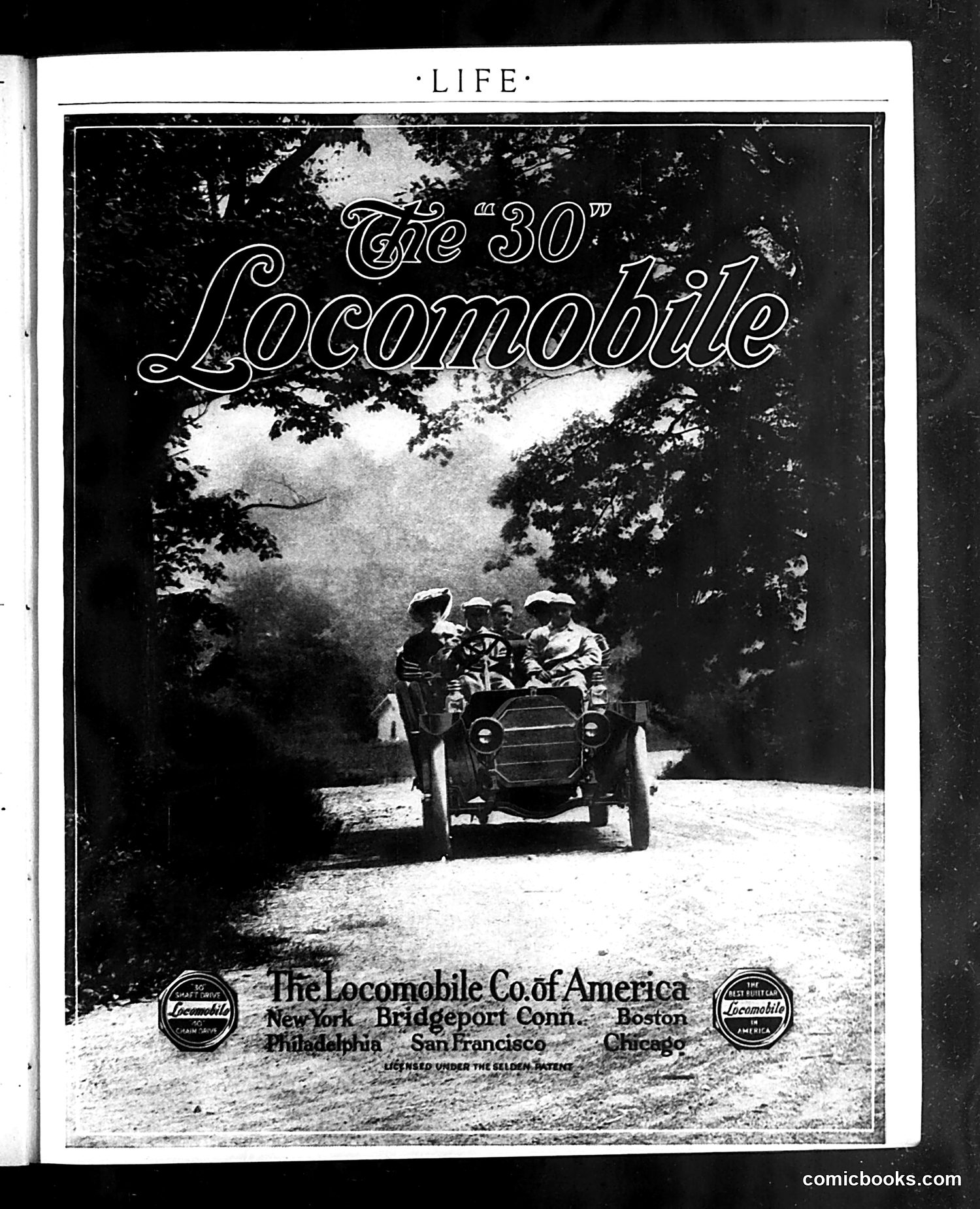
This is an advertisement page for the Locomotile automobile, not a political cartoon. The page features a photograph of an early motorcar (the "30" Locomotile) driving down a tree-lined country road with passengers holding parasols. The image emphasizes leisure and genteel travel. The Locomotile Co. of America lists multiple offices (New York, Bridgeport, Boston, Philadelphia, San Francisco, Chicago), suggesting it was a major manufacturer. The "licensed under the Selden patents" notation indicates this relates to early automotive patent disputes. For modern readers: this represents early automotive advertising targeting affluent consumers, emphasizing recreational driving and refined leisure travel—a novelty when automobiles were luxury goods.
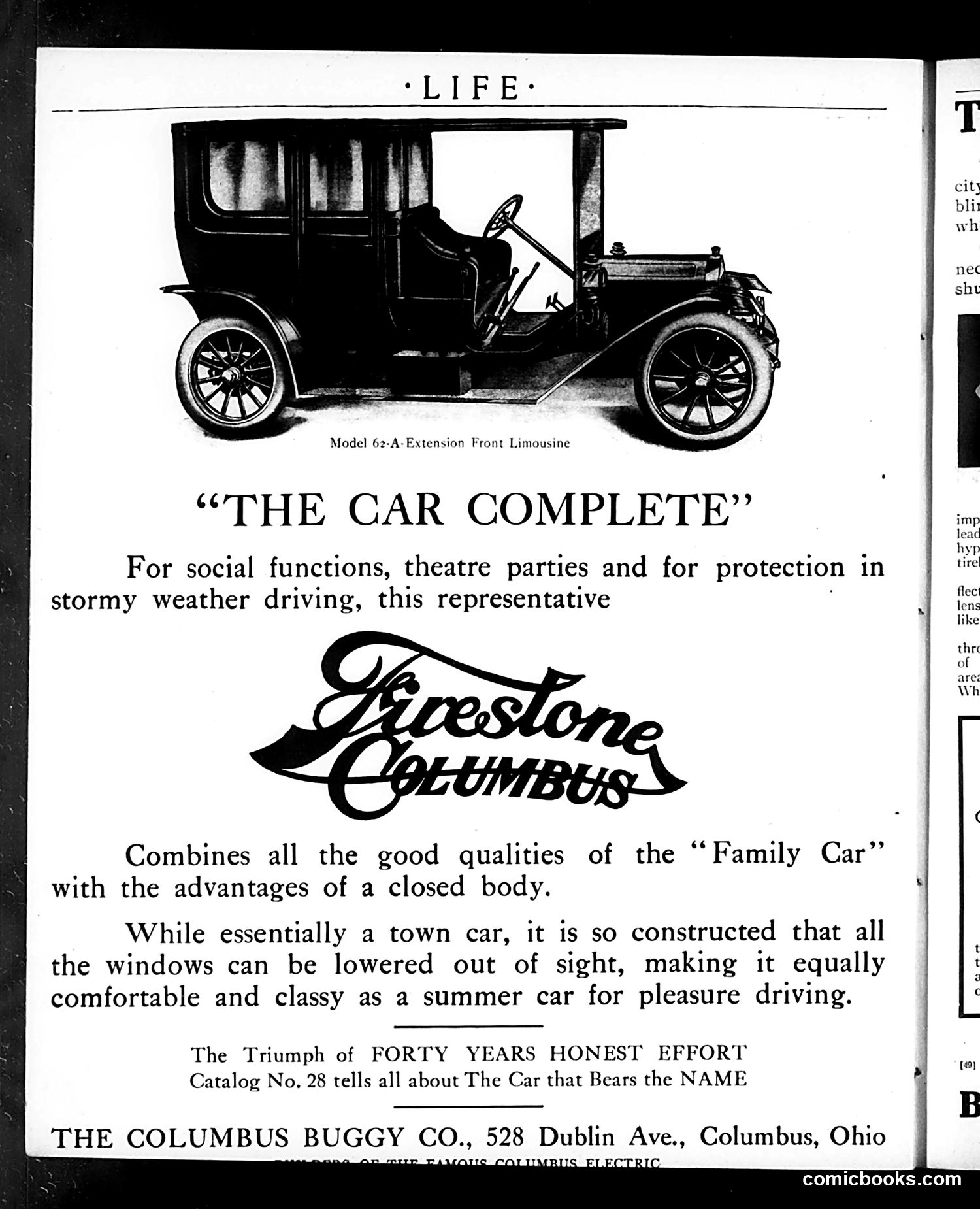
This page is **primarily an advertisement**, not satire or cartoon content. It promotes the Firestone Columbus Model 62-A, a closed-body automobile from the early automotive era (appears to be circa 1910s-1920s based on the vehicle design). The ad positions this car as "the car complete"—combining practicality of a family car with luxury features like a retractable closed body suitable for social events and bad weather. The marketing emphasizes social status: it's appropriate for "theatre parties" and "social functions," suggesting the target buyer is affluent. The only notable element is the appeal to forty years of manufacturing tradition, positioning Columbus Buggy Company as an established, trustworthy maker. This reflects early automotive-era marketing strategy: emphasizing longevity and reliability to consumers skeptical of new automobile technology. There is no political satire or social commentary visible on this page.
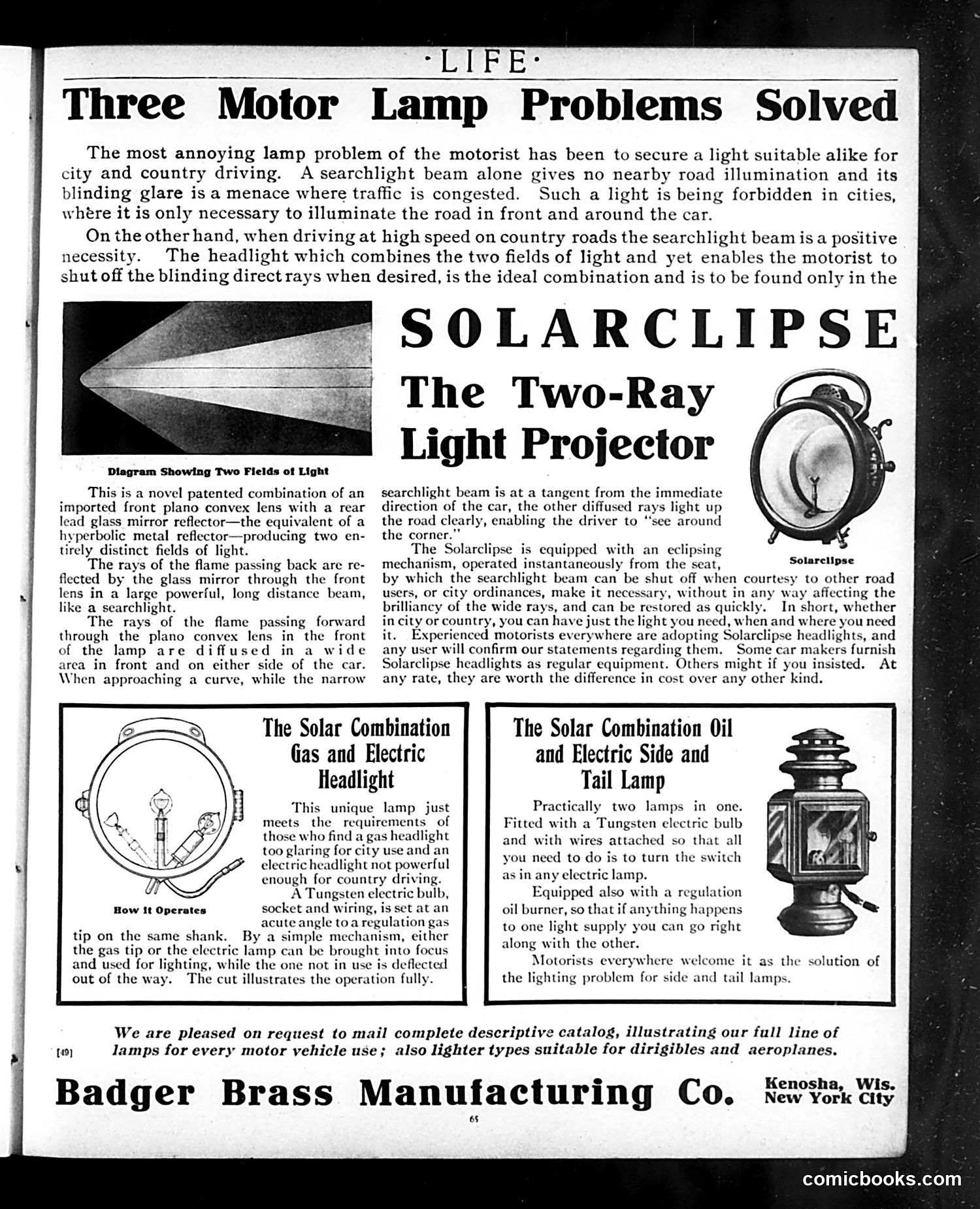
This page contains **no political cartoon or satire**—it's a straightforward advertisement for automobile lighting equipment by Badger Brass Manufacturing Co. The content addresses a genuine early-automotive problem: motorists needed different headlight beams for city versus country driving. Searchlights provided distance visibility but blinded oncoming traffic in congested areas; regular headlights were inadequate for high-speed country roads. Badger Brass marketed three solutions: the "Solarclipse" headlight (adjustable dual-beam), a gas-electric hybrid headlight, and a combination oil-electric side lamp. Each product offered practical switching mechanisms to adapt lighting to driving conditions. The technical diagrams and detailed descriptions reflect serious product engineering rather than humor. This represents typical Life magazine advertising from the early automotive era, when such innovations were genuinely novel and worth explaining to potential customers.
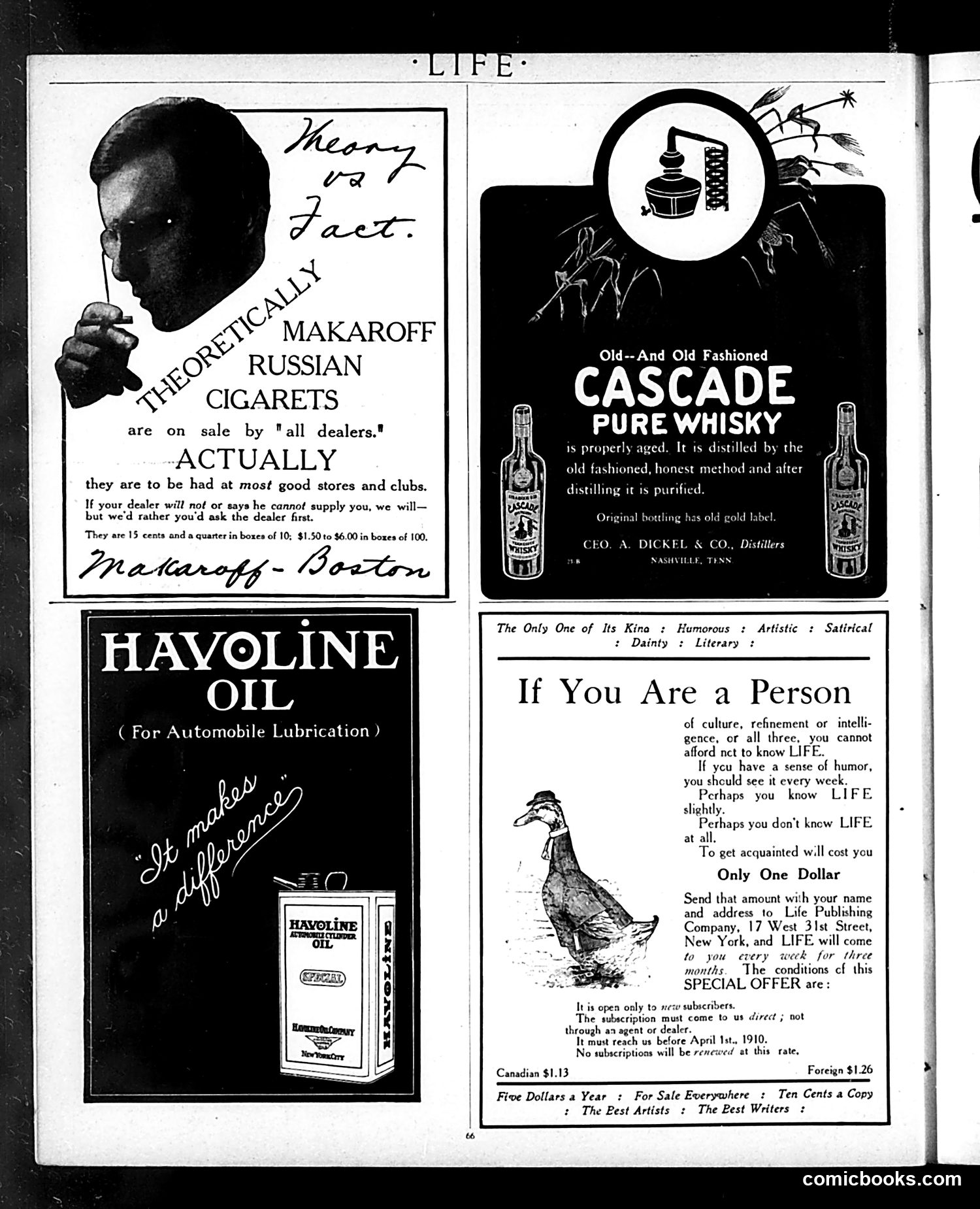
This page is primarily **advertisements**, not editorial content or satire. It contains four product ads for early 1900s goods: 1. **Makaroff Russian Cigarets** — emphasizes availability ("theoretically" a joke about scarcity claims) 2. **Cascade Pure Whisky** — claims old-fashioned distillation methods 3. **Havoline Oil** — automobile lubricant 4. **Life Magazine subscription pitch** — the magazine itself advertises its own content, targeting educated readers with "culture, refinement or intelligence" and "sense of humor" The only potentially satirical element is Life's self-promotion, which humorously appeals to cultured, intelligent readers while simultaneously suggesting many people don't know the magazine exists. The duck illustration accompanies this pitch. This appears to be a standard advertising revenue page from Life magazine (dated around 1910 based on the April 1st deadline reference), reflecting early 20th-century consumer products and marketing approaches.
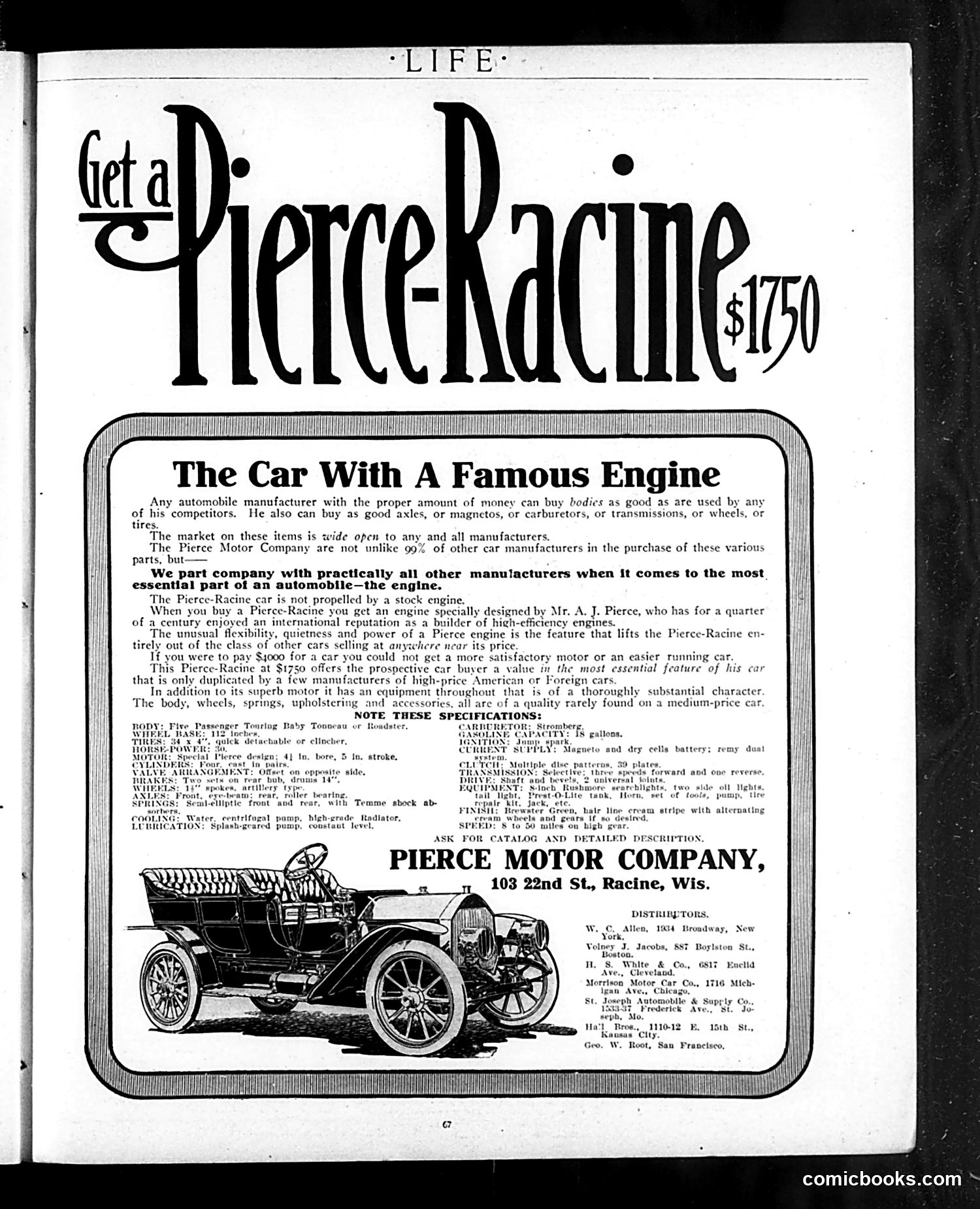
This is **not a cartoon or satire** — it's a straightforward automobile advertisement from Life magazine (likely early 1900s based on the vehicle style and price point). The Pierce Motor Company advertises their Pierce-Racine automobile at $1,750. The ad's pitch emphasizes that while competitors can buy identical standardized parts (bodies, axles, transmissions), Pierce differentiates itself through a **custom-designed engine** created by A. J. Pierce, known for quarter-century of engine innovation. The marketing argument: at this price point, you're getting an engine quality normally found only in expensive luxury cars — essentially luxury performance at a medium price. The illustration shows a period touring car with an open-air design typical of the era. Contact information lists distributors across the United States. **This is period advertising, not editorial satire.** Life magazine in this era regularly published both satirical content and commercial advertisements.
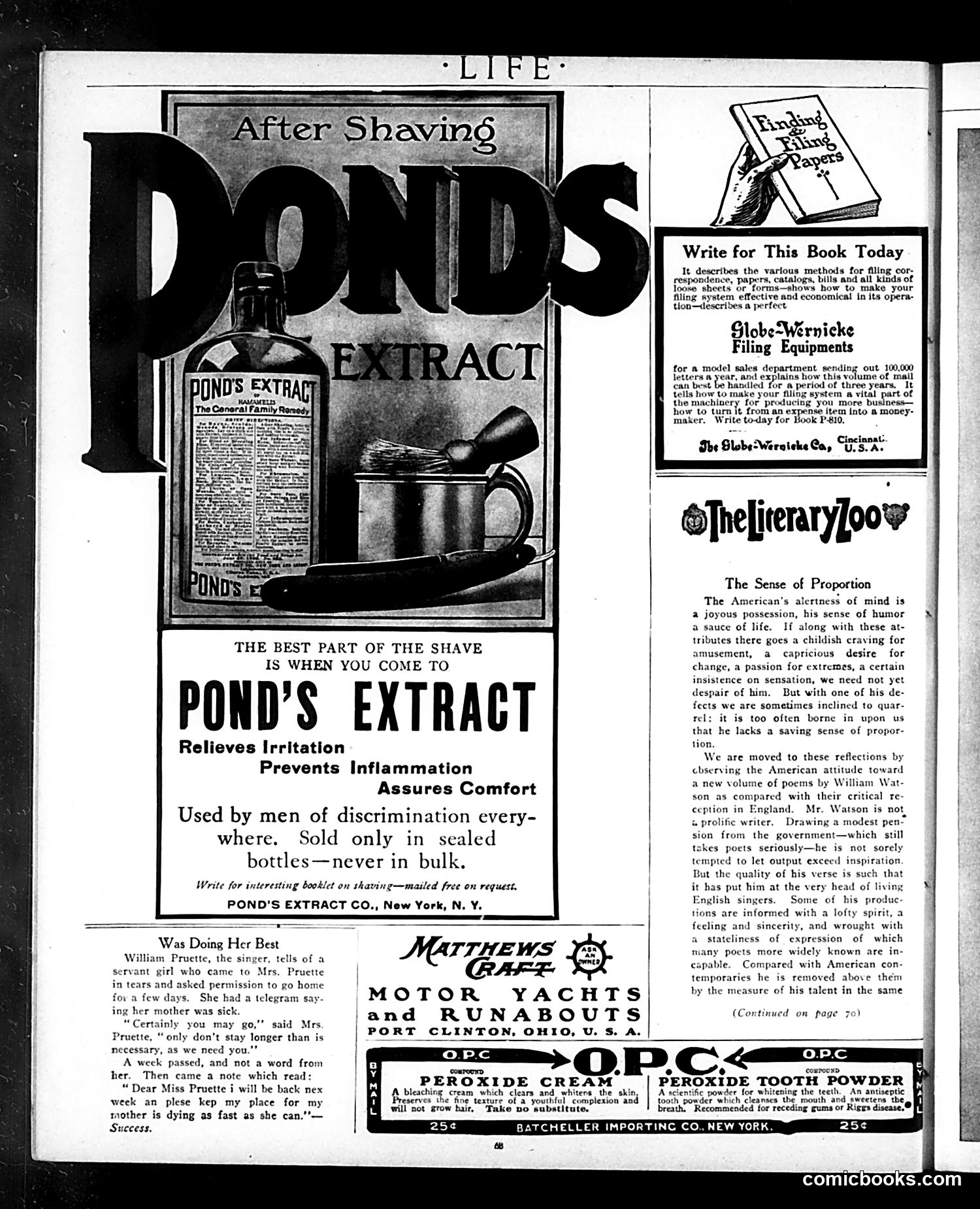
This page is **primarily advertising**, not political satire. The dominant content consists of product ads for Pond's Extract (aftershave), filing systems, dental products, and motor yachts. The one substantive article is "The Itinerary Zoo," which critiques American cultural attitudes toward the poet William Watson. The piece argues that Americans lack "a saving sense of proportion"—they demand novelty and sensation over quality. While Watson's work is praised as serious and well-crafted, American critics allegedly overrate or misunderstand him compared to English critics' more measured assessment. The article uses Watson's reception as a lens to satirize broader American cultural shallowness: the craving for extremes and change over sustained excellence. However, this is cultural commentary rather than political cartooning. The page's sole anecdote—about a servant girl's delayed return—illustrates devotion through humble perseverance, fitting the "success" theme advertised below.
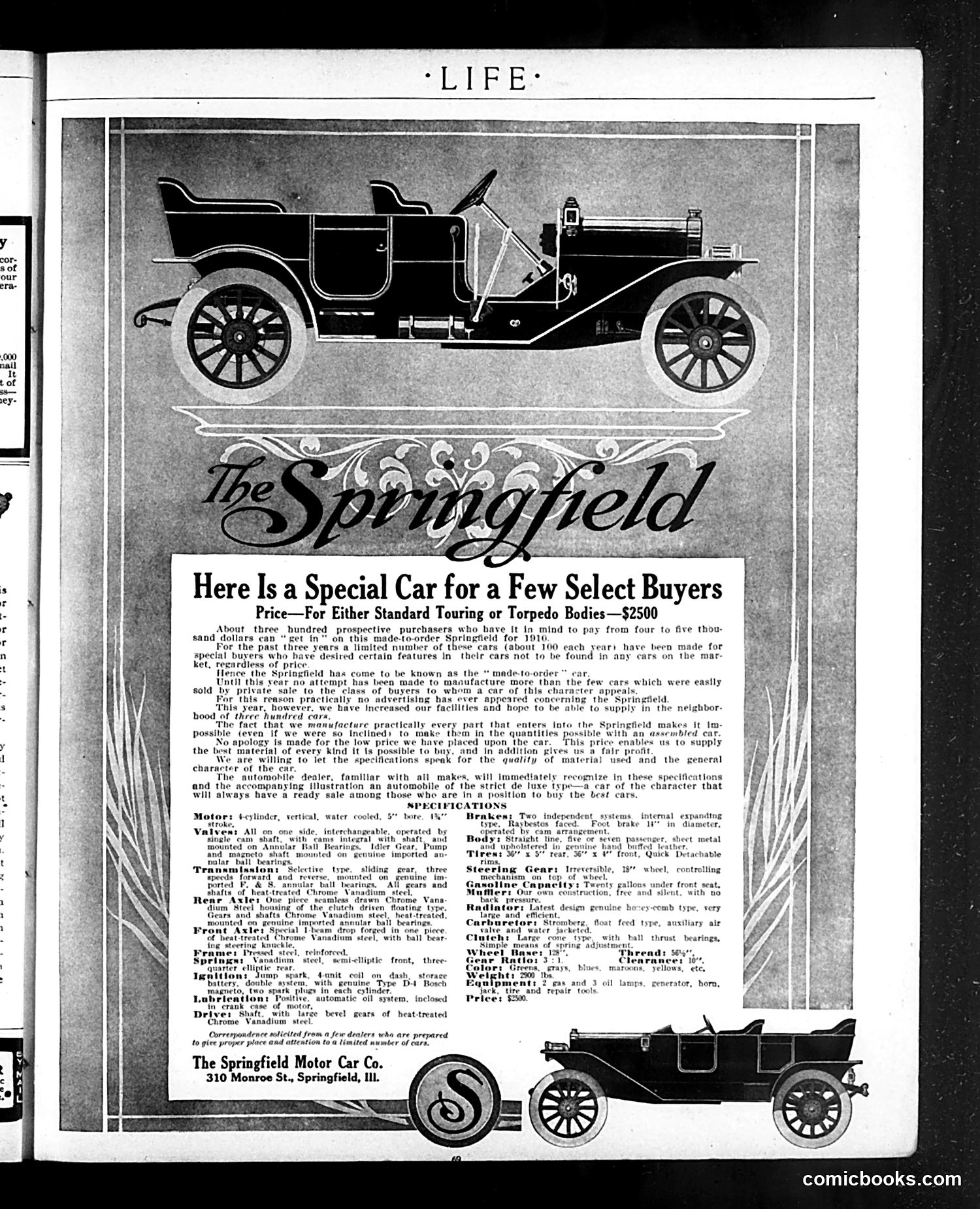
This page is **not a cartoon or satire**, but rather a straightforward automobile advertisement from Life magazine. It promotes the Springfield Motor Car Company's luxury vehicle priced at $2,500—positioned as an exclusive, made-to-order automobile for wealthy buyers willing to pay $4,000-$5,000. The ad emphasizes exclusivity and craftsmanship rather than mass production. It notes only "about 100 each year" have been manufactured for three years, appealing to a select clientele who desire custom features unavailable in mass-market cars. The detailed specifications (Vanadium steel frame, Stromberg carburetor, etc.) underscore engineering quality. The layout features technical drawings of the vehicle alongside dense specifications text—typical early-1910s advertising targeting educated, affluent readers interested in automotive engineering details. This represents pre-Model T luxury marketing, before Ford's mass-production philosophy transformed the industry.
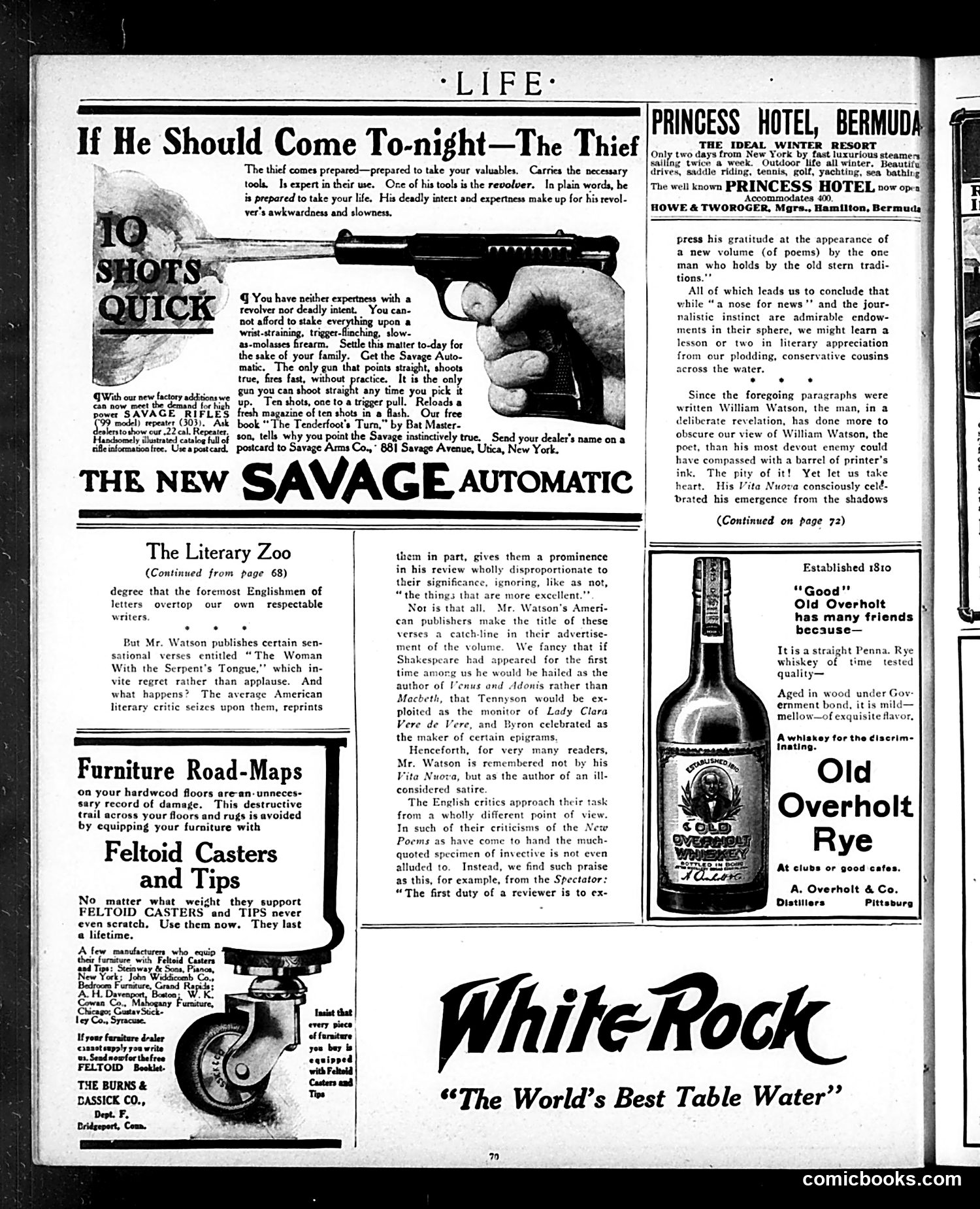
This page primarily features **advertisements and literary criticism**, not political satire. The main content is a **Savage Arms advertisement** using "home defense against burglars" as its sales hook—a common early-20th-century marketing angle. The copy emphasizes that homeowners lack the expertise and composure of criminals, so they need a reliable, accurate firearm. This reflects genuine period anxieties about urban crime. Below that, "The Literary Zoo" critiques American literary criticism's sensationalism. It argues that American critics overemphasize scandalous or attention-grabbing works—using poet William Watson as an example—while ignoring artistic merit. The piece contrasts this with English critics' more serious, appreciative approach. The satire targets American publishing's commercial instincts and readers' susceptibility to scandal. The remaining content includes period advertisements (Feltoid Casters, Old Overholt Rye, White Rock water, Princess Hotel) typical of Life's revenue model. The overall thrust: American cultural criticism prioritizes shock value over substance.
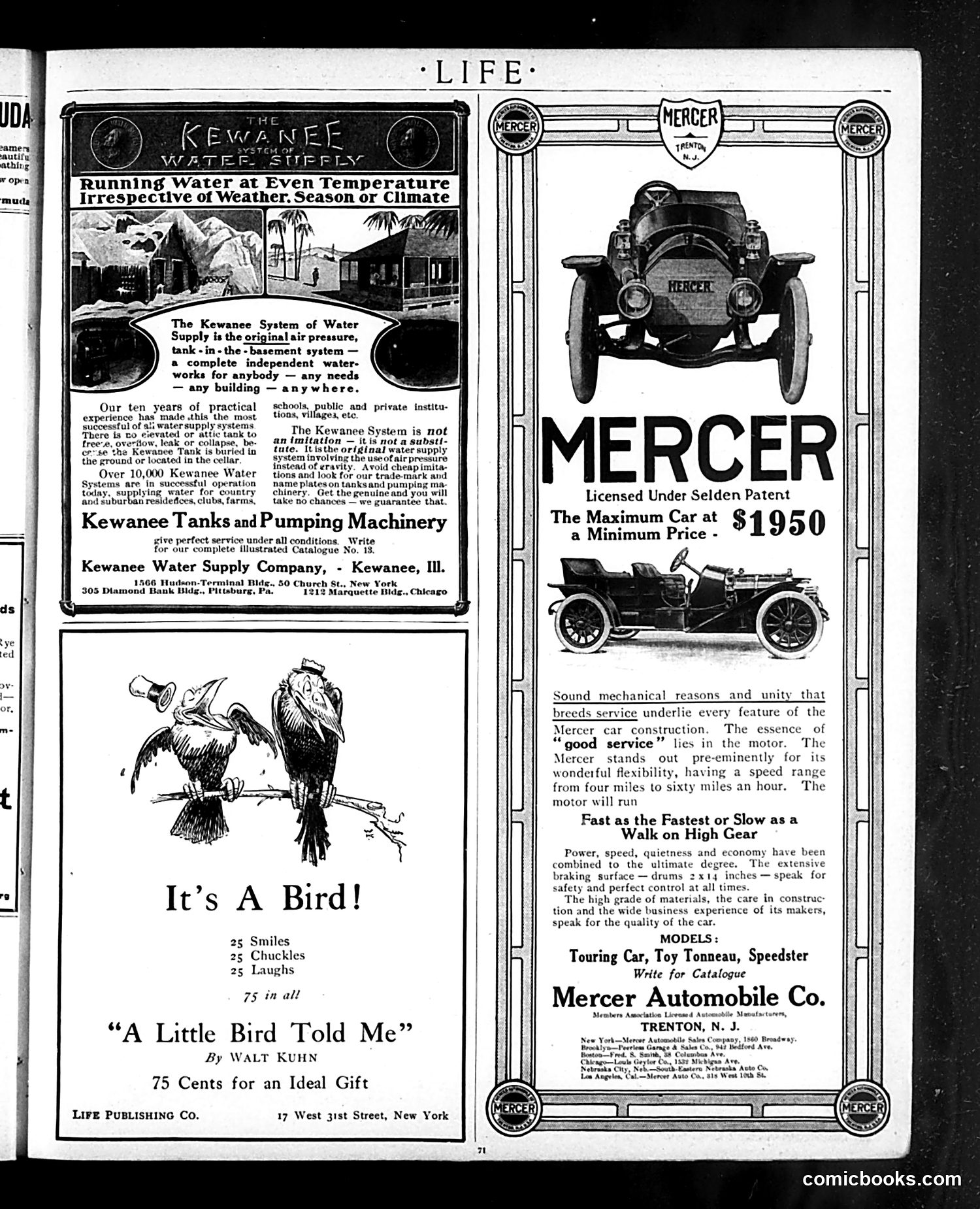
This page is primarily **advertising**, not political satire. It contains four unrelated commercial advertisements: 1. **Kewanee Water Supply System** (left): Promotes an underground water tank system for homes, emphasizing it's the "original" pressurized system, not an imitation. 2. **"It's a Bird" (bottom left)**: A humorous book advertisement by Walt Kuhn containing 25 smiles, chuckles, and laughs—appears to be a joke or humor collection priced at 75 cents. 3. **Mercer Automobile** (right): The dominant ad features a $1,950 luxury car, emphasizing mechanical reliability and performance flexibility ("fast as the fastest or slow as a walk on high gear"). The cartoonish birds illustration accompanying the book ad is decorative rather than satirical. No political figures or social commentary are evident. This is a typical early-20th-century magazine page mixing advertisements with light consumer humor.
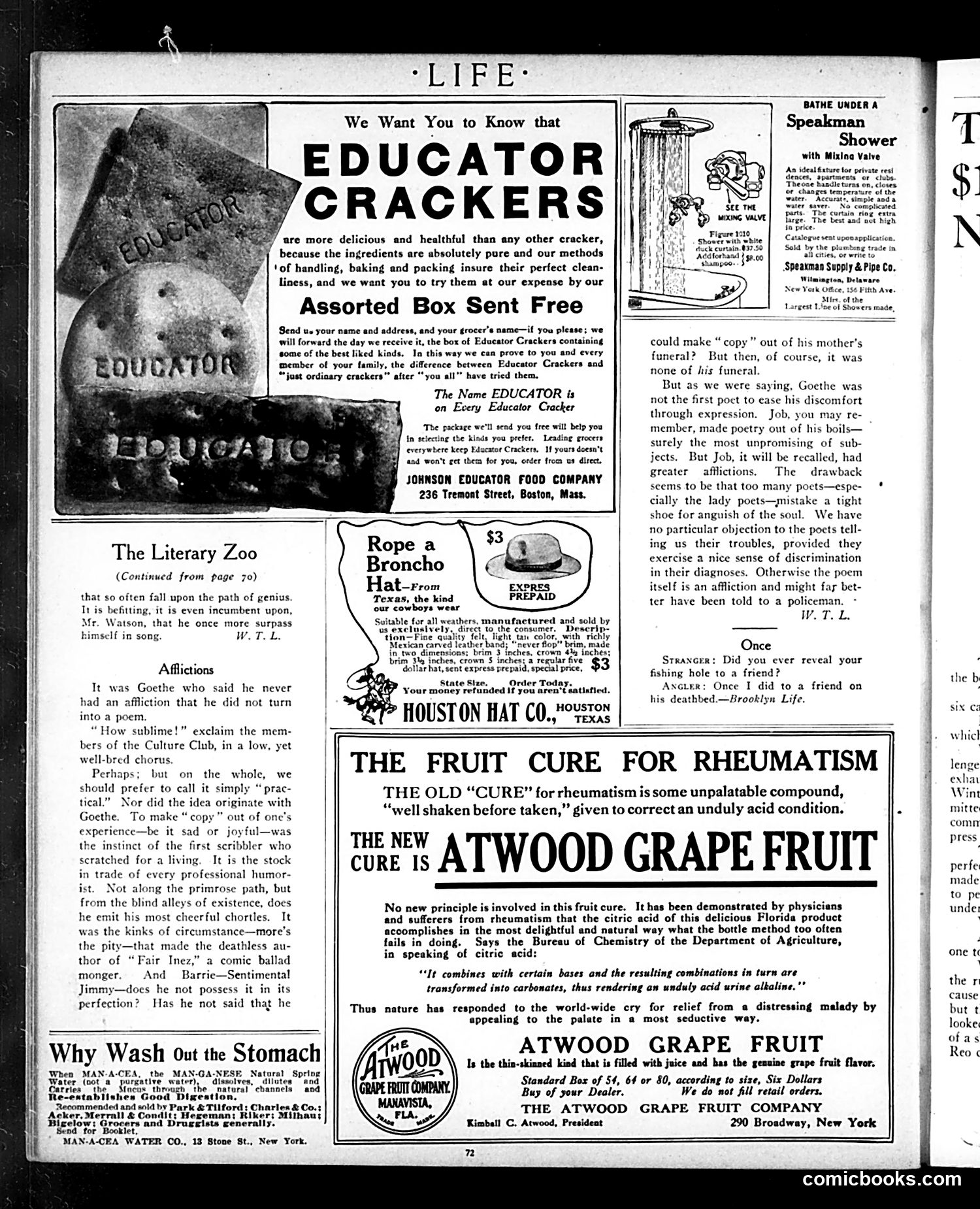
This page is primarily **advertisements** interspersed with a literary column called "The Literary Zoo." The main content is commercial: Educator Crackers offers free samples; Speakman advertises shower fixtures; Houston Hat Company sells broncho hats; and Atwood Grape Fruit promotes a supposed rheumatism cure. The **literary section** continues a discussion about how writers, like Goethe, transform personal afflictions into creative work. The satirical point is subtle: the author mocks both Goethe's supposed originality and modern "Culture Club" members who revere him uncritically. The piece gently ridicules professional humorists and especially "lady poets" who mistake trivial discomforts (like tight shoes) for profound suffering worthy of verse. The tone is urbane and skeptical—typical of Life's satirical approach to contemporary pretension.
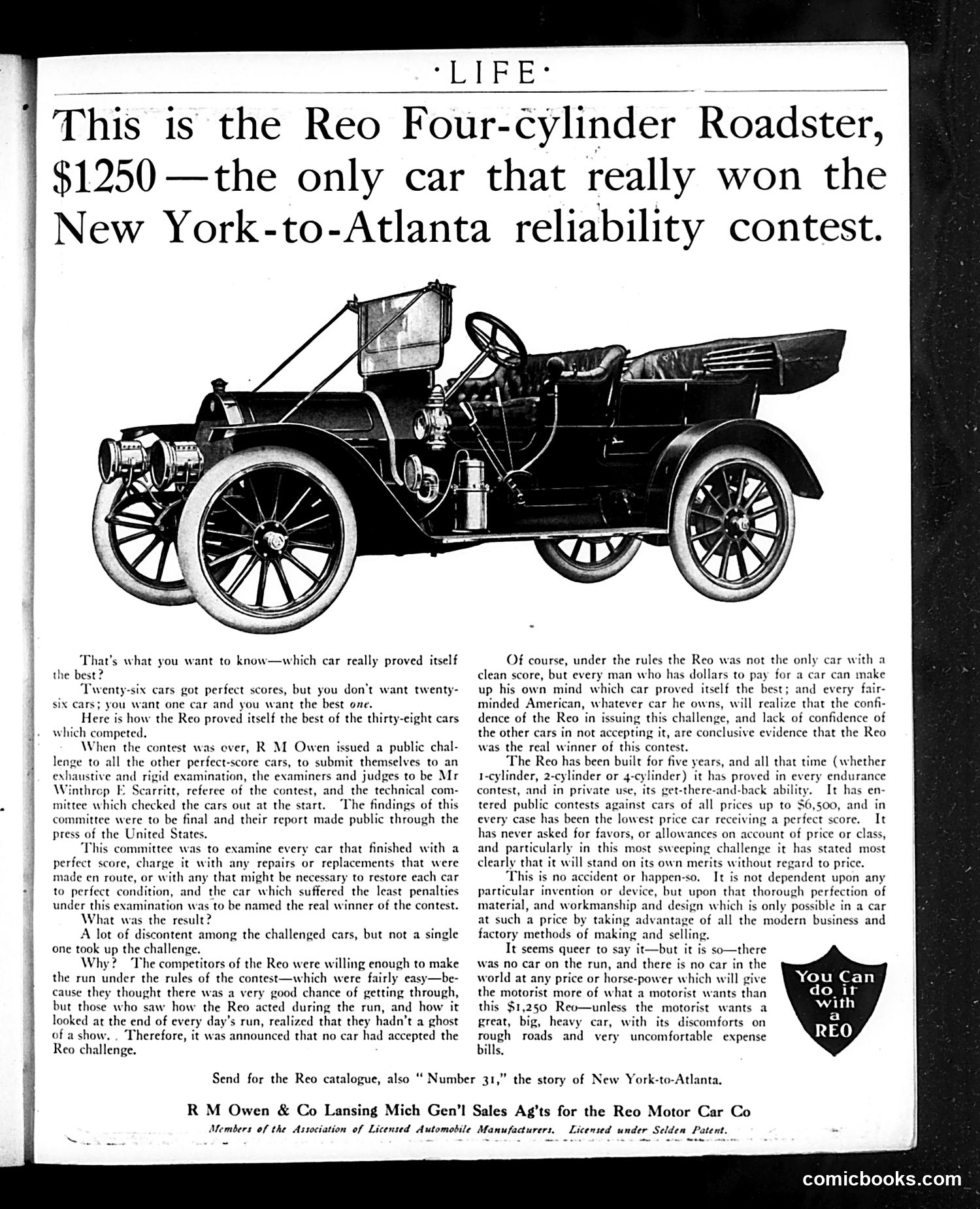
This is primarily **advertising copy**, not satire or political commentary. The page promotes the Reo Four-cylinder Roadster ($1,250) by claiming it was "the only car that really won" a New York-to-Atlanta reliability contest. The central claim is competitive rather than satirical: while 26 cars achieved perfect scores, Reo's owner (R.M. Owen) publicly challenged other perfect-score vehicles to rigorous post-race inspection. Notably, **no competing cars accepted the challenge**—the advertisement interprets this refusal as implicit admission that the Reo was superior. The argument emphasizes that the Reo proved itself "the best" not through accident but through superior "material, and workmanship and design" achievable at its affordable price point. This positions affordability as evidence of manufacturing excellence rather than compromise. The appeal targets "fair-minded American[s]" seeking practical value, suggesting the Reo's confidence and competitors' silence speak louder than perfect scores.
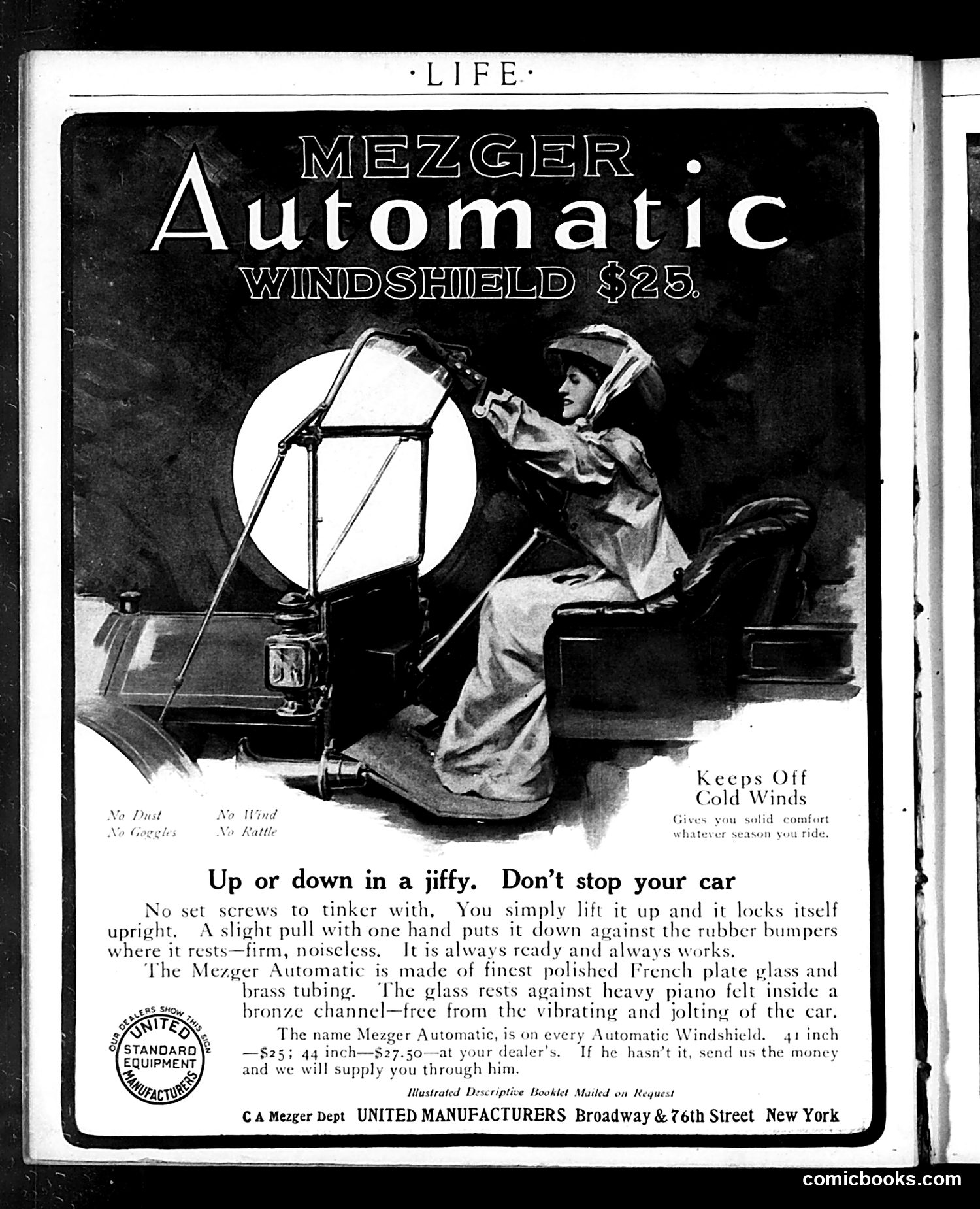
This is a **product advertisement**, not a political cartoon or satire. It promotes the Mezger Automatic Windshield, priced at $25-$27.50, manufactured by United Manufacturers in New York. The ad features an illustration of a motorist in period clothing (appears to be 1920s-era) demonstrating the windshield's convenience. The pitch emphasizes practical benefits for early automobile drivers: no screws to adjust, simple up-and-down operation, keeps out cold wind and dust, and remains stable despite car vibration. The marketing appeal targets car owners seeking comfort and ease of use—concerns specific to early automobiles when windshield technology was still developing. The "no set screws to tinker with" detail suggests competing products required manual adjustment, making this model's automatic mechanism a notable innovation for the era.
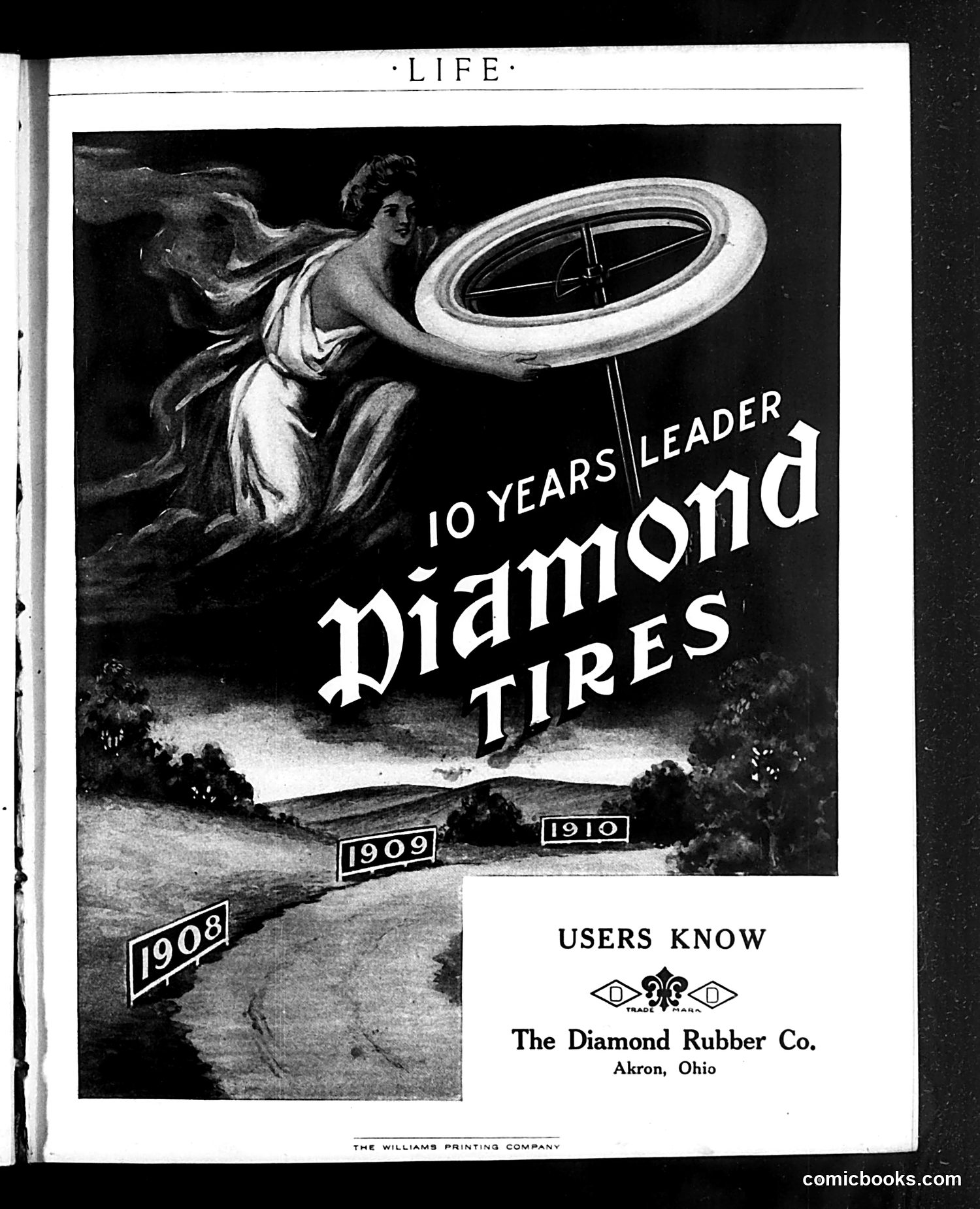
This is a **product advertisement**, not political satire. The Diamond Rubber Company of Akron, Ohio is marketing Diamond brand tires by claiming "10 Years Leader" status. The allegorical imagery shows a classical female figure (representing the brand or industry leadership) holding a large tire, with a landscape marked by years 1908, 1909, and 1910—establishing the company's decade-long market dominance. The phrase "Users Know" appeals to consumer trust and experience. The classical aesthetic and mythological styling were common in early 1900s advertising, lending authority and prestige to the product. This reflects the early automotive tire industry's competitive positioning during the rapid expansion of automobile manufacturing in America's industrial heartland.
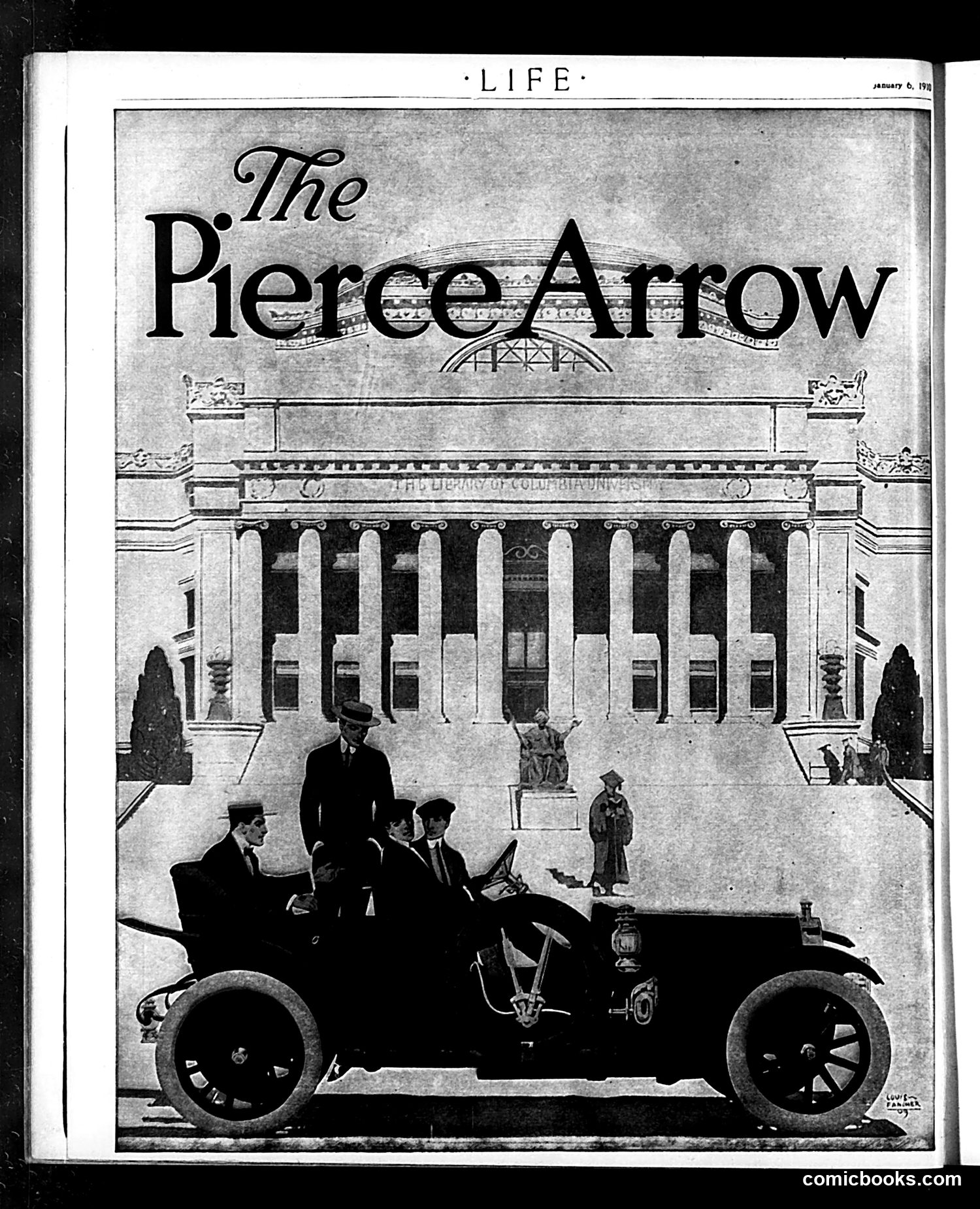
This is a **title page advertisement** for the Pierce Arrow automobile, not a political cartoon. The image shows a luxurious car positioned prominently in front of what appears to be a neoclassical government building (likely the Library of Columbia University, visible on the building's frieze). Well-dressed men in formal attire occupy the vehicle, while pedestrians and a statue are visible in the background, establishing an urban, prestigious setting. The composition suggests the Pierce Arrow represents sophistication and high status—appropriate transportation for important civic or business figures. The advertisement leverages architectural grandeur and formal dress to convey the car's quality and appeal to wealthy, influential buyers during what appears to be the early 20th century automobile era.