
Life, 1910-01-06 · page 36 of 76
Life — January 6, 1910 — page 36: what you’re looking at
What you’re looking at
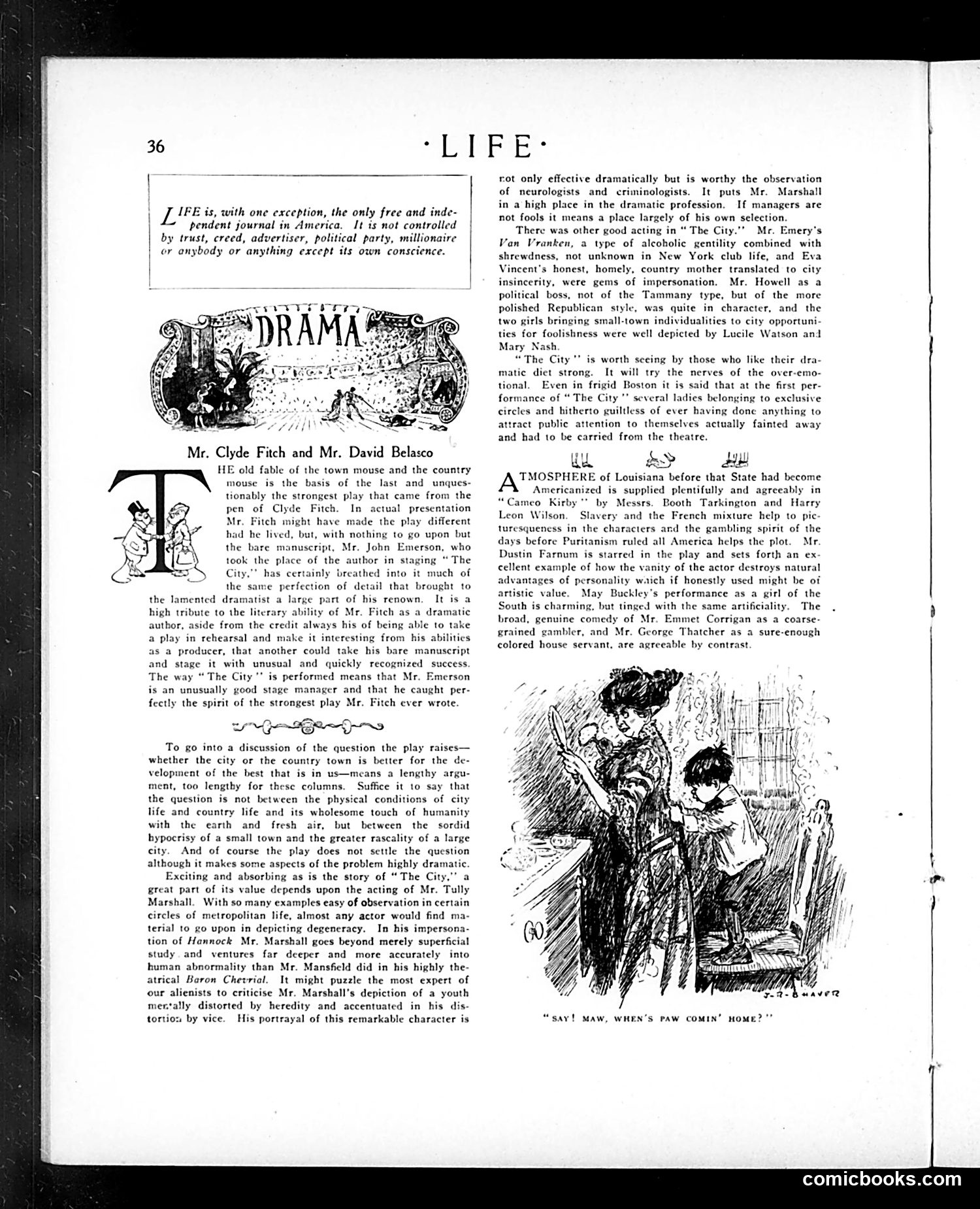
This page reviews **"The City,"** a play by the late dramatist Clyde Fitch, staged by director John Emerson after Fitch's death. The review praises Emerson's staging and particularly actor Tully Marshall's performance as the character Hannock, a youth morally corrupted by heredity and vice. The central dramatic tension involves the classic **town-mouse versus country-mouse fable**: comparing whether small-town or urban life better develops character. The play argues that small-town hypocrisy rivals big-city rascality—neither environment is morally superior. The sketch illustration (bottom right) shows what appears to be a domestic scene, likely depicting the play's action. The review is substantively about theater criticism and acting merit rather than political satire. It positions *Life* magazine itself (in the header box) as uniquely independent from commercial interests—a claim about editorial integrity rather than commentary on current events.
📄 Transcribed text from this page (OCR, searchable)
Machine-transcribed from the original scan — historical spelling and the odd misread are preserved.
| [FE is, with one exception, the only free and inde- | pendent journal in America, It is not controlled | | by trust, creed, advertiser, political party, millionaire | or anybody or anything except its own conscience. Mr. Clyde Fitch and Mr. David Belasco HE old fable of the town mouse and the country mouse is the basis of the last and unques- tionably the strongest play that came from the pen of Clyde Fitch. In actual presentation Mr. Fitch might have made the play different had he lived, but, with nothing to go upon but the bare manuscript, Mr. John Emerson, who took the place of the author in staging “The City,” has certainly breathed into it much of the same perfection of detail that brought to the lamented dramatist a large part of his renown. It is a high tribute to the literary ability of Mr. Fitch as a dramatic author, aside from the credit always his of being able to take his abilities a play in rehearsal and make it interesting from as a producer, that another could take his bare manuscript and stage it with unusual and quickly recognized success The way “The City’ is performed means that Mr. Emerson is an unusually good stage manager and that he caught per- fectly the spirit of the strongest play Mr. Fitch ever wrote. HN u~ge 9 To go into a discussion of the question the play raises— whether the city or the country town is better for the de- velopinent of the best that is in us—mcans a lengthy argu- ment, too lengthy for these columns. Suffice it to say that the question is not between the physical conditions of city life and country life and its wholesome touch of humanity with the earth and fresh air, but between the sordid hypocrisy of a small town and the greater rascality of a large city. And of course the play does not settle the question although it makes some aspects of the problem highly dramatic. Exciting and absorbing as is the story of “The City,” a great part of its value depends upon the acting of Mr. Tully Marshall. With so many examples easy of observation in certain circles of metropolitan life, almost any actor would find ma- terial to go upon in depicting degeneracy. In his impersona- tion of Hannock Mr. Marshall goes beyond merely superficial study and ventures far deeper and more accurately into human abnormality than Mr. Mansfield did in his highly the- atrical Baron Chevrial. It might puzzle the most expert of our alienists to criticise Mr. Marshall's depiction of a youth mentally distorted by heredity and accentuated in his tortion by vice. His portrayal of this remarkable character is ge Le) al rot only effective dramatically but is worthy the observation of neurologists and criminologists. It puts Mr. Marshall in a high place in the dramatic profession. If managers are not fools it means a place largely of his own selection. There was other good acting in “ The City."” Mr. Emery’s Van Vranken, a type of alcoholic gentility combined with shrewdness, not unknown in New York club life, and Eva Vincent's honest, homely, country mother translated to city insincerity, were gems of impersonation. Mr. Howell as a political boss, not of the Tammany type, but of the more polished Republican style, was quite in character, and the two girls bringing small-town individualities to city opportuni- ties for foolishness were well depicted by Lucile Watson and Mary Nash “The City"? is worth sceing by those who like their dra- matic diet strong. It will try the nerves of the over-en tional, Even in frigid Boston it is said that at the first per- formance of “The City "” several ladies belonging to exclusive circles and hitherto guiltless of ever having done anything to attract public attention to themselves actually fainted away and had to be carried from the theatre. 1) Wu de> ay TMOSPHERE of Louisiana before that State had become Americanized is supplied plentifully and agreeably in “Cameo Kirby" by Messrs. Booth Tarkington and Harry Leon Wilson. Slavery and the French mixture help to pic: turesqueness in the characters and the gambling spirit of the days before Puritanism ruled all America helps the plot. Mr. Dustin Farnum is starred in the play and sets forth an ex cellent example of how the vanity of the actor destroys natural advantages of personality waich if honestly used might be of artistic value, May Buckley's performance as a girl of the South is charming, but tinged with the same artificiality. The broad, genuine comedy of Mr. Emmet Corrigan as a coarse- grained gambler, and Mr. George Thatcher as a sure-enough colored house servant, are agreeable by contrast 'S PAW COMIN’ HoME? "” “say! MAW, WHE! comicbooks.com