
Life, 1910-01-06 · page 44 of 76
Life — January 6, 1910 — page 44: what you’re looking at
What you’re looking at
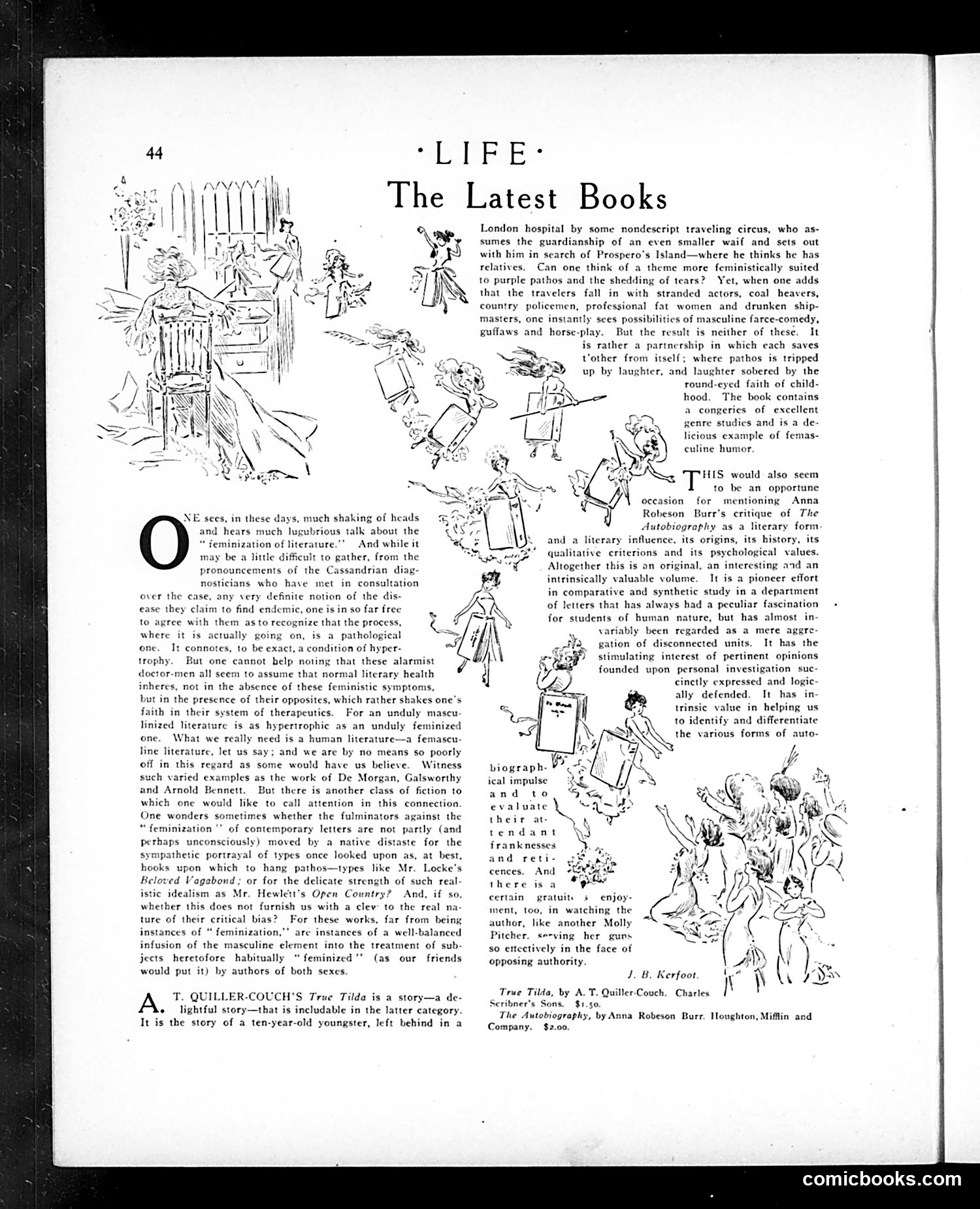
This page discusses the contemporary literary debate over "feminization of literature." Critics claimed modern writing was becoming too sentimental and emotionally focused—coded language for work by or about women. The reviewer argues this critique is flawed, noting that truly healthy literature requires balance rather than aggressive "masculinity." He defends works like Galsworthy's and Bennett's as well-balanced, and praises A.T. Quiller-Couch's *True Tilda*—a children's story that could seem sentimentally feminine (orphans seeking refuge) but combines pathos with masculine elements like farce and comedy. The cartoon illustrations appear to show characters from *True Tilda*, likely depicting the circus children and their various traveling-companion encounters. The review essentially argues: good literature transcends gendered categories; dismissing "feminine" work reflects critical bias rather than literary merit.
📄 Transcribed text from this page (OCR, searchable)
Machine-transcribed from the original scan — historical spelling and the odd misread are preserved.
4D RE The Latest Books NE sees, in these days, much shaking of heads and hears much lugubrious talk about the “ feminization of literature.” And while it may be a little difficult 10 gather, from the pronouncements of the Cassandrian diag- tion over the case, any very definite notion of the dis- ease they claim to find endemic, one is in so far free to agree with them as to recognize that the process, where it is actually going on, is a pathological one. It connotes, to be exact, a condition of hyper- trophy. But one cannot belp noting that these alarmist doctor-men all seem to assume that normal literary health inheres, not in the absence of these feministic symptoms, but in the presence of their opposites, which rather shakes one’s faith in their system of therapeutics. For an unduly mascu. linized literature is as hypertrophic as an undul What we really need is a human literature line literature, let us say; and we are by no means so poorly off in this regard as some would have us believe. Witness such varied examples as the work of De Morgan, Galsworthy and Arnold Bennett. But there is another class of fiction to which one would like to call attention in this connection One wonders sometimes whether the fulminators against the nosticians who have met in consu feminized ‘one. a femascu “ feminization’ of comtemporary letters are not partly (and perhaps unconsciously) moved by a native distaste for the sympathetic portrayal of types once looked upon as, at best, hooks upon which to hang pathos—types like Mr. Locke's Beloved Vagabond ; or for the delicate strength of such real istic idealism as Mr. Hewlett's Open Country? And, if so. whether this does not furnish us with a clev to the real na. ture of their critical bias? For these works, far from being instances of “ feminization,’’ are instances of a well-balanced infusion of the masculine element into the treatment of sub- jects heretofore habitually “feminized (as our friends would put it) by authors of both sexes A T. QUILLER-COUCH’S True Tilda is a story. de- lightful story—that is includable in the latter category. It is the story of a ten-year-old youngster, left behind in a London hospital by some nondescript traveling circus, who as- sumes the guardianship of an even smaller waif and sets out with him in search of Prospero’s Island—where he thinks he has relatives, Can one think of a theme more feministically suited to purple pathos and the shedding of tears? Yet, when one adds that the travelers fall in with stranded actors, coal heavers, country policemen, professional fat women and drunken s! masters, one instantly sees possibilities of masculine farce-comedy, guffaws and horse-play. But the result is neither of these. It is rather a partnership in which each saves vother from itself; where pathos is tripped id laughter sobered by the round-eyed faith of child- hood. The book contains a congeries of excellent genre studies and is a de- licious example of femas- culine humor. up by laughter, HIS would also seem to be an opportune occasion for mentioning Anna Robeson Burr's critique of The Autobiography as form and a literary influence, its origins, its history, its qualitative criterions and its psychological values. Altogether this is an original, an interesting and an intrinsically valuable volume. It is a pioneer effort in comparative and synthetic study in a department of letters that has always had a peculiar fascination for students of human nature, but has almost in- variably been regarded as a mere aggre- gation of disconnected units. It has the stimulating interest of pertinent opinions founded upon personal investigation suc- cinctly expressed and logic ally defended. It has in trinsic value in helping us to identify and differentiate the various forms of auto- erary biograph- z ical impulse and to evaluate their at- tendant franknesses and reti- cences. nd there is a certain gratuite 5 enjoy- ment, too, in watching the author, like another Molly Pitcher. serving her guns so ettectively in the face of opposing authority J. B. Kerfoot True Tilda, by A. T. Quiller-Couch. Charles ] Scribner's Sons. $1.50. The Autobiography, by Anna Robeson Burr. Houghton, Mifflin and Company. $2.00. comicbooks.com