
Life, 1910-01-06 · page 32 of 76
Life — January 6, 1910 — page 32: what you’re looking at
What you’re looking at
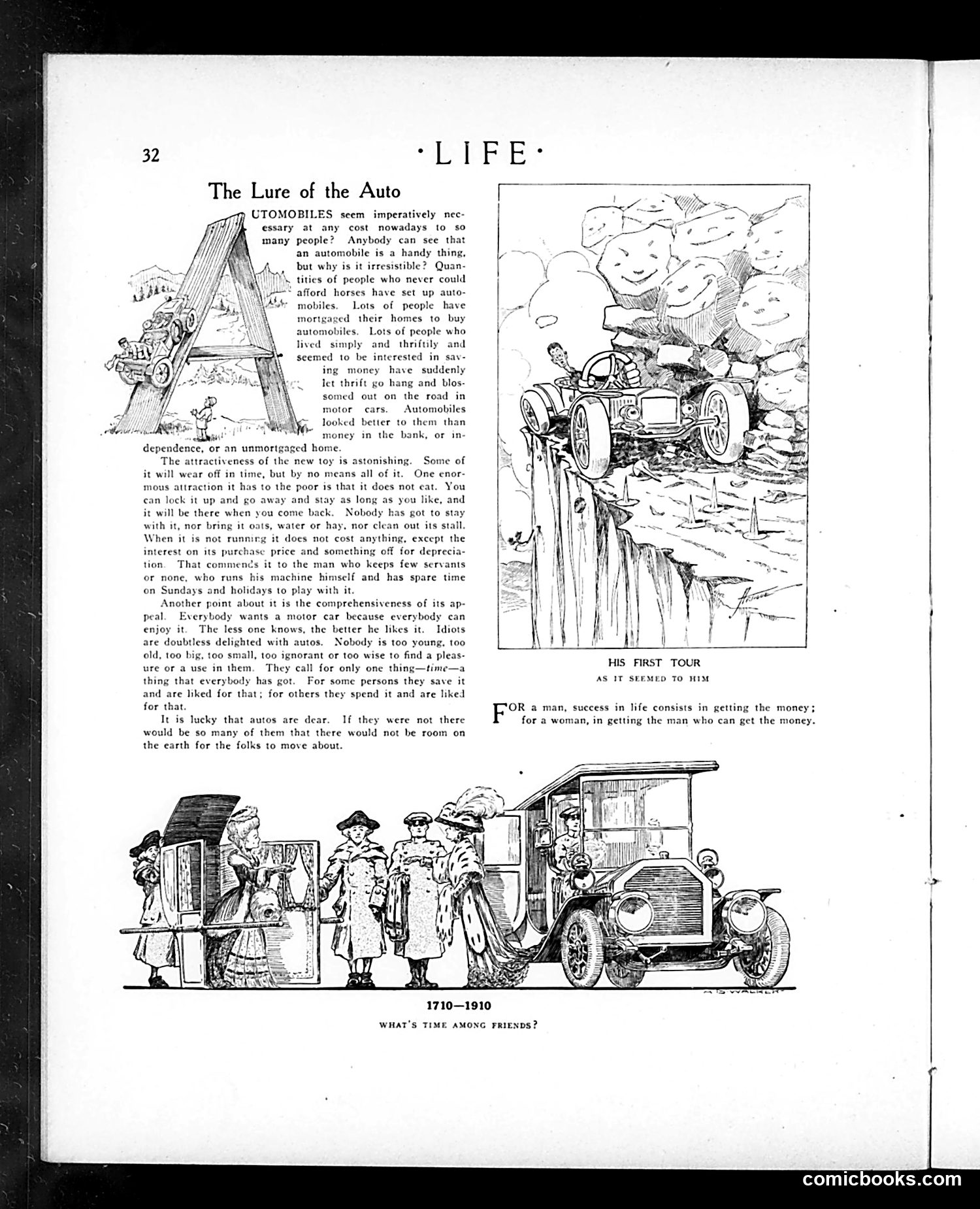
This 1910 article satirizes the automobile's irresistible appeal to Americans across all social classes. The text argues that cars have become a cultural obsession—people who "never could afford horses" are now "mortgaging their homes" to buy them, abandoning thrift and savings. The satire identifies the car's seductive power: unlike horses, it requires no daily maintenance; it's equally appealing to the ignorant and wise; and it offers democratic access—"everybody wants a motor car because everybody can enjoy it." The cartoon contrasts 1710 and 1910: where 18th-century travelers required elaborate horse-drawn coaches and attendants, the 1910 family arrives in a motorcar—suggesting technological progress but also social disruption through automobile adoption. The "His First Tour" illustration shows a wealthy driver joyfully motoring past rural poverty, capturing the era's class tensions as automobiles became status symbols and instruments of leisure for the wealthy.
📄 Transcribed text from this page (OCR, searchable)
Machine-transcribed from the original scan — historical spelling and the odd misread are preserved.
IEE * The Lure of the Auto UTOMOBILES scem imperatively nec- essary at any cost nowadays to so many people? Anybody can see that an automobile is a handy thing, but why is it irresistible? Quan- tities of people who never could afford horses have set up auto- mobiles. Lots of people have mortgaged their homes to buy automobiles, Lots of people who lived simply and thriftily and seemed to be interested in sav- i ing money have suddenly let thrift go hang and blos- somed out on the road in motor cars. Automobiles looked better to them than money in the bank, or in- dependence, or an unmortgaged bi The attractiveness of the new toy is astonishing. Some of it will wear off in time, but by no means all of it. One enor- mous attraction it has to the poor is that it does not eat. You can lock it up and go away and stay as long as you like, and it will be there when you come back. Nobody has got to stay with it, nor bring it oats, water or hay, nor clean out its stall. When it is not running it does not cost anything, except the interest on its purchase price and something off for deprecia- tion. That commends it to the man who keeps few servants or none, who runs his machine himself and has spare time on Sundays and holidays to play with it Another point about it is the comprehensiveness of its ap- \ peal. Everybody wants a motor car because everybody can ' enjoy it. The less one knows, the better he likes it. Idiots are doubtless delighted with autos. Nobody is too young, 100 old, too bi small, too ignorant of too wise to find a pleas- ure or a use in them. They call for only one shisig— dine a HIS FIRST TOUR thing that everybody has got. For some persons they save it AS IT StrateD To Wiat and are liked for that; for others they spend it and are liked for that. OR a man, success in life consists in getting the mone; It is lucky that autos are dear. If they were not there for a woman, in getting the man who can get the mone: would be so many of them that there would not be room on the earth for the folks to move about. > 1710—1910 WHAT'S TIME AMONG FRIENDS? comicbooks.com