
Life, 1910-01-06 · page 27 of 76
Life — January 6, 1910 — page 27: what you’re looking at
What you’re looking at
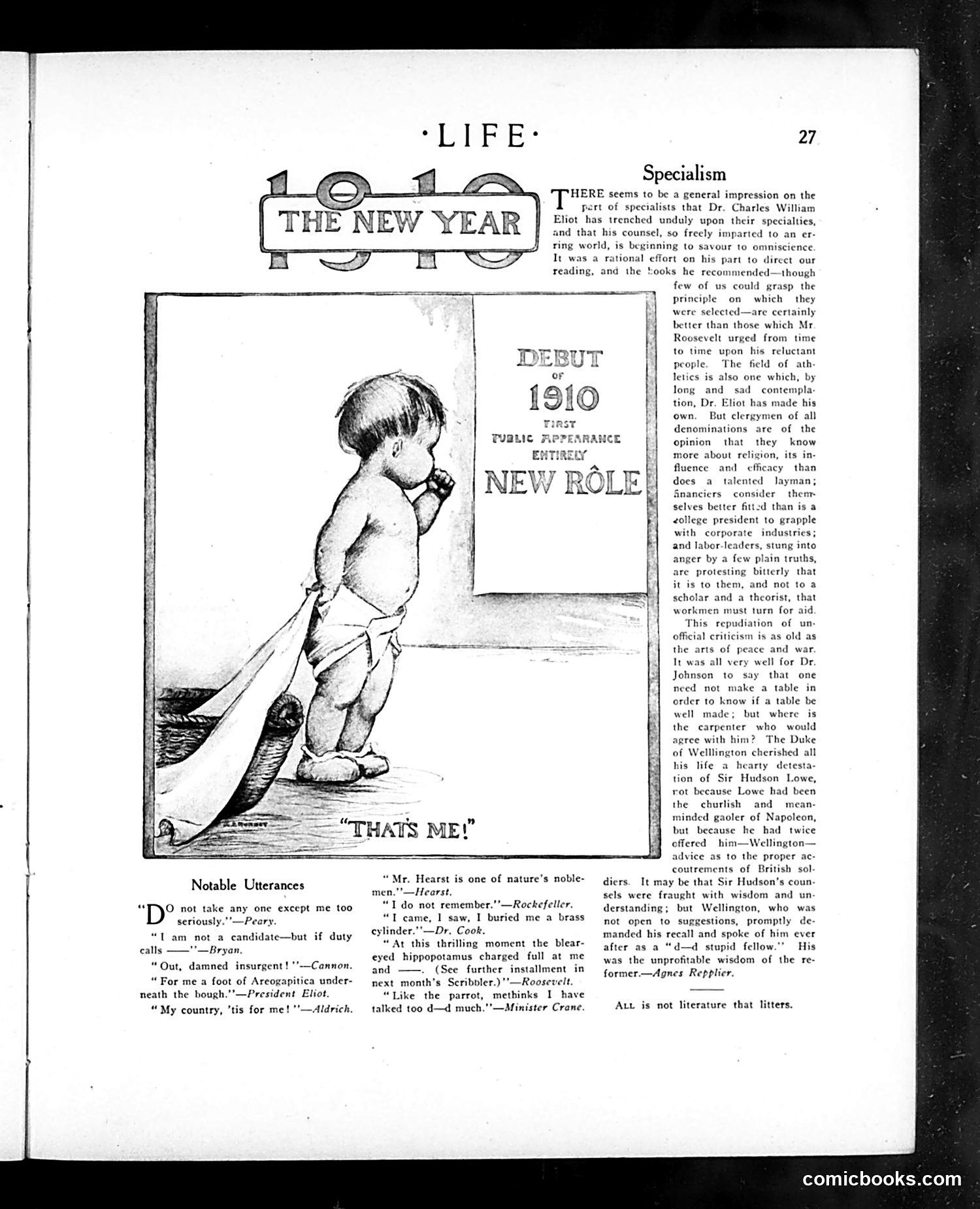
This page satirizes **Dr. Charles William Eliot**, president of Harvard, who had become known for offering unsolicited advice on numerous subjects—from reading lists to athletics to religion—despite lacking expertise in these fields. The cartoon depicts a baby (representing 1910) posting a sign announcing its "debut" and "new role," mocking Eliot's tendency to insert himself into domains beyond his authority. The "Notable Utterances" section below ridicules various public figures' self-serving or evasive statements from 1909-1910, including Theodore Roosevelt, William Jennings Bryan, and Frederick Cook (the fraudulent Arctic explorer). The accompanying essay by Agnes Repplier argues that specialists resent outsiders—even intelligent ones—offering criticism. She illustrates this with historical examples (Dr. Johnson, the Duke of Wellington) to suggest that expertise-based defensiveness is timeless and counterproductive. The satire targets both Eliot's presumption and the defensive attitude of specialists who reject legitimate outside perspective.
📄 Transcribed text from this page (OCR, searchable)
Machine-transcribed from the original scan — historical spelling and the odd misread are preserved.
HE NEW YEAR 27 Specialism HERE seems to be a general impression on the pert of specialists that Dr. Charles William liot has trenched unduly upon their specialties, and that his counsel, so freely imparted to an er- ring world, is beginning to savour to omniscience It was a rational effort on his part to direct our reading, and the books he recommende —though few of us could grasp the Notable Utterances “ O not take any one except me too '—Peary. “Tam not a candidate—but if duty calls Bryan. “Out, damned insurgent! ''—Cannon. “For me a foot of Areogapitica under- neath the bough.’’—President Eliot. “My country, 'tis for m Aldrich, “ Mr. Hearst is one of nature's noble- men."'"—Hearst. I do not remember.’’—Rockefeller. “T came, 1 saw, I buried me a brass eylinder.”'"—Dr, Cook. “At this thrilling moment the blear- eyed hippopotamus charged full at me and ——. (See further installment in next month’s Scribpler.)'’—Roosevelt. “Like the parrot, methinks I have talked too d—d much."’—Minister Crane. principle. on which they were selected—are certainly better than those which Mr Roosevelt urged from time to time upon his reluctant people. The field of ath letics is also one which, by long and sad contempla- tion, Dr. Eliot has made his own. But clergymen of all denominations are of the opinion that they know more about religion, its in- fluence and efficacy than docs a talen| Ananciers consider m selves better fitted than is a zollege president to grapple with corporate industries; and labor-leaders, stung into anger by a few plain truths, are protesting bitterly that it is to them, and not to a scholar and a theorist, that workmen must turn for aid This repudiation of un- official criticism is as old as the arts of peace and war. It was all very well for Dr, Johnson to say that one need not make a table in order to know if a table be well made; but where is the carpenter who would agree with him? The Duke of Wellington cherished all his life a hearty detesta- tion of Sir Hudson Lowe, rot because Lowe had been the cburlish and mean- minded gaoler of Napoleon, but because he had twice offered him—Wellington— advice as to the proper ac- coutrements of British sol diers. It may be that Sir Hudson's coun- sels were fraught with wisdom and un derstanding; but Wellington, who was not open to suggestions, promptly de- manded his recall and spoke of him ever after as a “d—d stupid fellow.” His was the unprofitable wisdom of the re- former.—Agnes Repplier. Att is not literature that litters. comicbooks.com