
Life, 1910-01-06 · page 26 of 76
Life — January 6, 1910 — page 26: what you’re looking at
What you’re looking at
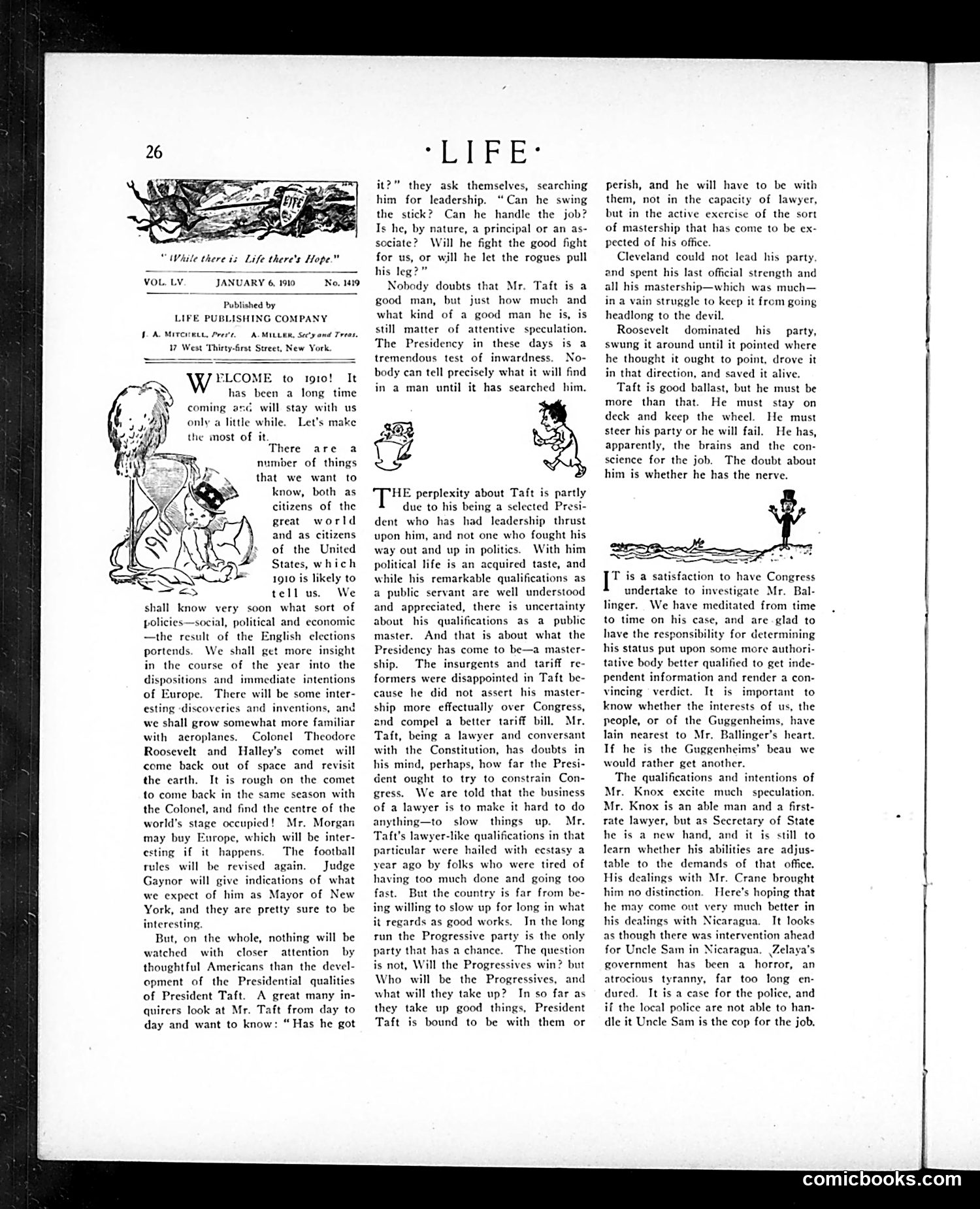
This *Life* magazine editorial assesses President William Howard Taft's leadership abilities as 1910 begins. The piece expresses uncertainty about whether Taft possesses genuine executive strength—asking repeatedly "Has he got it?" and "Can he swing the stick?" The author identifies a core problem: Taft was hand-picked as successor by Theodore Roosevelt rather than rising through political combat. This "selected President" lacks the aggressive mastery the office now demands. His legal background, while respectable, makes him cautious about constitutional limits on presidential power—a lawyer's tendency to complicate rather than act decisively. The editorial warns that the Progressive movement represents the nation's political future, and Taft must align with progressive goals or become irrelevant. The underlying concern: can this cerebral, constitutional lawyer provide the forceful leadership Americans expect, or will he prove merely an "associate" rather than a true "principal"?
📄 Transcribed text from this page (OCR, searchable)
Machine-transcribed from the original scan — historical spelling and the odd misread are preserved.
“ While there Life there's Hope.” VOL. LY JANUARY 6, 1910 No, 1419 Published by LIFE PUBLISHING COMPANY BAL MITCHMLE, Pree AL MILLER, Sec’y and Treas, 17 West Thirty-first Street, New York. ELCOME to i910! It has been a long time coming ané will stay with us only a little while. Let's make the most of it There are a number of things that we want to know, both as citizens of the great world and as citizens of the United States, which 1910 is likely to tell us. We shall know very soon what sort of policies—social, political and economic —the result of the English elections portends. We shall get more insight in the course of the year into the dispositions and immediate intentions of Europe. There will be some inter- esting discoveries and inventions, and we shall grow somewhat more familiar with aeroplanes. Colonel Theodore Roosevelt and Halley’s comet will come back out of space and revisit the earth. It is rough on the comet to come back in the same season with the Colonel, and find the centre of the world’s stage occupied! Mr. Morgan may buy Europe, which will be inter- esting if it happens. The football rules will be revised again. Judge Gaynor will give indications of what we expect of him as Mayor of New York, and they are pretty sure to be interesting. But, on the whole, nothing will be watched with closer attention by thoughtful Americans than the devel- opment of the Presidential qualities of President Taft. A great many in- quirers look at Mr. Taft from day to day and want to know: “Has he got “RUE it?” they ask themselves, searching him for leadership. “Can he swing the stick? Can he handle the job? Is he, by nature, a principal or an as- sociate? Will he fight the good fight for us, or will he let the rogues pull his leg?” Nobody doubts that Mr. Taft is a good man, but just how much and what kind of a good man he is, is still matter of attentive speculation. The Presidency in these days is a tremendous test of inwardness. No- body can tell precisely what it will find in a man until it has searched him. Le TH! perplexity about Taft is partly due to his being a selected Presi- dent who has had leadership thrust upon him, and not one who fought his way out and up in politics. With him political life is an acquired taste, and while his remarkable qualifications as a public servant are well understood and appreciated, there is uncertainty about his qualifications as a public master. And that is about what the Presidency has come to be—a master- ship. The insurgents and tariff re- formers were disappointed in Taft be- cause he did not assert his master- ship more effectually over Congress, and compel a better tariff bill, Mr. Taft, being a lawyer and conversant with the Constitution, has doubts in his mind, perhaps, how far the Presi- dent ought to try to constrain Con- gress. We are told that the business of a lawyer is to make it hard to do anything—to slow things up. Mr. Taft's lawyer-like qualifications in that particular were hailed with ecstasy a year ago by folks who were tired of having too much done and going too fast. But the country is far from be- ing willing to slow up for long in what it regards as good works. In the long run the Progressive party is the only party that has a chance. The question is not, Will the Progressives win? but Who will be the Progressives, and what will they take up? In so far as they take up good things, President Taft is bound to be with them or perish, and he will have to be with them, not in the capacity of lawyer, but in the active exercise of the sort of mastership that has come to be ex- pected of his office. Cleveland could not lead his party, and spent his last official strength and all his mastership—which was much— in a vain struggle to keep it from going headlong to the devil. Roosevelt dominated his _ party, swung it around until it pointed where he thought it ought to point, drove it in that direction, and saved it alive. Taft is good ballast, but he must be more than that. He must stay on deck and keep the wheel. He must steer his party or he will fail. He has, apparently, the brains and the con- science for the job. The doubt about him is whether he has the nerve. to investigate Mr. Bal- linger. We have meditated from time to time on his case, and are glad to have the responsibility for determining his status put upon some more authori- tative body better qualified to get inde- pendent information and render a con- vincing verdict. It is important to know whether the interests of us, the people, or of the Guggenheims, have lain nearest to Mr. Ballinger’s heart. If he is the Guggenheims’ beau we would rather get another. The qualifications and intentions of Mr. Knox excite much speculation. Mr. Knox is an able man and a first- rate lawyer, but as Secretary of State he is a new hand, and it is still to learn whether his abilities are adjus- table to the demands of that office. His dealings with Mr. Crane brought him no distinction. Here’s hoping that he may come out very much better in his dealings with Nicaragua. It looks as though there was intervention ahead for Uncle Sam in Nicaragua, Zelaya’s government has been a horror, an atrocious tyranny, far too long en- dured. It is a case for the police, and if the local police are not able to han- dle it Uncle Sam is the cop for the job. comicbooks.com