
A complete issue · 78 pages · 1920
Life — March 4, 1920
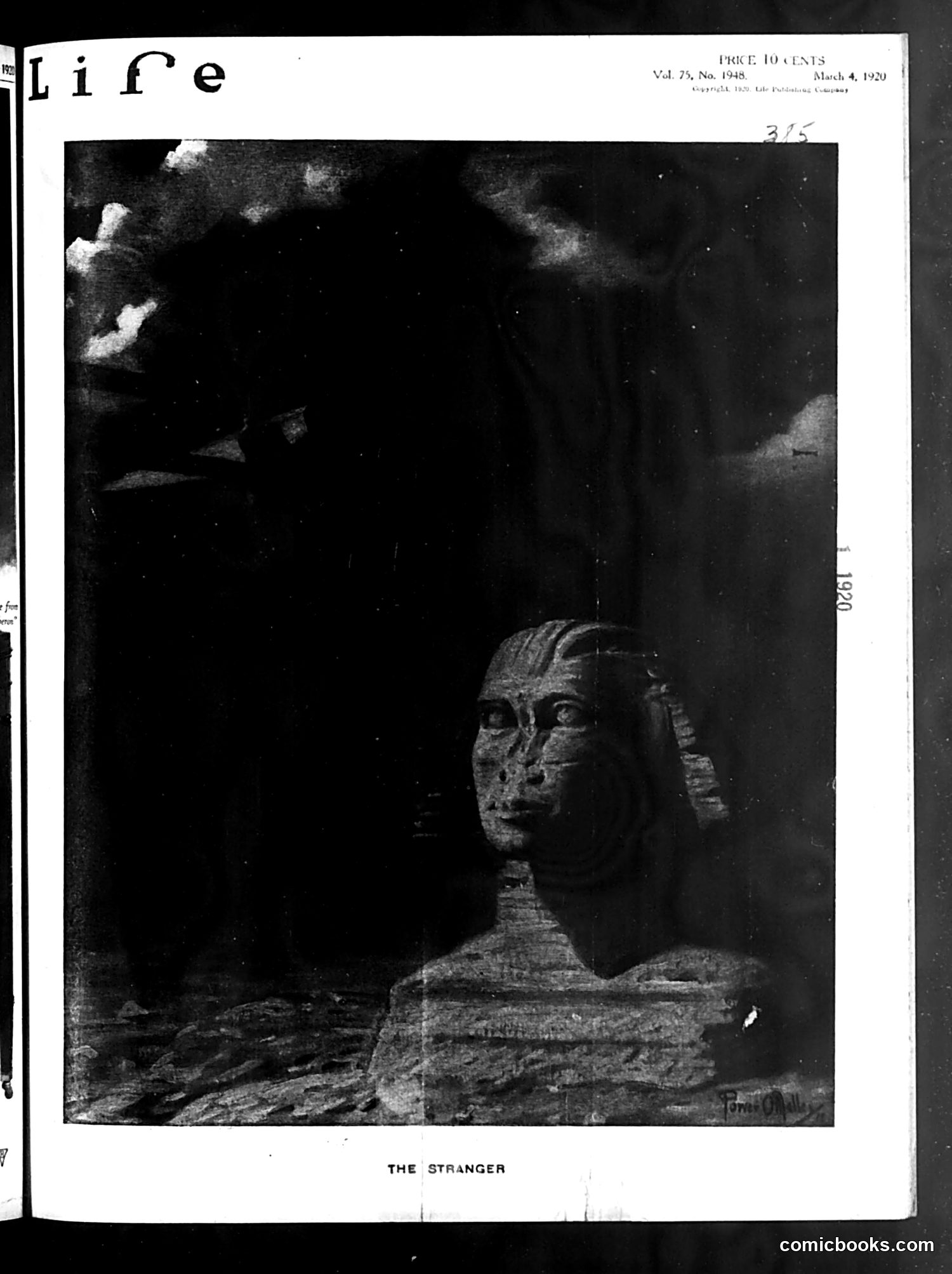
This Life magazine page from March 4, 1929 features an image titled "THE STRANGER." The photograph shows an Egyptian pharaoh statue or bust in dramatic lighting against a dark background. The statue wears traditional Egyptian headdress and regalia. Without additional context or accompanying article text visible on this page, the specific satirical point remains unclear. However, given Life's era and style, "The Stranger" likely uses the ancient Egyptian imagery metaphorically—possibly commenting on something foreign, unfamiliar, or ancient appearing in contemporary American society, or perhaps referencing an exhibition or archaeological discovery that was newsworthy in 1929. The dramatic, moody lighting emphasizes the statue's otherworldly quality, reinforcing the "stranger" concept.
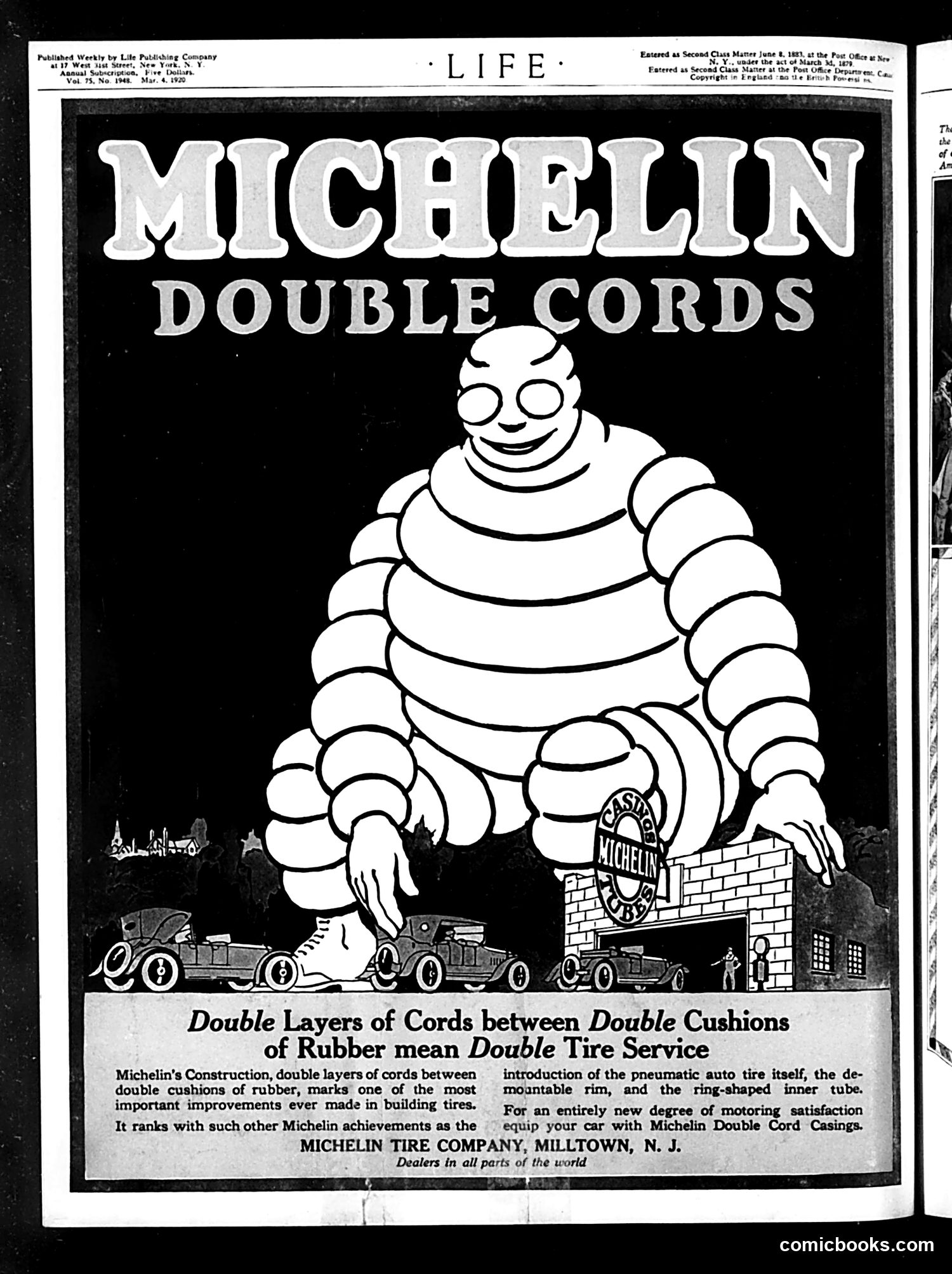
This is primarily a **commercial advertisement**, not political satire. It features Bibendum, Michelin's famous mascot—a rotund, jolly figure made entirely of stacked tire rings with a smiling face. The ad promotes Michelin's "Double Cords" tire technology, emphasizing "Double Layers of Cords between Double Cushions of Rubber" for enhanced durability and tire service. The imagery shows Bibendum as a benevolent giant overlooking early automobiles and an industrial building, suggesting confidence, strength, and innovation. The visual metaphor is straightforward: Bibendum's own pneumatic, cushioned construction represents the superior engineering now available to car owners. This appeared in *Life* magazine, which regularly featured advertisements alongside satire and commentary.
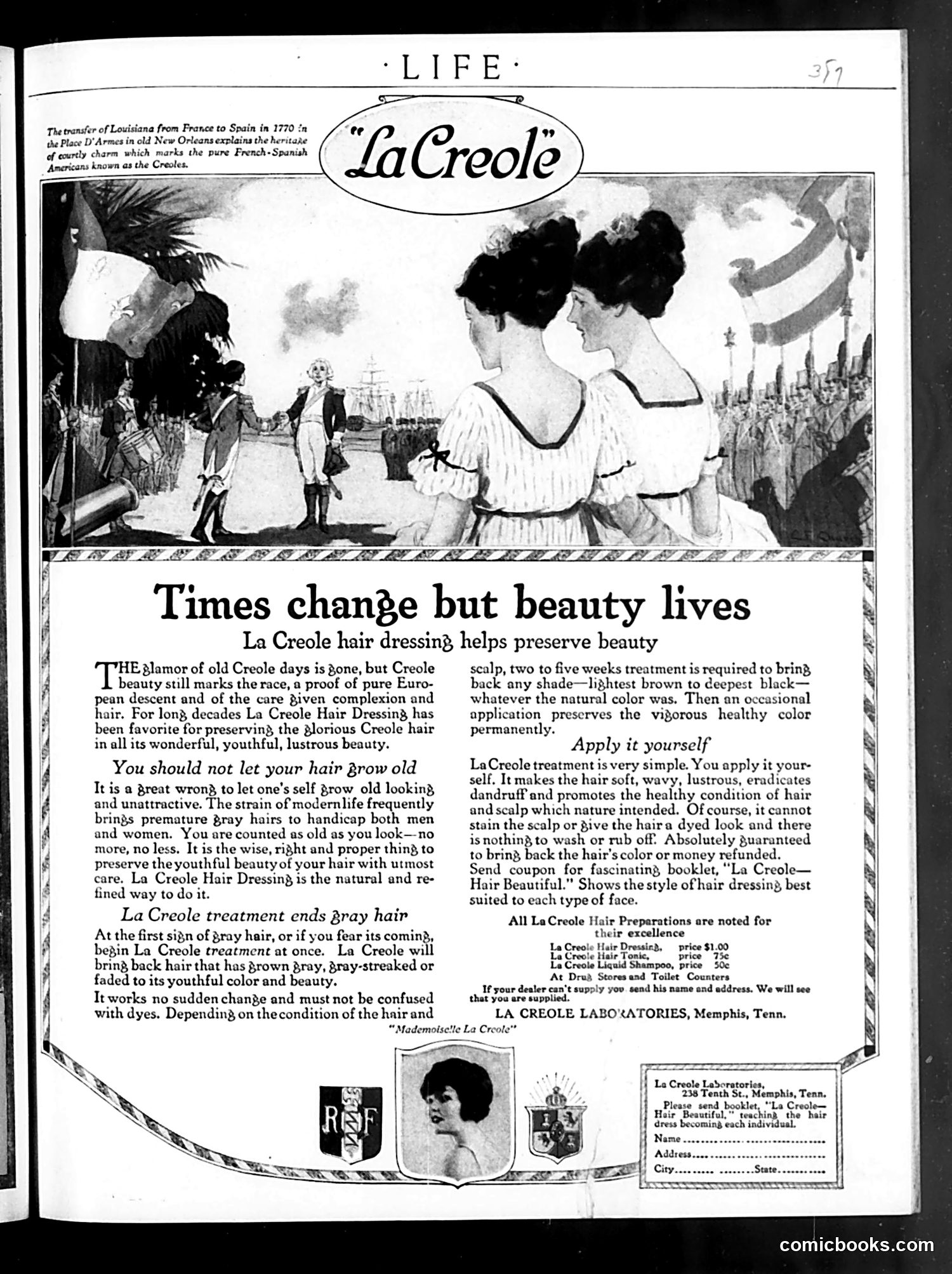
This is primarily a **product advertisement**, not political satire. It promotes "La Creole Hair Dressing," a hair treatment marketed to preserve natural hair color and prevent graying. The ad features two women in early 1900s fashion observing a historical scene depicting the transfer of Louisiana from France to Spain in 1770—likely referencing New Orleans' Creole heritage. This historical imagery establishes the product's connection to "Creole" culture and tradition. The advertisement emphasizes that the treatment is "simple" to apply yourself, works without staining the scalp, and guarantees results. It targets both men and women concerned about premature graying. The product was manufactured by La Creole Laboratories in Memphis, Tennessee, and included related items like hair tonic and shampoo.
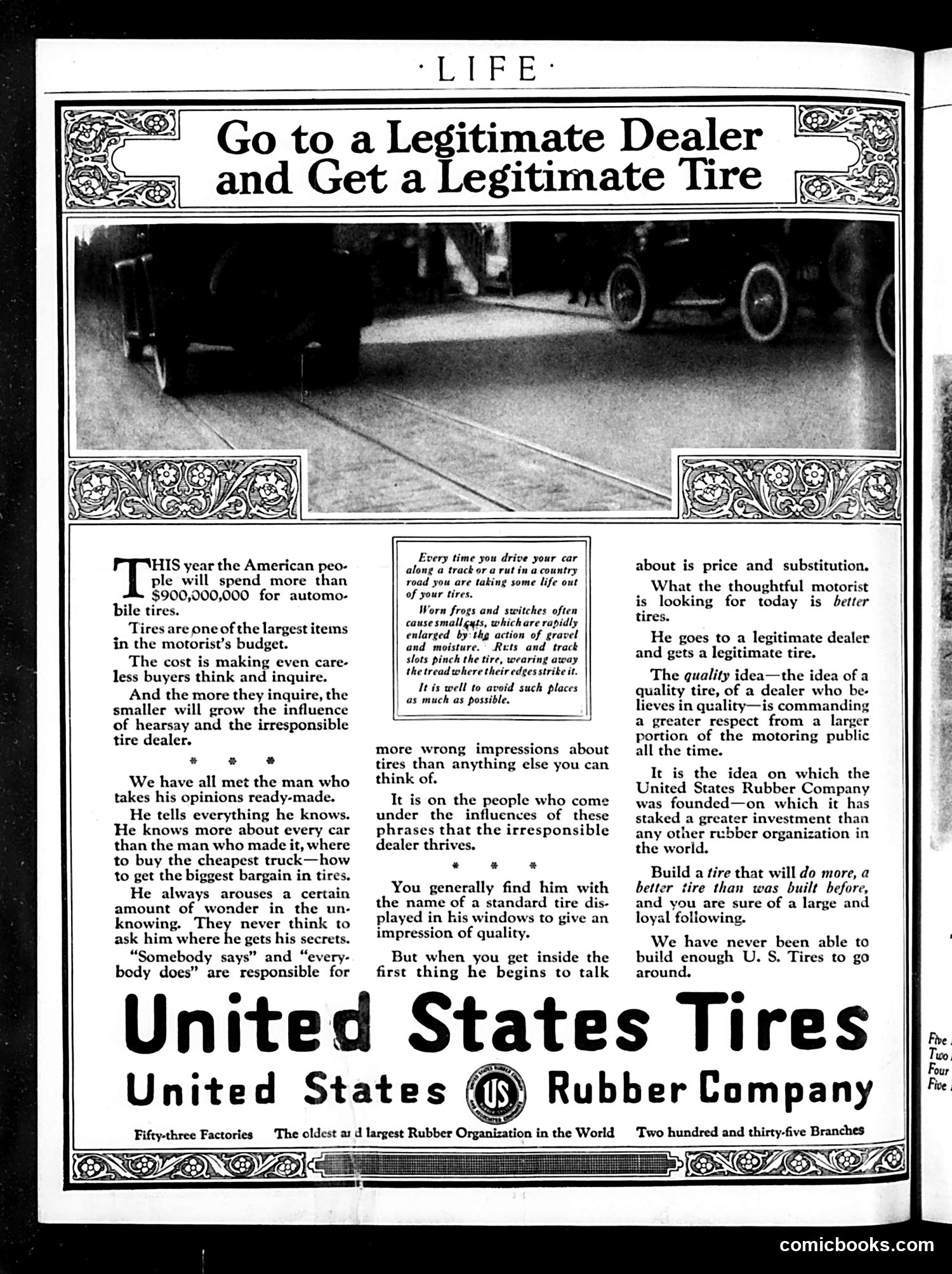
This page is primarily a **advertisement for United States Tires**, not satire or political commentary. The headline "Go to a Legitimate Dealer and Get a Legitimate Tire" addresses a genuine consumer problem of the era: counterfeit and substandard tires being sold by unscrupulous dealers. The ad criticizes the "irresponsible tire dealer"—the fast-talking salesman who claims to offer bargains but actually sells inferior products. It warns buyers against "rents and track slots" that wear away tire tread. The message is straightforward consumer advocacy: purchase from authorized dealers to ensure quality. The photograph shows early automobiles on a road. This reflects early 20th-century concerns about product authenticity and consumer protection, before modern regulations existed.
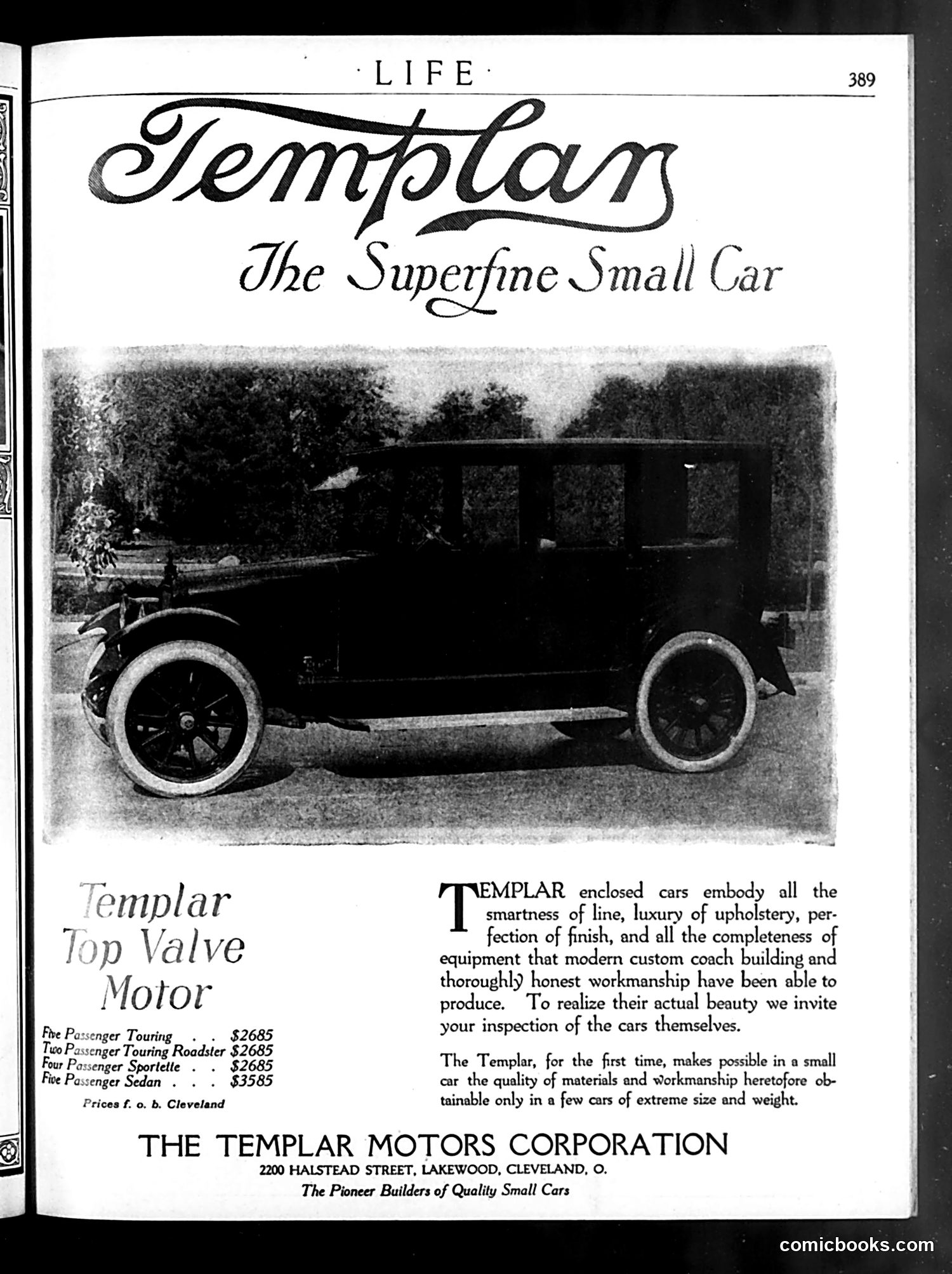
This page is **primarily an advertisement**, not satirical content. It features a Templar automobile—"The Superfine Small Car"—marketed as a high-quality, affordable vehicle produced by the Templar Motors Corporation in Cleveland, Ohio. The ad emphasizes the car's luxury features and craftsmanship, claiming it achieves in a small vehicle the quality previously available only in larger, expensive cars. Pricing ranges from $2,685 to $3,585. The only potentially humorous element is the tagline "The Pioneer Builders of Quality Small Cars," which appears designed to position Templar as an innovator in an emerging market segment. However, this reads as straightforward marketing rather than satire. This reflects early 1920s automotive advertising targeting middle-class consumers seeking affordable but respectable vehicles.
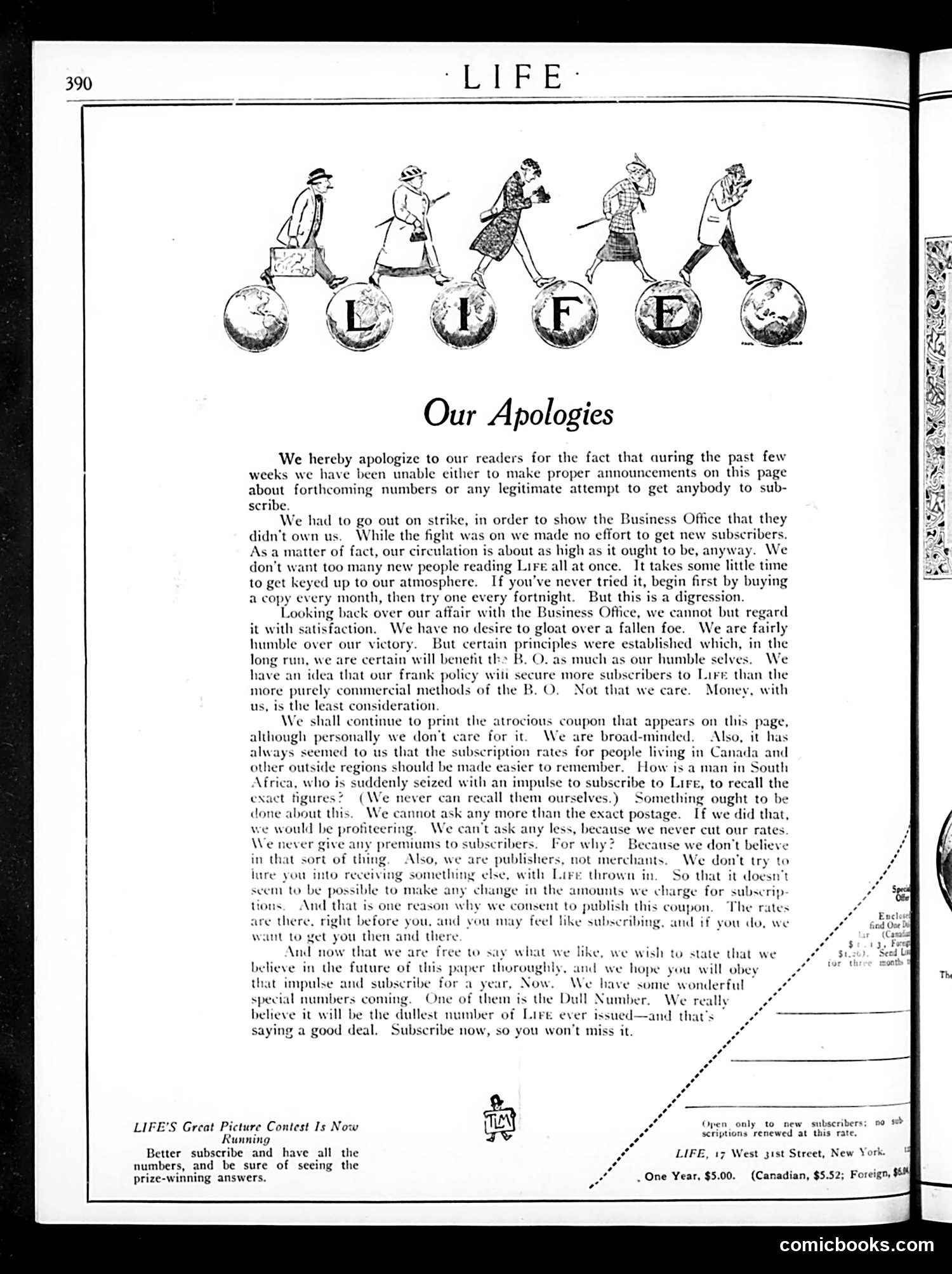
This is primarily an apology/editorial statement rather than a political cartoon. The decorative header shows six figures balanced on globes spelling "LIFE," illustrating the magazine's global reach. The text explains that Life magazine went on strike against its Business Office to establish editorial independence—they refused to solicit new subscribers while in dispute. The editors assert they prioritized principles over profit, stating they won't compromise editorial integrity for commercial gain. Notably, they defend printing a subscription coupon they personally dislike, and reference subscription rates for different regions (Canada, foreign). The piece promotes an upcoming "Dull Number" as a special issue. This reflects labor tensions and editorial autonomy debates common in early 20th-century publishing.
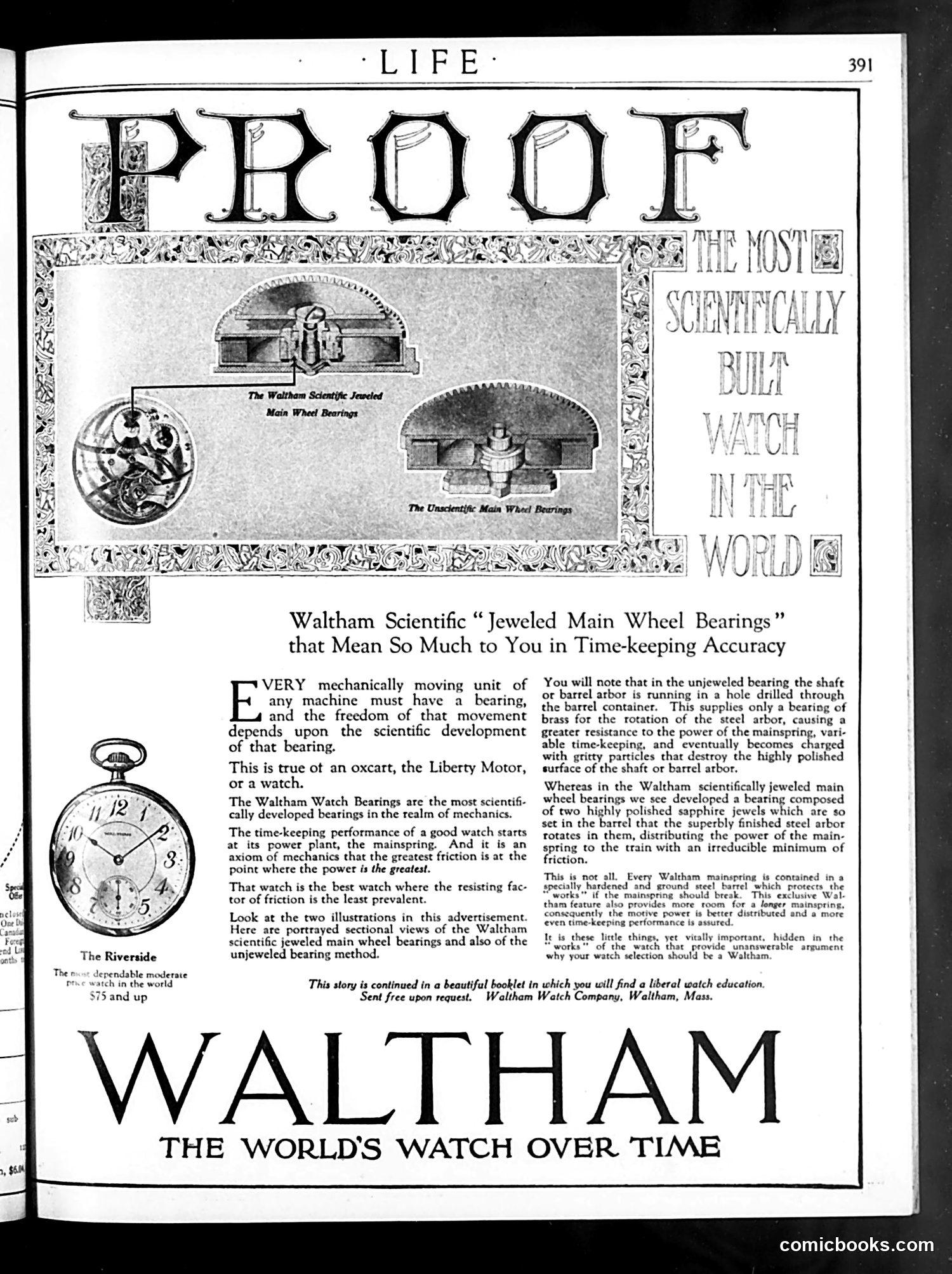
This is primarily a **Waltham Watch advertisement**, not a political cartoon. The page shows technical diagrams of watch bearings—comparing the "Waltham Scientific Jeweled Main Wheel Bearings" against "Unscientific Main Wheel Bearings." The ad uses a common early-20th-century marketing strategy: depicting a product's mechanical superiority through scientific comparison. The text explains that Waltham bearings contain jewels and superior materials, reducing friction and wear compared to inferior designs. A pocket watch illustration (The Riverside model, priced "$575 and up") appears on the left. The slogan "The World's Watch Over Time" emphasizes reliability and precision—key selling points for watches in this era when accurate timekeeping was commercially important. This is straightforward product advertising with no satirical content.
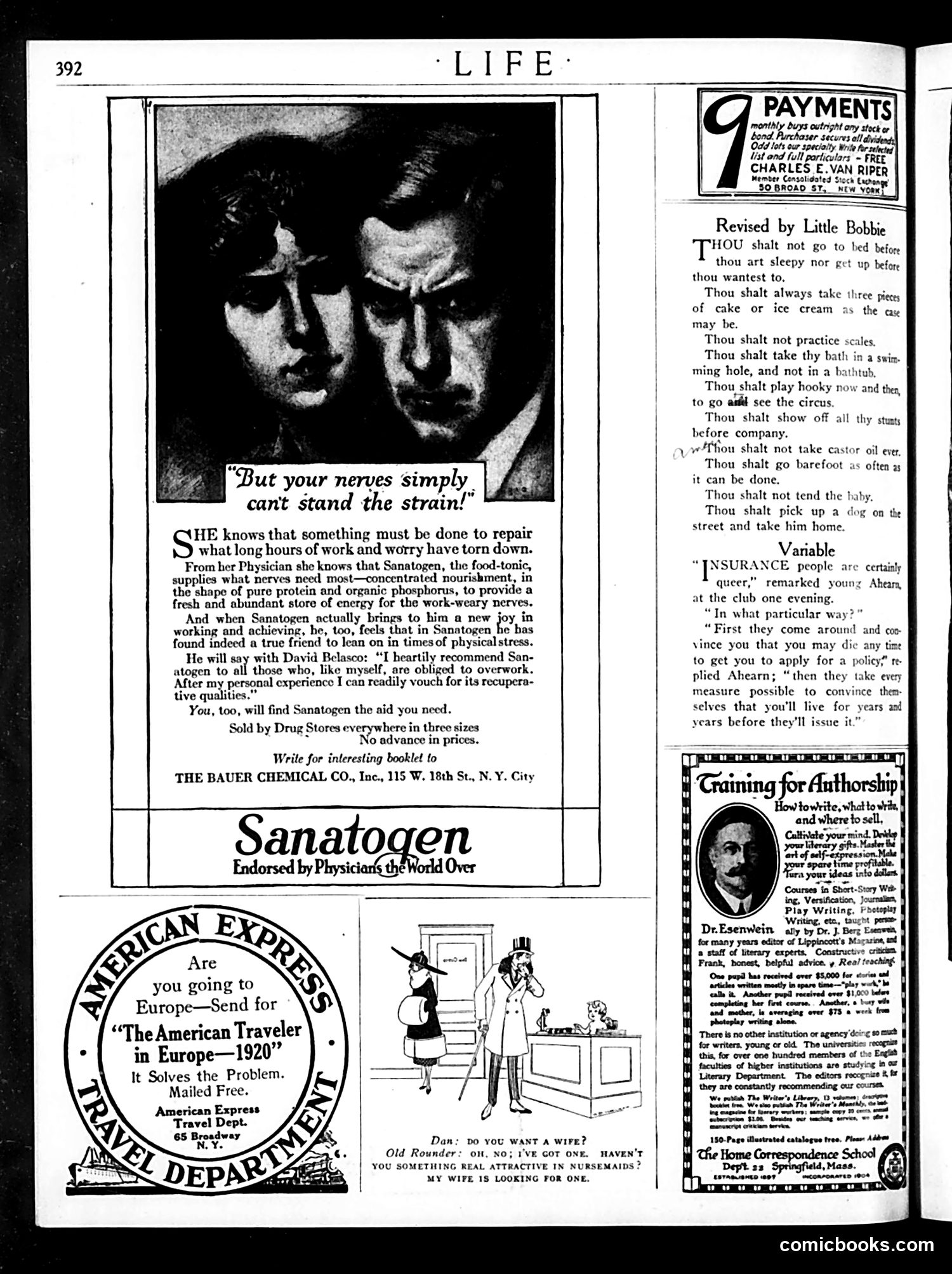
This page is primarily **advertising and filler content** from Life magazine, not political satire or comics requiring historical context. The main advertisement promotes **Sanatogen**, a commercial "food-tonic" product marketed to address nervous exhaustion and physical stress. The accompanying image shows an anxious-looking man with the caption "But your nerves simply can't stand the strain!" The ad emphasizes that the tonic contains protein and phosphorus to restore energy—typical wellness marketing of the early 20th century. Below are smaller ads for travel services, authorship courses, and correspondence schools—standard magazine filler of the era. A brief joke section ("Variable") appears about insurance, unrelated to the other content. The page contains **no political cartoons or social satire**—it's commercial content representative of Life's business model during this period.
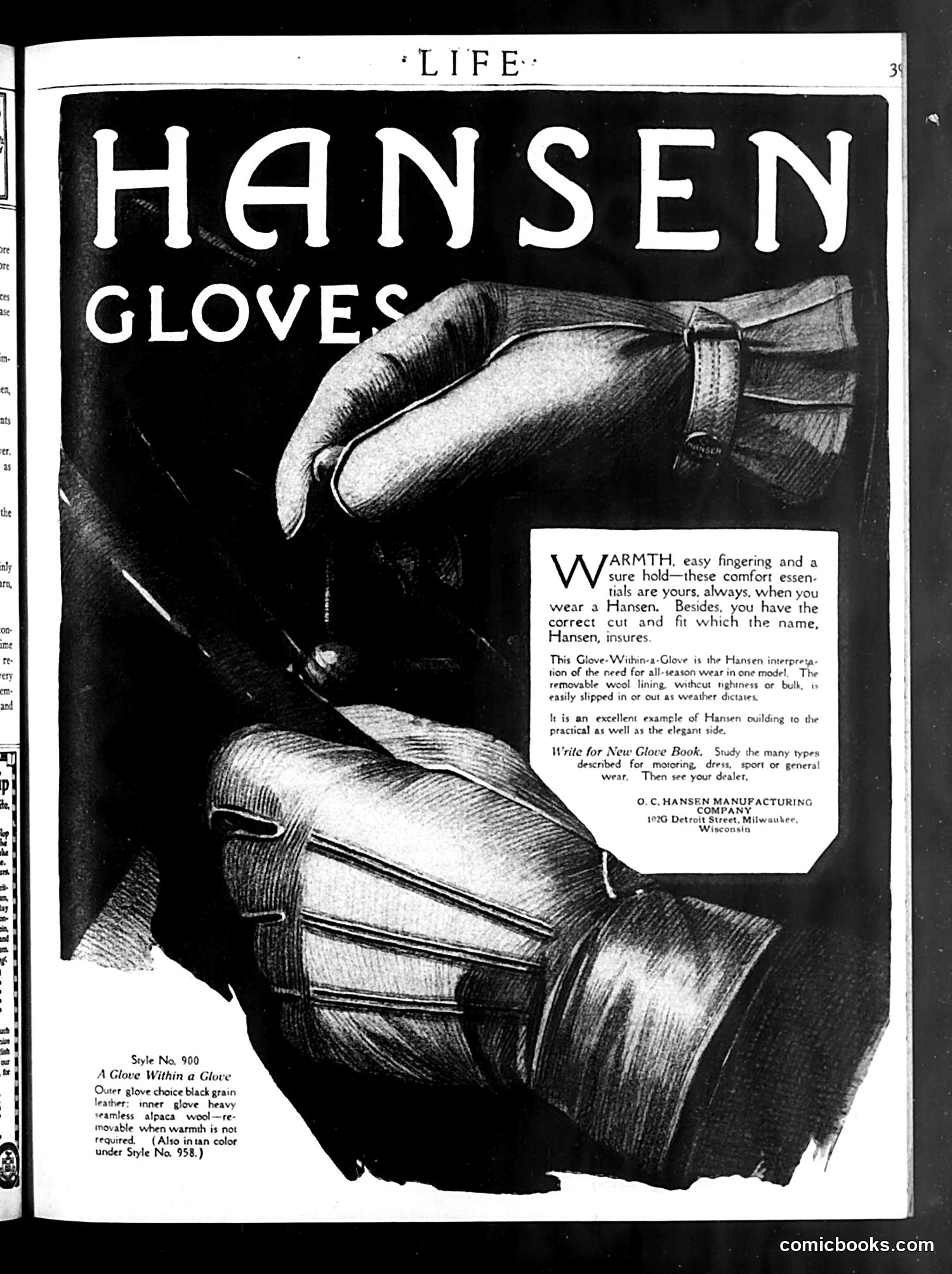
This is a straightforward **product advertisement**, not political satire or a cartoon. It promotes Hansen Gloves manufactured by O.C. Hansen Manufacturing Company in Milwaukee, Wisconsin. The ad features detailed illustrations of gloved hands showcasing the product's features. The text emphasizes practical benefits: warmth, easy fingering, secure grip, and correct fit. It highlights the "Glove-Within-a-Glove" design—a removable wool lining that can be slipped out when not needed for winter wear. The ad promises the gloves suit "morning, dress, sport or general wear" and directs readers to request a "New Glove Book" for additional styles. This appears to be vintage advertising from the early-to-mid 20th century, targeting consumers seeking quality, multi-purpose gloves.
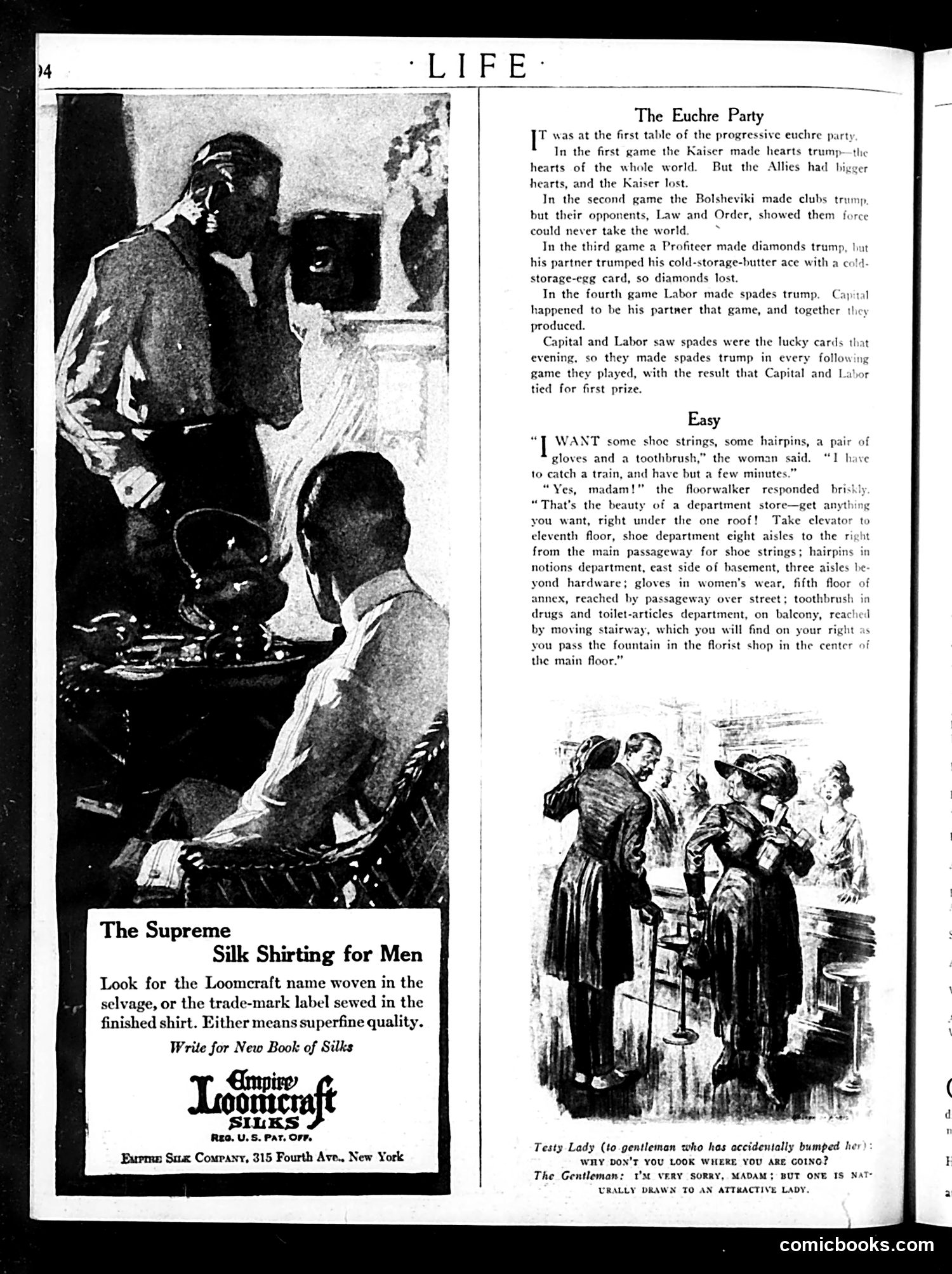
This page contains two distinct elements: **"The Euchre Party"** is a satirical allegory comparing international geopolitical conflicts to card games. It references WWI powers—the Kaiser (Germany), the Bolsheviks (Russia), a Profiteer, and Labor—as players competing for world dominance through various "trump" cards (hearts, clubs, diamonds, spades). The joke is that Capital and Labor happen to form a winning partnership, tying for first prize. **"Easy"** is a humorous domestic anecdote about a woman seeking multiple items in a department store and receiving overly detailed directions through the building's labyrinthine layout. The page also includes a Loomcraft Silks advertisement featuring men in formal wear. The political satire reflects post-WWI anxieties about competing ideologies and economic systems vying for global influence.
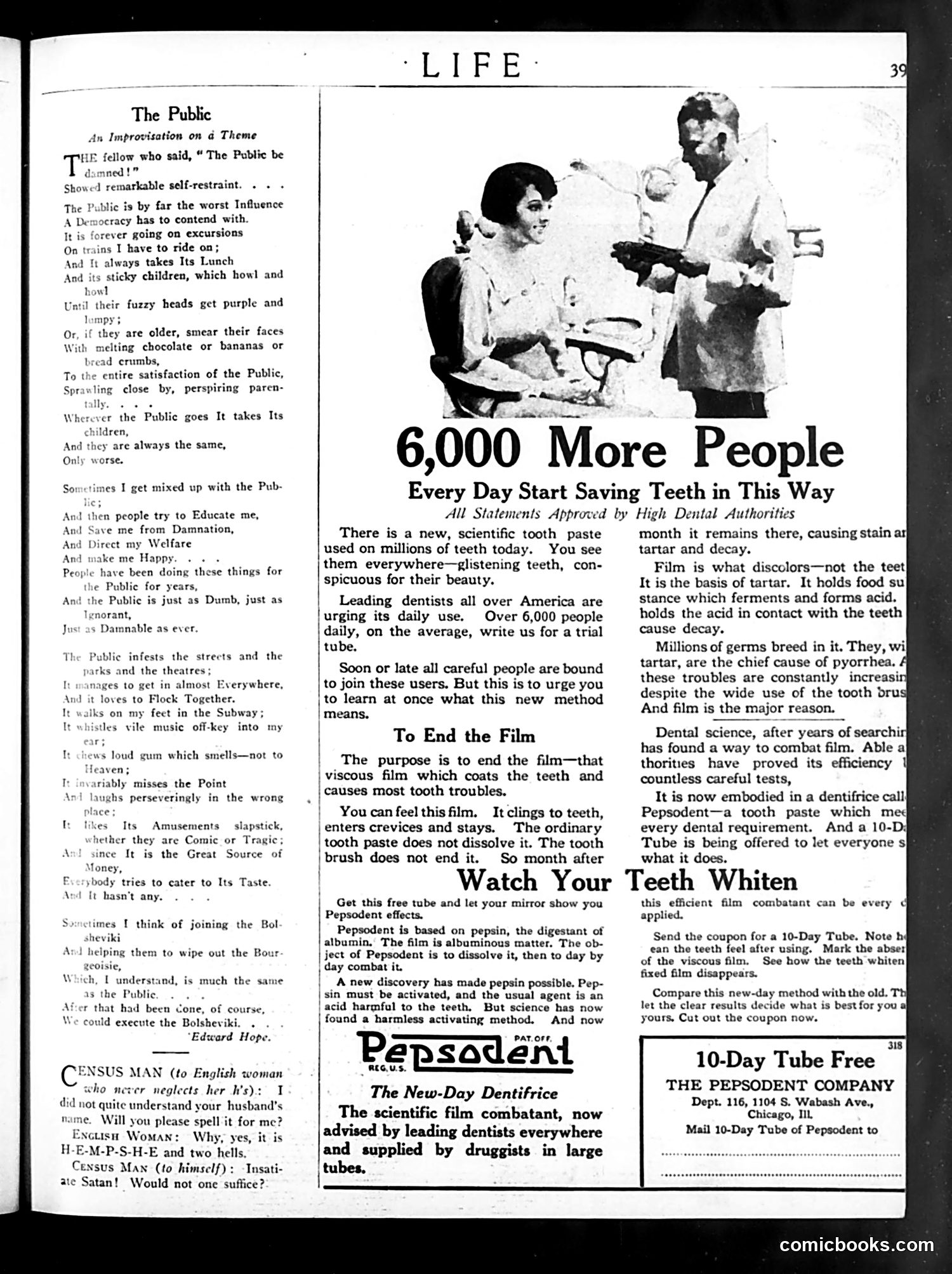
This page is **primarily advertising**, not satire. The main content is a large advertisement for Pepsodent toothpaste, featuring a photograph of a dentist demonstrating the product to a woman patient. The ad claims that "6,000 More People Every Day Start Saving Teeth in This Way" using Pepsodent's new formula. It emphasizes the product's ability to remove a "viscous film" that causes tooth decay—a selling point that appears to have been Pepsodent's marketing innovation at the time. The left column contains an unrelated satirical poem titled "The Public: An Improvisation on a Theme" by Edward Hope, mocking public behavior and attitudes. At bottom is a brief humorous "Census Man" exchange about spelling corrections, entirely separate from the advertisement above.
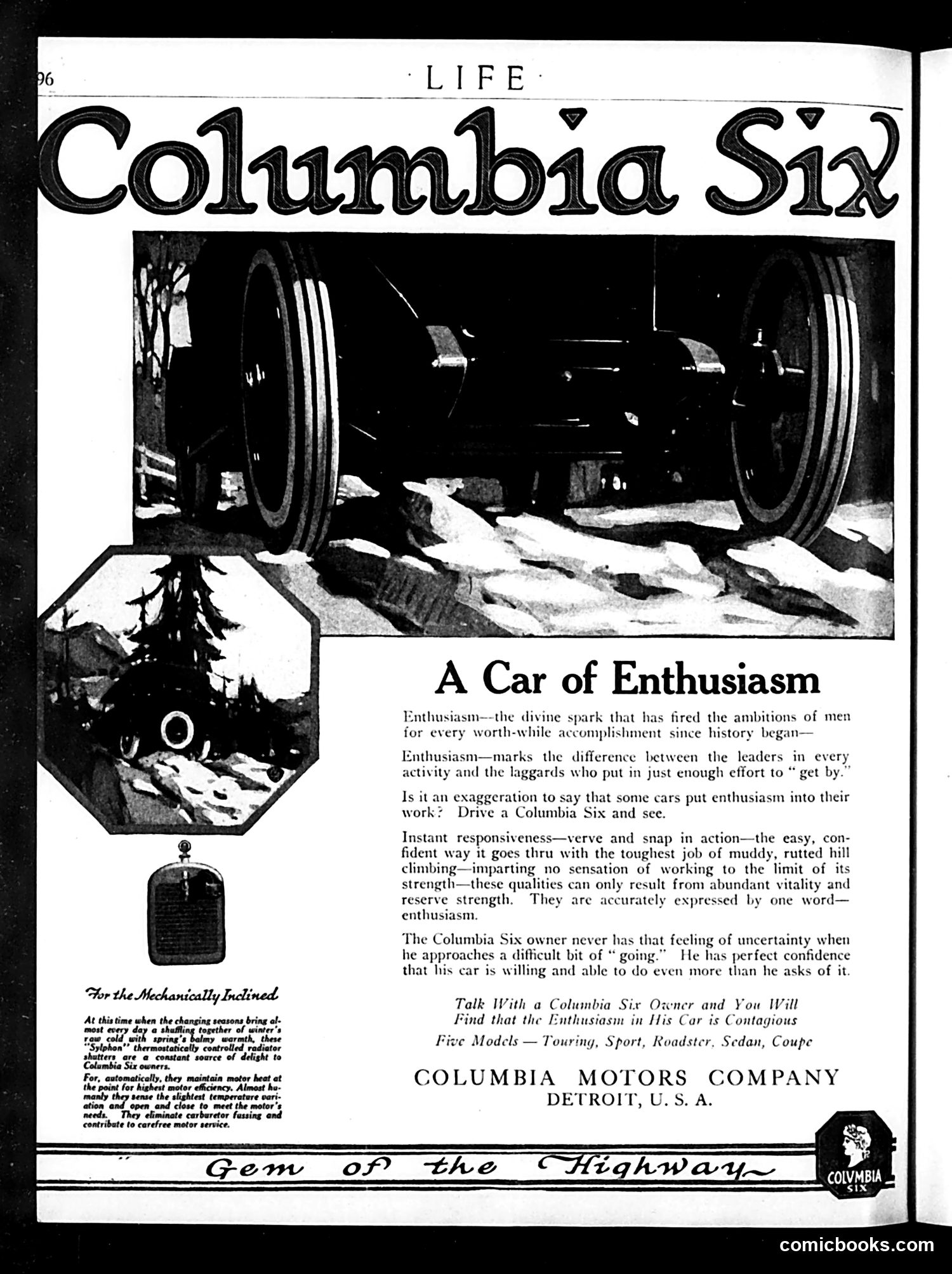
This is an advertisement, not a political cartoon. It promotes the Columbia Six automobile, manufactured by Columbia Motors Company in Detroit. The ad emphasizes the car's "enthusiasm"—defined as responsiveness and reliable performance on challenging terrain. The images show the vehicle navigating rough, muddy roads with large wheels and sturdy construction. The text appeals to buyers by claiming the Columbia Six provides confidence and dependability for difficult driving conditions. A secondary note addresses mechanically-inclined owners, highlighting the car's thermostatic cooling system and other technical features. The phrase "Gem of the Highway" (at bottom) was the car's marketing slogan. This represents early 1900s automotive advertising, when vehicles were still proving their practical utility rather than luxury appeal.
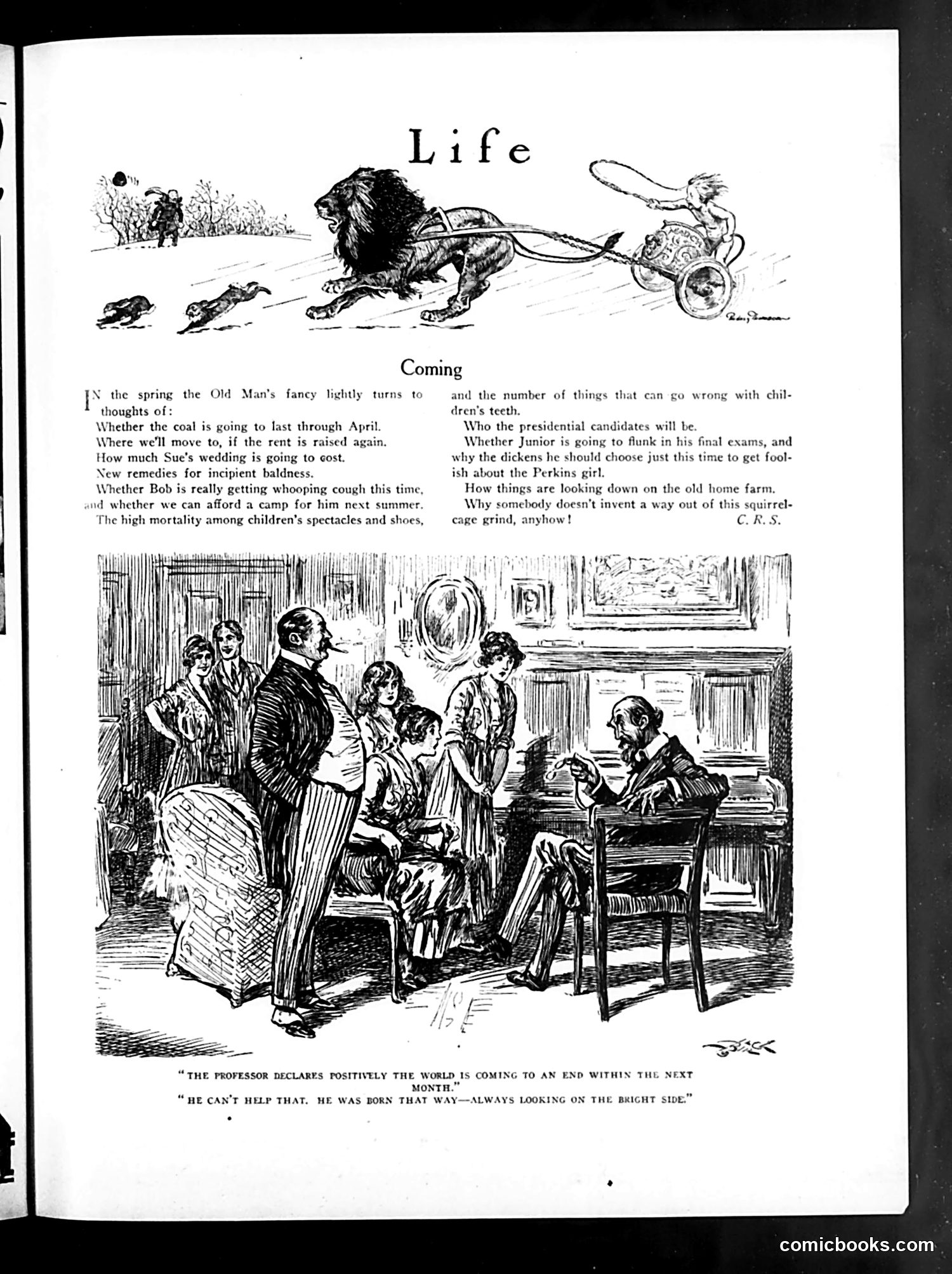
This page satirizes spring-season anxieties among the middle class. The top illustration depicts a lion pulling a cart with a cherub—a visual metaphor for life's chaotic forces dragging humanity along unpredictably. The text lists typical worries: coal lasting through April, moving expenses, wedding costs, baldness remedies, children's health, camping budgets, and mortality rates—mundane but persistent concerns of early 20th-century American life. The bottom cartoon shows a professor declaring "the world is coming to an end within the next month" to a concerned family. His companion responds he "can't help that. He was born that way—always looking on the bright side." The joke mocks habitual pessimists whose doom-saying is so chronic it becomes their personality trait, treated with weary humor by those around them.
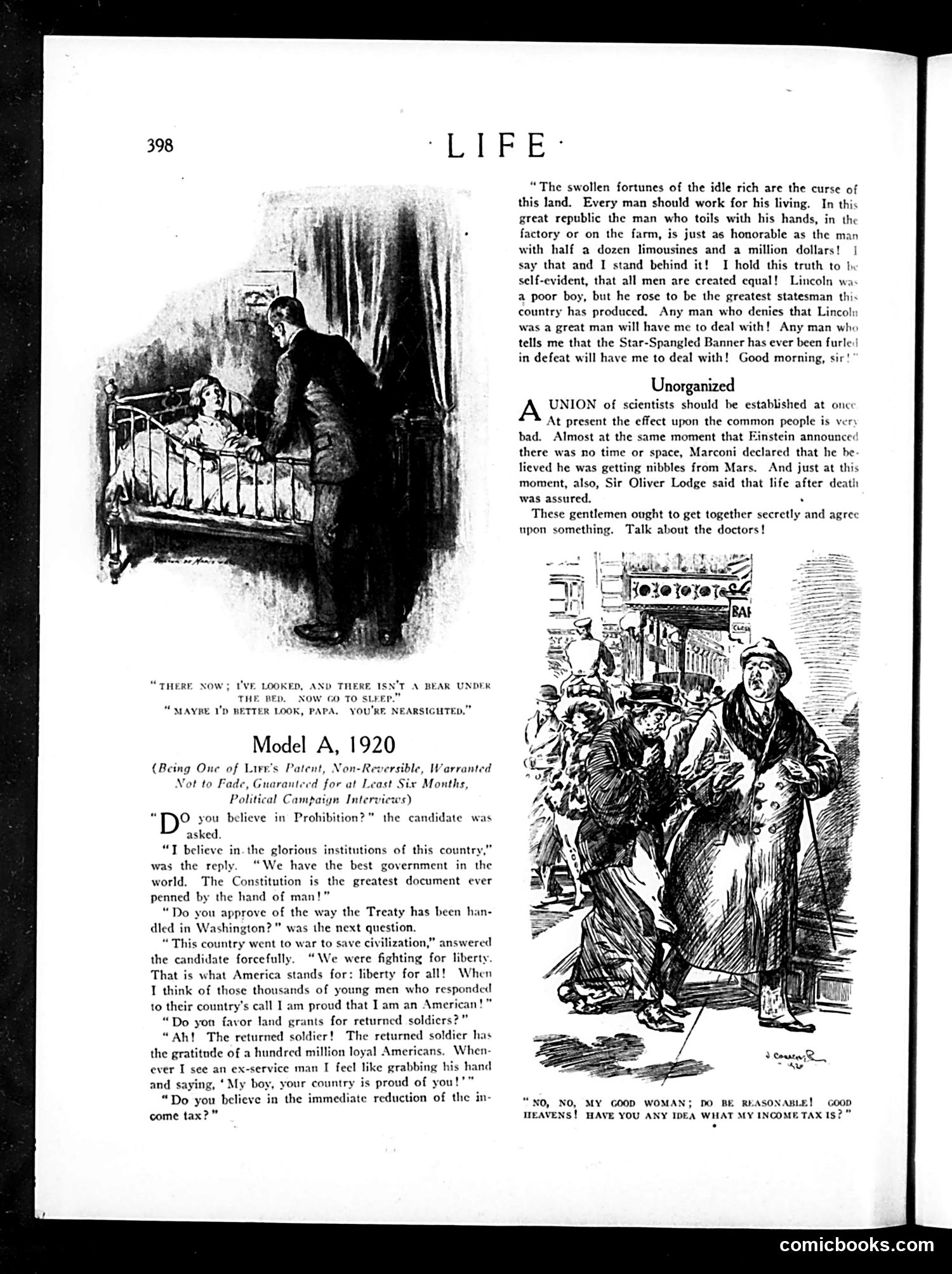
This page features a 1920 political interview ("Model A, 1920") mocking a political candidate's responses on Prohibition, war, and taxation. The candidate expresses jingoistic patriotism about America's superiority and the Constitution, praises returned soldiers, and defends the war as fought for "liberty for all!" The right-side cartoon depicts working-class people (likely immigrants or poor Americans) being confronted about income tax, with one figure exclaiming "Good heavens! Have you any idea what my income tax is?" The satire suggests wealthy citizens' outrage over taxation while working people struggle. Together, the content critiques both blind patriotic rhetoric and class hypocrisy regarding fiscal policy during the post-WWI era.
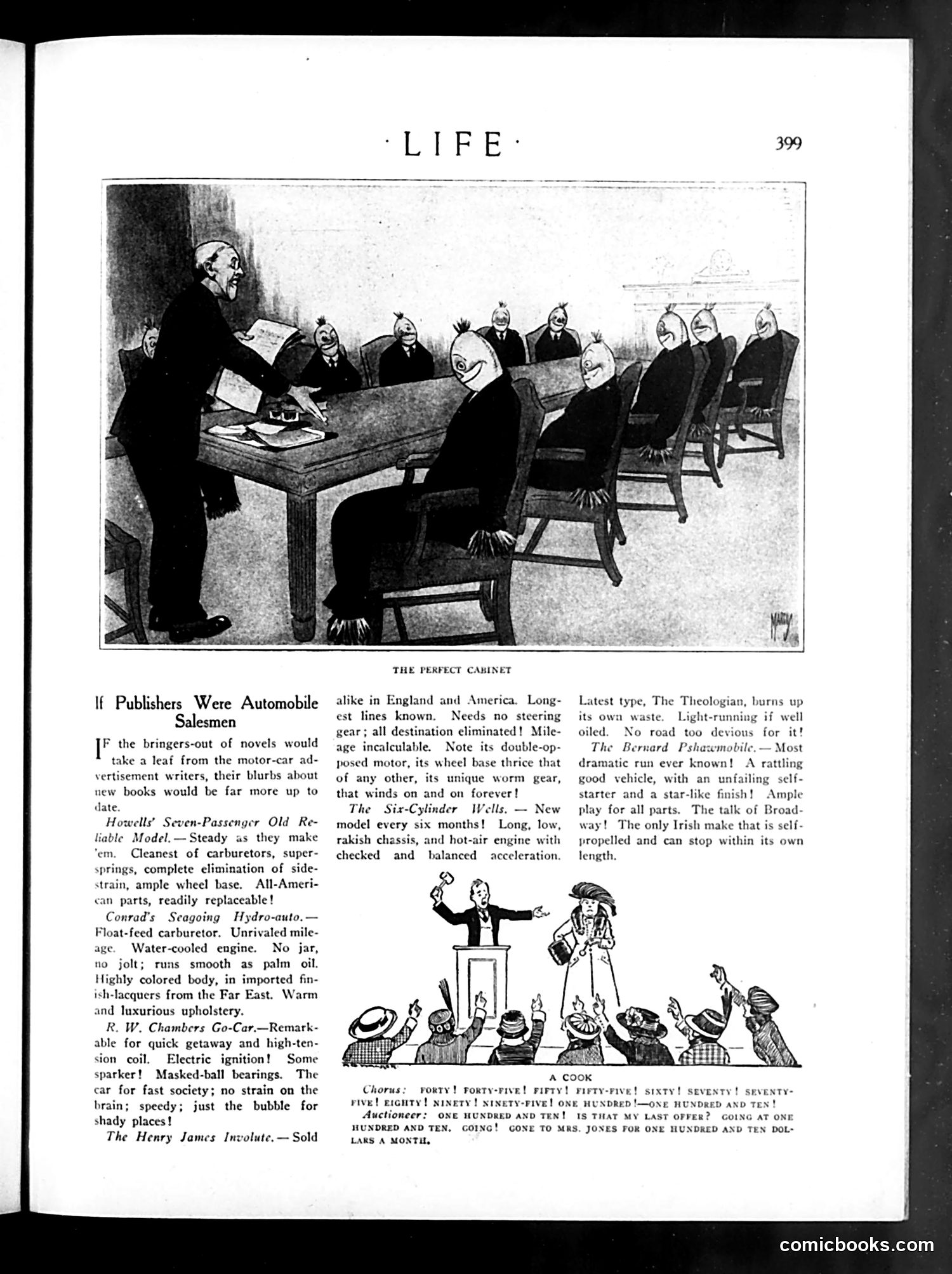
This cartoon satirizes a government cabinet meeting where all members wear identical grotesque masks with exaggerated grins. The single unmasked figure at left appears to be the leader presenting to this uniformly identical group. The satire targets **conformity and lack of individuality in government decision-making**—suggesting cabinet members are interchangeable yes-men with no independent thought or personality. The absurd uniformity of their grotesque expressions mocks the idea that a functional government requires such complete uniformity of opinion. The cartoon's precise political context (which administration or country it targets) isn't specified on this page, but the underlying critique is clear: effective governance requires diverse perspectives, not identical puppet-like compliance. The title itself is ironic—this perfect uniformity represents the *opposite* of good governance.
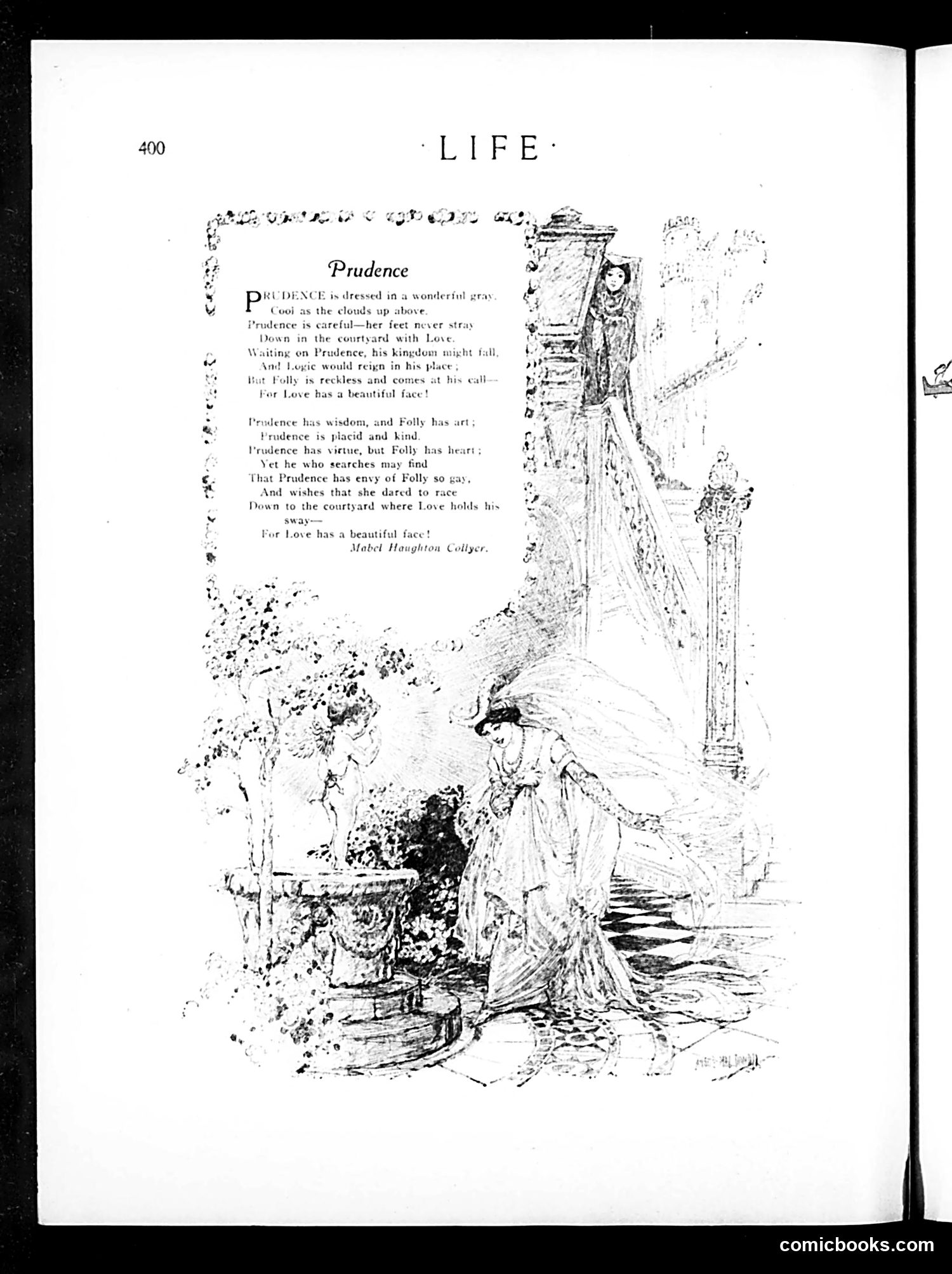
This page from *Life* magazine presents a poem titled "Prudence" by Mabel Haughton Collyer, accompanied by an illustrative sketch. Rather than political satire, this is a **moral allegory** exploring feminine virtue. The poem contrasts two female archetypes: **Prudence** (cautious, virtuous, wise) versus **Folly** (reckless, artistic, spirited). The verses suggest that while Prudence possesses wisdom and restraint, she secretly envies Folly's freedom and passion—particularly Folly's ability to descend into "the courtyard where Love holds his sway." The illustration depicts women in classical dress in what appears to be a courtyard setting, visualizing this tension between restraint and desire. The satire is gentle and philosophical rather than political—*Life* here critiques the rigid constraints placed on women's emotional expression, suggesting that even the most virtuous may yearn for the spontaneity and romantic agency denied them. This reflects early-20th-century debates about women's roles, sexuality, and independence.
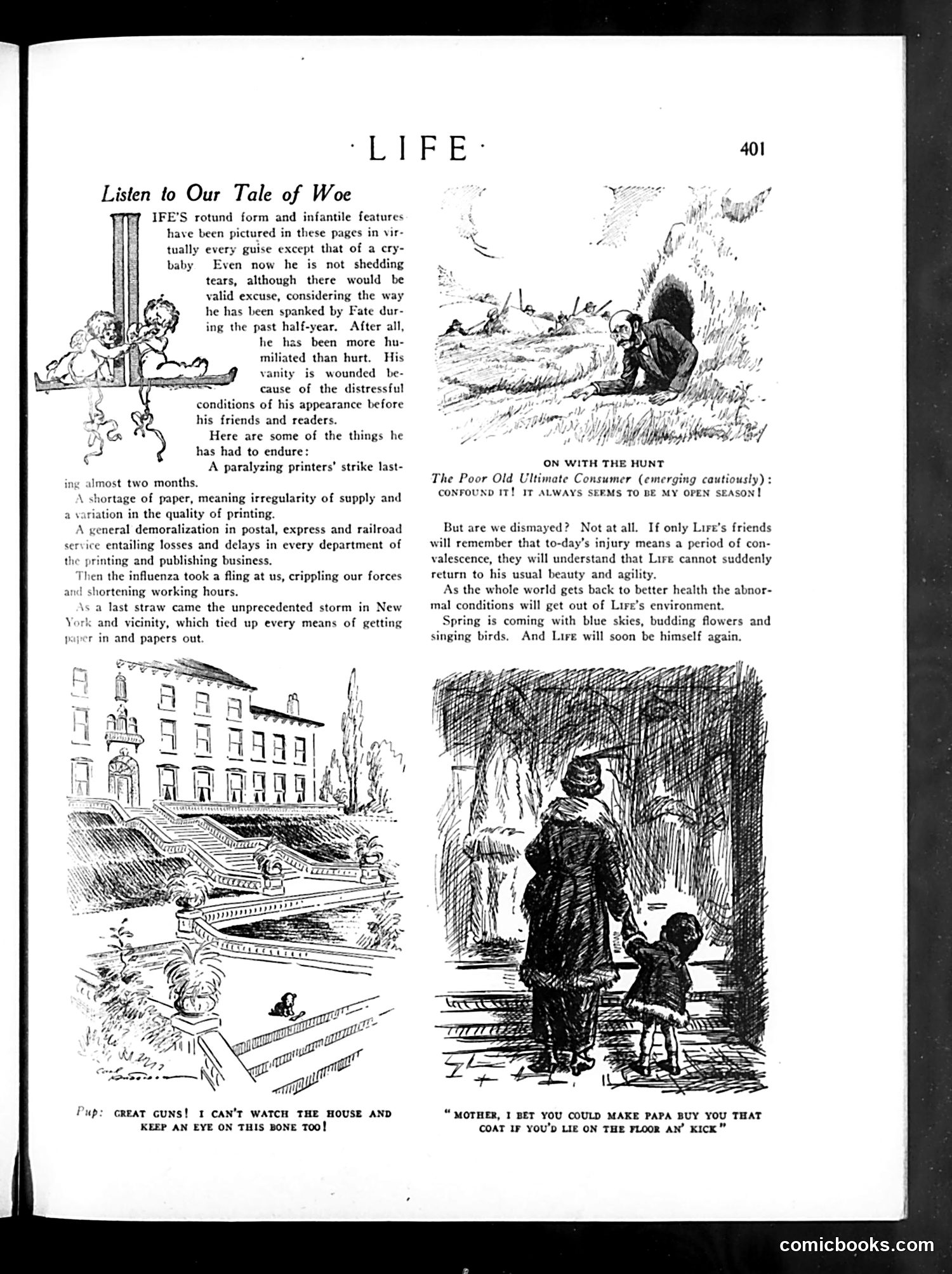
This page is *Life* magazine's humorous complaint about its own operational troubles. The anthropomorphic "Life" mascot (a rotund, childlike figure) has suffered multiple calamities: a two-month printers' strike, paper shortages, postal/railroad delays, influenza affecting staff, and a severe storm disrupting distribution. The editorial uses self-deprecating humor, personifying the magazine as a battered character while assuring readers that normal service will resume. The cartoons reinforce this: one shows a dog struggling to guard both house and bone (divided attention), representing Life's publication challenges. Another depicts a poor consumer caught in hunting season—satire on how ordinary people suffer from supply-chain disruptions. The child-coercion cartoon is unrelated domestic humor. The tone is apologetic yet wry, essentially saying: "We've had a rough time, but we'll recover."
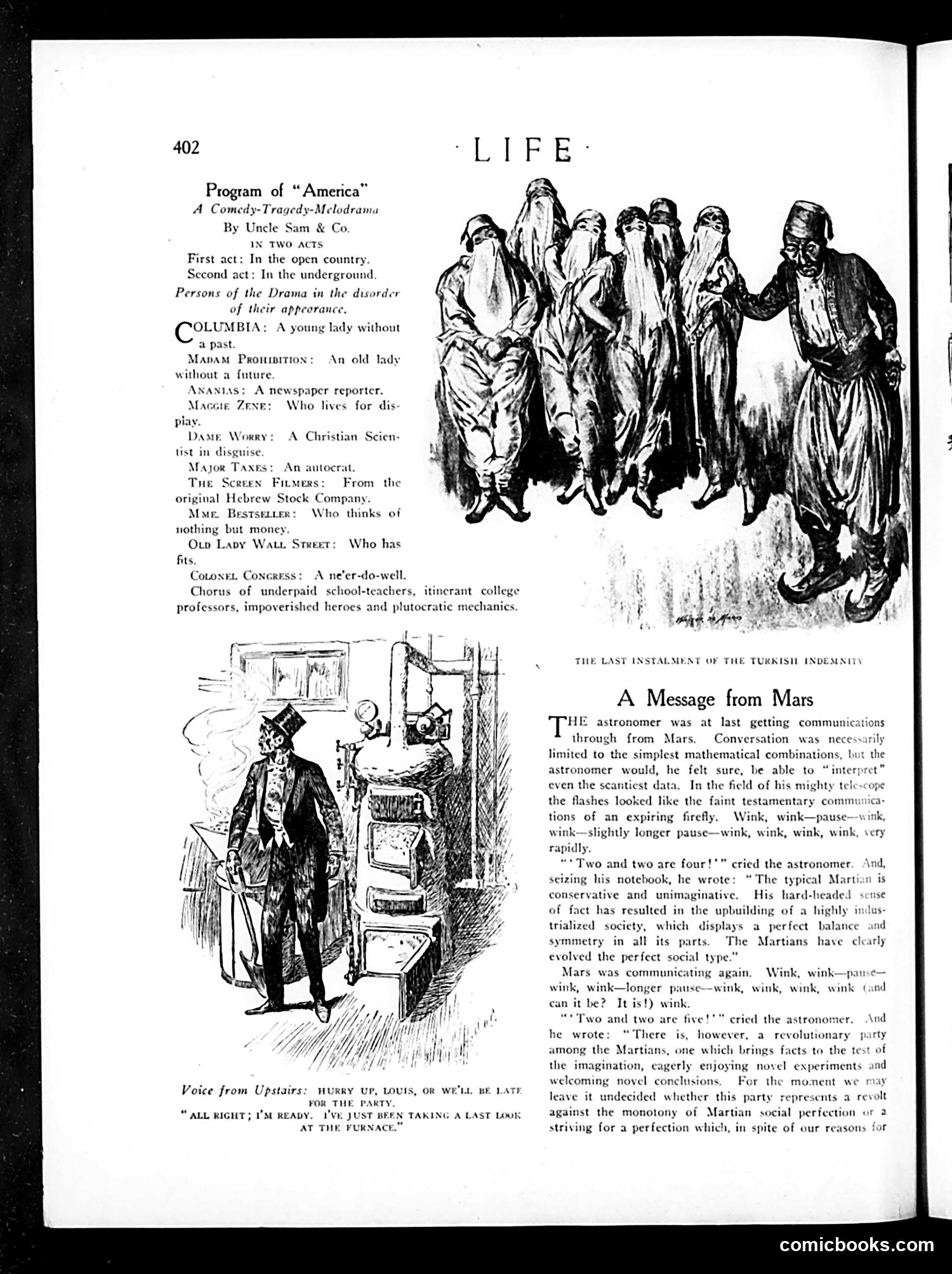
This page contains two satirical pieces from *Life* magazine: **"Program of America"** (left): A mock theatrical cast list caricaturing American social types and institutions. Characters include "Columbia" (the nation personified as a young woman), "Mamma Prohibition" (the alcohol ban), "Ananias" the newspaper reporter (alluding to biblical lies), "Major Taxes," and "Old Lady Wall Street." The joke presents American society as a comedic drama populated by stereotyped figures—journalists, profiteers, politicians—suggesting the absurdity of contemporary social problems. **"A Message from Mars"** (right): A science-fiction satire about an astronomer receiving signals from Mars. When Martians correctly calculate "two and two are four," the astronomer praises their perfectly ordered, "conservative" society. But when they signal "two and two are five" (intellectually challenging conformity), he notes a "revolutionary party" exists there. The satire critiques rigid social perfection, suggesting that nonconformity and imaginative thinking—even error—may be preferable to sterile order. It implies critique of American conformity.
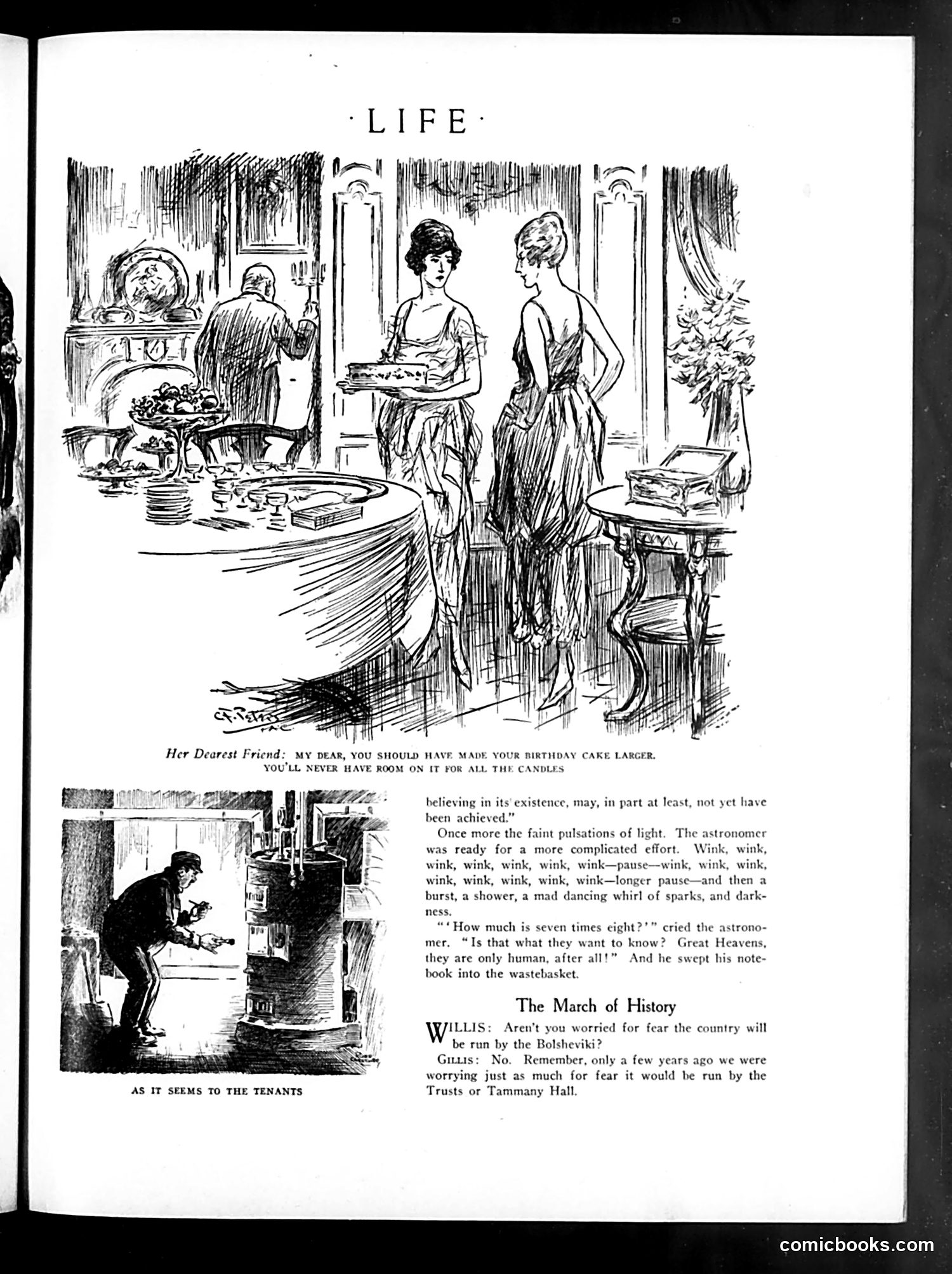
**Top Cartoon**: A woman tells her friend that a birthday cake needs to be larger to fit all the candles—a joke about aging. The friend's advanced age requires so many birthday candles that they won't fit on a normal cake. **Bottom Cartoon**: Titled "The March of History," this satirizes political anxiety. Willis worries the Bolsheviki (Russian communists) will run the country, but Gillis counters that a few years ago people worried equally about Trusts (monopolistic corporations) or Tammany Hall (corrupt New York Democratic machine) running things instead. The point: Americans constantly fear different villains will control the government, but life continues regardless. It's political satire mocking cyclical public panic about different perceived threats to democracy. The middle text appears to be unrelated story content about an astronomer communicating via light signals.
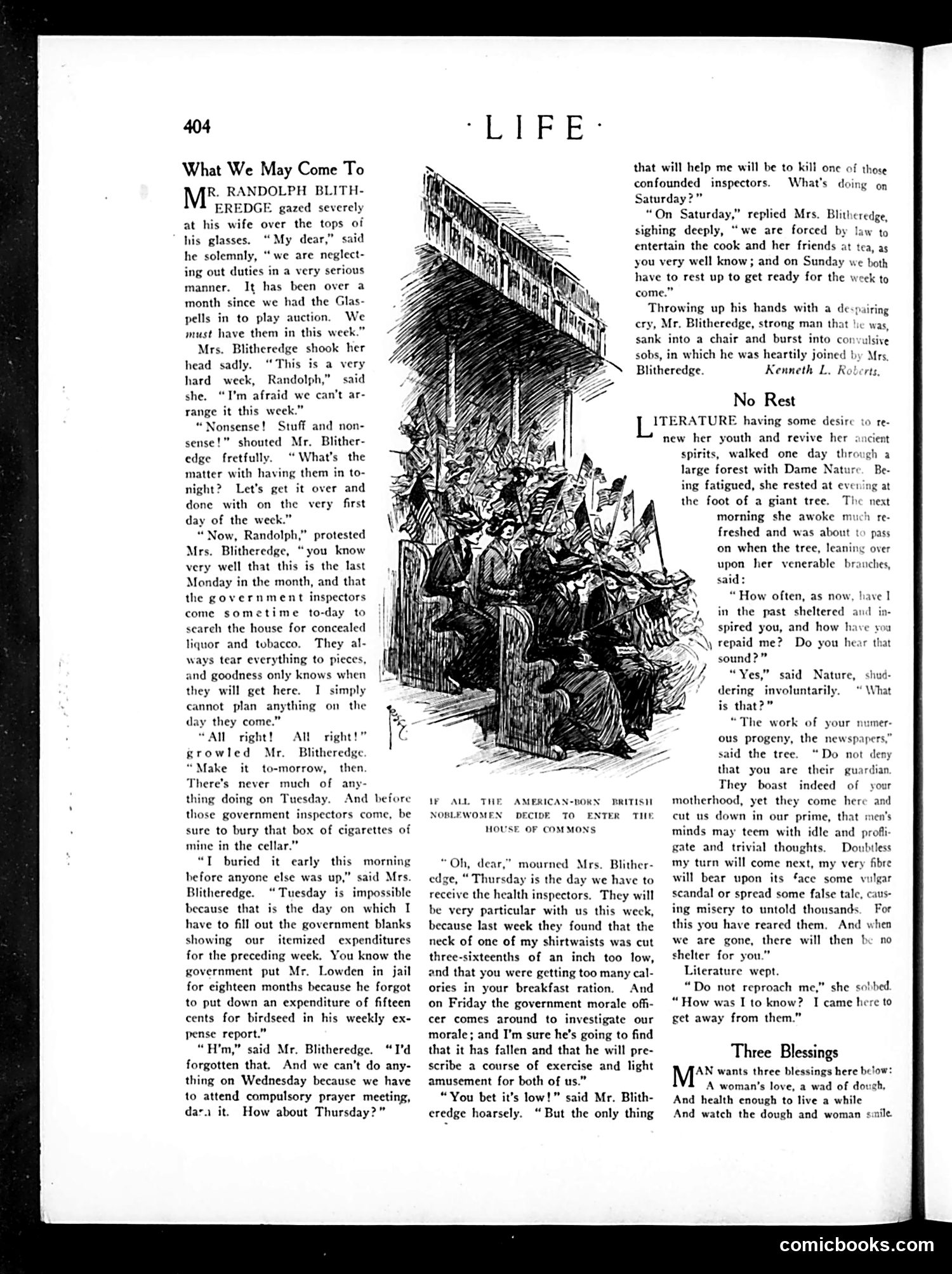
This page satirizes excessive government regulation in post-WWI America. The cartoon shows a married couple, the Blitheredges, unable to schedule a simple dinner party because government inspectors intrude on every day of the week: Monday for liquor/tobacco searches, Tuesday for filing expenditure forms, Wednesday for compulsory prayer meetings, Thursday for health inspectors checking clothing fit and calorie counts, and Friday for "morale officers." The humor comes from the absurdity of bureaucratic surveillance—Mr. Blitheredge must bury cigarettes; Mrs. Blitheredge faces fines for shirtwaist necklines being slightly too low. The satire critiques what the writer saw as oppressive government control over private citizens' lives, suggesting regulation had become so pervasive that ordinary domestic life was impossible. This reflects 1920s anxieties about Prohibition and expanding federal authority.
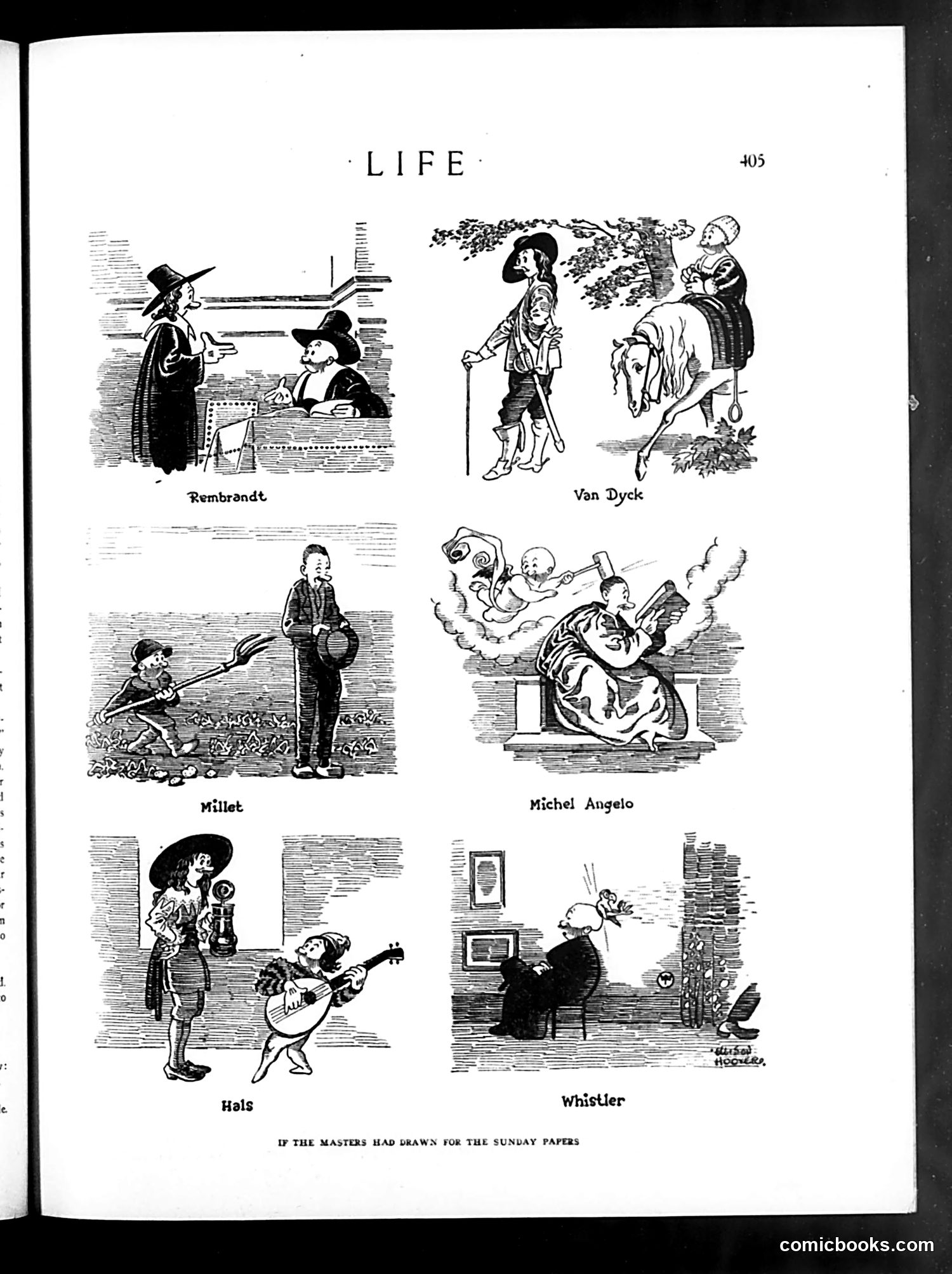
This is a satirical comparison imagining how famous Renaissance and Old Master painters would have drawn if they'd created comic strips for Sunday newspapers. Each panel pairs a master artist's name with a humorous domestic or artistic scene: - **Rembrandt**: Shows figure with telescope/surveying equipment - **Van Dyck**: Depicts someone with a goat and attendants - **Millet**: Features a child with guitar and singing figure - **Michel Angelo**: Shows cherubs and a reclining figure - **Hals**: Woman and child with musical instrument - **Whistler**: Man arranging or viewing pictures on a wall The satire mocks both the masters' distinctive styles and the lowbrow nature of newspaper comics, suggesting these high-art figures placed in commercial comic strip scenarios. It's period humor about the gap between fine art and popular entertainment.
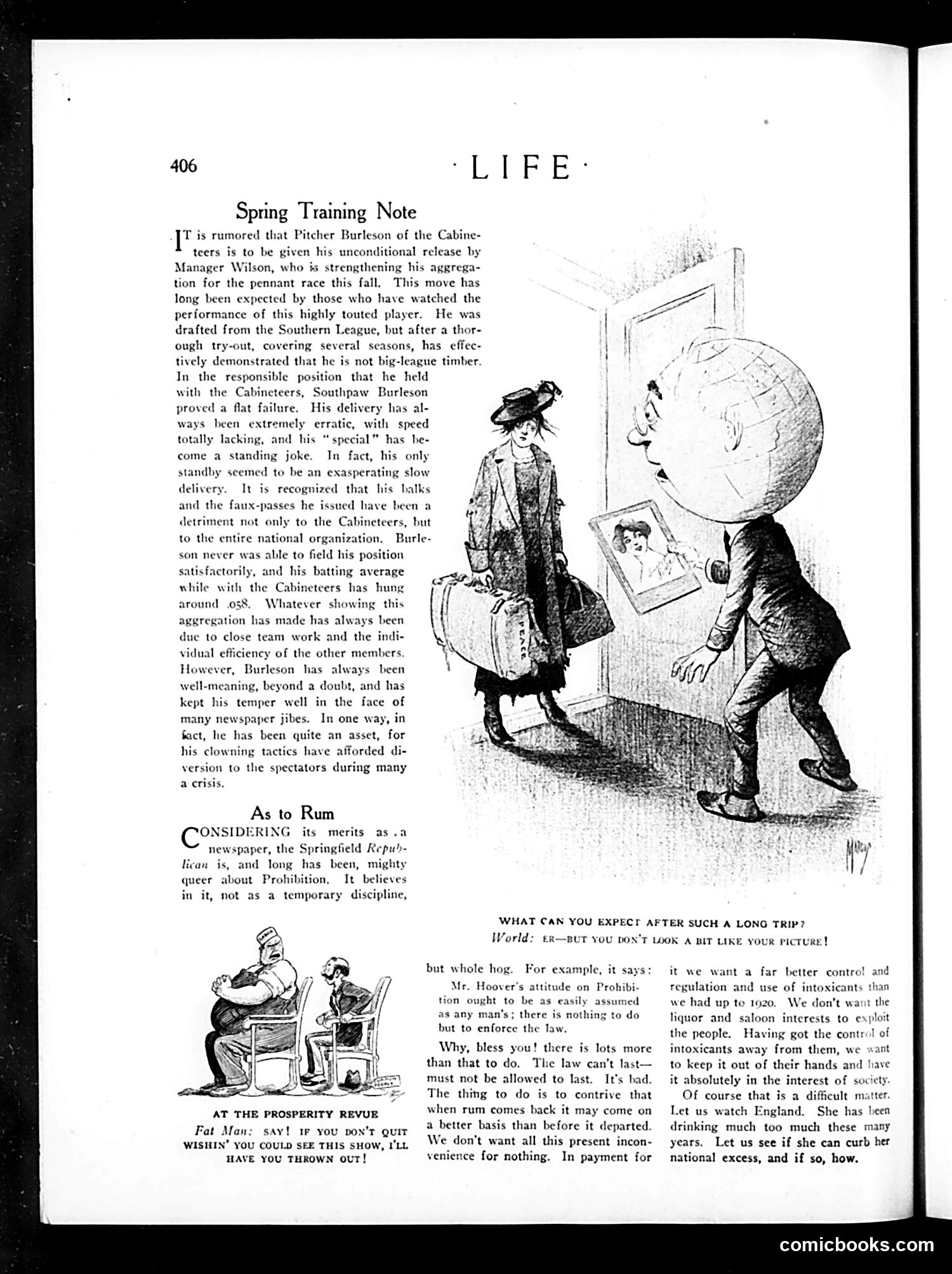
This Life magazine page uses baseball as political allegory. The "Pitcher Burleson of the Cabineteers" article satirizes a failed government official—likely Secretary of the Treasury Andrew Mellon or similar figure—by describing him as incompetent, unreliable, and unable to perform his duties despite high expectations. The "Cabineteers" clearly refers to President Hoover's Cabinet. The second section, "As to Rum," directly critiques Prohibition enforcement. It mocks the Springfield Republican newspaper and Hoover's absolutist approach, arguing that merely passing a law isn't sufficient—enforcement requires ongoing vigilance and careful regulation. The cartoons show a woman returning from a long trip (likely Europe, where alcohol remained legal) looking disheveled, and a fat man at a "Prosperity Revue," satirizing both the failure of Prohibition and the era's economic inequality. The satire suggests Prohibition is unenforceable and counterproductive without broader social reform.
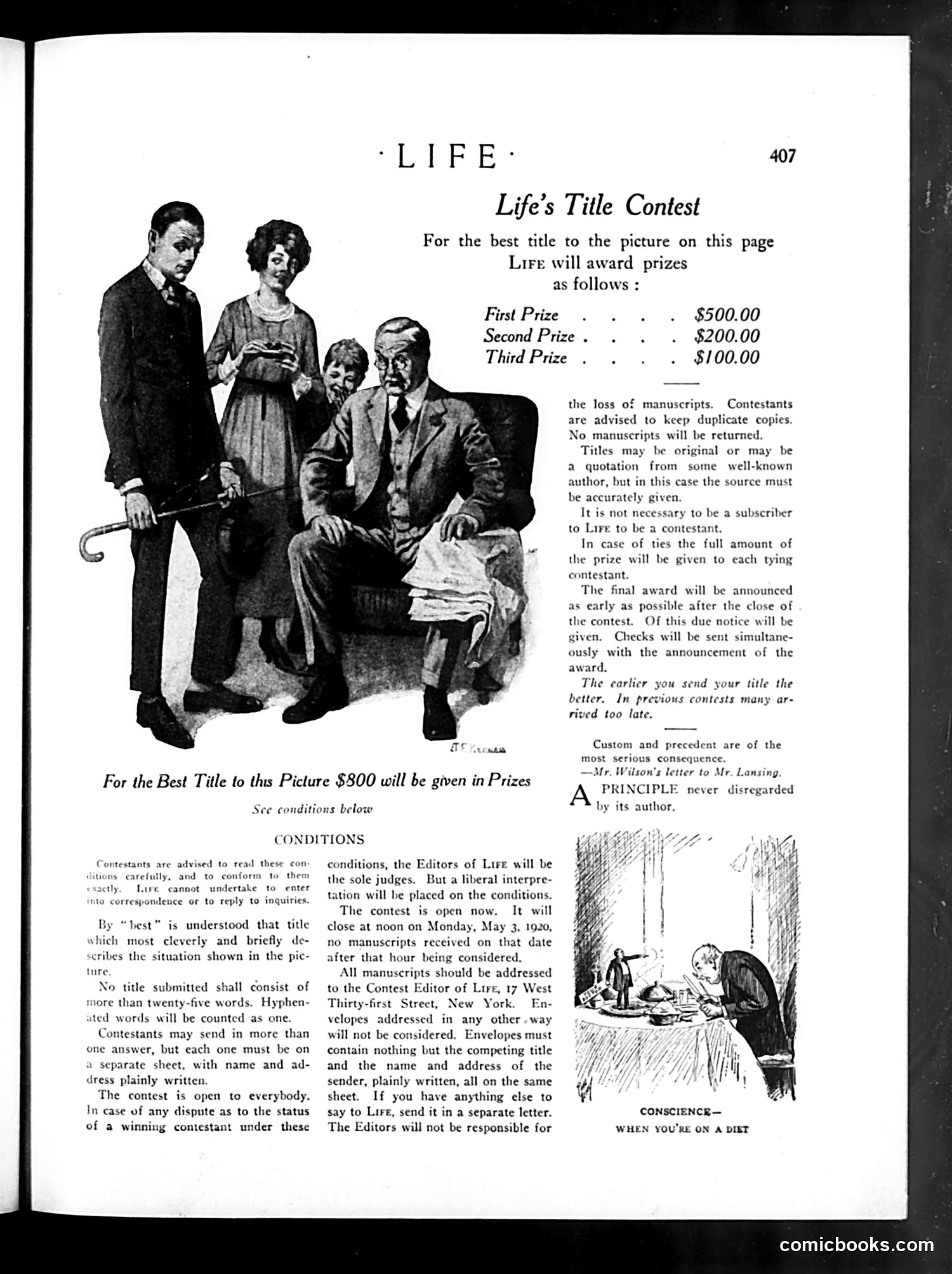
This page announces a reader contest asking for titles to accompany the illustrated scene showing four figures examining a document. The image appears to depict a formal or political situation—possibly involving government officials or diplomacy, given the serious expressions and formal dress. The contest offers substantial prizes ($500, $200, $100) for the best title, with a May 3, 1920 deadline. The detailed rules emphasize that titles must be concise (25 words maximum) and original or properly attributed. A quote at bottom—"Mr. Wilson's letter to Mr. Lansing"—suggests the image relates to President Woodrow Wilson and Secretary of State Robert Lansing, likely referencing a contemporary political matter. The subsequent mention of "PRINCIPLE never disregarded by its author" implies satirical commentary on Wilson's stated principles versus practical politics. Without identifying the specific document or moment depicted, the satirical intent appears to critique a gap between stated moral principles and actual conduct in governance.
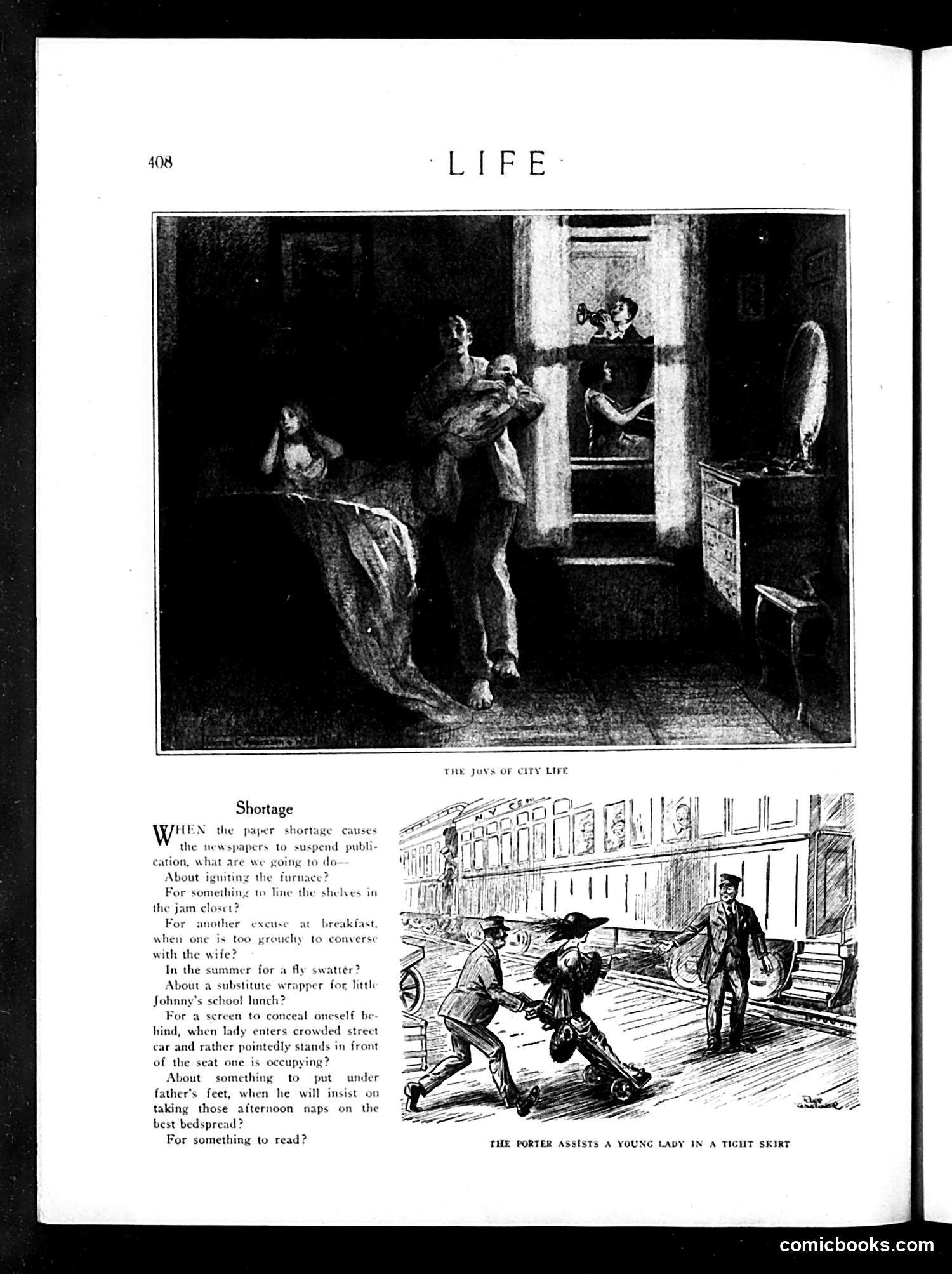
This page satirizes a **paper shortage** (likely WWI-era rationing) by humorously listing everyday uses for newspapers beyond reading. The joke catalogs domestic inconveniences if papers disappeared: fuel for furnaces, shelf-lining, conversation starters with irritable spouses, fly swatters, lunch wrappers, privacy screens on crowded streetcars, footrests for napping fathers, and finally—almost as an afterthought—"something to read." The accompanying illustration, "The Porter Assists a Young Lady in a Tight Skirt," depicts a porter helping a woman board a streetcar, likely commenting on fashion constraints of the era. The satire's point: newspapers serve so many practical household functions that their loss would disrupt daily life far more than losing reading material—a witty commentary on both newspaper indispensability and middle-class domestic routines.
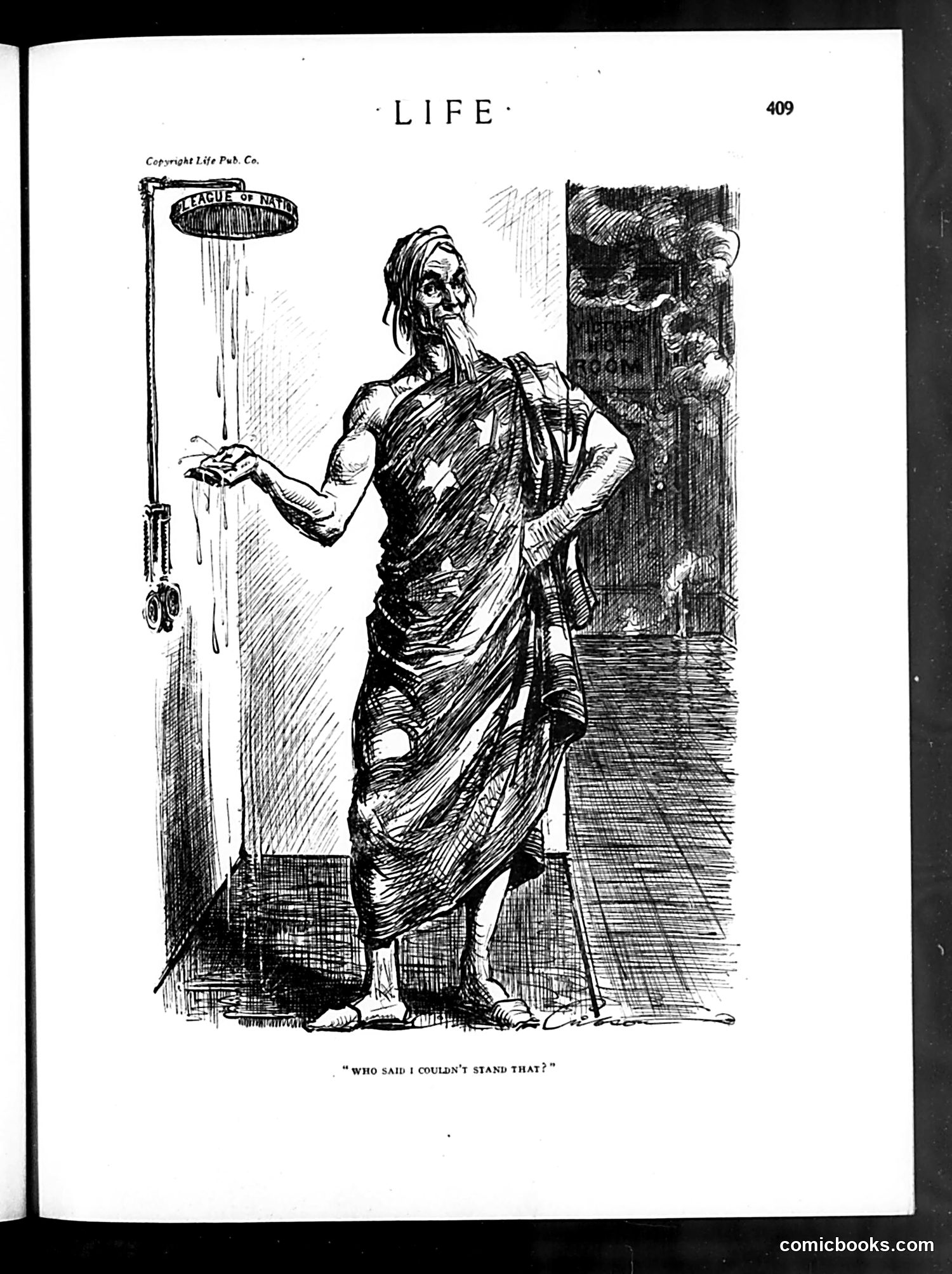
This page features a single cartoon depicting a classical or biblical figure—identifiable by his long beard, draped robes, and staff—standing beneath a sign reading "League of Nations." The figure holds what appears to be money in one hand. The caption reads: "WHO SAID I COULDN'T STAND THAT?" The satire appears to critique the League of Nations, suggesting it could be "propped up" or sustained through financial support despite skepticism about its viability. The classical figure likely represents either a historical or mythological reference to durability or endurance, implying that even questionable institutions can survive with sufficient funding. This dates to the League of Nations era (1920s-1930s), mocking contemporary doubts about the organization's effectiveness while suggesting money could overcome its fundamental problems.
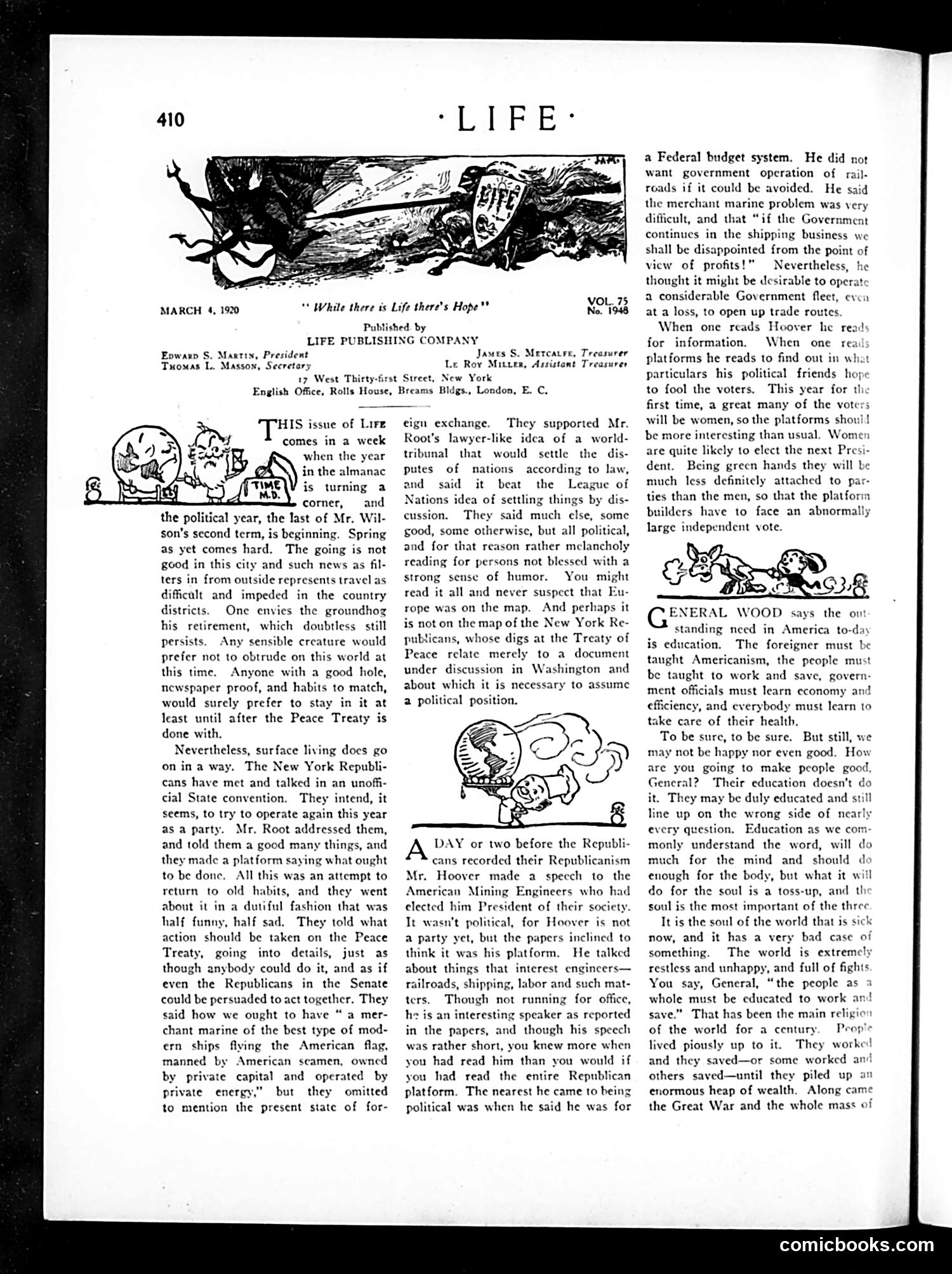
This editorial page critiques the New York Republican State Convention held days earlier. The cartoons (small illustrations) appear to mock political posturing, though they're difficult to identify with precision. The text contrasts two recent speeches: the Republican platform's abstract platitudes about the Peace Treaty and merchant marine, versus Herbert Hoover's address to mining engineers. Life suggests Hoover—not yet a political candidate—spoke more substantively about practical matters (railroads, shipping, labor) than the Republicans' lengthy platform. The satire targets Republican vagueness on post-WWI issues while praising Hoover's pragmatic approach. The piece reflects 1920's anxiety: Wilson's second term ending, European problems (the map reference), and uncertainty about America's postwar role—whether regarding the League of Nations, merchant ships, or foreign exchange. The tone is mordant about politics generally.
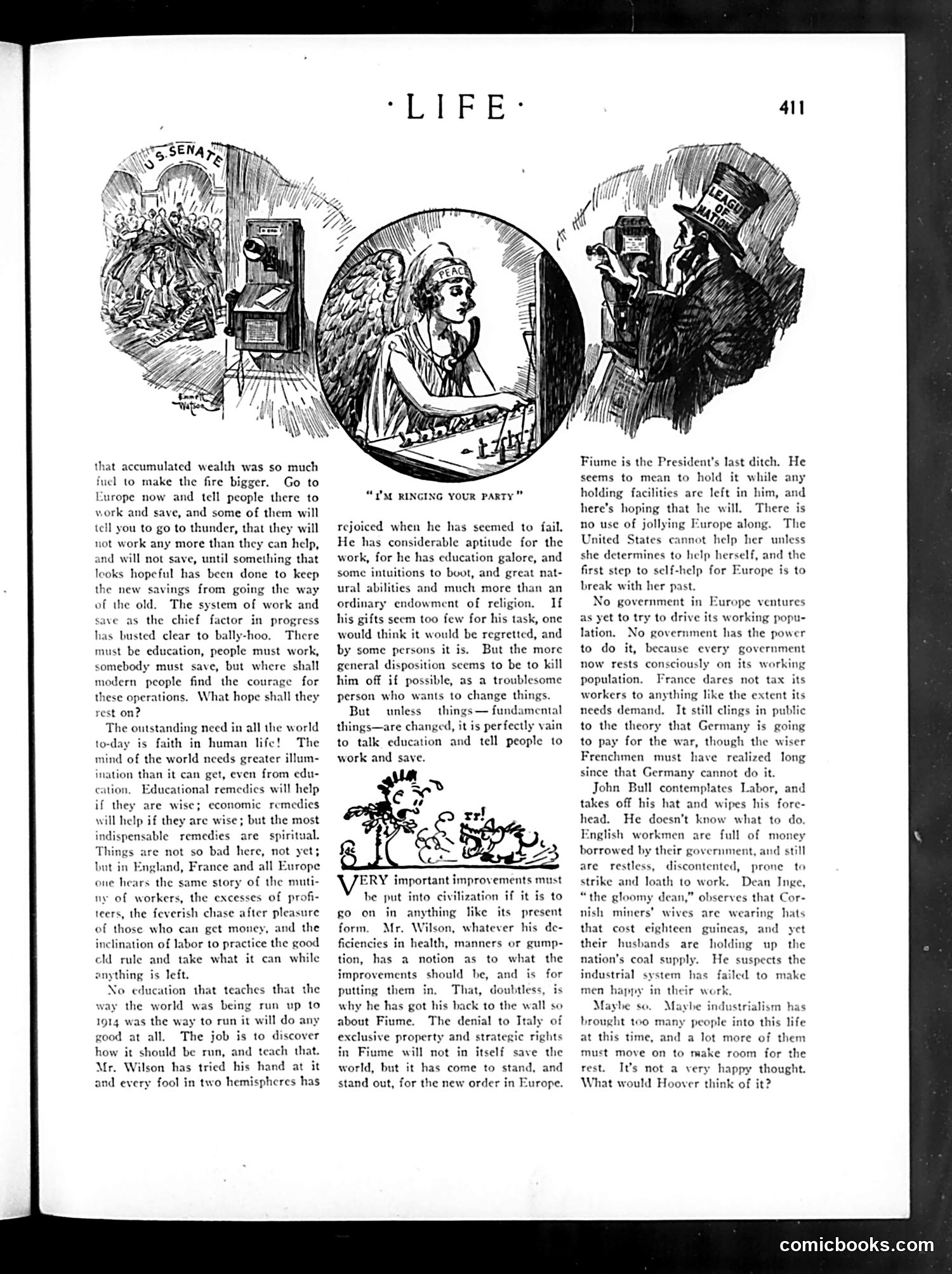
This page contains post-WWI political commentary attacking President Wilson's handling of the Fiume dispute at the Paris Peace Conference (1919). The central cartoon, titled "I'm Ringing Your Party," shows an angelic figure (likely representing idealism or the League of Nations concept) ringing a bell while politicians ignore the call—satirizing resistance to Wilson's internationalist vision. The text argues that fundamental social and economic change is necessary for post-war Europe's recovery, but that entrenched interests oppose Wilson's efforts. The author criticizes European governments and workers alike for failing to embrace necessary reforms, while suggesting Wilson—despite his considerable abilities—faces obstruction from "every fool in two hemispheres" who rejoices at his setbacks. The piece reflects the bitter divisions over American foreign policy following WWI, positioning Wilson as a visionary battling reactionary forces, both abroad and at home, who resist his idealistic restructuring of the post-war order.
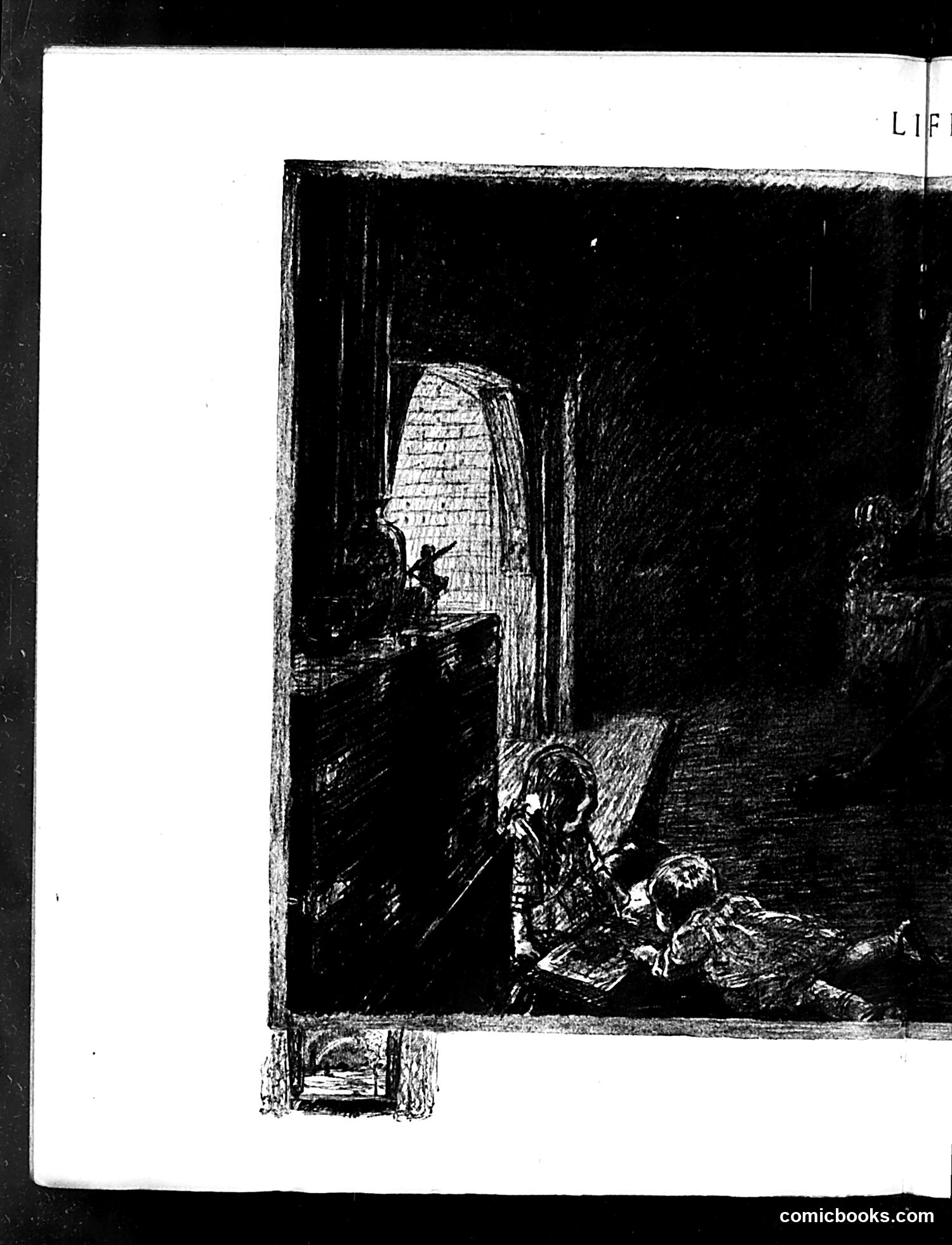
This appears to be an illustration rather than a political cartoon. The image shows a dark, dramatic scene viewed through a doorway or window frame. A figure stands silhouetted in the upper portion, while two other figures appear to be in the lower foreground, rendered in heavy cross-hatching characteristic of early-to-mid 20th century engraving or etching technique. Without clearer text or identifying labels, the specific satirical meaning is difficult to determine. The composition suggests a narrative scene—possibly depicting surveillance, eavesdropping, or clandestine activity—but the identities of the figures and the intended political or social commentary remain unclear from the image alone. The OCR text provided offers no context to clarify the cartoon's purpose or references.
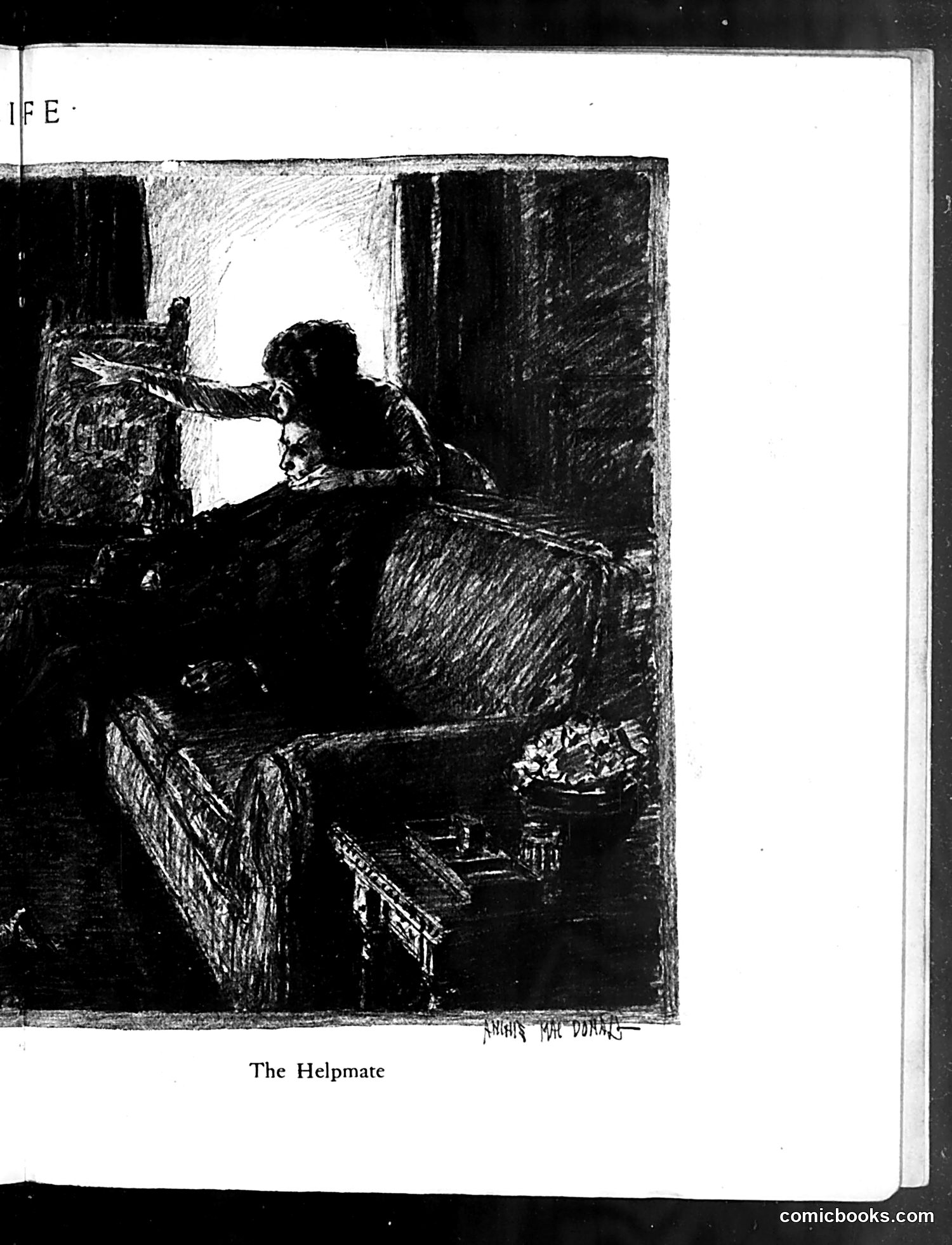
This appears to be a sketch from *Life* magazine showing a domestic interior scene. A figure seated at what looks like a desk or work surface gestures toward an open window or door showing bright light. The composition emphasizes contrast between the dark interior and bright exterior. The title "The Helpmate" suggests social commentary on marriage or domestic partnership, likely satirizing gender roles or spousal dynamics. The figure's posture—reaching outward—could indicate frustration, escape, or conflict within the domestic sphere. Without clearer details or additional context, the specific satirical target remains somewhat unclear, though the sketch appears to critique some aspect of domestic relationships or household hierarchy common to early 20th-century American society.
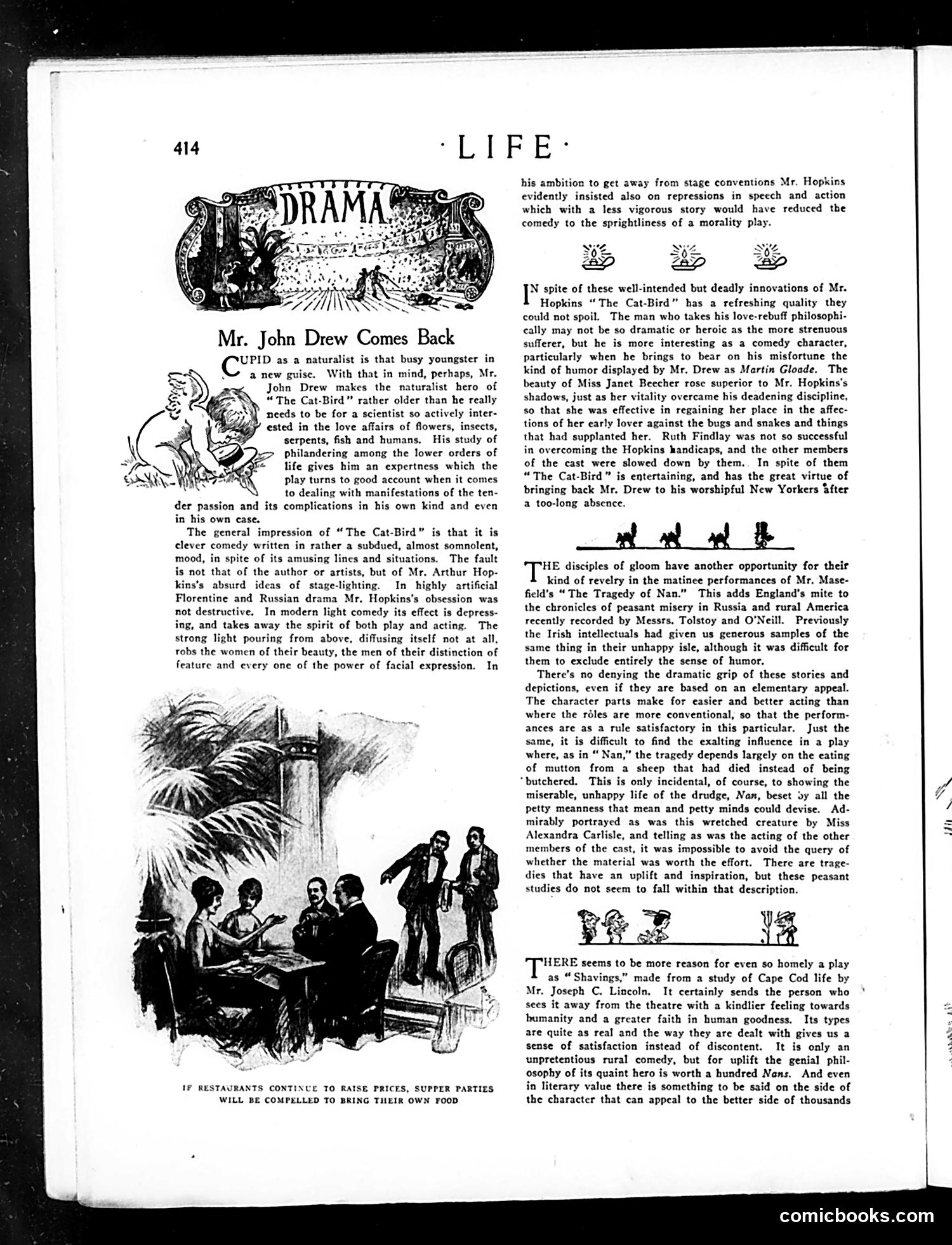
This page reviews stage productions, primarily **"The Cat-Bird,"** starring **John Drew**, a prominent American actor of the era. The text praises Drew's naturalist character and comedic timing, particularly his philosophical approach to romantic disappointment, which makes for more interesting comedy than overwrought suffering. The review **criticizes director Arthur Hopkins's lighting choices**—harsh overhead illumination that flattens actors' features and dampens the play's vitality. Despite these "deadly innovations," the production succeeds due to strong performances by Drew and actress Janet Beecher, who overcome the lighting's deadening effects. The page also mentions **Masefield's "The Tragedy of Nan,"** lumping it with gloomy European peasant dramas (Tolstoy, O'Neill) that, while dramatically gripping, offer little uplift. The cartoon at bottom mocks **restaurant price inflation**, suggesting supper parties will soon need to bring their own food—a satirical jab at wartime or post-war economic conditions.
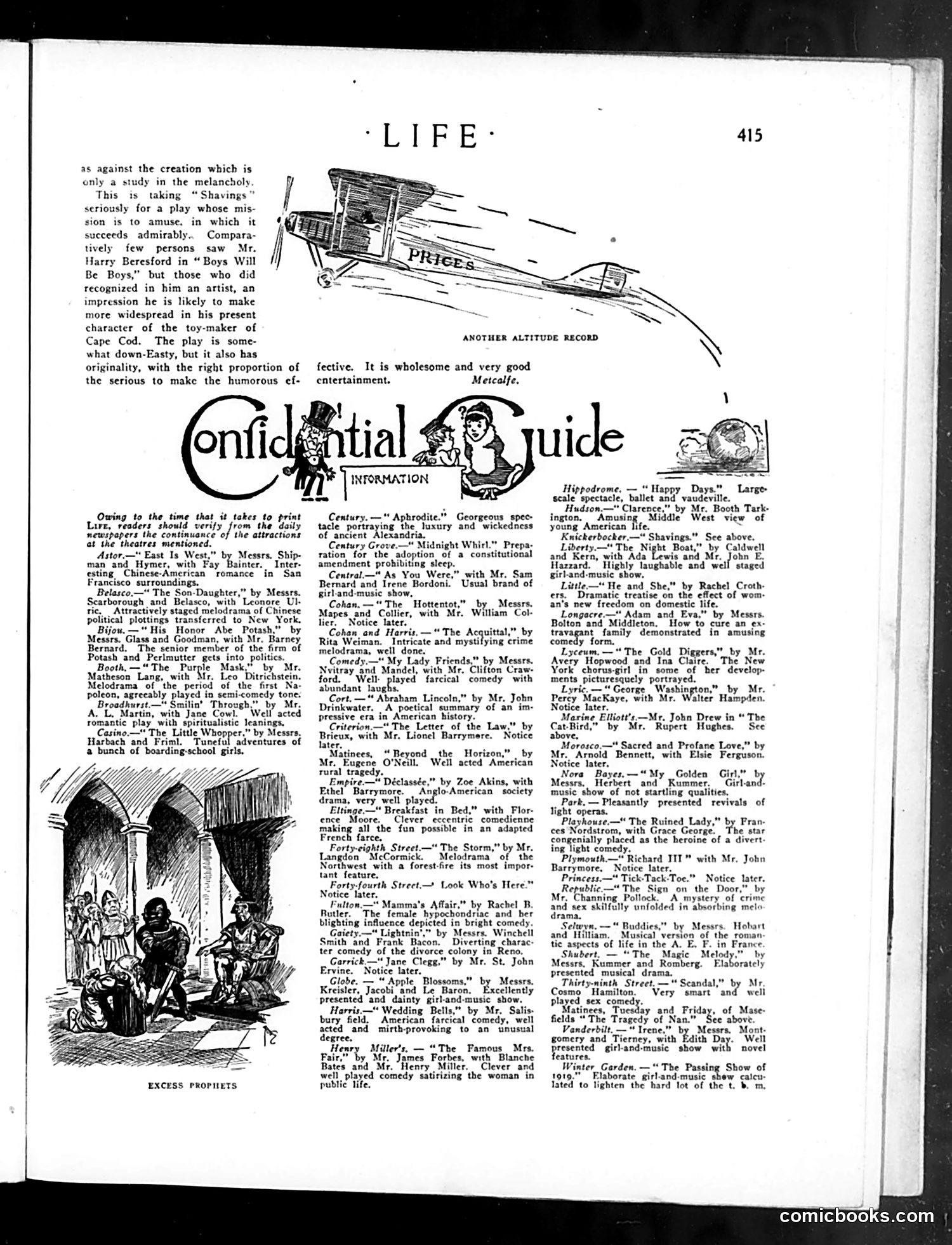
This page is primarily a **theater guide and review section** rather than a political cartoon page. The small illustration labeled "EXCESS PROPHETS" (bottom left) appears to show a crowd scene, possibly satirizing public speculation or financial speculation, though details are unclear. The bulk of the content is an **"Information" section** listing Broadway theaters and current productions with brief reviews. Notable 1920s plays mentioned include Eugene O'Neill's "Beyond the Horizon" and works by established playwrights. The top includes theater criticism discussing a play called "Shavings" and actor Harry Beresford's role as a Cape Cod toy-maker, noting the production balances humor with seriousness effectively. The airplane illustration labeled "ANOTHER ALTITUDE RECORD" appears unrelated to the theater content—likely a separate news illustration about aviation achievements, reflecting the era's fascination with flying.
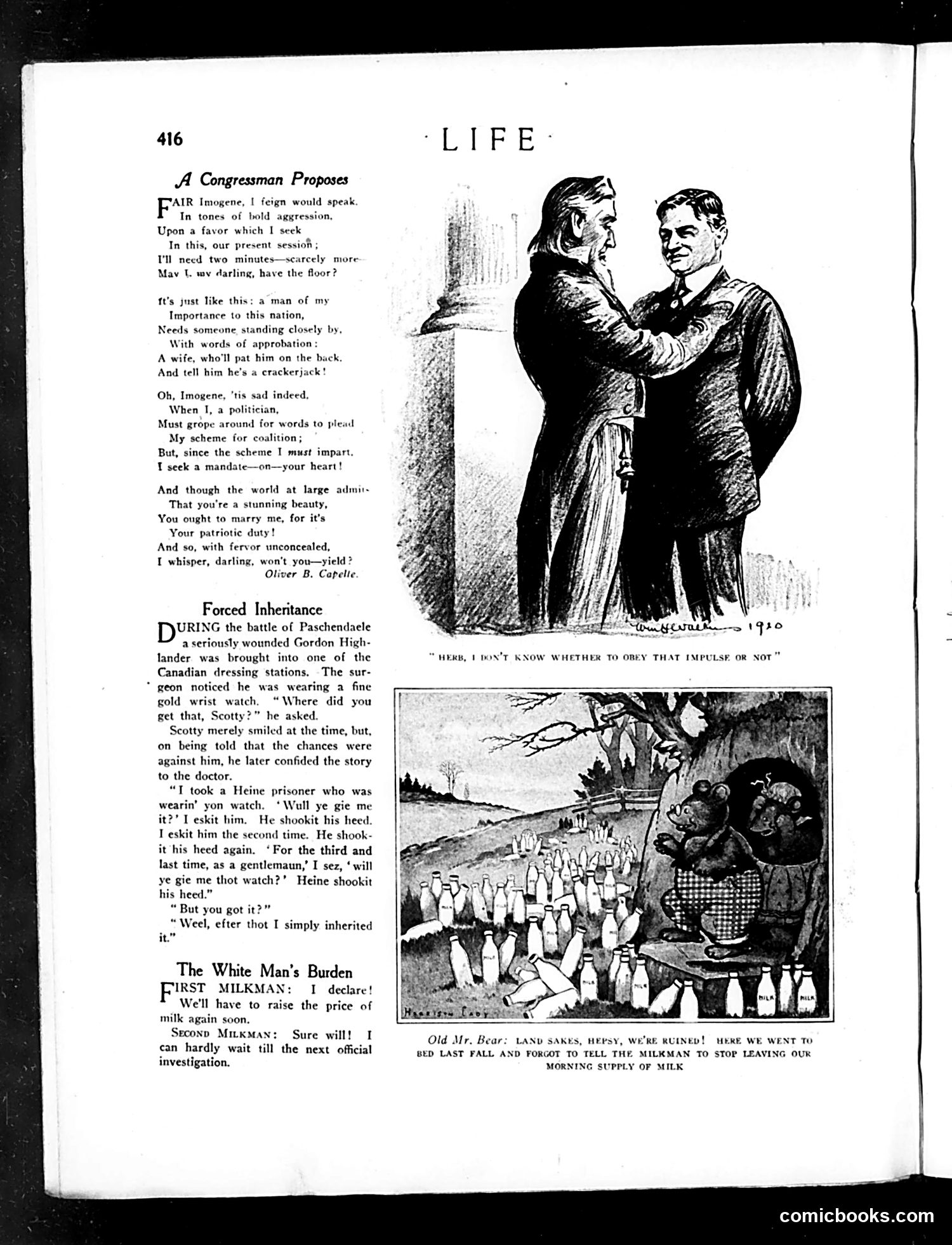
This page contains three satirical pieces from an early 20th-century American humor magazine: **"A Congressman Proposes"**: A poem mocking a self-important politician who frames a marriage proposal as a patriotic duty to the nation, needing a wife to praise him and support his political schemes. The satire targets politicians' inflated self-regard. **"Forced Inheritance"**: A anecdote about a Scottish soldier in WWI (Battle of Passchendaele) who repeatedly asks a German prisoner for his watch. When the prisoner refuses, the soldier simply takes it by force—then euphemistically calls it "inheritance." The dark humor satirizes wartime brutality disguised by wordplay. **"The White Man's Burden"**: Two milkmen discuss eagerly awaiting the next government investigation to justify raising milk prices, suggesting collusion. A separate cartoon shows bears complaining they forgot to tell their milkman to stop deliveries before hibernation. Together, these mock both price-fixing schemes and absurd bureaucratic consequences. The page satirizes politicians, wartime conduct, and economic manipulation typical of Life's critical stance on American society.
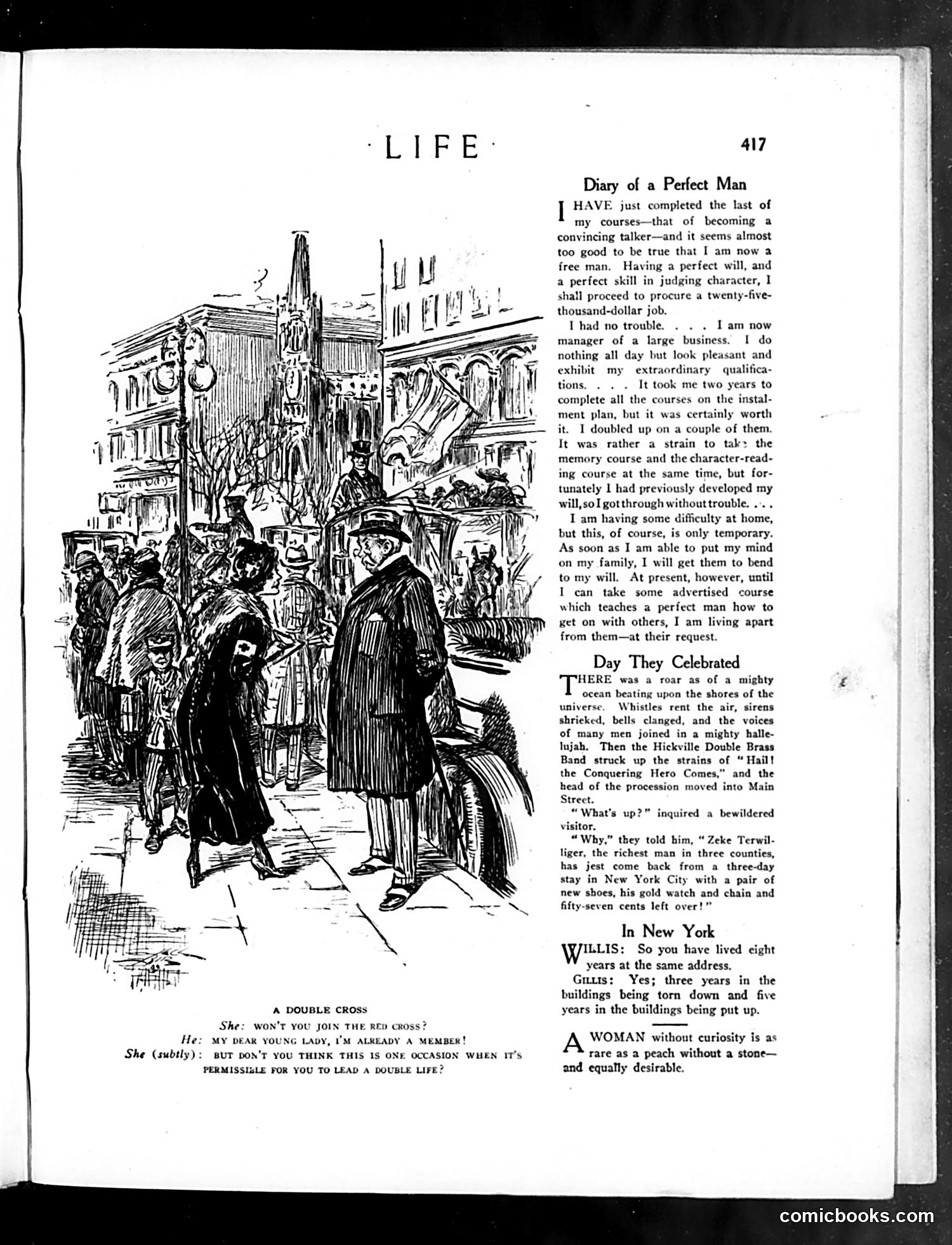
This cartoon satirizes the Red Cross organization through a dialogue between a man and woman on a city street. The man asks the woman to join the Red Cross; she responds by asking if joining would permit her to "lead a double life." The joke plays on the Red Cross's red cross symbol—the woman interprets "double cross" literally as duplicity or infidelity, rather than understanding it as simply the organization's name. This satirizes both the woman's naïveté and perhaps contemporary attitudes about women's charitable work and social propriety. The cartoon suggests that joining the Red Cross might provide cover for illicit activities, mocking either the organization's oversight or satirizing assumptions about women's behavior. The humor relies entirely on this verbal/visual pun with the cross symbol.
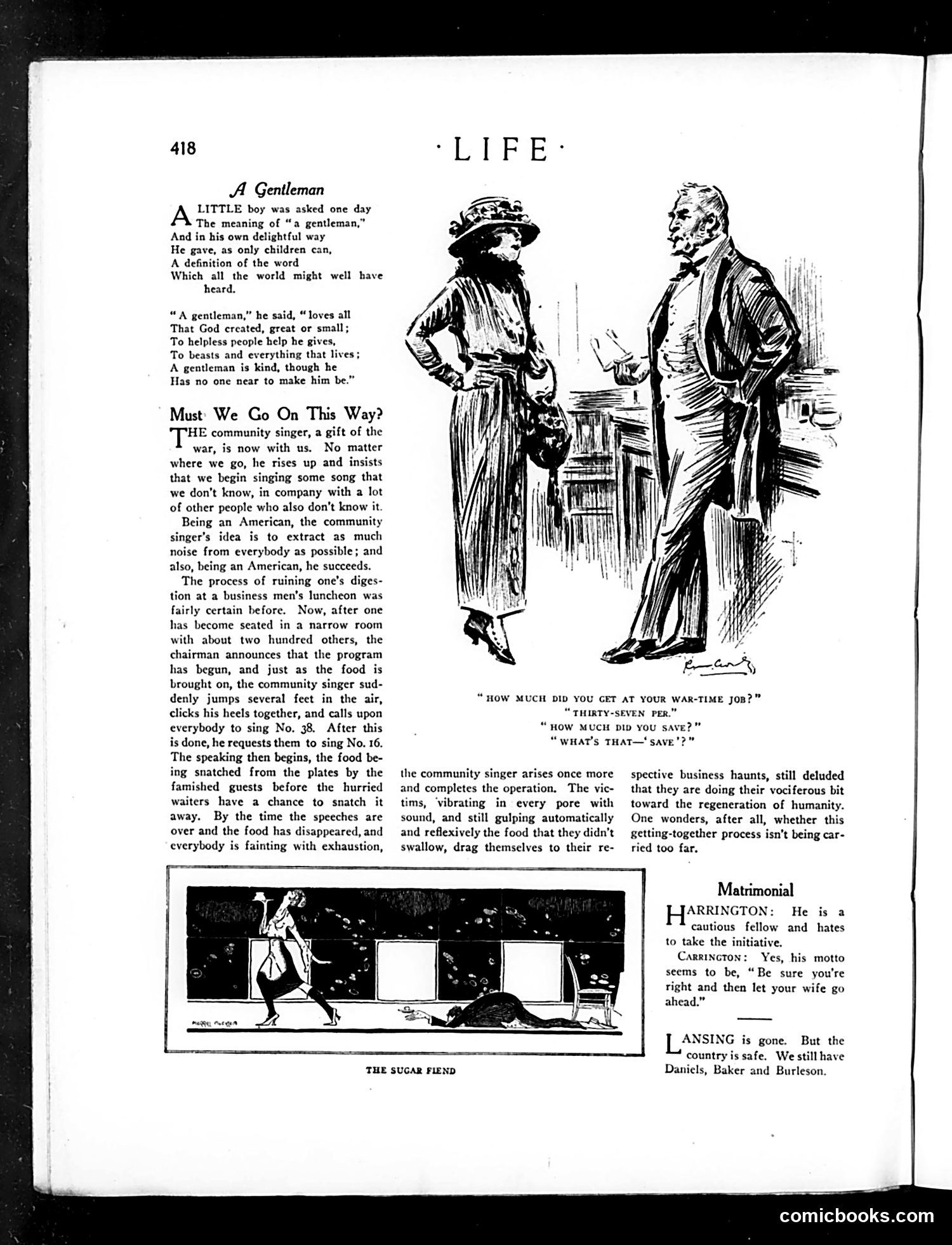
This page contains three satirical pieces from post-WWI America: **"A Gentleman"**: A sentimental poem defining gentlemanly virtue through a child's innocent perspective—emphasizing kindness to all creatures and helping the helpless. **"Must We Go On This Way?"**: Mocks the "community singer" phenomenon (apparently a wartime fad where organizers forced group singing at public events). The satire ridicules the forced gaiety, terrible timing during meals, and Americans' enthusiasm for extracting maximum noise from unwilling participants. **The dialogue cartoon** jokes about wartime profiteering: someone earned 37% profit during the war but "saved" nothing—implying wealth vanished through spending or was never truly accumulated. **"Matrimonial"**: A joke about a timid husband who won't take initiative, letting his wife lead. **Final quip**: References departing Secretary Lansing (State Department), asserting the country remains safe under Secretaries Daniels (Navy), Baker (War), and Burleson (Post Office)—likely ironic commentary on these officials' competence.
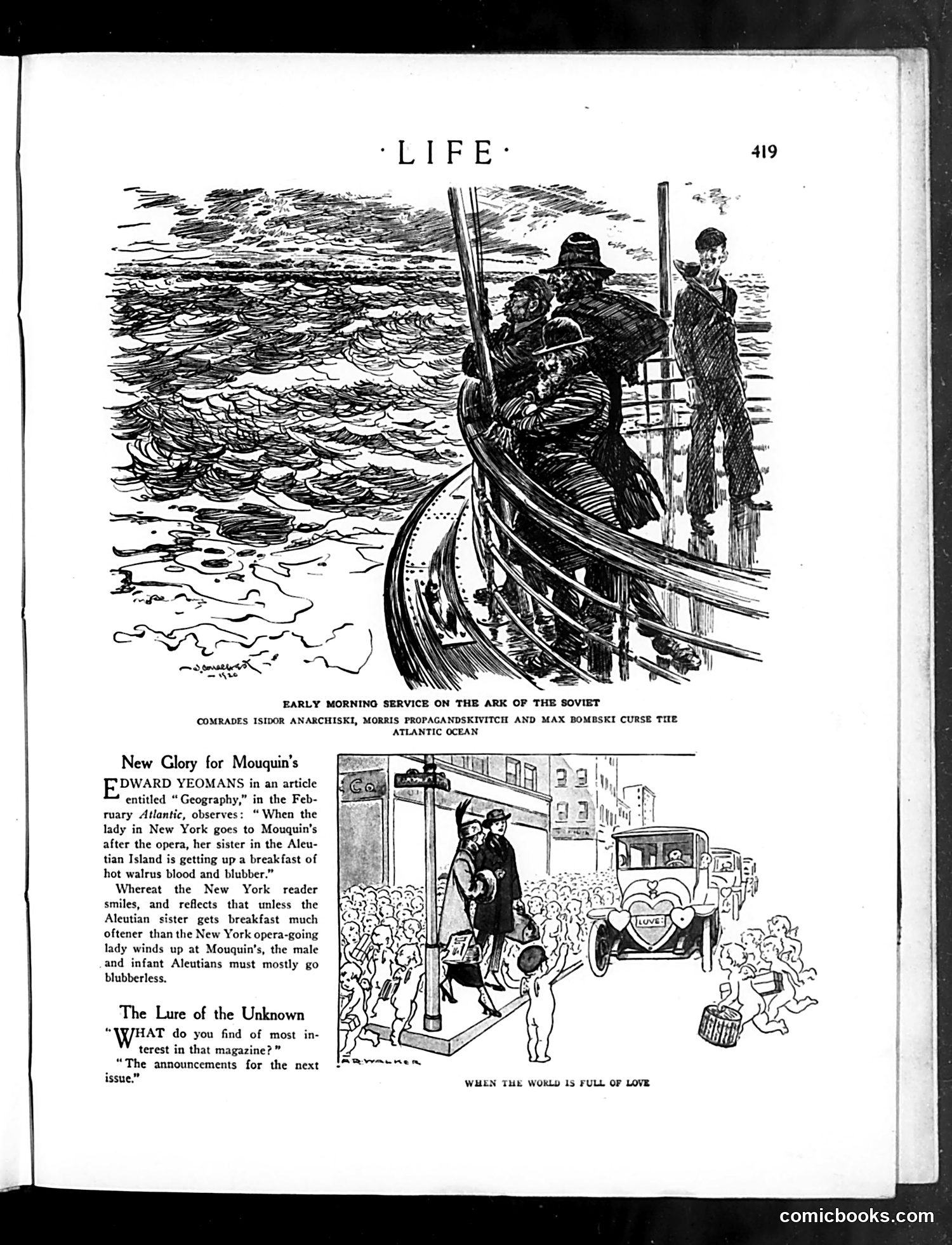
The top cartoon mocks Soviet communists through ethnic stereotyping. Three caricatured figures with exaggerated "Russian" surnames (Anarchiski, Propagandskivitch, Bombski) stand on a ship, cursing the Atlantic Ocean. This satirizes early 20th-century American anxieties about Bolshevik revolutionaries and communist propaganda, portraying them as foreign, incompetent, and absurdly antagonistic—even to natural obstacles. The "New Glory for Mouquin's" section humorously contrasts wealthy New York opera-goers dining at the upscale Mouquin's restaurant with Aleutian Islanders eating walrus blood. The joke critiques the absurdity of such geographic inequalities. The bottom cartoon ("When the World Is Full of Love") depicts a flapper-era couple amid urban chaos—a satirical commentary on romance amid modernity's chaos. The magazine's satirical tone targets both communist fears and contemporary social pretensions.
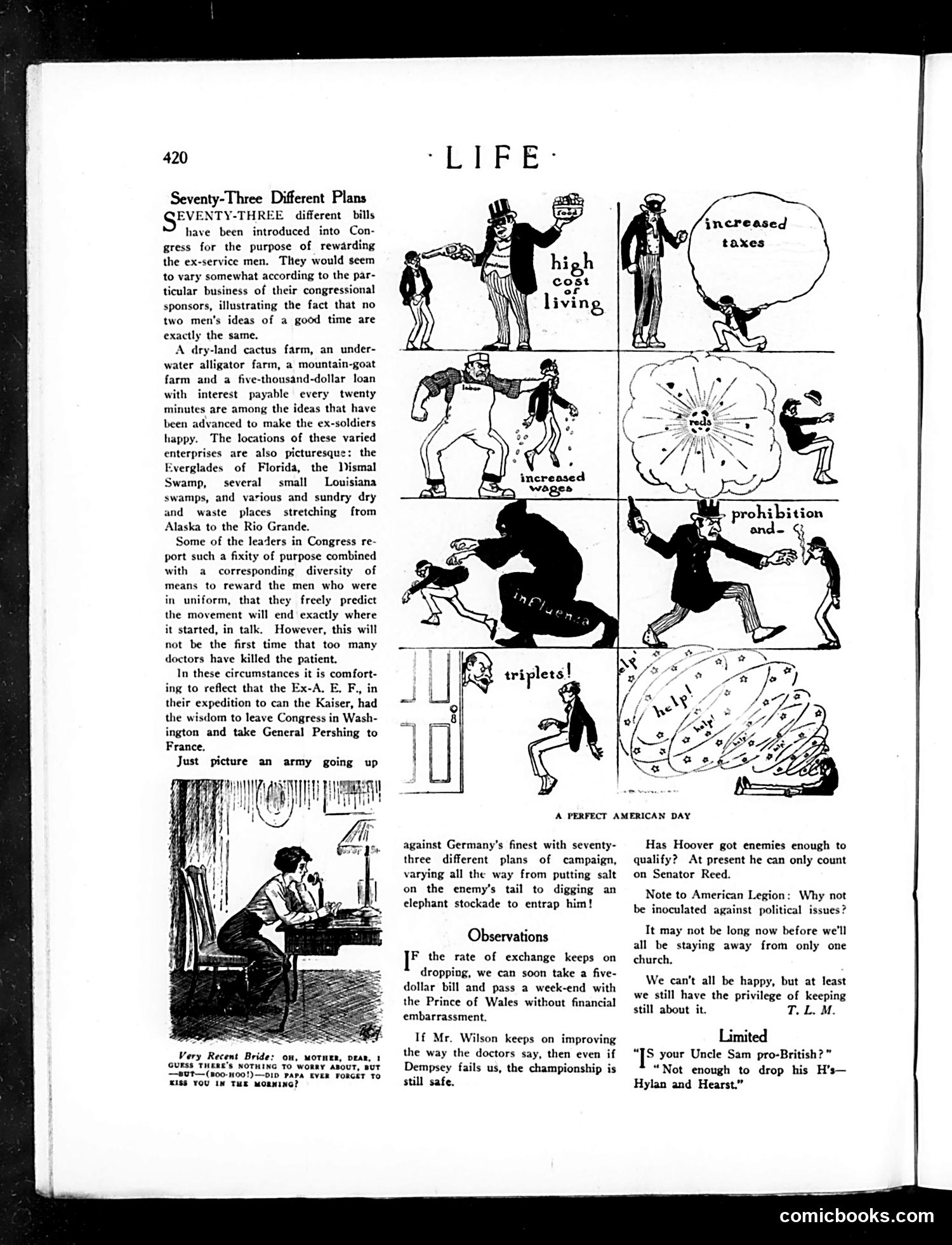
This satire mocks Congressional proposals to reward World War I veterans. The main cartoon illustrates the absurdity: congressmen propose wildly impractical schemes—dry-land cactus farms, underwater alligator farms, mountain-goat operations—located in bizarre places from Alaska to the Rio Grande, each reflecting the sponsor's business interests rather than veterans' actual needs. The article argues Congress is so fractured and self-interested that nothing will pass; they should have left decision-making to General Pershing rather than trying to coordinate 73 incompatible plans. The irony: an army succeeded in France because it had *one* unified command, not 73 competing strategies. The accompanying cartoons satirize other contemporary issues: inflation's effects ("increased taxes," "increased wages"), Prohibition, and political divisions. The page suggests American governance suffers from excessive talk and competing interests rather than coordinated action.
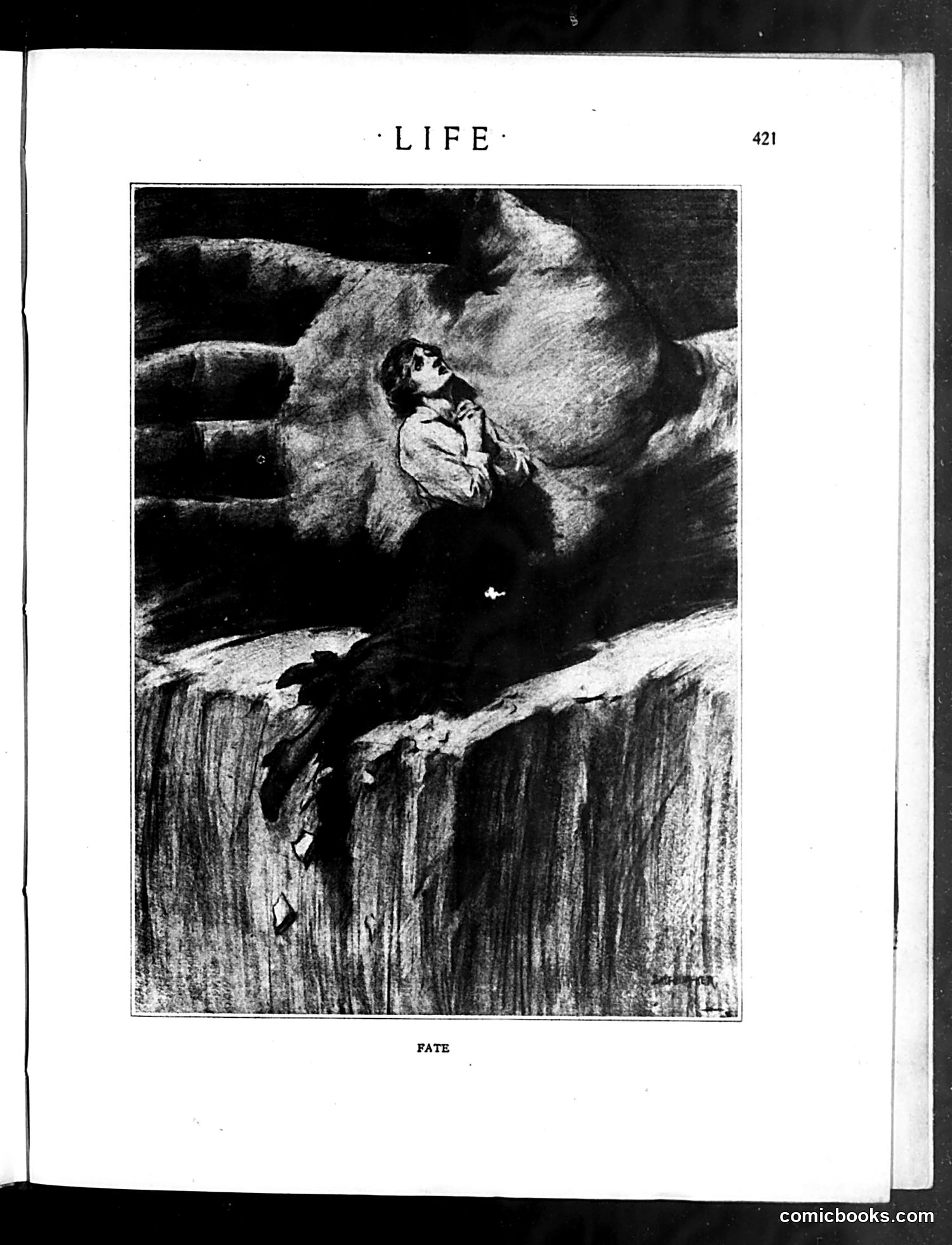
This illustration depicts a small human figure perched precariously on a narrow ledge, gazing upward at massive, looming rock formations or cliff faces above. The composition emphasizes human vulnerability against overwhelming natural forces. The single-word caption "FATE" suggests this is commentary on human powerlessness before forces beyond individual control. The figure's posture—looking upward with apparent resignation or anxiety—reinforces themes of insignificance. Without additional context about the publication date or artist, the specific satirical target remains unclear. However, the image appears to represent a broader philosophical statement about humanity's relationship to destiny or circumstances beyond personal agency—a common theme in early 20th-century American satirical commentary.
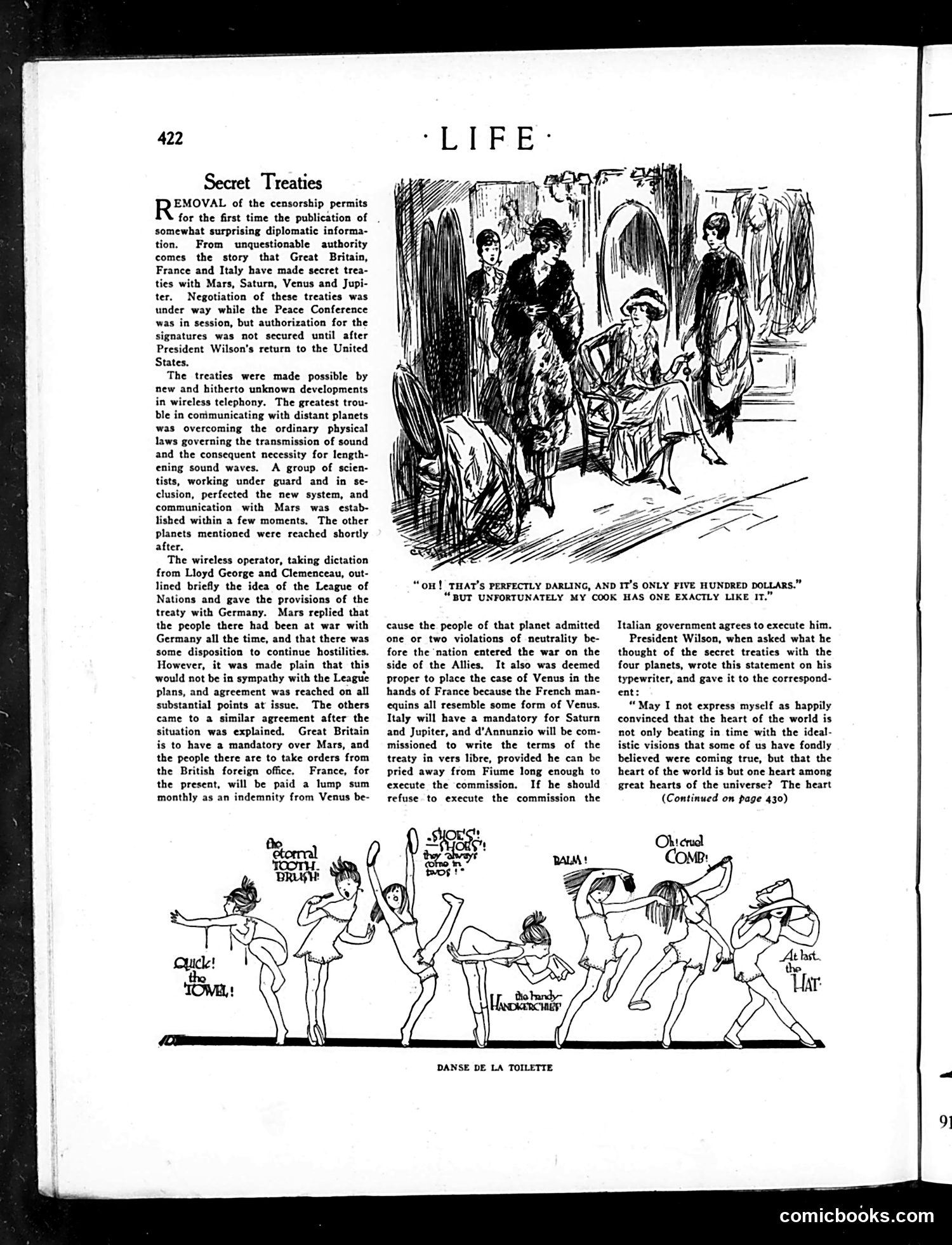
This article satirizes post-WWI diplomatic negotiations, particularly the 1919 Paris Peace Conference. The joke imagines that British, French, and Italian leaders (Lloyd George, Clemenceau, and implicitly Italian officials) have negotiated treaties with planets—a absurd exaggeration mocking the era's complex secret diplomacy and territorial mandates. The satire targets: 1. **League of Nations idealism** versus realpolitik (Mars demands continued war; planets admit neutrality violations) 2. **Imperial mandates** (Britain controls Mars; France gets Venus; Italy gets Saturn/Jupiter) 3. **Gabriele d'Annunzio**, the Italian poet-nationalist obsessed with Fiume, portrayed as more concerned with poetry than diplomacy 4. **Wilson's verbose, flowery rhetoric** (the concluding quote mocking his grandiose language) The bottom illustration, "Danse de la Toilette," is a separate fashion/society commentary, not related to the main article. The satire exploits the absurdity of interplanetary treaties to critique actual treaty-making's illogic and the gap between idealistic League principles and cynical power politics.
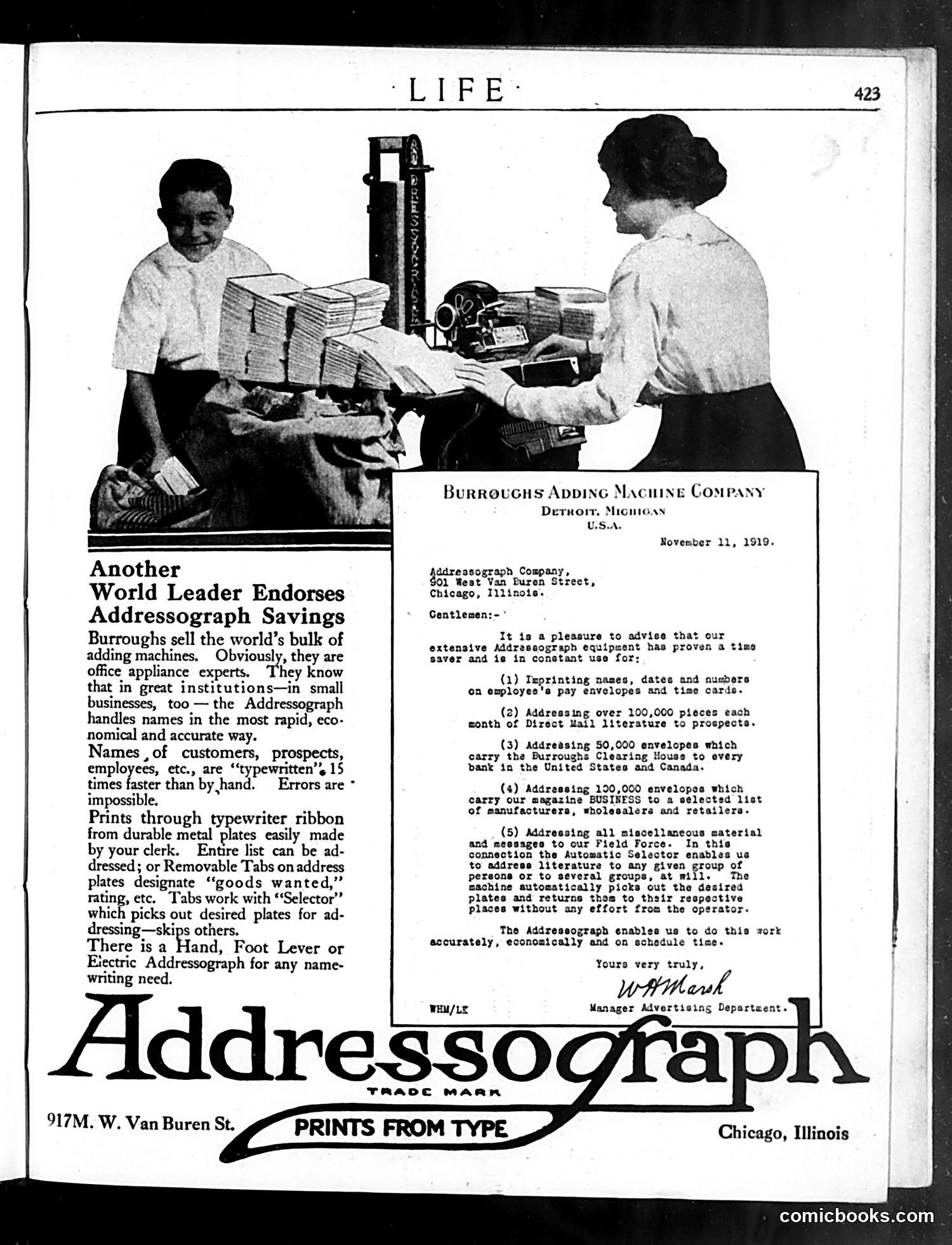
This page is primarily a **product advertisement** for the Addressograph machine, a mechanical device for printing addresses on envelopes and documents. There is no political cartoon or satire. The ad uses a testimonial format: a letter dated November 11, 1919, from an unnamed "World Leader" (the identity is deliberately obscured) endorsing the machine's efficiency. The letter details five business applications—addressing payroll envelopes, direct mail, bank correspondence, magazine distribution, and field force communications—claiming the Addressograph saves time and prevents errors. The photograph shows two office workers demonstrating the machine's operation with stacks of addressed materials. The satirical element is subtle: calling an anonymous business executive a "World Leader" mockingly elevates routine office efficiency to grand importance. The ad targets early-20th-century businesses seeking to modernize administrative operations through mechanization—a genuine concern of that era before computerized systems.
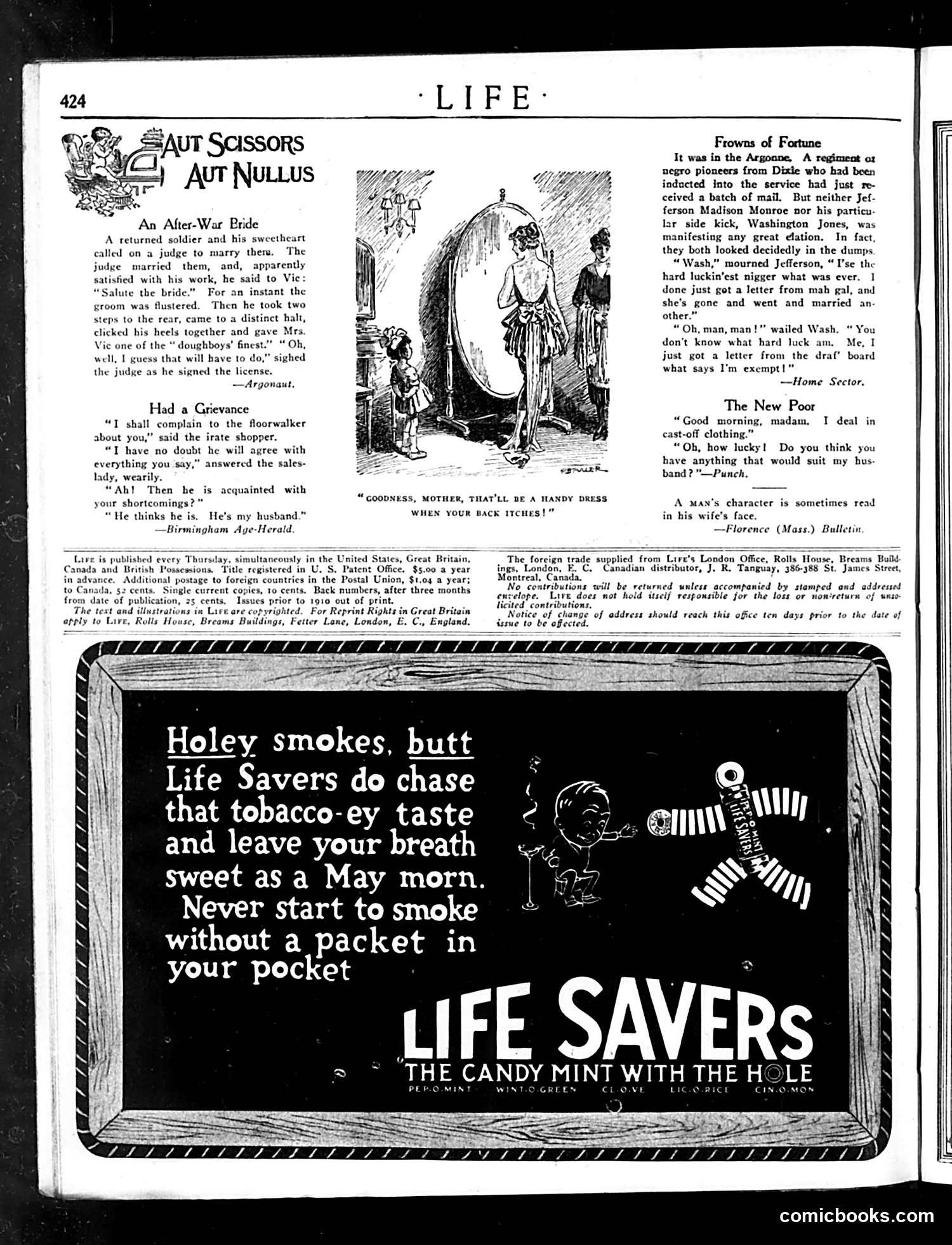
This page contains four satirical pieces and a Life Savers advertisement: **"An Alter-War Bride"**: A post-WWI joke mocking a returning soldier who, when asked to "salute the bride," gives a military salute instead of kissing her—reflecting the awkwardness of doughboys reintegrating into civilian life. **"Had a Grievance"**: A department store exchange where a customer threatens to complain to the manager; the saleswoman sarcastically agrees he'll side with her, implying the customer is famously difficult. **"Frowns of Fortune"**: A racial stereotype piece about African American soldiers receiving mail in the Argonne (WWI battlefield). The humor relies on dialect caricature and the irony that one soldier got drafted exemption instead of romantic good news. **"The New Poor"**: A Depression-era joke about poverty—a wife eagerly asks a used-clothing dealer if he has something for her unemployed husband. The **Life Savers advertisement** uses the slogan "Holey smokes, butt Life Savers do chase that tobacco-ey taste"—a pun on the candy's hole and smoking culture.
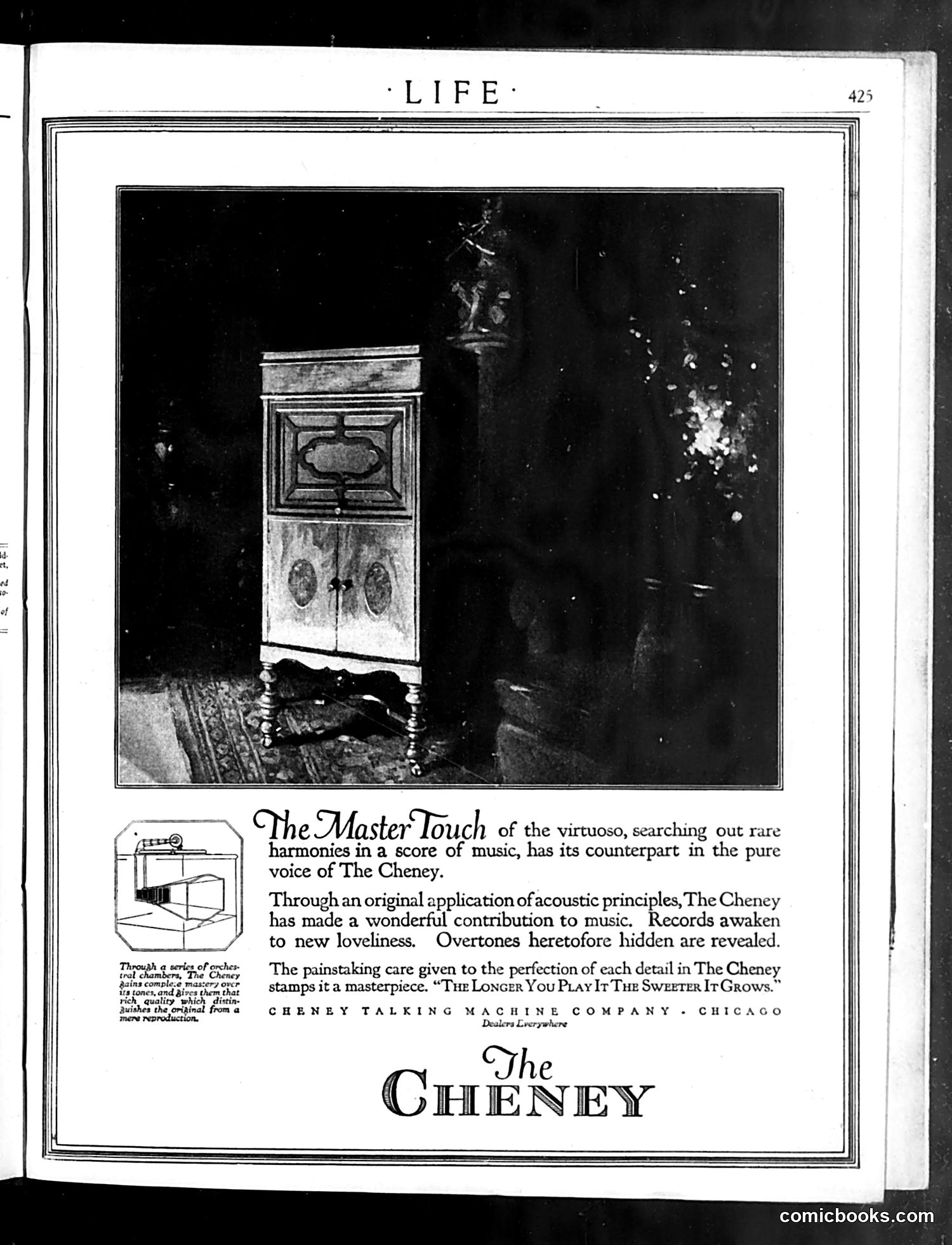
This is a **product advertisement**, not a political cartoon. It appears on page 425 of *Life* magazine and promotes The Cheney, a talking machine (phonograph/gramophone) manufactured in Chicago. The ad uses elevated, artistic language to market the device by comparing its sound quality to a virtuoso musician's "master touch." The imagery shows an ornate wooden cabinet-style phonograph in a darkened room, emphasizing its aesthetic appeal as furniture. The tagline—"The Longer You Play It The Sweeter It Grows"—suggests the machine improves with use or that listeners become more impressed the more they experience it. This represents early 20th-century marketing strategy: positioning new technology as a refined, almost artistic achievement rather than mere mechanical reproduction. The ad appeals to middle-class aspirations for culture and elegance in the home.
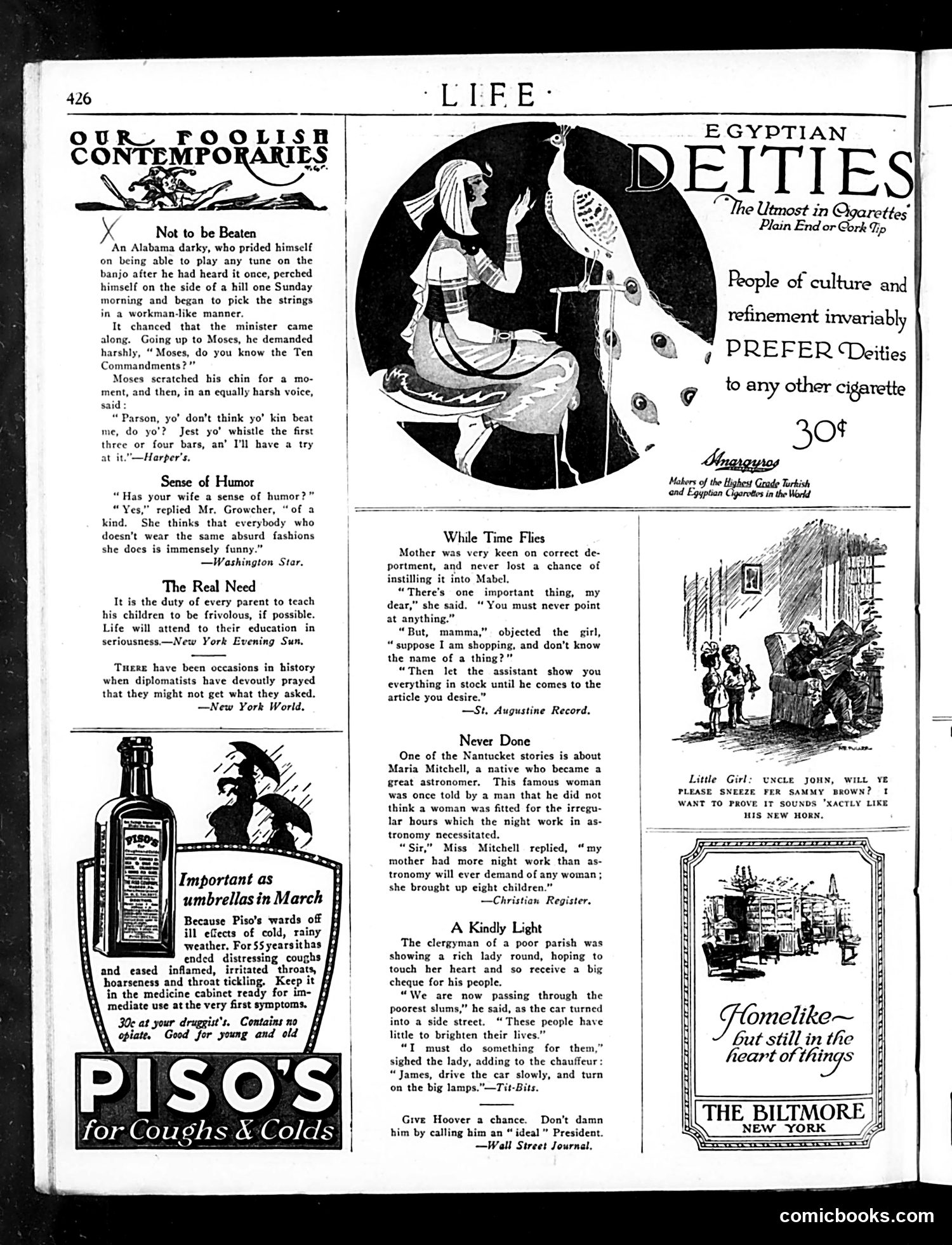
This page from *Life* magazine contains several short humorous anecdotes and advertisements typical of early 20th-century American humor. **"Not to Be Beaten"** uses a racist stereotype—depicting an enslaved or formerly enslaved Black man ("Alabama darky") as musically gifted but uneducated. The joke relies on the conceit that he can play any banjo tune by ear but doesn't know the Ten Commandments, suggesting intellectual limitation despite musical talent. **Other brief humor pieces** mock social pretension ("Sense of Humor"), satirize parenting philosophy, and present clean family jokes (a child wanting his uncle to sneeze to demonstrate his new horn). **Advertisements** dominate: Egyptian Deities cigarettes (appealing to sophistication), Piso's cough remedy, and the Biltmore Hotel in New York. The page reflects period attitudes: casual racial caricature was considered acceptable humor, while advertisements emphasized "culture" and "refinement" to sell consumer products to middle-class readers.
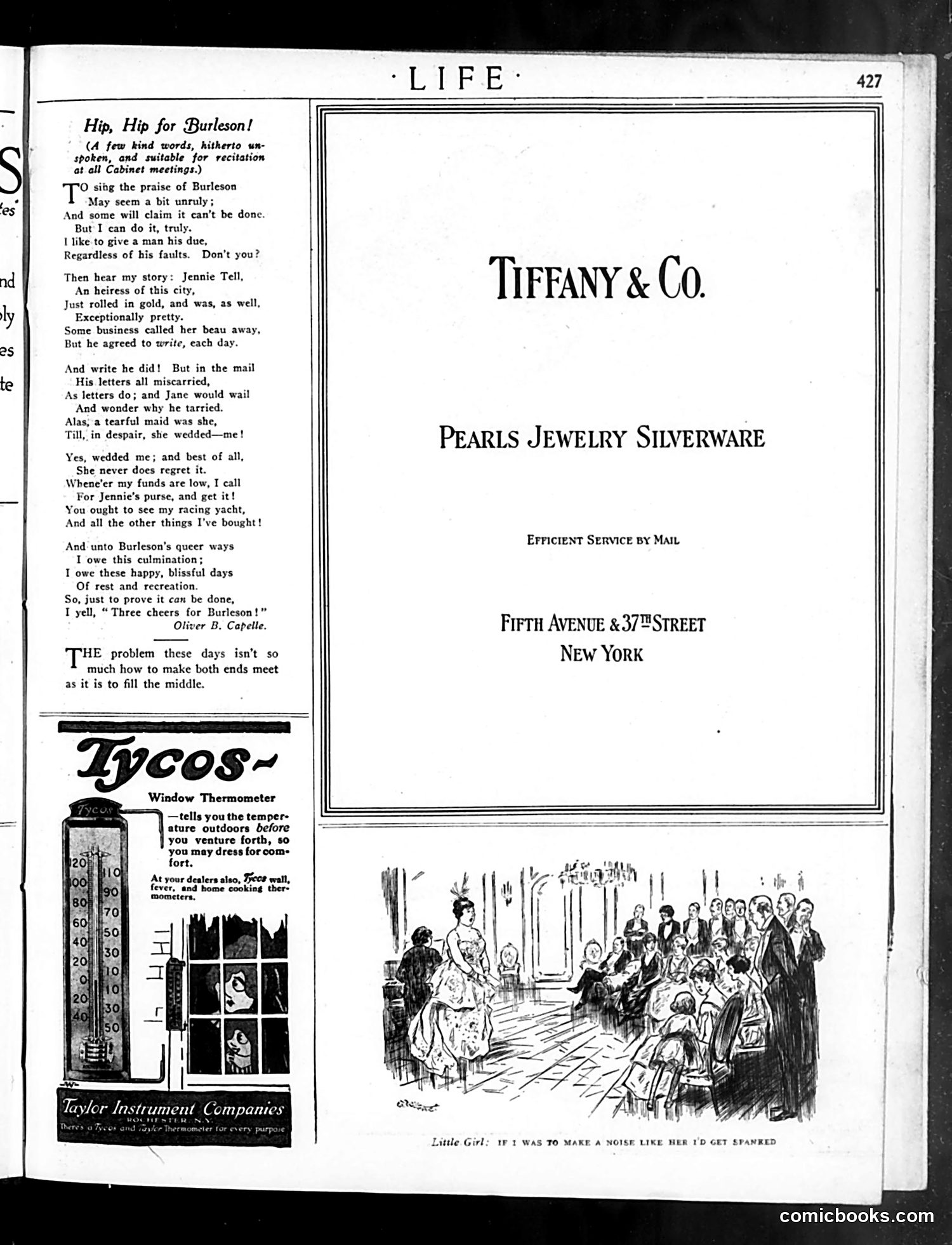
This page contains a satirical poem mocking **Albert Burleson**, Postmaster General under President Wilson. The poem's ironic "praise" actually criticizes his administration of the postal service by describing how mail miscarriage benefited the narrator—a wealthy man whose love letters failed to reach his intended, allowing him to marry a rich heiress instead and enjoy her money. The joke is dark: Burleson's incompetence at running the Post Office is presented as accidentally helpful to this fortune-seeker. The bitter humor reflects public frustration with postal service failures during this period. The bottom cartoon shows a little girl making noise in what appears to be a formal social setting (possibly a concert or Cabinet meeting, given the context). The caption suggests she'd be punished for such behavior—a mild social commentary on children's constrained roles. The page also contains period advertisements (Tiffany & Co., Tycos thermometer) typical of *Life* magazine's commercial content.
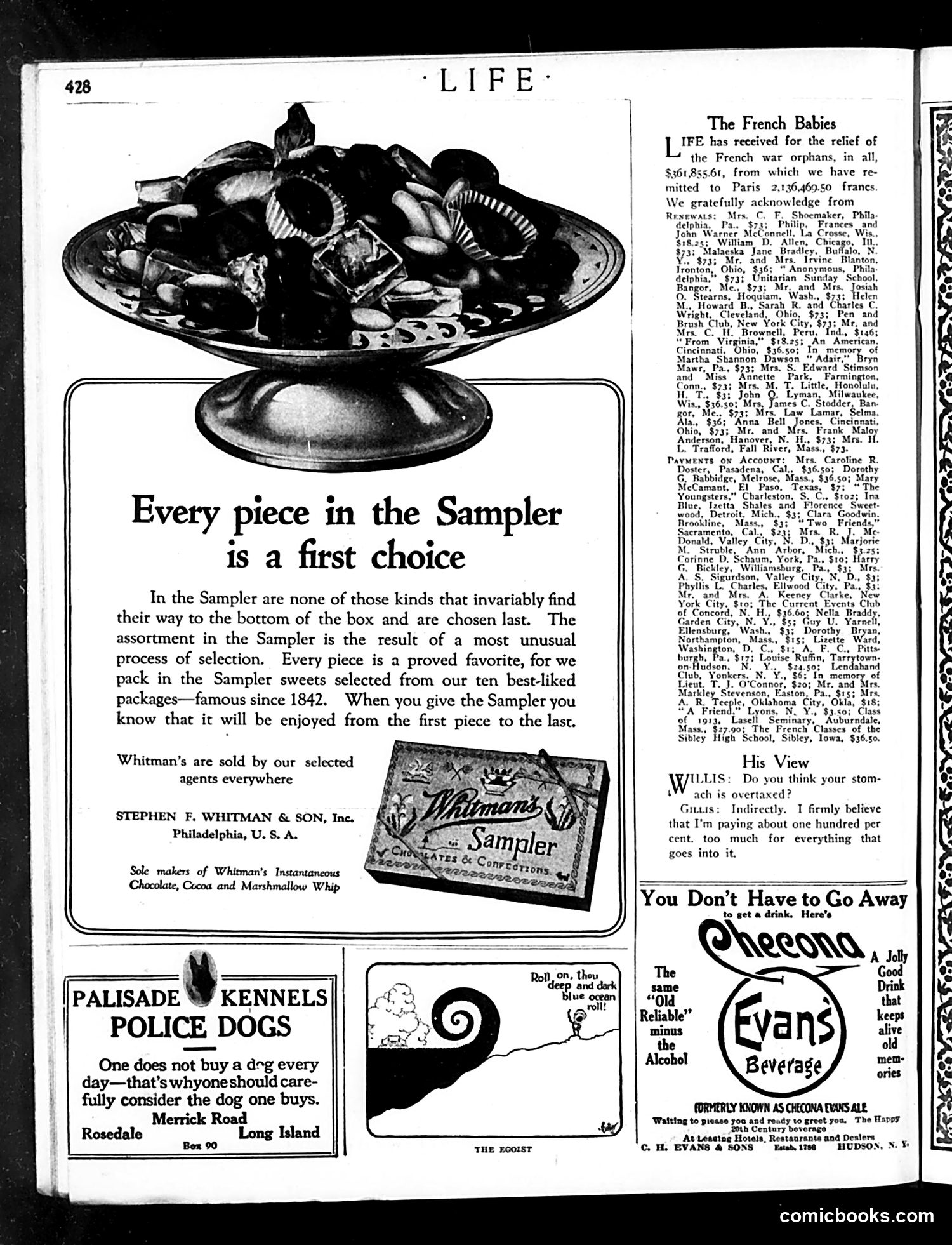
**Main Content: French War Orphans Relief** The dominant text acknowledges donations totaling $161,855.61 collected for French war orphans, with $2,136,469.50 francs remitted to Paris. This reflects American charitable response to WWI's humanitarian crisis in France. **Cartoons:** 1. **"The Rooster"** (bottom center): A simple line drawing of a rooster with the caption "Roll on, thou deep and dark blue ocean roll!" This appears to be mild political satire, though the specific reference is unclear without fuller context. 2. **"His View"** (right side): A conversation joke where one character asks if the other's stomach is "overtaxed," and he responds he's paying 100% too much for everything consumed. This satirizes post-WWI inflation and cost-of-living concerns affecting Americans. **Advertisements** dominate the remaining space (Whitman's Sampler candies, Palisade Kennels, Chicora Evans Beverage), typical of the era's magazine layout. The page reflects early 1920s American concerns: wartime charitable obligations and domestic economic anxieties.
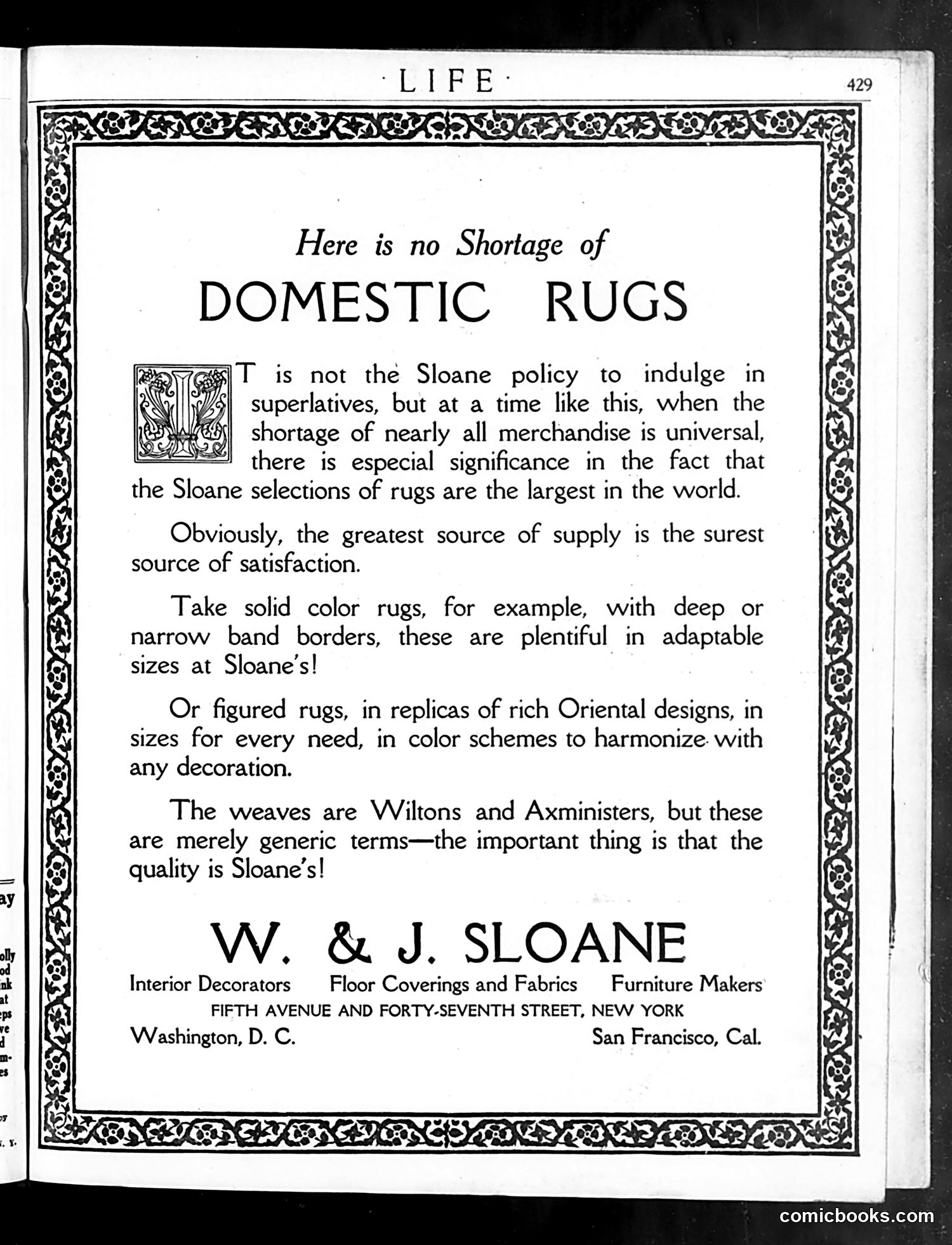
This is a **full-page advertisement**, not a cartoon or satirical content. It's a W. & J. Sloane furniture and home furnishings ad promoting their domestic rug selection. The ad's pitch capitalizes on **wartime scarcity** (likely WWI or WWII era, given references to "shortage of nearly all merchandise"). Sloane claims competitive advantage by boasting the "largest selections of rugs in the world" while competitors face shortages. The ad emphasizes availability of solid-color and Oriental-design rugs in various sizes, highlighting quality weaving (Wiltons and Axminsters). The message: when goods are scarce everywhere, Sloane has abundant inventory—positioning the company as reliably well-stocked. This is straightforward commercial messaging exploiting wartime supply constraints, not satire.
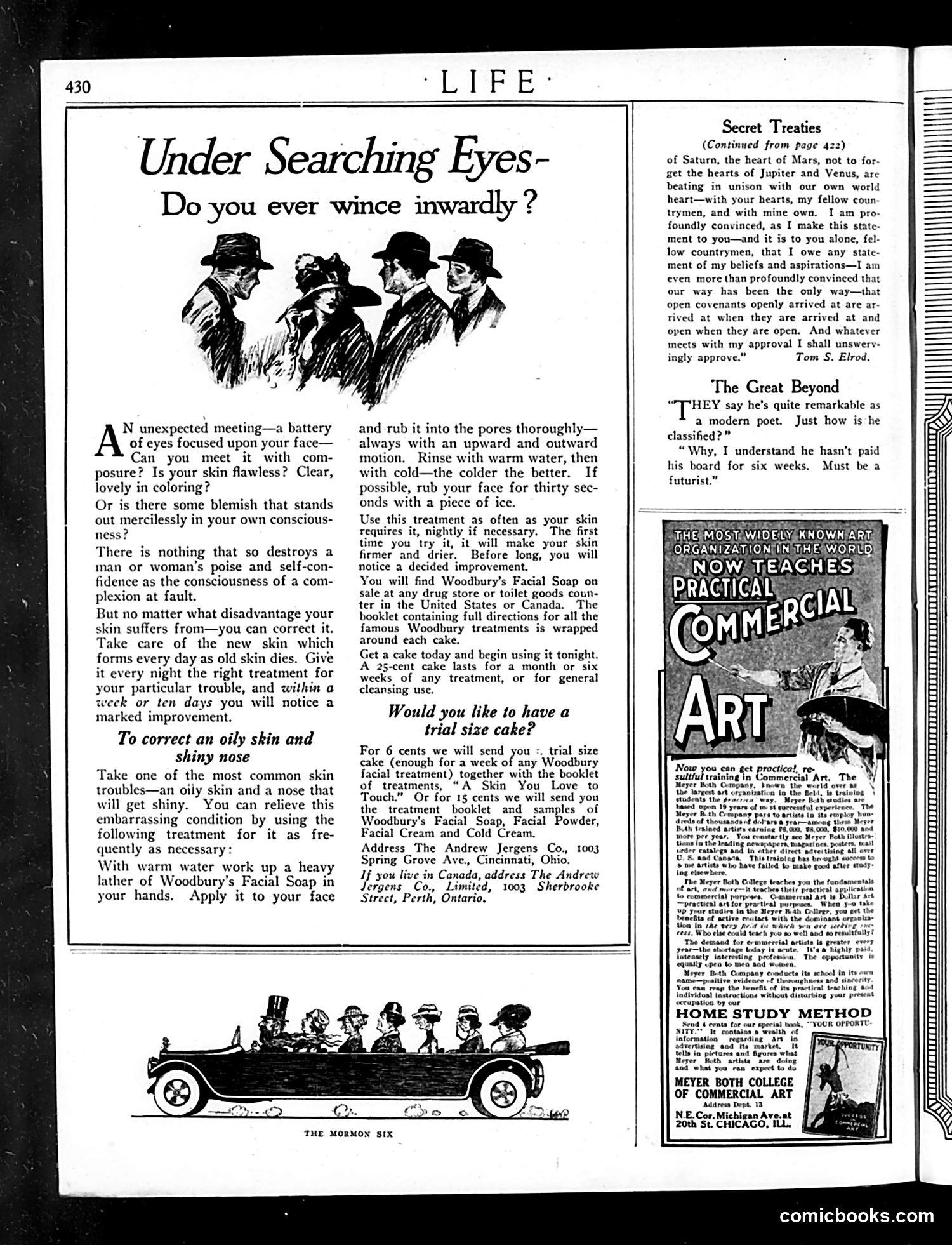
This page is **primarily advertising**, not political commentary. The main content is a Woodbury's Facial Soap advertisement using psychological manipulation—suggesting that visible skin imperfections cause social anxiety and embarrassment, then offering their product as the solution. This "beauty anxiety marketing" was common in early 20th-century advertising. The cartoon at bottom ("The Mormon Six") shows seven men crowded in a car, seemingly a gentle joke about the Mormon practice of polygamy—though the reference is oblique and the humor mild. The small item titled "The Great Beyond" is a brief, unrelated humor piece about a struggling poet labeled a "futurist" because he hasn't paid his rent. The "Secret Treaties" column appears to be satirical political commentary (referencing open vs. secret diplomacy), but the excerpt provided gives insufficient context to explain its specific targets or satire.
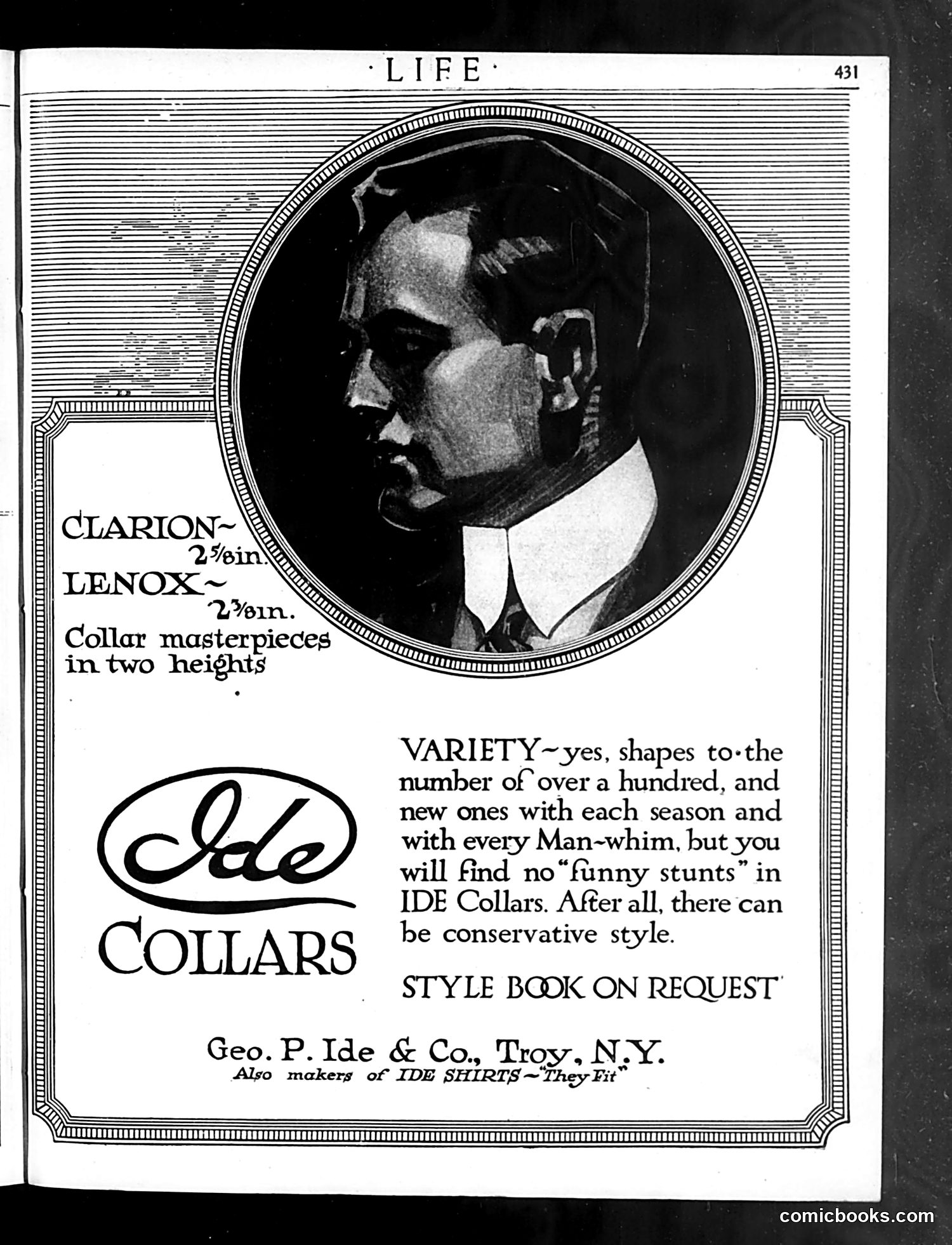
This page is primarily a **vintage advertisement** for Ide Collars, not a political cartoon. It features a formal portrait photograph of a man in profile wearing a starched collar, alongside marketing copy. The ad emphasizes that Ide Collars come in over a hundred styles and shapes, updated seasonally—yet claims to avoid "funny stunts," positioning the brand as conservative and reliable. The phrase "Man-whim" humorously suggests men's fashion preferences are capricious. The advertisement is from **Geo. P. Ide & Co. of Troy, New York**, a collar manufacturer. The "collar masterpieces in two heights" reference indicates the collars came in different sizes. For modern readers: this reflects an era (early 20th century) when detachable collars were standard menswear—a separate accessory from shirts, allowing variety without buying new shirts. The ad's appeal to conservative style reflects period business values.
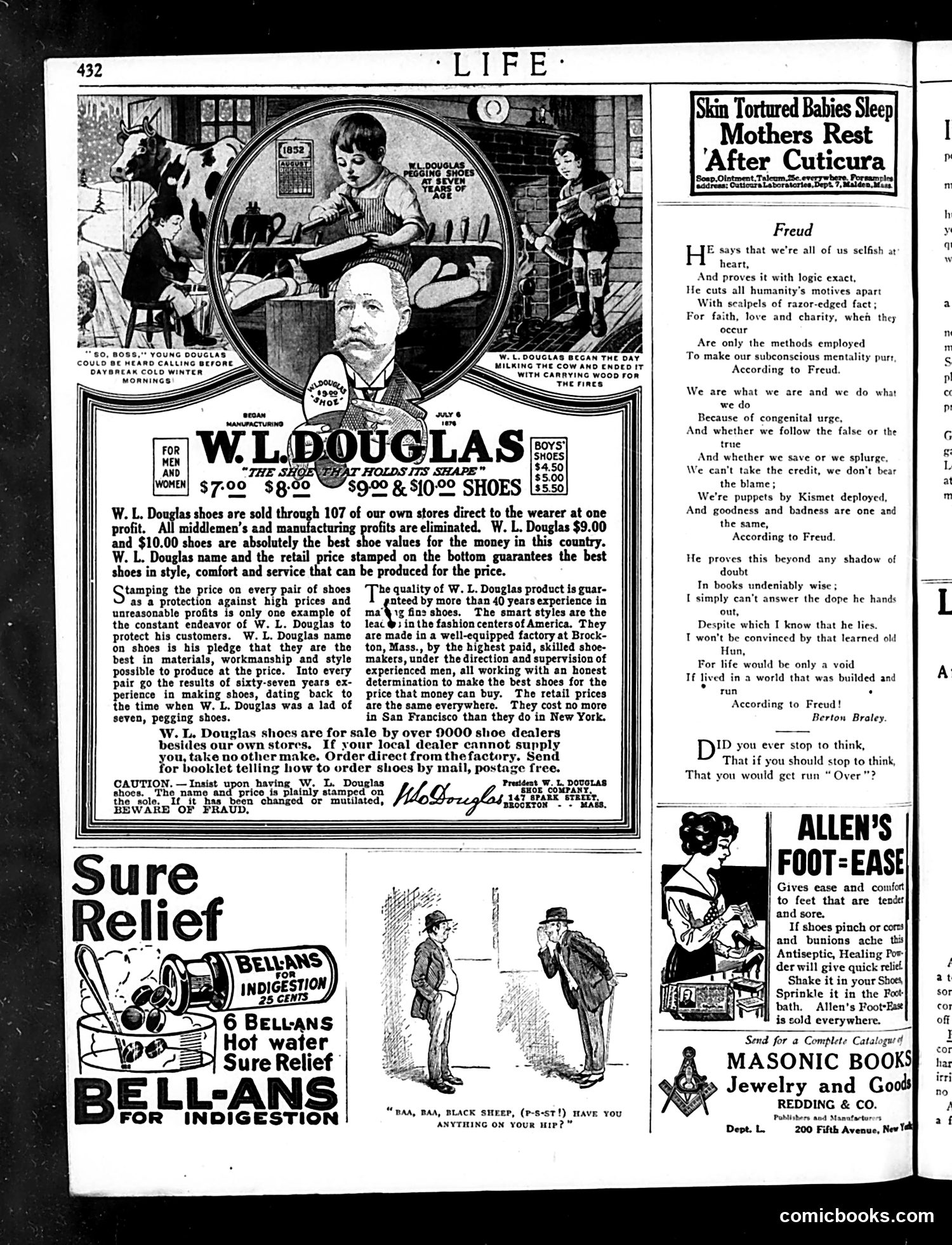
This page is primarily **advertising**, featuring a large W.L. Douglas shoe company ad that dominates the upper portion. The main editorial content is a poem titled "Freud" by Berton Braley (credited at bottom), which satirizes Sigmund Freud's psychological theories. The poem mocks Freud's deterministic view that human behavior stems from unconscious urges rather than conscious choice or morality. Lines like "We're puppets by Kismet deployed" and "goodness and badness are one and the same / According to Freud" ridicule his reductive view of human nature. The poem's speaker ultimately rejects Freud's conclusions as nihilistic, arguing that life would be meaningless if lived under such determinism. Below the poem is a simple visual gag: two figures in conversation, with dialogue suggesting someone contemplating "Over" (apparently a drink or product), accompanied by wordplay about "stopping to think." The remaining content consists of vintage patent medicine and product advertisements typical of the era.
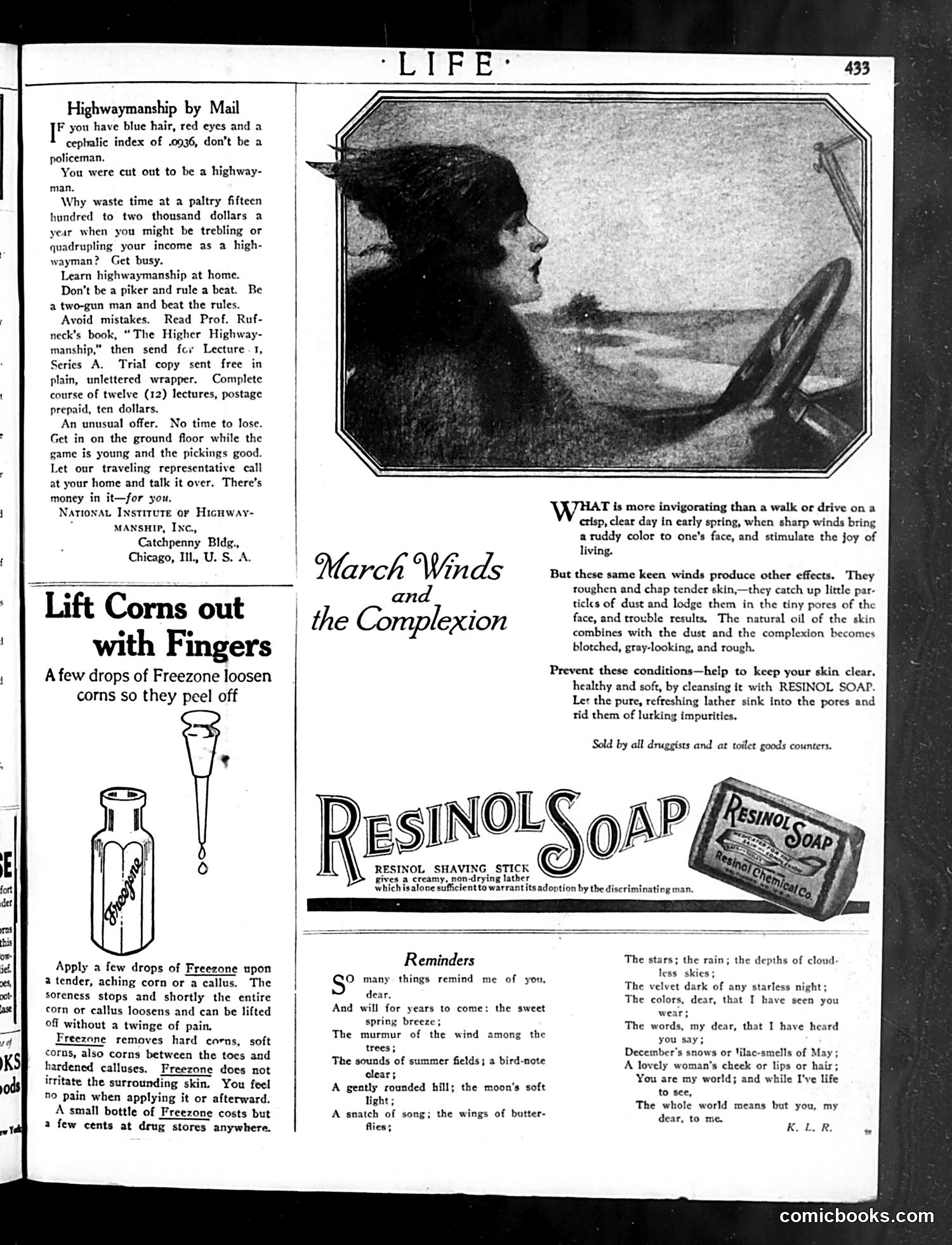
This is satirical advertising for a fake correspondence course in highway robbery, presented as a get-rich-quick scheme. The piece mocks both: 1. **Actual correspondence courses of the era** - Life ridicules the proliferation of mail-order educational schemes promising easy wealth 2. **Police officer recruitment** - It sarcastically suggests that honest police work (paying $1,500-2,000 yearly) is foolish when one could instead become a criminal robber earning more The humor relies on the absurd premise: a "National Institute of Highwaymanship" offering twelve lectures for ten dollars, complete with traveling salesmen and free trial copies. By presenting violent crime as just another career option to be marketed like any other product, the satire exposes the predatory nature of contemporary mail-order business schemes that promised unrealistic income to gullible customers. This reflects genuine concern about both widespread fraud and rising banditry during this period in American history.
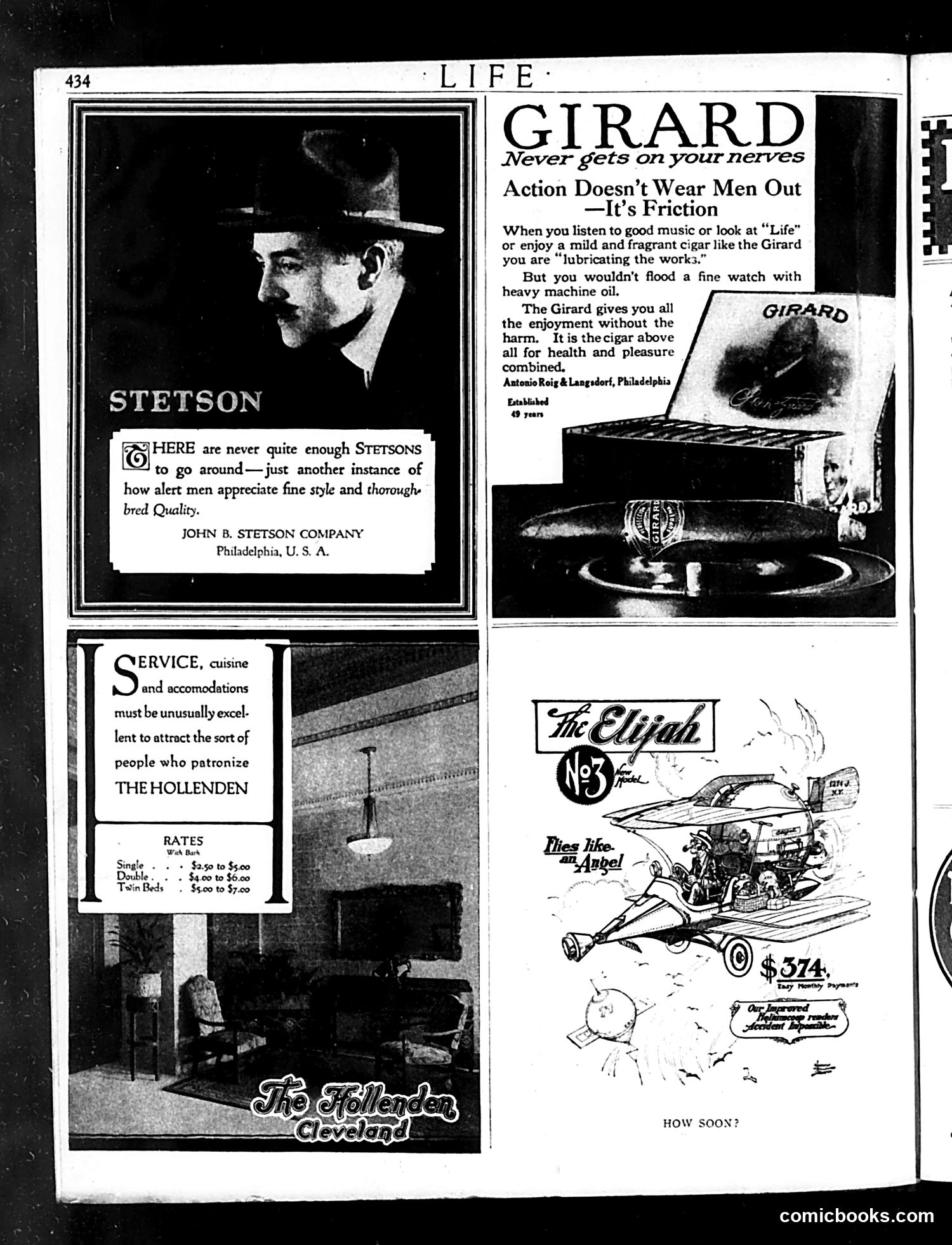
This page contains **four advertisements** from approximately the 1910s-1920s, with no satirical cartoons despite the "Life" magazine masthead. **The ads promote:** 1. **Stetson hats** — positioning the product as a status symbol for discerning men 2. **Girard cigars** — using a mechanical metaphor ("lubricating the works") to suggest the cigar provides gentle pleasure without harmful "friction" or wear on the body 3. **The Hollenden hotel** (Cleveland) — emphasizing luxury service to attract wealthy clientele, with room rates listed 4. **The Elphdi automobile** — a whimsical aircraft-car hybrid priced at $374, asking "HOW SOON?" to build anticipation The Girard ad is notable for its health-conscious pitch—a common early 20th-century marketing tactic claiming cigars were beneficial rather than harmful. The airplane-car reflects the era's fascination with emerging aviation technology. These are straightforward product advertisements rather than political or social satire.
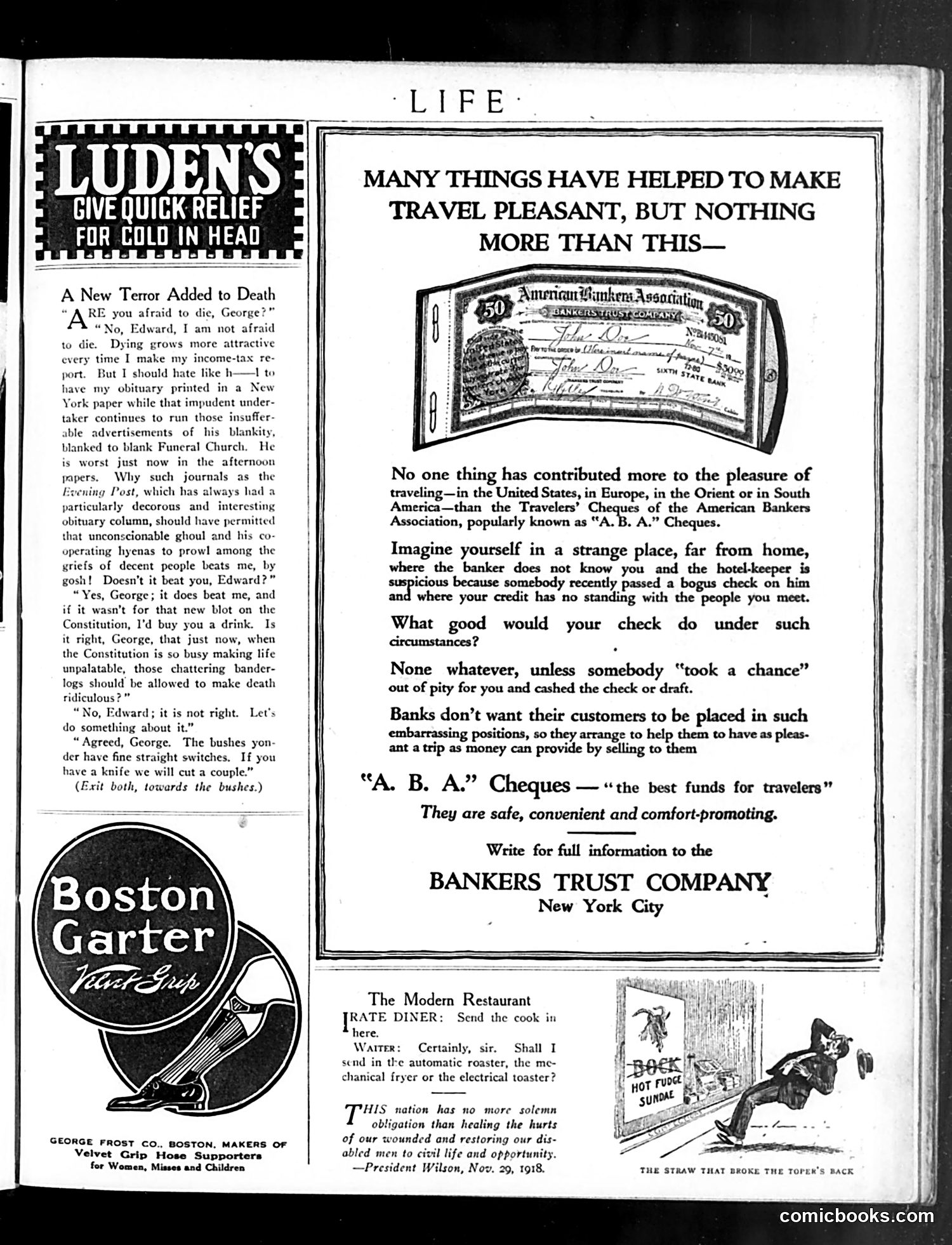
**Main Cartoon ("A New Terror Added to Death"):** Two men, George and Edward, discuss their fears. Edward complains that while he's not afraid of dying, he's horrified that funeral home advertisements now appear in newspaper obituary columns—desecrating what was once a dignified section. The satire mocks both aggressive advertising practices and the absurdity of fearing embarrassing publicity more than death itself. This likely reflects 1910s-1920s anxieties about commercialism invading traditionally sacred spaces. **Advertisements:** The page is dominated by ads for travelers' cheques and other products, with a small illustration showing a man breaking under strain ("The Straw That Broke the Tower's Back")—likely referencing war-disabled veterans or workplace stress. **Context:** The quote from President Wilson about caring for disabled soldiers appears near the bottom, suggesting the page dates to late 1918 or after, during WWI's conclusion. The cartoons reflect contemporary American concerns: commercialization, dignity, and social obligation.
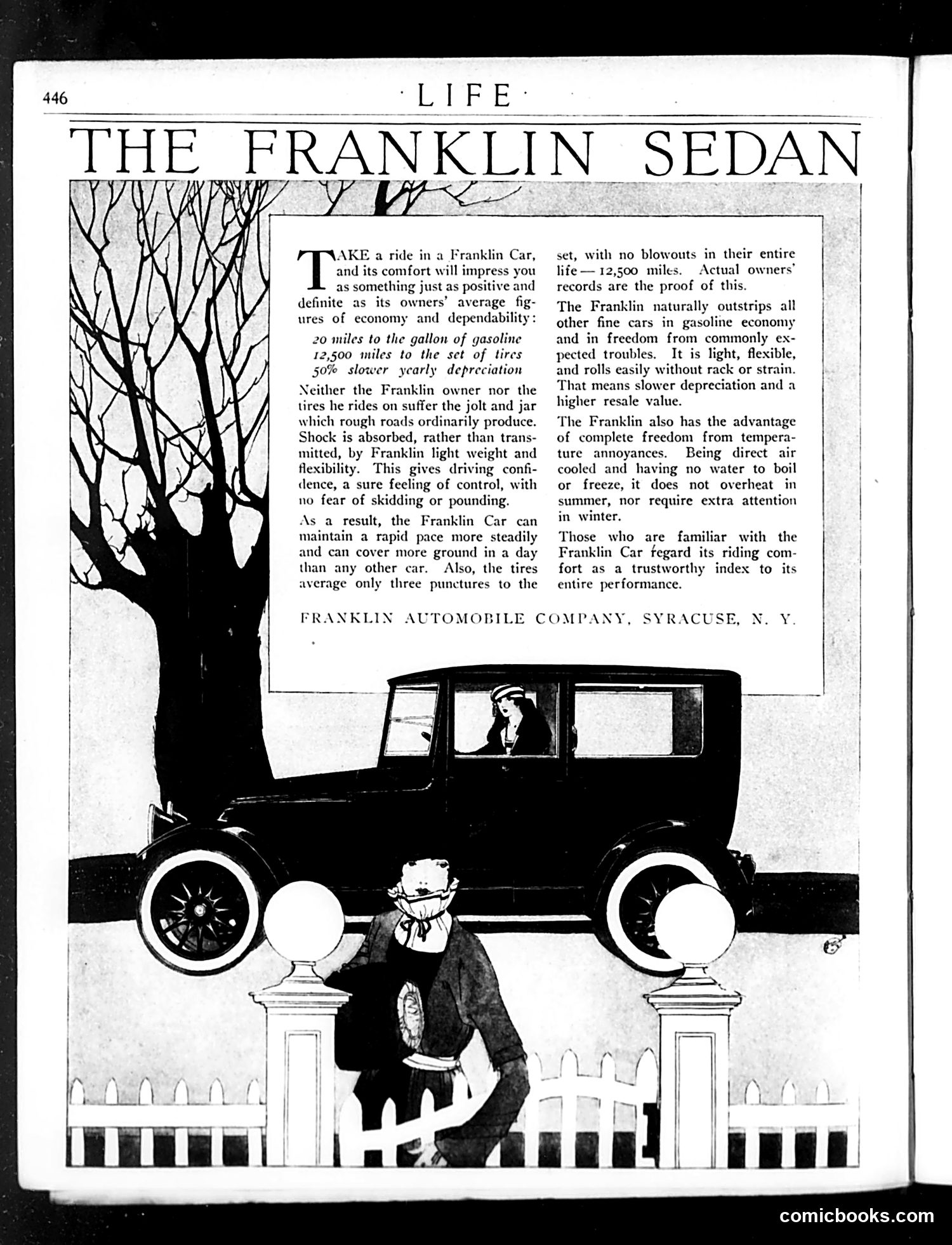
This is a **product advertisement**, not political satire. It promotes the Franklin automobile from Syracuse, New York, highlighting engineering advantages: superior fuel economy (20 mpg), tire longevity (12,500 miles), and reduced depreciation. The illustration shows a well-dressed woman admiring the car parked before her home—a common advertising trope of the era appealing to middle-class aspirations. The "joke" (if any) is subtle: the ad ironically emphasizes the car's reliability by boasting of only "three punctures" per tire set—a claim that seems absurdly low by modern standards but apparently impressive for early automobiles. The page reflects 1920s consumer culture where automotive reliability was genuinely uncertain and remarkable. The text's detailed performance metrics suggest manufacturers competed fiercely on practical durability metrics rather than styling—a stark contrast to later advertising.
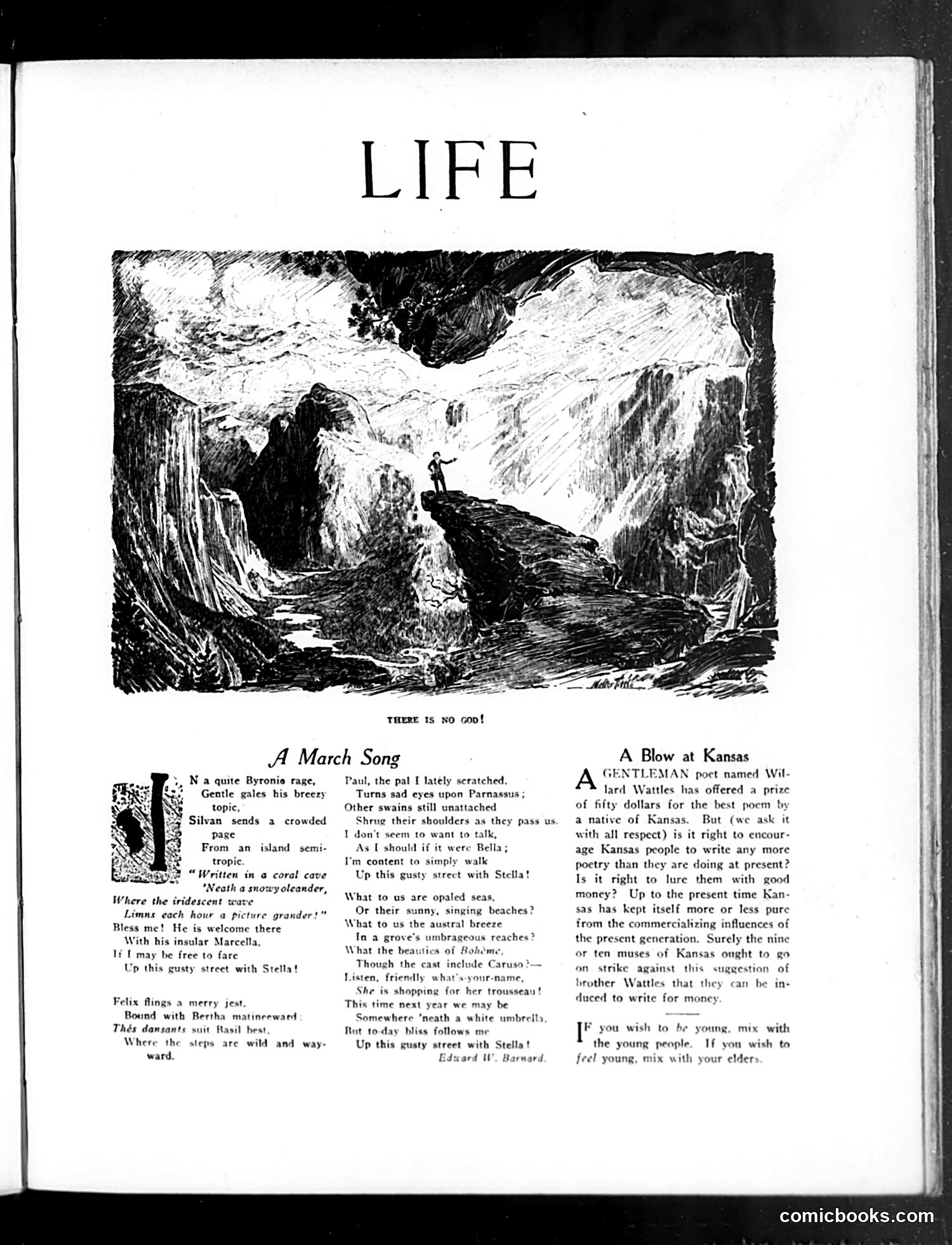
This page contains two separate pieces of satirical content: **"A March Song"** (left): A romantic poem mocking sentimental Victorian poetry. The speaker contrasts exotic locales—coral caves, tropical islands, Bohemia—with his simple contentment walking a "gusty street" with a girl named Stella. The satire targets overwrought Romantic-era verse and the pretentious poets who wrote it, suggesting their flowery descriptions of distant places are ridiculous compared to genuine affection found locally. **"A Blow at Kansas"** (right): A satirical editorial criticizing a Kansas poet named Willard Wattles for offering prize money for Kansas poetry. Life's editors humorously argue that Kansas has avoided "commercializing influences" and shouldn't corrupt its poets with financial incentives. The satire mocks both Wattles's well-intentioned literary promotion and (implicitly) Kansas's cultural pretensions. Both pieces use humor to deflate artistic and literary self-importance of the era.
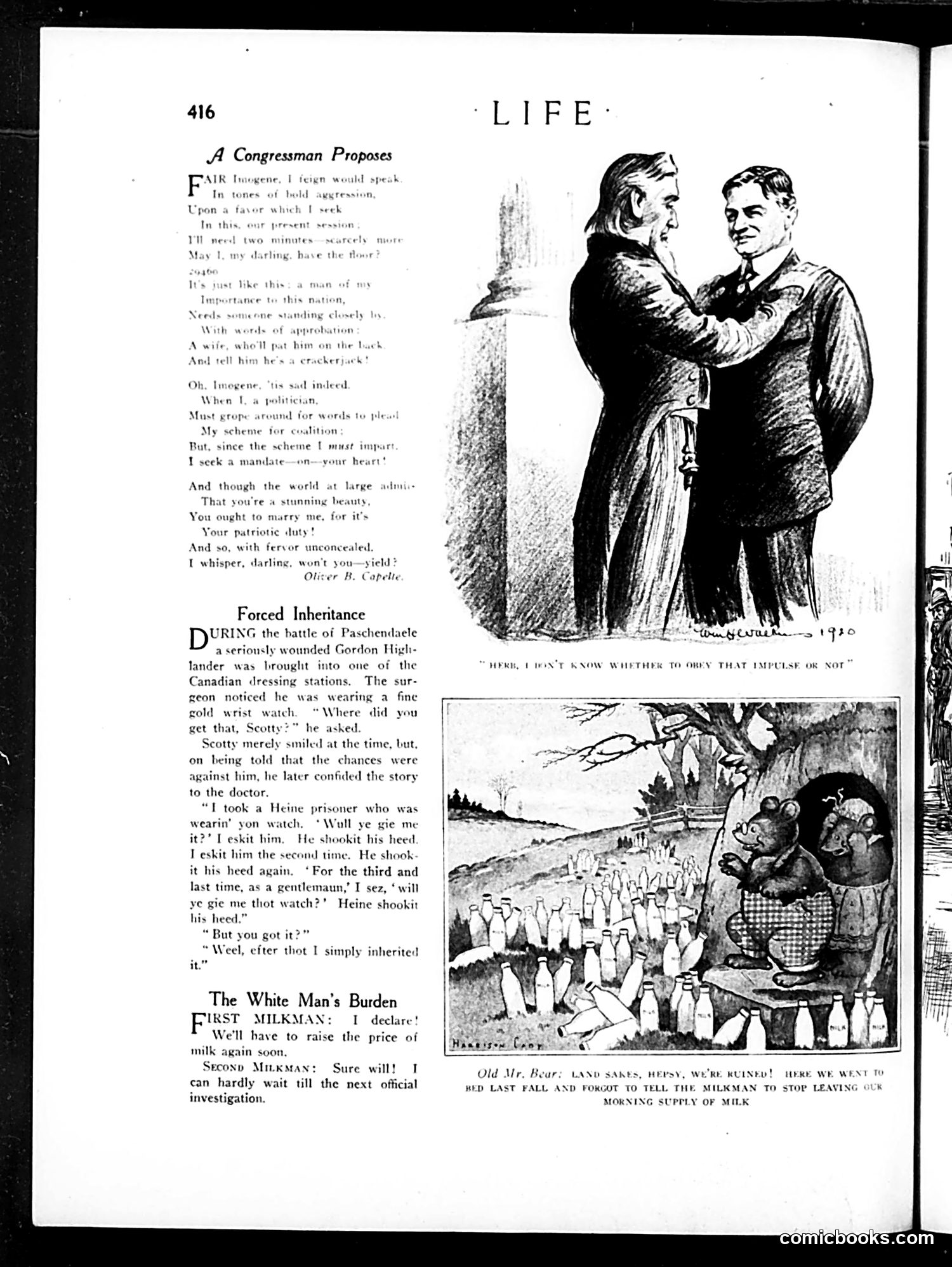
This page contains three satirical pieces: **"A Congressman Proposes"** mocks politicians' self-interested courtship of voters. A congressman claims to seek a mandate for his political scheme but frames it as a marriage proposal, revealing how politicians manipulate public sentiment with flattery and appeals to "patriotic duty." **"Forced Inheritance"** recounts a Scottish soldier's darkly humorous account of obtaining a German soldier's watch during WWI's Battle of Passchendaele. The joke: after the German refused three times, the Scot "simply inherited it"—a euphemism for killing him. The story plays on period attitudes toward wartime violence. **"The White Man's Burden"** satirizes milk price-gouging. Two milkmen discuss raising prices, with the second noting he "can hardly wait" for the next official investigation—implying collusion or that investigations accomplish nothing. The bottom cartoon shows a bear family forgotten by their milkman, suggesting supply-chain absurdities. All three pieces reflect post-WWI American cynicism toward politicians, wartime ethics, and corporate regulation.
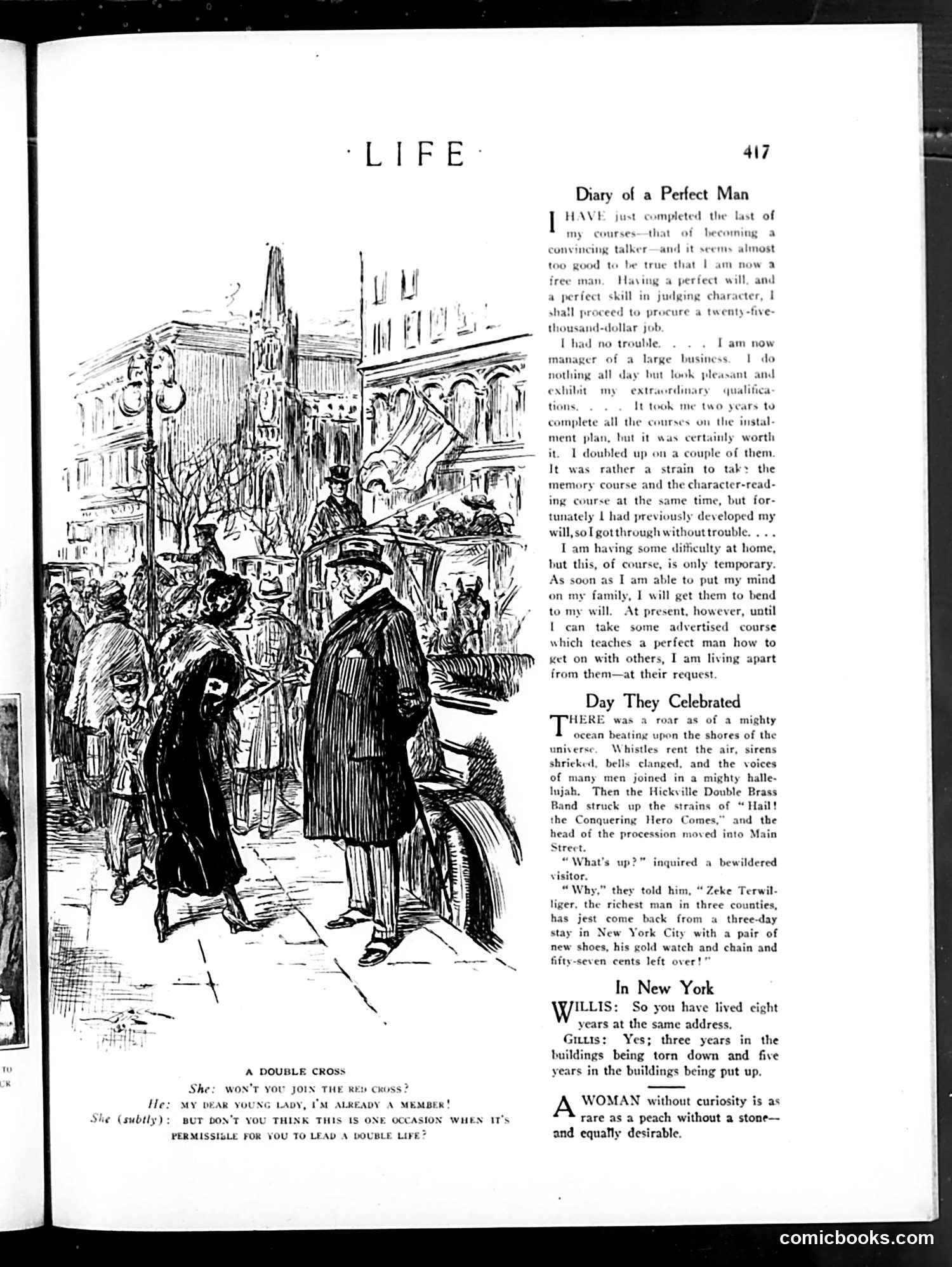
The page contains three distinct satirical pieces mocking self-improvement culture and American materialism: **"A Double Cross"** cartoon jokes about the Red Cross. A woman invites a man to join; he claims he's already a member. She subtly suggests he could "lead a double life" for this charitable occasion—satirizing people who avoid charitable giving while pretending moral virtue. **"Diary of a Perfect Man"** mocks self-help courses and mail-order instruction. A man takes expensive courses to become "perfect," achieving business success through charm alone. Yet he can't manage his own family, who force him to live separately—exposing the hollow pretense of purchased perfection and dominance. **"Day They Celebrated"** ridicules small-town materialism. Hickville celebrates Zeke Terwilliger returning from New York with new shoes and a watch but nearly broke—treating mere consumer goods and a wealthy man's financial foolishness as heroic achievement. All three pieces target 1920s American obsessions: charitable performance, self-improvement consumerism, and wealth worship.
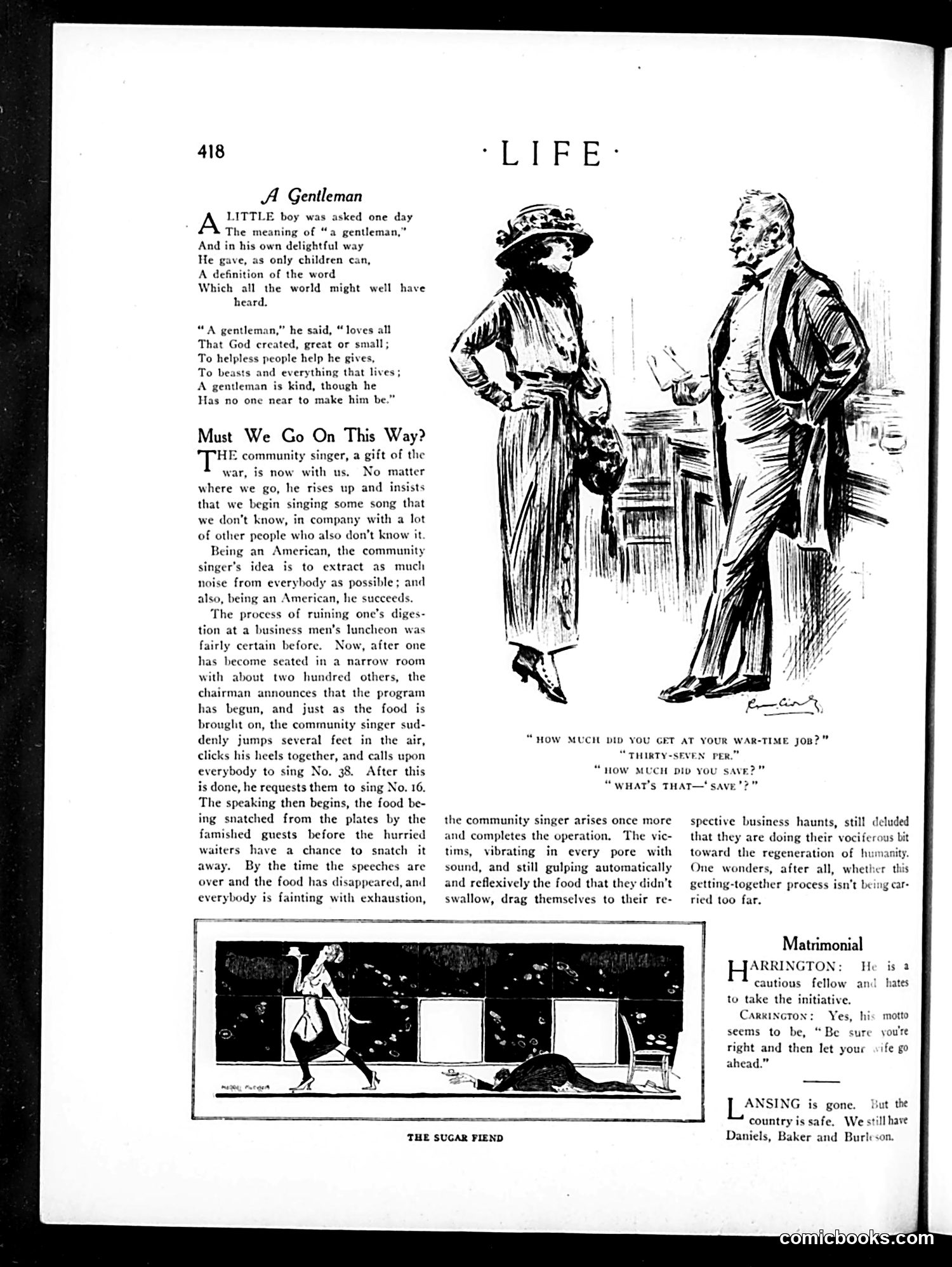
This page satirizes post-WWI American culture through three pieces: **"A Gentleman"** presents an idealized definition via a child's innocent wisdom—a gentleman shows kindness to all creatures without needing external reward. This contrasts sharply with the page's other content. **"Must We Go On This Way?"** mocks the "community singer" phenomenon—apparently a well-meaning post-war trend where enthusiastic singers forced group singing at public events. The satire targets both forced participation in mass activities and the disruption to digestion during business lunches, with food being grabbed mid-speech. The accompanying cartoon dialogue about war-time wages and savings suggests frustration with profiteering during WWI. **"The Sugar Fiend"** (cartoon, details unclear) appears to address wartime rationing or black-market activity. The brief matrimonial section jokes about hesitant courtship and concludes with relief that military leadership figures (Daniels, Baker, Burleson—likely Wilson administration officials) are gone, suggesting post-war political criticism. Overall, the page reflects post-1918 American anxieties about enforced "togetherness" and wartime social disruption.
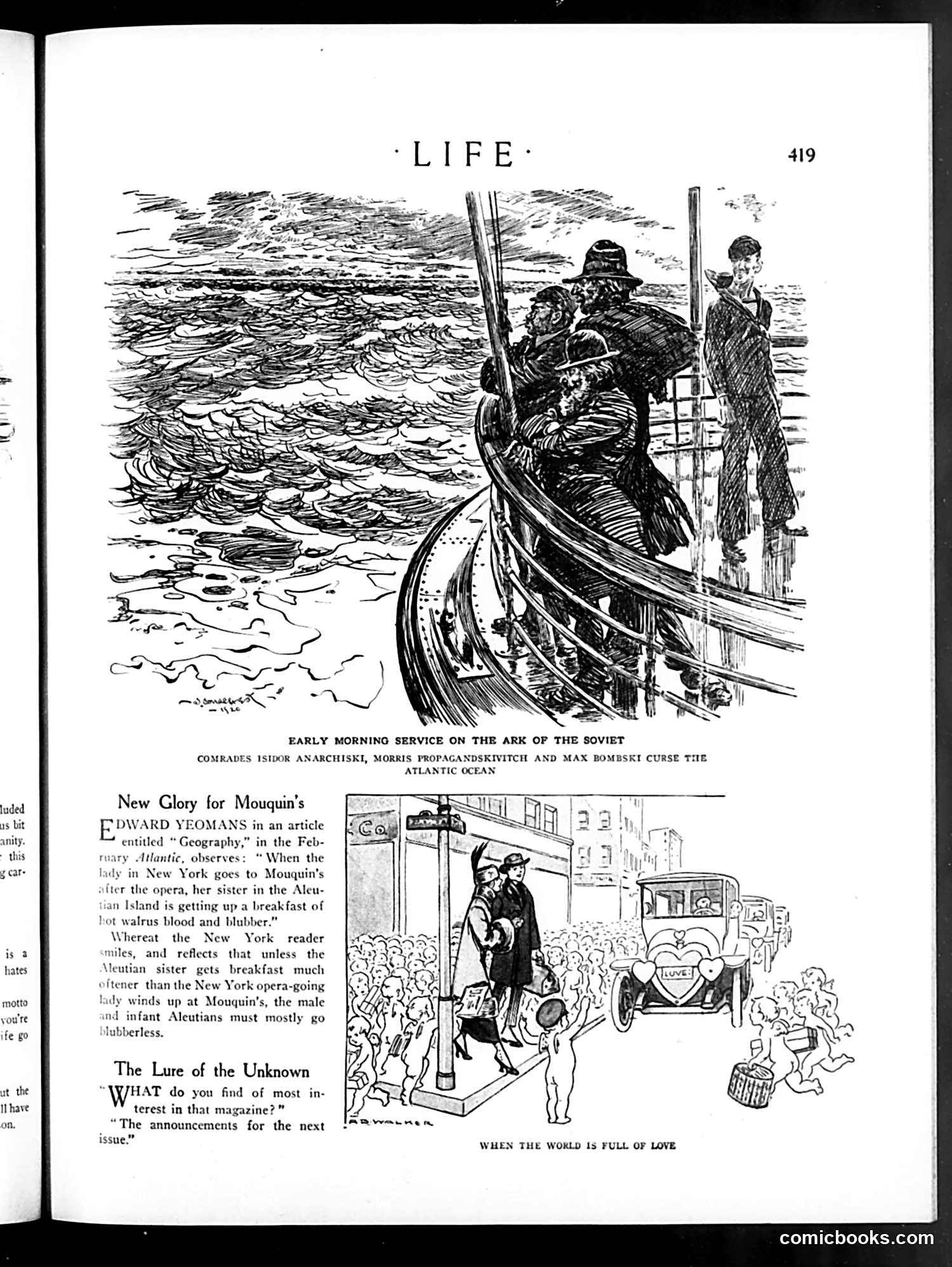
**Top Cartoon - "Early Morning Service on the Ark of the Soviet"** This is anti-Bolshevik propaganda from the Red Scare era (likely early 1920s). The "Ark of the Soviet" is a ship, and the named characters—with their obviously mock-Russian surnames ending in "-ski"—represent stereotyped Soviet/Bolshevik figures. The title mockingly suggests religious service aboard a Soviet vessel while the figures "curse the Atlantic Ocean," satirizing both communists and the Soviet state as foreign, alien, and incompetent. **Bottom Section - "New Glory for Mouquin's" and "When the World is Full of Love"** These appear to be lighter satirical pieces about New York society and dining (Mouquin's was a real restaurant). The first jokes about the contrast between sophisticated New York opera-goers and distant Aleutian Islanders. The second cartoon's caption suggests people care most about future magazine content rather than current issues. The page represents *Life*'s typical blend of political commentary and social satire aimed at American urban audiences.
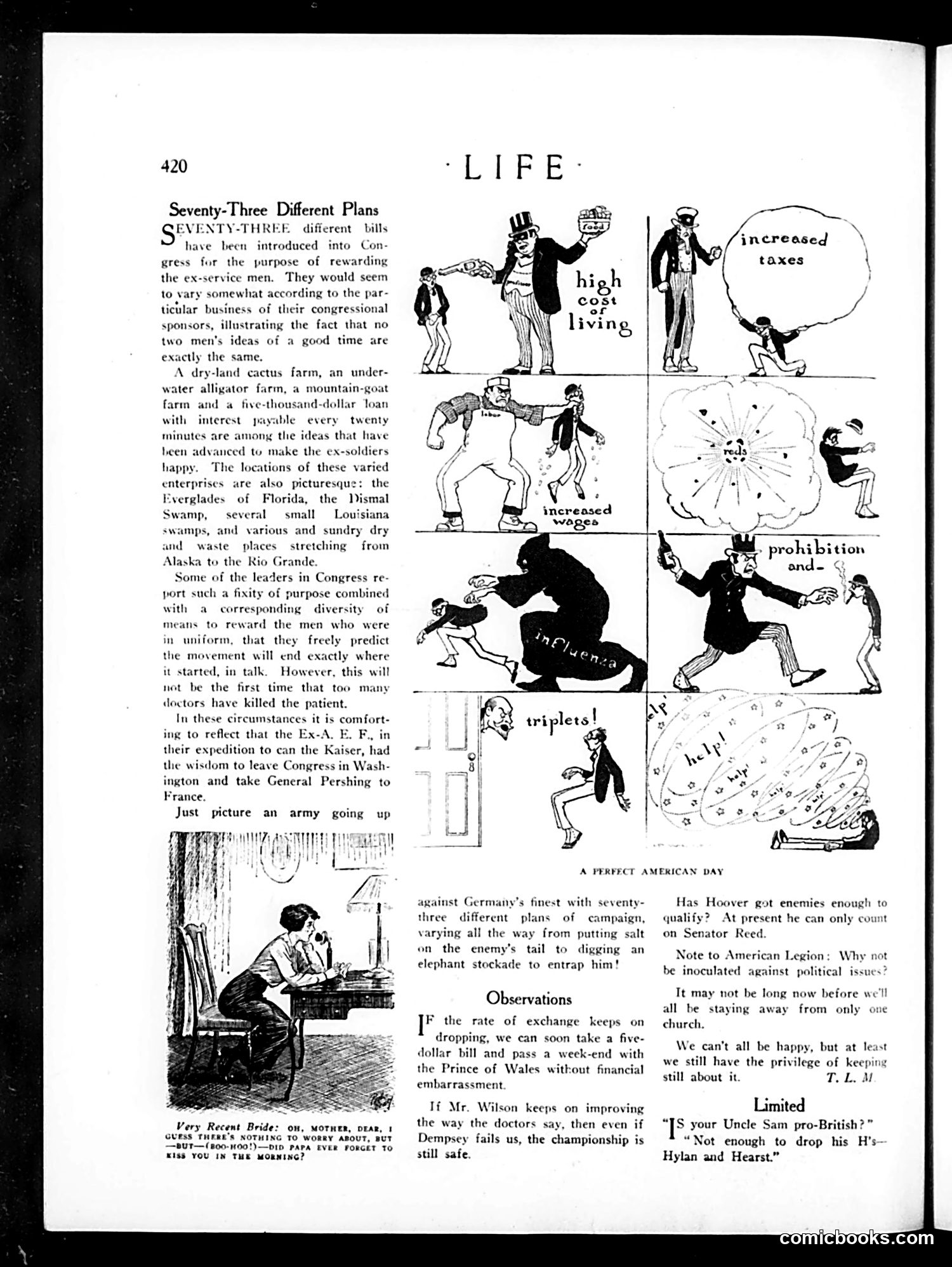
This 1919 satire mocks Congress's inability to agree on veteran benefits following WWI. Seventy-three competing bills propose absurdly disparate schemes—cactus farms, alligator farms, mountain-goat ranches—located in impractical swamps and wastelands from Alaska to Rio Grande. The cartoons illustrate the resulting chaos: "high cost of living," "increased taxes," "increased wages," "prohibition," and "influenza" all swirling around confused veterans. The satire's point: congressional diversity of opinion paralyzes action, with the text darkly noting "too many doctors have killed the patient." The accompanying text praises military leadership under General Pershing for leaving Congress behind in France, implying that body was incompetent. The broader message: well-intentioned legislative efforts devolve into political theater that benefits no one.
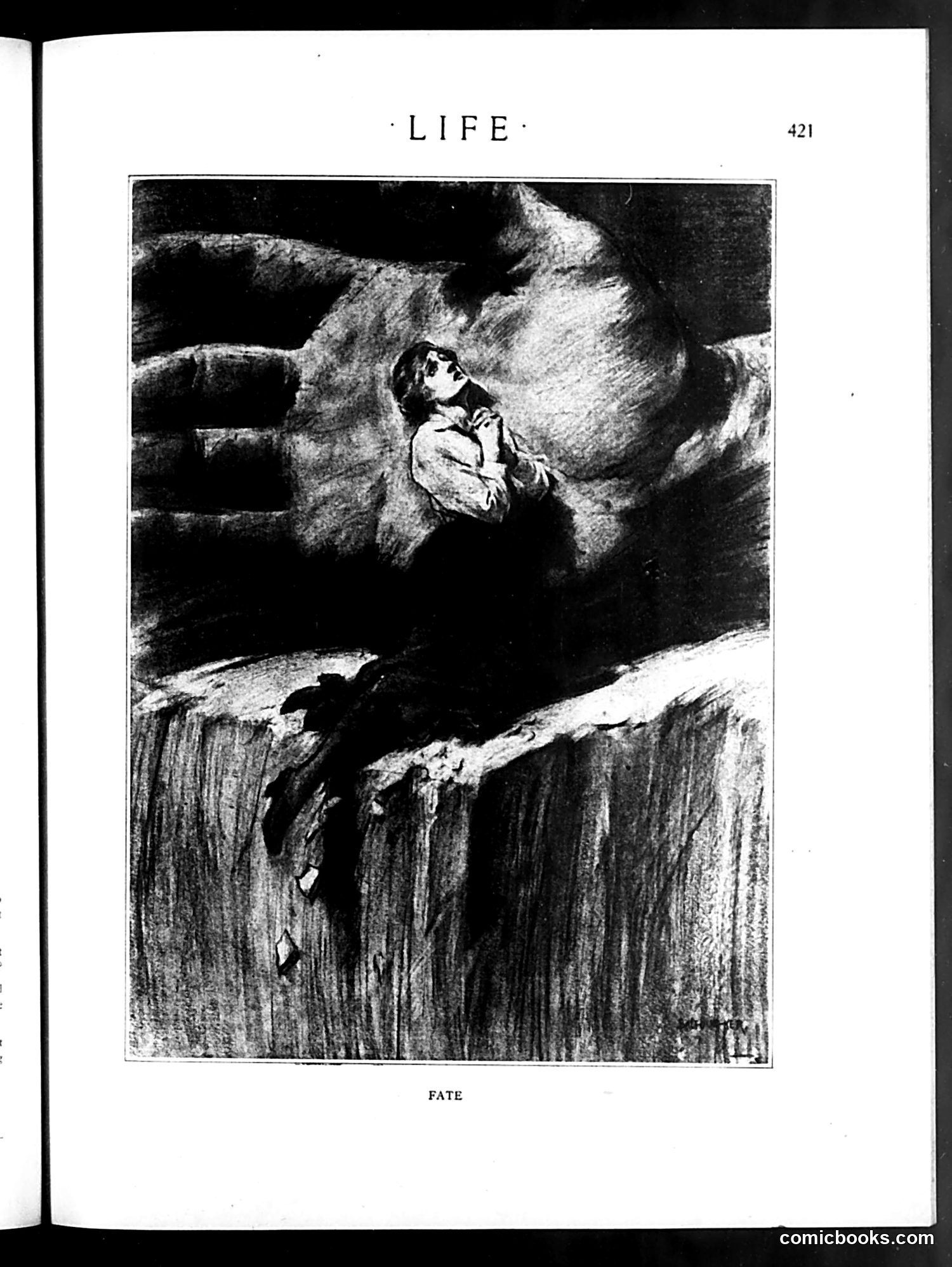
This illustration depicts a small human figure perched precariously on a wooden ledge or cliff edge, looking upward with apparent distress or resignation. Looming above are massive, shadowy hands or forces that appear to dominate the composition, suggesting an overwhelming, inescapable power. The title "Fate" indicates this is philosophical or allegorical commentary on human vulnerability to forces beyond individual control. The stark black-and-white rendering emphasizes the dramatic power imbalance between the tiny figure and the ominous, towering forms above. Without additional context or publication date visible, the specific historical or political reference remains unclear, though the image likely satirizes contemporary anxieties about powerlessness—whether regarding government, capitalism, war, or other societal forces of the era.
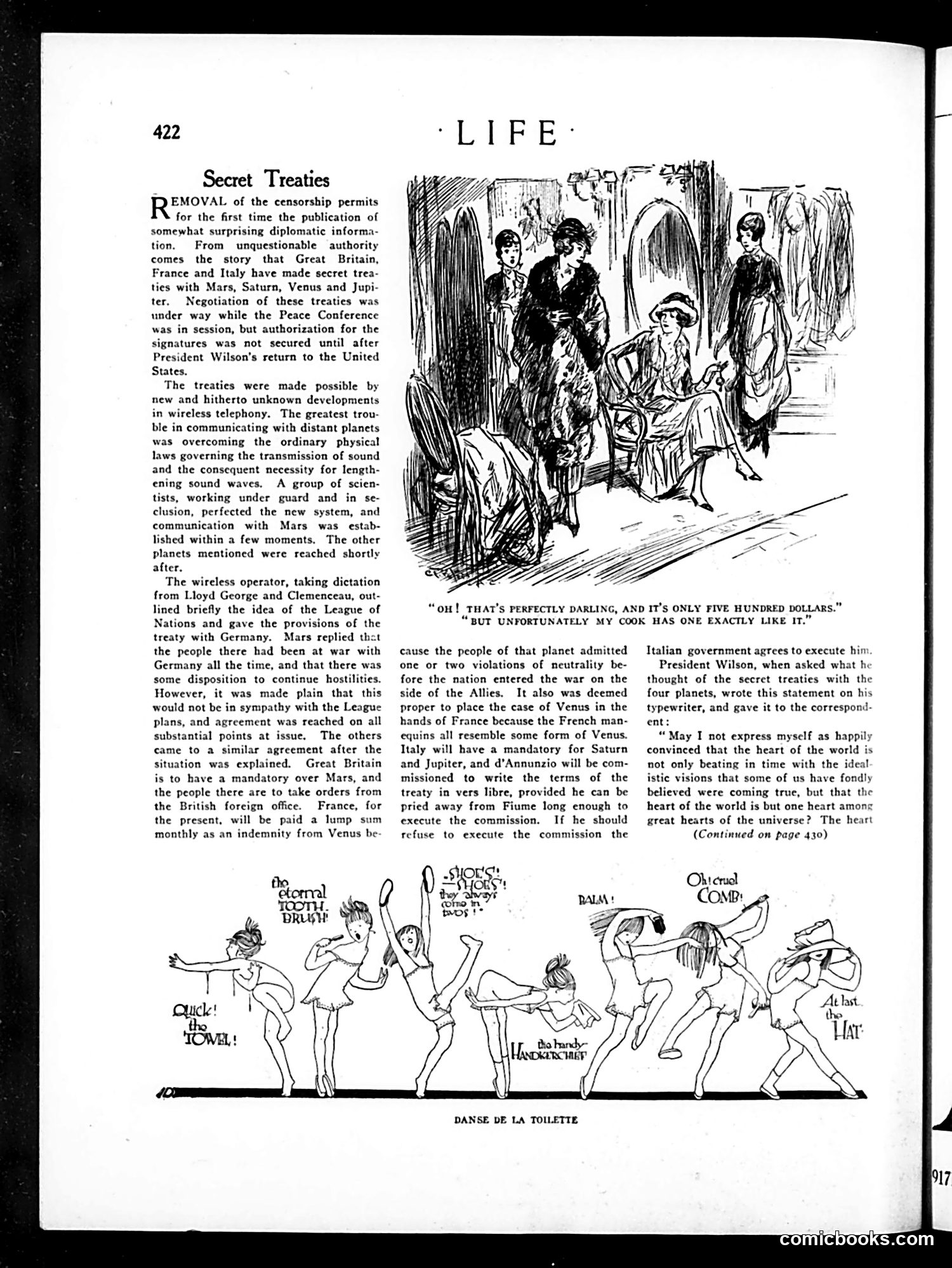
This piece satirizes post-WWI diplomacy, particularly the Paris Peace Conference (1919) and President Wilson's idealistic League of Nations. The satire mocks the era's secret diplomatic agreements and pretentious rhetoric. **The joke:** Life absurdly claims Britain, France, and Italy negotiated treaties with planets (Mars, Saturn, Venus, Jupiter) via newly-invented wireless technology. The text parodies real post-war negotiations, with each power claiming planetary "mandates"—referencing the actual League of Nations mandate system that divided former enemy territories among Allied powers. **Specific targets:** References to Lloyd George, Clemenceau, and Wilson; d'Annunzio (Italian nationalist demanding Fiume); and Wilson's notably flowery, vague statements ("great hearts of the universe"). **The point:** Satirizes how Western powers dressed up imperial conquest as noble international cooperation, and mocks Wilson's grandiose, meaningless rhetoric justifying these arrangements. The absurdity of planetary treaties mirrors the perceived absurdity of the peace settlement itself. The lower illustration ("Danse de la Toilette") is unrelated society commentary.
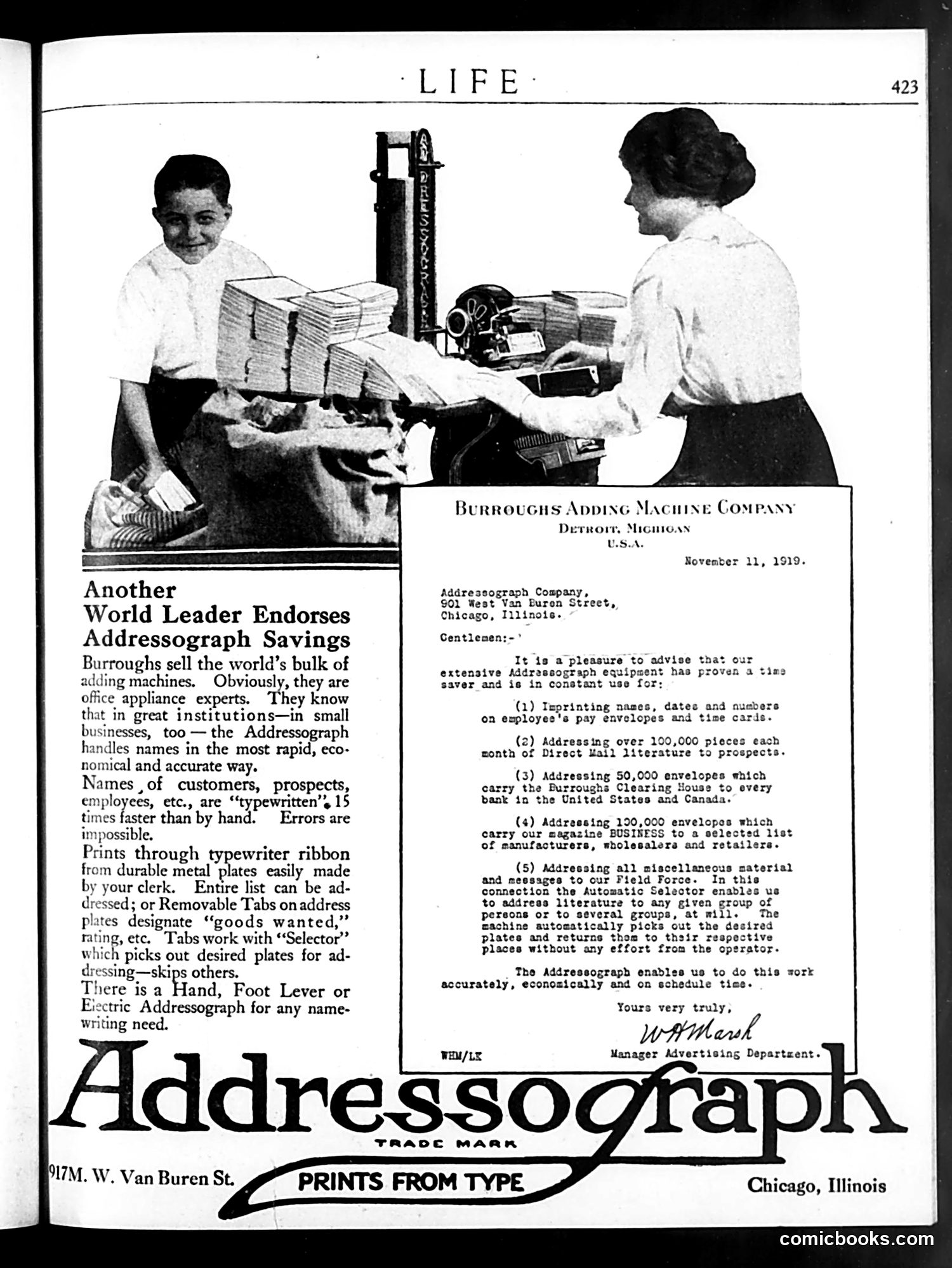
This is primarily a **product advertisement**, not satire or political commentary. The page promotes the Addressograph, a mechanical mail-addressing machine made by Burroughs Adding Machine Company. The "World Leader" reference in the headline appears to mean a major business institution (the letterhead shows it's from Burroughs' own advertising department), not a political figure. The accompanying photographs show office workers—a man and woman—operating the machine with stacks of addressed envelopes and mail materials. The appeal is practical: the machine allegedly addresses envelopes 15 times faster than handwriting, eliminates errors, and can selectively address different customer categories. The testimonial letter claims it handles massive volumes—100,000+ pieces monthly for direct mail campaigns and bank communications. This reflects **early 20th-century office modernization**, when such mechanical devices promised efficiency gains to businesses managing growing customer bases. There is no political content or satire present.
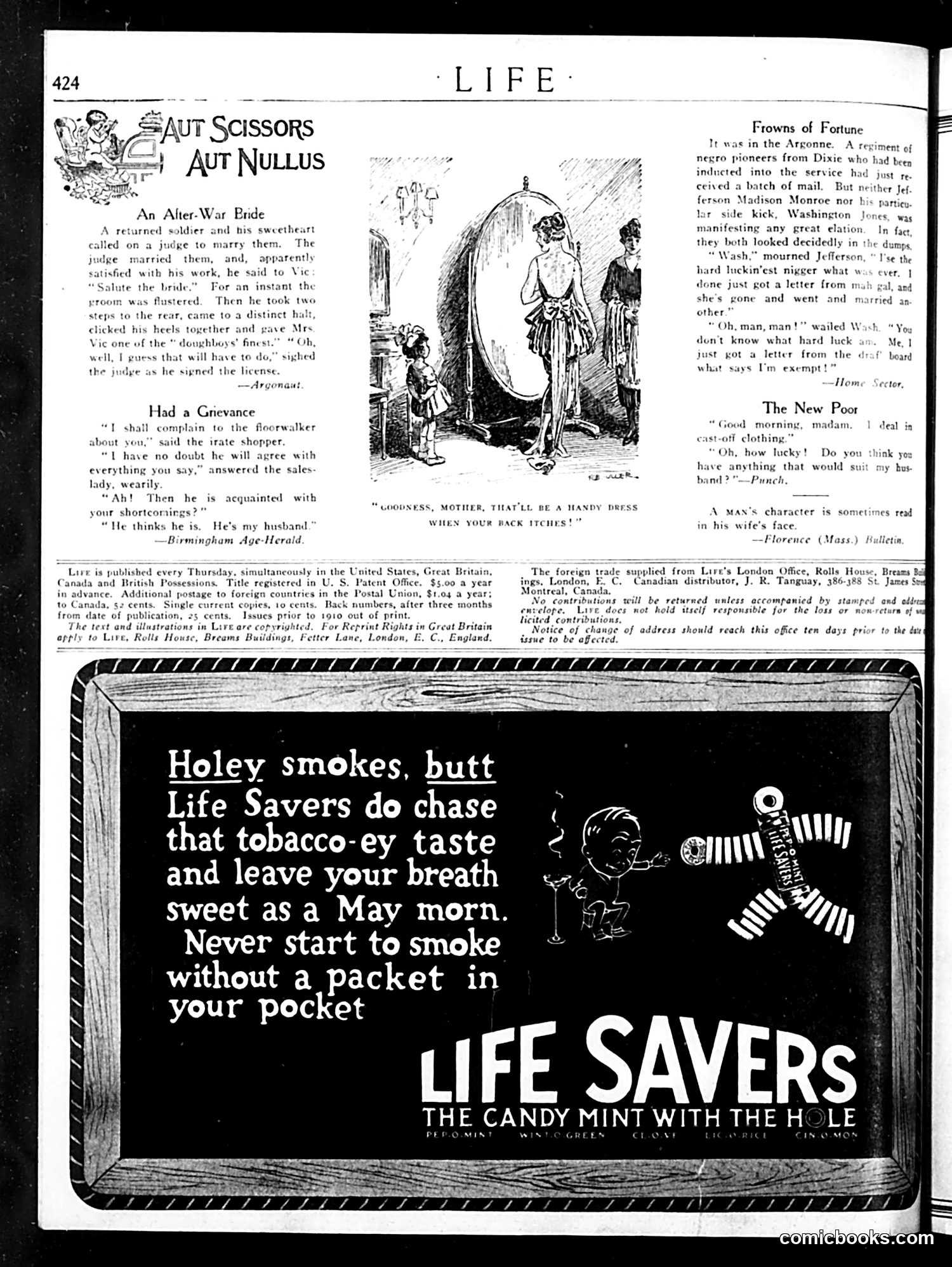
This page contains several satirical comics and an advertisement typical of early 20th-century American humor. **The Comics:** - "An Alter-War Bride" satirizes post-WWI marriage customs through a farcical scene where a judge performs a hasty ceremony - "Frowns of Fortune" uses racist dialect humor (common then, offensive now) depicting Black soldiers receiving bad news from home—one received a "Dear John" letter, another was drafted despite claiming exemption - "Had a Grievance" jokes about marital shortcomings - "The New Poor" references post-war economic hardship, with someone selling off clothing due to financial distress **The Advertisement:** The large bottom section promotes Life Savers candy mints, using humorous verse to encourage smokers to carry them to mask tobacco breath. The page reflects 1920s attitudes: post-WWI disillusionment, racial stereotyping presented as entertainment, and consumer culture. Most jarring to modern readers is the casual racist caricature.
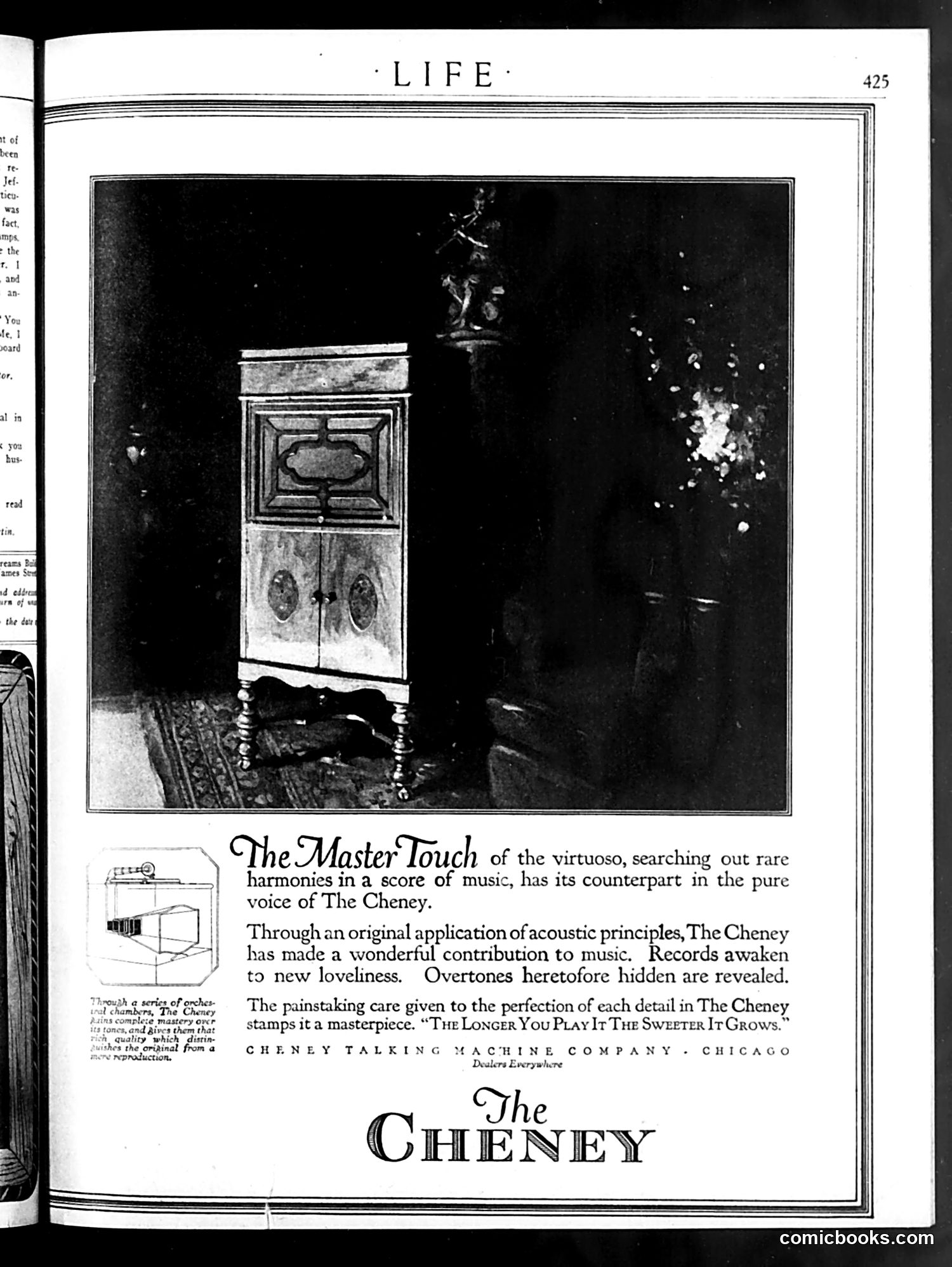
This is **not a political cartoon or satire**—it's a full-page advertisement for The Cheney talking machine (phonograph), published in *Life* magazine around the 1910s-1920s. The ad compares a musical virtuoso's skill to The Cheney phonograph's acoustic quality. The image shows an ornate cabinet-style phonograph with decorative inlays and legs. The copy claims the device applies "acoustic principles" to reveal "hidden overtones" in recorded music, positioning it as a high-end music device for discerning listeners. The tagline "The Longer You Play It The Sweeter It Grows" is a sales slogan, not satire. The small diagram shows the phonograph's internal mechanics. This represents early 20th-century advertising that appealed to consumers' aspirations for refined taste and technological sophistication.
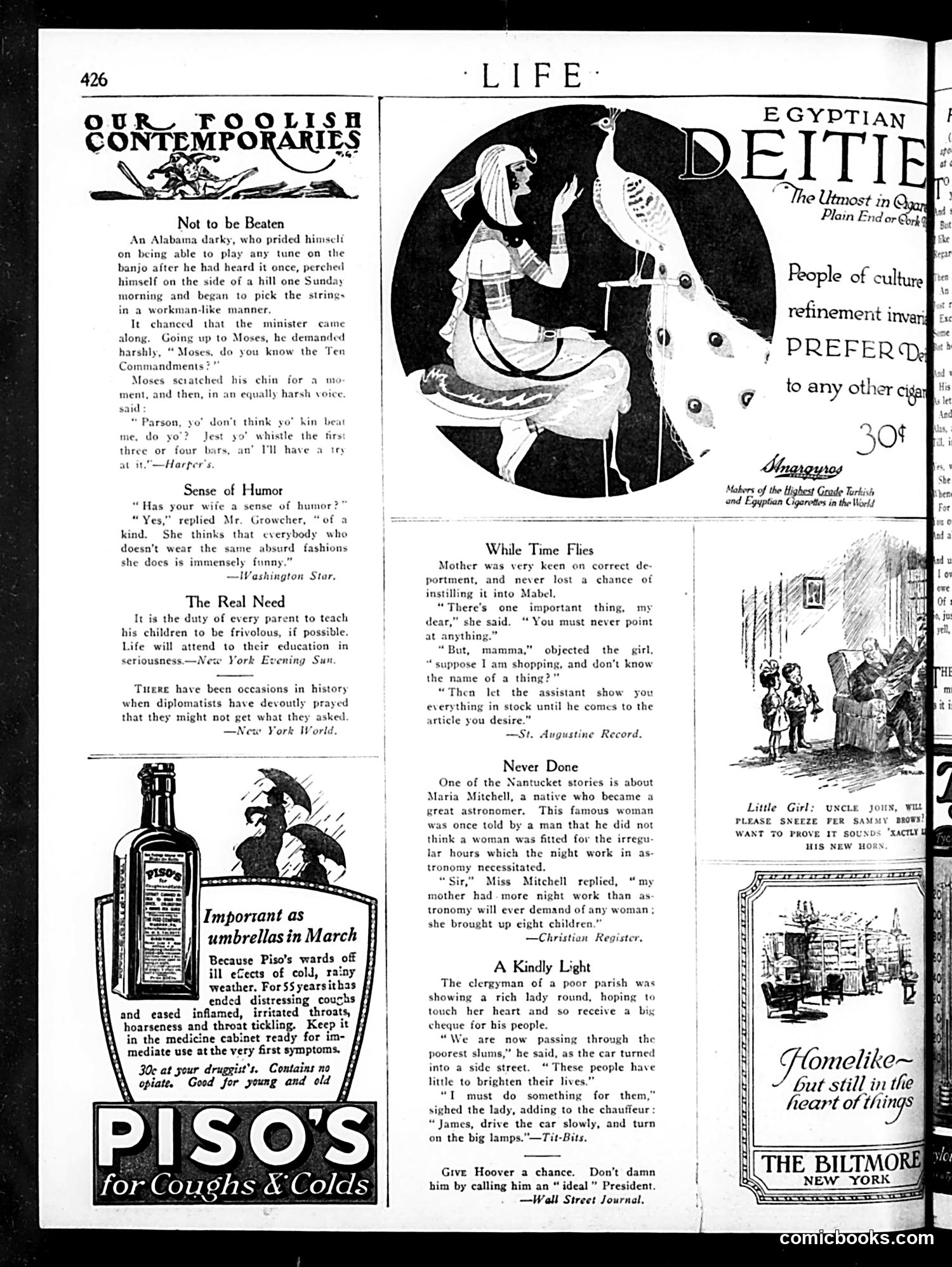
This page contains multiple short humorous anecdotes typical of Life's satirical format, plus period advertisements. **"Not to be Beaten"**: A dialect story mocking an African American banjo player in Alabama who claims he can play any tune after hearing it once. The minister tests him by asking if he knows the Ten Commandments; the man proposes the minister whistle the first bars so he can "play along"—the joke being his conflation of biblical knowledge with musical ability. **Other humor pieces** include observations on wives' fashion sense, parental duties, diplomatic hypocrisy, and women's capabilities (via Maria Mitchell astronomer anecdote). **Advertisements** dominate the right side: Egyptian Deities cigarettes and Piso's cough remedy. **Note**: The racial caricature and dialect humor reflect early 20th-century publication standards now recognized as offensive. The page demonstrates Life's mix of brief satirical commentary on social behavior alongside commercial advertising.
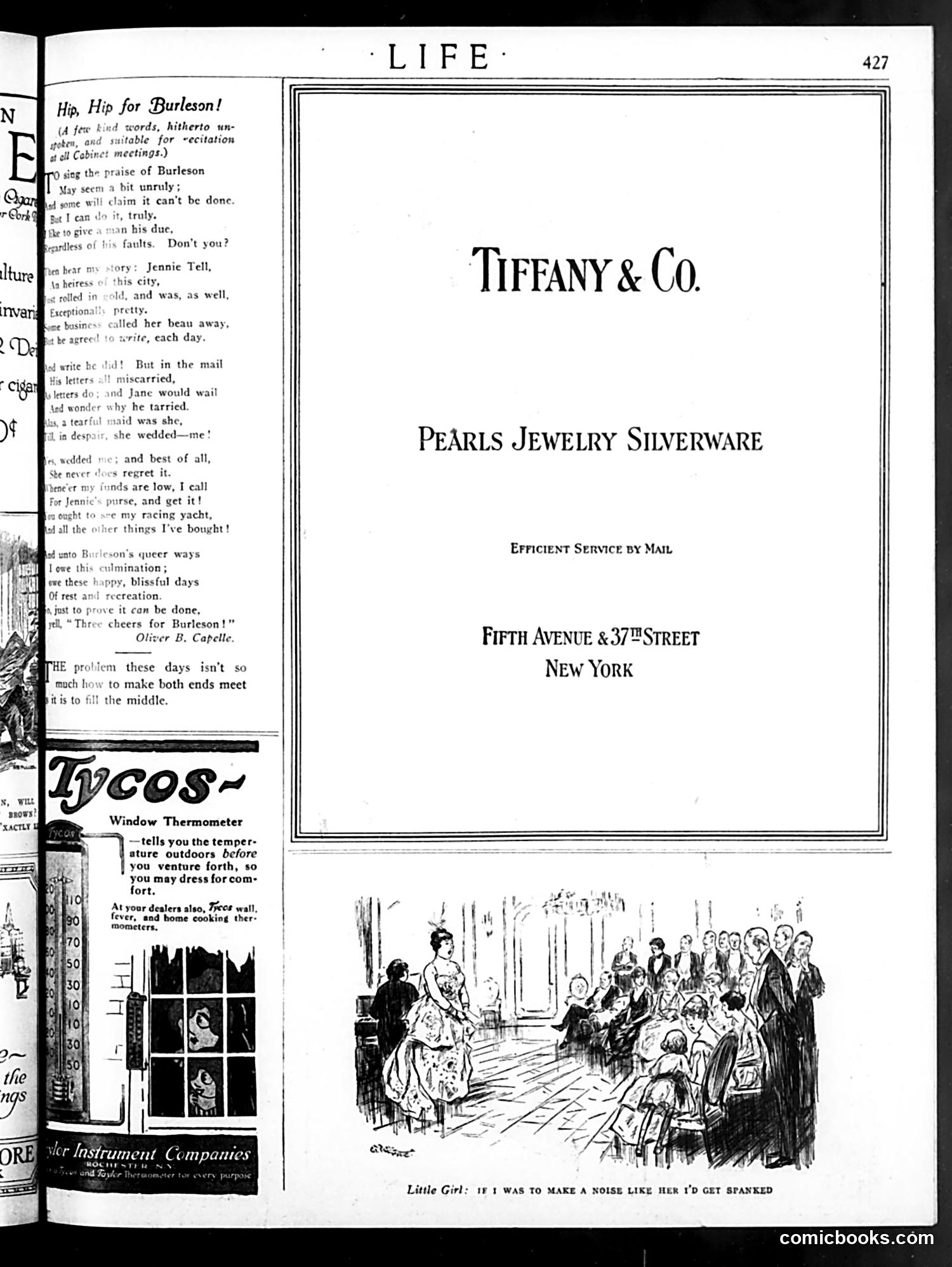
This page mixes advertising with satirical content about Postmaster General Albert Burleson (identified in the poem's title). The poem "Hip, Hip for Burleson!" appears to praise him with backhanded compliments—a common satirical technique. The verses celebrate Burleson while ostensibly acknowledging his unpopularity ("may seem a bit unruly"), suggesting the piece mocks his controversial policies or management style during his tenure under President Wilson. The bottom cartoon depicts a domestic scene where a little girl tells an adult she'd be spanked if she made noise "like her"—likely commentary on women's restricted social roles or children's discipline standards of that era. The page is primarily dominated by a full-page **Tiffany & Co. advertisement** for pearls, jewelry, and silverware, making this largely a commercial publication space. The satirical content is secondary to advertising.
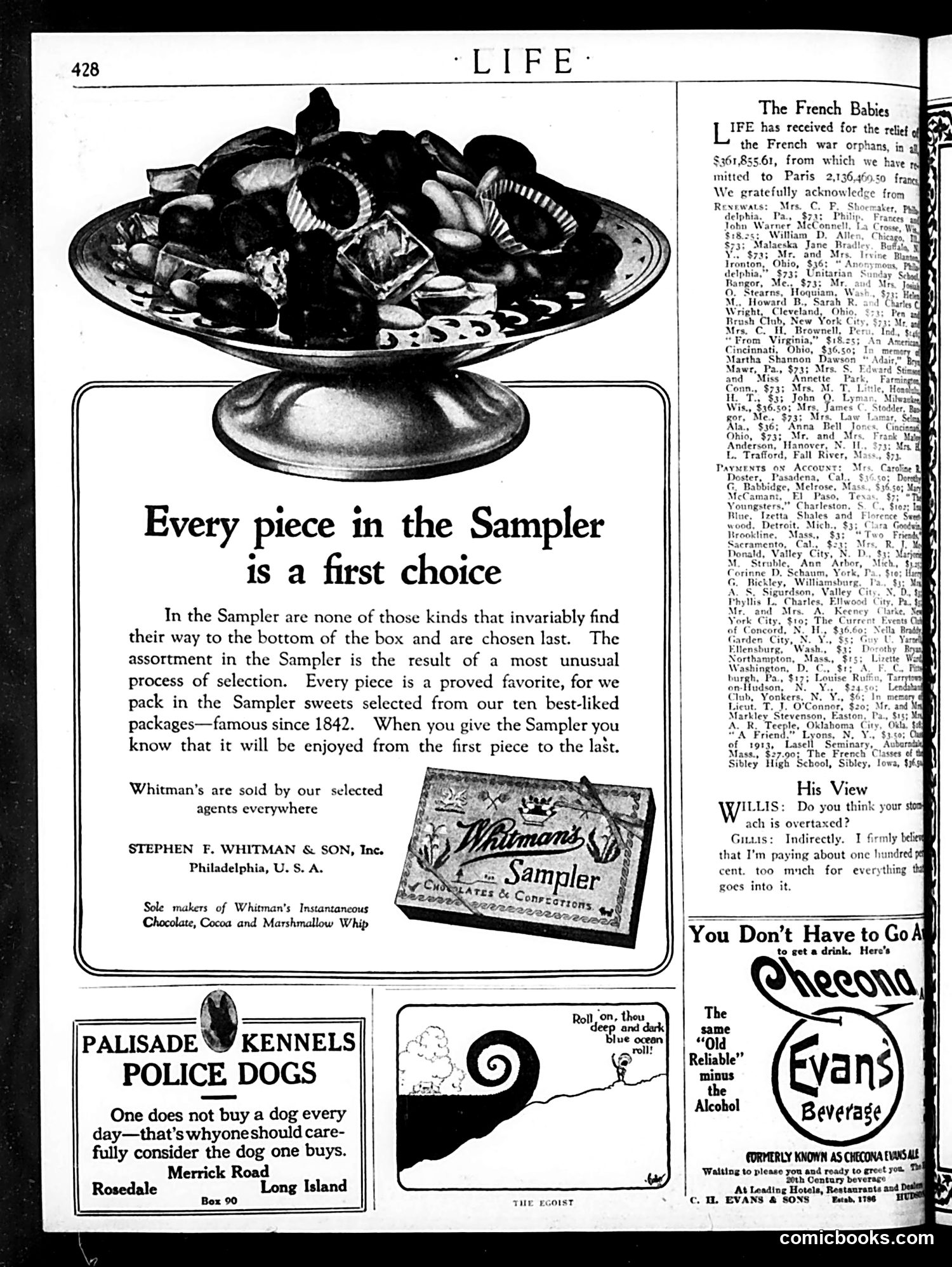
This page is primarily **advertising**, not political satire. The dominant content is a Whitman's Sampler candy advertisement featuring an ornate dish of assorted chocolates with the tagline "Every piece in the Sampler is a first choice." The page includes several smaller ads: Palisade Kennels Police Dogs, Evans Beverage (a non-alcoholic drink), and Chicona beverage. The only satirical element is a small cartoon labeled "The Egoist" showing a curled tail or wave with text about someone's stomach being "overtaxed" from paying too much for everything—a mild joke about overconsumption or greed. Notably, the page also lists donors to French war orphan relief, indicating this is from the **World War I era** when Life magazine combined commercial advertising with charitable fundraising appeals.
This is a **full-page advertisement**, not a cartoon or satirical content. It's a W. & J. Sloane furniture and home furnishings ad from *Life* magazine (page 429). The ad addresses a wartime or post-war shortage economy ("when the shortage of nearly all merchandise is universal") and positions Sloane as uniquely well-stocked with domestic rugs. The marketing angle is reassurance: while other goods are scarce, Sloane claims to have "the largest in the world" selection of rugs in various styles (solid colors, Oriental-inspired patterns) and weaves. The ad emphasizes quality and supply reliability as selling points during scarcity. The ornamental border frame and formal typography reflect early-to-mid 20th century advertising aesthetics. No satire is present—this is straightforward institutional advertising leveraging material shortages as a commercial opportunity.
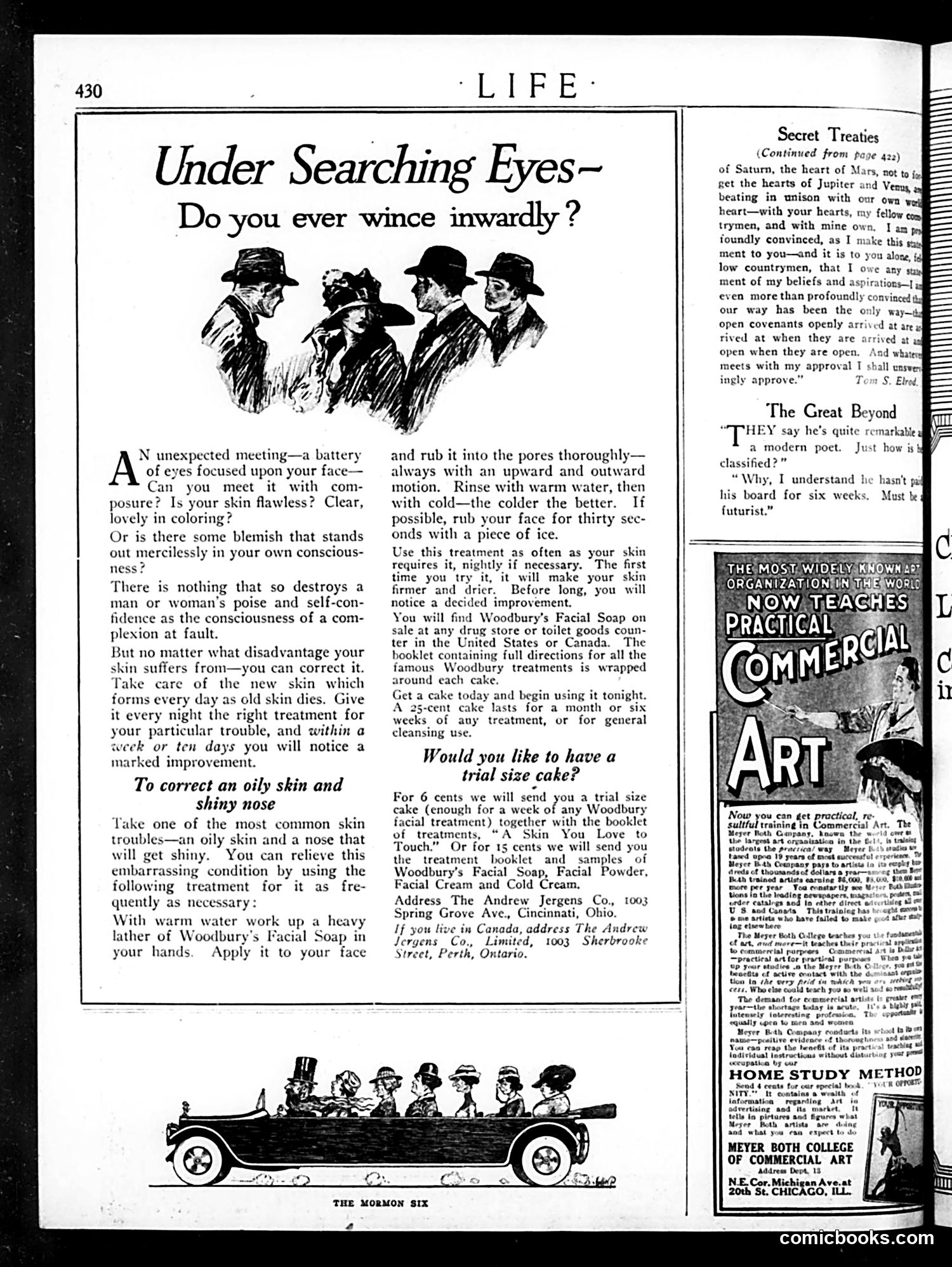
This page is primarily **advertising**, not satire or political commentary. The main content is a Woodbury's Facial Soap advertisement titled "Under Searching Eyes," which plays on social anxiety about appearance. The ad suggests that skin blemishes destroy one's confidence in social situations and promises improvement through their soap treatment regimen. The small cartoon at the bottom labeled "THE MORMON SIX" depicts seven figures in a car, likely a topical reference (unclear without fuller context), but receives minimal space. The right column contains unrelated content: fragments of "Secret Treaties" (appears to be satirical text, possibly political), a brief joke about a "futurist" poet, and advertisements for art education (Meyer Booth College) and commercial art training. The page reflects early 20th-century advertising psychology: using insecurity about appearance to sell personal care products.
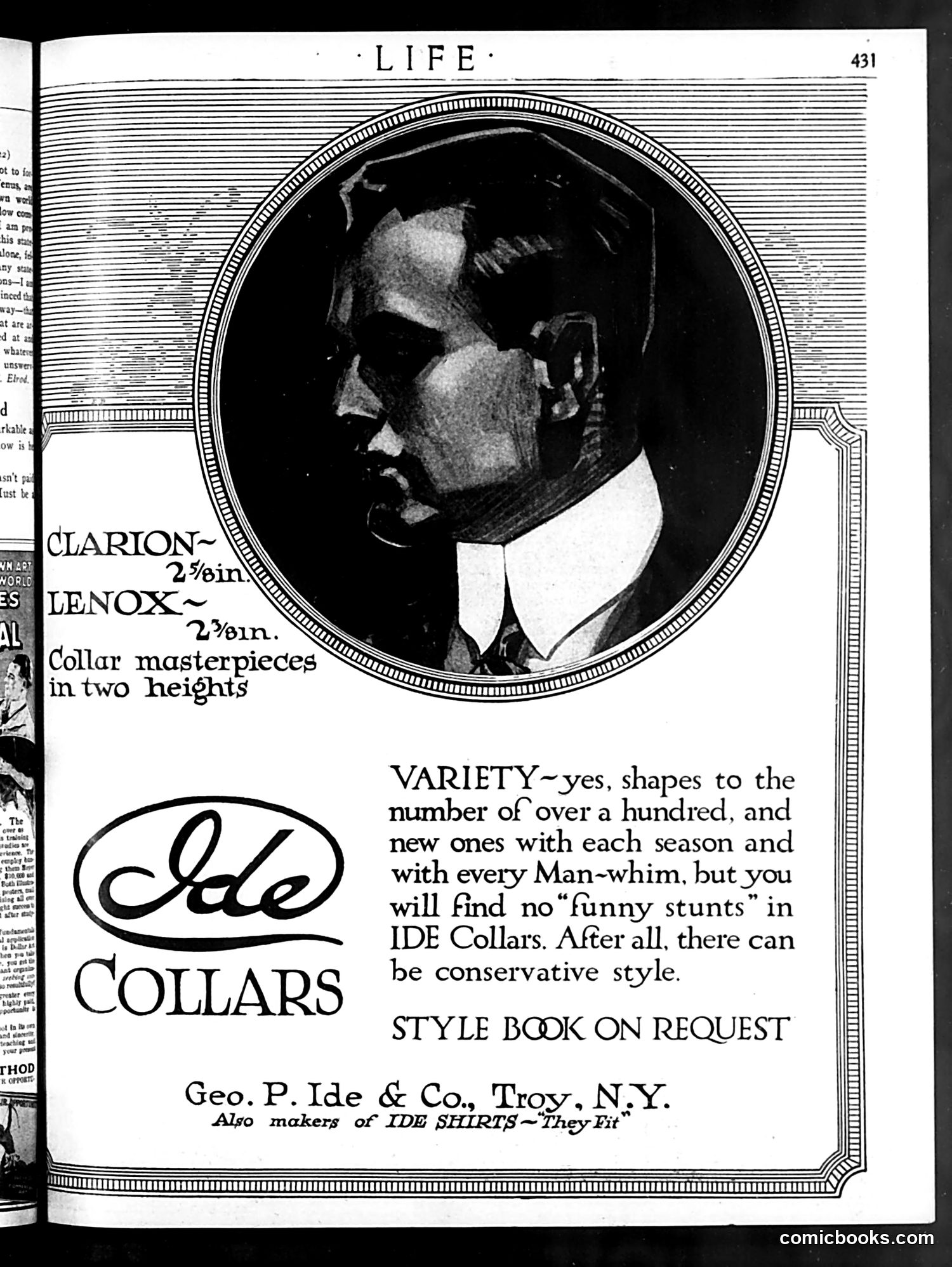
This is a commercial advertisement, not political satire. It promotes Ide Collars, manufactured by Geo. P. Ide & Co. of Troy, New York. The page features a formal portrait photograph of an unidentified man wearing a white collar—presumably showcasing the product. The text emphasizes that Ide offers "over a hundred" collar styles in two heights (Clarion and Lenox, both 2⅜ inches), with new designs each season. The sales pitch uses mild humor: while acknowledging fashion variety exists elsewhere, Ide claims no "funny stunts" in their collars—positioning themselves as the conservative, reliable choice for professional men. A style book is offered on request. The ad also promotes Ide shirts as a companion product. This reflects early 20th-century men's fashion conventions, when collar style was a significant status marker.
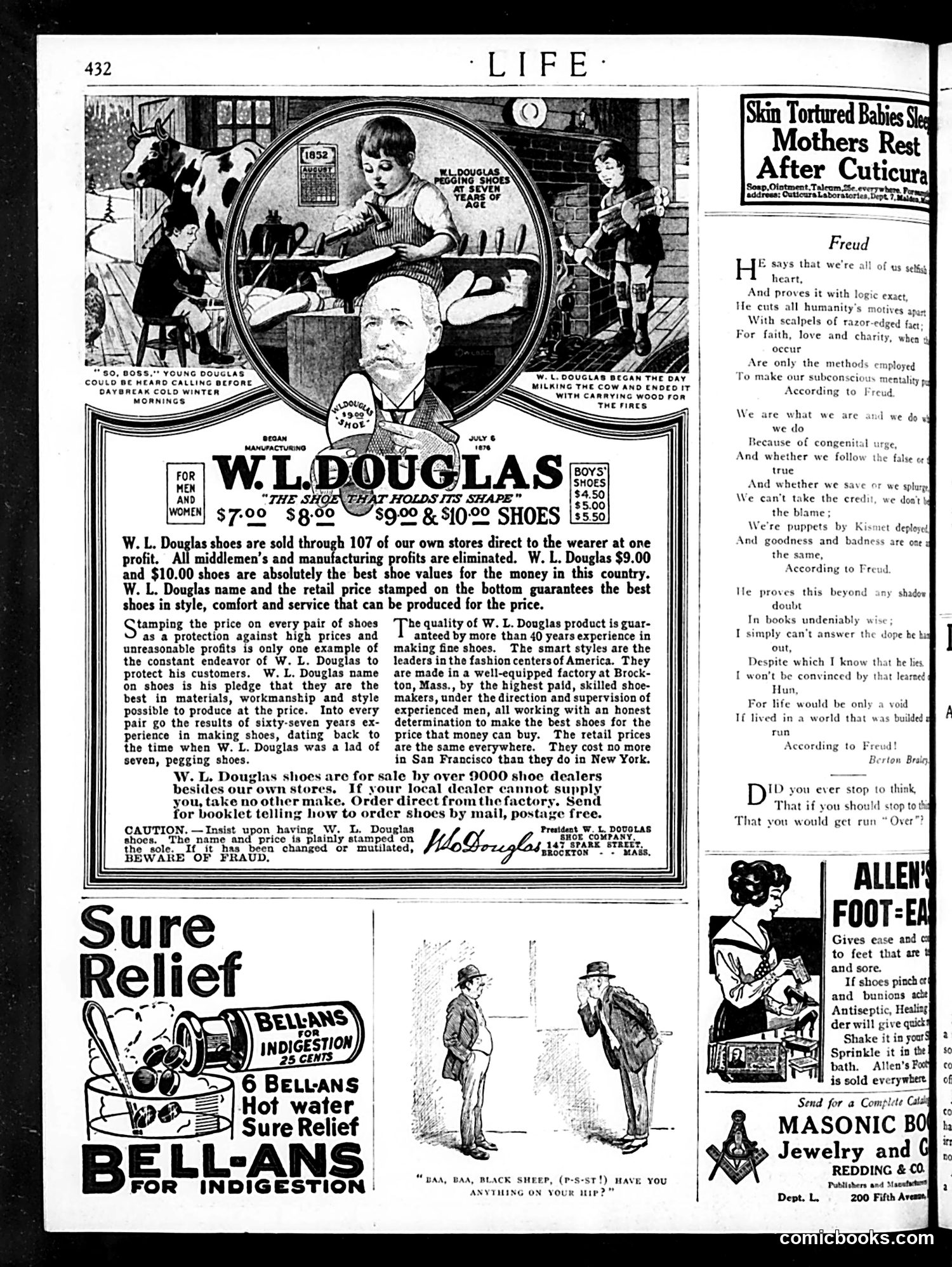
This page is dominated by a large W.L. Douglas shoe advertisement featuring a narrative arc: young Douglas doing chores before dawn, progressing to his factory success. The ad emphasizes direct-to-consumer sales eliminating "middlemen's and manufacturing profits" and price-stamping as consumer protection against "unreasonable profits." The accompanying text satirizes Freudian psychology, mocking the deterministic worldview that humans are mere puppets driven by unconscious urges rather than moral agents. The poem critiques Freud's reduction of human motivation to base instincts, arguing this makes life meaningless. The cartoon at bottom—"Baa, Baa, Black Sheep"—appears to mock conformity or herd mentality, asking if the sheep has "anything on your hip," possibly alluding to concealed thoughts or independence. The juxtaposition suggests early-20th-century tensions between optimistic self-made capitalism (Douglas's narrative) and pessimistic psychological determinism (Freud's influence).
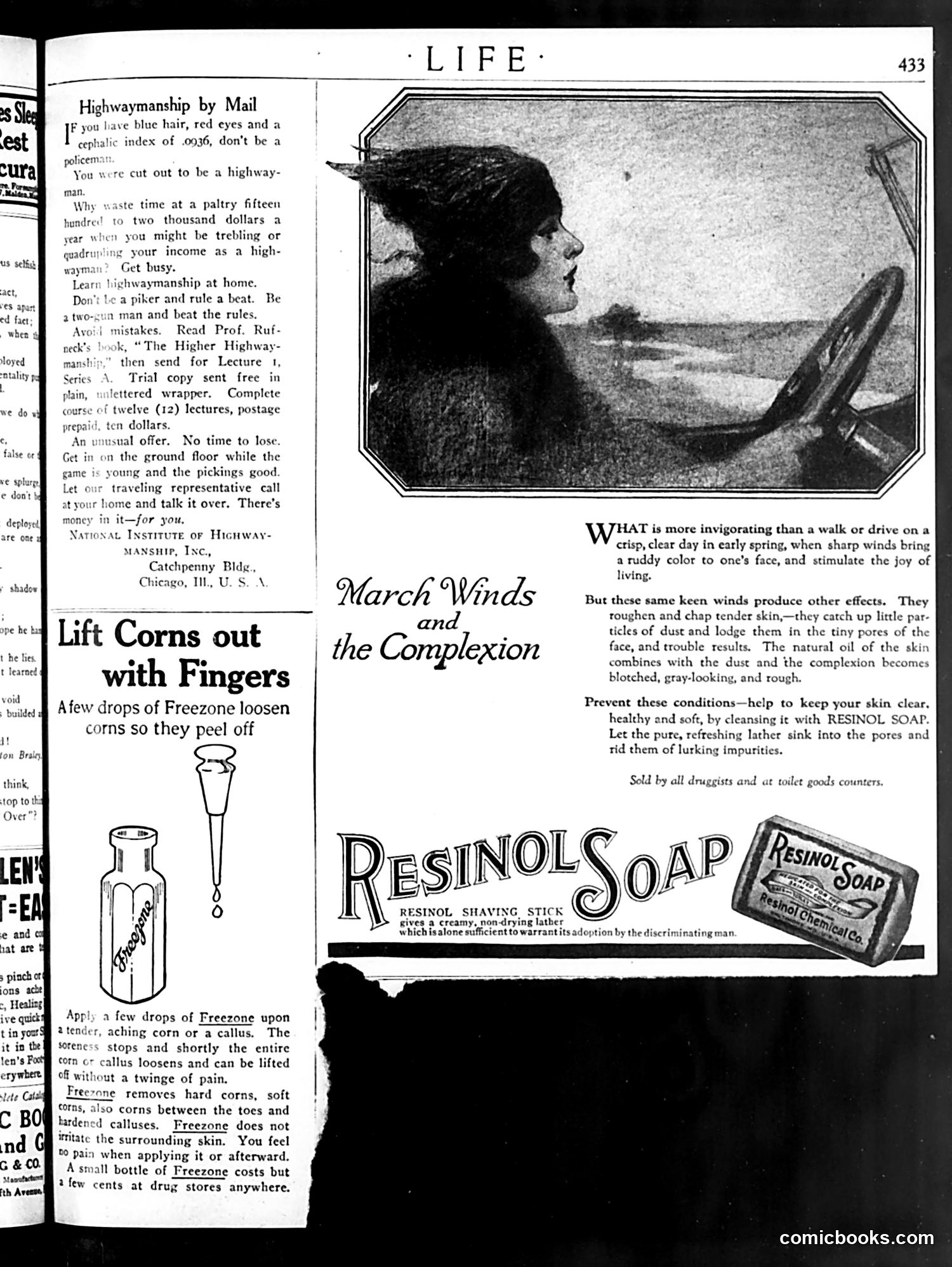
This page contains satirical and commercial content typical of early 20th-century Life magazine. **"Highwaymanship by Mail"** is a mock advertisement satirizing correspondence courses. It humorously suggests readers with certain physical traits should become *actual highway robbers* rather than police officers, offering a fake "Professor Rufneck's" course promising to triple or quadruple income through robbery. The satire targets the proliferation of dubious mail-order educational schemes of the era, which promised unrealistic financial gains—here taken to absurd criminal extremes as commentary on their fraudulent nature. The remaining content is genuine advertising: Freezone corn remover and Resinol Soap. The Resinol ad addresses spring weather's effects on skin, positioning their product as preventative skincare. This reflects period advertising's emphasis on complexion care as a woman's concern. **The cartoon** (upper right) shows a woman's face experiencing wind effects—a visual supporting the Resinol advertisement's claims about March conditions.
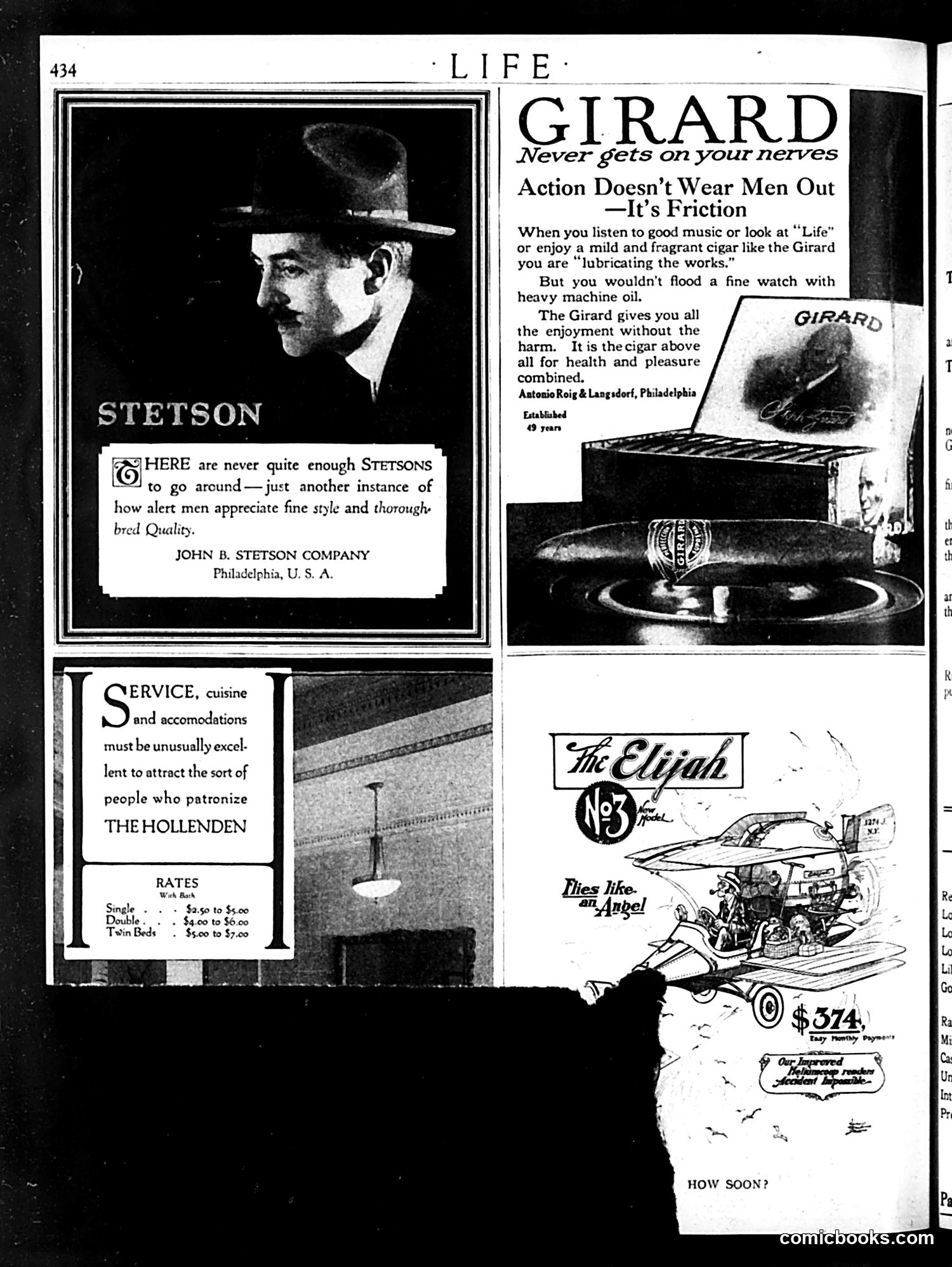
This page contains vintage advertisements rather than political cartoons. The visible ads include: 1. **Stetson Hats** — featuring a man in formal attire wearing a Stetson, emphasizing style and quality for discerning men. 2. **Girard Cigars** — using a mechanical metaphor ("lubricating the works") comparing cigar smoking to maintaining fine machinery, claiming health benefits alongside pleasure. 3. **The Hollenden Hotel** — advertising luxury accommodations with superior service and cuisine, listing room rates. 4. **The Elijah No. 3 Car** — promoting an automobile priced at $374, using the slogan "Flies like an Angel" to suggest speed and elegance. These ads reflect early 20th-century consumer culture, targeting affluent male consumers through appeals to style, sophistication, and technological progress.
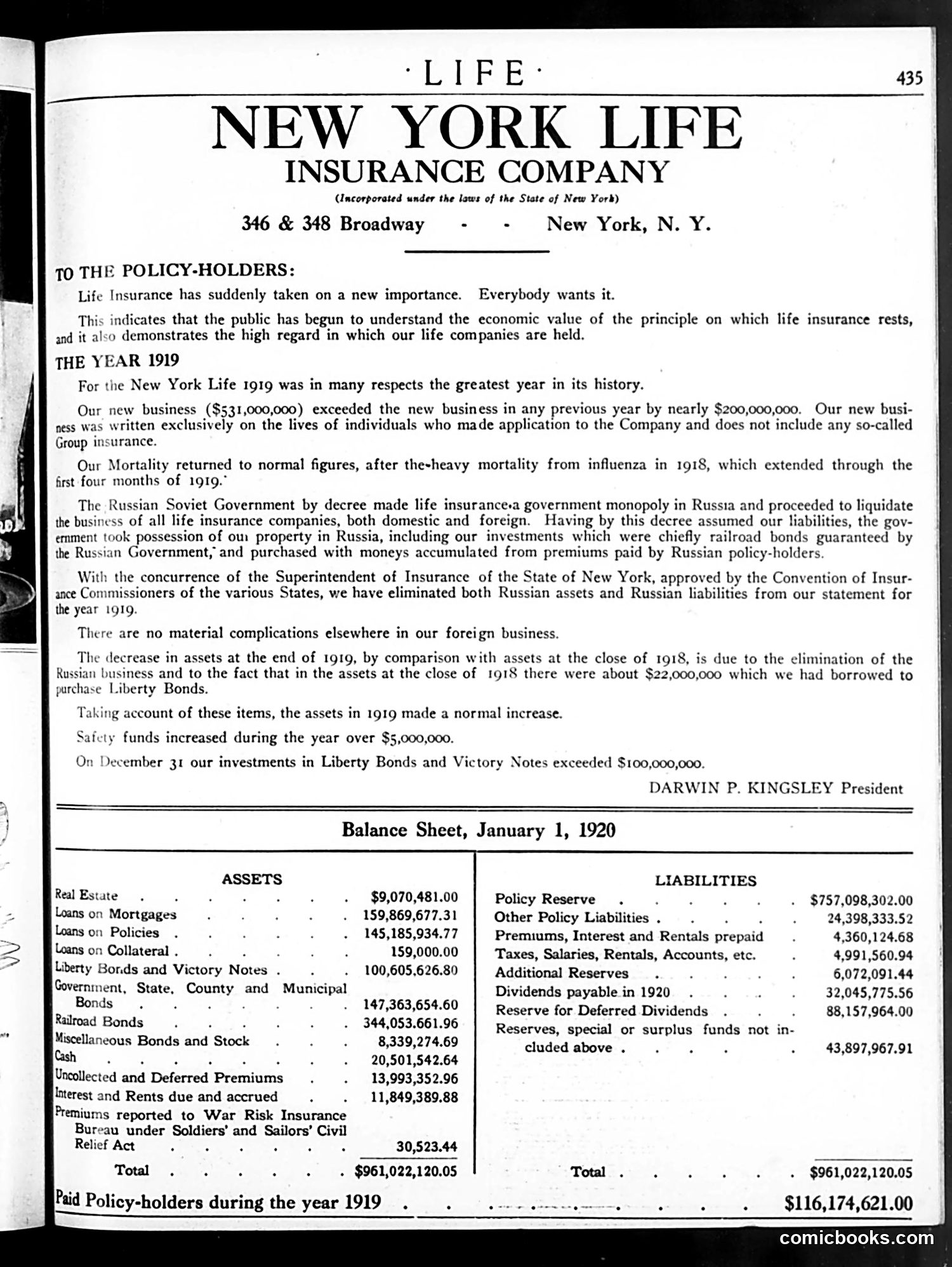
This page is **not a cartoon or satirical content**—it's a corporate financial advertisement and annual report from the New York Life Insurance Company, dated January 1, 1920. The page contains: - An address to policyholders explaining the company's strong 1919 performance - A balance sheet showing assets of $961,022,120.05 - Discussion of business growth and the influenza mortality spike of 1918 - Notable mention of **liquidating Russian assets** due to the Soviet government's seizure of foreign insurance companies The Russian reference reflects post-WWI geopolitical upheaval—the new Communist government nationalized foreign business interests, forcing American companies to write off their investments. This is straightforward corporate messaging, not satire.
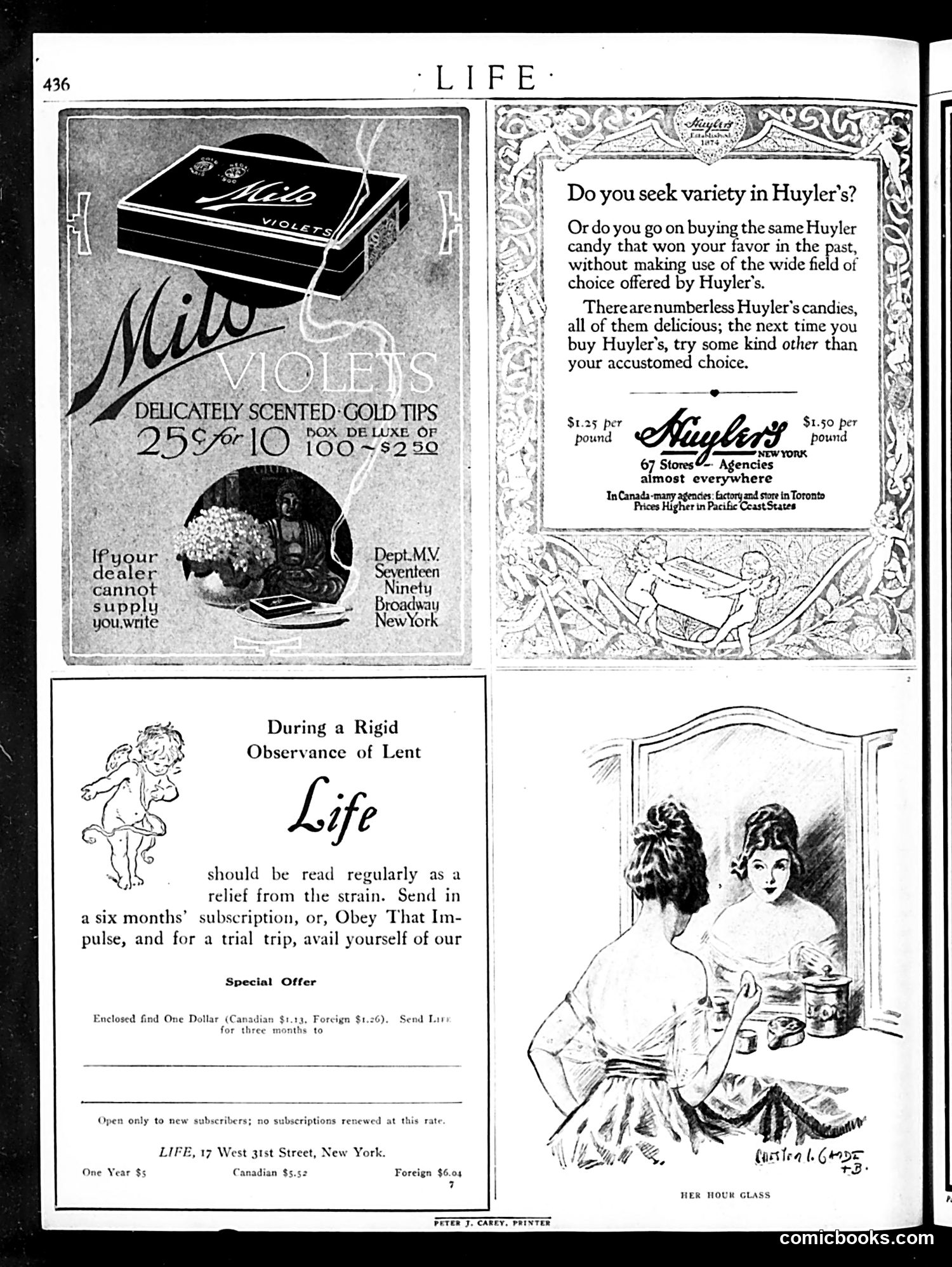
This page consists primarily of **advertisements and house ads** rather than satirical content. The top left advertises **Milo Violets** candy (delicately scented, gold-tipped chocolates). The upper right features a **Huyler's candy ad** encouraging consumers to try different varieties rather than repurchasing the same flavor. The lower half contains a **Life magazine self-promotional offer**, suggesting readers subscribe "during a rigid observance of Lent" as mental relief from strain. The accompanying illustration ("Her Hour Glass") depicts two women at a vanity, likely suggesting that Life magazine provides leisure reading. The subscription offer targets "new subscribers" with a special discounted rate of one dollar for three months. **Context for modern readers:** Early 20th-century magazines heavily subsidized their content through advertising and actively recruited subscriptions via discount offers placed within their own pages.
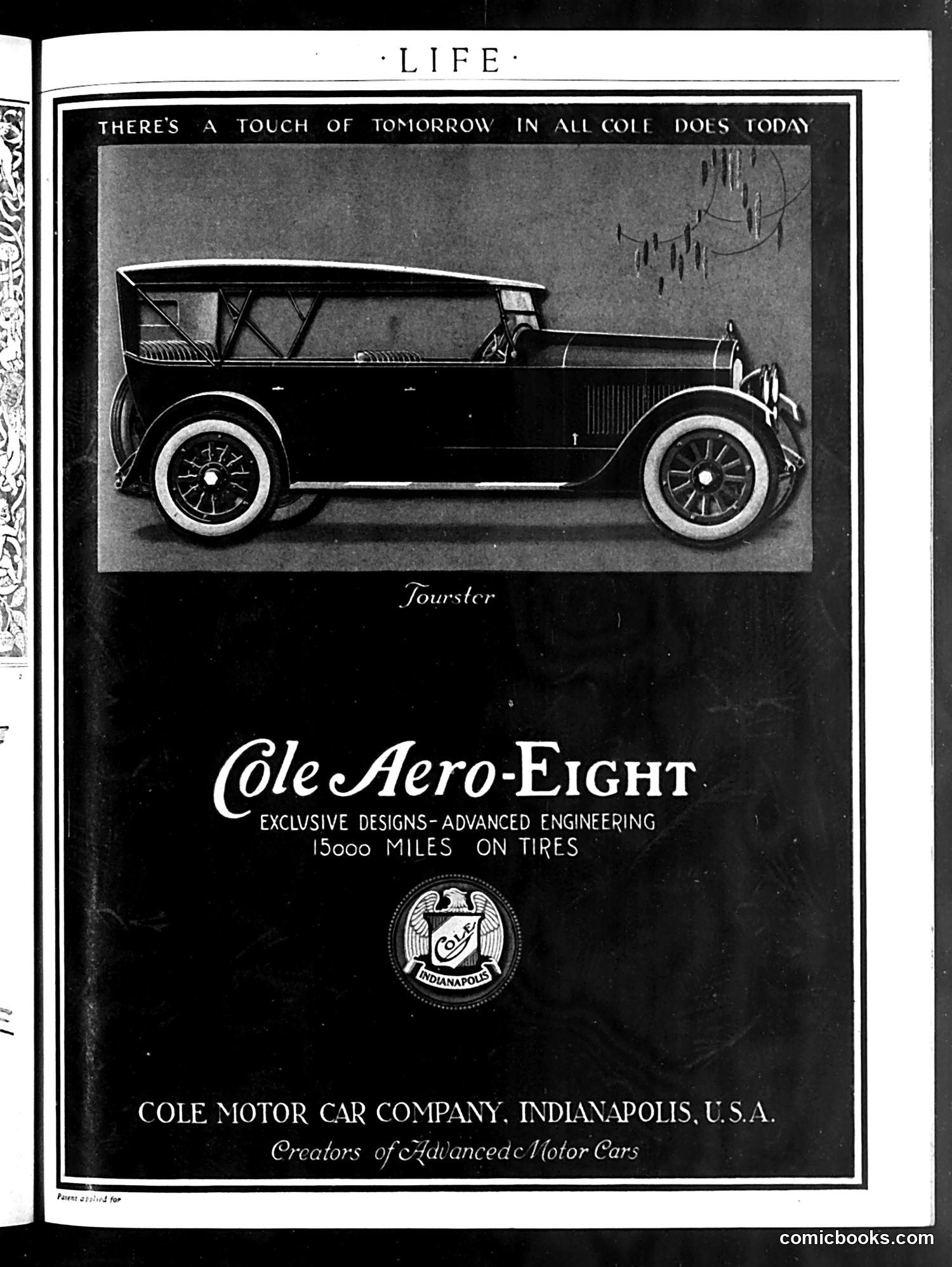
This is a full-page automobile advertisement, not a political cartoon. It advertises the Cole Aero-Eight, a luxury car manufactured by Cole Motor Car Company in Indianapolis. The ad features a side-view illustration of the "Tourster" model (an open-top touring car) and emphasizes its advanced features: exclusive designs, advanced engineering, and tire durability (15,000 miles on tires). The tagline "There's a touch of tomorrow in all Cole does today" positions the vehicle as forward-thinking and modern. The company's seal appears at the bottom. This represents early 20th-century automobile marketing emphasizing technological progress and engineering sophistication to appeal to affluent consumers.
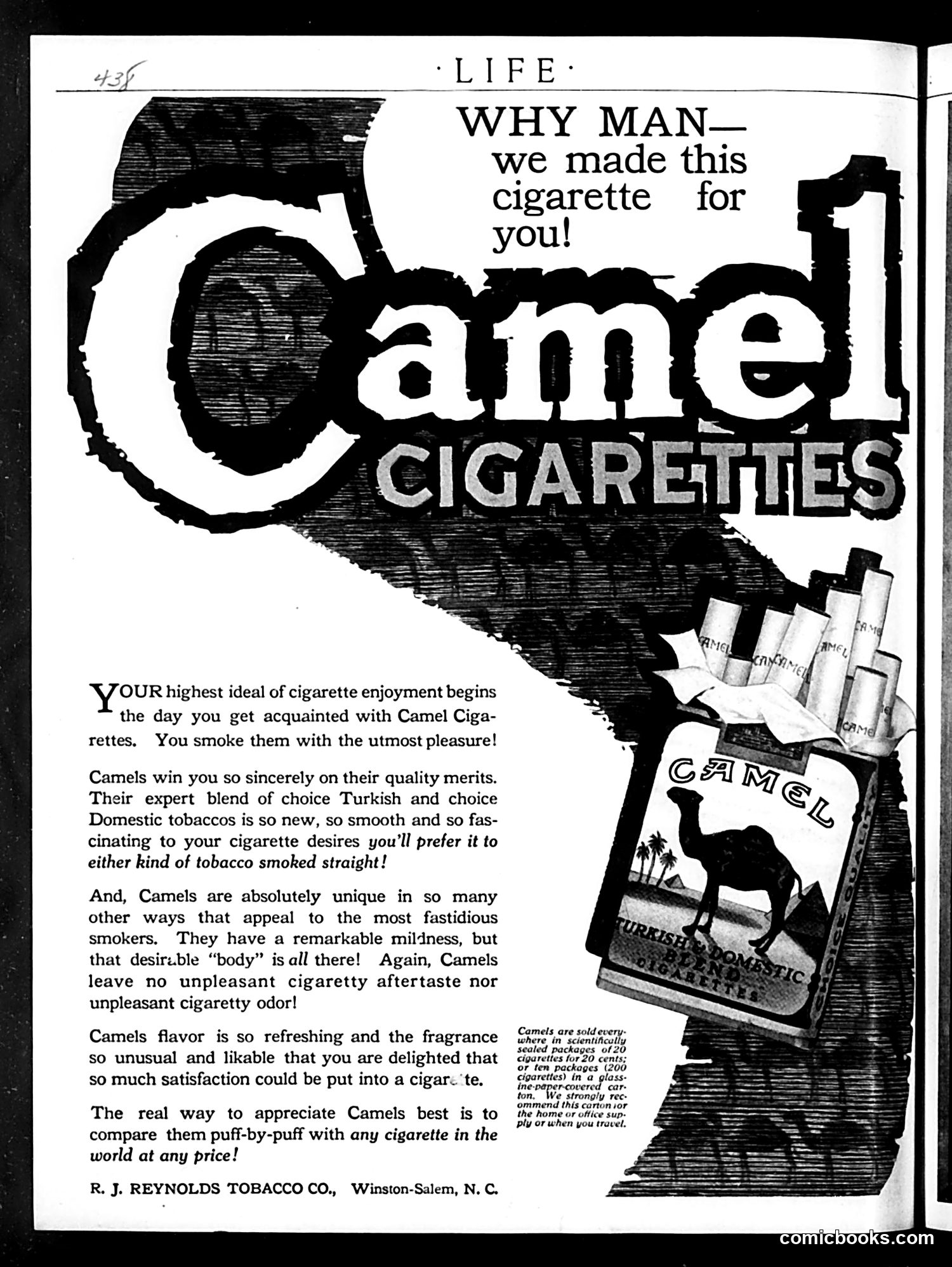
This page is primarily a **Camel cigarette advertisement**, not satire or political commentary. The "WHY MAN—" headline and casual tone are typical advertising copy from this era, not cartoon satire. The advertisement uses a silhouette of what appears to be **Texas** (the distinctive shape is recognizable) as a design element, with Camel cigarette packages displayed. This geographic reference likely appeals to regional pride or suggests wide availability. The copy emphasizes Camel's blend of Turkish and domestic tobacco, smoothness, lack of aftertaste, and superiority to competitors. The phrase "compare them puff-by-puff with any cigarette in the world" is a direct challenge to rival brands. **Modern context**: This predates any health warnings about smoking. The casual confidence in promoting cigarettes—especially highlighting their "mildness"—reflects early-to-mid 20th century advertising before tobacco's dangers were widely acknowledged or regulated. The R.J. Reynolds Tobacco Company operated without the restrictions modern smokers take for granted.
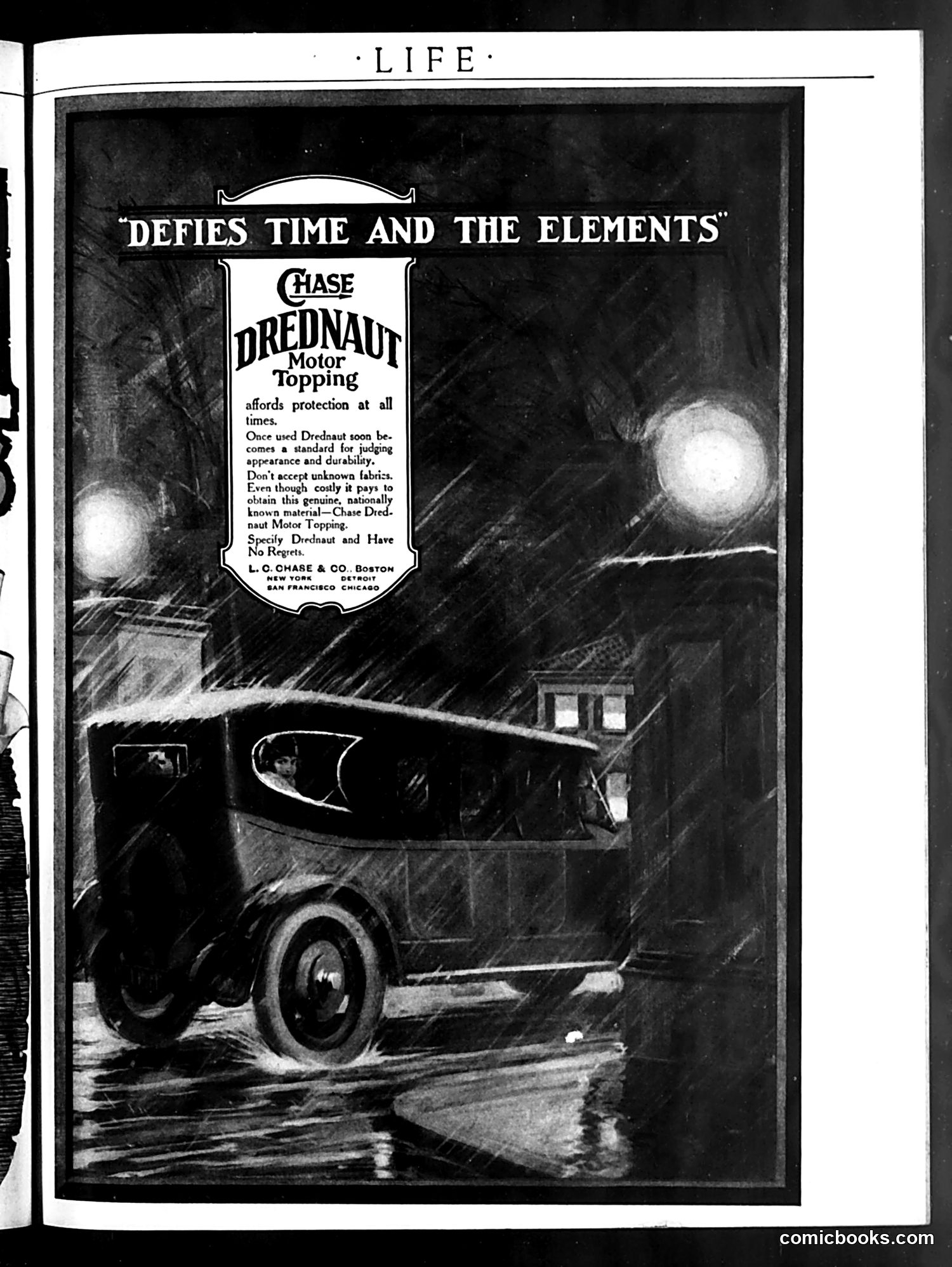
This is a **product advertisement**, not political satire. It promotes "Chase Drednaut Motor Topping," a automotive protective coating made by L.C. Chare & Co. (Boston, New York, Detroit, San Francisco, Chicago). The ad uses dramatic imagery—a vintage car driving through heavy rain and stormy weather at night—to illustrate the product's durability claim: it "Defies Time and the Elements." The advertisement positions Drednaut as a quality, reliable product that "becomes a standard for judging appearance and durability," urging buyers to "Specify Drednaut and Have No Regrets." This represents early 20th-century automotive accessory marketing, emphasizing protection and longevity during an era when cars were relatively new consumer goods.
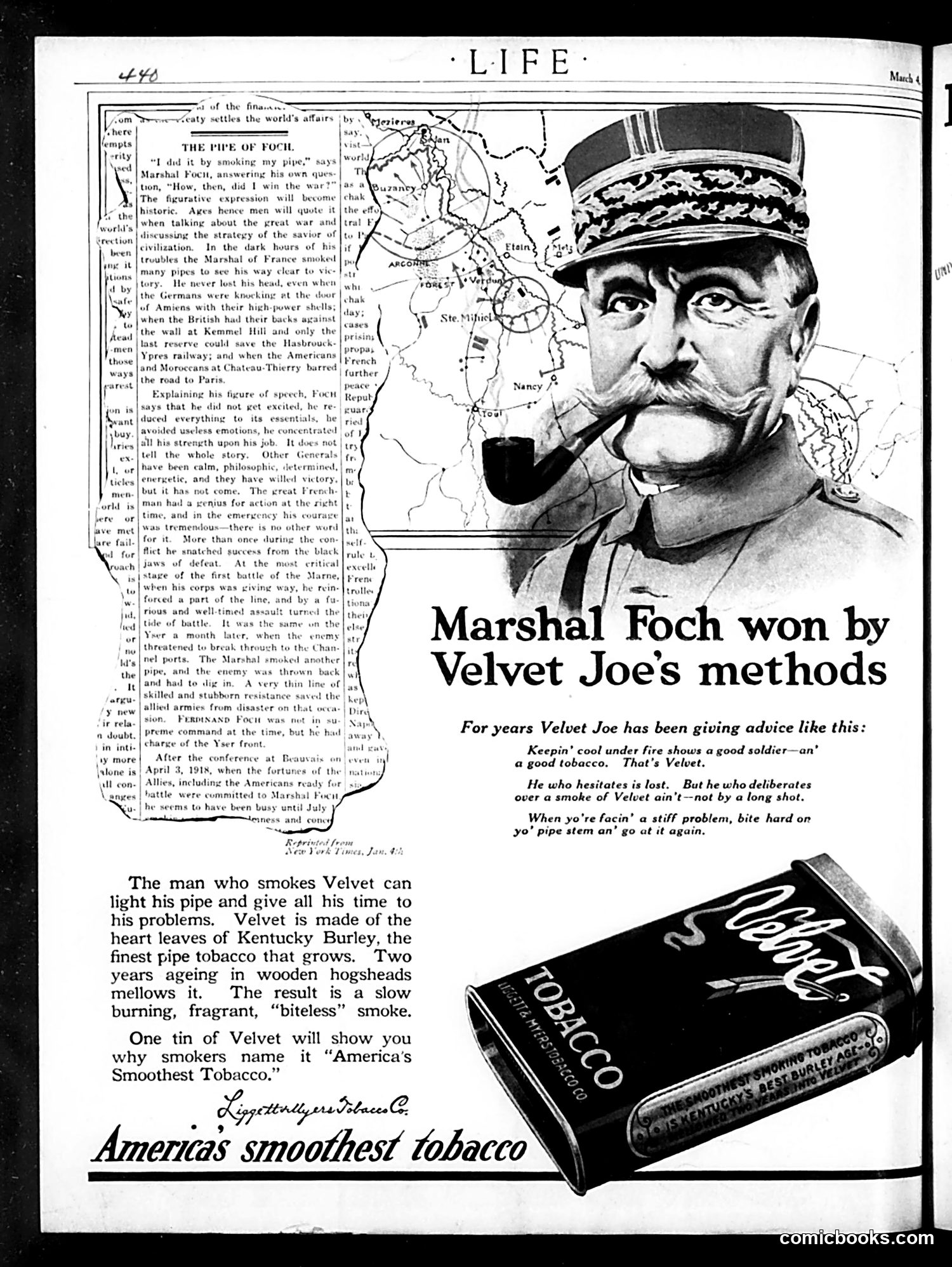
This is primarily a **tobacco advertisement** for Velvet pipe tobacco, disguised as editorial content through a political connection. The page features **Marshal Ferdinand Foch**, the French military commander who coordinated Allied forces in World War I. The left column discusses his military strategy and leadership during the war's critical moments. However, the advertisement hijacks this credible historical figure through a pun: "Velvet Joe's methods" compares Foch's strategic success to the benefits of smoking Velvet tobacco. The satirical angle—typical of LIFE magazine's advertising parodies—lies in the absurd equation: Foch won the war through careful deliberation → men should smoke Velvet to think carefully → therefore, Velvet helped win WWI. The fake soldier's advice ("Keepin' cool under fire shows a good soldier—an' a good tobacco") mocks patriotic messaging by conflating military virtue with consumer products. This represents early 20th-century advertising's shameless appropriation of wartime heroism to sell cigarettes to veterans.