
Life, 1920-03-04 · page 56 of 78
Life — March 4, 1920 — page 56: what you’re looking at
What you’re looking at
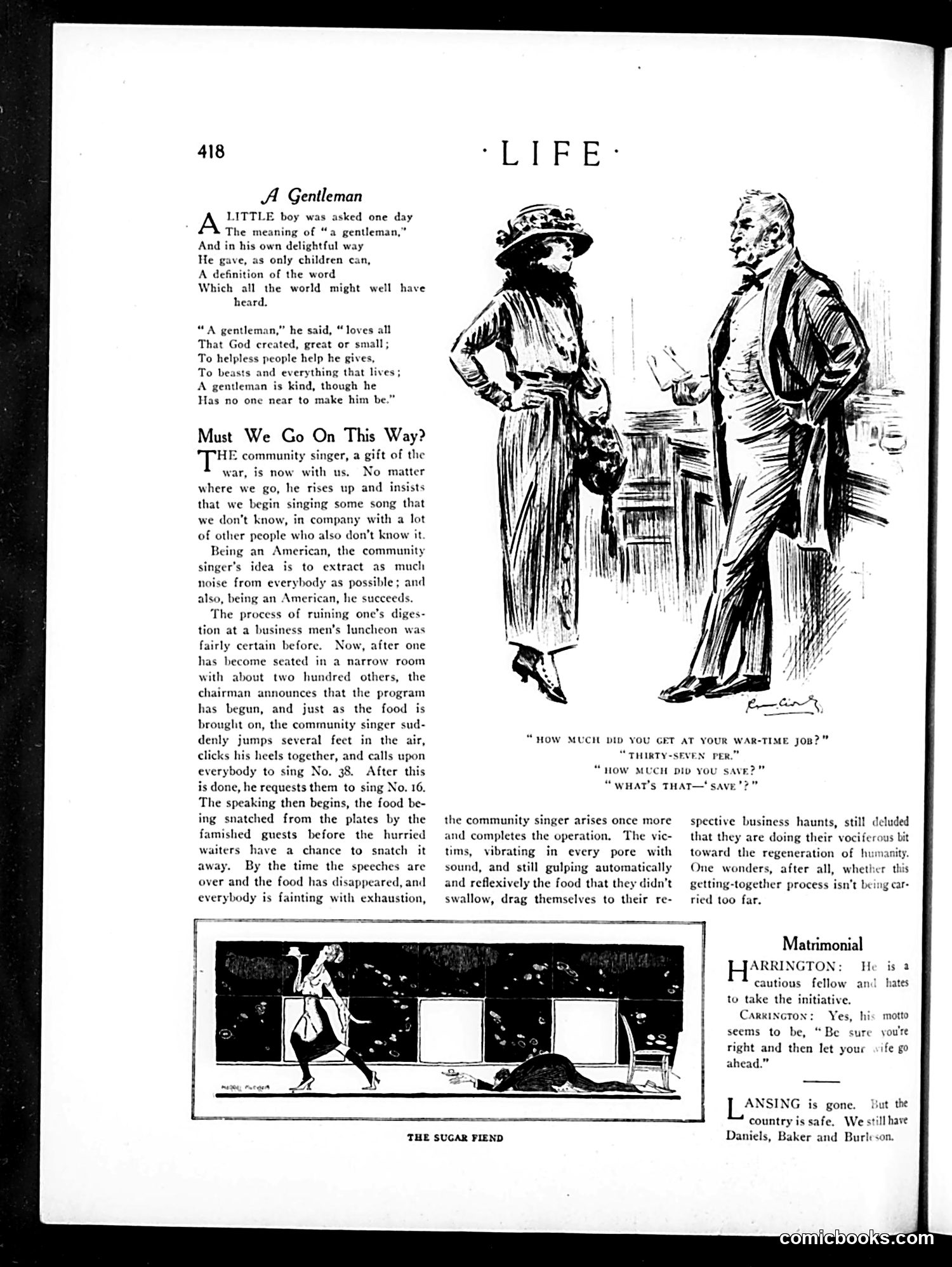
This page satirizes post-WWI American culture through three pieces: **"A Gentleman"** presents an idealized definition via a child's innocent wisdom—a gentleman shows kindness to all creatures without needing external reward. This contrasts sharply with the page's other content. **"Must We Go On This Way?"** mocks the "community singer" phenomenon—apparently a well-meaning post-war trend where enthusiastic singers forced group singing at public events. The satire targets both forced participation in mass activities and the disruption to digestion during business lunches, with food being grabbed mid-speech. The accompanying cartoon dialogue about war-time wages and savings suggests frustration with profiteering during WWI. **"The Sugar Fiend"** (cartoon, details unclear) appears to address wartime rationing or black-market activity. The brief matrimonial section jokes about hesitant courtship and concludes with relief that military leadership figures (Daniels, Baker, Burleson—likely Wilson administration officials) are gone, suggesting post-war political criticism. Overall, the page reflects post-1918 American anxieties about enforced "togetherness" and wartime social disruption.
📄 Transcribed text from this page (OCR, searchable)
Machine-transcribed from the original scan — historical spelling and the odd misread are preserved.
A Gentleman LITTLE boy was asked one day The meaning of “a gentleman,” And in his own delightful way He gave, as only children can, A definition of the word Which all the world might well have heard. “A gentleman,” he said, “loves all That God 1 To helpless people help he To beasts and everything that lives ; A gentleman is kind, though he Has no one near to make him be.” Must We Go On This Way? HE community singer, a gift of the war, is now with us, No matter where we go, he rises up and insists that we begin singing some song that we don’t know, in company with a lot of other people who also don’t know it Being an American, the community singer’s idea is to extract much noise from everybody as possible; and also, being an American, he succeeds. The process of ruining one’s diges- tion at a business men’s luncheon was fairly certain before. Now, after one has become seated in a narrow room with about two hundred others, the chairman announces that the program has begun, and just as the food is brought on, the community singer sud- denly jumps several feet in the air, clicks his heels together, and calls upon everybody to sing No. 38. After this is done, he requests them to sing No. 16. The speaking then begins, the food be- ing snatched from the plates by the famished guests before the hurried waiters have a chance to snatch it away. By the time the speeches are over and the food has disapy everybody is fainting with exhaustion, ed, and “HOW MUCIL DID YOU GET AT YOUR WAR-TIME Job?" “THIRTY-SEVEN PER.” “HOW MUCH DID YoU SAVE?" “WHAaT’s THAT—' SAvE’? the community singer arises once more and completes the operation, The vic- tims, vibrating in every pore with sound, and still gulping automatically and reflexively the food that they didn't swallow, drag themselves to their re- THE SUGAR FIEND spective business haunts, still deluded that they are doing their vociferou toward the regeneration of hum One wonders, after all, whether getting-together process isn’t being car- ried too far. Matrimonial ARRINGTON: H cautious fellow and to take the initiative. Cargincton: Yes, hi seems to be, “Be sure right and then let your ahead.” is a hates motto you're ife go But the LANSING is gone. country is safe. We still have Daniels, Baker and Burleson.