
Life, 1920-03-04 · page 27 of 78
Life — March 4, 1920 — page 27: what you’re looking at
What you’re looking at
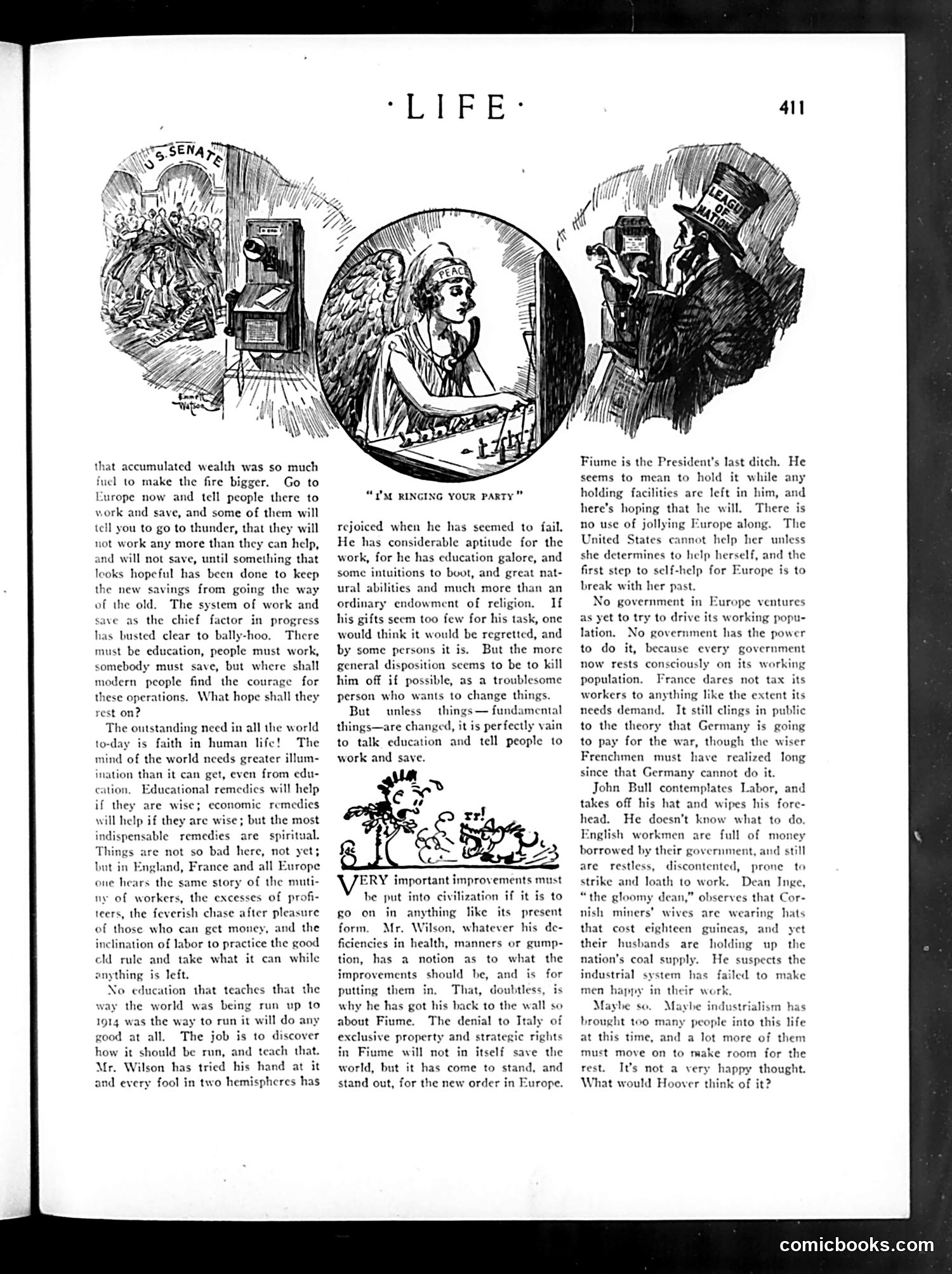
This page contains post-WWI political commentary attacking President Wilson's handling of the Fiume dispute at the Paris Peace Conference (1919). The central cartoon, titled "I'm Ringing Your Party," shows an angelic figure (likely representing idealism or the League of Nations concept) ringing a bell while politicians ignore the call—satirizing resistance to Wilson's internationalist vision. The text argues that fundamental social and economic change is necessary for post-war Europe's recovery, but that entrenched interests oppose Wilson's efforts. The author criticizes European governments and workers alike for failing to embrace necessary reforms, while suggesting Wilson—despite his considerable abilities—faces obstruction from "every fool in two hemispheres" who rejoices at his setbacks. The piece reflects the bitter divisions over American foreign policy following WWI, positioning Wilson as a visionary battling reactionary forces, both abroad and at home, who resist his idealistic restructuring of the post-war order.
📄 Transcribed text from this page (OCR, searchable)
Machine-transcribed from the original scan — historical spelling and the odd misread are preserved.
that accumulated wealth was so much fuel to make the fire bigger. Go to Europe now and tell people there to work and save, and some of them will tell you to go to thunder, that they will not work any more than they can help, and will not save, until something that looks hopeful has been done to keep the new savings from going the way of the old. The system of work and save as the chief factor in progress has busted clear to bally-hoo. There must be education, people must work, somebody must save, but where shall modern people find the courage for these operations, What hope shall they rest on? The outstanding need in all the world to-day is faith in human life! The mind of the world needs greater illum- ination than it can get, even from edu- cation, Educational remedics will help if they are wise; economic remedies will help if they are wise; but the most indispensable remedies are spiritual. Things are not so bad here, not yet; but in England, France and all Europe one hears the same story of the muti- ny of workers, the excesses of profi- teers, the feverish chase after pleasure of those who can get money, and the inclination of labor to practice the good eld rule and take what it can while anything is left. No education that teaches that the way the world was being run up to 1914 was the way to run it will do any good at all. The job is to discover how it should be run, and teach that. Mr. Wilson has tried his hand at it and every fool in two hemispheres has “YM RINGING YOUR PARTY” rejoiced when he has seemed to fail. He has considerable aptitude for the work, for he has education galore, and some intuitions to boot, and great nat- ural abilities and much more than an ordinary endowment of religion. If his gifts seem too few for his task, one would think it would be regretted, and by some persons it is. But the more general disposition scems to be to kill him off if possible, as a troublesome person who wants to change things. But unless — things — fundamental things—are changed, it is perfectly vain to talk education and tell people to work and save. ERY important improvements must he put into civilization if it is to go on in anything like its present form. Mr. Wilson, whatever his de- ficiencies in health, manners or gump- tion, has a notion as to what the improvements should be, and is for putting them in. That, doubtless, is why he has got his back to the wall so about Fiume. The denial to Italy of exclusive property and strategic rights in Fiume will not in itself save the world, but it has come to stand, and stand out, for the new order in Europe. Fiume is the President's last ditch. He seems to mean to hold it while any holding facilities are left in him, and here’s hoping that he will, There is no use of jollying Europe along. The United States cannot help her unless she determines to help herself, and the first step to self-help for Europe is to break with her past. No government in Europe ventures as yet to try to drive its working popu- lation. No government has the power to do it, because every government now rests consciously on its working population. France dares not tax its workers to anything like the extent its needs demand. It still clings in public to the theory that Germany is going to pay for the war, though the wiser Frenchmen must have realized long since that Germany cannot do it. John Bull contemplates Labor, and takes off his hat and wipes his fore- head. He doesn’t know what to do. English workmen are full of money borrowed by their government, and still are discontented, prone to strike and loath to work. Dean Inge, “the gloomy dean,” observes that Cor- restless, nish miners’ wives are wearing hats that cost eighteen guineas, and yet their husbands are nation’s coal supply. industrial system has holding up the He suspects the led to make in their work. Maybe industrialism has brought too many people into this life at this time, and a lot more of them must move on to make room for the rest. It’s not a very happy thought. What would Hoover think of it? Mayhe so comicbooks.com