
Life, 1920-03-04 · page 38 of 78
Life — March 4, 1920 — page 38: what you’re looking at
What you’re looking at
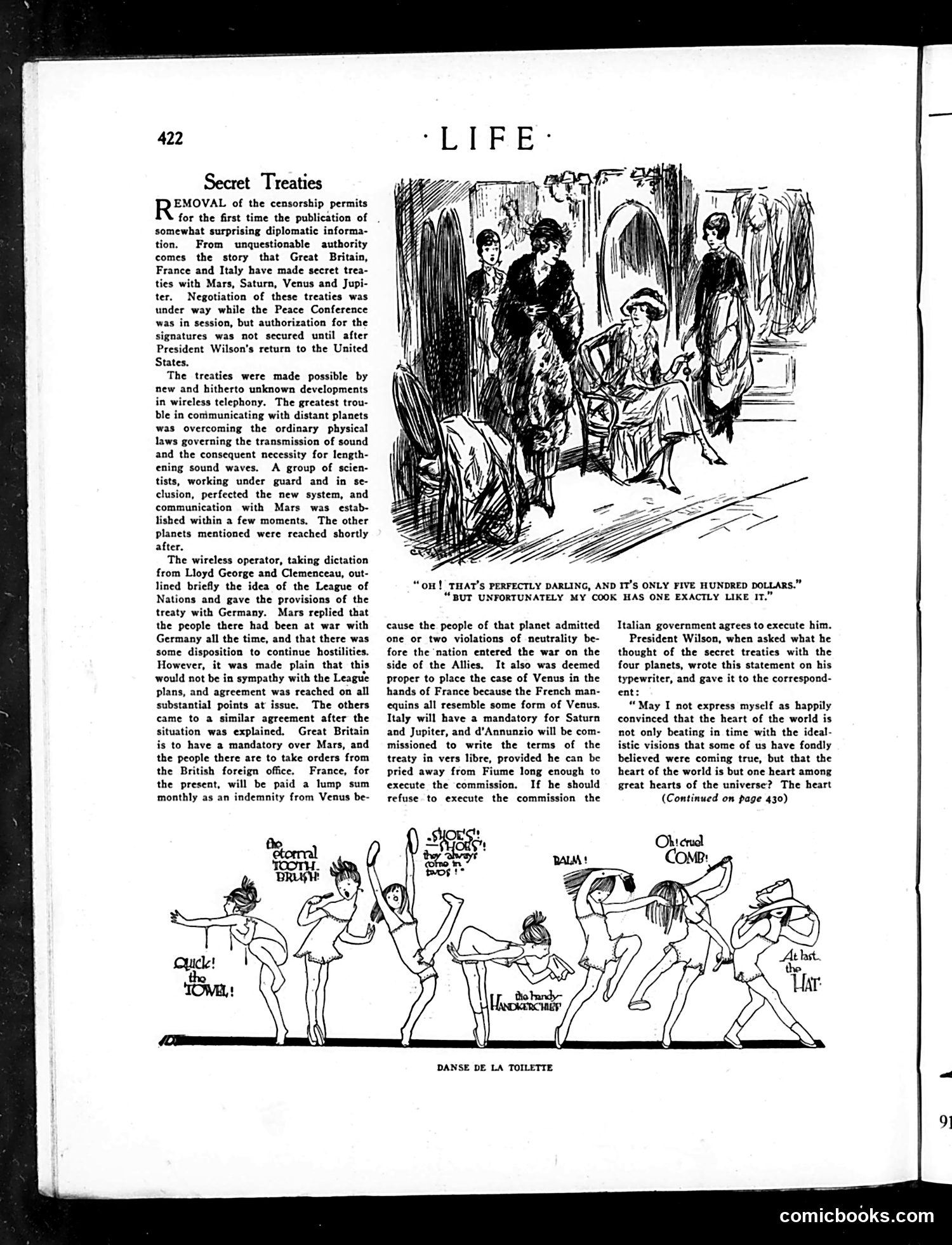
This article satirizes post-WWI diplomatic negotiations, particularly the 1919 Paris Peace Conference. The joke imagines that British, French, and Italian leaders (Lloyd George, Clemenceau, and implicitly Italian officials) have negotiated treaties with planets—a absurd exaggeration mocking the era's complex secret diplomacy and territorial mandates. The satire targets: 1. **League of Nations idealism** versus realpolitik (Mars demands continued war; planets admit neutrality violations) 2. **Imperial mandates** (Britain controls Mars; France gets Venus; Italy gets Saturn/Jupiter) 3. **Gabriele d'Annunzio**, the Italian poet-nationalist obsessed with Fiume, portrayed as more concerned with poetry than diplomacy 4. **Wilson's verbose, flowery rhetoric** (the concluding quote mocking his grandiose language) The bottom illustration, "Danse de la Toilette," is a separate fashion/society commentary, not related to the main article. The satire exploits the absurdity of interplanetary treaties to critique actual treaty-making's illogic and the gap between idealistic League principles and cynical power politics.
📄 Transcribed text from this page (OCR, searchable)
Machine-transcribed from the original scan — historical spelling and the odd misread are preserved.
Secret Treaties EMOVAL of the censorship permits for the first time the publication of | somewhat surprising diplomatic informa- tion. From unquestionable authority comes the story that Great Britain, France and Italy have made secret trea- ties with Mars, Saturn, Venus and Jupi- ter. Negotiation of these treaties was under way while the Peace Conference was in session, but authorization for the signatures was not secured until after President Wilson's return to the United States. The treaties were made possible by new and hitherto unknown developments in wireless telephony. The greatest trou- ble in conimunicating with distant planets was overcoming the ordinary physical laws governing the transmission of sound and the consequent necessity for length- ening sound waves. A group of scien- tists, working under guard and in se- clusion, perfected the new system, and communication with Mars was estab- lished within a few moments. The other planets mentioned were reached shortly after. The wireless operator, taking dictation from Lloyd George and Clemenceau, out- lined briefly the idea of the League of Nations and gave the provisions of the treaty with Germany. Mars replied that the people there had been at war with Germany all the time, and that there was some disposition to continue hostilities. However, it was made plain that this would not be in sympathy with the League plans, and agreement was reached on all substantial points at issue. The others came to a similar agreement after the situation was explained. Great Britain is to have a mandatory over Mars, and the people there are to take orders from the British foreign office. France, for the present, will be paid a lump sum monthly as an indemnity from Venus be- “on! THAT'S PERFECTLY DARLING, AND IT’S ONLY FIVE HUNDRED DOLLARS.” “BUT UNFORTUNATELY MY COOK HAS ONE EXACTLY LIKE IT.” cause the people of that planet admitted one or two violations of neutrality be- fore the ‘nation entered the war on the side of the Allies. It also was deemed proper to place the case of Venus in the hands of France because the French man- equins all resemble some form of Venus. Italy will have a mandatory for Saturn and Jupiter, and d’Annunzio will be com- missioned to write the terms of the treaty in vers libre, provided he can be pried away from Fiume long enough to execute the commission. If he should refuse to execute the commission the DANSE DE LA TOILETTE Italian government agrees to execute him. President Wilson, when asked what he thought of the secret treaties with the four planets, wrote this statement on his typewriter, and gave it to the correspond- ent: “May I not express myself as happily convinced that the heart of the world is not only beating in time with the ideal- istic visions that some of us have fondly believed were coming true, but that the heart of the world is but one heart among great hearts of the universe? The heart (Continued on page 430) comicbooks.com