
Life, 1920-03-04 · page 30 of 78
Life — March 4, 1920 — page 30: what you’re looking at
What you’re looking at
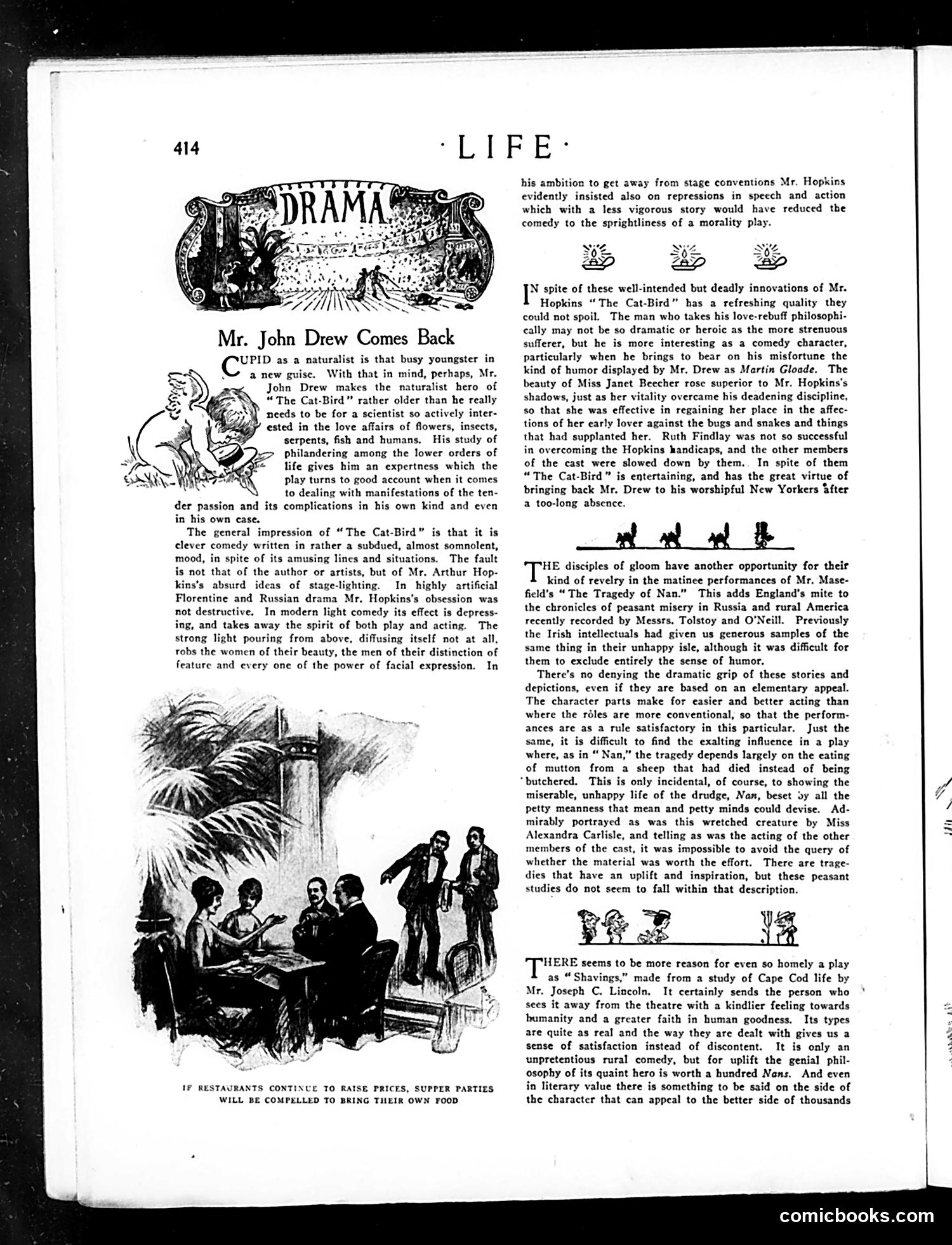
This page reviews stage productions, primarily **"The Cat-Bird,"** starring **John Drew**, a prominent American actor of the era. The text praises Drew's naturalist character and comedic timing, particularly his philosophical approach to romantic disappointment, which makes for more interesting comedy than overwrought suffering. The review **criticizes director Arthur Hopkins's lighting choices**—harsh overhead illumination that flattens actors' features and dampens the play's vitality. Despite these "deadly innovations," the production succeeds due to strong performances by Drew and actress Janet Beecher, who overcome the lighting's deadening effects. The page also mentions **Masefield's "The Tragedy of Nan,"** lumping it with gloomy European peasant dramas (Tolstoy, O'Neill) that, while dramatically gripping, offer little uplift. The cartoon at bottom mocks **restaurant price inflation**, suggesting supper parties will soon need to bring their own food—a satirical jab at wartime or post-war economic conditions.
📄 Transcribed text from this page (OCR, searchable)
Machine-transcribed from the original scan — historical spelling and the odd misread are preserved.
Mr. John Drew Comes Back corp as a naturalist is that busy youngster in a new guise. With that in mind, perhaps, Mr. John Drew makes the naturalist hero of “The Cat-Bird” rather older than he really needs to be for a scientist so actively inter- ested in the love affairs of flowers, insects, serpents, fish and humans. His study of Philandering among the lower orders of life gives him an expertness which the play turns to good account when it comes to dealing with manifestations of the ten- der passion and its complications in his own kind and even in his own case. The general impression of “The Cat-Bird” is that it is clever comedy written in rather a subdued, almost somnolent, mood, in spite of its amusing lines and situations. The fault is not that of the author or artists, but of Mr. Arthur Hop- kins’s absurd ideas of stage-lighting. In highly artificial Florentine and Russian drama Mr. Hopkins’s obsession was not destructive. In modern light comedy its effect is depress- ing, and takes away the spirit of both play and acting. The strong light pouring from above, diffusing itself not at all, robs the women of their beauty, the men of their distinction of feature and every one of the power of facial expression. In IP RESTAURANTS CONTINUE TO RAISE PRICES, SUPPER PARTIES WILL BE COMPELLED TO BRING THEIR OWN FOOD his ambition to get away from stage conventions Mr. Hopkins evidently insisted also on repressions in speech and action which with a less vigorous story would have reduced the comedy to the sprightliness of a morality play. ‘“ x vy ap = N spite of these well-intended but deadly innovations of Mr. Hopkins “The Cat-Bird” has a refreshing quality they could not spoil. The man who takes his love-rebuff philosophi- cally may not be so dramatic or heroic as the more strenuous sufferer, but he is more interesting as a comedy character, particularly when he brings to bear on his misfortune the kind of humor displayed by Mr. Drew as Martin Gloade. The beauty of Miss Janet Beecher rose superior to Mr. Hopkins’s shadows, just as her vitality overcame his deadening discipline, so that she was effective in regaining her place in the affec- tions of her early lover against the bugs and snakes and things that had supplanted her. Ruth Findlay was not so successful in overcoming the Hopkins handicaps, and the other members of the cast were slowed down by them. In spite of them “The Cat-Bird” is entertaining, and has the great virtue of bringing back Mr. Drew to his worshipful New Yorkers after a too-long absence. — A a if HE disciples of gloom have another opportunity for their kind of revelry in the matinee performances of Mr. Mase- ficld’s “ The Tragedy of Nan.” This adds England's mite to the chronicles of peasant misery in Russia and rural America recently recorded by Messrs. Tolstoy and O'Neill. Previously the Irish intellectuals had given us generous samples of the same thing in their unhappy isle, although it was difficult for them to exclude entirely the sense of humor. There's no denying the dramatic grip of these stories and depictions, even if they are based on an elementary appeal. The character parts make for easier and better acting than where the réles are more conventional, so that the perform- ances are as a rule satisfactory in this particular. Just the same, it is difficult to find the exalting influence in a play where, as in “ Nan,” the tragedy depends largely on the eating of mutton from a sheep that had died instead of being “butchered. This is only incidental, of course, to showing the miserable, unhappy life of the drudge, Nan, beset dy all the petty meanness that mean and petty minds could devise. Ad- mirably portrayed as was this wretched creature by Miss Alexandra Carlisle, and telling as was the acting of the other members of the cast, it was impossible to avoid the query of whether the material was worth the effort. There are trage- dies that have an uplift and inspiration, but these peasant studies do not seem to fall within that description. HERE seems to be more reason for even so homely a play as “Shavings,” made from a study of Cape Cod life by Mr. Joseph C. Lincoln. It certainly sends the person who sees it away from the theatre with a kindlier feeling towards humanity and a greater faith in human goodness. Its types are quite as real and the way they are dealt with gives us a sense of satisfaction instead of discontent. It is only an unpretentious rural comedy, but for uplift the genial phil- osophy of its quaint hero is worth a hundred Nans. And even in literary value there is something to be said on the side of the character that can appeal to the better side of thousands comicbooks.com