
Life, 1920-03-04 · page 35 of 78
Life — March 4, 1920 — page 35: what you’re looking at
What you’re looking at
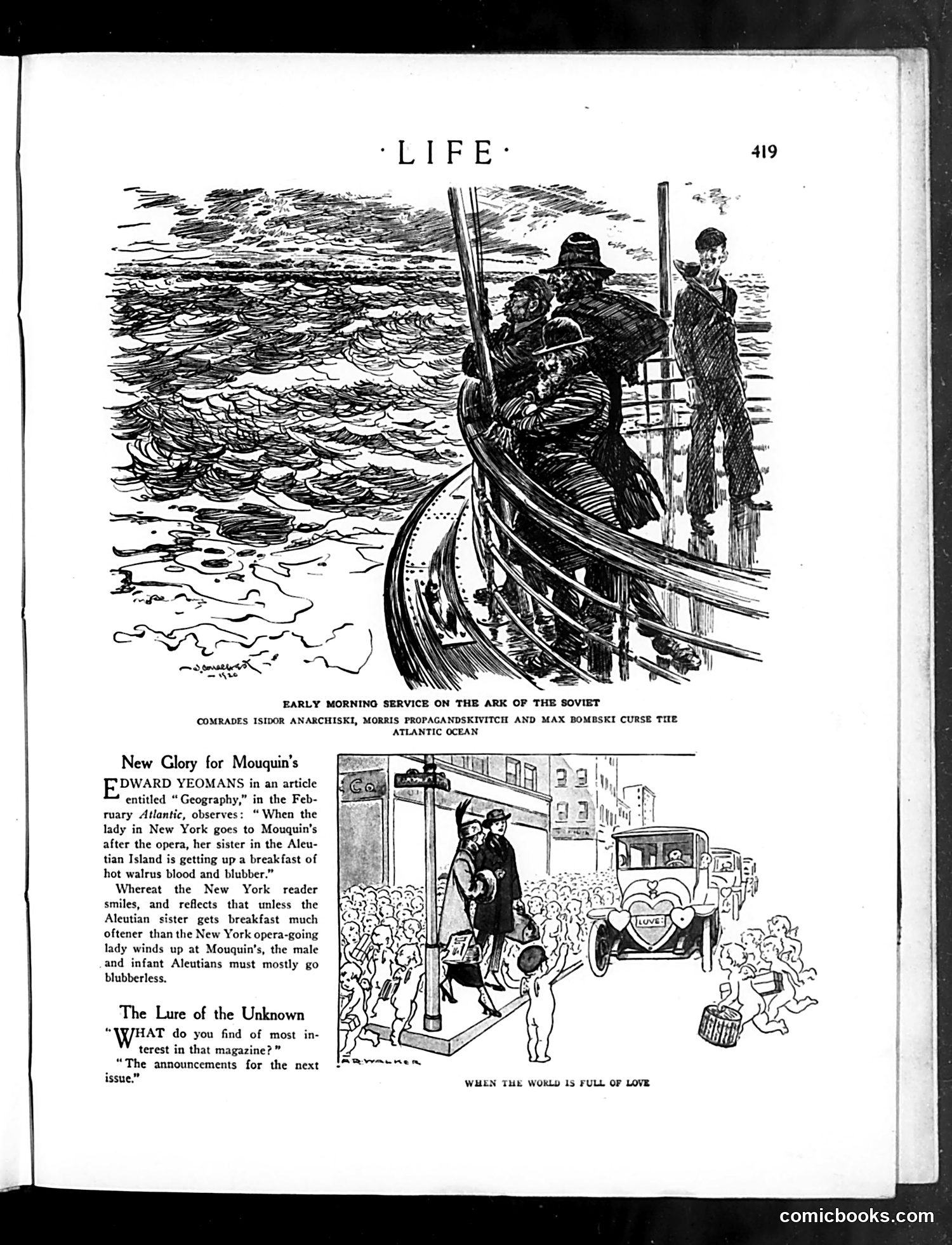
The top cartoon mocks Soviet communists through ethnic stereotyping. Three caricatured figures with exaggerated "Russian" surnames (Anarchiski, Propagandskivitch, Bombski) stand on a ship, cursing the Atlantic Ocean. This satirizes early 20th-century American anxieties about Bolshevik revolutionaries and communist propaganda, portraying them as foreign, incompetent, and absurdly antagonistic—even to natural obstacles. The "New Glory for Mouquin's" section humorously contrasts wealthy New York opera-goers dining at the upscale Mouquin's restaurant with Aleutian Islanders eating walrus blood. The joke critiques the absurdity of such geographic inequalities. The bottom cartoon ("When the World Is Full of Love") depicts a flapper-era couple amid urban chaos—a satirical commentary on romance amid modernity's chaos. The magazine's satirical tone targets both communist fears and contemporary social pretensions.
📄 Transcribed text from this page (OCR, searchable)
Machine-transcribed from the original scan — historical spelling and the odd misread are preserved.
EARLY MORNING SERVICE ON THE ARK OF THE SOVIET COMRADES ISIDOR ANARCHISKI, MORRIS PROPAGANDSKIVITCH AND MAX BOMBSKI CURSE THE ATLANTIC OCEAN New Glory for Mouquin’s DWARD YEOMANS in an article entitled “ Geography,” in the Feb- ruary Atlantic, observes: “When the lady in New York goes to Mouquin’s after the opera, her sister in the Aleu- tian Island is getting up a breakfast of hot walrus blood and blubber.” Whereat the New York reader smiles, and reflects that unless the Aleutian sister gets breakfast much oftener than the New York opera-going lady winds up at Mouquin’s, the male and infant Aleutians must mostly go blubberless. The Lure of the Unknown AT do you find of most in- terest in that magazine?” “The announcements for the next issue.” WHEN THE WORLD 15 FULL OF LOVE comicbooks.com