
Life, 1920-03-04 · page 51 of 78
Life — March 4, 1920 — page 51: what you’re looking at
What you’re looking at
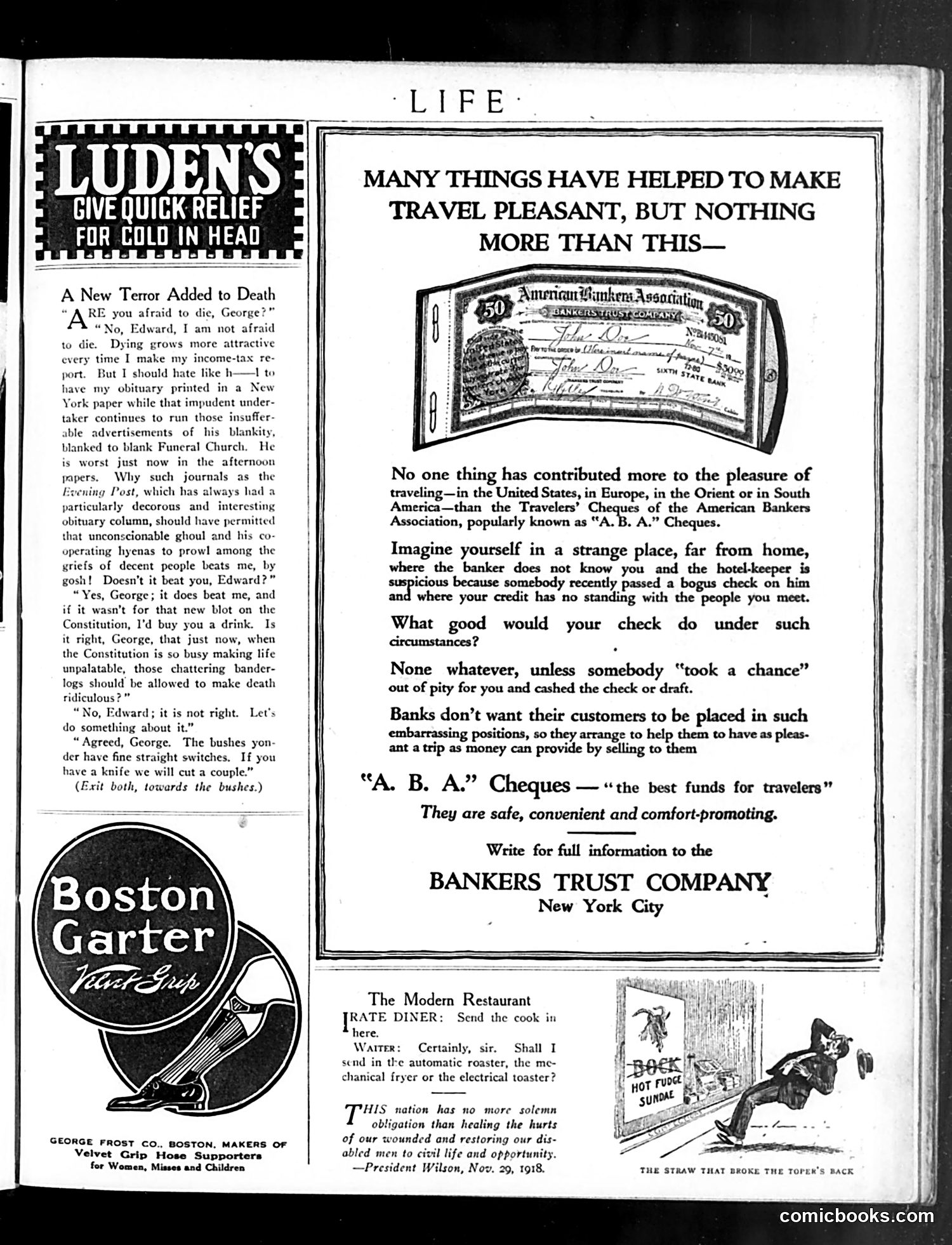
**Main Cartoon ("A New Terror Added to Death"):** Two men, George and Edward, discuss their fears. Edward complains that while he's not afraid of dying, he's horrified that funeral home advertisements now appear in newspaper obituary columns—desecrating what was once a dignified section. The satire mocks both aggressive advertising practices and the absurdity of fearing embarrassing publicity more than death itself. This likely reflects 1910s-1920s anxieties about commercialism invading traditionally sacred spaces. **Advertisements:** The page is dominated by ads for travelers' cheques and other products, with a small illustration showing a man breaking under strain ("The Straw That Broke the Tower's Back")—likely referencing war-disabled veterans or workplace stress. **Context:** The quote from President Wilson about caring for disabled soldiers appears near the bottom, suggesting the page dates to late 1918 or after, during WWI's conclusion. The cartoons reflect contemporary American concerns: commercialization, dignity, and social obligation.
📄 Transcribed text from this page (OCR, searchable)
Machine-transcribed from the original scan — historical spelling and the odd misread are preserved.
MANY THINGS HAVE HELPED TO MAKE TRAVEL PLEASANT, BUT NOTHING LUDENS GIVE QUICK RELIEF OR OLD IN HEAD A New Terror Added to Death “ A RE you afraid to die, George No, Edward, I am not afraid to die. Dying grows more attractive every time I make my income-tax re- port. But I should hate like h——I to have my obituary printed in a New York paper while that impudent under- taker continues to run those insuffer- able advertisements of his blankity, blanked to blank Funeral Church. He is worst just now in the afternoon papers. Why such journals as the ing Post, which has always had a particularly decorous and_ interesting obituary column, should have permitted that unconscionable ghoul and his co- operating hyenas to prowl among the No one thing has contributed more to the pleasure of traveling —in the United States, in Europe, in the Orient or in South America—than the Travelers’ Cheques of the American Bankers Association, popularly known as “A. B. A.” Cheques. Imagine yourself in a strange place, far from home, griefs of decent people beats me, by gosh! Doesn't it beat you, Edward?” “Yes, George; it does beat me, and if it wasn’t for that new blot on the Constitution, I'd buy you a drink. Is it right, George, that just now, when the Constitution is so busy making life unpalatable, those chattering bander- logs should be allowed to make death ridiculous?” “No, Edward; it is not right. Let's do something about it.” “Agreed, George. The bushes yon- der have fine straight switches. If you have a knife we will cut a couple.” (Exit both, towards the bushes.) GEORGE FROST CO.. BOSTON, MAKERS OF Velvet Grip Hose Supporters for Women, Misses and Children where the banker does not know you and the hotel-keeper is eupcos because somebody recently passed a bogus check on him where your credit has no standing with the people you meet. What good would your check do under such circumstances? None whatever, unless somebody “took a chance” out of pity for you and cashed the check or draft. Banks don’t want their customers to be placed in such embarrassing positions, so they arrange to help them to have as pleas- ant a trip as money can provide by selling to chem “A, B. A.” Cheques — ‘the best funds for travelers” They are safe, convenient and comfort-promoting. Write for full information to the BANKERS TRUST COMPANY New York City The Modern Restaurant RATE DINER: Send the cook in here. Wart: Certainly, sir. Shall I send in the automatic roaster, the me- chanical fryer or the electrical toaster? HIS nation has no more solemn obligation than healing the hurts of our wounded and restoring our dis- abled men to civil life and opportunity. —President Wilson, Nov. 29, 1918. THE STRAW THAT BROKE THE TOrER'S BACK comicbooks:com